
Factories Act 1948: Applicability, Rules & Compliance 2026
Download Factories Act 1948 PDF

Table of Contents

The Factories Act, 1948, was India’s main law for factory safety, worker health, welfare facilities, working hours, and annual leave. It placed legal duties on factory occupiers, managers, and employers.
India’s factory law framework changed on 21 November 2025. The Occupational Safety, Health and Working Conditions Code, 2020, also called the OSH Code, replaced the Factories Act and 12 other central labour laws.
Employers should no longer rely on the old Factories Act as their sole compliance reference. They must understand what the old law provided, what changed under the OSH Code, and which central or state rules now apply.
The OSH Code is one of India’s four new Labour Codes. Employers can read factoHR’s guide to new labour laws in India to understand how they connect with wage, social security, and industrial relations reforms.

What was the Factories Act, 1948?
The Factories Act, 1948, was a central law that regulated worker health, safety, welfare, working hours, and annual leave in Indian factories. Historically, it covered factories with 10 or more workers using power, or 20 or more workers without power. The OSH Code replaced the Act on 21 November 2025.
The Act aimed to protect factory workers from unsafe working conditions, industrial accidents, long working hours, and health risks.
Is the Factories Act, 1948, Still Applicable in 2026?
The Factories Act, 1948, is no longer the primary law governing factory health, safety, and working conditions. It was repealed and consolidated into the Occupational Safety, Health and Working Conditions Code, 2020, effective from 21 November 2025.
However, the old Act can still matter for:
- Violations committed before 21 November 2025
- Old licenses, registrations and statutory records
- Pending cases and investigations
- Duties or liabilities that arose under the prior law
- Existing rules or procedures saved during the transition
- Understanding court decisions made under the old Act
Employers must check the OSH Code, current government notifications, and applicable state rules before making a compliance decision.
Factories Act vs OSH Code: What Changed?
| Compliance point | Factories Act, 1948 | OSH Code, 2020 |
|---|---|---|
| Legal status | Repealed and consolidated | Current central framework |
| Effective transition date | Applied before the new Codes | Effective from 21 November 2025 |
| Factory using power | Historically, 10 or more workers | Generally 20 or more workers |
| Factory without power | Historically, 20 or more workers | Generally 40 or more workers |
| Daily working hours | Generally 9 hours | Generally eight hours |
| Weekly working hours | Generally 48 hours | Governed by the Code and applicable rules |
| Overtime | Twice the ordinary rate | Twice the rate of wages |
| Annual leave qualification | 240 days | Generally 180 days |
| Inspection authority | Inspector | Inspector-cum-Facilitator |
| Women on night shifts | Restricted, subject to state changes | Allowed with consent and prescribed safeguards |
| Registration | Factory registration and license | Common registration framework |
| Records | Multiple registers and notices | Common or electronic records where prescribed |
The official OSH Code provides the current central legal framework. Employers must also check the rules issued by the appropriate government.
Does the OSH Code Apply to Your Factory?
Employers can use the following questions for an initial coverage check.
1. Is a Manufacturing Process Carried on?
A factory does not always have to manufacture a finished product. A manufacturing process can include:
- Making or altering an article
- Repairing or finishing a product
- Packing, washing, or cleaning goods
- Generating or transmitting power
- Pumping oil, water, or sewage
- Printing and bookbinding
- Cold storage
- Constructing or repairing ships
For example, premises that treat, clean, and pack goods may carry on a manufacturing process even if the goods were produced elsewhere.
2. Does the Manufacturing Process Use Power?
The worker threshold differs based on whether power is used.
Under the historical Factories Act:
- 10 or more workers where power was used
- 20 or more workers where power was not used
Under the OSH Code’s general factory definition:
- 20 or more workers where power is used
- 40 or more workers where power is not used
Employers should verify whether a state amendment or government notification changes the threshold for their factory.
3. How Many Workers are Employed?
Employers should not count only permanent employees. Depending on the legal conditions, the count may include people:
- Employed directly
- Engaged through contractors
- Working temporarily or casually
- Cleaning production machinery
- Performing work connected with manufacturing
The actual work a person performs is more important than their job title when deciding whether they are covered as a worker.
4. Are the Premises Excluded?
The historical Factories Act excluded certain premises, such as:
- Mines
- Railway running sheds
- Mobile units of the armed forces
- Hotels
- Restaurants
- Eating places
A separate legal framework may apply to these premises.
5. Which Government Authority Applies?
The appropriate government may be the Central Government or the State Government, depending on the establishment.
This decides which requirements apply to:
- Registration
- Licenses
- Forms
- Working-hour permissions
- Welfare facilities
- Accident reporting
- Inspections
- Returns
- Record formats
Identifying the correct government is part of a wider compliance process. HR teams can use this statutory compliance guide to understand how central and state employment requirements affect workforce and payroll records.
6. Has the State Notified Its OSH Rules?
Operational requirements can differ by state.
A factory in Gujarat may not use the same forms, portal, or procedures as a factory in Karnataka, Maharashtra, Rajasthan, or Telangana.
Employers should check the latest notification issued by the relevant State Labour Department or Directorate of Industrial Safety and Health.

Important Definitions under Factory Law
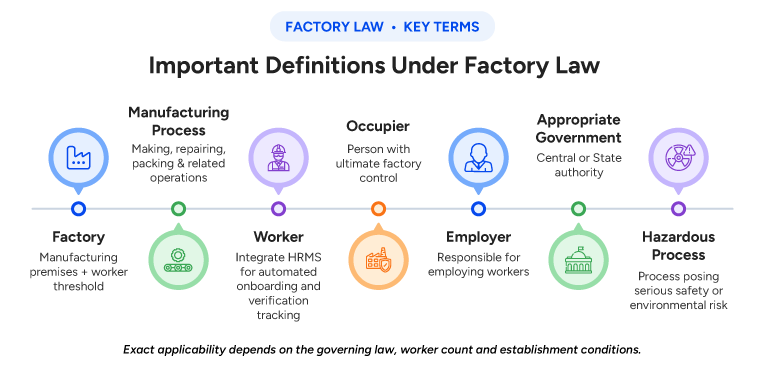
Factory
A factory generally refers to premises where a manufacturing process is carried on, and the applicable worker threshold is met.
The power condition and the number of workers must both be checked correctly.
Manufacturing Process
A manufacturing process includes making, altering, repairing, finishing, packing, cleaning, printing, pumping, power generation, and cold storage activities covered by the law.
Worker
A worker is generally a person employed in a manufacturing process or work connected with it.
Depending on the facts, the definition can include:
- Permanent workers
- Temporary workers
- Casual workers
- Certain contractor workers
- People cleaning machinery or production areas
Employer
An employer is the person or organization responsible for employing workers and meeting applicable workplace duties.
Occupier
Under the Factories Act, the occupier was the person with ultimate control over the operational matters of the factory
In a company, one of the directors was generally named as the occupier. Appointing a factory manager did not remove all of the occupier’s legal responsibilities.
Appropriate Government
The appropriate government is the Central or State Government authorized to administer the law for a particular establishment.
Hazardous Process
A hazardous process is an industrial process that may seriously harm workers or the environment when proper safety controls are not followed.
It may involve toxic chemicals, dangerous gases, combustible dust, high heat, or other harmful substances.
Recent Court Rulings You Should Know
State of Goa v. Namita Tripathi (2025)
The Supreme Court held that washing, cleaning, and dry-cleaning clothes using power-operated machines are a “manufacturing process” under the Factories Act, 1948. Therefore, a commercial laundry may qualify as a factory when the required worker and power conditions are met. The Court clarified that a process need not create a completely new product to be treated as manufacturing.
Although the Factories Act has now been replaced by the OSH Code, this judgment remains relevant to earlier disputes and explains how courts interpret the meaning of “manufacturing process.”
Case summary: State of Goa v. Namita Tripathi, 2025 INSC 306 Full judgment: Supreme Court judgment
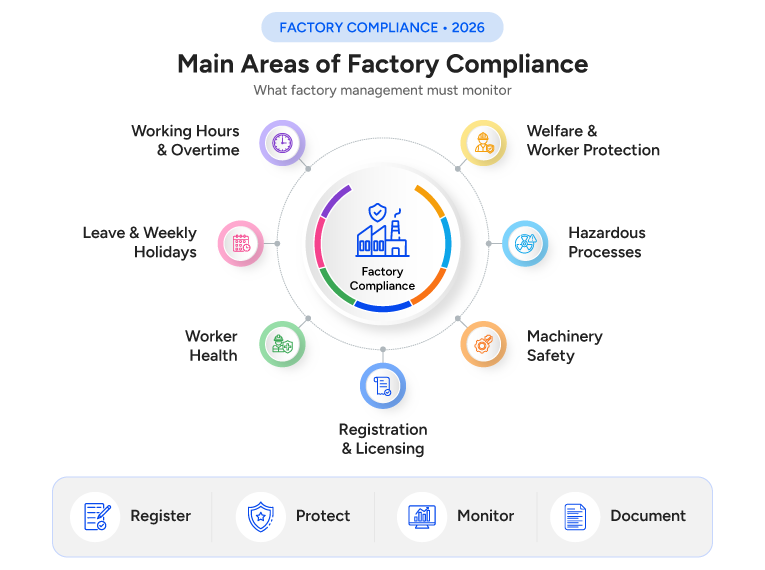
Main Areas of Factory Compliance
1. Registration, License and Notice
Under the historical Factories Act, factories generally required approval, registration, and a license under applicable state rules.
A registration or license application commonly includes:
- Factory name and location
- Occupier details
- Manager details
- Nature of the manufacturing process
- Number of workers
- Installed power
- Machinery details
- Factory building plan
- Safety information
The OSH Code introduces a common registration framework for covered establishments. It also provides for electronic notice of commencement or cessation for specified operations.
Factory management should verify:
- Whether registration is required
- Whether a separate license is needed
- Which government portal must be used
- Whether an existing registration continues
- Whether a change in occupier must be reported
- Whether factory expansion requires fresh approval
- Which notice must be filed before starting operations
An employer should not continue using an old form only because it was used in previous years.
2. Worker Health Standards
Factories must protect workers from conditions that may harm their health.
Cleanliness
Factory floors, walls, workrooms, and passages maintained in a clean and sanitary state. Waste should not be allowed to accumulate in working areas.
Waste and Effluent Disposal
Factories must safely treat and dispose of wastewater, chemicals, and manufacturing waste.
Ventilation and Temperature
Workrooms need proper airflow. Excessive heat and humidity must be controlled where they can harm workers.
Dust and Fumes
Factories must control exposure to harmful dust, fumes, smoke, gases, and vapor. Exhaust systems may be required where workers face direct exposure.
Overcrowding
Workers should have enough space to carry out their duties safely. Overcrowding can increase the risks of heat exposure and accidents.
Lighting
Natural or artificial lighting should be suitable for the work. Dangerous glare, shadows, and poorly lit machine areas should be avoided.
Drinking Water
Factories must provide safe drinking water at suitable locations. Drinking-water points should be protected from contamination.
Toilets and Sanitation
Factories must provide properly maintained sanitation facilities. Separate facilities may be required for male and female workers.
Medical Examinations
Workers involved in certain dangerous or hazardous processes may require:
- Pre-employment medical checks
- Periodic health examinations
- Fitness certificates
- Exposure monitoring
- Occupational health records
The frequency and required form depend on the work and applicable rules.

3. Machinery and Workplace Safety
Factories must identify and control risks created by machinery, equipment, and workplace conditions.
Machinery Guards
Dangerous moving parts must be properly guarded. Guards should not be removed during normal machine operation.
Maintenance near Moving Machinery
Only trained and authorized workers should inspect, adjust, or maintain machinery while it is moving.
Young Workers and Dangerous Machinery
Young workers should not operate dangerous machines without the required training, fitness certification, and supervision.
Lifting Equipment
Hoists, lifts, cranes, chains, ropes, and other lifting equipment must be tested, inspected, and maintained.
Pressure Plants
Boilers, pressure vessels, and other pressure equipment must operate within safe limits.
Floors, Stairs and Passages
Floors and access routes should be stable, clear, and properly maintained. Workers must have safe access when working at height.
Confined Spaces
Workers should not enter tanks, pits, or other confined spaces until the atmosphere has been tested and safety precautions are completed.
Fire and Emergency Safety
Factories should maintain:
- Emergency exits
- Firefighting equipment
- Evacuation routes
- Alarm systems
- Emergency lighting
- Worker training
- Regular emergency drills
Providing safety equipment without training workers is not enough.
4. Hazardous Processes and Emergency Planning
Factories carrying out hazardous processes have greater responsibilities.
Management should:
- Identify chemical and process risks
- Inform workers about the risks
- Provide safety instructions
- Provide suitable protective equipment
- Monitor worker exposure
- Conduct required medical examinations
- Prepare an emergency plan
- Maintain occupational health records
- Form a safety committee where required
- Report specified dangerous occurrences
- Coordinate with emergency authorities
Workers should have a clear method to report immediate danger.
Practical Example
A worker notices a strong chemical smell near a storage tank. The worker should be able to leave the unsafe area, warn others, and report the danger immediately.
The employer should then:
- Isolate the area.
- Stop the leak where it is safe to do so.
- Arrange medical assistance if needed.
- Examine the source.
- Inform the prescribed authority where required.
- Record the event.
- Correct the cause before restarting work.
5. Working Hours, Shifts and Overtime
Working-hour rules protect employees from excessive work and fatigue.
Under the historical Factories Act:
- Weekly work was generally limited to 48 hours.
- Daily work was generally limited to nine hours.
- Workers required a weekly holiday.
- A rest interval was generally required after five hours.
- Overlapping shifts were restricted.
- Double employment in factories was restricted.
- Overtime was paid at twice the ordinary rate.
Under the OSH Code, daily work is generally limited to eight hours. Weekly limits, rest intervals, spread-over, and exceptions must be checked under the Code and applicable rules.
HR teams should compare scheduled shifts with actual punch records before closing attendance. factoHR’s working hours calculator can help calculate total working time, breaks, and extra hours for an initial review.
Practical Shift Example
A factory schedules a worker from 8 a.m. to 6 p.m. with a one-hour lunch break.
The lunch break does not automatically make the shift compliant. HR must check:
- Actual working hours
- Rest intervals
- Permitted spread-over
- Overtime consent
- Weekly limits
- State-specific permissions
- Overtime payment
Attendance data should show regular hours and overtime separately.
How is Factory Overtime Paid?
The OSH Code provides overtime pay at double the ordinary rate of wages, subject to applicable statutory conditions.
The overtime rate alone is not enough to calculate the final amount. HR must also identify:
- Applicable wage base
- Number of extra hours
- Daily or weekly threshold
- Worker consent
- Maximum overtime limit
- Applicable state rule
See the detailed overtime calculation guide for the formula, examples, and related provisions.
6. Annual Leave and Weekly Holidays
Under the historical Factories Act, an adult worker generally qualified for annual leave after working for at least 240 days in a calendar year.
The general leave-earning formula was:
- One day for every 20 days worked by an adult
- One day for every 15 days worked by a child
The OSH Code generally reduces the qualifying requirement to 180 days. An eligible adult worker normally earns one day of leave for every 20 days worked.
Leave Calculation Example
Suppose a worker works 220 days in 2026.
Under the historical 240-day rule, the worker might not have met the normal qualification. Under the OSH Code’s general 180-day requirement, the worker may qualify, subject to the applicable rules and method of counting qualifying days.
HR teams should review:
- Qualifying working days
- Leave earned
- Leave used
- Carry-forward balance
- Refused leave
- Leave wages
- Payment when employment ends
- State-specific requirements
Factory leave is one part of India’s leave framework. Different rules can apply to offices, shops, and other establishments. HR teams can review the broader leave laws in India before creating a common policy across different locations.
A company can provide leave above the legal minimum, but it should not provide less than the applicable requirement.

7. Welfare and Worker Protection
The historical Factories Act contained worker-number-based welfare requirements.
First-Aid Facilities
At least one first-aid box was generally required for every 150 workers. It had to remain under the charge of a trained person.
Canteen
Factories employing more than 250 workers could be required to provide a canteen.
Restrooms and Lunchrooms
Factories employing more than 150 workers generally had to provide suitable shelters, restrooms, or lunchrooms.
Crèche
Factories employing more than 30 women workers generally had to provide a suitable room for children below six years of age.
Welfare Officer
Factories employing 500 or more workers generally had to appoint welfare officers.
Safety Officer
A safety officer was generally required in factories with 1,000 or more workers or where the government directed the factory to appoint one because of its risk level.
These figures belong to the historical Factories Act framework. Employers should not incorporate these historical thresholds into current company policies without verifying updated requirements under the OSH Code and state-specific rules.
Can Women Work Night Shifts in Factories?
Yes. The OSH Code allows women to work in all establishments and types of work.
Women may work before 6 a.m. or after 7 p.m. when:
- The female employee provides explicit, written consent for a night shift.
- The employer follows prescribed safety conditions.
- Suitable transport is arranged where required.
- Workplace security is provided.
- Lighting and surveillance requirements are followed.
- Rest intervals and weekly holidays are provided.
- Sexual harassment prevention requirements are followed.
- Applicable state conditions are met.
Consent must be given freely. An employer should not force a woman to accept night work as a condition for continuing employment.
Roles and Responsibilities in a Factory
Employer
The employer must provide a workplace free of hazards likely to cause injury or occupational disease.
Occupier
The occupier holds ultimate control over factory affairs and carries important factory-level responsibilities.
Factory Manager
The factory manager handles daily implementation, worker supervision, records, and compliance procedures.
Safety Officer
The safety officer identifies risks, investigates incidents, and monitors safety controls.
HR Team
The HR team usually maintains:
- Employee records
- Attendance
- Shift schedules
- Overtime
- Weekly holidays
- Leave
- Training records
- Payroll inputs
Supervisor
The supervisor ensures that workers follow safe operating procedures on the shop floor.
Worker
Workers must follow safety instructions, use protective equipment, and report dangerous conditions.
Contractor
A contractor must protect contract workers and maintain the required records.
Principal Employer
The principal employer must monitor contractor compliance where the law places responsibility on the principal employer.
Delegating specific operational tasks to an individual does not absolve other statutory duty-holders (such as the Occupier or Factory Manager) of their legal obligations under the OSH Code.

Records HR and Factory Management Should Maintain
The exact forms and retention periods can differ by state. Common factory records include:
- Worker register
- Attendance or muster roll
- Shift schedule
- Notice of work periods
- Overtime register
- Weekly holiday record
- Compensatory holiday record
- Annual leave register
- Wage and deduction records
- Young-worker fitness records
- Medical examination records
- Safety-training register
- Accident register
- Dangerous-occurrence reports
- Machinery inspection certificates
- Equipment-testing records
- Contractor-worker records
- Registration and license documents
- Inspection reports
- Corrective-action records
Attendance, shift, and overtime records should show the same working hours. If these records do not match, payroll and inspection documents may also become incorrect.
This guide explains how to track employee attendance effectively without relying only on manual registers.
What Should an Employer do after a Factory Accident?
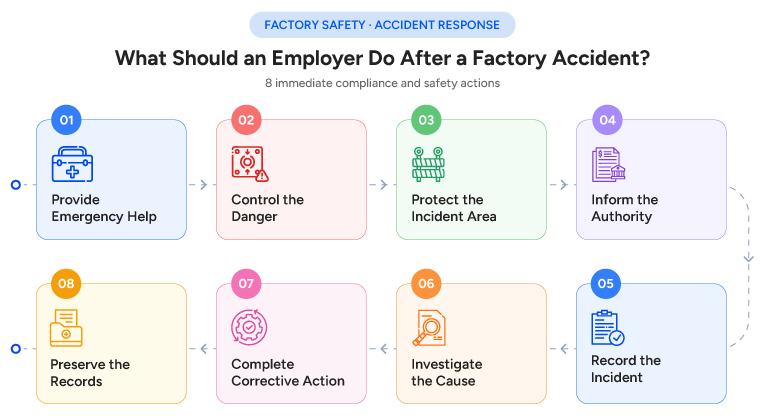
Step 1: Provide Emergency Help
Arrange first aid, medical treatment, and emergency rescue immediately.
Step 2: Control the Danger
Stop the machine or process where it is safe to do so. Prevent other workers from entering the dangerous area.
Step 3: Protect the Incident Area
Do not disturb important evidence unless required to rescue a person or prevent further harm.
Step 4: Inform the Prescribed Authority
Report the accident or dangerous occurrence within the required time and format.
Step 5: Record the Incident
Document:
- Date and time
- Location
- People involved
- Nature of injury
- Work being performed
- Equipment involved
- Witnesses
- Immediate action taken
Step 6: Investigate the Cause
Investigations should evaluate root causes rather than referring incidents solely to ‘operator error.’
Examine:
- Training
- Supervision
- Machine guarding
- Maintenance
- Workload
- Shift fatigue
- Safety procedure
- Protective equipment
Step 7: Complete Corrective Action
Repair the equipment, update the process, and retrain workers where required.
Step 8: Preserve the Records
Keep the incident report, photographs, witness statements, medical information, and evidence of corrective action.
Penalties under the Old and New Framework
Penalties under the Historical Factories Act
Under Section 92 of the Factories Act, a general violation could result in:
- Imprisonment for up to two years
- A fine of up to ₹100,000.
- Both imprisonment and fine
- Additional consequences for a continuing offense
Different penalties are applied to repeat offenses, obstruction, false certificates, and hazardous-process violations.
These were historical Factories Act penalties. They should not be presented as the current penalty for every OSH Code violation.
Penalties under the OSH Code
The OSH Code contains a different penalty framework. The result depends on:
- Which provision was violated
- Whether the violation caused death
- Whether it caused serious bodily injury
- Whether false records were created
- Whether an Inspector-cum-Facilitator was obstructed
- Whether the violation continued
- Whether it was a repeated offense
Serious cases can result in:
- Monetary penalties
- Imprisonment
- Higher repeat-offense penalties
- Additional daily penalties
- Restriction of dangerous operations
- Compensation or liability under other laws
Employers should check the specific OSH Code section and applicable rules before determining the consequences of a violation.
2026 Factory Compliance Checklist
Legal Coverage
- Confirm whether a manufacturing process is carried on.
- Check whether power is used.
- Count direct and contract workers correctly.
- Identify the appropriate government.
- Check current central and state rules.
Registration
- Verify registration and license status.
- Report changes in the occupier or manager.
- Check approval requirements before expansion.
- Submit commencement or cessation notices where applicable.
Working Hours
- Review shift timings.
- Record rest intervals.
- Provide weekly holidays.
- Obtain required overtime consent.
- Calculate overtime correctly.
- Monitor applicable overtime and spread-over limits.
Leave
- Apply the correct qualification threshold.
- Maintain earned and used leave records.
- Track carry-forward balances.
- Pay due wages for leave when employment ends.
Health and Safety
- Conduct risk assessments.
- Guard dangerous machinery.
- Inspect lifting and pressure equipment.
- Control dust, fumes, and chemicals.
- Maintain emergency exits.
- Provide protective equipment.
- Conduct safety training and emergency drills.
Worker Welfare
- Provide clean drinking water.
- Maintain toilets and washing facilities.
- Keep first-aid facilities ready.
- Review canteen, restroom, and crèche requirements.
- Arrange medical examinations where required.
Records and Reporting
- Maintain attendance and overtime records.
- Keep training and inspection records.
- Record accidents and dangerous occurrences.
- Reconcile attendance, overtime, and payroll.
- Complete corrective actions raised during inspections.
Employers should also review whether overtime hours and statutory payments are correctly reflected in payroll. This guide explains how payroll software supports compliance by connecting approved attendance, wage, and overtime information.

How Can factoHR Support Factory HR Records?
Factories often manage rotating shifts, overtime, weekly holidays, contract workers, and multiple plants. Manual attendance sheets can create differences between shift records, overtime registers, and payroll.
An attendance management system can capture employee working hours and connect approved attendance with payroll. factoHR helps HR teams manage shifts, attendance, overtime inputs, leave balances, and employee records through a connected system.
Software does not guarantee legal compliance. Employers must configure the applicable working-hour, overtime, and leave rules and review exceptions before finalizing payroll.
Conclusion
The Factories Act, 1948, created the foundation for factory health, safety, and worker welfare in India. It regulated working hours, machinery safety, annual leave, welfare facilities, and hazardous processes.
The legal framework changed on 21 November 2025 when the OSH Code came into effect. Employers should now review factory coverage, registration, shift timings, leave eligibility, safety systems, and statutory records under the current framework.
The safest approach is to maintain a state-wise compliance checklist. This helps HR, safety officers, and factory managers apply the correct requirements at each location instead of relying on one outdated national checklist.
Frequently Asked Questions
Is the Factories Act, 1948, Still Applicable in India?
The Factories Act, 1948, was repealed and consolidated into the OSH Code, 2020, effective from 21 November 2025.It remains applicable to legacy violations records, and transitional procedures. Current compliance must be checked under the OSH Code and relevant central or state rules.
What Law Replaced the Factories Act, 1948?
The Occupational Safety, Health and Working Conditions Code, 2020, replaced the Factories Act. The OSH Code combines 13 central laws dealing with workplace safety, health, and working conditions.
What is the Factory Threshold under the OSH Code?
The OSH Code’s factory definition generally uses a threshold of 20 workers where power is used and 40 workers where power is not used. Government notifications or state rules may affect the final coverage position.
Why do some Sources Mention 10 and 20 Workers?
The historical Factories Act used 10 workers (with power) and 20 workers (without power). The OSH Code generally changed the factory thresholds to 20 workers (with power) and 40 workers (without power).
Has Annual Leave Eligibility Changed?
Yes. Under the former Factories Act, 1948, workers were required to work at least 240 days in a calendar year to qualify for annual leave. Under the OSH Code, a worker generally qualifies after completing 180 days in a calendar year, subject to detailed conditions and applicable rules.
What is the Overtime Rate for Factory Workers?
The OSH Code provides overtime wages at twice the rate of wages. Employers should also verify the worker’s consent, overtime limits, working-hour records, and applicable wage definition.
Can Women Work Night Shifts in Factories?
Yes. Women can work night shifts with their consent when the employer meets prescribed safety, security, transport, welfare, and working-hour conditions. State-specific conditions must also be checked.
Does Factory Law Determine Minimum Wages?
No. The Factories Act and OSH Code regulate occupational safety and working conditions. Minimum wages are governed by the Code on Wages, 2019, and notifications issued by the appropriate government.
Are Existing Factory Licenses Automatically Canceled?
Employers should not assume that an existing license is automatically canceled or permanently valid. The position depends on the OSH Code, saved procedures, and rules issued by the appropriate government.
Which Records Should HR Maintain for Factory Workers?
HR should maintain worker, attendance, shift, overtime, leave, wage, medical, training, accident, and contractor records as required. The prescribed forms and retention periods can differ across states.
Are Factory Rules the Same in Every State?
No. The OSH Code provides the central framework, but state governments can issue operational rules and notifications. Companies with factories in different states should review each location separately.



Grow your business with factoHR today
Focus on the significant decision-making tasks, transfer all your common repetitive HR tasks to factoHR and see the things falling into their place.