
Top HR Interview Questions and Answers
Table of Contents

HR interviews can be challenging, but with the proper preparation, they become manageable opportunities to showcase communication skills, personality, and cultural fit. Top HR Interview Questions and Answers helps you prepare for your next interview with practical, up-to-date examples. Whether you are a fresher or an experienced professional, being ready for commonly asked questions is crucial to securing your dream job.
This guide covers 20+ of the most common HR interview questions, including tailored answers for freshers and experienced professionals. Explore sections on behavioral questions, salary negotiations, and culture-fit topics to understand what employers expect today. Questions are organized by experience level and subject.
Before Your Interview: Key Takeaways
Be Yourself and Stay Honest
Genuine answers leave a more substantial impact than rehearsed ones, so let your personality and real motivation come through.
Research the Company and the Role Thoroughly
Understand the mission, current initiatives, and how your strengths fit their needs so you can communicate with confidence.
Practice Your Answers out Loud
Speaking your responses helps improve flow, timing, and comfort, especially with behavioral questions. Take your prep to the next level! Practice with our mock interview tool or download this Q&A as a PDF.

Top HR Icebreaker Questions (Asked in Almost Every Interview)
1. Tell Me about Yourself
Why They Ask
This is one of the most frequently asked questions in HR interviews for both freshers and experienced candidates. HR managers ask this to understand how well you present yourself.
How to Answer
Keep your response brief and relevant, highlighting your background, key skills, experiences, and why you’re a good fit for the role. The goal is to provide a clear, focused overview that sets the tone for the rest of the interview without shifting off-topic.
Sample Answer
Hello, my name is [Name]. I have a background in [field/education] with a [degree/qualification] from [Institution], where I developed skills in [key skills]. In my previous jobs and internships, I gained experience in [specific skills], contributing to team projects and delivering results. I’m particularly interested in this role as it aligns with my skills and offers the opportunity to grow and make a meaningful impact.
What to Avoid: Sharing irrelevant details, rambling, being too generic, or reciting your CV.
Pro Tip: Keep it brief, highlight strengths that match the role, speak naturally, and end with enthusiasm for the position.
2. What are Your Strengths and Weaknesses?
Why They Ask
This question provides an opportunity to showcase the qualities that make you a suitable candidate for the role.
How to Answer
Focus on strengths that align with the position responsibilities. When discussing weaknesses, show self-awareness and honesty by selecting an area that does not impact the key requirements of the position and explain how you are working to improve it.
Sample Answer
My strengths include being well-organized, adaptable, and systematic, which help me deliver high-quality results consistently. A weakness I’m working on is public speaking, as well as managing my time more efficiently and being less self-critical, so that I can stay focused and productive.
What to Avoid: Avoid vague clichés and irrelevant points; instead, state one key strength aligned with the job and one honest weakness that you are actively improving.
Pro Tip: Frame your strengths as unique value to the employer and your weaknesses as growth opportunities, with a brief example of how you’re addressing each.
3. Why do You Want to Work with Our Company?
Why They Ask
HR professionals want you to explain why you are interested in working with their company.
How to Answer
Discuss what attracts you to its culture, HR policies, job role alignment, and employee benefits such as incentives, bonuses, and vacation policies. You may also describe the specific aspects of the company that appeal to you personally.
Sample Answer
I am interested in working with your company because it aligns with my career goals and values, offering opportunities to grow while contributing to meaningful projects. Your innovative approach and strong reputation make it an ideal place to learn and make an impact.
What to Avoid: Avoid vague, overly generic answers or focusing solely on salary and personal gain; instead, show enthusiasm by connecting your goals with what makes the company unique.
Pro Tip: Research the company thoroughly and provide a concise, authentic response that clearly highlights how your skills and ambitions align specifically with the company’s mission and culture.
4. Why Should We Hire You?
Why They Ask
HR interviewers ask the question to assess how well a candidate fits the role, the company, and the team.
How to Answer
Discuss your skills, dedication, and positive attitude while working on a project, and how you make a valuable contribution to your team’s success.
Sample Answer
You should hire me because my skills and experience align perfectly with the role, and I bring a strong commitment to delivering quality results. I’m eager to contribute ideas, learn quickly, and help the team achieve its goals.
What to Avoid: Avoid vague, generic answers like “I’m a hard worker,” overpromising without evidence, sounding arrogant, or focusing only on what the job offers you.
Pro Tip: Tailor your answer specifically to the role, using concrete examples of your achievements and skills.

HR Interview Questions for Freshers
Preparing for an HR interview as a fresher can be both exciting and challenging. These questions help assess your personality, communication skills, and cultural fit within a company. Understanding what to expect can boost your confidence and help you make a strong impression during your interview.
1. Why are You Interested in this Job?
Give details of the skills and expertise that fulfill the job profile. Tell the interviewer about your interest in a particular field. Also, give reasons such as the timing policy, leave allocation, and anything else you like about the company.
Sample Answer
I am interested in this job because it best fits my skills and expertise. This position will enhance my skills and contribute to my professional growth. The company’s learning-oriented environment also provides valuable opportunities to acquire new knowledge and expertise.
2. How do You Stay Motivated when Learning Something New?
When answering this question, explain your process and how you set goals. Discuss the discipline required to be consistent and the system that you follow to keep on track. Talk about your innate curiosity that keeps you motivated to learn new things.
Sample Answer
I am always eager to learn new skills, as continual learning enhances my perspective on my career. Addressing the critical skills gaps for my position helps me build the competencies required for my role, which benefits my career progression.
3. What Skills have You Gained during Your Education that are Relevant to this Job?
Discuss the skills or technical expertise that you learned during your education. Also, talk about skills that suit your job and discuss projects or certifications that you earned during your education.
Sample Answer
I learned Photoshop and Canva during my education. I have earned professional certifications in [course name], which make these skills relevant to the graphic design job I applied for.
4. How do You Prioritize Tasks when You have Multiple Deadlines?
Describe your task management skills, particularly in handling multiple projects with strict deadlines while collaborating effectively within a team. My ability to prioritize tasks, allocate resources efficiently, and maintain clear communication ensures smooth workflow and timely project completion.
Sample Answer
I am used to managing multiple deadlines without compromising quality. I use ERP systems to allocate resources efficiently and centralize data for better coordination. I can handle multiple tasks at once, and my time management skills are excellent.
5. Can You Work under Pressure?
Here, you need to tell your strengths in working under pressure. You can provide some examples of projects you completed during your education.
Sample Answer
I acknowledge that working under pressure can be incredibly stressful, but in my experience, these situations help me stay level-headed and improve my overall input. To manage pressure, I break my tasks into attainable goals, which helps me focus better on the project as a whole.
6. How do You Handle Constructive Criticism from a Senior or Manager?
The motive behind this question is to determine your attitude towards feedback and how you accept it. Mention your listening skills, curiosity to learn, and eagerness to improve. To handle criticism professionally, you must show maturity, adaptability, and commitment to continuous learning.
Sample Answer
I am open-minded and always willing to work on my weaknesses to improve myself. Constructive criticism helps me improve my performance and broadens my learning opportunities.
7. Which of Your Strongest and Weakest Points Apply Most?
Sample Answer
My good people skills enable me to relate to a wide range of personalities. Project management and problem-solving are my strengths. My meticulous nature guarantees work of excellence. I occasionally hesitate to assign work. I’m getting better by believing in team capacity.
8. Where in Five Years do You Envision Yourself?
Sample Answer
I aim to become knowledgeable in my role and take on additional responsibilities. I picture myself supervising group initiatives and supporting organizational development.
Fresher Power Moves
“Highlight your academic or personal projects by focusing on what you built, the tools you used, and what you learned. Present theoretical knowledge as a strength by showing how it sharpens your problem-solving and adaptability. Address the “no experience” gap confidently by focusing on internships, coursework, or personal initiatives that show drive, learning ability, and readiness to take on challenges”.

HR Interview Questions and Answers for Experienced Candidates
1. Why did You Leave Your Last Job?
Always avoid blaming an employer or a colleague for your departure from a previous job. You do not need to talk about poor salaries or management. Just discuss the areas of improvement that affect your current job position.
Sample Answer
In my previous role, I had the opportunity to improve my communication skills, but moving forward, I want to focus on refining my leadership and delegation skills. I am on excellent terms with my colleagues and employers, but I have reached a point where there are no more opportunities for me, and I want to expand my horizons.
2. What Challenges have You Faced in Your Last Job, and how did You Solve Them?
Be mindful of your job role when picking a challenge to discuss. Ensure you explain your problem-solving process step by step while remaining completely honest. Avoid exaggerating and always present the problems in a positive light.
Sample Answer
One of the challenges I faced was managing multiple tasks with tight deadlines. To overcome this, I prioritized tasks by urgency and strategically allocated resources to optimize efficiency and effectiveness. I also created a detailed plan and effectively communicated with team members to ensure everyone remained on track. I received recognition for successfully overcoming this challenge.
3. Can You Share an Example of a Strategic Decision You Made that had a Significant Impact on Your Team or Organization?
When discussing a strategic decision, focus on how your planning and analysis addressed a challenge, improved efficiency, or added value to the team or organization. Be sure to highlight your leadership, problem-solving skills, and the measurable positive outcome.
Sample Answer
In my previous role, I identified a gap in our project timeline management, which often caused delays. I introduced a new project tracking tool and revised our workflow to improve coordination. This decision increased project efficiency by 25% and improved team communication, leading to consistently timely deliveries.
4. Describe a Situation where You had to Manage Pressure during a Major Organizational Change. What did You do?
Focus on staying calm, prioritizing tasks, and supporting your team as you adapt to new processes. Emphasize problem-solving, flexibility, and maintaining productivity under pressure.
Sample Answer
During a company-wide restructuring, my team faced tight deadlines and shifting responsibilities. I prioritized tasks, communicated clearly with my team, and adjusted workflows to meet new expectations. This approach helped us stay on track, maintain quality, and support each other through the transition.
5. How do You Ensure Continuous Improvement and Efficiency within Your Team or Department?
Focus on showing that you promote growth, innovation, and productivity by encouraging feedback, learning, and data-driven decisions. Highlight teamwork, adaptability, and measurable progress.
Sample Answer
In my previous role, I regularly reviewed team workflows and encouraged open feedback to identify areas for improvement. By implementing small process changes and tracking performance, we increased efficiency and reduced errors. Moving forward, I want to continue fostering a culture of continuous learning and innovation within the team.
6. Describe Your Ideal Work Environment.
This question asks whether your preferences align with the company’s work environment. It will identify whether your vision aligns with the company’s values. You can consider company culture and a positive work environment ideal.
Sample Answer
My ideal work environment encourages collaboration, creativity, and a well-organized atmosphere. I appreciate creative freedom, but I also understand the importance of teamwork. I want to work in an adaptive environment that motivates me to work in the company.
7. How do You Stay Updated in Your Field?
The interviewer wants to know your learning style and how you stay up to date with trends in your field. You can share how you choose to stay updated.
Sample Answer
I prioritize ongoing learning through online courses, workshops, social media channels, and reading. I am always happy to gain knowledge that will help me grow professionally. Staying up to date with the latest trends in my field will help me meet my objectives and benefit the company.
8. Do You Prefer Working Independently or in a Team?
This question identifies whether you are an introvert or an extrovert. It specifies how well you collaborate with team members and how you can adapt to a new work environment. You need to give an answer that highlights your strengths and shows why you are a perfect fit for the organization.
Sample Answer
I appreciate both working independently and as part of a team. Working independently helps me focus on tasks and produce high-quality results. When working with a team, I focus on bringing diverse perspectives together to generate ideas outside the box, which helps achieve goals efficiently.
9. How do You Implement New Technologies in Your Current Role?
Sample Answer
I research innovations, develop implementation plans, and effectively train team members.
10. What is Your Approach to Performance Management?
Sample Answer
I develop clear metrics, provide regular feedback, and ensure fair evaluations.

HR Interview Preparation Timeline
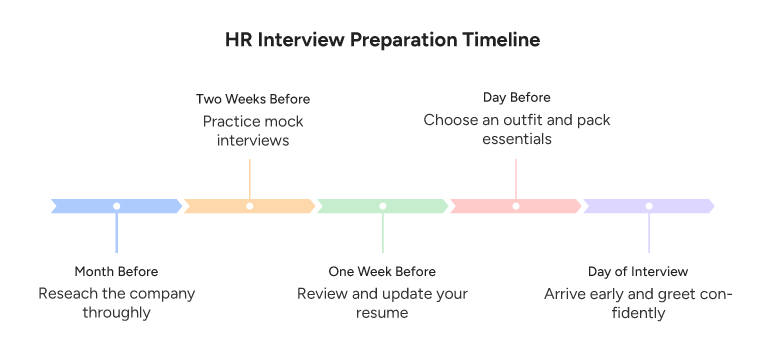
Preparing for an interview can feel daunting, but staying organized and confident makes all the difference. To help you prepare effectively, it’s important to follow a clear timeline, from understanding common questions beforehand to managing your final preparations on the interview day.
Month before
- Research the company thoroughly. Write down its mission, culture, key products, and recent milestones.
- Analyze the job description line by line and highlight the skills and responsibilities you can match from your own experience.
- Create a list of examples from your work or academic background that demonstrate these required skills.
Two Weeks before
- Practice mock interviews and record your sessions to observe your tone and body language.
- Prepare clear, concise answers using the STAR method (Situation, Task, Action, Result) for common HR questions.
- Study typical behavioral questions and refine your responses to reflect teamwork, leadership, and problem-solving abilities.
One Week before
- Review and update your resume to accurately reflect your recent work and achievements.
- Read the company’s latest news releases, HR initiatives, and social media updates to identify fresh talking points.
- Prepare 2–3 thoughtful questions to ask the interviewer about the role or the company culture.
Day before
- Choose an outfit that aligns with the company’s dress code, try it on, and ensure it’s clean and comfortable.
- Pack essentials, including printed resumes, ID, a notepad, a pen, and any requested documents.
- Check the interview location, map your route, and plan your travel time to ensure you arrive on time.
Day of Interview
- Arrive at the location at least 15 minutes early to settle in and review key notes.
- Turn your phone to silent and keep it out of sight during the interview.
- Greet the interviewer with a confident smile, maintain eye contact, and listen actively before responding.

Red Flags to AVOID: What NOT to Say in Your HR Interview
1. Frequent Job Changes
What to Avoid: Don’t say things like “I left because I got bored” or “The pay wasn’t good enough.” These statements make you seem unreliable or only motivated by money.
How to Address It Positively: Explain your career moves as part of your growth journey. You can say, “I was seeking opportunities to learn new skills and take on greater challenges,” or “I found roles that aligned better with my long-term career goals.” This shows maturity and purpose in your decisions.
2. Lack of Enthusiasm
What to Avoid: Avoid appearing uninterested or saying, “I haven’t read much about the company.” This signals to the interviewer that you may not care about the role.
How to Address It Positively: Show genuine excitement. Research the company’s values, products, or recent achievements, and mention what inspired you to apply.
3. Negative Attitude about Previous Employer
What to Avoid: Never criticize your previous manager or team. It comes across as unprofessional and may raise concerns about how you handle workplace conflicts.
How to Address It Positively: Stay professional and focus on what you gained from the experience. You might say, “That role taught me valuable lessons about teamwork and adaptability, and I’m ready to apply those skills in a new environment.”
You Might Like To Explore:
FAQs
How Many Types of HR Round Interviews are there?
There are several types of HR Round interviews that candidates may encounter during the hiring process. These typically include:
- Phone Screening
- General HR Interviews
- Panel Interviews
- Face-to-face Interviews
- Walk-in Interviews
What Questions do They Ask in an HR Round Interview?
HR interviews are not about your technical skills. They are to identify whether a candidate is suitable for the company. It includes general information, job and company-related questions, skills and experience, behavioral questions, and career goals.
What is the HR Round for Freshers?
The HR round is designed to assess a candidate’s soft skills, attitude, and personality. For freshers, this round primarily evaluates how well they fit the role and align with the company’s goals. It is important to be honest, confident, and positive throughout the HR interaction. To prepare effectively, freshers can refer to Common Interview Questions And Answers For Freshers, which cover common queries and provide sample responses to help build confidence and readiness for the interview process.
How Can I Pass the HR Interview?
- Read the job description.
- Review your resume.
- Visit the company website.
- Collect proper information.
- Take certifications with you.
- Wear professional attire.
What Questions do HR Ask about Salary in Interviews?
- What salary do you expect?
- Do you have another job offer?
- Are you applying to other jobs?
- Do you have a good work ethic?
What if I Don’t Know the Answer to a Question in the HR Round?
If you don’t know the answer, stay calm and be honest, acknowledge it instead of guessing. Show a learning mindset by explaining how you would find the answer or how quickly you are willing to learn.
What Should I Ask HR at the End of the Interview?
At the end of the interview, ask thoughtful questions about the company culture, team structure, or growth opportunities. You can also inquire about the next steps in the hiring process to show your interest.
Can I Negotiate Salary in the HR Round?
Yes, you can discuss salary expectations during the HR round, but do so professionally and back up your request with market research. Focus on your skills and value while expressing flexibility and interest in the role.
How do I Follow up after the HR Interview?
Send a polite thank-you email within 24 hours, expressing appreciation for the opportunity and reiterating your interest in the role. If you haven’t heard back within a week, send a brief follow-up to inquire about the next steps.
How Long is a Typical HR Interview?
A typical HR interview lasts about 20 to 45 minutes, depending on the role and company. It may take longer if multiple topics or assessments are covered.
What are HR Round Interview Questions on Work Ethic & Professionalism?
- How do you prioritize your work when handling multiple tasks?
- What does it mean to have a good balance between work and personal life?
- How do you ensure that you meet deadlines?
- How do you keep yourself motivated at work?
- Specific questions about the company and your job role.
What if the HR Interviewer Asks about Other Job Offers?
You can mention that you are exploring options, but emphasize your strong interest in this role and how it aligns with your career goals. Stay honest and confident without sharing unnecessary details.


Grow your business with factoHR today
Focus on the significant decision-making tasks, transfer all your common repetitive HR tasks to factoHR and see the things falling into their place.