
Top 20 Common Interview Questions and Answers for Freshers

Table of Contents

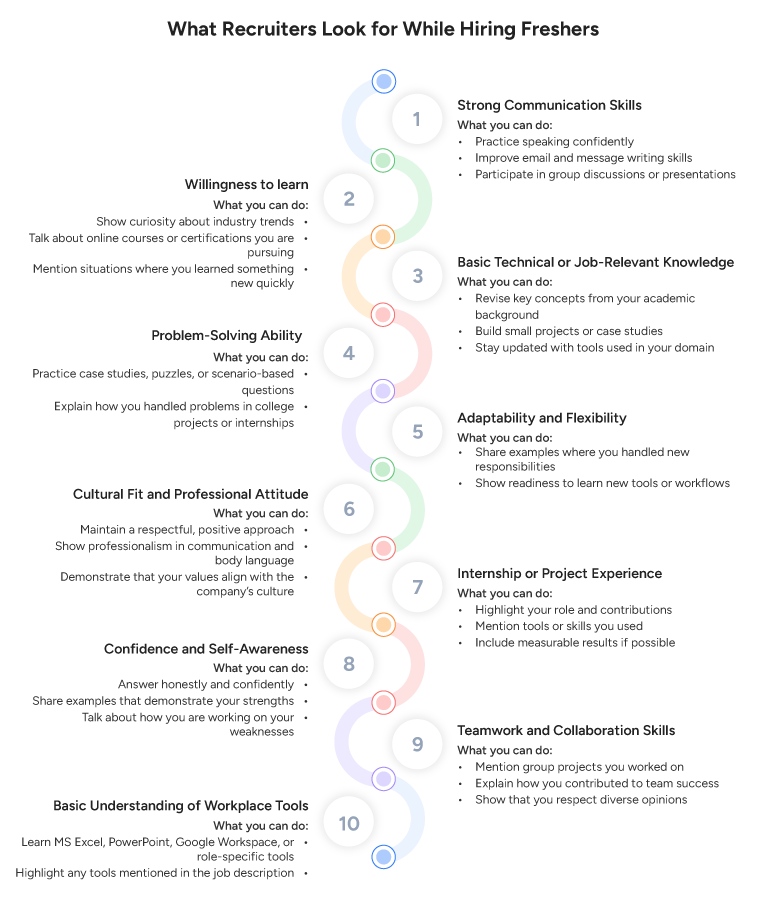
The interview is a crucial step for freshers transitioning from academia to a professional career, offering the first chance to demonstrate potential. Adequate preparation is key, significantly boosting your confidence and removing the fear associated with the process.
To help you succeed, this guide will provide the top 20 common interview questions and answers for freshers.
This article focuses on the most frequently asked interview questions and provides a clear structure for answering them effectively. It also covers additional frequently asked interview questions to ensure candidates are fully prepared for their entry-level role. Candidates appearing in college placement drives can first understand what campus recruitment means, including how employers screen, assess and select fresh graduates.
Interview Tips for Freshers
- Before appearing for an interview, freshers should prepare for some commonly asked interview questions.
- Frequently asked interview questions include questions on your graduation, interests, hobbies, and skills.
- Interviewers often also test your behavioural attributes and cultural traits to know whether your profile aligns with the role.
- Preparing for such questions can help boost your confidence and improve your chances of being hired.
- Freshers should avoid common mistakes such as giving vague answers, not researching the company, and appearing overly confident or underconfident.
- Tips for preparing for an interview include practicing common interview questions and preparing a list of questions to ask at the end.
- HR selects candidates based on factors like skills, cultural fit, personality traits, and other behavioural attributes.
- Candidates should wait a week or 10 days before requesting a follow-up to their interview. Following up with a formal email is advisable.
1. Tell Me about Yourself
Why They Ask: Interviewers ask this to understand your background, communication style, and how well you match the role.
How to Answer: Keep it structured and start with your education, then skills, then a short achievement, and end with what you want to contribute.
Sample Answer
I recently completed my Bachelor of Commerce from Delhi University, where I developed strong analytical and communication skills. During my final year, I led a financial planning project that enhanced my problem-solving and teamwork skills. I am now seeking an opportunity to contribute to meaningful work and grow professionally.

2. What are Your Strengths?
Why They Ask: This is one of the common interview questions that focuses on understanding your abilities and how well they fit the role.
How to Answer: Pick strengths relevant to the job and support each with a small example.
Sample Answer
One of my key strengths is my ability to learn quickly. During college, I joined an inter-college exhibition team at short notice. I understood the model quickly and presented confidently, which helped the team deliver well.
3. What are Your Weaknesses?
Why They Ask: Interviewers want to see how self-aware you are and whether you take initiative to improve.
How to Answer: Choose a real weakness that does not affect core job requirements and explain what you are doing to improve it.
Sample Answer
I realized I needed to get more comfortable with new software updates used in my field. To improve, I have been learning the latest version through online training and hands-on experience.
4. What are Your Hobbies?
Why They Ask: They seek to understand your character and how you manage responsibilities with your personal pursuits.
How to Answer: Share hobbies that reflect discipline, creativity, or balance.
Sample Answer
I follow a regular workout routine because it keeps me energized and helps me stay focused.
5. Why do You Want this Job?
Why They Ask: They aim to know whether your objectives align with the role’s requirements.
How to Answer: Mention what you like about the role, what you can bring, and why the company appeals to you. Including specific goals from the company’s vision and cultural traits is also an important factor.
Sample Answer
This role matches the skills I developed through my projects and internships. I thrive in environments where learning is continuous, and this company’s focus on growth makes it a great place to begin my career.

6. What do You Know about Our Company?
Why They Ask: They want to confirm whether you researched the company and evaluated the role.
How to Answer: Mention specific details such as services, key achievements, or culture highlights.
Sample Answer
I learned that your organization is a leading HR tech brand with a strong client base across industries. I also noticed that your HR software is widely adopted for improving recruitment efficiency. Your expansion plans for global markets reflect my long-term vision. I would love to know more about upcoming projects.
7. Why are You Interested in this Position?
Why They Ask: They want to know whether your interests and hobbies align with the role.
How to Answer: Relate your skills, interests, and what excites you about the position.
Sample Answer
This position aligns with my skills in communication and analysis. I enjoy tasks that require attention to detail, which makes this role a strong fit. I am also interested in understanding the functioning of software and how AI drives change through automation. Since your company focuses on automating tasks, I am even more eager to work with you.


8. How Well do You Handle Stress or Pressure?
Why They Ask: They want to know how you handle difficult situations or occupational stress.
How to Answer: Maintain your composure and focus on finding solutions.
Sample Answer
I stay focused on the task rather than getting pressured. During my post-graduation project, our team had coordination issues, but I focused on preparing the final presentation, which helped us complete the project smoothly.
9. Do You Prefer Working Alone or in a Team?
Why They Ask: They want to evaluate your ability to adapt to various work styles.
How to Answer: Show flexibility and openness in both situations.
Sample Answer
I enjoy collaborating in a team because it introduces fresh ideas, but I’m also comfortable working independently when tasks require my expertise.
10. What are Your Short-Term and Long-Term Goals?
Why They Ask: They would like to know about your goals and plans for growth.
How to Answer: Keep your goals realistic and relevant to the role, aligned with the company’s expectations.
Sample Answer
In the short term, I want to strengthen my digital marketing skills and contribute effectively to campaign execution. Over time, I plan to grow into a strategist role where I can lead projects.
11. What Skills are You Currently Working on Improving?
Why They Ask: They want to observe your eagerness to develop and improve so you can be future-ready. Based on that, they prepare a training and development plan.
How to Answer: Mention skills and explain how you are strengthening them.
Sample Answer
I am improving my presentation skills by confidently expressing myself and delivering my content in an organized way.

12. Where do You See Yourself in the Next Few Years?
Why They Ask: They want to understand your long-term commitment to the firm.
How to Answer: Give a practical response.
Sample Answer
In the next few years, I plan to gain expertise in digital marketing, mentor new team members, and manage projects.
13. What’s Your Biggest Accomplishment?
Why They Ask: They want to see how you tackle obstacles and goals.
How to Answer: Share an achievement that shows your determination or skill.
Sample Answer
Completing my degree with a 7.76 GPA while managing part-time work is my proudest accomplishment. It taught me time management and discipline.
14. How do You Evaluate Success?
Why They Ask: They want to understand your work ethic and code of conduct.
How to Answer: Give a thoughtful and practical reply.
Sample Answer
I am successful when I complete my tasks responsibly and contribute to meaningful results. Each project is an opportunity for me to learn something new.
15. Are You Willing to Change Your Role if Needed?
Why They Ask: They want to assess adaptability.
How to Answer: Be transparent with the response.
Sample Answer
Yes. I am willing to experiment with different roles as a new employee, as I believe exposure to a variety of situations promotes personal development.

16. Are You Willing to Relocate?
Why They Ask: They want to check your flexibility.
How to Answer: Be honest.
Sample Answer
I’m open to relocating if the role requires it. I would also like to understand the location and team structure.
17. What are Your Salary Expectations?
Why They Ask: They want to ensure your expectations match their budget.
How to Answer: Show flexibility.
Sample Answer
As a fresher, I am open to the company’s standard compensation for new hires. My priority is learning and professional growth.
18. Why Should We Hire You?
Why They Ask: They want to know what makes you a suitable candidate.
How to Answer: Highlight your skills and enthusiasm.
Sample Answer
I offer commitment, quick learning ability, and a mindset focused on improvement. My projects and college involvement have helped me build practical skills that I can apply from day one.
19. When Can You Start?
Why They Ask: They want to plan the onboarding process.
How to Answer: Give a clear timeline.
Sample Answer
I can join immediately, but I would also like to know your preferred start date so I can align with it.
20. Do You have any Questions for Us?
Why They Ask: They want to see whether you are genuinely interested.
How to Answer: Ask thoughtful questions about the company or role.
Sample Answer
Yes, I would like to know more about the company’s work culture and how collaboration works across teams.
Interview Preparation: Do’s and Don’ts for Freshers
Here are some dos and don’ts that freshers should keep in mind when preparing for an interview.
| Do | Don’t |
|---|---|
| Research the company and role | Going to the interview without understanding the company |
| Practice common interview questions | Memorise answers in a rigid way |
| Prepare examples from projects or internships | Give vague or generic responses |
| Dress appropriately | Wear casual or distracting outfits |
| Arrive early and stay focused | Arrive late or appear stressed |
| Keep your answers clear and structured | Speak too fast or provide long answers |
| Carry essential documents | Forget important documents or ID |
| Maintain good posture and eye contact | Look distracted or avoid eye contact |
| Ask thoughtful questions at the end | Say you have no questions |
| Show willingness to learn | Claim you know everything already |
Conclusion
Having discussed the standard questions, if the candidate is prepared to face the interview, they will crack it easily. And more than that, make sure you maintain good posture, which enhances your appearance. Even if there’s a question you are not prepared for, do not panic, sit up straight, and be honest and confident in your answers. These will surely help you make the best impression throughout the interview process.
FAQs
Why is Interview Preparation Important for Freshers?
Interview preparation builds confidence, reduces anxiety, and helps you communicate clearly. It strengthens your understanding of common interview questions so you can respond with clarity.
What are some Expert Tips to Crack Interviews for Freshers?
Research the company, practise common interview questions, prepare examples from real experiences, and stay calm.
What are the Common Mistakes Freshers Should Avoid in an Interview?
Avoid vague answers, speaking too fast, arriving unprepared, or skipping company research. Lack of clarity can reduce your chances.
What are Good Strengths to Mention in an Interview for Freshers?
Adaptability, willingness to learn, problem-solving, communication, and discipline are well-received.
How do I Handle Tricky Interview Questions as a Fresher?
Pause, think, and answer honestly. Use short examples from academics or internships to support your response.
What are some Smart Questions to Ask at the End of an Interview?
Some smart questions to ask at the end of an interview include:
- What does success look like in this role during the first 90 days?
- Can you describe the team I’ll be working with?
- What are the biggest challenges this position aims to solve?
- How is performance measured and reviewed here?
- What opportunities are available for learning and career growth?
- How would you describe the company culture and work environment?
- What are the next steps in the hiring process?


Grow your business with factoHR today
Focus on the significant decision-making tasks, transfer all your common repetitive HR tasks to factoHR and see the things falling into their place.