
Write a Formal Relieving Letter: Free, Ready-to-Download Templates

Download Relieving Letter Word & PDF Format


Table of Contents

A relieving letter is a formal document issued by an employer to confirm they accepted an employee’s resignation and successfully closed their role. It provides organisations with a clear record of the exit and helps new employers verify employment details. You will learn more about the proper relieving letter original format, what it means, and what to include when writing a clearance letter.
A quick look at what’s inside
- What is a relieving letter
- Standard professional Format
- What details required to draft this
- Download Ready-To-Use 5+ Templates For Various Scenarios
- Learn how to request this letter from HR
- Learn when is the right time for employers to issue this document
What is a Relieving Letter?
A relieving letter is a formal letter from an employer, which confirms that an employee has been officially released from their duties once their employment has ended. The reason for leaving can be resignation or termination of contract, and they have completed all the exit formalities. This document acts as proof of employment for future employers, as it helps verify a professional exit from the previous company.
Employers prepare this document in a structured manner, which includes the employee’s tenure and final working date. A standard relieve letter format helps ensure consistency and avoids disputes in the future.

Standard Relieving Letter Format (Template Structure)
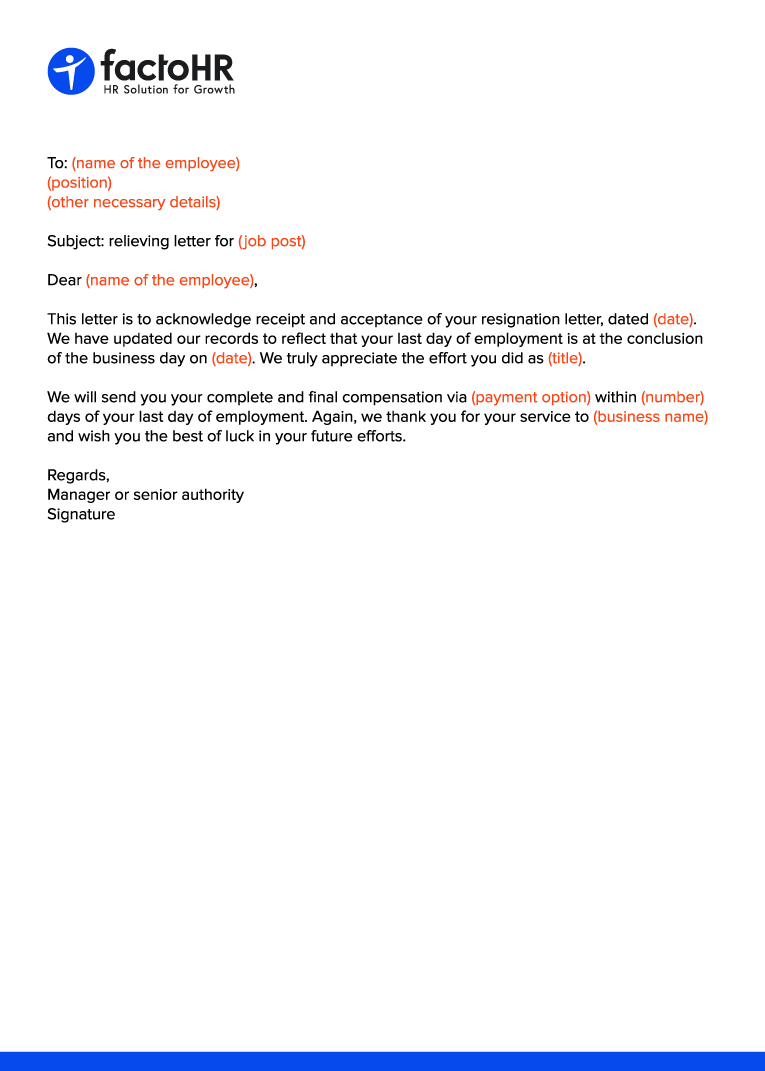
Sample of Formal Relieving Letter for Employees
A standard relieving letter template can be prepared once and saved digitally for later use. Every time HR teams need to generate a relieving application for an employee, they can fill in the relevant employee details in the gaps. The final draft can be stored digitally or printed as needed.
Xenia Pvt. Ltd
Date: 25th August, 2025
To: Employee Full Name: Mr. Sandip Patel
Employee ID: 1751
Designation: Senior Sales Manager
Subject: Letter of Relieving
Dear Mr. Sandip Patel,
This letter is in reference to your resignation letter dated 20th August 2025, in which you requested to resign from the role of Senior Sales Manager and confirmed serving the 2 Months notice period.
You were employed with us from 01st July 2020 to 20th October 2025. We accept your resignation and confirm that you will be relieved from your duties at our organization on 20th October 2025.
Your final settlement will be processed within the next 12 days, and we confirm that all formalities related to the termination of your employment have been completed.
We appreciate your contribution to the company and are certain your hard work and diligence will contribute to your success in the future.
Yours sincerely/Warm regards/Best regards,
Ms. Heena Khan
HR Manager
*Note: These clauses can be added to the above draft wherever applicable:
- We acknowledge that we have received all the tools and property provided to you for work purposes.
- The company retains sole ownership rights to all the work produced or developed during your employment.
- The employee must not disclose any confidential company information to external parties.
- The employee is prohibited from sharing any negative company information with the media or any other external bodies.

Best Relieving Letter Templates for HR
Make offboarding smooth with ready-to-use professional relieving letter templates for HR. Each template covers the last working day, handover, asset return, and full & final details.
Sample 1: Job Relieving Letter Format
(Company Letterhead)
Date:
To: Employee Full Name:
Employee ID: (if applicable)
Designation: (Job Title)
Subject: Letter of Relieving
Dear (name of the employee),
This is to acknowledge the receipt of your resignation letter dated (date), and we confirm that your resignation has been accepted.
We sincerely thank you for your contribution to (company name) during your tenure from (employment start date) to (employment end date). You are hereby relieved from your duties with effect from (employment end date).
We wish you continued success in your future endeavours.
Yours sincerely,
(Authorized Professional’s Name)
(Title or Designation)
Signature
Sample 2: Requesting a Relieving Letter to HR in Email Template
This sample template shows how an employee should request an exit letter to HR professionals via email. Note that this letter should be simple and should contain a formal tone.
To: (email ID of the Owner/Manager/HR)
CC/BCC: (if needed)
Subject: Request for Relieving Letter
Dear (Owner/Manager/HR),
I am writing to request the issuance of my exit letter formally. My tenure with (company name) began on (employment start date) and concluded on (employment end date) following the acceptance of my resignation letter dated (date).
I request that you provide this letter in the standard format at the earliest. Please confirm my employment details, my last working day, and the details regarding the full and final settlement.
This clearance or exit letter will assist in my future endeavors.
Thank you for your assistance.
Yours sincerely,
(Employee Full Name)
Sample 3: Relieving Certificate for Chartered Accountant (CA)
(Company Letterhead)
Date:
Subject: Relieving Certificate for CA (name)
To,
(Name of Chartered Accountant)
(Firm Name)
Dear Sir/Madam,
We confirm that (Employee Name) held the position of (Job Title) at (Company Name) from (Start Date) to (End Date). The employee resigned on (Date) and completed their tenure effective (End Date).
The employee has returned all the company property provided for work purposes, and we have completed the full and final settlement.
Please update your records accordingly.
Yours sincerely,
(Authorized Professional’s Name)
(Title or Designation)
Signature
Sample 4: Company Relieving Letter with Notice-Period Clause
(Company Letterhead)
Date:
To: Employee Full Name:
Employee ID: (if applicable)
Designation: (Job Title)
Subject: Relieving Certificate
Dear (name of the employee),
We acknowledge your resignation letter dated (date), which confirmed your last working day as (job title) on (employment end date). You successfully completed the required (duration) notice period per your employment agreement.
We acknowledge your resignation and confirm that your relieving date is [employment end date]. Your full and final settlement has been completed, and we confirm receipt of all company property issued to you for work purposes.
We appreciate your contribution to the organization and wish continued success in your future endeavours.
Yours sincerely,
(Authorized Professional’s Name)
(Title or Designation)
Signature
Sample 5: Manager-Level Relieving Letter Template
(Company Letterhead)
Date:
Subject: Relieving Certificate
Dear (name of the employee),
This is to confirm that your resignation from the position of Manager at (Company Name), effective from (employment end date), has been accepted.
We acknowledge your valuable contributions over the last (number of years) years, during which you demonstrated strong leadership, expertise, and commitment. Your problem-solving skills, creativity, and professional communication have positively impacted the team and the organization.
You are required to return all company assets to the IT department by (employment end date). All pending dues, if any, will be cleared within (number) days from your last working day.
We thank you for your service and wish you success in your future endeavors.
Yours sincerely,
(Authorized Professional’s Name)
(Title or Designation)
Signature
Pro Tips: These are the best relieving/exit letter templates for you to choose from. Maintain a digital backup of these letters for future reference. Provide one copy to the employee on their final working day and file the other copy for company records.

What Should a Relieving Letter Include?
Because the employer’s name is attached, they are responsible for ensuring the document is accurate, professional, and concise.
A standard relieving order format for an employee should include:
Company Letterhead
Using the company letterhead confirms both the authenticity and the official identity of the organization. Since a relieving application is considered a statutory obligation, it must be issued on the company letterhead to be valid.
Date of Issuance
The release date specifies when the letter was issued. It should appear at the top of the document. In case of any dispute, the date can provide important reference information.
Recipient Details
The employee’s details, which include name, designation, employee ID (if any), and department, appear directly below the issue date.
Subject Line
The subject, in this case “Relieving Certificate,” provides a summary of the letter’s intent.
Body Content
In the salutation section, the recipient should be addressed formally using a title and last name (e.g., “Dear Mr. Sharma,” or “Dear Ms. Kapoor”). If the appropriate title is unclear, use the employee’s full name(e.g., “Dear Krish Kapoor”) to maintain professionalism.
The body of the letter acknowledges acceptance of the resignation and confirmation that duties have been completed. It also specifies the resignation date, the employee’s start date, and the last working day with the organization.
Formalities Confirmation
The formalities and appreciation section requires the employer to confirm that the employee will receive the final settlement within a specified time frame. A note of appreciation and warm regards for the employee accompanies this confirmation.
Closing and Signature
The letter concludes with the signature of the CEO, HR representative, or another authorized person.
How to Write a Professional Relieving Letter
By following these necessary steps, one can write an accurate and simple relieving letter format:
Gather Necessary Details
When creating a relieving employee letter format in Word or any other application, an employer/HR must know what information should be included in the document.
This letter must consist of the employee’s full name, resignation date, job title held by the employee, start date, end date of employment, and the notice period served. It is advisable to always use the employee’s complete name as per official documents, such as an Aadhaar card or PAN card.
Draft the Main Body
The central section of this letter should affirm that the company has accepted the resignation. It must confirm the last working day, also referred to as the date of relieving, to verify that the individual is relieved from job responsibilities.
It must also include the details of the full and final settlement with the expected timeline, if applicable. The last sentence should include a brief statement of appreciation to reflect positively on the employee’s contribution and demonstrate their potential value to a future employer.
Optional details regarding the clearance of all dues, return of company assets, confidentiality obligations, and restrictions on negative publicity may also be included.
Review for Accuracy & Tone
This letter format template should contain the necessary details only. Before finalizing the letter, all details, such as names and dates, should be rechecked to avoid discrepancies. The letter must be drafted in simple language using a professional tone. It should be proofread to avoid grammatical or typographical errors.
Obtain Approvals & Signature
The final step is to validate the document by obtaining approval from the company owner, HR, or a senior authority. The signature and designation of an authorized person verify the document’s authenticity.

What is the Purpose of a Relieving Letter?
A relieving certificate plays a dual role for both employees and employers. For employees, it is proof that resignation has been accepted, work responsibilities have concluded, and the full and final settlement will be processed. It is commonly used for background verification when applying for new jobs, visas, or higher education.
Around 60% of employers conduct background checks during the hiring process. Recruiters often request an exit letter to verify an employee’s tenure, role, and exit details. In the absence of an employment separation letter, they may even reject a shortlisted candidate’s application.
For employers, issuing a relieving order reflects compliance with labor laws and . This letter records the official closure of employment and maintains positive relationships with former employees.
For employers, issuing a relieving order reflects compliance with labor laws and HR policies. This letter records the official closure of employment and maintains positive relationships with former employees.
Why the Relieving Letter is Crucial for Background Verification & HR Compliance
A relieving certificate is important as it serves as official proof of resignation. The certificate also confirms that an employee has served the required notice period, and that they have completed the necessary final exit formalities
Official Proof of Employment End
When HR issues a relieving letter, it captures the official closing date of service. This supports statutory filings (such as EPFO exit reporting) and helps reconcile internal records with external records.
Confirms No Dues Clearance
By noting that all dues are cleared and that company property is returned, the letter functions as a liability release. Under the Payment of Wages Act, employers are legally obliged to settle wage dues in a timely way and such confirmation helps solidify that no financial claims remain. Additionally, Code on Wages also emphasizes timely payment after exit.
Mandatory for Background Verification
Third-party verification firms or hiring managers commonly request a formal exit confirmation. It gives them a documented record of the role, last working day, and exit status, allowing them to cross-check and validate candidate-provided information.
Prevents Dual Employment Concerns
A clear exit confirmation reduces the risk of overlapping employment periods being misinterpreted as dual employment. This matters for statutory compliance for instance, overlapping PF records can raise questions during payroll checks or EPFO verification.
Boosts Professional Credibility
A clean, documented exit reflects positively on the individual’s professionalism. It signals stability and responsible conduct to future employers, enhancing trust and reputation.
Required for New Job Onboarding
Many organisations require this document before issuing a formal offer or completing onboarding. Some even make it a condition for joining, as per their employment agreement.
Useful for Future Legal and Official Needs
A separation document may be needed later for visa applications, loan approvals, or other legal processes..
Protects both Parties Legally
From a risk-management standpoint, having a mutual, written acknowledgement of exit, handover, and settlement protects both employer and employee. If disputes arise later, this document acts as a reference point for tenure, dues, and exit terms.
Best Practices for HR while Issuing Relieving Letters
HR should follow clear practices because exit documents often influence how external teams assess a former employee’s history. A careful approach also protects the organisation from avoidable disputes and supports a smooth transition for the departing employee.
Ensure Correct Dates
Record precise joining and separation dates. Even a small mismatch can create problems during external checks.
Align with Exit Policy
Use language that reflects the organisation’s approved exit procedure. This keeps every document consistent and avoids confusion within HR.
Store a Copy for Statutory Compliance
Maintain an internal record for audits or future queries. This helps HR respond quickly when a verifier or authority requests confirmation.
Avoid Defamatory Statements
Rely on factual, neutral wording. Avoid comments that sound personal or accusatory, as these can lead to legal complications.

How to Request a Relieving Letter: A Step-By-Step Guide [with Email Samples]
Resigning from a job involves more than just handing in your notice. One of the most critical documents you need to secure before walking out the door is the relieving letter.
Without it, joining your next company can become complicated, as most employers require it for background verification. If you aren’t sure how to ask for it, this step-by-step guide and ready-to-use professional email templates will help you navigate the process smoothly.
Step 1: Review Your Company’s Exit Policy
Start by reviewing your organization’s exit guidelines. Some companies issue the release confirmation automatically once full-and-final settlement is processed, while others provide it only when the employee submits a formal request. You can find this information in the employee handbook, the HR portal, or by asking your HR representative.
Step 2: Complete ‘No Dues’Formalities
Before asking for your employee no dues clearance certificate, ensure all exit procedures are finished. This includes returning company assets, completing handover notes, clearing IT access, and obtaining required approvals from managers. HR cannot issue the final relieving or closure documents until all no-dues items are cleared.
Step 3: Gather Essential Employment Details
Keep essential information handy like your employee ID, job title, joining date, last working day, resignation date, and the name of your reporting manager. Providing complete details reduces back-and-forth communication and speeds up processing.
Step 4: Draft a Professional Request Email
Write a concise, respectful email requesting your release confirmation. Mention your last working day, share any required information, and keep the tone professional. A short paragraph explaining that the document is needed for future employment checks or onboarding is usually enough.
Step 5: Follow up Professionally
If your employment closure certificate is not issued within the expected timeframe, send a polite follow-up. Avoid daily reminders. A gap of three to five working days is generally appropriate in Indian corporate settings.
Email Template 1: Standard Request (Sent Before or on the Last Working Day)
Request your exit clearance or release confirmation once you have completed handover and full and final settlement steps. Use a concise, polite email that lists key employment details, mentions your last working day, and asks for the document for background verification and onboarding.
Subject: Request for Exit Clearance / Release Confirmation:
Dear [HR / Manager Name],
I hope you are doing well. I am writing to request the issuance of my exit clearance / release confirmation for my employment at [Company Name]. My last working day is / was [DD MMM YYYY], and I have completed the required notice period along with all handover tasks.
My details are as follows:
- Full Name: [Your Full Name]
- Employee ID: [XXXX]
- Designation: [Your Job Title]
- Date of Joining: [DD MMM YYYY]
- Last Working Day: [DD MMM YYYY]
- Reporting Manager: [Name]
I request confirmation that all exit formalities have been completed and ask for the employment closure document along with the full and final settlement timeline. I have attached my resignation letter and handover file for reference.
It would be helpful to receive the document by [mention preferred timeframe], as it is needed for onboarding and background verification with my next employer.
Thank you for your support.
Warm regards,
[Your Full Name]
[Phone Number]
[Personal Email]

Template 2: Follow-Up Email (if there is a Delay)
Use a polite, professional follow-up email when your exit clearance or employment closure document is delayed. Reference your earlier request, remind HR of your last working day, and ask for a status update, while expressing appreciation for their assistance.
Subject: Follow-up: Exit Clearance / Release Confirmation Request
[Your Name], [Employee ID]
Dear [HR / / Manager Name],
I hope you are well. I’m writing to follow up on my earlier request for my exit clearance / release confirmation, sent on [Date of First Email]. My last working day with [Company Name] was [DD MMM YYYY]. I completed all formalities, including the handover and notice period, and shared my resignation and handover documents in the previous email.
Could you kindly update me on the current status of my employment closure certificate and the timeline for full & final settlement? This document is crucial, as it is required for my background verification and onboarding process for my next role.
If there is any pending paperwork or clearance from my side, please let me know, and I will address it immediately. I would be grateful if this could be issued at the earliest convenience.
Thank you again for your help and support.
Warm regards,
[Your Full Name]
[Employee ID]
[Phone Number]
[Personal Email]
Template 3: Requesting a Duplicate Relieving Letter (if Original is Lost)
When you’ve left a company some time ago but still need your release confirmation or exit certificate, send a courteous email. Acknowledge the gap, provide your employment details, and make a clear request while expressing understanding if there are administrative delays.
Subject: Request for Exit Clearance / Release Confirmation — [Your Name], Former Employee
Dear [HR / / Manager Name],
I hope this email finds you well. I previously worked at [Company Name] as a [Job Title], and the tenure was from [DD MMM YYYY] to [DD MMM YYYY]. Reaching out now to request the issuance of my exit clearance / employment closure document.
I understand that a considerable time has passed since my departure, but I require this certificate for [state reason — e.g., background verification, new job onboarding, higher education, visa]. Here are my details for reference:
- Full Name: [Your Full Name]
- Employee ID: [XXX / –]
- Department / Team: [Your Department]
- Designation: [Your Job Title]
- Date of Joining: [DD MMM YYYY]
- Last Working Day: [DD MMM YYYY]
If there are any formalities I need to complete or pending clearances, please guide me. I would appreciate your help in issuing the document, and I am happy to provide any additional information or identity verification, if needed.
Thank you for your time and understanding.
Warm regards,
[Your Full Name]
[Phone Number]
[Personal Email]
Use professionally written relieving letter request email templates to submit a clear and polite request that includes your last working day, handover completion, and the need for the document for background verification and onboarding.

What are Common Mistakes to Avoid in a Relieving Letter?
A relieving certificate is an official document that should be drafted with accuracy. These are a few things to keep in mind while drafting or proofreading a relieving letter:
- It should be drafted on the company’s letterhead with the signature of an authorized person and their designation to ensure credibility.
- It must verify and include the employee’s complete information to avoid disputes or confusion later.
- The tone must be formal and professional
- If the employee has not served the full notice period, the employment contract should specify any financial penalties or legal action.
Automate Your HR Processes with factoHR
A relieving letter acts as a proof of the end of employment, and is required at the time of offboarding. HR professionals must ensure that the letter is professional and includes all the relevant job details. The letter must include an employee’s designation, ID, and roles and responsibilities. Ensure that you send a proper certificate by using the given relieving letter format.
Want to avoid wasting hours and juggling spreadsheets and papers for generating letters? With factoHR you can use 200+ customizable templates or build one of your own using next-gen AI features! Try factoHR today, and experience end-to-end offboarding!
Frequently Asked Questions
How to Request a Relieving Letter after Resignation?
After submitting the resignation, complete all required exit formalities, such as returning company property. Next, you can write a formal request letter or email to the authorized person, requesting the letter.
How to Request a Relieving Letter after the Notice Period?
After completing your notice period, send a follow-up email to HR or your reporting manager if you have not received the employment separation letter. Clearly mention your last working day and request for a specific timeframe for receiving the letter. Keep the email polite, professional, and within the same email thread as your resignation to maintain a clear record.
Can an Employer Deny a Relieving Letter?
Yes, if an employee breaks company rules, misbehaves, leaves without notice, or does not complete the notice period, the employer can refuse to issue the relieving certificate. In some cases, employers may also withhold the letter if the employee’s performance did not meet expectations or if pending dues and formalities remain incomplete.
How Long does It Take to Issue a Relieving Letter?
Once all exit formalities and clearance procedures are complete, the timeframe for issuing the letter may vary according to an organization’s policies. However, most employers generally issue a relieving letter within a few days to a week after the employee’s last working day.
Is a Relieving Letter Mandatory for Resignation?
While not legally mandatory in all cases, Most organizations require it for onboarding new employees, conducting background verification, and maintaining employment records.
Is a Terminated Employee Eligible for an Exit Clearance Certificate?
Yes, a terminated employee can receive it if the termination followed due process or was mutually agreed upon. However, the document will state the reason for separation as termination, which may prompt questions during future employment checks.
What is the Difference between a Relieving Letter and an Experience Letter?
A relieving letter confirms that the employee was relieved from the job with no outstanding dues and specifies the date of relieving. An experience letter confirms the nature, duration, and quality of the service rendered. An experience letter focuses on skills and performance, while a relieving letter focuses on official closure and release from obligations.
Is It Legal for an Employer to Ask for the Original Relieving Certificate and Keep It for Months?
No. Employers may request originals for verification, but retaining original identity or qualification documents for an extended period is legally risky and has been challenged by Indian authorities and courts. Employers should return originals once verification is complete and rely on certified copies for record-keeping.
Can I Get a Relieving Letter after Absconding from a Company?
Often not automatically. If you abscond, employers commonly treat the separation as unauthorised and may refuse to issue an employment closure document. Resolution usually requires settlement of dues, formal re-engagement with HR, or legal remedy depending on company policy.
What Tone and Language Should be Used in a Relieving Certificate?
Keep language formal, factual, and concise. State employment dates, last working day, and that exit formalities are complete. Avoid subjective remarks or defamatory language; use neutral phrasing that supports background checks and legal clarity.
How Soon after Resignation Should I Request My Employment Separation Letter?
Request it once you have completed handover and clearance steps. Many organisations issue the document on or shortly after the last working day, while others wait until full and final processing finishes.
Should We Issue a Relieving Certificate before or after Full and Final Settlement?
issue a release confirmation after clearance of dues and return of company property. Some employers provide a provisional release note earlier, but the final employment closure document is typically linked to full and final completion.
What is the Difference between a Relieving Letter and Resignation Letter?
A resignation letter is an employee’s notice to leave. An exit certificate is an employer’s formal record confirming resignation acceptance, last working day, and clearance status.
How to Get an Employment Separation Letter from the Company?
Send a short, polite request to HR or the reporting manager with your employee details, resignation date, and last working day. Complete any pending clearances, attach supporting documents, and follow up professionally if delayed.
Is a Relieving Certificate Required for Background Verification?
Yes. Employers and third-party verifiers commonly use the employment closure document to confirm tenure and exit status. Providing a clear release confirmation speeds recruitment and onboarding checks.
Can I Join a New Company without a Relieving Letter?
Whether or not you can join a company without a relieving letter depends on your new company’s policy. Some firms allow joining without a clearance certificate and ask for it during onboarding. While other companies require it at the time of document verification.



Modernize your HR tasks with factoHR today
Experience the digitalization of everyday business activities with factoHR's modern and compatible solutions for every need.

© 2026 Copyright factoHR