
Termination Letter to Employee: 7 Professional Formats & Templates (2026 Guide)
Download Ready-to-Use Employee Termination Letter Template (India)


Table of Contents

Letting an employee go is arguably the most challenging responsibility an HR manager faces. Whether the decision stems from poor performance, misconduct, or organizational restructuring, the process demands dignity, clarity, and strict legal compliance.
A well-drafted termination letter is not just a formality; it is a critical legal document. It protects your organization from wrongful termination lawsuits, clarifies the Full and Final Settlement (FnF) process, and provides the employee with a clear roadmap for their exit.
This comprehensive guide covers everything you need to know about drafting a termination letter, including legal pitfalls to avoid, and provides 7 ready-to-use templates for every scenario.
What is a Termination Letter?
A termination letter (often referred to as a “pink slip” or “letter of separation”) is an official document issued by an employer to an employee to formally end their employment contract.
Unlike a resignation acceptance, which is reactive, a termination letter is proactive. It serves as definitive proof of the specific date and reason for the separation, which is vital for state compliance (such as the Industrial Disputes Act, 1947, in India) and internal audits.

Key Components of a Valid Termination Letter
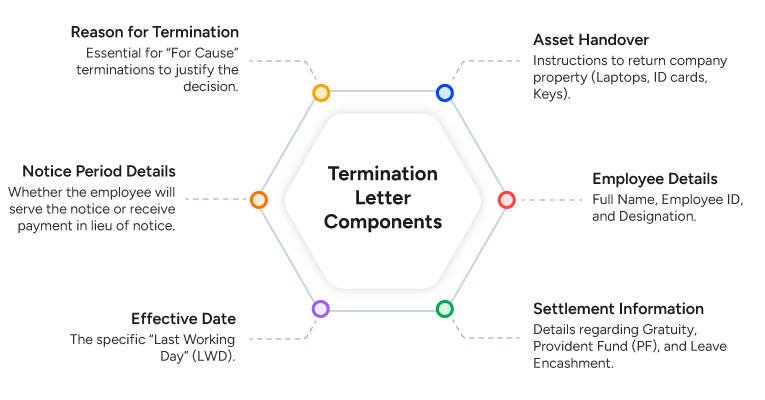
To be legally sound, every letter of termination must include:
- Employee Details: Full Name, Employee ID, and Designation.
- Effective Date: The specific “Last Working Day” (LWD).
- Reason for Termination: (Essential for “For Cause” terminations to justify the decision).
- Notice Period Details: Whether the employee will serve the notice or receive payment in lieu of notice.
- Settlement Information: Details regarding Gratuity, Provident Fund (PF), and Leave Encashment.
- Asset Handover: Instructions to return company property (Laptops, ID cards, Keys).
Legal Framework: Termination Rules in India
Before drafting the letter, ensure you comply with applicable labor laws. In India, termination is governed by:
- The Industrial Disputes Act, 1947: Mandates a 30-day notice or pay-in-lieu for “workmen” who have completed one year of service.
- State Shops and Establishments Acts: Varies by state, but generally requires a written notice for termination of service.
- Employment Contract: The terms signed during onboarding (Appointment Letter) legally bind the termination process. If your contract requires 60 days’ notice, you cannot terminate with 30 days’ notice without mutual agreement or compensation.
Pro Tip: Never use defamatory language in an employee termination letter. Citing “loss of trust” or “unethical behavior” without a formal inquiry can lead to defamation lawsuits. Stick to factual, objective reasons.
How to Write a Termination Letter (Step-by-Step)

Step 1: Use a Formal Header
Always use the official company letterhead. Include the date of issuance and the employee’s current address.
Step 2: Get Straight to the Point
Do not bury the lead. The opening sentence should clearly state that the employment is being terminated.
- Bad: “We are writing to discuss your future…”
- Good: “This letter serves as formal notification that your employment with [Company Name] is terminated, effective [Date].”
Step 3: State the Reason (if Applicable)
For misconduct or performance, cite the specific policy violation or the failure of the Performance Improvement Plan (PIP). For layoffs, mention “redundancy” or “restructuring.”
Step 4: Outline the Exit Process
Clarify the next steps clearly:
- FnF Settlement: “Your final dues will be processed using our Payroll Software to ensure 100% compliance with tax and gratuity laws.”
- Benefit Continuation: “Your health insurance coverage ends on [Date].”
- COBRA/PF: Details on porting benefits.
Step 5: Close Professionally
End with a neutral closing, and it protects your organization from a signature from the authorized signatory (usually the HR Head or Director).

7 Essential Termination Letter Formats
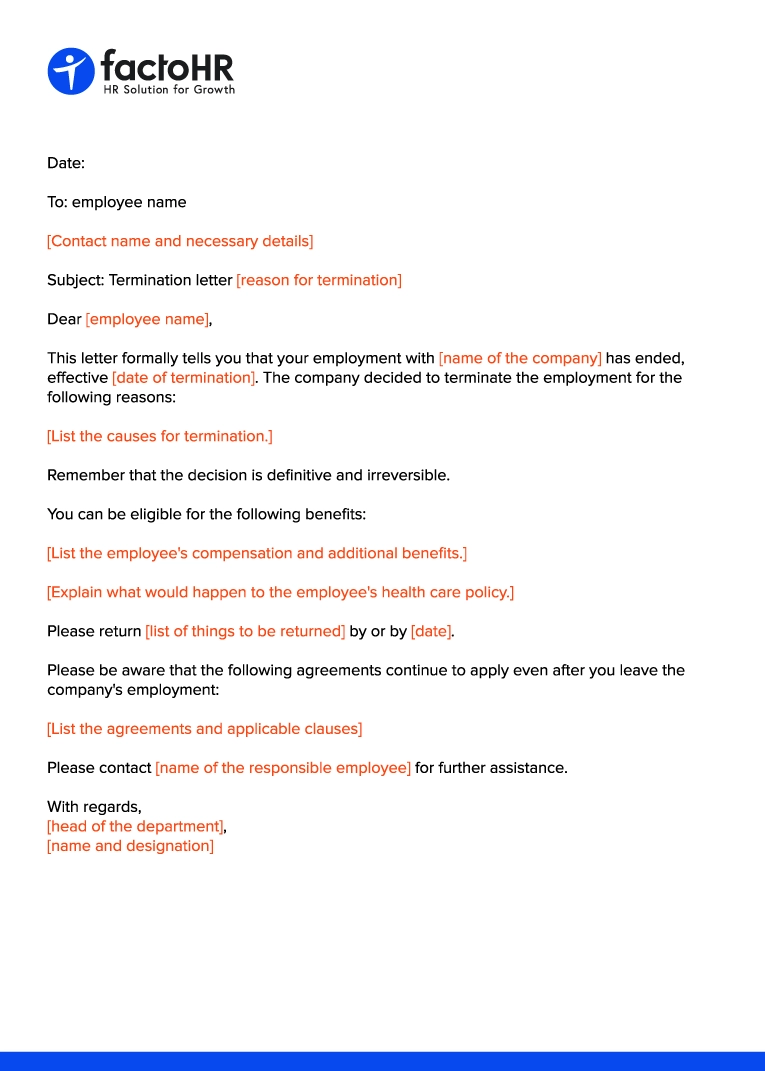
Select the termination letter template that matches your specific scenario.
1. Standard Termination Letter (Notice Period Served)
Use this for general separation where the employee will work during their notice period.
Subject: Termination of Employment
Dear [Employee Name],
We are writing to formally notify you that your employment with [Company Name] is being terminated. Per your employment contract, you are required to serve a notice period of [Number] months. Therefore, your last working day will be [Date].
Please ensure that you complete the handover of your current projects to [Manager Name] by [Date].
You are requested to return all company property, including your laptop, ID card, and access keys, to the IT department on your last working day. Your Full and Final Settlement (FnF), including unpaid salary and accrued leave encashment, will be processed within [Number] days from your exit.
We wish you the best in your future endeavors.
Sincerely,
[Name]
[HR Manager Designation]
2. Termination Letter Format for Poor Performance (Post-PIP)
Use this when an employee fails to improve after a Performance Improvement Plan.
Subject: Termination Due to Performance
Dear [Employee Name],
We regret to inform you that your employment as [Designation] at [Company Name] is terminated effective [Date].
This decision follows a detailed review of your performance. As discussed during your Performance Improvement Plan (PIP) initiated on [Date], and subsequent review meetings on [Date 1] and [Date 2], you have unfortunately not met the required targets for [Insert Key Metric/KPI].
Despite the training and support provided over the last [Number] months, the expected improvement was not observed. Therefore, we have made the difficult decision to end your contract.
You will receive payment for your notice period in your final settlement. Please contact HR regarding the conversion of your stock options and benefits.
Regards,
[Name]
[Director of HR]
3. Employee Termination Letter for Misconduct (Immediate Effect)
Use this for serious policy violations (e.g., theft, harassment, data breach).
Subject: Termination of Employment for Cause
Dear [Employee Name],
This letter serves as a notice of the immediate termination of your employment with [Company Name], effective today, [Date].
This action is being taken due to Gross Misconduct, specifically [State specific violation, e.g., violation of the Code of Conduct regarding data privacy / unapproved absence for 10 consecutive days]. An internal investigation concluded on [Date] that these findings were substantiated.
Due to the severity of this violation, you are not eligible for pay during the notice period. Please hand over your ID card and company assets immediately to the security officer present.
Regards,
[Name]
[HR Manager]
4. Termination Letter during Probation Period
Use this for new hires who are not a good cultural or skill fit.
Subject: Termination of Employment During Probation
Dear [Employee Name],
We are writing to inform you that your employment with [Company Name] is being terminated effective [Date] during your probationary period.
After evaluating your performance over the last [Number] months, we have determined that your skill set does not align with the current requirements of this role. As per clause [Number] of your appointment letter, the notice period during probation is [Number] days.
We appreciate the effort you put in and wish you success in your future career.
Regards,
[Name]
[HR Department]
5. Termination Letter Due to Redundancy/Layoff
Use this for downsizing, restructuring, or role elimination.
Subject: Notice of Layoff / Position Redundancy
Dear [Employee Name],
It is with regret that we inform you that your position as [Role] is being eliminated due to [Reason: e.g., company-wide restructuring / economic downturn/closure of the division]. Your employment will end on [Date].
This decision is purely business-driven and is not a reflection of your performance. To assist in your transition, the company is offering a severance package consisting of [Number] months of salary and extended health coverage for [Number] months.
We are happy to provide a positive letter of recommendation for your future job applications.
Sincerely,
[Name]
[CEO / HR Head]
6. Termination Letter for Attendance Issues (Absconding)
Use this for employees who have stopped coming to work without notice.
Subject: Termination Due to Job Abandonment
Dear [Employee Name],
Our records indicate that you have been absent from work since [Start Date] without authorization or notification. Despite our multiple attempts to contact you via email and phone on [Dates], we have received no response.
We interpret your absence and lack of communication as a voluntary resignation and abandonment of your position. Consequently, your employment is terminated effective [Date].
Please contact the HR department immediately to arrange for the return of company property.
Regards,
[Name]
[HR Manager]
7. Remote Employee Termination Letter
Use this for remote workers, with a focus on digital access and asset shipping.
Subject: Termination of Remote Employment
Dear [Employee Name],
This letter confirms the termination of your employment with [Company Name], effective [Date].
As you are a remote employee, your access to all company systems (Slack, Email, CRM) will be revoked at [Time] today.
We have enclosed a pre-paid shipping label with this email. Please use it to ship your company-issued laptop and monitor to our headquarters by [Date]. Your final settlement will be processed once the assets are received and verified by our IT team.
We wish you the best.
Sincerely,
[Name]
[HR Manager]

Termination Letter vs. Relieving Letter: What’s the Difference?
Many HR professionals confuse these two critical documents. Here is the distinction:
| Feature | Termination Letter | Relieving Letter |
|---|---|---|
| Purpose | Ends the employment relationship. | Confirms no pending dues/obligations. |
| Issued By | Employer (Initiates the exit). | Employer (After exit is complete). |
| Timing | Issued before the notice period starts. | Issued after the notice period ends (on LWD). |
| Tone | Formal, definitive, sometimes corrective. | Neutral, confirming dates of service. |
For more on the final documentation process, read our guide on Relieving Letter Formats.
Legal Checklist: Avoid Wrongful Termination
Before hitting send, ensure you have ticked these boxes to avoid legal repercussions:
- Documentation: Do you have written proof of prior warnings (emails)?
- Consistency: Have you treated this employee the same way you have treated others in similar situations?
- Dues Clearance: Have you accurately calculated Leave Encashment and Gratuity?
- Asset Recovery: Have you initiated the Asset Return Request in your HRMS?

Frequently Asked Questions (FAQs)
What is the Best Reason to Put in an Employee Termination Letter?
The best reason is always factual and documented. For performance issues, cite specific unmet KPIs or failed Performance Improvement Plans (PIP). For layoffs, cite “redundancy” or “restructuring.” Avoid vague terms like “bad attitude,” which can lead to legal disputes.
Can I Terminate an Employee without a Warning Letter?
Generally, no. Labor laws usually require a “due process” that includes verbal and written warnings, except in cases of Gross Misconduct (e.g., theft, sexual harassment, or violence). For misconduct, you can issue an immediate termination letter after an internal inquiry.
Is a Termination Letter Mandatory for Probationers?
Yes. Even during probation, a formal letter is required to legally end the employment contract. While the notice period may be shorter (e.g., 7 or 15 days), a written record is essential for processing the Full and Final Settlement.
Can an Employee be Terminated while on Sick Leave?
It is legally risky. Terminating an employee solely because they are on sick leave can be considered discriminatory or wrongful termination. However, termination for unrelated reasons (e.g., redundancy or prior misconduct) is generally permissible if documented correctly.
What is the Difference between Termination and Layoff?
Termination refers to firing an employee for their performance or behavior (fired for cause). A layoff (or Retrenchment) is when an employer reduces the workforce due to a lack of funds or work (no fault of the employee). Layoffs often require specific severance packages under the Industrial Disputes Act.
Does a Terminated Employee Get Gratuity?
Yes, if they have completed 5 continuous years of service, they are eligible for Gratuity, even if terminated. However, gratuity may be forfeited if the termination is due to “riotous or disorderly conduct” or “damage to property,” as per the Payment of Gratuity Act, 1972.
How do I Handle a Payment in Lieu of Notice?
If you want an employee to leave immediately, you can pay them the salary equivalent to their notice period (e.g., 30 days’ salary). This must be explicitly stated in the termination letter: “The company is waiving your notice period and will provide 30 days’ salary in lieu of notice in your final settlement.”
What if the Employee Refuses to Sign the Termination Letter?
An employee’s signature is for acknowledgment, not acceptance. If they refuse to sign:
- Send the letter via Registered Post (for legal proof of delivery).
- Email the letter with a “Read Receipt” enabled.
- Have two witnesses sign a statement confirming the employee refused to accept the letter.
Can I Terminate a Remote Employee via Zoom/Teams?
Yes, but it should be handled carefully. Schedule a video call to deliver the news verbally, then immediately follow up with the formal termination email and a calendar invite for the Asset Handover Process to return laptops and access keys.



Modernize your HR tasks with factoHR today
Experience the digitalization of everyday business activities with factoHR's modern and compatible solutions for every need.

© 2026 Copyright factoHR