
Employee Business Expense and Reimbursement Policy Guide (+ Free Template)

Table of Contents

Managing thousands of employee profiles and payroll cycles has shown us exactly where expense policies fail. An Employee Business Expense Policy (also known as an Expense Reimbursement Policy) is essential for guiding employees on how to get reimbursed for business-related expenses. It clarifies which costs are reimbursable, how to submit claims, and the approval process. This policy helps maintain transparency, compliance with laws, and timely reimbursements, while protecting both employees and the organization from misunderstandings or misuse of funds.
What is an Employee Reimbursement Policy?
An Employee Business Expense and Reimbursement Policy is a formal set of guidelines that dictates how a company repays its employees for out-of-pocket, work-related expenses. It defines eligible costs such as travel, meals, and office supplies and outlines the mandatory approval and submission process.
In this Expense Reimbursement Policy Template, you will get:
- The purpose of implementing this policy.
- The applicability of the expense policy.
- The meaning of business expenses.
- The meaning of qualified expenses.
- The meaning of unqualified expenses.
- The guidelines regarding the policy.
- The provisions regarding employee reimbursement.
Get a Free Employee Reimbursement Policy Template
An employee expense reimbursement policy template standardizes the process for reimbursing employees for work-related expenses, including travel, meals, and office supplies. It provides clear guidelines on eligible expenses, claim submission, and approval procedures, ensuring your business maintains financial governance. This template will help you create a comprehensive and effective policy.
Purpose
The purpose of this policy is to establish clear procedures for reimbursing employees for work-related expenses incurred while performing duties on behalf of [Company Name].
Scope
This policy applies to all full-time, part-time, contract, and remote employees of [Company Name] who incur expenses on the company’s behalf.
Eligible Expenses
Employees may be reimbursed for reasonable and necessary expenses incurred during approved business activities. Reimbursable categories include, but are not limited to:
- Airfare, train/bus tickets, car rentals, mileage (for personal vehicles), parking, tolls, and public transportation during business travel.
- Hotel stays, associated lodging costs, and other reasonable incidentals incurred during business trips.
- Meal expenses during business travel, client meetings, or client entertainment, as well as venue fees and related event costs for hosting business meetings. If per diem rates do not apply, itemized receipts are strictly required.
- Office equipment, supplies, or software necessary for business operations.
- Business-related expenses such as conference fees, parking, tolls, internet services, and other necessary business costs, provided they are properly documented.
Non-Eligible Expenses
The expenses mentioned below are not eligible for reimbursement under this policy:
- Expenses that are not related to business activities, including personal travel, family expenses, personal gadgets, or late payment fees.
- Penalties or fines related to parking violations, or any other fines incurred during business or personal activities.
- Alcoholic beverages, unless pre-approved and directly related to client entertainment.
- Non-business or luxury expenses will not be eligible for reimbursement.
- Expenses incurred due to personal travel or any deviations from the approved business trip itinerary.
- Employees will be notified within 5 business days of any rejected claims, along with a clear, documented explanation for the rejection.
- The company has the right to recover any incorrectly reimbursed non-eligible expenses through payroll deductions, provided the employee is notified 7 days in advance.
Why are non-business luxury expenses strictly prohibited? From a compliance standpoint, reimbursing personal expenses can trigger taxable income events for the employee and create audit liabilities for the company under current tax regulations. Always separate personal and corporate spending.
Approval Process
To keep the process organized and avoid delays or unauthorized spending, follow this simple approval process:
- Pre-Approval: Some expenses, like travel or accommodation, need manager approval before being spent.
- Expense Reports: After spending, employees should submit an expense report with receipts and details (like what was purchased, the purpose, and the date) within [X] days.
- Manager Review: Your manager will review and approve the report to ensure it follows the rules and is reasonable.
HR Pro-Tip: “In our experience helping companies transition to automated HR software, the number one bottleneck in reimbursements is lost physical receipts. We highly recommend enforcing a rule where employees snap a photo of their receipt the moment the expense occurs. Transitioning to a digital-first submission process drops reimbursement delay times by an average of 40%.”
Expense Submission
Please follow these steps to ensure timely reimbursement:
- Submission Timeline: Submit your claims within 30 days of the expense or within 15 days of returning from travel. Claims submitted after 60 days will be rejected automatically.
- Supporting Documents: Include the original receipts with item details or GST invoices for your claims. Credit card statements alone are not enough.
- How to Submit: Claims can be submitted digitally (through HR software or Excel) or with physical forms. Please follow your company’s reimbursement policy.
Reimbursement Process
Outline when and how reimbursements will be processed to manage expectations and maintain compliance.
- Reimbursements are paid through the payroll system, direct deposit, or another approved method.
- After your claim is approved, you will receive your claim within [X] business days.
- The company will maintain digital records of all claims for at least 7 years to support audits.
All submitted financial data, including credit card statements and bank routing details for direct deposits, must be processed through encrypted, SOC-compliant HR software to ensure employee data privacy and prevent internal fraud.
Claim Documentation
- Receipts: Employees should submit detailed receipts for all expenses. Credit card statements alone will not be enough for reimbursement.
- Documentation: You may need to provide additional documents, such as meeting agendas or travel plans, to support your expenses.
Employee Responsibilities
It is every employee’s responsibility to report expenses honestly and help maintain accurate and fair reimbursement records.
- Accurate Reporting: Employees must ensure their claims are complete, honest, and limited to only business-related expenses.
- Follow the Policy: It’s the employee’s responsibility to understand and comply with spending limits, approval steps, and documentation requirements before making any purchases.
- Keep Your Records: Employees need to keep original receipts for 180 days after submitting claims, in case of a follow-up audit.
False Claims
Any attempt to falsify expenses or submit fraudulent claims will result in disciplinary action, including possible termination of employment. [Company Name] has the right to investigate any suspicious or unusual expense reports.
Non-compliance and consequence
Employees must comply with this policy. Any non-compliance may result in financial or accounting discrepancies and may be flagged during audits. This negligence will strictly be viewed in accordance with the Employee Code of Conduct policy. Corrective actions will be taken accordingly.
Policy Review
We review this policy annually to keep it effective and up to date. If there are any changes, we will inform all employees.

Why do You Need an Expense Reimbursement Policy?
With the implementation of the policy, you can help your organization to maintain financial transparency and control costs. Some of the reasons why you need an expense reimbursement policy are mentioned above.
Financial Accountability
A well-structured policy has a culture of fiscal responsibility in the organization. It may sometimes be the employer’s fault for not informing employees about the expense policy. It can sometimes be the employees’ fault for not carefully reviewing the policy. Both situations can lead to trouble. These issues can be solved by taking some proactive measures, such as creating a practical expense policy.
Improved Expense Management
Implementing an expense reimbursement policy will allow the organization to analyze and optimize all expenses. The finance team will get accurate information on each expense as employees are informed about the policy. This approach will help in identifying patterns and unnecessary costs.
Compliance
A carefully designed policy ensures strict compliance with local tax authority guidelines, clearly separating taxable income from deductible business expenses. By specifying all eligible expenses and the necessary documents for submitting an expense claim, the organization will avoid any legal issues.
Audit Preparation
The policy will not only help the company ensure that all expenses are compliant but also support financial audits. When the policy is organized, it streamlines the documentation process and allows for smooth auditing. The policy also ensures that all expense claims are provided with proper receipts and relevant details.
Risk Mitigation
A strict approval workflow actively mitigates the risk of expense fraud, preventing financial leaks and protecting the organization from inflated or fictitious employee claims. There are real-life examples of organizations that have faced financial issues due to internal fraud. A powerful employee expense reimbursement policy will help prevent fraudulent claims and data leaks.
Saved Time and Effort
Fixing compliance issues in the reimbursement process takes a lot of time. An assertive policy will reduce confusion and uncertainty. This clarity speeds up the process, saving the employees and the finance team valuable time and effort.

Key Elements of an Employee Reimbursement Policy
To ensure fairness, prevent compliance issues, and reduce friction for your finance team, your policy must be comprehensive. A well-structured document sets clear expectations for employees before they spend out of pocket.
Here are the essential components that every standard reimbursement policy should include:
1. Purpose and Scope
The policy’s foundation must clearly state its intent: to ensure financial transparency and accountability. The scope must clearly define who is covered under the policy (e.g., full-time employees, contractors, remote workers) and set boundaries between legitimate business and personal expenses.
2. Types of Reimbursable Expenses
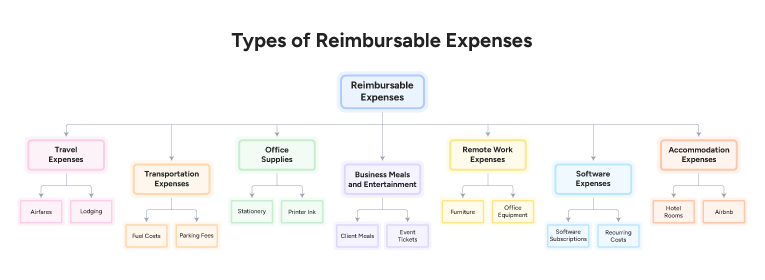
Categorizing approved expenses reduces confusion. A robust policy typically covers:
- Travel and Transportation: Costs incurred during business tours, including airfare, fuel, public transit, and daily commuting outside of normal office routes.
- Accommodation: Hotel stays and lodging expenses required during overnight business trips.
- Business Meals and Entertainment: Expenses related to client meetings, conferences, and approved team-building activities. For meals and incidental expenses during travel, the company may issue a standard per diem allowance based on the destination.
- Office Supplies: Ad-hoc purchases of daily office items like printer ink or stationery, specifically when department petty cash funds are unavailable.
- Remote Work & Software: Stipends for home office setups, internet service, or recurring digital software subscriptions required for daily tasks. After COVID-19, remote work arrangements have become popular. It covers expenses for setting up a home office and internet service, provided they align with the approved work from home policy.
3. Clear List of Non-Reimbursable Expenses
Explicitly stating what isn’t covered is just as important as stating what is. This section should prohibit personal travel extensions, luxury upgrades, traffic fines, and unauthorized personal gadgets to ensure compliance with local tax authorities.
4. Documentation and Submission Process
Require detailed, itemized receipts for all claims. Credit card statements alone are legally insufficient for audits. Outline a strict submission timeline (e.g., within 30 days of the expense). Encourage staff to utilize an automated expense management system to submit digital receipts, track claims in real time, and ensure compliance without manual paperwork.
5. Approval Workflow
Define the exact chain of command for expense approvals. Typically, an employee submits the claim to their direct manager, who verifies the business need, before it moves to HR or finance for final payout. A strict approval workflow helps mitigate the risk of expense fraud and prevent financial leaks.
6. Payment Methods and Timelines
Set clear expectations on how and when employees will get their money back. Specify the payment method (such as direct deposit or adding it to the next payroll cycle) and the expected processing time after a manager approves the claim.

What is the Difference Between an Expense Policy and a Reimbursement Policy?
An expense policy outlines the rules for which expenses are allowed and how they should be managed within a company. In contrast, a reimbursement policy defines the process by which employees are paid back for business expenses they’ve already incurred.
| Aspect | Expense Policy | Reimbursement Policy |
|---|---|---|
| Definition | A set of guidelines that define what expenses are allowed and how they should be managed. | A policy that defines how employees are repaid for expenses they’ve already incurred. |
| Purpose | To set rules for spending and managing expenses within the company. | To outline how employees can claim and receive payment for their approved expenses. |
| Focus | Focuses on acceptable expenses, spending limits, and approval procedures. | Focuses on the process and timelines for reimbursing expenses. |
| Scope | Covers all types of business-related expenses (e.g., travel, meals, supplies). | Covers the process of submitting claims and receiving reimbursement for eligible expenses. |
| Pre-Expense vs Post-Expense | Mostly applied before the expense is made (e.g., approvals, caps). | Applied after the expense is made (e.g., submitting receipts and getting reimbursed). |
| Process | Pre-approval process for expenses and setting spending limits. | Post-approval process for submitting claims and receiving funds for those expenses. |
| Concern | What is allowed to be spent and under what conditions? | How and when employees get paid back for what they’ve spent. |
| Examples | Travel expenses, office supplies, entertainment, and training costs. | Reimbursing employees for out-of-pocket travel, meals, office supplies, etc. |
Disclaimer
This policy template provides general guidelines and should be used as a reference. It does not consider all relevant local, state, or federal laws. It is not a legal document. The author or factoHR will not assume any legal liability for using this policy.


Transform your HR operations with factoHR today
Choose a perfect plan satisfying your business demands and let factoHR handle all your HR’s tasks efficiently.

© 2026 Copyright factoHR