
Teamwork Makes the Dream Work: Meaning & Strategies

Table of Contents

Teamwork makes the dream work This concept is true for organizational success. Overcoming the challenges of working in groups can help teams perform better. Trust, clear communication, shared goals, and inclusion are some key elements that make teams more efficient.
Investing in team-building activities, setting clear goals, and recognizing group achievements can help organizations create a positive work environment. Organizations benefit from improved problem-solving, productivity, innovation, and employee engagement when individuals collaborate.
Key Takeaways
- Teamwork makes the dream work, as working in teams brings numerous benefits for individuals and organizations.
- Working together toward shared goals with mutual responsibility improves performance, morale, innovation, and problem-solving.
- Leadership plays a crucial role in guiding and supporting team members.
- Clear communication and trust are the pillars of strong teams.
- Team-building activities, recognition, continuous feedback, and setting clear goals help organizations build stronger teams.
What does “Teamwork Makes the Dream Work” Really Mean?
The phrase “teamwork makes the dream work” means that goals become more achievable when people work together. It highlights the importance of collective effort, shared responsibility, and cooperation in achieving individual and organizational success.
This concept became widely popular when motivational speakers repeatedly used it in the workplace to encourage collaboration. Leadership experts promoted it by emphasizing the importance of teamwork in improving work ethics and productivity.
Businesses face complex challenges, work under tight deadlines, and must continue innovating. To keep pace with the fast-changing demands of today’s workplace, companies depend on strong teamwork to achieve lasting success.

Key Elements of Effective Teamwork
Strong teams rely on these essential elements for success:
Trust and Transparency
A positive team culture creates respect, eliminates uncertainty, and fosters psychological safety. As people trust each other’s intentions and abilities, it helps teams stay focused on shared goals rather than personal issues, strengthening the overall work ethics in the organization.
Transparency clarifies expectations, responsibilities, and decisions, thereby preventing conflicts and improving coordination. High transparency in teams directly supports better employee retention over time.
Shared Goals and Mutual Accountability
When roles and responsibilities within a team are well defined, it makes team members accountable and committed to the work they are assigned. Regular communication of the team’s vision, especially in virtual teams, keeps everyone focused on achieving the same outcomes.
Diversity and Inclusion in Teamwork
Teams with individuals from diverse backgrounds, experiences, and perspectives perform better, as each member brings their unique ideas and problem-solving capabilities to the team, strengthening overall workforce diversity.
Inclusion ensures that every member’s insight is heard and respected. Thus, diversity and inclusion create an environment where people feel motivated to perform their best.
Benefits of Teamwork in the Workplace
Effective teamwork creates measurable value for both employees and organizations.
Improved Problem-Solving and Innovation
Different viewpoints of team members allow teams to review challenges from multiple angles and explore practical, holistic solutions, a process strengthened by systems that track employee productivity. When team members collaborate, it improves information processing, enabling them to adopt helpful ideas and make informed decisions.
Teamwork also plays a key role in driving innovation. While an individual may suggest one solution, a group generates a broader range of ideas. New thinking emerges when people with varied backgrounds and experiences work together. Diverse teams are more creative, understand challenges more clearly, and consistently perform better than uniform groups.
Higher Morale and Employee Engagement
Teamwork builds a positive work environment where employees feel supported and valued, creating stronger employee engagement. When collaboration is based on respect, open communication, and mutual understanding, employees are more willing to cooperate and support one another during challenges.
Working in supportive teams boosts motivation, reduces stress, and increases productivity and reduces turnover. Research from the University of Warwick also shows that happier employees can be up to 12 percent more productive, reinforcing this link between well-being and performance.
Faster Achievement of Organizational Objectives
In today’s work environment, it is difficult for individuals to address complex business problems independently. When employees use their specialized skills within a collaborative setting backed by structured performance management systems, it helps organizations achieve their objectives quickly while maintaining quality.
Teamwork enables organizations to achieve goals more efficiently by sharing responsibility and reducing work pressure. Clear accountability within teams ensures work is delegated correctly, improving quality and ensuring timely completion.
Employee Skill Enhancement
When individuals collaborate within teams, they gain exposure to different working styles, ideas, and problem-solving approaches. Regular interaction helps employees identify both their strengths and areas for improvement. Peer feedback helps employees avoid repeated mistakes and improve their working methods.
Skills such as communication, listening, time management, and critical thinking improve naturally through daily collaboration, with structured training and development reinforcing these gains. As employees grow individually, their improved capabilities strengthen the team’s overall performance.
Challenges Teams Often Face
Even well-managed teams can face challenges that can affect collaboration, productivity, and trust.
Ego and Unhealthy Competition
Ego and unhealthy competition arise when individuals focus more on personal recognition than on team success. Instead of sharing knowledge or supporting others, team members may focus on getting credit or avoiding extra work patterns often seen as signs of bad leadership if left unchecked. This mindset can lead to poor communication, lack of cooperation, and unnecessary conflicts.
Miscommunication or Lack of Clarity
Poor communication results in misunderstandings, delays, and errors, particularly in fast-paced or remote work environments, which directly undermines organizational objectives.
Unclear Roles and Responsibilities
When roles and responsibilities are not clearly defined, team members may duplicate work or overlook critical tasks. This creates confusion, delays, and frustration within the team. Also, accountability/workflow becomes disorganized, and overall team efficiency declines.
Resistance to Feedback
Feedback is essential for identifying mistakes, improving performance, and learning new skills. When team members are unwilling to accept constructive feedback, it affects both individual progress and overall team development.
Limited Collaboration Skills
Team members must possess active listening, clear communication, cooperation, and conflict resolution skills. When team members lack these skills, team coordination breaks down, and misunderstandings increase.
Strategies to Strengthen Teamwork and Overcome Challenges
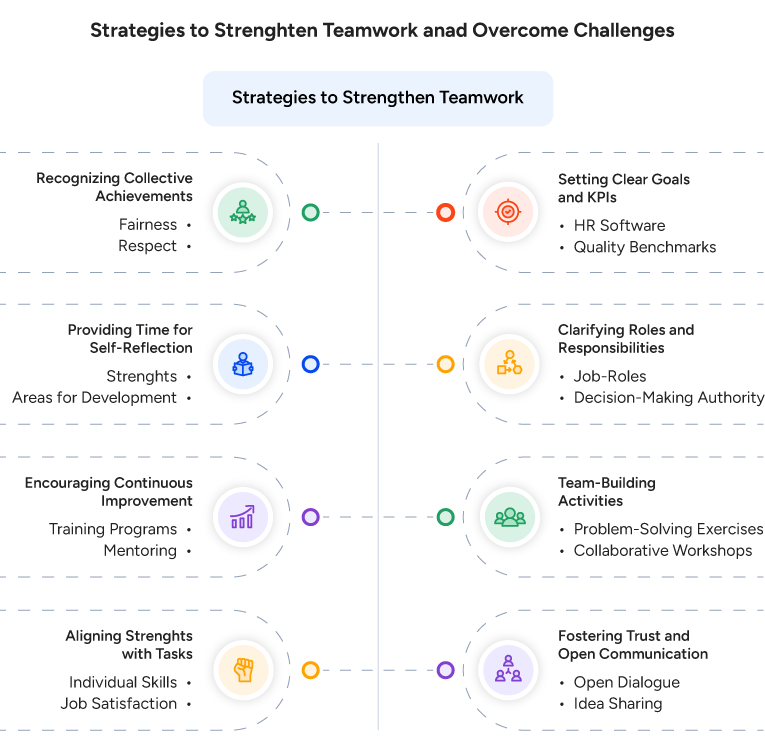
Teams perform effectively when common challenges are addressed through the following practical strategies:
Setting Clear Goals and KPIs
Organizations should define clear objectives and measurable KPIs for every team using HR software to track and centralize these metrics. Defining quality benchmarks for every role provides performance expectations. Regular tracking and reviews should be conducted to monitor progress, along with providing timely feedback, and keep teams aligned with overall business priorities.
Clarifying Roles and Responsibilities
Document and share job roles and decision-making authority at the start of each project to avoid confusion among team members. Managers should review and adjust responsibilities as workloads or priorities change to maintain smooth coordination.
Team-Building Activities
Organizations should plan problem-solving exercises, collaborative workshops, or off-site retreats. Team-building activities strengthen relationships and improve collaboration. The focus should be on improving communication, encouraging cooperation, and helping employees understand each other’s working styles and strengths.
Fostering Trust and Open Communication
Open dialogue and idea sharing strengthen team relationships, build trust, and reduce misunderstandings. When leaders initiate discussions, employees feel confident in expressing their views.
Aligning Strengths with Tasks
Responsibilities must be assigned based on each team member’s strengths to accomplish tasks efficiently and to a high standard. When tasks align with individual skills, it improves confidence, engagement, and overall job satisfaction.
Encouraging Continuous Improvement
Encourage teams to update their skills through training programs, mentoring, and learning opportunities. Focusing on continuous improvement helps teams adapt to change, improve efficiency, and maintain consistent progress toward long-term goals.
Providing Time for Self-Reflection
Self-reflection helps individuals improve their contribution to the team. Employees should be given time and space to reflect on their strengths, interests, and areas for development to support better role alignment, career planning, and personal accountability.
Recognizing Collective Achievements
When leaders value teamwork and recognize collective achievements, employees are more likely to collaborate and work toward common goals. Effective leadership styles promote fairness, respect, and shared responsibility within the team. It also improves morale and builds loyalty.

Conclusion
For any organization, teamwork is crucial to workplace success. Teams may achieve results more quickly and efficiently than individuals. Mutual trust, open communication, and working toward shared goals improve the team’s performance across all areas.
Leadership support, transparent processes, and consistent encouragement help teams overcome challenges. Organizations that invest in strong teamwork build a culture of cooperation, steady growth, and long-term success.



Grow your business with factoHR today
Focus on the significant decision-making tasks, transfer all your common repetitive HR tasks to factoHR and see the things falling into their place.