
Employee Rehire Policy Template (Free Sample & Guide)
Download Employee Rehire Policy Template PDF Format For Free

Table of Contents

Key takeaways:
- An employee rehire policy provides clear rules for rehiring former employees (often called “boomerang employees”) to ensure fairness and consistency.
- The core components include eligibility criteria, ineligibility rules, reinstatement of seniority, and a defined evaluation process.
- This article includes a customizable Former Employee Rehire Policy Template.
- Best practices involve proper documentation, fair decision-making, and compliance with local labor laws.
A rehire policy guides a company to make an informed decision when a former employee wants to rejoin the organization. Without clear rules, HR may face uncertainty about how to accommodate returning employees under the new organization’s rules. A firm policy provides a consistent approach, enabling HR and managers to make confident and fair rehire decisions.
Simple Employee Rehire Policy Template
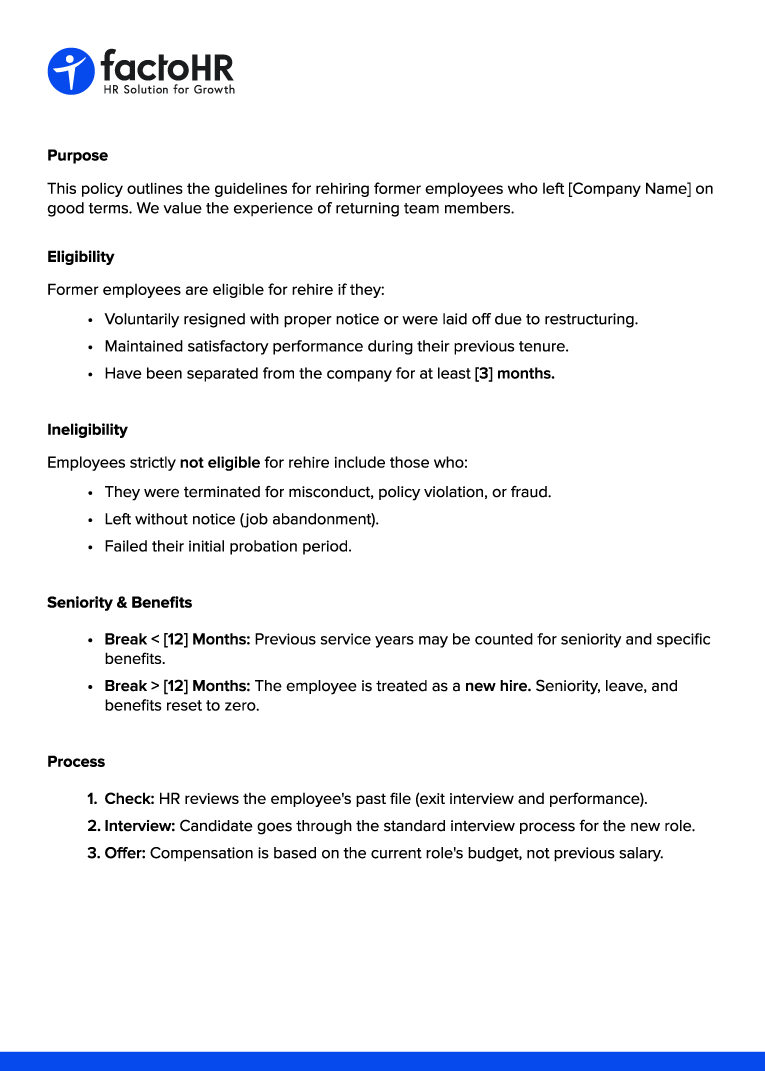

Key Components of a Standard Rehire Policy
A clear employee rehire policy works effectively when its key components are well-drafted.
Eligibility Criteria
A strong policy clearly states who can return. It sets out straightforward criteria for work history, performance, completion of notice periods, and past conduct.
Ineligibility
The policy should prohibit rehiring employees terminated for misconduct, fraud, or serious policy violations.
Seniority and Benefits Reinstatement
The policy must state what returning employees are entitled to regarding leave balances, gratuity, and tenure recognition.
The Hiring Process
Outlines the steps HR takes to review old files, confirm eligibility, and conduct interviews.
Downloadable Employee Rehire Policy Template
Policy Brief and Purpose
This policy explains how we handle the rehiring of former employees. At times, it may be helpful and cost-effective to bring back people who have previously worked with us and performed well. This document describes when a former employee may be rehired and the rules we follow.
Scope
This policy applies to employees who have permanently left the company.
It does not apply to employees who are on medical leave, parental leave, or any other long-term approved leave.
Policy Elements
Former employees are allowed to apply for open positions. However, this policy explains the conditions under which they may be considered for rehire.
A former employee may be considered for rehire if they left the company for one of the following reasons:
- Voluntary resignation
- Company lay-offs
- Contract expiration
- Termination for reasons not related to illegal or unethical behavior
Eligible former employees can apply for a role after a minimum of [4] months from their last working day.
The only exception is employees whose contracts have expired. They may request a contract renewal immediately, and the company may consider it.
Employees Who are Not Eligible for Rehire
Employees who were terminated for misconduct or who left their job without notice (job abandonment) are not eligible for rehire.
If there is a strong reason to rehire such employees, senior management must review and approve the decision. Examples of acceptable reasons include:
- A court order requiring the company to rehire the employee.
- Reliable evidence that the employee’s past behavior will not be an issue anymore. In such cases, the company may consider rehiring, but is not obligated to do so.
There are two additional conditions for rehire. Former employees must have:
- Completed their probation period when they were first hired.
- Performed their duties satisfactorily during their employment.
Employees who accepted a job offer letter but did not report for work on their first working day will not be considered for rehire for [6] months unless they have a serious and valid reason, such as a medical emergency.
If the company decides to rehire retired employees, we will follow all applicable legal requirements.
Employee Status and Benefits
Former employees who worked with the company for less than [12] months will be treated as new hires if they return. New hires may need to complete the full hiring and onboarding process, either fully or partially.
Former employees who worked with the company for more than [12] months may not need to repeat all new-hire procedures. Their previous service may count toward seniority and certain benefits, such as stock options or sick leave accrual. However, these benefits are granted at the company’s discretion.
To qualify for these benefits, the employee must not have been away from the company longer than they were employed. For example:
- If an employee worked for 3 years and was absent for 4 years, they will be treated as a new hire.
- Employees are eligible for benefit reinstatement if their break in service is shorter than their previous tenure with the company.
In all cases, any employee who has been away for more than 5 years will automatically be considered a new hire.
Fair Decisions
Our company is committed to equal opportunity in all hiring decisions. We do not discriminate based on any protected characteristic.
All former employees being considered for rehire will be treated fairly, without discrimination or unfair rejection.
Procedure
When a former employee applies for a job or reaches out about rejoining, the following steps must be followed:
- HR reviews records
- HR will verify the employee’s past performance records to confirm whether they are eligible for rehire.
- Eligibility and qualification check
- If eligible, the hiring manager will review whether the former employee is suitable for the specific role.
- If not eligible, HR will inform the former employee.
- Next steps for eligible candidates
- If the former employee is qualified, the hiring manager will contact them to proceed with the hiring process. This may include an interview, a screening test, or even a direct job offer.
- If the employee is eligible but not qualified for that role, the hiring manager will inform them. They may still apply for other positions.
The company may also choose to contact former employees on its own. Their eligibility must be checked before doing so.

Best Practices for Implementing a Rehire Policy
A rehire policy works effectively when it is applied with clear steps and consistent actions. The points below show the most trusted methods for using a rehire policy in real workplace situations.
Create Clear Rules
Write simple steps for your rehire policy so everyone understands how rehiring works.
Train Managers and HR
Train them how to review files, check rehire eligibility, and follow the same process each time.
Keep Records Updated
Store exit notes, performance history, and reasons for leaving. This helps you review a former employee quickly.
Communicate the Policy
Share the former employee rehire policy with all employees and ensure they understand the rules that apply after a resignation letter.
Use a Fair Evaluation
Check behaviour, performance, and company needs. Avoid bias in every decision.
Review the Policy Often
Update it when company goals change or new laws apply.
Track Results
Measure how many returning employees succeed. Use this data to improve your rehiring policy.
Final Notes
A strong rehire policy makes the whole process easy to understand and fair for everyone. It sets simple rules, cuts down bias, and helps HR make clear decisions. It also sets clear expectations for returning employees. When a company follows this policy well, it improves the quality of hiring and strengthens long-term ties with skilled people who choose to return. This makes the experience smoother for both the company and the employee.

FAQs about Rehiring Former Employees
What is a Boomerang Employee Policy?
A boomerang employee policy describes how a company handles the return of a former employee. It explains who can come back, what benefits they may receive, and the steps taken to hire them fairly again.
What is the Difference between a Rehire and a Reinstatement?
A rehire joins again as a new hire. A reinstatement brings the person back to the same role, benefits, and status without starting over. The company decides this based on the employee’s reason for leaving.
Why is an Employee Rehire Policy Important?
A rehire policy clears up confusion. It sets simple rules for eligibility, benefits, and the steps in the hiring process. It also helps the company make fair decisions and reduces bias when they review former employees.
What Should an Employee Rehire Policy Include?
It should list eligibility rules, ineligibility cases, hiring steps, seniority decisions, and benefit reinstatement. It must also guide managers on fair evaluations of returning employees.
How does the Policy Handle Employees Who Left Due to Company Lay-Offs?
Most companies allow laid-off employees to come back. HR simply checks how they performed earlier, what skills they have, and whether the company currently has a real need for their role before calling them again.
Is It a Good Idea to Rehire Former Employees?
Yes, when they left on good terms. They know the culture, need less training, and can quickly add strong skills to the team.
What Employees are Ineligible for Rehire?
Employees involved in fraud, misconduct, or major policy violations are usually not eligible. HR also checks behaviour, performance history, and the reason for leaving. These reviews help the company decide which former employee can return.
How do You Calculate Gratuity for a Rehired Employee?
Gratuity is calculated separately for each period of service. If there is a long gap between jobs, companies count every period as a separate cycle. HR adds the years together only when the break fits the company’s rules for continuous service.
What Questions Should I Ask a Boomerang Employee?
You can ask why they left earlier, why they want to return now, what new skills they have gained, and how they plan to add value. Their answers give a clear picture of their growth, motivation, and fit for the role.
Disclaimer
This policy is meant to give general guidance and should be used as a reference. It may not include all laws that apply at the local, state, or federal level and should not be treated as a legal document. The author and factoHR are not responsible for any legal issues that may arise from using this policy.



Transform your HR operations with factoHR today
Choose a perfect plan satisfying your business demands and let factoHR handle all your HR’s tasks efficiently.