
Company Car Policy Template | Free Download
Free Company Car Policy Template in PDF Format

Table of Contents

A company vehicle policy explains how company-owned or company-leased vehicles are provided, used, and managed for official work purposes. It helps employees understand when they are eligible to use a company vehicle and the responsibilities that come with it.
Company Car Policy Template
This ready-to-use company vehicle policy template outlines the rules and responsibilities for employees assigned a company-provided vehicle. Companies may adapt this template to align with their HR policies and procedures.
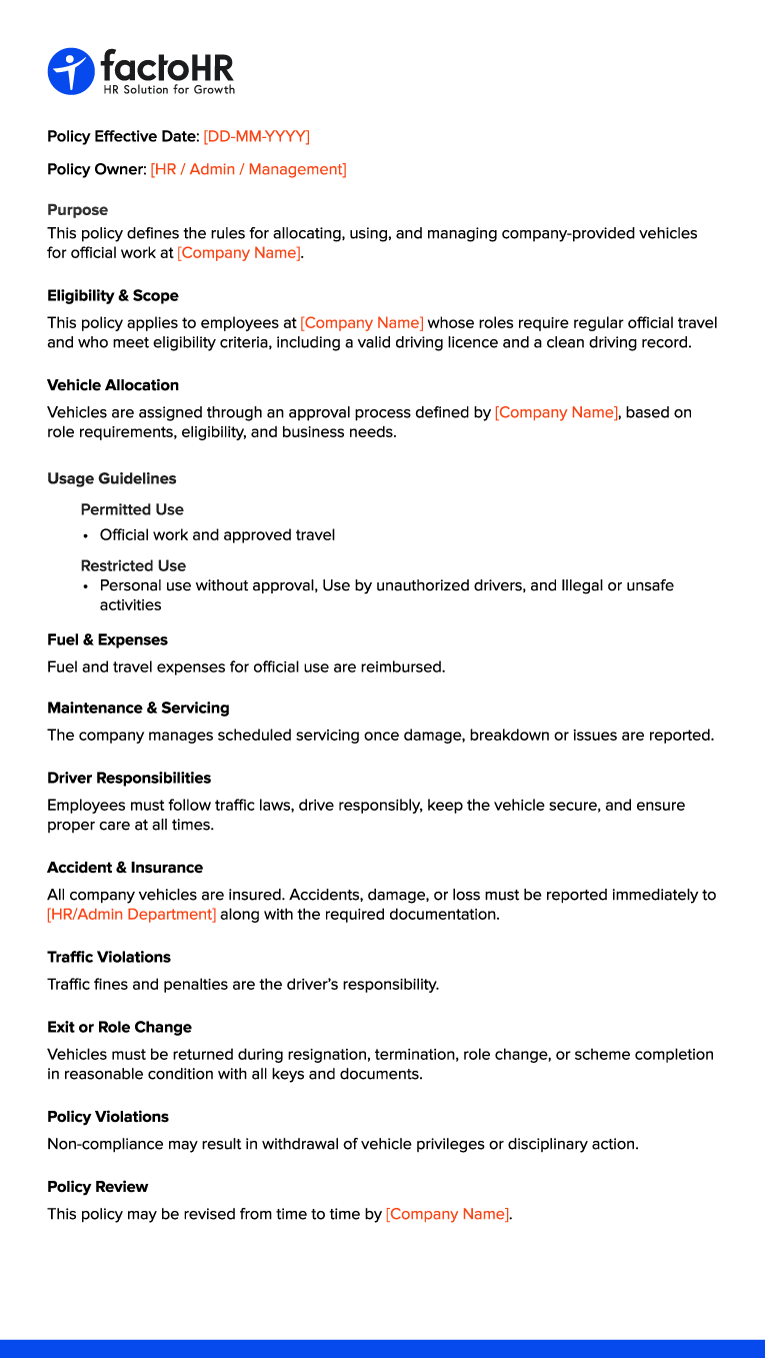

Company Car Policy Sample
Purpose
[Company Name] provides vehicles to support employees in performing official work that requires regular travel. This policy explains the rules for the allocation, use, and management of company-provided cars.
Eligibility & Scope
This policy applies to employees who require a company vehicle to perform their job duties. Eligibility is based on business need, operational requirements, position level, performance, or tenure.
The following individuals may be eligible to apply:
- Individuals under an official employment agreement with[Company Name]
- Roles involving regular official travel or driving more than [Number of kilometres] per month
- Positions where vehicular travel is a primary job requirement
- Entitlement to a company car as part of assigned job benefits
- A valid driving licence and a clean driving record, with no major traffic violations or at-fault accidents for at least [X] years
Types of Company Vehicles
The company may offer one of these categories of vehicles to employees who qualify:
- Company-owned vehicles
- Company-leased vehicles
- Pool vehicles assigned for official use
The type of vehicle provided depends on role requirements and availability:
- Executive Vehicles: Luxury or high-end models for senior management
- Standard Vehicles: Mid-range models for sales and field staff
- Specialty Vehicles: For specific needs, such as transporting equipment
Vehicle Allocation
- Employees must apply through HR or their manager to request a company car
- Applications are reviewed based on role requirements, business needs, eligibility, and vehicle availability
- Vehicle allocation is approved by the authorized company representative
- Once approved, the employee will receive the vehicle and required documents
- The employee must acknowledge receipt of the company car
Usage Guidelines
Employees who are allotted company vehicles must follow these usage guidelines for approved, responsible use.
Permitted Use
- Employees may use the company vehicle for official work-related travel approved by their reporting manager.
- Employees may use the company vehicle for personal purposes outside working hours only with prior approval.
- Personal use must not interfere with business operations or official responsibilities.
Restricted Use
- The allotted company vehicle must not be used by anyone other than the authorized employee or drivers.
- Employees must refrain from excessive personal use or from using resources unrelated to business needs.
- Employees must not use the officially allotted vehicle for illegal, unsafe, or non-approved activities that violate company rules or applicable guidelines.
Fuel & Expense Policy
Employees must follow these guidelines to get reimbursement for the company vehicle expense:
- Fuel expenses for official travel are reimbursed in accordance with company guidelines.
- Personal fuel expenses are not reimbursable unless specifically approved.
- Employees must maintain and submit required expense records for reimbursement and applicable tax purposes.
Maintenance & Servicing
Employees must ensure the following for regular servicing and maintenance of company-owned or leased vehicles.
- The company covers regular maintenance and scheduled servicing of company vehicles.
- The vehicle must be serviced on time, in line with manufacturer recommendations or company instructions, at authorized service centers or as specified by the company.
- All company vehicles must comply with applicable state transport regulations and safety requirements.
- Vehicle registrations and insurance policies must be renewed on time to ensure uninterrupted use.
- Any mechanical issues, damage, or breakdowns must be reported immediately to HR or the designated team.
- Seek prior approval for major repairs, where applicable.
Driver Responsibilities
Employees assigned a company vehicle are expected to use it responsibly and follow company guidelines. They must:
- Hold a valid driving licence for the assigned vehicle category.
- Follow all traffic laws and local driving regulations.
- Drive safely, responsibly, and only when fit to do so.
- Maintain a clean driving record and inform HR if the driving licence is suspended or revoked.
- Keep the vehicle clean, secure, and in usable condition at all times.
- Ensure required vehicle documents and proof of insurance are available during use.
- Avoid smoking inside the company vehicle.
- Do not lease, sell, lend, or allow unauthorized persons to drive the company car.
- Ensure the vehicle is not left unlocked or unattended.
- Commit to driving sober, avoiding alcohol or drugs that impair judgment.
Accident, Damage & Insurance
This company car policy for employees in India must follow these standard procedures during an unforeseen event:
- All company vehicles are covered under company-arranged insurance.
- In the event of an accident, damage, theft, or loss, employees must inform HR immediately so that insurance support can be initiated.
- Employees should comply with legal requirements when exchanging information with other parties involved.
- Notify local authorities of serious accidents, as required by law.
- Employees must submit all the necessary details and documents for insurance or internal review.
- Employees must cooperate during insurance claims or internal investigations.
- Employees should not accept responsibility or guarantee payment to any party involved in an accident unless authorized by the company.
Traffic Violations
In any instance, if traffic fines and penalties are imposed while the vehicle is in use, they will be the sole responsibility of the driver. Repeated violations may be reviewed by management and may result in disciplinary action.
Parking & Toll Charges
Parking and toll charges for official travel are reimbursable as per policy. However, employees must note that charges incurred during personal use are not reimbursed.
Exit/Transfer Policy
This section defines the process for returning company vehicles during role changes or exits.
- As part of the employee exit policy, A company vehicle must be returned when an employee resigns, is terminated, changes roles, or when the vehicle lease or scheme ends.
- The company may also require the vehicle’s return if policy conditions are not met or maintenance standards are not followed.
- The vehicle must be returned in reasonable condition, consistent with normal wear and tear.
- Before returning, the vehicle should be cleaned and all personal belongings removed.
- All keys, documents, accessories, and items issued with the vehicle must be handed over.
- The vehicle will be inspected for damage or excessive wear and tear upon return.
- Any outstanding costs, damages, or charges may be deducted in the final settlement, where applicable.
- Return terms may vary depending on whether the vehicle is company-owned or leased, and will follow the applicable scheme conditions.
Policy Violations & Disciplinary Actions
Failure to comply with the company car policy for employees will result in disciplinary action, based on the nature and severity of the violation, and in line with the company’s disciplinary policy.
Warnings (Verbal or Written)
- Given for minor or first-time policy violations
- Repeated traffic fines while using the company car
- Allowing unauthorized people to drive the company vehicle
- Using the vehicle without approval
- Not following reporting or documentation rules
Loss of Car Privileges
- Applies when violations continue after a warning
- Company car access may be temporarily or permanently removed
- The employee may no longer be eligible to use the company vehicle
Suspension, Demotion, or Reassignment
- Applied in cases of serious misconduct
- Leasing or using the company car for personal financial gain
- Misuse of the vehicle resulting in damage or legal liability
- Serious negligence or repeated non-compliance with the policy
- The employee may be reassigned to a role that does not include company vehicle eligibility
Termination and Legal Action
- Applied in cases of severe or unlawful violations
- Causing an accident while driving under the influence of alcohol or drugs
- Intentional misuse leading to major financial or legal risk for the company
- Any action that violates the law or seriously harms the company’s interests
- The company may take legal action where necessary
Policy Review
- The company reserves the right to revise this policy.
- Any changes will be communicated to employees promptly
Not Sure Which HR Policies Your Organization Needs?
Access Ready-To-Use Templates that Save Time and Simplify Your HR Process.
Benefits of a Company Car Policy for Employees
A company car policy offers several benefits to employees, including:
Lower Out-of-Pocket Travel Costs
A company car reduces the need for employees to spend their own money on fuel, maintenance, and other work-related travel expenses.
More Efficient Salary Structuring
In some cases, company-provided vehicles can be structured in a tax-efficient way, helping employees better manage their take-home pay, subject to applicable tax rules.
Access to Well-Maintained Vehicles
Vehicles that are regularly serviced and insured by the company improve reliability and safety.
Flexibility for Work-Related Travel
A company car allows employees to travel for official work without depending on public transport or frequent reimbursements, making work travel more convenient.
Improved Comfort and Job Satisfaction
Reliable transportation support helps create a smoother work experience and allows employees to focus on their responsibilities without added travel-related stress.
What a Company Car Policy Includes
The following sections are commonly included in a company car policy.
- Purpose: Helps employees understand why company vehicles are provided and when they should be used for official work.
- Eligibility & Scope: Clarifies which employees may be eligible for a company car and the basic requirements.
- Vehicle Allocation Process: Describes how company vehicles are requested, approved, and assigned.
- Types of Vehicles: Explains the types of vehicles the company may provide based on job needs.
- Usage Guidelines: Guides the proper and responsible use of company vehicles.
- Fuel, Maintenance & Servicing: Clarifies responsibilities related to fuel expenses, servicing, and vehicle care.
- Insurance & Accident Handling: Provides steps to follow in case of accidents, damage, or theft.
- Traffic Fines & Legal Responsibility: Highlights employee responsibility for traffic violations while using a company vehicle.
- Return of Vehicle: Explains when a company vehicle must be returned.
- Policy Violations: Outlines the consequences of not following the policy.
- Termination & Legal Action: Covers serious violations that may lead to strict action.
- Policy Updates: Informs employees that the policy may be updated and how changes will be communicated.

Frequently Asked Questions
Who Can Use a Company Car in the Organization?
Employees who are approved and assigned a company car based on their role, tenure, performance, or business needs may use it.
Is the Company Car Policy Applicable to all Employees?
No. The company car policy applies to employees who are eligible or permitted to use company-provided vehicles for official purposes.
Can I Use a Company Car for Personal Work?
No. Personal use is not allowed unless the company has given specific approval.
What Approvals do I Need to Get a Company Car?
To get a company car, approval from authorized management or HR is required.
Who Will Cover the Fuel Expenses when I Use a Company Car?
Fuel expenses for official travel are covered in accordance with company guidelines, while those incurred for private use are not reimbursed.
Does the Company Car Policy Apply across all Locations in India?
Yes. The policy applies across all company locations in India, unless otherwise stated.
What Happens if I Don’t Follow the Company Car Policy?
If you fail to follow the company car policy, the company will review the non-compliance and may take corrective action.
Can the Company Update Its Company Car Policy in the Future?
Yes. The company can update the policy and will communicate any changes to employees.
Disclaimer
This Company Car Policy is for general guidance only and should be used as a reference and not legal advice. It may not address all applicable local or federal laws. Neither the author nor factoHR shall assume any legal liability arising from the use of this policy.



Transform your HR operations with factoHR today
Choose a perfect plan satisfying your business demands and let factoHR handle all your HR’s tasks efficiently.