
RACI Matrix Guide & Free RACI Template for HR Teams
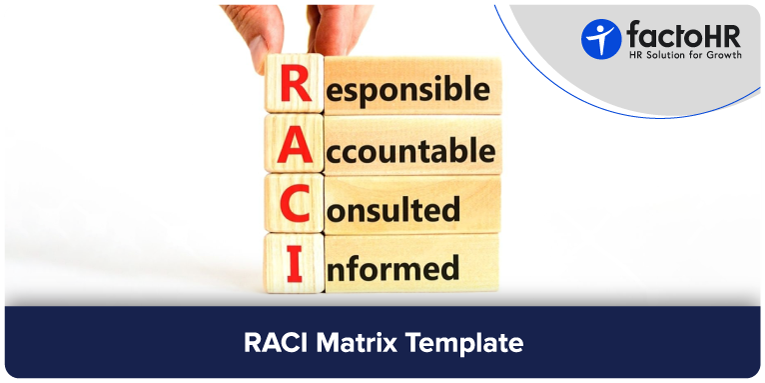
Table of Contents

Most teams struggle because responsibility lives in their heads rather than being on paper in a concrete form. This is where the RACI matrix quietly helps the most.
In essence, an RACI matrix clarifies who is Responsible, Accountable, Consulted, and Informed for a specific task. But, in real environments, it does more than define roles.
The RACI matrix reduces friction and feedback loops. The ‘I thought you were handling it’ moments come down to zero, and don’t slow down the team anymore.
This guide about the RACI matrix is for HRs, project managers, and cross-team operations who need to work without constantly following up. We will show you how to apply RACI in real scenarios, when it should be used, and how simple templates can clear confusion about transparent ownership.
Key Takeaways
- RACI matrix clarifies the role of everyone in a task and shows who’s accountable.
- It helps HR and Project teams become focused, avoid overlapping tasks, and speed up approvals.
- You will know what the RACI Matrix Full form is and what it means in practice.
- Real HR examples to showcase real-world use of the RACI matrix
- A simple step-by-step guide to building an impactful RACI matrix
- Ready to use RACI templates without starting from scratch
- See how RACI fits into modern, fast-moving workflows
What is an RACI Matrix?
An RACI matrix is a well-articulated framework to define who is responsible, accountable, consulted, and informed for each task or decision. It makes responsibility visible. Who does the work, who owns a decision, who needs an opinion, and who should be updated is all crystal clear. For HR and business teams where unclear ownership is a frequent issue, the RACI matrix creates smooth work processes and faster execution.
Free RACI Templates You Can Use
- RACI Template for HR Projects
| Purpose: Define responsibilities for HR projects (e.g., recruitment drives, policy rollouts, HR system implementation). Ensures ownership, accountability, and communication clarity. | |||||||
| Task / Activity | HR Manager | HR Ops | Recruitment Team | Payroll Team | Finance | IT | Explanation |
|---|---|---|---|---|---|---|---|
| Project kickoff & timeline creation | Accountable | Responsible | Consulted | Informed | Informed | Informed | HR Manager owns the project goals, HR Ops executes timeline planning, Recruitment/Finance/IT provide input or are updated. |
| Define project objectives & deliverables | Accountable | Responsible | Consulted | Informed | Consulted | Informed | HR Manager approves objectives, HR Ops drafts details, others provide feedback or are kept in the loop. |
| Resource allocation (budget & staff) | Accountable | Responsible | Consulted | Consulted | Consulted | Informed | HR Manager ensures resources meet needs; HR Ops executes allocation; Finance validates budget. |
| Stakeholder consultation & sign-offs | Accountable | Responsible | Consulted | Informed | Consulted | Informed | HR Manager approves, HR Ops coordinates meetings; other teams consulted for input. |
| Execution & monitoring of HR tasks | Responsible | Accountable | Consulted | Informed | Informed | Informed | HR Ops executes tasks; HR Manager monitors progress and ensures accountability. |
| Final project review & reporting | Accountable | Responsible | Informed | Informed | Consulted | Informed | HR Manager signs off; HR Ops prepares reports; Finance validates numbers if budget impacted. |
- RACI Template for Employee Onboarding
| Purpose: Assign clear ownership for every step of employee onboarding, from documentation to orientation and IT setup. | |||||||
| Task / Activity | HR Manager | HR Ops | IT | Hiring Manager | Payroll | New Employee | Explanation |
|---|---|---|---|---|---|---|---|
| Collect employment documents | Accountable | Responsible | Informed | Informed | Informed | Responsible | HR Manager ensures all documents are requested; HR Ops collects and verifies; employee submits documents; IT/Payroll are updated. |
| System access setup (email, ERP, LMS) | Informed | Consulted | Responsible | Informed | Informed | Informed | IT executes system setup; HR Ops ensures approvals; managers and employees are informed. |
| Orientation scheduling | Accountable | Responsible | Informed | Consulted | Informed | Informed | HR Manager approves schedule; HR Ops organizes sessions; manager consulted for timing; employee informed. |
| Training session enrollment | Responsible | Accountable | Informed | Consulted | Informed | Informed | HR Ops ensures employee attends sessions; HR Manager tracks compliance; manager consulted for role-specific training. |
| Policy acknowledgment tracking | Accountable | Responsible | Informed | Informed | Consulted | Responsible | HR Manager oversees; HR Ops tracks; payroll and IT informed; employee signs off policies. |
| First week check-in & feedback | Accountable | Responsible | Informed | Responsible | Informed | Informed | HR Manager monitors onboarding success; HR Ops coordinates; Hiring Manager provides feedback on employee integration. |
If these onboarding responsibilities involve too many manual handoffs between HR, IT, payroll, and managers, reviewing the best employee onboarding software in India can help you find a platform that automates tasks while keeping ownership clear.
- RACI Template for Payroll Tasks
| Purpose: Assign responsibilities for payroll processing, approvals, compliance, and reporting to avoid errors and delays. | ||||||
| Task / Activity | Payroll Manager | HR Ops | Finance | IT | Employees | Explanation |
|---|---|---|---|---|---|---|
| Salary calculation | Accountable | Responsible | Consulted | Informed | Informed | Payroll Manager owns calculations; HR Ops executes; Finance validates deductions; IT/Employees informed. |
| Payroll approval | Accountable | Informed | Responsible | Informed | Informed | Payroll Manager signs off; Finance approves payments; HR Ops/IT/Employees informed. |
| Tax deduction & statutory compliance | Accountable | Consulted | Responsible | Informed | Informed | Payroll Manager ensures compliance; Finance executes tax deposits; HR Ops consulted; IT/Employees informed. |
| Payroll disbursement | Accountable | Responsible | Consulted | Informed | Informed | Payroll Manager owns; HR Ops executes; Finance reviews; IT/Employees informed. |
| Payroll reporting | Accountable | Responsible | Consulted | Informed | Informed | Payroll Manager approves; HR Ops prepares reports; Finance validates; IT/Employees informed. |
| Employee payroll queries | Responsible | Consulted | Informed | Informed | Accountable | HR Ops handles questions; Payroll/Finance provide guidance; Employee’s query is closed with accountability to employee experience. |

The 4 Core Roles of RACI Explained
An RACI matrix works because it breaks down roles into four easy-to-follow roles. Each role now answers a different question. Together, it becomes a responsibility matrix that removes the gray areas and helps teams pivot toward their goals.
Responsible (the Doers)
Responsible means the person or the team that actually executes the task. There can be multiple responsible parties for a single project. This is similar to how HR and payroll responsibilities are divided in most companies.
It answers: Who is doing the work?
Accountable (the Owners)
Accountable refers to the single owner of the outcome. This role makes sure that the tasks are completed correctly and on time. In a RACI matrix template, there should always be one and only one accountable role assigned.
It answers: Who is ultimately the person accountable for a task?
Consulted (the Advisors)
Consultation refers to the stakeholders of a project. These stakeholders are supposed to provide input before the process moves forward. In an RACI chart template, they provide their expertise and validation but do not necessarily execute a task.
This role answers: Who needs to be asked before we decide?
Informed (the Followers)
Informed refers to the stakeholders who merely need updates but are not involved in a task. They are updated after decisions are made or major checkpoints are crossed.
This role answers: who needs to know that something happened?
Cohesively, these four roles make the RACI matrix full form much more than a definition. They turn it into a practical responsibility mantra that teams can depend on.
How to Create a RACI Matrix: Step-By-Step Guide
You don’t need complex tools or a heavy project management ideology to create an RACI matrix. If you have basic structured thinking and can align roles, it is quite effortless to do. Let’s see a practical way to build a RACI chart that is actually useful.
List all Tasks and Deliverables
Be specific and start writing all minor tasks, activities, or decisions involved in a task. Don’t write broad items like ‘employee onboarding’. Break it into realistic minor steps like document collection, HR document management, system setup, and induction. A detailed task list reflects the work that truly happens, and not a scattered plan of action.
Define the Team Roles Involved
Identify the roles involved in the process. Not individuals, but roles, so ownership is never missed. This way, if people change, your responsibility matrix template can become adaptable. For example, in HR workflows, the roles could look like: HRops, Payroll manager, IT, Finance, or Vendors.
Assign R, A, C, and I to each Task
For every task, assign each role to an individual. Define who is Responsible, Accountable, Consulted, and Informed. The most important rule is that each task should have an accountable role. This way, you have ownership, execution, expertise, and visibility on one page.
Review and Validate with Stakeholders
A RACI chart should never be created without a stakeholder context. Get the matrix checked by important stakeholders so expectations and reality are not left unchecked. Any conflicts that arise early can be resolved. What matters most is that you have real authority and decisions, rather than misguided assumptions.
Update and Iterate over Time
A RACI matrix is not a one-time document. The way teams can scale, roles can evolve, and processes can change, your matrix should be updated with each modification. Your RACI matrix sample should be a living document that grows with your team.
RACI Matrix Example: Marketing Campaign Launch
| Task / Activity | Marketing Manager | Head of Marketing | Content Team | Design Team | Sales Team |
|---|---|---|---|---|---|
| Campaign brief & goals | Responsible | Accountable | Consulted | Informed | Consulted |
| Messaging & content creation | Accountable | Informed | Responsible | Consulted | Consulted |
| Design creatives | Informed | Informed | Consulted | Responsible | Informed |
| Review & approval | Responsible | Accountable | Consulted | Consulted | Informed |
| Campaign launch | Responsible | Informed | Consulted | Informed | Informed |
| Performance tracking & reporting | Responsible | Accountable | Consulted | Informed | Consulted |
Why does this Work 100%?
- The Marketing Manager is the one responsible for executing and coordinating tasks.
- The Head of Marketing is accountable for results, task priorities, and final approvals.
- Content and Design would always focus on execution, rather than finalizing details.
- Sales is always consulted where market input matters; they do not execute any task.
When done correctly, an RACI matrix turns the most complex teams and projects into visible plans. No more confusion, plain smart work.

When HR Needs a RACI Matrix
HRs need to use an RACI matrix whenever work slows down due to vaguely assigned responsibilities. Which signals should you watch out for?
- When tasks start getting overlooked (use RACI to assign responsibility to get things done)
- When approvals take too long (use RACI to clear who has the final say, so there are no approval delays)
- When too many people are involved, or you notice recruitment challenges (use RACI to define specific roles so there is no disorder)
- When HR depends on managers or other teams (use RACI to set clear expectations)
- When the same issues repeat every cycle (use RACI to pinpoint missing and unclear ownership in the process)
- When communication feels messy (Use RACI so your team can share the right info with the right people)
- When teams grow, or processes change (RACI keeps roles clear even as work becomes more complex.)
RACI is also often seen to be useful in training and development processes, where HR, managers, and employees all share ownership in different stages. In short, if HR work feels unclear, slow, or dependent on assumptions, a RACI matrix is the simplest way to restore clarity and control.
Benefits of Using RACI in HR & Projects
Using the RACI matrix in daily operations across teams can render your team inherently more powerful and comfortable with its pace. Let’s see a few evident benefits:
Eliminates Confusion and Overlap
A RACI matrix helps in identifying ownership of tasks in a structured way, eliminating confusion and overlap. Teams can identify who exactly is doing the work and who is accountable for the results.
Increases Accountability
With a single owner assigned, there are no delays in decision-making and approval. This increases the accountability of the HR and project teams, where you will also see a difference in the employee turnover ratio.
Improves Efficiency in Workflows
This matrix increases the efficiency of the workflows (especially when linked with Best HR administration practices) by eliminating the need for follow-ups and rework. Projects move ahead at a faster pace as the roles are established from the beginning.
Elevates Communication
The RACI chart template clarifies who should be consulted or updated. This eliminates unnecessary meetings while keeping the right people informed.
Optimizes Resource Allocation
The responsibility matrix template helps in identifying where efforts are concentrated and where support is required. This helps to plan and organize the HR and project teams.

RACI in Modern HR Tech & Agile Environments
RACI works, but not the way it used to. RACI earlier was a fixed paper document. Defined once, shared with the team, and rarely reopened. This approach is reasonable when processes were slow and teams were disciplined.
Modern HR is vastly different. Today, work is done through tools, workflows, and cross-functional teams. It becomes a tool for clarity rather than micro-management.
Here’s how RACI supports modern HR today:
- Resolves ownership issues in HR systems. RACI ensures that approvals, workflows, and task ownership are properly aligned in HR technology platforms.
- Decision-makers are identified without slowing down the process, so that teams understand who is responsible for the result, even when work is done at a rapid pace.
- Reduces HR dependency by specifying what managers and leaders are responsible for.
- Improves teamwork by clearly specifying roles. There are no delays due to misunderstandings or misalignment.
- Keeps communication on track. The stakeholders are updated and ensure visibility without getting involved.
RACI works best when:
- Processes involve multiple stakeholders
- Decisions and approvals are important.
- Protocols and accountability are required.
Teams need to adapt the RACI matrix when:
- Work is experimental or changing frequently
- Roles are adaptable or temporary.
RACI isn’t automatically a control mechanism or a tool for rigidity. It is about making responsibility visible and clear, so work moves at an enhanced pace.
Managing RACI More Easily with factoHR Project Management Tool
The simplest part is creating the RACI matrix. The harder part is ensuring the processes are actually followed. The vast majority of teams will create a nice and neat RACI matrix, share it with the team once, and then let it fade into oblivion.
You can’t solve this problem with more documents. The only way the RACI matrix can be put into action is: Infrastructure. By integrating approval processes, document collection, and task ownership into the tools you already use, the RACI matrix becomes more than a document: it becomes the process itself. HR systems like factoHR set up workflows so approvals go to the right person. The onboarding steps are complete, and no one ever references the original spreadsheet.
To assess how well the RACI matrix is working, check the number of approvals, escalations, and task reassignments in progress. If those numbers are high, then the RACI matrix is in place; it’s just not actually doing anything yet.
With factoHR, align every task, approval, and ownership exactly as per plan!
FAQs
What is the Full Form of RACI in HR?
RACI stands for Responsible, Accountable, Consulted, and Informed, which defines the responsibilities of each role in human resources and projects.
What is the Golden Rule of RACI?
Each activity in a RACI chart should have only one Accountable role, which is essential for clear ownership and timely decision-making.
What is the Main Benefit of Making a RACI Chart?
A RACI chart removes confusion by clearly stating who does the work, who is accountable for the result, and who needs to be informed.
What are the Limitations of the RACI Matrix?
The RACI matrix can become inflexible or outdated if there are frequent changes in roles and if the matrix is not updated periodically.
Can One Person be both Responsible and Accountable?
Yes, in small teams, one person can take up both the Responsible and Accountable roles, provided there is clear ownership.
What are Common Mistakes in a RACI Matrix?
Common mistakes include assigning multiple accountable roles, involving too many consulted stakeholders, and failing to update the matrix.
What is the Difference between RACI and RASCI?
RACI and RASCI are both responsibility assignment matrices. RASCI is an extension of RACI that includes a fifth role, support, which represents people who help with the execution but are not responsible.
Is a RACI Matrix Suitable for Small Teams?
Yes, a RACI matrix is ideal for small teams because it prevents confusion that arises from overlapping responsibilities.
What is the Alternative to the RACI?
RACI Alternatives includes:
- RASCI
- DACI
- RAPID
- Gantt chart
- Work breakdown structure
- Project dashboard
What is another Name for the RACI Chart?
A RACI chart is also known as a responsibility assignment matrix or responsibility matrix.



Grow your business with factoHR today
Focus on the significant decision-making tasks, transfer all your common repetitive HR tasks to factoHR and see the things falling into their place.