
20+ Best Google Ads Interview Questions with Sample Answers
Table of Contents

Preparing for a Google Ads interview can be challenging if you are unsure what questions might be asked. Interviewers usually test your knowledge of campaigns, keywords, bidding strategies, and performance tracking. In this guide, we have listed common Google Ads interview questions, along with sample answers, to help you prepare and feel more confident when answering.

Commonly Asked Google Ads Interview Questions
1. Can You Explain What Google Ads is?

Reason Behind Asking: To know your basic understanding of the platform and ensure you know its primary purpose.
Sample Answer: Google Ads, formerly known as Google AdWords, is an online advertising platform developed by Google that enables businesses to display ads on Google Search, YouTube, and partner websites. It mainly operates on a PPC (Pay-Per-Click) model and allows advertisers to target users based on keywords, location, and audience interests.
2. What is Ad Rank in Google Ads?
Reason Behind Asking: To see if you know how Google determines ad positions and the factors that affect them.
Sample Answer: Ad Rank is the value Google uses to decide an ad’s position on the search results page. It is calculated using your bid amount, Quality Score, and the expected impact of ad extensions. A higher Ad Rank improves ad placement and can lower cost-per-click.
3. What is the Difference between CPC and CPM?
Reason Behind Asking: To check your basic understanding of different bidding models in Google Ads and when to use them based on campaign objectives.
Sample Answer: CPC is a cost-per-click model in which advertisers are charged only when users click their ads, making it ideal for performance-driven campaigns. CPM is a cost-per-mille model where advertisers pay for every 1,000 impressions, making it better suited for increasing brand exposure.
4. What is PPC Advertising?
Reason Behind Asking: To see if you have a clear understanding of PPC basics in Google Ads, like bidding and cost calculations.
Sample Answer: PPC (Pay-Per-Click) is an online advertising model in which advertisers pay only when someone clicks their ad. It works through an auction system where advertisers bid on keywords to show their ads to the right audience. This helps businesses generate targeted traffic, leads, or sales cost-effectively.
5. What are Keywords and Match Types?
Reason Behind Asking: To check if you understand how keywords work in Google Ads and how match types control which searches trigger your ads.
Sample Answer: Keywords are the terms or phrases that trigger your ads when users search for related terms. Match types, like Broad, Phrase, and Exact match, determine how closely a search must match your keyword to show your ad, helping control ad reach and relevance.
6. What is CTR?
Reason Behind Asking: To see if you understand how ad performance is measured and how well your ads attract clicks.
Sample Answer: CTR stands for Click-Through Rate, which measures the percentage of users who click on your ad after seeing it, calculated as (Clicks / Impressions) × 100. A higher CTR signals that ads are relevant and can improve Quality Score, potentially lowering costs and boosting ad rankings.
7. How is a Google Ads Account Structured?
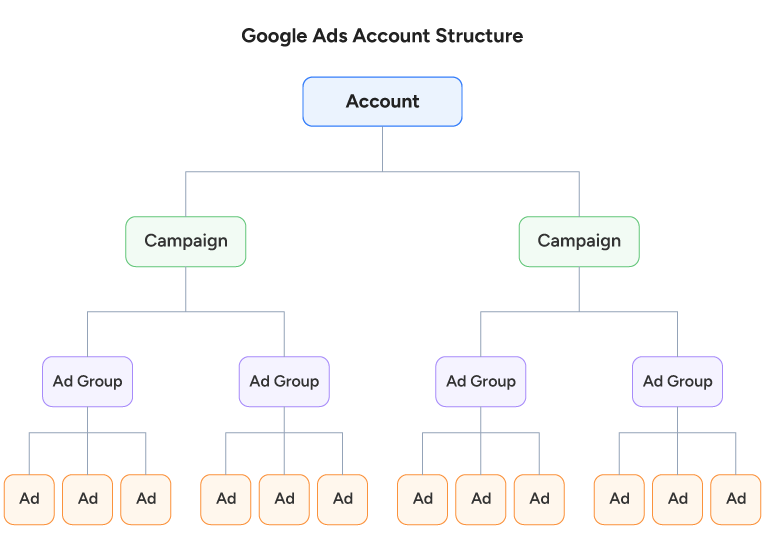
Reason Behind Asking: To see if you understand the Google Ads hierarchy, including campaigns, ad groups, and ads, and can effectively organize and optimize them to meet business goals.
Sample Answer: A Google Ads account is organized in layers: the account itself, campaigns, and ad groups. Ads and keywords are grouped within ad groups. The account handles billing and settings, campaigns set budgets and targeting, and ad groups group related keywords and ads.
8. What are Ad Extensions in Google Ads?
Reason Behind Asking: To see if you understand how ad extensions improve ads, provide more information to users, and improve ad performance and visibility.
Sample Answer: Ad Extensions (now called Assets in Google Ads) are additional pieces of information that expand your Google Ads text ads, such as sitelinks, call buttons, or location details. They make ads more informative and engaging, thereby improving click-through rates and overall ad performance.
9. What Types of Ads are Available in Google Ads?

Reason Behind Asking: To check if you understand the different Google Ads formats and when to use each to meet campaign goals.
Sample Answer: Google Ads offers several types of ads, including Search Ads, Display Ads, Shopping Ads, Video Ads, App Ads, Local Services Ads, Smart Ads, Performance Max Ads, and Demand Gen Ads. Each ad type is designed for different marketing goals, such as driving website traffic, promoting products, increasing brand awareness, generating leads, or maximizing conversions across Google platforms.

Google Ads Interview Questions for Experienced Candidates

10. What is Quality Score in Google Ads, and how Would You Improve It?
Reason Behind Asking: To assess your knowledge of Google Ads performance metrics and how Quality Score impacts ad rank, costs, and overall ROI.
Sample Answer: Quality Score in Google Ads is a number from 1 to 10 that shows how relevant your keywords and landing pages are, based on expected click-through rate, ad relevance, and landing page experience.
To improve Quality Score, I would create focused ad groups, write relevant ads with clear calls to action, speed up landing pages, make sure the ad and landing page messages match, and use negative keywords to boost relevance and click-through rates.
11. How do You Reduce Cost per Click?
Reason Behind Asking: To evaluate your capability to optimize Google Ads campaigns and manage ad spend effectively.
Sample Answer: To reduce cost per click (CPC), I focus on three key areas. First, I ensure strong alignment between ads, keywords, and landing pages to improve relevance and Quality Score. Second, I use Smart Bidding to automatically adjust bids in real time, optimizing for conversions based on user behavior and contextual signals. Finally, I implement negative keywords to block irrelevant searches and prevent wasted ad spend.
12. How do You Choose the Right Keywords?
Reason Behind Asking: To see your awareness of keyword research and how well you align keywords with campaign goals and user intent.
Sample Answer: I start by understanding the business goals and target audience. Then I use keyword research tools to find relevant terms with good search volume and strong intent, focusing on transactional terms that indicate users are ready to buy or take action. I improve them by reviewing search term reports, adding negative keywords, and monitoring metrics like CPC and Quality Score.
13. What are Negative Keywords?
Reason Behind Asking: To check how well you understand traffic quality and how you avoid wasting money on Google Ads.
Sample Answer: Negative keywords are words or phrases that filter out irrelevant search queries, ensuring ads appear only for relevant traffic. They help filter out unqualified traffic and make your campaigns more effective. Using negative keywords helps me cut wasted spending and target the right audience.
14. How do You Track Conversions?
Reason Behind Asking: To assess your technical knowledge of conversion tracking and how well you can measure campaign performance.
Sample Answer: I set up conversion tracking by using Google Ads conversion tags or importing Google Analytics events. I monitor important actions like purchases, form submissions, and calls to see how well the campaign is performing. This information helps me adjust bids, keywords, and ads based on actual performance.
15. How do You Optimize a Low-Performing Campaign?
Reason Behind Asking: To see your problem-solving skills and your ability to improve campaign performance using data-driven strategies.
Sample Answer: I analyze key metrics like CTR, CPC, Quality Score, and conversion rate to identify issues. With the analysis, I improve keywords, ad copy, targeting, and bids, and add negative keywords to reduce wasted spend. I continuously test and monitor changes to improve overall campaign performance.
16. How do You Manage a Google Ads Budget Effectively?
Reason Behind Asking: To assess your ability to allocate budget efficiently, maximize ROI, and prevent overspending in campaigns.
Sample Answer: I prioritize budget toward high-performing campaigns, monitor spend closely, and continuously optimize bids and keywords to maximize conversions and reduce waste.
Looking for Ready-to-Use Job Description Templates?
Hiring for a new role? Access professionally written job description templates to define responsibilities, required skills, and expectations for different positions.
Scenario-Based Google Ads Interview Questions
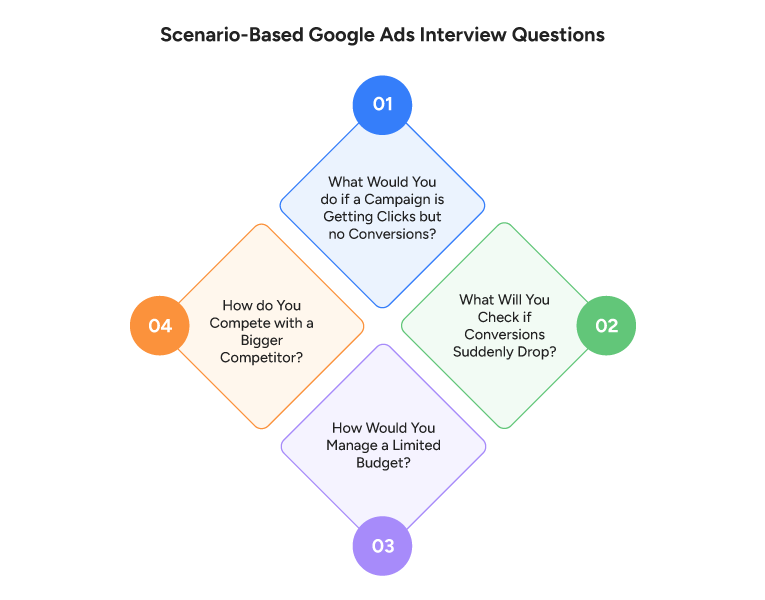
17. What Would You do if a Campaign is Getting Clicks but no Conversions?
Reason Behind Asking: To see how well you can identify problems, understand the conversion process, and improve a campaign overall, not just get more clicks.
Sample Answer: I would first check if the landing page is relevant and loads quickly. I would also make sure it has clear calls to action to align the ad and keep visitors engaged. Then, I’d review keywords and ad copy for user intent and add negative keywords to filter irrelevant traffic. Finally, I’d monitor changes and run A/B tests to improve conversions.
18. What Will You Check if Conversions Suddenly Drop?
Reason Behind Asking: To assess your analytical thinking and ability to quickly identify and fix issues impacting campaign performance.
Sample Answer: First, I’d ensure conversion tracking in Google Ads and Analytics is working correctly after any site changes. Next, I’d check traffic trends, bids, and negative keywords for issues. Finally, I’d review campaign edits, ad disapprovals, competitor activity, and run A/B tests on landing pages to identify and fix the root cause.
19. How Would You Manage a Limited Budget?
Reason Behind Asking: To assess your ability to prioritize skills, maximize ROI, and make strategic decisions when resources are limited.
Sample Answer: With a limited budget, I focus on high-intent, high-performing keywords and campaigns to maximize conversions. I use Smart Bidding strategies and schedule ads for peak times to improve efficiency, while frequently reviewing performance and pausing underperforming ads to get the best results.
20. How do You Compete with a Bigger Competitor?
Reason Behind Asking: To see your strategic thinking, creativity, and ability to optimize campaigns against competitors with larger budgets or market share.
Sample Answer: I compete with bigger competitors by focusing on precision rather than budget size. Using Auction Insights, I analyze overlap rate and impression share to find gaps where I can win more efficiently. In Google Ads, I improve Quality Score, fine-tune negative keywords, and target high-intent audiences to lower costs and increase conversions.
Nervous About Your HR Interview Round?
Check the most common HR interview questions and learn how to answer them with confidence.
Advanced Google Ads Strategy Questions

21. Which Bidding Strategies have You Used?
Reason Behind Asking: To evaluate your practical experience with different bidding strategies and your ability to choose the right one based on campaign goals.
Sample Answer: I’ve used Manual CPC, Maximize Clicks, Maximize Conversions, Target CPA, and Target ROAS depending on campaign objectives. For lead generation, I typically use Target CPA for general campaigns and Target ROAS for e-commerce campaigns to maximize conversions. I choose the strategy based on goals, data availability, and performance trends.
22. How do You Scale a Successful Campaign?
Reason Behind Asking: To assess your ability to grow performance while maintaining efficiency and profitability.
Sample Answer: To scale a successful campaign, I gradually increase the budget while closely monitoring CPA or ROAS to maintain efficiency. I expand high-performing keywords, audiences, and locations, and test new ad creatives to grow reach. I scale in small increments and pause underperformers quickly to protect overall ROI.
23. How do You Measure ROI?
Reason Behind Asking: To assess your understanding of profitability and your ability to connect ad performance with business results.
Sample Answer: I calculate ROI by subtracting total costs (ad spend, margins, and overhead) from campaign revenue, then dividing by those costs. I track conversions and revenue through Google Ads and Analytics, along with metrics like ROAS and cost per acquisition. While ROAS measures gross revenue per ad dollar, true ROI accounts for profitability after all expenses. This helps determine whether campaigns are profitable and where to optimize.
24. What is A/B Testing in Google Ads, and why is It Important?
Reason Behind Asking: To assess your understanding of experimentation and optimization in campaigns to improve performance systematically.
Sample Answer: A/B testing in Google Ads involves running two or more versions of an ad, landing page, or creative to see which performs better. It’s important because it helps identify what resonates with the audience, improves CTR and conversions, and ensures decisions are based on data rather than assumptions.
25. How do You Allocate Budget across Campaigns?
Reason Behind Asking: To evaluate your ability to prioritize spending effectively, maximize ROI, and align budget allocation with business goals.
Sample Answer: I allocate budget based on campaign goals, performance, and potential ROI. High-performing campaigns or those driving critical conversions get more budget, while underperformers are limited or paused. I continuously monitor results and adjust budgets to maximize efficiency and results.
Preparing for a Digital Marketing Interview?
Practice the most asked 50+ digital marketing interview questions with sample answers.
Behavioral Questions in a Google Ads Interview

26. Tell Me about a Campaign You Improved
Reason Behind Asking: To evaluate your practical experience, problem-solving skills, and ability to optimize campaigns for better performance.
Sample Answer: I managed an e-commerce campaign with low conversions, auditing performance to pause underperforming keywords, add negative keywords, and implement Smart Bidding. I also optimized ad copy, landing pages, and used remarketing audiences. This increased conversion volume by 30% and improved ROAS by 20% within 3 months.
27. How do You Handle Client Pressure?
Reason Behind Asking: To assess your stress management, communication skills, and ability to maintain professionalism and expectations under tight deadlines.
Sample Answer: I handle client pressure by actively listening to their concerns and setting realistic expectations. I provide clear data-driven updates and explain the reasoning behind my recommendations. This approach builds trust while ensuring campaigns continue to perform effectively.
28. How do You Manage Multiple Campaigns?
Reason Behind Asking: To assess your organizational skills, prioritization, and ability to efficiently manage multiple campaigns without compromising performance.
Sample Answer: I manage multiple campaigns using Google Ads tools like labels, shared budgets, and automated rules to stay organized. I prioritize campaigns based on performance metrics like return on ad spend (ROAS) and Click-Through Rate (CTR), reviewing high-impact campaigns daily and others weekly. This ensures efficient resource allocation and allows for quick optimizations to maintain strong performance.
29. What do You do when Results are Not Improving?
Reason Behind Asking: To assess your problem-solving skills, analytical approach, and ability to optimize campaigns when performance stagnates.
Sample Answer: When results aren’t improving, I analyze metrics like CTR, conversion rate, and Quality Score to identify issues. I refine keywords, ad copy, targeting, and landing pages, add negative keywords, and run A/B tests on ads or landing pages. I monitor performance over 1–2 weeks and make changes based on what works best.
Final Tips to Prepare for a Google Ads Interview
Use the tips below to get ready and confidently show your practical campaign experience.
- Practice speaking your answers out loud to build confidence and sound natural.
- Review your past campaigns and be ready to discuss results, challenges, and lessons learned.
- Prepare examples of problem-solving and performance improvements under pressure.
- Think about how you prioritize tasks when managing multiple campaigns.
- Show that you can analyze results and make data-driven decisions.
- Prepare a few ideas on how you would improve a campaign if given the chance.
- Practice answering clearly and confidently, focusing on clarity over speed.
- Stay calm, positive, and professional, even with unexpected questions.
- Prepare 2–3 questions to ask the interviewer to display genuine interest.
Common Red Flags to Avoid in a Google Ads Interview
Knowing these common mistakes helps you stay confident and make a positive impression.
- Giving vague answers without real examples from your campaigns.
- Talking only about clicks, not actual results like leads, sales, or ROI.
- Overloading answers with jargon or theory instead of practical insights.
- Struggling to explain your thought process clearly.
- Avoiding questions about challenges, mistakes, or learning from failures.
- Blaming tools or budgets instead of taking responsibility and showing solutions.
- Overpromising quick wins that aren’t realistic.
- Ignoring the audience or customer when discussing campaigns.
- Appearing unprepared or unsure about past campaigns and results.
- Rambling, going off-topic, or not asking any questions about the role.

Frequently Asked Questions
Is Google Ads Certification Required for a Google Ads Job?
No, Google Ads certification is not required, but it can help demonstrate your knowledge and credibility. Many employers value it as proof of understanding best practices while still prioritizing hands-on experience.
What Tools does a Google Ads Specialist Usually Use?
A Google Ads specialist typically uses tools like Google Ads, Google Analytics, Keyword Planner, and Google Tag Manager to manage and optimize campaigns. They may also use third-party tools like SEMrush or Ahrefs for keyword research and competitor analysis.
What Metrics are Important in Google Ads Campaigns?
Important metrics in Google Ads campaigns include Click-Through Rate (CTR), Cost Per Click (CPC), Conversion Rate, Cost Per Acquisition (CPA), and Quality Score. These help measure performance, ROI, and the effectiveness of ads and targeting.
What Skills are Required for a Google Ads Role?
A Google Ads role requires skills in campaign management, keyword research, ad copywriting, and data analysis. Strong knowledge of bidding strategies, analytics tools, and optimization techniques is also essential for driving ROI and performance.

Grow your business with factoHR today
Focus on the significant decision-making tasks, transfer all your common repetitive HR tasks to factoHR and see the things falling into their place.

© 2026 Copyright factoHR