
Company Email Policy for Employees: Free Template & Best Practices
Download our free Email Policy Template PDF below

Table of Contents

Major corporate breaches begin the same way, with an ordinary email no one thinks twice about. Email powers modern business, where customer conversations, internal decisions, approvals, and more move through inboxes each day. But it also opens the door to fraudulent threats and activities. Studies show that 57% of organizations are targeted by phishing scams at least weekly, and nearly 1.2% of all emails are malicious.
This is where a well-defined email policy becomes important. An email usage policy is a set of clear corporate guidelines that define how employees should use company-provided email accounts. This policy explains acceptable and unacceptable email usage for employees, based on company type, location, and other factors.
This article helps HR and IT teams design an email policy that goes beyond the written policy. It provides templates and best practices to protect both the organization and the employee in the long run.
Why Your Business Needs a Strong Email Policy for Employees
Emails are central to everyday business communication, making them highly risky if left unmanaged. Instead of restricting employees, a strong email policy educates and warns employees before small mistakes lead to serious consequences.
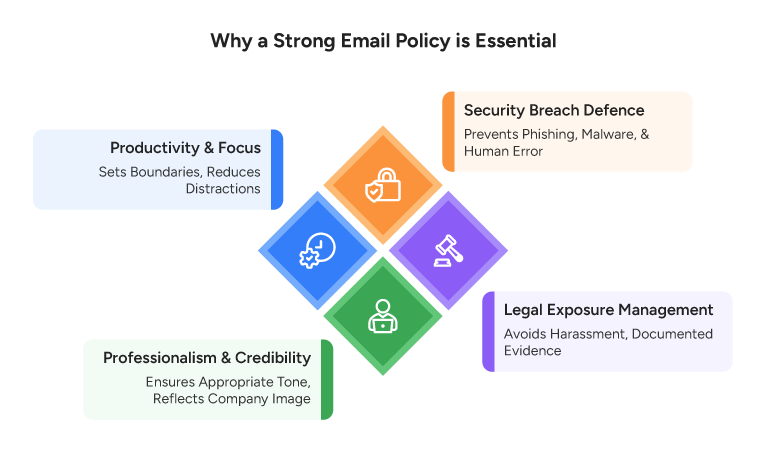
Security Breach
Email policies are the first line of defense against phishing, spoofing, malware, and Business Email Compromise (BEC). By defining what employees should trust, be open about, share, or report, the policy reduces human error. After all, human errors are the most common entry point for cyber threats.
Legal Exposure
Any email containing harassment, discriminatory remarks, or inappropriate jokes can be termed as legal evidence. Without a documented email policy, organizations cannot enforce discipline or escalate situations during disputes.
Professionalism
Every email sent from a company domain reflects the organization. Poor tone, careless or incriminating language, and unprofessional communication can damage your company’s credibility.
High Productivity Cost
Excessive usage of email for personal purposes reduces focus and efficiency. An email policy sets much-needed boundaries without micromanagement.
Ultimately, not having an email policy impacts security, compliance, and business welfare when an organization can least afford it.

Sample Email Usage Policy
This email usage policy defines the acceptable use, security requirements, and governance standards for all email accounts provided by the Company.
1. Purpose and Scope
The purpose of this policy is to protect organizational data, ensure professional communication, and reduce legal, security, and operational risks. It is applicable to all employees, contractors, consultants, interns, and temporary staff of the company. Employees are expected to follow this policy when using the company email system.
2. Acceptable Use
All emails must be work-related and aligned with company objectives. These email accounts are provided only for purposes, including:
- Internal team communication
- Communication with clients, vendors, and partners
- Scheduling meetings
- Sharing work-related documents
- Receiving company-approved newsletters or industry updates
3. Inappropriate Use
Any activity that risks security, compliance, or the company’s reputation is strictly prohibited. Company email must not be used for illegal, unethical, or non-work activities, including:
- Gambling, illegal downloads, or copyright violations
- Harassment, hate speech, discrimination, or offensive language
- Sending inappropriate jokes, images, or content that could offend others
- Running personal businesses or side ventures
- Misrepresenting identity, authority, or job role
4. Personal Use
Personal use of company email may be restricted or prohibited at the discretion of management. Company email should not be used for any financial subscriptions or sign-ups. If limited personal use is allowed, it must be:
- Minimal and occasional
- Not disruptive to work
- Not harmful to system performance or security
5. Email Security Requirements
All users must follow company security standards, including using strong passwords and enabling multi-factor authentication. Some of the security rules are:
- Never share email credentials
- Be cautious with unknown emails, links, or attachments
- Watch for phishing or spoofed emails
Any suspected security incident must be reported immediately to the IT or security team, as per the Email Security Policy.
6. Data Protection and Confidentiality
Employees must protect confidential and sensitive company information. Always verify that the recipient is authorized to receive the information. This includes:
- Do not send company data to personal email accounts
- Do not share information with unauthorized recipients
- Use approved encryption or secure file-sharing methods when required.
7. Email Etiquette and Professional Conduct
All emails sent from the company domain represent the organization. Employees are expected to:
- Use a respectful and professional tone
- Write clear subject lines
- Use approved email signatures
- Respond within expected timelines based on urgency
8. Email Retention, Backup, and Monitoring
Company emails are considered official business records. They are accessed during company audits or legal investigations. Employees should not treat inboxes as their own personal storage.
9. Consequences of Non-Compliance
Serious violations, such as data leakage, harassment, or intentional security breaches, may lead to immediate termination and legal action.

What Employees Need to Know
Company email systems are owned by the organization, not by the individual employees. It includes the email account, stored messages, and attachments sent/received.
The company reserves the right to monitor and review email activity for security, legal, and compliance purposes.
This is done to:
- Prevent data breaches
- Detect security threats
- Ensure that the policy is followed
Monitoring is not intended to spy on employees. It is done to protect business information, clients, and employees themselves. Internal reviews are conducted only when necessary and in accordance with internal procedures.
How to Implement and Enforce the Policy
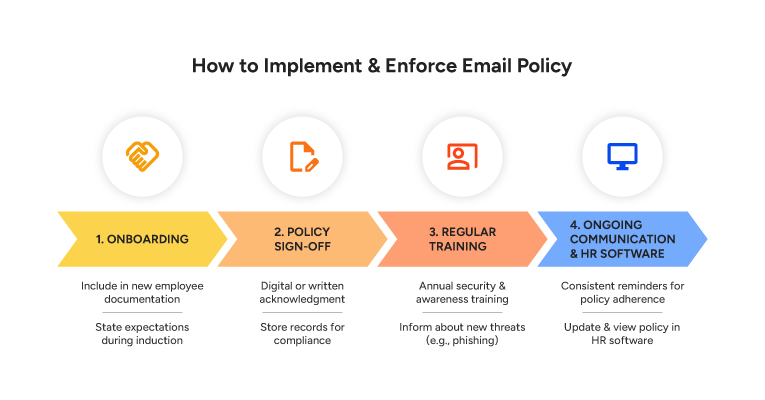
Onboarding
- The email policy can be included in the new employee documentation
- During induction, expectations can be clearly stated from the outset.
Policy Sign-Off
- Your employees should sign off digitally or in writing to acknowledge the policy. Store these signed records for compliance purposes.
Regular Training
- Conduct security and awareness training on an annual basis.
- Keep your employees informed about new threats, such as phishing.
Consistent communication ensures that employees follow the email usage policy. In many scenarios, the email policy can be updated in HR software, allowing employees to view it whenever needed as part of effective HR policy management.
Conclusion
A company email policy is not meant to restrict employees. It is designed to protect the firm’s data, reputation, and people. Every organization should review its current email policies regularly and update them to reflect modern security and compliance needs.

FAQs
What Should be Included in a Corporate Email Policy?
A corporate email policy should explain acceptable and inappropriate usage. It should clearly state the protection rules and the consequences of misuse.
Can I Use My Work Email for Personal Reasons?
You can use your work email for personal reasons, but only in certain situations. This should not interfere with work, violate company rules, or expose the organization to security or legal risks.
Is It Legal for an Employer to Read Employee Emails in India?
Yes, Indian employers can monitor official email accounts. Employees are generally informed, and monitoring is conducted for legitimate business and security purposes only.
What is Considered Inappropriate Use of Company Email?
Inappropriate use of email includes sharing confidential data, sharing offensive content, or conducting personal business. Illegal or unethical communication is at the top of this list.
Can an Employee be Terminated for Email Misuse?
Yes, serious or repeated misuse of email can lead to disciplinary action. If the misuse is deemed serious, employees can also be terminated, depending on the company policy.
What are the Security Risks of Not Having an Email Policy?
Without an email policy, organizations face a high risk of data breaches, phishing attacks, legal non-compliance, and reputational damage.


Transform your HR operations with factoHR today
Choose a perfect plan satisfying your business demands and let factoHR handle all your HR’s tasks efficiently.

© 2026 Copyright factoHR