
Equal Employment Opportunity Policy Template & Sample
Get a Free EEO Policy Template in PDF – Ready to Use

Table of Contents

An equal opportunity employer policy helps create a workplace where diversity is not just a statement but a real experience. When organizations follow this policy in practice, employees feel respected, included, and given fair opportunities to grow and succeed.
What is an Equal Employment Opportunity (EEO) Policy?
An Equal Employment Opportunity (EEO) policy ensures that employment decisions such as hiring, pay, and promotion are based on merit, skills, and performance, not on race, gender, age, or background.
A good EEO policy gives employees a clear way to speak up when they experience unfair treatment.
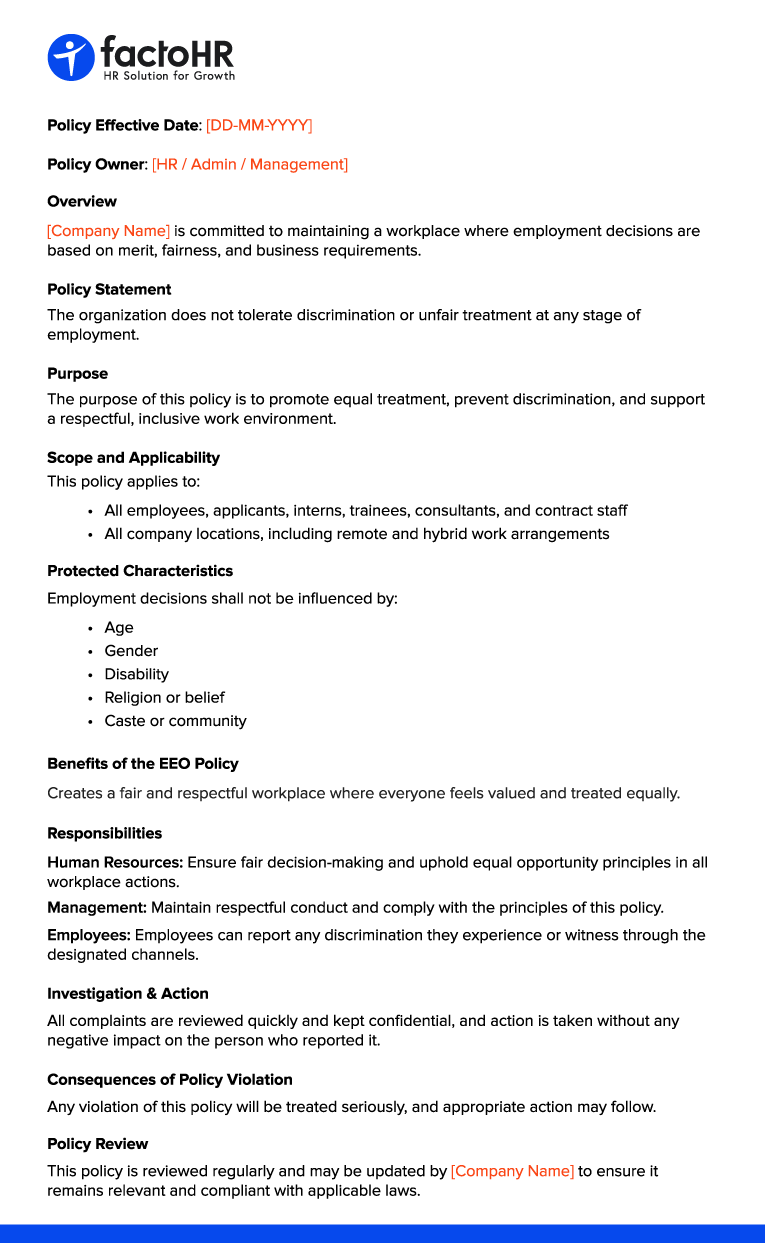
Equal Employment Opportunity Policy Template
An equal opportunities policy template outlines the policy’s key principles, supports compliance with EEO laws, and promotes fairness in the workplace. Organizations can adapt it to suit their specific needs.
Create a Company Vehicle Policy in Minutes
Use our professionally structured, ready-to-use template to define clear vehicle guidelines.
Equal Employment Opportunity Policy Sample
Overview
[Company Name] is an equal opportunity employer. Our decisions are guided by merit, respect, and inclusion. We believe everyone deserves equal treatment and the same opportunity to succeed.
Policy Statement
[Company Name] follows a merit-based approach in all employment decisions. When we’re hiring someone, promoting a team member, setting salaries, or handling day-to-day workplace matters, we look at skills, performance, and what the business needs. We do not encourage or tolerate discrimination of any kind at any stage of employment.
Equal opportunity applies to everyone, especially those who may face unfair treatment. The company does not guarantee outcomes but ensures decisions are made fairly and without bias.
Purpose
The purpose of this equal opportunity employer policy is to ensure every employee working is treated with respect and consideration. We promote equality and diversity in the workplace to support a healthy and productive work environment. We believe that a workplace free from discrimination allows skills and talent to reach their full potential.
Scope and Applicability
This policy works alongside other workplace policies, including those aligned with the POSH Act, to ensure a safe and respectful environment for everyone. It applies to the following individuals and work settings:
- All employees, job applicants, interns, trainees, consultants, and contract staff.
- Every stage of employment, including hiring, training, performance reviews, promotions, and day-to-day workplace interactions.
- All company locations and work settings, including remote and hybrid work arrangements.
Protected Characteristics
Discrimination is not allowed based on any personal trait unrelated to job performance. We provide the same opportunities for hiring, advancement, and benefits to all our employees without discriminating due to protected characteristics like:
- Age
- Gender
- Sexual orientation
- Marital status
- Pregnancy or parental status
- Disability
- Medical conditions
- Religion or beliefs
- Caste or community
- Race or ethnicity
- Nationality
- Language
All employees, managers, and stakeholders are expected to respect these differences and treat one another fairly at all times.
Principles of Equal Employment Opportunity
[Company Name], through its Equal Employment Opportunity Policy (EEO Policy), along with the support and active participation of its management and employees, is committed to:
- Make hiring and promotion decisions based on skills, experience, and performance.
- Provide equal access to training, learning, and growth opportunities.
- Ensure fair pay and benefits for employees based on their job responsibilities, job complexity, professional skills, and location.
- Maintain respectful communication and professional conduct at work.
- Prevent and address any form of discrimination or harassment, including sexual harassment, through prompt and appropriate action.
- Treat employees, applicants, customers, business associates, and other stakeholders with equal respect and dignity.
Benefits of the EEO Policy
- Create a safe and respectful workplace for everyone
- Ensure fair treatment in daily work and career growth
- Build trust between employees and management
- Encourage open communication without fear
- Support a positive and inclusive work environment
Roles and Responsibilities
Management
- Lead by example and ensure fair treatment in all workplace decisions.
- Make sure decision-makers are properly trained in equal employment opportunity principles.
HR
- Develop and maintain policies that support a fair and inclusive workplace.
- Ensure employees understand their responsibilities under the policy.
- Monitor progress, identify issues, and work with managers to correct any concerns.
Employees
- Follow the policy in all work-related activities.
- Treat colleagues, clients, and others with respect at all times.
Reporting of Complaints
- Employees can raise concerns if they experience or witness unfair treatment or discrimination at work.
- All complaints are handled carefully, reviewed fairly, and kept confidential as much as possible.
- Retaliation against anyone who raises a concern in good faith is strictly prohibited.
- Issues related to inappropriate behavior or harassment should be reported according to the company’s sexual harassment policy.
Investigation and Corrective Action
- Once a complaint is reported, it is reviewed promptly in a fair and unbiased manner.
- The company may speak with the complainant, the respondent, and others who can provide relevant information.
- If suitable and with the consent of both parties, mediation may be offered to help resolve the issue. Mediation is voluntary.
- Wherever possible, the review process is completed within 10 working days.
- Based on the findings, appropriate action is taken to address the concern and stop any discriminatory behavior.
- The goal is to restore a respectful work environment and maintain workplace harmony.
Consequences of Policy Violation
- The company takes any violation of the Equal Employment Opportunity policy seriously.
- If discrimination is confirmed or resolved through mediation, corrective steps may be taken.
- These steps may include role changes, transfers, or other actions depending on the situation.
- No action taken will negatively affect the person who raised the concern.
- All actions are handled according to the company’s disciplinary policy.
Policy Review and Updates
- This policy is reviewed regularly to ensure it remains clear and relevant.
- Updates may be made when needed.
- Any changes will be shared with employees.

Conclusion
Equal opportunity is indispensable to our workplace culture. It guides our decisions, shapes our behavior, and determines how we treat each other. This policy ensures fairness, respect, and equal access are standard practice for everyone.
Frequently Asked Questions
What is an Example of an Equal Opportunity Policy?
An example of an equal opportunity policy is: Two candidates who enroll at the same time receive promotions based on their skills and performance, rather than their background or biased decisions.
Why is an Equal Opportunity Policy Important?
An EEO policy is important for an organization to create a fair and respectful workplace. It specifies ground rules for expected behavior and gives employees the confidence that decisions are made without bias.
What Should an Equal Opportunity Policy Include?
An EEO policy should clearly list protected characteristics, outline responsibilities, and share the reporting procedures. It basically should outline the organization’s objective and purpose in drafting the policy.
How Can Employees Report Potential Policy Violations?
Employees can raise concerns confidentially with HR or management without fear of judgment or retaliation. Organizations review the reports fairly and address any discrimination with actions to rectify or resolve the issue.
Disclaimer
This template provides general guidance on fair workplace practices and should be used as a reference. It is meant to support understanding and consistency at work. It does not replace professional legal advice or applicable laws, including relevant Employment Equality Acts.


Transform your HR operations with factoHR today
Choose a perfect plan satisfying your business demands and let factoHR handle all your HR’s tasks efficiently.

© 2026 Copyright factoHR