
Top 50+ Python Interview Questions and Answers (2026 Update)

Table of Contents

Key takeaways:
- Understand the top Python interview questions asked by interviewers.
- Learn Python basics and internals in simple language.
- Revise data structures, functions, and OOP concepts.
- Prepare for coding and system-level Python interview questions.
- Useful for freshers, experienced candidates, and HR teams.
Python interviews often test more than syntax. Most data science and AI jobs now list Python as a required language due to its extensive ecosystem and ease of use. Interviewers want to know how well you understand Python concepts, how you think through problems, and how you apply Python in real situations. That is why specific Python interview questions recur across interviews, regardless of the company or role.
This guide covers the most frequently asked Python interview questions and answers for freshers, explained in a simple, interview-friendly way. It helps freshers build strong basics and experienced developers refresh core concepts before interviews.

Top 10 Most Asked Python Interview Questions
These are the most frequently asked Python interview questions, appearing in interviews for both freshers and experienced candidates.
1. What is the Difference between a List and a Tuple?
A list and a tuple are used to store multiple elements in Python. The main difference is whether the data can be changed after creation.
| Feature | List | Tuple |
|---|---|---|
| Mutability | Mutable (Can be changed) | Immutable (Cannot be changed) |
| Syntax | Square brackets [] | Parentheses () |
| Memory | Consumes more memory | Consumes less memory |
| Performance | Slower | Faster |
| Example | [1, 2, 3] | (1, 2, 3) |
2. What is the __init__ Method and how is It Used?
The __init__ method is executed when an object is created from a class. It is used to set the initial values of the object.
It runs automatically during object creation, helps store starting data, and prepares the object for use.
Answer
class User:
    def __init__(self, name):
        self.name = name
u = User("Alex")
print(u.name)
Output:
Alex
3. What is a Decorator, and how does It Change a Function’s Behavior?
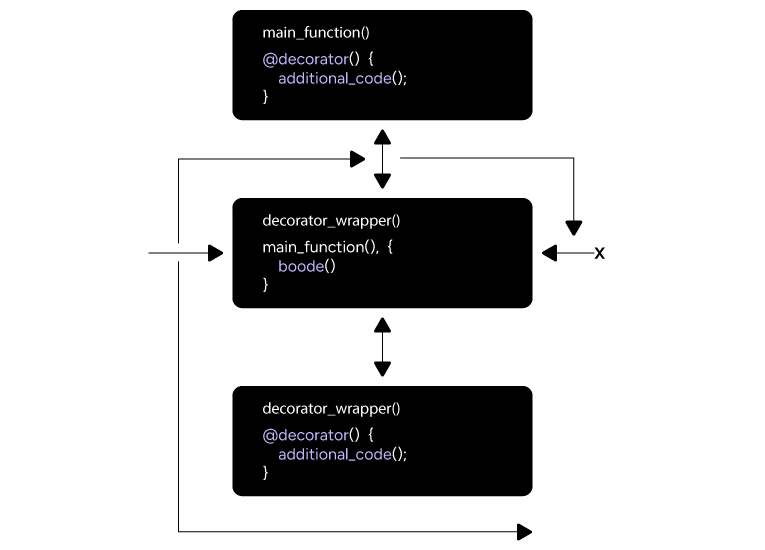
A decorator lets you add additional work to a function without changing the function itself. It is often used when you want to extend a function’s behavior without changing the main code.
- A decorator wraps another function,
- It can run code before or after the function runs,
- It helps keep the main function clean and easy to read
Answer
def my_decorator(func):
    def wrapper():
        print("Before")
        func()
        print("After")
    return wrapper
@my_decorator
def hello():
    print("Hello")
hello()
Output:
Before
Hello
After
4. What is the Global Interpreter Lock (GIL) and how does It Affect Multi-Threading?
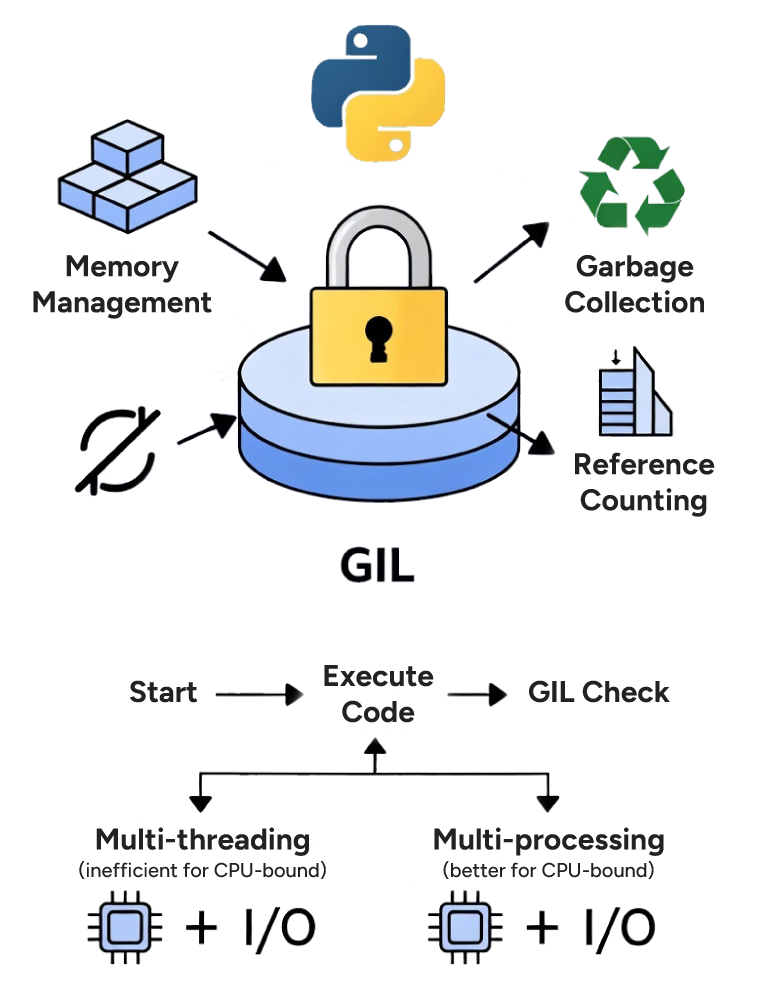
The Global Interpreter Lock (GIL) is a Python mechanism that allows only one thread to execute Python bytecode at a time, even on multi-core systems. It exists to keep Python’s memory management safe, especially because Python uses automatic garbage collection and reference counting, which are not thread-safe by default.
Because of the GIL, multi-threading does not improve performance for CPU-intensive tasks. Only one thread can run Python code at a time, so threads end up taking turns. However, multi-threading still works well for I/O-bound tasks such as file handling, network requests, or waiting for external resources.
For CPU-heavy workloads, multiprocessing is the recommended workaround. It runs multiple processes rather than threads, bypassing the GIL and enabling true parallel execution across multiple CPU cores.
5. What is the Difference between is and ==?
Both “is” and “==” are used for comparison in Python. They compare different things.
- == compares values. is compares memory addresses (identities)
- The same values can exist in different memory locations
Answer
a = [1, 2]
b = [1, 2]
print(a == b)
print(a is b)
Output:
True
False
6. What is a Lambda Function?
A lambda function is a small one-line function. It is used when the logic is very simple and is needed for a short time. Instead of defining a full function using def, a lambda function lets you write quick logic in a single line.
- Lambda functions have no name
- Written in one line
- can take arguments but return only one result
- commonly used with functions like map(), filter(), and sorted()
- Best suited for short and simple operations
Answer
add = lambda x: x + 1
print(add(5))
Output:
6
7. How does Python Manage Memory and Garbage Collection?
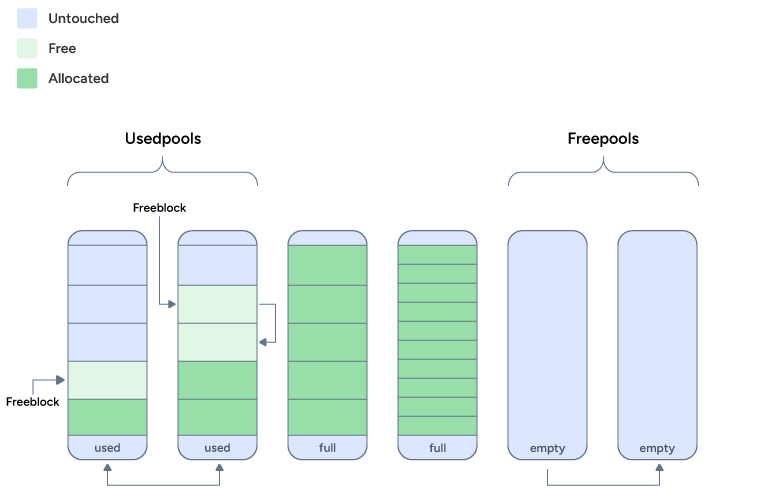
Python manages memory automatically, so developers do not need to allocate or free memory manually. It uses a private memory space where objects are created and stored. Python mainly relies on reference counting to track how many variables point to an object. When an object has no references left, it becomes eligible for removal. Python also uses a garbage collector to detect and clean up unused objects, especially those involved in circular references. This automatic process helps prevent memory leaks and makes Python easier and safer to use.
8. What do * Args and ** Kwargs Allow You to do in Function Definitions?
They allow a function to accept a number of arguments. This is useful when the number of inputs is not fixed.
- *args accepts multiple positional values
- **kwargs accepts multiple named values
Answer
def demo(*args, **kwargs):
    print(args)
    print(kwargs)
demo(1, 2, a=10, b=20)
Output:
(1, 2)
{a: 10, ‘b’: 20}
9. What is the Difference between Range() and Xrange() (Python 2 vs 3)?
Both range() and xrange() are used to generate a sequence of numbers. They are most commonly used inside for loops. However, their behavior changes depending on the Python version.
In Python 3, the distinction no longer exists. The range() function itself works like the old xrange(). That means xrange() was completely removed.
In Python 2, the difference is more noticeable:
- range() creates the entire list of numbers in memory upfront. This makes it simple to use but potentially inefficient when dealing with large ranges.
- xrange(), on the other hand, generates numbers one at a time as they are needed. It does not store the full list in memory. This makes it faster and more memory-friendly for large iterations. This on-demand behavior is known as lazy evaluation.
10. What is a Generator, and How is It Different from a Normal Function?
Generators are a special type of function in Python. They produce values one at a time, as needed, rather than all at once. They are highly efficient for handling large datasets or infinite sequences.
What makes a function a generator is the use of the yield keyword. When Python encounters yield, the function temporarily pauses execution. It remembers its current state, and the next time the generator is called, execution resumes exactly from where it left off, not from the beginning.

Core Concepts and Python Basics
This section explains how Python works internally, focusing on execution, scope, and basic rules.
11. Does Python Read Code all at Once or Line-by-Line?
Python first goes through an internal compilation step, where it parses the source code and converts it into bytecode. If there are no errors, it then runs the code step by step.
Answer
print("Hello")
print("World")
Output:
Hello
World
12. When Should You Use a for Loop Versus a while Loop?
This is one of the common Python interview questions. It checks how well you understand loops.
- for loop is used when the count is known, often with lists, tuples, sets, or dictionaries.
- while loop is used when the end condition is known, but the number of future repetitions is unknown.
Answer
for i in range(3):
    print(i)

c = 0
while c < 3:
    print(c)
    c += 1
Output:
0
1
2
0
1
2
13. What is the Difference between / and // in Python?
/ gives exact division and returns a decimal value. // removes the decimal part and always returns the lower whole number.
Answer
print(5 / 2)
print(5 // 2)
Output:
2.5
2
14. Is Strict Spacing Required in Python?
Yes, spacing is very important in Python. It tells Python which lines belong together.
- Indentation defines code blocks.
- Wrong spacing causes errors.
- Makes code easy to read.
Answer
If True:
    print("Valid code")
Output:
Valid code
15. What does It Mean that Python Figures out Data Types Automatically?
Python determines the data type at runtime. You do not need to declare it. This makes the code shorter.
Answer
x = 10
y = "Python"
print(type(x))
print(type(y)
Output:
<class 'int'>
<class 'str'>
16. What is the Purpose of the Pass Keyword?
pass is used when Python expects a statement, but no action is needed.
- Used as a placeholder
- Keeps code valid
- Helpful during planning
Answer
def demo():
    pass

print("Program runs")
Output:
Program runs
17. Explain the Difference between Break, Continue, and Pass.
This is a Python interview question to test loop control.
- break stops the loop,
- continue skips one loop step, pass does nothing
Answer
for i in range(3):
    if i == 1:
        continue
    print(i)
Output:
0
2
18. How does Python Determine where a Variable Can be Used (LEGB Rule)?
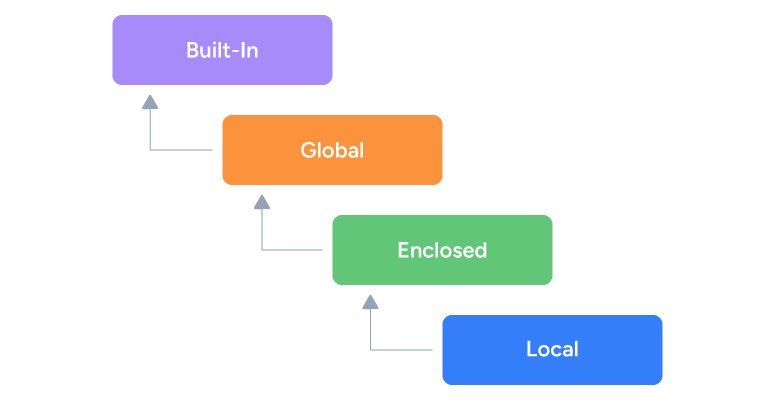
Python checks different places to find a variable. It follows a fixed order. So, it knows which value to use when the same name appears more than once.
- First, it looks inside the current function (Local)
- Then, it checks any outer function (Enclosing)
- After that, it checks the main program (Global)
- Finally, it checks built-in names (Built-in)
Answer
x = 10

def demo():
    x = 5
    print(x)

demo()
print(x)
Output:
5
10
19. What are Docstrings, and why are They Used?
A docstring is a built-in way to describe what a piece of Python code does. It acts as an inline guide for anyone reading the code, including future developers and even your future self. Docstrings can be written for modules, classes, functions, and methods to explain their purpose, behavior, and usage.
A docstring is placed immediately after the definition of a class or function and is written using triple quotes, either single (''') or double ("""). When written correctly, Python automatically recognizes it as documentation.
It is stored as part of the object and can be retrieved at runtime using the __doc__ attribute or by calling Python’s built-in help() function.
20. How do You Cut out Specific Parts of a String or List?
This is done using slicing. It is common in Python coding interview questions.
- Uses start and end positions
- Works on strings and lists
- Very fast and simple
Answer
text = "Python"
print(text[1:4])
Output:
yth

21. What is a Namespace, and how does It Prevent Naming Conflicts?
A namespace keeps names (variables, functions, objects) separate to prevent clashes. As each function has its own space, there is no confusion when names are the same.
22. Write a Simple Code to Display the Current Time
Python provides a built-in time module that allows you to access and display the current system time.
Answer
import time

currenttime= time.localtime(time.time())
print ("Current time is", currenttime)
Output:
Current time is time.struct_time(tm_year=2025, tm_mon=6, tm_mday=10, tm_hour=11, tm_min=56, tm_sec=57, tm_wday=1, tm_yday=161, tm_isdst=0)
23. How does the New Switch Statement (Match-Case) Work in Python?
Python uses match-case instead of switch. It makes multiple conditions easier to handle.
- Introduced in Python 3.10
- Cleaner than many if-else
- Used for matching values
Answer
x = 2

match x:
    case 1:
        print("One")
    case 2:
        print("Two")
Output:
Two
24. What does the “:=” Operator do?
This operator assigns and uses a value simultaneously. It is also called the walrus operator.
- Assigns value inside expressions
- Reduces extra lines
- Best used when it improves readability and avoids repeated calculations
Answer
if (n := 5) > 3:
    print(n)
Output:
5
Data Structures (Lists, Dicts, & Sets)
This section focuses on how Python stores and organizes data using built-in data structures.
25. How do You Join Two Lists Together?
This is a common topic in Python interview questions and answers.
In Python, you can join two lists in more than one way. You can create a new list or update the existing one.
Answer
a = [1, 2]
b = [3, 4]

c = a + b
print(c)

a.extend(b)
print(a)
Output:
[1, 2, 3, 4]
[1, 2, 3, 4]
26. How do You Round a Number Down to the Nearest Integer?
This is often asked in Python basic interview questions. Python provides an easy way to round numbers down by using the floor.
Floor means rounding a number down by removing its decimal part using the math module.
Answer
import math

n = 4.8
print(math.floor(n))
Output:
4
27. Can You Show a Short Way to Make a List from another List?
This is done using list comprehension.
Answer
nums = [1, 2, 3]
new_nums = [x * 2 for x in nums]
print(new_nums)
Output:
[2, 4, 6]
28. What is the Main Difference between a Set and a Dictionary?
A set and a dictionary both store data. The way they store data is different.
Set stores only values and removes duplicates. A dictionary stores a key and a value.
Answer
my_set = {1, 2, 2, 3}
my_dict = {"a": 1, "b": 2}

print(my_set)
print(my_dict)
Output:
{1, 2, 3}
{'a': 1, 'b': 2}
29. What are the Basic Data Types Built into Python?
Python has many built-in data types, which are:
- Numeric types: int (whole numbers), float (decimal values), complex (real and imaginary parts).
- Text type: str (text or characters).
- Sequence types: list (ordered, mutable), tuple (ordered, immutable), range (sequence of numbers).
- Mapping type: dict (key-value pairs).
- Set types: set (unordered, unique elements),frozenset (immutable set).
- Boolean type: bool (True or False).
- None type: NoneType (absence of a value).
30. Which Data Types Can You Change (Mutable) vs. those You Can Not (Immutable)?
In Python, data types are classified as mutable or immutable based on whether their values can be changed after creation. Mutable data types, such as lists, dictionaries, and sets, allow their contents to be modified without creating a new object. Immutable data types, such as integers, strings, and tuples, cannot be changed once they are created, and any modification results in a new object being formed.
Understanding this difference is important because it helps prevent unexpected behavior and bugs, especially when working with functions, variables, and shared data.

31. How is a Dictionary Different from a List?
A list and a dictionary differ mainly in how they store and access data. A list stores values in a fixed order and accesses them by index, starting from zero. In contrast, a dictionary stores data as key-value pairs.
Each value is accessed using a unique key instead of a numeric index. As dictionaries use keys, they offer faster and more meaningful data lookup, especially when working with large or structured data.
Answer
my_list = ["Tom", 25]
my_dict = {"name": "Tom", "age": 25}

print(my_list[0])
print(my_dict["name"])
Output:
Tom
Tom
32. Does Python Use Arrays? How are They Different from Lists?
Python supports specialized array structures through modules such as the array module. However, lists are more commonly used in practice. Arrays store values of the same type, but Lists store mixed-type values and are more flexible.
Answer
from array import array

# Array (stores same data type only)
arr = array('i', [1, 2, 3])
print(arr)

# List (stores mixed data types)
my_list = [1, "Python", 3.5]
print(my_list)
Output:
array('i', [1, 2, 3])
[1, 'Python', 3.5]
33. What are Type Hints in Python?
Type hints are optional labels that indicate the expected type of a variable or a function's return value. They make code easier to read and understand, especially in large projects or team environments. Python does not enforce type hints at runtime, so the program will still run even if the types do not match. However, tools like linters, IDEs, and type checkers use type hints to catch errors early and improve code quality.
34. How do You Create a Dictionary in Just One Line of Code?
You can create a dictionary in Python in a single line by using curly brackets and defining key-value pairs separated by colons. This approach is simple, readable, and commonly used in everyday Python programming.
Answer
my_dict = {"a": 1, "b": 2}
print(my_dict)
Output:
{'a': 1, 'b': 2}
35. Can You Make a Tuple in One Line like a List? Or why Not?
Yes, you can make a tuple in one line, just like a list. The primary difference is the syntax; tuples use parentheses while lists use square brackets, and a tuple’s inherent immutability, which means it cannot be changed after creation.
- List uses [] and can change.
- Tuple uses () and stays fixed.
- For a single-item tuple, you must add a comma.
Answer
my_list = [1, 2, 3]
my_tuple = (1, 2, 3)
single_item = (5,)

print(my_list)
print(my_tuple)
print(single_item)
Output:
[1, 2, 3]
(1, 2, 3)
(5,)
36. Why Would You Choose a Tuple Instead of a List?
A tuple is used when data should not change.
- Tuples are fixed, so they prevent accidental changes.
- They are good for records like (name, age).
- Tuples are slightly faster for reading.
37. Which Sorting Method does Python Use when You Run .sort()?
Python uses a sorting method called Timsort. It is efficient for real-world data and is stable.
Answer
nums = [4, 1, 3, 2]
nums.sort()
print(nums)
Output:
[1, 2, 3, 4]
Functions & Functional Programming
This section explains how functions work in Python and how they support reusable, well-structured code which are key topics in many Python interview questions.
38. Can You Pass a Function into another Function as an Input?
Yes, you can pass a function as an argument in Python. This is common in Python programming interview questions.
Functions can be stored in variables. They can be passed into other functions, making them useful for reusable code.
Answer
def greet():
    return "Hello"

def run(func):
    print(func())

run(greet)
Output:
Hello
39. Does Python Send the Actual Value or Just a Link to the Value when Passing Arguments?
Python passes a reference to the object, not a full copy. Mutable objects can change inside a function. That is why lists can change inside a function. Immutable objects do not change in place.
Answer
        def add_item(lst):
    lst.append(4)

nums = [1, 2, 3]
add_item(nums)
print(nums)
Output:
[1, 2, 3, 4]
40. What is the Map() Function, and how is It Used with Lambdas?
The map() function applies a function to every item in an iterable (such as a list). When used with a lambda function, it allows for quick, one-line data transformations without defining a named function.
Answer
nums = [1, 2, 3]
# Square each number using map and lambda
squared = list(map(lambda x: x**2, nums))
print(squared)
Output:
[1, 4, 9]

41. What do * Args and ** Kwargs Mean?
Both *args and **kwargs let a function accept many values without fixing the number in advance.
| Feature | *args | **kwargs |
|---|---|---|
| Full Form | Arguments | Keyword Arguments |
| Input Type | Accepts multiple positional arguments. | Accepts multiple named (keyword) arguments. |
| Data Structure | Received as a Tuple ( ). | Received as a Dictionary { }. |
| Syntax Symbol | Single Asterisk (*) | Double Asterisk (**) |
| Best Used For | When the number of inputs is unknown. | Handling optional or configuration-based inputs. |
42. Can a Decorator accept Arguments? If So, how?
Yes, decorators can accept arguments. You need an extra function layer. The outer function receives the arguments, and the inner function wraps the original function.
Answer
def repeat(n):
    def decorator(func):
        def wrapper():
            for _ in range(n):
                func()
        return wrapper
    return decorator
Note: Here, n is the decorator argument.
43. What is an Iterator?
An iterator is an object that gives values one by one. It remembers where it is in the loop.
- Used in for loops
- Created with iter()
- Next value is read using next()
Answer
nums = [10, 20, 30]
it = iter(nums)

print(next(it))
print(next(it))
Output:
10
20
44. How is a Generator Different from a Normal Function?
A generator gives values step by step using yield. A standard function returns all at once using return. A normal function finishes after one return, but a generator yields one value at a time and uses less memory.
Answer
def gen():
    yield 1
    yield 2

for x in gen():
    print(x)
Output:
1
2
45. What does the Zip() Function do?
zip() joins items from two lists side by side. It combines values in pairs and stops at the shortest list. This function is commonly used in clean looping.
Answer
names = ["A", "B"]
scores = [10, 20]

for n, s in zip(names, scores):
    print(n, s)
Output:
A 10
B 20
46. What are Function Annotations? Do They Force You to Use Specific Types?
Function annotations provide metadata about a function’s parameters and return value. They improve code readability and support tooling such as type checkers and documentation generators, but they do not enforce type constraints at runtime.
With annotations, you can hint at the type of a parameter or the type of the returned value. However, Python itself does not enforce these types. The function will still run even if the types do not match.
Object-Oriented Programming (OOP)
This section covers classes and objects in Python, which are key topics in many Python interview questions.
47. Can a Class Inherit Features from More than One Parent Class?
Yes, Python allows a class to inherit from more than one class. This concept is called multiple inheritance and is common in Python interview questions.
- A child class can inherit from more than one parent.
- It allows the reuse of code from multiple classes.
- It should be used carefully, as complex inheritance hierarchies can make code harder to understand and maintain.
Answer
class A:
    def show_a(self):
        print("Class A")

class B:
    def show_b(self):
        print("Class B")

class C(A, B):
    pass

obj = C()
obj.show_a()
obj.show_b()
Output:
Class A
Class B
48. What is Polymorphism?
Polymorphism in Python allows the same method to behave differently depending on the object that uses it.
When different classes share a common method name, each class can define its own version of that method. Python decides which version to run based on the object calling it, not the method name itself.
This is commonly seen when a child class provides its own implementation of a method already defined in a parent class. Even though the method name stays the same, the behavior changes.
Polymorphism in Python mainly focuses on method overriding rather than method overloading, because it does not support traditional method overloading by default. It helps you write flexible, reusable code in which different objects respond in their own ways while following the same interface.
49. How do You Keep Data Private inside a Class?
Python does not enforce strict privacy. Instead, it uses naming rules to indicate private data.
- _name means internal use
- __name hides the variable more
- Prevents direct access
50. How do You Hide Complex Details from the User?
This concept is called abstraction. The user only sees what they need to use. Abstraction hides internal logic and provides a simple interface, making code easier to use.
Answer
class Car:
    def start(self):
        self.__engine()

    def __engine(self):
        print("Engine started")

c = Car()
c.start()
Output:
Engine started

51. What is the Difference between a Static Method, a Class Method, and a Normal Method?
The main difference lies in how each method interacts with the class and its data.
| Method Type | Decorator | First Argument | Can Access |
|---|---|---|---|
| Instance Method | None | self | Instance & Class Data |
| Class Method | @classmethod | cls | Class Data Only |
| Static Method | @staticmethod | None | Neither (Independent) |
52. What is __init__ and why do We Use Self?
The function __init__ sets values when an object is created. It is used to initialize an object’s data and to provide each object with its own starting values.
However, self refers to the current object. It allows a method to access the object’s variables and methods. The function ensures that data belongs to a specific object, not the class.
53. Does Python have Public and Private Keywords like Java?
No, Python does not use keywords like public or private. It relies on naming style instead. All variables are public by default.
Advanced & System Internals
This section focuses on error handling, memory management, and system-level tools used in Python.
54. How do You Handle Errors so the Program doesn't Crash (Try/Except)?
Errors can stop a program if not handled. Python uses try and except to catch errors safely.
- Code that may fail goes inside a try.
- Error-handling code goes inside the except.
- The program continues running
Answer
try:
    x = int("abc")
except:
    x = 0

print(x)
Output:
0
55. What is the Difference between a Module and a Package?
A module is a single Python file. A package is a folder that contains multiple modules.
| Feature | Module | Package |
|---|---|---|
| Definition | A single Python file ending in .py. | A directory (folder) that contains multiple modules. |
| Composition | Contains Python code, such as functions, classes, and variables. | Contains a collection of modules and optionally an __init__.py file. |
| Purpose | Used to organize related code into a single file. | Used to organize large projects into a hierarchical structure. |
| Importing | Imported using import module_name. | Imported using the import package. module. |
56. What is the difference between a Shallow Copy and a Deep Copy?
| Feature | Shallow Copy | Deep Copy |
|---|---|---|
| What it does | Creates a new object but inserts references to the items found in the original. | Creates a new object and recursively adds copies of the nested objects found in the original. |
| Nested Objects | Does not copy nested objects; references are shared. | Copies all nested objects recursively. |
| References | References to inner objects are shared with the original. | Completely independent; no references are shared. |
| Effect of Changes | Changes to nested data affect both the original and the copy. | Changes to the copy do not affect the original object. |
| Performance | Faster and uses less memory. | Slower and uses more memory. |
Answer
import copy

a = [[1, 2]]
b = copy.copy(a)
c = copy.deepcopy(a)

a[0].append(3)
print(b)
print(c)
Output:
[[1, 2, 3]]
[[1, 2]]
57. How do You Find and Fix Bugs in Your Code?
Python provides simple tools for debugging. Use print() to check values. Read error messages carefully. Test code in small parts.
Answer
x = 5
print(x)
Output:
5
58. How does Python Manage Memory and Clean Up Unused Data?
Python manages memory automatically. Unused objects are removed when no longer needed.
- Memory allocation: Python uses a private heap to store objects. The memory manager controls allocation and deallocation.
- Reference counting: Every object keeps track of how many references point to it. When the count drops to zero, the object becomes eligible for removal.
- Garbage collection: Python includes a garbage collector. It finds and removes unused objects, especially those involved in circular references.
- Memory reuse: Freed memory is reused by Python for new objects. This improves performance and reduces overhead.
59. How do You Delete a File from the Computer Using Python?
You can delete a file from a computer using Python by using its built-in modules, most commonly the os module. Python provides simple functions that allow you to interact with the operating system and perform file-related operations.
To delete a file, you must specify the correct file path, and the file must already exist at that location. If the file path is incorrect or the file does not exist, Python will raise an error.
Answer
import os

# os.remove("test.txt")
print("File deleted")
Output:
File deleted
60. What is PIP?
PIP is Python’s built-in package management tool used to install, update, and manage external libraries. It is typically used from the command line and allows developers to download and install Python packages from online repositories easily.
Answer
# pip install requests
Output:
Package installed

61. What is Pickling and Unpickling?
Pickling saves Python objects to a file. Unpickling loads them back.
- Pickle saves data
- Unpickle restores data
- Used for storing objects
Answer
import pickle

data = {"a": 1}
with open("data.pkl", "wb") as f:
    pickle.dump(data, f)

with open("data.pkl", "rb") as f:
    new_data = pickle.load(f)

print(new_data)
Output:
{'a': 1}
62. What are Unit Tests and why are They Important?
Unit tests check small parts of code. They help catch bugs early.
- Tests small code blocks
- Improves code quality
- Saves time later
Answer
def add(a, b):
    return a + b

print(add(2, 3))
Output:
5
63. How do “Exception Groups” Help Handle Multiple Errors at Once?
Exception Groups allow handling many errors together. They are useful in modern Python programs.
- Handle multiple errors
- Improve error management
- Used in advanced programs
64. What is the Difference between Multiprocessing and Multithreading in Python?
Both are used to run tasks in parallel, but they work differently. Multithreading is used for file downloads, whereas multiprocessing is used for computationally intensive tasks.
| Feature | Multithreading | Multiprocessing |
|---|---|---|
| Memory | Shared memory space | Separate memory space |
| CPU Usage | One core (due to GIL) | Multiple cores |
| Best For | I/O-bound tasks (Network, Web) | CPU-bound tasks (Math, ML) |
| Overhead | Low | High (creating processes is heavy) |


Grow your business with factoHR today
Focus on the significant decision-making tasks, transfer all your common repetitive HR tasks to factoHR and see the things falling into their place.

© 2026 Copyright factoHR