
Top 10 Most Asked Stay Interview Questions to Retain Talent
Table of Contents

Companies allocate resources and organize exit interviews, only to wonder why a top talent has left their firm. Annual performance reviews are scheduled at a set time, leading to the loss of top talent and a decline in the team’s morale. This is where stay interviews act as a strategic tool for organizations seeking to address turnover issues before they escalate.
Stay interviews can help modern businesses maintain casual and ongoing conversations to keep employees engaged. They can identify pain points of employees and boost retention for the company’s long-term scalability. This blog includes the importance of stay interviews and steps to conduct them. We have also included the top 10 most asked questions for this type of interview, along with its guidelines for organizations.
Key Takeaways
- Proactively retain top talent by conducting stay interviews before turnover issues escalate, unlike reactive exit interviews.
- Boost employee engagement through casual one-on-one conversations that uncover pain points and motivators.
- Reduce employee turnover by addressing concerns like burnout, recognition gaps, and career growth early.
- Ask top 10 questions including “What keeps you here?” and “What might tempt you to leave?” to reveal retention drivers.
- Avoid common mistakes like defensiveness, empty promises, or turning interviews into performance reviews.
- Act on feedback immediately by documenting patterns, measuring impact, and centralizing data for HR strategies.

What is a Stay Interview?
A stay interview is an informal one-on-one conversation between a manager and an employee to understand the pain points they face in their job. This interview is conducted to learn what keeps the employee engaged and the reasons they might leave the organization. The goal is to boost employee engagement and improve job satisfaction by addressing these issues before they escalate.
Companies conduct exit interviews after an employee’s resignation to discover the reasons for leaving. Stay interviews focus on the current high-performing employees to gather feedback and improve retention.
Importance of Stay Interviews
- It helps reduce employee turnover by identifying and resolving their concerns before they become a problem, like a lack of recognition.
- These interviews can increase employee engagement through meetings, which makes them feel valued and heard.
- Team leaders gain feedback on what keeps employees in the firm and what might drive them to resign from their jobs.
- The interview allows for taking preemptive actions against issues, like burnout or dissatisfaction.
- These strengthen the company’s culture by tracking morale and creating a positive work environment that retains top talent.
Stay Interview vs. Exit Interview
The difference between a stay interview and an exit interview is mentioned below:
| Aspect | Stay Interview | Exit Interview |
|---|---|---|
| Timing | It is conducted when an employee is still employed. | It is conducted after an employee’s resignation or departure. |
| Purpose | To identify motivators and risk factors to find solutions to retain talent. | It is to uncover reasons for leaving and identify turnover patterns. |
| Approach | Proactive and forward-looking, individual-focused. | Reactive and focused on company-wide trends. |
| Conductor | By a supervisor or manager | By HR professionals |
| Impact | Real-time issue resolution to boost engagement. | Insights for future policy improvements. |
| Feedback Focus |
|
|
Why Your Company Desperately Needs Stay Interviews
A stay interview should be conducted at a specific time, not after an employee’s start/performance review. The right time to conduct a stay conversation is after an employee has settled into their role and is accustomed to the environment. Organizations should take this interview to yield useful results and boost employee engagement.
HR teams conduct stay interviews within a few days to weeks for each employee. This will help HR teams act on the employee feedback they have collected and identify solutions to challenges. Companies need to address retention issues promptly to reduce turnover costs and boost productivity through higher job satisfaction. Some of the reasons why stay interviews are needed are:
- Proactive Retention Strategy
- Personalized Insights
- Cost Savings
- Enhanced Engagement
- Competitive Edge
- Data-Driven Decisions

How to Conduct a Stay Interview
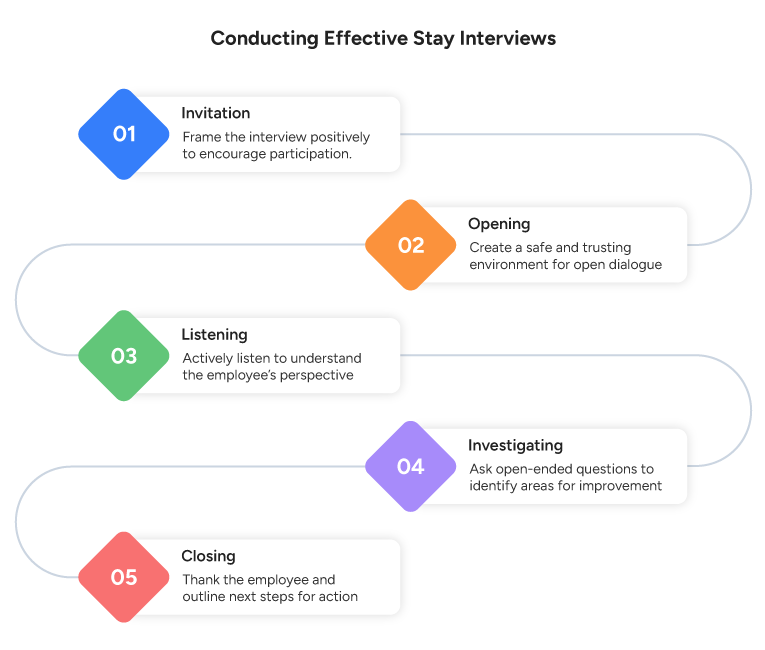
Stay interview questions help organizations retain talent by understanding employee needs through structured and one-on-one conversations. The aim of such interviews is to focus on current job satisfaction rather than post-departure feedback. Every organization has a different approach to conducting stay conversations. We have mentioned some of the standard steps below:
Step 1: The Invitation
HR teams should frame the invitation in a positive way to avoid negative impressions. Using email or other means of communication, the message should convey that this is not a performance review. For example, “I would love to chat about how we can make this workplace even better for you.”
Step 2: The Opening
It is important to build psychological safety for employees at the start of the interview. Managers can provide reassurance and state the company’s goals, like understanding the employee experience. For example, “This session is arranged for you to share your thoughts and perspective to improve our culture.”
Step 3: Listening
Managers should actively listen by having continuous feedback to what employees are saying and understand the challenges they face. The 80/20 rule applies here: listen 80% of the time and speak only 20% to avoid interruptions.
Step 4: Investigating
Some of the questions should include phrases like “Tell me more about this” or “What can make this better?” These open-ended questions allow employees to answer directly.
Step 5: Closing
The last step is to thank the employee for providing their feedback and key points. They should be informed about the following steps and actions.
The “Who, When, and Where” of Stay Interviews
Organizations should plan the process for conducting staff interviews, like who will be talking to the employees. This process also includes when it will take place and where the interviewers will conduct it. Every step should be planned to avoid confusion and allow the conversation to focus on the employee from the start.
Who
- The Interviewer: The manager or supervisor is the interviewer who has a direct professional relationship with the employee.
- The Interviewee: These are top-performing or key employees that the company wants to retain.
When
- Regularly: It can be conducted annually, which is a common practice in most organizations.
- Separately: It can be scheduled every 6 months, before or after performance reviews, to keep the focus on engagement.
- In Advance: It is advised to schedule in advance to show respect and allow the employee to prepare for the interview.
Where
- Neutral space:A quiet space can help the employee feel safe and comfortable being transparent.
- Flexible: It can also be in-person or virtual.

Top 10 Most Asked Questions on Stay Interview
What do You Look Forward to when You Come to Work each Day?
Why Ask this
This shows some of the intrinsic motivators for employees, for example, team interactions and challenging tasks. This way, companies can help identify strengths to improve the workplace environment.
What to Look for in the Answer
Look for positive aspects, like collaborating on projects, which shows high employee engagement. Unclear or vague answers include coffee, which suggests morale issues.
What Keeps You Working Here?
Why Ask this
Companies can identify loyalty factors, for example, culture and growth opportunities. These can help frame retention and overall productivity strategies.
What to Look for in the Answer
Search for answers that include team support, which indicates strong ties with fellow employees. Also, identify answers that include external factors, for example, a convenient location that highlights vulnerabilities.
What is the Best Part of Your Job?
Why Ask this
This question highlights peak experiences across the team and boosts overall satisfaction.
What to Look for in the Answer
Managers should look for role-specific replies, like solving client problems, which show strategies for work. Watch out for some of the generic praise that may hide employees’ dissatisfaction.
What Part of Your Job Would You Cut out if You Could?
Why Ask this
When employees answer this question, it exposes their inefficiencies and frustrations. For example, unnecessary processes for streamlining operations.
What to Look for in the Answer
Answers should include actionable complaints, like excessive reporting. When an employee does not respond, it might indicate hidden burnout.
What Can I do More or less as Your Manager?
Why Ask this
It provides direct, actionable feedback to team leaders, helping them improve one-on-one relationships.
What to Look for in the Answer
The answer should include aspects like “more feedback, less micromanaging”. Hesitation from the employee’s side indicates their trust issues and gaps.
Do You Feel Recognized for Your Contributions?
Why Ask this
Employee rewards and recognition drive retention, which measures if efforts are valued even during burnout risks.
What to Look for in the Answer
Answers should include recognition during meetings or reward programs.
If You were the CEO for a Day, What’s the First Thing You Would Change?
Why Ask this
It shows some of the systemic issues from an employee’s point of view, which prioritize impactful reforms.
What to Look for in the Answer
Employees might pour their ideology, which might include flexible work hours and some unrealistic answers, like double salaries.
What Might Tempt You to Leave? (Crucial Question)
Why Ask this
This question is asked to identify exit triggers for employees, like pay scale or work culture, which allows companies to take preemptive action.
What to Look for in the Answer
Some answers should be used to prevent exit factors, like better work-life balance or competitor packages.
When was the Last Time You Thought about Leaving, and why?
Why Ask this
This answer uncovers employees’ recent pain points and strategies for leaving the organization.
What to Look for in the Answer
Managers should look for answers with recent thoughts with reasons, like last month, due to workload. When an employee answers “never”, it may indicate disengagement.
What does Your Dream Job Look like?
Why Ask this
It shows their aspirations against current reality, which reveals skill gaps or unmet needs.
What to Look for in the Answer
The answers should also include their current role, for example, more leadership. This way, leaders can suggest internal growth paths and success.

Guidelines for Stay Interviews
There are a few guidelines prepared to conduct this type of interview, as the focus is on maintaining trust and retaining the top talent. Some of these guidelines are:
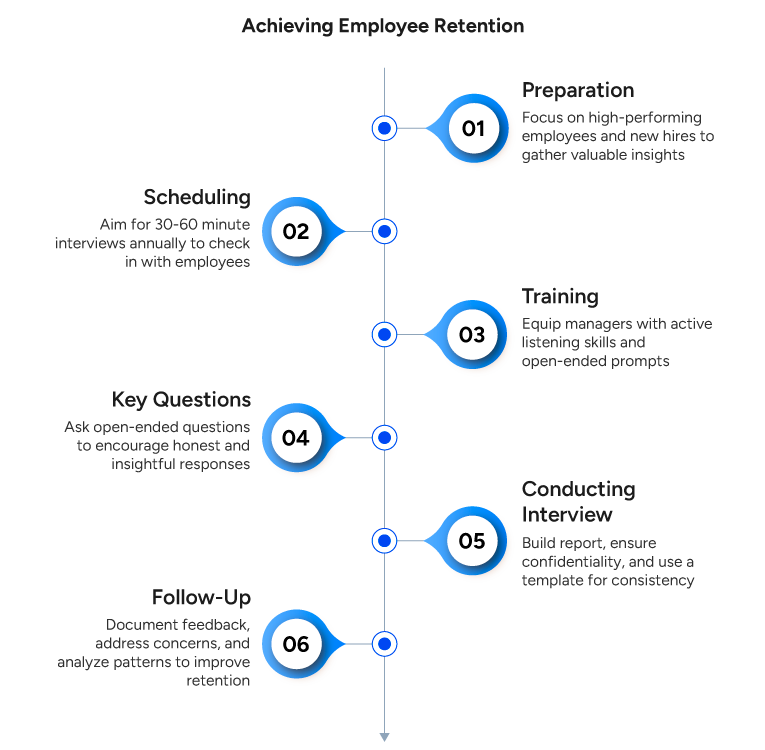
Preparation Steps
- Start small and prioritize: The top-performing employees should be interviewed first, and new hires who have completed at least 3-6 months. Note that it is not necessary to interview everyone at the same time.
- Schedule strategically: The sessions should not be long or too short; for example, 30-60 minute sessions can be conducted annually.
- Train and equip managers: Managers/supervisors should be provided with lessons on active listening (80% listening, 20% talking) and asking questions such as “Tell me more”.
Key Questions
Team leaders should ask some open-ended questions to spark honest answers. Some of these are:
- What is it that you enjoy about your work the most, and why?
- What can be the reason for you to leave your current job, and what keeps you here?
- How can the company make your work more fulfilling?
- What career growth opportunities are you looking for in our firm?
- Do you see yourself here in a year? If yes, why?
Conducting the Interview
- Build mutual rapport: Managers should prioritize in-person conversations and listen to employees to ensure they feel valued in the organization. Their feedback should be summarized in key points at the end.
- Ensure confidentiality: The employees ‘ information should be kept confidential and stored centrally for easy access by managers.
- Follow a template: Keep the interview structured yet flexible, and for consistency, companies can use some templates.
Follow-Up and Analysis
- Act immediately: Employee feedback: loyal employees should be documented to plan retention strategies.
- Spot patterns: There are some trends that can be grouped as recurring patterns. For example, growth opportunities or workload issues, which drive the organization towards growth.
- Measure impact: Regular stay interviews can help reduce employee turnover when actions are taken on time. This also shows the company’s commitment to value for employees and transparency.
Common Mistakes Managers Make
In some cases, managers do not take retention interviews seriously; for example, they lack preparation and treat these as interrogations. This weakens employees’ trust and gives incomplete insights.
- Defensiveness: Managers should not get defensive when employees share constructive feedback about the organization. It is better to actively listen and respond with empathy to build strong relationships.
- Making Promises You Can’t Keep: Team leaders should not make assurances they can’t deliver; employees can remember misleading information.
- Turning it into a Performance Review: Supervisors should not shift their focus from employees’ past failures. These one-on-one conversations should feel supportive and lead to genuine development.
- Lack of Follow-through: It is important for companies to understand that employees feel undervalued if their feedback goes unfulfilled. There should be regular check-ins and progress to show commitment to them.
Conclusion
A stay interview questionnaire template helps organizations to identify employee needs and boost engagement. This way, companies can also retain top talent in a competitive market and scale accordingly. Organizations can focus on team collaborations through genuine connections and showing employees that they matter.
By implementing thoughtful questions and targeted strategies, HR professionals can reduce turnover risks and increase growth opportunities. Managers who prioritize these conversations see higher engagement and lower costs from reduced hiring needs. Schedule a stay interview today and prepare open-ended questions for immediate impact.

FAQs
How do I Prepare for a Stay Interview?
Employees should focus on job satisfaction and growth opportunities. Managers should identify potential issues and frame questions accordingly.
What does a Stay Interview Look like?
It is a one-on-one manager-employee meeting, which is focused on job satisfaction and retention methods. Managers should ask open-ended questions like “What do you like most?” or “What frustrates you?”
How Long Should a Stay Interview be?
The interview should be 25-45 minutes, which is for a focused discussion. This allows honest feedback without overwhelming the employees.
When to Conduct Stay Interviews?
These interviews should be conducted annually after employees have settled into their jobs and should be treated as performance reviews. Companies should arrange interviews with top-performing and disengaged employees to gather feedback.
What are the Tips for Effective Stay Interviews?
Managers should stay focused on building trust between employees to get honest feedback. They should use open-ended questions customized to the employee.


Grow your business with factoHR today
Focus on the significant decision-making tasks, transfer all your common repetitive HR tasks to factoHR and see the things falling into their place.

© 2026 Copyright factoHR