
9 Box Grid Explained: Talent & Performance Management
Table of Contents

Key Takeaways
- The 9‑Box Grid evaluates employees based on performance and potential across nine categories.
- It helps identify high performers, high-potential talent, and development areas.
- Using the grid supports succession planning and strategic workforce decisions.
- HR teams can combine it with other tools, such as 360-degree feedback, to achieve more accurate assessments.
- Clear criteria, rating scales, and real examples improve fairness and consistency.
- Common challenges include bias, oversimplification, fixed labels, and limited depth, which can be managed with multi-rater input and qualitative feedback.
- The model encourages targeted development, internal promotions, and better alignment with company goals.
- Customizing the criteria to the organization’s culture makes the tool more effective.
- Its real value comes from the conversations, evaluations, and development actions that follow the grid placement.
What is the 9 Box Grid?
The 9-box grid is a standard talent management tool that assesses employees based on performance and potential. It categorizes staff into nine segments, helping HR teams identify top performers, high-potential individuals, and individuals requiring focused development.
The effectiveness of this performance tool increases when combined with regular feedback, performance reviews, and targeted learning programs. When implemented appropriately, the 9‑box grid helps organizations make informed decisions, nurture talent, manage the succession pipeline, and build a future-ready workforce.

How to Create and Use the 9 Box Model
Managers and HR teams can follow these steps to create and use the 9-box model as an effective talent management tool:
Define Criteria for Performance and Potential
Start by setting clear, objective criteria to ensure everyone follows the same standard. This step reduces bias and maintains fairness in the process. Use performance indicators such as work impact, quality, efficiency, and quantity to assess performance. Managers can rate an employee’s performance using the 1–3 scale:
- Does the person meet the role’s primary responsibilities?
- Is the work accurate and reliable?
- How well does the person manage workload and timelines?
To assess potential, consult with managers and team members to get a holistic view. Focus on indicators such as leadership interest, adaptability, emotional awareness, and learning ability. Managers can ask these sample questions to rate an employee’s potential using the (1–3 scale):
- Does the person learn new skills quickly?
- Can the person handle new or challenging tasks with limited support?
- Does the person show interest in taking on more responsibility or guiding others?
Construct the Grid
Once the performance and potential axes are drawn, divide each axis into low, medium, and high levels. This creates the nine boxes(9 Box Grid), where each intersection represents a distinct combination of performance and potential. For clarity, label each box, for example: ‘Underperformer’ (low/low), ‘Core Team Member’ (medium/medium), or ‘Future Leader’ (high/high). These labels provide a simple reference for discussion and development planning.
Evaluate Employees and Calibrate
Managers must assess each employee using the criteria and rating scale. To ensure success, it is advisable to focus on one team or division at a time. After initial ratings, hold a calibration meeting to ensure consistency and reduce bias. Additionally, ask managers to provide brief examples or observations to support their ratings.
Plot Employees on the Grid
Position each employee in the appropriate box based on their performance and potential scores. Managers and stakeholders must confirm the placements after repeated discussions to avoid mistakes and misjudgements. To strengthen transparency and trust, it is also important to ensure that employees have the opportunity to provide input.

Detailed Breakdown of the 9 Box Grid
Understanding what each box represents helps HR and managers take the appropriate steps for talent management and succession planning. Below is an explanation of all 9 Box Grid and guidance on how to support the individuals in each group.
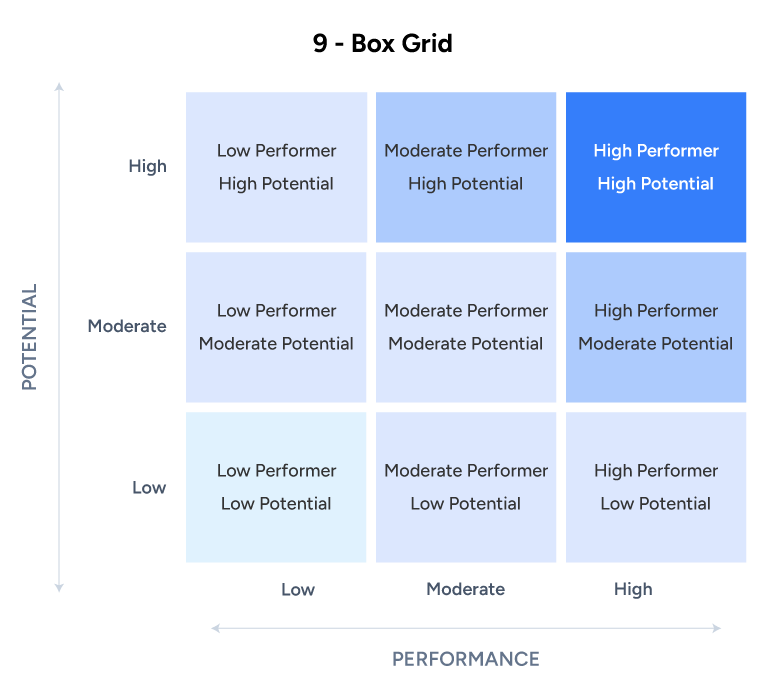
Low Potential, Low Performance
This box is the lowest on the grid, with employees in it struggling with both performance and potential. They may be a misfit for their current role.
Check if personal issues or role mismatches are affecting their work. If performance does not improve even after support, reconsider the hiring decision.
Low Potential, Moderate Performance
These employees perform at an average level but show limited long-term potential.
The best approach may be to clearly communicate that their performance needs improvement. Set clear goals and provide a structured performance improvement plan to help them overcome personal hindrances.
Low Potential, High Performance
Although these employees score low on potential, they consistently perform well.
Motivate these employees and recognize their contribution through salary increases. Offer relevant skill-building opportunities so they are ready to face future changes. They may not be ideal for promotion, but they are valuable assets.
Moderate Potential, Low Performance
These employees can grow, but are currently not meeting expectations. This may happen due to unclear responsibilities or a lack of feedback from senior leadership.
Identify the reasons behind their low performance. Subsequently, provide support, guidance, and regular feedback to help them improve.
Moderate Potential, Moderate Performance
The employees in this group are reliable, consistent, and capable of developing further. They meet expectations, but have the calibre to improve their performance and potential.
Expose these employees to new tasks and moderately challenging roles, while providing the support and guidance they need to excel. Continue setting clear expectations and recognizing good work when they meet or exceed expectations.
Moderate Potential, High Performance
These employees are strong performers, consistently delivering excellent results while showing promising potential.
Invest in their training and development. Identify the areas where they exceed expectations and assign them similar, more challenging responsibilities. Acknowledge their achievements and encourage them for their initiatives.
High Potential, Low Performance
They have strong potential but are currently underperforming due to factors such as the time required to adjust to new roles or unclear expectations.
Identify and clear the barriers affecting their performance. Assign them a role that aligns with their capabilities, career goals, and objectives. Set clear expectations and provide ongoing feedback to accelerate improvement.
High Potential, Moderate Performance
These employees are highly ambitious, willing to tackle multiple projects, gain knowledge, and take on new challenges. However, they need to deliver more consistent results to be identified as high potential.
Offer targeted development opportunities and set clear performance benchmarks. Help them progress toward the top-performing category.
High Potential, High Performance
These are top performers with strong leadership potential. They should be the focus of the organization’s succession planning strategy as they are key contributors and future leaders.
Keep them engaged with challenging projects. Focus on advanced development, especially in leadership and people management skills, to prepare them for senior roles.

Benefits of the 9-Box Model
The 9-box model is one of the most commonly used talent management tools because it is simple, practical, and effective across different industries. A few key benefits include:
Improves Succession Planning and Reduces Hiring Costs
Hiring externally, especially for senior roles, is time-consuming and can be expensive. The 9-box model helps HR identify people who can grow into leadership roles based on their performance and potential, making succession planning more structured.
Teams can spot high performers with strong potential, as well as moderate performers who can advance with focused training and support. This makes internal promotions easier, reduces future skill shortages, and lowers recruitment expenses. To back this claim, Wharton research shows that external hires cost 18 to 20% more than internal hiring.
Re-Evaluate Talent Placement
The model provides a clear overview of an individual’s current performance and future growth potential. This helps leaders identify where the company may lack critical skills or future leaders.
The grid also highlights performance issues early, helping managers decide who needs extra training, coaching, or support. By addressing these gaps promptly, organizations build a stronger, more capable workforce.
For evaluation, managers can ask questions such as:
- Has the team member shown interest in growing within the company?
- Would they perform better in a different role?
- Are they prepared for a more senior position?
- Is someone struggling because the role does not match their strengths?
These insights help managers develop people into roles that align with their skills and career goals.
Flexible and Easy to Use
The 9-box model can be used in any department, even in roles where performance is difficult to quantify. It is quick to learn and implement.
Its visual layout helps managers and HR teams understand performance and potential easily. Instead of focusing only on past performance, the model encourages teams to consider long-term growth and future contribution.
It also creates space for honest conversations between HR, managers, and team members by answering questions such as:
- Who consistently delivers strong results?
- Who could take on more responsibility soon?
- Where are the most significant growth areas in the team?
- Which skills or behaviors support strong performance?
These discussions help teams better understand strengths, areas for improvement, career goals, and training priorities.

Common Challenges and Solutions
While the 9-box model is useful, some limitations should be managed carefully. Implementing these solutions can mitigate the challenges and ensure the tool is applied fairly and responsibly.
Bias and Subjectivity
One of the most significant risks is relying too much on personal judgment. Performance and potential interpretations may vary across managers, leading to inconsistent ratings. Intentional or unintentional bias can also influence an employee’s placement on the grid. These biases can affect morale and may disadvantage people from underrepresented groups.
Ensure that assessments are not based on a single viewpoint by involving managers, peers, and HR. Use clear criteria, documented examples, and structured rating scales to focus on evidence-based evaluations and reduce personal assumptions.
Oversimplification of Talent
The grid summarises a team member’s performance and potential into a single category, which may not fully reflect their varied strengths. An employee can excel at specific tasks and still be developing in other parts of the role.
Combine quantitative ratings with qualitative feedback to build a more accurate understanding of each person. Use notes from one-on-one discussions, project outcomes, and real work examples to provide a holistic overview.
Risk of Fixed Labels
Once team members are placed in a box, managers may unintentionally hold on to that label. For instance, someone marked as low potential may be overlooked for projects that could help them grow. This can restrict development, limit career mobility, and reduce motivation.
Review placements regularly, at least once or twice a year. Talent changes as people learn new skills or take on new responsibilities. Frequent updates ensure the grid reflects current performance and growth.
Limited Depth
The 9-box model offers a quick overview, but it cannot replace a detailed performance review. The simplicity that makes it easy to use also makes it imprecise. Without deeper conversations, managers may misinterpret where someone truly stands.
Use the grid alongside broader performance management tools, such as goal tracking, competency assessments, and development plans. Encourage open conversations with team members about their placements to clarify expectations, identify skill gaps, and set meaningful development plans.
Conclusion
The 9 Box Grid provides a straightforward method to understand employee performance and growth potential. It helps HR teams recognize talent, identify development needs, and support planning for future roles. The grid works efficiently with regular meetings, feedback, and learning programs. This approach helps organizations make fair decisions about development and support different career paths.
factoHR’s performance management tools support this process by giving teams a centralized location to track goals, reviews, and development plans. The platform makes it easier to record feedback, monitor progress, and keep performance data organized throughout the year. When the 9 box grid is used alongside these tools, HR teams gain clearer insights, make faster decisions, and provide more structured support for employee growth.
How Often Should a 9-Box Review be Conducted?
Annually or bi-annually during performance review cycles.
Does the 9-Box Grid Demotivate Employees?
Yes, if not implemented carefully. Labeling employees as “low potential” can discourage growth and reduce engagement.
How does the 9-Box Grid Relate to Succession Planning?
It identifies high-potential, high-performing employees as successors for leadership roles and guides their development.
What are the Modern Alternatives to the 9-Box Grid?
4-Box Grid, Skill-Will Matrix, 360-Degree Feedback, Competency Models, AI-Driven Predictive Models, and Talent Profiles.
How do You Plot an Employee on a 9-Box Grid?
Assess performance (X-axis) and potential (Y-axis), then place the employee in the corresponding box on the grid.


Grow your business with factoHR today
Focus on the significant decision-making tasks, transfer all your common repetitive HR tasks to factoHR and see the things falling into their place.

© 2026 Copyright factoHR