
The Complete Guide to Employee Salary Advance Policy in India
Download Employee Salary Advance Policy PDF Format For Free

Table of Contents

Sometimes people face sudden money problems. An advance on their pay can really help. It shows you care about your team. But without clear rules, giving out early pay can cause big headaches for HR. This guide helps you build a fair, easy-to-follow process. We will show you how to handle requests without messing up your payroll system.
Key Takeaways
- Learn exactly what an advance is and how it works.
- See the main differences between an advance and a regular loan.
- Find out how to write a clear policy with rules and limits.
- Get the facts on taxes and payroll rules in India.
- See how to get the money back safely from the next paycheck.
- Learn about new tools like Earned Wage Access.
- Discover how HR software makes the whole process fast and simple.
What is a Salary Advance?
A salary advance means paying a worker a part of their earned wages before their normal payday. You then deduct this exact amount from their future paychecks. It is usually a small part of their take-home pay. People often use it for sudden emergencies.
To get this money, the worker must follow your company’s rules. They usually need to fill out a simple salary advance request form and get approval from their boss.
Salary Advance vs. Employee Loan
Both options help workers get cash fast. But they are very different. You must know the difference to stay legal and keep your books clean.
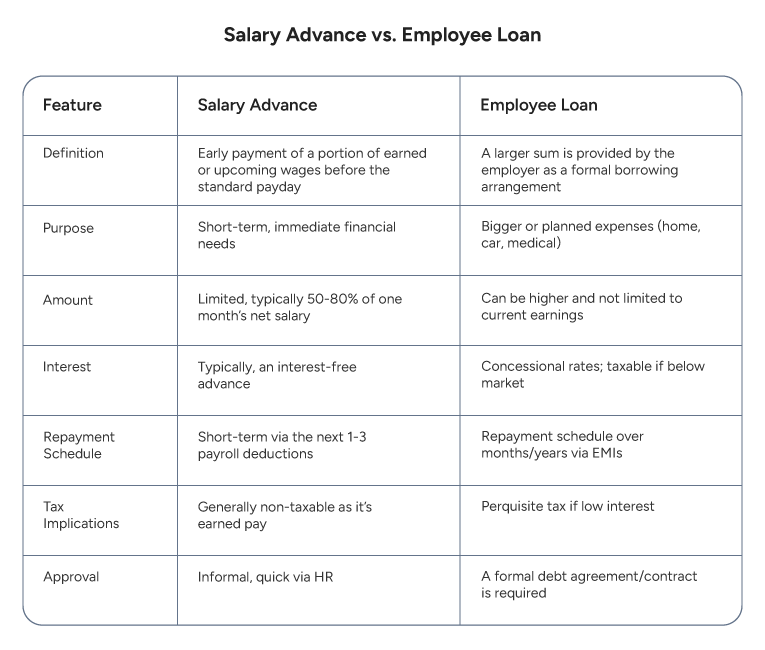
Salary Advance
- What it is: Early payment of money that the worker has already earned.
- Why use it: Quick help for short-term needs.
- How much: Usually 50 percent of one month of take-home pay.
- Interest rate: No interest charged.
- Payback time: Taken out of the next one to three paychecks.
- Taxes: Not taxed as extra income.
- Approval: Quick and easy through HR.
Employee Loan
- What it is: A larger amount of money borrowed from the company.
- Why use it: Big expenses like a car or a hospital bill.
- How much: Can be much more than one month of pay.
- Interest rate: Often low.
- Payback time: Paid back over many months or years.
- Taxes: Can be taxed if the interest rate is very low.
- Approval: Needs a formal legal contract.

Free Salary Advance Policy Templates for Employees
Writing a new rulebook from scratch takes too much time. We want to make your job easy. Below is a free salary advance policy template that you can use right now. You can just copy and paste this text directly into your company handbook. We even included a simple salary advance application format at the bottom. Just change the details to match your own company rules, and you are good to go.
Salary Advance Policy Template
To beat the competition and give your team the best support, your policy needs clear rules. Here is how to write a salary advance policy for employees that works.
1. Purpose of this Policy
This policy explains how our company helps workers during financial emergencies. We offer a salary advance to help bridge the gap until payday.
2. Who Can Apply for a Salary Advance?
To qualify for a salary advance, the following eligibility criteria must be met:
- Full-time employment status with the company is required.
- A minimum of six months of service must be completed.
- No other active salary advances or company loans should be outstanding.
- A good performance record and a clean disciplinary history are necessary.
3. Acceptable Reasons
We approve early pay for sudden emergencies. Good reasons include:
- Unexpected medical bills for you or a close family member.
- Sudden home repairs.
- Urgent travel for a family emergency.
- We do not approve advances for vacations or buying luxury items.
4. Money Limits
- The most you can ask for is 50 percent of your monthly take-home pay.
- The lowest amount you can ask for is 5000 rupees.
- You can only get one advance per year.
5. How to Apply
- Fill out the Salary Advance Request Form.
- Give the form to your direct boss for approval.
- Your boss will send the approved form to HR.
- HR will let you know if you are approved within two working days.
6. Paying the Money Back
- We do not charge interest on this money.
- We will take the money back directly from your next paycheck.
- If the amount is large, HR might split the payback over two or three paychecks.
- If you leave the company, we will deduct the remaining amount you owe from your final settlement pay.
Salary Advance Request Form Template
Employee Details
- Full Name: [Insert Name]
- Employee ID: [Insert ID]
- Department: [Insert Department]
- Date of Request: [Insert Date]
Advance Details
- Money Requested: [Insert Amount]
- Reason for Request: [Briefly explain the emergency]
Agreement
I promise that the information above is true. I agree that the company can deduct this exact amount from my future paychecks until it is fully paid back. If I leave the company before paying it back, the company can take the money from my final paycheck.
- Employee Signature: _______________ Date: _______
- Manager Signature: _______________ Date: _______
- HR Approval Signature: _______________ Date: _______
This clear salary advance policy covers eligibility, limits, approvals, repayment, and recovery. It ensures transparency, reduces HR workload, and provides employees with a fair, consistent, and compliant process for accessing advances.

Taxes and Payroll Rules in India
You do not usually pay extra taxes on an advance. It is just early pay. But you must follow the advance salary rules in India to avoid trouble.
How to Take the Money Back
In India, advance money should be recovered from the net pay after completing all standard salary deductions.
- First, apply the Provident Fund (PF) deduction.
- Next, calculate the Professional Tax (PT) deduction.
- Finally, deduct Income Tax (TDS).
After you take out those three things, you can take the advance money from what is left. This keeps your taxes correct. Always have the worker sign a form agreeing to this deduction.
Tax Rules for Big Advances
If you give a worker more than 20,000 rupees, tax rules might apply. If it acts like a free loan, the government might view it as a special perk. You will have to calculate the saved interest and tax it. Small advances paid back quickly do not face this rule.
A New Option: Earned Wage Access
Traditional payroll cycles have long been the standard, but they often leave employees in a “liquidity crunch” between paychecks. Historically, workers turned to high-interest payday loans or informal salary advances that burdened HR departments with manual tracking. Enter Earned Wage Access (EWA) – the modern, tech-driven alternative to the traditional cash advance.
What is EWA?
EWA is a financial wellness tool that allows employees to access a portion of their already-earned wages in real time, rather than waiting until the end of the month. Unlike a loan, no interest is charged; it is simply a way for workers to unlock the capital they have already worked for.
Benefits for Employers and Employees
The shift toward EWA is gaining momentum because it solves pain points for both the business and the workforce:
- Zero Impact on Cash Flow: Because many EWA providers utilize NBFC partnerships (Non-Banking Financial Companies), the provider fronts the capital. This means the employer doesn’t have to dip into their own working capital to support employee needs.
- Automated HR Workflows: Modern EWA platforms integrate directly with existing payroll systems, automating the tracking and deduction process without adding to the HR team’s workload.
- Improved Employee Retention Strategies: Financial stress is a leading cause of turnover. By offering EWA, companies position themselves as empathetic employers, using it as a cornerstone of their employee retention strategies to keep talent focused and loyal.
Why It’s the Better Alternative
Unlike traditional advances, which can be awkward to request and difficult to manage, EWA provides a “self-serve” experience. It empowers employees to handle emergencies, like medical bills or car repairs, while the company remains focused on its core operations.
Automate Your Payroll with factoHR
Doing all this by hand takes too much time. You can lose track of papers and make mistakes. You can automate your payroll with factoHR to consolidate the entire process into a single, easy-to-use system.
- Quick Phone Requests: Workers check their limit and request cash right on their phones.
- Fast Approvals: Bosses receive an alert and can say yes with a single click.
- Perfect Sync: The system connects the advanced right to your payroll software. No more typing numbers twice.
- Automatic Payback: The software takes the money back on payday all by itself. It even shows up clearly on the payslip.

Frequently Asked Questions
Is a Salary Advance Taxable in India?
No, a normal advance is not taxed. It is just your normal pay given early. But very large amounts might be taxed as a special benefit.
Can a Company Say no to a Request?
Yes. Early pay is a favor, not a strict legal right. A boss can say no if the worker breaks the policy rules.
How Much Money Can a Worker Ask for?
It depends on your company’s rules. Most places allow up to 50 percent of the monthly take-home pay.
How does the Company Get the Money Back?
HR sets up an automatic cut from the next paycheck. This continues until the money is fully paid back.
What if the Worker Quits before Paying It Back?
The company will take the remaining amount from their final leave pay.



Transform your HR operations with factoHR today
Choose a perfect plan satisfying your business demands and let factoHR handle all your HR’s tasks efficiently.