
Attrition vs Turnover: What is the Difference?
Table of Contents

Key Takeaways:
- What Attrition vs Turnover truly means and why the difference matters.
- How turnover impacts short-term hiring needs and daily operations.
- How attrition shapes long-term workforce planning and cost decisions.
- The eight key differences that help HR leaders understand both metrics clearly.
- How to calculate turnover, attrition, and churn with simple formulas.
- When HR should track each metric to make smarter staffing decisions.
- Proven strategies that reduce unwanted exits and improve retention.
- How HR leaders use combined data insights to make strong workforce decisions.
Strong HR decisions depend on how well you interpret Attrition vs Turnover trends. When your top performer suddenly resigns, do you call it attrition or Turnover? Many HR teams use these terms interchangeably.
Here, you will learn clear definitions, easy formulas, example calculations, real-world scenarios, and proven strategies to reduce both attrition and Turnover, along with practical HR insights you can apply immediately.
What is Employee Attrition?
Employee attrition refers to an organization’s decision not to fill positions after employees leave. Instead of hiring new staff, the organization allows headcount to shrink naturally. Attrition can take several natural forms, such as:
Voluntary Attrition
Employees leave on their own through retirement, relocation, or career change, and the company chooses not to refill those positions.
Involuntary Attrition
The organization terminates employees due to reasons like poor performance, misconduct, or company restructuring, and chooses not to replace them.
Internal Attrition
Employees move into other internal roles, and their previous positions remain vacant or are merged into different responsibilities.
Demographic-Specific Attrition
When employees from a specific age group, skill set, or department leave the organization at a higher rate than other groups.

What is Employee Turnover?
Employee turnover is the number of employees who leave and are replaced by new hires in an organization within a specific period. The number clearly indicates the frequency of Employee exits, Recruitment cycles, Onboarding & training sessions
Turnover is an important workforce indicator because it affects employee retention, engagement, hiring costs, and overall stability. Many HR teams track turnover to understand workplace culture, team satisfaction, and talent sustainability.
Employee turnover can be divided into the following categories:
Voluntary Turnover
Employees resign on their own due to reasons like better career growth, poor management, low engagement, or higher compensation elsewhere.
Involuntary Turnover
The organization asks employees to leave because of layoffs, performance issues, restructuring, or disciplinary actions.
Internal Turnover
It indicates an employee’s transition to a different role or department within the same organization. Internal turnover does not reduce overall headcount but affects team stability.
Functional vs. Dysfunctional Turnover
- Functional Turnover: Low-performing or misaligned employees leave, improving team efficiency.
- Dysfunctional Turnover: High performers leave, causing productivity loss and higher replacement costs.
Attrition vs Turnover: 8 Key Differences Explained
When it comes to understanding the gravity of attrition vs turnover in a situation, consider evaluating the following eight key differences.
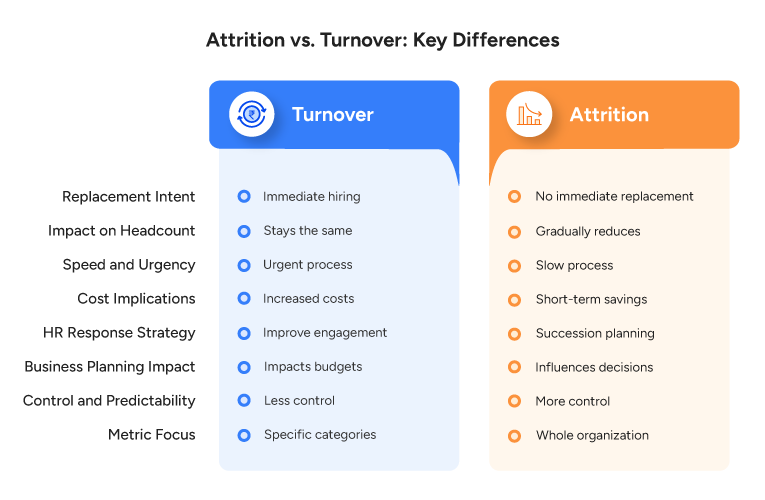
1. Replacement Intent
- Turnover: The organization immediately hires someone to fill the vacant position to maintain continuity and avoid workflow disruption.
- Attrition: The organization chooses not to replace the employee. The role may remain vacant temporarily or be filled permanently, depending on business requirements.
2. Impact on Headcount
- Turnover: Headcount stays the same because the organization hires immediately.
- Attrition: Headcount gradually reduces as the organization does not fill the vacant positions.
3. Speed and Urgency
- Turnover: The process feels urgent, and hiring begins immediately to avoid productivity loss.
- Attrition: The process is slow as the HR has time to assess workload distribution or redesign job roles.
4. Cost Implications
- Turnover: Recruitment, onboarding, and training of new hires increase costs associated with recruiting, hiring, and training.
- Attrition: Saves payroll costs in the short term but may impact team productivity without additional support.
5. HR Response Strategy
- Turnover: Focus on improving core issues and boosting employee engagement to reduce churn rate in the first place.
- Attrition: HR invests in succession planning, internal mobility, knowledge transfer, and long-term workforce planning.
6. Business Planning Impact
- Turnover: Impacts recruitment budgets, training schedules, and operational timelines due to constant hiring and training cycles.
- Attrition: Influences big decisions, such as departmental restructures and forecasting future workforce models.
7. Control and Predictability
- Turnover: HR professionals have less control over the churn rate, as employees may also leave suddenly for personal reasons.
- Attrition: In the case of attrition, management typically plans and controls natural exits or gradual workforce reduction over time.
8. Metric Focus
- Turnover: Tracked by specific categories like department, job level, tenure, or demographics to identify problem areas.
- Attrition: Measured across the whole organization to support long-term workforce and budget planning.
As you can see, both attrition and Turnover are useful for tracking employee exits and developing strategies for long-term retention.

Attrition vs Turnover: Side-by-Side In-Depth Comparison
Let us have a quick attrition vs Turnover comparison below for better understanding.
| Factor | Employee Turnover | Employee Attrition |
|---|---|---|
| Definition | Employees leave, and the organization hires replacements to fill the same roles. | Employees leave, but the organization intentionally does not replace them, reducing headcount. |
| Replacement Decision | Backfilling is immediate to maintain workflow continuity. | The position is left vacant or removed from the structure. |
| Headcount Effect | Stays stable because each exit is replaced quickly. | Declines gradually as roles go unfilled. |
| Common Causes | Poor management, low engagement, burnout, career change, and better offers. | Natural retirement, restructuring, hiring freeze, budget cuts, and role redundancy. |
| Timeline | Fast and urgent replacements within weeks. | Vacancies remain open for months or permanently. |
| Cost Impact | High costs for recruiting, hiring, onboarding, training, and productivity loss | Short-term savings on payroll, but possible workload pressure on existing teams |
| HR Priority | Retention improvement, employee engagement, hiring efficiency | Succession planning, role consolidation, long-term workforce design |
| Warning Signs | Frequent resignations, high exit interview issues, and rising hiring volume | Increasing vacant roles, smaller team size, and dependency on remaining staff |
| Measurement Frequency | Monthly or quarterly by department or job category. | Yearly across the whole organization |
| Business Goal Alignment | Supports operational stability and ongoing productivity | Supports restructuring, cost optimisation, and strategic workforce planning |
| Employee Morale Impact | Lower morale due to high Turnover and onboarding cycles | Teams may feel pressured due to vacant positions. |
| Example Scenarios | The sales manager quits, and HR immediately hires a new manager | A retiring admin assistant’s role is removed due to automation. |
How to Calculate Employee Attrition Rate
Employee attrition rate shows how fast a company loses people without hiring new ones. This metric helps HR make better decisions to improve employee engagement.
Attrition Rate Formula
(Employees who left and did not get replaced ÷ Average number of employees) × 100
Step 1: Count the employees who left and were not replaced.
Step 2: Find the average number of employees:(Opening headcount + Closing headcount) ÷ 2
Step 3: Divide the non-replaced exits by the average employee count.
Step 4: Multiply the answer by 100.
Employee Attrition Rate Example
- Employees who left without replacement: 5
- Average employees: 150
- Attrition Rate = (5 ÷ 150) × 100 = 3.3%
Types of Attrition Rates to Track
- During restructuring or cost control periods
- When many employees retire or shift careers
- When you want to study long-term workforce health
This insight supports strong planning and better attrition vs turnover analysis.

How to Calculate Employee Turnover Rate
Employee turnover rate indicates the percentage of employees who leave a company during a specific period. This is a basic metric for comparing Attrition vs Turnover patterns and for addressing workforce challenges.
Turnover Rate Formula
(Number of employee separations ÷ Average number of employees) × 100
Step 1: Identify how many employees left during the selected period (month, quarter, or year).
Step 2: Calculate the average number of employees: (Opening headcount + Closing headcount) ÷ 2
Step 3: Divide separations by the average number of employees.
Step 4: Multiply the result by 100 to get the percentage.
Employee Turnover Rate Example
- Employees who left: 12
- Average employees: 150
- Turnover Rate = (12 ÷ 150) × 100 = 8%
Types of Turnover Rates to Track
- Voluntary Turnover Rate: Measures employees who resign by choice, often linked to culture, compensation, or career growth.
- Involuntary Turnover Rate: Tracks exits due to termination, layoffs, or performance issues.
- Departmental Turnover Rate: Measures which teams have higher turnover, helping pinpoint leadership or workload issues
- New Hire Turnover Rate: Tracks employees who leave within the first 90 days or first year.
- High-Performer Turnover Rate: Shows how many top performers leave. This is critical because losing key talent affects productivity and morale.
HR teams track turnover trends, exit patterns, and hiring needs using HR software. These softwares help HR measure employee flow, study workforce trends, and make faster decisions.
How to Reduce Employee Turnover (12 Proven Strategies)
Let’s discuss twelve proven strategies to reduce employee turnover and improve retention rate at the same time.

1. Improve Hiring and Onboarding Quality
- Hire skilled candidates who best match the role and your culture.
- Offer a realistic view of the job profile during the interview for candidates to make a conscious decision.
- Develop a strong onboarding process to reduce early exits and rehiring costs.
2. Offer Competitive Compensation and Benefits
- Offer a competitive salary to attract top talent and retain them for a long time.
- Include attractive perks like health cover, work-from-home flexibility, and task bonuses.
- Regularly ask employees what they value in a compensation and benefits package to identify areas for improvement.
3. Provide Clear Career Development Paths
- Map out progression routes for employees at different verticals of your organization.
- Offer upskilling, internal mobility, and promotion roadmaps.
- Provide opportunities for employees to practice new skills through cross-training, job shadowing, or on-demand projects.
4. Strengthen Manager–Employee Relationships
- Managers influence daily experience more than any system you introduce.
- Train managers to listen to employees and guide them toward long-term retention.
- Investment in manager capability will immediately provide structured support to your workforce.
5. Foster Work–Life Balance
- Work-life balance drives employee performance.
- Try to control workloads by providing predictable schedules that help employees avoid burnout.
- Designing healthier work rhythms helps people give better output and stay longer.
6. Build a Recognition and Appreciation Culture
- Employees notice when their efforts are recognized.
- Recognition motivates them faster than most financial perks.
- When you acknowledge sincere efforts, teams stick with the company during challenging phases.
7. Conduct Stay Interviews
- Stay interviews are all about understanding why people might leave months before they decide.
- The insights help you uncover risks early, identify leadership gaps, and address them to reduce turnover.
8. Improve Workplace Culture and Engagement
- Your organization’s culture is what employees experience daily at the workplace.
- Promote fairness, transparency, and strong teamwork in every aspect of the work culture.
- When employees feel safe contributing ideas, it will automatically resolve trust issues quickly.
9. Address Toxic Leadership Immediately
- Toxic leaders create hidden attrition long before resignations appear in data.
- When you see early signs like sudden sick leave, team transfers, or silence in meetings, take action quickly. Removing negative leadership, trust, and retention improves instantly.
10. Offer Meaningful Work
- Employees feel motivated to work when you assign tasks to them that align with their strengths.
- Once they begin to appreciate their task, voluntary turnover decreases.
11. Improve Internal Communication
- Clearly communicate task priorities and expectations to teams.
- You can share weekly clarity updates and reduce unnecessary conflicts.
- Help employees see the bigger picture so that they feel more connected to your mission.
12. Analyse Turnover Data for Patterns
- Simple Turnover percentages tell you nothing without context.
- Study exists by tenure, performance, manager, and role type to identify the root causes.
- When you segment data, you get an actual attrition vs Turnover picture and act with confidence.

How HR Can Use Turnover and Attrition Data Together?
- Perform the attrition vs turnover analysis to understand both fast exits and slow workforce changes
- Analyze turnover data to pinpoint the factors behind rapid exits and increased recruitment activity.
- Attrition data shows long-term gaps, shrinking teams, and future skill needs.
- HR can use both metrics to improve retention and reduce hiring costs.
- This combined view can help HR plan team size, manage workloads, support leaders, fix culture issues, improve communication, and build a stable workforce.
Common Mistakes Companies Make with Turnover and Attrition
Let’s take a look at the top five mistakes organizations make with turnover and attrition.
Mistake 1: Using Terms Interchangeably
Most organizations lack clarity on the distinction between attrition and turnover and treat them as the same. This leads to flawed decisions because the two metrics show different workforce changes.
Mistake 2: Only Tracking Overall Numbers
Focusing on reducing attrition and turnover rates should not be the core purpose. HR must study the deeper patterns. Investigate the factors driving the score and work on lowering them with the right strategy.
Mistake 3: Ignoring Voluntary Turnover Patterns
Voluntary exits indicate cultural and leadership issues in the workplace. HR should compare attrition vs turnover rates to identify valid reasons.
Mistake 4: Viewing all Attrition as Positive
Some attrition helps reduce costs, but high attrition weakens skills and increases stress. HR must judge it carefully within the attrition vs turnover context.
Mistake 5: No Action Plans Post-Analysis
Most organizations study attrition and turnover data but take no action. It is important to work on the insights to create real changes in engagement, leadership, and communication.
Wrapping up
Understanding attrition vs turnover is the key to making better workforce decisions. Turnover shows fast exits that need quick hiring. Attrition shows slow changes that shape long-term planning. It is imperative to understand the implications of both situations to optimize hiring costs and address core workplace issues. The right approach turns employee data into practical action and builds a healthier workplace.

FAQs
Are Attrition and Turnover the Same?
No, attrition vs turnover shows two different types of employee exits. The comparison shows which exits reduce headcount and which need new hiring.
Is a 20% Attrition Rate High?
Yes, 20% is high for most industries. High attrition puts pressure on teams, increases workload, and weakens long-term workforce strength.
Which is Worse for a Company: High Attrition or High Turnover?
Both hurt the business, but high turnover affects teams faster in the attrition vs turnover comparison.
How Can HRMS Software Help Track these Metrics?
HRMS software tracks exits, headcount changes, trends, and reports in one place.
Can Attrition Ever be Beneficial?
Yes, positive attrition removes extra roles and reduces costs in attrition vs turnover planning.


Grow your business with factoHR today
Focus on the significant decision-making tasks, transfer all your common repetitive HR tasks to factoHR and see the things falling into their place.

© 2026 Copyright factoHR