
Employee Disciplinary Action Policy Template
Download Employee Disciplinary Action Policy In Word & PDF Format

Table of Contents

A disciplinary policy defines acceptable workplace behavior and outlines the steps taken when standards are not met. It ensures clarity, fairness, and consistency across employee-related actions, providing guidance for managers and protecting both the organization and its workforce.
HR teams depend on this framework to address misconduct, support compliance obligations, and reduce legal exposure.
This Disciplinary Policy Template can be customized according to your company’s requirements and serves as a starting point for developing your internal guidelines.
Key Takeaways:
- A structured, ready-to-use template for managing employee misconduct and behavioral issues effectively.
- A clear roadmap for the progressive discipline stages from verbal warnings to termination.
- Specific examples distinguishing when to start with counseling (minor issues) vs immediate dismissal (gross misconduct).
- Essential documentation requirements and appeal procedures to protect your business from wrongful termination risks.
Establish a fair workplace with a comprehensive Disciplinary Action Company Policy. This guide outlines progressive discipline steps, ensures HR compliance, and protects your business from legal risks while managing employee misconduct effectively
Employee Disciplinary Action Policy Format
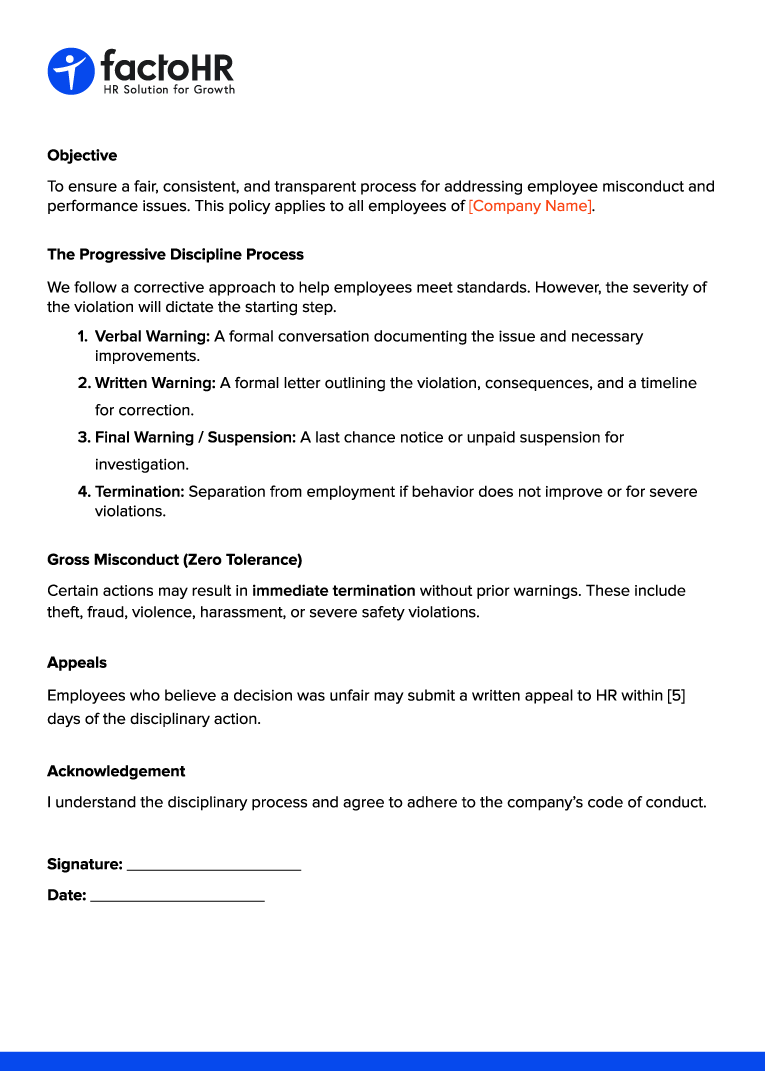
Your disciplinary action company policy should include:
- Stages of disciplinary procedures, from verbal warnings to termination
- Examples of violations and their corresponding starting stage
- Documentation requirements at every step
- Appeal and review processes

Employee Disciplinary Action Policy Template
Policy Brief & Purpose
The employee disciplinary policy explains how our organization manages employee misconduct, behavioral issues, or performance challenges. Employees must understand the consequences of their actions, and this document provides a structured pathway for corrective measures.
Scope
This policy applies to all employees across all departments.
Policy Elements
The following stages may be applied when disciplinary action is necessary:
- Verbal warning
- Counseling or corrective guidance
- Written warning
- Formal disciplinary meeting
- Final written warning
- Temporary loss of privileges or benefits
- Suspension or demotion
- Termination of employment
The employee must be informed of the issue at the start of the process. A verbal warning may be a brief conversation or a more detailed discussion, depending on the situation.
Employees are required to review and acknowledge written warnings and final notices. These documents outline the corrective actions expected and the timeframe for improvement.
Starting Points for Disciplinary Action
The appropriate stage depends on the type and severity of the violation.
Performance-Related Issues Begin at Stage 1
Examples include:
- Not meeting performance expectations
- Repeated attendance issues
- Missing deadlines
Minor Misconduct Begin at Stage 1
Examples include:
- Unprofessional interactions
- Minor mistakes during work
- Dress code or policy violations
- Unintentional discrimination
Repeated Misconduct Began at Stage 5
Examples include:
- No improvement after counseling
- Outbursts toward customers or colleagues
- Serious operational errors
- Ignoring safety procedures
Severe Violations (Gross Misconduct) Begin at Stage 6 or Direct Termination
Examples include:
- Fraud or theft
- Violent or threatening behavior
- Harassment or intentional discrimination
- Major breach of confidentiality
- Substance abuse on duty
- Violation of employment agreements
Managers and HR may repeat steps or adjust the stage based on employee response, severity, or context. Disciplinary action begins only after sufficient evidence is gathered; suspected misconduct must be investigated before escalation.Employees may file appeals with the next supervisory level.
HR must document every stage except the initial verbal warning, including relevant evidence, witness statements, and employee progress.Retaliation is strictly prohibited. The organization maintains a no-retaliation policy to ensure disciplinary actions are not misused.
The company may revise this policy or take other lawful actions when appropriate, but discipline will always be administered fairly and consistently.

Four Stages of the Disciplinary Procedure
| Step | Action | Documentation Required | Purpose (HR POV) |
|---|---|---|---|
| Step 1: Verbal Warning | The manager addresses the issue in a direct meeting. | HR logs the date of the verbal warning, the issue discussed, expectations, and the improvement timeline. | This process is designed to address behavioral issues proactively, establish clear performance expectations, and mitigate the risk of future escalation. |
| Step 2: Written Warning | HR issues a formal written notice. The employee acknowledges receipt. | Written memo, evidence of violation, improvement plan, timelines, and signatures. | The goal is to create an official record, reinforce the seriousness of the matter, and ensure accountability. |
| Step 3: Final Written Warning / Suspension | HR escalates action due to repeated violations or a serious issue. This may include temporary suspension. | Detailed incident report, copies of prior warnings, investigation notes, and final warning letter. | To emphasize that this is the final opportunity for the employee to rectify the behavior or performance issue. To safeguard the company’s interests by formally documenting the history of repeated issues. |
| Step 4: Termination | The company ends employment based on repeated misconduct or severe breach. | Full investigation file, prior warnings, employee statements, witness statements, and HR approval documents. | To close the case legally and procedurally. To ensure a defensible termination decision. |
Important HR Notes
In cases of gross misconduct, the organization can terminate the employment on an effective basis. These include fraud, theft, harassment, violence, insubordination, breach of data/confidentiality, or any action that places the organization in danger.
Related Company Policies

Frequently Asked Questions
What is a Disciplinary Action Company Policy?
A disciplinary policy is a formal document that defines job expectations and outlines the actions the organization will take when an employee violates those expectations. This guarantees equity and consistency.
What is an Example of a Disciplinary Action Policy?
A widespread coverage involves four steps: verbal caution, written warning, very last written caution or suspension, and termination. Each step consists of documentation and describes responsibilities for managers and human resources.
What is the Purpose of Disciplinary Policy?
This protects the organization from legal disputes. It provides clarity to employees. This ensures that managers handle violations consistently. It also helps HR maintain compliance and reduce risks.
What Should a Disciplinary Action Policy Include?
This should include:
- Defined Steps Of Discipline
- Types Of Violations
- Testing Guidelines
- Documentation Requirements
- Appeal Process
- Human Resources Responsibilities
- Gross Misconduct Exception
How does the Policy Address Different Types of Violations?
This policy uses a progressive approach to small issues. It increases if behavior does not improve. This bypasses steps for serious or high-risk violations. HR selects the appropriate step based on evidence and severity.
Are Employees Allowed to Appeal Decisions Taken under the Disciplinary Action Policy?
Yes. Employees can file an appeal to the subsequent stage of management or human resources. HR opinions the case, evaluates the documentation, and communicates the very last choice in writing.
Why this Guide is Crucial for HR Professionals
HR experts rely upon an established disciplinary framework to manage incidents efficiently and consistently. This guide helps them create a defense-prepared, compliant, and impartial policy.
Why do HR Professionals Need this Guide?
To create consistent, transparent, and defensible disciplinary processes across the organization.
How does It Support Compliance?
It aligns disciplinary actions with internal policies, legal standards, and audit expectations.
Does It Help Reduce Legal or Reputational Risk?
Yes, clear documentation and standardized procedures help protect the company during disputes.


Transform your HR operations with factoHR today
Choose a perfect plan satisfying your business demands and let factoHR handle all your HR’s tasks efficiently.

© 2026 Copyright factoHR