
Guide to Conducting a Training Needs Analysis in 2026 [Free Template]

Table of Contents

You see companies spending crores on training programs, only to realize that their employees are still figuring out the first-level basics of their jobs. This is where Training Needs Analysis steps in. Rather than a nice-to-have function, it is the fuel that enables companies to rocket towards future-proof success through performance management systems.
Modern Indian businesses face constant disruption from rapid automation to managing a hybrid workforce. A proper TNA identifies gaps that exist and sets the stage for smart, measurable learning opportunities. In an industry where random workshops are the norm, Training needs assessment amplifies productivity to a colossal level.
Your people, processes, and profits demand TNA, as it provides the blueprint for building the next-gen capability you need. This blog doesn’t just explain the TNA process; it dives deep into the concept and the 360° cycle behind building a foolproof learning-and-development strategy.
Let’s read!
What is a Training Needs Analysis (TNA)?
Training Needs Analysis (TNA) is the process of identifying gaps between existing skills, knowledge, and employee performance. It highlights the skills needed to achieve organizational goals. TNA helps Learning and Development (L&D) teams and managers identify individuals who need training and determine the level or category of training they require. By systematically analyzing these gaps, TNA makes learning systems purposeful, targeted, and aligned with individual growth & company’s ambitions.
Training needs assessment, though, is never a magic wand for companies that are facing cultural differences or motivation problems. When employees are not sufficiently motivated, you offer rewards, engagement programs, or smart HR policies. A PowerPoint training will not boost their enthusiasm.

Understanding KSAs: Knowledge, Skills, and Abilities
- Knowledge: What employees must know about their role. For example, a content writer must have basic knowledge of different kinds of content formats.
- Skills: What an employee must have to get work done. For example, a content writer must be skilled enough to distinguish between a press release and a blog post.
- Abilities: How they apply what they know, adapting leadership style for remote teams, for instance. Ability is how an employee applies what they know to their job for maximum impact. For example, how well a blog is written to gain maximum reach and leads is what sets the content writer apart.
TNA works on three levels:
- Organizational: TNA efforts focused on strategic growth
- Job: Define how different roles can grow
- Individual: Pinpointing personal gaps of an employee for maximum potential
The real game-changer is when TNA insights are connected to competency management. You can now plan trainings based on actual skill gap analysis, making your learning framework robust and effective for your team.
The 3 Core Levels of Training Needs Analysis
As a forward-thinking company, you notice that your HR team keeps fumbling payroll reports, and the sales team often misses targets. Your digital strategy is in shambles. Where do you even begin? This is where Training Needs Analysis levels come in. TNA is not a one-size-fits-all solution. It can pinpoint exactly where the gap is and make your training programs high-performing.
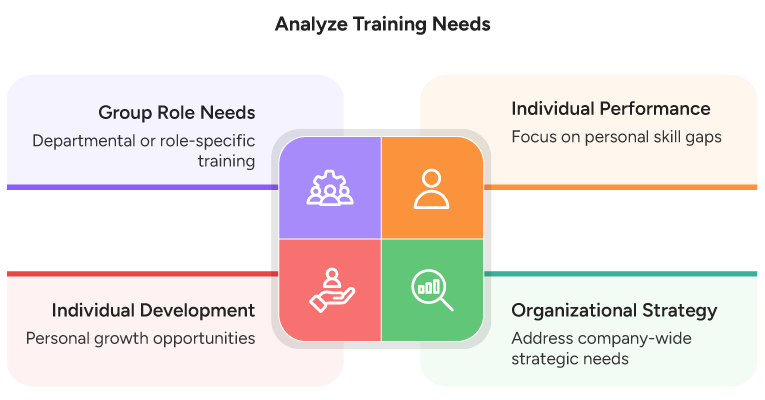
1. Organizational Level Gaps
At this level, you are looking for gaps that affect the whole company. These gaps can be caused by market shifts, new regulations, or even technology upgrades.
- Example: An Indian IT company must train all staff on new data privacy rules following the government’s updates to privacy and compliance laws.
- Use of TNA: You will want each employee to fill the knowledge gap here and adapt to the company’s new direction.
2. Group/Job Role Level Gaps
Here, the TNA is focused on specific departments or roles. This gap does not affect the whole company, but merely certain teams.
- Example: HR department struggles with payroll mistakes after a new HRMS feature is released.
- Use of TNA: The HR department will need to learn the backend of the new feature, a targeted skill upgrade needed to prevent payroll mistakes.
3. Individual Level Performance Gaps
TNA is at its most focused here, as it impacts a person’s performance and career growth.
- Example: A sales executive keeps missing targets due to recurring client-handling errors.
- Use of TNA: TNA can be used to determine whether the executive needs to learn client communication, negotiation, or objection handling. Figuring out the skill gap in this scenario can help the executive immediately.
Let’s see a bird’s-eye view of Training Needs Analysis Levels.
| Level | Focus | Example | Best use of TNA for |
|---|---|---|---|
| Organizational | Company-wide gaps | Employees need to be aware of the recently announced cybersecurity rules. | Strategically aligning employees to the company vision. |
| Group / Job Role | Departmental gaps | The HR department has to adapt to the company’s new HR software. | Increasing departmental efficiency. |
| Individual | Personal performance gaps | The sales manager is missing sales targets due to low negotiation skills. | TNA can help the exec learn negotiation and improve client handling. |
The key behind training needs analysis is simple: Don’t train your team blindly. You need to ask questions like: “Is this a company problem? A team problem? Or an employee problem?” Once you know the level of NA needed, TNA becomes precise rather than being random.
To make the Training needs analysis process even smarter, you can integrate it with your HRMS. An HRMS can help you identify gaps to see where training is truly needed for employee development.

The Purpose and Business Benefits of Conducting a TNA
most Training Programs Fail because You Train Employees without Knowing the Real Gaps. TNA is Supposed to be a Quick Check-Up; It Shows where People Need Support. Every Training Session Bridges Performance Gaps and Benefits both the Company and the Employees.
Why TNA matters:
- It aligns training with business goals, so everyone learns what really matters.
- This identifies missing skills before they affect work, which is great, especially for Indian companies.
- This saves money on workshops that won’t help, as TNA shows exactly what’s needed.
- Employee morale is boosted as their skills and careers improve through effective TNA, directly increasing employee retention and strengthening your overall talent development pipeline.
- Hybrid teams juggling office and remote work especially benefit from role-specific training.
Modern HR tools make training needs analysis easier. HRMS data can reveal skill gaps to complement your Succession Planning or Employee Skill Development Programs. A training needs assessment can be your sure-shot plan to grow skills and business results.
Future L & D Trends in Training Needs Analysis (2026 and Beyond)
In 2026, Training Needs Analysis (TNA) is no longer a reactive, once-a-year HR checklist. Powered by AI and real-time data, modern TNA has evolved into a predictive engine that prevents skill gaps from impacting your bottom line.
Here are the four trends reshaping Learning and Development (L&D):
1. AI-Powered Skills Forecasting
Instead of waiting for performance to drop, predictive analytics now forecast the exact competencies your organization will need 12 to 18 months out. By analyzing HRMS data, behavioral profiles, and market shifts, AI automatically flags talent shortages and triggers targeted upskilling initiatives.
2. Hyper-Personalized Learning Paths
The days of generic, one-size-fits-all workshops are over. Today, Generative AI integrates with your Learning Management System (LMS) to dynamically build custom career paths. Employees receive hyper-targeted learning modules tailored to their real-time performance, role requirements, and individual progress.
3. The Shift to Agile Skill Frameworks
Rigid job titles are losing relevance. The modern workplace runs on agile skill frameworks that prioritize what an employee can do actively rather than what their job description says. Modern competency mapping builds a highly flexible, cross-functional workforce capable of adapting to rapid market changes.
4. Continuous, Data-Driven Assessments
Relying on annual reviews means looking at a highlight reel of missed opportunities. Continuous TNA leverages real-time performance data to identify inefficiencies. This allows L&D teams to deploy quick micro-learning interventions exactly when and where they are needed, replacing slow, outdated assessment models.
In fast-moving sectors like biotech, continuous TNA supports constant upskilling.
Recent World Economic Forum reports focus on one thing: Reskilling must be continuous, data-driven, and future-focused. As automation and AI reshape corporate realities, static training models might fall far behind.

How to Conduct a Training Needs Analysis: Step-by-Step Process

Step 1: Define Your Organizational Goals
The first step in a Training needs analysis is to assess. Without clear goals, training becomes a random activity. Numerous workshops are conducted, with little to no impact. The point is simple: you have to figure out where the business is struggling and make training solve those problems.
You can look for the main points: Are there payroll issues piling up in HR? Or are sales falling apart due to client handling skill issues? Are the hybrid teams missing deadlines because they don’t understand the project? These issues will highlight where training is most needed.
Now, you’ve identified the problems. Define a level for each goal.
Once you identify the problems, break goals into three levels:
- Organizational goals can include company-wide priorities such as improved customer service, better feedback systems, or migrating from legacy systems to digital ones.
- Departmental goals can appear to be team-specific issues. Payroll errors in HR, knowledge transfer in digital marketing for Freshers, or low lead conversion in sales.
- Individual goals can look like filling personal gaps. For example, a manager needing better time-management skills or a junior employee needing data-mining training.
Your TNA will be even more focused when you ask these questions:
- Which gaps are hurting business results the most?
- Which roles are important to hitting company goals?
- What knowledge or skills can fix these issues?
- How will we know if training worked?
Mapping business goals to training focus:
| Business Goal | Training Focus | Level |
|---|---|---|
| Reduce compliance errors | Run HR compliance workshops | Organizational |
| Improve payroll accuracy | HRMS hands-on training | Departmental |
| Increase sales closure rate | Negotiation & client handling | Individual |
| Improve hybrid team productivity | Collaboration & digital tool training | Departmental |
Defining goals in this manner ensures that training does what it is actually meant for: grow the team’s productivity. Every session has a purpose when training is planned in line with the company’s strategy. This step turns TNA into something that solves real business problems, rather than just HR paperwork. It sets the stage for smarter, measurable training methods that deliver outstanding results.
Step 2: Define Relevant Job Behaviors and Outcomes
After step 1, your job is to identify job behaviours that actually drive performance. Training only works when it targets actions that your employees can control. Economies can’t be fixed with a workshop in Excel; your employee needs targeted training to advance their career. This is where job analysis and task inventory become your best tools. You need to break down each role into an employee’s daily activities and how these activities move the business forward.
Ask yourself these questions:
- Which tasks really impact company goals?
- Which behaviors are measurable and observable?
- Where are employees spending time on things that don’t matter (and maybe shouldn’t)?
For example, if the goal is effective onboarding, proficiency in HRMS is most important.
When an HR person repeatedly logs data incorrectly or skips induction steps, it wastes time and creates useless protocols for everyone. Double-checking attendance and submitting reports on time is not a fancy job, but 100% required for accurate payroll. Thus, when a job behaviour is defined, training needs analysis is simpler and more accurate.
This clarity is most important during phases like employee onboarding. If newly hired employees aren’t trained right from day one, it can affect their productivity, goals plus retention.
Job Behavior Analysis Table
| Role | Key Behaviors | Measurable Outcome |
|---|---|---|
| HR Executive | Complete onboarding tasks using HRMS | New employees are onboarded within 3 days. |
| Payroll Associate | Verify attendance and process payroll | 100% error-free payroll submissions |
| Sales Executive | Follow up with leads promptly | Increased conversion rates |
| Customer Support | Respond to queries within SLA | Higher customer satisfaction |
Big goals like increasing productivity or boosting customer experience sound really great on paper. But does your employee actually know what to do to achieve those goals on a Monday morning? This is why defining behaviours becomes highly important for a tangible, result-oriented training needs analysis.
Behaviours are the small, visible actions people can take every day, such as how a sales rep handles objections or how a manager reviews performance. These behaviours can sound dull. Following a checklist or reviewing reports on time. But these boring actions are what separate consistent performers from struggling teams.
This is why defining job behaviour analysis sharpens TNA. Instead of running broad programs and hoping they work, you can create training that specifically leads to measurable results. This way, the training becomes practical, focused, and directly performance-led.
Step 3: Identify Required KSAs and Conduct a Skills Audit
Now that the job behaviours are defined, the next best step is to conduct the skills and knowledge audits needed to perform those behaviours. This helps you identify gaps between what your employees have and what the job demands, enabling you to build a robust competency framework. You can map these findings onto a skills gap analysis matrix to visualize them more easily.
You can start by mapping the KSA to a specific job behaviour. For example, if a payroll associate processes payroll accurately, he should have knowledge about HR compliance and payroll laws. He should have the skills to use the HRMS properly. Their abilities include attention to detail and respecting deadlines.
Once you know the required KSAs, your next step is to assess your employees’ current level of knowledge, skills, and abilities. What are the gaps? These gaps determine where training is necessary and how process improvements can be made better.
You can use these methods to identify gaps:
- Surveys: A quick way to understand employees’ perceptions of their own skills. Pros: Fast and scalable option. Cons: The employee could overestimate abilities. Best for large teams or when initial screening is required.
- Interviews: Direct conversations with employees or managers. Pros: get detailed insights. Cons: It can be a bit time-consuming. Best option for candidates in critical roles or leadership positions.
- Observations: Observing tasks done by employees. Pros: accurate and context-specific conclusions. Cons: Require heavy resources.
- HRIS / HRMS Data Mining: Checking performance data, learning history, and competency levels. Pros: Data never lies, and you gain comprehensive solutions. Cons: It depends on data quality. Best for companies with integrated HR systems.
- Performance Reviews: Includes 360-degree feedback and PMS data. Pros: Intertwines multiple perspectives. Cons: Could be biased if not properly structured. Best when you need to assess ongoing skills.
TNA Methods Table
| Method | Pros | Cons | When to Use |
|---|---|---|---|
| Surveys | Fast, scalable | Self-report bias | Large teams, initial screening |
| Interviews | Deep insights | Time-intensive | Critical roles, leadership |
| Observations | Accurate, context-specific | Resource-heavy | Complex/high-stakes tasks |
| HRMS/HRIS Data | Data-driven, objective | Quality-dependent | Integrated HR systems |
| Performance Reviews | Multiple perspectives | Potential bias | Continuous assessment |
The goal of Training needs analysis is not to collect mountains of data. Rather, it is about gathering actionable insights to identify where employees lack key KSAs. This further helps identify organizational and individual training needs.
As Peter Drucker, the father of modern management and an American author, says: what gets measured gets managed. In this case, measuring Knowledge, skills, and abilities ensures that your training fixes the right gaps at the right time. By systematically mapping KSAs and identifying gaps, companies can design world-class training programs to drive high business growth.
Step 4: Develop Actionable Training Recommendations
You found the gaps, but what should you do about them? Step 4 is the answer to this very question. After identifying the KSAs, you now determine whether training is really the solution. If yes, what kind of training would actually make sense? Not every problem can be solved in a classroom. Some issues require clear guidance, coaching, or strict adherence to protocols. Good training needs analysis tells you exactly what’s needed early and clearly.
Let’s understand when HR training methods are the right answer:
| Training Method | When It’s the Right Answer | Key Characteristics & Benefits |
|---|---|---|
| On-the-job training | When employees need hands-on practice while actively doing their jobs (e.g., system usage, learning processes, or role-specific tasks). | It is the most practical solution for role-specific learning, especially effective for Indian teams. |
| Workshops | Best when addressing common skill or knowledge gaps across entire teams (e.g., compliance awareness, team communication basics, leadership fundamentals). | A proven method that encourages active participation, warranting more role-play rather than just theory. |
| LMS-based learning | When a group needs to learn something consistently and quickly, such as company-wide policy updates or specific process protocols. | Uses an integrated Learning Management System (LMS) to track completion, monitor progress, and help leadership accurately measure the ROI of training. |
One reality check that many organizations miss is that some gaps simply are not training issues.
If employees know the process but refuse to comply, training will not help.

What Non-Training Solutions Can You Use?
- If the issue is employee attitude or effort → coaching
- If the process is unclear or outdated → changes in policy
- Performance is poor despite repeated trainings → focus on performance improvement plans.
A structured Performance Improvement Plan helps clearly set expectations, timelines, and consequences.
This step connects directly to Step 3. KSAs show what is missing. Training recommendations decide what action to take. Mixing these up leads to wasted budgets and tired employees.
Strong recommendations are simple. They respect time, money, and reality. They use training where skills are missing and other tools where behavior or systems are the problem.
When done right, this step turns TNA from analysis into action—and ensures learning actually improves performance, not just attendance numbers.
Real-World Training Needs Analysis Examples
Let us look at some examples of Training Needs Analysis (TNA) and how its conclusions can be implemented in practice.
Organizational Example: Sales Team Capability Gap
Mid-sized B2B companies often face an odd issue. The sales activity is high, with calls, demos, follow-ups, and more. But revenue growth figures are stalled. Most companies jump straight into ‘training’ and ‘sales workshops’. But an ideal solution is to dig deep into deal reviews and historical sales data.
The pattern becomes instantly clear: 20% of sales reps struggle during pricing conversations, and 50% of deals are closed through late-stage negotiations. 30% of leads are untouched, and late responses to hot leads are a major reason for low response rates.
When the reasons are clear, companies can roll out short, role-specific workshops that focus on each reason. Managers can then track the team’s progress and provide feedback. This is when TNA does its job efficiently; it connects business pain to noticeable job behavior.
Job Role Example: HR Team Lacking HRMS Proficiency
For example, an HR team implemented updates to an HRMS. But the performance cycles were still run manually. Appraisals were delayed, feedback was compromised, and reports took months. Companies typically hold training sessions to sort these issues.
But if a role-level training needs analysis is conducted, it would immediately clarify that HR professionals know what to do, but the system lacks the capability to follow through. HR executives knew performance management, but how to do it with the system was the question.
After the task-based HRMS training, the team knew the solution. The data quality vastly improved, and so did the appraisal cycles. It is a textbook case of how TNA can help improve performance management when job behavior and system skills are aligned.
Individual Example: New Hire Onboarding Failure
A newly hired employee completed the induction process but continued to underperform for 3 months. There was no escalation that flagged it, but the training needs analysis of this individual revealed the truth. The employee had a limited understanding of task ownership and no exposure to systems in the early days after induction.
Instead of retraining the employee, HR designed an onboarding process with role-based checklists and HRMS walkthroughs. The outcome was not dramatic, but the employee’s productivity definitely stabilized.
When the same onboarding gaps affect multiple new hires, HR teams can compare onboarding software in India for structured checklists, task ownership, training coordination, system access, and progress tracking.
Mini Case: TNA Integration Using factoHR.
Training needs analysis doesn’t have to be noisy. Rather, it addresses problems with clear diagnosis and focused action items.
An Indian company followed a set employee training policy. Training and learning were applied where they mattered and clearly avoided where they didn’t. This is how a training needs assessment not only identifies problems but also reveals potential.

Common Challenges in TNA & How to Overcome Them
Even the best Training needs analysis can face blockages. Ignoring such roadblocks can turn TNA into untouched paperwork that sits in a drawer. But when these challenges are faced head-on, TNA really does improve performance and deliver measurable results.
1. Resistance from Managers and Employees
Managers can see TNA as an unnecessary bureaucratic move. Employees worry that it flags underperformance.
Solution: Teach managers about TNA value and involve them in the early phases. Show examples of how TNA can be applied, i.e., sales teams improving deal close rates via targeted workshops. For employees, position TNA as a growth opportunity. You can even use anonymous surveys to get honest and clear responses from them.
2. Inaccurate or Outdated Data
Relying on old annual reviews leads to wrong conclusions plus inflated skill gaps. Many firms struggle to measure training ROI because the data is old.
Solution: Make decisions based on data. You can use real-time metrics from PMS and LMS, as seen in companies using factoHR’s HRMS Integration. You can combine performance logs or 360-degree feedback to get a complete and accurate picture.
3. Time and Resource Constraints
TNA can take 4-6 weeks and requires significant effort across teams.
Solution: Automate TNA as much as possible. Systems like factoHR help you consolidate different data streams into a single platform. It shows performance data to identify where employees are struggling, so HR doesn’t have to guess who needs training. With the built-in learning system from factoHR, training can be easily assigned, tracked, or reviewed. You can start small with high-impact roles and align them with TNA processes asap.
4. Bias in Remote and Hybrid Assessments
Remote or hybrid setups can misguide results. An employee can score lower due to technical issues or a certain bias.
Use continuous training feedback loops, such as LMSs and analytics, to fairly track employee learning activities. When these tools are matched with structured employee training policies, you can reduce bias to a huge extent. By checking data gaps, resource limits, and bias, TNA can become your strategic tool to improve measurable outcomes.
Free Training Needs Analysis Template (Excel/Google Sheets)
Simplify your TNA process with a ready-to-use, customizable template. This template includes a built-in training needs analysis questionnaire to help managers consistently evaluate their teams.
Download Free Training Needs Analysis Template

Key Questions to Ask during Your Assessment
1. Organizational Level
- Which business outcomes are not being met?
- Are there changes in the market, technology, or regulations affecting us?
- Which departments contribute most to strategic goals?
- What metrics indicate a gap in skills or knowledge?
- Are current training programs achieving desired results?
- Which upcoming projects or opportunities require new competencies?
- Are we spending training resources efficiently?
2. Job Role/Group Level
- Which tasks are most error-prone or slow?
- Which tools, software, or processes are challenging?
- What behaviors separate top performers from others?
- Are employees clear on role expectations?
- Which role responsibilities are changing soon?
- Do teams struggle with collaboration or communication?
3. Individual Level
- Does this employee meet performance expectations?
- Which KSAs are strong, and which are lacking?
- Has the employee expressed interest in upskilling?
- Are there obstacles preventing learning?
- Which skills support their career growth?
- How does their performance affect team or organizational goals?
4. Evaluation & Follow-Up
- How will we measure training effectiveness?
- What timeline is realistic for seeing improvements?
- How will knowledge retention and behavior change be tracked?
- Should coaching or refresher sessions be scheduled?
- Should coaching or refresher sessions be scheduled?
- Can we use HRMS/LMS data to continuously improve training?
- Which gaps still exist after training?
What if every Training Decision Could Make Real Business Impact?
A Training Needs Analysis is not a checkbox on an HR to-do list. It is a strategic tool that can drive real business outcomes. The real value is evident when TNA is continuous and data-driven, leveraging insights from PMS and LMS systems to spot issues. As Indian workplaces today embrace hybrid teams and rapid technological shifts, TNA can serve as a predictive lens for companies. It can help leaders prepare for the future while improving the present performance.
Software like factoHR can make this process seamless and integrate analytics with employee skill development programs and succession planning. Make TNA less about paperwork and more about business advantage, and you get smarter, faster decisions.

FAQs on Training Needs Analysis
Why is TNA Important in 2026?
Talent needs analysis (TNA) helps identify current and future skill gaps, ensuring the workforce remains competitive in an environment where artificial intelligence, automation, and dynamic job roles define the landscape.
How do You Conduct a TNA Step by Step?
Begin with organizational goals, define job behaviors, identify necessary knowledge, skills, and abilities (KSAs), analyze gaps, and design training interventions to meet the objectives.
What are the Best Methods for Training Needs Assessment?
Use a mix of surveys, interviews, observations, performance data, and HRMS analytics to provide accurate information.
How does HR Software Help with TNA?
Systems like factoHR’s performance management software integrate PMS and LMS data to automate gap detection and continuously track progress.
What Should a TNA Template Include?
Fields for organizational goals, job behaviors, KSAs, gap analysis, and training recommendations, so you can plan, assign, and measure TNA efforts efficiently.
How is TNA Different from Performance Appraisal?
While performance appraisals assess past performance, TNA predicts future gaps and helps you develop proactive training modules to improve your employees’ skills.
How do You Identify Skill Gaps in Remote Teams?
You can use LMS analytics, online assessments, and virtual feedback tools to identify gaps in technical and soft skills in a fair way.
Can You Measure the ROI of TNA?
You can track changes in key performance indicators (KPIs), including reductions in errors, increases in productivity, and employee engagement metrics.
What are Common Challenges in Remote TNA?
Challenges of remote TNA include biased assessments, limited visibility into work processes, and low survey response rates. Strategies to overcome these include continuous feedback, the use of xAPI-enabled LMS, and analytics integration.



Grow your business with factoHR today
Focus on the significant decision-making tasks, transfer all your common repetitive HR tasks to factoHR and see the things falling into their place.