
What are NCP Days in PF?

Table of Contents

Have you seen “NCP days” on your payslip or PF statement and had no idea what it means? You are not alone.
NCP days in PF stand for Non-Contributory Period. These are the days in a month when an employee does not earn wages. Because no wages are paid, no PF contribution is made for those days.
This affects your EPF balance, your pension service record, and how payroll is filed every month. If you are in HR or payroll, getting this wrong in your ECR filing can cause mismatches and compliance issues.
This post breaks it all down in simple terms.
TDLR:
- What NCP days mean in PF and payroll
- How they differ from leave without pay and absent days
- How to calculate them with real examples
- How they affect salary and PF contributions
- ECR reporting rules you need to follow
What does NCP Mean in PF?
NCP in PF stands for Non-Contributory Period. It refers to the days in a wage month when an employee does not receive wages. Since no wages are paid, no EPF or EPS contribution is made for those days.
These days are reported in the monthly ECR (Electronic Challan cum Return) filed with the EPFO. Reporting them correctly keeps your contribution records clean and prevents issues in future PF or pension claims.

Why do NCP Days Matter in PF?
These days are more important than most people think. Here is why they matter:
- They reduce PF contributions for that month. PF is calculated as a percentage of wages. If an employee has 10 unpaid days in a 30-day month, PF is only calculated on the wages earned in the remaining 20 days.
- They explain why wages look lower. Fewer paid days mean lower wages. Reporting these days correctly tells EPFO why the contribution is lower than usual. This prevents flags or rejections in your ECR filing.
- They are mandatory in the ECR. If you skip this field or enter it wrong, your ECR can get rejected. Even worse, it can create mismatches that take months to fix.
- They protect the employee’s service record. Unpaid days must not be counted as contributory service. If they are, the employee’s EPS pension calculation gets inflated, which is against EPFO rules.
- They affect EPS pension service. Under the Employees’ Pension Scheme, only months with actual contributions count toward pension. More unpaid days means less pensionable service.
When are NCP Days Reported in PF?
NCP days are reported any time an employee is on the payroll but does not receive wages for one or more days in a month.
Common Situations that Trigger NCP Days
- Leave Without Pay (LWP): This is the most common reason. If an employee takes unpaid leave, those days are reported as NCP days.
- Unpaid Absence: Unplanned absences without pay, prolonged absenteeism, or suspension without wages all count.
- Joining or Leaving Mid-Month: If someone joins on the 15th of the month, the days before joining are not included in payroll. PF is calculated only from the date of joining.
- Zero Wages for the Full Month: If an employee is on the payroll but earns nothing that month, every day in that month is an NCP day.
The Zero-Wage Rule You Need to Know
If an employee’s wages are zero for a full month, EPFO requires that the NCP days equal the total number of days in that month. So for a 30-day month, you report 30 NCP days. For February, you report 28 or 29.
The employee stays active on the records. But no contribution is made for that month.
Are NCP Days the Same as Leave Without Pay?
No. They are related but not the same thing.
Leave without pay (LWP) is a type of leave. NCP days are a PF reporting status.
When an employee takes LWP, those days usually become NCP days in PF records. But not every NCP day comes from LWP. An employee could have NCP days due to a suspension without pay, a layoff period, or any other reason wages are not paid.
Paid leaves like earned leave or casual leave are never NCP days. Wages still apply on those days, so PF contributions continue normally.

How to Calculate NCP Days in PF
The calculation is straightforward.
Formula:
NCP Days = Total days in the wage month when no wages were paid
That is it. No complex math needed.
EPFO Rule on Whole Numbers EPFO only accepts whole numbers in the ECR. You cannot enter 0.5 or 2.5. If a half-day absence occurs, your payroll team will need to round up or down. The final entry must always be a full number.
Examples:
| Scenario | Month | Unpaid Days | NCP Days to Report |
|---|---|---|---|
| Full attendance, no LWP | April (30 days) | 0 | 0 |
| 3 days unpaid leave | July (31 days) | 3 | 3 |
| Absent the whole month | February (28 days) | 28 | 28 |
NCP Days Examples in PF: Real Scenarios
Example 1: Full Attendance
Ramesh works all 30 days in April. He takes no unpaid leave.
- NCP Days: 0
- PF is calculated on his full monthly salary.
Simple and clean.
Example 2: Partial Unpaid Leave
Priya takes 3 days of unpaid leave in July. July has 31 days. She worked 28 days.
- NCP Days: 3
- Her PF wage is adjusted for 28 days worked.
If her monthly PF wage is Rs. 15,000:
PF Wage = (15,000 / 31) x 28 = Rs. 13,548
Her PF contribution is calculated on Rs. 13,548 instead of the full Rs. 15,000.
Example 3: Full Month without Pay
Suresh is on the payroll in February but earns no wages. He is on extended medical leave without pay.
- NCP Days: 28 (full month)
- No PF contribution is made for February.
- His UAN stays active. But this month does not count as contributory service.

How NCP Days Affect PF Contributions
Fewer paid days mean lower PF contributions. It is that simple.
PF is calculated as 12% of PF wages. When an employee has NCP days, the wages are prorated. Lower wages mean lower contributions from both the employee and the employer.
Example:
An employee has a PF wage of Rs. 15,000 for a 30-day month. They take 5 unpaid days.
- Contributory days: 25
- Adjusted PF wage: (25 / 30) x Rs. 15,000 = Rs. 12,500
- Employee contribution: 12% of Rs. 12,500 = Rs. 1,500
- Without LWP, it would have been 12% of Rs. 15,000 = Rs. 1,800
Both the employee and employer contribute less that month. This is standard payroll practice under EPF rules.
How NCP Days Affect Your Salary
NCP days are unpaid days. So they directly reduce your monthly salary.
Here is the chain reaction:
- Unpaid days reduce your paid day count.
- Your gross salary is prorated based on paid days.
- Your PF wage base drops along with your gross salary.
- PF contribution falls because it is a percentage of the reduced wage.
Both your take-home pay and your PF credit for that month are lower.
Do NCP Days Affect EPS and Pension Service?
Yes. NCP days reduce your EPS pensionable service.
Here is why. EPS counts only the months in which actual contributions are made. If an employee has too many NCP days in a month and the contribution is zero, that month does not count toward pension service.
Over time, this can reduce the total pensionable service period. That lowers the monthly pension amount at retirement.
Reporting NCP days correctly makes sure your service record matches your actual contributions. This protects the employee later.
How Employers Report NCP Days in ECR
Employers report NCP days every month while filing the ECR on the EPFO Unified Portal.
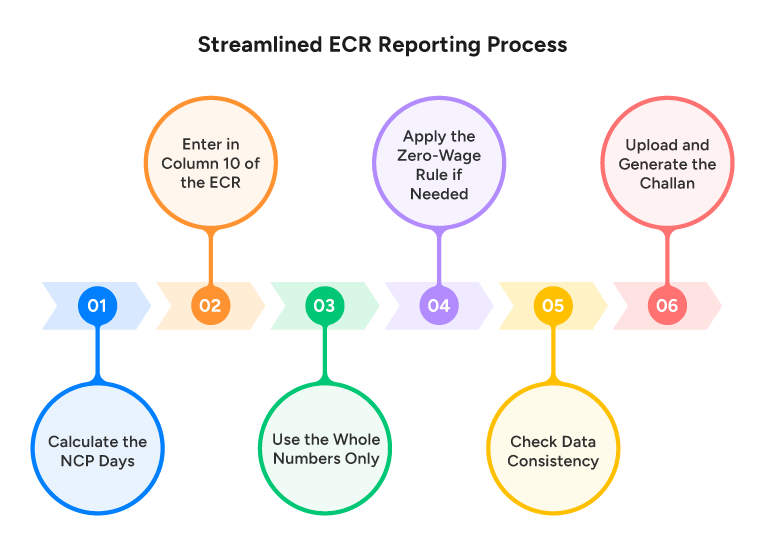
Step-by-Step ECR Reporting
Step 1: Calculate the NCP Days: Subtract paid days from the total days in the month.
Total Days in Month – Paid Days = NCP Days
Step 2: Enter in Column 10 of the ECR: This column is mandatory. If there are no unpaid days, enter 0. Never leave it blank.
Step 3: Use Whole Numbers Only: No decimals. No half-days. Whole numbers only.
Step 4: Apply the Zero-Wage Rule if Needed: If wages are zero for the full month, NCP days must equal the total days in that month.
Step 5: Check Data Consistency: Make sure your payroll software figures match what you are uploading to EPFO. Mismatches cause rejections.
Step 6: Upload and Generate the Challan: Submit on the EPFO Unified Portal. Review everything before you generate the challan.

Where Can Employees Check Their NCP Days?
Not sure how many NCP days you have? Here are the places to check:
- Payslip: Look for “LOP” or “Loss of Pay” days. This is usually the fastest way.
- HRMS or ESS portal: Most companies provide access to payroll history through an HRMS or employee self-service portal. HR teams looking for a more integrated system can compare HRMS software in India based on payroll, attendance, leave, and employee self-service capabilities.
- EPFO Member Passbook: Log in with your UAN at the EPFO portal to see your monthly contribution entries.
- Annual PF Statement or Form 26AS: These show contribution history and can flag gaps.
- HR or Payroll Team: When in doubt, just ask. They can pull your record directly.
Common Mistakes in NCP Days Reporting

These mistakes show up more often than you think. Avoid them.
- Including paid leave in NCP days: Casual leave, sick leave, and earned leave are paid. Do not count them as NCP days.
- Entering decimals: EPFO only accepts whole numbers. If you enter 2.5, the ECR will reject it.
- Not filing ECR for zero-wage months: Even if an employee earns nothing, you still need to file the ECR. Report the full month as NCP days.
- Mismatch between payroll and ECR data: If your payroll software shows 3 LOP days but your ECR shows 5, EPFO may flag it. Always reconcile before uploading.
- Counting calendar days vs working days incorrectly: Check your payroll policy. Some companies calculate on calendar days, others on working days. Use the correct one consistently.
NCP Days vs LOP vs Absent Days: What is the Difference?
These three terms are often confused. They are related but they are not the same.
NCP days are a PF reporting term. LOP is a payroll term. Absent days is an attendance term. Here is how they compare:
| NCP Days | LOP (Loss of Pay) | Absent Days | |
|---|---|---|---|
| What it means | Days with no PF contribution made | Salary deducted for unauthorized unpaid leave | Days an employee did not show up |
| Salary impact | Indirect (follows LOP) | Direct deduction from gross salary | Depends on whether it is paid or unpaid |
| PF impact | Reduces contribution and service period | Reduces PF wage base | Only unpaid ones affect PF |
| Where it is used | ECR filing with EPFO | Internal payroll accounting | Attendance and leave tracking |
| Are they always the same? | No. Only unpaid absences become NCP days | LOP often leads to NCP days, but they are not identical | No. Includes both paid and unpaid absences |
Final Thoughts
NCP days in PF are not just a payroll code. They directly affect how much PF gets credited each month and how your service record is calculated over time.
For employees, knowing your NCP days helps you track your EPF balance and EPS pension correctly.
For HR and payroll teams, reporting them accurately in the ECR every month is not optional. Mistakes here can lead to rejections, mismatches, and compliance issues that take a long time to fix.
If you manage payroll, make sure your team has a clear process for tracking and reporting these days each cycle.

Frequently Asked Questions
What is the Meaning of NCP Days in PF?
NCP days in PF stand for Non-Contributory Period. These are the days in a month when an employee does not earn wages. Since no wages are paid, no EPF or EPS contribution is made for those days.
What is the Full Form of NCP in PF?
The full form of NCP in PF is Non-Contributory Period.
How are NCP Days Calculated in EPF?
NCP days equal the total number of unpaid days in a wage month. Subtract the paid days from the total days in the month. Only whole numbers are allowed in the ECR. Decimals are not accepted.
Do NCP Days Reduce PF Contribution?
Yes. Since PF is calculated on wages earned, unpaid days lower the wage base. Lower wages mean lower contributions from both the employee and the employer for that month.
Are NCP Days the Same as Leave without Pay?
No. Leave without pay often leads to NCP days, but they are not the same. NCP days are a PF reporting term that covers any period with no wages, including suspensions and layoffs.
Can NCP Days be Entered in Decimals?
No. EPFO only accepts whole numbers in the ECR. Half-days cannot be entered. Round up or down based on your payroll policy.
What Happens if Wages are Zero for the Whole Month?
If an employee earns zero wages in a month, the NCP days equal the total days in that month. The employer still needs to file the ECR. No contribution is made, but the UAN stays active.
Do Paid Leaves Count as NCP Days?
No. Paid leaves like earned leave, casual leave, or sick leave do not count as NCP days. PF contributions continue normally on paid days.
Do NCP Days Affect Pensionable Service?
Yes. EPS counts only months with actual contributions. More NCP days in a month can mean lower or zero contribution, which reduces your total pensionable service and can affect your pension amount.
Where Can I Check My NCP Days?
Check your payslip for LOP days, your company’s HRMS portal, or your EPFO Member Passbook at the EPFO portal using your UAN and password.



Grow your business with factoHR today
Focus on the significant decision-making tasks, transfer all your common repetitive HR tasks to factoHR and see the things falling into their place.