
Last Working Day Email: 12 Templates, Samples & How to Write One (2026)

Table of Contents

Your last working day email is the final message you send before you walk out the door for the last time. It is a small step, but it matters. A good farewell email wraps up your time at the company on a positive note and makes sure there is no confusion about your departure.
You are already juggling a lot on your way out. Handovers, pending tasks, exit formalities, full and final settlement. In all of that, this one email often gets pushed to the last minute. This guide gives you 12 ready-to-use templates so you can send a proper farewell without spending hours writing one.
We have covered templates for every situation, a step-by-step writing guide, 30+ subject line ideas, and a clear list of what to do and what to avoid. Pick the one that fits and you are done.
TL;DR
- Send your farewell email on your last day or the day before, after completing your handover.
- Keep it short. Three to five sentences is enough for most audiences.
- Thank people genuinely, skip the corporate phrases.
- Share your personal email or LinkedIn only if you actually want to stay in touch.
- Tone it down if you are leaving on bad terms. Neutral and professional always wins.
- A bad farewell email can undo years of good impressions. Write it carefully.
What is a Last Working Day Email?
A last working day email is a short message you send on or just before your final day at a company. It lets your colleagues, manager, and clients know you are leaving and gives them a chance to stay in touch if they want to.
It is not the same as your resignation letter. That is a formal document you submit to HR. This email is more of a warm sign-off. Most people send it to their team, their manager, and anyone else they worked closely with. Some companies also expect a company-wide message if the culture supports it.
The email usually goes out after you have completed your handover and before your relieving letter is issued. Keep it brief. A few honest, warm sentences are far better than a long speech.

Last Working Day Email Sample
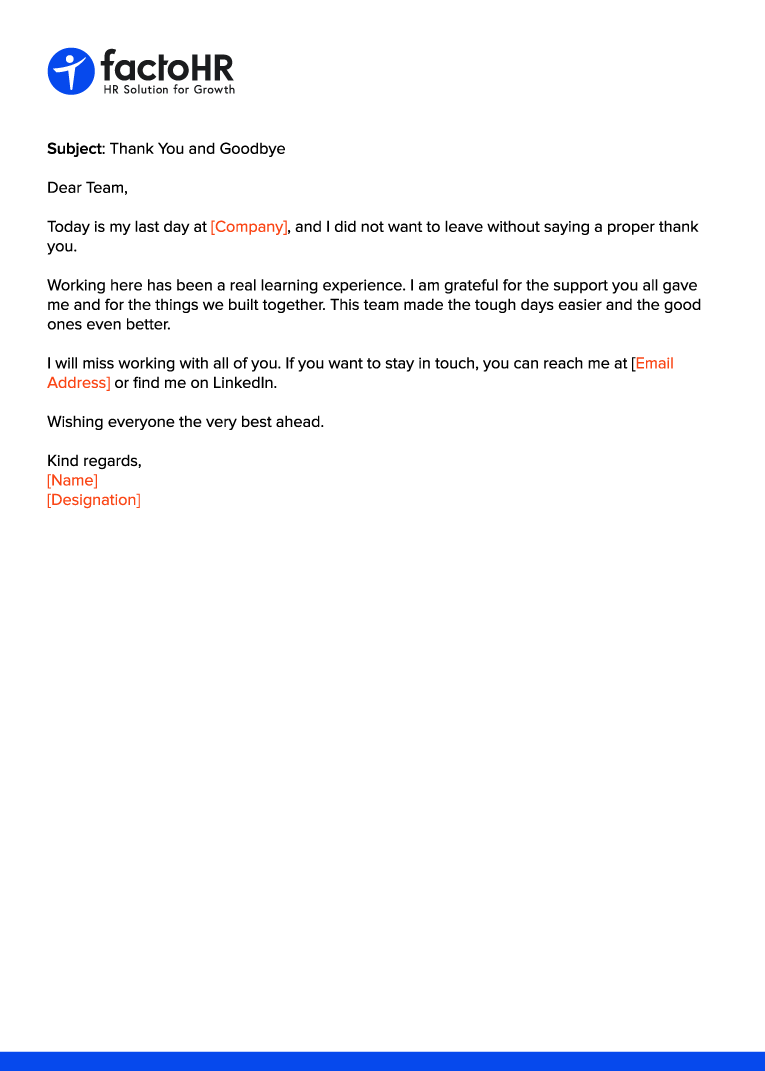
Here is a simple, ready-to-use sample you can adapt to your situation:
12 Last Working Day Email Templates
You can use the following creative last working day mail templates according to your needs. You also need to formally submit your resignation and draft email messages before your full and final settlement, and make your message more effective. Here are a few templates:
1. Last Working Day Email to Colleagues
When to use: When you want to thank your day-to-day teammates before you leave.
Subject: Thank You and Goodbye
Dear Team,
Today is my last working day at [Company], and I could not leave without saying thank you.
Working alongside all of you has been one of the best parts of this job. You made the late nights manageable, the wins more fun, and the hard days a lot easier to get through.
I am grateful for everything I learned here and for the friendships that grew out of this team. As I move on to my next role, I am carrying a lot of those lessons with me.
Please stay in touch. You can reach me at [Email Address] or connect with me on LinkedIn. I would love to hear how things go from here.
Wishing you all the very best.
Warm regards,
[Name]
2. Last Working Day Email to Your Manager
When to use: When you want to personally thank your manager for their support and guidance.
Subject: Thank You for Your Support
Dear [Manager’s Name],
As today is my last working day, I wanted to take a moment to thank you directly.
Your guidance made a real difference to how I grew in this role. The feedback you gave me, the space you gave me to try things, and the way you handled the hard conversations, all of it has shaped how I work. I will carry those lessons into whatever comes next.
Thank you for being a good manager. It is not something I take for granted.
I wish you and the team continued success. Please keep in touch.
With gratitude,
[Name]
3. Last Working Day Email to Your Team or Direct Reports
When to use: When you are leaving a leadership role and want to acknowledge your team before you go.
Subject: Thank You for Being an Exceptional Team
Dear [Manager’s Name],
Today is my last day, and I want to be honest with you: leaving this team is the hardest part of this decision.
Each of you brought something genuine to the work. The commitment, the creativity, and the way you looked out for each other, those things are rare. I am proud of everything we built together, and I am confident you will keep building long after I am gone.
Trust each other. Back each other up. You already know how to do that.
It has been a privilege. You can always reach me at [Email Address] if you need anything.
Best wishes,
[Name]
4. Last Working Day Email to Senior Leadership
When to use: When you want to thank directors or senior leaders for the opportunity before your departure.
Subject: Thank You for the Opportunity
Dear [Leader’s Name],
As today is my last working day at [Company], I wanted to reach out and express my appreciation.
The opportunity to work here has been genuinely valuable. I joined wanting to grow, and I did. The culture, the standards, and the people at this organisation pushed me to be better at what I do.
Thank you for the trust you placed in me and for the environment that made good work possible.
I wish you and the organisation continued success. It has been a privilege.
Kind regards,
[Name]
5. Last Working Day Email to a Close Colleague or Friend
When to use: When you are saying goodbye to someone you worked with closely and built a real friendship with.
Subject: This One is Personal
Dear [Name],
I could not leave without sending you a separate note.
Working with you has been one of the genuinely good things about this job. The conversations, the venting sessions, the laughs in the middle of stressful weeks, you made all of it better. I am going to miss having you around.
Let us not let the distance do what we will not. I expect to hear from you regularly. My personal email is [Email Address] and you already have my number.
Take care of yourself. I mean it.
With warmth,
[Name]
6. Last Working Day Email to Clients
When to use: When you manage client relationships and need to hand them over professionally before you leave.
Subject: A Quick Note Before I Go
Dear [Client Name],
I am writing to let you know that today is my last day at [Company].
It has been a real pleasure working with you. Your projects have been some of the most interesting work I have been part of here, and I have valued the relationship we built.
I want to make sure this transition is smooth for you. [Colleague Name] will be your new point of contact from today. They are already fully briefed on your account, your ongoing work, and your upcoming priorities.
If you have any questions during the transition, please do reach out to me at [Email Address] before the end of today.
Thank you for the trust and collaboration.
Kind regards,
[Name]
7. Last Working Day Email to the Entire Organisation
When to use: When your company culture expects a company-wide farewell or your role touches many teams.
Subject: Goodbye and Thank You
Dear All
Today is my last day at [Company], and I want to say a proper goodbye.
Over the past [X years], I have had the chance to work with people across nearly every team here. That breadth of collaboration does not happen everywhere, and it has made this job genuinely memorable. I have learned something from almost every conversation I have had here.
Thank you to everyone who made this a place worth coming to. The culture here is real, and that comes from the people who show up every day and make it so.
I am reachable at [Email Address] if you ever want to connect down the line.
Wishing the organisation everything it deserves.
Warm regards,
[Name]
[Designation]
8. Last Working Day Email to Cross-Department Colleagues
When to use: When you work with people across other teams and want to acknowledge them before you leave.
Subject: Thank You for the Collaboration
Dear Colleagues,
As today is my last day at [Company], I wanted to reach out to the teams I had the privilege of working with across the organisation.
We may not have shared a daily workspace, but the projects we collaborated on were better because of your involvement. Your expertise and willingness to make things work across teams made a real difference.
I hope our paths cross again in some form. You can reach me at [Email Address] if you ever want to stay connected.
All the best,
[Name]
9. Last Working Day Email to Support Staff
When to use: When you want to personally thank the people who keep the office running every day.
Subject: A Heartfelt Thank You
Dear Team,
Today is my last day at [Company], and I could not leave without thanking you personally.
The people who make a workplace actually work are often the ones who go unnoticed. You kept things running, you greeted people warmly, and you made coming in every day a little easier. That is not a small thing.
Thank you for everything you did, seen and unseen. I hope you all know how much it was appreciated.
Wishing you the very best.
With warmth,
[Name]
10. Short Last Working Day Email
When to use: When you want to keep your farewell brief and professional, suitable for any audience.
Subject: Goodbye and Thank You
Dear All,
Today is my last working day at [Company].
I am grateful for the time I spent here, the people I worked with, and the things I got to be part of. You have all contributed to a chapter I will look back on positively.
Thank you. Wishing everyone great things ahead.
If you want to stay connected, I am at [Email Address].
Best,
[Name]
11. Last Working Day Email for Remote / Hybrid Teams
When to use: When you have worked remotely and never shared a physical office, so your goodbye is entirely digital.
Subject: Signing Off from the Home Office
Dear Team,
Today is my last working day at [Company], and even though we rarely shared the same room, it never once felt that way.
We built real things across screens and time zones, and that says a lot about this team. The quick messages, the video calls that ran long because the conversation was good, the way everyone stayed connected without being in the same place — I will genuinely miss all of it.
Distance never got in the way here, so let us not let it now. You can reach me anytime at [Email Address] or on LinkedIn.
Wishing you all the very best, wherever you are logging in from.
Warm regards
[Name]
12. Last Working Day Email after a Short Tenure
When to use: When you are leaving after only a few months and want to exit graciously without over-explaining.
Subject: Thank You and Goodbye
Dear Team,
Today is my last working day at [Company]. My time here was short, but it was genuinely valuable, and I did not want to leave without saying thank you.
Even in a few months, I learned a great deal and had the chance to work with people I respect. I am grateful for the warm welcome and the support I received from day one.
I wish you and the team every success ahead. If you would like to stay in touch, you can reach me at [Email Address].
Best wishes,
[Name]

30+ Last Working Day Email Subject Lines
Pick a subject line that matches your tone. Group them by the relationship you have with your audience. And if you want to add a personal touch beyond the subject line, browse our collection of farewell wishes and messages for colleagues to find the right words for your goodbye.
Professional subject lines
Use these for clients, senior leaders, and formal workplaces.
- Thank You and Goodbye
- My Last Working Day at [Company]
- Farewell and Best Wishes
- Thank You for Your Support
- Signing Off with Gratitude
- A Note of Thanks Before I Leave
- Appreciation and Goodbye
- Moving On, Thank You for Everything
- My Farewell Message
- Thank You for the Opportunity
- Wishing You Continued Success
Warm subject lines
Use these for your team and regular colleagues.
- Grateful for the Journey
- Thank You for the Memories
- Farewell, and Stay in Touch
- My Last Day, My Heartfelt Thanks
- Looking Back with Gratitude
- Time to Say Goodbye
- Thank You for Being Part of My Journey
- Goodbye, but Not Forever
- It Has Been a Pleasure Working with You
- Here is to New Beginnings
Casual Subject Lines
Use these for close friends and informal cultures.
- That is a Wrap
- Signing Off Today
- See You Around
- Until We Meet Again
- One Last Thank You
- Time to Go
- On to My Next Adventure
- Goodbye for Now
- It Has Been Great
- Catch You Soon
- Here is to What Comes Next
After your last working day, your employer issues an experience letter, which confirms your role and employment period. This document is required when you are applying for future jobs as proof.
How to Write a Last Working Day Email

1. Start with a clear subject line
Your subject line should tell the reader immediately why you are writing. Keep it to six words or under. Something like ‘Thank You and Goodbye’ or ‘My Last Day at [Company]’ works perfectly. Do not be vague or clever. People get a lot of emails.
2. Open by stating your last day
Get straight to the point in your first line. ‘Today is my last working day at [Company]’ says everything the reader needs to know upfront. You can mention the date if there has been any confusion about your departure timeline.
3. Say something real
This is not the place for corporate phrases. Skip ‘it has been a privilege to be part of this dynamic organisation.’ Tell people what you actually valued about working there. One specific, genuine sentence lands better than three generic ones.
4. Thank the right people
Thank people for specific things where you can. If you are writing to a manager, mention the guidance they gave you. If it is your team, acknowledge what you built together. The more specific you are, the more the message means.
5. Share your contact details if you want to
This is optional. If you genuinely want to stay in touch, include your personal email address and LinkedIn profile. If you would rather keep some distance, especially from certain people or the company itself, you do not have to.
6. Wish people well and close cleanly
End with a genuine wish for the people you are leaving behind. Then close with a standard sign-off like ‘Warm regards’ or ‘Best wishes’ and your name. That is all you need.
7. Proofread before you hit send
Check the names. Check the dates. Read it out loud once. A farewell email with a typo in someone’s name is not the final impression you want to leave.
Do’s and Don’ts of a Farewell Email
| Do | Don’t |
|---|---|
| Keep it short. Three to five sentences is enough for most people. | Do not use your farewell email to air grievances. Whatever your reasons for leaving, this is not the forum. |
| Say something genuine, not something you copied from a template word for word. | Do not share contact details you do not actually want people using. |
| Mention your last working day clearly so there is no confusion. | Do not send the same generic email to everyone. A one-size-fits-all approach reads as lazy. |
| Personalise the message for different audiences. Your manager deserves a different email than your cross-department contacts. | Do not send it before your handover is done. Getting the timing right matters. |
| Proofread everything before sending, especially names and dates. | Do not use harsh words or emotional language. You may need references from these people one day. |
| Send it after your handover is complete, not before. | Do not feel pressured to include personal information you are not comfortable sharing. |
Tip: If you are serving a notice period, you need to wait til it is officially confirmed and your handover is complete. This way, your farewell message can reach colleagues at the right time and avoid confusion.
Final Word
Your last working day email does not have to be perfect. It just has to be honest.
People can tell the difference between something written with care and something cobbled together in five minutes to tick a box. Take ten minutes to personalise it. Check the names. Make sure your contact details are right if you are including them.
This is the last thing most of your colleagues will hear from you in a professional context. A genuine, well-written farewell email leaves a better impression than almost anything else you could do on your way out.
If you are about to start your new role, you may also find our guide on how to write a joining letter useful. It covers what to expect when you formally accept a new position and what your first communication with a new employer should look like.

Frequently Asked Questions
Should I Send an Email on My Last Working Day?
Yes, and it is worth sending even if your departure was not on great terms. A professional farewell email ensures there is no confusion about when you left, helps close out your time at the company properly, and leaves a positive final impression. It also makes the exit process smoother for HR.
When Should I Send My Last Working Day Email?
Send it on your final day, ideally in the morning or just before you leave. Some people send it the day before if they have a lot of handover meetings on the last day. The important thing is to send it after your handover is complete and your exit formalities are in order.
How Long Should a Last Working Day Email be?
Short. Most farewell emails should be between 80 and 150 words. People are busy and they want to read a warm note, not a speech. If you are writing to a close colleague or your direct manager, you can go slightly longer. For company-wide or cross-department emails, keep it to three or four sentences.
What is a Good Subject Line for a Last Working Day Email?
Keep it clear and direct. Something like ‘Thank You and Goodbye’, ‘My Last Day at [Company]’, or ‘Farewell and Best Wishes’ all work well. The goal is to make it immediately obvious what the email is about so people actually open it.
What Should I Include in a Last Working Day Email?
You need four things: a clear statement of your last day, a genuine thank you, an optional line about staying connected, and a warm closing. You do not need to explain why you are leaving or give a detailed account of your time there. Keep it warm and keep it short.
What if I am Leaving on Bad Terms?
Keep it neutral and brief. Do not mention the reasons for your departure. Do not reference conflicts, grievances, or anything negative. A short, professional email that thanks people genuinely and wishes everyone well is all you need. The goal is to leave cleanly, not to settle scores or explain yourself.
Should I Send a Farewell Email if I was Let Go or Fired?
This one is entirely your call. You are not obligated to send a farewell email if you were made redundant or let go involuntarily. If you do choose to send one, keep it brief and positive. Thank people you genuinely valued, wish the team well, and leave it at that. There is no need to address the circumstances of your departure.
Is It the Employee or HR Who Sends the Last Working Day Email?
Both, usually. The employee sends a personal farewell message to their team and relevant colleagues. HR may separately send an internal notice confirming the last working day for official records. These are two different communications with two different purposes.
What is Last Working Day Email Etiquette in India?
In Indian workplaces, it is standard to send a farewell email to your direct team, your manager, and any cross-functional colleagues you worked with. More formal organisations may also expect a company-wide email. Always ensure your handover is complete and your full and final settlement is in process before you send the email. Keep the tone professional and warm, regardless of how your time there went.



Grow your business with factoHR today
Focus on the significant decision-making tasks, transfer all your common repetitive HR tasks to factoHR and see the things falling into their place.