
Rejection Email Templates for HR: A Guide to Candidate Rejection

Table of Contents

Recruiting often involves rejecting candidates, which can be one of the most challenging yet most critical aspects of a recruiter’s job. If mishandled, it can harm the employer’s brand. While sending a job offer letter is the highlight of a recruiter’s day, sending a rejection is equally important. When done thoughtfully, it can leave a positive impression and foster goodwill, even after a rejection.
What you will explore in this blog
- Understanding what a rejection letter is and its role in providing closure and maintaining respect for applicants.
- Why sending a formal response is crucial for supporting your agency’s brand, valuing candidate time, and avoiding unprofessional “ghosting.”
- A breakdown of the key components every r ejection letter needs, from the proper address to the expression of gratitude.
- A collection of pre-made templates tailored for various stages, including resume screening, post-interview decisions, and hiring freezes.
- Actionable advice on timing, tone, and clarity to ensure the rejection is handled with empathy and professionalism.
- Insights into frequently asked questions, such as how soon to send a letter and whether to include specific constructive feedback.
Rejection Letter Format
What is a “Rejection Letter”?
A rejection letter (also called “rejection mail”) is a letter sent by an organization to an applicant informing them that they have not been selected for the role. Generally, the rejection email can be sent to the candidate after the interview or after the application screening.
The purpose of the letter is to provide closure for the candidate, thank them for applying, maintain respect for them, and leave the possibility of the candidate applying for another position with your company in the future open.
Why Sending a Rejection Email Matters
Value the Candidate’s Investment
A streamlined recruitment process requires respecting the candidate’s investment. The act of submitting a resume, interviewing for the job, and hoping for a positive response requires a candidate’s time, energy, and effort; hence, sending a rejection letter is an investment.
Support Agency Brand and Popularity
Sending a high-quality rejection email creates a positive impression for your organization, even for individuals who were not selected to move forward in the process.
Keeping the Door Open for Future Opportunities
Sending a polite rejection email encourages the candidate to consider applying for future roles, especially if they are an ideal fit.
Emphasize Professionalism and Ethical Practice
According to recent studies, candidate ghosting (no response) is a significant pain point and leaves applicants feeling dissatisfied or annoyed.

Key Components of a Professional Rejection Letter/Email
The ideal rejection letter/email should contain the following:
- Date and proper address: Ensure the email is addressed to the candidate personally.
- Expression of gratitude: Thank them for their time and interest.
- The Decision: A clear, professional statement that you will not be moving forward with their application.
- Reasoning (Optional): A concise, respectful explanation (e.g., “we decided to move forward with a candidate who has more experience in X”).
- Future Outlook: Encourage them to apply again (if they were a good candidate).
- Sign-off: Professional closing with your name, title, and company.
6 Rejection Email Templates for Common HR Scenarios
Below are pre-made rejection letter templates for various HR issues (with placeholders).
Template 1: Standard Rejection (Post Application/Resume Screen)
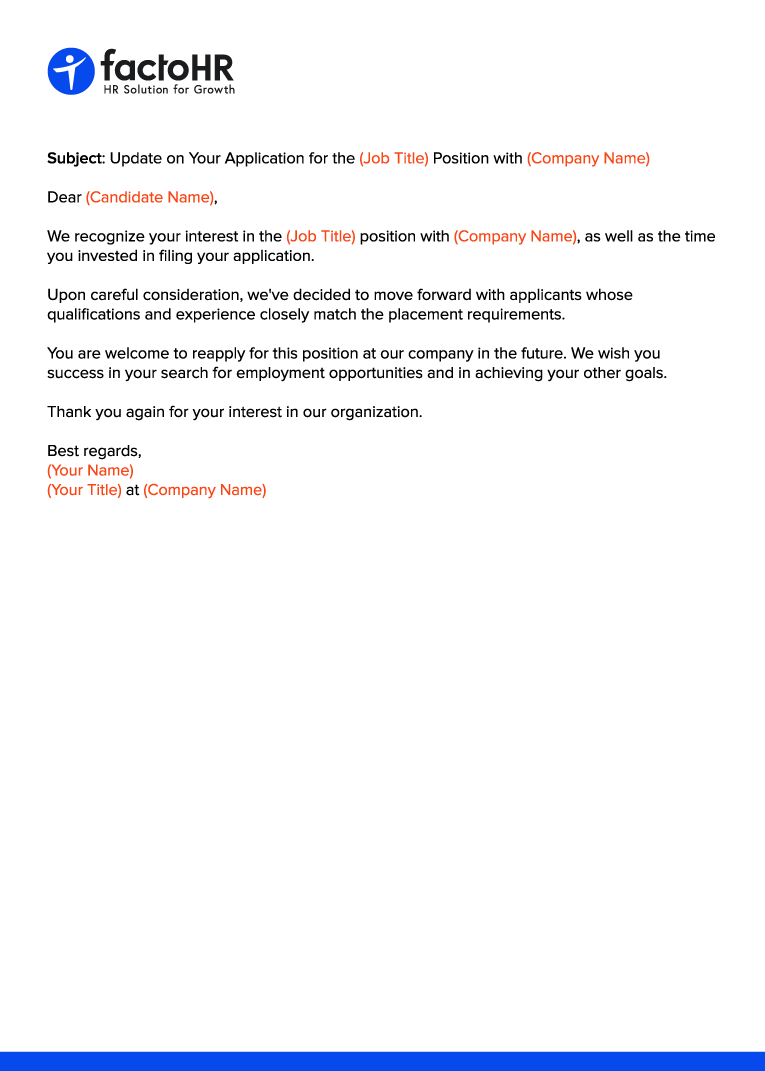
Subject: Update on Your Application for the (Job Title) Position with (Company Name)
Dear (Candidate Name),
We recognize your interest in the (Job Title) position with (Company Name), as well as the time you invested in filing your application.
Upon careful consideration, we’ve decided to move forward with applicants whose qualifications and experience closely match the placement requirements.
You are welcome to reapply for this position at our company in the future. We wish you success in your search for employment opportunities and in achieving your other goals.
Thank you again for your interest in our organization.
Best regards,
(Your Name)
(Your Title) at (Company Name)
Template 2: Post-Interview Rejection Letter/Email
Subject: (Company Name) – Status Update Regarding Your (Job Title) Interview
Dear (Candidate Name),
Thank you for your time during the interview for the (Job Title) position at (Company Name).
We regret to inform you that after reviewing all applicants who interviewed for this position, we cannot move forward with your application. The selection process was challenging due to the high number of qualified candidates.
We were impressed by (insert one or two things you liked about the candidate), and we encourage you to reapply for future positions that align with your qualifications.
Thank you once again, and we wish you good luck as you continue your search for a new position.
Best regards,
(Your Name)
(Your Title)
(Company Name)
Template 3: “Close Call”/Final-Round Candidate Rejection
If a candidate has reached the final rounds and become a strong contender, you might consider a slightly more tailored message:
Subject: Result Of Your Application For (Job Title) – (Company Name)
Dear (Candidate Name),
Thank you for your efforts in our recruiting process for the (Job Title) position at (Company Name). We appreciate your expertise, especially the key accomplishments we’ve noted, such as (insert specific examples of strengths or achievements).
After a thorough evaluation, the company selected a candidate with qualifications that better matched our current hiring needs.
We thank you for taking the time to apply and hope that you will continue to consider future opportunities with (Company Name). We have retained your resume and could reach out when any future openings arise that are a better fit for you.
Best wishes for success in your career.
Warmest regards,
(Your Name)
(Your Position)
(Company Name)
Template 4: Rejection Due to Role Cancellation/Hiring Freeze
Sometimes the rejection has little to do with the candidate; perhaps the position was canceled, or hiring is frozen. Transparency helps maintain trust.
Subject: Follow-Up on (Job Title) with (Company Name)
Dear (Candidate Name),
Thank you for your interest in the (Job Title) role and for the time and effort you invested during the recruitment process.
At this time, we regret to inform you that due to an unanticipated interruption in our hiring plan (including the cancellation of the position or a hiring freeze), we do not have an opportunity available that aligns with your application.
We are genuinely impressed by your credentials and value your contributions. While we cannot move forward with this opportunity, we are open to keeping your information on file for potential future opportunities that may arise.
Thank you for your understanding during this time.
Best regards,
(Your Name)
(Your Title)
(Company Name)
Template 5: Rejection with Constructive Feedback (Optional/Use with Caution)
Providing comments shows empathy and admiration, but be careful: comments must be constructive and professional, not overly important or personal.
Subject: Feedback on Your Application – (Job Title) at (Company Name)
Dear (Candidate Name),
Thank you for taking the time and effort to participate in the interview process for the position of (Job Title) at (Company Name).
Although we were inspired by your (insert type of skill or talent, such as “ability to communicate well and demonstrate initiative”), we selected another candidate who was a better fit for (insert the specific reason, such as “experience managing projects with large teams”).
If you are interested in using similar roles in the future, we recommend focusing on developing specific experience, such as “large-scale deployment project experience.”
We encourage you to apply for other positions at (Company Name) that align with your profile, and we wish you success in your future career.
Sincerely,
(Your Name)
(Your Title)
(Company Name)

Best Practices (Tips & What to Avoid)
- Send rejection letters/emails promptly- once a decision is made. Don’t keep applicants waiting indefinitely.
- Please be polite, empathetic, and knowledgeable. Avoid using harsh or inappropriate language.
- Be concise and clear; make the rejection unmistakable.
- Optionally, offer to keep their resume on file or encourage future applications – this keeps the door open for mutual gain.
- Avoid overly precise, potentially misunderstood comments; keep remarks broad and optimistic if you provide them.
- Use a professional closing and proper signature – including name, title, and company.
Common errors to avoid: ghosting applicants, sending unhelpful messages, delaying responses, using an overly impersonal or robotic tone, or omitting simple courtesies.
Other HR Letters to Explore
Frequently Asked Questions (FAQs)
How Long do I have to Wait before Sending a Rejection Email?
As quickly as the selection is finalized (or the function is closed), it is best to send the rejection right away; delaying can also cause confusion and frustration.
Should I Explain why the Candidate Wasn’t Hired?
You may, if appropriate, do this sensitively. General remarks (e.g., talent mismatch) can help applicants enhance. But a particular complaint may additionally backfire, so be cautious.
What Forms of Rejection Letters Exist?
There are many: application-screening rejections, post-interview rejections, final-round “close call” rejections, inner-candidate rejections, rejections due to function cancellations or hiring freezes, rejections with remarks, and encouragement / re-application invitations.
How do Agencies Gain from Using Rejection Letter Templates?
Templates save time, ensure consistency, assist in holding an expert tone, lessen the chances of mistakes or oversight, and guide enterprise branding by retaining recognition for all candidates.


Modernize your HR tasks with factoHR today
Experience the digitalization of everyday business activities with factoHR's modern and compatible solutions for every need.

© 2026 Copyright factoHR