
10 Rejection Email Templates for HR + Candidate Rejection Letter Samples

Table of Contents

While sending a job offer letter is the highlight of a recruiter’s day, sending a well-crafted rejection is equally important. Utilizing standardized rejection email templates can help you leave a positive impression and foster goodwill, even after the candidate did not get the role.
According to a SHRM study, approximately 75% of job seekers never receive a response after submitting an application. This “candidate ghosting” creates frustration and damages your organization’s reputation in the talent market. A simple, empathetic rejection email can make the difference between a candidate who speaks positively about your company and one who warns others to stay away.
TLDR;
- Learn what a rejection letter is and why it matters in the hiring process.
- Understand how rejection emails protect employer brand and improve candidate experience.
- Review the key elements every professional rejection email should include.
- A quick-reference comparison table covering all 10 templates at a glance.
- Compare 10 ready-to-use templates for different hiring situations.
- Explore subject line examples, legal guidance, and practical HR best practices.
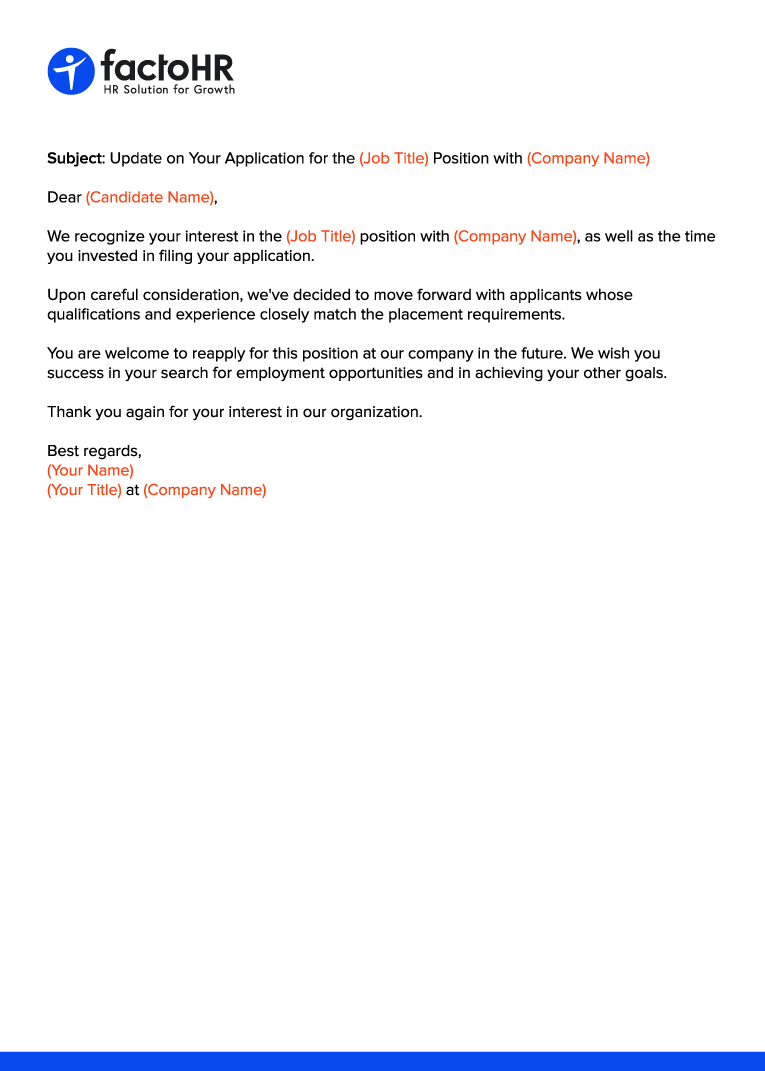
Rejection Letter Format

What is a Rejection Letter?
A rejection letter, also called a rejection email or candidate rejection notice, is a formal communication sent by an organization to an applicant informing them that they have not been selected for a role. The rejection email can be sent at various stages of the recruitment process, including after the initial application screening, following a phone or in-person interview, after a skills assessment, or even after a final interview round.
The purpose of a rejection letter is to provide closure for the candidate, thank them for investing their time and effort, maintain respect and professionalism, and leave the door open for the candidate to apply for future positions within your company. A well-written rejection email protects your employer brand and contributes to a positive candidate experience throughout your hiring process.
Why Sending a Rejection Email Matters
Value the Candidate’s Investment
A streamlined recruitment process requires respecting every candidate’s effort. The act of researching a company, tailoring a resume, preparing for an interview, and waiting for a response takes significant time, energy, and emotional investment. Sending a rejection letter acknowledges that investment and treats candidates with the respect they deserve. Research from LinkedIn Talent Solutions shows that candidates who have a positive experience, even when rejected, are 80% more likely to apply again.
Protect Your Employer Brand and Reputation
A high-quality rejection email creates a positive impression. In the age of employer review platforms like Glassdoor and social media, word spreads quickly. Candidates who are ghosted or treated poorly during hiring often share their negative experiences publicly, which can deter future applicants and damage your company’s ability to attract top talent.
Keep the Door Open for Future Opportunities
Not every rejected candidate is wrong for your company; they may simply be wrong for this particular role at this particular time. A polite rejection email encourages strong candidates to consider applying for future roles, especially if they were a close fit. This approach helps you build a valuable talent pipeline without any additional sourcing cost.
Emphasize Professionalism and Ethical Practice
According to industry studies, candidate ghosting (receiving no response at all) is one of the most significant pain points in the job search process and leaves applicants feeling dissatisfied, frustrated, or even disrespected. Sending a formal rejection demonstrates that your organization values ethical hiring practices and treats every applicant as a human being, not just a number in your applicant tracking system.
Reduce Legal Risk
A professional, well-worded rejection email also reduces your exposure to potential legal claims. By keeping communication neutral, focused on job-related criteria, and free of any mention of protected characteristics, you create a documented record that supports fair hiring practices.
Key Components of a Professional Rejection Email
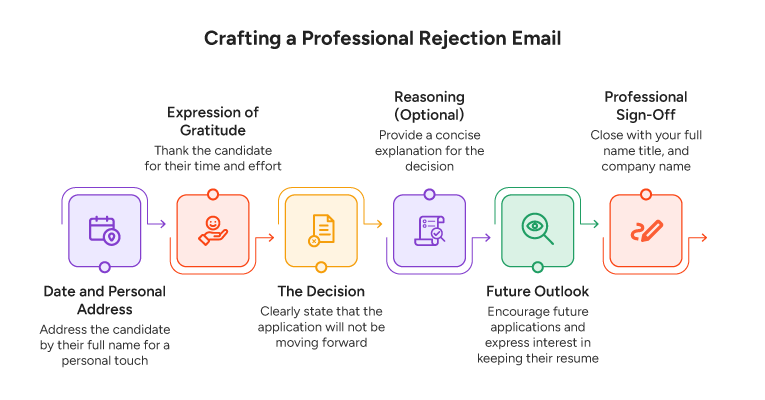
The ideal rejection email should contain the following essential elements:
Date and Personal Address
Ensure the email is addressed to the candidate by their full name. Generic “Dear Applicant” greetings feel impersonal and should be avoided whenever possible.
Expression of Gratitude
Thank the candidate sincerely for their time, interest, and effort. Acknowledge the specific stage they reached in your process, whether it was an application, phone screen, or in-person interview.
The Decision
Include a clear, professional statement that you will not be moving forward with their application. Ambiguity can cause confusion or lead candidates to believe they are still under consideration.
Reasoning (Optional but Recommended)
A concise, respectful explanation of why another candidate was chosen, framed around role requirements rather than personal shortcomings. For example, stating that the selected candidate had more direct experience in a specific skill area is appropriate.
Future Outlook
Encourage strong candidates to apply again for future openings. If you genuinely want to keep their resume on file, say so explicitly and mean it.
Professional Sign-Off
Close with your full name, job title, and company name. This adds a human touch and makes the communication feel personal rather than automated.
Quick-Reference Template Comparison Table
| # | Template Name | Best Used For | When to Send | Tone Level |
|---|---|---|---|---|
| 1 | Standard Rejection | After application/resume screening | Within 1 week of the decision | Professional, brief |
| 2 | Post-Interview Rejection | After a phone, video, or in-person interview | Within 2–3 business days | Warm, appreciative |
| 3 | Final-Round Close Call | Candidates who reached the final rounds | Within 1–2 business days | Highly personal, empathetic |
| 4 | Role Cancellation/Hiring Freeze | Position canceled or budget frozen | As soon as the decision is known | Transparent, apologetic |
| 5 | Rejection with Feedback | Strong candidates who want growth tips | Within 3–5 business days | Encouraging, constructive |
| 6 | Internal Candidate | Current employees not selected for the new role | Same day or within 24 hours | Sensitive, supportive |
| 7 | Internship/Entry-Level | Interns or junior applicants | Within 1 week | Encouraging, motivational |
| 8 | Post-Assessment/Test | Candidates who completed a skills test | Within 3–5 business days | Appreciative, specific |
| 9 | Late Application | Qualified but applied after the deadline | Within 1 week | Positive, inviting |
| 10 | Follow-Up After Phone Rejection | Confirming a verbal phone rejection | Same day as phone call | Personal, confirming |

10 Rejection Email Templates for Every HR Scenario
A quick-reference comparison table covering all 10 rejection email templates at a glance. Use the “Copy Template” button to quickly copy any template to your clipboard.
Template 1: Standard Rejection (Post Application/Resume Screen)
When to use: After reviewing applications and deciding not to move a candidate to the interview stage.
Subject: Update on Your Application for the (Job Title) Position with (Company Name)
Dear (Candidate Name),
Thank you for your interest in the (Job Title) position with (Company Name) and for the time you invested in submitting your application.
After carefully reviewing all applications, we have decided to move forward with candidates whose qualifications and experience more closely align with the requirements for this role.
This decision does not diminish the value of your skills and background. We encourage you to keep an eye on our careers page for future opportunities that may be a stronger match, and you are welcome to reapply at any time.
We wish you every success in your job search and future career endeavors.
Best regards,
Employee Name
Your Position,
Company Name
Template 2: Post-Interview Rejection Email
When to use: After conducting a phone, video, or in-person interview and deciding to move forward with a different candidate.
Subject: (Company Name) – Update on Your (Job Title) Interview
Dear (Candidate Name),
Thank you for taking the time to interview for the (Job Title) position at (Company Name). We genuinely enjoyed learning more about your background and experience during our conversation.
After careful consideration of all candidates who interviewed for this role, we have decided to move forward with another applicant whose qualifications more closely match our current needs.
The selection process was highly competitive, and we were particularly impressed by (mention one or two specific things you valued about the candidate, such as “your strong communication skills and your experience leading cross-functional projects”). We sincerely encourage you to apply for future positions at (Company Name) that align with your expertise.
Thank you again for your interest in our organization. We wish you the very best as you continue your career journey.
Best regards,
Your Name
Your Title
Company Name
Template 3: Final-Round “Close Call” Candidate Rejection
When to use: For candidates who reached the final interview rounds and were serious contenders for the position.
Subject: Your Application for (Job Title) at (Company Name) – Final Decision
Dear (Candidate Name),
Thank you for the considerable time and effort you invested throughout our interview process for the (Job Title) position at (Company Name). It was a genuine pleasure getting to know you across multiple conversations, and our team was deeply impressed by your qualifications, particularly (mention specific strengths or accomplishments, such as “your strategic approach to market expansion and your proven track record in building high-performing teams”).
After much deliberation, we have ultimately selected a candidate whose specific experience in (mention the deciding factor, such as “enterprise SaaS sales within the healthcare vertical”) was the closest fit for our immediate needs. Please know that this was an exceptionally difficult decision, and your candidacy was among the strongest we received.
With your permission, we would like to retain your resume in our talent pool and reach out to you directly when future roles arise that match your outstanding profile. We truly believe you could be a great fit for (Company Name) in the near future.
If you have any questions or would like to discuss this decision further, please do not hesitate to reach out to me directly at (email/phone).
Wishing you continued success in all your professional endeavors.
Warmest regards,
Employee Name
Your Position,
Company Name
Template 4: Rejection Due to Role Cancellation or Hiring Freeze
When to use: When the rejection has nothing to do with the candidate’s qualifications, and is due to the position being canceled, budget constraints, or a company-wide hiring freeze.
Subject: Important Update – (Job Title) Position at (Company Name)
Dear (Candidate Name),
Thank you for your interest in the (Job Title) role at (Company Name) and for the time and effort you invested during our recruitment process.
We are writing to inform you that, due to unforeseen changes in our organizational plans (choose the applicable reason: the position has been canceled/we have implemented a company-wide hiring freeze / the role has been restructured), we are unable to proceed with filling this role at this time.
We want to emphasize that this decision is entirely unrelated to your qualifications or performance during the hiring process. We were genuinely impressed by your credentials and the value you could bring to our team.
We would like to keep your information on file and contact you proactively if this role or a similar opportunity reopens. If you are open to this, no action is needed on your part.
Thank you for your understanding, and we sincerely apologize for any inconvenience this may have caused.
Best regards,
Your Name
Your Title
Template 5: Rejection with Constructive Feedback
When to use: When a candidate requests feedback or when you feel constructive guidance would genuinely help a strong but unsuccessful candidate. Use with caution — feedback must be professional, job-related, and free of personal criticism.
Subject: Feedback on Your Application for (Job Title) at (Company Name)
Dear (Candidate Name),
Thank you for the time and effort you dedicated to the interview process for the (Job Title) position at (Company Name). We appreciate the enthusiasm and professionalism you brought to every stage of our process.
While we were impressed by your (mention specific strengths, such as “excellent communication skills and clear passion for the industry”), we ultimately selected a candidate who had stronger qualifications in (mention the specific area, such as “hands-on experience managing multi-regional payroll compliance at scale”).
We would like to share some constructive feedback that we hope will support your professional development. Based on our evaluation, gaining additional experience in (mention specific area, such as “end-to-end HR technology implementation” or “data-driven workforce analytics”) would significantly strengthen your candidacy for similar roles in the future. You might consider (suggest specific actions, such as “pursuing a certification in [relevant area]” or “seeking project opportunities that involve [specific experience]”).
We genuinely encourage you to apply for future openings at (Company Name) as they arise. We believe your talent and drive will serve you well in your career.
Best wishes,
Employee Name
Your Position,
Company Name
Template 6: Internal Candidate Rejection
When to use: When an existing employee within your organization applies for a different internal role and is not selected. This scenario requires extra sensitivity as the candidate will continue working at your company.
Subject: Your Application for (Job Title) – Internal Transfer Decision
Dear (Employee Name),
Thank you for expressing your interest in the (Job Title) role and for going through the internal application process. We truly value the initiative you have shown in seeking new challenges and growth opportunities within (Company Name).
After careful evaluation of all candidates, both internal and external, we have decided to move forward with another applicant for this particular position. This decision was based on (mention neutral, role-specific criteria such as “the specific technical requirements of the role” or “the need for deep prior experience in [specific domain]”) and does not reflect negatively on your performance or contributions in your current role.
We recognize and appreciate the work you do in your current position as (Current Role Title), and we want to actively support your career growth here at (Company Name). We would like to schedule a meeting with you and your manager to discuss your career development plan, identify areas where you can build new skills, and ensure you are considered for future opportunities that align with your goals.
Please feel free to reach out to me if you would like to discuss this decision in more detail. We are committed to your growth and success within our organization.
Best regards,
Name
Company Name
Template 7: Internship or Entry-Level Position Rejection
When to use: When rejecting applicants for internships, graduate programs, or entry-level roles. These candidates are typically early in their careers and benefit greatly from encouragement.
Subject: Your Application for the (Internship/Position Title) at (Company Name)
Dear (Candidate Name),
Thank you for your interest in the (Internship/Position Title) at (Company Name) and for taking the time to apply. We received an impressive number of applications from talented candidates like yourself, and we appreciate the effort you put into your submission.
After careful review, we have decided to move forward with other candidates whose academic background and experience were more closely aligned with the specific needs of this (internship/role).
We want you to know that your (mention a positive attribute, such as “academic achievements,” “enthusiasm for the field,” or “involvement in extracurricular projects”) stood out to us, and we believe you have a bright future ahead. The job market for early-career professionals can be competitive, and we encourage you to continue building your experience and applying for opportunities that excite you.
We anticipate having additional (internship/entry-level) openings in the (mention next cycle, such as “upcoming summer” or “next quarter”), and we would welcome your application at that time. In the meantime, feel free to follow our careers page to stay updated on new opportunities.
Wishing you all the best in your studies and career journey.
Warm regards,
Employee Name
Your Position,
Company Name
Template 8: Rejection after Skills Assessment or Test
When to use: When a candidate completes a technical test, skills assessment, case study, or work sample and is not selected to continue.
Subject: Update on Your (Job Title) Application – Assessment Results at (Company Name)
Dear (Candidate Name),
Thank you for completing the (type of assessment, such as “technical skills assessment” or “case study exercise”) as part of our hiring process for the (Job Title) position at (Company Name). We appreciate the time and effort you invested in this stage of the evaluation.
After reviewing the results of all assessments, we have decided to move forward with candidates whose performance more closely matched the specific technical requirements of this role. This decision was based on (mention general criteria, such as “the depth of proficiency in [specific tool, language, or skill area] required for day-one impact in this position”).
We recognize that assessments capture only a snapshot of a candidate’s full abilities, and your (mention a positive element, such as “problem-solving approach” or “clear communication of your thought process”) was noted and appreciated by our evaluation team.
We encourage you to continue developing your skills in (mention relevant area) and to apply for future openings at (Company Name) that align with your strengths.
Best regards,
Name
Company Name
Template 9: Late Application Rejection
When to use: When a candidate applies after the application deadline or after the position has already been filled, especially when their qualifications are strong.
Subject: Your Application for (Job Title) at (Company Name)
Dear (Candidate Name),
Thank you for your interest in the (Job Title) position at (Company Name). We appreciate you taking the time to submit your application.
Unfortunately, we had already finalized candidate selection for this role before receiving your application. We reviewed your resume and were impressed by your (mention a specific positive, such as “extensive experience in [relevant field]” or “strong qualifications in [specific area]”).
We would love to consider you for similar opportunities in the future. If you are open to it, we would like to keep your resume on file and notify you when comparable positions become available. We also encourage you to regularly visit our careers page at (link) to stay informed about new openings.
Thank you again for your interest in (Company Name). We hope to connect with you again soon.
Best regards,
Your Name
Your Title,
Company Name
Template 10: Follow-Up Email after Phone Call Rejection
When to use: After you have already delivered the rejection verbally by phone. This email serves as a written confirmation and helps the candidate retain the key points discussed. This is considered best practice for candidates who have reached advanced stages.
Subject: Following Up on Our Conversation About the (Job Title) Role at (Company Name)
Dear (Candidate Name),
Thank you for taking my call today. I wanted to follow up in writing to confirm our discussion regarding the (Job Title) position at (Company Name).
As I mentioned, while our team was thoroughly impressed by your qualifications, particularly your (reference specific strengths discussed on the call, such as “leadership experience and ability to drive results in fast-paced environments”), we have decided to move forward with another candidate whose background more specifically aligned with (mention the key deciding factor discussed).
I also want to reiterate the feedback we shared during our conversation: (briefly summarize any constructive feedback given on the call, such as “expanding your experience in [specific area] would make you an even stronger candidate for senior-level roles like this one”).
It was a genuine pleasure getting to know you throughout this process. With your permission, I would like to keep you in our talent pipeline and reach out personally if a role that suits your profile opens up.
Please do not hesitate to reach out if you have any further questions. I wish you every success going forward.
All the best,
Your Name
Your Title,
Company Name
Rejection Email Subject Line Best Practices
The subject line is the first thing a candidate sees, and it determines whether your email gets opened and how the candidate feels before even reading the message. A strong subject line should be clear, professional, and free of misleading language that might create false hope.
Principles for Effective Rejection Email Subject Lines
Your subject line should be transparent about the email’s purpose without being blunt or harsh. It should include the job title and company name for easy identification, especially since candidates often apply to multiple companies simultaneously. Avoid clickbait-style subjects, vague phrasing like “Regarding Your Application” (which can be mistaken for positive news), or overly negative language like “You Were Not Selected.”
Examples of Effective Subject Lines
- “Update on Your Application for [Job Title] at [Company Name]”
- “[Company Name] – Your [Job Title] Application Status”
- “Following Up on Your Interview for [Job Title]”
- “Your Application for [Job Title] – Decision from [Company Name]”
- “Important Update: [Job Title] Position at [Company Name]”
- “Thank You for Your Interest in [Job Title] at [Company Name]”
- “Decision Regarding Your Application for [Job Title]”
Subject Lines to Avoid
- “Exciting News About Your Application” (misleading — implies positive outcome)
- “Congratulations” or “Great News” (deceptive)
- “Regarding Your Application” (too vague — causes anxiety)
- “We Regret to Inform You” (overly formal and impersonal)
- No subject line at all (unprofessional)
When to Call vs. Email a Candidate Rejection
Choosing the right communication channel for your rejection is an important part of providing a positive candidate experience. The general rule is that the further a candidate progresses in your hiring process, the more personal your rejection communication should be.
When an Email is Sufficient
Email is the appropriate channel for candidates rejected at the application screening stage, after an initial phone screen, or after a first-round interview. At these stages, candidates have invested relatively less time, and a thoughtful, personalized email provides adequate closure. Email is also more practical when you need to efficiently reject a large number of candidates.
When is a Phone Call Better?
A phone call is strongly recommended for candidates who reached the final interview round, completed multiple rounds of interviews, invested significant time in presentations or case studies, or were among the top two or three finalists. For internal candidates being rejected for a transfer, a face-to-face meeting is ideal, with a phone call as the minimum. After delivering a verbal rejection by phone, always follow up with a written email (see Template 10 above) to confirm the decision and any feedback shared.
A Combined Approach
For your strongest rejected candidates, the gold standard is a phone call to deliver the news personally, followed by a thoughtful email that recaps the conversation and leaves the door open. This approach demonstrates the highest level of professionalism and significantly increases the likelihood that the candidate will consider future opportunities with your company.
Legal Considerations for Rejection Emails
Sending rejection emails is not just a matter of courtesy; there are important legal considerations that HR professionals must keep in mind to protect both the candidate and the organization.
Avoid Referencing Protected Characteristics
Under employment discrimination laws (including Title VII in the United States, the Equality Act in the United Kingdom, and similar legislation in other jurisdictions), you must never reference a candidate’s age, gender, race, ethnicity, religion, disability, marital status, pregnancy, sexual orientation, or any other protected characteristic as a reason for rejection. Even subtle or indirect references can create legal exposure.
Keep Rejection Reasons Job-Related
When providing a reason for rejection, always frame it in terms of job qualifications, skills, experience, or role-specific requirements. For example, saying “We selected a candidate with more experience in enterprise cloud architecture” is appropriate. Saying “We felt you might not fit in culturally” can be interpreted as discriminatory.
Maintain Consistent Recordkeeping
Store all rejection communications in a secure system accessible only to authorized HR personnel. Consistency in your rejection process, using templates like the ones provided in this guide, helps demonstrate that your organization treats all candidates fairly and applies the same standards to every applicant.
Respect Data Privacy Regulations
If your organization is subject to GDPR (General Data Protection Regulation), CCPA (California Consumer Privacy Act), or similar data privacy laws, include a note informing candidates how to request deletion of their personal data. Several of the templates above include a sign-off regarding the retention of resume data; make sure this practice aligns with your data retention policy and gives candidates the option to opt out.
Respond to Feedback Requests Professionally
If a rejected candidate requests more detailed feedback or challenges the decision, respond calmly and professionally. Stick to job-related criteria, avoid getting drawn into comparisons with other candidates, and consult your legal team if a candidate’s correspondence becomes adversarial.

How to Write a Rejection Email: Best Practices and Mistakes to Avoid
Best Practices
- Send promptly. Once a hiring decision is finalized, send rejection emails as soon as possible. For application-stage rejections, aim for within one week. For post-interview rejections, within two to three business days is ideal. Delays create unnecessary anxiety and frustration for candidates.
- Be empathetic but clear. Strike a balance between compassion and directness. Thank the candidate genuinely, acknowledge their effort, and state the decision clearly. Do not use language so soft that the rejection is ambiguous.
- Personalize whenever possible. At a minimum, address the candidate by name and reference the specific role they applied for. For candidates who interviewed, mention something specific you appreciated about their candidacy. This transforms a form email into a meaningful communication.
- Keep it concise. A rejection email should typically be between 100 and 200 words. Respect the candidate’s time by getting to the point without unnecessary filler. Longer is appropriate only for final-round candidates or for providing constructive feedback.
- Encourage future applications. If the candidate was strong but not the best fit for this role, explicitly invite them to reapply. If you want to retain their resume, say so and follow through.
- Use a professional subject line. As covered in the subject line section above, be clear and honest in your subject line. The candidate should know the email’s general purpose before opening it.
Common Mistakes to Avoid
- Ghosting candidates. Failing to respond is the single most damaging mistake an employer can make in the hiring process. It signals disrespect and generates negative word-of-mouth about your organization.
- Using a robotic, impersonal tone. Template emails that sound like they were generated by a machine with no human touch leave candidates feeling like a number. Always add at least one personalized element.
- Being too vague. Phrases like “after careful consideration,” without further context, can feel dismissive. Where appropriate, provide at least a general reason for the decision.
- Providing overly detailed or personal criticism. There is a fine line between constructive feedback and criticism that feels hurtful. Keep any feedback broad, focused on role requirements, and forward-looking.
- Delaying the rejection. Holding onto a rejection for weeks while you “finalize things” wastes the candidate’s time and prevents them from fully focusing on other opportunities.
- Sending the rejection to the wrong person. Double-check names, email addresses, and job titles before sending. Sending a rejection addressed to the wrong candidate is embarrassing and unprofessional.
- Including discriminatory language. Even unintentionally, referencing protected characteristics or making subjective judgments about “culture fit” without defining it in terms of specific values or behaviors can expose your organization to legal risk.
Other HR Letters and Templates to Explore
Frequently Asked Questions (FAQs)
How Long Should I Wait before Sending a Rejection Email?
Send the rejection email as soon as the hiring decision is finalized. For post-application or screening-stage rejections, aim to notify candidates within one week. For post-interview rejections, the best practice is to send your email within two to three business days. Delaying causes unnecessary confusion and frustration, and candidates who are left waiting often form negative opinions about your employer brand.
Should I Explain why the Candidate was Not Hired?
You may provide general, job-related feedback if done sensitively. For example, noting that the selected candidate had more experience in a specific skill area is appropriate and helpful. However, avoid overly detailed or personal criticism, which can backfire or create legal exposure. For candidates who request detailed feedback, offer to schedule a brief call rather than putting extensive comments in writing.
What are the Different Types of Rejection Letters?
The most common types include application-screening rejections, post-interview rejections, final-round close-call rejections, internal candidate rejections, internship rejections, rejections due to role cancellations or hiring freezes, rejections after skills assessments or tests, late-application rejections, rejections with constructive feedback, and follow-up confirmation emails after a phone-call rejection.
How do Companies Benefit from Using Rejection Email Templates?
Templates save significant time for busy HR teams, ensure consistent messaging across all candidates, maintain a professional and respectful tone, reduce the risk of errors or accidentally including inappropriate language, and support your employer brand by ensuring no candidate is ghosted or left without closure.
Is It Better to Call or Email a Rejection?
For early-stage rejections, such as after application screening or an initial phone screen, email is efficient and appropriate. For candidates who have invested significant time in multiple interview rounds or reached the final stage, a personal phone call followed by a confirmation email is considered the gold standard for professional and empathetic communication.
What Should a Rejection Email Subject Line Say?
The subject line should be clear, professional, and honest. Good examples include “Update on Your Application for [Job Title] at [Company Name]” or “Your Application Status – [Company Name].” Avoid misleading subject lines that could create false hope, such as “Exciting Update” or “Great News,” and avoid overly blunt language like “You Were Not Selected.”
Can a Rejection Email have Legal Consequences?
Yes. Rejection emails that reference protected characteristics such as age, gender, race, religion, disability, or marital status can lead to discrimination claims. Always keep rejection language neutral and focused on job-related qualifications. Store all rejection communications securely, maintain consistent processes across all candidates, and consult your legal team if you are unsure about the wording of any rejection.
How do You Reject a Candidate without Burning Bridges?
Express genuine gratitude for their time and effort, acknowledge specific strengths you observed, provide a clear but empathetic rejection, offer to keep their resume on file for future opportunities, and encourage them to apply again. Timeliness and personalization are the two most important factors in maintaining a positive relationship with rejected candidates.



Modernize your HR tasks with factoHR today
Experience the digitalization of everyday business activities with factoHR's modern and compatible solutions for every need.