
Late-Coming Policy for Employees [Template + Guidelines]
Download Late-Coming Policy PDF Format For Free

Table of Contents

Most employees wonder why Indian companies have the strictest late-coming policy and why flexible working hours are not the norm. This routine delay in employees’ schedules may seem minimal or even unimportant. However, silent costs such as communication lapses, uneven workloads, and missed meetings accumulate over time. A late-coming policy for employees is built exactly to avoid such situations.
With the steady rise in the acceptance of flexible or hybrid work models, clear attendance rules have become essential. The absence of a clearly defined employee punctuality policy can negatively affect attendance tracking, payroll calculations, and performance evaluations.
A late-coming policy helps organizations set clear expectations on attendance plans, working hours, grace periods, and leave management. In this blog, we will explore a templated late-coming policy for employees and learn how to build a fair attendance framework.
What this Blog Covers
- Definition of a late-coming policy for employees.
- Scope and purpose of the standard late-coming policy document.
- Key policy components, including grace periods, deductions, and attendance regularization rules.
- Disciplinary actions for habitual latecomers.
- A sample late-coming policy template and practical FAQs.

What is a Late-Coming Policy?
A late-coming policy is a company’s punctuality rulebook. It defines the organization’s guidelines for employees who report to work after their scheduled start time and outlines the consequences of late arrival. Moreover, the employee punctuality guidelines must clearly specify the impact of arriving late for work on payroll processing and performance reviews.
From a compliance perspective, it ensures consistency and fairness across departments while serving as a reference for loss-of-pay calculations and attendance audits. Since most organizations rely on digital tracking systems, clearly defined biometric attendance late rules are essential to avoid confusion and payroll disputes.
Scope and Purpose
A late-coming policy for employees is uniformly applied to all full-time, part-time, and contract employees within an organization, regardless of position or level. Some exceptions may be granted for employees with pre-approved flexible schedules or those with disabilities.
Attendance tracking for on-site employees differs from that of remote or hybrid teams. Most organizations use biometric or facial recognition systems for on-site employees, while remote or hybrid teams are typically monitored through touchless attendance solutions or HRMS integration.
The purpose of the late-coming policy for employees is to ensure everyone is held accountable for their punctuality and treated fairly. Any exceptions or distinctions should be clearly stated in the official policy document.
Key Components of a Late-Coming Policy
A late-coming policy must clearly explain the rules for employees arriving late to work and how the organization handles tardiness. The key components are as follows:
1. Standard Work Hours
As an organization enforcing a late-coming policy, you must clearly define official working hours and break durations. These timings act as a baseline for determining late arrivals and half-day calculations.
- Working Hours: 9:00 a.m. to 6:00 p.m.
- Lunch Break: 1:30 p.m. to 2:00 p.m.
2. Grace Period for Office Timing
It is humanly not possible to arrive at the exact time every single working day. A grace period for office timing is a highly flexible option for employees that extends just beyond their scheduled shift timings. It provides a brief window to account for minor delays and usually does not incur any penalty. However, when this window is misused, the company may step in and take corrective action as outlined in its guidelines.
Common Grace Structures:
- Fixed daily grace: 15 minutes allowed every day.
- Monthly allowance: 15-minute grace permitted 2 to 3 times per month.
- No grace: Strictly enforced for shift-based or critical operations.
3. Notification Procedure
Employees must inform their Head of Department or reporting manager if they expect to arrive late for work. They can communicate the delay using any approved communication channel, such as a call, email, or internal message, at least 30 minutes before the scheduled start time.
- Unless the situation is critical, failure to provide prior intimation may result in the late arrival being treated as unapproved.
- If the company does not find the reasons genuine, some late arrivals may not be exempted. Emergencies, major public transport disruptions, or unexpected road closures are examples of unavoidable circumstances that managers can consider.

4. Frequency Limits
The policy must define a clear limit on the number of late arrivals permitted within a specified period. Generally, up to three late arrivals in a month may be allowed before formal corrective action is implemented.
5. Deduction Rules and Late Mark Deduction Calculator
Matters generally become complicated when deductions are applied. As an organization implementing a late-coming policy for employees, you should clearly explain how deductions are calculated to prevent payroll confusion.
The policy may include simple rules such as:
- Three late marks equal one half-day leave deduction.
- A 30-minute to 2-hour late arrival results in a half-day deduction.
- A late arrival of more than 2 hours may be treated as a full-day absence or leave.
Organizations that use automated attendance-tracking software often rely on a built-in late-mark deduction calculator to maintain consistency. To avoid disputes, these deductions should always align with the documented payroll deduction.
Loss of Pay Calculation Formula:
Loss of Pay is applicable when the available leave balance is exhausted. The formula for calculating LOP is as follows:
Example:
- Monthly Salary: ₹50,000 | Working Days: 22
- 1 Half-Day LOP = (₹50,000 ÷ 22) × 0.5 = ₹1,136.36
6. Biometric Attendance Late Rules
In systems that use biometrics, attendance and late arrivals will be recorded strictly based on biometric data. Organizations must explicitly state these rules in their late-coming policy for employees when using such hardware:
- Employees are expected to punch in upon arrival at work.
- The biometric time recorded is considered final for the official records.
- Punching on someone else’s behalf is strictly prohibited.
- If any employee violates the biometric attendance regulations, it may result in disciplinary action, up to and including termination.
- Any manual correction to biometric records requires prior documented approval from the reporting manager.
7. Sandwich Rule (if Applicable)
It is common for many employees to arrive late, be absent, or take leave immediately before or after a weekend or a declared public holiday. Many organizations adopt and define the sandwich rule in their attendance policies to prevent misunderstandings or disputes in such scenarios.
Under the rule, if an employee stays absent or arrives late without approval, the weekend or holiday immediately before or after the leave can be included in the total leave or absence count.

Disciplinary Actions for Habitual Latecomers
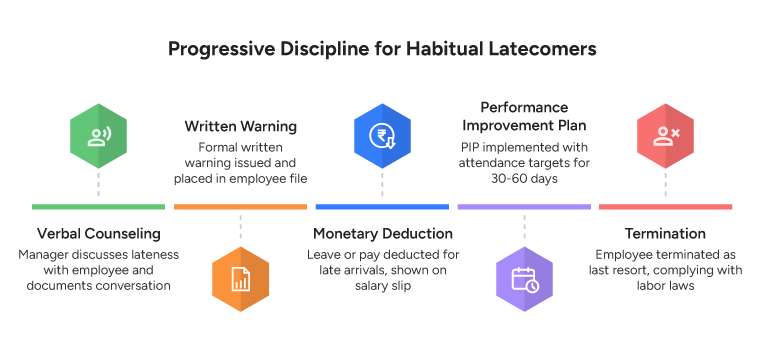
Organizations should follow a progressive discipline approach rather than impose immediate, extreme penalties when addressing frequent latecomers.
Step 1: Verbal Counseling
If an employee frequently arrives late three to four times a month, the manager should hold a one-on-one discussion to understand the underlying reasons. The discussion should be documented for record-keeping.
Step 2: Written Warning
A formal written warning should replace a verbal warning if the employee records six or more late arrivals or continues to arrive late after counseling. This warning must be placed in the employee’s official file.
Step 3: Monetary Deduction
If communication does not deter the behavior, leave or loss-of-pay deductions should be applied. All late-coming deductions must be clearly shown on the employee’s salary slip.
Step 4: Performance Improvement Plan (PIP)
If an employee continues to arrive late for three or more months, a PIP should be implemented for 30 to 60 days with clear, measurable attendance targets.
Step 5: Termination
Organizations use termination as an absolute last resort, only when all previous corrective steps have failed. Employers must ensure compliance with all applicable labor laws during this stage.
Late-Coming Policy Sample Template
Effective Date: [Date]
Policy Overview and Objective
At [Company Name], maintaining discipline and mutual respect at work is a shared responsibility. A structured late-coming policy for employees is not intended to control staff unnecessarily. Punctuality is a key part of our culture, as it protects both productive work time and overall team morale. This policy explains the organization’s position on tardiness and outlines the actions taken when core attendance expectations are not met.
Office Timings
- Standard working hours are from 9:30 a.m. to 6:30 p.m., Monday to Saturday.
- The lunch break is scheduled from 1:30 p.m. to 2:00 p.m.
Tardiness Protocol
- General Punctuality: Employees are expected to be present at their workstations and ready to begin work by 9:30 a.m.
- Late Arrival: Employees who arrive between 9:30 a.m. and 10:30 a.m. will be marked as late.
- Half-day Attendance: Employees reporting between 10:30 a.m. and 11:30 a.m. will be considered on half-day leave.
- Full-day Leave: Employees arriving after 11:30 a.m. without prior approval from their reporting manager will be marked on full-day leave.
Penalties for Tardiness
Leave Deduction
- Two late arrivals will result in the deduction of one day of casual leave.
- For the fourth and fifth late arrivals within the same month, a quarter-day leave will be deducted for each instance.
- For each late arrival after the sixth in a month, a half-day leave will be deducted.
Salary Deduction
- If late arrivals result in more than two days of leave deduction in a single month, any additional leave will be treated as unpaid.
- In cases where an employee has no available leave balance, any further late arrivals will be recorded as unpaid leave, and the salary will be adjusted on a pro rata basis.
Year-end Reconciliation
- At the end of the calendar year, all leave records will be reviewed.
- If an employee has unused earned leave that offsets leave deducted for late arrivals, the corresponding salary amount will be reimbursed.
- Any such reimbursement will be processed along with the January payroll of the following year.
Responsibility and Accountability
Employees are expected to comply with office timings at all times. Reporting managers are responsible for monitoring punctuality within their teams and addressing repeated delays. The HR department will maintain attendance records and apply leave or salary deductions in line with this official policy.
Conclusion
Punctual attendance reflects an employee’s commitment to their role and to the broader goals of [Company Name]. All employees are encouraged to value punctuality and contribute positively to a highly disciplined work environment.
Note: This late-coming policy for employees may be revised based on operational needs or feedback. Employees will be notified of any changes in a timely manner.
Approved By: [Name, Designation]
HR Contact: [Email/Phone]

Frequently Asked Questions
What is the Standard Grace Period for Late-Coming?
There is no universal standard grace period for employees arriving late to work; it largely varies by organization policy. It is usually around 15 to 30 minutes for most corporate organizations.
Can Salary be Deducted for Late-Coming?
Yes, employers can deduct salary for employees who continue to arrive late for work despite verbal and written warnings. This is adjusted in accordance with standard loss-of-pay rules.
How do I Handle Late Arrivals for Remote Employees?
You can track late arrivals for remote employees by reviewing login times in your HRMS or work tools, tracking their participation in scheduled virtual meetings, and monitoring their general availability during core working hours.
Is Late-Coming Different from a Half Day?
Yes.
- Late-coming: Arriving late but working the remaining shift. Deductions depend strictly on your company policy.
- Half-day leave: A pre-approved absence for half the shift, resulting in a guaranteed half-day salary deduction.



Transform your HR operations with factoHR today
Choose a perfect plan satisfying your business demands and let factoHR handle all your HR’s tasks efficiently.