
Relieving Letter Format: 6 Free Templates in Word and PDF (2026)

Download Relieving Letter Word & PDF Format


Table of Contents

A relieving letter is the document your employer hands you on your last day. It confirms three things: your resignation was accepted, your dues are cleared, and your exit was clean. Whether you’re an HR professional drafting a company relieving letter or an employee searching for a sample of a relieving letter to submit to your next employer, this guide gives you ready-to-use formats in both Word and PDF.
You’ll need it. Industry reports indicate that the majority of Indian companies request it during background verification (BGV), and most IT, BFSI, and MNC offers are conditional on its production (NASSCOM, HireRight 2024).
This guide includes the standard format, 6 ready-to-use templates (Word + PDF), sample request emails, the legal context, and answers to the 16 questions HR teams and employees most often ask.
TDLR;
- A relieving letter is issued after the employer accepts the resignation and clears all dues (full & final settlement).
- Mandatory for background verification (BGV) in 87% of Indian companies and effectively non-negotiable in IT and BFSI.
- Must sit on company letterhead and include the date, employee details, tenure, last working day, and an authorised signature.
- Not the same as an experience letter (which describes skills and role) or a resignation letter (which the employee writes).
- Indian companies typically issue it within 7–15 days of the last working day.
- 6 ready-to-use templates are below. Copy them into Word or PDF.
What is a Relieving Letter?
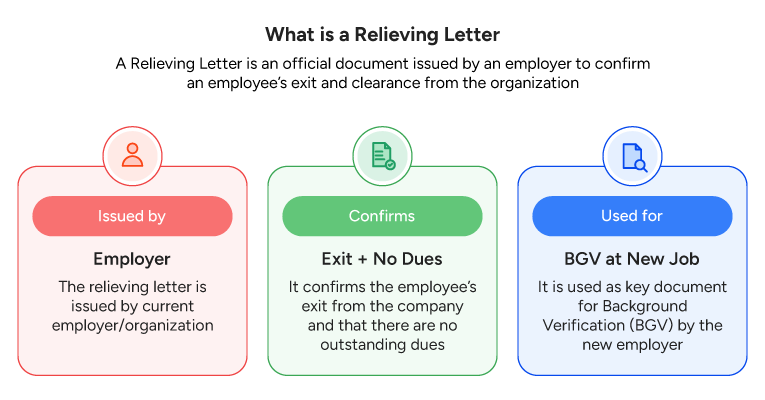
A relieving letter is the formal document an employer issues to confirm an employee has been released from duty after resignation or contract end, and that all exit formalities, no-dues clearance (confirmation that you owe the company nothing), asset return, and final settlement are complete.
It confirms three things in one document:
- Employer accepted the employee’s resignation
- The employee completed their notice period and exit formalities
- The employment relationship officially ended on the date stated
That’s the entire job of the document. Nothing more.
Relieving Letter vs Experience Letter vs Resignation Letter vs Service Certificate
Most exit-document confusion comes from people mixing these up. Here’s the clean version:
| Document | Issued By | Purpose | When Issued | Mandatory For |
|---|---|---|---|---|
| Relieving Letter | Employer | Confirms exit, relieving date, and no-dues clearance | After the last working day | Background verification (BGV) |
| Experience and Relieving Letter (Combined) | Employer | Confirms role, tenure, skills, and exit together | After exit (on request) | New job applications |
| Resignation Letter | Employee | Notifies intent to leave the job | Before notice period | Initiating the exit process |
| Relieving Certificate | Employer | Same as a relieving letter, an alternative term used in PSUs and the government | On request | Visa, loan applications |
| Service Certificate | Employer | Confirms service duration only | On request | Visa, loan applications |
Bottom line: The relieving letter is the only one that legally proves the exit was clean and dues were cleared. That’s exactly what BGV teams ask for.
Note: In some government, PSU, and defense organizations, you may see this referred to as a relieving certificate or relieving order. These are the same documents with different labels; they carry equal legal weight.
Standard Relieving Letter Format (India)
Below is the standard relieving letter format in Word that HR teams can save once and reuse. You can copy this structure directly or download the editable Word and PDF versions further down. Each time someone exits, fill in the employee details and reissue.
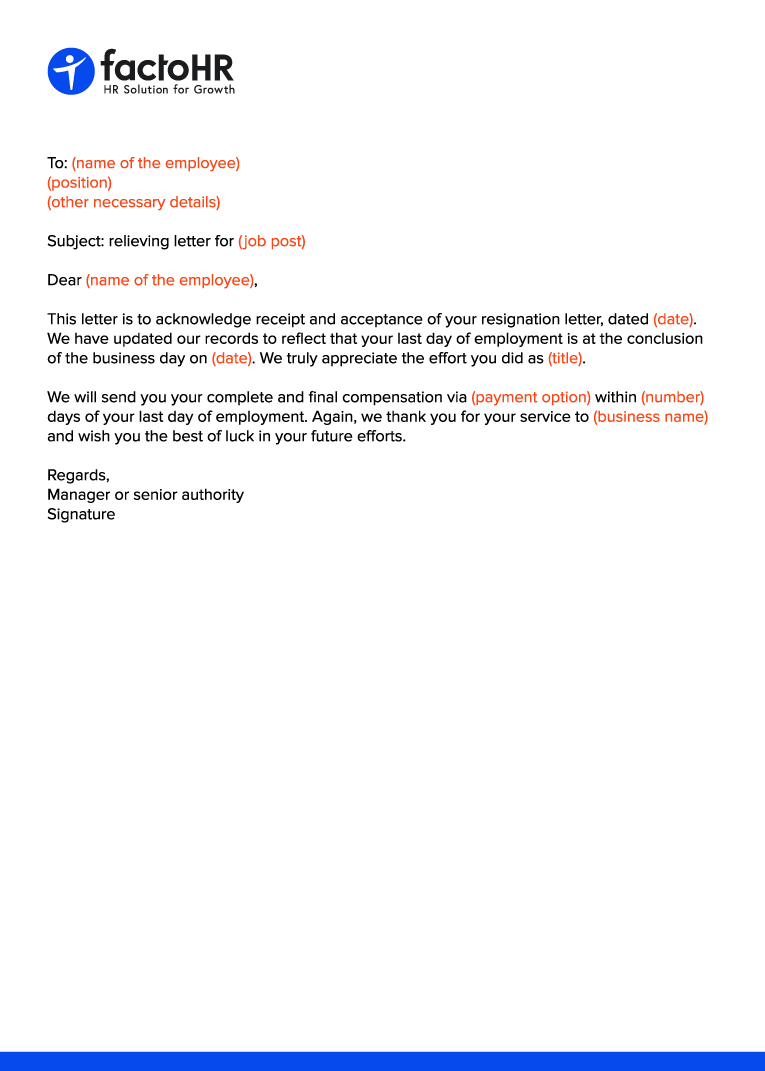
Sample of a Formal Employee Relieving Letter
Xenia Pvt. Ltd. Date: 22nd October 2025
To: Mr. Sandip Patel Employee ID: 1751 Designation: Senior Sales Manager
Subject: Relieving Letter
Dear Mr. Patel,
Regarding your resignation letter dated 20 August 2025, in which you tendered your resignation from the position of Senior Sales Manager. We confirm that you served the required 2-month notice period from 21st August 2025 to 20th October 2025.
You were employed with Xenia Pvt. Ltd. from 1st July 2020 to 20th October 2025. We hereby confirm that you have been relieved from your duties effective 20th October 2025.
Your full and final settlement was processed on 22nd October 2025, and all exit formalities, including no-dues clearance and the return of company assets, have been completed.
Thank you for your contributions, and we wish you success in your future endeavors.
Yours sincerely, Ms. Heena Khan,
HR Manager,
Xenia Pvt. Ltd.
[Signature]
6 Free Templates (Word + PDF Downloads)
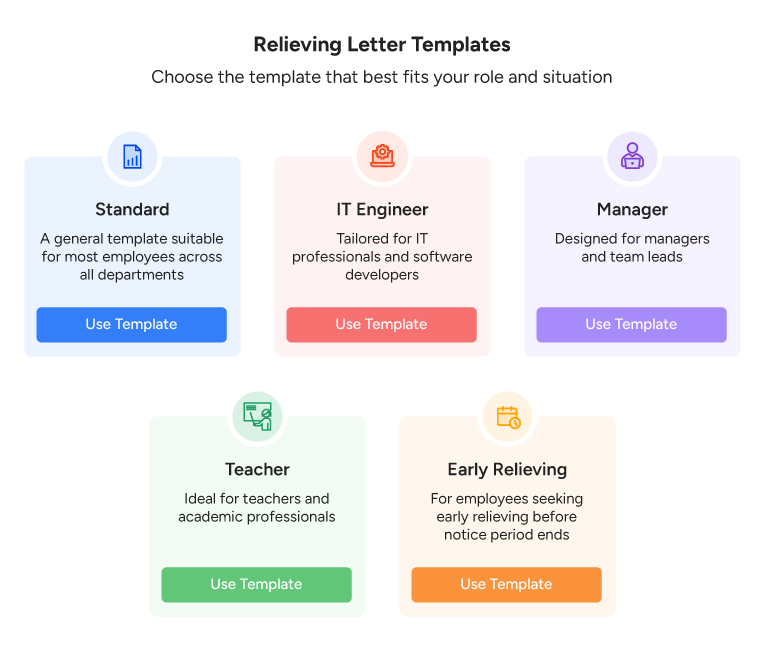
Use these ready-to-edit templates to speed up offboarding. Each one covers the four things that matter: the last working day, handover, asset return, and full & final (F&F) settlement details.
Template 1: General Relieving Letter Format
(Company Letterhead)
Date:
To: Employee Full Name:
Employee ID: (if applicable)
Designation: (Job Title)
Subject: Letter of Relieving
Dear (name of the employee),
This is to acknowledge the receipt of your resignation letter dated (date), and we confirm that your resignation has been accepted.
We sincerely thank you for your contribution to (company name) during your tenure from (employment start date) to (employment end date). You are hereby relieved from your duties with effect from (employment end date).
We wish you continued success in your future endeavours.
Yours sincerely,
(Authorized Professional’s Name)
(Title or Designation)
Signature
Template 2: Relieving Letter for IT/Software Engineer
[Company Letterhead]
Date: [DD MMM YYYY]
To: [Employee Full Name]
Employee ID: [XXXX]
Designation: Software Engineer / Senior Software Engineer Department: Engineering
Subject: Relieving Letter
Dear [Employee Name],
This is to confirm that your resignation, dated [DD MMM YYYY], has been accepted. You were associated with [Company Name] as a [Designation] from [Start Date] to [End Date].
During your tenure, you contributed to [briefly mention 1–2 projects/tech stacks, e.g., “the development of our cloud migration platform using AWS and Node.js”]. We confirm that all source code, repository access, hardware (laptop, ID card, access cards), and confidential project documentation have been duly returned, and access has been revoked.
We have completed your full and final settlement, including unutilized leave encashment and ESOP (Employee Stock Option Plan) clarifications, on [Date].
Thank you for your technical contributions, and we wish you success in your future endeavors.
Yours sincerely,
[HR Manager Name]
[Designation]
Template 3: Relieving Certificate for Chartered Accountant (CA)
(Company Letterhead)
Date:
Subject: Relieving Certificate for CA (name)
To,
(Name of Chartered Accountant)
(Firm Name)
Dear Sir/Madam,
We confirm that (Employee Name) held the position of (Job Title) at (Company Name) from (Start Date) to (End Date). The employee resigned on (Date) and completed their tenure effective (End Date).
The employee has returned all the company property provided for work purposes, and we have completed the full and final settlement.
Please update your records accordingly.
Yours sincerely,
(Authorized Professional’s Name)
(Title or Designation)
Signature
Template 4: Company Relieving Letter with Notice-Period Clause
(Company Letterhead)
Date:
To: Employee Full Name:
Employee ID: (if applicable)
Designation: (Job Title)
Subject: Relieving Certificate
Dear (name of the employee),
We acknowledge your resignation letter dated (date), which confirmed your last working day as (job title) on (employment end date). You successfully completed the required (duration) notice period per your employment agreement.
We acknowledge your resignation and confirm that your relieving date is [employment end date]. Your full and final settlement has been completed, and we confirm receipt of all company property issued to you for work purposes.
We appreciate your contribution to the organization and wish continued success in your future endeavours.
Yours sincerely,
(Authorized Professional’s Name)
(Title or Designation)
Signature
Template 5: Manager-Level Relieving Letter Template
(Company Letterhead)
Date:
Subject: Relieving Certificate
Dear (name of the employee),
This is to confirm that your resignation from the position of Manager at (Company Name), effective from (employment end date), has been accepted.
We acknowledge your valuable contributions over the last (number of years) years, during which you demonstrated strong leadership, expertise, and commitment. Your problem-solving skills, creativity, and professional communication have positively impacted the team and the organization.
You are required to return all company assets to the IT department by (employment end date). All pending dues, if any, will be cleared within (number) days from your last working day.
We thank you for your service and wish you success in your future endeavors.
Yours sincerely,
(Authorized Professional’s Name)
(Title or Designation)
Signature
Template 6: Relieving Letter for Teacher/Academic Staff
[School/Institution Letterhead]
Date: [DD MMM YYYY]
To: [Teacher’s Full Name]
Designation: [Subject Teacher / Senior Teacher / HOD]
Subject: Relieving Letter
Dear [Mr./Ms. Last Name],
I am writing regarding your resignation dated [DD MMM YYYY] from the position of [Designation] at [Institution Name]. We confirm that you served at our institution from [Start Date] to [End Date], and that you have completed the academic session/notice period in accordance with institutional policy.
You are hereby relieved from your duties effective [End Date]. We confirm that we have handed over all academic records, lesson plans, and institutional property, and that your full and final settlement has been processed.
We appreciate your dedicated service to our students and the institution, and wish you continued success in your academic career.
Yours sincerely,
[Principal / Director Name]
[Designation]
Pro Tips: These are the best relieving/exit letter templates for you to choose from. Maintain a digital backup of these letters for future reference. Provide one copy to the employee on their final working day and file the other copy for company records.
What Should an Employee Relieving Letter Include?
Because the employer’s name is attached to it, the letter has to be accurate, professional, and free of fluff. Whatever it’s called, relieving order, release letter, or relieving certificate, the mandatory elements are the same.
A standard relieving letter format should include:
- Company letterhead: Confirms the document is officially from your organization.
- Date of issuance and date of relieving: When the letter is issued, and when the employee was officially released. Both should appear at the top.
- Recipient details: Employee name, designation, employee ID, and department, listed below the date.
- Subject line: “Relieving Letter,” so the intent is clear at a glance.
- Body content: Confirms resignation was accepted, states the joining date, the resignation date, and the last working day.
- Formalities confirmation: Confirms the F&F settlement has been processed (or will be, with a clear timeline), plus a brief note of appreciation.
- Closing and signature: Signed by the HR head, CEO, or another authorized signatory, with the company seal.
7 Mandatory Elements of a Valid Relieving Letter
- Company letterhead (with logo and registered address)
- Date of issuance and date of relieving
- Employee name, ID, and designation
- Subject line (“Relieving Letter”)
- Body: resignation acceptance + tenure + last working day
- Confirmation of full & final settlement / no-dues
- Authorized signature with name, title, and company seal
How to Write a Professional Relieving Letter in 4 Steps
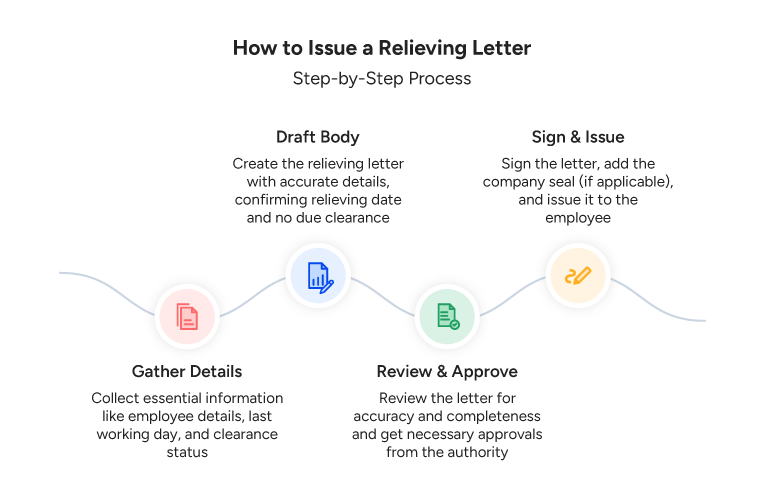
Step 1: Gather Employment Details
Pull the employee’s full legal name (matching Aadhaar/PAN), employee ID, joining date, relieving date, designation, and notice period served. Confirm whether the employee needs a standard relieving letter or a combined experience-and-relieving letter.
Step 2: Draft the Body
Please confirm acceptance of the resignation, state the tenure clearly, mention the last working day, and add the F&F settlement timeline. If relevant, include clauses on asset return and confidentiality. Use the same template format across all employees so the document looks consistent.
Step 3: Review and Proofread
Cross-check every date and name against your HRMS records. Stick to a formal, neutral tone. Avoid subjective remarks or anything negative, as they can lead to defamation claims.
Step 4: Get Approval and Sign
Please send the draft to the HR head or an authorized signatory. Sign on the company letterhead and stamp with the company seal. Hand one copy to the employee and keep one for company records.
Purpose of a Relieving Certificate (why It Matters)
The relieving letter does two jobs at once: one for the employee, one for the employer.
For employees, it proves three things: the resignation was accepted, work duties ended, and the full and final settlement is done. Most employees use this letter for background verification when applying for new jobs, visas, or higher education. A HireRight report report found that 92% of Indian employers run background checks during hiring, and recruiters specifically ask for a relieving letter to verify tenure, role, and exit status.
For employers, issuing it shows compliance with the Payment of Wages Act, the Code on Wages, 2019, and your own internal HR policies. It officially closes the employment record, supports EPFO (Employees’ Provident Fund Organization) exit reporting, and helps maintain a clean employer brand among ex-employees.
Why this Document is Crucial for Background Verification
The relieving letter is more than paperwork. It’s a legally referenced exit document that protects employees during background verification and shields employers from compliance disputes. Here are the eight reasons every Indian organization should issue one.
1. Official Proof that Employment Ended
The relieving letter captures the exact official date of relieving. That helps with statutory filings (such as EPFO exit reporting) and reconciles internal records with external records.
2. Confirms No-Dues Clearance
By stating that all dues have been cleared and that company property has been returned, the no dues certificate serves as a release of liability. The Payment of Wages Act requires employers to settle wage dues on time, and the Code on Wages reinforces timely payment on exit. This document is the written proof.
3. Mandatory for Background Verification
Third-party BGV firms ask for the relieving letter as official proof of role, the last working day, and the exit status. Without it, they can’t close the verification.
4. Prevents Dual-Employment
Prevents dual-employment concerns, especially among Indian companies in IT and BFSI, by flagging candidates who appear to be working two jobs simultaneously. A relieving letter with a clear last working day immediately shuts down that suspicion. For senior roles, this single document can be the difference between an offer being confirmed or revoked.
5. Boosts Professional Credibility
Recruiters specifically check whether you have a relieving letter from every past employer. A missing one shifts you from the “shortlist” pile to the “risky hire” pile, even if your skills are stronger than the next candidate’s.
6. Often Required for New Job Onboarding
Many companies, especially MNCs, require this document before issuing a formal offer or starting onboarding, particularly for senior-level roles.
7. Useful for Visas, Loans, and Other Legal Needs
Years after you’ve left, you may still need this letter for UK/Schengen/US visa applications, home loan paperwork, or legal disputes. Banks and consulates treat tenure proof + clean exit as a credibility signal.
8. Protects both Parties Legally
If a wage or tenure dispute arises later, the relieving letter serves as the reference document both sides can cite. Both the employer and the employee benefit from a written, mutual acknowledgment of how the exit occurred.
How to Request One from Your Company (Email Sample)
Most relief letter delays are resolved with a single clear email to HR. Use this template after your F&F settlement has been processed, but the letter hasn’t arrived. Replace the placeholders with your details.
To: hr@[company-name].com
CC: [your former manager’s email]
Subject: Request for Relieving Letter [Your Full Name], Employee ID [XXXX]
Dear [HR Manager’s Name],
I hope you are well.
I’m writing to formally request my relieving letter from [Company Name]. Sharing my details below for your records:
- Full Name: [Your Full Name]
- Employee ID: [XXXX]
- Designation: [Your Last Designation]
- Department: [Your Department]
- Date of Joining: [DD MMM YYYY]
- Last Working Day: [DD MMM YYYY]
- Notice Period Served: [X months/days]
- F&F Settlement Date: [DD MMM YYYY] (already processed)
All exit formalities have been completed on my side, assets returned, knowledge transfer completed, and dues cleared. Please share the relieving letter as soon as possible, as I need it for the background verification process with my new employer.
Please let me know if you need any additional information or documentation from my end.
Thank you for your time and support.
Best regards,
[Your Full Name]
[Personal Email ID]
Tips before You Hit Send
- Send it from your personal email, not your old work email, as that account may already be deactivated.
- Save the sent email. It becomes written proof of the request if the letter is delayed further.
- No reply in 5 working days? Send a polite follow-up referencing this email.
- For senior roles or sensitive exits, send a hard copy by registered post as well. The acknowledgment receipt is admissible evidence if escalation becomes necessary.
What to do if Your Employer Refuses to Issue It
Some employers delay or refuse to issue a relieving letter, sometimes for legitimate reasons, sometimes as retaliation. Here’s the practical path forward.
When the Refusal is Legitimate
Employers can legally withhold a relieving letter in four situations:
- The employee absconded, leaving without serving notice or completing handover.
- F&F dues are unsettled the employee owes the company money.
- Company assets (laptop, ID card, sensitive documents) weren’t returned.
- An active legal or disciplinary case is pending against the employee.
If any of these apply to you, fix the underlying issue first. The letter will follow once the dispute is resolved.
When the Refusal is Unjustified
If you served your notice, returned all assets, cleared dues, and there’s no legal case, the employer cannot lawfully withhold the letter. Indian courts have repeatedly held that an arbitrary denial violates the employee’s right to seek future employment.
If you’re in this situation, here’s how to escalate.
5-Step Escalation Path
Step 1: Send a formal written request
Use the email template above. Please mark a copy for your former manager and the HR head. Keep the tone professional; this email becomes your first piece of written evidence.
Step 2: Escalate to senior management
If HR doesn’t respond in 7 working days, escalate to the HR director or the company CEO. Attach your earlier email and ask for a written reason if they’re refusing.
Step 3: Send a legal notice
If senior management ignores the request, hire a labor lawyer to send a legal notice under the Indian Contract Act, 1872, and the Code on Wages, 2019. A legal notice typically costs ₹3,000–₹10,000, and most companies respond once one arrives.
Step 4: File a complaint with the Labor Commissioner
Under the Industrial Disputes Act, 1947, you can file a written complaint with the Regional Labor Commissioner in your state. The office summons the employer for a conciliation meeting. The process is free and usually resolves the matter within 30–60 days.
Step 5: File a civil suit or write a petition
As a last resort, file a civil suit for damages or a writ petition in the High Court for the right to employment. This is rare; most cases settle at the legal notice or labor commissioner stage.
Keep Records at every Stage
Save every email, registered post receipt, legal notice copy, and labor commissioner filing. If the matter reaches court, this paper trail is what you’ll rely on. Most disputes don’t get that far, but those that do are won by the side that documents everything.
Best Practices for HR Teams
Exit documents shape how external teams, recruiters, BGV firms, banks, and embassies assess a former employee’s history. So get the basics right.
- Get the dates exactly right. The joining date and relieving date must match the HRMS to the day. Even a one-day mismatch creates BGV red flags.
- Stick to your exit policy language. Use wording that reflects your approved exit procedure. A consistent format across the company means fewer drafting errors.
- Store a copy for compliance. Keep an internal record for audits and future verification queries.
- No defamatory or subjective remarks. Stick to factual, neutral wording. Anything else is a legal risk.
- Issue within 7–15 days of the relieving date. Indian labor courts have flagged unjustified delays as a violation of natural justice (the legal principle that no one should be unfairly denied what they’re owed).
- Use the same format across the organization. Inconsistent formats from the same company are a common BGV flag.
- Digitize and store securely. Maintain digital copies in your HRMS for at least 7 years, in line with Income Tax Act requirements.
8 Common Mistakes to Avoid in a Job Relieving Letter
| # | Mistake | Why It’s a Problem | How to Avoid |
|---|---|---|---|
| 1 | Issuing on plain paper (no letterhead) | Lacks legal validity for BGV | Always use official letterhead with logo |
| 2 | Mismatched dates | Triggers BGV red flags | Cross-check with HRMS records |
| 3 | Missing employee ID | Hard to verify in BGV | Always include ID + designation |
| 4 | Subjective or negative remarks | Risk of defamation lawsuits | Stick to factual, neutral language |
| 5 | Missing F&F settlement note | Implies pending dues | State clearance status explicitly |
| 6 | Missing signature or seal | Invalidates the document | HR head signature + company seal mandatory |
| 7 | Vague last working day | Causes payroll/PF reconciliation issues | Use exact DD MMM YYYY format |
| 8 | Issuing before F&F clearance | Creates legal exposure | Only issue after dues are cleared |
Generate Relieving Letters in Seconds with factoHR
Skip the manual drafting. factoHR lets your HR team:
- Auto-generate any relieving letter in Word or PDF using 200+ pre-approved templates
- Personalize letters with employee data pulled directly from your HRMS, with no manual entry
- Trigger letter generation automatically once the F&F settlement is approved
- Store digitally with audit-ready logs for 7+ years (Income Tax compliance)
- Email letters to employees in one click, with e-signature support
Related HR Letters & Templates
Frequently Asked Questions
What is the Format of a Relieving Letter?
The standard format includes company letterhead, date of issuance, employee name and ID, subject line, a body confirming acceptance of resignation and tenure, the date of relieving, confirmation of no-dues clearance, and the HR manager’s signature with company seal.
How do I Request a Relieving Letter after Resignation?
Please complete all exit formalities, wait for the F&F settlement, and then send a formal email to HR with your employee ID, designation, joining date, and last working day. If you don’t get a reply in 5 working days, send a polite follow-up.
What is the Difference between a Relieving Letter and an Experience Letter?
A relieving letter confirms resignation acceptance, no-dues clearance, and the official date of relieving. An experience letter describes the employee’s role, responsibilities, and skills. Some companies issue both in one combined document, called an experience and relieving letter.
Can an Employer Deny a Relieving Letter?
Yes, in specific cases, if the employee absconded, dues are unsettled, assets weren’t returned, or there’s an active legal case. But employers can’t deny the letter as punishment if exit obligations are met. Indian courts have ruled that an arbitrary denial violates the employee’s right to seek future employment.
How Long does It Take to Issue a Relieving Letter?
Typically, 7–15 working days after the relieving date, provided F&F is complete. If you haven’t received it within 15 days, send a polite follow-up referencing your relieving date.
What Happens if I Need Early Relieving?
Raise the request with HR in writing. If approved, the company will issue a relieving letter with the agreed-upon early relieving date. Some companies deduct the notice period shortfall from the F&F settlement. Confirm this in writing before agreeing.
Is a Relieving Letter Mandatory for Resignation?
Not legally there’s no Indian labor law that says you must issue one. But practically, yes: 87% of Indian companies, and 100% of IT/ITES, BFSI, and MNCs, ask for it during BGV. We recommend issuing it to comply with the Code on Wages, 2019.
What’s the Difference between a Relieving Letter and a Relieving Order?
A relieving order is the same document; the term is more common in government, PSU, and defense organizations. The relieving order format may also mention the next posting or transfer, which doesn’t apply in private-sector exits.




Modernize your HR tasks with factoHR today
Experience the digitalization of everyday business activities with factoHR's modern and compatible solutions for every need.