
Skill Will Matrix: Meaning, Format, Examples, and Template for HR Teams
Table of Contents

You have one team member who used to deliver strong work and now contributes only the minimum. You have another who tries hard every day but keeps missing the mark. Although both belong to the same team, they require different management approaches.
The Skill Will Matrix gives you a simple way to differentiate between the two. It is a practical diagnostic tool that shows whether a person is held back by a gap in ability, motivation, or both, so you can respond to the real cause. People sometimes confuse it with the skill matrix. A Skill Matrix measures the ability of an entire team. A Skill Will Matrix helps understand an individual’s contributions from a skill and motivation perspective.
This guide covers what the Matrix is, its four quadrants, the format, workplace examples, a free template, and how it fits into HR work.
Key Takeaways
- The Skill Will Matrix separates a skill problem from a motivation problem, so that you can respond accordingly.
- Assess it for a specific task or role, rather than as a label on an individual.
- Four quadrants point to four clear responses: guide, delegate, excite, and direct.
- It works as a coaching and development tool, not a ranking or a scorecard.
- People shift between quadrants, so you review their position regularly.
- It supports onboarding, training plans, engagement, and succession in one simple view.
What is a Skill Will Matrix?
A Skill Will Matrix is a simple two-by-two grid that maps how skilled a person is at a task against their willingness to do it. You assess each individual as high or low, and the intersection point shows how best to support them.
The tool comes from Max Landsberg, who described it in his book The Tao of Coaching. He built on situational leadership theory and developed it into a format that managers could use in everyday conversations. You may also see it written as the skill and will matrix or the skill vs will matrix, but all of these refer to the same tool.
The two words carry specific meanings:
- Skill is what a person can do, based on their training and experience with the task.
- Will is how motivated a person is to do it, shaped by their confidence and their sense of purpose.
One important point to remember is this: You assess skill and will for a specific task, role, or responsibility, not for the person as a whole. An employee can rate high on both when handling payroll queries and low on both when asked to build a dashboard. The matrix reflects the task in front of them, which helps keep the assessment fair and relevant.

Skill Matrix vs Skill Will Matrix
People often confuse the skill matrix and the Skill Will Matrix because the names sound alike. The two are connected, since both assess capability, but they operate at different levels. One maps ability across a team, while the other diagnoses how to manage a single person on a single task.
A skill matrix, sometimes called a competency matrix, maps the skills of a whole team against the skills each role needs. It shows you who can do what and where the gaps are across the group.
A skill motivation matrix looks at one person and one task, and it adds motivation to the picture. It helps you decide how to support that person in the current situation.
Here is how the two compare:
| Point | Skill Matrix | Skill Will Matrix |
|---|---|---|
| What it measures | Skill and proficiency levels | Skill plus motivation |
| Focus | The whole team | One person on one task |
| Main question | Who can do what? | How do I support this person? |
| Common use | Capability mapping and training plans | Coaching and management decisions |
| When to use | Workforce and project planning | One-on-ones and development talks |
A skill matrix tracks what employees can do across a team, while a Skill Will Matrix helps you decide how to lead one person through a task.
The 4 Quadrants of the Skill Will Matrix
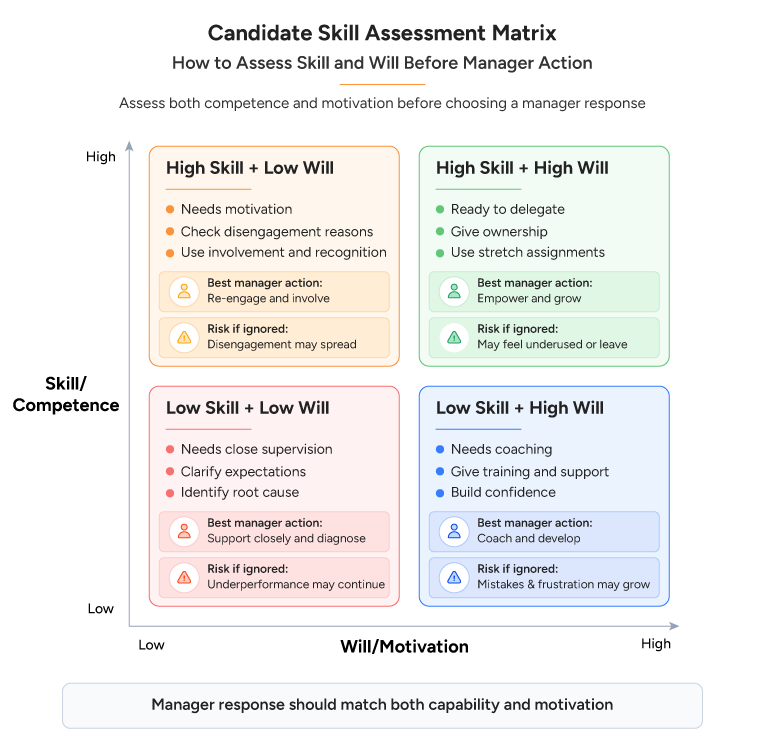
Once you rate a person on skill and will, they fit in one of four quadrants. Each quadrant points to a different response. Here is the summary below, followed by a detailed explanation of each one.
| Quadrant | Skill | Will | Manager response |
|---|---|---|---|
| Star performer | High | High | Delegate |
| Eager learner | Low | High | Guide |
| Capable but checked out | High | Low | Excite |
| Needs a fresh start | Low | Low | Direct |
High Skill, High Will: Delegate
- Characteristics: They need little supervision and perform consistently across tasks. They often look for the next challenge. A promoted employee settling into a senior role is an ideal example.
- Manager action: Delegate meaningful work and give them autonomy
- HR action: Support their development with career paths and try to retain such talent.
- Example: Meera, a payroll executive in Ahmedabad, clears complex cases independently and has started suggesting process improvements.
Low Skill, High Will: Guide
- Characteristics: Motivated but needs to build skills. New hires and departmental transfers are the best examples.
- Manager action: Support learning through regular feedback and give guidance where necessary. Create small, achievable goals to improve their confidence.
- HR action: Provide a structured skill development plan, so all the stakeholders can evaluate the progress and the employee can grow in a structured, phased manner.
- Example: Rahul, a customer support associate in Pune, brings output but still struggles with product questions and depends on teammates.
High Skill, Low Will: Excite
- Characteristics: Experienced and highly skilled, but lacks the “will” for a specific task. This can be because of burnout, repetitive work, lack of recognition, or personal reasons outside of work.
- Manager action: Have a one-on-one conversation and provide support based on the reasons, and address a new challenge to reconnect with the work, if needed.
- HR action: Review their role design and recognition practices that are affecting their motivation.
- Example: Arjun, a software engineer in Bangalore, is highly skilled in software development but has not been delivering for a month.
Low Skill, Low Will: Direct
- Characteristics: Both skill and motivation are low. New hires and employees who do not find the role suitable are two usual scenarios.
- Manager action: Give clear directions and help improve their confidence as well as their competency with regular feedback and constructive criticism.
- HR action: Check role fit and find other suitable roles from them within the company.
- Example: Sana moved into a data role through an internal transfer and is struggling with both the tools and her confidence.

Skill Will Matrix Format
The skill matrix format is simple to build and can be used in one-on-one meetings. You pick a task, rate skill and will, and place the person in the right quadrant. Here is a format you can take into consideration:
| Field | What to add | Sample entry |
|---|---|---|
| Employee name | Name of the employee being assessed | Riya Shah |
| Department | Team or department the employee belongs to | Sales |
| Role | Employee’s job title or role | Sales Executive |
| Task or competency | Specific task, skill, or competency being evaluated | Lead follow-up and CRM update |
| Skill score | Employee’s ability or capability score | 8/10 |
| Will score | Employee’s motivation or willingness score | 8/10 |
| Quadrant | Employee’s Skill Will Matrix category | High Skill, High Will |
| Recommended manager action | Coaching, guiding, delegating, motivating, or supporting action | Delegate more ownership and set higher targets |
| HR support needed | Any training, mentoring, policy, or HR intervention required | Advanced sales training |
| Review date | Date for the next performance or progress review | 30 days |
| Progress notes | Updates on improvement, performance, or manager feedback | Performs well and shows strong ownership |
Employee Skill Will Matrix Chart
A skill matrix chart helps you track your entire team’s performance in one skill or task. The chart clearly shows where the gaps are and who needs training in which skill. This makes it an important tool for workforce planning and L&D. The chart is a coaching tool and is best for identifying where and who needs support, not for ranking team members.
How to Create a Skill Will Matrix
You can create a matrix by following these steps:
- Select one task or area and evaluate people based on that specific task.
- Gather evidence. It can be a one-on-one conversation as well, along with recent works and your observations.
- Rate skill or will allow or high. Rating on a scale of 1 to 5 would be a good starting point.
- Based on the ratings, place each team member in a quadrant.
- Based on that, Guide, delegate, excite, or direct.
- Review the matrix regularly and consider your team members’ views when assessing.
How to Use the Skill Will Matrix for Employees
Once you have the chart, it earns its place across several HR moments:
- Performance reviews: It gives review conversations a clear structure and keeps them focused on support rather than blame.
- Training needs analysis: It shows who needs skill building and motivation, so training budgets go where they have the greatest impact.
- New hire onboarding: It helps you set the right level of direction for a new joiner’s first week.
- Succession planning: It surfaces the high skill, high will people who are ready for more.
- Engagement improvement: It flags capable people who have lost motivation, so you can act before turnover becomes a risk.
- Internal mobility: It helps you identify which employee is ready to move and who would do better in a different role.

Skill Will Matrix Examples in the Workplace
Here are four short examples that show the skill matrix for employees in action across Indian workplaces. Each one moves from the situation to the quadrant to the HR action.
Imran, line supervisor, Coimbatore
- Situation: Imran was promoted from operator to supervisor last month and is eager, but still learning to plan shifts and handle escalations.
- Quadrant: Low skill, high will.
HR action: His manager provides training and development direction and checks in from time to time.
Priya, sales executive, Mumbai
- Situation: Priya consistently achieves her targets but has stopped volunteering for new accounts for 4 months.
- Quadrant: High skill Loe will
- HR action: Her manager identifies that the reason was burnout and allocates leave for recreational purposes so that she can recover and re-engage with work.
Kavya, HR coordinator, Hyderabad
- Situation: She manages onboarding and takes on additional responsibilities. She also identifies gaps and suggests improvements in different onboarding processes.
- Quadrant: High skill, high will.
- HR action: Her manager promotes her to recruitment manager, delegates additional responsibilities, and assigns her responsibility for training.
Deepak, store associate, Jaipur
- Situation: Deepak moved from the warehouse to the sales floor and is struggling with both customer interaction and confidence.
- Quadrant: Low skill, low will.
- HR action: His manager sets small daily goals with close support, and HR reviews whether a back-of-house role would suit him better.
Skill Motivation Matrix: Matching Leadership Style to Employee Needs
The Skill Will Matrix is also known as the skill motivation matrix, since will is about motivation. Seen this way, each quadrant points to a leadership style, and HR’s task is to teach managers to adapt their approach to each employee’s needs.
The four styles come from Situational Leadership, which shares its roots with the matrix:
| Quadrant | Leadership style | What it looks like |
|---|---|---|
| Low skill, high will | Coaching | Clear direction with encouragement to build skills |
| High skill, high will | Delegating | Trust, autonomy, and space to lead |
| High skill, low will | Supporting | Less direction, more listening and motivation |
| Low skill, low will | Directing | Strong structure with close, supportive guidance |
No manager employs a single leadership style for all team members. The value of the skill motivation matrix is that it gives managers a shared language for changing their approach, and it gives HR a simple way to coach managers on when to adapt.

Benefits of the Skill Will Matrix for HR Teams
The matrix turns vague performance issues into clear action. Each benefit answers an HR challenge.
| HR challenge | How the Skill Will Matrix helps |
|---|---|
| Treat a motivation gap as a training gap | It separates a skill problem from a will problem, so you fix the underlying cause. |
| Review conversations lack structure | It gives managers a clear structure for honest talks |
| Development plans lack focus | It shows exactly what each person needs to grow |
| Training budget spreads too thin | It helps you prioritize who needs skill-building first |
| Managers use one style for everyone | It guides the right leadership style for each person |
| Leadership pipelines are unclear | It surfaces ready talent for succession planning |
| Strong people leave | It helps you spot and retain high-potential employees |
| Engagement keeps slipping | It flags capable people who have lost motivation |
| Everyone gets managed the same way | It replaces one-size-fits-all management with a tailored approach |
| Performance data sits unused | It turns assessment into a clear next step |
7 Common Mistakes to Avoid when Assessing an Employee with the Skill Motivation Matrix
Avoid these seven common mistakes when you evaluate an employee’s productivity based on the skill matrix –
- Keep revisiting. Do not assess any employee based only on their performance in the current task.
- Combine instinct with structured analysis. Base your call on evidence as well as instinct rather than one of them.
- Do not measure will without asking first. Motivation is qualitative. So, have a one-on-one conversation before you assess an individual
- Do not apply the matrix to a person as a whole. Consider only the specific tasks that the individual finds difficult.
- Do not ignore external factors. Loe can be a result of burnout, lack of clarity, repetitive work, or other personal reasons.
- Do not confuse confidence with competency. Stress more on competency rather than confidence.
- Do not consider quietness as a lack of will. An introverted person might not interact much, but can be highly committed.
Free Skill Will Matrix Template
To make this easy, we have put the whole format into a free Skill Will Matrix template.
The template includes these fields:
| Field | What to add |
|---|---|
| Employee name | Name of the employee being assessed |
| Department | Team or department the employee belongs to |
| Role | Employee’s job title or role |
| Task or competency | Specific task, skill, or competency being evaluated |
| Skill score | Employee’s ability or capability score |
| Will score | Employee’s motivation or willingness score |
| Quadrant | Employee’s Skill Will Matrix category |
| Recommended manager action | Coaching, guiding, delegating, motivating, or supporting action |
| HR support needed | Any training, mentoring, policy, or HR intervention required |
| Review date | Date for the next performance or progress review |
| Progress notes | Updates on improvement, performance, or manager feedback |

How HR Software Helps Manage Skill and Performance Data
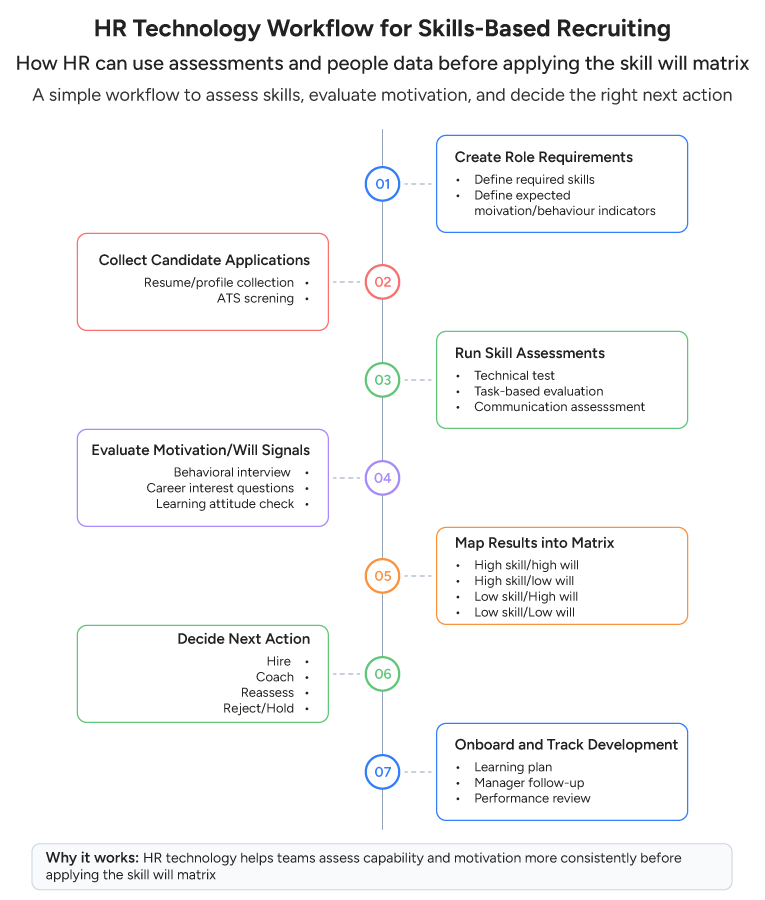
A spreadsheet is a good place to start. The challenges come when you manage the matrix across many teams and try to keep every score, action, and review date up to date manually.
This is where connected HR software helps. Instead of scattered sheets, skill and performance data is stored in one place, updated in real time, and linked to the rest of your people processes. Employees can self-assess, and HR can collaborate with managers, so everyone works from the same source.
From there, the same data can be used for performance reviews, individual development plans, training, and succession planning without re-entering anything. A platform like factoHR integrates these processes, so the work you do in the Skill Will Matrix connects naturally with your HR workflows rather than being a disparate aspect.
FAQs
What is a Skill Will Matrix?
A Skill Will Matrix is a two-by-two grid that maps a person’s skill at a task against their will, or motivation, to do it. The quadrant they land in shows the manager how to support them.
What is the Difference between a Skill Matrix and a Skill Will Matrix?
The former maps the skills of a whole team against role requirements. The latter focuses on one person and one task, and it adds motivation, so it guides how to manage that person.
What are the Four Quadrants of the Skill Will Matrix?
High skill and high will, low skill and high will, high skill and low will, and low skill and low will. Each point leads to a response: delegate, guide, excite, or direct.
How do You Create a Skill Will Matrix?
Pick a task, gather evidence, score skill and will, place the person in a quadrant, choose the matching response, and agree on a next step with a review date.
Is the Skill Will Matrix Used in Performance Reviews?
Yes. It gives review conversations a clear structure and keeps the focus on support and development rather than blame.
What is the Skill Motivation Matrix?
It is another name for the Skill Will Matrix, since will reflects motivation. Each quadrant maps to a leadership style, from coaching to delegating.
How Often Should You Update the Skill Will Matrix?
Review it on a regular cadence, such as each quarter or after a major change in role or workload, because people move between quadrants over time.
What are the Limitations of the Skill Will Matrix?
Will is hard to measure from the outside; the tool can be misused as a permanent label, and it works only when you assess a specific task rather than the whole person.



Grow your business with factoHR today
Focus on the significant decision-making tasks, transfer all your common repetitive HR tasks to factoHR and see the things falling into their place.