
Attendance Policy for Employees [Template + Guidelines]
Download Attendance Policy for Employees

Table of Contents

Attendance is the backbone of operational efficiency in any organization. When employees follow defined work hours and reporting norms, productivity remains stable, and operations stay predictable. However, a vague attendance policy often creates frustrating grey areas. These gaps lead to frequent late-coming, inconsistent clock-in and clock-out practices, or unexplained absences, making enforcement difficult for managers.
For HR professionals and business owners, this challenge becomes even more critical when automating rules through an attendance management system. The purpose of this blog is to help you draft a watertight attendance policy for employees that removes ambiguity, integrates smoothly with your payroll, and strictly complies with Indian labor standards.
What this Guide Covers
With this Attendance Policy template, you can:
- Define clear rules: Establish standard work hours, shift times, and clock-in expectations, leaving no room for interpretation.
- Standardize lateness protocols: Document procedures for grace periods, Loss of Pay (LOP), and formal disciplinary action.
- Establish a structured framework: Cover leave regularization, exceptions, and approval workflows aligned with HR compliance.
- Ensure consistency: Guarantee fair enforcement, payroll accuracy, and smoother workforce management across all departments.

Key Components of an Effective Attendance Policy
1. Work Schedule & Shift Timings
A clear attendance policy for employees must begin by defining standard working hours. This removes ambiguity and helps maintain consistent staff attendance across teams. HR teams should clearly document when an employee’s workday starts, ends, and how breaks are accounted for within total work hours.
Key elements to define include:
- Start time: The official time an employee is expected to report to work.
- End time: The standard close of the working day.
- Break durations: Approved lunch and rest breaks, including their paid or unpaid status.
For organizations operating in shifts, the policy should also specify shift timings and rotation rules. Where applicable, shift changes must be communicated in advance to support staff attendance regulation and operational continuity.
2. Clock-In/Clock-Out Procedures
An effective attendance management policy must clearly define how employees are required to mark their daily attendance. Clear clock-in and clock-out procedures help maintain accurate employee time tracking records and drastically reduce disputes related to payroll processing.
Organizations may allow employees to record attendance through one or more of the following methods:
- Biometric attendance devices installed at the office premises.
- Mobile applications approved by the organization (often with geo-fencing).
- Web login systems tailored for remote or hybrid work setups.
Some organizations may also adopt advanced technologies such as a facial recognition attendance system to improve accuracy and prevent proxy attendance.
Employees must ensure they punch in at the start of work and punch out at the end of the workday. Failure to clock in or clock out correctly may result in a Loss of Pay (LOP), even if the employee is physically present at work.
3. Grace Period & Late Arrival Rules
A grace period allows for small, unavoidable delays without immediately treating them as lateness. Most organizations follow a 15-minute grace period. Any arrival beyond this designated window is marked as late.
The policy should also explicitly explain what happens when late arrivals repeat.
Example: Arriving late by 15 to 30 minutes on three working days within a single month will result in a half-day leave deduction.
Clear consequences like this help control repeated lateness and make enforcement much easier for reporting managers.
4. Absenteeism & No-Show Policy
Absenteeism means being absent from work without prior approval or a formal leave application. A “no-show” happens when an employee does not report to work and completely fails to inform their manager.
When an employee does not report to work or inform anyone for three consecutive days, it is generally treated as job abandonment, triggering formal HR disciplinary action.
5. Leave Integration
Attendance and leave rules must work seamlessly together. Attendance records are used to decide when Casual Leave (CL) or Sick Leave (SL) apply and whether missed punches need regularization. Any absence not covered by an approved leave is treated according to strict attendance rules.
Employees should also refer to the official holiday list to distinguish declared holidays from standard working days. When attendance tracking software, leave management, and holidays are linked, payroll errors and leave disputes are virtually eliminated.

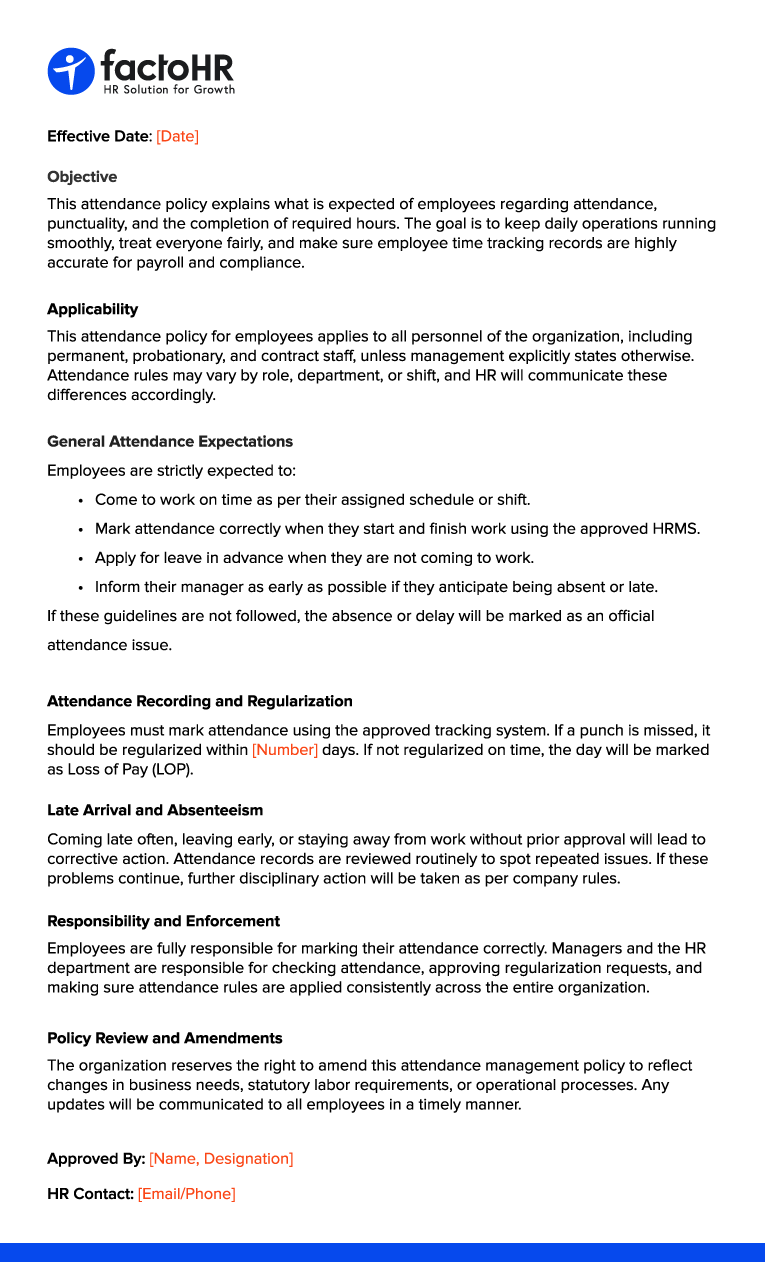
Attendance Policy Sample Template
Conclusion
A documented attendance policy is the first step toward building a disciplined and highly productive workforce. By clearly defining work hours, grace periods, and leave integration, you eliminate guesswork and protect your organization from compliance risks and payroll errors.
Take the manual work out of tracking employee hours by integrating this policy directly into factoHR. With automated biometric tracking, geo-fenced mobile clock-ins, and seamless payroll integration, factoHR ensures your attendance rules are enforced fairly and accurately every single day.

FAQs
What is an Attendance Policy?
An attendance policy explains when employees are to be present at work and how their attendance is tracked. With a working hours policy, employees know exactly when to start work and when to log off. Clear rules prevent confusion and support fair and accurate payroll. For Indian organisations, a written policy helps maintain compliance as teams grow.
What are Disciplinary Actions for Policy Violations?
Disciplinary actions are formal steps taken when an employee repeatedly breaks attendance rules. These may include documented written warnings, forced leave deductions, Loss of Pay (LOP), or termination in severe cases.
Why does Your Company Need a Documented Attendance Policy?
A documented policy clearly tells employees exactly what is expected of them. It helps managers handle late arrivals without confusion, ensures HR compliance, and guarantees payroll accuracy by eliminating tracking disputes.
What is the Standard Grace Period for Attendance in India?
There is no Fixed Legal Rule. However, Most Corporate Companies in India Follow a 15-Minute Grace Period. This Allows for Minor Travel Delays without Encouraging Habitual Lateness.
Can I Terminate an Employee for Attendance Issues?
Yes, but termination usually happens only after repeated attendance problems. Employers must issue formal warnings first. In serious cases like prolonged unauthorized absence or job abandonment, termination is permitted under standard labor laws.
How do You Create an Attendance Policy for a Small Business
Start by identifying the attendance issues you currently face. Define what counts as “on time,” choose a single method for recording attendance, and clarify the consequences for unapproved absences. Keep the rules simple but apply them consistently.
How do You Handle Attendance for Remote Employees?
Remote attendance should focus heavily on availability and output rather than physical presence. Define core working hours, set response time expectations, and use a unified HRMS tool or check-in system to track daily availability.
Is an Attendance Policy Mandatory for Small Businesses?
While not always legally mandatory, it becomes absolutely necessary the moment attendance affects an employee’s pay, leave, or discipline. A written policy protects both the business and the employee from unfair decisions.
Disclaimer
This is a reference template, not a legal document. Modify it based on your business needs and labour laws.


Transform your HR operations with factoHR today
Choose a perfect plan satisfying your business demands and let factoHR handle all your HR’s tasks efficiently.

© 2026 Copyright factoHR