
70+ HR Manager Interview Questions and Answers 2026

Table of Contents

What is the Role of an HR Manager?
An HR Manager is responsible for hiring the right talent, managing employee performance, handling employee relations, ensuring legal compliance, overseeing payroll, and building a positive workplace culture. They also act as a bridge between employees and leadership to support smooth HR operations and business goals.
Key Takeaways
- 70+ HR manager interview questions along with concise, easy-to-follow responses.
- The questions are organized by category (people operations, payroll, performance, onboarding, culture, employee relations, etc.)
- The blog also highlights potential pitfalls and a last-minute interview checklist to help candidates prepare for interviews with confidence.
Most Common HR Manager Interview Questions and Answers
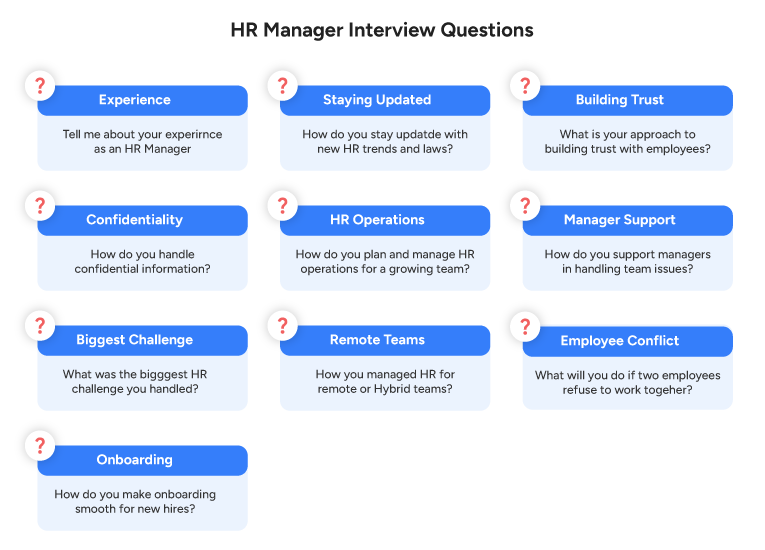
1. Can You Tell Me about Your Experience as an HR Manager?
Reason Behind Asking: The interviewer asks the question to gain a general overview of the candidate’s professional background, areas of responsibility, and practical HR experience.
Sample Answer: As an HR Manager with over 6 years of experience at my previous company, I handled end-to-end HR functions such as recruitment, employee relations, performance management, policy implementation, and compliance. I worked closely with team leaders to support organizational growth and ensure a positive and healthy work environment.
2. How do You Stay Updated with New HR Trends and Laws?
Reason Behind Asking: This question helps interviewers assess the candidate’s dedication to lifelong learning. To minimize organizational risk and enhance workforce management, HR professionals need to stay up to date on human resource planning, changing labor regulations, industry trends, and best practices.
Sample Answer: I stay up to date on current HR trends by regularly reading HR publications, tracking regulatory changes, attending webinars and workshops, and participating in professional HR forums.
3. What is Your Approach to Building Trust with Employees?
Reason Behind Asking: The interviewer would like to know how the candidate builds credibility, transparency, and good relationships in the organization. Trust is an essential aspect of effective HR administration, and it directly influences employee engagement and retention.
Sample Answer: I build trust with employees by communicating clearly, listening to their concerns, and treating everyone fairly. This helps my employees feel comfortable, respected, and supported at work.
4. How do You Handle Confidential Information?
Reason Behind Asking: This question assesses the candidate’s ethical standards, data privacy knowledge, and ability to protect sensitive employee and organizational information. The HR role is a major responsibility regarding confidentiality.
Sample Answer: I am very discreet with confidential information. I limit access to sensitive records and share information only when needed. To build trust and ensure compliance, maintaining confidentiality is essential.
5. What does a Successful HR Function Mean to You?
Reason Behind Asking: The interviewer is assessing how the candidate perceives the role of HR in the organization and how they understand what success is in the organization outside the administrative functions.
Sample Answer: A good HR role to me adds value to both the workforce and the organization. It can provide compliance, a favourable working culture, facilitate employee development, and align people strategies with business objectives to achieve long-term organizational success.

Role-Based HR Manager Interview Questions
6. What is Your Main Responsibility as an HR Manager?
Reason Behind Asking: The recruiter is simply asking whether you are a business partner. They would like to know whether you really understand how the company’s strategy relates to its existence and prosperity.
Sample Answer: As an HR Manager, my primary responsibilities include hiring and onboarding employees, managing performance, handling payroll processes, ensuring legal compliance, and supporting training and development to help employees grow within the organization.
7. How do You Plan and Manage HR Operations for a Growing Team?
Reason Behind Asking: The interviewer would like to test your ability to scale HR operations without causing inefficiencies. This question refers to the extent to which you look forward to improvement, the complexity of the workforce, and the balance between speed and structure.
Sample Answer: I plan and manage HR operations by understanding the company’s growth plans and the skills needed in the future. I look at workforce trends and business goals so I can plan hiring and resources in advance. I use HR tools and basic workforce data to predict talent needs and improve HR processes.
8. How do You Support Managers in Handling Team Issues?
Reason Behind Asking: This question discusses your aptitude as a strategic partner. It helps understand whether managers can be prepared to handle people issues effectively, rather than sending all matters to HR.
Sample Answer: I support managers by listening to their concerns and guiding them on how to handle team issues. I help them improve communication, manage conflicts, and resolve problems early.
9. How do You Align HR Goals with Business Goals?
Reason Behind Asking: The interviewer is interested in how you perceive HR as a strategic or support role. The question assesses your skills in turning business goals into HR action programs.
Sample Answer: I ensure that HR objectives are aligned with business priorities through monitoring key performance indicators and keeping in touch with the leadership objectives. Regardless of whether HR strategies focus on growth, efficiency, or retention, I align the HR initiatives, like hiring schemes, learning initiatives, and performance models, with the goals that will directly aid quantifiable business returns.
10. How do You Measure the Success of Your HR Initiatives?
Reason Behind Asking: This question challenges your results-oriented mind. It assists in determining whether HR initiatives can be measured, rather than being guided purely by intuition or qualitative feedback.
Sample Answer: My measurements of HR success are outcome-oriented, such as engagement (including the benefits of employee engagement), retention rates, time-to-hire, performance trends, and internal mobility. Regular review of these indicators will enable me to assess what is working, identify gaps, and improve HR efforts to deliver specific business value.
Experience & Background Interview Questions
11. Can You Describe Your Past HR Roles and Key Achievements?
Reason Behind Asking: The interviewer wants to understand your hands-on experience, how your role evolved, and whether you delivered tangible outcomes rather than just performing routine HR tasks.
Sample Answer: In previous roles, I managed core HR responsibilities throughout the employee lifecycle and focused on improving processes that directly impacted experience and efficiency. For example, I streamlined onboarding and partnered with managers to resolve people challenges while aligning HR practices with business goals.
12. What was the Biggest HR Challenge You Handled?
Reason Behind Asking: The interviewer wants to understand how you respond to pressure, ambiguity, and sensitive situations involving others.
Sample Answer: One of the biggest challenges I handled was employee uncertainty during a period of organizational change. There was anxiety about role clarity and future growth, which began to affect morale. I worked closely with leadership to ensure consistent communication and created safe channels for employees to voice concerns. Transparency and timely communication helped rebuild trust and stability.
13. Have You Managed Remote or Hybrid Teams?
Reason Behind Asking: This assesses your adaptability to modern work models and your ability to maintain fairness and engagement across locations.
Sample Answer: Yes, I have supported both remote and hybrid teams. One key focus was ensuring that remote employees felt equally informed and included. I worked on standardizing communication, virtual onboarding, and performance tracking to keep expectations clear regardless of location.
14. What HR Processes have You Created or Improved?
Reason Behind Asking: The interviewer is assessing your ability to contribute strategically and actively improve existing systems.
Sample Answer: I have improved several HR processes, including onboarding, performance reviews, and grievance handling. For instance, I helped formalize performance review cycles by defining timelines, documentation standards, and feedback mechanisms. This brought more clarity to both employees and managers and made the process feel fair and structured rather than subjective.

Skills & Competency Interview Questions
15. How do You Prioritize Tasks during Busy HR Periods?
Reason Behind Asking: This question evaluates how you handle workload without compromising accuracy or employee trust.
Sample Answer: During busy periods such as payroll processing or hiring, I prioritize tasks based on urgency and impact. Employee pay, compliance deadlines, and critical employee issues always come first. I rely on task planning, checklists, and clear timelines to ensure nothing important is missed, even when I am handling several tasks or deadlines at once.
16. What Skills Make You an Effective HR Manager?
Reason Behind Asking: The interviewer wants insight into your self-awareness and core strengths.
Sample Answer: My effectiveness comes from a combination of communication, empathy, and attention to detail. I am approachable, which helps employees feel comfortable raising concerns, but I am also structured and policy-driven when making decisions. This balance allows me to support employees while maintaining fairness and consistency.
17. How do You Ensure Accuracy while Handling Multiple Tasks?
Reason Behind Asking: This assesses your reliability in a role where small errors can have serious consequences.
Sample Answer: I rely on structured processes and double-checking critical information, especially for payroll, compliance, and employee records. I also ensure to document tasks and maintain clear records so that nothing depends solely on memory or assumptions.
18. How do You Make Fair and Unbiased Decisions?
Reason Behind Asking: The interviewer is testing ethical judgment and objectivity.
Sample Answer: I base decisions on documented facts, company policies, and consistent standards rather than personal opinions. I also ensure all sides before concluding. This approach helps maintain trust and ensures employees feel decisions are made fairly.
19. How do You Maintain Strong Relationships with Employees?
Reason Behind Asking: This question evaluates trust-building and interpersonal effectiveness.
Sample Answer: I maintain strong relationships by being accessible and responsive. Employees value HR when they feel heard and supported, even if the answer is not always what they expect. Clear communication and follow-through help build credibility over time.
Scenario-Based Interview Questions for HR Managers
20. What Will You do if Two Employees Refuse to Work Together?
Reason Behind Asking: This is a test of neutrality in conflict resolution.
Sample Answer: My initial communication would be one-on-one with each employee to know about the issue behind it. After identifying the root cause, I would organize a discussion on professional expectations and cooperation. This would help them collaborate respectfully despite their differences.
21. How Will You Handle a Complaint against a Manager?
Reason Behind Asking: The interviewer is assessing confidentiality, courage, and fairness.
Sample Answer: I would handle the complaint discreetly and objectively, following the company’s grievance procedure. This includes gathering facts, documenting discussions, and ensuring the process remains unbiased. It is important that employees trust HR to address such issues without favoritism.
22. What Steps Will You Take if an Employee is Consistently Underperforming?
Reason Behind Asking: This evaluates the candidate’s performance management maturity, indicating their understanding of organizational performance systems and strategy implementation.
Sample Answer: I would begin by understanding whether the issue is related to skill gaps, role clarity, or external factors. Based on this, I would work with the manager to set clear expectations and a realistic improvement plan, offering support before considering corrective measures.
23. How Will You Manage a Sudden Rise in Employee Resignations?
Reason Behind Asking: This exercise assesses one’s ability to think critically and analyze information effectively.
Sample Answer: I would review exit feedback and engagement data to identify patterns. Alongside leadership, I would address root causes such as workload, leadership gaps, or growth concerns. Clear communication and timely action are critical to prevent further attrition.
24. What Will You do if Payroll Errors Happen at Month-End?
Reason Behind Asking: The interviewer is looking to assess how candidates demonstrate accountability in challenging situations and under intense pressure.
Sample Answer: I would immediately investigate the issue as soon as possible and inform affected employees transparently. After resolution, I would review controls and checks to ensure the same error does not recur.

Payroll Interview Questions for HR Manager
25. How do You Ensure Payroll Accuracy every Month?
Reason Behind Asking: This question evaluates your attention to detail, process discipline, and ability to manage a critical function that directly affects employee trust.
Sample Answer: I ensure payroll accuracy by following a structured process every month. This includes validating attendance data, approved leave, and salary components before processing payroll. I also cross-check inputs with previous records and coordinate closely with finance to resolve discrepancies early, so employees are paid correctly and on time.
26. How do You Explain the Salary Structure to New Employees?
Reason Behind Asking: The interviewer wants to assess your communication skills and ability to make compensation details clear and transparent.
Sample Answer: I explain the salary structure in simple, clear terms by breaking down each component, including fixed pay, allowances, deductions, and statutory contributions. I also ensure employees understand how their net pay is calculated to avoid confusion later.
27. How do You Handle Employee Queries about Tax, PF, or ESI?
Reason Behind Asking: This question assesses your statutory knowledge and ability to support employees on sensitive financial matters.
Sample Answer: I address employee queries by referring to current statutory guidelines and company policies. I explain the details patiently and ensure accuracy. If needed, I coordinate with payroll or finance teams to provide complete clarity, so employees feel confident and informed.
28. What is Your Process to Verify Attendance and Overtime?
Reason Behind Asking: The interviewer is evaluating operational accuracy and control over payroll inputs.
Sample Answer: I verify attendance through system reports and ensure all leave and overtime entries are approved by managers. I ensure any discrepancies are clarified before payroll processing to avoid errors and ensure fair compensation.
29. How do You Manage Benefit Programs like Insurance or Bonuses?
Reason Behind Asking: This question evaluates your ability to manage employee benefits effectively and consistently.
Sample Answer: I manage benefit programs by clearly communicating eligibility, timelines, and coverage details to employees. I also coordinate with vendors and internal teams to ensure the timely resolution of employee concerns regarding benefits or bonuses.
HR Policies & Compliance Interview Questions
30. How do You Create or Update HR Policies?
Reason Behind Asking: This assesses your understanding of compliance, organizational requirements, and policy structuring.
Sample Answer: I create or update HR policies by reviewing legal requirements, organizational needs, and practical implementation challenges. I ensure policies are clear, compliant, and easy for employees to understand while aligning with company values.
31. How do You Ensure Employees Follow Company Policies?
Reason Behind Asking: The interviewer wants to understand how you drive adherence.
Sample Answer: I ensure policy adherence through clear communication, regular reminders, and consistent application across all employees. When policies are applied fairly and explained well, employees are more likely to follow them.
32. What is Your Process for Handling Compliance Issues?
Reason Behind Asking: This question tests your risk management and problem-solving approach.
Sample Answer: I address compliance issues by first identifying the gap and understanding organizational impact. I then take corrective action, document the process, and implement controls to prevent recurrence, while keeping leadership informed.
33. How do You Audit HR Documents and Records?
Reason Behind Asking: The interviewer is assessing your attention to detail and data governance.
Sample Answer: I conduct periodic audits using checklists to review employee records, contracts, and statutory documents. This helps ensure accuracy and proper documentation at all times.
34. How do You Educate Employees about Policy Changes?
Reason Behind Asking: This evaluates your communication and change management skills.
Sample Answer: I educate employees about policy changes through clear announcements, written documentation, and explanation sessions when required. I also encourage questions to ensure everyone understands the compliance updates and their implications.

HR Manager Interview Questions on Onboarding & Exit Process

35. How do You Make Onboarding Smooth for New Hires?
Reason Behind Asking: The interviewer wants to assess whether you can create a structured employee onboarding guide that helps new employees feel confident, informed, and productive early on.
Sample Answer: I make onboarding smooth by ensuring it is planned well in advance and executed consistently for every new hire. This starts with pre-joining communication, document readiness, system access, and coordination with managers. During onboarding, I clarify the role, set expectations, and help the employee understand how their role fits into the organization.
36. What Information do You Share on a New Employee’s First Day?
Reason Behind Asking: This question evaluates your ability to prioritize essential information without overwhelming the new employee.
Sample Answer: On the first day, I focus on sharing information that helps the employee feel comfortable, so that it does not overload them with too many details at once. This includes core values of the company, basic HR policies, reporting structure, and role expectations. I also explain whom they can approach for support, whether it is HR, their manager, or team members.
37. How do You Collect Feedback from New Joiners?
Reason Behind Asking: The interviewer wants to know whether you actively evaluate and improve the onboarding experience.
Sample Answer: I collect feedback through structured check-ins during the first few weeks and a more in-depth discussion after onboarding. I ask targeted questions to assess support, clarity of expectations, and challenges faced. These insights help identify hidden gaps in processes or support. Using 360-degree feedback, I address issues and continuously improve onboarding to enhance retention, engagement, and time-to-productivity.
38. What Steps do You Follow during Employee Exit?
Reason Behind Asking: This assesses your ability to manage exits professionally while ensuring compliance and continuity.
Sample Answer: I follow a structured exit process that begins with acceptance and confirmation of the notice period. This is followed by planning knowledge transfer, conducting an exit interview, and coordinating final settlement and documentation. A clear employee exit process helps reduce risk, ensures compliance, and maintains professionalism throughout.
39. How do You Ensure a Positive Exit Experience?
Reason Behind Asking: The interviewer is assessing how you safeguard the employer brand even when employees leave.
Sample Answer: I ensure a positive exit experience by maintaining respectful and transparent communication until the employee’s last working day. I address concerns professionally, ensure timelines are honored, and complete exit formalities smoothly. Even when an employee chooses to leave, a respectful exit experience leaves a positive impression and preserves goodwill.
People Operations Interview Questions
40. How do You Improve Employee Engagement?
Reason Behind Asking: This evaluates your ability to build a motivated and connected workforce.
Sample Answer: I encourage open communication by listening to feedback and supporting initiatives that make employees feel valued. Engagement improves when employees understand how their work contributes to the organization and feel recognized for their efforts. I also work with managers to address engagement issues through wellness programs proactively rather than reactively.
41. What Steps do You Take to Keep Teams Motivated?
Reason Behind Asking: The interviewer wants to assess how you sustain engagement over time.
Sample Answer: I help managers keep teams motivated by encouraging regular feedback, recognition, and succession planning. Motivation is not just about rewards but also about clarity, appreciation, and growth opportunities. When employees see progress and feel supported, motivation remains consistent.
42. How do You Manage Employee Data and HR Systems?
Reason Behind Asking: This tests accuracy, confidentiality, and HR Information Systems discipline.
Sample Answer: I manage employee data by ensuring records are updated accurately and on time, and that access is restricted by role. I also conduct periodic reviews to ensure data consistency and compliance. Maintaining accurate employee data is critical for payroll, compliance, and decision-making.
43. How do You Support Teams during Organizational Changes?
Reason Behind Asking: This assesses your change management capability.
Sample Answer: During changes, I focus on clear and consistent communication, including sharing updated organizational charts. I work closely with leadership to ensure messages are aligned and help managers address team concerns. Transparency, timely updates, and empathy are essential to reduce uncertainty and maintain trust during change.
44. How do You Track and Improve Employee Experience?
Reason Behind Asking: The interviewer is testing strategic HR thinking.
Sample Answer: I track employee experience through feedback, engagement surveys, exit insights, and regular interactions. These inputs help identify recurring concerns and improvement areas. Based on the insights, I work with leadership to improve policies, processes, and communication that affect the employee experience.

Training & Development Interview Questions
45. How do You Identify Training Needs in a Company?
Reason Behind Asking: This evaluates alignment between learning initiatives and business needs.
Sample Answer: I identify training needs by reviewing performance gaps and discussing skill requirements with managers. Employee feedback also plays an important role in identifying areas for development. This ensures training initiatives are relevant and aligned with organizational priorities.
46. How do You Design Training Plans for Different Teams?
Reason Behind Asking: The interviewer wants to see whether you can tailor learning initiatives.
Sample Answer: I design training plans based on team roles, required competencies, and career progression paths. Different teams have different learning needs, so customization is essential. Tailored training plans lead to better engagement and the practical application of learning.
47. How do You Measure Training Success?
Reason Behind Asking: This tests outcome-oriented thinking.
Sample Answer: I measure training success through participant feedback and KPI tracking. I also look at how effectively employees apply the skills in their daily work. Training is successful only when it translates into better performance and productivity.
48. How do You Promote Continuous Learning?
Reason Behind Asking: This evaluates the long-term development mindset.
Sample Answer: I promote continuous learning by encouraging knowledge sharing, supporting access to learning resources, and aligning learning initiatives with career growth. When learning is integrated into development rather than treated as a one-time activity, participation improves naturally.
49. How do You Handle Employees Who Resist Training?
Reason Behind Asking: This assesses communication and influence.
Sample Answer: I handle resistance by first understanding the reason behind it. I then explain the relevance of the training and how it supports both individual growth and role effectiveness. When employees see training as beneficial rather than mandatory, resistance usually reduces.
HR Manager Interview Questions on Performance Management
50. How do You Set Performance Expectations with Employees?
Reason Behind Asking: This evaluates clarity and fairness in goal-setting.
Sample Answer: I set performance expectations by clearly defining measurable goals aligned with role responsibilities. I ensure employees understand what is expected and how performance will be evaluated. Clear expectations reduce confusion and support fair assessments.
51. What is Your Process for Conducting Performance Reviews?
Reason Behind Asking: The interviewer wants to assess structure and consistency.
Sample Answer: I follow a structured review process that includes self-assessment, manager feedback, and evaluation against predefined objectives. This approach ensures transparency and consistency across teams and helps employees understand their strengths and improvement areas.
52. How do You Handle Low Performance Fairly?
Reason Behind Asking: This evaluates the balance between empathy and accountability.
Sample Answer: I handle low performance by identifying the root cause and discussing it openly with the employee and manager. I focus on setting improvement plans and providing support before taking corrective action. Fairness comes from consistency and giving employees a genuine opportunity to improve.
53. How do You Support Managers in Rating Employees?
Reason Behind Asking: This tests HR’s role as a business partner.
Sample Answer: I support managers by guiding them on clear, role-based evaluation criteria with the help of a performance management system. This helps ensure performance ratings are consistent, aligned with organizational standards, and fair while actively mitigating unconscious bias in decision-making.
54. How do You Link Performance with Rewards?
Reason Behind Asking: The interviewer is assessing the fairness and transparency of the reward.
Sample Answer: I link performance with rewards by aligning outcomes with company policies and ensuring transparency in how rewards are decided. When employees understand the link between performance and rewards, trust in the system increases.

Interview Questions on Employee Relations & Conflict Handling
55. How do You Build Strong Employee Relationships?
Reason Behind Asking: The interviewer wants to assess how effectively you build trust, approachability, and long-term credibility with employees.
Sample Answer: I build strong employee relationships by being approachable, consistent, and transparent in my interactions. Employees need to feel that HR is a safe place to contact, not only in crisis but also in regular interactions. I listen actively, respond, and follow through on commitments.
56. How do You Handle Employee Complaints?
Reason Behind Asking: This question evaluates your ability to manage sensitive issues objectively while maintaining confidentiality and fairness.
Sample Answer: I handle complaints through active listening and ensuring the employee feels heard. I maintain confidentiality and gather facts before taking any action. I follow a structured, documented process aligned with company policy to ensure the issue is addressed without bias.
57. What is Your Approach to Resolving Conflicts?
Reason Behind Asking: The interviewer wants to understand your mediation skills and ability to handle disagreements professionally.
Sample Answer: My approach to resolving conflicts is first to understand all perspectives involved. I focus on identifying the root cause and then facilitating a professional discussion that emphasizes respect, accountability, and common goals. The objective is not to blame but to help employees move forward.
58. How do You Maintain a Positive and Inclusive Workplace?
Reason Behind Asking: The interviewer is assessing your commitment to fairness and inclusion.
Sample Answer: I maintain a positive and inclusive workplace by promoting respect, fairness, and equal opportunity in all HR practices. I ensure policies are applied consistently and encourage open communication. Inclusion is sustained when employees feel safe, respected, and valued, regardless of background or role.
Culture Fit Interview Questions for HR Manager
59. What Type of Work Culture do You Perform Best in?
Reason Behind Asking: The interviewer wants to assess cultural alignment with the organization.
Sample Answer: I perform best in a transparent and collaborative work culture where accountability and people development are valued. I believe such environments encourage trust, ownership, and long-term growth for both employees and the organization.
60. How do You Help Maintain Company Culture?
Reason Behind Asking: This question evaluates your influence on organizational culture.
Sample Answer: I help maintain company culture by reinforcing values through policies, leadership alignment, and daily HR interactions. Culture is shaped not only by statements but also by consistent behavior, and HR plays a key role in ensuring values are reflected in everyday practices.
61. How do You Handle Employees Who do Not Align with the Culture?
Reason Behind Asking: The interviewer is testing your corrective and coaching approach.
Sample Answer: I address cultural misalignment through timely feedback and targeted coaching. I clearly explain expectations and allow employees to adjust their behavior. If misalignment continues despite support, I follow formal processes to ensure fairness and consistency.
62. What does a Healthy Workplace Culture Mean to You?
Reason Behind Asking: This assesses your personal understanding of workplace culture.
Sample Answer: A healthy workplace culture is one where employees feel respected, trusted, and supported. It encourages open communication, accountability, and psychological safety while enabling employees to grow and perform at their best.
63. How do You Promote Teamwork and Collaboration?
Reason Behind Asking: This evaluates your ability to foster cooperation across teams.
Sample Answer: I promote teamwork by encouraging open communication, shared objectives, and collaboration across functions. When teams understand common goals and feel supported, collaboration becomes natural rather than forced.
64. How do You Communicate Difficult Decisions to Employees?
Reason Behind Asking: The interviewer is assessing emotional intelligence with transparency and clarity.
Sample Answer: I communicate difficult decisions honestly and respectfully. I explain the rationale behind the decision, acknowledge employee concerns, and ensure the message is delivered with empathy. Clear and transparent communication helps employees understand the context, even if the decision is difficult.
65. How do You Ensure Your Communication is Clear?
Reason Behind Asking: This tests your ability to avoid misunderstandings.
Sample Answer: I ensure clarity by keeping communication simple, structured, and relevant. I avoid assumptions and encourage questions to confirm understanding. Clear communication reduces confusion and strengthens organizational trust.
66. How do You Manage Misunderstandings between Employees?
Reason Behind Asking: This evaluates mediation skills.
Sample Answer: I manage misunderstandings by encouraging open dialogue and clarifying facts. I guide employees to focus on professional behavior and conflict resolution rather than personal differences, ensuring the discussion remains respectful and constructive.
67. How do You Communicate Updates to Leadership?
Reason Behind Asking: The interviewer is assessing executive communication skills.
Sample Answer: I communicate updates to leadership in a concise and structured manner, supported by relevant data and insights. This helps leadership make informed, timely, and effective decisions.

Behavioral Interview Questions for HR Manager
68. Tell Me about a Time You Solved a Complicated HR Issue
Reason Behind Asking: This assesses your experience and judgment in complex situations.
Sample Answer: I once handled a sensitive employee relations issue that required careful investigation and neutrality. I gathered facts from all parties, documented each step, and aligned actions with company policy. By maintaining transparency and fairness, the issue was resolved without escalation, and trust was preserved.
69. Describe a Situation where You Handled Pressure Well
Reason Behind Asking: This evaluates resilience and prioritization under stress.
Sample Answer: During a high-hiring period with payroll processing, I managed the pressure by prioritizing tasks, planning timelines, and maintaining focus on accuracy. Staying organized enabled me to meet deadlines without compromising quality.
70. How do You Respond when Employees Disagree with Your Decision?
Reason Behind Asking: The interviewer is testing professionalism and openness.
Sample Answer: I listen to employee concerns and explain my decision clearly, including the rationale behind it. While I remain open to discussion, I also ensure consistency and fairness in applying policies.
71. Tell Me about a Time You Supported an Employee in Distress
Reason Behind Asking: This assesses empathy and discretion.
Sample Answer: I noticed the team member was stressed, so I talked with them one-on-one, listened to their concerns, reduced their workload for a time, and supported them until they felt comfortable again.
72. Describe a Situation where You Led a Challenging HR Project
Reason Behind Asking: This evaluates leadership and execution skills.
Sample Answer: I led an HR process improvement project that required coordination across multiple teams. The challenge was to align stakeholders and maintain timelines. Through clear communication, regular follow-ups, and stakeholder engagement, the project was completed successfully and improved operational efficiency.
Red Flags to Watch for
- Lack of knowledge on HR-related practices and principles.
- Not able to provide clear answers in the interview.
- Unable to handle employee conflict and other difficult conversations.
- Showing a negative attitude towards previous companies/employers.
- Difficulty in explaining their last job roles and achievements in HR.
- Responses that are contradictory when it comes to their work history.
- Unprofessional behavior or inappropriate language during the interview.
- Fails to ask questions related to the company and the role they applied for.
Your Last-Minute HR Manager Interview Checklist
- Review Company Culture and Values.
- Prepare examples for behavioral questions.
- Understand the basics of HR compliance.
- Familiarize yourself with HR tools and analytics.
- Review organizational charts, HR strategy, and succession planning.
Read More Interview Questions with Sample Answer


Grow your business with factoHR today
Focus on the significant decision-making tasks, transfer all your common repetitive HR tasks to factoHR and see the things falling into their place.

© 2026 Copyright factoHR