
60+ Project Manager Interview Questions and Answers
Table of Contents

How do I prepare for a Project Manager interview? If you’re not sure what HR and hiring managers may ask, don’t worry, we’ve covered 60+ common Project Manager interview questions with sample answers and helpful tips, so you can easily prepare and give your best in the interview.
What Will You Learn?
- 60+ project management interview questions for freshers, mid-level, and experienced candidates with sample answers.
- Basic HR questions on planning, key skills, and why you want this role.
- Senior-level questions on budget, risks, team handling, and real work situations.
- Agile questions explained in simple words, including Agile vs Waterfall, Scrum, and Sprint.
- Common questions about handling stress, resolving conflicts, and working under pressure.
- Quick Interview Tips: What Hiring Managers Expect

Project Manager Interview Questions and Answers for Freshers
Is this your first project manager interview as a fresher? You’re in the right place. This section includes easy interview questions with sample answers to help you get started.

1. What is Project Management, and what does a Project Manager do?
Why They Ask: Interviewers test your conceptual understanding as well as your practical knowledge for the position.
How to Answer: Briefly define what project management is and describe the role of a project manager.
Sample Answer: Project management is the practice of leading a team to achieve specific goals within defined constraints such as time, scope, and budget by planning, executing, monitoring, and closing tasks. A project manager is responsible for coordinating with stakeholders and guiding the team through the project cycle from initiation to completion.
2. Why did You Choose Project Management as a Career?
Why They Ask: Such questions are often asked to know more about your motivations for preferring a job.
How to Answer: Answer honestly about what interests you in project management. Keep it positive, practical, and show enthusiasm.
Sample Answer: I chose project management because I enjoy turning plans into results, solving problems, working with a team, and seeing a project successfully completed.
3. What Skills are Required for a Project Manager Role?
Why They Ask: Interviewers assess your theoretical and practical understanding of the role with such questions.
How to Answer: Mention technical, leadership, and soft skills.
Sample Answer: A project manager requires leadership, communication, time management, risk management, budgeting, and stakeholder management skills. Technical proficiency in project management tools and methodologies such as Agile or Waterfall is also essential for delivering projects effectively.
4. Explain the Project Management Life Cycle Process
Why They Ask: To assess your knowledge of the project management cycle.
How to Answer: Briefly define and list the phases of the project management cycle.
Sample Answer: I would start by clearly defining the project goals. Then, I’d make a detailed plan with timelines, resources, and possible risks. During execution, I’d coordinate the team, manage daily tasks, and monitor progress. At the end, I’d close the project by delivering the final output and reviewing what went well and what could be improved.
5. What is the Difference between a Project and a Program?
Why They Ask: To evaluate your basics related to organizational structure.
How to Answer: Clearly differentiate between the scope and purpose of a project and a program.
Sample Answer: A project is temporary, specific, and narrower compared to a program and focuses on achieving specific deliverables. While a program is broader and comprises a group of projects, it aims at broader organizational goals.
6. What is the Triple Constraint in Project Management?
Why They Ask: Interviewers want to know whether you understand how project success factors are interrelated.
How to Answer: Briefly define the triple constraints and give an example of how to manage constraints in a project.
Sample Answer: The triple constraint, also called the project management triangle, refers to the three project constraints: scope, time, and budget. As these factors are interconnected, changing one factor affects the others. For instance, adding scope affects time and cost.
7. How is Project Success Defined?
Why They Ask: to find out how you measure project success.
How to Answer: Define and explain success criteria.
Sample Answer: Project success is defined by achieving objectives within the approved scope, schedule, and budget while meeting quality standards and stakeholder expectations. A successful project also delivers measurable business value.
8. How has Your Education or Experience Prepared You for this Role?
Why They Ask: to identify whether your background aligns with the role.
How to Answer: Highlight relevant education, certifications, and real-world experience.
Sample Answer: My degree in engineering provided strong analytical and problem-solving skills, while my experience managing cross-functional projects taught me planning and scheduling, along with communication skills. Additionally, I hold a PMP certification.
9. What do You Enjoy Most about Managing Projects?
Why They Ask: Interviewers want to know what you specialize in and like about project management.
How to Answer: Focus on aspects like leading teams, solving problems, and delivering value.
Sample answer: I particularly enjoy collaborating with cross-functional teams for complex and interdisciplinary projects. They help me explore different domains and make a project more interesting.
10. Why do You Want to Join Our Organization as a Project Manager?
Why They Ask: Employers want to know whether you researched their firm and identify your personality and cultural fit with the firm.
How to Answer: Prepare in advance by researching the organization you are applying to, and note down relevant values that resonate with you.
Sample Answer: I appreciate your company’s commitment to innovative software and teamwork. My background in leading cross-functional teams and managing projects will help me deliver strong results and support the company’s goals.

Mid-Level Project Manager Interview Questions and Answers
Candidates with 2-4 years of experience should prepare for this set of project manager interview questions. The sample answers are ideal for answering questions on execution and risk management.
11. Where do You See Yourself in the Next 3 to 5 Years?
Why They Ask: Managers want to know your career aspirations and gauge your growth potential in their organization.
How to Answer: Demonstrate ambition and commitment while aligning with realistic career paths in project management.
Sample Answer: In the next 3 to 5 years, I aim to grow into a senior project manager or program manager role, leading larger, strategic projects and mentoring junior project managers.
12. How do You Create a Basic Project Plan?
Why They Ask: To test your awareness of the basic project management concepts.
How to Answer: Explain the process of creating a basic project plan by mentioning the relevant steps.
Sample Answer: I would start by defining the project goal and deliverables, then break the work into smaller tasks. I would estimate time and cost, arrange tasks in the right order, and assign them to the team. Finally, I would create a timeline with milestones and keep a simple risk plan ready.
13. What is a Work Breakdown Structure (WBS)?
Why They Ask: To assess your understanding of WBS in terms of a theoretical concept and practical application.
How to Answer: Define WBS, and state its purpose.
Sample Answer: A Work Breakdown Structure is a hierarchical decomposition of the total project scope into smaller, manageable work components. It organizes deliverables and tasks into logical levels, making the work easier to estimate, assign, track, and control.
14. How do You Estimate Project Timelines?
Why They Ask: To assess your ability to set a realistic schedule.
How to Answer: Describe the estimation inputs and methods you rely on.
Sample Answer: I estimate timelines by dividing the project into small tasks, checking how long each task will take, and arranging them in the right order. Then I create a schedule, build in a buffer for risks, and review it with stakeholders.
15. What is a Milestone in a Project?
Why They Ask: to identify whether you understand the basics of project tracking and scheduling.
How to Answer: Define milestones and explain their purpose in monitoring progress and decision points.
Sample Answer: A milestone is a significant point or event in a project timeline that represents the completion of a key phase or deliverable. Milestones help keep track of the project by facilitating reviews and monitoring progress.
16. What is a Project Charter, and why is It Important?
Why They Ask: To find out whether you understand the processes involved in managing projects.
How to Answer: define the project charter and briefly state its purpose.
Sample Answer: A project charter is a document that formally authorizes a project, defines objectives, scope, key stakeholders, and initial requirements. It enables the manager to allocate resources and serves as a reference for decision-making.
17. What Project Management Tools are Commonly Used?
Why They Ask: To check your knowledge of the popular project management tools.
How to Answer: Candidates should group tools by purpose rather than listing brand names randomly.
Sample Answer: Common project management tools include:
- Scheduling and planning tools such as Microsoft Project and Smartsheet,
- Task and work management tools like Jira, Asana, and Trello,
- Collaboration and communication tools, including Microsoft Teams, Slack, and Confluence, and
- Reporting and performance monitoring tools such as Power BI dashboards.
18. How do You Prioritize Project Tasks?
Why They Ask: Task prioritization reveals your ability to manage constraints and risk, ensuring that critical activities receive focus and resources within a limited time.
How to Answer: Explain your prioritization criteria: impact on objectives, dependencies, deadlines, risks, and resource limits.
Sample Answer: I prioritize tasks by looking at deadlines, what matters most for the project, and what needs to be done first to avoid delays. I also take care of high-risk tasks early, consider the team’s availability, and keep stakeholder priorities in mind.
19. What is a Project Baseline, and why is It Important?
Why They Ask: This tests whether you understand project control and performance measurement.
How To Answer: Define what a baseline is, state what it includes, and explain its role in tracking performance.
Sample Answer: A project baseline is the approved reference point for key elements of the project, typically scope, schedule, and cost. It serves as a benchmark against which progress and performance are measured throughout execution.
20. How do You Monitor Project Performance and Keep It on Track?
Why They Ask: Interviewers want to see whether you understand the continuous monitoring process.
How to Answer: Describe how you use defined performance indicators and regular data reviews to compare planned vs. actual progress.
Sample answer: I monitor performance by tracking key performance indicators such as schedule progress, cost usage, and quality measures against the approved baseline. I use dashboards and reports to compare actual outcomes with planned targets, and review risks and change requests.
21. How do You Involve Your Project Team Members in the Planning Process?
Why They Ask: Employers assess your collaboration skills with such questions.
How to Answer: Mention the methods that you use to include team members in the planning phase.
Sample Answer: I involve my team members and stakeholders from the start by holding planning discussions and asking for their input early. Throughout the project, I stay in regular touch with stakeholders to confirm progress, validate key steps, and get their feedback on tasks related to their areas.
22. What KPIs Should a Project Manager Track?
Why They Ask: They want to see if you know specific measurable metrics.
How to Answer: List specific KPIs and briefly state what each measures and why it matters.
Sample Answer: I include KPI such as –
- Timetable metrics like schedule variance and on-time completion percentage,
- Budget measures like cost performance index (CPI) and actual vs planned cost,
- Quality indicators such as rework rate and customer satisfaction, and
- Effectiveness metrics like resource utilization rate.
23. How do You Handle Missed Deadlines?
Why They Ask: Employers want to know how you would communicate missed deadlines to stakeholders and find the root causes.
How to Answer: Explain how you would adjust the strategies and communicate with the stakeholders.
Sample Answer: When a deadline is missed, I first find the real reason behind the delay. Then, I assess the impact on the overall schedule and adjust the plan with updated task durations or resource allocation. Finally, I share the revised timeline and next steps with stakeholders to keep everyone aligned.
24. How do You Manage Multiple Projects at the Same Time?
Why They Ask: To assess your time management skills.
How to Answer: Discuss prioritization frameworks, use of tools, and regular checkpoints.
Sample Answer: I manage multiple projects by prioritizing work based on business importance and available resources. I make clear schedules and use project management tools like Trello to keep track of everything. I also check in regularly and communicate to balance my workload and keep all projects moving forward.
25. How do You Ensure Quality during Project Execution?
Why They Ask: They want to know if you actively plan for quality and validate deliverables through structured checks.
How to Answer: Explain both preventive and verification measures you use.
Sample Answer: I define clear acceptance criteria and organize peer reviews. I also use feedback loops to improve processes.
26. How do You Control Project Costs?
Why They Ask: Employers want to know how you would optimize costs by forecasting future needs and monitoring spending.
How to Answer: Walk through your cost control process, including tracking and escalation.
Sample Answer: I control project costs by setting a detailed budget, tracking expenses, and comparing actual costs to the budget. I use tools like Excel or MS Project to monitor spending and identify variances early. When needed, I reallocate resources or revise timelines to stay within budget.
27. How do You Manage Vendors or Third-Party Stakeholders?
Why They Ask: To evaluate your communication skills and ability to oversee contracts.
How to Answer: Highlight clear expectations, performance metrics, and accountability mechanisms.
Sample Answer: I manage vendors by clearly outlining SOWs and SLAs. I define deliverables and establish clear performance criteria. Lastly, I hold regular coordination meetings and monitor progress with KPIs and performance monitoring tools.
28. How do You Manage Task Dependencies?
Why They Ask: Dependencies impact schedule logic; interviewers want to see if you can identify, sequence, and adjust work dependencies to avoid bottlenecks.
How to Answer: Explain how you capture and sequence dependencies, and how you adjust when changes occur.
Sample Answer: I identify task dependencies early in planning and setting the project timeline. I use tools like Gantt charts and project management software to visualize task relationships. I monitor progress, adjust resources as needed, and inform the team of any delays or changes to ensure projects remain on track.
29. How do You Balance Scope, Time, and Budget Conflicts?
Why They Ask: The project management triangle (scope, time, cost) is a foundational concept, and interviewers want to see your decision-making framework for trade-offs.
How to Answer: Mention impact analysis and stakeholder engagement.
Sample Answer: When conflicts happen, I first understand what’s changing and how it will affect the scope, timeline, and budget. Then I share clear options with stakeholders so we can decide the best way forward. For example, if the deadline can’t change but the work increases, we may need more budget, or we may deliver only the priority features first.
30. What are the Key Steps to Closing a Project Successfully?
Why They Ask: Successful project closure is critical, and interviewers want to analyze how you would close a project.
How to Answer: List the closure steps in order: acceptance, documentation, transition, and lessons learned.
Sample Answer: To close a project successfully, I first get final approval from stakeholders. Then I confirm all work and contracts are completed and hand over the project to the support or operations team. Finally, I document the results, save project files, and note key learnings to improve future projects.
31. What is Risk Management in Project Management?
Why They Ask: Risk management is a formal concept in project management, and interviewers want to assess your theoretical and practical understanding of it.
How to Answer: Define risk management clearly and explain the structured process for identifying, analyzing, planning responses, and controlling risks throughout the project lifecycle.
Sample Answer: Risk management is the structured process of planning what to do if problems occur. It is about noting possible risks, keeping track of them, understanding how serious they could be, and planning what to do when they happen.
32. What is the Difference between a Risk and an Issue?
Why They Ask: Understanding the distinction between risks and issues is fundamental to proper decision-making and documentation in project control.
How to Answer: Contrast risks and issues based on timing, certainty, and management approach.
Sample Answer: A risk is a potential future event or condition that may or may not happen and could affect project objectives. An issue is a current event or problem that has already occurred and needs quick action. In a project, I track risks in a risk register, and I record issues in an issue log so they can be fixed immediately, and the work doesn’t stop.
33. How do You Identify and Prioritize Project Risks?
Why They Ask: This assesses whether you know how to identify threats or opportunities systematically and then focus attention on those that matter most to project outcomes.
How to Answer: Describe identification methods, then explain how you prioritize risks using probability and impact measures.
Sample Answer: I identify project risks through structured methods such as brainstorming with the team, expert interviews, historical data reviews, and using a risk breakdown structure to cover all categories. Once identified, I prioritize risks by evaluating their probability of occurrence and potential impact on project objectives.
34. How do You Handle Unexpected Project Problems or Crises?
Why They Ask: Interviewers want to see whether you can remain composed under pressure and apply systematic problem-solving rather than reacting impulsively.
How to Answer: Explain your approach for assessing the situation and managing unexpected challenges.
Sample Answer: To handle unexpected problems or crises, I will calmly assess the root cause and impact. I communicate clearly with stakeholders and collaborate with the team to quickly implement effective solutions. After resolution, I review the incident to prevent recurrence. For example, when a server crashed and risked missing a deadline, we quickly used a backup system and finished the work on time.
35. How do You Manage Project Delays?
Why They Ask: This is often asked to assess your analytical, problem-solving, and communication skills.
How to Answer: Describe your process for managing project delays and touch on how you would communicate the changes to the relevant stakeholders.
Sample Answer: I have a three-step process for managing project delays. I identify root causes such as dependency bottlenecks or external factors. Next, I assess the overall impact on the schedule and resource plan. Lastly, I explore options such as fast-tracking or crashing and communicate them to relevant stakeholders.
36. How do You Prevent Recurring Project Issues?
Why They Ask: Such questions evaluate your ability to learn from past mistakes and implement systemic solutions based on those lessons.
How to Answer: emphasise the importance of process improvement and documentation.
Sample Answer: I prevent recurring issues by conducting root cause analysis after an issue is resolved to understand why it happened. I then implement preventive measures such as adjusting templates, refining processes, updating checklists, and increasing training. I document these actions in a lesson learned register so the entire team benefits, and I include checkpoints in plans to catch similar issues before they arise.
37. What is Scope Creep, and how do You Prevent It?
Why They Ask: Scope creep is one of the most frequent causes of project overruns and failures. Interviewers want to assess your ability to control project boundaries.
How to Answer: Define scope creep concisely and list preventive measures tied to formal controls.
Sample Answer: Scope creep refers to the uncontrolled or continuous expansion of the project scope beyond what was originally agreed upon. I prevent scope creep by defining the project scope and baselining it upfront, and establishing an approval process. I also frequently communicate impact assessments before incorporating any change.
38. How do You Manage Change Requests?
Why They Ask: Change requests affect scope, schedule, and budget, so interviewers want to make sure you follow a formal, controlled approach.
How to Answer: Outline the change control process from submission through evaluation and approval.
Sample Answer: I document the change request and assess the change’s impact on scope, timeline, risk, cost, and quality. Then, if approved, I communicate the change to the team to ensure everyone is on the same page. Lastly, I updated the project baseline to reflect the change.
39. How do You Evaluate the Impact of Scope Changes?
Why They Ask: Employers want to evaluate whether you can translate scope changes into measurable impact.
How to Answer: Describe the factors you analyse and how you present the evaluation to stakeholders.
Sample Answer: I follow a structured process for analyzing factors related to scope changes. I analyze how the scope affects time, cost, resources, dependencies, and risk exposure. I compare the current baseline with the proposed changes using scheduling models and estimation techniques. Additionally, I present the report to stakeholders to support informed decision-making.
40. How do You Communicate Risks and Changes to Stakeholders?
Why They Ask: Such questions assess your communication skills.
How to Answer: Focus more on formal communication, such as documenting risks rather than informal communication channels.
Sample Answer: I use formal reports and risk dashboards. Next, I document risks and changes in a risk log and share updates at regular intervals to keep the stakeholders in the loop.

Senior Project Manager Interview Questions and Answers
Candidates with 5+ years of experience can prepare for these project manager interview questions for senior-level roles. This section covers leadership, strategic planning, team management, and Agile project management.
41. How do You Align Projects with Business Goals?
Why They Ask: Interviewers want to confirm that you can ensure strategic alignment.
How to Answer: Describe a structured approach using strategic planning, portfolio processes, and clear links between project objectives and business goals.
Sample Answer: I focus on three aspects for aligning projects with objectives. First is tying project outcomes to strategic objectives. Then I ensure value alignment during portfolio planning, and use performance metrics like KRAs and KPIs to ensure that the performance goals are linked with the firm’s strategic objectives.
42. How Would You Create the Budget for the Project?
Why They Ask: Creating a project budget tests whether you can translate scope into financial terms.
How to Answer: Give a step-by-step explanation of the budgeting process.
Sample answer: I create a budget by reviewing the WBS to identify required resources and estimate labor costs. This includes contingencies for known risks by analyzing historical data and ensuring that all the processes are documented for future reference.
43. How do You Prioritize Projects at a Portfolio Level?
Why They Ask: Prioritization at the portfolio level ensures the organization invests in the right mix of projects.
How to Answer: Describe the criteria and frameworks used to rank projects for selection and resource allocation.
Sample Answer: I prioritize projects by assessing their strategic alignment, expected benefits, resource requirements, risks, and ROI potential. I rely on various scoring models and a prioritization matrix to align the project with organizational priorities.
44. How do You Ensure Projects Deliver Strong ROI?
Why They Ask: Interviewers want to see that you can drive business value.
How to Answer: Mention both upfront ROI estimation and ongoing value tracking.
Sample Answer: I define realistic ROI goals based on financial expectations. Throughout execution, I rely on benefits realization metrics such as Net Present Value (NPV) and Benefit Cost Ratio (BCR) to estimate the potential gains. Lastly, I adjust resourcing or scope as needed to protect returns.
45. How do You Manage High-Budget or High-Risk Projects?
Why They Ask: Interviewers want to know how you manage high-risk / high-budget projects.
How to Answer: Discuss what you do for managing risks and planning.
Sample Answer: I focus on quantitative as well as qualitative aspects of risk management. Additionally, I submit performance reports to stakeholders to keep everyone aligned. I also tie performance metrics to schedule, cost, and value, which helps me mitigate any issues earlier.
46. How do You Handle Executive Stakeholders?
Why They Ask: Interviewers want to know you can communicate upwards effectively and manage expectations.
How to Answer: Explain your approach to communication with senior leadership.
Sample Answer: I communicate strategic updates and decision points. I actively listen to their priorities so that I can reflect them in the project decisions.
47. What Role does Data Play in Project Decision-Making?
Why They Ask: Interviewers want evidence that you rely on objective measures rather than intuition.
How to Answer: Mention specific data types (performance metrics, trends, forecasts) and how they inform decisions. Add in an industry statistic that can make your answer strong.
Sample Answer: Data provides objective insights into project performance and trends. I use performance metrics like cost variance, schedule indexes, and trend analysis to detect deviations early. I also rely on analytics for forecasting risks.
48. How do You Manage Organizational Change through Projects?
Why They Ask: Interviewers want to know you can manage people, processes, and expectations as well as deliver outputs.
How to Answer: Describe change management activities that help stakeholders adapt and adopt.
Sample answer: I communicate the change clearly to all the stakeholders. I especially make sure to discuss any significant organizational changes with employees who might be affected. Additionally, I rely on data to suggest and implement the changes.
49. When Should a Project be Stopped or Pivoted?
Why They Ask: Interviewers want to know if you can recognise when continuing a project no longer delivers value, and if you can make tough decisions based on evidence.
How to Answer: Mention checkpoints and objective criteria.
Sample Answer: A project should be stopped or changed when it’s not giving the expected results. This can happen if the cost goes too high, the risk becomes too big, or the business priorities change. I review progress at key stages and decide whether to continue, make changes, or stop the project.
50. How do You Build High-Performing Project Teams?
Why They Ask: Employers want to find out whether you can create a collaborative and motivated team.
How to Answer: Explain your philosophy and approach for building and managing teams.
Sample Answer: I believe teamwork always comes first, and no one person is more important than the team. I build the same mindset in every project by keeping everyone focused on the goal and working together as one team.
51. How do You Mentor Junior Project Managers?
Why They Ask: Interviewers look for managers who can not only manage projects but also build future leaders.
How to Answer: Describe how you would mentor junior colleagues.
Sample Answer: I make sure junior team members feel comfortable asking questions and sharing ideas. I stay available for them whenever they need help. Most importantly, I encourage them to take ownership of their decisions, to include them in important decisions, and to share insights with them as needed.
52. How do You Handle Underperforming Team Members?
Why They Ask: Such questions evaluate your ability to improve team performance while ensuring that the team is motivated and engaged.
How to Answer: Mention that you have a balanced approach that combines formal and informal practices.
Sample Answer: If a team member is not performing well, I first understand the reason behind it and talk to them openly. I would also give constructive feedback. Then, if the team member doesn’t improve, I discuss performance improvement plans and reassign tasks.
53. How do You Resolve Conflicts within a Team?
Why They Ask: Interviewers assess your emotional intelligence through such questions.
How to Answer: Focus on collaborative solutions and describe your approach for resolving conflicts.
Sample Answer: I engage in in-person conversations with the people involved. I listen to their concerns, note the key points, and help them find a fair solution. If needed, I also support a proper investigation to make sure the issue is handled in the right way.
54. How do You Manage Remote or Distributed Project Teams?
Why They Ask: The post-COVID increase in remote workers influences how teams are distributed, and interviewers want to know what you would do to effectively manage remote teams.
How to Answer: Highlight the importance of communication and interactive activities. Also, emphasise the use of tech tools for better collaboration.
Sample Answer: I keep the team engaged by making meetings more interactive and using dashboards to clearly show progress. I also support work-life balance and tell the team they can reach out anytime. If possible, I include them in office activities to strengthen team connections.
55. How do You Prevent Team burnout?
Why They Ask: Interviewers want a candidate who can improve morale and retention by preventing team burnout due to workload.
How to Answer: Mention what you would do to improve a team’s well-being and balance workload.
Sample Answer: I ensure that the workload is equally distributed among all the team members. I also advise team members to take short breaks and promote a culture of work-life balance by encouraging them to spend time in recreational activities.
56. How do You Ensure Accountability across Teams?
Why They Ask: Employers look for a candidate who can ensure accountability through transparent and constructive mechanisms.
How to Answer: Explain the processes that you use for measuring performance and giving feedback.
Sample Answer: I ensure accountability by setting clear expectations and deadlines for each team member. I use measurable performance indicators and regular updates to make progress visible. In case of any issues, I focus on implementing corrective actions that we have agreed on.

Project Manager Interview Questions on Agile and Scrum
As a senior candidate, you must be aware of different methodologies of project management, such as agile and waterfall. Interviewers often ask related questions to assess your conceptual knowledge as well as the practical application of these methods.
57. What is Agile Project Management?
Why They Ask: As an experienced candidate, you are expected to know different methodologies used in managing projects.
How to Answer: Briefly define agile project management.
Sample Answer: Agile project management is an iterative approach that delivers value in small, measurable increments rather than in a single final deliverable. It emphasises stakeholder collaboration, adaptive planning, and continuous improvement throughout the project lifecycle.
58. What is the Difference between Agile and Waterfall?
Why They Ask: To check your knowledge on different methodologies used in project management.
How to Answer: Clearly differentiate agile and waterfall methods of project management by contrasting them with each other.
Sample Answer: Agile is iterative and flexible,e and delivers projects in short cycles. Waterfall is sequential and defines requirements upfront. Agile is ideal for projects with evolving requirements. Waterfall is more suitable for projects with an established, stable scope.
59. What is Scrum, and how does It Work?
Why They Ask: Scrum is a primary Agile framework. Interviewers want to know if you understand roles, artifacts, events, and iterative delivery cycles.
How to Answer: Explain Scrum roles in brief.
Sample Answer: Scrum is a way of working where the team completes work in short time periods called sprints (1 to 4 weeks). One person sets the work priority, one person helps the team follow the process, and the team delivers the work. Every sprint has planning, short daily updates, and a review at the end to check what was done and improve for next time.
60. What is a Product Backlog?
Why They Ask: To check if you understand how Agile teams manage and prioritize work over time.
How to Answer: Define what it is and briefly mention its role.
Sample Answer: A product backlog is an ordered list of features, bug fixes, and enhancements required for the product. It is continuously refined and prioritised by the Product Owner based on business value and stakeholder input. The team selects backlog items for each sprint during planning.
61. How do You Prioritize Backlog Items?
Why They Ask: They want to gauge how you would prioritize items and tasks.
How to Answer: Describe prioritization methods like MoSCoW, value scoring, cost-of-delay, and alignment with business goals.
Sample Answer: I prioritize backlog items by working on the most important tasks first. I look at deadlines, impact on the project, and task dependencies. I also talk to stakeholders and update priorities when things change.
62. How do You Handle Changing Requirements in Agile Projects?
Why They Ask: Employers want to know your approach to managing change in agile projects.
How to Answer: Mention a systematic approach for managing evolving requirements.
Sample Answer: I handle changing requirements by adding them to the backlog. I would prioritize the items based on value and risk. Lastly, I would review the prioritized items with the team when refining backlogs and consider them during sprint planning.
63. When Should Agile Not be Used?
Why They Ask: They want to assess your ability to select the right methods for different projects.
How to Answer: List scenarios or projects where agile’s strengths would be counterintuitive.
Sample Answer: Agile is not suitable when requirements are fully defined and unlikely to change, or when projects require strict schedule, cost, and scope control, such as in highly regulated industries or long infrastructure projects. In such cases, Waterfall or hybrid approaches are more suitable.

Behavioral and Situational Interview Questions
Behavioural and situational questions about managing stress, resolving conflicts, and meeting deadlines are common in project management interviews. Read on to learn how to answer such questions using the STAR (Situation, Task, Action, Result) method.
64. Tell Me about a Challenging Project You Managed.
Why They Ask: Interviewers want to assess your problem-solving, leadership, and adaptability skills in real-world scenarios.
How to Answer: Use the STAR (Situation, Task, Action, Result) method to structure your answer.
Sample Answer: In one project, we had a tight deadline and many stakeholders involved. The team faced delays due to dependencies. I reprioritised tasks, held daily meetings, and coordinated with stakeholders to match expectations. By adjusting the schedule and focusing on results, we completed the project on time.
65. Describe a Project that Failed and What You Learned from It
Why They Ask: Such questions gauge your self-awareness, accountability, and ability to learn from previous mistakes.
How to Answer: Describe a real-life example, and emphasize what you learned from the failed project.
Sample Answer: In one project, we missed the quality targets because the initial requirements were not clear and complete. I took responsibility for it and fixed the process. I worked closely with stakeholders to identify missing points, improve communication, and update our requirement templates so the same issue doesn’t happen again.
66. Describe a Conflict You Resolved during a Project
Why They Ask: Firms want project managers who can demonstrate emotional intelligence and leadership skills.
How to Answer: Describe the conflict and your approach to solving it.
Sample Answer: In a project, two teams disagreed on resource allocation. I met with both teams, noted their views, and suggested a rotating use of resources to avoid future conflicts. As a result, team collaboration improved.
67. How do You Manage Stress in High-Pressure Projects?
Why They Ask: Employers want to know how you would maintain team performance under pressure.
How to Answer: Explain practical techniques you use, like structured planning, prioritization, delegation, and mindfulness, while maintaining team morale.
Sample Answer: I handle pressure by planning the work in advance and breaking it into small tasks. I distribute the tasks equally and stay calm in case of delays. Additionally, I encourage the team to take breaks and maintain a positive environment.
Project Manager Interview Tips: What Hiring Managers Expect
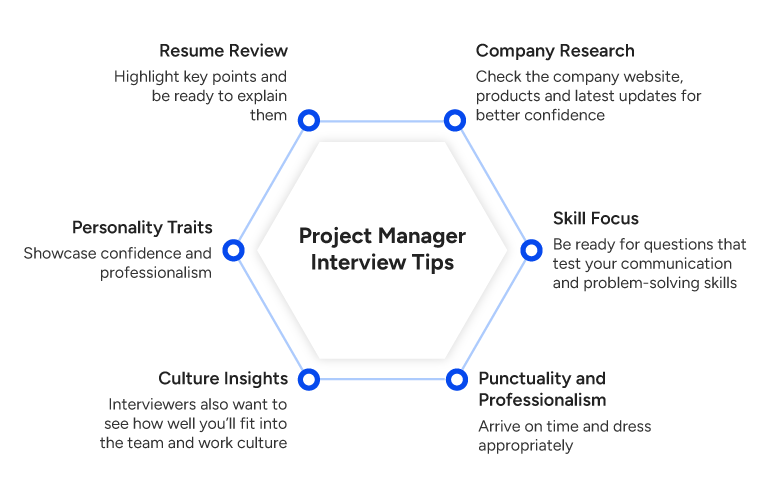
As you learned how to answer common interview questions for project managers. Now, let’s explore the most helpful tips that can help you ace the project manager interview.
- Read about the company’s values, employees, products, and clients. This will help you demonstrate your thinking ability by asking relevant questions.
- Reviews on popular platforms like LinkedIn and Indeed are ideal to gain insights about the work culture and employees of the organization.
- Focus on skills as well as discipline-specific concepts. So, prepare basic definitions and familiarize yourself with common project management terms.
- Companies focus on personality traits as much as skills. So, make sure that you appear confident, but do not exaggerate or sound arrogant.
- Arrive on time, and if you fail to do so, then mention a genuine reason for being late. Maintain a friendly but professional tone, and wear professional attire.
- Remember, your resume is your first impression. So, before the interview, read it once, highlight your key points, and be ready to explain them in your own words.
We hope that this guide helped you prepare for the project manager’s role. We included common PM interview questions that are usually asked in interviews. We wish you all the best for your project manager interview!

Read More Interview Questions with Sample Answer
Related Job Descriptions


Grow your business with factoHR today
Focus on the significant decision-making tasks, transfer all your common repetitive HR tasks to factoHR and see the things falling into their place.

© 2026 Copyright factoHR