
Table of Contents

Manual leave management for 10 employees could be a piece of cake, but when the number rises to 100+, the leave management system can slowly collapse. Wrong spreadsheet calculations, a scattered approval chain, and an outdated paper-trail led to the most loss-making payroll run you’ll ever see.
It’s the brutal truth – traditional leave management had its merits in the 90s, but when smarter options are available, why risk it all? A leave management system takes the burden off HR and automates end-to-end leave requests, approvals, balances, and records.
This article highlights the tangible benefits of a leave management system for HR teams, managers, employees, and businesses as a whole.
Key Takeaways
- Why manual leave management quietly breaks HR operations
- The 10 core benefits of a leave management system
- How does it help HR teams, managers, employees, and businesses differently
- Which features actually deliver these benefits
- When your business needs to make the switch
- How factoHR simplifies leave management end-to-end
Why does Manual Leave Management Create Problems?
Most leave management systems do not break down suddenly; they erode slowly from a hundred small mistakes. Several wrong leave balances, massive delay in approvals, or an inaccurate attendance count. These mistakes don’t look big initially, but they can take a catastrophic turn in the future.
These are the common problems seen with manual leave tracking:
- Miscalculated leave balances due to manual entry
- Delayed approvals due to the manager’s unavailability
- Unclear concept about different leave types
- Incorrect payroll processing due to unverified leave data
- No one screen view of who is absent, present, or on a half-day
- HR becomes a help desk due to repetitive queries
- Scattered records across files, sheets, and inboxes without proof
Why do these Problems Multiply as Your Team Grows?
In a fifty-person team spanning multiple reporting managers and office locations, regional calendars, multiple leaves, and compliance can be a headache to manage. One of the main benefits of leave management in such scenarios is not just about automation; it’s about digging into a goldmine of data for valuable team insights.

What are the Advantages of a Leave Management System?
Leave management, more than a back-office checkbox, is a direct signal of a company’s operational integrity. Here are the top 10 benefits of a leave management system that every HR leader and business owner needs to understand:
1. Saves Time by Automating Leave Requests and Approvals
Paper forms and email threads can be a lost cause in efficient leave management. When you have a multi-level approval workflow where every request moves through the correct chain of command, leave management becomes much simpler. HR no longer has to route requests manually, as regular notifications and alerts keep managers and stakeholders informed at every step. The admin effort reduces substantially with an automated leave management system.
2. Reduces Manual Errors in Leave Balances and Records
Hand calculators were the norm, but reconciling hundreds of leaves with them at month-end is risky. Real-time leave balance tracking dissolved this risk and automatically calculates balances for leave types, carry-forwards, and accruals. Your records stay consistent, as reliable data is the main selling point of such leave management software.
3. Gives Real-Time Visibility into Leave Status and Team Availability
Does your HR know who is on leave across all existing teams and office locations? Right now, they would have to check a spreadsheet for this answer. Leave management software benefits HRs by providing live team calendars and tracking leaves in real time, giving managers and HR teams an eagle-eye view of team availability.
Employees can also check their own leave balances instantly via employee self-service, without raising a single query. During peak workload, this visibility can feel like a godsend and keeps team operations smooth.
4. Improves Policy Compliance and Rule Enforcement
If leave rules apply differently to different people, employees notice and remember these scenarios. One of the major benefits of a leave management system is leave policy configuration. You can set your own rules by establishing fixed policies for types of leave, department, role, or location, and the system follows them without exception. Employee leave management system benefits include zero ad-hoc decisions or opinion differences, with the same company-wide standard.
5. Makes Payroll Processing More Accurate
Leave data and payroll are two sides of the same coin, but in most manual steps, they are treated as separate tasks. This is exactly why corrections happen during the month-end. An online Leave management system offers an attendance management system and payroll integration to close this massive gap. Leaves approved by the management are recorded and seen in the payroll software, where deductions can be applied automatically.
6. Improves Workforce Planning and Shift Coverage
Workforce planning is more than predicting the future; it means you aren’t caught unprepared. When your HR team has real-time team availability and accurate holiday calendars, managers can plan work tasks in advance. This way, you also avoid getting understaffed during critical periods and make smart resourcing decisions.
7. Enhances Employee Experience
Employees today prefer convenience over a long chain of commands, which can take forever to approve a single leave. Many leave management systems offer Mobile access, allowing employees to apply for leave, track it, and check their leave balances on their own. There is almost zero dependency on HR for routine queries.
8. Creates a Clear Audit Trail and Better Reporting
HR teams often are pressured into creating quick reports when a sudden compliance check arrives or a dispute arises. In such scenarios, one of the best benefits of a leave management system is that you get clear reports and analytics of all leaves managed across your organization. Even if you want to understand absenteeism trends, the system tells the complete story.
9. Supports Multi-Location and Policy-Based Organizations
A company operating across multiple cities and departments cannot run on rigid leave rules. If you have different locations, holiday schedules, or time zones, you can configure leave policies without losing central control.
10. Helps HR Focus on Strategic Work Instead of Admin Work
The most expensive thing an HR team does is spend hours answering the same queries 40 times a month. Every automated task from a leave management system improves HR efficiency. HRs can now focus on what they were really hired for – hiring, retention planning, workforce planning, and more.
Benefits of Leave Management System for Managers
When managers have the right information, they can lead their teams better. One of the biggest advantages of a leave management system is that managers get exactly what they require: live team reports, fast approvals, and workforce-planning ways to avoid schedule conflicts. A leave management guide can effectively help the upper management set up an online leave management system with clear processes and approval workflows.
- Faster approvals with instant leave request notifications
- Live team calendar for spotting attendance gaps
- Smart workload planning before any absences creates pressure
- Fewer employee follow-ups for leaves
- Less schedule conflicts due to cross-team and cross-location visibility

Benefits of a Leave Management System for Employees
Employees ask for simple approval processes, nothing more. They want to work without friction, and know their leave balance without having to email 10 times. A leave management system delivers this seamlessly:
- Simple leave applications
- Transparent leave balance calculations
- Fast approvals
- Clear status updates
- Convenient mobile access
- Standard experience for everyone
Benefits of Leave Management System for Business Operations
Any unplanned absence, without systematic planning, can cost a business. As a business owner, leave data is your best source for workforce planning and running sharper operations.
These are some of the best benefits of a leave management system:
- Fewer disturbances in operations
- visible leave data for advance planning
- Less admin costs due to process automation
- Consistently followed policies
- Smart productivity planning
- Fewer payroll-related concerns
- Better business decisions
To better understand available options, many businesses refer to the top 10 leave management systems in India for 2026 for comparison.
When does a Business Need a Leave Management System?
The right time to adopt a leave management system is before the problems become expensive. For most businesses, that moment has already passed.
Here is how to know when exactly you should consider switching, along with key signs your business needs a leave management system:
- When HR still uses spreadsheets
- When leave approvals are delayed
- When payroll errors happen due to a leave mismatch
- When employees ask HR for balances frequently
- when there are multiple teams, shifts, or locations
- When the leave policy has become hard to manage manually
How a Leave Management System Supports Compliance and Policy Control?
Policy means nothing if it is not applied equally to all members of an organization. A leave management system establishes a standard format for leave approval processes or a leave policy template for employees. It shows a clean record trail that can be cross-checked for any internal review processes.
The Real Business Impact of Automating Leave Management
Smile India Trust is an NGO established in 2017 that works to protect and develop children on the streets. It operated manually and managed a workforce across multiple locations. Their managers found it hard enough to monitor remote employees; leave records were inaccurate, and HR spent a lot of time answering routine queries instead of meaningful work.
After switching to an automated leave management system from factoHR, they were amazed by the perks they received. They opted for an integrated attendance, leave, and shift management module, which automated their daily HR tasks to a great extent. Through the mobile application, the organization had access to the team’s geo-fenced locations, along with face recognition.
They had:
- Cleaner records
- Faster approvals
- An HR team that was finally free to focus on productive work

How factoHR Leave Management System Delivers these Benefits?
factoHR cancels out all HR issues with one seamless leave management system. This system gives you consistency, visibility, and payroll accuracy without any hassle. Cherry on top, it is available on mobile for swift approvals and access across locations and teams.
- Automated policies enforce leave rules without any manual checks.
- HR, managers, and employees can all see leave balances in real time.
- A mobile-first leave application is available through the factoHR app.
- Attendance integration keeps workforce records accurate and unified, while payroll integration eliminates leave-related salary errors.
- Take charge with centralized control across teams, locations, and departments.
What you are buying with factoHR is not a tool to simply manage leaves. It resolves issues on both sides, increasing employee satisfaction while reducing managerial delays.
Final Thoughts
The true value of a leave management system goes beyond just automation. It lies in the accuracy, visibility, and accessibility of planning that becomes possible due to a leave management system. Every organization that manages people deserves a system that excels in these areas. See how factoHR makes it happen.
Frequently Asked Questions
What are the Main Benefits of a Leave Management System?
A leave management system automates all leave requests, approvals, and balance tracking formats of an organization. It minimizes manual errors, improves policy compliance, and provides real-time visibility into leave data.
How does a Leave Management System Help HR Teams?
Repetitive admin work is reduced, and HR teams spend less time on routine tasks and more time on strategic HR processes, benefiting the business.
Does a Leave Management System Reduce Payroll Errors?
Yes. When leave data flows directly into payroll, paid and unpaid leaves are calculated automatically. No manual calculations, no manual payroll errors.
How does Leave Management Software Improve Employee Experience?
Employees can apply for leave and track their leave balances instantly via a mobile app, without having to chase HR or the Manager for a fast response. Full transparency and quick response systems can make the employee experience quite straightforward.
Can a Leave Management System Help with Policy Compliance?
Absolutely. Your leave policy follows the same rules and the same approval process across all teams and locations. No rules can be accidentally violated.
What is the Difference between Manual and Automated Leave Management?
Manual leave management depends on Excel, emails, and humane communication, which can create errors, delays, and inconsistent operations. An automated leave management system transforms the entire workflow, making it accurate, fast, and requiring zero iterations.
Why is Real-Time Leave Balance Tracking Important?
Important elements like workforce planning and payroll depend on correct leave data. If leave data is incorrectly tracked, payroll disputes and inaccurate workforce planning can happen, leading to dissatisfied employees and poor decisions.
Is Leave Management Software Useful for Small Businesses?
Yes. Small businesses significantly benefit from fewer manual errors. Automation in leave management brings the same level of accuracy and efficiency regardless of team size.

Table of Contents
Businesses today deal with more regulations, a shortage of skilled workers, and time-consuming administrative tasks. A Professional Employer Organization (PEO) can help by handling HR, payroll, and benefits, allowing you to focus on expanding your company. With a PEO as your partner, you get flexible solutions that lower costs and improve efficiency.
Key Takeaways
- Know what a Professional Employer Organization (PEO) is and how it supports businesses through HR outsourcing.
- Learn how a PEO works using a co-employment model and what responsibilities it handles.
- Find out the advantages and disadvantages of using a PEO.
- Explore how PEO pricing works, including common cost structures and factors that affect pricing.
- Understand how PEOs operate in India and the important legal and compliance considerations.
- Learn how to choose the right PEO provider based on business needs, services, and support quality.
What is a Professional Employer Organization (PEO)?
A Professional Employer Organization (PEO) is a firm that provides comprehensive HR outsourcing solutions for small and mid-sized businesses. Through a co-employment arrangement, the PEO handles key administrative tasks, including payroll, tax filings, benefits administration, and workers’ compensation insurance.
When business owners delegate these complex HR functions to a PEO, they can lower operational costs, avoid compliance problems, and offer better benefits to their employees. This lets them focus more on growing their business.

What is Co-Employment in a PEO?
Co-employment is a partnership between a PEO and a business where both share employer responsibilities. The PEO becomes the employer of record for administrative tasks like payroll, taxes, benefits, and compliance, while the business retains control over daily operations, employee management, and company culture.
Employees continue working for the company as usual, but are also contractually linked to the PEO for HR functions. This arrangement minimizes administrative workload, ensures compliance, and helps companies offer better benefits efficiently.
How does a Professional Employer Organization (PEO) Work?
A Professional Employer Organization (PEO) works through a co-employment model. The PEO becomes the employer of record for administrative tasks, while you control recruiting, scheduling, and day-to-day operations.
The PEO takes care of HR duties and makes sure your business follows employment laws. This partnership helps reduce paperwork and risks for small and medium businesses, usually costing 3–15% of payroll. It allows you to focus more on growing your business.
What Services does a PEO Provide?
A PEO service provides a wide range of outsourced HR and administrative services to help businesses, especially small and mid‑sized ones, operate more efficiently. These services include:
- Payroll and Tax Management: End-to-end processing of salaries, bonuses, and deductions, along with handling tax withholding, filings, and local compliance.
- Benefits Administration: Manages health, dental, and vision insurance, plus retirement plans and employee enrollment.
- Compliance and Risk Management: Makes sure your business follows labor laws, manages workers’ compensation, and offers advice on workplace safety and HR policy reviews.
- Talent and HR Support: Helps with recruiting, onboarding, employee relations, and setting up performance management and training programs.
By combining these services, a PEO helps businesses reduce administrative workload, stay compliant, and provide better support and benefits to their employees.

Advantages and Disadvantages of a PEO
A Professional Employer Organization (PEO) offers several benefits, especially for small and mid-sized businesses, but it also has limitations. The table below shows the key advantages and disadvantages:
| Advantages | Disadvantages |
|---|---|
| Reduces HR workload by handling payroll, benefits, and administrative tasks | Less control over certain HR functions and decisions |
| Saves time and costs by streamlining HR processes and accessing better benefit rates | Limited flexibility in choosing benefits providers or policies |
| Ensures legal compliance with labor laws, taxes, and regulations | Service costs can be high, depending on company size and needs |
| Provides better employee benefits at competitive rates | Shared liability between the business and the PEO |
| Access to HR expertise and professional guidance | Dependence on a third-party provider for critical HR operations |
| Improves productivity by allowing focus on core business activities | Possible employee concerns or resistance to the co-employment model |
| Helps attract and retain employees with better benefits | Possible impact on company culture or employee connection |
PEO vs EOR vs HR Outsourcing: Key Differences
Understanding the distinction between a PEO, an EOR, and HR Outsourcing is crucial for companies. While all 3 involve outsourcing HR functions, they vary in legal responsibility, employment relationships, and geographic reach.
| Aspect | PEO | EOR | HR Outsourcing |
|---|---|---|---|
| Relationship | Co-employment: You and PEO share employer duties. You keep control of daily work. | Full employer: EOR becomes the legal employer for employees. You manage day-to-day tasks. | No employment change: Vendor just handles specific tasks like payroll or recruiting. |
| Best For | Domestic growth in your country, where you already have a business setup. Good for small/medium firms. | Global hiring without setting up offices abroad. Quick entry into new countries. | Businesses needing partial HR support |
| Legal Risk | Shared: You and PEO split compliance risks. | EOR takes all risks, like taxes and laws. | Low: You stay fully responsible for employees. |
| Services | Recruiting, training, payroll, benefits, compliance. | Payroll, taxes, benefits, and contracts in a foreign location. Less recruiting. | Select either payroll-only or HR support services, no full package. |
| Cost | Lower insurance rates, but setup fees. Good for long-term local teams. | Flat fees, no entity setup cost. Flexible for short projects. | Cheapest for single tasks, pay per service. |
| Location | Mostly one country or region. Needs your local entity. | Worldwide, no need for your own office. | Anywhere, but no deep global compliance. |

Is a PEO Right for Your Business?
Are you finding HR management tasks such as payroll, compliance, benefits, and hiring to be challenging? A PEO can help by sharing responsibility for your employees and managing many administrative tasks, while you stay in charge.
PEOs are ideal for small and mid-sized businesses, offering cost savings, better employee benefits through pooled resources, regulatory compliance, and improved efficiency so you can focus on growth.
If HR is taking up too much of your team’s time, a PEO may be a smart solution. However, it may not suit businesses that need full control or highly customized policies, so consider your budget, control preferences, and business needs before deciding.
How Much does a PEO Cost?
The cost of a PEO depends on your company’s size, the services you need, and your industry. Most providers use one of two main pricing models:
- Flat Fee: This ranges from $40 to $160 per employee each month and is often a good fit for companies with higher-paid employees.
- Percentage of Payroll: This model charges 2% to 12% of total gross payroll and is common for businesses with fluctuating or seasonal workforce costs.
The price usually includes payroll, compliance, HR support, and access to employee benefits. However, benefits and insurance might cost extra. Additional fees may include one-time setup fees and charges for special services.
Although a PEO might appear costly at first, it can help lower your overall HR expenses by making processes more efficient, managing risks, and offering better rates on benefits.
How PEO Works in India (Key Things to Know)
A Professional Employer Organization in India acts as a strategic HR partner through a co-employment-style arrangement. This setup is typically used by businesses with a legal entity in India that want to outsource complex administrative and compliance tasks.
A PEO serves as an administrative HR and payroll service provider, handling functions such as payroll, TDS, PF, ESIC, gratuity, professional tax, statutory filings, and labor law documentation, while your company remains the legal employer in India. Unlike the US co-employment model, which has specific legal precedents, the arrangement in India is generally treated as a service-provider relationship focused on HR and compliance support.
Your company defines roles, manages daily work, and makes hiring decisions. The PEO handles compliance and administrative responsibilities, helping your business run smoothly and reducing compliance risks.
Key Things to Know
- Entity Requirement: Works with companies that already have a legal entity in India. This is different from an EOR, which does not need one.
- Co-Employment: You remain the principal employer with full operational control, while the PEO manages HR administration.
- Payroll & Compliance: Handles salary processing, TDS, PF, ESIC, gratuity, and state-specific professional tax.
- Regulatory Support: Ensures your company complies with Indian labor laws and files all required documents on time.
- Risk & Responsibility: Helps reduce your operational workload, but your Indian entity remains primarily responsible for legal matters.

How to Choose the Right PEO Provider?
To choose the right PEO provider, start by assessing your specific HR, payroll, and benefits needs. Make a list of providers with NAPEO accreditation and experience in your field. Check how they price their services and check if their technology is user-friendly.
The provider must understand local labor laws and provide responsive support. Finally, prioritize a partner that offers a strong cultural fit, and always review contracts carefully before committing.
Conclusion
In summary, working with a Professional Employer Organization (PEO) is a smart choice for businesses that want to grow smoothly. A PEO takes care of HR, payroll, compliance, and employee benefits through a shared responsibility model.
It reduces risks, saves costs, and improves employee satisfaction by offering better benefits. This enables business leaders to focus on growth and innovation rather than administrative tasks. The right PEO partner can transform HR challenges into strategic advantages.
FAQs
Does a PEO Replace My HR Team?
No, a PEO doesn’t replace your HR team. It works alongside them to handle administrative tasks like payroll, benefits, and compliance. Your internal HR can then focus more on strategic initiatives like culture, employee engagement, and growth.
Is Using a PEO Legal in India?
Yes, using a PEO is legal in India. It is commonly used to manage HR, payroll, and compliance through a co-employment model.
Do Companies Lose Control over Employees when Using a PEO?
No, companies do not lose control over their employees when using a PEO. You retain full authority over day-to-day management and decisions, while the PEO handles administrative HR functions.
Who Should Use a PEO?
PEOs are ideal for small to mid-sized businesses looking to streamline HR, payroll, and compliance. They’re also a good fit for companies expanding into new markets that already have a legal entity.
Can a PEO Help with Compliance in India?
Yes, a PEO helps businesses stay compliant with Indian labor laws by managing PF, ESIC, payroll taxes, and other statutory requirements. It reduces legal risks by ensuring timely filings and keeping your business aligned with changing regulations.
How Long does It Take to Start Working with a PEO?
The timeline depends on onboarding requirements such as employee data setup, payroll integration, and compliance checks.
Table of Contents
What if the experience certificate you used to get your dream job could trigger a background check? This costs you your role and sometimes your entire career. The job market is competitive, and the pressure to find better opportunities is real. But submitting a fake experience certificate is not a shortcut. It is a criminal offense that can permanently damage your professional reputation.
The background verification process in HR has changed completely. Companies now run automated checks that cross-verify employment history across databases, government records, and third-party sources. A fake employment history check in India can surface within days of joining. And when it does, the consequences are not just losing the job. Legal action follows.
This article explains why candidates fake experience letters, how organizations catch them, what legal action against a fake experience letter looks like under Indian law, and what corporate disciplinary actions employers must take.
Why Candidates Risk Using Fake Experience Letters (and why It Fails)
The reasons why individuals use fake experience certificates go beyond simple fraud. Many candidates try to cover employment gaps after layoffs or career breaks. During unsuccessful job switches, they overstate their salary to reach a higher position. They assume the data will not be thoroughly checked.
Another common misconception is that once someone joins an organization, their past employment details will not be verified. This was sometimes true years ago. It is not true anymore.
What most candidates do not realize is that providing false information to an employer is not just an HR issue. It is a legal offense. Action against the employee providing false information can be taken under multiple sections of the Indian Penal Code.
Why this Approach Fails in Modern Hiring
Organizations now operate with a compliance-first approach using technology that leaves very little room for manipulation. HR professionals rely on:
- Automated background verification process tools that verify employment history across multiple databases
- UAN and EPFO portal verification to check employment tenure and salary contribution records
- Third-party verification agencies that directly contact previous employers
Even small inconsistencies like mismatched dates or unverified company names can raise immediate suspicion. The consequences go beyond losing a job. They can include termination of employment and criminal charges under Sections 420, 467, 468, and 471 of the IPC.
How HR Verify Fake Experience Certificates: The Background Verification Process
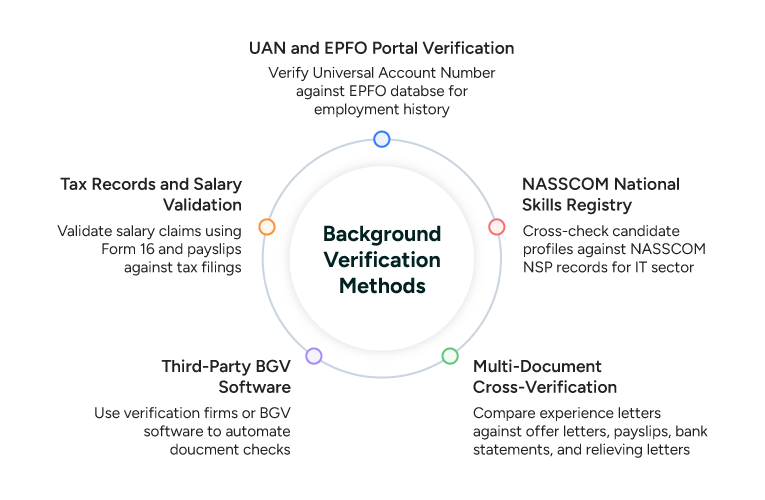
Background verification is no longer a basic HR task. It is a data-driven investigative process. Companies do not rely only on what candidates submit. They verify through systems that are difficult to manipulate. HR professionals use a layered approach where data is cross-checked against trusted sources. Explore the essential background verification checks every HR team should follow to avoid hiring risks and fraud.
UAN and EPFO Portal Verification
This is one of the most reliable methods used by employers. A candidate’s Universal Account Number (UAN) is linked to the EPFO database, which records past employment through employer contributions. These are government-backed records that are very hard to fake.
Tax Records and Salary Validation
Companies verify salary claims using Form 16 and payslips. Any mismatch between the declared salary and actual tax filings can expose fabricated employment history instantly.
NASSCOM National Skills Registry (NSR)
Used primarily in the IT and services sector, the NASSCOM National Skills Registry stores pre-verified employee credentials in a centralized database. Companies cross-check candidate profiles against NSR records to confirm authenticity.
Third-Party BGV Software and Verification Agencies
Organizations collaborate with verification firms that directly contact previous employers to validate documents. Many companies now use dedicated BGV software that automates document checks, flags inconsistencies, and generates audit reports in real time. This has made it significantly harder for fake documents to pass through undetected.
Multi-Document Cross-Verification
Experience letters are not checked in isolation. They are compared against:
- Offer letters
- Payslips
- Bank statements
- Relieving letters
All four documents must align. If any one of them contradicts the others, the entire application gets flagged.
Legal Action Against Fake Experience Letter: IPC Sections and Punishments
Submitting a fake experience certificate is a serious criminal offense under the Indian Penal Code. Legal action against a fake experience letter can involve multiple IPC sections at once, depending on how the document was created and used.
Section 420 IPC: Cheating and Dishonest Inducement
This section applies when a candidate deceives an employer to secure a job by providing false information. In the case of a fake experience certificate, this means using misrepresentation to gain employment or financial benefit.
| Offense | Punishment | Bail | Triable By |
|---|---|---|---|
| Cheating and dishonestly inducing delivery of property or making of a valuable security | 7 Years + Fine | Non-Bailable | Magistrate First Class |
Section 467 IPC: Forgery of Valuable Security
This is one of the most severe forgery provisions in the IPC. If a fake experience certificate is treated as a critical document influencing a hiring decision, especially for high-value or sensitive roles, it can fall under this section.
| Offense | Punishment | Bail | Triable By |
|---|---|---|---|
| Forgery of valuable security or important documents | Imprisonment for Life or 10 Years + Fine | Non-Bailable | Magistrate First Class |
Section 468 IPC: Forgery for the Purpose of Cheating
This section targets forgery done specifically with the intention to cheat. Submitting or creating a fake experience certificate to secure a job falls directly under this category.
| Offense | Punishment | Bail | Triable By |
|---|---|---|---|
| Forgery committed for the purpose of cheating | Imprisonment up to 7 Years + Fine | Non-Bailable | Magistrate First Class |
Section 471 IPC: Using Forged Documents as Genuine
This section applies when a candidate has not created the document themselves but has knowingly used a forged one during the hiring process.
| Offense | Punishment | Bail | Triable By |
|---|---|---|---|
| Using a forged document as genuine | Imprisonment up to 2 Years, or Fine, or Both | Non-Bailable | Magistrate First Class |
Corporate Disciplinary Actions: What Employers Must do
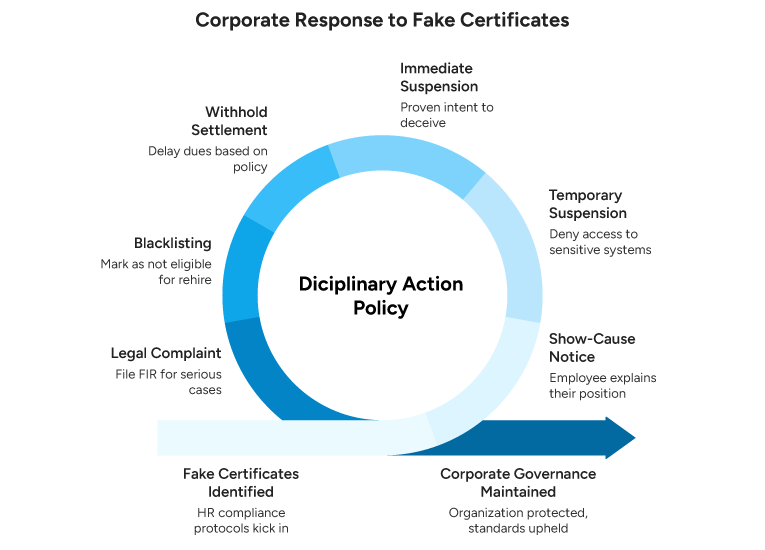
When fake certificates are identified, HR compliance and risk management protocols kick in immediately. These are structured, Disciplinary Action Policy-driven actions designed to protect the organization and maintain corporate governance standards.
Issuance of a Show-Cause Notice
When discrepancies are found, the employee is asked to explain their position in writing. This step upholds the principle of natural justice before any further action is taken. Use our ready-to-edit Warning Letter format to formally initiate disciplinary action.
Temporary Suspension or Role Restriction
For high-risk roles in finance or compliance, the employee is denied access to sensitive systems and data while the investigation is ongoing. Download a compliant Suspension Letter template to handle sensitive cases professionally.
Immediate Termination of Employment (with or without Notice)
Many organizations apply immediate termination when the intent to deceive is proven during the investigation. Termination of employment for document fraud is usually without notice pay, as the misconduct voids the employment contract. HR must document the entire process to stay protected legally. Refer to this Termination Letter format to ensure legally sound and documented exits.
Withholding of Full and Final Settlement (F & F)
Employers can legally delay settlement dues based on company policy and contractual terms, especially when damages or losses are involved. Use this Full and Final Settlement Letter template to manage dues and documentation correctly.
Blacklisting or Internal Flagging
The employee can be marked as “not eligible for rehire” in internal HR systems. In sectors covered by NASSCOM, this flag may also appear in the National Skills Registry, affecting future job prospects significantly.
Filing a Legal Complaint (FIR)
In serious or repeated cases, companies can escalate the matter by filing an FIR under:
- Section 420 (Cheating)
- Section 467 (Forgery of valuable security)
- Section 468 (Forgery for cheating)
- Section 471 (Using forged documents as genuine)
How to Bulletproof Your Hiring Process Against Fraud
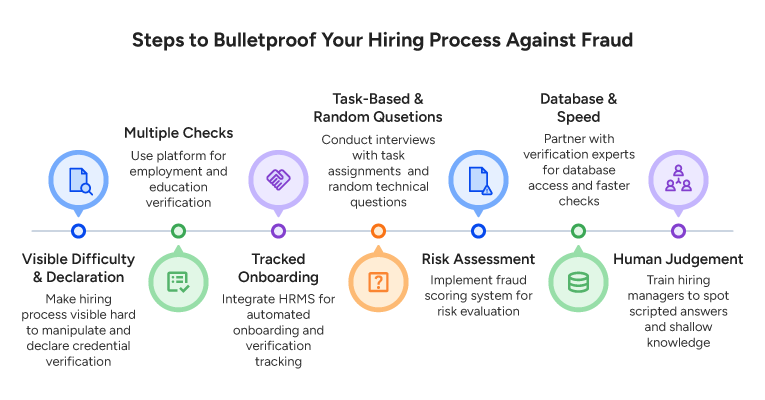
Here are the steps to build a structured, fraud-resistant hiring process.
- Design your hiring process so it is visibly difficult to manipulate. Include a clear declaration that all credentials will be verified before the offer is confirmed.
- Use a platform that runs multiple verification checks, not just reference calls. This should include both employment and education verification.
- A good HRMS also helps here. When your onboarding checklist is built into the system, every verification step is tracked and nothing gets skipped.
- Secure the interview process with task-based assignments and random technical questions. Document fraud is becoming more sophisticated, and scripted answers are easier to spot when candidates are tested on real skills.
- Build a simple fraud-scoring system. Not every red flag means fraud. Set criteria like this:
- Low risk: proceed
- Medium: manual review
- High: reject or escalate
- Collaborate with verification experts who maintain databases of known fraudulent entities. They also provide faster turnaround on checks.
- Train your hiring managers. Even the best systems fail without human judgment. Teach them to spot scripted answers and polished but shallow knowledge.
The Role of Technology in Fraud Prevention
Manual checks alone cannot keep up with the speed of modern hiring. Employee onboarding automation software now integrates the entire background verification process and documentation into one system. Nothing falls through the cracks.
This allows:
- Onboarding with accuracy at every step
- Smooth coordination between HR and compliance teams
- Alerts before offer confirmation if a check is incomplete
- Audit trails for both legal defense and internal reviews
Conclusion: Integrity is the Best Policy
The conversation around fake experience certificates is no longer just about catching fraud. It is about how organizations build a trust-driven, compliance-focused hiring ecosystem that is hard to game from the start.
Candidates can still attempt to bypass verifications. But the long-term risk outweighs any short-term gain. A few extra years on a resume is not worth a criminal record, a termination, and a blacklisted profile.
Organizations are moving fast toward verified career histories and digital-first hiring. As digital records become the norm, legal action under Sections 420 and 471 will be applied more consistently and more quickly. The companies that build transparency into their hiring process now will be the ones that avoid costly mistakes later.
Want to strengthen your hiring process from day one? factoHR helps you verify every candidate before they join, not after.
Frequently Asked Questions
Can You Go to Jail for Using a Fake Experience Certificate in India?
Yes. Under Sections 420 and 468 of the IPC, using a fake experience certificate is a criminal offense. Punishment includes imprisonment of up to 7 years and a fine. Legal action is taken when the fraud is proven during the investigation.
What is the Legal Action against a Fake Experience Letter in India?
Legal action against a fake experience letter can be filed under IPC Sections 420 (cheating), 467 (forgery), 468 (forgery for cheating), and 471 (using a forged document). These are non-bailable offenses with imprisonment ranging from 2 years to life, depending on the severity.
How do Companies Verify Experience Certificates?
The background verification process in HR includes checking UAN and EPFO contribution records, reviewing Form 16 and salary documents, and using third-party BGV agencies. Many companies now also use BGV software to automate cross-verification across multiple databases instantly.
What Happens if Caught in a Background Verification?
If caught in a fake employment history check, your offer can be revoked before joining. For existing employees, this leads to immediate termination. You may also be blacklisted in NASSCOM’s National Skills Registry, which flags your profile to future employers across India.
Can an Employer Withhold Salary for Fake Documents?
Yes. Employers can legally withhold salary for fake documents. This can also void the employment contract, giving HR the right to conduct the Full and Final settlement process on their own terms and potentially pursue legal recovery.
How Can HR Software Prevent Hiring Fraud?
HR software prevents fraud by building verification steps directly into the onboarding workflow. No employee is activated in the system without BGV clearance. This ensures that all document checks are completed and recorded before the candidate’s first day.
Table of Contents
Have you seen “NCP days” on your payslip or PF statement and had no idea what it means? You are not alone.
NCP days in PF stand for Non-Contributory Period. These are the days in a month when an employee does not earn wages. Because no wages are paid, no PF contribution is made for those days.
This affects your EPF balance, your pension service record, and how payroll is filed every month. If you are in HR or payroll, getting this wrong in your ECR filing can cause mismatches and compliance issues.
This post breaks it all down in simple terms.
TDLR:
- What NCP days mean in PF and payroll
- How they differ from leave without pay and absent days
- How to calculate them with real examples
- How they affect salary and PF contributions
- ECR reporting rules you need to follow
What does NCP Mean in PF?
NCP in PF stands for Non-Contributory Period. It refers to the days in a wage month when an employee does not receive wages. Since no wages are paid, no EPF or EPS contribution is made for those days.
These days are reported in the monthly ECR (Electronic Challan cum Return) filed with the EPFO. Reporting them correctly keeps your contribution records clean and prevents issues in future PF or pension claims.

Why do NCP Days Matter in PF?
These days are more important than most people think. Here is why they matter:
- They reduce PF contributions for that month. PF is calculated as a percentage of wages. If an employee has 10 unpaid days in a 30-day month, PF is only calculated on the wages earned in the remaining 20 days.
- They explain why wages look lower. Fewer paid days mean lower wages. Reporting these days correctly tells EPFO why the contribution is lower than usual. This prevents flags or rejections in your ECR filing.
- They are mandatory in the ECR. If you skip this field or enter it wrong, your ECR can get rejected. Even worse, it can create mismatches that take months to fix.
- They protect the employee’s service record. Unpaid days must not be counted as contributory service. If they are, the employee’s EPS pension calculation gets inflated, which is against EPFO rules.
- They affect EPS pension service. Under the Employees’ Pension Scheme, only months with actual contributions count toward pension. More unpaid days means less pensionable service.
When are NCP Days Reported in PF?
NCP days are reported any time an employee is on the payroll but does not receive wages for one or more days in a month.
Common Situations that Trigger NCP Days
- Leave Without Pay (LWP): This is the most common reason. If an employee takes unpaid leave, those days are reported as NCP days.
- Unpaid Absence: Unplanned absences without pay, prolonged absenteeism, or suspension without wages all count.
- Joining or Leaving Mid-Month: If someone joins on the 15th of the month, the days before joining are not included in payroll. PF is calculated only from the date of joining.
- Zero Wages for the Full Month: If an employee is on the payroll but earns nothing that month, every day in that month is an NCP day.
The Zero-Wage Rule You Need to Know
If an employee’s wages are zero for a full month, EPFO requires that the NCP days equal the total number of days in that month. So for a 30-day month, you report 30 NCP days. For February, you report 28 or 29.
The employee stays active on the records. But no contribution is made for that month.
Are NCP Days the Same as Leave Without Pay?
No. They are related but not the same thing.
Leave without pay (LWP) is a type of leave. NCP days are a PF reporting status.
When an employee takes LWP, those days usually become NCP days in PF records. But not every NCP day comes from LWP. An employee could have NCP days due to a suspension without pay, a layoff period, or any other reason wages are not paid.
Paid leaves like earned leave or casual leave are never NCP days. Wages still apply on those days, so PF contributions continue normally.

How to Calculate NCP Days in PF
The calculation is straightforward.
Formula:
NCP Days = Total days in the wage month when no wages were paid
That is it. No complex math needed.
EPFO Rule on Whole Numbers EPFO only accepts whole numbers in the ECR. You cannot enter 0.5 or 2.5. If a half-day absence occurs, your payroll team will need to round up or down. The final entry must always be a full number.
Examples:
| Scenario | Month | Unpaid Days | NCP Days to Report |
|---|---|---|---|
| Full attendance, no LWP | April (30 days) | 0 | 0 |
| 3 days unpaid leave | July (31 days) | 3 | 3 |
| Absent the whole month | February (28 days) | 28 | 28 |
NCP Days Examples in PF: Real Scenarios
Example 1: Full Attendance
Ramesh works all 30 days in April. He takes no unpaid leave.
- NCP Days: 0
- PF is calculated on his full monthly salary.
Simple and clean.
Example 2: Partial Unpaid Leave
Priya takes 3 days of unpaid leave in July. July has 31 days. She worked 28 days.
- NCP Days: 3
- Her PF wage is adjusted for 28 days worked.
If her monthly PF wage is Rs. 15,000:
PF Wage = (15,000 / 31) x 28 = Rs. 13,548
Her PF contribution is calculated on Rs. 13,548 instead of the full Rs. 15,000.
Example 3: Full Month without Pay
Suresh is on the payroll in February but earns no wages. He is on extended medical leave without pay.
- NCP Days: 28 (full month)
- No PF contribution is made for February.
- His UAN stays active. But this month does not count as contributory service.

How NCP Days Affect PF Contributions
Fewer paid days mean lower PF contributions. It is that simple.
PF is calculated as 12% of PF wages. When an employee has NCP days, the wages are prorated. Lower wages mean lower contributions from both the employee and the employer.
Example:
An employee has a PF wage of Rs. 15,000 for a 30-day month. They take 5 unpaid days.
- Contributory days: 25
- Adjusted PF wage: (25 / 30) x Rs. 15,000 = Rs. 12,500
- Employee contribution: 12% of Rs. 12,500 = Rs. 1,500
- Without LWP, it would have been 12% of Rs. 15,000 = Rs. 1,800
Both the employee and employer contribute less that month. This is standard payroll practice under EPF rules.
How NCP Days Affect Your Salary
NCP days are unpaid days. So they directly reduce your monthly salary.
Here is the chain reaction:
- Unpaid days reduce your paid day count.
- Your gross salary is prorated based on paid days.
- Your PF wage base drops along with your gross salary.
- PF contribution falls because it is a percentage of the reduced wage.
Both your take-home pay and your PF credit for that month are lower.
Do NCP Days Affect EPS and Pension Service?
Yes. NCP days reduce your EPS pensionable service.
Here is why. EPS counts only the months in which actual contributions are made. If an employee has too many NCP days in a month and the contribution is zero, that month does not count toward pension service.
Over time, this can reduce the total pensionable service period. That lowers the monthly pension amount at retirement.
Reporting NCP days correctly makes sure your service record matches your actual contributions. This protects the employee later.
How Employers Report NCP Days in ECR
Employers report NCP days every month while filing the ECR on the EPFO Unified Portal.
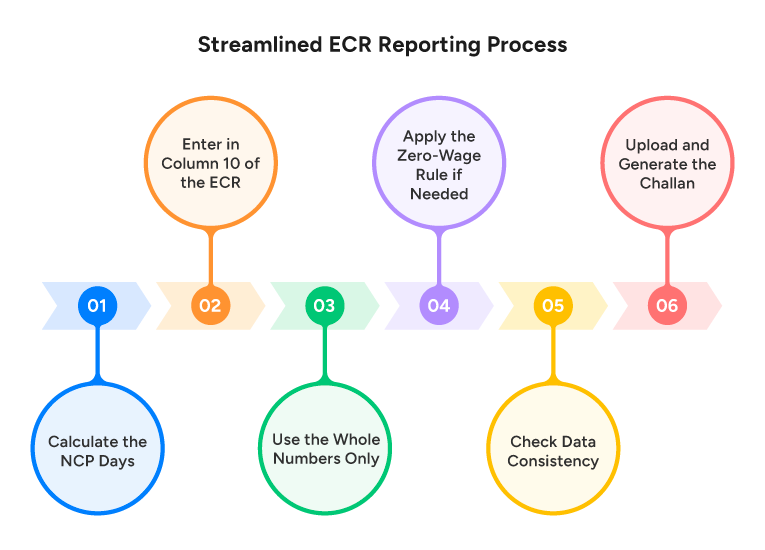
Step-by-Step ECR Reporting
Step 1: Calculate the NCP Days: Subtract paid days from the total days in the month.
Total Days in Month – Paid Days = NCP Days
Step 2: Enter in Column 10 of the ECR: This column is mandatory. If there are no unpaid days, enter 0. Never leave it blank.
Step 3: Use Whole Numbers Only: No decimals. No half-days. Whole numbers only.
Step 4: Apply the Zero-Wage Rule if Needed: If wages are zero for the full month, NCP days must equal the total days in that month.
Step 5: Check Data Consistency: Make sure your payroll software figures match what you are uploading to EPFO. Mismatches cause rejections.
Step 6: Upload and Generate the Challan: Submit on the EPFO Unified Portal. Review everything before you generate the challan.

Where Can Employees Check Their NCP Days?
Not sure how many NCP days you have? Here are the places to check:
- Payslip: Look for “LOP” or “Loss of Pay” days. This is usually the fastest way.
- HRMS or ESS portal: Most companies have an employee self-service portal with payroll history.
- EPFO Member Passbook: Log in with your UAN at the EPFO portal to see your monthly contribution entries.
- Annual PF Statement or Form 26AS: These show contribution history and can flag gaps.
- HR or Payroll Team: When in doubt, just ask. They can pull your record directly.
Common Mistakes in NCP Days Reporting
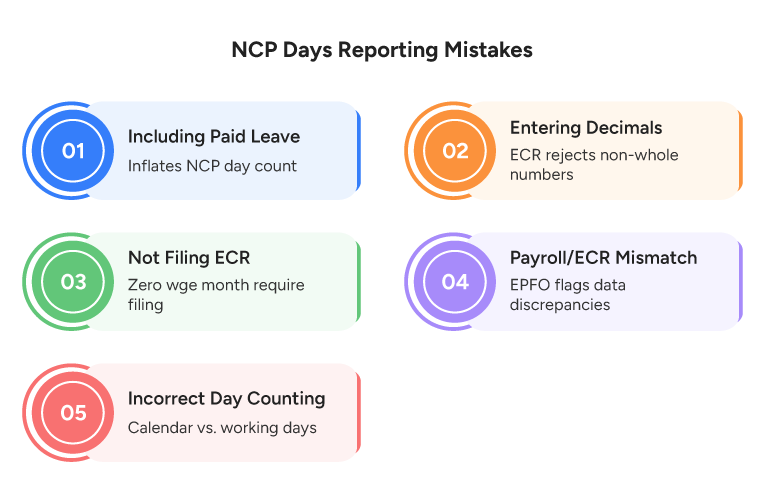
These mistakes show up more often than you think. Avoid them.
- Including paid leave in NCP days: Casual leave, sick leave, and earned leave are paid. Do not count them as NCP days.
- Entering decimals: EPFO only accepts whole numbers. If you enter 2.5, the ECR will reject it.
- Not filing ECR for zero-wage months: Even if an employee earns nothing, you still need to file the ECR. Report the full month as NCP days.
- Mismatch between payroll and ECR data: If your payroll software shows 3 LOP days but your ECR shows 5, EPFO may flag it. Always reconcile before uploading.
- Counting calendar days vs working days incorrectly: Check your payroll policy. Some companies calculate on calendar days, others on working days. Use the correct one consistently.
NCP Days vs LOP vs Absent Days: What is the Difference?
These three terms are often confused. They are related but they are not the same.
NCP days are a PF reporting term. LOP is a payroll term. Absent days is an attendance term. Here is how they compare:
| NCP Days | LOP (Loss of Pay) | Absent Days | |
|---|---|---|---|
| What it means | Days with no PF contribution made | Salary deducted for unauthorized unpaid leave | Days an employee did not show up |
| Salary impact | Indirect (follows LOP) | Direct deduction from gross salary | Depends on whether it is paid or unpaid |
| PF impact | Reduces contribution and service period | Reduces PF wage base | Only unpaid ones affect PF |
| Where it is used | ECR filing with EPFO | Internal payroll accounting | Attendance and leave tracking |
| Are they always the same? | No. Only unpaid absences become NCP days | LOP often leads to NCP days, but they are not identical | No. Includes both paid and unpaid absences |
Final Thoughts
NCP days in PF are not just a payroll code. They directly affect how much PF gets credited each month and how your service record is calculated over time.
For employees, knowing your NCP days helps you track your EPF balance and EPS pension correctly.
For HR and payroll teams, reporting them accurately in the ECR every month is not optional. Mistakes here can lead to rejections, mismatches, and compliance issues that take a long time to fix.
If you manage payroll, make sure your team has a clear process for tracking and reporting these days each cycle.

Frequently Asked Questions
What is the Meaning of NCP Days in PF?
NCP days in PF stand for Non-Contributory Period. These are the days in a month when an employee does not earn wages. Since no wages are paid, no EPF or EPS contribution is made for those days.
What is the Full Form of NCP in PF?
The full form of NCP in PF is Non-Contributory Period.
How are NCP Days Calculated in EPF?
NCP days equal the total number of unpaid days in a wage month. Subtract the paid days from the total days in the month. Only whole numbers are allowed in the ECR. Decimals are not accepted.
Do NCP Days Reduce PF Contribution?
Yes. Since PF is calculated on wages earned, unpaid days lower the wage base. Lower wages mean lower contributions from both the employee and the employer for that month.
Are NCP Days the Same as Leave without Pay?
No. Leave without pay often leads to NCP days, but they are not the same. NCP days are a PF reporting term that covers any period with no wages, including suspensions and layoffs.
Can NCP Days be Entered in Decimals?
No. EPFO only accepts whole numbers in the ECR. Half-days cannot be entered. Round up or down based on your payroll policy.
What Happens if Wages are Zero for the Whole Month?
If an employee earns zero wages in a month, the NCP days equal the total days in that month. The employer still needs to file the ECR. No contribution is made, but the UAN stays active.
Do Paid Leaves Count as NCP Days?
No. Paid leaves like earned leave, casual leave, or sick leave do not count as NCP days. PF contributions continue normally on paid days.
Do NCP Days Affect Pensionable Service?
Yes. EPS counts only months with actual contributions. More NCP days in a month can mean lower or zero contribution, which reduces your total pensionable service and can affect your pension amount.
Where Can I Check My NCP Days?
Check your payslip for LOP days, your company’s HRMS portal, or your EPFO Member Passbook at the EPFO portal using your UAN and password.

Table of Contents
Many employees feel they are not actually connected with their workplace. They attend meetings, complete tasks, and hit their targets. But they still feel left out of the bigger picture. This leads to lower participation and a drop in overall morale.
This is where employee resource groups (ERGs) can make a real difference. An employee resource group is a voluntary group where employees come together based on shared experiences, identities, or interests. ERGs give people a safe space to connect, support each other, and feel genuinely included at work.
Research backs this up. Studies show that 90% of Fortune 500 companies now have ERGs in place. And employees who rate their ERGs as effective are 83% more likely to feel included at work compared to employees whose ERGs are seen as ineffective.
This guide covers what ERGs are, why they matter, their types, benefits, and how to start one from scratch.
TDLR;
- Understand what ERG (Employee Resource Group) is and why employees feel disconnected at work.
- Learn the ERG full form and meaning in HR for workplace inclusion.
- Explore different types of employee resource groups and their purpose.
- Discover key benefits of ERGs like employee retention and leadership growth.
- Follow a simple process to create an employee resource group in your company.
- Identify common ERG challenges and practical solutions.
- Apply best practices for successful ERGs and higher participation.
- Learn how to measure ERG impact using simple HR metrics.
What are Employee Resource Groups (ERGs)?
Employee resource groups (ERGs) are voluntary, company-supported groups that bring employees together based on shared identities, interests, or life experiences. They create a space where employees can connect, provide support, and feel included at work.
The ERG full form is Employee Resource Group. The ERGs meaning in HR goes beyond just having a social community. These groups are formally supported by the company and aligned with broader goals like employee engagement, diversity, and career development. ERGs help employees feel heard and valued.
The first employee resource group was formed at Xerox Corporation in 1970, when Black employees organized to address racial tensions in the workplace. Since then, ERGs have grown into one of the most common and effective tools for building inclusive workplaces.
Why Employee Resource Groups Matter in Workplaces
In many organizations, employees do not truly feel connected to their workplace. This happens even when tasks get completed on time. Employees experience a disconnect from the overall culture, and this is exactly why ERGs are becoming more important every year.
Here are the core problems ERGs help solve:
- Lack of belonging: Employees may feel they do not fit in or are not represented in their team or company.
- No employee voice: There are limited safe spaces to share ideas, raise concerns, or give feedback.
- Remote work isolation: Fewer face-to-face interactions lead to weak team connections, especially in hybrid or fully remote setups.
- Lack of inclusion in decision-making: Employees feel their ideas are overlooked by leadership.
- Low participation in workplace initiatives: Engagement drops when employees do not feel a personal connection to the organization.
- Cultural and diversity gaps: Differences in background and experience are not openly discussed or supported.
- Weak peer support systems: Employees lack communities to rely on when facing professional or personal challenges.
What is the Difference Between ERGs, BRGs, and Affinity Groups?
These three terms are often used interchangeably. But they are not the same. Understanding the difference helps you choose the right structure for your team.
Affinity Groups
Affinity Groups are the most informal of the three. They form around shared interests or identities and exist in many settings beyond the workplace. They have minimal structure and usually no formal company sponsorship.
Employee Resource Groups (ERGs)
Employee Resource Groups (ERGs) are more structured than affinity groups. They are formally supported by the organization and typically aligned with diversity and inclusion initiatives. ERGs focus on both community-building and professional development. They can influence company policies but remain primarily people-focused.
Business Resource Groups (BRGs)
Business Resource Groups (BRGs) are the most strategically aligned option. They are directly tied to business goals, have executive sponsors, and are often charged with specific business objectives like market insights or product development. A BRG is essentially an ERG that has matured into a strategic business partner.
| Affinity Group | ERG | BRG | |
|---|---|---|---|
| Structure | Informal | Formal | Highly structured |
| Company Support | Minimal | Moderate to strong | Full executive backing |
| Focus | Social connections | Inclusion and development | Business outcomes |
| Goals | Community | DEI and career growth | Business strategy |
Types of Employee Resource Groups
Organizations create different types of ERGs based on employee needs and company goals. Here are the most common categories.
Identity-Based ERGs
These are the most common employee resource group examples. They focus on shared identity or personal experiences.
- Gender groups: For example, a women in leadership ERG that supports career growth and addresses gender gaps.
- Ethnicity and nationality groups: They promote cultural awareness and inclusion by celebrating diverse traditions.
- LGBTQ+ groups: They create safe and supportive spaces for diverse identities by supporting equality and rights.
- Neurodiversity groups: They support employees with different thinking styles by providing resources and encouraging inclusive work practices.
- Accessibility and disability groups: They address workplace barriers and improve involvement for employees with disabilities.
- Military or veteran groups: They help veterans transition into civilian work and connect with peers who understand their background.
Life and Interest-Based ERGs
These groups bring employees together based on shared life stages or personal interests. They improve everyday connections at work.
- Parents or caregivers: They support work-life balance and create community for employees managing family responsibilities.
- Pet lovers groups: They form informal communities that increase engagement through shared personal interests.
- Hobby-based groups: They bring people together through activities like fitness, wellness, reading, or volunteering.
Professional ERGs
These are more focused on career growth and development, and they align closely with business goals.
- Leadership development groups: They prepare employees for future roles by building skills and creating growth opportunities.
- Mentorship or career growth groups: They connect employees with experienced professionals for guidance and networking.
Community-Based ERGs
These ERGs focus on social impact and building connections beyond the immediate workplace.
- Volunteer groups: They encourage employee participation in community events and social causes.
- Community service initiatives: They build goal-driven employee engagement across teams by aligning efforts with shared social causes.
Key Benefits of Employee Resource Groups
Improves Employee Engagement
ERGs give employees a space to connect beyond daily work tasks. Employees who feel connected to a community at work are more likely to participate actively and feel invested in the organization. Research shows that employees not involved in ERGs are 1.4 times more likely to report a lack of belonging at work.
Boosts Retention
When employees feel supported and included, they are far less likely to leave. ERGs build an internal connection with the workplace that directly supports long-term retention. Studies show that employees involved in both mentoring programs and ERGs have the lowest reported turnover rates compared to those not involved.
Supports Diversity and Inclusion
ERGs help create a more inclusive workplace by giving employees a platform to share experiences and contribute to culture-building discussions. About 55% of women in ERGs report that their group helped improve parental leave benefits at their company.
Builds Leadership Skills
Many ERG members take on ownership roles to organize events and lead initiatives. This gives them real-world practice in succession planning, communication, and leadership that they might not get in their core job role.
Enhances Employer Branding
Companies with active ERGs are seen as more people-focused and inclusive. This reputation makes them more attractive to candidates. Around 90% of Fortune 500 companies now use ERGs as part of their employer brand.
Drives Innovation
ERGs bring together employees from different backgrounds and perspectives. This diversity of thinking leads to better ideas. For example, at Fidelity Investments, the LGBTQ+ ERG trained staff to serve LGBT customers with estate planning products, opening an overlooked market segment.
Improves Work Conditions
Feedback shared through ERGs gives HR and leadership direct insight into employee concerns. This can lead to improvements in policies, workplace mental health initiatives, and overall employee experience.
How to Start an Employee Resource Group (Step-by-Step Guide)
Starting an ERG does not have to be complicated. Follow these steps to get it right from the beginning.
Step 1: Understand Employee Needs
Start by identifying what employees are actually looking for. Use surveys or pulse checks to spot gaps, such as a lack of inclusion or peer support for specific employee groups.
Step 2: Set a Clear Purpose and Goals
Define goals that are simple and specific. Good examples include improving belonging, supporting career growth, or creating safe spaces for underrepresented employees. Use a SMART framework: Specific, Measurable, Achievable, Realistic, and Time-bound.
Step 3: Get Support From Leadership
Bring senior leaders into the conversation early. Executive sponsorship is not optional. Research shows that while 100% of executive sponsors believe they support ERGs effectively, only 52% of ERG leaders actually agree. Closing this gap early is essential.
Step 4: Create Roles and Responsibilities
Assign clear roles to all team members. This keeps the group organized, prevents burnout, and makes sure activities happen consistently. Consider a co-leadership model to distribute the workload fairly.
Step 5: Launch and Spread Awareness
Introduce the ERG through internal communication channels. Make the goals clear and invite employees to join voluntarily. Transparency about what the group does and who it is for encourages more people to participate.
Step 6: Track Progress and Improve
Measure participation and outcomes on a regular basis. Use insights to improve the group over time and connect ERG activity to broader HR goals like employee retention and engagement.
Common Challenges of Employee Resource Groups
Even well-planned ERGs run into problems. Here are the most common ones and how to handle them.
- Low participation: Employees may not engage if they do not see clear value. Be specific about what the group offers and how it connects to their work and career.
- Lack of leadership support: Without backing from leaders, ERGs struggle to get visibility or resources. Establish executive sponsors before you launch. According to research, approximately half of ERGs operate on annual budgets of less than $5,000, which severely limits their impact.
- Burnout among ERG leaders: ERG work is often unpaid and added on top of regular job duties. This is one of the most underreported problems in ERG management. Use co-leadership models and formally recognize ERG contributions in performance reviews.
- Unclear goals: ERGs without a defined purpose lose direction quickly. Set measurable objectives from day one and review them quarterly.
- Limited budget: Without proper funding, events and activities are hard to sustain. Make the business case to leadership using retention data and engagement scores.
Best Practices to Make ERGs Successful
- Align with business goals: Connect ERG activities to company values like inclusion, engagement, and retention. This makes it easier to show real impact and secure ongoing resources.
- Keep leadership involved: Ensure top management actively supports and participates. Visibility from leaders significantly increases member confidence and participation rates.
- Set clear, measurable goals: Define objectives using a SMART framework so the group stays focused and can demonstrate outcomes over time.
- Encourage participation from all employees: Create an inclusive environment where everyone, including allies outside the identity group, feels comfortable joining and contributing.
- Foster cross-ERG collaboration: Encourage different ERGs to collaborate on joint events and share resources. This prevents competition and builds a stronger overall culture of inclusion.
- Track results regularly: Review outcomes quarterly and share them with leadership. Link ERG impact to broader HR metrics like engagement and turnover.
How to Measure the Success of Employee Resource Groups
Measuring ERG impact ensures they deliver real value to both the workforce and the organization. Here are the key metrics to track:
- Participation rate: Track how many employees join and actively take part in ERG activities each quarter.
- Employee engagement scores: Monitor changes in engagement survey results among ERG members versus non-members.
- Retention rate: Check whether employees involved in ERGs stay longer at the company. This is one of the strongest indicators of ERG value.
- Feedback and satisfaction scores: Collect member feedback after events and initiatives to understand what is working and what is not.
- Internal promotion rate: Measure how ERG members progress into leadership and senior roles over time.
- Event attendance trends: Track whether attendance is growing or declining across ERG activities to gauge overall health.
Conclusion
Building a strong sense of connection and inclusion is no longer optional for organizations that want to grow and retain good people. Employee resource groups give HR teams and business leaders a practical, proven way to bring employees together and create a more supportive workplace.
The data is clear. Companies with effective ERGs see stronger retention, higher engagement, better employer branding, and more innovation. The groups that work best are the ones with clear goals, real leadership support, and consistent measurement.
If your organization has not yet built an employee resource group structure, there is no better time to start. Begin small, get leadership involved, and grow from there.
Want to streamline how your HR team manages employee programs, engagement tracking, and onboarding? See how factoHR HR software helps you build a more connected workplace.
Frequently Asked Questions
What is an Employee Resource Group?
An employee resource group (ERG) is a voluntary, company-supported group where employees come together based on shared identities, interests, or experiences. ERGs help employees feel included, build community, and support professional development. They are formally aligned with company goals like diversity and employee engagement.
What is the ERG Full Form?
The ERG full form is Employee Resource Group. These are also sometimes called affinity groups or business resource groups, though each term has a slightly different meaning.
What does ERGs Mean in HR?
In HR, ERGs meaning refers to structured employee groups that support inclusion, engagement, and career development. They are voluntary, company-backed communities that give employees a safe space to connect and be heard.
Are Employee Resource Groups Only for Large Companies?
No. Employee resource groups can work in companies of any size. Even small teams can start a simple employee group to improve connection and engagement. The structure and budget can scale based on the organization’s size and resources.
Do Employee Resource Groups Require a Budget to Run?
Not always. ERGs can be started with minimal or no budget. As the group grows and demonstrates value, companies typically increase financial support for events and activities.
What is the Difference between ERGs and Affinity Groups?
ERGs are more structured and formally aligned with business goals. They usually have executive sponsorship and clear objectives. Affinity groups are more informal, with less organizational structure and typically no formal company backing.
How do Employee Resource Groups Improve Workplace Culture?
ERGs create spaces where employees feel supported, heard, and included. They build stronger peer relationships and give employees a platform to raise concerns and shape company culture. Research shows that employees in effective ERGs are 83% more likely to feel included at work.
Can Remote Employees Participate in ERGs?
Yes. ERGs work well in remote and hybrid settings. Virtual meetings, online communities, and digital events make it easy for employees to stay connected and participate from anywhere.
How do Companies Measure the Success of ERGs?
Companies track ERG success through participation rates, engagement survey scores, retention rates among members, feedback scores, and internal promotion trends. The most important metric is whether ERG members feel more included and engaged than non-members.
What is the Difference between an ERG and a BRG?
An ERG (Employee Resource Group) focuses primarily on inclusion, community, and professional development. A BRG (Business Resource Group) is more strategically focused and directly tied to business outcomes like market insights, product development, or customer strategy. BRGs typically have stronger executive alignment and more formal business objectives.
Table of Contents
Every year, millions of salaried employees in India ask the same question: which tax regime is better for me? The difference between the old and new tax regime is not just about rates. It is about how much you earn, what you invest, and how you want to file.
For FY 2025–26 (AY 2026–27), this decision matters even more. The new tax regime is now the default. If you do not actively choose the old regime, you are placed in the new one automatically. This guide compares both options clearly so you can decide with confidence.
TL;DR
- Understand the core difference between the old and new tax regimes and how each impacts your take-home salary.
- Understand when the old tax regime vs new tax regime works in your favour, based on your actual salary and deductions.
- Get a clear view of the new regime tax slabs for FY 2025–26 and how the rates differ between the two regimes.
- Learn which major deductions like HRA, 80C, and home loan interest are available and which ones you may be overlooking.
- See some practical examples to understand which option can save more tax in real situations.
- Follow a simple step-by-step approach to compare your tax liability under each regime.
- Identify common mistakes employees make while choosing a regime and how to avoid paying extra tax.
What is the Old Tax Regime?
The old tax regime is the traditional way of calculating income tax. This is where you can reduce your taxable income by claiming various deductions and exemptions.
- Allows deductions like investments and home loan interest
- Offers ways to reduce taxable income through tax planning
- Comes with comparatively higher tax rates
- Requires proper tracking of investments and expenses
- Standard Deduction (Section 16): Salaried employees can claim a flat Rs. 50,000 standard deduction under the old tax regime as well. This is in addition to other deductions and is often not claimed by mistake.
Who should use it? This regime is suitable for individuals who actively claim deductions and have tax-saving investments.
What is the New Tax Regime?
The new tax regime has lower tax rates and is easier to follow, but gives up most deductions and exemptions.
- Offers lower and simpler tax slab rates
- Provides limited deductions compared to the old regime
- Reduces the need for tax-saving investments
- Designed to make tax filing more straightforward
Note: This is the default tax regime for FY 2025–26 (AY 2026–27), meaning an individual is placed under it unless they actively opt for the old regime.
Old vs New Tax Regime: Key Differences
Here is a clear comparison of the old and new tax regimes across the key factors that affect your salary and tax filing.
| Factor | Old Tax Regime | New Tax Regime |
|---|---|---|
| Tax Rates | Higher slab rates | Lower slab rates |
| Deductions and Exemptions | Most deductions available (80C, HRA, home loan, etc.) | Very limited deductions allowed |
| Complexity | More complex due to multiple claims | Simple and easy to understand |
| Investment Requirement | Requires tax-saving investments | No mandatory investment needed |
| In-Hand Salary | Can be higher if deductions are high | Can be higher if deductions are low |
| Best For | People with multiple deductions and tax-saving investments | People who prefer simplicity and fewer investments |
| Flexibility | High flexibility in tax planning | Limited flexibility in claiming benefits |
Income Tax Slab Rates (FY 2025–26 Updated)
Old Tax Regime Slabs (FY 2025–26)
| Income Range | Tax Rate |
|---|---|
| Up to Rs. 2,50,000 | Nil |
| Rs. 2,50,001 to Rs. 5,00,000 | 5% |
| Rs. 5,00,001 to Rs. 10,00,000 | 20% |
| Above Rs. 10,00,000 | 30% |
New Tax Regime Tax Slabs for FY 2025–26
| Income Range | Tax Rate |
|---|---|
| Up to Rs. 4,00,000 | Nil |
| Rs. 4,00,001 to Rs. 8,00,000 | 5% |
| Rs. 8,00,001 to Rs. 12,00,000 | 10% |
| Rs. 12,00,001 to Rs. 16,00,000 | 15% |
| Rs. 16,00,001 to Rs. 20,00,000 | 20% |
| Rs. 20,00,001 to Rs. 24,00,000 | 25% |
| Above Rs. 24,00,000 | 30% |
Deductions Allowed in Old vs New Tax Regime
Old Regime
- Section 80C: Allows you to claim up to Rs. 1.5 lakh by investing in options like PPF, life insurance premiums, and ELSS.
- Section 80D: Deductions for health insurance premiums paid for self, family, and parents, which help reduce taxable income.
- HRA (House Rent Allowance): Salaried employees living in rented accommodation can claim tax exemption on rent paid.
- LTA (Leave Travel Allowance): A tax benefit on travel expenses within India, subject to specific conditions and limits.
- Home Loan Interest (Section 24): Deduction of up to Rs. 2 lakh on interest paid for a self-occupied home loan.
- Standard Deduction (Section 16): A flat Rs. 50,000 deduction available for all salaried employees under the old regime. This is often overlooked but adds up over the year.
The old regime is beneficial for those who actively use these deductions to reduce their taxable income.
New Regime
- Standard Deduction: A flat deduction of Rs. 75,000 from salary income that reduces taxable income for all salaried individuals and pensioners.
- Employer NPS Contribution (Section 80CCD(2)): A deduction on the employer’s contribution to NPS, which can help reduce tax liability.
- Deduction on Family Pension: A limited deduction available on family pension income, if applicable.
- Gratuity and Leave Encashment (on retirement): Tax exemptions available as per limits and conditions.
- Allowances for Official Duties: Certain allowances, like travel for work purposes, may still be exempt.
Most deductions like 80C, HRA, Leave Travel Allowance, and home loan interest are not allowed under the new tax regime. This is why it is considered simpler but less flexible for tax savings.
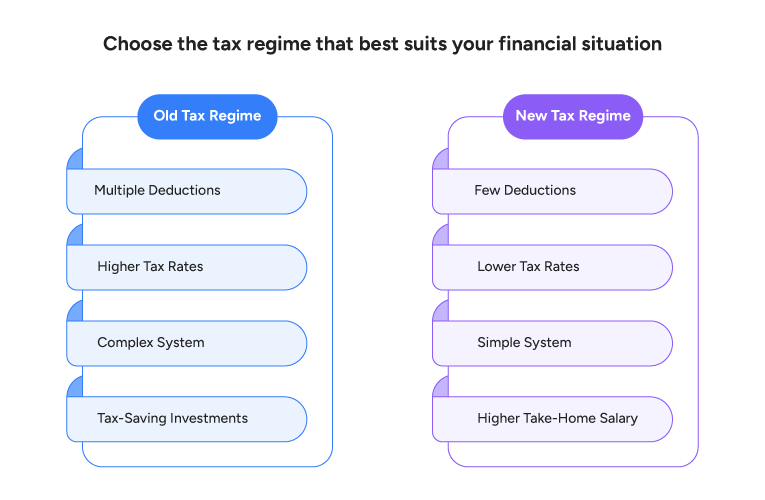
Which Tax Regime is Better?
When you compare old and new tax regime options, the right answer is never the same for everyone. Here is a simple way to figure out which is better, the old or the new tax regime, based on your situation.
Choose Old Regime if
- You claim multiple deductions like 80C, 80D, HRA calculations, and home loan interest, which reduces your taxable income.
- Your total deductions are high, around Rs. 2 lakh or more, making the higher tax rates less impactful overall.
- You are paying rent and regularly claiming HRA, which lowers your taxable salary.
- You have an ongoing home loan with interest payments, allowing you to claim tax benefits.
- You invest in tax-saving options like PPF and ELSS to optimize your tax liability.
- Your salary structure includes components like LTA and other exemptions that you can apply for.
Choose New Regime if
- You have few or no deductions to claim, so the benefit of the old regime is limited.
- Your total deductions are low, below Rs. 1.5 to 2 lakh, making lower tax rates more beneficial overall.
- You prefer a simple tax system that does not require tracking investments or submitting proofs.
- You do not want to lock your money into tax-saving instruments to reduce tax.
- Your salary structure does not include exemptions like HRA or LTA, which reduces the benefits of the old regime.
- You want a higher monthly take-home salary, as less capital is tied up in tax-saving investments.
Old vs New Tax Regime: Example Comparison
Below is a simple salary example that compares taxes under both regimes to clarify the decision.
Assumptions (FY 2025–26)
| Particulars | Amount |
|---|---|
| Annual Salary | Rs. 12,00,000 |
| Total Deductions (80C + HRA + Home Loan + Others) | Rs. 2,50,000 |
Tax Calculation
| Particulars | Old Tax Regime | New Tax Regime |
|---|---|---|
| Gross Annual Income | Rs. 12,00,000 | Rs. 12,00,000 |
| Total Deductions | Rs. 2,50,000 | Rs. 50,000 (Standard Deduction only) |
| Taxable Income | Rs. 9,50,000 | Rs. 11,50,000 |
| Income Tax Payable (Approx.) | Rs. 67,600 | Rs. 1,05,000 |
Note: The old tax regime saves around Rs. 37,400 in this example, thanks to strong deductions like 80C and HRA. If your deductions are lower, the new regime will likely give you a better result.
How to Calculate Tax under Both Regimes
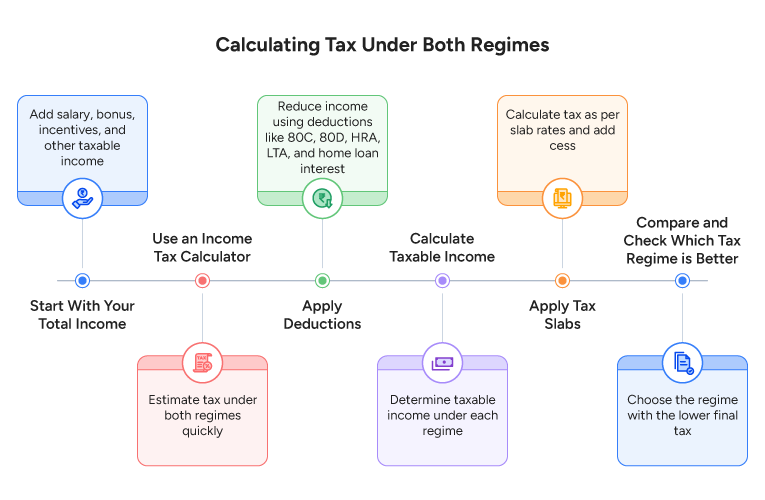
Step 1: Start with Your Total Income
Add your salary, including bonus and incentives, along with any other taxable income. This gives you your gross annual income.
Step 2: Use an Income Tax Calculator
Before calculating manually, use an income tax calculator for better clarity. This reduces manual errors and helps you estimate tax under both regimes quickly.
Step 3: Apply Deductions
Old Tax Regime: Reduce income using deductions like 80C, 80D, HRA, LTA, and home loan interest. This lowers your taxable income.
New Tax Regime: Only limited benefits apply, like the standard deduction and employer NPS contribution. Most exemptions are not allowed.
Step 4: Calculate Taxable Income
Under the old regime, multiple deductions bring your taxable income down. Under the new regime, fewer deductions apply, so taxable income stays higher.
Step 5: Apply Tax Slabs
Calculate tax as per the respective slab rates for each regime. Do not forget to add the health and education cess of 4% on the final tax amount.
Step 6: Compare and Check Which Tax Regime is Better
This is how to check which tax regime is better for you. Whichever gives the lower final tax number is the right choice for that year. Do this every year before you submit your investment declaration to your employer.
Automate Tax Calculations with factoHR HRMS
Tired of manually managing income tax, TDS, and payroll deductions every month? factoHR’s HRMS income tax calculator automates the entire process for accurate and compliant payroll. It helps you compare tax regimes, calculate liabilities based on the latest FY slabs, and apply deductions without manual effort. Run payroll faster with complete confidence and zero calculation errors. [Explore factoHR HRMS]
How to Switch Between Old and New Tax Regime
Yes, you can switch between the old and new tax regime every year if you are a salaried employee. But the rules are different for business owners. Here is how it works.
For Salaried Employees
- Salaried individuals can choose their tax regime every financial year.
- The choice is made when your employer asks for an investment declaration at the start of the year.
- You can select either the old or the new regime.
- Your final selection is reflected in your TDS (salary tax deduction).
- You can still change your choice while filing your Income Tax Return (ITR).
This flexibility allows employees to re-evaluate their decision each year based on their income and investments.
For Business Owners/Professionals
- If you have business or professional income, switching is more limited.
- Once you opt out of the new tax regime, you can switch back to it only once, with conditions.
- After switching back to the new regime, you cannot opt for the old regime again.
- This rule is designed to ensure consistency in business tax planning.
Common Mistakes to Avoid
Many people just go with the default new regime without checking if the old regime saves them more. This is the most common and costly mistake.
Always calculate your tax under both regimes before deciding. Picking one without comparing is like guessing and hoping for the best.
- Avoiding deductions like HRA, 80C, or home loan interest can result in paying unnecessary tax.
- The new regime has lower rates and fewer deductions, but this does not always mean more savings.
- Choosing one regime for the year and later realizing it is not beneficial can affect your monthly TDS.
- Your tax regime should be re-evaluated annually, as income and investments can change.
- Consider how the regime affects your monthly in-hand salary, not just the annual tax figure.
- Do not rely on assumptions. Use a calculator to avoid incorrect decisions and a higher tax bill.
Conclusion
Choosing between the old and new tax regimes is not a one-time decision. It should evolve with your income, lifestyle, and financial goals.
As salary structures change and tax rules shift every budget, what works this year may not be the best option next year. Review your regime annually and compare before deciding. Do not just stick to one choice out of habit.
The smartest move is to look at your full picture, including take-home salary, investments, and long-term goals, before picking a side. Tax savings are just one piece of it.

Frequently Asked Questions
Which Tax Regime is Better for Salaried Employees?
It depends on your deductions. If you claim HRA, 80C, and home loan interest, the old regime usually saves more. If you have fewer deductions, the income tax new regime works better with its lower slab rates. Always calculate both before deciding.
Which Tax Regime is Better for a 7-Lakh Salary?
For a Rs. 7 lakh salary, the new tax regime is better in most cases. Under the new regime, income up to Rs. 7 lakh has zero tax liability due to the rebate under Section 87A. If you have significant deductions, compare both before filing.
Which Tax Regime is Better for a 10-Lakh Salary?
At Rs. 10 lakh, the choice depends on deductions. If your deductions are around Rs. 2 lakh or more, the old regime can save more tax. Otherwise, the new regime is sometimes a better choice.
Which Tax Regime is Better for a 12-Lakh Salary?
The old regime is beneficial if you have strong deductions for a Rs. 12 lakh salary. If deductions are limited, the new regime is a good option.
Which Tax Regime is Better for a 15-Lakh Salary?
The old regime works well for individuals who invest and claim deductions at Rs. 15 lakh. The new regime suits those who prefer fewer deductions and a higher take-home salary.
Which Tax Regime is Better for a 20-Lakh Salary?
For an income of Rs. 20 lakh, the decision depends on deductions. The old regime can reduce taxes when deductions are high. The new regime keeps the process simpler.
Which Tax Regime is Better for a 25-Lakh Salary?
At Rs. 25 lakh, the old regime is useful if you have strong deductions. If not, the new regime provides a more straightforward and tax-efficient option.
Which Tax Regime is Better for Investors?
The old tax regime is a good option for investors who use tax-saving instruments such as 80C investments and other eligible deductions to reduce their taxable income.
Which Tax Regime is Better for NRIs?
NRIs can choose either regime based on their income and deductions. The old regime suits those who claim deductions. The new regime is better for a simplified tax structure.
Can I Switch between the Old and New Tax Regimes?
Yes. Salaried employees can switch between old and new tax regime every year. You choose at the start of the financial year through your employer’s investment declaration. Business owners and professionals have limited switching flexibility under current rules.
How do I Check which Tax Regime is Better for Me?
Calculate your taxable income under both regimes. Apply the deductions you actually claim under the old regime. Then apply the new regime slabs. Compare the final tax number from each. The lower one is your answer. You can also use an online tax calculator to do this in under two minutes.
Table of Contents
For HR professionals, knowing exactly how many work days are in a year is not just a statistic; it is an important planning tool. Not just HR teams, but also a project manager allocating team capacity or a freelancer calculating annual income, need to know the exact number of working days in a year to make decisions. The number of days forms the basis for various business activities, like payroll processing and leave planning.
Identifying the total number also depends on various factors, for example, weekends and public holidays, along with company leave policies. Because of these factors, HR professionals depend on a standard working-day calculation formula to estimate annual work capacity. This guide explains the exact calculation for 2026, along with the factors that affect the total working days calculations and their importance.
Key Takeaways:
- Yearly Work Days: A standard 5-day workweek has 260-261 gross days, while a 6-day week has 313 days (excluding holidays).
- Annual Work Hours: Full-time schedules gross around 2,080 hours a year, reducing to roughly 1,920 net hours after PTO and holidays.
- Changing Variables: Total work days fluctuate based on leap years, the 5- or 6-day workweek structure, leave policies, and regional holidays.
- The Monthly Standard: For daily wage and payroll calculations, HR teams typically use a benchmark of 22 working days per month.
- Business Impact: Knowing the exact number of work days is critical for error-free payroll processing, accurate capacity planning, and legal compliance.
How Many Working Days are in a Year?
In a standard year with a 5-day workweek (Monday to Friday), there are 260 or 261 work days. This is based on the total number of weeks in a year, with an assumption that employees work on weekdays and weekends are non-working days.
But the actual number of payroll working days can vary depending on public holidays, company policies, and regional labor practices. HR and payroll teams calculate the total working days in a year by using a simple formula, which is:
Total Working Days = Total Days in a Year – Weekend Days
Here’s how the calculation works in a year:
- Total days in a year: 365
- Total weeks in a year: 52
- Weekend days: 52 weeks × 2 days = 104 days
- Week Days = 365 – 104 = 261 days
The Exact Calculation for 2026
When companies and HR professionals plan payroll processing or workforce capacity, breaking down working days is important. Here is the calculation for a standard 5-day workweek:
- Total days in 2026: 365 days (2026 is not a leap year)
- Weekends: 52 weeks × 2 weekend days = 104 days
- Gross Week Days: 365 – 104 = 261 days
- Public Holidays: Subtract the average number of national or regional holidays. Most countries have 10-12 public holidays, but this varies by region and company policy. You can refer to our holiday policy for exact dates.
- Net Work Days: 261 – 10 = 251 actual work days (assuming a standard 5-day workweek and 10 public holidays)
Pro tip: It is advised to adjust the net weekdays based on your company’s leave policies and any additional non-working days. To simplify HR professionals’ tasks, this process can be integrated with a Leave Management System. This helps ensure all the deductions and payroll calculations are accurate.
How Many Work Hours are in a Year?
In an organization, there are approximately 2,080 working hours per year under a full-time schedule.
Standard Calculation (8-Hour Workday)
- Work days in a year (average): 260 days
- Work hours per day: 8 hours
Total Work Hours = 260 × 8 = 2,080 hours (gross)
This calculation works as a reference for most HR teams in salary structuring and capacity estimation.
Adjusting for PTO and Public Holidays
The actual number of working hours is reduced once you calculate paid time off (PTO) and public holidays:
- PTO (2 weeks): 10 days × 8 hours = 80 hours
- Public holidays (average): 10 days × 8 hours = 80 hours
Total deductions = 160 hours
Net Working Hours = 2,080 – 160 = 1,920 hours per year
You can ensure accurate tracking of these variations by implementing time and attendance systems that automatically record working hours and leave.
Pro tip: When setting hourly rates or estimating annual income, your calculations should be based on 1,900 working hours per year instead of 2,080. This includes sick days, along with unpaid leaves and holidays.
4 Factors that Change the Number of Working Days
Even with a standard baseline, the actual number of working days can vary. We have mentioned 4 key factors that directly affect the final calculation.
Leap Years
A leap year adds one extra day (366 days instead of 365) to the calendar every 4 years.
- If this extra day falls on a weekday, it can increase the total
- In this case, the gross work days are 262 days (for a 5-day workweek)
The 6-Day Work Week
A 6-day workweek is very common in India across industries like manufacturing and retail.
Simple calculation:
- Total days in a year: 365
- Weekly off (Sundays): 52
Work days = 365 − 52 = 313 days (gross)
HR professionals find it difficult to manage these schedules manually. To simplify the process, organizations can use shift scheduling/roster tools to plan shifts and weekly off.
Paid Time Off (PTO) & Sick Leaves
An employee’s actual work days will be based on the leave they take.
- Earned leave, casual leave, and sick leave
- Unplanned absences or unpaid leave (LWP)
- Maternity/paternity leave
Because of these types of leaves, net work days are lower than gross weekdays.
Regional and State Holidays
Public holidays can vary depending on geography and government regulations.
- There are holidays according to state and religion in India, for example. Diwali and Pongal.
- Companies customize holiday lists based on region and operational needs.
This is why HR professionals need to align calculations with specific regions and company policies.
Why do HR and Employers Need to Know the Exact Number?
Knowing the exact number of work days in a year directly impacts workforce planning and overall business efficiency. There are multiple reasons why HR professionals and employers need to know the exact number of work days. These are:
Accurate Payroll Processing
The number of payroll working days is used to estimate how salaries are calculated for new joiners when they are onboarded to the firm, and to apply overtime calculations. Any errors during payroll processing can lead to discrepancies and compliance-related issues.
Workforce Capacity & Project Planning
Project managers can risk overcommitting resources and underutilizing the workforce. This directly affects the team’s productivity, as they cannot estimate the proper allocation of resources.
Billable Hours & Revenue Forecasting
Work days translate directly into billable hours and revenue for service-based businesses and freelancers. This way, it helps calculate annual earnings and improve the client’s project estimation.
Leave Planning & Policy Management
Understanding the total number of workdays helps HR professionals create a fair leave policy and maintain business continuity during leave periods. A Leave Management System (LMS) also helps with accurate tracking of employees’ leave of absence.
Compliance & Organizational Planning
As a business owner, you know that labor laws and industry standards require defined work days and hours with proper documentation of attendance/leave. You can maintain transparency and compliance with less manual effort by using some of the modern tools.
How to Calculate Working Days in a Month
Till now, you know that there is no fixed number of working days in a month. It ranges between 20 and 23 days, depending on the calendar. Also, the months are not uniform; the days change based on these reasons.
- Total days in the month (28, 30, or 31)
- How weekends fall within that month
- Public holidays specific to that period
For example:
- February (28 days): It has around 20 days
- 30-day months (April, June, September): It has 21-22 days
- 31-day months (January, August, October): It can have 22-23 days
You can calculate days in any month with this formula:
Work Days = Total Days in Month – Weekend Days – Public Holidays
The “22-Day Month”: HR and payroll teams can use a standard assumption of 22 work days per month for salary and per-day cost calculations.
Conclusion
From the whole guide, you know that understanding working days in a year is more than just a basic calculation. It is an important input for accurate payroll processing and effective workforce planning. When you rely on rough assumptions, it can lead to misaligned project timelines and inefficient resource allocation. So the correct method for planning is to bifurcate on weekends, public holidays, PTO, and regional holidays.
But note that there is no “one-size-fits-all” number in this category. The most effective approach is to customize and continuously calculate working day metrics. This is where factoHR helps you can automate your working-day calculations with accuracy using the Attendance and Payroll software. Schedule a demo now!
Frequently Asked Questions (FAQs)
How Many Working Days are in a Year for a 5-Day Work Week?
In a standard 5-day workweek (Monday-Friday), there are 260 to 261 working days in a year before deducting public holidays or paid leave. There is a simple calculation where the total days in a year are 365, and weekend days are 104 (52 Saturdays + 52 Sundays)
How Many Working Days are in a Year for a 6-Day Week?
In a 6-day workweek, employees work 6 days and have 1 day off each week. This is 313 days (Total days [365] – weekly off days [52]).
How is an Employee’s Daily Wage Calculated?
An employee’s daily wage is calculated by dividing the monthly salary by the number of work days of that particular month. For example, if the monthly salary is ₹30,000 and there are 22 working days in a month, the daily wage would be ₹30,000 ÷ 22 = ₹1,363.64 per day.

Table of Contents
As businesses deal with an unstable economy, rewarding employees without affecting payroll has become a growing concern. As an owner, you are constantly finding ways to appreciate and motivate high performers. Also, employees expect recognition that is not only meaningful but also leads to career growth. These kinds of situations have led to small changes in the workplace, which can affect how engaged and loyal employees are.
One such trend that is gaining attention across multiple industries is dry promotion. HR professionals and companies think of it as a budget-conscious solution. This guide includes descriptions of why companies offer dry promotions and the pros and cons of them. We have also discussed how HR should handle these promotions and how employees should navigate them.
Key Takeaways
- Understand the definition of Dry Promotion clearly and quickly.
- Know the motive behind why companies provide these promotions.
- Get a comparison table between dry and quiet promotion.
- Learn the pros and cons of this promotion for both employers and employees.
- Study how HR professionals should handle this promotion effectively.
- Discover how employees should navigate this promotion.
What is a Dry Promotion?
For example, an organization can promote a Senior Executive to a Team Lead position. The company expects them to manage projects and supervise team members on the same pay scale. This approach is used by organizations during budget constraints or to assess an employee’s readiness for a higher position while reviewing broader types of compensation.
A dry promotion is a situation in which an employee is moved into a higher job role. This includes increased responsibilities and authority but does not involve a salary increase. The promotion offers only additional duties and leadership exposure, not financial compensation. It is used by companies that want to recognize their employees’ performance and fill leadership gaps by training employees within budget.

Why do Companies Offer Dry Promotions?
Organizations can provide dry promotions for many reasons due to business constraints and operational needs. These decisions show the reality of balancing talent recognition with financial constraints.
Economic Downturns & Budget Cuts
When businesses want to reward high-performing employees, they might not have the finances to increase salaries immediately. So, sometimes offering a higher title helps recognize their contributions and retain talent until budgets improve as part of broader employee retention strategies.
Testing the Waters for Leadership Roles
These promotions are seen as a trial period, as leadership roles include higher risks and responsibilities. Employers prefer to evaluate an employee first, which helps them ensure that they can manage teams and make decisions before a permanent salary increase.
Urgent Leadership Gaps
Business changes and sudden resignations can create vacancies, which companies need to fill quickly to avoid operational disruptions. Promoting an employee without a salary increase helps maintain business continuity and supports long-term succession planning within the organization.
Startup and Early-Stage Business Constraints
Startups and bootstrapped companies have limited funding and tight cash flow. These organizations want to provide career growth opportunities, but they lack the financial resources to raise salaries.
Dry Promotion vs. Quiet Promotion
It is important to understand the difference between these two terms, as it helps set clear expectations and avoid employee dissatisfaction.
| Aspect | Dry Promotion | Quiet Promotion |
|---|---|---|
| Definition | It occurs when an employee receives a higher job title and increased responsibilities without a salary increase. | It occurs when an employee is given additional responsibilities or leadership tasks informally without a formal promotion. |
| Title Change | Includes a formal change in job title within the organization. | No official title change has been announced. |
| Compensation | No immediate salary increase, even though the role becomes more senior. | No salary increase, as the extra work is assigned temporarily or informally. |
| Responsibility Level | The employee takes on higher-level duties, decision-making authority, or team leadership. | The employee handles extra tasks or projects beyond their original job scope. |
| Recognition | Communicated as a formal promotion internally. | Happens without formal recognition or announcement. |
| Purpose for Employers | Used to fill leadership gaps, test readiness for a higher role, or manage budget constraints. | Used to handle workload distribution or urgent projects without restructuring roles. |
| Employee Impact | It can strengthen the employee’s resume and leadership experience, but may create frustration if compensation does not follow. | May lead to work overload or burnout if additional tasks continue without recognition. |
| Example | A Senior Executive is promoted to Team Lead, given responsibility for managing a team and overseeing projects, but their salary remains the same initially. | A Marketing Executive is asked to lead a campaign and supervise interns, even though their title and compensation remain unchanged. |

The Pros and Cons of a Dry Promotion
A dry promotion can provide short-term advantages for both organizations and employees. But, it also comes with several risk factors, and understanding these pros and cons helps HR leaders and employees know if the arrangement is beneficial or not.
For Employers (HR & Management)
Pros
- Cost control during financial pressure: These promotions help organizations recognize high performers without increasing payroll expenses during budget constraints.
- Filling critical roles quickly: When vacancies arise due to resignations or restructuring, companies can promote internal employees to maintain operational continuity.
- Testing employee readiness: Managers can evaluate the employee when they are assigned greater responsibilities before adjusting the salary.
- Temporary motivation boost: A new job title or additional authority can increase an employee’s confidence and overall engagement.
Cons
- High Flight Risk: In some situations, employees can update their resumes after gaining a stronger title and look for better-paying opportunities.
- Impact on Team Morale: When employees know that promotions are given without additional/fair compensation, it can reduce trust and motivation across the team.
- Potential Resentment or Disengagement: Employees can also feel undervalued if increased responsibilities are not matched with financial recognition.
For Employees
Pros
- Strong Resume Value A higher job title can improve career prospects and give employees more credibility when they look for new work.
- Leadership Skill Development When employees take on new responsibilities, they develop decision-making and management skills.
- Greater Authority and Visibility Employees can gain more power within the company and get to know the managers better.
Cons
- Illusion of Progression: A promotion is career growth, but it does not include the financial reward associated with advancement.
- Higher Risk of Burnout: Additional responsibilities without a salary increase can create work-related pressure and emotional fatigue.
- Feeling Undervalued: Sometimes employees feel their contributions are not properly recognized, which affects engagement and long-term loyalty to the organization.
How HR Should Handle Dry Promotions Effectively
HR teams should manage these promotions carefully to maintain trust and retention.
- Be 100% Transparent: HR professionals should be transparent with employees so they understand the business reality and prevent misunderstandings.
- Set a Clear Timeline for Review: When the promotion is offered, the HR team should define when compensation will be reviewed, based on contributions tracked through a Performance Management System.
- Provide Non-Monetary Benefits: Even if an immediate salary hike is not possible, HR professionals should offer other incentives, like additional paid time off (PTO) and flexible work arrangements.
- Formalize the Role Change: Even if the promotion does not include a salary increase, it should be documented officially so the employee is recognized within the organization and aligned with company payroll policy guidelines.
- Provide the Right Support: HR professionals should provide a smooth transition by providing training and mentorship, which helps them adapt quickly to their expanded responsibilities.

How Employees Should Navigate a Dry Promotion
Negotiate Alternatives
If a salary increase is not possible, you should request benefits like extra PTO or learning opportunities. These incentives help balance the additional workload and provide immediate value.
Ask for a Written Timeline
You should request a timeline for a salary review to make sure your compensation is reconsidered. This way, accountability is created, and prevention can be taken for unresolved issues.
Use It as a Career Step
Treat the promotion as an opportunity to add leadership experience and strengthen your resume for future roles. Taking on more responsibility can help your chances of getting better-paying jobs in the future.
Alternatives to Dry Promotions
Retention Bonuses
Companies can offer a one-time bonus to reward high-performing employees and encourage them to stay with the organization during difficult financial periods. This approach recognizes employee contributions without adding payroll costs.
Stretch Assignments
Managers can assign temporary leadership responsibilities to employees, which helps them develop new skills and prepare for future promotions.
Profit-Sharing or Equity
Startups and other organizations can give profit-sharing plans to employees as a part of recognition. This way, they can benefit financially from the company’s future growth when a salary increase is not possible.
Conclusion
Dry promotions can be a practical short-term solution for organizations facing budget constraints or urgent leadership needs. Companies can recognize employee contributions and maintain operational continuity. But they must be handled carefully, as relying too much on them can affect employee morale and retention.
So for this reason, HR professionals can focus on transparent communication and clear timelines for compensation reviews. When dry promotions are managed thoughtfully and used as a temporary strategy rather than a long-term practice, they can help balance business realities with employee career growth.
Managers can rely on factoHR’s performance management system to track performance and measure outcomes, which also allows them to make fair decisions.

Frequently Asked Questions (FAQs)
Is It Legal to Give a Dry Promotion?
Yes, it is legal for employers to offer a promotion without a salary hike, as long as it complies with labor laws and employment contracts and does not discriminate against any employee.
Should I Accept a Dry Promotion?
It depends on various factors like career growth and leadership experience. If the role helps you gain skills and visibility, it may be worth accepting, but you should clarify expectations with HR professionals.
How Long Should a Dry Promotion Last?
A dry promotion should last about 3 to 6 months, or until the company can review your performance and adjust your salary accordingly.
Can I Decline a Dry Promotion?
You can decline if you feel the role does not match your salary expectations and career goals. But you should discuss the alternatives with HR before making the final call.
Download New Labour Codes
Table of Contents
On the 21st of November 2025, the government implemented four new labour codes through a number of the Ministry of labour and Employment notifications. For employees, the new labour codes in India provide social security and a number of other benefits. For employers, it helps simplify the compliance structure and avoid legal conflicts.
The new 4 labour codes, the code on wages, the OSH code, the social security code, and the IR code, consolidate 29 labour laws and significantly reform India’s labour laws in 2026. You will know about all the updates on labour laws, the four new labour codes, and the changes in effect from November 2025. We also provide a checklist outlining what to do in April 2026 to comply with these changes.
What’s inside?
- November 2025 update: what changed?
- The new labour codes in India, including:
- The Code on Wages, 2019,
- Industrial Relations Code, 2020,
- Social Security Code, 2020, and
- Occupational Safety, Health and Working Conditions Code, 2020.
- Central rules related to each code, including code on wages rules, OSH rules, IR code rules, and SS code central rules.
- New labour codes VS old labour laws
- Impact on employers and employees, including part-time employees and contractors, along with benefits.
- Structural and regulatory changes: national floor wages, dispute resolution mechanisms, among others.
What’s Changed in Indian Labour Laws in November 2025
In November 2025, over 29 labour laws were amended and consolidated into four labour codes. Earlier, labour laws in India comprised different state and central acts covering areas of wage and hour rules, employee relations, and safety regulations. Now, these different labour laws are subsumed under four codes, which are:
- The Code on Wages 2019,
- Industrial Relations Code, 2020,
- Social Security Code 2020, and
- Occupational Safety, Health, and Working Conditions Code 2020.
In December 2025, the government published the draft central rules for all four new labour codes. As of April 2026, the central rules are implemented, but most states are still in the implementation phase.
The New Labour Codes in India 2026
Each of these new labour codes addresses a particular area of regulation.
1. Code on Wages, 2019 (Right to Minimum Wages for Everyone)
Passed in 2019, the Code on Wages regulates areas related to payment of wages, minimum wages, equal remuneration, and payment of bonuses. It provides for a national floor wage in light of the cost of living. Section 2(Y) of the code introduces the 50% wage rule, thereby improving employees’ financial security. It aims to combine wage and hour regulations under a single framework. The Code on Wages repeals four labour laws in India.
*For a list of repealed laws, refer to the table below.
Code on Wages Central Rules
Notified in 2025, the Code on Wages (Central) Rules establishes the procedural framework for fixing minimum and floor wages based on defined consumption units. It defines a standard working-class family as three units requiring 2700 calories and 66 meters of cloth annually. Rule 13 enforces the 50% deduction cap for recoveries, ensuring employee take-home pay is protected. The rules supersede eighteen prior central regulations, including the Minimum Wages (Central) Rules, 1950.
2. Industrial Relations (IR) Code, 2020
The Industrial Relations Code, 2020, modernizes labour law by officially recognizing trade unions at the central and state levels. It also raises the limit for approval for layoffs to 300 employees. Additionally, the act also provides for a skill retrenchment fund and improves women’s representation in the grievance redressal committee.
The Draft Industrial Code Central Rules
The Industrial Relations (Central) Rules establish the structure for collective bargaining, union recognition, and dispute resolution. It provides for a Negotiating Council in establishments with multiple trade unions to ensure structured representation.
3. Social Security Code, 2020 (Social Security for Everyone)
This code aims to unify laws related to EPF, ESIC, gratuity, and other social security provisions. Most importantly, it provides social security to gig and platform workers, contract workers, and unorganized workers. It simplifies the registration process by providing for registration using the Aadhaar number.
Draft Social Security Code Rules
The Social Security Central Rules define the procedures for managing insurance and retirement funds. Significantly, they set up a Social Security Fund for unorganized and gig workers to ensure wider coverage. Rule 82 mandates the use of the Aadhaar system to verify identity during the registration process.
4. OSH Code – 2020 (Right of Security to Workers in all Situations)
The Occupational Safety, Health and Working Conditions Code, 2020, consolidates and replaces 13 laws related to safety regulations and working conditions. The code aims to unify safety standards and establish rules related to working conditions and health. Another objective of OSHWC is to simplify compliance and improve employee welfare.
OSHWC Central Rules
The Occupational Safety, Health and Working Conditions (Central) Rules, 2025, mandate medical examinations for workers (aged 40 or above) as well as Emergency Medical Services (EMS) systems. Rules 6 and 7 establish a rigorous protocol for assessing worker health, shifting the responsibility of clinical oversight directly onto the employer.
These four new labour laws repeal 29 old labour laws in India. The table below lists the repealed laws and their corresponding new Codes.
| Old Labour Laws Replaced by New Labour Codes | |
|---|---|
| New Labour Codes 2026 | Law Repealed |
| Code on Wages, 2019 | Payment of Wages Act 1936, Minimum Wages Act 1948, Payment of Bonus Act 1965, Equal Remuneration Act 1976 |
| Code on Social Security, 2020 | Employees’ Compensation Act 1923, ESI Act 1948, EPF Act 1952, Employment Exchanges Act 1959, Maternity Benefit Act 1961, Payment of Gratuity Act 1972, Cine-Workers Welfare Fund Act 1981, BOCW Cess Act 1996, BOCW Act 1996, Unorganized Workers’ Social Security Act 2008 |
| Industrial Relations Code, 2020 | Trade Unions Act 1926, Standing Orders Act 1946, Industrial Disputes Act 1947 |
| Occupational Safety, Health and Working Conditions Code, 2020 (OSH – Code) | Factories Act 1948, Mines Act 1952, Dock Workers Safety Act 1986, Contract Labour Act 1970, Inter-State Migrant Workmen Act 1979, Working Journalists Acts 1955 & 1958, Motor Transport Workers Act 1961, Beedi & Cigar Workers Act 1966, Sales Promotion Employees Act 1976, Plantations Labour Act 1951, Labour Laws (Exemption from Returns & Registers) Act 1988 (partial repeal) |
Official Resource: https://labour.gov.in/sites/default/files/labour_code_eng.pdf
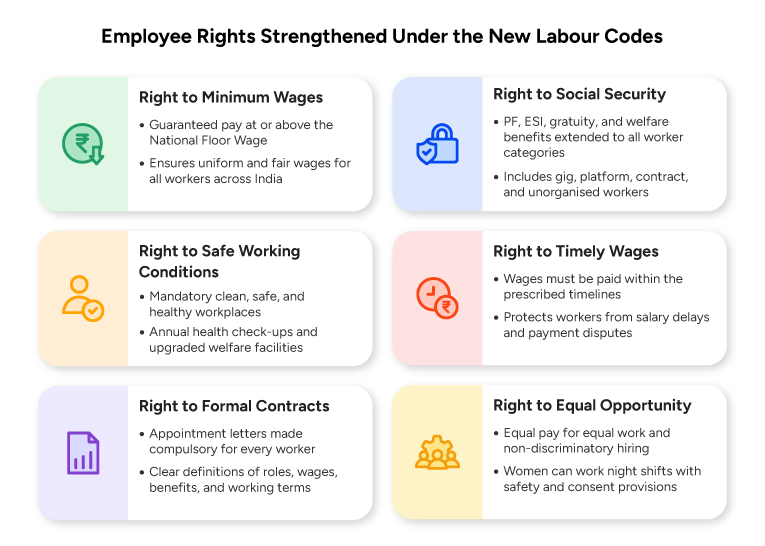
New Labour Codes vs Old Labour System: What Changed?
Indian labour laws have undergone reform in the areas of minimum wages, social security, and safety. The four new labour codes make some necessary changes to the old labour laws. The table below lists some of the important changes from an employee’s and an employer’s perspective.
| 12 Major Labour Law Changes in India | ||
|---|---|---|
| Area of Change | Before (Earlier Law) | After (New Labour Codes) |
| Expanded Minimum Wages | Applied only to scheduled employees. | Covers all workers across all sectors. |
| Revised Wage Definition and Take-Home Pay | Different definitions as per state regulations. | A uniform definition of wages covering full-time, part-time, contract, gig, and platform workers. |
| Social Security Coverage | Limited coverage of EPF, gratuity, and ESI. | Extensive coverage of EPF, ESI, and gratuity for all the employees, including workers in the unorganized sector. |
| Gratuity Eligibility | Required a minimum of five years of service for all employees. | Only one year of service for fixed-term employees. *The five-year rule still applies to full-time employees. |
| Mandatory Appointment Letters | Not mandated for all the sectors. | Mandatory in all the sectors, including the unorganized sector and audio / visual content creation. |
| Overtime at Double Wages | Overtime was mandatory, but the rate differed based on sector and state-specific regulations. | Mandatory overtime pay at double the rate of wages in all sectors. |
| Increased Leave Entitlement | Employees were required to work for 240 days to become eligible. | Employees become eligible for annual paid leave after completing 180 days of work in a year. |
| Women Can Work Night Shifts | Generally restricted in all sectors except IT and related sectors. | Can work with their consent in any sector. |
| Work From Home Provision | No specific legal provision. | The codes formally recognize work from home and allow relevant governments to form related rules. |
| Free Annual Health Check-ups | Only mandatory for workers engaged in hazardous processes. | Mandatory for all employees above the age of 40 years. |
| Timely Wage Payment | Only for employees falling under certain criteria. | All the employees would receive timely wage payments. |
| Commuting Accidents Covered | Coverage based on judicial interpretation. | Universal coverage with a uniform definition of a commuting route. |
Impact of New Labour Laws on Employees
The four new labour codes significantly improve working conditions, provide for women’s representation and participation, improve wage structure, and cover all the workers engaged in formal or informal work. One of the major changes is the 50% wage rule.
- National floor wage: (Section 9(1)code on wages ) Employees will receive sufficient wages and will be able to improve their living standards. *As of April 2026, the baseline for national floor wages per day is ₹178 as notified in 2019. This baseline would change when the government notifies new national floor wage levels under the COW.
- The 50% wage rule (Section 2(y), code on wages): This rule ensures that your EPF and gratuity would be higher, improving your financial security in the long term. Earlier, there was no such legally binding provision.
- Social Security (Sections 114 and 109 of the Social Security Code): Gig, platform, unorganized, and part-time employees will also receive the same EPF and ESI benefits as full-time employees.
- Extensive coverage: Earlier, labour laws only covered full-time and, to some extent, contract employees. Now, the new labour codes recognize workers across all sectors, including the unorganized sector.
- Equal representation: (Section 43 OSHWC code) Women can also participate equally in any work, including night shifts. The grievance redressal committee is also required to include women representatives.
- Working hours: (Section 25(1)(a) OSHWC code) The code reduces the daily working hours from 9 hours to 8 hours.
Impact of New Labour Laws on Employers
For employers, the new labour laws simplify compliance. However, they also affect salary structure and employee classification.
- Compliance: A unified process for returns and registration would reduce compliance burden. (Section 33(2) of the OSHWC code, read with Rule 66 of the draft OSH rules)
- Wage and salary structure: Employers will need to reconsider their wage structure, as the wage code introduces the 50% wage rule.
- 50% basic salary: According to section 2(y) of the code on wages, basic pay, DA, and retaining allowance should be at least 50% of the total remuneration, increasing statutory liability for gratuity, EPF, and ESI.
- Payroll and payment of wages: Establishments will need to pay wages on time to all employees. So, employers will need to have sufficient cash flows. (Section 17(1) of the Code on Wages).
- Workplace safety and health: The OSHWC code introduces a number of safety regulations, including mandatory health check-ups. So, employers will need to revisit their benefits administration policies. (Section 6(1)(c) of the OSHWC code read with Rule 6 of the draft OSHWC rules)
- Employer-employee relations: Provisions in the IR code provide for mandatory notice before strikes. This can be beneficial for employers as they would have time to reschedule projects. (Section 62(1) of the Industrial Relations Code)
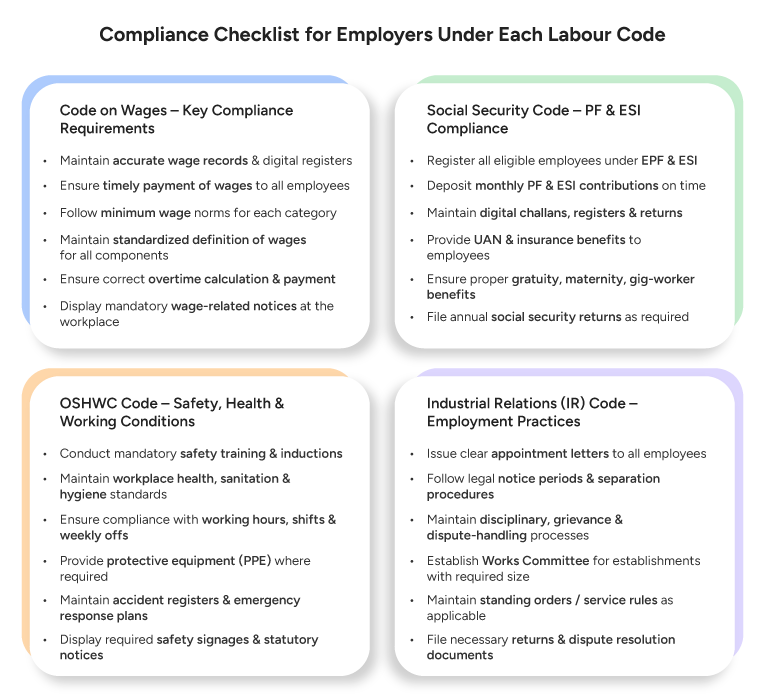
Types of Workers Who Get Benefits under the New Labour Law
There are eleven categories of workers that benefit from the four new labour codes, including full-time, part-time, contract, gig, and platform workers.
1. Full-Time Employees
Codes that cover them: Code on Wages, Social Security Code, OSHWC Code, Industrial Relations Code
Benefits
- Unified wage rules ensure predictable salary, overtime, and bonus calculations.
- Stronger social security coverage, including PF, ESIC, gratuity, and maternity benefits.
- Safer workplaces with mandatory welfare facilities and health monitoring.
- Greater job clarity through defined service conditions and dispute mechanisms.
2. Contract Workers
Codes that cover them: Code on Wages, Social Security Code, OSHWC Code
Benefits
- Standardized wage rules regardless of contractor engagement.
- Coverage under PF/ESIC is determined on the basis of the establishment and contractor registration.
- Mandatory safety, sanitation, and welfare facilities at contractor-managed sites.
- Clear responsibility is placed on the contractor and principal employer.
3. Fixed-Term Employees
Codes that cover them: Industrial Relations Code, Code on Wages, Social Security Code
Benefits
- Same pay and working conditions as permanent staff for the contract’s duration.
- Access to key statutory benefits, including gratuity on a pro-rata basis.
- Predictable terms of engagement through written fixed-term agreements.
- Social security benefits are available throughout the contract period.
4. Gig Workers
Codes that cover them: Social Security Code
Benefits
- Dedicated social security framework designed for gig-based work.
- Accident, disability, and health-support schemes are funded through the government and aggregators.
- Registration-based access to welfare benefits without traditional employment relations.
- Digital registration for access to future schemes.
5. Platform Workers
Codes that cover them: Social Security Code
Benefits
- Access to platform-specific welfare plans (health, social insurance, risk cover).
- Aggregators are required to contribute a percentage of turnover toward welfare funds.
- National and state-level welfare boards for improving scheme implementation.
6. Daily-Wage & Unorganized Sector Workers
Codes that cover them: Social Security Code, Code on Wages
Benefits
- Minimum wage and floor-wage protection across all categories of casual work
- Digital enrolment into unorganized-worker welfare programs
- Access to health, life insurance, skill-building, and construction-worker welfare schemes
- Access to state-level support
7. Women Workers
Codes that cover them: Social Security Code (maternity), Code on Wages, OSHWC Code
Benefits
- Expanded maternity and nursing benefits and childcare facility access, where mandated.
- Equal wage protection and gender-neutral job classifications. Permission to work night shifts with safety, transport, and consent requirements.
- Improved workplace hygiene, privacy, rest facilities, and welfare amenities.
8. IT, Remote & Knowledge Workers
Codes that cover them: Code on Wages, Social Security Code, OSHWC Code (as applicable)
Benefits
- Consistent wage calculations for bonuses, PF, and allowances.
- Eligibility for social security when engaged through covered establishments.
- Flexibility under standing-order models for remote and hybrid work setups.
- Duty-of-care standards for employer-managed workspaces or designated remote hubs.
9. Factory & Industrial Workers
Codes that cover them: OSHWC Code, Social Security Code, Code on Wages, Industrial Relations Code
Benefits
- Strict hazard-management rules and safety controls for manufacturing and industrial sites.
- Welfare amenities like canteens, rest areas, medical rooms, and protective equipment.
- Annual medical checks, working-hour standards, overtime rules, and shift safeguards.
- Clear industrial-relations procedures for disputes, layoffs, and re-skilling.
10. Apprentices & Trainees
Codes that cover them: Industrial Relations Code, Code on Wages, Social Security Code
Benefits
- Recognized classification with protected training terms and regulated stipend.
- Defined training hours and structure for skill-building.
- Access to select welfare measures and safety protections inside establishments.
- Safeguards against misuse of “trainee” status.
11. Audio/Visual Content Creators (Audio-Visual Workers)
Codes that cover them: OSHWC Code (dedicated chapter), Code on Wages
Benefits
- Mandatory written contracts stating wages, timelines, safety terms, and dispute process.
- Registration of each engagement with the designated authority.
- Clear rules for working hours, safe studio/production conditions, and welfare facilities.
- Secure electronic wage payments for transparency and auditability.
Structural & Regulatory Changes under the New Labour Codes
New Definition of Wages and the 50% Rule
Before the new labour laws came into effect, wages were primarily defined by the Payment of Wages Act, 1936, and the Minimum Wages Act, 1948. These definitions covered which components to include/exclude, but did not specify the 50% threshold. Under the code on wages, section 2(Y) specifies that basic pay, dearness allowance, and retaining allowance should not be less than 50% of total remuneration. Let’s understand this with an example.
- Old Way: Employers might set Basic at ₹20,000 and Allowances at ₹80,000. PF is only calculated on ₹20,000.
- New Rule: Allowances cannot exceed ₹50,000. The “excess” ₹30,000 from the allowances is added back to the wages. Your new “Wage” base for PF/Gratuity becomes ₹50,000.
National Floor Wage
Under the Minimum Wages Act, the concept of a national floor wage was advisory in nature. States could set minimum wages below the floor wage. Now, under the wage code, Section 9 empowers the Central Government to fix a National Floor Wage after consulting with the Central Advisory Board. This wage acts as a mandatory minimum threshold across India, ensuring that no state sets a minimum wage below this limit.
Gender Neutrality
Section 3 of The Code on Wages, 2019, prohibits discrimination in wages and recruitment for all genders. Earlier, the Equal Remuneration Act, 1976, only covered women, and in effect, did not prohibit discrimination against other genders. Additionally, section 43 of the OSHWC code removes employment restrictions on women by allowing them to work on night shifts with their consent. older labour laws like The Factories Act, 1948, and The Mines Act, 1952, prohibited women from working on night shifts.
Inspector-Cum-Facilitator System
Old labour laws like the Payment of Wages Act, the Minimum Wages Act, and the Contract Labor Act emphasized the punitive role of an inspector. Now, section 51 of the Code on Wages, 2019 establishes the ‘Inspector-cum-Facilitator’, replacing the traditional, punitive ‘Inspector’ role with one that primarily advises employers on compliance issues. The facilitator promotes a culture of voluntary compliance and transparency through a web-based inspection scheme and electronic records.
Mechanisms for Dispute Resolution
Before, the Industrial Disputes Act, 1947, limited internal grievance redressal committees to 6 members. The IR code expanded these committees to 10 members. The code also makes proportional representation of women mandatory. The 1947 act provided for only one woman in the GRC. Additionally, sections 4(10) and 53 (6) enable faster resolution by providing direct access to the tribunal.
Simplified Compliance
Before, fragmented laws like the Minimum Wages Act, 1948, and the Contract Labour (Regulation and Abolition) Act, 1970, required employers to maintain separate, manual registers for attendance, wages, and fines. Now, Section 123 of the Code on Social Security, 2020, and Rule 54 of the SS Rules, 2025, unify compliance into a single electronic return and standardized digital registers.
National OSH Board (Occupational Safety & Health)
Before, sector-specific laws like the BOCW Act, 1996, and the Mines Act, 1952, established separate advisory committees for construction and mining safety. Now, Section 16 of the OSHWC Code, 2020, replaces these with a single National Occupational Safety and Health Advisory Board to monitor standards across all sectors. Additionally, this Board is empowered to recommend research and frame unified safety rules for factories, docks, and plantations. Older labour laws relied on state-level inspections.
Social Security Board
Earlier, the Unorganized Workers’ Social Security Act, 2008, established a National Board, but its scope was limited to traditional unorganized sectors. Now, Section 6 of the Code on Social Security, 2020, creates a National Social Security Board that specifically includes gig and platform workers. Additionally, it advises on welfare schemes for life, disability, and health benefits for these previously excluded categories.
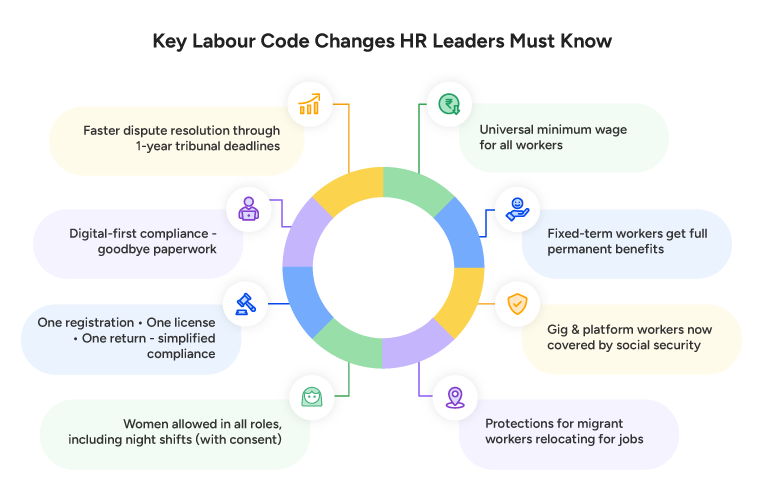
Employer Compliance Checklist
This is a checklist for improving compliance with the four new labour codes.
- Update employment contracts, as the new labour laws provide a number of new employee benefits and change criteria related to old benefits.
- Review the salary structure, and check your state’s labour commission’s website for updated minimum wages.
- Ensure proper wage breakup, as wage components like ESI and EPF are necessary to include even in the payslips of contract and gig workers.
- Ensure timely wage payment: even platform workers and contractual employees are entitled to timely wage payment under the new labour laws in India.
- Maintain employee records online: a unified process for registration is digital. So, storing employee records digitally can help improve efficiency.
From Compliance to Care: Redefining Worker Experience in India
The new labour laws in India not only improve compliance but also employee welfare. Provisions like unified processes for returns simplify compliance. Mandatory health check-ups improve employee health and well-being.
Additionally, social security coverage for gig, platform, unskilled, and contract workers can improve their living conditions. Mandatory appointment letters for all the workers, including audio-visual workers, ensure that employment is formalized, and all the workers receive benefits introduced under the four new labour codes.
FAQs
How do the New Labour Codes Affect Employers in India?
Manpower costs rise as at least 50 % of CTC must count as “wages,” increasing PF, gratuity, and other benefits. Compliance is simpler with single registration, unified returns, and retrenchment approvals now required only for 300+ workers.
What are the Key Labour Law Changes for Employees in 2026?
Workers, including gig, platform, contract, and fixed‑term staff, get extended social‑security coverage, mandatory appointment letters, timely wages, equal pay, and safe night shifts for women. Fixed‑term employees qualify for gratuity after one year.
How does the Minimum Wage Rule Change under the New Labour Codes?
The national floor wage prevents states from setting minimum pay below a baseline, standardizing wages across sectors. Coverage now extends to all workers, including informal and gig employees.
What is the 50% Wage Rule? What is Its Impact on Employees?
The 50% rule mandates that “wages” (Basic, DA, and Retaining Allowance) must comprise at least half of total remuneration. If other allowances exceed this 50% cap, the excess is added to the wage base. For employees, this improves long-term financial security.
How Can Employers Simplify Compliance under the New Codes?
The 29 old laws are consolidated into four codes, reducing complexity. Employers now need one registration and a unified annual return, cutting paperwork and streamlining compliance.
What are the Penalties for Non-Compliance with Labour Laws in 2026?
Minor procedural lapses are mostly decriminalized, with fines replacing jail for first-time breaches. Serious violations like unsafe conditions or non-payment of statutory benefits still attract heavy penalties.
How do the Labour Code Changes Affect Contract and Temporary Workers?
Contract and fixed‑term workers now get benefits similar to permanent staff, including social security, leave, and medical cover. Fixed-term employees are eligible for gratuity after one year, and gig/platform workers are formally covered under social security.
Are there any Regional Differences in Implementing the New Labour Laws 2026?
Labour is a concurrent subject. While central laws set minimum standards, states must enact rules individually, so some provisions vary regionally until state rules are finalized.
How Can HR Teams Prepare for the New Labour Law Compliance Requirements?
HR teams must reconfigure payroll to comply with the 50% wage rule, update contracts and job descriptions for fixed-term or gig workers, issue mandatory appointment letters, and implement digital compliance and reporting systems.
What are the Updated Gratuity Provisions under New Labour Laws in India 2026?
Fixed-term employees qualify for gratuity after one year instead of five. The redefined wage base increases payouts, ensuring higher gratuity payments when employees exit.
Table of Contents
Income Tax Calculator helps you quickly and accurately estimate how much tax you need to pay without dealing with complex calculations or confusing tax rules. Many individuals struggle to understand their tax liability due to multiple income sources, deductions, and frequent changes in tax laws, which often leads to errors or last-minute stress. This is exactly why you need an income tax calculator-it gives you instant clarity on your taxable income, compares tax liability under the old and new tax regimes, and helps you plan your finances better throughout the year. By using an income tax calculator, you save time, avoid costly mistakes, and make informed decisions to optimize your tax savings with confidence.
This guide includes a step-by-step process of calculating income tax with examples (old vs. new regime) and the benefits of using an online income tax calculator.
What is an Income Tax Calculator?
An income tax calculator is a simple online tool that calculates income tax under the current tax system in India. This calculator takes different inputs like annual income, allowances, expenses, rent, EMIs on loans, and other tax deductions & exemptions. This also includes tax-saving investments to provide individuals with an estimated tax figure that they are liable to pay.
Whether you are an individual or a business entity, paying income tax from salary or other income is mandatory for all, and by using a free income tax calculator, employees can get an estimated amount for their income tax, which can be useful while filing for the income tax return.

Income Tax Calculator
Income Details
Enter annual income values. Blank fields are treated as zero.
Deductions and Exemptions
The calculator automatically applies only deductions allowed in each regime.
Old vs New Regime
The calculator automatically applies only deductions allowed in each regime.
Gross Income
Taxable Income
Total Tax (Old)
Total Tax (New)
Best Regime
Estimated Tax Saved
Old Regime
Taxable Income
Base Tax
Rebate
Surcharge
Cess
Final Tax
| Slab | Rate | Tax |
|---|---|---|
| ₹0 – ₹2,50,000 | 0% | ₹0 |
| ₹2,50,000 – ₹5,00,000 | 5% | ₹12,500 |
| ₹5,00,000 – ₹10,00,000 | 20% | ₹18,600 |
New Regime
Taxable Income
Base Tax
Rebate
Surcharge
Cess
Final Tax
| Slab | Rate | Tax |
|---|---|---|
| ₹0 – ₹4,00,000 | 0% | ₹0 |
| ₹4,00,000 – ₹8,00,000 | 5% | ₹20,000 |
| ₹8,00,000 – ₹12,00,000 | 10% | ₹36,300 |
Important note: This tax calculation is for estimation purposes only. While we aim to keep it accurate based on the selected financial year and the values entered, you should not rely on it as final tax advice. Please cross-check the calculation with your Chartered Accountant or tax advisor before making any financial decisions.
How to Calculate Income Tax?
An online income tax calculator is a simple tool for both HR professionals and employees. This tool is designed to provide results based on user input, for example, annual income, along with deductions and exemptions. Below are the steps to use an income tax calculator AY 2026-27:
- Step 1: HR professionals/individuals should first choose the financial year for which they want their taxes to be calculated.
- Step 2: Choose the income tax payee’s age and type, as the tax regimes (old and new) differ.
- Step 3: Enter annual gross income and exemptions u/s 10 A, if applicable. This includes Leave Travel Allowance (LTA) and House Rent Allowance (HRA).
- Step 4: In standard deduction, net income from a sale of an asset should be calculated, for which the formula is (Sale consideration – Cost of Acquisition).
- Step 5: Other details, like interest on income and rental income, should also be entered.
- Step 6: Some of the tax-saving investments under section 80D (health insurance) and 80CCD(1B) (NPS) should be entered, if applicable.
The income tax calculator online will evaluate, which can be compared with both the old and new tax regimes.

How to Calculate Income Tax on Salary with Example?
Nayan works in Delhi and earns a basic monthly salary of ₹80,000, plus an HRA of ₹20,000 per month and a yearly LTA of ₹40,000. He lives in a rented house and pays ₹15,000 in rent. His additional income from other sources is ₹2,00,000.
Nayan’s gross taxable income from the above figures will be:
| Nature | Amount (₹) |
Deductions/Exemptions (₹) |
Taxable (Old, ₹) |
Taxable (New, ₹) |
|---|---|---|---|---|
| Basic Salary | ₹9,60,000 | – | ₹9,60,000 | ₹9,60,000 |
| HRA | ₹2,40,000 | ₹1,56,000* | ₹84,000 | ₹2,40,000 |
| LTA | ₹40,000 | ₹35,000 | ₹5,000 | ₹40,000 |
| Gross Salary | ₹12,40,000 | – | ₹10,49,000 | ₹12,40,000 |
| Standard Deduction | – | ₹50,000 | -₹50,000 | -₹75,000 |
| Salary After Std Ded | – | – | ₹9,99,000 | ₹11,65,000 |
| Other Sources | ₹2,00,000 | – | ₹2,00,000 | ₹2,00,000 |
| Gross Taxable Income | – | – | ₹12,00,000 | ₹13,65,000 |
Here are the deductions from gross income to compute the total tax payable.
| Particulars | Old Tax Regime (₹) | New Tax Regime (₹) |
|---|---|---|
| Gross Income | ₹14,40,000 | ₹14,40,000 |
| Total Deductions | ₹3,94,000 | Not Applicable |
| Net Taxable Income | ₹10,46,000 | ₹14,40,000 – ₹75,000 = ₹13,65,000 |
| Tax Slab-wise Calculation | ||
| Up to ₹3 lakh | Nil | Nil |
| ₹3 – ₹6 lakh | 5% on ₹3L = ₹15,000 | 5% on ₹3L = ₹15,000 |
| ₹6 – ₹9 lakh | 10% on ₹3L = ₹30,000 | 10% on ₹3L = ₹30,000 |
| ₹9 – ₹10 lakh | 15% on ₹1L = ₹15,000 | 15% on ₹1L = ₹15,000 |
| ₹10 – ₹12 lakh | 20% on ₹2L = ₹40,000 | 20% on ₹2.5L = ₹50,000 |
| ₹12 – ₹12.5 lakh | – | 25% on ₹0.5L = ₹12,500 |
| ₹12.5 – ₹13.65 lakh | – | 25% on ₹1.15L = ₹28,750 |
| Above ₹10 lakh (surcharge portion) | 30% on ₹46,000 = ₹13,800 | – |
| Total Income Tax | ₹1,26,300 | ₹1,51,250 |
| 4% Health & Education Cess | ₹5,052 | ₹6,050 |
| Total Tax Payable | ₹1,31,352 | ₹1,57,300 |
As you can see in the above table, the income tax is calculated under both the new and old tax regimes. We can clearly see a difference in total tax payable amounts, even though the tax rates were higher in the old regime; the tax payable was lower than in the new regime because of the deduction benefits in the old regime.

New Income Tax Slabs for FY 2025-26
Taxpayers in India pay taxes according to their income tax slabs. Tax slabs are different tax rates specified for different income ranges. It means that tax is charged according to the amount of income one earns. If an employee’s income is high, then they are liable to pay more in taxes compared to those who have less income. The tax slabs are:
| Net Taxable Income Range (₹) | Income Tax Rates |
|---|---|
| Up to ₹4 lakh | NIL |
| ₹4 lakh – ₹8 lakh | 5% |
| ₹8 lakh – ₹12 lakh | 10% |
| ₹12 lakh – ₹16 lakh | 15% |
| ₹16 lakh – ₹20 lakh | 20% |
| ₹20 lakh – ₹24 lakh | 25% |
| Above ₹24 lakh | 30% |
- Individuals (below the age of 60)
| Net Taxable Income Range (₹) | Income Tax Rates |
|---|---|
| Up to ₹2.5 lakh | NIL |
| ₹2.5 lakh – ₹5 lakh | 5% |
| ₹5 lakh – ₹10 lakh | 20% |
| Above ₹10 lakh | 30% |
- Senior citizens (between the ages of 60 and 80)
| Net Taxable Income Range (₹) | Income Tax Rates |
|---|---|
| Up to ₹3 lakh | NIL |
| ₹3 lakh – ₹5 lakh | 5% |
| ₹5 lakh – ₹10 lakh | 20% |
| Above ₹10 lakh | 30% |
- Super senior citizens (age over 80)
| Net Taxable Income Range (₹) | Income Tax Rates |
|---|---|
| Up to ₹5 lakh | NIL |
| ₹5 lakh – ₹10 lakh | 20% |
| Above ₹10 lakh | 30% |
Exemptions & Deductions Allowed under the Old Tax Regime
Earlier. We mentioned that the old regime allows major exemptions and deductions that could help reduce the tax amount. Through the following list, you can know what the exemptions & deductions that are allowed under the old tax regime are:
- House rent allowance & Leave travel allowance are tax-exempt.
- Section 80C – Deductions up to ₹1.5 lakh on tax-saving investments.
- Section 80EE – Deduction on interest paid for home loans availed from any financial institution.
- Section 80G – Deduction on donations made to charity.
- Section 80E – Deduction on interest paid for educational loans for higher studies.
- Section 80GGC – Deduction on the contribution made towards any political party.
- Section 80D – Deduction on health insurance premium & medical expenses.
- Section 80TTA – Deduction up to ₹10,000 on the income earned from interest on a savings account.
- All salaried individuals can claim a standard deduction of ₹50,000.
Exemptions & Deductions Allowed under the New Tax Regime
The new tax regime allows fewer deductions & exemptions compared to the old regime, but they are still useful for reducing total income tax. The following are the exemptions & deductions allowed under the new tax regime:
| Old Regime vs New Regime | ||
|---|---|---|
| Feature | New Tax Regime (FY 2025-26) |
Old Tax Regime (FY 2024-25) |
| Basic Exemption Limit | ₹4 lakh | ₹2.5 lakh (for individuals < 60) |
| Tax-Free Income | Up to ₹12 lakh (₹12.75 lakh for salaried) | Up to ₹5 lakh (due to rebate) |
| Standard Deduction | ₹75,000 for salaried/pensioners (from FY 2024-25) | ₹50,000 for salaried/pensioners |
| Deductions | Very few allowed (e.g., standard deduction for salary, employer’s NPS contribution, interest on let-out property home loan) | Many allowed (HRA, LTA, 80C, 80D, home loan interest, etc.) |
| Tax Rates | Generally lower rates across more slabs | Higher rates, but reduced by deductions |
| Complexity/Paperwork | Lower, simpler compliance and less documentation | Higher, requires proof of investments/expenses |
- Section 80CCD(2) – deduction on employer’s contribution towards NPS.
- Tax exemption on interest earned and the maturity amount of the PPF Account and the Sukanya Samridhi Yojana.
- Section 10(10D) – Tax exemption on maturity amount from life insurance.
- Section 10(15) – Deduction on interest earned from a post office savings account.
- Tax exemption on income received from leave encashment on retirement.
- Tax exemption if the individual opts for voluntary retirement.

Benefits of Using an Online Income Tax Calculator
There are multiple benefits of using an online income tax calculator India. These are:
Saves Time and Effort
Individuals can save time and effort by avoiding hours of calculating complex tax figures. They can get an instant tax liability estimate in a few clicks with basic financial information.
Eliminates Manual Calculation Errors
Online calculators apply the latest tax laws and slab rates, which eliminates errors caused by manual calculations.
Helps with Tax Planning
When employees know their estimated tax liability in advance, it can help them plan their budget and make informed decisions. These decisions include their savings and expenses throughout the year.
Supports Investment Decisions
This calculator helps employees understand the various deductions and exemptions (under Sections 80C and 80D) they are eligible for. Some of the tax-saving investments, like ELSS and life insurance, can help minimize the tax burden.
Improves Financial Clarity
The tool helps improve financial clarity by providing an accurate estimate of an employee’s liability. This helps in budget planning and identifying tax-saving opportunities.
Free and Accessible Anytime
These online tools are designed to be simple; they can be calculated without expert knowledge. They are also accessible from any device with an internet connection at any time.
How Much Tax is Deducted from Salary in India?
There are multiple factors on which the tax is deducted from salary in India. These are:
Total Taxable Income and Salary Components
Total taxable income is calculated using gross salary (including HRA and bonuses) and deducting exemptions (standard deduction of ₹75,000) under the new regime.
Applicable Income Tax Slab Rates
There are updated tax slab rates in the new regime (FY 2025-26). Individuals can visit government websites to calculate.
Employee’s Age and Residential Status
Age affects the old-regime slabs; compared to the new regime, the percentages are uniform across age groups. Also, residential status (resident/non-resident) impacts exemptions.
Choice of Tax Regime (Old vs. New)
The new tax regime is the default, but employees can choose between the old and new regimes for filing ITRs. The latest version includes lower deductions when compared to the older one.
Exemptions and Deductions
The new regime allows limited exemptions, for example, standard deduction (₹75,000) and employer NPS (14% of salary). The old version included thorough calculations, for example, 80C (₹1.5L) and 80D health insurance.
Other Income/Losses Declared to the Employer
Employees can report income (capital gains and business profits) and losses (house property), which reduces their Tax Deducted at Source (TDS).
Simplify Your Tax Calculations with factoHR’s Income Tax Calculator
Employees can simplify their tax calculations with factoHR’s income tax calculator, designed to deliver quick and accurate results as per Indian tax rules. Simply enter income details, along with deductions and exemptions, to generate estimated tax figures. The tool supports multiple income categories and helps you calculate tax under the new regime for FY 2025–26 using the latest slabs.
For organizations, this doesn’t have to remain a manual process. With factoHR payroll software, income tax calculations are automatically handled for every employee, including deductions, exemptions, and compliance updates. This reduces manual effort, eliminates errors, and ensures accurate payroll processing every month.
Switch to Automated Payroll & Tax Calculation
FAQs
What Information do I Need to Use the Calculator?
To use the income tax calculator, you need:
- Provide your gross income
- Your age group and financial year
- Applicable deductions or exemptions (for the old regime)
- Fewer details (for the new regime)
Who Can Use this New Tax Regime Calculator?
The new regime calculator can be used by individuals and salaried employees. This also includes those individuals with income from other sources, as there are multiple tax-related comparison options with minimal deductions.
Does It Include the Latest Tax Slabs?
Yes, factoHR’s income tax calculator 2025-26 includes the latest slabs, i.e., FY 2025-26 new regime rates. It is advised to verify these slabs with the official income tax portal.
What are the Key Components and Terminologies of Income Tax?
Some of the key tax components include:
- Gross total income (salary, house property, capital gains)
- Deductions (80C, 80D in the old regime)
- Exemptions (HRA and LTA), tax slabs
How do I Choose between the New vs Old Tax Regimes?
When an individual is confused about choosing between regimes, it is best to select the new regime. This is because the deductions are low and are simple when compared to the old regime.
Can I Use this Calculator for Tax Planning before Investments?
Individuals can use this calculator before planning investments, for example, ELSS under 80C in the old regime, which helps in forecasting savings.
What is the Difference between FY and AY in Tax Calculation?
Financial Year (FY) is the income-earning period (April 1 to March 31), and Assessment Year (AY) is for filing (AY 2026-27 for FY 2025-26 income, due July 31). Organizations and HR teams should know that taxes are calculated on FY income during AY.
Which Tax Regime is Better for Salaried Employees?
The new regime is more beneficial for salaried employees, with lower deductions and a standard deduction of ₹ 75,000. The old regime is suitable for those with high claims, for example, rent and insurance.
Is the Calculated Tax Amount Final for Filing My ITR?
The tax amount is not final for filing the ITR, as the calculator provides an estimate. This should only be used as a guide, as the final amount includes audits and revisions.
Table of Contents
Taking time off for a wedding is an important personal event that requires advance planning. A marriage leave application is a formal request to be excused from work for your own or a family member’s wedding. It ensures that your leave is approved on time, plans are properly organized, and work or studies continue smoothly, which employees and students often need.
This guide includes formats, tips, and email examples for your own and family weddings to help you manage the process in 2026.
What is a Marriage Leave Application?
A marriage leave application is a formal written request an employee submits to their manager or HR to take time off work for their own wedding or to attend someone else’s. It includes the reason for the leave, the exact days off, and any details needed to help the employer manage work while the employee is away.
How to Write a Leave Application for Marriage (Step-by-Step)
Writing a leave application for your wedding (or a family member’s) is a standard professional procedure, but it requires a balance of personal joy and professional responsibility. Since you’ll likely be away for an extended period, providing clarity helps your team manage your absence smoothly.
- Choose the right format according to your company’s policy: email for most workplaces, or a formal letter if required. Make sure it follows professional standards, including proper structure and contact details.
- Use a clear subject line, such as “Marriage Leave Application – [Your Name] – [Dates]”, to help your manager quickly identify and prioritize your request.
- Start your application with a polite greeting, such as “Dear [Manager’s Name]”. It creates a good first impression.
- Start by clearly mentioning that you are requesting leave for your marriage or to attend a wedding. Keep it direct to avoid any confusion.
- Briefly explain how your responsibilities will be managed during your absence. Mention a colleague or plan to ensure a smooth workflow.
- Mention the leave dates and expected return date. This helps avoid scheduling conflicts and ensures clarity.
- You can indicate how you can be reached for critical or emergency matters during your leave. Be specific about whom to contact, rather than remaining available. This helps manage expectations while respecting your time off.
- Respectfully request approval for your leave, using professional language. Express gratitude for your manager’s time and consideration.
- End with a formal closing, such as “Sincerely” or “Regards.” Include your full name and designation for identification.
- Attach your wedding invitation only if company policy requires it or to support requests for extended or special leave.
Marriage Leave Application Format and Email Template
When you need days off for your own marriage.
Marriage Leave Application Samples (10+ Situational Examples)
Leave Application for Own Marriage
When to use: Use this for corporate environments, government offices, or when applying to a manager you don’t interact with daily. It is clear, concise, and sticks to the facts.
Subject: Leave Application for Marriage – [Your Name]
Dear [Manager’s Name],
I am writing to request leave from [Start Date] to [End Date] for my wedding. I plan to resume my duties on [Return Date].
I have ensured that my current projects are up to date and have briefed [Colleague’s Name] on any important matters that may arise during my absence. I will also make sure all pending reports are submitted before my leave begins.
Thank you for your support and understanding.
Sincerely,
[Your Name]
[Your Department]
Leave Application for My Wedding with Remote Availability
When to use: When you want to formally request leave for your wedding, but also assure your manager that you’ll remain reachable for emergency situations.
Subject: Leave Request for My Wedding with Remote Availability
Dear [Manager’s Name],
I hope you are well. I am pleased to let you know that my wedding is planned for [date]. I would like to request leave from [start date] to [end date], and I will be back at work on [return date].
I will complete all responsibilities in advance, with [colleague’s name] to manage tasks during my absence, and remain available remotely for any urgent matters via email.
Please let me know if there are any priorities to address before my leave.
Thank you for your consideration.
Sincerely,
[Your Name]
[Your Department]
Leave Application for Brother Marriage
When to use: Use this for professional environments where you need to provide a formal record for HR or your department head. It’s best to send it 2-4 weeks in advance.
Subject: Leave Application for Brother’s Marriage
Dear Sir/Madam,
I would like to inform you that my brother’s marriage is scheduled on [date]. I request leave from [start date] to [end date] to attend the wedding ceremonies and support family obligations and ceremony planning.
I will complete all my responsibilities in advance and ensure that work is not affected during my absence.
Thank you for your support and consideration during this special time.
Yours faithfully,
[Your Name]
[Designation]
Leave Application for Sister Marriage
When to use: Best for modern offices or startups where you have a good relationship with your manager and need a written record.
Subject: Leave Request for Sister’s Marriage
Dear [Manager’s Name],
I am pleased to inform you that my sister’s wedding is scheduled on [date]. I request leave from [start date] to [end date] to attend the functions.
I have completed all pending tasks and delegated my responsibilities to [Colleague’s Name]. I will be available for any urgent matters. Please approve my leave for [number of days] days.
Thank you for considering this request.
Sincerely,
[Your Name]
[Your Position]
Leave Application for Cousin Marriage
When to use: Submit 2-4 weeks in advance for planned family weddings, especially before busy work periods, to allow sufficient time for approvals and planning.
Subject: Leave Application for Cousin’s Marriage
Dear Sir/Madam,
I am writing to request leave from [start date] to [end date] to attend my cousin’s wedding on [date] and assist my family with the preparations.
I will complete my responsibilities in advance to ensure a smooth workflow during my absence. I will return to the office and be fully available on [Return Date].
I request your approval for leave during this period.
Yours faithfully,
[Your Name]
[Designation]
Leave Application for Friend Marriage
When to use: Use this for traditional corporate environments or when submitting a formal request to a manager.
Subject: Leave Request for Friend’s Marriage
Dear [Manager’s Name],
I hope you are doing well. I would like to inform you that my friend’s marriage is scheduled on [date]. I request leave from [start date] to [end date] to attend the wedding functions.
I will ensure that all my responsibilities are completed in advance so that work is not affected during my absence.
I kindly request your approval for this leave.
Warm regards,
[Your Name]
[Designation]
[Department]
Leave Application for Daughter Marriage
When to use: For government jobs, traditional institutions, or workplaces that require a formal handover plan in the leave application.
Subject: Leave Request for Daughter’s Marriage
Dear [Manager’s Name],
I am submitting this application to request [Number] days of leave for my daughter’s wedding ceremony and related family functions. I am requesting this leave from [Start Date] to [End Date].
Before my departure, I will complete [Specific Task/Project]. During my absence, [Colleague’s Name] has kindly agreed to oversee my ongoing responsibilities. I will be available by phone for emergencies only. Please note that I will have limited connectivity during this period.
Please let me know if any forms need to be completed to formalize this request.
Kindly approve my leave for the mentioned period.
Sincerely,
[Your Name]
[Designation]
[Department]
Extended Marriage Leave Application
When to use: Use this when you have already been granted leave but realize you need a few extra days due to travel delays, traditional ceremonies, or wedding-related tasks.
Subject: Extension of Marriage Leave – [Your Name]
Dear [Manager’s Name],
I am writing to request a brief extension to my previously approved marriage leave. Due to [brief reason, e.g., international travel logistics/additional family ceremonies], I would like to revise my return date from [Old Return Date] to [New Return Date], adding [Number] days to my absence.
I have already coordinated with [Colleague’s Name], who will continue covering my responsibilities during this period.
I apologize for any inconvenience this adjustment may cause and appreciate your understanding.
Best regards,
[Your Name]
[Your Designation]
Marriage Leave Application for Government Employee
When to use: Use this when you are getting married. This usually requires the longest lead time (ideally 15-30 days in advance) as per the Leave Rules (e.g., CCS Leave Rules in India) to allow proper redistribution of work.
Subject: Application for Grant of Earned Leave (EL) for My Marriage
Respected Sir/Madam,
I, [Your Name], working as [Your Designation] in [Department Name], wish to inform you that my marriage is scheduled for [Date of Wedding].
I would like to request Earned Leave for [Number of Days] days, from [Start Date] to [End Date]. I will return to work on [Date of Joining].
During my absence, I have handed over my duties and responsibilities to [Colleague’s Name, Designation]. I shall be available on [Phone Number] in case of any urgent official matter.
I would appreciate your approval.
Yours faithfully,
[Your Name]
[Employee ID]
[Designation]
Marriage Leave Application for School/College Student
When to use: Use this when a school student needs to attend a sibling’s wedding. It is usually written by the parent or the student, depending on school policy.
Subject: Leave application for sister’s/brother’s marriage
Respected Sir/Madam,
I, [Parent’s Name], am writing to request leave for my son/daughter, [Student’s Name], a student of class [Class/Section], from [Start Date] to [End Date].
The leave is required to attend the marriage of his/her elder brother/sister. As it is a significant family event, his/her presence is essential for the various ceremonies at home.
I assure you that he/she will complete any pending homework and stay up to date with the lessons taught during his/her absence. I kindly request you to grant him/her leave for [Number of Days] days.
Thank you.
Yours faithfully,
[Parent’s Signature]
[Parent’s Name]
[Date]
Tips for Writing a Marriage Leave Application to Get Quick Approval
Getting your marriage leave approval quickly is all about professionalism and preparation. Use these tips to make the process easy and smooth:
- Submit your request at least 2-4 weeks before the wedding. Giving your manager sufficient time makes it easier to get approval and avoids last-minute conflicts.
- Keep your application short, around 100-150 words. Clearly explain the reason for your leave and the dates. Avoid unnecessary details.
- Specify the exact start and end dates of your leave. Avoid vague terms like “around mid-December” and use precise dates such as “December 12th to December 22nd.”
- Clearly mention who will handle your responsibilities while you are away. This shows you’ve planned ahead and will ensure operational continuity.
- Maintain a professional tone regardless of your office culture. Using the phrase ‘I am writing to formally request leave’ creates a clear record, which is preferable for HR documentation compared to informal conversations.
- Mention in your application that you will set an out-of-office reply. This ensures that clients and colleagues know exactly when you’ll return and who to contact in your absence.
- Including a PDF of your invitation serves as instant “proof” for documentation. It adds credibility and helps HR with internal record-keeping.
- Check your HR portal before submitting the request. Ensure you are using the correct application format and that you have enough leave balance available for the dates you’re requesting.
- Never rely on a verbal “okay”. Specifically ask for a reply via email so you have a dated record of the approval for your reference.
- Do not request more days than necessary. Asking for an excessive amount of time can create a negative impression regarding your dedication to work.
Marriage Leave Rules in India
In India, there is no single nationwide law that guarantees marriage leave across all private-sector workplaces. In most organizations, marriage leave depends on company policy, and employees may need to use casual leave, earned leave, or other available leave types. State-specific Shops and Establishments rules may also affect how leave is structured.
How Many Days of Marriage Leave Can You Take?
The number of days you get for marriage leave can vary a lot:
| Category | Details |
|---|---|
| Private Sector | 3-5 days; some companies offer 7-10 days. Depends on company policy |
| Government/Public Sector | 5-15 days as per department circulars and service rules |
| Own Marriage | Paid leave; counts as working days; often allowed once (first marriage) |
| Sibling/Family Weddings | No fixed leave. You can use CL or EL from the available leave types; sometimes, 1-3 days of special leave may be granted, depending on company policy. |
Marriage leave can be combined with Casual Leave, Earned/Privilege Leave, weekends, or public holidays to extend time off. The total duration typically ranges from 3 to 15 days.
Marriage Leave Rules in India
- Paid or unpaid: Leave for your own marriage is paid. It does not reduce your annual leave unless you take additional days, though this depends on your company’s policy.
- Eligibility and documentation: This leave is mostly allowed by companies only once. Some family events may qualify for a shorter period of special leave.
- Notice period: Most companies require advance notice, since weddings are planned events, which helps with workload planning.
Pro Tip: Review your HR policy early and submit your leave application 2 to 4 weeks in advance. Include the reason, dates, backup plans, and proof to make approval easier.
What Managers & HR Look for in a Marriage Leave Application
When you apply for marriage leave, managers and HR expect a clear, professional, and well-organized request. A good application reassures them that your absence will not disrupt work. Here are the key points to include:
- Leave Dates: Specify your leave start and end dates (e.g., October 15 to 22, 2026). Try to apply 2-4 weeks in advance so work can be planned properly.
- Work Handover Plan: Explain who will handle your responsibilities while you are away. For example: “Project X will be managed by Colleague Y, and urgent emails can be directed to Supervisor Z.”
- Return Date: Clearly state when you will resume work (e.g., October 23, 2026) to avoid confusion.
- Task Management: Mention how you will manage your work before leaving—whether you will complete important tasks or hand them over.
- Proof Documents: Attach your wedding invitation or certificate if required, especially in formal workplaces, to confirm the reason for leave.
Pro Tip: Check your company’s leave policy and follow any format rules in the Employee Handbook. A careful, well-prepared application shows professionalism and makes approval more likely.
Conclusion
Applying for marriage leave doesn’t have to add stress to your wedding preparations. It is a formal way to request time off for your own or a family member’s wedding while ensuring work continuity. By following the proper format and clear timelines, you can make the process seamless.
Use our customizable templates to save time and maintain professionalism, and explore our full guide today to download your preferred sample and tick one more task off your wedding checklist!
FAQs
How Many Days of Leave Can I Take for Marriage?
The number of days you can take for marriage leave typically varies by company policy, with most employers offering 3 to 5 days of paid leave. You should check your employment contract or HR handbook, as some organizations may provide up to 10-15 days.
How to Write a Leave Application for Marriage?
When writing a leave application for your marriage, make sure to include your wedding dates and how long you need off. Add a brief plan for handing over your work and provide emergency contact information. Keep it clear and professional, and send it to your manager or HR for approval in advance.
How Far in Advance Should I Apply for Marriage Leave?
You should apply for marriage leave at least 2-4 weeks in advance. For longer, extended leaves (e.g., 1 month or more), inform your manager 30 to 60 days in advance to ensure smooth scheduling and coverage. Always check your company policy, as some employers may have specific notice requirements.
Can My Employer Reject My Marriage Leave Application?
Yes, your employer can reject your marriage leave if it conflicts with business needs or policy. It’s best to submit your request early and discuss any concerns with your manager to improve your chances of approval.
Do I Need to Attach a Wedding Invitation to My Leave Application?
No, you usually don’t need to attach a wedding invitation unless your company asks for it. Just sharing your leave dates and how long you’ll be away is enough. But if you’re asking for special or longer leave, including the invitation might help.
Is Marriage Leave Paid or Unpaid?
Marriage leave may be paid or unpaid, depending on your company’s policy and local labor laws. Check your HR guidelines to confirm whether your leave is paid, unpaid, or deducted from your annual leave.

Table of Contents
Confused about the difference between a stipend and a salary? You are not alone. Both are forms of pay but they work very differently. A stipend usually covers living or training costs. A salary is regular pay for a permanent job with legal protections and benefits.
Getting this wrong has real consequences for HR teams. Wrong classification can trigger FLSA penalties, incorrect TDS treatment, or PF liability where none was needed. This guide covers everything you need to know about stipend vs salary — what each means, how they are taxed in India, and when to use which.
TDLR;
- A stipend is a fixed financial support payment for interns, trainees, or apprentices. A salary is formal compensation for employment.
- The key difference between stipend and salary is purpose — stipend covers living or learning costs, salary compensates for work performed.
- Stipends may be tax-exempt under Section 10(16) of the Income Tax Act if given purely for educational purposes. Otherwise they are taxable.
- Salaries are always taxable in India, subject to TDS, PF, ESIC, and professional tax deductions.
- Interns on stipends typically do not receive PF, ESIC, or gratuity unless the internship is structured as employment.
- Section 87A rebate can reduce salary tax to zero for income up to Rs 12 lakh under the new regime.
What is a Stipend?
A stipend is a fixed, periodic payment given to interns, apprentices, trainees, or fellows to support their living expenses while they learn or contribute in a non-employment capacity. It is financial assistance — not full compensation — and is not tied to hours worked or tasks completed.
Stipend salary meaning in simple terms: it is a subsistence allowance. It keeps the recipient financially supported while they focus on learning. Unlike a salary, it sits outside the formal wage structure and usually excludes statutory benefits like PF, ESIC, and gratuity.
Internship stipend meaning: a payment made to an intern during a defined programme to cover basic daily costs like food, transport, and accommodation. It is not a wage in the legal sense and does not appear in a formal salary structure.
What is a Salary?
A salary is regular, fixed compensation paid to an employee in exchange for their professional work under a formal employment contract. It forms the foundation of a long-term employment relationship.
A salary is built on a defined structure that includes basic pay, allowances like HRA and conveyance, and statutory deductions covering PF, ESIC, TDS, and professional tax. To understand how each of these payroll components is calculated and applied, HR teams need a clear framework before designing any compensation package.
Unlike a stipend, a salary is always taxable, always subject to statutory deductions, and always tied to a formal employment agreement.
Types of Stipends
Stipends are not just for interns. Modern organisations use them for a wide range of purposes. Here is a breakdown of the most common types:
| Stipend Type | Purpose | What It Covers | Who Gets It |
|---|---|---|---|
| Internship Stipend | Support basic living costs during training | Food, travel, accommodation | Interns, trainees, apprentices |
| Wellness Stipend | Promote physical and mental health | Gym, therapy, fitness trackers | Full-time employees |
| Transportation Stipend | Cover daily commute costs | Transit passes, parking, fuel | Office-based employees |
| Work-from-Home Stipend | Support remote work setup | Internet, electricity, home office | Remote and hybrid workers |
| Professional Development Stipend | Encourage skill growth | Courses, certifications, workshops | All employees seeking upskilling |
| Relocation Stipend | Help with moving costs for work | Packing, travel, temporary housing | New hires relocating |
| Mobile / Communication Stipend | Cover business communication costs | Phone bills, data plans, devices | Employees with remote needs |
Stipend vs Salary: Key Differences
This is the core question — what is the difference between stipend and salary? The table below breaks it down across every dimension HR teams need to understand.
| Factor | Stipend | Salary |
|---|---|---|
| Purpose | Cover living or learning expenses during training | Compensation for regular work under an employment contract |
| Employment Status | Intern, trainee, student, volunteer | Full-time or part-time employee |
| Legal Wages | Not covered under the Minimum Wages Act | Subject to Minimum Wages Act and all labour laws |
| Payment Structure | Fixed periodic amount for a limited period | Regular ongoing pay, often performance-linked |
| Benefits and Perks | Usually none — no PF, ESIC, or gratuity | Includes PF, ESIC, paid leave, insurance |
| Taxation | May be exempt under Section 10(16); otherwise taxable | Always fully taxable with TDS, PF, ESIC deductions |
| Reimbursement Nature | Subsistence allowance — not wages | Direct compensation for services rendered |
| Duration | Short-term — project or programme based | Ongoing — tied to permanent or long-term employment |
| Applicability | Internships, fellowships, apprenticeships | Full-time and part-time professional roles |
The stipend and salary difference is not just about the amount. It is about the nature of the relationship. Stipend recipients are not employees in the legal sense. Salaried employees are.
When Should You Use a Stipend vs Salary?
Internship and Training Roles
Use a stipend for learning-focused, short-term roles where the primary goal is skill development and industry exposure — not revenue generation. This covers interns, trainees, and apprentices.
Example: A marketing intern working for three months gets a Rs 10,000 monthly stipend. They are gaining skills. They are not a permanent employee. A stipend is the right payment here.
Full-Time Employment
Use a salary for permanent roles with set responsibilities and regular working hours. These positions come with all statutory obligations — PF, ESIC, TDS, paid leave, and minimum wage compliance.
Example: A software developer hired on a permanent basis receives a monthly salary with PF deductions, HRA, and annual appraisal cycles. Managing this kind of compensation accurately is where payroll software removes the risk of manual errors, especially during appraisal season when salary revisions happen across multiple employees at once.
Contract and Temporary Roles
For contract roles, the payment depends on the nature of the work. A learning-focused temporary role gets a stipend. A skilled contract role with measurable deliverables gets a salary or fixed fee.
Example: A data entry trainee on a two-month programme gets a stipend. A contract software developer hired for a three-month project at a defined deliverable rate gets a salary.
Advantages and Disadvantages of Stipend
Advantages of Stipend
- Cost-effective for employers. Stipends are lower than full salaries and may not attract PF, ESIC, or gratuity obligations. This keeps labour costs manageable for training programmes.
- Flexible payment structure. Stipend amounts can be adjusted by project, duration, or role without the rigidity of a formal salary revision process.
- Suitable for training and internships. Stipends are designed for financial support during learning — not for compensating work output. This makes them the right fit for internship programmes, apprenticeships, and fellowship schemes.
- Lower compliance requirements. Stipends generally do not require PF registration, ESIC enrolment, or gratuity provisioning — reducing administrative and legal overhead significantly.
- Ideal for short-term roles. For programmes with a defined start and end date, stipends avoid the complexity of full employment contracts.
Disadvantages of Stipend
- No PF, ESIC, or statutory benefits. Stipend recipients are not entitled to provident fund, health insurance, or retirement protection under Indian law. This leaves them financially exposed.
- No job security. Stipend roles end when the programme ends. There is no guarantee of continued employment or conversion to a permanent role.
- Limited legal protection. Many labour laws that protect employees do not extend to interns or trainees. Grievance redressal options are limited.
- Not suitable for long-term roles. If someone is doing the work of a full-time employee, paying them a stipend instead of a salary creates legal and ethical risk. Misclassification can attract penalties.
- Role ambiguity. Without a clear job description, stipend recipients may end up doing full-time work without full recognition or fair pay.
Advantages and Disadvantages of Salary
Advantages of Salary
- Financial stability for employees. A fixed monthly salary gives employees predictable income. This supports long-term financial planning and reduces attrition driven by financial insecurity.
- Legal compliance built in. A structured salary automatically handles TDS, PF, ESIC, professional tax, and minimum wage compliance — reducing legal exposure for HR teams.
- Includes statutory employee benefits. Salaried employment includes paid leave, provident fund, health insurance, and gratuity eligibility — making the role attractive to quality candidates.
- Improves retention. Reliable CTC, structured appraisals, and a clear growth path reduce attrition and retain experienced talent. Understanding how to calculate in-hand salary from CTC helps employees trust that what they were offered is what they receive — which directly supports retention.
- Builds long-term workforce capability. Regular employment enables skill development, institutional knowledge retention, and reduced cost-per-hire over time.
Disadvantages of Salary
- Higher total cost for employers. Salaried employees attract PF employer contribution, ESIC employer contribution, gratuity provisioning, and paid leave costs on top of the take-home amount.
- More compliance obligations. Payroll must handle TDS filings, PF challans, ESIC returns, professional tax payments, and Form 16 issuance every year.
- Fixed monthly outflow regardless of output. Salaries are paid irrespective of productivity fluctuations, seasonal demand, or business performance.
- Less flexibility. Adjusting a salary downward is legally complex. Variable incentives are easier to manage than fixed salary revisions.
Tax on Stipend vs Salary in India
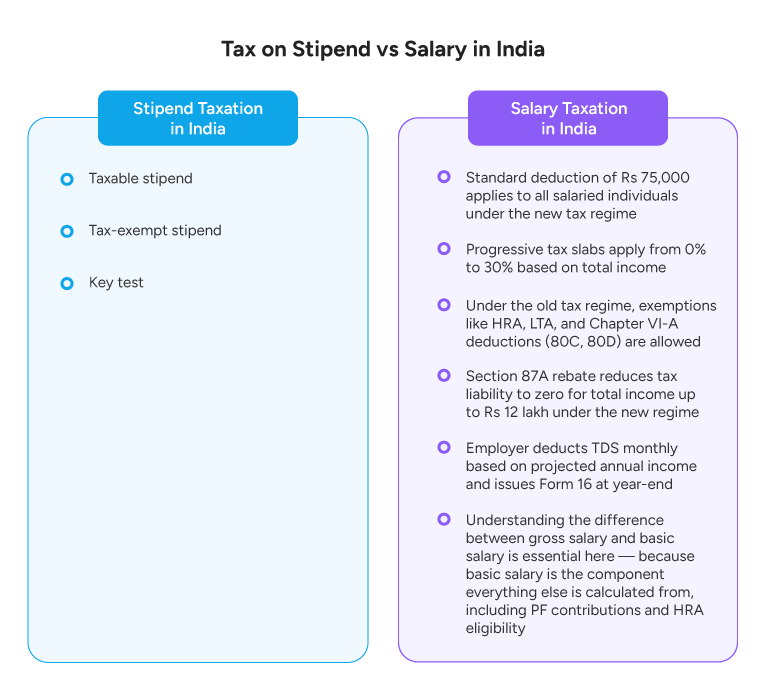
The tax treatment of stipend vs salary in India is one of the most misunderstood areas in HR compliance. Here is how each is treated under the Income Tax Act, 1961.
Stipend Taxation in India
The Income Tax Act does not define the word “stipend” directly. Tax treatment depends entirely on the purpose of the payment.
Taxable stipend: If a stipend is paid in exchange for services — including internship duties involving fixed hours, specific tasks, and supervision — it is treated as income. It is taxed either under “Income from Salary” or “Income from Other Sources” depending on the employment relationship. TDS may be deducted. Form 16 or Form 16A may be issued.
Tax-exempt stipend: Under Section 10(16) of the Income Tax Act, scholarships granted to meet the cost of education are fully exempt from tax. If a stipend is paid purely as an educational scholarship or research grant — with no job duties or deliverables attached — it qualifies for this exemption. Research fellowships, academic stipends, and government scholarship programmes commonly fall here.
Key test: Is the payment for services or for support? Services = taxable. Support for learning = potentially exempt under Section 10(16).
Salary Taxation in India
A salary is always taxable if it exceeds the basic exemption limit. Key rules:
- Standard deduction of Rs 75,000 applies to all salaried individuals under the new tax regime
- Progressive tax slabs apply from 0% to 30% based on total income
- Under the old tax regime, exemptions like HRA, LTA, and Chapter VI-A deductions (80C, 80D) are allowed
- Section 87A rebate reduces tax liability to zero for total income up to Rs 12 lakh under the new regime
- Employer deducts TDS monthly based on projected annual income and issues Form 16 at year-end
Understanding the difference between gross salary and basic salary is essential here — because basic salary is the component everything else is calculated from, including PF contributions and HRA eligibility.
Stipend vs Salary: Which One is Better for Employers?
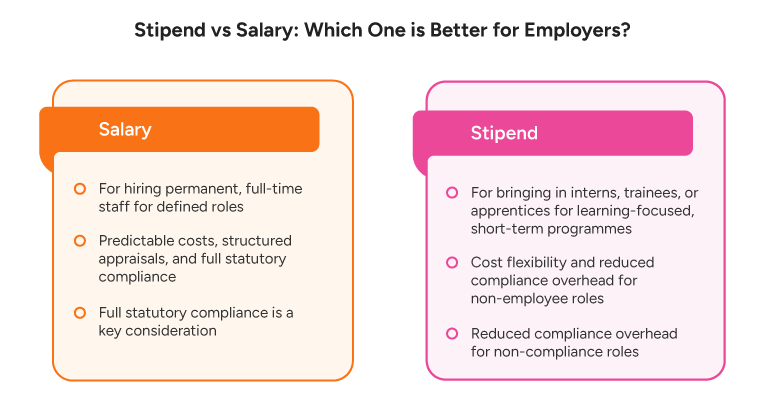
There is no universal answer. The right choice depends on the role, duration, and nature of the relationship.
Choose a salary when:
- Hiring permanent, full-time staff for defined roles
- The role generates direct business output and is expected to continue long-term
- You want predictable costs, structured appraisals, and full statutory compliance
Choose a stipend when:
- Bringing in interns, trainees, or apprentices for learning-focused, short-term programmes
- Offering supplemental benefits to existing employees — wellness, remote work setup, professional development
- You want cost flexibility and reduced compliance overhead for non-employee roles
Always ensure the payment type genuinely matches the nature of the role. Paying a stipend to someone doing full-time employee work is a misclassification risk under Indian labour law. The reimbursable components of salary — like travel allowances and professional development costs — are often confused with stipends, but they sit within a formal salary structure and are treated differently for tax purposes.
Conclusion
The stipend and salary difference comes down to one thing: purpose. Stipends are for learning, training, and short-term support. Salaries are for employment, sustained output, and long-term roles.
For HR teams, getting this right matters. Use a stipend for interns and trainees in genuine learning roles. Use a salary for anyone doing regular, measurable, business-critical work. Misclassifying the two creates legal exposure — both in terms of statutory obligations and tax treatment.
When building your compensation framework, match the payment type to the role. That keeps you compliant, fair, and protected under Indian labour law.
Frequently Asked Questions
Is a Stipend the Same as a Salary?
No. A stipend is a fixed, limited payment given for internships, training, or support — not compensation for employment. A salary is regular pay for a permanent job with legal protections, statutory benefits like PF and ESIC, and full tax liability. The difference between stipend and salary is primarily about the nature of the relationship, not just the amount.
What is Stipend Meaning in an Internship?
A stipend in an internship is a fixed monthly payment given to an intern to cover basic living costs like food, travel, and accommodation during the internship period. It is not a wage. Intern stipends in India typically range from Rs 5,000 to Rs 25,000 per month depending on company size, industry, and location. Tech companies and large firms often pay Rs 15,000 or more.
What is the Difference between Stipend and Salary for Tax Purposes in India?
A stipend may be fully exempt from tax under Section 10(16) of the Income Tax Act if it is paid as a scholarship or educational grant with no job duties attached. If paid in exchange for services, it is taxable as salary or other income. A salary is always fully taxable with TDS deducted monthly and Form 16 issued annually.
Why do Companies Offer Stipends Instead of Salaries?
Companies offer stipends for short-term, learning-focused roles like internships, fellowships, and apprenticeships because stipends are lower in cost, carry fewer statutory obligations (no mandatory PF, ESIC, or gratuity), and suit the temporary nature of the relationship. They are not suitable for permanent roles where employees perform core business functions.
Can an Employee Receive both a Stipend and a Salary?
Yes. A salaried employee can receive both a salary for regular work and a stipend for specific expenses like wellness, professional development, or remote work setup. The salary is fully taxable. The stipend may be partially or fully taxable depending on its nature and purpose. HR must document both clearly and ensure correct TDS treatment for each.
Which is Better — Stipend or Salary?
It depends on the role and the individual’s situation. A salary offers higher pay, full statutory benefits, and long-term job security — suitable for permanent professionals. A stipend provides a fixed, often lower-taxed allowance suitable for interns, trainees, and short-term learners. For employers, the right choice depends entirely on the nature of the engagement and the compliance obligations that go with it.
Do Interns Receive PF or ESIC Benefits?
No. Interns receiving a stipend are generally not entitled to PF or ESIC benefits under Indian law because they are not classified as regular employees. However, if an internship is structured as actual employment with fixed hours and a defined role, PF and ESIC obligations may apply. Companies should seek legal advice before structuring any internship where duties resemble regular employment.
When Should HR Choose a Stipend over a Salary?
HR should choose a stipend for interns, trainees, research fellows, or apprentices in short-term, learning-focused roles without statutory benefits. Stipends reduce compliance costs and suit roles where the primary purpose is skill development rather than productive output. For any permanent or long-term role where the individual is doing actual business work, a salary is legally required.
How Much Stipend do Interns Get in India?
Intern stipends in India typically range from Rs 5,000 to Rs 25,000 per month. Startups usually offer Rs 8,000 to Rs 12,000. Mid-size companies offer Rs 10,000 to Rs 18,000. Large tech firms and MNCs often pay Rs 15,000 to Rs 25,000 or more, especially for engineering, product, and data roles. Location matters too — stipends in Bengaluru, Mumbai, and Hyderabad tend to be higher than in tier-2 cities.
What is CTC and how is It Different from a Stipend?
CTC stands for Cost to Company — the total annual cost an employer bears for a salaried employee. It includes basic salary, HRA, allowances, employer PF contribution, ESIC, gratuity provisioning, and any other benefits. Use the CTC calculator to understand exactly what each component costs and how in-hand salary is derived from the total CTC. A stipend has none of this structure — it is a simple fixed payment with no employer statutory contributions attached.
Table of Contents
Employees today expect more than just a salary. They look for meaningful benefits that improve their daily lives. One of the simplest and most effective ways companies deliver this value is through employee discounts.
From saving on everyday expenses to accessing premium services at reduced costs, employee discount programs help organizations create a more supportive and rewarding workplace.
In this guide, you will learn what employee discounts are, their types, benefits, real-world examples, and how HR teams can build and manage effective discount programs.
What are Employee Discounts?
Employee discounts are reduced prices that organizations offer to their employees on products or services. These discounts may apply to the company’s internal services or to products and services provided by partner organizations through corporate agreements.
For example, retail companies offer discounts on products, hospitality organizations provide discounted stays, and technology companies may offer free or subsidized digital services.
These programs are often part of a broader employee benefits strategy aimed at improving employee satisfaction and engagement.
Why do Companies Offer Employee Discount Programs?
Employee discounts are widely used by organizations because they provide clear value for both employees and employers.
- Support employee well-being by reducing personal expenses.
- Strengthen workplace engagement and connection with the organization.
- Increase job satisfaction and employee loyalty.
- Encourage a sense of appreciation among employees.
- Boost enthusiasm for representing the company.
- Promote company products and services internally.
- Help employees become more familiar and confident with the brand.
Key Benefits of Employee Discount Programs
Employee discounts bring real value to both the people who receive them and the companies that offer them.
Benefits for Employees
- Real Financial Savings: Discounts on everyday spending genuinely help with savings.
- Better Quality of Life: Access to health, travel, and lifestyle perks improves life outside work.
- Feeling Recognized: Being offered good perks sends a clear message that the company values its staff.
- Less Financial Stress: Savings on regular expenses reduces a common source of anxiety that affects performance at work
- More Connection to the Brand: Employees who use company products understand and appreciate them more.
Benefits for Employers
Many organizations that build thoughtful employee engagement initiatives around discounts and perks consistently report higher retention and satisfaction scores.
Specific employer benefits include:
- Reduced Employee Turnover: Staff with good benefits packages stay longer
- Stronger Hiring Pipeline: Perks are a genuine selling point for candidates
- Higher Productivity: Employees who feel cared for usually perform better.
- Stronger Employer Branding: Employees who enjoy the company’s product naturally promote it.
- Lower Absenteeism: Wellness-related discounts help employees stay healthier and take fewer leaves.
Types of Employee Discounts (with Examples)
Most employee discount programs fall into a few common categories. The right mix depends on the organization, its workforce, and the available budget. The following sections explain the most common types of employee discounts used by companies.
1. Discounts on Company Products or Services
Many companies offer employee discounts on their own products or services. This type of discount is easy to manage because the organization controls the product and its pricing.
For example, bakery chains may provide free or discounted meals to staff. Car manufacturers may offer reduced prices on vehicles. Software companies may give employees free access to their tools. These discounts help employees save money and become more familiar with the company’s products.
2. Retail and Shopping Discounts
When a company’s own products are not part of everyday spending, retail partnerships help fill the gap. These partnerships give employees access to lower prices at grocery stores, electronics retailers, clothing brands, and online shopping platforms.
Common examples include:
- Discount codes for major e-commerce platforms
- Cashback through partner credit or debit cards
- Special pricing at local stores near office locations
These discounts support employees in their daily expenses. For example, an employee who saves money on weekly groceries benefits from this regularly.
3. Travel and Hospitality Discounts
Travel perks are among the most talked-about employee discounts, particularly in the aviation and hospitality industries. But they are not exclusive to those sectors.
Many companies arrange corporate travel deals with hotel chains, car rental services, or booking platforms. Staff get discounted or free access to things they would otherwise pay full price for, whether that is a weekend away or a business trip upgrade.
4. Health and Wellness Discounts
Companies that invest in wellness programs understand that sound employees are the backbone of a productive workforce. They have fewer sick days, lower burnout rates, and better focus at work.
Typical offerings include:
- Subsidized gym or fitness studio memberships
- Discounts on mental health apps like Calm or Headspace
- Reduced rates on health screenings or dental care
- Partner deals with nutrition or supplement brands
For employees, this feels like the company actually values their lives outside work. That matters more than most employers realize.
5. Entertainment and Lifestyle Discounts
These are the perks that make employees loyal to the company, such as discounted cinema tickets, streaming subscriptions, restaurant coupons, or access to events and concerts.
They do not carry a huge financial weight, but they signal that the company is building goodwill over time.
6. Airline Staff Travel Discounts
This benefit serves as a cornerstone of the industry’s Employee Value Proposition (EVP). Airline employees, and often their immediate families, can fly at a substantially reduced cost, sometimes for free on standby tickets. It is a strong illustration of how the right discount, in the right context, can define an employer’s entire value proposition.
Examples of Employee Discounts in Different Industries
Understanding how these programs work in practice helps both employees and HR teams think more concretely about what is possible.
1. Retail Industry
Large retailers, like Walmart and Amazon, offer employees a discount on in-store purchases. Amazon gives staff access to a range of internal benefits, including product discounts.
Smaller retailers typically offer a flat percentage, anywhere from 10% to 40%, across their product range. In some cases, seasonal or new-hire discounts are offered at a higher rate as an incentive.
2. Airlines and Travel Companies
The aviation industry runs some of the most generous employee discount programs in the world. Carriers like Emirates, British Airways, and Delta offer staff heavily reduced fares, with some extending those benefits to spouses, children, and parents.
Beyond flights, travel companies often bundle hotel rates, car hire deals, and holiday packages, creating a complete travel benefit that adds up to thousands of dollars in annual savings for employees.
3. Technology Companies
Tech firms, like Apple, Google, and Microsoft, offer employees discounts on hardware, software, and related services. Apple, for instance, offers staff a yearly discount allowance on its products. Microsoft gives employees access to its software suite at no cost.
4. Hospitality Industry
Hotels and restaurant groups have a natural advantage when it comes to employee discounts. Marriott, Hilton, and similar chains offer staff discounted or complimentary stays at their properties worldwide.
Restaurant employees often receive free meals during shifts and discounted dining outside of working hours. These perks reduce daily living costs and reinforce a sense of pride in the brand.
How Employee Discount Programs Work in Organizations
The way employee discounts work depends on the company’s size and HR systems. However, the basic process is similar in most organizations.
First, HR or management defines the programme. This includes eligibility, available discounts, and usage limits. For external offers, the company partners with vendors and agrees on corporate discount rates. After that, employees receive information on how to access the discounts.
Many organizations manage these offers through an employee self-service portal. Employees can log in, view available discounts, and redeem them easily.
Companies should also review the program regularly. Regular updates help keep the discount program useful and relevant.
Why Employee Discounts Help Improve Employee Retention
Depending on the role and industry, replacing an employee can cost anywhere from 50% to 200% of their annual salary, including recruitment fees, lost productivity, and training time.
Discounts alone will not stop someone from leaving if there is a mismatch between the employee and the role. However, they contribute to employees’ feelings about their workplace. When included as part of a broader compensation and benefits package, they signal that the company cares about its employees.
Employee retention depends on whether people feel valued. Consistent and well-communicated perks help build this feeling in ways that annual reviews or infrequent pay increases cannot.
When combined with structured employee retention strategies such as career development and flexible work arrangements, employee discounts can support better long-term retention.
How HR Can Implement an Employee Discount Program
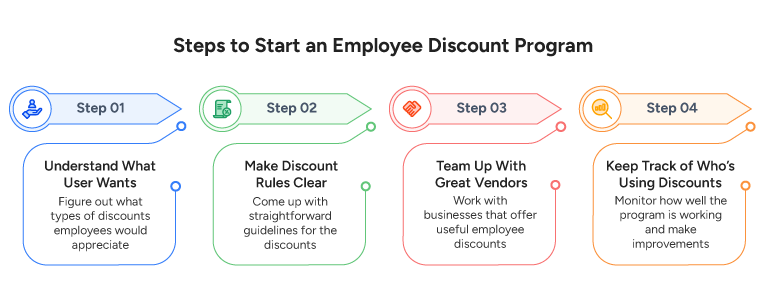
Setting up an employee discount program is more organized than most HR teams think.
Define the Policy
Before approaching any vendors or communicating with staff, create a strong HR policy. This means deciding:
- Which employees qualify, and from what date
- What categories of discount will be offered
- Are there any usage limits or exclusions
- How will the program be reviewed and updated
A clear policy protects both the company and employees and makes the program easier to manage at scale.
Partner with Vendors
Local gyms, nearby restaurants, and regional retailers are often willing to offer corporate rates in exchange for a guaranteed flow of customers. National platforms that already run corporate discount schemes are another good option.
Use HR Software to Manage Discounts
Trying to manage a discount program through spreadsheets and email threads creates confusion.
HR software centralizes everything, including which discounts are available, who is eligible, how to redeem, and which offers are most used. It also removes the burden from HR staff who would otherwise field constant questions about how to access perks.
Communicate the Benefits to Employees
Use every available channel, onboarding emails, team meetings, internal newsletters, and HR portals, to make sure employees are aware of what they have access to.
Common Challenges in Employee Discount Programs
Even good discount programs run into problems if they are not managed properly, as discussed below.
1. Low Employee Awareness
Programs fail when employees do not know about them or find them too complicated to use. This can be mitigated through simplified access and communicating more often than feels necessary.
2. Vendor Management Issues
Partner agreements can become messy over time, and managing multiple relationships manually is time-consuming. A centralized system and regular contract reviews prevent this from becoming a problem.
3. Compliance and Tax Concerns
In some countries, certain employee benefits are treated as taxable income above a threshold. This varies by region and benefit type. Always consult your payroll or finance team before finalizing anything.
4. Lack of Access for Remote Employees
Office-based perks, cafeteria discounts, local vendor deals, and on-site gym access exclude remote staff by design. Intentionally building a program that includes digital discounts and online perks ensures everyone benefits equally.
Tools like remote employee monitoring software can help HR teams stay connected to their distributed workforce and ensure remote employees are included in company benefit communications.
Best Practices for Managing Employee Discounts
To make your employee discount program work well, follow these simple practices:
- Keep the Process Simple: Plan it properly before starting so it is easy to manage.
- Promote It Regularly: Review the program and remove offers that employees don’t use.
- Offer Digital-Friendly Benefits: Make sure employees can access discounts online, especially for remote teams.
- Simplify Redemption: Keep the process quick and easy so employees do not get confused.
- Keep Improving the Program: Do not treat it as a one-time setup; update it as needs change.
- Combine with Other Benefits: Link discounts with rewards and other employee perks.
- Track What Works: Use data to identify which discounts are effective and to improve the program.
Employee Discount Policy Template
Organizations can use the following template to create their own employee discount policy.

Employee Discount Policy Sample
Company Name: BrightMart Retail Pvt. Ltd.
Policy Effective Date: 01-01-2025
Policy Owner: Human Resources Department
Purpose
BrightMart Retail Pvt. Ltd. offers employee discounts to support employee well-being and improve workplace satisfaction. This policy explains the discounts available to employees and the rules for using them.
Eligibility
All full-time and part-time employees on the company payroll are eligible for employee discounts after completing their probation period.
Interns and temporary employees may receive limited discounts if approved by the HR department.
Available Discounts
BrightMart employees may receive discounts in the following categories:
- BrightMart retail products
- Partner grocery stores
- Gym and wellness memberships
- Travel and hotel bookings
Discount Details
Current discounts available to employees include:
| Discount Type | Provider | Discount |
|---|---|---|
| Retail products | BrightMart Stores | 20% off |
| Gym membership | FitLife Gym | 15% off |
| Travel bookings | TravelEase | 10% off |
Employees can view updated discount details in the HR self-service portal.
Access and Usage
Employees must log in to the HR portal to access discount codes or offers. Discounts are for personal use only and cannot be transferred to others.
Misuse Policy
Sharing discount codes with non-employees or using discounts for resale is considered misuse. Such actions may result in disciplinary action according to company policy.
Policy Updates
The HR department reviews this policy each year. Employees will be informed of any major changes through official company communication.
Conclusion
Employee discount programs are a simple yet powerful way to improve employee satisfaction without increasing costs. The companies that get it right are not necessarily the ones spending the most; they are the ones paying attention to what their people actually need and making those benefits easy to access.
When designed properly, they help employees save money, feel valued, and stay engaged with the organization.
Start small, listen to employees, and build a program that truly adds value.
Frequently Asked Questions
Are Employee Discounts Considered Employee Benefits?
Yes, employee discounts are a type of non-monetary benefit offered to employees as part of a total rewards package.
Do Employee Discounts Increase Employee Retention?
Discounts alone will not retain employees in a job they are dissatisfied with. However, as part of a broader benefits package, they consistently show up as a retention factor.
How do Companies Offer Employee Discount Programs?
Companies offer employee discounts in three ways: directly on their own products, through negotiated deals with third-party vendors, or via employee benefits platforms that aggregate multiple offers in one place. Access is usually managed through an HR portal or company intranet.
Are Employee Discounts Taxable?
Some discounts may be taxable depending on the country and benefit type. Always consult your finance team.
Disclaimer
This policy template provides general guidance and serves as a reference only. It may not cover all applicable local, state, or federal laws and should not be treated as a legal document. The author and Workable are not responsible for any legal issues that may arise from using this policy.
Table of Contents
The most effective organizations treat professional development as a continuous strategic asset rather than an administrative checkbox.This is where an Individual Development Plan (IDP) makes a real difference. An IDP gives employees a clear path forward. It connects current performance with future career goals in a structured and practical way.
For HR and managers, it becomes a shared roadmap for individual development rather than a one-time HR activity. In this guide, you will learn what an individual development plan is, how it works in practice, and why it matters.
Key Takeaways
- Understand what an individual development plan is and why it matters
- See how IDPs support employee growth and retention
- Learn from practical individual development plan examples
- Use a simple IDP format and template for employee skill building
- Apply a clear HR process to roll out IDPs across teams
What is an Individual Development Plan (IDP)?
As per the LinkedIn Workplace Learning Report 2025, 49% of organizations are concerned that employees do not have the right skills to execute their business strategy. This misalignment highlights the urgent need for a structured individual development plan.
An IDP is a written plan that shows how an employee can grow in their role. An IDP is a shared document, not an HR form.
- The employee defines career goals and learning needs.
- The manager helps set priorities and realistic actions.
Together, they identify
- Skills to build
- Support required
- Progress review process
This partnership keeps development focused, measurable, and aligned with both employee ambition and team needs.
IDP vs. PDP vs. PIP
These plans may sound similar, but they are used for different reasons. Knowing the difference between an IDP, PDP, and PIP helps employees and managers choose the right option for growth or improvement. especially when you understand what a Performance Development Plan (PDP) is versus a PIP
| Plan | Focus | Ownership | Primary use |
|---|---|---|---|
| IDP (Individual Development Plan) | Career growth and skill development | Employee and manager | Building future-ready capabilities |
| PDP (Personal Development Plan) | Personal and professional improvement | Employee | Self-driven skill enhancement |
| PIP (Performance Improvement Plan) | Performance correction | Manager and HR | Addressing performance issues |
Benefits of Implementing IDPs
Let us understand the benefits of implementing IDPs from the perspective of both employees and organizations.
For the Employee
- Offers clarity: Employees gain clarity on which skills to enhance and how to support their long-term career goals.
- Engagement: Regular development conversations make employees feel involved in their own growth.
- Motivation: A visible growth path increases ownership. Employees put more effort into roles they see a future in.
For the Organization
- Retention: Clear development paths reduce exit risk. IDPs directly support long-term employee retention policy by showing employees a reason to stay.
- Succession planning: Managers can spot readiness early by using the 9 Box Grid and prepare future leaders in advance.
- Skill alignment: IDPs help teams focus on the right skills for current and upcoming business needs, rather than pursuing incidental training.
Key Components of an IDP Template
An effective individual development plan template should stay simple and action-focused. These are the essential fields every IDP document must include.
- Employee details: Start with the employee’s name, current position, and reporting manager. This makes it clear who the plan belongs to and who is responsible for reviewing progress. It also avoids confusion during follow-ups.
- Career goal (1–2 years): Clearly state where the employee wants to be in the next one to two years. This gives the plan a clear direction and helps align development efforts with a realistic next step.
- Strengths: Highlight what the employee does well in their current role. This helps build confidence and makes it clear that development is about growing skills, not just fixing problems.
- Development area: Document the specific skills that need improvement. These should directly support better performance or prepare the employee for the next role, rather than listing broad or vague weaknesses.
- Action plan: Explain how each skill will be developed, such as through hands-on work, learning programs, or mentoring. Actions should be clear enough to track and follow.
- Timeline: Add timeframes for each action. Deadlines help maintain focus and ensure the plan actually moves forward.
Real-World Individual Development Plan Examples
Let’s understand the individual development plan better through some real-world examples to see how it helps employees close skill gaps and grow confidently into their next role.
Example 1: The “New Manager” (Transition from Peer to Boss)
Role: Senior Developer ⮕ Team Lead
Goal: Improve delegation and conflict resolution.
The Gap: Struggles to let go of technical tasks; avoids difficult conversations.
Action Plan:
- Immediate: Delegate the daily stand-up meeting to a junior peer.
- Short-term: Read “Radical Candor” and apply one feedback technique per week.
- Medium-term: Attend a “Leadership for First-Time Managers” workshop.
Here, the workflow is simple. At first, senior developers learn to lead the daily stand-up for a junior team member and to focus more on the team than on their own work. It also helps them practice how to trust others.
Meanwhile, they learn how to practice Radical Candor that makes tough conversations feel less awkward over time. It becomes part of normal work instead of something to avoid. The leadership workshop further adds guidance on how to handle people and situations better.
Example 2: The “Skill Pivot” (Changing Direction)
Role: Customer Service Rep ⮕ Social Media Marketer
Goal: Move into the Marketing department within 12 months.
The Gap: Great product knowledge, but lacks copywriting and design skills.
Action Plan:
- 70% (Do): Volunteer to write replies to social media comments for the company page.
- 20% (Network): Shadow the Marketing Manager for 1 hour every Friday.
- 10% (Learn): Complete a “Canva for Beginners” certification.
This plan helps the employee move from customer support into a marketing role by learning on the job. Writing replies to social media comments lets them use their product knowledge while getting used to marketing-style writing. Over time, they learn what kind of tone works and how the brand should sound online.
Sitting with the Marketing Manager each week helps the employee understand how marketing actually gets done. They can see how tasks are planned, checked, and improved. The Canva course helps them learn basic design so they can create simple posts on their own. Over time, this makes the move into a marketing role feel more realistic and achievable.
Example 3: The “Soft Skill” Polish (for High Performers)
Role: Sales Executive
Goal: Handle enterprise-level clients (High-ticket sales).
The Gap: An aggressive closing style works for small deals but alienates large corporate clients. Needs “Executive Presence.”
Action Plan:
- Mentorship: Pair with the VP of Sales for monthly listening sessions.
- Practice: Lead the quarterly business review presentation for the team.
- Training: Course on “Negotiation & Emotional Intelligence.
This action plan helps the sales executive evolve from a high-energy closer into a trusted advisor for enterprise clients. Monthly listening sessions with the VP of Sales expose them to how senior leaders communicate with executives. By watching how senior leaders speak and make decisions, the executive learns a calmer and more confident way to deal with clients. This helps them move away from pushing for quick closes and focus more on building trust.
Running the quarterly business review helps them get used to speaking in front of senior leaders and leading the conversation. They practice explaining results and responding to questions in a clear way. The negotiation and emotional intelligence course teaches them how to listen more and handle client relationships better. With time, this softens their aggressive approach and prepares them to work with large clients as a team lead, not just as a salesperson.
Example 4: The “Underperformer” (Getting Back on Track)
Role: Admin Assistant
Goal: Improve time management and error rate.
The Gap: Misses deadlines and has data entry errors.
Action Plan:
- Tool: Master the advanced features of the company’s task management software.
- Habit: Implement the “Pomodoro technique” for deep work sessions.
- Check-in: Daily 5-minute sync with manager for the next 2 weeks to prioritize tasks.
This plan helps the admin assistant get back on track by fixing everyday work issues just to ensure it doesn’t get confused with a formal Performance Improvement Plan (PIP) used for performance correction. Learning the task tool properly makes it easier to organise work, remember deadlines, and avoid repeated mistakes. It gives them a clearer way to manage daily tasks.
Short focus sessions help them pay attention and make fewer mistakes. The quick daily check-ins teach how to prioritize tasks and fix small issues early. After some time, their work becomes steadier, leading to long-term professional reliability.
Example 5: The “Remote Worker” (Visibility Focus)
Role: Remote Content Writer
Goal: Increase visibility within the company to prepare for a Senior Editor role.
The Gap: Does great work but is “invisible” on Zoom calls.
Action Plan:
- Visibility: Lead one internal “Knowledge Share” session per quarter.
- Collaboration: Spearhead a cross-departmental project with the Design team.
This plan helps the remote writer become more visible at work. By leading a knowledge-share session once in a while, they get a chance to speak up, share what they know, and feel more confident in group calls. People begin to notice their input and ideas, not only the content they produce.
Being part of a project with the Design team gives them exposure beyond writing tasks. They get used to working with others, responding to feedback, and keeping things on track. With time, this builds trust and makes their work more visible. It helps them grow into someone who can support and guide others.
HR Steps to Implement an IDP Program
HR teams should follow a simple and practical process for connecting employee goals with business priorities. This clarity helps in keeping development efforts organized and trackable.
Align IDP Objectives with Business and Role Goals
First, figure out the ideal outcomes the organization expects from employees. Map those outcomes to skills employees will require in the next 12–24 months. This prevents IDPs from becoming generic learning lists.
Conduct Skills and Career Aspiration Discussions
Assess current capability using evidence from performance data and past outcomes. Define the employee’s realistic career direction, not aspirational titles. This creates an honest starting point.
Draft SMART Goals and Identify Activities
Each goal should focus on one real skill that needs improvement. For every goal, add one or two clear actions, such as helping on a project, learning from a Senior, or taking on a new responsibility. Avoid goals that are too broad or unclear.
Validate Feasibility and Secure Manager Buy-In
Before finalising the plan, make sure the workload is manageable. Managers should agree on the time needed for guidance and task sharing. If this is not discussed early, the plan is hard to follow later.
Integrate with HR Tech (LMS + PMS)
Use the learning system to assign courses and the performance system to track progress. Keeping everything in the same systems avoids confusion and helps link development to regular reviews.
Track Progress and Provide Continuous Feedback
Progress should be checked every few months, not once a year. Goals may need small changes if the role or business needs change. Regular feedback helps keep the plan useful and easy to act on.
How to Measure the Success of IDPs
Looking at results helps show if IDPs are actually working. It shows whether employees are improving their skills, performing better, and moving forward in their careers, not just completing activities.
Promotion Rate
Track how many employees move into new or higher roles after completing their plans. When more roles are filled internally, it shows the development plans are helping people prepare for the next step.
Retention Rate
Check the retention rate of strong performers after putting them through IDPs. If it is high, employees feel more engaged and clearer about their future. While a rising employee turnover ratio is usually your early warning sign. This also leads to more stable teams.
Goal Completion
Check if learners are finishing the training, projects, or certifications they agreed to. High completion rates signal that goals are realistic and employees are committed to growth.
Common Challenges and How to Overcome Them
Every IDP faces challenges in practice. Understanding common obstacles and knowing how to overcome them helps HR and managers keep development plans realistic, consistent, and effective.
Lack of Managerial Commitment
Some managers complete IDPs only to meet a requirement instead of using them for development. They focus on daily targets and set aside development discussions. As a result, the plan gets completed but is not used in regular work.
How to Overcome
Tie IDP actions to team results and performance reviews this becomes easier when your org has a clear HR strategy that defines capability-building as a manager responsibility Mak quarterly reviews mandatory. Set the expectation that people development is part of a manager’s job, not optional.
One-Size-Fits-All Templates
Sometimes, organizations use the same IDP template for every role. When it happens, employees struggle to see how IDP supports their growth. One IDP cannot target role-specific skills that differ from one employee to another, even within the same department.
How to Overcome
Keep the overall structure consistent, but tailor goals and actions based on role, level, and career direction. Development areas should reflect real skill gaps rather than generic competencies.
Data-Tracking Overload
Using too many tools, spreadsheets, and metrics may compel HR to spend more time tracking information than supporting employee development.
How to Overcome
Focus only on what truly matters, such as goals, agreed actions, and progress updates. Use a single system to record reviews and follow-ups. Avoid tracking data that does not support decisions or development outcomes.
Resistance from Employees
Some employees feel that IDPs add extra tasks to their work. Others are concerned that the information may be used to evaluate their performance. As a result, they may participate less and avoid being fully open during the process.
How to Overcome
Explain clearly that IDPs are meant to support growth, not to point out mistakes. Keep them separate from performance warnings or disciplinary discussions. Use real examples to show how development plans have helped employees move into new roles or get promoted.
Future Trends Shaping IDPs
Future trends are reshaping how IDPs work. Data, continuous feedback, and personalized learning are making development plans more flexible, relevant, and closely aligned with evolving business needs.
AI-Driven Skill-Gap Analytics
AI will analyse role data and performance signals to identify precise gaps. Pair this with better data practices and HR dashboards so skill decisions aren’t based on gut feel.This helps HR build an individual development plan that targets real needs, not assumptions. IDPs become predictive, not reactive.
Microlearning and Bite-Sized Upskilling
Short learning modules will replace long courses in most development plans. Employees upskill faster without disrupting work. This keeps the IDP plan practical and achievable.
Gamified Goal Tracking
Progress in an individual development plan for employees will be tracked through milestones, scores, and visible progress indicators. This improves follow-through and keeps motivation high across teams.
AR and VR Scenario-Based Learning
Immersive simulations can help employees build leadership, sales, and safety skills. These tools let employees practice real workplace situations in a safe setting before using those skills on the job. This helps improve confidence and overall development.
Conclusion
An effective individual development plan turns growth into action. It gives employees direction and helps managers build future-ready teams. The difference between a stagnant team and a high-performing one often comes down to how seriously development is planned and tracked.
Don’t wait for the annual review. Pilot IDPs next quarter, use a clear IDP template, and start meaningful career conversations today.
Table of Contents
It is payday, and your salary is not credited. Soon, you get messages about pending bills and late rent reminders. Writing a formal request letter for salary helps you address these stressful scenarios. As a formal document, it acts as proof during legal disputes. The Code on Wages, 2019, mandates that employers pay monthly wages by the 7th of each month. Knowing how to write a salary request letter for an increment can also help you in getting a pay raise.
Key takeaways:
- Learn to write a salary request letter for an increment, an advance, an emergency, and other purposes.
- Know the dos and don’ts of writing a request letter for salary.
- Understand what to include in the letter so that HR sees it clearly in their inbox.
- Download 5 salary request letter templates for different scenarios, like salary increments and medical emergencies.
- Understand your rights under The Code On Wages, 2019, related to timely payment from your employer.
What is a Salary Request Letter?
A salary request letter is a formal document you can send to your employer to request salary payment. Under the Code on Wages, 2019, you are entitled to timely payment of salary before the 7th of each month. Send a request letter for salary in these five scenarios.
- To claim a missed salary payment,
- To ask for an advance in case of any emergency,
- To ask for a pay hike based on your performance,
- To get a salary slip and apply for loans, and
- To receive the payment of full and final settlement when you resign.
How to Write a Salary Request Letter?
Many times, you send a salary request letter, but do not receive a reply. It could be that you did not structure the letter in a clear format and forgot to mention key details. First, we cover which components to include in your request letter for salary. Next, we briefly list all the steps to write a request letter that gets a response.
Components to Include in Your Salary Request Letter
| Standard Format Structure | |
|---|---|
| Component | What to Include |
| Sender’s Details | Name, designation, department, employee ID, contact |
| Date | Current date (DD Month YYYY) |
| Recipient’s Details | Name, designation, company/department address |
| Subject Line | Clear and concise (5–8 words) |
| Salutation | “Dear Mr./Ms. [Last Name]” or “Respected Sir/Madam” |
| Opening Paragraph | Introduce yourself + state purpose clearly |
| Body Paragraph(s) | Core request + supporting details/reasons |
| Closing Paragraph | Polite request for action + timeline mention |
| Complimentary Close | “Sincerely” / “With regards” / “Thanking you”. |
| Signature + Name | Handwritten + typed name, designation (Include a digital signature if you use one) |
| Enclosures (if any) | Attendance records, bank statements, and appointment letters |
5 Steps for Structuring Your Salary Request Letter
- Collect your employee ID, job title, and any relevant dates or records.
- Write a short subject line that tells the reader what you need. For example, a request letter for an advanced salary due to a medical emergency.
- Open with a direct sentence that shows the purpose of your letter.
- List specifics related to salary amount, advance payment, or performance-related data in the body of your letter.
- End the letter with a polite request for a response by a specific date.
After learning about writing a salary request letter, let’s see some sample templates that you can edit to send request letters.
Ready-to-Use Request Letter Templates for Salary (All 5 Types)
Here are five templates that you can use to send request letters for different purposes. Before each template, we list what details to include and who can use it.
Template 1 – Request Letter for Pending Salary
This section provides a formal application for pending salary.
- When to use it: Use this template when your monthly salary has not been deposited into your bank account by the agreed-upon date.
- Who uses it: Any employee who is facing a delay in receiving their regular monthly wages.
- Which details are required: Current month of payment, the exact amount missing, the original due date, and any mention of financial difficulties or pending bills.
Subject: Request for Pending Salary – February 2026
Dear Mr. Sharma,
I am writing to bring to your attention that my salary for February 2026 has not yet been credited to my account. My total pay of ₹55,000 was expected by 5 March 2026.
This delay has made it difficult to manage my monthly bills and expenses. I have attached my attendance records as proof for your reference. Please look into this delay and ensure the amount is released as soon as possible.
With regards,
Priya Sharma
Senior Analyst (EMP-0312)
Template 2 – Application for Advance Salary
Use this advance salary request letter for urgent financial needs.
- When to use it: Use this when you require a portion of your upcoming month’s salary early to cover an immediate, unforeseen expense.
- Who uses it: Employees facing sudden medical emergencies or critical family situations that require funds.
- Which details are required: The specific amount of advance requested, the urgent reason for the request, and a proposal for repayment through monthly deductions.
Subject: Application for Advance Salary – Medical Emergency
Respected Ma’am,
I am writing to request a salary advance of ₹30,000 for the upcoming month. My family is currently facing a medical emergency that requires immediate financial assistance.
I propose that this advance be repaid through monthly deductions of ₹10,000 from my salary over the next three months. I appreciate your understanding and support during this difficult time.
Sincerely,
Vikram Nair
Team Lead (E-2045)
Template 3 – Salary Increment Request Letter
This salary increment request letter helps you ask for a raise.
- When to use it: Use this during your annual performance review or after completing a major project or reaching a work milestone.
- Who uses it: Employees who wish to request a pay hike based on their job performance and achievements over the past year.
- Which details are required: Your job tenure, specific achievements (like client retention or new certifications), and the percentage of increment you are requesting.
Subject: Salary Increment Request – Rohit Mehta
Dear Ms. Singh,
I have been working with the company for three full years now. During this time, I have led a team of 6 and helped the company retain 18% more clients over the last 12 months. I also recently completed an AWS Cloud Architect certification.
Based on my performance and these contributions, I am requesting a 12 percent raise in my current pay. I believe this reflects industry standards for my role. I look forward to discussing this with you in our next meeting.
With regards,
Rohit Mehta
Software Engineer (EMP-5521)
Template 4 – Request Letter for Salary Slip
This salary slip request letter is for official use.
- When to use it: Use this when you need an official record of your income and tax deductions for external applications.
- Who uses it: Employees applying for home loans, vehicle loans, personal credit lines, or visa processing.
- Which details are required: The specific months for which the slips are needed and the reason for the request (e.g., bank loan application).
Subject: Request for Salary Slip – April to June 2025
Dear HR Team,
I am writing to request my salary slips for the months of April, May, and June 2025. I require these documents as proof of income for a bank loan application.
The bank has requested these files by 25 March 2026. Please share the copies of these slips at your earliest convenience.
Thanking you,
Anjali Singh
Marketing Executive (EMP-0988)
Template 5 – Salary Release Letter After Resignation
This is a salary release letter after resignation for final dues.
- When to use it: Use this once you have completed your notice period and finished the exit formalities, but have not received your final paycheck.
- Who uses it: Former employees who are following up on their Full and Final (F&F) settlement including payroll – after leaving the company.
- Which details are required: Your last working day, your previous designation, confirmation of task clearance, and updated bank details for the final credit.
Subject: Request for Final Salary Release – Rohit Mehra
Dear Mr. Gupta,
I am writing to request the release of my final settlement. My last working day as a Consultant with the company was 10 March 2026.
I have completed all exit formalities and cleared all pending tasks and company dues. Please process my final payment and credit it to the HDFC bank account. I have included my account details below for your reference.
With regards,
Rohit Mehra (EMP-7712)
Letter vs. Email – Which Format to Use?
The choice between a formal request letter and an email usually depends on the seriousness of your request and your company’s culture. While email is the standard for most day-to-day communication, a digital letter is still the best way to keep official records.
| Factor | Formal Letter | |
|---|---|---|
| Best for | Pay disputes or final settlements. | Performance raises and correcting minor errors. |
| Tone | Formal. | Relatively conversational. |
| Record-Keeping | Ideal if your company stores documents digitally. | Can be printed to PDF. |
Do’s and Don’ts when Writing a Salary Request Letter
Following a few professional rules ensures your salary request letter is well structured, and you have more chances of receiving a response. These tips help you maintain a positive relationship with HR while staying firm about your pay.
Do’s:
- List your employee ID, the missing amount, and relevant dates.
- Mention the Code on Wages, 2019, to show you understand the legal timelines for major pay-related disputes.
- Use short paragraphs so the payroll team can easily scan your request.
- Politely ask for an update or a resolution by a specific business day.
- Provide attendance records or bank statements to support your claim.
Don’ts:
- Avoid sounding angry or desperate; stick to the facts of the delay or request.
- Do not mention a coworker’s pay when asking for your own raise.
- Do not leave the subject line blank or use generic titles like “Question.”
- Do not assume that an informal conversation with your manager counts as an official record.
Salary Request Letters in Special Situations
Here are some scenarios that can take place when writing a request letter for salary.
When Salary is Delayed Due to Company Financial Trouble
If your employer is struggling with cash flow, stay professional and stick to your contract. Focus on the work you have already completed.
- State clearly that you need the advanced / missed payment to meet your financial obligations.
- The Code on Wages, 2019, protects your right to pay, even during a financial crisis.
- Keep a physical or digital copy of your conversations with HR about salary requests.
When Requesting a Salary Certificate vs. a Salary Slip
A salary slip and a salary certificate are two different documents. Read the table, and send any of the letters as per your requirement.
| Document Type | What it Shows | Best Used For |
|---|---|---|
| Salary Slip | Monthly pay and tax deductions. | Proof of income for rent. |
| Salary Certificate | Total yearly income and tenure. | Bank loans and visa applications. |
How to Follow up after Sending the Letter
Wait for 4-5 business days before you follow up. Reply to your salary request letter, and briefly remind HR about the issue. Talk to your department head or HR manager. If they still do not respond. If it’s a major dispute, you can contact the labor commissioner as well.
Provisions under the Code on Wages, 2019
One of the new labor codes, The Code On Wages, 2019, makes it mandatory that you receive timely payment. Here are some provisions that you should know related to missed payments, claims, deductions, and full and final settlement.
| Provision | Legal Requirement | Relevant Section |
|---|---|---|
| Monthly Payment | Salary must be paid by the 7th day of the following month. | Section 17(1) |
| Final Settlement | All dues must be cleared within two working days of resignation or termination. | Section 17(2) |
| Deduction Limit | Total deductions cannot exceed 50% of your wages in any month. | Section 18 |
| Claim Period | You have exactly three years from the date of the dispute to file a claim. | Section 45(6) |
| Authority for Claims | Claims must be filed with the Authority (not below the rank of a Gazetted Officer) appointed by the government. | Section 45(1) |
Conclusion
A missed payday results in financial instability. A formal salary request letter is the only way to turn a verbal complaint into a document HR must act on. Under the Code on Wages, 2019, your pay is a legal right, not a favor. Use a salary increment request letter to secure a raise or a standard request letter for salary to get your missing wages.
FAQs
When Should I Send an Application for a Pending Salary?
Send a request letter for salary after 2-3 days of the 7th of each month. The Code on Wages, 2019, requires employers to pay salaries before the 7th day of the following month.
What Should I Include in an Advance Salary Request Letter?
An advance salary request letter must state the exact amount you need and your plan to pay it back through future deductions. Providing these details in your request letter for salary helps HR approve the funds faster for emergencies.
Is a Salary Slip Request Letter Required for a Bank Loan?
Yes. Banks require official proof of income to process any loan application. A salary slip request letter ensures your employer provides the documents you need to prove your financial stability to the lender.
How Soon Should I Send a Salary Release Letter after Resignation?
The law requires your final dues to be cleared within two working days of your last day. If the company misses this deadline, send a salary release letter after resignation to claim your unpaid wages and exit benefits.
Is an Email As Valid as a Printed Salary Request Letter?
An email is faster for daily communication and is recognized as a valid record. However, for pay disputes, attaching a signed PDF salary request letter is better.
Table of Contents
Understanding the differences between payroll deductions such as PF, ESI, PT, and Income Tax (TDS) is crucial for both HR professionals and employees to ensure 100% statutory compliance in India.
Are you a small business that still calculates payroll and tax manually? Delays or errors in tax calculations can lead to compliance penalties and frustrated employees. As the total deductions on an employee’s salary fall into different categories, learning the exact difference between payroll tax vs income tax is essential to process error-free payroll and ensure employee satisfaction.
Here is everything you need to know about how these taxes work, how they are calculated, and why they matter.
What are Payroll Taxes?
A payroll tax is a fixed percentage withheld from an employee’s salary, specifically designated for Social Security, medical welfare, and retirement benefits. Under these schemes, both the employee and the employer typically share the responsibility of contributing to government-mandated funds.
Though deducted in small percentages, these taxes secure the employee’s future by providing retirement funds, disability coverage, and hospital care. Employers deduct this amount, add their matching contribution, and submit the total to the government. Employees can claim these funds later, such as during retirement or medical emergencies.
What are the Different Types of Payroll Taxes?
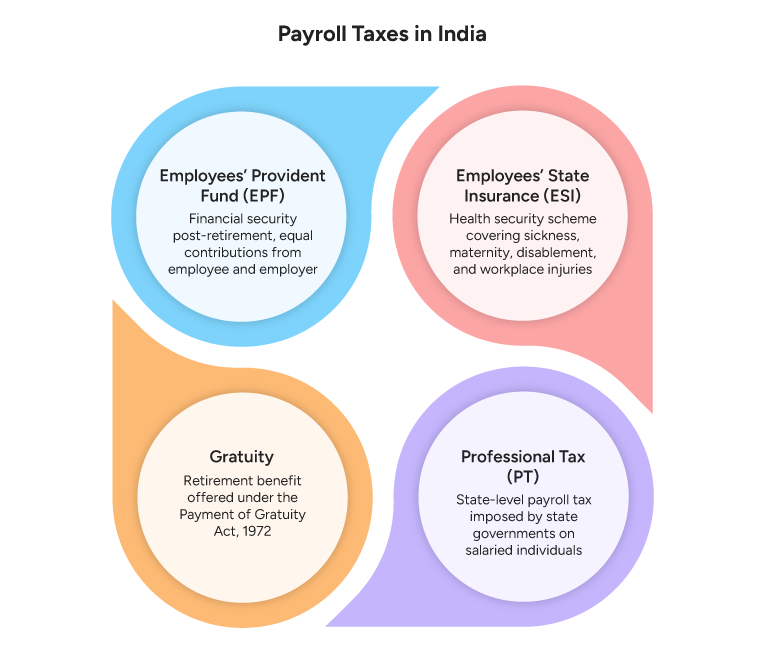
In India, statutory compliance in payroll processing requires employers to handle several types of payroll taxes. The four main categories include:
1. Employees’ Provident Fund (EPF)
Enacted under the EPF & Miscellaneous Provisions Act, 1952, this scheme ensures financial security post-retirement. It applies to organizations with 20 or more employees.
- Both the employee and employer contribute equally to the fund.
- Employee Contribution: 12% is deducted directly from the EPF.
- Employer Contribution: 3.67% goes to EPF, and 8.33% goes to the Employees’ Pension Scheme (EPS).
- These funds earn a government-mandated interest rate and must be deposited by the 15th of every month.
2. Employees’ State Insurance (ESI)
Managed by the ESI Corporation (Act of 1948), this is a self-financing health security scheme covering sickness, maternity, disablement, and workplace injuries.
- It covers employees earning up to ₹21,000 in gross wages per month.
- Employee Contribution: 0.75% of income.
- Employer Contribution: 3.25% of income.
3. Professional Tax (PT)
This is a critical deduction often confused with income tax. Professional Tax is a state-level payroll tax imposed by state governments on salaried individuals.
- The maximum limit a state can charge is ₹2,500 per year.
- It is usually deducted monthly (e.g., ₹200/month) and remitted to the state government.
- Note: Not all Indian states levy Professional Tax.
4. Gratuity
Gratuity is a retirement benefit offered under the Payment of Gratuity Act, 1972. It is a lump-sum payout given to employees as a token of appreciation for completing at least 5 continuous years of service in the same organization.
- The employer sets aside a portion of the funds to cover this.
- Formula: Gratuity = (Last drawn Salary) × (15/26) × (Total years of employment).
What is Income Tax (TDS)?
While payroll tax goes toward employee welfare, Income Tax (deducted as TDS – Tax Deducted at Source) is the employee’s contribution to the central government for the nation’s economic development and infrastructure.
Unlike payroll taxes, which have fixed percentage rates, the income tax rate is variable. It increases progressively based on the individual’s salary.
Every year, the government may update these tax slabs during the Financial Budget. Details of the TDS deducted throughout the year are recorded in Form-16, which the employer must provide to the employee.
Latest Income Tax Slabs (Default Tax Regime 2026)
As per the latest updates for FY 2025-26 (Assessment Year 2026-27), the standard deduction has been increased to ₹75,000, and income up to ₹12,00,000 is effectively tax-free due to Section 87A rebates. The base slabs are:
| Income Tax Slabs (2026) | Tax Rate |
|---|---|
| Up to ₹4,00,000 | Nil |
| ₹4,00,001 – ₹8,00,000 | 5% |
| ₹8,00,001 – ₹12,00,000 | 10% |
| ₹12,00,001 – ₹16,00,000 | 15% |
| ₹16,00,001 – ₹20,00,000 | 20% |
| ₹20,00,001 – ₹24,00,000 | 25% |
| Above ₹24,00,000 | 30% |
(Note: Employees can file Income Tax Returns (ITR) at the end of the financial year to claim refunds if excess TDS was deducted.)
Payroll Tax vs Income Tax: Head-to-Head Comparison
To understand the core differences clearly, here is a breakdown of employer vs employee tax contributions in India:
| Parameter | Payroll Taxes (PF, ESI, PT) | Income Tax (TDS) |
|---|---|---|
| Who Pays? | Both Employer and Employee (except PT, which is paid by the employee). | Employee only (Employer merely deducts and deposits it). |
| Calculation Basis | Fixed % of salary/wages (e.g., 12% for PF). | Progressive slab based on annual income. |
| What It Covers | PF, ESI, Professional Tax, Gratuity. | Tax on total income including salary, rent, investments. |
| End Benefit | Claimable by the employee (e.g., withdrawing PF after retirement). | Non-claimable (Except for claiming refunds on excess TDS paid). |
| Governing Body | EPFO, ESIC, and State Governments. | Central Government (Income Tax Department). |
| Deducted From | Partially from employee’s salary (PF, ESI); employer also contributes. | Fully deducted from employee’s taxable income. |
| Refund Possibility | Not applicable – these are statutory contributions. | Refund possible if excess tax deducted (via ITR filing). |
| Filed By | Employer files returns with EPFO, ESIC, and state PT departments. | Employee files ITR; employer files TDS returns. |
| Applicable Laws | EPF Act, ESI Act, State PT Acts. | Income Tax Act, 1961. |
| Compliance Frequency | Monthly remittance and filings. | Annual ITR; quarterly TDS filing by employer. |
| End Use | Funds employee social benefits (pension, insurance, healthcare). | Used for national development and public services. |
| Thresholds | PF: applicable for organizations with 20+ employees; ESI: salary ≤ ₹21,000/month. | Effectively tax-free up to ₹12,00,000 annually (FY 2025-26, with Section 87A rebate). |
How to Calculate Income Tax and Payroll Tax on Salary (with Example)
Let’s look at a practical example of payroll deductions in India 2026 to see how these two taxes affect an employee’s take-home pay.
Meet Rahul. He works in Maharashtra and has a CTC of ₹15,00,000/year.
- His Basic Salary is ₹7,50,000/year (₹62,500/month).
1. Payroll Tax Deductions (Monthly):
- EPF: 12% of Basic Salary = ₹7,500 deducted monthly.
- Professional Tax (PT): ₹200 deducted monthly (Maharashtra state slab).
- Total Payroll Tax Deducted = ₹7,700/month.
2. Income Tax (TDS) Deduction (Yearly Estimate):
- Rahul’s Gross Income: ₹15,00,000
- Less Standard Deduction: -₹75,000
- Taxable Income: ₹14,25,000
- Based on the 2026 slabs, tax is calculated progressively on ₹14.25 Lakhs. Once the total tax liability is found, the employer divides it by 12 and deducts it as TDS every month.
In short, the ₹7,700/month goes toward Rahul’s future security, while the TDS goes directly to the central government.
Challenges of Payroll and Income Taxes for Businesses
Managing these deductions isn’t always smooth sailing. Growing businesses often face hurdles such as:
- Multi-State Complexities: If you have employees in different states, managing varying Professional Tax (PT) slabs and local labor welfare funds becomes a headache.
- Changing Legislation: Tax slabs and rules (like the new 2026 budget updates) change frequently. Keeping a manual track of these updates often leads to costly calculation errors.
- Strict Deadlines: EPF must be deposited by the 15th, and TDS by the 7th of the following month. Missing these invites heavy fines and legal notices.
Best Practices for HR Management
To avoid salary violation charges and statutory fines, businesses must adopt modern practices:
- Automate Calculations: Manual Excel sheets are prone to human error. Use dedicated tools to automate TDS vs Payroll tax calculations.
- Regular Audits: Conduct quarterly checks to ensure TDS deposited matches the Form-16 data.
- Transparent Salary Slips: Clearly separate the “Employer PF Contribution”, “Employee PF Contribution”, and “TDS” on payslips so employees understand where their money is going.
Wrapping up
After looking closely at professional tax vs income tax and other deductions, it’s clear that both have distinct calculations and purposes. Payroll taxes secure employees’ futures, while Income tax supports the nation.
A small error in these calculations can cause severe statutory compliance issues and damage your company’s prestige. Thus, an employer must mark the difference, calculate accurately, and ensure timely payouts.
To eliminate manual errors and ensure 100% compliance with 2026 rules, explore solutions from India’s best payroll software – factoHR. Streamline your entire payroll process today and free up your valuable time to focus on business growth!
Frequently Asked Questions (FAQs)
Is Professional Tax the Same as Income Tax in India?
No, Professional Tax (PT) and Income Tax are different. Professional Tax is a state-level payroll tax capped at a maximum of ₹2,500 per year. Income Tax, on the other hand, is collected by the Central Government and is calculated progressively based on your total annual income slabs.
Are Payroll Taxes and TDS the Same Thing?
No. Payroll taxes include mandatory deductions like EPF, ESI, and Professional Tax, which are meant for the employee’s social and medical security. TDS (Tax Deducted at Source) is simply the mechanism used by the employer to deduct your estimated Income Tax in advance and deposit it with the government.
Does the Employer Match My Income Tax Deductions as They do for EPF?
No, employers do not contribute to your Income Tax. For payroll taxes like the Employees’ Provident Fund (EPF), the employer matches your 12% contribution. However, Income Tax is solely the employee’s liability; the employer merely acts as a deductor.
Can I Claim a Refund on Payroll Taxes like I Can for Income Tax?
You cannot claim a “refund” on payroll taxes in the traditional sense. You can withdraw your accumulated EPF corpus upon retirement or during specific life events. However, if excess Income Tax (TDS) was deducted from your salary, you can claim a direct refund by filing your Income Tax Return (ITR) at the end of the financial year.
Which is Calculated First on a Salary: Professional Tax or Income Tax?
Professional Tax (PT) is accounted for first. In fact, the total Professional Tax you pay throughout the financial year is allowed as a standard deduction from your gross salary under Section 16(iii) of the Income Tax Act. Only after this deduction is your final taxable income calculated for Income Tax.
Table of Contents
Problem-solving is one of the most sought-after skills in any workplace, and interviewers know exactly how to test it. Whether you are a candidate preparing for your next interview or an HR professional building a structured question bank, having the right problem-solving questions in your toolkit makes all the difference.
This guide covers the most effective problem-solving questions with answers for both sides of the table. You will find ready-to-use questions for recruiters and practical, realistic answers for candidates, all in one place.
Expert Note: Based on our experience building solutions for modern HR teams, the best problem-solving approaches don’t just fix symptoms—they also reveal a candidate’s ability to diagnose root causes and prevent issues from recurring.
What are Problem-Solving Interview Questions?
Problem-solving interview questions are behavioral and situational questions designed to assess how a candidate identifies a challenge, analyzes data, and executes a logical solution under pressure. Unlike general interview questions that focus on background, these explore real past experiences and hypothetical business scenarios.
They are also called analytical thinking questions or competency-based questions. Recruiters use them to evaluate critical thinking, decision-making, and emotional intelligence. For a broader view of what hiring managers assess, exploring complete modern HR interview questions and answers is highly recommended.
Why do Employers Ask Problem-Solving Questions?
Understanding what interviewers are really looking for helps candidates give sharper answers and helps recruiters ask better questions. Employers include these questions in every serious recruitment and selection process to evaluate four core areas:
- To assess critical thinking under real-world conditions, interviewers observe how candidates gather information, think it through, and decide what to do when the answer is not obvious.
- To evaluate decision-making style: Recruiters look for structured thinking and the confidence to commit to a course of action, even with incomplete information.
- To identify proactive vs. reactive thinking: A proactive candidate anticipates problems before they escalate, rather than just reacting to emergencies.
- To measure cognitive flexibility: Employers value candidates who exhibit cognitive flexibility by quickly shifting their approach when the first solution stops working.
What Recruiters Look for in Problem-Solving Answers
To build a structured hiring process, HR teams score candidate responses against specific behavioral signals. Below is the evaluation matrix recruiters use to separate average candidates from top performers.
| Skill Evaluated | Positive Signal (What to look for) | Red Flag (What to avoid) |
|---|---|---|
| Critical Thinking | Breaks the problem down into logical components before acting. | Jumps straight to the solution without analyzing the root cause. |
| Accountability | Uses “I did” when describing actions; takes full ownership of outcomes. | Blames the team, management, or external factors for the issue. |
| Data-Driven Thinking | Mentions specific metrics, research, or historical data to guide choices. | Relies purely on “gut feeling” or guesses without validation. |
| Adaptability | Shows a willingness to pivot quickly when the initial solution fails. | Becomes defensive, frustrated, or gives up when facing a roadblock. |
| Result Orientation | Closes the answer with measurable outcomes (e.g., % improved, hours saved). | Stops the story at the action taken, without sharing the final business impact. |
How to Use the STAR Method for Problem-Solving Questions
The STAR method is an interview framework that structures answers in a way that is logical, concise, and easy for interviewers to follow.
- Situation: Set the context briefly (1-2 sentences).
- Task: Clarify your specific role and responsibility in the scenario.
- Action: Walk through exactly what steps you took and why.
- Result: Close with the outcome, using numbers and metrics wherever possible.
Worked Example:
- Question: Tell me about a time you solved a difficult problem at work.
- Answer: “We were in the middle of a project when our main software vendor suddenly shut down with only 30 days’ notice (Situation). I needed to migrate our entire database without disrupting daily operations (Task). I mapped all our dependencies, vetted three alternative vendors, and ran a small-scale test with the most viable option before migrating the full team (Action). We successfully moved to the new system in three weeks, and the new setup actually reduced our reporting time by 15% (Result).”
Top Problem-Solving Interview Questions and Answers
This section covers the most effective problem-solving questions across three distinct categories.
Behavioral Problem-Solving Questions
1. Describe a time when you solved a problem without your manager’s help
Why recruiters ask this: To test initiative and self-reliance. They want to know you don’t need hand-holding for daily operational hurdles.
Answer: “Our weekly reports kept having errors because we were pulling data manually from three different systems. The task was creating bottlenecks. So, I took the initiative to write a simple script to consolidate the data streams into one dashboard. After that, the errors stopped completely, and the team saved about 4 hours per week.”
2. Give an example of when you identified and fixed a problem before it escalated
Why recruiters ask this: To identify proactive thinking versus reactive troubleshooting.
Answer: “While checking vendor payments, I noticed a few small duplicate entries. At first, they looked minor, but I dug deeper and realized a system glitch had been repeating these micro-payments for months. I compiled the data, presented the financial leak to the finance manager, and suggested a mandatory secondary approval workflow. We recovered the funds and prevented future leaks.”
3. Describe a situation where your first solution did not work. What did you do?
Why recruiters ask this: To test cognitive flexibility and resilience when initial plans fail.
Answer: “I introduced a new task management tool to fix missed deadlines, but team adoption dropped off within two weeks because it was too complex. Instead of forcing it, I ran a short feedback session, stripped the process back to its essentials, and switched to a simpler integrated tool we already had. Deadline adherence improved by 45% over the following six weeks.”
Situational Problem-Solving Questions
4. How would you handle a project deadline that is suddenly moved forward by two weeks?
Why recruiters ask this: To evaluate prioritization skills and stakeholder management under pressure.
Answer: “I would immediately audit the project to separate ‘must-have’ deliverables from ‘nice-to-haves’. I’d adjust the scope based on the core requirements, and then communicate proactively with stakeholders. Setting clear, realistic expectations upfront is far better than over-promising and failing to deliver.”
5. How would you respond if you discovered a process error affecting multiple departments?
Why recruiters ask this: To assess cross-functional communication and crisis containment.
Answer: “I would first identify exactly which departments are affected and contain the immediate damage. Then, I would escalate the issue to the relevant decision-makers with a concise, factual summary of the impact. Once stabilized, I’d lead a cross-functional root-cause analysis to ensure we implement a permanent preventive measure.”
Critical Thinking and Analytical Questions
6. How do you approach a problem you have never encountered before?
Why recruiters ask this: To see if a candidate possesses a repeatable, logical framework for navigating ambiguity.
Answer: “I start by defining the problem in its simplest terms to remove any panic. Then I look for historical data or consult subject-matter experts who have faced similar challenges. Once I have context, I run a small-scale test of my proposed solution to measure its effectiveness before rolling it out fully.”
7. Walk me through how you diagnose the root cause of a recurring issue
Why recruiters ask this: To separate candidates who merely fix surface symptoms from those who eliminate actual problems.
Answer: “I gather data on every instance of the issue, looking for patterns in timing, environment, or user behavior. I then apply the ‘Five Whys’ technique, drilling down past the obvious symptoms until I hit a structural or process flaw that is genuinely actionable.”
(Note: For HR panels building question banks, pairing these with specific HR manager interview questions ensures a comprehensive candidate assessment.)
Problem-Solving Interview Questions for Freshers

For entry-level candidates, interviewers focus on clear thinking, ownership, and coachability. You can effectively use examples from college projects, internships, or volunteer work.
1. Tell me about a time you solved a problem in a team setting
Why recruiters ask this: To check if a fresher can navigate interpersonal dynamics while protecting a shared goal.
Answer: “During our final year project, two team members strongly disagreed on our methodology, and progress stalled. I organized a brief meeting where we mapped out the pros and cons of both ideas visually. We ultimately combined the strongest elements of both approaches. We finished ahead of schedule and achieved the highest score in our batch.”
2. Describe a situation where you had to figure something out with no guidance
Why recruiters ask this: To test self-reliance and resourcefulness.
Answer: “In my recent internship, I was asked to prepare a competitor analysis but wasn’t given a template. Instead of waiting for instructions, I researched industry-standard frameworks, selected a SWOT model, and built the report independently. My supervisor was impressed and adopted my format for the entire department.”
Problem-Solving Questions for Experienced Candidates and Managers

Senior interviews require quantified results. A strong senior candidate proves their strategic thinking with metrics and cross-functional leadership examples.
1. Tell me about a time you solved a complex problem involving multiple departments
Why recruiters ask this: To evaluate a leader’s ability to align competing priorities and drive change without having direct authority over everyone involved.
Answer: “Our organization was facing high client churn, and three departments were blaming each other. I pulled 12 months of data and conducted exit interviews. The data clearly showed a disconnect between sales promises and the reality of onboarding. I presented this objectively to the department heads, and we collaboratively redesigned the handoff process. Churn dropped by 28% in two quarters.”
2. How have you used data to influence a strategic decision at an organizational level?
Why recruiters ask this: To verify that a manager uses data to shape business direction, not just for operational reporting.
Answer: “Leadership wanted to expand into two new regional markets simultaneously. I built a risk analysis model comparing our historical data with the regulatory environments of both regions. The data proved that one market carried an unsustainable compliance risk. Based on my presentation, the board pivoted to a single-market entry, which achieved profitability 4 months ahead of schedule. We integrated these KPIs directly into our performance management system to track success.”
Common Mistakes to Avoid in Problem-Solving Interviews
- Being Vague: Every answer must center on a specific, concrete situation.
- Playing the Blame Game: Recruiters want to hear how you fixed the issue, not who was at fault.
- Using “We” Instead of “I”: While teamwork is great, the interviewer is hiring you. Focus on your specific contribution.
- Skipping the Results: An action without a measurable result is an incomplete story. Always quantify the outcome.
- Offering a Non-Solution: Describing a problem you noticed but left for someone else to fix is a major red flag.
Frequently Asked Questions
What are the Most Common Problem-Solving Interview Questions?
The most common problem-solving interview questions include: “Describe a time you solved a problem without your manager’s help,” “How do you handle unexpected challenges under pressure?”, and “How do you diagnose the root cause of a complex issue?”
How do You Answer Problem-Solving Questions in an Interview?
You should answer problem-solving interview questions using the STAR method (Situation, Task, Action, Result). Outline the context, explain the exact steps you took to analyze and fix the issue, and conclude with a measurable, positive outcome.
What are Good Examples of Problem-Solving for an Interview?
Strong examples include identifying a financial or process error before it escalates, resolving a deep-rooted team conflict to save a project from missing its deadline, automating a manual task to save the company hours, or using data to pivot a failing strategy.
Can Freshers Answer Problem-Solving Interview Questions without Work Experience?
Yes. Freshers can successfully answer problem-solving questions by drawing examples from university group projects, internships, hackathons, or organizing campus events. The focus should be on resourcefulness and logical thinking.
Table of Contents
Wondering if you got the job after an interview? Waiting without hearing back can be stressful, but following up is completely normal and professional. A polite message shows your interest in the role and helps keep you in the recruiter’s mind. This guide will show you how to ask about your interview results the right way, including when to reach out and how to do it. It also explains what to say, so you stay professional while showing your enthusiasm.
Key Takeaways
- Understand that it’s professional and acceptable to ask for interview results.
- Learn the best timing and method for following up without seeming impatient.
- Discover how to write a polite, concise, and effective follow-up email or message.
- Know common mistakes to avoid, like sending too many messages or sounding demanding.
- Gain tips on how to request feedback after a rejection to improve your skills.
- Learn how to stay proactive, maintain professionalism, and continue applying while waiting for a response.
Is It Okay to Ask for Interview Results?
Yes, it is okay to ask for interview results. Following up shows your interest and initiative in the job. Wait about 5-7 business days after the interview, then send a short, polite email requesting an update. You can ask via email, LinkedIn, or phone, but email is the preferred method because it does not disturb recruiters and gives them time to respond.
When Should You Ask for an Interview Result?
The best time to ask about the interview outcome is after giving the recruiter enough time to review candidates and make a decision. In most cases, you should wait about 5-7 business days after the interview, or until the timeline the interviewer provided has passed.
If the Interviewer Gave a Timeline
- Wait until the scheduled date has passed.
- Send a polite follow-up 1-2 days later if you have not received an update.
If the Interviewer Gave a Timeline
- Wait 5-7 business days after the interview before asking for an update.
- This allows recruiters enough time to finish interviews and review candidates.
After a Final Interview
- If you have completed the last round, you can follow up within about one week if you haven’t heard back.
When to Send a Second Follow-Up
- If you still don’t receive a response, wait another 7-10 days before sending a second follow-up email.
Important tip: Recruiters generally recommend not sending more than two follow-up emails, as sending too many messages can make you seem impatient. A short and polite follow-up at the right time shows professionalism and interest in the job.
How to Write an Email Asking for Interview Results
Writing an email to ask about your interview results should be simple, polite, and professional. A brief follow-up or email thank you after the interview reminds the recruiter about your conversation and shows that you’re still interested in the job. Here are some easy steps to help you write an effective email.
Step 1: Use a Clear Subject Line
Start with a clear subject line so the recruiter immediately understands the purpose of your email.
Here are some examples:
- Follow-Up on [Job Title] Interview – [Your Name]
- Interview Status for [Position] – [Your Name]
Step 2: Start with Appreciation
Begin your email by thanking the interviewer for their time and the chance to interview. This helps set a polite and respectful tone.
For example:
“Thank you for dedicating the time to interview me for the [Job Title] position.”
Step 3: Mention Interview Details
Briefly remind them about your interview by mentioning the job title and the interview date. This helps the recruiter quickly remember your conversation.
For example:
“I enjoyed speaking with you on [date] about the [Job Title] role.”
Step 4: Ask for an Update Politely
Ask politely for any updates on the hiring decision. Keep your request brief and respectful.
For example:
“I wanted to check if there are any updates regarding the hiring decision.”
Step 5: Reaffirm Your Interest
Let them know you’re still interested in the position and excited about the chance to join the company.
For example:
“I remain very interested in the opportunity to contribute to your team.”
Step 6: Close Professionally
End your email with a polite closing and include your contact details.
For example:
“Thank you again for your time and consideration. I look forward to hearing from you.”
Email Templates to Ask for Interview Results
Template 1: Simple Follow-Up Email
Use this simple follow-up email after an interview to politely ask for an update. It briefly shows your continued interest in the role and keeps the message clear, professional, and respectful.
Subject: Follow-Up on [Job Title] Interview – [Your Name]
Dear [Interviewer’s Name],
Thank you for taking the time to interview me for the [Job Title] position on [Interview Date]. I really enjoyed learning more about [Company Name] and discussing [specific topic from the interview, e.g., “your team’s upcoming projects”].
I wanted to kindly ask if there are any updates regarding the hiring decision. I remain very interested in the role and would appreciate any information on the next steps.
Thank you again for your time and consideration. I look forward to your response.
Best regards,
[Your Name]
[Email Address]
Template 2: Follow-Up after no Response
Use this email template to follow up when you have not received a response after your interview. It politely asks for an update, shows continued interest in the role, and keeps the message short and respectful.
Subject: Follow-Up on [Job Title] Application – [Your Name]
Dear [Interviewer Name],
I hope you are doing well. I’m following up regarding the [Job Title] position. I understand that the hiring process can take time. I would greatly appreciate any update on the status of my application.
If the position has been filled or the timeline has changed, please let me know so I can update my records. Thank you again for the opportunity to interview.
Best regards,
[Your Name]
[Email Address]
Template 3: Follow-Up after Final Interview
Use this professional email template to politely inquire about the results of your final interview round. It expresses enthusiasm, references the interview details, and requests interview feedback if needed.
Subject: Final Interview Follow-Up – [Job Role] – [Your Name]
Dear [Interviewer/Recruiter Name],
I’m reaching out to follow up on our final interview on [Date] for the [Job Title] position. I truly enjoyed our conversation and learning more about the team’s goals for the upcoming quarter.
During our meeting, you mentioned that a decision might be reached by [Mention the date they gave you]. I wanted to check in to see if there is an updated timeline or any additional information I can provide to assist with your decision-making process.
Thank you again for the opportunity. I look forward to hearing from you.
Best regards,
[Your Name]
[Your Phone Number]
Short Message Examples (SMS/Linkedin)
Hi [Recruiter Name], this is [Your Name]. I enjoyed our discussion on [Day] about the [Role] position. I’m checking in to see if there’s an update on the next steps timeline. Thanks!
Hi [Name], reaching out to check on the [Job Title] role. If the role has been filled, I’d be glad to stay connected for future opportunities or hear any brief feedback you may have on my application. Appreciate your time! [Your Name].
Hi [Name], hope you’re having a great week! I’m following up on our interview for the [Job Title] role last [Day]. I’m still very excited about the opportunity and was wondering if you have any updates on the status of my application. Best, [Your Name].
Mistakes to Avoid when Asking for Interview Results
When asking for interview results, avoid some common mistakes. Do not follow up too soon, send too many messages, or use an aggressive tone. These mistakes can create a negative impression and may reduce your chances of getting a response. It is always better to be patient, polite, and professional.
Following up Too Soon
Wait at least a week, or until the timeline mentioned by the recruiter, before following up. Early contact may seem impatient. Giving them time shows professionalism while still expressing your interest in the job.
Sending Too Many Emails
Send only one initial follow-up, and if you don’t get a reply, send one polite reminder after a few days. Sending too many messages can annoy recruiters and make you seem desperate. Give some space between messages to stay professional and maintain a good impression.
Writing Long Emails
A follow-up email should be short and clear. Long messages can overwhelm the recruiter and reduce the chances of a quick response. Include important details like your interview date, and make it easy for the recruiter to read quickly.
Sounding Demanding
Use polite, grateful language like “I appreciate any update” instead of “When will I hear back?” Keep your message respectful and considerate of the interviewer’s time and busy schedule.
What to do if You Don’t Hear Back
Waiting to hear back after an interview can be stressful, but silence doesn’t always mean rejection. Often, the hiring team is still reviewing candidates. Here’s what to do:
- Wait Before Following Up: Give the recruiter 5-7 business days after your interview before sending a follow-up. Patience shows professionalism.
- Send a Polite Follow-Up Email: If you haven’t received a reply, send a short, respectful email reconfirming your interest. Limit follow-ups to two to avoid seeming impatient.
- Ask for an Update: Politely ask if there are any updates regarding the hiring decision. Include your interview date and job title to help the recruiter recall your application quickly.
- Continue Your Job Search: Don’t stop applying to other roles. Network, build skills, and prepare for upcoming interviews, including HR rounds.
- Request Feedback: If you get a rejection, politely ask for feedback. This helps improve your performance for future interviews.
- Stay Professional: Delays often happen for reasons beyond your control. Keep a positive, professional tone and focus on the next opportunity.
How to Ask for Interview Feedback (if Rejected)
Getting rejected after an interview can be disappointing, but it can also help you learn and improve. Hiring decisions often take time because companies review many candidates before choosing the best fit. Sending a polite follow-up message can leave a good impression and may even lead to future opportunities.
Polite Examples for Requesting Feedback
When reaching out, keep your tone appreciative and growth-oriented. Here are four ways to phrase your request:
- “Thank you for the update. If you have a moment, I’d appreciate any constructive feedback to help me grow professionally.”
- “Thank you again for the interview. I would be grateful for any suggestions on how I could improve my skills for roles like this in the future.”
- “I understand another candidate has been selected. If you’re able to share any feedback, it would help me focus on improving my skills and professional development.”
- “Thank you for the opportunity to interview. I am always looking to grow, so I would be grateful for any insights you can share regarding my interview performance.”
Benefits of Asking for Feedback
Even if you didn’t get the job, sending this message provides three major advantages:
- Career Improvement: Direct insights from a recruiter help you identify “blind spots” in your technical skills or interview style, allowing you to iterate and improve for your next application.
- Relationship Building: Responding to rejection with grace and a desire to learn sets you apart as a mature, professional candidate. It leaves a lasting positive impression on the hiring team.
- Networking Opportunities: By staying in touch, you remain on the recruiter’s radar. If a similar role opens up or if their first-choice candidate doesn’t work out, you are often the first person they reconsider.
Tips: Hiring processes often take time because companies evaluate multiple candidates. Wait 1-2 weeks after a rejection before asking for feedback. Keep your message brief and email it to the interviewer or recruiter. Avoid sounding argumentative and focus on learning and growth. If you don’t receive a response, send a polite follow-up or move on.

Conclusion
Asking about interview results shows you’re professional and interested in the job. Wait 5 to 7 business days before sending a short, polite message by email or LinkedIn. This keeps you visible to the recruiter without coming across as pushy. Whether you get a job offer or feedback, staying polite and positive helps you build good professional relationships for the future.
FAQs
Why Ask for an Update after the Interview?
Asking for an update after an interview shows your continued interest in the role and keeps your application active with the hiring team. It also provides clarity on the hiring timeline, helping you manage expectations, plan next steps, and follow up professionally.
What Should You do while Waiting for Your Interview Result?
While you wait for your interview result, continue applying to other opportunities and focus on improving your skills. This keeps your momentum going and reduces stress while you wait for a response.
What are the Best Practices for Writing an Email to Ask about Interview Status?
Wait at least 5-7 business days after the interview or the given deadline before following up. In your email, be polite and concise, mention the interview date, thank the interviewer, reaffirm your interest, and politely ask for an update on the hiring process.
How Long Should You Wait before Asking for Interview Results?
Ideally, you should wait five to ten business days after the date you were told to expect an update. If no timeline was provided, sending a polite follow-up email one to two weeks after the interview is common professional practice.
Is It Rude to Ask about Interview Results?
No, it’s not rude. Politely following up on interview results shows your interest, professionalism, and respect for the hiring process. Typically, you should send a follow-up email to HR about a week after the interview.
How Many Times Should You Follow up after an Interview?
You should generally follow up once or twice after an interview, not more than that. A first thank‑you note within 24 hours and a polite status inquiry about a week after the expected feedback date is usually enough.
Table of Contents
Hiring one employee is manageable. But what happens when you need to hire 50, 100, or even 500 people at once?
That’s when things get tricky.
Screening hundreds of resumes, scheduling back-to-back interviews, and onboarding teams in bulk can quickly turn into chaos without the right plan.
This guide breaks down everything you need to know about mass recruitment. You’ll learn when companies need to hire in bulk, how the process works step by step, and what challenges to watch out for. We’ve also included proven strategies and real-world examples from mass-hiring companies to help you hire faster without sacrificing quality.
Key Takeaways
- Understand when bulk hiring makes sense for your business needs
- Follow a clear step-by-step mass recruitment process to stay organized
- Learn the key differences between mass hiring and regular recruitment
- See how top mass hiring companies handle large-scale recruitment
- Identify common challenges that slow down bulk recruitment
- Apply best practices to speed up hiring without sacrificing quality
- Discover tools that automate and simplify the entire process
What is Mass Recruitment?
Mass recruitment (also called bulk hiring or high-volume hiring) is the process of hiring many employees at the same time for similar or multiple roles.
Instead of filling one position at a time, companies recruit dozens or even hundreds of candidates within a short period. This approach uses structured systems and automation tools to handle large volumes of applications efficiently.
What does a Mass Recruiter do?
A mass recruiter specializes in managing bulk hiring. They focus on:
- Sourcing candidates from multiple channels quickly
- Screening applications at scale using filters and automation
- Coordinating group interviews and assessment drives
- Maintaining candidate communication throughout the process
- Ensuring smooth onboarding for large batches of new hires
The mass recruiter’s meaning goes beyond traditional hiring. These professionals must balance speed with quality while keeping the candidate experience positive.
When do Companies Use Mass Recruitment?
Organizations turn to mass hiring when they need to fill many positions fast. Here are common situations:
- Business Expansion: Opening new branches, warehouses, or production units requires hiring teams quickly.
- Seasonal Demand: E-commerce and retail companies hire heavily during festivals and holiday sales.
- New Projects: IT and consulting firms bring on large teams when landing big client contracts.
- High Attrition: Call centers and BPOs replace outgoing employees regularly through bulk recruitment. Understanding employee attrition helps HR teams plan better.
- Campus Hiring: Tech companies and mass hiring companies conduct college drives to onboard fresh graduates.
- Geographic Growth: Quick commerce and delivery platforms hire in bulk when entering new cities.
- Emergency Needs: Hospitals and healthcare providers recruit nurses and support staff during health crises.
Mass Recruitment Process: Step-By-Step Guide
Here’s how to run a successful bulk hiring process from start to finish:
Step 1: Plan Your Hiring Needs
Start by asking:
- How many people do you need?
- What roles are you filling?
- What’s your deadline?
- What’s your hiring budget?
Create a detailed workforce plan based on business goals, project timelines, and expected growth. Proper manpower planning ensures you hire the right number of people at the right time.
Step 2: Define Job Roles Clearly
Write simple job descriptions for each position. Include:
- Key responsibilities
- Required skills and experience
- Qualifications needed
- Work location and shift details
Clear job descriptions help attract the right candidates and reduce confusion later.
Step 3: Choose Your Sourcing Channels
Pick platforms where your target candidates spend time:
- Job Portals: Naukri, Indeed, Monster for experienced hires
- Social Media: LinkedIn, Facebook, Instagram for wider reach
- Campus Drives: College placements for fresh graduates
- Employee Referrals: Current staff recommend qualified candidates
- Walk-in Drives: Direct interviews at your office or hiring centers
Using multiple channels increases your candidate pool.
Step 4: Promote Job Openings Widely
Post your openings across all chosen platforms. Make sure to:
- Use attention-grabbing job titles
- Highlight benefits and growth opportunities
- Keep the application process simple
- Include clear instructions on how to apply
Targeted ads on social media can help you reach specific candidate groups faster.
Step 5: Collect Applications Efficiently
Use online forms or an applicant tracking system to gather candidate data. Keep your application form short. Only ask for essential information.
Long forms discourage candidates from completing their applications.
Step 6: Screen Resumes Using Automation
Manual screening becomes impossible when you receive hundreds of applications daily.
Use an ATS or AI-powered screening tools to:
- Filter resumes based on keywords and skills
- Remove duplicate applications
- Rank candidates by qualification match
- Flag top candidates for quick review
Automation saves hours and ensures you don’t miss qualified applicants.
Step 7: Conduct Smart Interviews
For bulk hiring, traditional one-on-one interviews aren’t practical. Try these methods:
- Rapid Screening Rounds: Quick phone or video calls to verify basic qualifications.
- One-Way Video Interviews: Candidates record answers to preset questions. Recruiters review them later.
- Group Interviews: Interview multiple candidates together for roles like sales or customer service.
- Assessment Tests: Online tests for technical skills, aptitude, or personality fit.
- Panel Interviews: Shortlisted candidates meet hiring managers for final evaluation.
Mix these methods based on the role and volume.
Step 8: Shortlist and Send Offers
- Review candidate performance across all stages. Select the best fits and send offer letters promptly.
- Keep communication clear. Delayed offers lead to candidate dropouts.
Step 9: Complete Onboarding and Documentation
Prepare onboarding schedules before new hires join. This includes:
- Document collection (ID proof, certificates, bank details)
- Background verification
- Training schedules
- System access and equipment setup
Smooth onboarding makes new employees feel welcome and ready to contribute. A structured employee onboarding process reduces early turnover.
Step 10: Track Metrics and Improve
Measure these key performance indicators:
- Time-to-hire: How long the process takes from posting to offer acceptance
- Cost-per-hire: Total recruitment cost divided by number of hires
- Quality-of-hire: New employee performance and retention rates
- Candidate experience: Feedback from applicants
Use insights to fix bottlenecks and improve your next bulk recruitment drive.
Mass Recruitment vs Regular Recruitment: Key Differences
Here’s how bulk hiring differs from traditional hiring:
| Aspect | Mass Recruitment | Regular Recruitment |
|---|---|---|
| Hiring Volume | Many positions at once (50-500+) | Few positions (1-10) |
| Speed | Fast-paced, tight deadlines | Flexible timelines |
| Purpose | Expansion, seasonal needs, campus hiring | Specific role replacement |
| Process | Standardized and automated | Customized for each role |
| Screening | Automated filters, AI tools | Manual, detailed review |
| Interviews | Group, video, quick rounds | One-on-one, in-depth |
| Focus | Speed, volume, consistency | Quality, specialization, fit |
| Tools | ATS, bulk communication, automation | Basic tools, spreadsheets |
| Complexity | Requires coordination across teams | Simpler to manage |
- Both approaches have their place. Choose based on your hiring needs.
Real-Life Examples of Mass Recruitment
Let’s look at how different companies use bulk hiring:
IT Services and Mass Hiring Companies
TCS, Infosys, and Wipro conduct annual campus drives across India. They hire thousands of engineering graduates every year. These mass hiring companies use:
- Online aptitude tests to screen candidates
- Multiple interview rounds at college campuses
- Standardized training programs for new joiners
This creates a steady talent pipeline for ongoing projects.
E-Commerce during Peak Seasons
Amazon and Flipkart scale their workforce before major sales events like Prime Day and Big Billion Days.
They hire:
- Warehouse workers for sorting and packing
- Delivery executives for last-mile delivery
- Customer support staff for increased queries
Mass recruitment helps them handle 5-10x normal order volumes.
BPO and Call Centers
Teleperformance, Concentrix, and Genpact regularly conduct bulk hiring when they win new clients.
They need large customer support teams quickly to:
- Meet service level agreements
- Handle increased call volumes
- Provide 24/7 support across time zones
Their recruitment runs almost year-round.
Quick Commerce and Delivery
Swiggy, Zomato, Zepto, and Blinkit hire delivery partners in bulk when entering new cities.
This ensures:
- Faster order fulfillment
- Better area coverage
- Ability to handle peak hours
They often use walk-in drives and mobile-based applications.
Healthcare during Emergencies
Hospitals and healthcare providers recruit nurses, support staff, and technicians in bulk during:
- Health emergencies or pandemics
- Opening of new facilities
- Expansion of existing departments
Quick bulk hiring ensures uninterrupted patient care.
Common Challenges in Mass Recruitment
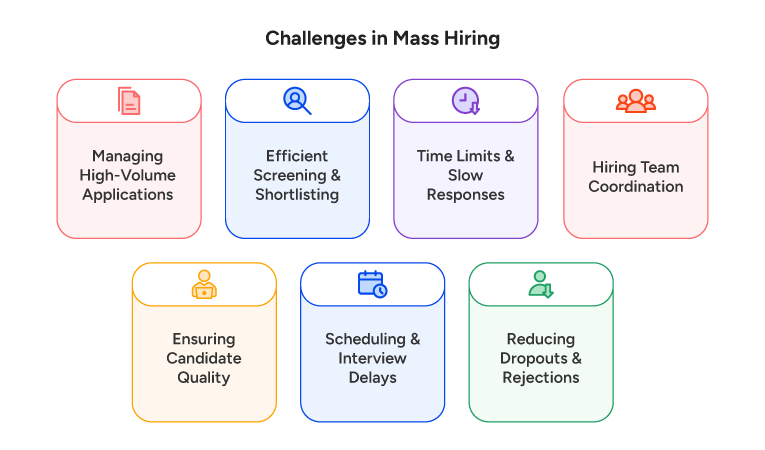
Bulk hiring comes with real obstacles. Here’s what HR teams struggle with:
Managing High Application Volumes
Receiving thousands of applications is overwhelming. Without proper systems, qualified candidates get lost in the pile.
Solution: Use an ATS to organize and track every application automatically.
Screening Candidates Efficiently
Manually reviewing hundreds of resumes takes days or weeks. This slows down the entire process.
Solution: Set clear criteria and use AI-based screening to filter candidates instantly.
Slow Communication and Delays
When dealing with large numbers, personalized communication becomes difficult. Candidates feel ignored and drop out.
Solution: Set up automated email updates at each stage. Keep candidates informed.
Poor Team Coordination
When multiple recruiters work on the same drive, miscommunication happens. Candidates might get contacted twice or not at all.
Solution: Use shared dashboards and assign clear responsibilities to each team member.
Maintaining Hiring Quality
Pressure to fill positions quickly can lead to poor hiring decisions. This increases employee turnover later.
Solution: Don’t skip essential screening steps. Use structured interviews and assessments.
Scheduling Interview Chaos
Coordinating interviews for hundreds of candidates across different locations is a logistics nightmare.
Solution: Use scheduling tools, group interviews, and one-way video interviews.
High Candidate Dropout Rates
Long hiring processes make candidates lose interest. They accept other offers before you finish.
Solution: Speed up decision-making. Keep the process under 2-3 weeks when possible.
What is Mass Mailing in Recruitment?
Mass mailing in recruitment means sending the same email to many candidates at once.
It’s used for:
- Announcing job openings to a database of candidates
- Sending interview invitations to shortlisted applicants
- Sharing updates about hiring status
- Requesting documents from selected candidates
Best practices for mass mailing:
- Personalize emails with candidate names
- Keep messages short and clear
- Include clear next steps
- Avoid spam triggers (excessive caps, too many links)
- Send from a professional email address
Mass mailing saves time, but should still feel personal and relevant.
Tools that Help in Mass Recruitment
The right technology makes bulk hiring much easier:
Applicant Tracking System (ATS)
An ATS helps you:
- Collect and organize applications in one place
- Track candidate status through each stage
- Filter resumes automatically
- Schedule interviews and send reminders
- Generate hiring reports and analytics
A good recruitment management system streamlines the entire hiring workflow.
Job Portals and Aggregators
Platforms like Naukri.com, Indeed, and Monster help you reach millions of job seekers. Post once and your opening appears across multiple sites.
AI-Based Screening Tools
These tools scan resumes for keywords, skills, and experience. They rank candidates based on job fit and save hours of manual work.
Video Interview Platforms
Zoom, Microsoft Teams, and HireVue allow remote interviews at scale. One-way video interviews let candidates record responses on their schedule.
Assessment and Testing Tools
Online platforms let you test candidates on:
- Technical skills (coding, data analysis)
- Soft skills (communication, problem-solving)
- Aptitude and reasoning
- Personality and culture fit
Smart HR Software
End-to-end HR software manages the complete employee lifecycle. From bulk hiring to onboarding, payroll, and exit, everything runs from one platform.
Communication Tools
WhatsApp Business, SMS gateways, and email automation help you stay connected with hundreds of candidates without manual effort.
Best Practices for Successful Mass Hiring
Follow these strategies to improve your bulk recruitment results:
1. Use Multiple Sourcing Channels
Don’t rely on just one platform. Mix job portals, social media, referrals, and campus drives to build a diverse talent pool.
2. Automate Wherever Possible
Use technology to handle repetitive tasks like resume screening, interview scheduling, and candidate updates. This frees your team to focus on evaluating fit.
3. Create Standardized Evaluation Criteria
Define what “qualified” means for each role. Use the same criteria across all candidates to ensure fair, consistent decisions.
4. Simplify the Interview Process
Skip unnecessary rounds. Use group interviews and video screening to evaluate more candidates faster without sacrificing quality.
5. Keep Candidates Informed
Send regular updates about their application status. Even automated messages show you value their time and keep them engaged.
6. Coordinate Your Hiring Team
Use shared tools and dashboards. Hold brief daily check-ins to align on progress and avoid duplicate work.
7. Prepare Onboarding in Advance
Don’t wait until offers are accepted. Plan training schedules, prepare documents, and set up systems before day one. Using an onboarding checklist helps ensure nothing gets missed.
8. Track Important Metrics
Monitor time-to-hire, cost-per-hire, and quality-of-hire. Use data to spot problems early and improve future drives.
9. Use Skills-Based Assessments
Online tests help you evaluate candidates objectively. They work especially well when screening large numbers quickly.
10. Build Your Employer Brand
Promote your company culture during the hiring process. Share employee stories, workplace videos, and growth opportunities to attract top talent.
11. Offer Competitive Packages
In bulk hiring, candidates compare multiple offers. Make sure your compensation and benefits stand out.
12. Follow up with Rejected Candidates
Build a talent database of good candidates who didn’t make the cut this time. They might be perfect for future openings.
How Mass Hiring Companies are Changing in 2026
Mass recruitment is evolving fast. Here’s what’s different now:
More AI and Automation
AI tools now handle screening, scheduling, and even initial interviews. This cuts hiring time by 40-50% compared to manual processes.
Mobile-First Applications
Many candidates, especially for delivery and field roles, apply through mobile apps. Companies are simplifying forms for smartphone users.
Skills over Degrees
More mass hiring companies focus on what candidates can do rather than where they studied. Skills assessments matter more than ever.
Faster Decision Making
Top companies now complete bulk hiring in 7-14 days instead of 4-6 weeks. Speed has become a competitive advantage.
Better Candidate Experience
Even in mass hiring, companies provide clear communication, quick feedback, and respectful treatment. This protects the employer brand.
Data-Driven Hiring
Recruitment teams track every metric. They know exactly where candidates drop off and continuously optimize the process.
Remote and Hybrid Options
Many bulk roles now offer flexible work arrangements. This expands the talent pool beyond geographic limits.
Conclusion
Mass recruitment isn’t just about filling seats quickly. It’s about building teams that drive your business forward.
The companies that succeed at bulk hiring in 2026 aren’t the ones who rush through it. They’re the ones who combine speed with smart systems, automation with human judgment, and efficiency with respect for candidates.
Whether you’re a mass hiring company onboarding thousands annually or a growing business planning your first bulk drive, the fundamentals stay the same. Plan carefully, use the right tools, communicate clearly, and never compromise on quality.
Start small if needed. Test your process with a pilot batch. Learn from the results. Then scale up.
The future of mass recruitment is here. And with the right approach, you can hire faster, better, and smarter than ever before.
Frequently Asked Questions
What is the Difference between Mass Recruitment and Regular Recruitment?
Mass recruitment involves hiring many people at once for multiple similar roles within a short time. Regular recruitment fills one or a few specific positions with more customized processes and longer timelines.
Is Mass Recruitment Suitable for Small Businesses?
Yes, small businesses can use bulk hiring when expanding to new locations, launching new products, or hiring seasonal workers. They just need to simplify the process and use basic automation tools to stay organized.
What is the Fastest Way to Complete Mass Recruitment?
Combine multiple sourcing channels with automation tools like an ATS. Use quick screening methods such as online assessments and group interviews. Keep communication automated but personal. Aim to complete the process in 2-3 weeks.
How do Mass-Hiring Companies Manage Interviews for Hundreds of Candidates?
They use group interviews, one-way video interviews, and assessment tests to evaluate many candidates quickly. Panel interviews or final rounds happen only for shortlisted candidates.
Can Mass Recruitment be Done without Software?
Yes, but it becomes very difficult and time-consuming as numbers grow. Manual tracking leads to missed candidates, scheduling conflicts, and poor candidate experience. Basic tools like an ATS make a huge difference.
What is Mass Mailing in Recruitment?
Mass mailing means sending the same email to multiple candidates at once. It’s used for job announcements, interview invitations, status updates, and document requests. Good mass mailing still feels personal with candidate names and relevant details.
Which Industries Use Mass Recruitment the Most?
IT services, e-commerce, BPO and call centers, quick commerce, retail, manufacturing, healthcare, and hospitality all rely heavily on bulk hiring to meet their workforce needs.
How Can I Reduce Candidate Dropout during Mass Hiring?
Speed up your process, communicate regularly, keep applications simple, provide clear timelines, and make quick decisions. Treat candidates with respect throughout the journey.
Table of Contents
Every business in this competitive world is experiencing change, and with this change, so are the HR industry and HR automation tools. Many organizations still rely on conventional and manual management of HR processes, which are time-consuming and lead to delays. With the advancement of technology, HR professionals are seeking innovative ways to manage their workforce efficiently.
HR automation tools are essential for modern organizations, streamlining and enhancing traditional HR practices. This blog will highlight the key benefits of HR automation and provide a list of tools to transform manual HR processes efficiently.
What are HR Automation Tools?
HR automation tools are software solutions that facilitate repetitive routine administrative HR tasks. These tasks include recruitment, onboarding, payroll management, and many other processes and help reduce manual errors. This is how HR professionals can focus more on other important and strategic tasks, as automation tools can save a lot of time. This will lead to a more productive workforce, and a better employee experience can be delivered.
List of 20 Best HR Automation Tools
HR automation tools are often implemented in modern organizations seeking to simplify their HR processes. They improve efficiency and enhance employee engagement. With HR automation, HR professionals can focus more on strategic decisions that drive organizations toward growth.
Below are 20 prominent HR automation tools, along with their features, pros and cons, and pricing.
- factoHR
- Jotform Workflows
- TankhaPay
- Peoplebox
- Applaud
- Workhuman
- iSmartRecruit
- OpportuneHR
- HR Cloud
- Mewurk
- Paycor
- Rippling
- Recooty
- Truein
- Teamtailor
- WorkTango
- BambooHR
- ADP
- Zoho People
- Oracle HCM
1. factoHR
factoHR is your go-to all-in-one HR software that makes managing core HR functions like a breeze! Whether it’s recruiting, tracking attendance, handling payroll, or performance management, factoHR has you covered. With its impressive features and easy-to-use interface, it boosts efficiency across your organization and helps you focus on what truly matters.
factoHR is a comprehensive mobile-friendly HRMS software that streamlines HR processes and offers incredible scalability. Its modern design lets organizations tailor modules to perfectly suit their unique needs!
Pros
- It has comprehensive features that include all the HR processes.
- Mobile app for easy access.
- Cloud-based HRMS focusing on mobile-first platform.
- Customizable modules to fit any business requirements and needs.
- Strong analytics and real-time reporting capabilities.
- Ad-hoc report builder by selecting various categories.
- Create multi-level approval workflows & automate lower-level repetitive tasks.
- Excellent customer support
Cons
- New users need time and effort to become proficient with a new system or technology.
- Some users feel that modules are complex to understand.
Pricing
factoHR offers various pricing plans customized for different businesses and sizes. Specific pricing details can be obtained directly from its website. Although factoHR is not free, you can use its free trial version to choose the most suitable plan for your business.
With factoHR’s cost-effective, all-inclusive HR management platform, any organization can optimize its core HR tasks while enhancing efficiency and performance.
2. Jotform Workflows
Jotform Workflows is a no-code automation platform designed to streamline HR processes through customizable, form-driven workflows. HR teams can automate employee onboarding, leave requests, timesheet approvals, and performance-related processes using a visual drag-and-drop builder. Thanks to conditional logic and automated notifications, it ensures tasks move seamlessly between people without manual intervention. The platform also integrates with popular tools, enabling centralized data management and real-time tracking. By reducing repetitive tasks and improving process visibility, Jotform Workflows helps HR departments operate more efficiently and deliver a better employee experience.
Pros
- Easy drag-and-drop workflow creation without coding.
- Strong HR automation with approvals and notifications.
- Integrations for seamless data syncing.
- Real-time tracking improves process visibility.
Cons
- Limited customization for highly complex workflows.
- Higher limits require paid plans.
Pricing
Jotform Workflows offers a free plan for basic usage, making it accessible for small HR teams getting started. Paid plans start from $34 per month and scale based on workflow limits and advanced features. Higher tiers provide increased automation capabilities, premium integrations, and priority support. Enterprise plans are also available with custom pricing, offering enhanced security, compliance features, and team management options for larger organizations.
3. TankhaPay
TankhaPay is an all-in-one HRMS and payroll platform specifically designed for Indian businesses of all sizes, from MSMEs to large enterprises. It simplifies the entire workforce management lifecycle, focusing heavily on accurate, automated payroll and comprehensive statutory compliance.
With powerful features like geo-smart and facial recognition attendance tracking, automated PF/ESIC/TDS compliance, and a multilingual Employee Self-Service (ESS) mobile app, TankhaPay ensures timely salary disbursements and full adherence to complex labor laws. It also offers unique managed services like Payroll Outsourcing Services, Employer of Record (EoR), and Apprentice Management (NATS), allowing businesses to scale and manage diverse workforces efficiently while reducing overhead costs.
Pros
- All-in-one HR solution from software to services it manages all
- Automated payroll and comprehensive statutory compliance (PF, ESI, TDS, etc.)
- Mobile-first platform with Geo-smart and Facial Recognition attendance
- Includes managed services like Payroll Outsourcing, Employer of Record (EoR) and Apprentice Management (NATS)
- Streamlines the entire HR process from hiring and onboarding to final settlement
- Dedicated and responsive customer support with compliance expertise
Cons
- Primarily focused on the Indian market and its specific compliance needs
4. Peoplebox
Peoplebox is a new-age, AI-native talent management and strategy execution platform designed to bridge the gap between people and business performance. By unifying OKRs, performance reviews, and employee engagement into a single source of truth, Peoplebox helps organizations move away from siloed tools and toward a goal-driven, high-performing culture.
With its “Nova” AI teammate and deep 50+ native integrations, Peoplebox embeds performance management into the tools your team already uses daily, such as Slack and Microsoft Teams. Whether you are a fast-scaling startup or a large enterprise, the platform offers the transparency and automation needed to align every individual’s work with the company’s strategic priorities.
Pros
- Strategy & Talent: Seamlessly connects OKRs, 1:1s, performance reviews, and engagement surveys in one platform.
- Exceptional Integrations: Deep “work-where-you-are” integrations with Slack, MS Teams, Jira, Asana, and 50+ other tools.
- AI-Powered Insights: Features “Nova,” an AI copilot that assists with screening, interview summaries, and coaching prompts for managers.
- Real-Time Dashboards: Provides a single-page view of company, team, and individual goals to ensure transparency and accountability.
- Highly Customizable: Offers flexible templates for 360-degree reviews, calibration sessions, and custom competency mapping.
- High Adoption Rates: Known for its intuitive UI, often requiring zero training for tech-savvy teams.
Cons
- Feature Depth: Some users may find the reporting or predictive analytics less exhaustive than specialized enterprise-only legacy systems.
- Onboarding Overhead: While easy to use, larger teams may require structured guidance to fully implement the robust OKR cascading features.
Pricing
Peoplebox offers tiered subscription plans billed annually to fit various business needs:
- Talent Management: Starts at $7/user/month (Performance reviews, 1:1s, engagement).
- OKR Platform: Starts at $8/user/month (Goal tracking, KPIs, business reviews).
- Full Suite: Range from $12 to $15/user/month for the complete professional or premium experience.
- Enterprise: Custom tailored pricing for large organizations requiring dedicated support and advanced security (SSO).
- Free Trial: A free trial is available to explore the platform before committing.
5. Applaud
Applaud is an omni-channel, HR Service Delivery platform designed for large, complex, global organizations that want to streamline employee support and automate HR work with governed agentic AI. Rather than just automating isolated tasks, Applaud orchestrates processes and HR journeys end to end, centralizes knowledge, and delivers answers and action across the channels employees use every day, reducing tickets, empowering self-serve, and keeping HR free to focus on strategic work rather than repetitive admin. Applaud’s architecture emphasizes extensibility and agility with plug-and-play integrations into existing HR systems and enterprise stacks.
Pros
- Employees get consistent HR support across tools like Microsoft Teams and Slack, not just through a single portal, with AI that answers questions and completes tasks.
- Built-in guardrails, audit trails, and policy controls ensure automation is secure, compliant, and enterprise-ready, enabling AI to coordinate multi-step tasks and decisions with the oversight organizations require.
- Designed for large, global organizations with complex HR environments, offering robust security, analytics, and support for dozens of languages.
- Connects easily with systems like Workday, SAP, Oracle, ADP, and ServiceNow, enabling automation without disrupting existing infrastructure.
Cons
- Applaud is purpose-built for complex, global organizations. Smaller companies with straightforward HR needs may not require the platform’s full breadth and depth.
- Some customers note that reporting took time to fully configure and tailor to their needs, but once set up, it delivered the visibility and insights required.
Pricing
Applaud uses a tiered pricing model based on organizational size, complexity, and module selection.
6. Workhuman
Workhuman is your go-to recognition-first HR platform that transforms traditional HR operations into meaningful, people-centric experiences. Whether it’s recognizing peers, managing performance, celebrating milestones, or gathering real-time feedback, Workhuman empowers organizations to build strong, connected workplace cultures.
With powerful AI-driven insights and a seamless mobile-friendly experience, Workhuman helps HR teams unlock deeper employee engagement and drive measurable results.
Workhuman is a cloud-based platform built for global workforces, offering scalable solutions like social recognition, performance check-ins, and employee well-being tools. Its modern interface ensures easy navigation, while deep integrations with tools like Workday, Slack, and Microsoft Teams embed recognition into the flow of everyday work.
Pros
- Enables peer-to-peer and manager-led recognition across teams
- Mobile app and integrations for quick and easy access
- Cloud-first platform with a focus on employee engagement
- Customizable recognition programs
- AI-powered analytics offering real-time workforce insights
- Built-in tools for performance check-ins and goal setting
- Excellent customer support
Cons
- New users may need time to get familiar with advanced tools
- Initial setup and customization may require guidance
Pricing
Workhuman offers tailored pricing based on organization size and feature requirements. Pricing is not publicly listed and can be obtained through a direct demo request. While Workhuman is not free, flexible packages are available and a trial or pilot version may be offered.
7. iSmartRecruit
iSmartRecruit is an AI-powered ATS and Recruitment CRM that automates hiring, helping HR teams and recruitment agencies find, engage, and hire top talent more efficiently. Its intuitive interface and AI-powered tools make it a popular choice for businesses looking to optimize their hiring strategies worldwide.
Pros
- Highly customizable with robust Java-based AI features.
- User-friendly and easy to onboard HR teams.
- Excellent customer service and value for money.
- Multilingual support for Global reach.
- Ideal for startups needing affordable, quick setups.
Cons
- Training is required for effective use.
- Complex settings, though the Support team is helpful.
Pricing
iSmartRecruit offers customized pricing based on the size and needs of the organization. For more details, contact iSmartRecruit for a tailored quote, available with a free demo.
8. OpportuneHR
A two-time award winning HRMS and payroll software, OpportuneHR has expertise in providing tailor-made software that aligns with business requirements. They have worked for most industry types including manufacturing, healthcare, AI, BSFI, and more. From core HR to analytics and AI, our features OpportuneHR designs website that address real life business scenarios.
Pros
- Artificial intelligence and analytics
- Bots to enhance employee experience
- Industry-focused tools
- Cloud access with mobile support
Cons
- Ticketing system not available for support
- Cultural bias towards Indian values.
- Specific focus on SME and startups
Pricing
Pricing for payroll software varies based on the features, number of employees, and customisation required. OpportuneHR offer flexible plans tailored to business size and needs, so it is best to request a personalised quote from them.
9. HR Cloud
HR Cloud is a modern human resources platform built on the cloud. It helps companies manage the entire employee lifecycle, from onboarding to daily engagement. The software creates a better work environment by improving communication and strengthening company culture. It gives HR teams the tools they need to automate key processes, keeping employees connected and focused.
The system works where your team works. It has a clean interface, mobile apps for access on the go, and powerful integrations. HR Cloud connects with Slack, Microsoft Teams, and Google Workspace, embedding HR functions directly into daily tasks. This approach combines process automation with user-friendly design, making it a practical solution for businesses of any scale.
Pros
- Offers extensive tools for onboarding and employee engagement.
- Includes a mobile app for convenient employee access.
- Workflows can be customized to fit specific company processes.
- Integrates with major collaboration platforms.
- Provides built-in survey and feedback mechanisms.
- Cloud-native architecture allows for easy scaling.
Cons
- Advanced features might need a more involved setup process.
- Ideal for companies ready to adopt a fully digital HR model.
Pricing
HR Cloud provides flexible pricing based on company size and specific needs. Prices are not listed publicly. Organizations must contact the company directly through its website to request a demonstration or a quote.
10. Mewurk
Mewurk is a comprehensive cloud-based workforce management software designed to streamline attendance, leave, shift, payroll, and HR operations from a single platform. It has a clean, clutter-free user interface and flexible pricing. Mewurk is for businesses that prefer straightforward and practical workforce management, without unnecessary complexity or bloat.
Pros
- Biometric (face recognition) & geo-fencing attendance tracking
- Smart leave & shift management
- Automated payroll with statutory compliance
- HR task & document management
- Mobile app for employees & managers
- Flexible, scalable pricing plans
Cons
- Currently focused on essential workforce management features for SMEs
- Larger organisations might find it a bit lean compared to enterprise-level HR platforms
- Being a fully cloud-based platform might seem less convenient for companies that prefer an on-premise HR setup.
Price
Mewurk offers a free trial of up to six months, allowing companies to experience the platform before making a decision. After the trial ends, pricing is customized based on the organisation’s size, feature requirements, and workforce.
11. Paycor
Paycor offers an integrated HR solution platform which can automate payroll processing. The software includes employee self-service portals, analytics, reporting tools, time tracking, employee management tasks, and many more.
Pros
- New-gen payroll processing features like direct deposits and automated processing
- Strong reporting capabilities and reporting tools for smooth integration of HR processes
- Excellent customer service with ESS portals on mobile app
Cons
- It can be an expensive software for small businesses or start-ups
- Some users find the interface outdated, as new updates have to be integrated manually
- Customer support can be slow or difficult to reach sometimes for “Basic” and “Essential” plans
Pricing
Paycor does not offer direct pricing, but you can try the HCM solution for free for one month. The different plans provide services to businesses with up to 50 employees.
12. Rippling
Rippling automates HR processes that seamlessly integrate with payroll and benefits. Additionally, with the support of IT and finance functions, employee management can be centralized.
Pros
- HR solution for IT industries
- Easy to use with smart navigation and integration capabilities
- Strong integration and automation features with seamless access.
Cons
- Limited customization options
- The subscription is “pay per user,” even though not all features are used.
- They do not have any standard plan, as in pay only for what you need and require
- When compared to competitors, it has a higher cost
Pricing
Pricing is customized based on company size and needs, and the plan starts at $8 per user per month. You can contact Rippling for more details.
13. Recooty
Recooty is an AI-driven recruitment platform that streamlines the hiring process for businesses of all sizes. It simplifies key tasks such as job posting, resume parsing, and candidate ranking, utilizing user-friendly tools designed to enhance recruitment efficiency.
Pros
- Intuitive User Experience: Known for being among the simplest recruitment software options, Recooty is accessible for recruiters with varying levels of expertise.
- Advanced AI Automation: The platform automates essential functions like crafting job descriptions, parsing resumes, and ranking applicants, allowing teams to save valuable time.
- Comprehensive Platform: Recooty consolidates job posting, collaborative hiring, and detailed analytics within a single system, making it convenient for users.
- Free Plan Option: Recooty provides a free plan, enabling companies to begin their hiring journey at no cost—a great advantage for small businesses.
Cons
- Fewer Integrations: Compared to some other recruitment solutions, Recooty offers limited integration options with third-party applications.
- No Mobile Application: The lack of a mobile app can hinder recruiters who need to manage their hiring processes while on the move.
Pricing
In addition to the free plan, Recooty offers several paid options: Starter Plan, Standard Plan, and Premier Plan.
A 15-day trial period is also available, allowing potential users to explore various features of the software before committing to a plan.
14. Truein
Truein is a leading time and attendance tracking solution for contract and distributed workforces. It simplifies the attendance process with AI-powered face recognition and GPS-based geofencing, ensuring accurate, hassle-free clock-ins. It helps businesses to plug revenue leakage and saves HR hours.
Pros
- AI-powered face recognition for accurate attendance tracking
- Geofencing and GPS-based clock-ins prevent fraudulent attendance
- Easily assign, rotate, and track shifts with customizable policies for overtime, late marks, and breaks.
- Real-time centralized dashboard for streamlined operations across multiple locations
Cons
- Not ideal for traditional office setups with fixed desktops and badge-based systems
- May not be necessary for small teams with a single work location where manual tracking is sufficient
Pricing
Truein offers pricing based on user size and business needs. Contact Truein to get detailed pricing.
15. Teamtailor
Teamtailor primarily focuses on the recruitment and selection process and its automation. A cloud-based applicant tracking system (ATS) provides tools like candidate tracking and employer branding to attract and retain top talent from mobile apps.
Pros
- Good recruitment features with a tracking system and other monitoring tools
- Easy-to-use platform and interface for both employers and candidates
- Good integration options with communication and collaboration across teams
Cons
- There are limited HR modules beyond the recruitment function and customization options
- May lack advanced reporting features
Pricing
To get accurate pricing, you can reach out to Teamtailor for specific rates. With the request, you will receive the quotation based on your needs.
16. WorkTango
WorkTango has automated employee engagement processes, which offers various tools. These tools include recognition rewards, surveys, feedback, goals, and performance reviews. As employees are a central part of WorkTango, engaging and retaining employees are their centralized focuses.
Pros
- A central focus on employee engagement with extra rewards
- Easy feedback collection tools
- Good analytics capabilities
Cons
- Limited traditional HR features along with poor customer support, according to some users
- Limited customization available
Pricing
WorkTango’s pricing begins at $8,000 for an annual contract. They offer tailored solutions according to the size of the organization.
17. BambooHR
BambooHR is cloud-based HRIS software that automates HR functions for small and medium-sized businesses. These functions include applicant tracking, performance management, employee engagement, and more.
Pros
- Easy to use and simplified interface with mobile app available on iOS and Android for free
- Data analytics and reporting tools for performance management
- Good customer support
Cons
- Integrating and aligning specific HR functions can be time-consuming
- Limited advanced modules for large organizations
- Sometimes, customer service response times are slow
Pricing
BambooHR offers customized monthly pricing plans based on the number of employees, i.e., over 25. Contact them for a more detailed quotation.
18. ADP
ADP is an automated HR software streamlining processes from hiring to retirement, ensuring compliance with regulations and providing support.
Pros
- One-stop solution for HR functions, which covers all the modules.
- Strong compliance support with regulations and high-security features.
- Scalability and expandable solutions for all sizes of businesses with additional tools.
Cons
- It can be difficult and complex to operate initially, and this can be time-consuming.
- High cost when compared to other competitors
Pricing
ADP’s pricing depends entirely on the services you choose. For accurate quotes and personalized options, contact the sales team.
19. Zoho People
Zoho People automates various HR tasks through its cloud-based HRMS solution. It is ideal for small to medium enterprises and easy to use software. HR tasks include employee-related services, attendance management, performance evaluations, etc.
Pros
- Affordable pricing options
- Comprehensive modules
- Better integration with other Zoho products
Cons
- UI design and interface can be difficult to understand
Pricing
Zoho People offers a range of flexible pricing plans, beginning with Essential HR and extending to People Plus. The Essential HR plan costs Rs.48 per user monthly, while the People Plus plan costs Rs.350 monthly. For further information, please visit their website.
20. Oracle HCM
Oracle HCM (Human Capital Management) is a comprehensive and integrated solution. This software is for managing the employee lifecycle, from recruitment to retirement.
Pros
- A comprehensive end-to-end solution including all HR functions
- AI-driven insights
- Strong integration capabilities with other Oracle applications
Cons
- It can be complex to implement and manage
- High cost when compared to other competitors
- Requires ongoing training for practical use.
Pricing
Oracle HCM offers tailored modules that cater to specific business requirements. Pricing is based on the number of users. For further information, please contact Oracle directly.
Explore pricing together to find the perfect tools for your needs!
| HR Automation Tools | Perfect for | Pricing |
|---|---|---|
| factoHR | Comprehensive HR management | Customized pricing available |
| HR Cloud | Modern organizations who are looking for engagement | Pricing available on request |
| Paycor | Small to medium-sized businesses | 1 month of free trial and custom pricing upon inquiry |
| Rippling | Companies wanting HR and IT integration | $8 per user per month |
| Teamtailor | Organizations focused on recruitment | Pricing available on request |
| WorkTango | Companies looking for employee engagement | $8000 minimum yearly contract |
| BambooHR | Small to medium-sized businesses | Different pricing is available based on the employees |
| ADP | Large companies with global requirements | Pricing available on request |
| Zoho People | Small to medium-sized businesses | Essential plan Rs.48/user monthlyPeople Plus plan Rs.350/ user monthly |
| Oracle HCM | Best suited for large organizations | Pricing available on request |
What are the Benefits of HR Automation Tools
There are various benefits of implementing HR automation tools in the workplace. Some of the key advantages are mentioned below for better understanding.
Enhanced Efficiency: Automation can streamline administrative tasks and increase efficiency. This is possible because it saves HR professionals time and simplifies the tasks.
Increased Accuracy: HR automation software minimizes humanly possible errors in data management and increases accuracy. This ensures consistent and accurate management of data.
Improved Employee Experience: You can simplify processes like onboarding and payroll and ensure enhanced employee experience. The automation software also provides a seamless candidate experience with an automated recruitment process.
Cost-effective: It reduces the need for manual tasks, such as data entry, record keeping, and various analytics. This automation will save costs, time, and labor.
Better Data management: It helps manage vast amounts of data efficiently. This data, which ranges from personal to performance metrics, is stored in a centralized location. This allows HR professionals to make informed decisions as well.
Improved Teamwork: Automating workflows will enhance communication, collaboration, and coordination between HR and other departments.
Scalability: It allows for scalability as organizations grow and expand. The software can quickly adapt to increased workloads.
Better Compliance: The software maintains and manages compliance with labor laws and ensures accurate record-keeping. The updates are timely and are regularly updated.
How does HR Automation Software Help Automate HR Processes?
HR automation software streamlines various HR processes, improving efficiency and effectiveness. Automating key HR functions reduces manual workload and minimizes errors. Below are five essential HR processes that benefit any organization.
Employee Onboarding
Employee onboarding software makes it easy to set up new hires or employees. Employee self-service portals help make the onboarding process smooth and efficient. This will lead to a seamless employee experience and engagement and less paperwork.
Attendance and Leave Management
Leave and attendance management are among the most repetitive and laborious tasks. Recording correct attendance is vital for accurate payroll processing. When these tasks are carried out manually, they are prone to human errors, wrong salaries, and employee resentment. The leave management system has an automated workflow approval process for leave requests, which increases efficiency.
Payroll Processing
Payroll software and processing are complex functions that ensure the HR teams make accurate and timely payments. Automating payroll processing improves efficiency multiplefold. It can also reduce human errors and administrative tasks, ensure proper compliance, and avoid legal issues or penalties.
Performance Management
Business goals are every employee’s collective effort, so focusing on individual output is essential. Performance management is a continuous process wherein you can track, evaluate, and generate automated reports and evaluations to be followed.
Recruitment and Applicant Tracking
The recruitment and selection process is not a one-time process that needs to be completed once but multiple times. It includes candidate sourcing, resume screening, interview scheduling, background checks, and more. An Applicant Tracking System (ATS) is software that can streamline various stages of the recruitment process with minimal effort and reduce the time-to-hire rate.
HR automation solutions are necessary for any modern organization to enhance its HR processes. Automating various functions of the HR process can improve efficiency and create a more engaging work environment for employees. This saves time, contributes to better decision-making, and leads to organizational success.
What Features Should You Look for in HR Automation Tool?
Selecting the right software is a significant process in any organization. Before choosing an HR automation tool, many features must be considered. Some of them are mentioned below.
- Mobile Accessibility
- Employee Self-Service
- Payroll Management
- Attendance and Leave Management
- Recruitment Management
- Performance Management
- Onboarding services
- Integration capabilities
- HR Analytics
Which HR Automation Tool is the Best?
Implementing HR automation tools is helpful for any modern organization, as they can enhance HR functions. Various options are available on the market for selecting the right HR automation tool, but factoHR stands out as one of the top choices for organizations of all sizes.
With factoHR’s all-in-one HR automation tool, you can cover the entire employee lifecycle, from recruitment to retirement. Its easy-to-use interface and mobile accessibility make it easy for both HR teams and employees to use the software. With factoHR, it is scalable for any modern workplace.

Table of Contents
Submitting a fake salary slip during hiring, onboarding, or internal verification may seem like a shortcut, but Indian law does not treat it lightly. Under the Bharatiya Nyaya Sanhita (BNS), it qualifies as forgery and fraud. For employers and HR teams, this is a serious compliance risk — one that can compromise hiring quality, payroll integrity, and organizational trust. For employees, it can lead to an FIR, immediate termination, up to 7 years in prison, and permanent damage to their career record.
This article breaks down exactly what counts as a fake salary slip, what Indian law says, how HR teams detect it, how employers can prevent payroll fraud within their organization, and what candidates and employees should do instead.
What is Considered a Fake Salary Slip? (Minor Tweak)
A fake salary slip is any payslip that has been deliberately altered, fabricated, or misrepresented to show false financial information. It need not be an entirely fabricated document to constitute fraud under Indian law. Even partial manipulation makes a salary slip legally fraudulent.
Common forms HR teams encounter include:
- Inflating basic pay or gross salary to qualify for a higher job role or better CTC offer
- Tweaking deductions like TDS, PF, or ESI to show a higher take-home income
- Using a company’s logo or letterhead without permission to make the slip look authentic
- Creating salary slips for a company that does not exist to fabricate work experience
- Changing CTC or job title to meet the salary expectations of a new employer
Any deviation from an authentic salary structure, especially one that inflates income or misrepresents employment, qualifies as a forged salary slip under Indian law.
HR teams can refer to the standard salary slip format to understand exactly what constitutes authentic documentation.
Legal Punishment for Fake Salary Slips in India
If a fake document is discovered, the affected employer has full legal authority to file an FIR and initiate criminal proceedings against the individual.
Forgery and Cheating under Indian Law (IPC and BNS)
Two primary legal provisions govern action against a fake salary slip in India. These existed under the Indian Penal Code and have now been carried forward under the Bharatiya Nyaya Sanhita (BNS), which came into effect in 2024.
1. Cheating (IPC Section 420/BNS Equivalent)
This section applies when a person uses false information to mislead an employer and, in doing so, secures a job, promotion, higher CTC, or any form of undue advantage.
- Submitting an inflated salary slip to an employer to negotiate a higher package falls directly under this provision
- Punishment includes imprisonment of up to 7 years, along with a monetary fine
- Both the person who submitted the document and anyone who helped fabricate it can be prosecuted
2. Forgery for the Purpose of Cheating (IPC Section 468/BNS Equivalent)
This section specifically targets the act of creating or using a forged salary slip with the intent to deceive.
- It applies when a fabricated document is used to gain employment or any undue professional advantage
- Punishment includes imprisonment of up to 7 years and a fine
- The offense is treated more seriously when it involves large corporations or government employers
3. Using a Forged Document as Genuine (IPC Section 471/BNS Equivalent)
You do not have to be the one who created the fake payslip to face criminal liability. Knowingly submitting a forged document as genuine is itself a punishable offense.
- Courts do not accept ignorance as a defense if evidence shows you knew the document was fake
- The punishment is the same as under Section 468, and fines apply equally to the person who submits the document as to the one who created it.
Severe Consequences of Submitting a Fake Payslip
The punishment for a fake salary slip is not limited to courts. The real damage hits careers immediately, often before any legal proceedings begin.
Impact on Job Seekers and New Employees
Submitting a fake salary slip to a new employer is the most common and most detected form of document fraud in Indian corporate hiring. Every mid-size and large organization today runs a structured Background Verification (BGV) process through third-party agencies such as AuthBridge, FirstAdvantage, and KPMG.
Here is what happens when a forged document is detected:
- Immediate termination, even if the employee has already joined and been working for weeks or months
- Offer letter cancellation if fraud is caught during pre-employment BGV before joining
- Industry blocklisting through shared BGV databases affects future hiring across companies
- A permanent adverse BGV report that follows the candidate across every future job application
- Internal escalation to legal teams, which can result in criminal prosecution under BNS provisions
- Loss of professional reputation within the industry, since HR networks and recruiter communities often share verified fraud cases
- Forfeiture of Full and Final (F&F) settlement, unpaid bonuses, and any pending incentives at the time of termination
The damage does not stop at one company. BGV agencies maintain shared records, and a fraud flag from one employer becomes visible to the next one.
Impact on Long-Term Career Growth
Beyond termination, fake salary slip fraud creates long-lasting professional consequences:
- Permanent entry in the BGV databases that every future employer can access
- Inability to clear Tier-1 company hiring processes, as top employers run the strictest verification
- Loss of reference credibility — former managers and HR contacts will not vouch for a candidate with a fraud record
- Challenges in obtaining professional certifications or roles requiring integrity clearance
- Exclusion from senior leadership roles, where background checks are significantly deeper.
How HR Teams Detect Fake Salary Slips
HR professionals today have multiple layers of verification that make detection almost inevitable. Modern HR teams combine digital tools, government portals, and direct employer outreach to verify every document.
| HR Verification Method | What It Checks |
|---|---|
| UAN verification | HR checks the employee’s UAN on the EPFO portal to confirm PF contributions and employer details |
| Form 16 verification | HR compares the salary slip with Form 16 to confirm what the previous employer reported to the Income Tax Department |
| Salary credit verification | HR reviews recent salary credit entries shared by the candidate to confirm consistency with the declared payslip |
| Employer verification through BGV | BGV agencies contact the previous employer’s HR to confirm designation, PF, and ESI deductions, tenure, and actual salary |
| Salary structure review | HR checks whether the salary structure (basic, HRA, allowances, deductions) looks realistic for the role, location, and industry |
| Offer letter & appointment letter cross-check | HR matches the payslip figures with the appointment letter issued by the previous employer |
| HRMS-to-HRMS verification | Many organizations using HRMS platforms can securely verify ex-employee records directly through trusted integrations |
| Digital signature & QR code validation | Authentic payslips from modern HRMS tools carry tamper-proof digital signatures or QR codes that HR can instantly validate |
Why You Should Never Use a Fake Payslip (and What to do Instead)
The consequences of using a fake payslip extend far beyond a rejected job application. One act of document fraud can permanently shut doors to employment and career growth. No short-term gain is worth that risk.
Legal and Honest Alternatives to Prove Income
- Submit your Form 16: Issued by your employer every financial year, it directly reflects what was reported to the Income Tax Department — one of the most credible income documents for HR teams.
- Present your offer letter or appointment letter: These clearly state your CTC and designation. HR teams treat them as legitimate proof of current employment.
- Share your UAN and PF passbook: HR can independently verify your employment history and salary contributions on the EPFO portal.
- Provide ITR acknowledgments: Income Tax Returns are filed directly with the government, making them a trusted source of income verification widely accepted by HR.
Negotiate Based on Skills, Not Inflated Numbers
Many candidates use fake payslips out of fear that their current salary will cap their next offer. The better approach is to shift the negotiation entirely.
- Look up salary benchmarks for your role and experience online. Real market data is more effective in a negotiation than an inflated payslip.
- Talk about what you have actually done, the skills you have built, and the results you have delivered. A strong track record justifies a better offer on its own.
- Be honest about what you earn and negotiate on market value. Most hiring managers respect transparency. It builds trust from day one.
Most reputable employers today are open to skill-based salary negotiations when a candidate can clearly demonstrate their value. Risking a criminal offense for a marginally better offer simply does not make sense when legitimate alternatives exist.
How Employers Prevent Payroll Fraud with factoHR
For HR leaders, business owners, and payroll managers, the risk of payroll fraud runs in two directions: catching fraudulent documents from candidates during hiring and ensuring that your organization’s salary slips cannot be tampered with, duplicated, or misused by current or former employees.
The Problem with Manual Payroll Processes
Organizations that still rely on spreadsheets, Word templates, or basic accounting tools to generate salary slips face serious risks:
- Payslips are easy to replicate, edit, and forward without any audit trail
- Company name, logo, and letterhead can be misused on forged documents
- Manual calculations lead to compliance errors in PF, ESI, TDS, and professional tax
- HR teams spend hours every month on repetitive payroll tasks instead of strategic work
- No centralized record makes ex-employee verification slow and unreliable
- Lack of role-based access exposes sensitive salary data to unauthorized personnel
How Automated Payroll Software Solves this
Using trusted payroll software ensures that every salary slip generated within your organization meets the highest standards of accuracy, compliance, and security. Here is what automated payroll management delivers for HR teams and employers:
- Tamper-proof salary slip generation with system-locked figures that cannot be manually altered after processing
- Digital signatures and QR-code verified payslips that allow any future employer to instantly validate authenticity
- Automatic statutory compliance ensuring PF, ESI, TDS, LWF, and professional tax are accurately calculated and reflected
- Complete audit trails that record every payroll action, making it easy for HR to verify the authenticity of any document issued
- Centralized employee records that HR teams can cross-reference instantly during BGV requests from other employers
- Role-based access control so only authorized HR and payroll staff can view or modify sensitive salary data
- Direct integration with EPFO and statutory portals, ensuring figures on salary slips always align with government records
- Employee Self-Service (ESS) portal, where employees can download authentic payslips anytime, reducing HR dependency
- Seamless BGV support — when a previous employer’s HR reaches out for verification, factoHR helps you respond with verified, system-generated records within minutes
For HR leaders aiming to eliminate payroll fraud risk, reduce manual workload, and strengthen compliance, adopting an end-to-end HRMS is no longer optional; it is essential.
Frequently Asked Questions
Can I Go to Jail for Providing a Fake Salary Slip?
Yes, you can face imprisonment. Submitting a fake salary slip falls under the provisions on forgery and cheating in the Bharatiya Nyaya Sanhita (BNS), which were earlier covered under IPC Sections 420 and 468. Punishment can lead to imprisonment of up to 7 years, along with a monetary fine. Both the creator and the person submitting the fake document can be prosecuted.
Will a Background Check Reveal a Fake Salary Slip?
Yes, in most cases it will be detected. Modern Background Verification (BGV) agencies cross-check UAN details with EPF passbooks, verify PF contributions, match salary data with Form 16, and directly contact previous employers. Detection is highly likely in any company with a proper BGV process.
What Happens if I am Caught with a Fake Salary Slip after Joining a Company?
Immediate termination is the most common outcome. Companies may terminate employment without notice, withhold a full and Final settlement, and file a fraud complaint under BNS provisions. The case may also be reported to BGV agencies, and the negative record can impact future job opportunities.
How Can HR Teams Quickly Verify the Authenticity of a Candidate’s Salary Slip?
HR teams can verify authenticity by cross-checking the UAN on the EPFO portal, matching salary details with Form 16, reviewing salary components for inconsistencies, contacting the previous employer’s HR, and validating digital signatures or QR codes on the payslip. HRMS platforms like factoHR further simplify this through centralized records and digital verification workflows.
How Can Employers Prevent Their Own Payslips from Being Forged?
Employers should replace manual or spreadsheet-based payroll systems with a secure HRMS that generates tamper-proof, digitally signed salary slips with audit trails. Features such as QR code validation, role-based access control, and EPFO integration help detect and prevent forgery effectively.
What is the HR Team’s Liability if a Fake Payslip Goes Undetected during Hiring?
While the primary legal responsibility lies with the individual committing fraud, HR may face internal accountability if proper verification processes were not followed. Implementing structured BGV checks and HRMS-based verification workflows helps reduce compliance and audit risks.
Table of Contents
Background verification is the process employers use to confirm that a candidate’s identity, educational qualifications, employment history, and criminal record are accurate before making a final hiring decision. In India, this typically involves checks across government databases, university records, EPFO portals, and previous employer confirmation.
This guide explains how background verification works and why it is necessary for building a reliable and secure workforce.
In this Guide, You Will Learn:
- What background verification is and why it matters
- Why do companies conduct background checks
- Types of checks involved in the process
- When background verification is done
- Step-by-step verification process in India
- Common red flags to watch during verification
- Best practices HR teams can follow
What is Background Verification?
Background verification is the process employers use during the hiring process to confirm the accuracy of a candidate’s information. It typically includes checks on identity, education, employment history, criminal records, and address details to ensure authenticity and reduce hiring risks.
This step is usually done after interviews and before final selection to help organizations build a trustworthy workforce and prevent fraud or misrepresentation.
When do Companies Perform Background Verification?
Background verification is typically conducted during the recruitment process, after a candidate clears HR interviews but before a final job offer is made. This allows employers to make an offer based on successful verification, helping reduce legal risks and prevent hiring delays.
After Interview Selection
Once a candidate clears the interviews, companies usually begin background checks to ensure the candidate is genuine. This helps HR avoid spending time and effort on someone who may have given false information about their qualifications or work history.
Before Final Job Offer
This is the most common stage, where the company gives you a conditional offer. This means the job is yours as long as you pass a background check. The company does this to protect itself by verifying your criminal record, education, and past work history before you sign a final contract.
After Employee Joins (Post-Employment Checks)
In some fast-paced industries, employees start working while the verification process continues in the background. If the final report reveals significant discrepancies or “red flags” after the start date, the company typically reserves the right to terminate the employment immediately.
Types of Background Verification Checks Companies Conduct
Identity Verification
The first step in a background check is verifying a candidate’s identity by checking their government-issued ID, like a passport, driving license, or Aadhaar card.
Address Verification
The organization may verify the candidate’s current and previous addresses to ensure they are accurate.
Employment Verification
Past employment history is verified by contacting previous employers’ HR departments to confirm job titles, responsibilities, and tenure.
Education Verification
Companies also verify a candidate’s educational qualifications by checking with the university or board that issued the certificate or degree.
Criminal Background Check
Check the applicant’s identity, education, and work experience to avoid hiring mistakes due to incorrect information.
Credit History Check
Companies may check a candidate’s credit history to understand how responsibly they handle money, but only with the candidate’s consent. This is less common or limited in many regions (including parts of India). It is usually done for senior roles or jobs in banking and finance, where handling money responsibly is crucial.
Reference Check
The organization may also perform a reference check by contacting the candidate’s previous employers or colleagues to verify their work performance, behavior, and work ethic.
Why Companies do Employee Background Verification
Companies conduct background checks to reduce hiring risks and build a reliable workforce. Many organizations use HR software to manage records, streamline hiring, and boost operational efficiency.
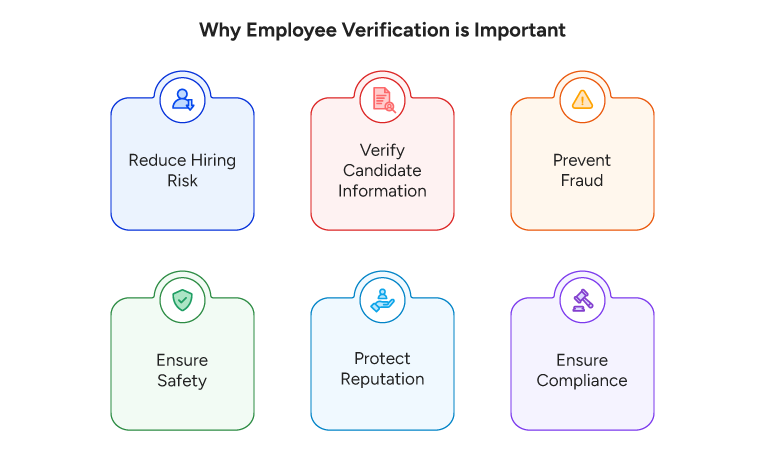
- Prevent Hiring Fraud: Background checks detect false claims and misleading information to ensure only qualified candidates are hired.
- Ensure Workplace Safety: Background checks protect employees, clients, and company property by reducing the risk of hiring individuals who may pose safety risks.
- Verify Candidate Credentials: Confirm education, employment history, and identity to prevent hiring errors caused by inaccurate information.
- Maintain Company Reputation: Hiring reliable employees increases credibility and supports company standards, and promotes a positive public image.
- Meet Legal and Compliance Requirements: Background checks help companies follow laws and regulations. It helps avoid possible legal problems and penalties.
Spending Too Much Time Drafting Verification Letters?
Use ready-to-use formats to create accurate and professional verification letters.
Background Verification Process in India (Step-by-Step Guide)
Understand how employee background verification works in India, from document collection to final verification reports. This step-by-step guide helps HR teams ensure accurate hiring while reducing compliance risks.
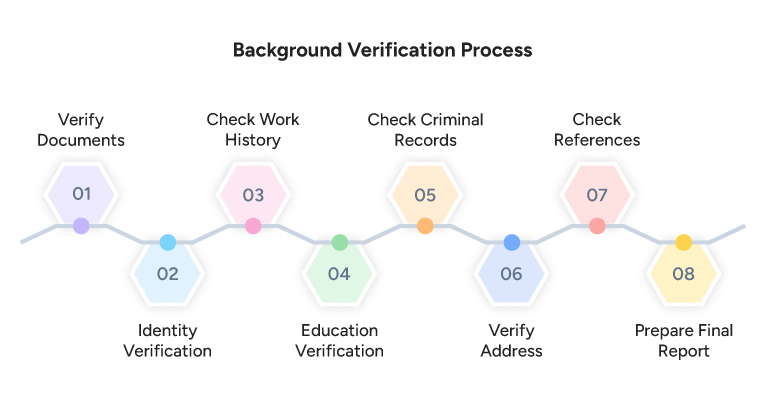
Step 1: Candidate Consent and Required Documents
Employers first obtain the candidate’s consent before starting background verification. The candidate submits KYC documents (PAN, Aadhaar), educational certificates, and employment proofs (offer/relieving letters, and last 3 months’ pay slips) for verification.
Since salary slips are among the key documents reviewed during employment verification, any discrepancy in them can be a serious red flag, especially in cases involving fake salary slip punishment in India.
These documents help verify the candidate’s details. Companies also use document management systems to store and track them securely during the hiring process.
Step 2: Identity Verification
Confirms you are who you claim to be by comparing your government-issued ID details with official records. This helps ensure there are no fake identities or false documents in your application.
Step 3: Employment History Verification
This step verifies job details, such as your role, tenure, and reasons for leaving, by contacting your previous employers and reviewing EPFO records. It helps confirm that the information on your resume matches your actual work history.
Step 4: Education Verification
Candidate’s degrees and certificates are verified with the university or official databases, such as the National Academic Depository, to ensure they are genuine.
Step 5: Criminal Record Check
This involves scanning local police records and court databases for any past or pending legal issues. It helps the employer assess a candidate’s character and ensure workplace safety.
Step 6: Address Verification
Physical or digital checks to verify the candidate’s current and permanent address.
Step 7: Reference Check
The hiring team contacts the references you provided, like your former managers or colleagues. These conversations give insights into your work ethic, performance, and behavior.
Step 8: Final Background Verification Report
All gathered information is compiled into a report and reviewed using Red/Amber/Green (RAG) status to highlight clear areas, warnings, and issues. HR uses this report to make the final hiring decision, and once everything is verified, the company proceeds with employee onboarding.
Need a Joining Letter Format?
Once verification is complete, the next step is sending a proper joining letter. Use the right format to make onboarding smooth and professional.
Common Red Flags Found during Background Verification
Verification helps find differences in a candidate’s information that could indicate potential risks in hiring. Here is a simple list of common red flags to look out for:
Fake Experience Letters
Some candidates may provide fake job letters from non-existent companies or with details that can’t be verified. Discrepancies often appear in the company logo, contact details, or the letter’s format and style.
Incorrect Employment Dates
Mismatched dates between resumes and employer records are often used to cover job gaps or to meet minimum experience requirements. Even a difference of a few months may imply a lack of integrity to a careful recruiter.
Fake Educational Degrees
Some candidates show fake or unrecognized degrees and certificates. Companies usually verify these directly with the institutions to ensure the qualifications are valid.
Criminal Record Issues
Having a record does not always mean automatic disqualification, but not disclosing a history of financial fraud or violent crime is a serious red flag. It raises concerns about workplace safety and the candidate’s honesty.
Identity Mismatch
This happens when personal details like Social Security numbers, PAN, or passport info do not match government records. Sometimes it’s just a small error, but in serious cases, it could mean identity theft or a fake identity.
Best Practices for HR Teams during Background Verification
Managing the background verification (BGV) process requires a balance between thorough checks and compliance with legal requirements, data privacy, and regulatory standards. Here is a breakdown of best practices to help the HR team remain efficient and professional.
Obtain Candidate Consent
Make sure you receive the candidate’s written and separate permission before starting any checks. This is required by law in many countries, including India. Provide clear information without extra conditions to avoid problems, and consider using e-signatures to save time.
Verify Information from Multiple Sources
Check a candidate’s details across multiple sources, such as colleges, past employers, and official records, to ensure the information is accurate. Relying on a single source can lead to mistakes or missed red flags.
Maintain Data Privacy and Security
Keep all collected information confidential and store it in secure, encrypted systems with limited access. Following data protection laws, such as GDPR and local regulations, helps prevent legal issues and protect the candidate’s sensitive information.
Use Reliable Verification Partners
Work with trusted verification agencies. Choose tech-enabled platforms that integrate with your ATS to improve speed without compromising accuracy. Review their security and compliance annually.
Keep Proper Documentation
Keep detailed records of every step, from the candidate’s consent form to the final verification report. A well-organized audit trail is important for handling disputes and showing fair hiring practices during internal audits.
Role of HR Software in Background Verification Management
HR software is no longer just used to store employee data. It helps HR teams handle background verification more efficiently, adhere to internal HR policy, and reduce manual work while ensuring accuracy.
- Centralized Employee Data: HR software stores all candidate details in a single employee database. This helps reduce mistakes and allows teams to access information easily.
- Verification Status Tracking: It offers real-time dashboards to track progress from start to finish and spot issues. HR teams receive alerts about delays, approvals, or problems, helping them make faster decisions.
- Integration with Verification Agencies: API integrations push candidate data to external verifiers and automatically pull back results. This reduces paperwork, confirms data accuracy, and attaches reports directly to employee profiles.
Conclusion
The verification process is important for employers to validate candidate credentials, reduce risks, and maintain a trustworthy workplace. By verifying identity, education, work history, and criminal records with the candidate’s consent, ensure well-informed hiring decisions and meet regulatory standards.
Ultimately, effective background checks improve company integrity, minimize errors, and, over time, promote a reliable workforce.
Frequently Asked Questions
What is Background Verification in India?
Background verification in India is a pre-employment process where employers confirm a candidate’s identity, educational qualifications, employment history, and criminal record before issuing a final offer letter. It is governed by company policy and, for consent-related requirements, by the Digital Personal Data Protection Act 2023. Most Indian companies complete standard background checks within 2 to 5 business days.
What Documents are Required for Background Verification?
Background verification in India requires three categories of documents. Identity verification requires an Aadhaar card, PAN card, or passport. To verify employment, you must submit offer letters, relieving letters, and the last three months’ salary slips. Finally, education verification demands degree certificates, mark sheets, and provisional certificates. Employers may also request a UAN number for EPFO-based employment history verification.
Background verification in India requires three categories of documents. For identity verification: Aadhaar card, PAN card, or passport. For employment verification, offer letters, relieving letters, and the last three months’ salary slips. For education verification: degree certificates, mark sheets, and provisional certificates. Employers may also request UAN number for EPFO-based employment history verification.
How Long does Background Verification Take?
This type of verification usually takes 2 to 5 business days for standard checks, such as employment or education. However, more detailed or international checks can take between 7 and 21 days.
Can a Job Offer be Canceled after Background Verification?
Yes, a job offer can be canceled if the background check finds false information, criminal records, or significant discrepancies in your details. Employers do this to avoid risks and follow their company policies.
What Happens if Background Verification Fails?
If only minor differences come up, candidates usually get a chance to explain. But for serious issues such as fake credentials or criminal records, the employer might cancel the job offer or terminate employment.
Is Background Verification Mandatory in India?
Background verification in India typically takes 2 to 5 business days for standard checks including employment and education. Criminal record checks, international employment verification, or checks involving government databases can extend the process to 7 to 21 business days. Companies using automated BGV platforms integrated with EPFO and the National Academic Depository can significantly reduce turnaround times.
Can Companies Check Criminal Records during Hiring?
Yes, companies often check criminal records when hiring to keep the workplace safe and trustworthy, especially for sensitive jobs. Employers need your consent and must comply with data privacy laws.
What is RAG Status in Background Verification?
RAG status in background verification stands for Red, Amber, and Green. Green means all checks passed with no discrepancies. Amber indicates minor inconsistencies that require clarification from the candidate before a final decision. Red flags serious discrepancies such as fake credentials, undisclosed criminal records, or identity mismatches that typically result in offer cancellation or immediate termination if discovered post-joining.
Table of Contents
Another financial year begins in India, and a few changes are already taking place. The government implemented the four new labour laws in November 2025. The Code on Wages, 2019, is one of those four new labour laws.
The wage code, 2019, regulates how you pay wages to employees and which components are part of the minimum wage. It also specifies payment modes and penalties for non-compliance. Additionally, the government notified the Code on Wages Draft Rules in December 2025, clarifying aspects related to calculating and fixing minimum wages.
This guide covers everything you need to know to comply with the wage code in 2026.
Key Takeaways
- The Code on Wages is one of the four new labor codes that regulate wages in India.
- It repeals four old laws related to minimum wages, gratuity, payment of bonus, and equal remuneration.
- COW also defines the national floor wage, sets minimum pay, and makes a few changes in the wage period.
- It also covers all types of employees, including full-time, part-time, and contractual employees, as well as workers in the unorganized sector.
- Ensure that ‘Wages’ (Basic + DA + Retaining Allowance) constitute at least 50% of the total remuneration to meet Section 2(y) requirements.
What is Code on Wages?
As one of the four new labour laws, the Code on Wages, 2019, replaces old minimum wages and compensation-related acts. Earlier, the four laws often contradicted each other and confused employers. Additionally, these laws left 80% of the workforce uncovered, as the old laws provided only minimum wages for full-time and, to an extent, part-time employees.
In effect, the old laws excluded contractual workers and employees working in the unorganized sector. Lastly, the Payment of Wages Act, 1936, only applied to workers earning less than ₹24,000.
What are the Draft Code on Wages Rules: 2025
The central government notified the Draft Code on Wages Rules, 2025, for operationalizing the COW. The rules clarify details such as the daily wage formula, criteria for fixing minimum wages, and the calculation of overtime.
Which Laws does the Code on Wages Replace?
Section 69 of the Code on Wages replaces four laws –
- The Payment of Wages Act, 1936,
- The Minimum Wages Act, 1948,
- The Payment of Bonus Act, 1965, and
- The Equal Remuneration Act, 1976
Here is a table showing what the old laws were, what they covered, and how they offered limited coverage compared to the new code.
| Repealed Law | What It Covered | Why It Was Limited |
|---|---|---|
| Payment of Wages Act, 1936 | When and how wages must be paid | Only covered employees earning up to ₹24,000/month |
| Minimum Wages Act, 1948 | Minimum wages for specific jobs | Excluded roughly 80% of the workforce |
| Payment of Bonus Act, 1965 | Annual bonus rules | Applied only to establishments with 20+ employees |
| Equal Remuneration Act, 1976 | Gender pay equality | Weak enforcement, limited scope |
What Changed under the Code on Wages?
The COW brought many changes, including minimum wages for more employees and a national floor wage. Here is a table that briefly discusses these new changes by comparing them with earlier provisions.
| Provision | Before | After |
|---|---|---|
| Coverage | Scheduled industries only | All establishments and employees (Section 2) |
| Floor Wage | Non-existent/Advisory | Legally binding (Section 9); States cannot set wages lower than the Central Floor Wage |
| Wage Definition | Differences across the 4 laws | Uniform Definition (Section 2(y)) |
| Minimum Wage Revision | Irregular | Reviewed every 5 years; VDA adjusted every 6 months |
| Overtime | Inconsistent | Minimum 2× normal rate (Section 14) |
| Equal Pay | Narrow scope | Section 3 covers all genders (including transgender) |
| Monthly Payment | Varied (7th or 10th) | 7th of the month for all establishments (Section 17) |
| Exit Settlement | 30-45 days | 2 working days post-exit (Section 17(2)) |
| Appointment Letters | Often skipped | Mandatory for all employees (Section 6 of the OSHWC Code) |
| Claims Window | 6 months to 2 years | 3 years (Section 54) |
Key Definitions under the Code on Wages
The code on wages clarifies several key terms, including –
- Wages,
- National floor wage,
- Minimum wage,
- Wage period, and
- Specific deadlines for the time of payment.
Now, let’s explore all these terms and components in detail.
1. What Counts as “Wages” under the New Law? (the 50% Rule)
Section 3 of COW specifies basic pay, dearness allowance, and retaining allowance as core components of wages. If excluded allowances exceed the 50% threshold, the excess is automatically added back to the wage base for PF and gratuity calculations. Here’s a table that will clarify which components are counted and which are excluded under the 50% rule.
| Counts as Wages | Excluded (Subject to 50% Limit) |
|---|---|
| Basic Pay | House Rent Allowance (HRA) |
| Dearness Allowance (DA) | Conveyance & Overtime |
| Retaining Allowance | Statutory Bonus & ESOPs |
| – | Gratuity & Retrenchment Compensation |
*Note: As per the Draft consolidated wage Rules, medical reimbursements like creche allowances and telecommute costs are not included in the gratuity calculation. Also, according to section 2(Y) of the code, non-cash benefits such as house rent allowance are counted as part of the minimum wage only up to 15%.
2. National Floor Wage vs. Minimum Wage: What’s the Difference?
The Code establishes a two-tier wage system to ensure a baseline standard of living across all states.
National Floor Wage
Under section 9 of the code, the central government sets national floor wages. Under rule 11 of draft COW rules, the national floor wage is calculated based on a family of four consumption units (2,700 calories/adult, clothing, and housing). No state government may set a minimum wage below the national floor wage threshold.
Minimum Wage
Set by the state government, this is the rate at which an employer must pay an employee. For minimum wages:
- Revision: The VDA is adjusted twice a year (April 1 and October 1) based on the Consumer Price Index (Rule 5).
- Formula: Minimum Wage = Basic Wage + Variable Dearness Allowance (VDA)
- Formula for daily wage: Daily Minimum Wage = Monthly Minimum Wage ÷ 26 working days
- Daily Conversion: Monthly Minimum Wage 26 working days (Rule 3(2)).
3. What is the Wage Period?
As per section 16 of COW, the wage period can be daily, weekly, fortnightly, or monthly. However, the gap between paydays should not exceed one month.
4. Payment Timelines
The Code removes previous distinctions based on establishment size, enforcing a uniform schedule for all employers. Section 17 is important here as –
- It specifies that monthly salaries must be paid by the seventh of the following month.
- Under section 17(2), full and final settlement dues must be paid within two working days.
How does the Code on Wages Affect Your Payroll?
The code on wages changes three things that you should know from a payroll compliance perspective:
Changes in Salary Structure
To comply with the Section 2(y) 50% rule, ensure that Basic Pay + DA constitutes at least 50% of the total remuneration.
Higher PF, ESI, and Gratuity
The 50% wage rule directly increases your statutory costs. Since Section 2(y) requires the “Wage” base to be at least half of the total CTC, the components calculated as a percentage of that base, specifically PF (12% of wages) and gratuity will rise proportionally, increasing the employer’s total contribution.
Timely Wage Payment Mandatory
Section 17 removes the old rules that varied by company size and requires all establishments to pay monthly wages by the 7th of the following month.
Who does the Code on Wages Cover?
The wage code covers all employees in India, including contract, fixed-term, gig, platform, part-time, and daily-wage workers.
- Full-time workers: Under Section 2(k), regular staff receive full protection. This includes the 50% wage base rule and mandatory payment by the 7th of the month(e.g., HR Executive, Accountant, Software Engineer).
- Contract Workers: Section 2(l) defines contractors as employers. This ensures that contract staff receive the legal minimum wage and a 2-working-day exit settlement under Section 17(2) (e.g., housekeeping staff, security guards hired via agencies).
- Fixed-term Workers: These employees hold the same rights as permanent staff for the length of their contract. Benefits are pro rata, and the Section 2(y) wage definitions apply in full (e.g., 6-month contract developer, project-based HR consultant).
- Gig Workers: If a “hire or reward” relationship exists under Section 2(k), the Code applies. This secures their right to minimum wages and prevents illegal pay deductions (e.g., Swiggy, Zomato delivery partners).
- Platform Workers: When classified as employees within an establishment, these workers are entitled to timely payment. This shift helps formalize digital and freelance work (e.g., Upwork, Fiverr freelancers working regularly for one company).
- Part-time Workers: Section 6 ensures these workers receive the hourly or daily equivalent of the official minimum wage. The law does not waive pay standards for shorter hours (e.g., part-time office assistant, retail store helper).
- Daily Wage Workers: Rule 3(2) of the 2025 Draft Rules sets the formula: Monthly Minimum Wage / 26 days. This division accounts for the mandatory weekly rest day (e.g., construction workers, daily labourers).
Impact on Employers and Employees
The wage code 2019 affects how you calculate and pay employees’ salaries. It also offers more protection to employees.
For Employers
- Budgeting for the 50% Rule: Restructuring salaries to meet the Section 2(y) wage cap will increase your PF, gratuity, and ESI costs.
- Payroll Policy: Reconfigure your payroll policies to comply with the “7th of the following month” deadline.
- Wage Rights: Section 60 makes any internal agreement where an employee waives their wage rights completely void, regardless of an employee’s consent.
- Equal Pay Compliance: Employers must ensure equal remuneration for the same or similar work, irrespective of gender.
For Employees
- Universal Minimum Wage: regardless of your establishment or employment type, you are entitled to minimum wage.
- Improved Financial Security: higher PF and ESI would help you in the future.
- Faster F&F settlement: You will receive your final settlement payments within two working days after your resignation.
- Gender Neutral Pay: Section 3 strictly prohibits pay discrimination based on gender for the same or similar work. This specifically includes protections for transgender employees to ensure fairness.
- Extended Claims Window: The timeframe for filing a wage claim has been extended to 3 years. This gives you more time to identify and resolve pay disputes.
Penalties for Non-Compliance
Section 54 of the wage code specifies the penalties for non-compliance. Read the table below to understand more about the specific provisions.
| Offense | Penalty | Section |
|---|---|---|
| Paying less than due wages (First offense) | Fine up to ₹50,000 | 54(1)(a) |
| Repeating underpayment (Within 5 years) | Imprisonment up to 3 months and/or fine up to ₹1,00,000 | 54(1)(b) |
| Non-compliance with other rules (First offense) | Fine up to ₹20,000 | 54(1)(c) |
| Repeating other violations (Within 5 years) | Imprisonment up to 1 month and/or fine up to ₹40,000 | 54(1)(d) |
Compliance Checklist for HR Teams: Comply with Code on Wages
Here are some factors you must include on your checklist to comply with the new wage code.
- Fix Basic and DA at 50% of CTC to cap excluded allowances
- Apply Section 2(y) wage definitions for PF and ESI base calculations
- Pay the higher rate between the state minimums and the national floor wage
- Set calendar alerts for VDA revisions in April and October
- Finalize monthly payroll by the 7th and clear F&F settlement payments within two days
- Refer to Social Security Code rules for specific gratuity exclusions and timelines
- Issue appointment letters and ensure equal pay for all contract staff
- Grant fixed-term employees gratuity eligibility after one year of service
- Pay double for overtime and monitor the 144-hour quarterly limit
- Comply with creche requirements.
- Brief your payroll team on the new labour laws.
How factoHR Helps in Complying with Code on Wages and Other Regulations
Managing payroll across multiple states involves tracking different minimum wage schedules, VDA revisions, and strict payment deadlines. A single error in a wage base or a missed deadline can quickly lead to a Section 54 notice.
As a cloud-based HRMS and payroll solution – factoHR is built to handle these requirements directly. It identifies non-compliant salary structures before they are finalized, ensuring PF and gratuity are calculated on the correct basis. The system also tracks state-specific minimum wage updates and automates exit workflows to meet the two-working-day settlement rule.
FAQs
What is the Current National Floor Wage in India?
As of April 2026, the Central Government has not fixed a specific National Floor Wage. Until an official rate is notified, individual states continue to set and enforce their own minimum wage schedules and VDA revisions independently.
What is the 50% Rule under the Code on Wages?
Section 2(y) mandates that “wages” must be at least 50% of the total remuneration. If allowances exceed half of the salary, the excess is added back to the base salary, thereby increasing the employer’s statutory contributions for PF and gratuity.
Does the Code on Wages Apply to Gig Workers?
Yes, if a “hire or reward” relationship exists under Section 2(k). While the Social Security Code of 2020 formally defines them, the Wage Code ensures they receive the legal minimum wage and are protected from unauthorized or illegal salary deductions.
When are Minimum Wages Revised under the New Wage Code?
Under Section 8, the Government must review and revise minimum rates at least every five years. Additionally, Variable Dearness Allowance (VDA) is typically adjusted twice a year to align worker earnings with the current cost of living.
What is the Difference between Floor Wage and Minimum Wage?
The Floor Wage is a national baseline set by the Center. Specific State Governments fix Minimum Wages. States can set their rates above the national floor, but they are legally prohibited from setting them below it.
When did the Code on Wages Come into Effect?
The Code on Wages was passed in 2019, but its nationwide implementation was aligned with the other three labor codes. Following extensive state-level rule-making, the unified framework became fully operational across India starting from the 2025-26 cycle.
Is Code on Wages Implemented in 2026?
Yes. Following the final notification of the 2025 Central and State Rules, the Code is now active. Establishments must comply with the 50% wage rule, 7th-of-the-month pay deadlines, and the mandatory two-working-day final settlement rule for all exits.
Table of Contents
Android developer interview questions usually test your understanding of Android basics, app architecture, Kotlin, UI handling, debugging, and performance. Whether you are preparing for your first Android role or hiring experienced talent, knowing the most common questions can help you approach interviews with more confidence.
India has a huge market for smartphone apps, and companies need skilled Android developers to meet growing demand. Finding the right talent is hard without good recruitment software. As a result, both candidates and recruiters need a practical set of questions that reflects real project work. This guide covers 40 Android developer interview questions and answers for 2026, from Activities, Fragments, and Intents to MVVM, Room, WorkManager, Jetpack Compose, and testing. It is useful for candidates, technical interviewers, and recruiters who want clear explanations and practical interview preparation.
What You Will Learn from These Android Developer Interview Questions
- Understand how the Android system runs your code.
- Learn how to explain your technical choices with confidence.
- How to pick the right background tools and data storage options.
- Discover how to talk about app crashes and bug fixes clearly.
- Get answers to common questions candidates and recruiters often ask.
Basic Android Developer Interview Questions
To begin with, these Android developer interview questions focus on the core concepts every candidate should understand before moving to architecture and advanced problem-solving.
1. What is the Android OS and Its Architecture?
Why they ask: They want to know if you understand the platform.
How to answer
Android is an open source platform. It uses a Linux kernel. The architecture has different layers. It starts with the kernel at the bottom. Then it has hardware layers and the Android Runtime. Above that is the Java API framework. System apps sit at the very top.
2. What is Clean Architecture?
Why they ask: This shows you can write code that is easy to test and grow.
How to answer
Clean Architecture splits code into layers. The Presentation layer handles the screen. The Domain layer holds the business rules. The Data layer manages databases and APIs. This keeps everything organized.
3. What is an Activity?
Why they ask: This is a core building block.
How to answer
An Activity is one single screen in your app. A login page is one Activity. Android stacks them up. When you press the back button, it takes you to the last screen.
4. How does the Activity Lifecycle Work?
Why they ask: Bad lifecycle management causes crashes and memory leaks.
How to answer
The lifecycle has specific steps. onCreate sets up the screen. onStart makes it visible. onResume makes it ready for the user to touch. onPause happens when you leave. onStop hides it. onDestroy cleans up the memory.
5. What is an Intent?
Why they ask: Intents help different parts of an app talk to each other.
How to answer
An Intent is a message. It asks for an action to happen. An explicit Intent names the exact screen to open. An implicit Intent requests a general action, such as sharing a photo.
6. What are Fragments, and when do You Use Them?
Why they ask: Fragments make apps flexible.
How to answer
Fragments are parts of a screen that you can reuse. You can put two Fragments side by side on a tablet. On a phone, you might just show one at a time. They make it easy to build dynamic screens.
7. What does the AndroidManifest File do?
Why they ask: The manifest is the rulebook for your app.
How to answer
The manifest tells the system everything about the app before it opens. It lists all the screens and services. It also asks for permissions, like using the camera or internet.
8. What is Context in Android?
Why they ask: Using Context the wrong way causes memory leaks.
How to answer
Context gives you access to system resources. Application Context lasts for the whole time the app runs. Activity Context only lasts as long as the screen is open. You use Application Context for databases and Activity Context for UI themes.
9. What is ADB?
Why they ask: They want to know if you use real tools to fix bugs.
How to answer
ADB stands for Android Debug Bridge. It connects your computer to your phone. You can use it to see live crash logs or install apps for testing.
10. What Causes an ANR, and how do You Fix It?
Why they ask: Nobody likes a frozen app.
How to answer
ANR stands for Application Not Responding. This happens if you block the main UI thread for five seconds. You fix it by moving heavy tasks to background threads using Kotlin Coroutines.
11. What is the Difference between Lazy and Lateinit in Kotlin?
Why they ask: They want to see your Kotlin skills.
How to answer
Both delay the creation of an object. You use laziness with val for things that do not change. It only loads when you need it. You use lateinit with var for things that will change. You must give it a value before you use it.
12. Why Use RecyclerView Instead of ListView?
Why they ask: RecyclerView is the modern standard for lists.
How to answer
RecyclerView is much faster. It uses a ViewHolder to recycle list items as you scroll. It also uses DiffUtil to only update the exact items that changed. This saves memory and keeps scrolling smooth.
13. What is a ViewModel?
Why they ask: This is a key part of making stable apps.
How to answer
A ViewModel holds data for a screen. It survives when the user rotates their phone. This means your data does not disappear if the screen changes size or flips.
14. How do Kotlin and Java Compare?
Why they ask: They want to know why you pick one language over the other.
How to answer
Java is fine for old apps. Kotlin is much better for new ones. Kotlin has null safety to prevent crashes. It also has extension functions to add features to existing classes easily. It takes less code to do the same job.
15. What are Sealed Classes in Kotlin?
Why they ask: This shows you know how to handle complex data states.
How to answer
A sealed class restricts the types of subclasses. The compiler knows all the possible options. This is perfect for handling network responses like success, error, or loading.
Intermediate Android Developer Interview Questions
Once the basics are clear, interviewers usually move to architecture, background tasks, local storage, and API handling to assess practical development skills.
16. How does MVVM Architecture Work?
Why do they ask: MVVM is the standard way to build Android apps today.
How to answer
MVVM has three parts. The Model handles the data logic. The View displays the screen. The ViewModel connects the two. The View watches the ViewModel for any updates using LiveData or StateFlow.
17. How is MVVM Different from MVP?
Why they ask: They want to see if you understand app design history.
How to answer
MVP uses a Presenter to tell the View exactly what to do through interfaces. MVVM does not talk to the View directly. Instead, the View just observes the ViewModel. This makes MVVM much easier to test.
18. What does the Repository Pattern do?
Why they ask: This tests how you handle offline caching and data.
How to answer
The Repository sits between the ViewModel and your data. The ViewModel asks the Repository for information. The Repository decides if it should get fresh data from the internet or use offline caching from a local database.
19. How does LiveData Work?
Why they ask: LiveData keeps the UI safe.
How to answer
LiveData holds data that the screen can observe. It is aware of the Activity lifecycle. It only updates the screen when the screen is actually visible. This stops background crashes.
20. What is Room, and how does It Compare to SQLite?
Why they ask: Storing data locally is a common task.
How to answer
SQLite makes you write long database queries by hand. A room is a wrapper that makes it much easier. Room checks your code as you type. It prevents errors before the app even runs.
21. What is the Difference between DataStore and SharedPreferences?
Why they ask: DataStore is the new standard for saving small bits of data.
How to answer
SharedPreferences is old and can block the main thread. DataStore is modern and uses Kotlin Coroutines. It is safer and prevents data corruption. You should use DataStore for all new projects.
22. When do You Use WorkManager?
Why they ask: Background tasks can be tricky.
How to answer
You use WorkManager for jobs that must finish. This includes uploading a file or syncing data. WorkManager makes sure the job runs even if the user closes the app or restarts their phone.
23. What are Services in Android?
Why they ask: Services run in the background.
How to answer
A Foreground Service shows a notification, like a music player. A Background Service runs quietly. A Bound Service connects directly to a screen. Today, we mostly use WorkManager instead of background services.
24. How do You Use Kotlin Coroutines?
Why they ask: Coroutines handle heavy lifting without freezing the app.
How to answer
Coroutines run tasks in the background without blocking the main thread. For network calls, developers usually use the IO dispatcher, while UI updates run on the Main dispatcher. This approach keeps the app responsive and makes asynchronous work easier to manage.
25. What is Retrofit?
Why they ask: Apps need to talk to the internet.
How to answer
Retrofit is a tool that connects your app to web APIs. You create an interface with the web addresses. Retrofit turns those addresses into actual network calls inside a coroutine.
26. How does Jetpack Navigation Work?
Why they ask: Modern apps use a single Activity and swap out Fragments.
How to answer
Jetpack Navigation manages how a user moves through your app. It handles the back button perfectly. It uses a visual graph to show exactly how screens connect to each other.
27. What is Jetpack Compose?
Why they ask: Compose is the new way to build Android screens.
How to answer
Compose replaces old XML files. You build the UI using Kotlin functions. When the data changes, Compose automatically redraws the screen. It is much faster and requires less code.
28. How do You Handle App Permissions?
Why they ask: Android protects user privacy.
How to answer
You must ask the user for sensitive permissions while they use the app. If they say no, you must handle it gracefully. You should tell them why you need the camera or location before you ask.
29. What is Dependency Injection with Hilt?
Why they ask: Large apps need organized code.
How to answer
Dependency Injection gives a class the tools it needs from the outside. You do not build them inside the class. Hilt is a library that does this for you automatically. It makes testing very easy.
30. How do You Load Long Lists of Data?
Why they ask: Loading everything at once crashes the app.
How to answer
I use Jetpack Paging. It loads a small chunk of data at a time. As the user scrolls down, it fetches the next chunk. This saves memory and keeps the app running fast.
Advanced Android Developer Interview Questions
At the senior level, Android developer interview questions focus more on performance, security, debugging, maintainability, and real production challenges.
31. How do You Optimize an Android App?
Why they ask: Fast apps keep users happy.
How to answer
I use the Android Studio Profiler first. I look for spikes in memory or CPU usage. I move heavy tasks to background threads. I also make sure images are sized correctly so they do not eat up RAM.
32. How do You Find a Memory Leak?
Why they ask: Memory leaks eventually crash the app.
How to answer
I use a tool called LeakCanary. It watches the app while I test it. If an old screen does not get deleted from memory, LeakCanary shows me the exact line of code causing the problem.
33. How do Kotlin Flows Compare to LiveData?
Why they ask: Flow is a powerful tool for complex data.
How to answer
LiveData is great for simple UI updates. Kotlin Flow is better for complex streams of data. Flow has more tools to filter and combine data. You can use StateFlow to replace LiveData completely.
34. How do You Keep Coroutines Safe?
Why they ask: Runaway background tasks drain the battery.
How to answer
I tie every coroutine to a specific scope. If the user leaves a screen, the ViewModelScope cancels the coroutine instantly. This stops the app from downloading data that no one will see.
35. Why Use a Multi-Module Architecture?
Why they ask: Huge apps take too long to build.
How to answer
I split the app into smaller feature modules. If I only change the search screen, the compiler only rebuilds the search module. This makes building the app much faster for the whole team.
36. Have You Built Custom Views?
Why they ask: Sometimes standard buttons are not enough.
How to answer
Yes. I try to only redraw the view when something actually changes. I avoid creating new objects inside the draw function because it runs many times a second. In Compose, I use the built in animation tools.
37. How do You Secure User Data?
Why they ask: Security is critical for banking or shopping apps.
How to answer
I use the Android Keystore to hold encryption keys safely. I use EncryptedSharedPreferences to hide sensitive user data. If the app needs extra security, I use the BiometricPrompt API for fingerprint login.
38. What is ProGuard?
Why they ask: This stops people from stealing your code.
How to answer
ProGuard shrinks the size of your app. It removes code you do not use. It also scrambles your code so hackers cannot easily read it or copy your hard work.
39. What is Your Testing Plan?
Why they ask: Good developers test their own code.
How to answer
I focus heavily on unit tests. I test my logic using mock data. I added a few integration tests to check my database. I only use UI tests for the most important user paths, like the checkout process.
40. How do You Move an Old App to Jetpack Compose?
Why they ask: Most companies are in the middle of this change.
How to answer
I do it one piece at a time. I leave old screens alone if they work fine. When I build a new screen, I use Compose. I use ComposeView to easily drop new elements into existing XML screens.
Android Developer Interview Questions: 10 Tips for Your Interview
Preparation Tips
- Build a real app to talk about. It shows actual experience.
- Tell them why you made a choice. Explain your thinking.
- Check your app on a cheap phone. Bugs hide there.
- Be ready to talk about how you fixed a tough bug.
Technical Interview Tips
- Learn modern tools. Do not just talk about old methods.
- Practice writing code while someone watches you.
- Share the pros and cons of your technical choices.
- Know a little about AI tools. It makes you stand out.
Communication and Closing Tips
- Prepare for team questions. Talk about how you handle disagreements.
- Ask a smart question at the end about their codebase.
Conclusion
These Android developer interview questions cover the core topics companies test in 2026, from Android architecture and Kotlin to UI development, background tasks, debugging, and testing. If you want to perform well in interviews, use this list to revise important concepts, explain your decisions clearly, and connect your answers to real project experience. In the end, strong preparation comes from combining technical knowledge with practical examples.
Once you hire the right person, make sure you use employee onboarding software to ensure they have a great first day.
Looking for more tech roles? Check out our guide on Python interview questions and answers.
Finally, here are a few common follow-up questions candidates and recruiters often ask after reviewing Android developer interview questions.
FAQs on Android Developer Interview Questions
What topics come up most often in Android developer interview questions?
Expect questions on MVVM architecture, Coroutines, and Jetpack Compose. They want to know how these tools work together.
Do Android developer interview questions still include XML layouts?
Yes. Many big apps still use them. You need to know how to fix old code and write new Compose code.
Why are Coroutines Important?
They keep the app smooth. They handle background tasks easily without freezing the main screen.
Is Jetpack Compose Required Now?
Yes. Most teams use it for new features. It is much faster to write than old XML files.
What Testing Skills do I Need?
You should know how to write unit tests for your logic. You should also know how to use mock data to simulate network calls.
Table of Contents
Leave management in India is complex. It is governed by both central laws and state-specific rules. What is mandatory in one state may not apply in another, making statutory compliance a moving target for HR teams across the country.
Non-compliance with the mandatory leave policy in India can lead to legal penalties and employee dissatisfaction that hurts retention.
This guide covers all statutory and optional leaves under Indian leave laws, the governing legislation for each, and what HR teams need to do to stay compliant.
Key Takeaways
- Leave policies in India are governed mainly by the Factories Act, 1948, and the state-specific Shops and Establishments Act
- HR teams must identify the applicable law based on industry and state before defining employee leave entitlements
- Statutory leaves in India include earned, casual, sick, and maternity leave under laws such as the Factories Act, 1948, the Shops and Establishments Act, and the Maternity Benefit Act, 1961
- Optional but widely offered corporate leave in India includes paternity, bereavement, and marriage leave, as well as comp off, to improve employee well-being and retention beyond statutory requirements
- In India, only earned leave can usually be carried forward or encashed, subject to laws such as the Factories Act, 1948, with tax treatment defined under the Income Tax Act, 1961
The Legal Framework Governing Leaves in India
The applicable leave laws in India depend on the nature of the business and the state in which it operates. HR teams must first identify which legislation applies before drafting any leave policy.
The Factories Act, 1948
The Factories Act 1948 applies to manufacturing units and factories where ten or more workers are employed with power, or twenty or more without power. However, these thresholds may vary depending on recent state amendments or the implementation of the new Labour Codes.
Under this Act:
- Workers are entitled to earned leave at the rate of 1 day for every 20 days of work performed in the previous calendar year
- Adult workers must complete at least 240 days of work in a year to be eligible for earned leave
- Leave can be carried forward up to a maximum of 30 days if not availed during the year
- The Act is enforced by state governments, so specific provisions may vary slightly by state
The Shops and Establishments Act
The Shops and Establishments Act governs IT companies, corporate offices, retail establishments, and all non-manufacturing businesses. Unlike the Factories Act, this is state-level legislation, meaning each state has its own version with specific rules.
Key points HR teams need to know:
- Leave entitlements, working hours, and holiday rules all differ from state to state under this Act
- For example, leave provisions in Maharashtra differ from those in Karnataka or Delhi. Maharashtra now follows the Maharashtra Shops and Establishments (Regulation of Employment and Conditions of Service) Act, 2017, which replaced the older Shops and Establishments law.
- Companies operating across multiple states must comply with the rules of each state separately
- This Act typically covers casual leave, sick leave, and earned leave entitlements for non-factory employees
Mandatory Types of Leaves in India (Statutory Leaves)
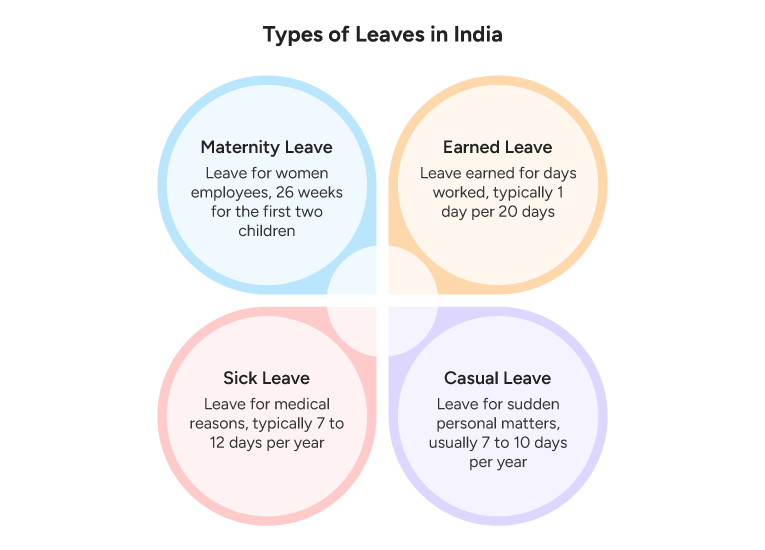
Understanding the legally mandated leave laws in India is the foundation of any compliant HR policy. These are the leaves every eligible employer must provide regardless of company size or industry. You can explore all the different types of leave in India in detail to build a fully compliant structure.
1. Earned Leave (EL)/Privilege Leave (PL)
Earned leave is the most regulated leave type under Indian labor laws and is governed differently across sectors.
- Under the Factories Act 1948, workers earn 1 day of leave for every 20 days worked in the previous calendar year
- Employees must complete a minimum of 240 days of work in a year to become eligible
- Most IT companies and corporate offices provide leave benefits above the statutory minimum, offering 15 to 21 days of earned leave annually
- Unused earned leave can typically be carried forward to the next year, subject to state-specific limits
- Earned leave rules in India also allow encashment of accumulated leaves either during service or at the time of resignation or retirement
To understand the full rules around privilege leave in India, including carry-forward limits and encashment calculations, refer to a dedicated guide.
2. Casual Leave (CL)
Casual leave is meant for sudden or urgent personal matters that require an employee to be away from work at short notice.
- Most organizations provide 7 to 10 days of casual leave per calendar year
- Casual leave is generally not carried forward to the next year and lapses if unused
- It cannot be combined with earned leave or sick leave in most state-specific Shops and Establishments Acts
- Casual leave is not governed by a single central law, and its quantum is largely determined by the applicable state legislation
For a detailed breakdown of eligibility, rules, and how to apply, refer to the guide on casual leave in India.
3. Sick Leave (SL)
Sick Leave (or Medical Leave) provides income protection during periods of illness or injury. It’s a critical component of any sick leave policy under the labor law.
- Employees are generally entitled to 7 to 12 days of sick leave per year, depending on the applicable state law
- Most organizations require a medical certificate if sick leave extends beyond 2 to 3 consecutive days
- Sick leave is typically not encashable and cannot be carried forward in most states
- Under the Factories Act 1948, sick leave provisions are included within the overall leave entitlement framework, while the Shops and Establishments Act of each state defines them separately for commercial establishments
HR teams building a compliant structure should also review the dedicated sick leave policy template for Indian private companies.
4. Maternity Leave
Maternity leave is one of the most significant statutory entitlements for women employees in India. It is governed by the Maternity Benefit Act, 1961, and substantially strengthened by the Maternity Benefit Amendment Act, 2017.
- Women employees are entitled to 26 weeks of fully paid maternity leave for the first two children
- For the third child onwards, the entitlement reduces to 12 weeks of paid leave
- The Act applies to all establishments employing 10 or more employees
- Employers with 50 or more employees are required to provide crèche facilities
- Adoptive mothers and commissioning mothers are entitled to 12 weeks of maternity leave under the 2017 amendment
- Dismissing or discharging an employee during maternity leave is a punishable offense under the Act
Optional but Standard Corporate Leaves
Beyond statutory entitlements, most organizations in India offer additional leaves as part of their HR policy to stay competitive, attract talent, and support employee well-being. While these are not mandated by any central law, they have become standard practice across the corporate sector.
1. Paternity Leave
India currently has no central legislation mandating paternity leave for private-sector employees. However, most mid-size and large organizations offer it as a matter of policy.
- Most corporate employers offer 3 to 7 days of paid paternity leave
- Government employees are entitled to 15 days of paternity leave under the Central Civil Services Rules
- Offering paternity leave signals a progressive workplace culture and DE&I (Diversity, Equity, and Inclusion) standards, while also directly supporting employee retention
For a full breakdown of paternity leave in India, including private sector norms and how to draft a policy, refer to the dedicated guide.
2. Bereavement Leave
Bereavement leave is provided to employees who have lost an immediate family member. No central law mandates this for private sector employees, but it is widely practiced.
- Most organizations offer 3 to 5 days of paid bereavement leave
- The definition of immediate family typically includes spouse, parents, children, and siblings
- A clearly defined bereavement leave policy prevents ambiguity during an already difficult time
3. Marriage Leave
Marriage leave is offered by many organizations to allow employees time off around their own wedding. It is not legally required under any central labor law, but it is a common HR practice.
- Most companies offer 3 to 5 days of paid marriage leave
- This is generally for the employee’s own marriage and is typically limited to one instance per marriage, subject to company policy
- Some organizations extend this benefit under their personal leave or special leave category
4. Compensatory Off (Comp Off)
Compensatory Off applies when an employee is required to work on a declared holiday or a weekly off day. It is one of the most practically relevant optional leaves in corporate India.
However, in many states, like Tamil Nadu and Karnataka, the compensatory off is a statutory requirement, but it must often be utilized within 90 days of the extra working day.
- Employees who work on holidays or weekends are entitled to a compensatory day off in return
- Most organizations require comp off to be availed within 30 to 60 days of the extra day worked
- While not universally mandated under central law, some state-level Shops and Establishments Acts do recognize comp off as a right
To understand the full eligibility rules and validity periods, refer to the detailed explainer on compensatory off in India.
Leave Encashment and Carry Forward Rules
Understanding the financial side of leave management is just as important as knowing the entitlements. Leave encashment rules in India vary by leave type, and carry-forward provisions also vary. Getting these wrong during payroll or Full and Final settlement can create serious compliance issues.
Which Leaves Can be Carried Forward
Only certain types of leave can be carried forward. Here is how it generally works:
Earned Leave (EL)/Privilege Leave (PL)
This is the only leave type that can typically be carried forward to the next calendar year. Under the Factories Act, the carry-forward limit is capped at 30 days. Corporate organizations may set their own limits, usually between 30 and 45 days, beyond which leaves lapse or must be encashed.
Casual Leave (CL)
Casual leave almost universally lapses at the end of the calendar year. Unused casual leave cannot be carried forward or encashed in most states.
Sick Leave (SL)
Similar to casual leave, sick leave generally lapses at year’s end and is neither carried forward nor encashed in most state-specific regulations.
Leave Encashment Rules in India
Leave encashment refers to the monetary compensation an employee receives in exchange for an unused leave balance. It applies in two scenarios:
During Employment
Some organizations allow employees to encash earned leave beyond a certain accumulated threshold while still in service. This is a company policy decision and not universally mandated.
At Resignation or Retirement (Fnf Settlement)
Encashment of accumulated earned leave is mandatory at the time of Full and Final settlement. The encashment amount is calculated based on the employee’s last drawn basic salary.
To track leave balances accurately throughout the year, HR teams should use a system that automatically calculates accruals and encashments.
Tax Implications of Leave Encashment
The tax treatment of leave encashment depends on the employment type and timing:
Government Employees
Leave encashment received at the time of retirement is fully exempt from income tax under Section 10(10AA) of the Income Tax Act.
Private Sector Employees
Encashment received at retirement or resignation is partially exempt up to Rs. 25 lakhs as per the latest government notification. Anything above this limit is taxable as salary income.
Encashment during Employment
Any leave encashment received while still employed is fully taxable in the year it is received, regardless of the sector.
How to Automate Leave Compliance with factoHR
Manually tracking leave balances across different leave types, state-specific rules, carry-forward limits, and encashment calculations is not easy. It is a compliance risk that grows with every new hire and every new state your organization operates in.
A single error in prorated leave calculation or a missed state-specific provision can lead to a labor dispute or a legal penalty.
The Problem with Manual Leave Tracking
- Spreadsheets cannot automatically adjust for state-wise leave laws in India under the different Shops and Establishments Acts
- Calculating prorated leaves for mid-year joiners or tracking carry-forward limits manually leaves room for human error
- HR teams waste hours every month reconciling leave balances instead of focusing on strategic work
- Employees lose trust in HR when their leave balances are inaccurate, or the FnF encashment figures are disputed
How factoHR Simplifies Leave Compliance
factoHR leave management system is built to handle the full complexity of statutory compliance across industries and states, without manual intervention.
Here is what it delivers:
State-Wise Compliance is Built-In
The system automatically applies the correct leave rules based on the state where your employees work, keeping you compliant without manual monitoring.
Automated Leave Accrual and Proration
Leaves are calculated and credited automatically based on the joining date, workdays, and applicable entitlements, eliminating calculation errors entirely.
Carry Forward and Lapse Automation
The system enforces your carry-forward policies at the end of every calendar year, ensuring that unused leave is either carried forward or lapsed in accordance with the applicable rules.
Encashment Calculations during FNF
Leave encashment amounts are automatically computed based on the last drawn basic salary, reducing disputes and ensuring accurate settlements every time.
Employee Self-Service
Employees can apply for leave, check balances, and track approvals in real time through factoHR’s time-off management platform, significantly reducing the administrative burden on HR teams.
Audit-Ready Leave Records
Every leave transaction is recorded and stored, giving HR teams instant access to accurate data during audits or legal disputes.
Frequently Asked Questions
What are the 3 Main Types of Leave in India?
The main types of statutory leave in India are Earned Leave (EL), Casual Leave (CL), Maternity Leave (ML), and Sick Leave (SL). These form the foundation of any compliant leave policy across industries. The exact number of days for each type varies based on the applicable state-specific Shops and Establishments Act. Employers must refer to their respective state legislation to determine the minimum entitlement.
Is Sick Leave Mandatory in India?
Yes, providing sick leave is mandatory in India. State laws generally mandate between 7 and 12 days of sick leave per year, depending on the applicable legislation. Employers commonly require a medical certificate for continuous absences of 2 to 3 days or more, and the exact provisions vary by state.
Can an Employer Reject Earned Leave?
Yes, an employer can reject an earned leave request as the approval is subject to business requirements and managerial discretion. Employees are generally expected to serve a proper notice period before availing of earned leave. Employers can defer requests during peak business periods as long as the employee’s right to avail the leave is not permanently denied.
What is the Maximum Limit for Maternity Leave in India?
The maximum limit for maternity leave in India is 26 weeks. This is fully paid leave provided under the Maternity Benefit Amendment Act 2017, applicable to women employees for their first two children. For the third child onwards, the entitlement reduces to 12 weeks. Adoptive and commissioning mothers are also entitled to 12 weeks under the same amendment.
Is Leave Encashment Taxable in India?
Yes, leave encashment is generally taxable as Income from Salary. However, specific exemptions under Section 10(10AA) of the Income Tax Act allow Government employees full tax exemption on leave encashment at retirement. Non-government employees receive a partial exemption of up to Rs. 25 lakhs upon retirement or resignation. Any encashment received during employment is fully taxable, regardless of the sector.
Table of Contents
The demand for SEO Managers is on the rise as businesses, as they rely on digital marketing to drive growth. Companies are looking for skilled SEO leaders who can boost visibility, strengthen brand authority, and deliver measurable returns.
SEO Manager interviews don’t just test technical know-how – like on-page optimization, keyword research, and audits – they also evaluate strategic skills, including campaign planning, analysis, and leadership.
This article walks through common interview questions for search engine optimization to help candidates prepare confidently. It’s a valuable resource for aspiring SEO Managers, seasoned professionals seeking leadership roles, recruiters, and digital marketers making the transition into SEO.
| Skills Interviewers Look for in an SEO Manager | ||
|---|---|---|
| Core Technical Skills | Strategic & Analytical Skills | Soft Skills & Leadership |
| Keyword research and search intent analysis | SEO strategy development and competitive analysis | Strong communication and stakeholder reporting |
| Technical SEO (crawling, indexing, Core Web Vitals, schema markup) | Analytics proficiency (Google Analytics/GA4, data interpretation, reporting) | Team leadership and cross-functional collaboration |
| On-page SEO and content optimization | SEO experimentation and multivariate testing | Project management and deadline adherence |
| Link building and off-page strategies | Critical thinking and strategic planning | Adaptability to SEO trends and algorithm changes |
| Proficiency with tools like Ahrefs, SEMrush, Screaming Frog, and Google Search Console | ROI measurement and performance forecasting | Problem-solving and critical thinking |
| Site speed optimization and mobile-first indexing | A/B testing and conversion rate optimization | Creativity in content and link-building strategies |
Basic & Conceptual SEO Manager Interview Questions
1. What is SEO and why is It Important for Business Growth?
Sample Answer
SEO drives business growth by boosting organic traffic through higher rankings, increasing brand visibility, generating qualified leads, and ultimately improving revenue. It’s a cost-effective strategy that gives long-term results without paying for ads continuously.
2. How do Search Engines Rank Websites?
Sample Answer
Search engines like Google rank websites by first discovering them (crawling), storing them in their databases (indexing), and then evaluating them with algorithms. They assess how relevant a site is to search queries and the quality of its content, as the goal is to show users the most helpful and reliable results.
3. What is Search Intent, and why is It Important?
Sample Answer
Search intent is the underlying reason a user performs a search – what they really want to achieve, such as information, a product, or a specific page. It is important because matching that intent boosts relevance, improves rankings, and increases user engagement and conversions.
4. How do You Approach E-E-A-T (Experience, Expertise, Authoritativeness, Trustworthiness)?
Sample Answer
My approach to E-E-A-T focuses on creating people-first content supported by case studies and detailed author bios. Also, clearly showcasing expertise with accurate and evidence-based insights. I increase the site’s authority with the help of high-quality backlinks and build trust with transparent policies. I also perform regular audits to ensure these signals stay strong and aligned with Google’s Quality Rater Guidelines.
5. How do You Handle Keyword Cannibalization?
Sample Answer
I start by identifying all pages competing for the same keyword using tools such as Google Search Console and a rank tracker, then select the best-performing or most relevant page as the primary target. From there, I either consolidate overlapping content with 301 redirects or re-optimize pages for unique keywords and intents, updating internal links and canonical tags to strengthen the primary page.
Technical SEO Manager Interview Questions
6. How do You Perform a Complete SEO Audit?
Sample Answer
To perform a complete SEO audit, I begin with a crawl using tools like Screaming Frog to find issues. For example, crawl errors, indexation, and site performance. Then, I review on-page factors such as content quality and meta tags, along with off-page elements like backlinks. Finally, I use Google Search Console and Analytics to find opportunities and prioritize fixes based on business impact.
7. How do You Identify and Fix Crawling and Indexing Issues?
Sample Answer
I audit the site using tools like Google Search Console, Screaming Frog, and server logs to find errors, redirect loops, and blocked or duplicate content. I prioritize technical fixes for high-impact pages by optimizing robots.txt, meta tags, canonical tags, and XML sitemaps. After applying changes, I review indexing status, monitor organic traffic trends, and continuously optimize the site to maintain strong crawlability and search performance.
8. What are Core Web Vitals and why does It Matter?
Sample Answer
Core Web Vitals are Google’s way of measuring how users experience a website. They look at loading speed (Largest Contentful Paint – LCP), interactivity (Interaction to Next Paint – INP), and visual stability (Cumulative Layout Shift – CLS). When these scores improve, users have a smoother experience, which can reduce bounce rates, increase engagement, and help boost search rankings, traffic, and conversions.
Note: A basic understanding of HTML and JavaScript can also help candidates explain technical SEO issues more confidently.
9. How do You Optimize Website Architecture for SEO?
Sample Answer
To optimize website architecture, I create a clear hierarchy with SEO-friendly URLs and use internal linking and breadcrumbs to improve user and search engine navigation. I also manage XML sitemaps and robots.txt, and monitor the structure in Google Search Console to maintain crawl efficiency as the site grows.
10. How do You Handle Duplicate Content Issues?
Sample Answer
I identify duplicate content by finding similar pages and guiding search engines to the preferred version. To maintain unique content, I consolidate similar pages, manage URL parameters, and rewrite content as needed. Regular audits with tools like Google Search Console help maintain crawl efficiency, indexing, and overall search performance.
11. What is Schema Markup and how does It Help SEO?
Sample Answer
Schema markup is structured data added to a website’s code that helps search engines understand a page’s content. This improves visibility, click-through rates, and relevance, ultimately driving more qualified traffic to the site.
Keyword Research & Content Strategy Questions
12. How do You Conduct Keyword Research for a New Website?
Sample Answer
I begin by identifying seed keywords based on the business goals, target audience, and competitors. I research through tools like Google Keyword Planner and SEMrush. These tools help evaluate search volume, competition, and intent to uncover high-value long-tail opportunities. Finally, I map keywords to the site structure, cluster topics into content hubs, and focus on those that maximize relevance, traffic, and conversions.
13. How do You Map Keywords to Landing Pages?
Sample Answer
I group keywords by search intent and topic using SEO tools or spreadsheets. Then I map each cluster to the most relevant landing page and prioritize high-intent keywords. Finally, I optimize the page and monitor performance to refine the strategy.
14. How do You Create an SEO Content Strategy?
Sample Answer
I begin by analyzing the audience, business goals, and competitors to identify content gaps. Then I conduct keyword research and map keywords to pages or content hubs for maximum impact. Lastly, I create and optimize content based on user intent and track performance using traffic, engagement, and conversion metrics.
15. How do You Identify Keyword Opportunities Competitors are Ranking for?
Sample Answer
To identify keyword opportunities competitors are ranking for, I analyze competitors’ top-performing pages to see which keywords drive their traffic. I find gaps where they rank, but we don’t, focusing on high-intent, low-competition keywords. Then I prioritize these opportunities in our content strategy to increase traffic and improve rankings.
16. How do You Measure Keyword Performance?
Sample Answer
I measure keyword performance using tools such as Google Search Console, Google Analytics, and SEO platforms. I measure conversions and ROI for each keyword to understand its impact on business goals. Finally, I analyze trends and adjust targeting and strategy to maximize SEO effectiveness and revenue.
Off-Page SEO & Link Building Questions
17. What Link Building Strategies do You Use?
Sample Answer
I focus on earning high-quality, relevant backlinks through content-led strategies such as guest posting, digital PR campaigns, and building relationships with authoritative websites in the niche. I also use broken-link building, reclaim unlinked brand mentions, and plan outreach to industry blogs to secure contextual links on reputable sites.
18. How do You Evaluate Backlink Quality?
Sample Answer
I evaluate backlink quality based on relevance to my niche and placement within contextual content. Finally, I audit backlink profiles for spam or low-quality links and monitor link acquisition to maintain a robust, penalty-free SEO profile.
19. How do You Recover from Toxic Backlinks?
Sample Answer
To fix toxic backlinks, I audit backlinks using tools like Ahrefs or SEMrush to identify toxic links, request their removal, and disavow any that remain in Google Search Console. Then I build high-quality links through guest posts and content marketing while continuously monitoring the profile to protect rankings.
20. How do You Build Authority for a New Domain?
Sample Answer
I build authority for a new domain through targeted link building via guest posts and digital PR, while ensuring strong technical SEO, fast site performance, and internal linking to direct traffic and pass link equity to key pages to maximize search visibility.
Analytics & Performance Measurement Questions
21. How do You Measure SEO Success?
Sample Answer
I measure SEO success by tracking key metrics using tools such as Google Analytics and Search Console. I also evaluate business impact through conversions, revenue, and ROI to make sure SEO efforts contribute to overall goals. Finally, I analyze trends over time and adjust strategy, content, and technical SEO to continuously improve performance and visibility.
Note: Candidates who want to sharpen their reporting mindset can also explore data analyst interview questions and answers.
22. Which SEO Tools do You Use and why?
Sample Answer
I use SEMrush for keyword research, competitor analysis, and site audits, and Ahrefs for backlink analysis and content gap discovery. I also use Google Search Console and Analytics to track performance, identify technical issues, and make data-driven SEO decisions.
23. How do You Track ROI of SEO Campaigns?
Sample Answer
I track SEO ROI by measuring organic traffic, conversions, and revenue in Google Analytics, and calculate costs – including tools, content, agency fees, and team time – using the formula (Revenue – Costs) ÷ Costs × 100. I review trends monthly with tools like Google Sheets or Ahrefs, focusing on high-ROI pages and adjusting strategies.
24. How do You Deal with Traffic Drops and Google Penalties?
Sample Answer
I diagnose traffic drops or Google penalties using Google Search Console and Analytics to identify manual actions, algorithm updates, or technical issues. I fix problems like thin content, toxic backlinks, and site speed issues, submitting reconsideration requests if needed. I also prevent future drops through regular audits, quality content, competitor monitoring, and staying updated on Google’s guidelines.
25. Which Metrics Matter Most for SEO Reporting?
Sample Answer
The metrics that matter the most for SEO reporting include organic traffic, keyword rankings, impressions, clicks, and CTR to track visibility and engagement. I also monitor conversions, revenue, and ROI to measure the business impact of SEO efforts. Additionally, technical metrics like crawl errors, page speed, and indexation are tracked to ensure the site’s health supports sustainable SEO performance.
Strategy & Problem-Solving Questions
26. How do You Create a Long-Term SEO Roadmap?
Sample Answer
I start with a full audit of technical health, content gaps, and competitors, then set SMART goals aligned with business objectives. I prioritize tasks using an impact-effort matrix, address foundational issues first, and plan content clusters and authority-building initiatives.
27. How do You Prioritize SEO Tasks?
Sample Answer
I align SEO tasks with business objectives and focus on high-impact pages that drive traffic and conversions. I continuously reassess priorities using data from Analytics, Search Console, and rankings to stay focused on the best ROI opportunities.
28. How do You Handle Google Algorithm Updates?
Sample Answer
I stay updated on Google’s algorithm changes through official channels, SEO communities, and tools like Search Console to assess their impact quickly. I then conduct audits to identify issues in content, technical SEO, and user experience, prioritizing key fixes like Core Web Vitals and thin content. Finally, I implement data-driven recovery strategies and focus on user-first tactics to build long-term SEO resilience.
29. How do You Manage SEO for Multiple Websites?
Sample Answer
I manage SEO for multiple websites by conducting regular audits to ensure unique keyword strategies and avoid cannibalization. Using tools like Google Search Console and Ahrefs, I track performance, optimize on-page elements, and monitor backlinks. Prioritizing scalable processes like structured data and tailored content helps maintain consistent rankings and meet each site’s goals.
30. How do You Balance SEO with User Experience?
Sample Answer
I balance SEO and user experience by prioritizing user intent in keyword research and content creation, ensuring natural keyword use without stuffing. Fast-loading, mobile-friendly designs and intuitive navigation improve engagement metrics like low bounce rates and boost search rankings. Regular analytics testing maintains this balance, delivering value to users while satisfying search algorithms.
Leadership & Managerial Interview Questions
31. How do You Manage and Mentor an SEO Team?
Sample Answer
I manage an SEO team by setting clear goals, assigning tasks based on strengths, and fostering teamwork through regular check-ins and idea sharing. For mentoring, I conduct one-on-one sessions, give helpful feedback, and support growth through training, workshops, and hands-on projects. This approach keeps the team motivated, performing well, and up to date with SEO trends while leading by example.
32. How do You Communicate SEO Results to Non-Technical Stakeholders?
Sample Answer
I communicate SEO results to non-technical stakeholders by focusing on key metrics like traffic, conversions, and ROI, using simple visuals and reports. I explain how SEO efforts support broader business goals and growth.
Note: This is similar to the clarity needed in interview feedback and stakeholder communication during hiring.
33. How do You Handle Client Expectations?
Sample Answer
I manage client expectations by setting clear, realistic goals from the start, based on data and industry standards. I maintain open communication, provide regular updates, and clear progress reports. Finally, I make sure clients understand that SEO is a long-term strategy and guide them on the time needed to see measurable results.
34. How do You Coordinate with Content and Development Teams?
Sample Answer
I act as the bridge between technical execution and creative strategy. With content teams, I provide SEO briefs during ideation so search intent is built into the draft, not added later. With developers, I translate SEO goals into actionable Jira tickets, prioritizing high-impact fixes like Core Web Vitals and schema implementation, making SEO a “seamless requirement” rather than a “last-minute request.”
35. How do You Handle SEO Campaign Failures?
Sample Answer
When an SEO campaign fails, I conduct a thorough audit using tools like Google Analytics and Search Console to identify issues such as poor keyword alignment, technical issues, or algorithm shifts. I then adjust by updating content, improving outreach, and trying new strategies while closely monitoring KPIs to drive rapid improvements. Finally, I document the insights gained to refine future campaigns, ensuring continuous improvement through data-driven decisions.
Scenario-Based SEO Manager Interview Questions
36. What Will You do if Website Rankings Suddenly Drop?
Sample Answer
If website rankings suddenly drop, I’d quickly check the site using tools like Google Search Console and Ahrefs to identify any issues, such as indexing errors or traffic drops. Then I look for technical issues (such as crawl errors or slow page speeds) and check whether the content has changed or if there’s duplicate content. Finally, I will fix issues such as removing bad links or optimizing pages, and continue tracking the recovery with regular updates to stakeholders.
37. How Will You Improve Organic Traffic for a New Website?
Sample Answer
To improve organic traffic for a new website, I’ll start with thorough keyword research to identify high-value, low-competition keywords. I’ll create high-quality, user-focused content optimized for SEO, and ensure a strong technical foundation (site speed, mobile-friendliness, crawlability). Finally, I’ll build authority through strategic link-building and continuously monitor performance to refine the strategy.
Note: Candidates from broader marketing backgrounds may also find these digital marketing interview questions useful.
38. How Would You Approach SEO for an E-Commerce Website?
Sample Answer
For an e-commerce website, I focus on balancing scalability and authority. I start with a technical audit to improve site speed and refine the site filtering system, then prioritize high-value category pages and product pages with unique descriptions and Schema markup. Finally, I implement a full-funnel content strategy – using blogs to capture top-of-funnel traffic and internal linking to pass authority down to product pages.
39. How do You Handle Website Migration without Traffic Loss?
Sample Answer
I start with a full SEO audit and crawl all URLs using tools like Screaming Frog, then create a detailed 301 redirect map from old to new pages. Next, I test the migration on a staging site, preserve metadata and structured data, update XML sitemaps, and submit them to Google Search Console before launch. Finally, I monitor traffic and rankings closely after launch and make any necessary adjustments to address issues quickly.
40. How do You Improve Low-Performing Content?
Sample Answer
To improve low-performing content, I analyze user intent, search volume, and engagement metrics to identify opportunities. I then update the content with relevant keywords, better visuals, and internal links. Finally, I promote the content through outreach and social media to boost visibility and traffic.
Advanced & Trend-Based SEO Questions
41. How is AI Impacting SEO?
Sample Answer
AI is impacting SEO by shifting the focus from simple keyword matching to understanding user intent and delivering direct answers. As AI-generated results increase zero-click searches, success increasingly depends on strong brand authority and being cited as a trusted source. SEO managers must focus on high-quality, E-E-A-T driven content and optimize for visibility in AI-powered search experiences.
42. What is Programmatic SEO?
Sample Answer
Programmatic SEO automates the creation of many optimized web pages using templates and structured data. It focuses on long-tail keywords and automatically generates pages for sites like e-commerce, real estate, or travel using databases or spreadsheets. This method saves time and improves search visibility for specific searches.
Note: For advanced automation workflows, some candidates also build familiarity through Python interview questions and answers
43. How do You Optimize for Voice Search?
Sample Answer
To improve your site for voice search, use natural, conversational keywords that match how people speak. Include clear answers or FAQ sections, and add schema markup so voice assistants like Siri and Alexa can better understand your content. Also, make sure your site is mobile-friendly, loads quickly, and ranks well for local searches, since many voice queries are local.
44. How do You Prepare an SEO Strategy for Featured Snippets?
Sample Answer
To prepare an SEO strategy for featured snippets, I first identify question-based and long-tail keywords that users commonly search. Then I create clear, concise content lists, tables, or short answers that directly address those queries. Finally, I use structured data (schema markup) and optimize formatting to increase the chances of being selected by Google.
45. What is Entity-Based SEO?
Sample Answer
Entity-Based SEO focuses on optimizing content around real-world entities, like people, places, brands, or concepts, rather than just keywords. It uses semantic context, relationships between entities, and structured data to help search engines understand content and match user intent. This way increases visibility in features like Knowledge Panels by focusing on meaning rather than exact phrases.
SEO Manager Interview Preparation Tips
To succeed in an SEO Manager interview, you need a mix of technical expertise, strategic thinking, and leadership skills. The tips below will help you stand out and leave a strong impression.
- Be ready to discuss on-page, off-page, and technical SEO strategies.
- Explain how SEO helps achieve business goals like boosting conversions and increasing revenue.
- Be ready with examples of how you fixed SEO problems, such as traffic drops or penalties.
- Get comfortable using tools like Google Search Console, Ahrefs, and SEMrush.
- Show how you track SEO success using important metrics and KPIs.
- Discuss how you fine-tune content for SEO and user intent, matching it to the sales funnel.
- Keep yourself updated on the latest SEO trends, algorithm changes, and best practices.
- Demonstrate that you can clearly explain SEO strategies to teams and stakeholders.
- Be ready to answer hypothetical questions by outlining clear, data-driven steps.
- Ask about the company’s current SEO challenges and goals to show you’re interested.
- Before final rounds, it also helps to review broader final round interview questions and answers.
Avoid Common SEO Manager Interview Mistakes
SEO Manager interviews can be challenging. To succeed, focus on demonstrating your skills and experience while avoiding common preparation mistakes.
- Avoid vague answers and support your strategies with concrete data and clear results.
- Explain concepts clearly and simply, especially when talking to non-technical team members.
- Highlight how SEO helps achieve important business goals like revenue, conversions, and brand growth.
- Show that you can adapt to algorithm updates, business shifts, and changing trends.
- Research the company’s SEO strategy and challenges, then tailor your answers accordingly.
- Set realistic expectations for SEO results, timelines, and return on investment.
- Give clear examples of managing or mentoring a team if you’re applying for a managerial position.
- Prepare for “What would you do if…” questions by practicing practical examples.
- Show strong interpersonal and communication skills to connect well with teams and stakeholders.
- Stay up to date on the latest trends, such as Core Web Vitals, E-E-A-T, and Google algorithm changes.
Avoiding these mistakes will help you present yourself as a skilled, knowledgeable, and flexible SEO Manager.
Conclusion
To summarize, an SEO Manager role demands a combination of technical expertise, strategic thinking, and leadership skills, along with strong fundamentals and practical project experience to stand out in interviews. Staying up to date and learning are very important in the continuously evolving SEO industry, as search engines and best practices change regularly.
Using guides, templates, or curated question-and-answer resources like this one can help candidates prepare efficiently, build confidence, and increase their chances of success in SEO Manager interviews.
FAQs
How do I Prepare for an SEO Manager Interview?
To prepare for an SEO Manager interview, review key SEO concepts, tools, and analytics, and be ready to discuss past campaigns and measurable results. Practice explaining strategies, problem-solving approaches, and how you improve website performance.
What Questions are Asked in Senior SEO Interviews?
Questions asked in Senior SEO interviews are often about advanced topics. These include Google updates, technical audits, keyword research, link building, and website performance, such as Core Web Vitals. They also test your strategic abilities, which include predicting results, handling penalties, and managing local SEO.
What Skills are Required for an SEO Manager Role?
Skills required for an SEO Manager role include keyword research, on-page/off-page optimization, technical SEO, and tools like Google Analytics. Strong communication, project management, content strategy, and adaptability to algorithm changes are also essential.
How Much Experience is Needed to Become an SEO Manager?
To become an SEO Manager, you typically need 3-5 years of hands-on experience in SEO, digital marketing, and related areas like keyword research and analytics. Proven results in driving organic traffic and team leadership are also essential.
How do Interviewers Evaluate SEO Manager Candidates?
Interviewers evaluate SEO Manager candidates through practical tests and past campaigns. This helps assess technical skills, strategy, and problem-solving. They prioritize hands-on experience and up-to-date knowledge of tools over qualifications or buzzwords.
Table of Contents
If we are being honest, using asset allocation in a financial advisor interview is no longer helping you bypass the gatekeepers. Interviewers have simply heard every jargon and are not interested in high-profile language skills. What they really want to know is:
Can you handle funds and the client when markets are in free fall?
Can you sell their services without sounding like a rookie under pressure?
Are you ethical as a financial advisor?
Most candidates stumble when financial advisor interview questions are not about textbook theory, but about the real scenarios out there. The questions that test your mettle are about judgment, discipline, and how you work under pressure. It is essentially like a Shark Tank pitch. Except the interviewer is the judge here, and they are scrutinizing YOU as the product.
In this blog, you will learn to answer the most common financial advisor job interview questions, which you should be prepared for.
Key Takeaways:
- How to answer the most asked financial advisor interview questions
- How to explain investment decisions
- How to handle behavioral scenarios like a pro
- How can freshers showcase internships, certifications, and a learning attitude
- How experienced advisors can prove their long-term advisory thinking
General Interview Questions
These financial advisor interview questions decide whether you can talk to a client without sounding like a flight risk. Big firms don’t like dramatic claims; they expect a calm composure in unfavorable situations.
1. Walk Me through Your Background and What You do Best as a Financial Advisor.
Sample Answer
I am from a commerce background and started my career in retail banking. My day-to-day involved client meetings, SIP discussions, and insurance renewals. While tracking my monthly targets, I handled 35-40 active clients at a time. I focus on being consistent with clients by ensuring reviews and expectations. I have noticed that clients trust advisors more when they don’t promise aggressive returns. I look at the suitability rather than just closing the deal.
2. Why this Firm and why this Advisor Role?
Sample Answer
I have followed your firm’s advisory model and especially how you structure the risk profiles, plus conduct portfolio reviews. That is something I admire. In my current role, the firm focuses more on pushing the product. I want to work in an environment where planning as well as ethics matter equally. This role and your firm can help me move in that direction, rather than focusing on monthly sales numbers.
3. What are Your Strengths and Weaknesses?
Sample Answer
One of my strengths is that I stay calm under pressure and do not panic with my clients during alarming market conditions. I explain to them well about the situation at hand and why patience would help them. As for my weakness, I used to hesitate in asking for referrals. I have amplified the impact of my own advisory process instead of feeling off-balance about business development.
Note: If you are just starting out and don’t yet have client-handling experience to draw on, you can review common interview questions for freshers to help you frame your answers.
4. What Type of Clients do You Enjoy Working with Most, and why?
Sample Answer
Investors who are investing for the first time or salaried clients are a personal preference. They take advice seriously and stay connected. Small business owners have also been a part of my clientele, but their conversations are more about cash flow and liquidity. I adapt depending on the client, but I perform well with clients who value long-term discipline over quick profits.
5. How do You Build Trust in the First 30–60 Days with a New Client?
Sample Answer
I do not start with product knowledge. I start with evaluating their current investments and past experiences. Many clients face losses or have been sold the wrong products. In the first month, I set realistic return expectations, which increases the circle of trust. I follow up regularly and send summaries to the client. I proactively call them instead of waiting for them to inquire. This level of timely transparency usually builds their confidence in me and the firm.
Experience & Background Questions
This is where the ‘politeness’ in interviews ends. Firms are now checking whether you have ‘proof’ of your confidence. In Indian financial advisory roles, these financial advisor job interview questions decide whether you have handled real finances or are merely flaunting your economic knowledge.
6. Tell Me about Your Current/Previous Role, Day-To-Day Work, and Responsibilities.
Sample Answer
In my current role, I manage around 45-60 active clients. I start with reviewing portfolios and tracking the funds, along with completing the pending documentation. Client meetings, risk profiling, and product recommendations are a part of my role as well. Apart from advisory, I am also responsible for monthly revenue targets and maintaining the compliance documentation.
Note: If you’re unsure how to frame your responsibilities, reviewing a Financial Manager Job Description can help you align your experience with industry expectations.
7. What Client Segments have You Handled?
Sample Answer
I have dealt with salaried professionals, small business owners, and a segment of retirees. My investor portfolio is dominated by first-time investors entering SIPs in the range of ₹5,000 to ₹25,000. With business owners, my focus has been to help them with liquidity management and taxation. With retirees, their focus has been to protect capital and create a regular income. My advice is based on their life stages and cash flows.
8. What Results have You Delivered So Far?
Sample Answer
In the last financial year, I have achieved around 92% of my annual targets and have managed to increase the SIP book size by around 25%. I have also maintained my client retention rate above 85% through constant reviews and managing realistic return expectations. I was able to convert around 30% of my inactive leads into active clients through my follow-up strategies.
9. What Products have You Advised on Most Often, and how Comfortable are You with each?
Sample Answer
My advice is primarily focused on mutual funds, term insurance, ULIPs, and fixed income products. I am confident in advising my clients on equity mutual funds and SIPs, as they are the majority part of my portfolio advice. I am also careful in advising my clients on debt and fixed income products, as I prioritize safety. I always intend to match the right product with the right tenure.
10. Tell Me about a Tough Client Situation You Handled and What the Outcome was.
Sample Answer
During a market scenario, one client wanted to stop all SIPs immediately. I did not argue and instead took him through his long-term goal plan and market recovery history. I was not aggressive. This client stopped one SIP and continued the others. Six months later, this client thanked me for not letting him completely withdraw from the investments.
Note: Situational questions like these are also common across functions. Check these HR interview questions and answers to structure behavioral responses more confidently.
11. Describe a Time You Gave Advice that a Client Didn’T like but It was the Right Call.
Sample Answer
One of my clients was looking to invest a huge amount in a fund that promised high returns. I advised him on diversification. He was skeptical initially, as the fund was giving high returns. I took him through concentration risk and correlated it with his risk profile. He eventually agreed. Later, this fund fell significantly, and diversification worked in favor of this client.
12. How do You Stay Current with Markets, Product Changes, and New Rules without Getting Distracted by Noise?
Sample Answer
For my information, I follow trusted sources such as updates from the AMFI, SEBI circulars, fund house briefings, and compliance notes. I don’t follow every news headline or social media rumors circulating in the market.
13. Have You Worked with Compliance or Audit Checks before? What Changed in Your Process because of that?
Sample Answer
Yes, I have completed internal audits and compliance checks on my processes. Earlier, I used to work with verbal confirmations from the clients. But after receiving feedback, I have become more diligent in documenting the risk profiling of the clients. I make sure that every recommendation is in line with the risk appetite of the client.
Note: On the interview side, it’s equally useful to know what questions an employer cannot legally ask, especially when financial firms conduct multi-round, in-depth interviews.
Technical & Role-Specific Questions
This is the part where your charm is out of the equation. These financial advisor interview questions and answers focus completely on reasoning, and not theory. Large banks or AMCs hire financial advisors who can refuse, structure risk, and justify their decisions without hesitation or guesswork.
14. When You Evaluate an Investment Opportunity, What do You Check First and What Can Make You Reject It Quickly?
Sample Answer
First, I look at suitability before performance, ensuring alignment with risk profile and the client’s time slab. Next, I look at the consistency of returns, the fund manager’s performance, the expense ratio, and volatility. I immediately reject opportunities if returns are generated from short-term fluctuations or if risk concentration outweighs the client’s risk tolerance. I don’t recommend an investment if I’m not able to articulate potential downside risk.
15. Explain Your Step-by-Step Process from the First Meeting to the Final Recommendations.
Sample Answer
The first meeting is essentially about grasping the client’s income, liabilities, investments, goals, and risk tolerance. I analyze any gaps between the client’s current investments and long-term goals. I then create a client investment allocation plan, which includes equities, debt, and cash. I discuss risks before finalization. Execution and scheduling of periodic reviews are done after client approval.
Note: After multi-stage financial advisory interviews, understanding how interview feedback works can help you interpret outcomes and improve for the next round.
16. How do You Figure out a Client’s Risk Comfort in Real Life, Not Just a Questionnaire?
Sample Answer
I try to extract information about how they’ve managed market corrections in the past. Did they take money out or continue to invest? How stable is the income, and how much of it depends on the investments? Sometimes the clients claim to be aggressive investors, but when the topic of loss arises, their body language changes. These are some of the things I look for before determining the level of risk.
17. How do You Balance Goals vs Budget for Example, Retirement, Child Education, and Home Loan Together?
Sample Answer
My priority list is based on time and flexibility. For the home loan, the EMI is fixed, which is why it’s the first priority. For the other two, I work backward to create the corpus required for the goal. If the money isn’t sufficient, I can adjust the expected returns or increase the time required for the goal. This avoids adding more risk to the investments.
18. How do You Decide the Right Mix between Equity, Debt, and Cash for a Client?
Sample Answer
The right mix is based on the investor’s age and the timeline they have decided for their goal. Their income stability is also a vital aspect, as it determines the client’s risk tolerance. If investors are young, they can take more risks. On the contrary, if the client is a retiree, I advise them to choose predictable income options and maintain cash reserves for emergencies.
Note: For salaried clients in particular, understanding types of employee benefits is highly relevant, as provident fund contributions, gratuity, and group insurance all factor into how you assess their overall financial picture.
19. A Client Wants High Returns but Says They Can’T Tolerate Losses. How do You Handle that Gap?
Sample Answer
I try to explain to the client that high returns often mean high risks. I show them the history of these kinds of investments and explain the real consequences. If they still prefer high-risk options, I can try to reduce the equity exposure. I can always set moderate expectations rather than overpromising clients.
20. If Markets are Volatile, What Changes in Your Recommendations, and What Stays the Same?
Sample Answer
With long-term goal plans, I do not change my asset allocation strategies. I communicate more with the client and increase reviews. I frequently explain market scenarios in a level-headed manner. Drastic asset allocation is not my choice in most cases, unless the client’s funds are significantly affected.
21. How do You Decide whether a Product Fits a Client? What Key Checks do You do before Recommending?
Sample Answer
I check if the risk suits the client, their liquidity requirements, the lock-in period, plus tax impact. Most importantly, if this product aligns with the goal timeline. If the product is beyond the client’s risk level or increases tax burden, I don’t recommend it despite the possibility of attractive returns.
22. How do You Group Products by Risk Level for Clients?
Sample Answer
I believe that fixed deposits, liquid funds, or short-term debt funds are potentially low risk. I categorize balanced funds or conservative hybrid funds as medium risk. The high-risk category includes equity mutual funds, small-cap funds, and sector-specific investments.
23. From a Tax Point of View, What Products do You Usually Consider for a Typical Retail Investor and why?
Sample Answer
For salaried retail investors, I bank on ELSS for Section 80C benefits, term insurance for risk cover, and PPF for a stable foundation. Depending on what clients want to achieve, I add debt funds or tax-saving mutual funds to the mix.
Note: Understanding how a client’s salary is structured in India, including HRA, basic pay, and allowances, directly impacts which tax-saving instruments are most relevant for them
Behavioral & Situational Questions
These questions test your character. In Indian advisory roles, one wrong recommendation can cost you your reputation. So, these financial advisor job interview questions check whether you protect the client when you are under the gun.
24. Explain a Complex Product to a Non-Finance Client in a Simple Way.
Sample Answer
In describing equity mutual funds to a client without financial knowledge, I explain that the client is not buying shares of one stock but rather pieces of various corporations. This happens through a professional manager who reduces risk due to dependence on one stock. I also explain that the price may change daily, but over a period of five to ten years, it is part of a natural process. I avoid financial jargon unnecessarily.
25. A Client Wants to Exit Everything during a Market Fall What Exactly do You Say and do?
Sample Answer
I listen carefully without interrupting and then explain how the client’s portfolio was assembled, correlating with their future goals. I explain market corrections using factual information rather than personal opinion. I reduce the equity portion of the portfolio slightly if the client is still uncomfortable. But I do not remove the funds entirely unless the client’s financial circumstances have significantly changed.
26. How do You Handle a Client Who Keeps Comparing Your Advice with Social Media Tips?
Sample Answer
I do not automatically dismiss social media sources, but instead ask what they found informative. I then determine whether that source of information is compatible with the client’s risk tolerance and goals. Most sources on social media do not consider taxes, liquidity, and risk tolerance. I steer the conversation back to the financial plan rather than engaging in debates about online financial trends.
27. Tell Me about a Mistake You Made in Advice or Workflow, and What You Changed after that.
Sample Answer
Earlier in my career, I delayed recording the client’s new risk profile after discussing it. However, on reviewing it later, I realized the importance of recording the changes to ensure the interests of all the parties involved. Now, I make it a point to update the records as soon as any changes are made.
Advanced or Role-Fit Questions
By this stage, the firm should have gauged your ability. They know you understand your job. Now these financial advisor interview questions are deciding something crucial – can you survive targets, compliance, reviews, prospecting, and much more – without breaking down? If you can’t manage yourself, client funds are out of the question.
28. How do You Set Priority for Your Tasks and Manage Your Time?
Sample Answer
I divide my workweek into blocks. The morning slots are reserved for client meetings and portfolio reviews, as it’s the time when the clients are most responsive. The afternoons are reserved for follow-up activities, such as documentation and operations or compliance work. I use a sheet to keep track of the pending tasks, such as SIP renewals, KYC changes, review calls, etc. The priority of my tasks depends on the urgency and the financial impact of the work. The compliance or documentation work is done on priority. The prospecting work or new meetings are planned on a daily basis to keep the business engine running.
Note: For advisors working within firms that also handle internal finance functions, familiarity with payroll budgeting adds useful context when coordinating with HR or operations teams.
29. What Makes You Stand out from Other Candidates for this Role?
Sample Answer
I focus on suitability rather than speed. I do not focus on quick closures if the product does not fit the risk profile of the client. This approach has helped me retain my clients over the years. Another thing that I have been consistent with is my review process. Many advisors are good salespeople but tend to disappear after the sale. However, an advisory profile requires you to be present always, especially when markets are unstable. This consistency is what makes me different from my peers.
Tips to Ace Your Financial Advisor Interview
Here are some tips to ace a Financial Advisor Interview, especially if you are learning from structured financial advisor interview questions and answers.
- You should know a rough figure of the funds/assets you have managed, the percentage of clients’ profits, and the client retention rate.
- Identify the client segment the firm is focusing on (for example, regular clients, high net-worth clients, or insurance-driven clients). Once identified, tailor your answers to their ideology.
- You can talk about hitting targets, but also emphasize the importance of the right advice for your clients.
- Provide examples of situations with difficult clients, volatile markets, or instances where the goals were not met, as many financial advisor job interview questions center around such situations.
- Describe the process of how you track follow-ups, meetings, and your tasks. This showcases how organized you can be.
- Clear communication, conciseness, and composure in the face of adversity or difficult situations.
- Speak clearly, keep it simple, and keep your composure even if questions are unknown to you or are difficult.
Being aware of income tax declaration challenges also helps when advising salaried clients, who often confuse the declaration with the actual tax filing. It is a common pain point you can proactively address.
Wrapping Up
A financial advisor interview is rarely about bold statements; it is a test of how you think and act. Firms need to identify if you can explain reasoning clearly, and treat client funds with 100% judgement and preparation. It is about preparing your responses for financial advisor interview questions and being able to explain complex concepts without excessive jargon.
Real examples of tough situations, like panicked clients or market dips, will help you show your true mettle, as they speak about your tenacity in pressured scenarios. If your answers reflect how balanced, clear, and practical you are, the interview panel becomes confident in you. As a seasoned advisor, you will be promptly selected if you can handle responsibility with apt judgment and market knowledge.
FAQs
How do I Prepare for a Financial Advisor Interview?
You should research the firm you are applying to. The interviewers can ask you questions about core investment concepts and real client scenarios, which you can prepare for in advance.
What Skills do Interviewers Look for in Financial Advisors?
They look for communication skills and test your financial knowledge. Your ethical judgement plus relationship management skills are of utmost importance.
What are the Common Mistakes Candidates Make in Financial Advisor Interviews?
Many financial advisors overpromise on returns and use unnecessary jargon. They lack explanation of real examples and fail to show a client-centric ideology.
What Qualifications are Required to Become a Financial Advisor?
If you are a degree holder in finance or related fields, and have a license plus relevant certifications, you are an ideal candidate to become a financial advisor.
What Qualities Make a Strong Financial Advisor Candidate?
If a candidate shows commitment to placing client interests above their own, has expertise in portfolio management, risk analysis, and financial planning, they are a strong candidate. Their empathetic nature and proactive mentality, when combined with problem-solving skills, can help them win the interviewers’ confidence.
What Career Growth Opportunities Exist after Becoming a Financial Advisor?
Advisors, when they once experience the job enough, can grow into senior advisory roles, portfolio managers, wealth managers, or branch leadership positions.
How do Financial Advisors Differentiate Themselves during Interviews?
Excellent financial advisor candidates provide practical results and expert explanations on how they handled realistic scenarios calmly. Their client-centric mindset immediately shows their sales ability to the interviewers.
What Questions Should I Ask Interviewers for Financial Advisor Roles?
Ask the interviewer about which client segments they target and what their exact performance expectations are. You can also inquire in depth about their compliance structure and growth opportunities.
Table of Contents
Are you struggling to find an iOS developer who delivers both clean code and business results? We know that hiring the right person is quite difficult, and sometimes companies gamble for the job during the recruitment process.
As you know, there are billions of apps competing in the market, and hiring the right iOS developer has become more important. With this, technical interviews can be tricky when you’re preparing for questions. Whether you are a startup or an MNC, we have discussed iOS interview questions that are frequently asked.
Key Takeaways
- Get a structured list of general and technical iOS developer interview questions you should ask every candidate.
- Learn how to assess a candidate’s knowledge of Swift interview questions, which include language features and best practices.
- Understand what to look for when evaluating experience with UIKit and SwiftUI interview questions.
- Know how to test knowledge when it comes to memory management and scalable app design.
- Discover how to evaluate skills in API integration and data handling strategies.
- Learn how to check for experience with UI testing and other development tools.
- Get behavioral and scenario-based questions that show how a candidate solves challenges.
Most Asked iOS Interview Questions with Answers
1. Tell Me about the Most Complex iOS App You have Built and Published
Reason behind asking: Hiring managers ask this to know your real-world experience designing apps and your deployment knowledge.
Sample answer: I have built and published a budgeting app using MVVM with SwiftUI and Combine. This app was able to manage real-time transaction syncing, and we scaled to 1,00,000+ monthly active users. We also reduced crash rates from 3.5% to 0.9% by implementing advanced error handling, which feeds into the performance management system.
2. Why did You Choose iOS (Swift) over Android (Kotlin) or Web Development?
Reason behind asking: HR professionals want to know if you really understand Apple’s ecosystem and if you are dedicated to the technical path for your career.
Sample Answer: I chose Swift as it has strong type safety and modern syntax. I also like Apple’s integration ecosystem, i.e., consistency across iPhone, iPad, and Mac devices. This way, performance can be optimized,d and the outcome is predictable when compared to other platforms. Apple’s updates allow us, as developers, to move toward better architecture and security practices.
3. How do You Stay Updated with the Latest iOS Changes (WWDC, Swift Evolution)?
Reason behind asking: Managers want to know if you keep yourself updated with Apple’s ecosystem and if you can adopt new frameworks to stay competitive
Sample Answer: I watch Apple Worldwide Developers Conference (WWDC) sessions every year and look for newly announced APIs. I also test apps on beta versions to understand breaking changes and prepare a plan wherever possible. With this, I also follow Swift Evolution proposals and some blogs to stay informed about upcoming changes.
4. Which Version of Swift are You Currently Using?
Reason Behind Asking: This is asked to check your current technical knowledge and how you understand the recent improvements.
Sample Answer: I’m currently working with Swift 5.9, which introduced macro support and improved concurrency features. I have also explored structured concurrency using async/await to simplify callback-heavy networking code.
5. Have You Ever had an App Rejected by the Apple App Store? Why?
Reason behind asking: As you know, app rejections are common. This is asked to know how you solve issues regarding App Store policies and compliance.
Sample Answer: There was once a time when my app was rejected due to insufficient privacy disclosure for location access. After knowing this, I updated the app with clearer justifications and resubmitted within a few days. Now, due to this experience, I have incorporated App Store Review Guidelines checks into my pre-release checklist to avoid these issues.
6. What are Your Favorite Third-Party Libraries (CocoaPods/SPM)?
Reason behind asking: Interviewers want to know about your decision-making ability and awareness of alternatives.
Sample Answer: I like working with Alamofire for networking when rapid development is required. With this, I am more comfortable using URLSession for control. I have used Kingfisher to handle asynchronous downloads for image caching.
7. Do You have Experience with Cross-Platform Tools (Flutter/React Native) or Just Native?
Reason behind asking: This is asked to check your flexibility and architectural understanding that is beyond just development.
Sample Answer: My primary expertise is native iOS using Swift, but I have also worked with Flutter for building MVPs. This helped me understand some of the business logic and platform tradeoffs. For performance-critical applications, I prefer native development for optimization and UI integration.
8. How do You Handle Supporting Older iOS Versions (E.g., iOS 15 vs iOS 18)?
Reason behind asking: By answering this, managers can know your backward compatibility strategies.
Sample Answer: I use @available checks to allow newer APIs conditionally. I also maintain fallback logic for older versions like iOS 15. I test on physical devices and simulators to catch version-specific issues. So before dropping support, I analyze user distribution metrics to justify the decision.
9. What are the “ Human Interface Guidelines” (HIG) and why does It Matter?
Reason behind asking: This is asked to know your awareness of UX and knowledge of platform compliance.
Sample Answer: HIG provides design standards that make apps intuitive and consistent in iOS. Using it helps me improve usability and increase approval chances during App Store review. It also reduces the learning curve for users because the interface behaves predictably.
10. Explain the iOS App Lifecycle (States like Active, Inactive, Background)
Reason behind asking: Answer this in the iOS app transitions that include performance issues and data loss due to crashes.
Sample Answer: An app’s lifecycle includes starting with an active state when interacting with the user. It moves to the background when the user switches apps, and is suspended if no tasks are running. I handle lifecycle events using AppDelegate or SceneDelegate methods to manage resources efficiently.
Essential Swift Language iOS Interview Questions
11. What is the Difference between Let and Var in Swift?
Reason behind asking: Hiring managers want to know if you can actually differentiate between the two terms while also understanding code safety practices and best practices.
Sample Answer: In Swift, let is used to declare constants whose values cannot change after initialization, while var allows mutation. I try to use let wherever possible to prevent accidental state changes and make code more predictable. This way, I can improve safety and reduce bugs.
12. Explain the Difference between a Struct (Value Type) and a Class (Reference Type)
Reason behind asking: This is asked for you to identify various performance decisions along with memory management.
Sample Answer: Structs are copied when passed around, and classes share references. I prefer structs as they are safer and avoid unintended shared state for models. I use classes when I am in need of inheritance or lifecycle management.
13. What are “ Optionals” in Swift, and how do You Unwrap Them Safely?
Reason behind asking: This is asked to verify if you know the core Swift safety features.
Sample Answer: This is one of the complex questions, but I will make it easy for you. Optionals prevent null pointer crashes by forcing developers to handle the absence of a value explicitly. I unwrap them safely by using if let, guard let, or optional chaining. I avoid force unwrapping in situations where I am absolutely sure a value cannot be nil.
14. What is “ Optional Chaining” (?. )?
Reason behind asking: Interviewers ask this to know the basic understanding of the term and how you can explain it to them.
Sample Answer: This is a simple term meaning that optional chaining allows me to call properties or methods only if the optional contains a value. So if it is nil, the expression safely returns nil instead of crashing. This way, I can keep the code concise and maintain safety.
15. Explain the Concept of “ Closures” in Swift
Reason behind asking: Interviewers ask about this to know whether you understand its scope and memory management, along with other aspects.
Sample Answer: Sometimes developers get confused between this term, but I will make it simple for you. Closures are used for completion handlers in networking or animations. They select surrounding variables, which makes them powerful. But with this, it also requires attention to memory management.
16. What is the Difference between Weak and Unowned References?
Reason behind asking: Interviewers ask this to see if you understand how to manage relationships between objects responsibly and write stable code that does not crash or leak resources.
Sample Answer: The difference between this is simple: I use weak references in delegating patterns to prevent strong reference cycles. Now that weak references can become nil, they should be optional. I use unowned only when I am sure the reference will never be nil during its lifetime.
17. What are “ Generics” and why are They Useful?
Reason behind asking: This is to see if you can design flexible, reusable solutions that are maintainable.
Sample Answer: They are useful in many aspects. Generics help me create reusable components without giving up type safety. So, for example, I have created generic network response handlers to decode different models using the same function. This way, I can reduce code duplication and improve maintainability.
18. Explain “ Protocols” and “ Protocol Oriented Programming” (POP)
Reason behind asking: The manager asks this to understand if you can design clean and flexible systems, along with following modern development practices.
Sample Answer: These terms can be confusing, but to make it simple, Protocols allow the abstraction and decoupling of components. In some situations, I use protocol-oriented programming to reduce tight coupling and improve testability. This is useful for dependency injection and during unit testing.
19. What is the Guard Statement and how is It Different from if Let?
Reason behind asking: Interviewers ask this to see if you write code in a readable and maintainable way rather than creating unnecessary complexity.
Sample Answer: To keep the logic less nested and more readable, I use a guard for early exits. This way, I can ensure the required conditions are met before continuing execution. It makes functions clean and easy to maintain.
20. What is the Difference between Array, a Set, and Dictionary?
Reason behind asking: Managers want to know if you really understand how to organize information and choose the most efficient method to manage data.
Sample Answer: I use arrays when order matters, sets when uniqueness is required, and dictionaries for fast key-based lookups. I know that choosing the correct structure improves performance and readability. For example, sets provide O(1) lookup time for membership checks.
UIKit & SwiftUI Related iOS Interview Questions

21. What is the Main Difference between UIKit and SwiftUI?
Reason Behind Asking: This is asked to know if you understand modern iOS development trends and can differentiate between traditional and new UI frameworks.
Sample Answer: UIKit requires manual state updates and lifecycle management, and SwiftUI reacts automatically to state changes. SwiftUI reduces boilerplate and improves readability. However, UIKit still offers deeper customization for projects.
22. How do You Handle” Auto Layout” in UIKit? (Constraints)
Reason behind asking: The manager asks this to assess if you can build responsive interfaces to different screen sizes and accessibility settings.
Sample Answer: I use NSLayoutConstraint or third-party tools like SnapKit to define constraints programmatically. I ensure layouts adapt to different screen sizes and orientations. I also test dynamic type and accessibility adjustments.
23. What is a UIView vs. a UIViewController?
Reason behind asking: This is asked to see if you understand iOS app structure and can separate responsibilities between UI elements and their controlling logic.
Sample Answer: UIView handles rendering and user interaction elements, while UIViewController coordinates data and lifecycle events. I avoid placing business logic directly inside views to maintain separation of concerns.
24. Explain the “ Delegate Pattern” (e.g., UITableViewDelegate)
Reason behind asking: This is asked to check if you know how to allow communication between components while keeping your code scalable.
Sample Answer: The delegate pattern allows decoupled communication between objects. For example, UITableView uses delegates to handle row selection. I implement weak delegate references to prevent retain cycles.
25. What are @State, @Binding, and @EnvironmentObject in SwiftUI?
Reason behind asking: Interviewers ask this to evaluate your understanding of the state management in and how data flows between views.
Sample Answer: @State manages local state within a view. @Binding passes state between parent and child views. @EnvironmentObject shares global state across multiple views efficiently.
26. How do You Migrate a Project from UIKit to SwiftUI Incrementally?
Reason behind asking: This is asked to check if you understand how to modernize a legacy app safely without rewriting the entire codebase.
Sample Answer: I know writing code from scratch can be tiring; for this reason, I transition piece by piece. I start by inserting SwiftUI views into the existing UIKit app using UIHostingController, keeping stable screens untouched while building new features in SwiftUI.
27. What is the Purpose of Storyboard vs. nib/xib Files?
Reason behind asking: Interviewers ask this to know how UI layout tools differ and how they affect app structure.
Sample Answer: A storyboard provides a visual map of multiple screens and transitions in one place, which is useful for navigation flows. A nib (or xib) file represents just one screen or component, making it easier to manage individual views. Both are ways to design interfaces visually rather than coding layouts entirely.
28. How do You Debug UI Issues (View Hierarchy Debugger)?
Reason behind asking: This question confirms if you can troubleshoot layout problems when you are building interfaces on iOS.
Sample Answer: I use Xcode’s View Hierarchy Debugger to inspect the actual UI structure at runtime. It lets me see how views are nested, identify misplaced constraints or overlapping elements, and understand which views are causing rendering issues. It’s essential for resolving tricky layout bugs quickly.
iOS Interview Questions on Memory Management and App Architecture
29. What is ARC (Automatic Reference Counting) and how does It Work?
Reason behind asking: Hiring managers ask this to understand if you know memory management fundamentals and know how to prevent memory leaks in iOS applications.
Sample Answer: ARC increases or decreases reference counts automatically when objects are created or released. When the count reaches zero, memory is freed. Developers must avoid strong reference cycles.
30. What is a “ Retain Cycle” (Memory Leak), and how do You Fix It?
Reason behind asking: This question is asked to see if you have advanced memory management concepts and the ability to prevent memory leaks in apps.
Sample Answer: Retain cycles occur between closures and class instances. I prevent them from using weak or unowned references. I also use Xcode’s memory graph debugger to detect leaks.
31. Explain the MVC (Model-View-Controller) Pattern
Reason behind asking: To assess your understanding of app architecture patterns and whether you can design scalable applications.
Sample Answer: MVC leads to massive view controllers. MVVM separates presentation logic into ViewModels, which improves testability and maintainability. I prefer MVVM for scalable applications.
32. How does MVVM (Model-View-ViewModel) Improve upon MVC?
Reason behind asking: To analyze your understanding of architectural improvements and the separation of concerns.
Sample Answer: MVVM moves presentation logic from the ViewController into a ViewModel, which reduces controller bloat and improves testability. It creates a cleaner separation between UI and business logic, so that the app is easy to maintain and scale compared to traditional MVC.
33. What is the “ Singleton” Pattern and when Should You Use (or Avoid) It?
Reason behind asking: To assess your understanding of design patterns and responsible shared state management.
Sample Answer: A Singleton makes sure only one instance of a class exists and provides a global access point, for example, for network managers or configuration services. I avoid overusing it because it can create tight coupling and make testing difficult.
34. What is “ Dependency Injection”?
Reason behind asking: This is asked to check if you understand loose coupling and testable architecture.
Sample Answer: I know there are different ways to explain this, but the most simple definition is that Dependency Injection means providing required dependencies from outside a class instead of creating them internally. This improvement makes unit testing easier and reduces tight coupling between components.
35. How do You Organize Your Project Structure (Folders, Groups)?
Reason behind asking: To study your approach to maintainability and scalability in large projects.
Sample Answer: I try to implement my time management skills by organizing projects by feature and then by file type. Each module contains its Views, ViewModels, Models, and services together. This keeps related logic grouped and scales better for larger teams.
36. What is VIPER Architecture? (Advanced)
Reason behind asking: To evaluate your advanced architectural knowledge for complex applications.
Sample Answer: This is a complex concept to know, but in simple terms, VIPER is a highly modular architecture that separates responsibilities into View, Interactor, Presenter, Entity, and Router. It improves testability and scalability by implementing strict separation of concerns.
Networking and Data Persistence Key iOS Interview Questions

37. How do You Make an API Call in Swift? (URLSession vs. Alamofire)
Reason behind asking: Interviewers ask this to assess third-party dependencies with native frameworks and make balanced architectural decisions.
Sample Answer: Most of the time, developers might get confused between the two terms. But let me explain in simple terms, URLSession provides fine-grained control and reduces dependencies. Alamofire simplifies request handling and response validation. I choose based on project complexity and long-term maintainability.
38. How do You Parse JSON Data in Swift? (Codable Protocol)
Reason behind asking: Interviewers ask this to check if you know how to take JSON data and turn it into usable Swift objects, which shows your efficiency.
Sample Answer: In Swift, you can use the Codable protocol to easily convert JSON into model objects. Codable combines Encodable and Decodable, allowing your data types to be automatically converted to and from JSON. For example,
struct User: Codable {
    let id: Int
    let name: String
    let email: String
}

Decode JSON data like this:

let decoder = JSONDecoder()
do {
    let user = try decoder.decode(User.self, from: jsonData)
    print(user.name)
} catch {
    print("Decoding failed: \(error)")
}
39. What is “ Core Data” and when Would You Use It over “ UserDefaults”?
Reason behind asking: This allows interviewers to assess your understanding of data persistence options and your ability to choose the correct storage solution.
Sample Answer: I use UserDefaults when lightweight key-value storage is suitable, like for user settings. Core Data is used for relational data and offline caching. I evaluate performance needs before choosing.
40. What is a “ Realm” Database?
Reason behind asking: This is asked to know your knowledge of alternative local database solutions and performance trade-offs.
Sample Answer: In easy-to-understand terms, Realm is a mobile database designed for fast local data storage with an object-oriented approach. It is easier to set up than Core Data and offers better performance for complex queries in many cases.
41. How do You Handle Image Caching (Downloading Images Efficiently)?
Reason behind asking: Interviewers want to know your understanding of performance optimization and memory management.
Sample Answer: This is something that I have always done, i.e., I avoid downloading images repeatedly by implementing caching using URLCache or libraries like SDWebImage. I load images asynchronously and cache them in memory and on disk. This way, there is proper reuse in table or collection views to prevent flickering and improve scrolling performance.
42. What is “ Keychain” and why is It Important for Security?
Reason behind asking: Hiring managers ask this to know if you have an understanding of secure data storage and how you protect sensitive user information in apps.
Sample Answer: Although there are many important features of a keychain, some of them securely store credentials, tokens, and sensitive data. It encrypts data and persists across app reinstalls. I use it for authentication tokens and biometric-protected data.
43. How do You Handle background Tasks (E.g., Uploading Files while the App is Closed)?
Reason behind asking: This is asked to check your knowledge of app lifecycle management and background execution.
Sample Answer: This is something I do almost every time as I handle many background tasks. I use URLSession’s background configuration to handle uploads and downloads even when the app is suspended or terminated. I also implement proper completion handlers and app delegate methods to resume tasks reliably and update the UI when the app becomes active again.
iOS Interview Questions for Testing and CI/CD Tools

44. Do You Write Unit Tests? What Framework do You Use (XCTest)?
Reason behind asking: Hiring managers ask this to know if you write tests to catch bugs early, thinking that your work is more trustworthy.
Sample Answer: I write unit tests using XCTest to validate business logic and ViewModels. My goal is for high coverage in critical modules like networking and data parsing. Testing reduces regression issues during feature updates.
45. What is “ UI Testing” in iOS?
Reason behind asking: Interviewers ask this to see how you check if the app is working bug-free from a user’s perspective.
Sample Answer: This is something very general and used in everyday tasks. UI tests simulate user actions like tapping buttons and verifying screen transitions. They ensure major workflows function correctly after updates. I use them for critical user journeys.
46. Have You Used “ Fastlane” for Automation?
Reason behind asking: This is asked to see if you can automate repetitive app release tasks and reduce errors, which makes the release process more reliable.
Sample Answer: I do have experience with using Fastlane. I have used Fastlane to automate build generation and TestFlight deployment. It reduces manual errors in provisioning and signing. Automation speeds up release cycles significantly.
47. What is “ TestFlight” and how do You Use It for Beta Testing?
Reason behind asking: This is to check if you understand how to test apps with real users before they reach the public.
Sample Answer: TestFlight is Apple’s platform for beta testing iOS apps. I use it to distribute pre-release builds to internal team members and external testers. Testers can provide reports of crashes and suggest improvements. This way, I can identify issues early and ensure a more reliable App Store release.
48. How do You Manage Dependencies (CocoaPods vs. Carthage vs. Swift Package Manager)?
Reason behind asking: Interviewers ask this to see if you can manage dependencies correctly, as it makes your codebase easier to work with and reduces bugs from manual setup.
Sample Answer: This is a bit confusing, but I will make it easy to understand for you. CocoaPods has a large ecosystem and handles installation and integration automatically. Carthage is more minimal‑impact, it builds frameworks and lets you integrate them manually, giving control without modifying your project setup. Swift Package Manager is Apple’s native solution, integrated into Xcode, and lets you add packages directly in the IDE using a Package. Swift manifest.
49. How do You Track Crashes in Production (Firebase Crashlytics/Sentry)?
Reason Behind Asking: The question shows if you can detect issues in real time and take action to improve the user experience.
Sample Answer: I have faced this kind of situation before, so what I do is I integrate Firebase Crashlytics or Sentry to monitor crashes in real time. These tools provide stack traces and device information. This way, I prioritize fixes based on crash frequency and severity.
50. Do You Use Git for Version Control? Describe Your Branching Strategy
Reason behind asking: This is to check if you can work effectively in a team and keep the project organized.
Sample Answer: Yes, I do use Git for version control. I use Git with a feature-branch workflow. Each feature is developed in isolation and merged via pull requests after code review. I have used GitFlow to manage releases for larger teams.
Behavioral and Scenario-Based iOS Interview Questions

51. A Specific Feature is Causing the App to Crash on Iphone 12 but Not Iphone 15. how do You Debug It?
Reason behind asking: This is to ask if you can handle real-world issues that do not appear everywhere and debug device-specific problems.
Sample Answer: I once faced a situation where I had to reproduce the issue on the same OS version using a simulator or a physical device. Then I analyzed crash logs and checked for hardware-specific APIs. I would also verify memory usage and deprecated APIs that behave differently.
52. The Designer Provided a UI that is Impossible to Implement Efficiently. How do You Handle It?
Reason behind asking: Managers want to evaluate if you can communicate constraints respectfully and suggest alternatives instead of just rejecting ideas.
Sample Answer: We, as developers, face this situation with almost every designer. But if a UI design is difficult or inefficient to implement, I first analyze the technical challenges and identify why it may cause performance issues. I will suggest alternatives that maintain the user experience, as my goal is to collaborate and not push back.
53. How do You Explain a Technical Debt Issue to a Product Manager?
Reason behind asking: This checks if you can communicate technical risks into business impact.
Sample Answer: I normally face this situation, where I explain technical debt in terms of business impact. This can be slower feature development, increased bug risk, or reduced app performance. I also suggest a practical plan, like allocating time in the next sprint to resolve high-impact debt.
54. Describe a Time You had to Learn a New Framework (E.g., Widgetkit) Quickly
Reason behind asking: Interviewers want to understand your adaptability and learning speed when working with evolving technologies.
Sample Answer: When I wanted to learn a new framework, I started by reviewing documentation and sample projects. I built a small prototype to understand the lifecycle and limitations. This approach helped me deliver the feature on time and understand the framework thoroughly enough.
55. What would You do if a Critical Bug was Found after the App was Released to the App Store?
Reason behind asking: Interviewers ask this to understand how you react under pressure and how you take responsibility to solve the problem.
Sample Answer: A few years ago, I faced this situation, and I can tell you I solved it. I had immediately assessed the severity and reproduced the issue. This was a critical problem, where I had to prepare a hotfix build and expedite review. I had also communicated this to the stakeholders to avoid confusion.
56. How do You Prioritize Features when the Deadline is Tight?
Reason behind asking: This evaluates your decision-making skills and ability to focus on impact under pressure.
Sample Answer: When deadlines are tight, I prioritize features based on business impact and user value. I collaborate with the product team to identify must-have functionality in comparison to nice-to-have enhancements.
57. How do You Handle Code Reviews with a Junior Developer?
Reason behind asking: Interviewers assess mentorship ability and team collaboration by asking this question.
Sample Answer: I provide constructive, specific feedback and explain the reasoning behind suggestions rather than just pointing out mistakes. My goal is to maintain code quality while helping the junior developer grow in technical understanding.

How to Prepare for an iOS Interview
- Practice coding problems regularly on platforms like LeetCode or HackerRank.
- Review core data structures, for example, arrays, linked lists, trees, and graphs.
- Revise key algorithms like sorting, searching, recursion, and dynamic programming.
- Understand time and space complexity analysis.
- Prepare to explain your past projects and contributions clearly.
- Practice system design concepts, even for small-scale applications.
- Be ready for behavioral questions using the STAR (Situation, Task, Action, Result) method.
- Communicate answers logically and confidently.
- Research the company by studying its products and tech stack.
- Prepare thoughtful questions to ask the interviewer.
- Practice problem-solving and critical thinking, and not just coding.
Related Interview Questions:
Table of Contents
HTML is a deceptively simple interface used to build billion-dollar platforms. As per W3Techs – 97.4% of sleek interfaces today use HTML as the base, and recruiters today know the value of hiring a seasoned HTML developer, rather than focusing on tags. HRs like to know your thinking and how structured, clear, and semantic your code is. If you fumble on fundamental HTML interview questions, you raise a red flag quickly.
This blog on HTML interview questions is not a glossary guide. Rather, you can use it to rehearse your answers to heighten your confidence and knowledge. In an HTML interview, this would speak volumes.
HTML Interview Preparation Checklist
Before you read these HTML interview questions, you should understand what HRs are truly interested in now. It’s not your memory that they test, it’s about how maturely and quickly you can engineer code. Even advanced HTML interview questions are less about tricky coding and more about your architectural coding skills.
- Prepare to compare approaches, especially in advanced HTML interview questions.
- Understand the purpose of HTML beyond tags, in the form of structural value and semantics.
- Reiterate your basics on document flow, DOM hierarchy, and how markup is interpreted by browsers.
- Be ready to explain your logic behind choosing a specific element. Just writing it will not show your skill.
- Write clean, accessible HTML code without relying on pure framework logic.
- Understand HTML5 features like semantic tags, media elements, storage, and APIs.
- Study accessibility standards and ARIA usage with practical examples.
- Learn how to connect HTML decisions to SEO for influencing performance results.
- Try to rebuild a simple webpage from scratch to revise and implement your basics.
- You will be asked follow-up questions based on your answers, as interviewers like to go deeper to know your thinking.
Strongly prepared candidates appear clear in technical interviews, as their answers are structured. This prep is often mirrored in their markup as well.
HTML Interview Questions for Freshers
1. What is HTML?
Sample Answer
The full form of HTML is HyperText Markup Language. It is the first foundation of every web page and defines the structure plus meaning of content. Without HTML, headings, paragraphs, links, or images couldn’t be bifurcated. While styling and behaviour are managed by CSS and JavaScript, HTML is essentially the skeleton of a web page. Browsers like Chrome read HTML and convert it into a visual page that users can interact with. For example:
<h1>Welcome</h1> <p>This is a webpage.</p>In short, HTML is a code for giving content a structure, so browsers can render it correctly.
2. What is the Difference between an HTML Tag and an HTML Element?
Sample Answer
An HTML tag is a coding keyword written inside angular brackets. However, when this tag is placed around the content and opens as well as closes the content, it becomes an HTML element. In short, a tag is a piece, while an element is the full structure that is seen in a document. It becomes part of the DOM. For example:
<p>This is a paragraph.</p>
Here, <p> – both of them are the tags. But when placed around the content ‘This is a paragraph’, it becomes a whole element.
3. Explain Doctype Declaration
Sample Answer
The DOCTYPE declaration instructs the browser to interpret the page as per modern HTML rules, i.e., Standards Mode, instead of outdated compatibility modes like Quirks Mode. Without this declaration, different browsers can interpret the same page in different formats, also causing layout issues.
<!DOCTYPE html>In HTML5, it is very simple to use; it should be used at the top of the document, before the <html> tag.
4. Describe the Basic Structure of an HTML Document
Sample Answer
To properly organize content, every HTML page has a defined structure. The document starts by showcasing the HTML version. Main containers are defined using the <html> tag, and background information like titles and styles is managed by the <head> tag. The <body> tag manages everything that users see on the webpage. For example:
Example:
<!DOCTYPE html> <html> <head> <title>Page Title</title> </head> <body> <h1>Hello World</h1> </body> </html>This structure makes sure that browsers render the webpage clearly and with a consistent layout.
5. What is the Difference between Block-Level and Inline Elements?
Sample Answer
Block-level elements help structure the major sections of a webpage. These elements make the content automatically move to a new line. Inline elements remain with the text flow and only use the space needed. Knowing this difference helps in designing page layouts as well as controlling the content’s appearance. For example:
<p>This is <span>inline</span> text.</p>
6. How do You Create a Hyperlink in HTML?
Sample Answer
To create a clickable link in HTML, you can use the anchor tag and define the destination using the href attribute. It allows users to switch between web pages, sections on the same page, or external websites. Hyperlinks are important to connect content on the web across different locations. For example:
<a href="https://example.com">Visit Website</a>
7. What are Semantic HTML Elements?
Sample Answer
Semantic elements provide a purposeful structure to a webpage by describing the content, rather than just showing how it looks. Browsers, search engines, and other technologies can refer to this hierarchy and the purpose of the content to provide better SEO performance and an accessible experience.
Using semantic elements makes code more meaningful and structured.
8. How do You Create Lists in HTML?
Sample Answer
HTML supports three types of lists: ordered, unordered, and description lists. Ordered lists use <ol>, unordered lists use <ul>, and both contain <li> items. Example:
<ul> <li>HTML</li> <li>CSS</li> </ul>Lists help organize related content in a structured and readable format.
9. How do You Add Comments in HTML?
Sample Answer
Developers can add notes within their code to explain logic, mark a section, or collaborate with other developers. Especially in larger projects, these comments are helpful for explanations, without affecting how a webpage appears. For example:
<!-- This is a comment -->
10. What is an Empty HTML Element?
Sample Answer
Some HTML elements perform specific functions, even when they don’t have content. These are standalone elements, which do not require closing tags. They can be used for inserting media, line breaks, or structural markers inside a webpage. For example:
<img src="image.jpg" alt="Profile Image">If you are just starting your career, these questions are similar to - interview questions and answers for freshers but focused specifically on HTML fundamentals.
HTML Interview Questions for Experienced
11. What is the Difference between HTML4 and HTML5?
Sample Answer
HTML5 helped modernize web development to a great extent by reducing dependency on external plugins and adding built-in support for multimedia. Meaningful semantic tags like <section> and <article> were introduced to improve accessibility and SEO. The doctype was simplified to <!DOCTYPE html>. Overall, HTML5 can make apps more mobile-friendly and aligned with modern browsing standards.
12. What are Semantic HTML Elements, and why are They Important?
Sample Answer
Semantic elements such as <header>, <nav>, <main>, and <footer> are what provide structure to the code and context to a webpage. Instead of relying on generic containers, you can define specific roles within the code layout. You can maintain and enhance accessibility better so that technologies and search engines can understand content hierarchy better, along with intent. For example:
<article>
    <h2>Article Title</h2>
</article>
13. How do You Embed Audio and Video in HTML5?
Sample Answer
HTML5 approach improves performance and cross-device compatibility, as it has built-in <audio> and <video> elements to embed media without plugins. These tags support attributes like controls, autoplay, and loop, and allow fallback content for unsupported browsers. For example:
<video controls>
    <source src="video.mp4" type="video/mp4">
</video>
14. What Best Practices do You Follow when Writing HTML?
Sample Answer
I focus on writing structured, semantic, and maintainable code. I include meaningful elements instead of excessive <div> usage, keep a clean DOM, and follow accessibility standards for consistent formatting. I also validate markup and avoid deprecated practices for long-term maintainability.
15. Explain the Difference between Localstorage and Sessionstorage.
Sample Answer
Both storage mechanisms allow client-side data persistence without server interaction. The key difference is lifecycle. LocalStorage retains data even after the browser is closed, making it suitable for long-term preferences. SessionStorage is temporary and tied to a specific tab session, making it appropriate for short-lived data. For example:
localStorage.setItem("user", "John");I use LocalStorage for persistent preferences and SessionStorage for temporary session data.
16. What are Data Attributes in HTML?
Sample Answer
Data attributes help to store custom information directly inside HTML elements. They can start with data and can be accessed using JavaScript. They can help to pass extra information without affecting layout or semantics, for lightweight, element-specific metadata. For example:
<div data-user-id="101"></div>
17. How do You Optimize an HTML Page’s Load Time?
Sample Answer
Performance optimization begins with clean and efficient markup. I lessen unnecessary nesting, optimize media assets, and defer scripts that are not immediately required. I implement lazy loading where I can. A lean DOM structure improves rendering performance and the overall user experience.
18. When Would You Use the <canvas> Element versus the <svg> Element?
Sample Answer
I choose <canvas> when the rendering is performance-heavy, like real-time graphics, where pixel-level control is needed. I prefer <svg> when I am working with vector graphics like icons or charts. They need to remain responsive, stylable, and accessible within the DOM.
19. How do You Handle Cross-Browser Compatibility Issues?
Sample Answer
I start by writing HTML code compliant with standards and avoiding deprecated elements. I can test layouts across major browsers as well as devices early. I use feature detection better than browser detection for seeing the differences. When needed, I use polyfills or fallbacks for unsupported features. The goal is to provide a consistent user experience without compromising clean code.
20. What are ARIA Roles and why are They Important?
Sample Answer
ARIA stands for Accessible Rich Internet Applications, and is important for users who rely on screen readers. It enhances accessibility when native HTML is enough. ARIA roles define how elements should be interpreted by assistive technologies. However, I use semantic HTML first and add ARIA only when necessary to improve accessibility. For example:

<div role="navigation"></div>
HTML Interview Questions for Expert
21. How does a Browser Parse and Render HTML?
Sample Answer
When a browser loads a webpage, it reads the HTML and converts it into the DOM, and also does the same for CSS - creating a style structure. These can be combined to determine what appears on the screen and how it looks. The browser calculates positioning and finally displays the page. If JavaScript changes the content or styles, the browser recalculates and redraws parts of the page, which can also affect performance.
22. What is the Difference between DOM and HTML Source?
Sample Answer
The HTML source is the raw code, sent from the server. The DOM is the structure tree created from that code, while the page is running. As JavaScript adds, removes, or updates elements dynamically, the structure of the DOM can change even when the original source remains the same. When debugging dynamic apps, this difference becomes quite important to know.
23. How does HTML Affect SEO?
Sample Answer
Search engines rely mainly on the HTML structure to understand content. When headings, semantic elements like <header>, <article>, and <h1>, or metadata are used correctly, search engines can interpret the page’s purpose and hierarchy correctly. A structured markup helps the search engine discover the page easily and increases the chances of a better SpO ranking.
24. What is the Difference between Semantic HTML and ARIA?
Sample Answer
Semantic HTML provides meaning built in, as elements are properly used. ARIA adds extra information related to accessibility when native elements themselves can’t describe behavior or roles. I always prefer semantic HTML first because it's simpler and more reliable. I use ARIA carefully to enhance accessibility whep required.
25. Explain the Critical Rendering Path in HTML.
Sample Answer
A browser’s path to display a webpage is called the critical rendering path. It converts HTML, CSS, and JavaScript into visible pixels and builds the DOM, CSSOM, render tree, layout plus paint. If styling information blocks this sequence, the page can become slower. Optimizing this flow helps me improve loading speed and user pxperience.
26. How do You Optimize HTML for Performance?
Sample Answer
I focus on keeping the HTML structure clean and lightweight to reduce unnecessary tags, which improves parsing speed. I limit render-blocking resources like non-critical scripts as well. This way, a simple and structured DOM reduces browser workload plus enhances overall performance.
27. What are HTML Web APIs?
Sample Answer
HTML Web APIs are built-in browser features for advanced tasks like storing data locally, fetching server data, and accessing device location. These APIs can enable dynamic and interactive functionality while working alongside HTML structure to build modern web apps.
28. How do Microdata and Structured Data Work in HTML?
Sample Answer
Microdata and structured data add extra meaning to content so search engines can interpret it better. Search engines can display rich results like ratings or profiles to improve visibility and contextual understanding. They use attributes like itemscope, itemtype, and itemprop. For example:
<div itemscope itemtype="https://schema.org/Person">
    <span itemprop="name">John Doe</span>
</div>
29. How do You Ensure HTML Security Best Practices?
Sample Answer
I prevent malicious code from being injected into the page. I make sure that user-generated data is validated and cleaned before it's rendered. Unsafe scripting patterns plus secure protocols help me protect users from client-side attacks.
30. Explain how HTML Supports Accessibility Standards (WCAG).
Sample Answer
HTML plays a key role in accessibility, so we can provide structured or meaningful markup. I use proper headings, alternative image text, and label the forms correctly to write accessible HTML. This kind of structured HTML makes content usable by all users.
Common Mistakes to Avoid in HTML Interviews
- Do not define HTML without explaining its purpose in real projects. Textbook definitions are rarely useful in an interview.
- Do not mention confusing tags or elements during basic questions. Keep it simple.
- Ignoring the importance of semantic HTML and overusing <div> everywhere.
- Do not get confused and forget the correct HTML5 Declaration, i.e., <!DOCTYPE html>.
- Always remember the difference between block and inline elements – and explain it well.
- Explaining technical concepts in an academic tone will confuse the interviewer. Use practical examples or small code pieces to convey your point.
- Ignoring necessary concepts like alt text or proper heading structure. These are vital when talking about semantic HTML.
- Not knowing how HTML impacts SEO performance, or not being able to explain its performance.
- Mixing up LocalStorage and SessionStorage usage.
- Avoiding or over-complicating questions on browser rendering or DOM basics.
- Writing poorly structured or invalid HTML in coding rounds.
- Relying on overstretched explanations instead of being clear on the concepts of HTML.
When you focus on explaining the real-world understanding along with clear technical concepts of HTML, your interviewers immediately notice the difference.
Conclusion
The art of answering HTML interview questions is all about showing structural thinking skills rather than just remembering the syntax. This directly reflects how you perform in real roles and evaluations, similar to how an organization measures performance through a performance management system. HTML is all about organizing ideas, the importance of accessibility, and building foundations that can be used by others. Strong foundations are a sign of a strong engineering mentality. Your HTML explanations should mean more than just the syntax to the interviewers; they should mean readiness.
FAQs
How Should I Start Preparing for an HTML Interview as a Fresher?
Start with the fundamentals and build static pages from scratch to brush up on your basics. Focus on WHY a tag is used, not just on the how. Practice explaining these concepts aloud, as if you are already in an interview.
What Type of HTML Questions are Commonly Asked in Technical Interviews?
The most common interviews cover key concepts such as the difference between tags and elements, the distinction between block and inline elements, semantic HTML, and HTML5. There can also be questions about accessibility, search engine optimization basics, and browser rendering. You can also be asked follow-up questions to test real-world understanding rather than simple memorization of definition terms.
How Can I Revise HTML Concepts Quickly before an Interview?
The candidate should review key points such as document structure, semantic elements, forms, media tags, and storage APIs. Rebuild a basic, simple webpage to reinforce coding knowledge. Quickly scan the most common HTML interview questions and answer them from a conceptual standpoint.
What Practical HTML Skills do Interviewers Usually Look for in Candidates?
The interviewer will test the structure’s clarity, semantic percentage, and accessibility awareness. They will check if the candidate can create well-structured, valid HTML code without relying on frameworks. Knowledge of the relationships between HTML, CSS, JavaScript, search engine optimization, and performance is also a great plus.
How Important is HTML5 Knowledge for Modern Web Development Interviews?
Knowing answers to HTML5 interview questions is a must in today’s modern IT era. Most modern apps rely on semantic structures, media, and browser storage features added in HTML5. As frontend frameworks always render HTML, strong HTML5 knowledge reflects solid conceptual understanding.
What is the Best Way to Practice HTML Interview Questions Effectively?
Practice real-world coding with small-scale projects such as landing pages or forms. Explain your reasoning for coding decisions, not just the coding methods. Include scenario-based questions in your practice rather than purely theoretical ones. Regular practice will help you articulate your answers in a better way.
How do Interviewers Evaluate a Candidate’s HTML Knowledge?
The interviewer will judge your clarity, structural logic, and practical reasoning. They want to see how you express your ideas and whether you can connect your theoretical understanding to real-world web applications. Logical reasoning, self-assurance, and proper vocabulary are more important than elaborate answers. A good foundation of knowledge makes you instantly visible in an interview.
Download Ready to Use Compassionate and Compliant Layoff Letter
Table of Contents
Key Takeaways
- A layoff letter is a formal notice that a job is ending because of company reasons, not bad performance.
- You must always include the exact end date, final paycheck details, and severance info.
- Have your legal team review all templates before you hand them to any employee.
- Always hand the letter to the person during a short, private meeting. Do not just email it.
Letting someone go is never easy. As an HR professional, writing a layoff letter is likely the hardest part of your job. You are delivering news that will change a person’s life.
But you still have a job to do. This guide is here to help you figure out how to write a layoff letter the right way. We will give you the exact structure and templates you need. You will learn how to handle the process with deep respect. We will also cover basic HR compliance rules so you can protect your company from legal headaches.
What is a Layoff Letter?
A layoff notice to an employee is the formal document that makes a job loss official.
But the most important thing to remember is that a layoff is not the employee’s fault. They did not do bad work. A layoff happens when the company simply runs out of work or needs to cut budgets.
This is very different from firing someone. An employee termination letter due to downsizing simply states that the business is shrinking. It proves the person did not fail at their job.
Why Tone and Language Matter in a Layoff Notice
The words you choose matter a lot. Good Employer-Employee Relations mean treating people with dignity, especially on their worst days.
If your letter sounds cold or rude, people will naturally get angry. Angry former employees might try to sue you. They might also write terrible reviews about your company online. That does real damage to your brand.
During a company restructuring, your tone must be kind but incredibly clear. Try to avoid saying sorry over and over. It actually makes the message confusing. Just state the facts softly and clearly. A direct letter helps the person process the bad news much faster.
Before You Write: The Prep Checklist
Please do not just open a blank document and start typing. You need to gather all your facts first. Getting the details wrong right now can cause a lot of legal stress later.
- Check the exact dates: Know exactly when their last working day will be.
- Review their vacation time: See exactly how many paid days off they have left in the bank.
- Talk to your legal team: Always have a lawyer look at your plan before you print anything out.
- Plan the face to face meeting: Decide who will be in the room when you hand them the letter.
Essential Elements to Include in Every Layoff Letter
Every letter needs to cover a few solid facts. This stops the employee from guessing. It gives them the answers they need the second they read it.
The Exact Reason for the Layoff
Tell them clearly why this is happening. Use plain words like downsizing. Keep it very brief. You do not need to write a long story about the global economy. A single sentence about company changes is plenty.
Effective Date and Final Paycheck Details
You must state the effective date of termination clearly. They need to know their exact last day in the office. If you are giving them a notice period, write that down too.
People will immediately panic about their money. That is just human nature. Tell them exactly when they will get their final paycheck. Explain how you will handle their Full and Final Settlement (FnF). This clears up so much worry. If you need a refresher, you can read more about the exact steps for the full and final settlement process to make sure you get the math right.
Severance Pay, Benefits, and Outplacement
Next, talk about their financial safety net. Will they get a severance package? Write down the exact amount of money they will receive.
Tell them what happens to their health insurance next month. Explain how they can apply for unemployment benefits in your state or country. If your company offers Outplacement services to help them find a new job, tell them exactly how to use those tools. Managing all these final payouts is a lot easier if you use an automated payroll system to handle the heavy lifting.
What to Say in the Meeting
Do not just email this letter and hide at your desk. You really must have a face to face meeting. Keep the meeting under ten minutes. You can use a simple, caring script like this.
“I have some hard news to share today. We are closing down your role because of company changes. Today will be your last day. I have a letter here with all the details about your final pay and your benefits. We are truly grateful for your hard work, and we are here to help you transition.”
Free Layoff Letter Templates for Employers
Here are a few tools to help you out. You can copy a layoff letter template from below to save yourself some time.
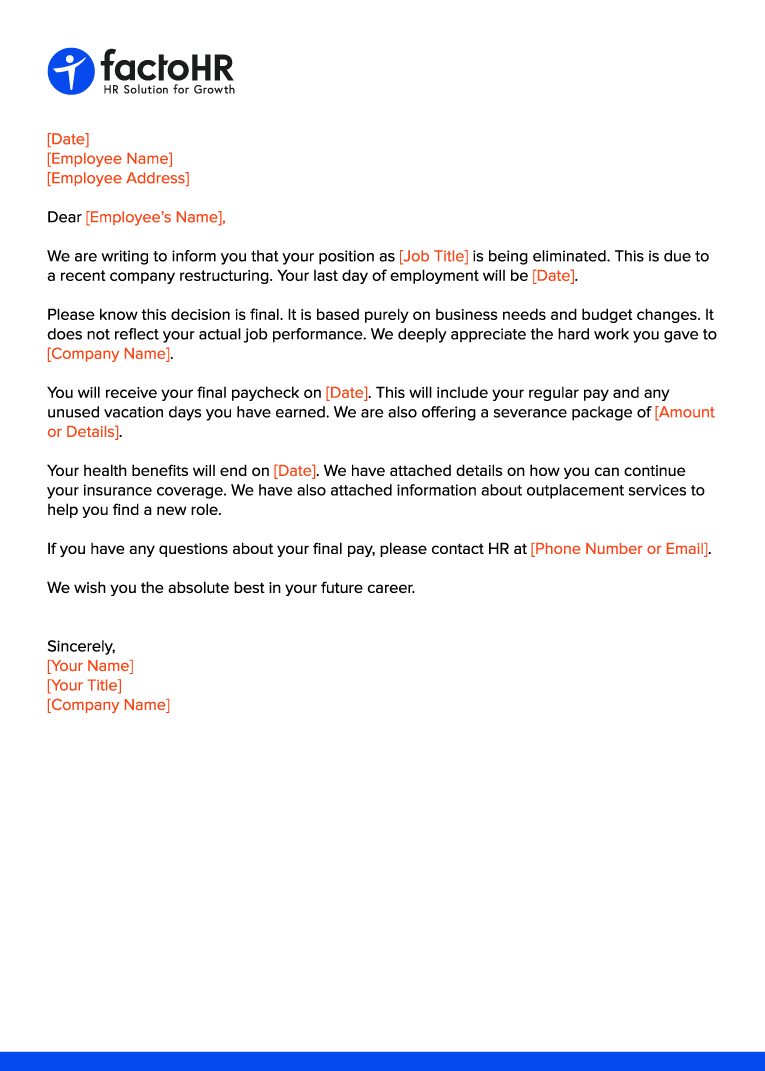
Template 1: Standard Permanent Layoff Due to Downsizing
Use this employee termination letter due to downsizing when the job loss is permanent.
[Date]
[Employee Name]
[Employee Address]
Dear [Employee Name],
We are writing to inform you that your position as [Job Title] is being eliminated. This is due to a recent company restructuring. Your last day of employment will be [Date].
Please know this decision is final. It is based purely on business needs and budget changes. It does not reflect your actual job performance. We deeply appreciate the hard work you gave to [Company Name].
You will receive your final paycheck on [Date]. This will include your regular pay and any unused vacation days you have earned. We are also offering a severance package of [Amount or Details].
Your health benefits will end on [Date]. We have attached details on how you can continue your insurance coverage. We have also attached information about outplacement services to help you find a new role.
If you have any questions about your final pay, please contact HR at [Phone Number or Email].
We wish you the absolute best in your future career.
Sincerely,
[Your Name]
[Your Title]
[Company Name]
Template 2: Temporary Layoff Letter (Furlough)
Sometimes work just pauses for a little while. Use this temporary layoff letter if you plan to bring the worker back later.
[Date]
[Employee Name]
[Employee Address]
Dear [Employee Name],
We are writing to inform you of a temporary layoff. This is due to a sudden lack of work at the company right now. Your temporary layoff will begin on [Date].
This layoff is currently expected to last for [Number] weeks. Your anticipated return-to-work date is on or around [Date]. You will be notified immediately if that date changes.
During this time, you will not receive your regular pay. However, your health benefits will remain active until [Date]. You may be able to file for unemployment benefits right now. We strongly suggest you contact your local labor office to apply.
We truly value your place on our team. We hope to have you back as soon as business improves. Please contact HR if you have any questions at all.
Sincerely,
[Your Name]
[Your Title]
[Company Name]
How HR Software Streamlines the Offboarding Process
Dealing with all this paperwork during a layoff is stressful. Good Human Resources Management means making things easier for your own HR team, too.
Offboarding is the process completed when an employee leaves the company. It typically includes collecting company property, disabling work email access, and, in some cases, conducting an exit interview.
You can actually automate all these tricky tasks. Using good employee offboarding software takes away the manual headache. It gives your team a clear checklist. It tracks everything so you do not miss a single legal step during a very tough day.
Frequently Asked Questions
Is a Layoff Letter Legally Required?
Yes, in many places it is required by law. Certain labor laws demand that you give written notice before a mass layoff. Always check your local laws to be perfectly safe.
Can a Layoff Letter be Sent via Email?
Yes, but it is always best to hand it to them in person. If they work far away, you can email it after you have a private video call with them first. Never let an email be the way they find out.
What is the Difference between a Layoff Letter and a Termination Letter?
A layoff means the company lacks work or money. A termination usually means the person is being fired for poor work or bad behavior.
Should a Layoff Letter Include the Exact Reason for Downsizing?
No, you do not need a long, detailed explanation. Keep it very basic. Say it is for economic reasons or company restructuring.
Do I Need to Mention Severance Pay in the Layoff Letter?
Yes. If you are giving them severance money, put the exact details in the letter. It helps prevent arguments and confusion later on.
Disclaimer
We are not your lawyers. Always have your own legal counsel check your termination documents before you hand them to anyone. Employment laws change constantly depending on where your company is located.
Table of Contents
Are you preparing for a content writer interview?
This guide will help you practice the most common interview questions with simple and clear sample answers. Whether you are a fresher or an experienced writer, you’ll find practical tips to feel confident and ready.
What Will You Learn
- The most common interview questions and how to answer them clearly
- Practical writing test interview questions
- Scenario-based interview questions
- What interviewers look for in a content writing role
- Quick preparation tips if you have limited time
- Red flags to watch for during interviews
Most Common Content Writer Interview Questions
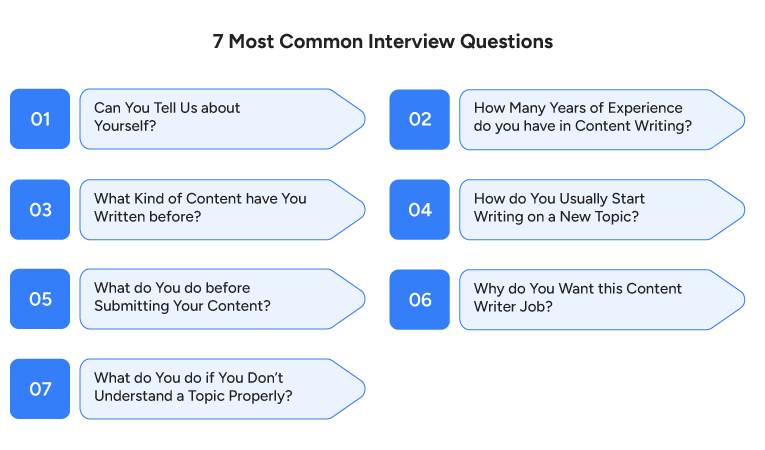
1. Can You Tell Us about Yourself?
Reason Behind Asking: The interviewer wants to understand your background, skills, and personality. This question also helps them assess how clearly and confidently you communicate, which is an essential skill for a content writer.
Sample Answer: Hello, I’m [Your Name]. I completed my Bachelor’s degree in [Your Field]. During my studies, I improved my research and communication skills. I also started writing blogs and small projects, which helped me get better at writing and understand what the audience wants.
2. How Many Years of Experience do You have in Content Writing?
Reason Behind Asking: Interviewers ask this to understand your experience level and the type of work you have handled.
Sample Answer: I have over 5 years of experience in content writing. I started by creating blogs and website content, then moved into a senior role where I handled content planning and basic SEO. Recently, I’ve also guided writers and helped maintain brand consistency across content.
3. What Kind of Content have You Written before?
Reason Behind Asking: To understand your content versatility, industry exposure, and whether your background aligns with their content needs, such as blogs, SEO, or social media.
Sample Answer: I’ve created content for tech startups, including blogs, website pages, emails, and social media campaigns, raising engagement by 40%. My work also includes B2B whitepapers, website copy, and video scripts, always customized to the audience and goals.
4. How do You Usually Start Writing on a New Topic?
Reason Behind Asking: To understand your research process, approach to unfamiliar subjects, and ability to structure content effectively before writing.
Sample Answer: When I start a new topic, I first read and research to understand it well. I check other articles to see what works and what is missing. Then, I make a simple outline with headings and the main points I want to cover. After that, I start writing, adding keywords organically and keeping the content clear, engaging, and informative.
5. What do You do before Submitting Your Content?
Reason Behind Asking: To see how much attention you pay to detail, quality checks, and commitment to delivering error-free content.
Sample Answer: Before submitting my content, I carefully review it for grammar, flow, SEO, and accuracy, ensuring all facts and sources are correct. I also refine the tone and style to match the brand voice, making it engaging and ready to publish.
6. What do You do if You Don’t Understand a Topic Properly?
Reason Behind Asking: The goal here is to understand how you manage unfamiliar topics, carry out research effectively, and maintain accuracy and consistency in your writing.
Sample Answer: I start by researching the topic using reliable sources to gain a clear understanding. I outline key points to get a clear picture. If needed, I ask colleagues or subject matter experts for clarification. After understanding the topic, I create an outline and write the content, making sure it is accurate, concise, and easy for readers to understand.
7. Are You Comfortable Making Changes after Feedback?
Reason Behind Asking: To see if you can accept constructive criticism and can adapt your writing to meet expectations.
Sample Answer: Yes, I am comfortable making changes after feedback. I welcome feedback to improve content and align it with project or brand goals. I review suggestions carefully, ask questions if needed, and make updates to ensure the work is clear, accurate, and meets expectations.
8. Why do You Want this Content Writer Job?
Reason Behind Asking: To know why you are interested in the role, along with how your goals align with the business’s goals and values.
Sample Answer: I want this content writer job because I’m passionate about creating engaging content that connects with readers. I’m excited to work for a company that values storytelling and communication. With experience, I can strengthen your content strategy while continuing to learn and grow my skills.
Content Writer Interview Questions for Freshers
9. Why do You Want to Become a Content Writer?
Reason Behind Asking: To know your motivation, passion for writing, and commitment to the role.
Sample Answer: I want to be a content writer because I enjoy creating engaging, easy-to-understand content that shares ideas and tells stories. This role also lets me improve my skills, learn new things, and help the business grow while doing what I love.
10. In Your Opinion, What Makes Content Engaging for Readers?
Reason Behind Asking: To know your approach to engaging readers and creating content that captures attention.
Sample Answer: In my opinion, what makes content interesting is that it is useful, easy to follow, and has clear headings, relatable examples, and the right tone. Adding tips or helpful information makes it valuable, teaching, entertaining, or inspiring readers while keeping them wanting more.
11. How Would You Write a Blog from Scratch?
Reason Behind Asking: To understand your approach to planning, researching, and creating structured, engaging content.
Sample Answer: To write a blog from scratch, I research the topic, understand the audience, and create an organized outline with headings and main ideas. I write in a suitable tone, add examples or visuals to engage readers, and proofread and edit to ensure it is clear, accurate, and ready to publish.
12. Before Submitting Your Content, how do You Make Sure there are no Grammar or Spelling Errors?
Reason Behind Asking: To see your attention to detail, writing accuracy, familiarity with editing tools, and ability to maintain professional-quality content.
Sample Answer: I proofread carefully and use tools like Grammarly and Microsoft Editor. I read aloud to catch awkward sentences, use Hemingway to improve readability, and, for important work, have a colleague review it to ensure the final draft is clear and error-free.
13. How do You Improve Your Writing Skills?
Reason Behind Asking: To understand your commitment to growth, learning, and producing high-quality, engaging content.
Sample Answer: To improve my writing skills, I practice daily and receive feedback. I take opportunities to learn by writing on different topics, reading books, and taking courses on SEO and storytelling. I also study top-performing articles to improve my article structure, hooks, and overall writing effectiveness.
14. What is the Difference between Simple Writing and Creative Writing?
Reason Behind Asking: To assess if you understand different writing styles and can create content for clarity and audience needs.
Sample Answer: The difference between simple writing and creative writing is that simple writing focuses on clarity and delivers information directly, while creative writing uses imagination and storytelling to engage readers emotionally.
15. If Your Manager Makes Changes to Your Content, how do You Take It?
Reason Behind Asking: To see your attitude toward feedback, willingness to learn, and ability to improve your work.
Sample Answer: I welcome feedback to improve my writing and meet project goals. During my internship at [Company Name], I applied editorial suggestions to improve SEO and increase organic traffic, and I asked clarifying questions to learn and avoid repeating mistakes.
16. What are Your Strengths as a Writer?
Reason Behind Asking: To understand your self-awareness, see if your skills match the role, and find out how you can help achieve their content goals.
Sample Answer: As a writer, my strengths include strong research skills, clear explanations of complex topics, and creativity in storytelling. I adapt tone for different audiences, optimize content for SEO, and consistently meet deadlines to deliver high-quality, engaging content.
17. Do You Prefer Working Alone or in a Team?
Reason Behind Asking: To see if you can work well alone or with a team and handle feedback from editors or stakeholders.
Sample Answer: I’m comfortable working independently and in teams. I stay focused, plan efficiently, and deliver high-quality work, while also collaborating, sharing ideas, and aligning with team goals. I adapt my approach to meet project needs and achieve the best results.
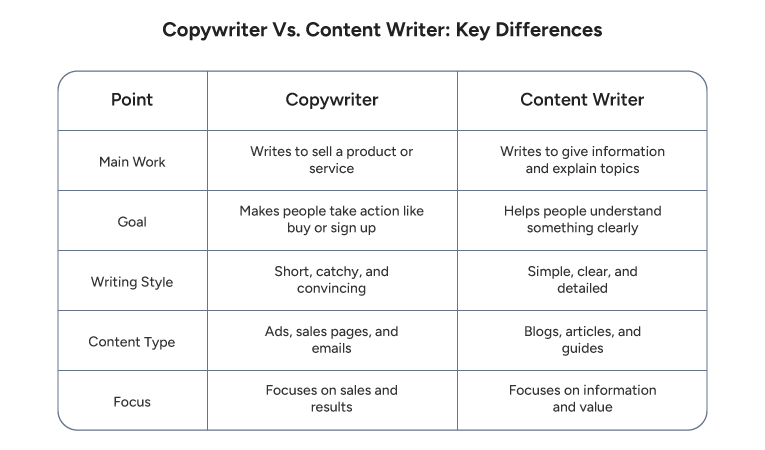
Content Writer Interview Questions for Experienced Candidates
18. How do You Decide the Tone of Your Writing?
Reason Behind Asking: To see if you understand your audience, can adjust your writing, and match the brand’s voice, which is important for creating interesting and consistent content.
Sample Answer: I determine my writing tone by analyzing the audience, purpose, and brand voice, using a conversational tone for young professionals and a formal tone for corporate reports. I adapt to each platform, keeping it snappy for social media and detailed for blogs, and use A/B testing to ensure engagement and brand alignment.
19. How do You Make Sure Your Writing Style Stays Consistent?
Reason Behind Asking: To see how you keep the brand’s voice consistent across projects, work smoothly with a team, and avoid costly revisions.
Sample Answer: I keep my writing consistent by following the brand’s style & tone guidelines, maintaining uniform language, structure, and formatting. I review content before publishing to ensure alignment with previous materials and use templates and checklists to deliver professional, on-brand content across all channels.
20. Tell Us about a Difficult Writing Project You Handled
Reason Behind Asking: This question assesses your problem-solving abilities, resilience, and ability to deliver quality content under pressure, as well as how you adapt your research, creativity, and workflow in difficult situations.
Sample Answer: One challenging project was a technical whitepaper for a non-technical audience. I simplified complex concepts while maintaining accuracy by organizing clear sections, using examples, and consulting experts. The client praised its clarity and engaging presentation.
21. How do You Manage Multiple Writing Tasks at the Same Time?
Reason Behind Asking: To evaluate your time management, prioritization skills, and ability to deliver quality content under pressure when handling multiple tasks simultaneously.
Sample Answer: I organize my work by deadlines and break projects into smaller tasks. I use schedules and tools to track progress and keep managers or clients updated. Focusing on each task helps me meet deadlines, maintain quality, and create accurate, engaging content.
22. What do You do when a Client Keeps Asking for Revisions?
Reason Behind Asking: To see your professionalism, patience, and capability to handle feedback while continuing to maintain quality and client satisfaction.
Sample Answer: When a client keeps asking for revisions, I clarify expectations. If changes continue, I schedule a call to understand their perspective, offer 2–3 options, and refer to the original brief. If needed, I suggest additional paid revisions. This keeps projects on track, builds trust, and often turns frustrated clients into long-term partners.
23. Some Topics Can be Quite Complex. How do You Make Them Easy for Readers to Understand?
Reason Behind Asking: To see if you can turn complicated ideas into clear, engaging content that’s easy for the audience to understand.
Sample Answer: I simplify complex topics by researching thoroughly, breaking content into clear sections, and using simple language with examples, analogies, or visuals to make ideas relatable. I focus on what matters most to the audience, making the content accurate, easy to follow, and engaging so readers can grasp complex information without feeling overwhelmed.
24. How do You Make Sure Your Content is Original?
Reason Behind Asking: To evaluate your understanding of originality, plagiarism prevention, and research ethics, and to ensure you deliver authentic, insightful work.
Sample Answer: I ensure originality by researching thoroughly and creating unique content in my own words, with original structure and examples. I use tools like Grammarly Premium to review and revise, delivering authentic, high-quality content that adds real value.
25. If I Give You a Choice, What Kind of Content Would You Prefer to Write?
Reason Behind Asking: To assess your capabilities, experience, and the content areas where you can deliver the greatest results.
Sample Answer: I’m most confident writing blog posts and website content, and I enjoy research, clear structure, and creating engaging, value-driven pieces. I adapt tone for different industries and audiences to align with brand voice and business goals.
26. Have You Ever Missed a Deadline? What did You Learn from It?
Reason Behind Asking: To assess your accountability, time management skills, and ability to learn from mistakes.
Sample Answer: Yes, early in my career, I underestimated how much time the research for a project would take and missed a deadline. I’ve since learned to build in buffer time, divide tasks into milestones, and keep others informed throughout the process.
Hiring a Technical Writer? Save time with our ready-to-use Job Description template and create a professional job post in minutes.
Practical Interview Questions for Content Writer

27. Can You Write a Short Introduction on this Topic?
Reason Behind Asking: To assess your ability to quickly understand a topic, writing skills, research ability, and SEO knowledge.
Sample Answer: Yes. For example, for a blog on healthy eating, I might begin: “Eating well doesn’t have to be complicated. With a few simple changes, you can boost your energy, improve your health, and enjoy every meal.” This sets the tone and encourages readers to continue.
28. Can You Rewrite this Paragraph to Make It Better?
Reason Behind Asking: To see your editing skills, attention to detail, and ability to boost clarity and flow while keeping the original meaning intact.
Sample Answer: Yes, I read the paragraph to grasp its main idea and purpose. Then I simplify complex sentences, remove unnecessary words, and improve flow and structure while maintaining a tone suitable for the audience. For example: “Step into all-day comfort with our stylish, cushioned shoes, perfect for any adventure.” This boosts readability and impact.
29. Can You Suggest a Catchy Headline for this Topic?
Reason Behind Asking: To evaluate your creativity, understanding of the audience, and ability to create attention-grabbing headlines that align with users’ intent and drive engagement.
Sample Answer: Yes, I create headlines that are easy to understand, catchy, and relevant to the topic, so they attract readers while clearly conveying the content. For example, for a blog on productivity tips, a headline could be: “7 Simple Daily Habits That Actually Boost Productivity.”
30. If a Topic Feels Boring, how Would You Make It More Interesting?
Reason Behind Asking: To evaluate your creativity, storytelling skills, and ability to engage readers while keeping the content informative.
Sample Answer: I make content engaging by using unique angles, familiar examples, and a conversational tone. I break long sections into shorter ones, add bullet points and visuals, and highlight key benefits to turn dull or technical information into clear, readable content that keeps the audience’s attention.
31. How Would You Change Your Writing for a Different Group of People?
Reason Behind Asking: To see your adaptability, understanding of audience needs, and ability to tailor content style, tone, and complexity.
Sample Answer: I first identify the audience’s interests and preferences, then adjust tone, vocabulary, and examples. For executives, I use bullet points, ROI examples, and clear, jargon-free language; for beginners, I explain ideas with analogies, visuals, and engaging examples. This ensures the content is clear, useful, and easy to understand.
Scenario-Based Interview Questions for Content Writers

32. If Your Manager Feels Your Content Sounds Boring, What Would You do?
Reason Behind Asking: To see how well you handle feedback, solve problems, and make content more engaging without getting defensive.
Sample Answer: I would thank my manager for the feedback and ask for specifics on which aspects feel boring. Then, I’d revise the content to make it more engaging, add storytelling elements, or use a more dynamic tone, while keeping it aligned with the brand’s voice. I see feedback as an opportunity to improve and connect better with readers.
33. If You Don’t Agree with the Edits Made by the Reviewer, How Will You Respond?
Reason Behind Asking: To see how well you work with others, handle feedback calmly, and improve content. Writing is a team effort, so they want writers who prioritize quality.
Sample Answer: If I disagree with a reviewer’s edits, I first consider their feedback and thank them for it. I politely explain my perspective if needed, staying open to compromise to ensure the final content is high-quality and aligns with brand goals.
34. If You are Given a Topic You Don’t like, how Will You Handle It?
Reason Behind Asking: To evaluate your professionalism, adaptability, and ability to deliver quality content regardless of personal preferences.
Sample Answer: If I’m given a topic that I don’t like, I focus on the audience’s needs, research thoroughly, find engaging angles, and see it as an opportunity to learn and improve my versatility. I break tasks into manageable steps when needed to stay productive and deliver clear, well-researched content on time.
35. If the Instructions are Not Clear, What Steps Will You Take?
Reason Behind Asking: This evaluates your problem-solving, communication, and initiative to ensure you deliver content that meets expectations with minimal revisions.
Sample Answer: If instructions are unclear, I review the brief, ask specific questions to clarify expectations, and provide examples if needed. I document agreements to ensure I fully understand requirements, avoid errors, and deliver content that meets client goals efficiently.
Red Flags to Watch for in Candidates
- Coming late or behaving too casually in the interview can show poor work habits.
- Writing samples with many mistakes can reflect weak writing skills.
- Unclear or messy communication can make teamwork difficult.
- Showing no excitement about the role or company may show low interest.
- Asking to reschedule many times can show poor time management. Writers must meet deadlines.
- Giving unclear or different answers may suggest lack of preparation.
- Not asking questions about the job or company may show low interest.
How to Prepare for the Content Writer Interview
- Review your portfolio: Check your Job Description and select 3–5 writing samples that match the required skills. Be ready to explain your process and share your work.
- Research the company: Read their website and blog. Understand their tone and topics. Think about how your writing can match their needs.
- Practice common questions: Prepare answers for questions like how you handle deadlines or simplify complex topics.
- Know tools and trends: Understand basics like keyword research and grammar tools. Stay aware of AI writing tools and voice search.
- Show your creativity: Be ready to write or edit content during the interview. Practice writing quickly and clearly.
- Dress well and test tech: Dress properly, even if it’s an online interview. Make sure your mic and internet are working. Try to join a few minutes early.
Frequently Asked Questions
Is there Always a Writing Test in a Content Writer Interview?
Not always, Many content writer interviews include a writing test to check your skills. However, some companies may skip the test and evaluate you based on your portfolio.
How Long does a Content Writer Interview Usually Take?
Content writer interviews typically last 30-60 minutes for a standard one-on-one session with a hiring manager. This can extend to 90 minutes or more for panel or writing task rounds.
What Skills are Most Important for a Content Writer?
The most important skills for a content writer are creativity, strong writing and research abilities, and understanding audience, tone, and platform adaptability.
What are the Best Ways to Stand out in a Content Writer Interview?
To stand out, focus on showing your best work. Bring clear and varied writing samples, explain how you research and write for the right audience, and ask simple, smart questions about the company’s content. This shows confidence, interest, and readiness for the role.
Table of Contents
Each exit interview will tell a story that your organizational chart will not know. Asking exit interview questions to a departing employee is your last chance for an honest conversation, which most companies don’t realize. Exit interview questions can help you run deep diagnostics on your company’s culture gaps, management issues, and blind spots, before they can adversely impact your business.
This guide to 20 sharp exit interview questions is for the managers and people leaders who intend to build workplaces that employees choose to stay in. If used correctly, these questions also open a door to honest feedback and meaningful experiences that improve your retention.
Key Exit Interview Questions to Understand Why Employees Leave
- Why did You Decide to Leave the Company?
- What Made You Start Looking for a New Job?
- Was there Anything We Could have Done to Make You Stay?
- How Long had You been Thinking about Leaving?
- What is Your New Role Offering that this One did Not?
- Did the Role Meet Your Expectations when You Joined?
- What did You Enjoy Most about Your Job or the Company?
- What did You Enjoy Least about Your Job?
- Did You have the Tools, Systems, and Resources Needed to do Your Job Effectively?
- Were Your Responsibilities Clear throughout Your Time Here?
- Did You Receive Enough Training to Succeed in Your Role?
- Were there Enough Opportunities for Learning and Development?
- Did You See a Clear Path for Career Progression Here?
- How Would You Describe Your Relationship with Your Manager?
- How Could Your Manager have Supported You Better?
- Did You Feel Recognized and Appreciated for Your Contributions?
- How Would You Describe the Leadership Style in the Organization?
- Did You Feel Comfortable Raising Concerns or Sharing Ideas?
- Would You Recommend this Company to a Friend as a Place to Work?
- What is One Thing You Would Change to Make this a Better Place to Work?
What is an Exit Interview in HR?
An exit interview is an official conversation with an employee departing from the organization. It takes place during the notice period and is usually conducted by HR or an unbiased representative. It plays a vital role in the offboarding process by capturing honest feedback and acknowledging improvements, consequently strengthening retention strategies.
Why Exit Interview Questions Matter
Most companies think of exit interviews as a checkbox to be ticked compulsorily. The ones taking it seriously know the importance of well-thought-out exit interview questions.
They Reveal the Real Reasons Employees Leave
Rarely does an employee quit over one bad day. Burnout and work-life imbalance in the form of stuck compensation, delayed promotion, or a toxic manager accumulate over time and cause deeper resentment. Truth usually sits in layers, and it’s your job to peel them one by one.
They Help Improve Retention
Exit interview questions help HR read underlying signals useful for creating employee retention strategies and detect patterns over time, which can derive actionable insights like: which policies can be fixed, which managers need mentoring, and where employee engagement is suffering.
They Strengthen Offboarding and Employer Brand
A dignified offboarding experience builds a brand reputation that no PR or Ad can cement. Respectful exits from a company increase their goodwill and keep referral pipelines open long after the candidate has left.
They Help Organizations Act on Real Employee Feedback
Thirty conclusions from thirty interviews are your best evidence against real issues. If paid attention to, exit feedback can help you systematically weed out operational roadblocks and reduce the employee turnover ratio.
Build Smarter Offboarding Processes
What Questions Should You Ask in an Exit Interview?
These questions are more than conversation starters, as each question is designed to move past surface-level answers and uncover the ground reality.
Questions about Reasons for Leaving
1. Why did You Decide to Leave the Company?
Why ask this: The key point is to dig through this question’s first answer slowly. The first answer here is rarely the real one.
What to listen for: Vague responses like a better opportunity signal you to not accept the answer at face value. Listen for genuine reasons like an unbearable manager, a stagnant career path, or a toxic environment. These are the ones a company can actually resolve.
2. What Made You Start Looking for a New Job?
Why ask this: Why did the employee have to look for a job in the first place? This reason gives you the ignition you need.
What to listen for: It is best to listen to a specific moment, a missed promotion, or a bad conversation. When multiple employees gradually get frustrated due to the same trigger, you have organizational data on what needs to change.
3. Was There Anything We Could have Done to Make You Stay?
Why ask this: This question cuts through the layers and directly helps you with retention intelligence.
What to listen for: Adjusting salaries, role advancements, increasing flexibility, or recognition. If the answer is a ‘No’ – that’s useful as well. It means the exit was about growth and not dissatisfaction. If the answer is ‘yes’, it should be documented as valid retention data.
4. How Long had You been Thinking about Leaving?
Why ask this: Knowing that someone was mentally detached from the company long before they resigned changes the situation.
What to listen for: Unaddressed feedback, invisible frustration, or an ignorant manager are slow-building problems that grow over months. Short timelines often signal that the employee has found an opportunity elsewhere or is related to a specific incident.
5. What is Your New Role Offering that this One did Not?
Why ask this: You understand what the market is offering that you aren’t, and whether that gap can be closed.
What to listen for: Compensation chances, title upgrades, increased flexibility, or a structured growth trajectory. If you can offer value, but you don’t – that is a question for a policy-related mindset. But if you genuinely can’t match their expectations, it becomes a different conversation.
Questions about Role Clarity and Job Experience
6. Did the Role Meet Your Expectations when You Joined?
Why ask this: Tells you if the scope, growth, or ownership expectations were promised and have not been delivered in reality.
What to listen for: Listen for scope differences, seniority expectations, team structure, or day-to-day reality scenarios. These recruiting and onboarding problems are often worth fixing before you hire the next employee.
7. What did You Enjoy Most about Your Job or the Company?
Why ask this: Rather than always outlining problems, understanding positive elements can also help you protect them.
What to listen for: Genuine enthusiasm about projects, team dynamics, great manager behaviours, flexibility, or cultural moments that made the employee happy, can become your real employer brand – for attracting valuable newcomers.
8. What did You Enjoy Least about Your Job?
Why ask this: You will know what employees tolerate the longest before they finally quit.
What to listen for: When multiple employees flag the same issues of bureaucracy, unclear priorities, poor management, or micromanagement, you know exactly what is causing the high employee turnover.
9. Did You have the Tools, Systems, and Resources Needed to do Your Job Effectively?
Why ask this: To know if employees are frustrated by broken processes and outdated systems, which make quality work impossible.
What to listen for: Specific gaps in technology, budgets, team support, or process support. When you know the gaps are caused by infrastructure, not people, they can be fixed quickly.
10. Were Your Responsibilities Clear throughout Your Time Here?
Why ask this: To check if the employee was clear about their responsibilities, beyond their job description.
What to listen for: Ownership confusion, unclear responsibilities, or sudden shifts in priority without communication. Giving employees complete clarity should be the highest priority, and you can know if it has not been done accurately.
Questions about Training and Career Growth
11. Did You Receive Enough Training to Succeed in Your Role?
Why ask this: Low investment in onboarding and training can be checked and corrected immediately.
What to listen for: Unclear technical training, less documented processes, no structured onboarding, and being expected to independently learn everything. You can know whether new hires feel unprepared and change this asap.
12. Were There Enough Opportunities for Learning and Development?
Why ask this: To know whether learning and development was just a checkbox, or if it was taken seriously throughout the employee lifecycle.
What to listen for: Less mentoring, or zero access to courses, or managers who don’t invest in their team’s development. A culture that does not prioritize learning treats it as a personal expense, which hinders employee growth.
13. Did You See a Clear Path for Career Progression Here?
Why ask this: To see if employees are clear about their growth trajectory in the company. If yes, it becomes the fastest road to resignation.
What to listen for: Vague promotions, inconsistent growth criteria, favoritism, or never having a career conversation with their manager. If high performers don’t see where they are going, they often tend to leave.
Questions about Management and Leadership
14. How Would You Describe Your Relationship with Your Manager?
Why ask this: This question gently, but directly opens the door to knowing the single largest reason behind employee dissatisfaction.
What to listen for: Disconnection, inconsistent communications, lack of trust, or micromanagement. Employees who don’t name a single positive interaction are reporting core data.
15. How Could Your Manager have Supported You Better?
Why ask this: This helps you take constructive input rather than criticism and share a useful perspective.
What to listen for: Providing more feedback, clearer direction, recognition, or simply being heard. These answers can directly be used in manager coaching conversations and performance development.
16. Did You Feel Recognized and Appreciated for Your Contributions?
Why ask this: If an employee is not recognized, it becomes the most commonly cited reason why people mentally detach long before they actually resign.
What to listen for: Invisibility despite strong performance. Recognition gaps often are caused by specific managers or team cultures and cannot be resolved without deliberately interfering.
17. How Would You Describe the Leadership Style in the Organization?
Why ask this: It helps you understand the overall culture rather than just managers, and employees get to narrate their experience.
What to listen for: Negative words like top-down, reactive, or unpredictable can indicate culture-wide leadership issues. Positive words like transparent, empowering, or consistent can show you what strengths to maintain and protect.
Questions about Culture, Communication, and Belonging
18. Did You Feel Comfortable Raising Concerns or Sharing Ideas?
Why ask this: If high-performing teams cannot raise valid concerns, it is a question of psychological safety.
What to listen for: Whether employees feel connected, whether speaking up has consequences, or whether feedback loops really do exist. Self-censored workforces are risky and can lead to bigger problems later.
19. Would You Recommend this Company to a Friend as a Place to Work?
Why ask this: This answer is more honest than any engagement survey, because there is nothing left to lose.
What to listen for: If the employee hesitates while giving this answer, you can think of it as a Hard no. If the answer is a straight-away yes, the employee is leaving satisfied.
Final Reflection Question
20. What is One Thing You Would Change to Make this a Better Place to Work?
Why ask this: This can easily become the defining moment of the exit interview, and invite the employee to be constructive, one last time.
What to listen for: When someone immediately answers without any hesitation, it is the real answer. It is always advisable to track these responses religiously, as this is the most real feedback you will ever get.
Simplify how You Manage Exit Interviews
Exit Interview Questions to Avoid
Not every question belongs in this interview. If the exit interview questions are defensive, accusatory, or company-sided, they will feel like an interrogation and shut down the conversation instantly.
Skip questions like:
- Don’t you think the team did everything they could for you?
- Are you sure the problem wasn’t your own performance?
- Who specifically said that to you?
- Did anyone influence your decision to leave?
- Don’t you think the compensation was fair given your output?
- Would you reconsider if we matched the salary?
How to Conduct an Effective Exit Interview
Exit interview questions do matter, but a poorly run interview format can give you polite but nonchalant answers. A well-run exit interview, with a structured employee exit process, gets you the truth.
Choose the Right Timing
Rather than a last-minute discussion, schedule the interview somewhere during the notice period. When employees get the right psychological space before the decision, they tend to be more candid with their feedback.
Select a Neutral Interviewer
A neutral entity, like an HR, almost always does this better than a manager, as you get real insights about sensitive situations. When the person being discussed is present, the employee cannot be entirely honest.
Explain the Purpose Clearly
Outline well why this conversation is happening, how their feedback is to be used, and that it stays confidential. When employees believe that their opinions will not be weaponized, it changes the entire tone.
Ask Open-Ended Questions First
Ask broader questions first, then go specific as per their answers. Avoid leading questions, so the employees can narrate their experience from their own perspective before you narrow down.
Practice Active Listening
Ask clarifying questions rather than defending management or authority mid-conversation. When you become defensive instead of curious, the interview dies down instantly.
Record and Review Responses Properly
Store the feedback and compare patterns across teams and length of service. When you categorize raw data received and implement the insights, entire frameworks can be elevated to the next level.
How to Use Exit Interview Feedback Effectively
Asking exit interview questions and not doing anything is worse than not collecting them at all. This invaluable feedback can also be used proactively in the stay interview questions. Here are some ideas for using exit interview feedback skillfully.
Collect and Store Feedback Securely
Use a standardized form every time to collect comparable data. These forms can be stored confidentially in one system.
Tag Feedback by Theme
Categorize your employees’ feedback to turn it into actionable intelligence. You can tag various exit reasons as compensation, manager support, career growth, workload, training, work-life balance, culture, systems, and processes.
Look for Patterns, Not One-Off Complaints
Compare feedback across teams, tenure lengths, locations, or functions. If the same level of frustration shows up in multiple employees, it could easily be flagged as an organizational issue.
Turn Insights into Action
Assign ownership. Take the actions needed – like revising FN&F policies, improving onboarding, coaching or developing managers, or redesigning roles. If used properly, this feedback data can help your team improve in unfathomable ways.
Review Trends Regularly
Track whether the implemented changes are being consistently implemented, because when progress is not evaluated, outcomes are not measured.
Common Mistakes to Avoid during Exit Interviews
The interview can fail even before a single word is said if you do not avoid these mistakes:
- Scheduling it for the last hour of the employee’s last day
- Having the direct manager conduct the interview
- Asking defensive questions
- Treating the interview as a checkbox – with no seriousness
- Not having a follow-up plan
- Failing to document employee feedback
- Letting feedback sit still for months
Conclusion
The best organizations actually do something when people leave, rather than sit back and let the same fiascos happen again. Every exit carries a signal, and the organizations that care about it ask a curated list of exit meeting questions like the one above. Most importantly, they have the courage to act on what they hear.
Manage Exit Interviews the Right Way
FAQs
1. What are Exit Interview Questions?
Exit interview questions are structured questions asked to employees leaving an organization to understand their experience, reasons for leaving, and areas of improvement in management, culture, and processes.
2. How Many Questions Should an Exit Interview Include?
An effective exit interview generally includes 10-21 questions. These are enough to probe inside the vital areas related to role, management, culture, and growth.
3. Who Should Conduct an Exit Interview?
HR professionals are best suited to conduct exit interviews. They can act neutral, confidential, and objective when collecting honest feedback.
4. Are Exit Interviews Confidential?
Yes, exit interview responses should be kept strictly confidential, as confidentiality guarantees honest feedback.
5. What are the Best Exit Interview Questions to Ask?
The best questions can cover reasons for leaving, clarity about the role, the relationship with the manager, career growth, and cultural knowledge.
6. What Should You Not Ask in an Exit Interview?
It is Best to Avoid Asking Leading, Defensive, or Accusatory Questions. Never Ask Employees to Name Colleagues or Justify Their Decisions. These Can Quickly Turn the Conversation on a Negative Note.
7. Can Exit Interviews Improve Employee Retention?
Yes, when the collected feedback is tracked, themed, or actually acted upon. Exit interviews can identify recurring patterns in management and improve growth and culture.
8. What is the Difference between an Exit Interview and an Exit Survey?
An exit interview is a live conversation and is more flexible and better for follow-up. An exit survey can be faster and easier to scale, but it is limited in its ability to gather in-depth feedback.
9. Should a Manager Conduct the Exit Interview?
Generally, a manager can be the reason for an employee leaving, which is quite common. If they lead the interview, you will not get any honest feedback.
10. Can HR Software Manage Exit Interviews?
HR software makes exit interviews easier by using the same set of questions for everyone, letting employees share honest feedback online, and keeping all responses in one place. This helps HR teams spot patterns in why people leave and make smarter decisions to improve the workplace and retain employees.
Table of Contents
Preparing for a Google Ads interview can be challenging if you are unsure what questions might be asked. Interviewers usually test your knowledge of campaigns, keywords, bidding strategies, and performance tracking. In this guide, we have listed common Google Ads interview questions, along with sample answers, to help you prepare and feel more confident when answering.
Commonly Asked Google Ads Interview Questions
1. Can You Explain What Google Ads is?
Reason Behind Asking: To know your basic understanding of the platform and ensure you know its primary purpose.
Sample Answer: Google Ads, formerly known as Google AdWords, is an online advertising platform developed by Google that enables businesses to display ads on Google Search, YouTube, and partner websites. It mainly operates on a PPC (Pay-Per-Click) model and allows advertisers to target users based on keywords, location, and audience interests.
2. What is Ad Rank in Google Ads?
Reason Behind Asking: To see if you know how Google determines ad positions and the factors that affect them.
Sample Answer: Ad Rank is the value Google uses to decide an ad’s position on the search results page. It is calculated using your bid amount, Quality Score, and the expected impact of ad extensions. A higher Ad Rank improves ad placement and can lower cost-per-click.
3. What is the Difference between CPC and CPM?
Reason Behind Asking: To check your basic understanding of different bidding models in Google Ads and when to use them based on campaign objectives.
Sample Answer: CPC is a cost-per-click model in which advertisers are charged only when users click their ads, making it ideal for performance-driven campaigns. CPM is a cost-per-mille model where advertisers pay for every 1,000 impressions, making it better suited for increasing brand exposure.
4. What is PPC Advertising?
Reason Behind Asking: To see if you have a clear understanding of PPC basics in Google Ads, like bidding and cost calculations.
Sample Answer: PPC (Pay-Per-Click) is an online advertising model in which advertisers pay only when someone clicks their ad. It works through an auction system where advertisers bid on keywords to show their ads to the right audience. This helps businesses generate targeted traffic, leads, or sales cost-effectively.
5. What are Keywords and Match Types?
Reason Behind Asking: To check if you understand how keywords work in Google Ads and how match types control which searches trigger your ads.
Sample Answer: Keywords are the terms or phrases that trigger your ads when users search for related terms. Match types, like Broad, Phrase, and Exact match, determine how closely a search must match your keyword to show your ad, helping control ad reach and relevance.
6. What is CTR?
Reason Behind Asking: To see if you understand how ad performance is measured and how well your ads attract clicks.
Sample Answer: CTR stands for Click-Through Rate, which measures the percentage of users who click on your ad after seeing it, calculated as (Clicks / Impressions) × 100. A higher CTR signals that ads are relevant and can improve Quality Score, potentially lowering costs and boosting ad rankings.
7. How is a Google Ads Account Structured?
Reason Behind Asking: To see if you understand the Google Ads hierarchy, including campaigns, ad groups, and ads, and can effectively organize and optimize them to meet business goals.
Sample Answer: A Google Ads account is organized in layers: the account itself, campaigns, and ad groups. Ads and keywords are grouped within ad groups. The account handles billing and settings, campaigns set budgets and targeting, and ad groups group related keywords and ads.
8. What are Ad Extensions in Google Ads?
Reason Behind Asking: To see if you understand how ad extensions improve ads, provide more information to users, and improve ad performance and visibility.
Sample Answer: Ad Extensions (now called Assets in Google Ads) are additional pieces of information that expand your Google Ads text ads, such as sitelinks, call buttons, or location details. They make ads more informative and engaging, thereby improving click-through rates and overall ad performance.
9. What Types of Ads are Available in Google Ads?
Reason Behind Asking: To check if you understand the different Google Ads formats and when to use each to meet campaign goals.
Sample Answer: Google Ads offers several types of ads, including Search Ads, Display Ads, Shopping Ads, Video Ads, App Ads, Local Services Ads, Smart Ads, Performance Max Ads, and Demand Gen Ads. Each ad type is designed for different marketing goals, such as driving website traffic, promoting products, increasing brand awareness, generating leads, or maximizing conversions across Google platforms.
Google Ads Interview Questions for Experienced Candidates
10. What is Quality Score in Google Ads, and how Would You Improve It?
Reason Behind Asking: To assess your knowledge of Google Ads performance metrics and how Quality Score impacts ad rank, costs, and overall ROI.
Sample Answer: Quality Score in Google Ads is a number from 1 to 10 that shows how relevant your keywords and landing pages are, based on expected click-through rate, ad relevance, and landing page experience.
To improve Quality Score, I would create focused ad groups, write relevant ads with clear calls to action, speed up landing pages, make sure the ad and landing page messages match, and use negative keywords to boost relevance and click-through rates.
11. How do You Reduce Cost per Click?
Reason Behind Asking: To evaluate your capability to optimize Google Ads campaigns and manage ad spend effectively.
Sample Answer: To reduce cost per click (CPC), I focus on three key areas. First, I ensure strong alignment between ads, keywords, and landing pages to improve relevance and Quality Score. Second, I use Smart Bidding to automatically adjust bids in real time, optimizing for conversions based on user behavior and contextual signals. Finally, I implement negative keywords to block irrelevant searches and prevent wasted ad spend.
12. How do You Choose the Right Keywords?
Reason Behind Asking: To see your awareness of keyword research and how well you align keywords with campaign goals and user intent.
Sample Answer: I start by understanding the business goals and target audience. Then I use keyword research tools to find relevant terms with good search volume and strong intent, focusing on transactional terms that indicate users are ready to buy or take action. I improve them by reviewing search term reports, adding negative keywords, and monitoring metrics like CPC and Quality Score.
13. What are Negative Keywords?
Reason Behind Asking: To check how well you understand traffic quality and how you avoid wasting money on Google Ads.
Sample Answer: Negative keywords are words or phrases that filter out irrelevant search queries, ensuring ads appear only for relevant traffic. They help filter out unqualified traffic and make your campaigns more effective. Using negative keywords helps me cut wasted spending and target the right audience.
14. How do You Track Conversions?
Reason Behind Asking: To assess your technical knowledge of conversion tracking and how well you can measure campaign performance.
Sample Answer: I set up conversion tracking by using Google Ads conversion tags or importing Google Analytics events. I monitor important actions like purchases, form submissions, and calls to see how well the campaign is performing. This information helps me adjust bids, keywords, and ads based on actual performance.
15. How do You Optimize a Low-Performing Campaign?
Reason Behind Asking: To see your problem-solving skills and your ability to improve campaign performance using data-driven strategies.
Sample Answer: I analyze key metrics like CTR, CPC, Quality Score, and conversion rate to identify issues. With the analysis, I improve keywords, ad copy, targeting, and bids, and add negative keywords to reduce wasted spend. I continuously test and monitor changes to improve overall campaign performance.
16. How do You Manage a Google Ads Budget Effectively?
Reason Behind Asking: To assess your ability to allocate budget efficiently, maximize ROI, and prevent overspending in campaigns.
Sample Answer: I prioritize budget toward high-performing campaigns, monitor spend closely, and continuously optimize bids and keywords to maximize conversions and reduce waste.
Looking for Ready-to-Use Job Description Templates?
Hiring for a new role? Access professionally written job description templates to define responsibilities, required skills, and expectations for different positions.
Scenario-Based Google Ads Interview Questions
17. What Would You do if a Campaign is Getting Clicks but no Conversions?
Reason Behind Asking: To see how well you can identify problems, understand the conversion process, and improve a campaign overall, not just get more clicks.
Sample Answer: I would first check if the landing page is relevant and loads quickly. I would also make sure it has clear calls to action to align the ad and keep visitors engaged. Then, I’d review keywords and ad copy for user intent and add negative keywords to filter irrelevant traffic. Finally, I’d monitor changes and run A/B tests to improve conversions.
18. What Will You Check if Conversions Suddenly Drop?
Reason Behind Asking: To assess your analytical thinking and ability to quickly identify and fix issues impacting campaign performance.
Sample Answer: First, I’d ensure conversion tracking in Google Ads and Analytics is working correctly after any site changes. Next, I’d check traffic trends, bids, and negative keywords for issues. Finally, I’d review campaign edits, ad disapprovals, competitor activity, and run A/B tests on landing pages to identify and fix the root cause.
19. How Would You Manage a Limited Budget?
Reason Behind Asking: To assess your ability to prioritize skills, maximize ROI, and make strategic decisions when resources are limited.
Sample Answer: With a limited budget, I focus on high-intent, high-performing keywords and campaigns to maximize conversions. I use Smart Bidding strategies and schedule ads for peak times to improve efficiency, while frequently reviewing performance and pausing underperforming ads to get the best results.
20. How do You Compete with a Bigger Competitor?
Reason Behind Asking: To see your strategic thinking, creativity, and ability to optimize campaigns against competitors with larger budgets or market share.
Sample Answer: I compete with bigger competitors by focusing on precision rather than budget size. Using Auction Insights, I analyze overlap rate and impression share to find gaps where I can win more efficiently. In Google Ads, I improve Quality Score, fine-tune negative keywords, and target high-intent audiences to lower costs and increase conversions.
Nervous About Your HR Interview Round?
Check the most common HR interview questions and learn how to answer them with confidence.
Advanced Google Ads Strategy Questions
21. Which Bidding Strategies have You Used?
Reason Behind Asking: To evaluate your practical experience with different bidding strategies and your ability to choose the right one based on campaign goals.
Sample Answer: I’ve used Manual CPC, Maximize Clicks, Maximize Conversions, Target CPA, and Target ROAS depending on campaign objectives. For lead generation, I typically use Target CPA for general campaigns and Target ROAS for e-commerce campaigns to maximize conversions. I choose the strategy based on goals, data availability, and performance trends.
22. How do You Scale a Successful Campaign?
Reason Behind Asking: To assess your ability to grow performance while maintaining efficiency and profitability.
Sample Answer: To scale a successful campaign, I gradually increase the budget while closely monitoring CPA or ROAS to maintain efficiency. I expand high-performing keywords, audiences, and locations, and test new ad creatives to grow reach. I scale in small increments and pause underperformers quickly to protect overall ROI.
23. How do You Measure ROI?
Reason Behind Asking: To assess your understanding of profitability and your ability to connect ad performance with business results.
Sample Answer: I calculate ROI by subtracting total costs (ad spend, margins, and overhead) from campaign revenue, then dividing by those costs. I track conversions and revenue through Google Ads and Analytics, along with metrics like ROAS and cost per acquisition. While ROAS measures gross revenue per ad dollar, true ROI accounts for profitability after all expenses. This helps determine whether campaigns are profitable and where to optimize.
24. What is A/B Testing in Google Ads, and why is It Important?
Reason Behind Asking: To assess your understanding of experimentation and optimization in campaigns to improve performance systematically.
Sample Answer: A/B testing in Google Ads involves running two or more versions of an ad, landing page, or creative to see which performs better. It’s important because it helps identify what resonates with the audience, improves CTR and conversions, and ensures decisions are based on data rather than assumptions.
25. How do You Allocate Budget across Campaigns?
Reason Behind Asking: To evaluate your ability to prioritize spending effectively, maximize ROI, and align budget allocation with business goals.
Sample Answer: I allocate budget based on campaign goals, performance, and potential ROI. High-performing campaigns or those driving critical conversions get more budget, while underperformers are limited or paused. I continuously monitor results and adjust budgets to maximize efficiency and results.
Preparing for a Digital Marketing Interview?
Practice the most asked 50+ digital marketing interview questions with sample answers.
Behavioral Questions in a Google Ads Interview
26. Tell Me about a Campaign You Improved
Reason Behind Asking: To evaluate your practical experience, problem-solving skills, and ability to optimize campaigns for better performance.
Sample Answer: I managed an e-commerce campaign with low conversions, auditing performance to pause underperforming keywords, add negative keywords, and implement Smart Bidding. I also optimized ad copy, landing pages, and used remarketing audiences. This increased conversion volume by 30% and improved ROAS by 20% within 3 months.
27. How do You Handle Client Pressure?
Reason Behind Asking: To assess your stress management, communication skills, and ability to maintain professionalism and expectations under tight deadlines.
Sample Answer: I handle client pressure by actively listening to their concerns and setting realistic expectations. I provide clear data-driven updates and explain the reasoning behind my recommendations. This approach builds trust while ensuring campaigns continue to perform effectively.
28. How do You Manage Multiple Campaigns?
Reason Behind Asking: To assess your organizational skills, prioritization, and ability to efficiently manage multiple campaigns without compromising performance.
Sample Answer: I manage multiple campaigns using Google Ads tools like labels, shared budgets, and automated rules to stay organized. I prioritize campaigns based on performance metrics like return on ad spend (ROAS) and Click-Through Rate (CTR), reviewing high-impact campaigns daily and others weekly. This ensures efficient resource allocation and allows for quick optimizations to maintain strong performance.
29. What do You do when Results are Not Improving?
Reason Behind Asking: To assess your problem-solving skills, analytical approach, and ability to optimize campaigns when performance stagnates.
Sample Answer: When results aren’t improving, I analyze metrics like CTR, conversion rate, and Quality Score to identify issues. I refine keywords, ad copy, targeting, and landing pages, add negative keywords, and run A/B tests on ads or landing pages. I monitor performance over 1–2 weeks and make changes based on what works best.
Final Tips to Prepare for a Google Ads Interview
Use the tips below to get ready and confidently show your practical campaign experience.
- Practice speaking your answers out loud to build confidence and sound natural.
- Review your past campaigns and be ready to discuss results, challenges, and lessons learned.
- Prepare examples of problem-solving and performance improvements under pressure.
- Think about how you prioritize tasks when managing multiple campaigns.
- Show that you can analyze results and make data-driven decisions.
- Prepare a few ideas on how you would improve a campaign if given the chance.
- Practice answering clearly and confidently, focusing on clarity over speed.
- Stay calm, positive, and professional, even with unexpected questions.
- Prepare 2–3 questions to ask the interviewer to display genuine interest.
Common Red Flags to Avoid in a Google Ads Interview
Knowing these common mistakes helps you stay confident and make a positive impression.
- Giving vague answers without real examples from your campaigns.
- Talking only about clicks, not actual results like leads, sales, or ROI.
- Overloading answers with jargon or theory instead of practical insights.
- Struggling to explain your thought process clearly.
- Avoiding questions about challenges, mistakes, or learning from failures.
- Blaming tools or budgets instead of taking responsibility and showing solutions.
- Overpromising quick wins that aren’t realistic.
- Ignoring the audience or customer when discussing campaigns.
- Appearing unprepared or unsure about past campaigns and results.
- Rambling, going off-topic, or not asking any questions about the role.
Frequently Asked Questions
Is Google Ads Certification Required for a Google Ads Job?
No, Google Ads certification is not required, but it can help demonstrate your knowledge and credibility. Many employers value it as proof of understanding best practices while still prioritizing hands-on experience.
What Tools does a Google Ads Specialist Usually Use?
A Google Ads specialist typically uses tools like Google Ads, Google Analytics, Keyword Planner, and Google Tag Manager to manage and optimize campaigns. They may also use third-party tools like SEMrush or Ahrefs for keyword research and competitor analysis.
What Metrics are Important in Google Ads Campaigns?
Important metrics in Google Ads campaigns include Click-Through Rate (CTR), Cost Per Click (CPC), Conversion Rate, Cost Per Acquisition (CPA), and Quality Score. These help measure performance, ROI, and the effectiveness of ads and targeting.
What Skills are Required for a Google Ads Role?
A Google Ads role requires skills in campaign management, keyword research, ad copywriting, and data analysis. Strong knowledge of bidding strategies, analytics tools, and optimization techniques is also essential for driving ROI and performance.
Table of Contents
Income Tax is a statutory obligation imposed by the Government of India to foster economic development and defense. Under the landmark Income Tax Act 2025 (which replaces the 1961 Act), the process has been structurally overhauled to favor a simpler, digital-first approach.
The most significant change is the move to a unified “Tax Year” – replacing the old “Previous Year” and “Assessment Year” confusion. Now, the year you earn and the year you file are the same. But while the law is simpler, the transition poses unique challenges for both HR teams and employees. Here’s how factoHR helps you stay ahead.
Key Takeaways
- The Income Tax Act 2025 introduces a simpler, digital-first tax system with a unified Tax Year concept.
- The New Tax Regime under Section 202 is now the default, so employees must declare carefully to avoid unwanted TDS deductions.
- Employees face new challenges in tax planning, HRA verification, perquisite valuation, and deduction tracking.
- HR teams must handle updated compliance requirements, new forms, real-time reconciliation, and digital audit readiness.
- factoHR helps simplify tax declarations, automate compliance, and reduce manual workload for both employees and HR.
Key Tax Declaration Challenges for Employees in Tax Year 2026
It is the employees’ duty to file their own income tax returns, and this process includes various information to be submitted. As the truthfulness of the information is essential, employees face a lot of difficulties, as mentioned below.
The “Section 202” Default Trap
Under the new Act, the New Regime (now codified under Section 202) is the statutory default. Employees who miss the declaration window will see their TDS deducted at the New Regime rates automatically. For high-earners with significant home loans or Section 80C commitments, this “silent” switch can lead to a drastic reduction in monthly liquidity.
The Break-Even Analysis Complexity
With the Standard Deduction increased to ₹75,000 and a full tax rebate for income up to ₹12.75 Lakhs (for salaried individuals), the traditional “invest to save” strategy is under fire. Employees now face the challenge of calculating whether their ₹2-3 Lakhs in deductions actually outweigh the lower slab rates of the New Regime.
Stricter HRA Verification for “New Metros”
Residents of Bengaluru, Hyderabad, Pune, and Ahmedabad are now eligible for 50% HRA exemption. However, the Income Tax Rules 2026 mandate a “Relationship Disclosure.” If you pay rent to a family member, you must now explicitly declare the relationship, and rent receipts must be digitally verifiable to avoid automated rejection.
Perquisite Valuation Shifts
The new Act has redefined “Perquisites.” For example, company-provided accommodation or electric vehicle (EV) charging benefits now have updated valuation rules. Employees often struggle to understand why their “Taxable Pay” differs from their “Gross Salary” due to these non-cash benefits.
NPS Vatsalya and New Savings Avenues
The introduction of NPS Vatsalya offers new tax-saving routes for those staying in the Old Regime. Tracking these niche deductions across multiple family members adds to the year-end paperwork.
Simplify Section 202 Declarations for Employees.
Top HR Compliance Hurdles under the New Income Tax Act 2025
Human resource is undoubtedly an indispensable part of any business, and it plays a significant role in payroll management and income tax computation. Specifically, in the month of March, there’s no room on HR’s plate. Because the financial year comes with lots of responsibilities, and the organizations that process the IT computation manually feel a lot of hurdles to overcome. Let’s see what those are.
Migration from Form 16 to Form 130
The sunsetting of Form 16 in favor of Form 130 (Annual TDS Certificate) is not just a name change. Form 130 requires a “Three-Part” reconciliation (Part A, B, and C) that must be pulled directly from the TRACES portal after processing the new Form 138 (Quarterly Statements). Manual generation is now legally invalid.
Managing “Hybrid” Payroll Structures
HR must now maintain a “Split-Master Data” system. Processing payroll where 60% of staff are under the Section 202 default and 40% have “Opted-out” (via the new Form 124) creates a dual-logic burden for every monthly cycle.
Real-Time TDS Reconciliation (Form 138)
The move from Form 24Q to Form 138 demands more frequent data synchronization. Any mismatch between the salary paid and the TDS deposited now triggers automated “Defective Return” notices to the employer almost instantly.
Mandatory Digital Residency & Backups
The 2026 Rules require companies to disclose where their payroll data is stored. HR must ensure that their software provider maintains physical backup servers within India and provides 5-year digital audit trails for every employee investment proof.
Handling the “Metro Status” Back-Calculations
For companies with pan-India offices, shifting employees from 40% to 50% HRA for the four new metros (Pune, Blr, Hyd, Ahmd) requires a mid-year data audit to ensure employees aren’t being over-taxed based on old city classifications.
The “Faceless” Scrutiny Support
Under the new Act, if an employee’s return is picked for faceless assessment, the HR department is often asked to provide “Employer Certificates” or digital proof of perquisites. Managing these ad-hoc requests for thousands of employees is a massive support load.
Process 2026 Tax Year Payroll Faster.
How factoHR Automates 2026 Tax Compliance and Form 130 Generation
The transition to the Income Tax Act 2025 requires more than just a payroll calculator; it demands a comprehensive digital ecosystem. factoHR offers an end-to-end IT declaration suite accessible via a web portal and a cross-platform mobile application (Android and iOS), ensuring compliance is always within reach.
Intelligent Regime Selection & Simulation
The platform provides a unique comparison engine for “Pre-budget” (Old) and “Post-budget” (New Section 202) calculations. Employees can simulate their tax liability across different slabs, helping them make an informed decision before submitting their final regime declaration.
Dynamic Tax Projections & “View Tax Calculation”
To eliminate year-end “Salary Shock,” our “View Tax Calculation” feature provides total transparency. Employees can track exactly how much tax was deducted in previous months and view projected tax liabilities for the remainder of the Tax Year. This real-time insight is crucial for verifying TDS accuracy before the final March payroll run.
Zero-Paper Proof Management
factoHR’s online upload feature eliminates the need for physical documentation. Employees can simply capture photos of their investment proofs or upload soft copies directly via their smartphones. The system automatically categorizes these proofs under the relevant 2026 statutory sections, ensuring a clutter-free and audit-ready submission process.
Comprehensive Income Categorization
Our feature library is pre-configured with all recognized income and exemption categories under the 2025 Act. From standard salary components to specific exemptions like the updated Children’s Education Allowance, employees can easily enter amounts and attach supporting evidence in one centralized location.
Automated Generation of Form 130 & 138
Moving beyond the manual era of requesting documents from HR, employees can now instantly download their Form 130 (Annual TDS Certificate) and other relevant tax summaries directly from the app. For HR teams, the software facilitates the bulk sharing of digitally signed forms, ensuring that every employee receives their compliance documents securely and on time.
The 2026 Statutory “Safety Net”
factoHR isn’t just a tool; it’s a safeguard. By automatically capping exemptions at the new legal limits and providing a 5-year encrypted digital archive for all uploaded proofs, we ensure your organization meets the Faceless Assessment requirements of the new Act without the administrative burden.
Income Tax Act 1961 vs. Income Tax Act 2025: Key Changes at a Glance
| Features | IT Act 1961 (Old) | IT Act 2025 (New) |
|---|---|---|
| Yearly Concept | Financial & Assessment Year | Unified Tax Year |
| Default Regime | Optional | Statutory Default (Sec 202) |
| Zero Tax Limit | ₹7 Lakhs | ₹12.75 Lakhs (for Salaried) |
| HRA Metro List | 4 Cities | 8 Cities (Hyd, Blr, Pune, Ahmd added) |
| TDS Certificate | Form 16 | Form 130 |
| Standard Deduction | ₹50,000 | ₹75,000 |
Conclusion
The Tax Year 2026-27 brings landmark changes to India’s payroll landscape, from updated Metro HRA statuses to the new ₹75,000 Standard Deduction. Staying compliant under the Income Tax Act 2025 demands real-time accuracy and digital-first reporting. factoHR’s comprehensive tax declaration suite automates everything from regime selection to Form 130 generation, ensuring a seamless, error-free experience for both HR and employees.
Ensure Error-Free Tax Year 2026 Payroll.
FAQs
What are the Primary IT Declaration Challenges for Employees in 2026?
The biggest challenges include navigating the Section 202 default regime, performing complex break-even analysis between old and new slabs, and meeting stricter digital verification for HRA in newly added metro cities. Many employees also struggle with the shift to the unified “Tax Year” and understanding new perquisite valuation rules.
How has the Income Tax Act 2025 Changed the HRA Declaration Process?
Under the 2025 Act, the 50% HRA exemption has expanded to eight cities, including Bengaluru, Hyderabad, Pune, and Ahmedabad. However, the Income Tax Rules 2026 now mandate “Relationship Disclosures” for rent paid to family and require all rent receipts to be digitally verifiable to prevent automated rejection during scrutiny.
What is the Section 202′ Default Trap in Income Tax Declarations?
The Section 202 default trap refers to the New Tax Regime becoming the automatic statutory choice. If an employee fails to submit an explicit “Opt-out” declaration (Form 124) by the HR deadline, their TDS is calculated at the new slabs by default. This can significantly reduce monthly take-home pay for those relying on traditional 80C or home loan deductions.
Why is the Transition from Form 16 to Form 130 a Challenge for HR?
The transition is challenging because Form 130 (Annual TDS Certificate) requires a complex three-part reconciliation (Parts A, B, and C) pulled directly from the TRACES portal. Unlike the old Form 16, manual generation is legally invalid under the Income Tax Act 2025, requiring HR to use automated, integrated payroll systems for compliance.
Can I Still Claim a Standard Deduction under the New Tax Act 2025?
Yes. Under the Income Tax Act 2025, the Standard Deduction has been increased to ₹75,000 and is applicable even in the New Regime. This, combined with the Section 87A rebate, allows salaried individuals with a total income of up to ₹12.75 Lakhs to maintain a zero-tax liability for the 2026 Tax Year.
How does an Automated HRMS Solve IT Declaration Challenges?
An automated HRMS like factoHR solves these challenges by providing side-by-side regime simulations, automated Form 130 and 138 generation, and a secure digital vault for the mandatory 5-year audit trail. It eliminates manual errors in TDS calculation and ensures real-time compliance with the latest 2026 statutory limits.
Table of Contents
Your HR team schedules interviews in weeks, but top candidates make decisions in days. Hiring delays may not seem like a big issue at first, but they can lead to missed opportunities and higher hiring costs.
This is where hiring automation can help. It makes the process smoother and helps you move faster. In this article, you will understand how recruitment automation works, along with its benefits and best practices to reduce time to hire.
What is Time-to-Hire in Recruitment?
Time-to-hire is the number of days it takes from when a candidate enters the hiring process to when they accept the job offer.
It shows how quickly a company moves a candidate through the recruitment process. A shorter time-to-hire usually means faster decision-making and a better experience for candidates.
Why is Reducing Time-to-Hire Important for Businesses?
Hiring delays may not always show up in reports, but they affect your business in many ways. In fact, over 60% of candidates lose interest if the hiring process takes more than three weeks, making it difficult to reduce time to hire.
Impact of Slow Hiring on Productivity
An open role does more than leave an empty chair; it slows projects and increases workload for existing employees. Teams work below capacity, and operational momentum is deeply affected – more than leaders initially realise.
Losing Top Candidates to Competitors
Think about it, would you wait for weeks if you had multiple job offers? Most candidates would not.
Top companies move fast because they know strong candidates have options. If your hiring process takes too long, candidates are likely to accept offers from your competitors.
Increased Recruitment Costs
The longer a position stays open, the more it costs your business. Recruiters spend more time screening candidates, and teams spend more hours in interviews, which increases overall effort.
Without a structured onboarding software, new hires may also take longer to become productive, further adding to hidden costs.
These combined delays, along with lost productivity, can increase hiring costs week by week.
Traditional Hiring vs Automated Hiring: Which One Helps You Hire Faster?
For decades, recruitment followed a monotonous process where recruiters managed most of the tasks manually. Here’s a quick comparison of traditional hiring vs automated hiring:
| Stage | Traditional | Automated |
|---|---|---|
| Job Posting | Manually post vacancies across multiple job portals and career pages. | Publish one-click job posts across all job platforms automatically – from one dashboard. |
| Resume Screening | Check hundreds of resumes manually, eating up several hours and days. | Scan resumes instantly and highlight candidates with the most relevant skills according to predefined criteria. |
| Shortlisting | Manual judgment and Excel sheets decide which candidate is shortlisted. | Automated candidate screening ranks applicants based on predefined criteria. |
| Scheduling | Multiple emails back and forth to coordinate interview timings. | Synced calendars and booked automatic slots with interview scheduling functionality. |
| Candidate Communication | Manual updates and follow-ups are sent to the candidate. | Automated emails and chatbots for keeping candidates informed. |
| Reporting | Hiring data is manually compiled, even after the process has ended. | Real-time dashboards show recruitment metrics easily. |
What is Automated Hiring?
Automated hiring is the process of using AI-powered HR software to handle repetitive recruitment tasks. These tasks include resume screening, candidate shortlisting, interview scheduling, and regular communication with candidates.
How Automated Hiring Reduces Time-to-Hire?
Hiring speed is not just about making quick decisions. It improves when each step of the hiring process becomes faster and smoother. Automation removes delays from every stage, which helps reduce overall time-to-hire.
Here’s how automation speeds up each stage of the hiring process:
Automated Resume Screening
A single job posting today can source hundreds of resumes, and manually reviewing each resume can take days. But an automated resume screening tool can analyze all applications within seconds.
- Instant Processing: Analyzing thousands of resumes in minutes instead of days with resume parsing technology.
- Semantic Understanding: Matching candidates based on skills and experience, not just keywords
- Bias Reduction: Evaluating candidates objectively based on qualifications
- Quality Improvement: Identifying top candidates with better accuracy
Automated Job Posting
Posting jobs on multiple platforms manually can take a lot of time and effort. It involves formatting job descriptions, adding details, and uploading them on different job portals.
With automated job posting, this process becomes much easier and faster. Job posting automation can help you:
- Share job openings across multiple platforms at the same time
- Improve job descriptions for better visibility
- Track how your job posts are performing
- Refresh job posts automatically to keep them active
AI-Based Candidate Shortlisting
Shortlisting candidates can slow down the hiring process when everything is reviewed manually. Instead of starting from scratch, many companies now use AI and machine learning in recruitment to make better and faster shortlisting decisions.
AI-based shortlisting features help recruiters by:
- Identifying patterns across candidate profiles
- Analyzing skills, work experience, and project history
- Highlighting candidates who closely match job requirements
Automated Interview Scheduling
Interview scheduling may look simple, but mismanagement of candidate timings and hours can lead to unexpected delays.
Coordinating between management calendars, hiring managers, and candidates can become confusing and lead to repetitive rescheduling requests.
These features help you:
- Match calendars across candidates, recruiters, and managers
- Enabling candidates to self-schedule interviews
- Sending automated reminders to reduce ghosting before interviews
- Integrating video interview links for remote hiring
- Automating rescheduling when there are conflicts
Automated Candidate Communication
When candidates wait too long for updates, they often lose interest or accept other offers. Poor communication can lead to drop-offs and a bad candidate experience.
With automated communication features, you can stay connected with candidates at every step.
- Send application confirmation emails
- Share updates at each stage of hiring
- Personalize messages based on candidate responses
- Send reminders for pending actions
- Deliver offer letters with e-signature
Automated Skill Assessments
Traditional interviews often focus more on resumes and less on actual skills. With automated skill assessment features, you can test candidates early and understand their real abilities.
With automation, you can:
- Send tests automatically after initial screening
- Get instant scores and results
- Link results directly to candidate profiles
- Customize assessments for different roles
- Track performance and completion status
Faster Offer Management and Onboarding
Even after interviews are finished, delays can still happen during the offer stage. Sending offer letters late or handling documents manually can slow down the process.
With employee onboarding automation, you can:
- Send offer letters quickly
- Collect e-signatures without delay
- Check documents and complete compliance
- Assign onboarding tasks to new employees
- Track background checks easily
Benefits of Recruitment Automation
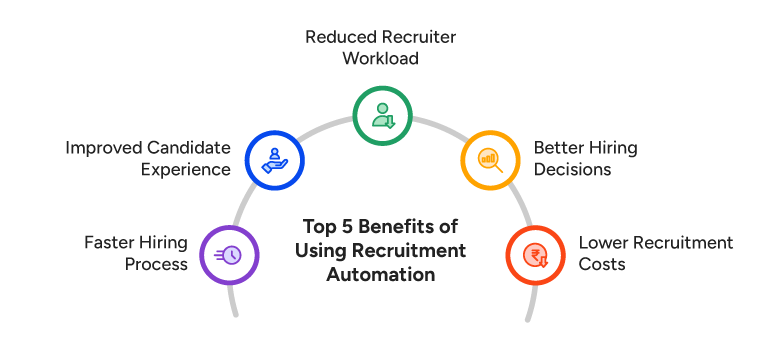
Recruitment automation is often used to solve hiring delays, but HR automation tools offer benefits that go beyond speed.
Faster Hiring Process
By using automation and modern AI HR tools, you can reduce delays in tasks like resume screening, shortlisting, and coordination. Recruiters get structured candidate lists instead of starting from scratch, which helps reduce time-to-hire.
Improved Candidate Experience
No more waiting for HR’s message for your next update. Automating communication reduces uncertainty for a candidate and keeps them engaged throughout the entire hiring process. Your candidates gain a transparent experience, and you gain a strong brand image.
Reduced Recruiter Workload
A large portion of an HR’s time is spent on admin tasks like screening resumes, scheduling interviews, and sending follow-up emails. While these are important, an automated process allows recruiters to focus on evaluating candidates and making strategic hiring decisions.
Better Hiring Decisions
With an automation system structuring data, recruiters can compare candidates objectively and track recruitment metrics rather than relying solely on instinct. Based on these, they can identify patterns in successful hires and make better, data-driven decisions.
Lower Recruitment Costs
Faster recruitment cycles directly lower recruitment expenses. When recruiters spend less time on admin tasks and more on interview coordination, these operational improvements contribute to a much more cost-effective recruitment strategy.
These benefits show up soon after hiring automation is applied, but the challenge is: how do you apply hiring automation in a way that supports both recruiters and candidates effectively?
Best Practices for Implementing Hiring Automation
An HR automation process is not just about technology; it is about strategy, focus, and planning. The following are some practical steps to take to ensure that it actually benefits your business:
Identify Hiring Bottlenecks
Understanding your recruitment process and mapping it out can highlight areas where your process is slowing down. This can include resume screening, interview scheduling, and other stages.
Choose the Right Tools
Choose the right recruitment software for your business after calculating your size, recruitment needs, and process. It is better not to over-engineer your systems; it is about efficiency for your team, not sophisticated tech concepts.
Automate Repetitive Tasks
Automate the most repetitive tasks, such as resume screening, candidate management, and interview scheduling. This can free your recruiters to focus on other important tasks, such as candidate performance evaluation, engagement, and strategy.
Track Recruitment Analytics
Recruitment analytics such as time-to-hire, candidate drop-off rates, and quality of hire must be continuously monitored. These metrics can provide insights into how your automated recruitment process is actually performing.
Train HR Teams
Recruitment automation is only as good as your ability to effectively utilize it. Training your teams on the process, guidelines, and systems can ensure they use the automated systems effectively without compromising the quality of your hiring process.
Conclusion
Hiring is not just a process. It directly affects your business growth. With hiring automation, you can speed up recruitment, reduce delays, and make better hiring decisions.
The real impact comes when you use automation with a human touch. If you want to simplify your hiring and reduce time to hire, book a demo with us today.
Frequently Asked Question
How Recruitment Automation Works?
Recruitment automation scans resumes, finds suitable candidates, shortlists them, schedules interviews, and keeps candidates updated. This helps you save time and hire faster.
What Tools Help Automate Recruitment?
There are several tools that can help automate recruitment, such as applicant tracking systems, AI-based recruitment software, candidate screening tools, interview scheduling tools, and assessment platforms. These tools help manage different hiring tasks more efficiently.
What is a Good Time-to-Hire Benchmark?
A good time-to-hire depends on the industry and role. For most positions, 3 to 6 weeks is considered a reasonable timeline. For specialized or senior roles, it may take longer.
Can Small Businesses Use Recruitment Automation?
Yes, small businesses can also use recruitment automation. You do not need a big HR team to get started. Many tools are simple to use and can help you handle tasks like talking to candidates and scheduling interviews. This makes hiring easier and saves time.
What Tasks Can be Automated in Recruitment?
Many HR tasks can be automated, including resume parsing, job posting, shortlisting, interviewing, candidate communication, skill testing, offer generation, and onboarding.
Table of Contents
Traditional attendance systems, like manual registers or punch cards, can lead to mistakes, time theft, and delays, especially for employees who work remotely or in the field. As more businesses rely on mobile teams, it’s difficult to track who is really at work.
Geofencing utilizes GPS to establish virtual boundaries around worksites. It permits recording punch-ins and punch-outs only when employees are physically present, ensuring accurate records, reducing payroll errors, improving compliance, and saving managers time.
What is a Geofencing Attendance System?
A geofencing attendance system uses GPS (Global Positioning System), Wi-Fi, or cellular data to create a virtual boundary around a workplace. It makes sure employees punch in and out only when they’re inside this area.
This removes the need for manual tracking and works especially well for field staff, remote employees, and teams working across multiple locations like construction sites.
How a Geofencing Attendance System Works

This attendance system establishes virtual perimeters (geofences) around a workplace using GPS, Wi-Fi, or cellular data. Once an employee enters these coordinates, they can punch in via a mobile app, effectively preventing location fraud and automating data flow directly into HR systems.
Creating a Geofence around the Workplace
Through dashboards, admins define a virtual perimeter around the workplace or site, such as a 100-200 meter radius, using mapping software in the HRMS or app. This boundary acts as the zone where employees can punch in or out.
Detecting Employee Location Using GPS
When an employee opens the mobile app to punch in, the system uses GPS, Wi-Fi, or cellular network signals to verify if they are within the geofenced area.
Employees Mark Attendance through Mobile App
Employees can punch in or out through a smartphone app once they are within the geofence. Some systems may also require a quick tap or a selfie to verify the employee’s identity.
Attendance Data Syncs with HRMS and Payroll
Attendance data, such as punch-in times and locations, is automatically sent to the HRMS or payroll system. This allows managers to view real-time reports, generate timesheets, receive alerts, and process payroll accurately without delays.
Key Features of a Geofencing Attendance System
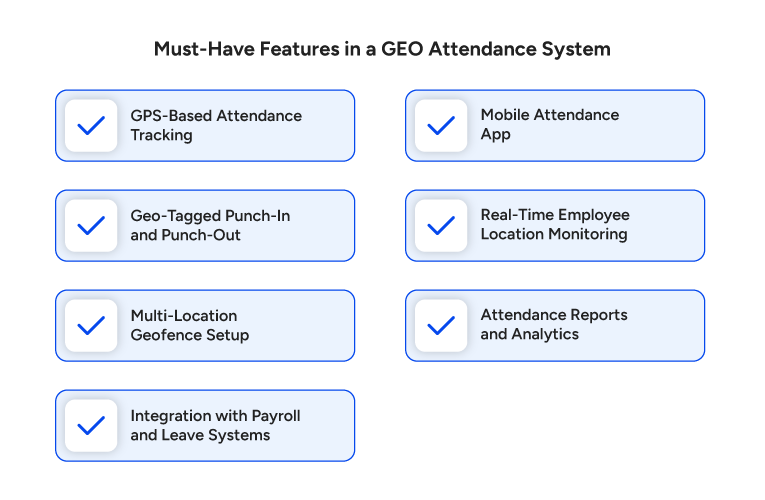
Geofencing helps businesses track their workforce by replacing manual logs with automated systems. It records attendance only within set locations, which is why many companies rely on remote employee monitoring software to manage distributed teams.
GPS-Based Attendance Tracking
Track location-based attendance using GPS to ensure employees are present at the designated worksite when punching in or out.
Mobile Attendance App
Employees can punch in and out securely via a mobile app when entering geofenced areas. Real-time automatic tracking helps HR eliminate manual errors and guarantee accurate attendance for remote or field teams.
Geo-Tagged Punch-In and Punch-Out
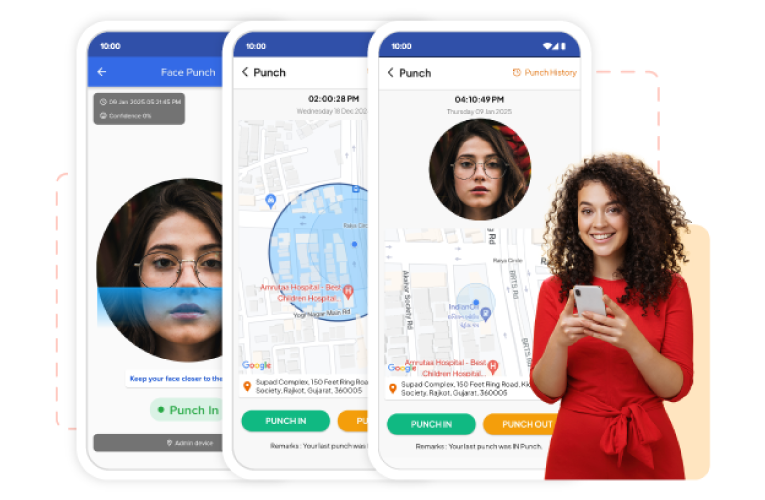
Records the exact location and time for each check-in and check-out to ensure accurate attendance verification via geo-tags stored in attendance logs.
Real-Time Employee Location Monitoring
Managers can view a live dashboard showing the current distribution of their workforce across various project sites. This visibility helps in optimizing resource allocation and ensures safety by knowing exactly where team members are during work hours.
Multi-Location Geofence Setup
It allows organizations to create multiple geofenced zones for different office locations. This flexibility allows a single system to manage a diverse workforce spread across cities or regions.
Attendance Reports and Analytics
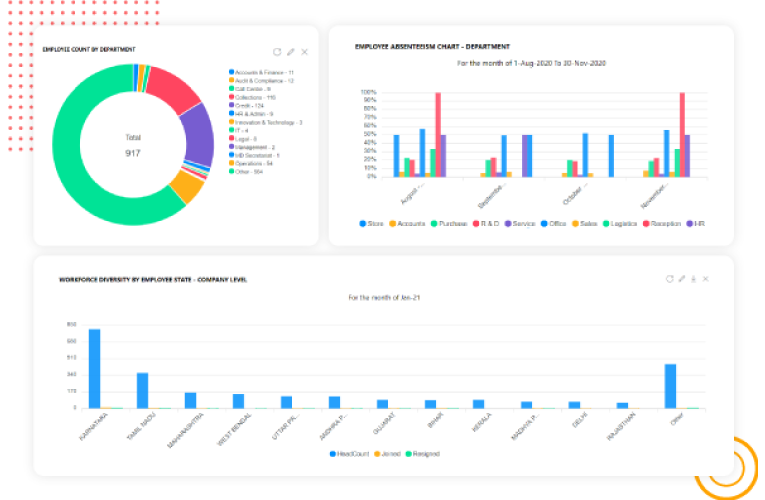
Generates detailed reports and insights on employee attendance, which also includes work hours, overtime, and absenteeism to support data-driven HR decisions.
Integration with Payroll and Leave Systems
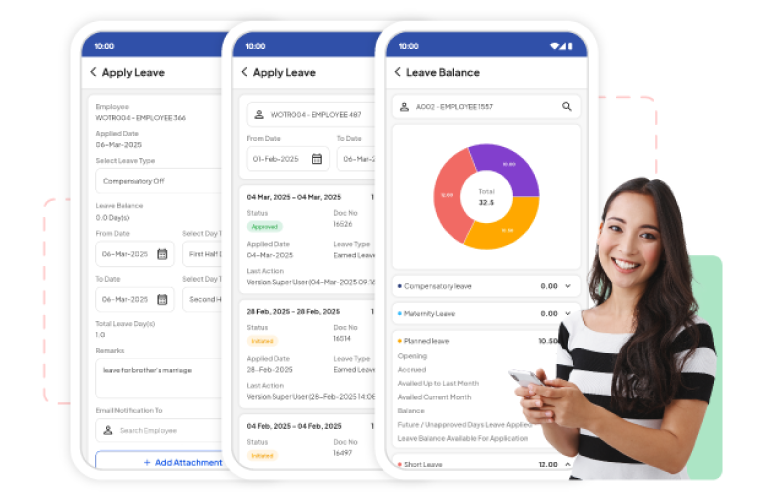
Connects attendance data with payroll (e.g., factoHR) and leave management tools for automated salary processing, deductions, and compliance.
Benefits of Using a Geofencing Attendance System
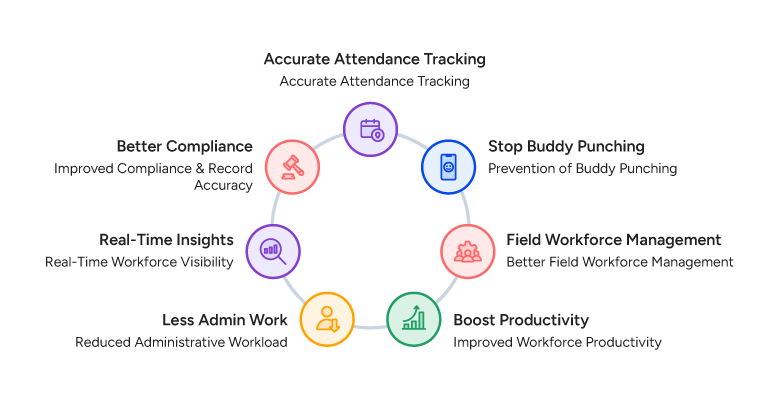
Location-based technology allows businesses to verify employee presence in real time using GPS. It improves attendance accuracy, reduces time fraud, and simplifies workforce management for both employees and administrators.
Accurate Attendance Tracking
Geofencing ensures employees can only punch in and out when they are physically present within the defined work location. This greatly reduces manual errors, fake punch-ins, and incorrect records in your timesheet software.
Prevention of Buddy Punching
Buddy punching, where one employee punches in for another, costs businesses significantly in stolen time. Since geofencing requires the employee’s own device and live location, the ability to fraudulently log hours for a coworker is eliminated.
Better Field Workforce Management
Geofencing shows who reached which site and when. Managers can assign jobs based on the nearest location and verify visits. This leads to better coordination of remote and multi-location teams.
Improved Workforce Productivity
Employees start their shift on time when they know attendance and location are tracked automatically. Managers can identify late arrivals and early exits, which helps increase accountability and overall productivity.
Reduced Administrative Workload
Manual registers and Excel spreadsheets are replaced by automated logs. HR professionals can quickly generate accurate reports, which reduces errors.
Real-Time Workforce Visibility
Provides live insights into where employees are during work hours, improving operational oversight.
Improved Compliance and Record Accuracy
Maintains reliable, tamper-proof attendance records, supporting HR compliance and audits. In case of inspections or client queries, organizations can easily produce accurate historical records.
Industries that Use Geofencing Attendance Systems
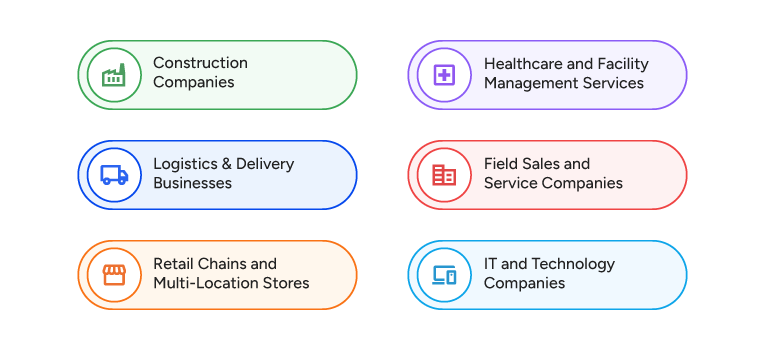
The industries that use geofencing for attendance tracking rely on GPS or Radio Frequency Identification (RFID) technology to create virtual boundaries around specific locations. When an employee enters or leaves this perimeter, the system automatically logs their attendance, providing a seamless “hands-off” tracking experience.
Construction Companies
Managers can track workers across multiple remote sites without requiring physical punch-in systems. It ensures labor costs are accurate by verifying that personnel are actually on-site.
Logistics and Delivery Businesses
Dispatchers gain real-time visibility into when drivers arrive at warehouses or customer sites, and the system automatically records the time. This removes manual logging and helps managers identify delays and improve delivery routes.
Retail Chains and Multi-Location Stores
For businesses with multiple branches, geofencing ensures staff are at their assigned store location. It simplifies payroll for employees who move between different outlets or locations.
Healthcare and Facility Management Services
Caregivers verify visits to patient homes or facilities automatically upon arrival. This ensures service quality, accurate billing, and compliance in field operations.
Field Sales and Service Companies
Sales representatives and technicians use GPS to check in at client sites or territories, which stops fraud that happens away from the site. It provides data for performance analysis and route optimization. Service teams benefit from automated logs for billing accuracy.
IT and Technology Companies
Remote or hybrid IT teams, including support and deployment staff, use geofencing to track on-site visits to data centers or client offices. This ensures accurate monitoring, secure access, and real-time availability for urgent deployments while integrating with project tools.
Geofencing Attendance vs Biometric Attendance: Difference Explained
| Aspect | Geofencing Attendance | Biometric Attendance |
|---|---|---|
| Technology Used | GPS, Wi-Fi, and cellular data via smartphones to create virtual boundaries | Fingerprint, facial, or retina scanners for unique biological traits. |
| Hardware Requirement | Employee smartphones (no dedicated devices needed) | Dedicated biometric devices. |
| Employee Mobility Support | Ideal for field staff, remote workers, and multi-location via app. | Requires physical presence at office locations or single-entry factory gates. |
| Implementation and Maintenance Cost | Software/app-based, no hardware install; scales easily. | Hardware purchase, installation, and ongoing maintenance. |
| Attendance Accuracy and Security | High location accuracy, but vulnerable to GPS spoofing or shared devices. | Nearly impossible to fake biometrics; tamper-resistant. |
| Best Use Cases for Businesses | Field services, delivery logistics, remote/hybrid offices, and multi-site operations. | High-security zones where identity verification is critical (e.g., offices, factories, corporate HQ). |
Challenges of Geofencing Attendance Systems
Attendance with geofencing offers a streamlined way to track work hours, but they come with technical and ethical challenges. Here are the most common ones:
Employee Privacy Concerns
Geofencing tracks employees’ precise locations, raising concerns about constant surveillance and employer misuse of data. These concerns can affect trust and even legal problems under privacy regulations like the General Data Protection Regulation (GDPR).
Internet and GPS Dependency
These systems rely on a steady internet connection and accurate GPS signals. In remote locations or buildings with weak signals, connectivity issues can disrupt attendance recording. This leads to disputes and unreliable data.
Battery Consumption on Mobile Devices
Continuous GPS monitoring drains mobile device batteries during work hours. It causes incomplete attendance records; employees may disable the app or location services, causing.
Best Practices for Implementing Geofencing Attendance
Implementing geofencing requires proper technical setup and clear communication with employees. The following best practices can help ensure a smooth rollout:
Setting the Correct Geofence Radius
Set the geofence radius between 50 and 200 meters for offices to balance accuracy and GPS reliability. Test and adjust the radius based on the site layout, and avoid overlaps with nearby areas to prevent false punch-ins.
Defining Clear Attendance Policies
Establish clear attendance rules, such as requiring employees to keep GPS enabled and allowing only one punch-in per shift within the geofence. Communicate company policies clearly and explain the consequences of location spoofing or proxy attendance.
Training Employees on Mobile Attendance Apps
Provide training sessions that show employees how to use the app, enable GPS, and resolve common issues. Use demos and FAQs to build confidence and highlight benefits such as automatic logging for field employees.
Integrating Attendance with HRMS and Payroll
Integrate location-based attendance data with HRMS and payroll software to automate calculations and reduce manual work. Set up real-time syncing with validation checks to identify issues before payroll processing, ensuring accurate and timely payments.
Conclusion
Modern attendance systems are very important for businesses with distributed or mobile workforces. Traditional methods struggle to accurately track employees, leading to errors, time theft, and payroll issues.
Geofencing uses GPS technology to verify employee presence in real time. By automating attendance tracking and providing accurate, tamper-proof records, these systems improve compliance and reduce administrative workload. It also helps organizations efficiently manage decentralized teams, allowing a focus on productivity and growth.
Frequently Asked Questions
Can Geofencing Attendance Track Employees outside Working Hours?
No, these systems are designed to record punch-ins and punch-outs only during scheduled work periods at approved locations. They typically do not track or log employee locations outside working hours to respect privacy.
Can Geofencing Attendance Work without Internet?
Yes, geofencing can work without an internet connection using the device’s GPS to record punch-ins and punch-outs, storing the data locally and syncing it automatically once the internet is available.
How Accurate is a Geofencing Attendance System?
Geofencing is accurate because it uses GPS to verify an employee’s real-time location within a virtual boundary. Adding AI-powered facial recognition can improve reliability by preventing proxy attendance. However, accuracy may decline if signals are weak or locations are falsified.
What Happens if an Employee Turns off the GPS while Marking Attendance?
If GPS is turned off, most geofencing apps will block the punch-in and ask the employee to enable location services. In some cases, the entry may still be submitted but flagged as invalid or out of range for manager review.
Which Industries Use Geofencing Attendance Systems?
Industries that commonly use geofencing attendance systems include construction, retail, transportation and logistics, healthcare, and field services. These sectors benefit from real-time location verification, which helps reduce time theft and improve workforce management across dynamic job sites.
Is Geofencing Attendance Suitable for Small Businesses?
Yes. Geofencing attendance is suitable for small businesses, as employees can use their smartphones to punch in and out within a defined location. This eliminates the need for extra hardware and provides a cost-effective way to track mobile teams without manual timesheets.
Does Geofencing Attendance Replace Biometric Systems?
No, geofencing attendance does not replace biometric systems. It verifies location using GPS boundaries, while biometrics ensure identity via fingerprints or facial recognition, providing higher security against proxy attendance.
Table of Contents
Common onboarding mistakes are errors in the onboarding process that reduce employee engagement, delay productivity, and increase early attrition. According to Gallup, only 12% of employees think that onboarding is done well. And yet, 58% of organizations still focus on paperwork rather than improving the employee experience. This proves that despite knowing what goes wrong, firms still make common onboarding mistakes that cost them talent and productivity.
Some of the most common employee onboarding mistakes include ignoring employee feedback, overloading new hires with paperwork, giving vague role descriptions, and neglecting remote and hybrid onboarding. You could be an HR manager who wants to reduce attrition or a founder who needs a scalable onboarding system. It is a must that you understand why onboarding is important and how to avoid common onboarding mistakes.
Why Avoiding Common Onboarding Mistakes is Important for Business Growth
A structured onboarding process does more than introduce policies. It directly impacts how quickly employees contribute and how long they stay.
- Improves retention: Employees who experience structured onboarding are more likely to stay longer and feel satisfied at work.
- Reduces cost: Replacing an employee costs 100% to 300% more than their monthly salary.
- Fosters a sense of belonging: A people-centric onboarding process makes employees feel welcome.
- Improves time to productivity: Employees who have clarity about their roles are more likely to be productive in less time.
- Connects to the company culture: It is a must that new hires align with your culture, and a structured 90-day onboarding makes it possible with orientations and engaging activities.
Fix onboarding gaps and save time.
What Makes Onboarding Fail in Most Companies
Before diving into the mistakes, it is important to understand why onboarding fails:
- It is treated as an HR task instead of a business function
- Managers are not actively involved
- There is no structured plan beyond day one
- Communication breaks after offer acceptance
- Systems are manual and disconnected
These gaps lead to confusion, disengagement, and early attrition.
What are Common Onboarding Mistakes and How to Avoid Them?
Some of the most common employee onboarding mistakes include –
- Treating onboarding as a one-day process
- Overloading employees with information on day one
- Lack of clear role expectations
- No communication during the pre-boarding stage
Other onboarding mistakes also include poor manager involvement, neglecting remote and hybrid onboarding, not assigning a buddy, and a lack of feedback loops. Read this onboarding guide till the end to know what the 12 common onboarding mistakes businesses make and how established brands solve them.
1. Treating Onboarding as a One-Day Process
In most firms, HR conducts orientation, introduces employees to the company values, tells them about the policies, and briefs them about their role. All this in one day.
Why It Happens
Organizations treat it as a one-day event rather than a structured process.
Impact
- Employees find it difficult to understand their role, company policy, culture, mission, and values in one day.
- Businesses lose valuable employees, and those who stay are less productive.
Solution
- Create 30-60-90 day plans with defined outcomes.
- Make managers responsible for onboarding progress along with HR.
- Schedule weekly check-ins in the first month.
- Google uses a manager checklist to structure onboarding and make it a phased process.
- The factoHR solution: Build structured onboarding journeys. Track tasks so everyone knows their role.
Improve employee onboarding from day one.
2. Lack of Pre-Boarding Communication
Neither HR nor managers communicate with new hires after they accept the offer, resulting in lower engagement from the start.
Why does this Happen?
Firms assume that onboarding starts when the new hire joins and do not give much importance to the pre-boarding phase.
Impact
- Employees feel like “they don’t belong at your workplace”.
- Candidates join another firm where they feel more welcomed in the window between accepting your offer and their joining date.
Solution
- Send welcome emails before candidates join.
- Introduce new employees through a get-together.
- Managers should be in touch immediately after a candidate confirms they are joining.
- At Microsoft, managers meet candidates before they join and in their first week.
- The factoHR solution: Automate your pre-boarding workflows. Send scheduled emails and automatic reminders.
3. Overloading Information on Day 1
As firms treat onboarding as an event, they give all the information to the new hire in one day. This makes it difficult for employees to process any information.
Why does this Happen?
Mostly, onboarding is assigned to HR only, and they feel that their role is to provide information and tick off administrative tasks.
Impact
- New joiners are neither clear about their role nor about policies or company values.
- Businesses feel that “they are losing productivity.”
Solution
- Treat onboarding as a 90-day process.
- Focus on role clarity first.
- Introduce employees to policies gradually, and organize interactive events so that they find it easier to process the information.
- IBM focuses on phased learning so that employees can apply it in practice.
- The factoHR solution: Deliver phased onboarding modules. Set up scheduled learning paths for new hires.
4. No Clear Role Expectations
Employees are briefed about company culture and tools more than about their role in the organization and their department.
Why does this Happen?
Companies make onboarding more process-driven rather than people-centric.
Impact
- Employees are less productive and often need to ask seniors what to do next.
- Hiring managers and department heads feel like the new employee is not meeting their expectations.
Solution
- Rather than giving a lengthy job description, define what the candidate is required to do in the first month.
- Check with new joinees weekly and clarify their doubts.
- Adobe uses continuous check-ins to improve role clarity.
- The factoHR solution: Set specific role-based goals. Track employee progress from day one.
5. Giving Less Importance to Company Culture
Often, HR fails to introduce the employees to the nuances of the work culture.
Why does this Happen?
Teams feel like introducing employees to policies and mission is enough.
Impact
- Employees feel less connected with their workplace.
- Firms face hiring and retention issues due to disengagement.
Solution
- Use orientation to clarify doubts and show “what a day looks like” at your firm.
- Assign a buddy as soon as you can.
- Make culture a priority when you hire new candidates.
- Zappos prioritizes culture in hiring and onboarding.
- The factoHR solution: Share company values clearly. Distribute team videos through the central portal.
6. Poor Manager Involvement
Managers are not involved during onboarding.
Why does this Happen?
Leaders believe that onboarding is the responsibility of only the HR department.
Impact
- Employees feel less connected to their work.
- Department heads find it difficult to involve new joiners in work and decision-making meaningfully.
Solution
- Like with HR, define the manager’s responsibilities during the onboarding process.
- Prefer an open-door policy where employees can approach managers in case of any doubts.
- The factoHR solution: Assign tasks directly to managers. Track completion within your onboarding workflows.
7. Not Assigning a Buddy or Mentor
Firms do not assign a buddy on time.
Why does this Happen?
Teams do not place much importance on buddies/mentors during onboarding.
Impact
- Employees hesitate to ask questions.
- More chances of attrition.
Solution
- Assign a buddy before day one, preferably in the pre-boarding stage.
- Encourage informal conversations.
- The factoHR solution: Assign peer buddies digitally. Prompt them to check in with new hires.
8. Lack of Feedback Loops
Often, new hires are not given feedback in the first two months.
Why does this Happen?
Leaders believe that feedback is an annual process rather than a regular, continuous process.
Impact
- Employees remain unsure about how they are performing.
- Businesses find that employees are not aligning their work with performance goals.
Solution
- Give weekly feedback.
- Encourage continuous feedback with 360-degree feedback modules.
- Industry leaders like Netflix prioritize a culture of continuous feedback over formal annual reviews.
- The factoHR solution: Capture continuous employee feedback. Track performance metrics consistently over time.
9. Using Outdated or Manual Onboarding Processes
Many companies still rely on spreadsheets and emails rather than onboarding software.
Why does this Happen?
Businesses often struggle to replace their old software with new systems, which discourages them from using it at all.
Impact
- New employees have to fill out different forms on various platforms. This negatively affects the employee experience.
- HR finds it difficult to manage administrative work and has to invest more time in managing documents and forms.
Solution
- Adopt an onboarding software that has built-in integrations and connects with your system without much effort.
- Automate onboarding with centralized documents, ready-made checklists, and templates.
- Use automated tools for training and performance.
- Walmart uses digital training tools to improve its onboarding experience.
- The factoHR solution: Digitize your entire onboarding workflow. Connect your tools to save time and effort.
Build a smooth onboarding experience today
10. Not Measuring Onboarding Success
Organizations have a structured onboarding program, but do not track its effectiveness.
Why does this Happen?
Firms only track recruitment and performance metrics and do not pay attention to metrics related to onboarding and employee experience.
Impact
- CHROs are unsure about the success of their onboarding initiatives.
- Not measuring onboarding success also results in poor employee experience.
Solution
- Track metrics like time to productivity more closely during the first 90 days.
- Gather feedback from employees.
- Actively look for signs of disengagement.
- Salesforce uses employee success metrics to improve onboarding processes.
- The factoHR solution: Track progress with visual analytics dashboards. Measure your success with real data.
11. Neglecting Remote and Hybrid Onboarding
Companies use the same template for remote and in-office onboarding.
Why does this Happen?
Department heads think that what works well for onboarding employees in the office would also work for a remote setup.
Impact
- Employees feel isolated.
- Employees are less productive as they do not feel connected to their workplace.
Solution
- Design remote-first workflows.
- Schedule regular virtual interactions.
- Make a different checklist for remote onboarding from in-office onboarding.
- Shopify redesigned practices to support distributed teams.
- The factoHR solution: Enable remote onboarding instantly. Run everything through a centralized digital system.
12. The Day 1 IT and Equipment Disaster
A new hire arrives ready to work, only to find no laptop, no desk, and no passwords. They spend the first day just waiting for access.
Why does this Happen?
HR and IT don’t coordinate, so IT only finds out about the hire on day one.
Impact
- The hire feels like the company wasn’t ready.
- You might feel that the ROI gains from your recruitment drives are less than what you expected.
Solution
- Automate IT alerts at the time of offer acceptance.
- Confirm hardware is ready 24 hours early.
- Create a “Day 1 Access” checklist.
- Cisco improved productivity by digitizing its HR, including assigning assets.
- The factoHR solution: Use automated task triggers to alert IT and Admin teams instantly so everything is ready on time.
Manual vs Automated Onboarding: What Changes
A lot of employee onboarding issues, like delays in assigning assets, issues in measuring onboarding metrics, and a lack of continuous feedback, can be solved if you rely on digital software rather than manual onboarding. Read the table below to understand the difference that automated onboarding can make at your firm.
Here’s a simple breakdown of manual vs automated onboarding:
| Factor | Manual Onboarding | Automated Onboarding | Business Impact |
|---|---|---|---|
| Process Efficiency | Tracking paperwork by hand consumes your entire day. | Digital workflows handle the routine tasks automatically. | Your HR team gains hours of free time. |
| Time to Productivity | New hires wait days just for system access. | Employees get full access on day one. | Your new team members start contributing much faster. |
| Accuracy & Error Rate | Typing data manually leads to mistakes. | The system verifies all information instantly for you. | You maintain clean and accurate company records. |
| Documentation & Compliance | Important legal forms often get lost on desks. | Secure cloud storage keeps every required file safe. | You avoid expensive fines during legal audits. |
| Employee Experience | A slow process leaves new hires feeling confused. | A smooth digital welcome makes people feel valued. | Your organization would be able to retain and attract top talent. |
| Personalization | Everyone gets the same generic packet. | Software tailors training to each role. | Learning feels highly relevant to their actual job. |
| Communication & Engagement | Busy managers often forget to send welcome emails. | The system automatically schedules and sends friendly check-ins. | You build strong trust from the start. |
| Scalability | Hiring many people at once is difficult. | The software handles high hiring volumes without stress. | Your business grows without adding administrative pain. |
| Cost Efficiency | Printing paper and replacing lost hires costs money. | Smart software costs much less than wasted hours. | You save the company money every month. |
| Tracking & Analytics | You just guess how the onboarding is going. | Live dashboards show you the exact progress and bottlenecks. | You make smart business choices based on facts. |
| Remote/Hybrid Support | Mailing physical forms to remote workers creates delays. | A fully digital process works perfectly from anywhere. | Remote employees feel fully supported and connected. |
| Integration with Other Systems | You must type the same details multiple times. | Information flows directly into your main payroll software. | You always maintain one source of truth. |
Automate onboarding and reduce manual work
Best Practices to Avoid Common Onboarding Mistakes
Follow these best practices and stop making common onboarding mistakes:
- Send a welcome note, assign assets such as laptops, and get all paperwork signed before the first day.
- Build a 90-day roadmap to move the hire from basic training to project management.
- Assign a peer Buddy to explain office culture and answer the questions a manager might miss.
- Schedule introductions with other departments in the first two weeks to show how the company functions.
- Use a digital portal to finish all tax and bank forms before Day 1.
- Hold a 10-minute check-in every morning for the first week to identify mistakes and clear roadblocks early.
- Stay active in the process until the 90-day mark to help the hire become fully independent.
- Ask the hire for feedback on the process after their first week and use it to fix gaps in the system.
30-60-90 Day Onboarding Checklist
Follow this checklist to build a structured onboarding process at your organization.
Pre-Boarding and Day 1
- Send a welcome note and the Day 1 agenda within 48 hours of the offer being signed.
- Confirm that the laptop and every software login are tested and ready 24 hours before they start.
- Finish all tax, bank, and legal forms through a digital portal before the new employee walks in.
- Verify that the daily tasks match what you promised during the interview.
- Assign a peer buddy and give them a list of people to introduce to the new hire.
- Set up the workspace with everything they need so they aren’t waiting on IT or Admin.
The First Week
- Meet for 10 minutes every morning to answer “how-to” questions.
- Define what “productive work” looks like for the first month.
- Give the hire one task that the team will use by the end of the week.
- Explain the “unwritten rules” of the office, like how the team prefers to communicate.
- Check that the hire has access to all the tools and folders they need for their role.
The First 30 Days
- Schedule meetings with people from other departments.
- Provide an honest review of their first month so they know exactly where they stand.
- Ask the hire if the job is what they expected when they signed the offer.
- Ensure the hire completes one project from start to finish with your guidance.
- Identify any “knowledge gaps” and point them toward the right training or people.
The 60 to 90-Day Window
- Hand over a project.
- Ask the hire for their solutions to problems instead of just giving them the answers.
- Finalize the numbers and targets the hire will be judged on moving forward.
- Let the hire lead a team meeting or a project update on their own.
- Ask for honest feedback on your onboarding process and fix the gaps the hire found.
Conclusion
“The way you onboard someone is the way you tell them what kind of company you are.” – Laszlo Bock, Former SVP of People Operations, Google.
Onboarding is not just a process. It is the foundation of employee experience. By avoiding common onboarding challenges and mistakes like poor communication, lack of structure, and minimal manager involvement, businesses can improve retention, productivity, and long-term engagement. A structured onboarding approach, supported by the right systems and processes, ensures that new hires become confident and productive faster.
Make onboarding faster and more structured.
FAQs
What are the Common Onboarding Mistakes?
Common onboarding mistakes include treating onboarding as a one-day process, lack of pre-boarding communication, unclear role expectations, and poor manager involvement.
How do Onboarding Mistakes Affect Employee Retention?
Poor onboarding leads to confusion, low engagement, and early attrition, especially in the first 90 days.
Who Should be Responsible for Onboarding New Employees?
HR, managers, and assigned buddies share responsibility. HR handles processes, managers provide role clarity, and buddies support day-to-day guidance.
How Can HR Improve the New Hire Onboarding Experience?
HR can improve onboarding by using structured plans, involving managers early, and automating administrative tasks.
How does HR Software Help Reduce Onboarding Mistakes?
HR software automates most, if not all, the aspects of onboarding, including sending invitations, assigning assets, setting reminders, and allowing employees to upload documents in the pre-boarding phase, among others.
How Can Small Businesses Improve Onboarding without a Full HR Team?
Small businesses should find affordable onboarding software that automates the administrative and operational aspects of onboarding.
How is Pre-Boarding Different from Onboarding?
Pre-boarding covers the period between the signed offer and the employee’s first day, focusing on logistics like paperwork and equipment setup. Onboarding begins on day one and is a long-term process designed to train and support the new employee.
Table of Contents
Let’s be honest. When an employee is about to retire after decades with your company, a “Thank You” card and a handshake wouldn’t suffice. They’ve worked relentlessly for years, trained new hires, and stayed late when projects went sideways.
So when they finally leave, what do you give them? Most HR teams stress scrolling through endless online lists with hundreds of options, only to feel more confused than when they started. But here’s what they miss: it’s not about how many gift ideas you consider. It’s about choosing the right one.
This blog gives you 10 carefully chosen retirement gift ideas that show respect, appreciation, and thoughtfulness. Not generic corporate junk. Not items that people will dump in a drawer. Something that reflects well on the organization’s culture and leaves a lasting positive impression on the retiring employee.
Key Takeaways
- Retirement gifts shape how current employees view company culture and loyalty.
- The best retirement gift for employees shows respect for years of service and boosts team morale.
- You don’t need 50 options. You need the right retirement gift ideas that fit the employee’s personality and the occasion.
- HR teams must balance sentiment with budget, company policy, and tax considerations.
- Personalized and meaningful retirement gifts leave lasting impressions far better than generic items.
Why Thoughtful Employee Retirement Gifts Matter
Retirement is the ultimate milestone in your employee recognition program.
A retirement gift is the final moment in the employee lifecycle that matters more than most companies realize. Think about it. Every employee watching that retirement ceremony is silently asking themselves: “Will they do this for me someday?”
When you hand someone a thoughtful gift after decades of service, you’re not just honoring them; you’re celebrating them. You’re sending a message to everyone still working that this company values the time they invested. This is employee recognition at its most visible peak, shaping your company culture in real time.
HR teams often focus heavily on onboarding. They plan orientation programs to make the first day memorable. But the last day? That often gets overlooked. If retirement is not handled well, it can damage morale faster than a great onboarding can build it.
A well-planned retirement farewell is the final step of a structured employee exit process. When employee offboarding is done right, it strengthens your employer brand, creates goodwill, and keeps retirees connected to your employee alumni network long after they’ve left.
Top Corporate Retirement Gifts from the Company

When the company itself gives the retirement gift, it needs to feel official, respectful, and memorable. These three corporate retirement gifts check all the boxes without going overboard.
1. Commemorative Crystal Awards or Plaques
Give a beautifully engraved crystal or wooden plaque that recognizes the employee’s years of service. This is the ultimate long-service award for employees who have dedicated 20+ years to your organization. This retirement gift idea is formal, display-worthy, and carries weight.
Engrave it with their name, role, years of service, and a short heartfelt message that will bring a smile to their face. Place it in a quality display box to add more value.
2. Premium Travel Vouchers or Luggage Sets
Retirement is about freedom. Most retirees want to travel. You can gift a travel voucher or a high-quality luggage set for their post-retirement adventures. This gift says, “Go enjoy your life now.”
Flight, hotel, or experience vouchers offer flexibility. Luggage sets are practical and long-lasting. Either way, it’s a gift they’ll actually use. This retirement gift idea works best for employees who’ve expressed interest in travel or who are relocating post-retirement.
3. Post-Retirement Masterclass or Hobby Subscriptions
Retirement is not the end of learning. Many retirees want to explore passions they never had time for during their careers. You can give a paid subscription to a skill-building platform of their choice, or to a hobby-focused service like photography classes, gardening workshops, or cooking courses.
This is one of the most unique retirement gifts because it shows you’ve thought about their next chapter, not just their past contributions.
Memorable Retirement Gifts for Coworkers

When a team pools money together for a colleague, the gift should feel personal, thoughtful, and tied to the relationships they’ve built. These retirement gifts for coworkers hit that mark perfectly.
4. Personalized Team Memory Books or Signed Canvases
This is one of the most emotional personalized retirement gifts you can give. It’s not something they can buy. It’s something only their team can create.
Ask every team member to write a short note or share a favorite memory. Add candid photos from office events, team lunches, or project celebrations. Bind it professionally or have it printed on canvas. It’s the kind of gift that stays with them forever.
5. High-End Noise-Canceling Headphones
Retirement means quality time for oneself and family. Whether they’re listening to music, audiobooks, or just enjoying silence, headphones make a difference. Give your retiring employees premium wireless headphones with noise-cancelling features from top brands.
This retirement gift idea is practical. It’s high-value. And it’s something they’ll use regularly.
6. Customized Golf, Gardening, or Cooking Kits
Retirement is when people finally have time for hobbies. Give your employee a fully personalized kit tailored to their hobby on their last day.
- A Golf set with engraved balls.
- Gardening tools with their name on the handle.
- A chef’s knife set in a custom wooden box.
A customized kit shows you know what they love and want them to enjoy it fully. This is a retirement farewell gift that feels personal, not generic.
7. A Premium Coffee or Wine Tasting Subscription
Give a monthly subscription box that delivers curated coffee blends or wine selections to their home. It’s a gift that keeps giving.
Every month, they’ll receive something new to try, and they’ll think of the team who gave it to them. A perfect gift for coffee or wine lovers; thoughtful and ongoing.
Meaningful Retirement Gifts for Your Boss or Manager

Choosing a farewell gift for a retiring boss requires extra thought. It should feel respectful, professional, and appropriate for their position. These three options are perfect for presenting after the farewell speech at the office retirement party.
8. Luxury Desk Accessories for the Home Office
Many managers continue consulting, mentoring, or working on passion projects. A premium desk set that includes items like a leather desk pad, pen holder, business card holder, or a high-end fountain pen is best for bosses who plan to stay active in some capacity post-retirement.
This is one of the best retirement gifts for bosses because it’s classy, functional, and not overly personal.
9. A High-Quality Smartwatch or Fitness Tracker
Retirement is when health becomes a priority. A smartwatch helps your retiring employee stay active, monitor vitals, and set fitness goals.
Gifting a high-quality smartwatch or fitness tracker is a thoughtful, non-intrusive gesture. This retirement gift idea shows you care about their well-being, not just their professional contributions.
10. A Significant Charitable Donation in Their Name
You can ask colleagues or family members about the employee’s favorite local organization and donate in their name. A donation to a cause or organization they care about, made in their honor, is one of the most excellent retirement gift ideas. Present them with a framed certificate or letter from the charity acknowledging the donation.
For leaders who already have everything, a charitable donation shows deep respect. It says, “We know what matters to you.”
This is one of the most meaningful professional appreciation gifts because it aligns with their values rather than just their preferences.
Meaningful Experience Gifts (Great for Team Pooling)

11. A Weekend Getaway or Resort Package
After years of adhering to a strict 9-to-5 schedule, the best gift is the luxury of time. A fully paid weekend stay at a serene resort allows the retiree to officially unplug.
12. Premium Wellness or Spa Retreat Vouchers
Decades of desk work can take a toll on the body. A premium package for massages, wellness therapies, or a yoga retreat shows that the company genuinely cares about its long-term health and relaxation.
13. A 5-Star Gourmet Dining Experience
Gift a prepaid reservation or a high-value voucher to the city’s finest restaurant. Allow them to celebrate their milestone with their spouse or family without worrying about the bill.
High-Quality Hobbies & Leisure

14. Premium Whiskey Decanter or Barware Set
For the retiree who appreciates the finer things, a personalized, heavy-crystal decanter set paired with a set of Glencairn glasses makes a sophisticated addition to their home bar.
15. A High-End E-Reader (like a Kindle Oasis)
Retirement finally provides the time to tackle that reading list. An ergonomic, waterproof e-reader loaded with a gift card for their first few book purchases is a highly practical gift.
16. Touring or Adventure Gear
If the retiring employee is a road-trip enthusiast, loves motorcycles, or plans to travel cross-country, upgrade their gear. Think high-quality riding jackets, premium customized helmets, or top-tier camping equipment.
Personalized Keepsakes & Art

17. Custom Caricature or Team Illustration
Commission a local artist to draw a high-quality caricature or illustration of the retiring employee surrounded by inside jokes, tools of their trade, or their team members.
18. Personalized Map Art
Gift a beautifully framed, custom map highlighting significant locations: where they started their career, where the company headquarters is, and where they are retiring to.
19. An Engraved Luxury Timepiece
While a smartwatch is great for fitness, a classic, mechanical luxury watch is the traditional gold standard for retirement. Engrave the back with their retirement date and a short message.
Practical Post-Retirement Upgrades
20. A Smart Home Starter Kit
Help them modernize their living space with a bundle of smart home devices—like a smart display hub, voice-activated speakers, and smart plugs.
21. Premium Leather Weekender Bag
A beautiful, full-grain leather travel duffel is a massive upgrade from a standard corporate backpack. It’s perfect for short trips to visit grandchildren or weekend getaways.
22. An Ergonomic Lounge Chair or Recliner
They’ve spent years in office chairs; now it’s time for ultimate comfort. Chipping in for a high-quality recliner for their living room or reading nook is a gift they will use every single day.
Exclusive Gifts for Bosses & Leaders

23. Lifetime Membership to an Exclusive Club
For senior leaders, arrange and pay the initiation fee for a local golf club, a prestigious library, or an exclusive alumni/business network.
24. A Commissioned Desktop Sculpture
Instead of standard office supplies, commission a beautiful glass, wood, or metal sculpture that subtly represents their industry or leadership style for their home study.
25. A Financial Planning or Estate Consultation Package
Retirement comes with complex financial transitions. Gifting a fully paid session with a top-tier, fiduciary financial planner or estate lawyer is incredibly valuable for a retiring executive.
Corporate Gifting Policies and Tax Implications to Consider
Before you finalize any retirement gift, HR teams need to check corporate gifting policies, as ignoring them can create tax headaches or compliance issues down the line.
Check your company’s employee exit policy and gifting rules first. Most organizations have internal rules about gift budgets, approval processes, and what’s allowed. Some companies cap gifts at a specific amount. Others require a manager’s sign-off for values above a certain threshold. Know your limits before you commit.
Understand tax implications. In India, gifts above a certain value are considered taxable income. If you’re giving something worth more than ₹5,000, it may need to be reported as part of the employee’s income when processing their full and final settlement.
HR is already handling final payouts, pending dues, and leave encashment rules during this time. Adding a surprise tax liability on top of that is not ideal.
A good human resources management team should plan thoughtfully to avoid turning the retirement gift into a compliance headache. When in doubt, consult your finance or legal team before purchasing high-value items.
Document everything. Keep records of what was gifted, its value, and who approved it. This protects both the company and the employee. It also ensures consistency when future retirements happen.
Conclusion
Retirement is a moment that defines how your company treats the people who’ve given it years of their lives. The gift you choose should reflect your employees’ persona and preference, not just what the company budget allows. You don’t need the most expensive gift. You need the right retirement gift ideas. Something that shows thought, not just routine.
And here’s the thing. A smooth retirement farewell is just one part of a bigger picture. Managing people well means managing the entire journey, from handing them their first joining letter to celebrating their final day. That’s what great HR looks like.
If you want to streamline your entire employee offboarding process, stop juggling spreadsheets and manual checklists. factoHR automates exit workflows, tracks pending tasks, calculates settlements accurately, and keeps everything documented in one place.

Frequently Asked Questions
How Much Should a Company Spend on a Retirement Gift?
For official corporate retirement gifts, Companies typically allocate a flat budget of ₹10,000 to ₹50,000, depending on seniority, or calculate it at ₹1,000 to ₹2,000 per year of service. Senior leadership or employees with 25+ years of experience, or those based on their contributions, may receive higher-value gifts. It is always advisable to check your company’s gifting policy first, to stay within approved limits.
Are Retirement Gifts for Employees Taxable?
In India, gifts valued at more than ₹5,000 are generally taxable and must be reported as part of an employee’s income. This is why HR teams should coordinate with finance before purchasing high-value employee offboarding gifts to avoid surprises during the FnF process.
What is a Good Traditional Retirement Gift?
A commemorative plaque or crystal award is the most traditional option. Other classic choices include a gold watch, a framed certificate, or gift vouchers. These retirement appreciation gifts are valued for their respect and meaning.
Should Coworkers Chip in for a Retirement Gift?
Yes. Pooling money allows the group to buy a higher-quality gift and also makes the gift feel collective rather than individual. Just make sure contributions are voluntary, and no one feels pressured.
Do You Give the Retirement Gift at the Farewell Party?
Yes, the farewell party is an ideal occasion. It allows the retiree to receive the gift publicly, which adds to the emotional value. If there’s no party, hand it over during their last week, either at a small gathering or in a one-on-one meeting.
Table of Contents
Finding good people to hire is really hard right now. But maybe the problem isn’t a lack of talent. Maybe the problem is where companies are looking.
Think about it. The best person for the job might already be sitting in your office. They might be on your payroll right now.
This is what Internal Mobility is about. Instead of looking outside for strangers, you look at your own team. You find skills inside your company. Then you give those people a chance to move and grow.
Top executives at major companies love this idea. A Deloitte report says 76% of executives think this is necessary for 2026.
Key Takeaways for HR Leaders (2026)
- The “Build” vs. “Buy” Shift: In 2026, 76% of executives prioritize internal mobility to combat unpredictable external hiring markets.
- Cost Efficiency: Replacing an employee costs 1.5 to 2 times their annual salary; internal mobility reduces this by 40%.
- The AI Advantage: Modern mobility relies on AI Agents and Skills Ontologies to match hidden internal talent to open gigs instantly.
What is Internal Mobility?
Internal mobility is just a fancy way of saying “moving people around inside the company”.
It means giving employees a chance to try new jobs, join new teams, or lead new projects. They don’t have to leave the company to get a better job.
Expert Insight: “In 2026, internal mobility is no longer just about promotions. It is about deployment agility, getting the right skills to the right problem at the right time, regardless of job title.”
Why It Matters Now
According to LinkedIn Talent Solutions, employees at companies with high internal mobility stay 60% longer than those at companies with low internal mobility, making employee mobility a direct driver of retention and engagement.
In today’s competitive hiring landscape, internal mobility in HRM helps organizations remain agile, competitive, and better positioned for long-term success.
3 Types of Internal Mobility: The 2026 Framework
Workplace mobility depends on business needs and employee career goals. The three most common types are vertical mobility, lateral mobility, and gig-based mobility. This mix of mobility options allows organizations to balance career growth, skill development, and business agility without relying only on external hiring.
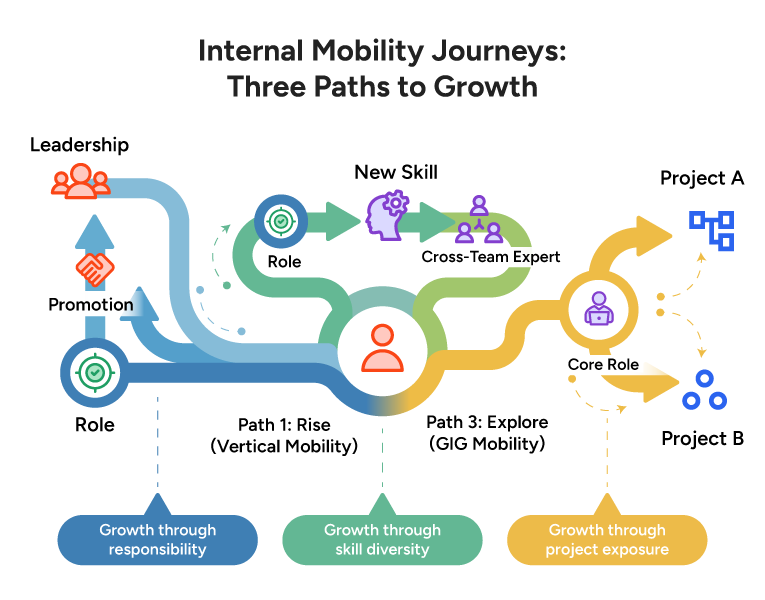
Comparison Table for Types of Internal Mobility in an Organization
| Type of Mobility | What It Means | Common Examples | When It Works Best |
|---|---|---|---|
| Vertical Mobility | Movement to a higher role with increased responsibility | Promotions, leadership roles, and role upgrades | When rewarding performance and building future leaders |
| Lateral Mobility | Movement across roles at the same level | Department transfers, role changes, cross-functional shifts | When developing new skills and reducing role stagnation |
| Gig-Based Mobility | Short-term or project-based internal assignments | Internal projects, task forces, temporary roles | When testing skills quickly or filling short-term business gaps |
Gig-based mobility has become increasingly popular as organizations prefer agility without permanent role changes. These assignments allow employees to test new skills, explore different functions, and contribute to high-priority initiatives while maintaining their primary role. This flexibility benefits both employee development and organizational responsiveness to urgent business needs.
5 Key Benefits of Internal Mobility for Businesses
The internal talent movement supports organizations in numerous ways. Here are a few data-backed reasons why internal mobility should be a priority at your organization:
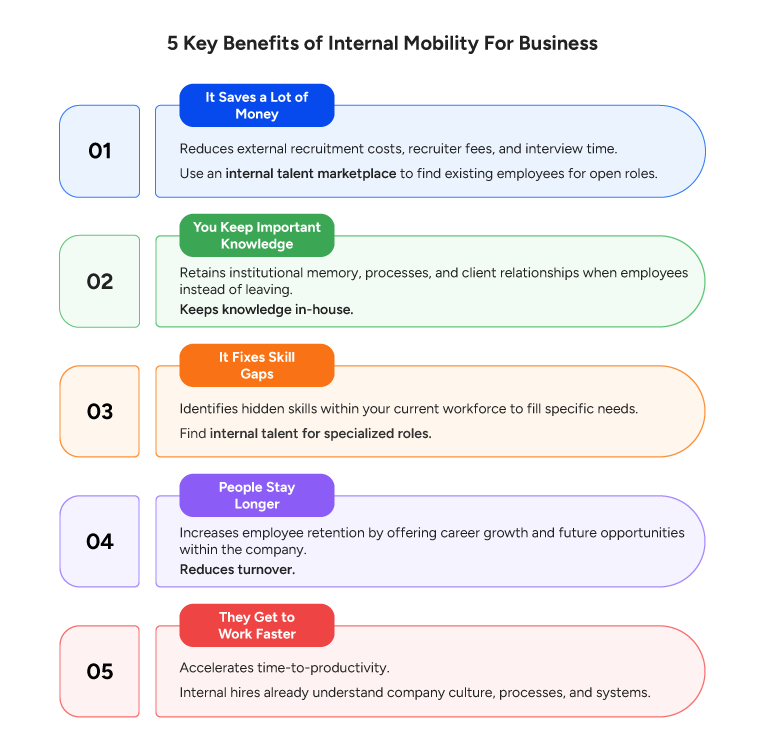
1. It Saves a Lot of Money
Hiring new people is expensive. You have to pay recruiters. You have to spend time interviewing. It costs about 1.5 times an employee’s salary to replace them.
An internal talent marketplace, supported by modern recruitment management software, allows organizations to look inward first. By identifying and matching existing employees to open roles, companies can reduce their reliance on external hiring and shorten the overall time-to-hire
2. You Keep Important Knowledge
When a person leaves, they take their knowledge with them. They know how the coffee machine works and how to talk to difficult clients. If they stay but just move desks, you keep that knowledge in-house.
3. It Fixes Skill Gaps
Sometimes you need a specific skill, but you can’t find it outside. Maybe someone in your accounting team knows how to code Python. If you have internal mobility, you can find that person and let them use that skill.
4. People Stay Longer
Employees leave when they feel stuck. If they see a future at your company, they will stay. It is that simple.
5. They Get to Work Faster
A new hire takes months to learn the ropes. An internal hire already knows the company. They know the passwords and where the bathroom is. They can start working for real in just a few weeks.
Why Employees Value Internal Career Paths
Companies with robust internal talent mobility programs demonstrate clarity, growth, and fairness in how opportunities are created and communicated. Employees know which role they’re aiming for next and what they need to do to get there. They don’t feel limited by a rigid career path. Research shows that 94% of employees would stay longer at an organization that invests in their career development.
When internal roles are visible and accessible, employees invest time and effort in ongoing skill development, gain confidence in their future within the organization, and feel recognized, which contributes to stronger employee retention and engagement.
Common Challenges in Implementing Talent Mobility and How to Overcome Them
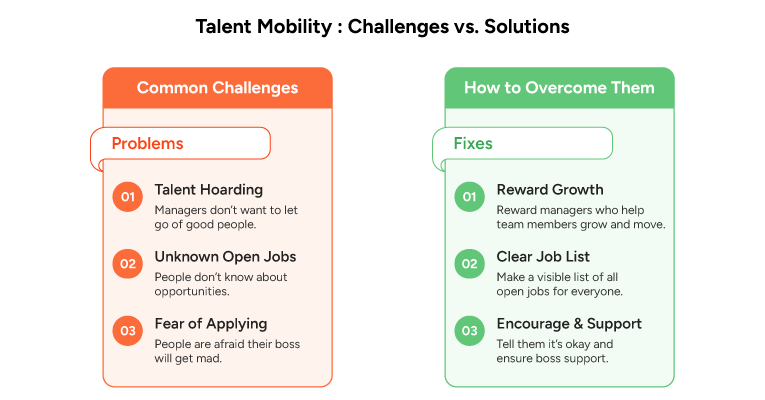
It is not always easy. Here are things that might go wrong and how to handle them.
- Problem: Managers don’t want to let go of good people. We call this “talent hoarding”.
- Fix: Reward managers who help their team members grow. Make it a good thing to send people to other teams.
- Problem: People don’t know about open jobs.
- Fix: Make a clear list of all open jobs. Let everyone see it.
- Problem: People are afraid to apply.
- Fix: Tell them it is okay to apply. Make sure their current boss doesn’t get mad.
How to Build Your Strategy: A 4-Step Action Plan
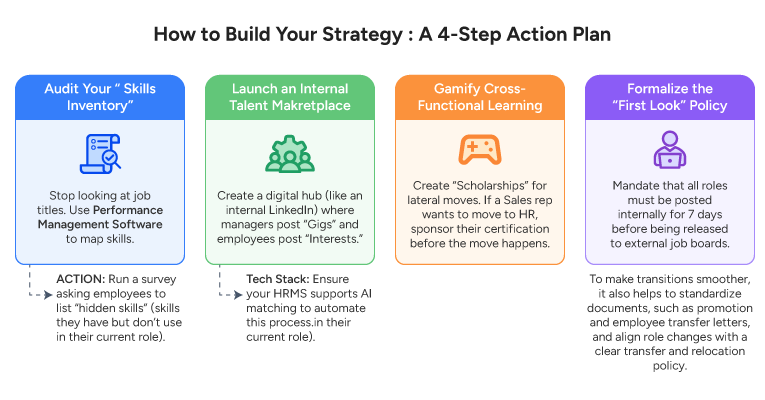
A successful internal mobility strategy aligns business needs with employee aspirations. Below is a step-by-step approach for organizations to build sustainable internal talent mobility programs.
Step 1: Audit Your “Skills Inventory”
Stop looking at job titles. Use Performance Management Software to map skills.
- Action: Run a survey asking employees to list “hidden skills” (skills they have but don’t use in their current role).
Step 2: Launch an Internal Talent Marketplace
Create a digital hub (like an internal LinkedIn) where managers post “Gigs” and employees post “Interests.”
- Tech Stack: Ensure your HRMS supports AI matching to automate this process.
Step 3: Gamify Cross-Functional Learning
Create “Scholarships” for lateral moves. If a Sales rep wants to move to HR, sponsor their certification before the move happens.
Step 4: Formalize the “First Look” Policy
Mandate that all roles must be posted internally for 7 days before being released to external job boards.
To make transitions smoother, it also helps to standardize documents, such as promotion and employee transfer letters, and align role changes with a clear transfer and relocation policy.
Measuring Success: KPIs for 2026
How do you know if it is working? Look at these numbers:
- Internal Fill Rate: How many jobs did you give to your own people vs strangers?
- Retention: Are people staying longer than before?
- Time to Fill: Are you filling jobs faster now?
Conclusion
The importance of mobility in human resource planning is reflected in its direct impact on employees’ perceptions of their growth and future within the organization. When employees see clear internal opportunities, engagement and retention improve. Hiring time and costs also reduce because roles are filled by people who already know the business.
As younger generations make up a larger part of the workforce, employees seek more varied career experiences rather than a single, linear career path. Employees want visibility into where they can progress in their careers and what skills they need to achieve their goals.
Building an internal mobility program that works for both employees and leadership means removing cultural and structural roadblocks. This is where an advanced HRMS solution plays a key role. factoHR brings employee skills, performance data, and career progression into one system, making it easier to manage promotions, transfers, and role changes transparently and consistently.
Frequently Asked Questions
What is an Example of Internal Mobility?
Promoting a team member to a team lead role after an unexpected resignation is a clear example of internal mobility.
What is the Biggest Barrier to Internal Mobility?
Talent Hoarding. Managers fear losing their best team members. The solution is to incentivize managers on “Talent Export”, rewarding them when their team members get promoted to other departments.
Does Internal Mobility Increase Retention?
Employee retention increases with internal mobility, as employees are more likely to stay when growth opportunities exist within the company.
What are the Three Types of Internal Mobility?
Internal mobility is categorized as:
- Vertical mobility (promotions)
- Lateral mobility (role changes at the same level)
- Gig-based mobility (temporary projects or assignments)
How do You Measure Internal Mobility?
Internal mobility is measured using internal fill rate, time-to-fill, retention rate, and post-move performance KPIs.
What is the Difference between Talent Mobility and Internal Mobility?
Internal mobility focuses on identifying skills within an organization’s internal staff and creating opportunities for growth and movement. Talent mobility refers to the movement of employees across locations, business units, and roles, both within and beyond the organization.
What is the Difference between Career Pathing and Internal Mobility?
Career Pathing is the plan (the map). Internal Mobility is the action (the vehicle). You need pathing software to visualize where you can go, and a mobility policy to help you get there.
Why does Your Organization Need an Internal Mobility Strategy?
An internal mobility strategy brings structure and fairness to employee movement across the organization. It helps organizations retain talent, close skill gaps, reduce hiring costs, and create clear career paths.
Table of Contents
Sometimes unexpected things happen, but sending a polite email to HR shows professionalism and keeps your opportunity safe. To help you, we’ve included a ready-to-use email template for rescheduling an interview that shows you how to communicate clearly, politely, and confidently with HR.
What is a Reschedule Interview Email?
A rescheduled interview email is a message sent to change the date or time of a job interview. It is written when the candidate or employer cannot attend at the scheduled time. The email politely explains the reason and suggests a new date or time that works for you, and asks for their approval. This keeps things professional and shows respect for their schedule.
Email Template for Rescheduling an Interview
Subject: Request to Reschedule Interview
Dear [Hiring Manager’s Name],
Thank you for scheduling my interview for the [Job Title] position on [Original Date/Time].
Unfortunately, due to [reason], I will not be able to attend at the scheduled time. I sincerely apologize for the inconvenience and would like to request a new interview time.
I am available at the following times:
- [Alternative Date/Time 1]
- [Alternative Date/Time 2]
Please let me know if any of these options work for you, or if another time would be more convenient.
Best regards,
[Your Name]
[Contact Information]
Reschedule Interview Email Samples for Different Situations
1. Sample Email for Reschedule Interview Due to a Medical Emergency
Subject: Request to Reschedule Interview – Tia Malhotra
Dear Mr. Mehta,
Thank you for scheduling my interview for the Software Engineer position on February 25 at 10:00 AM. Unfortunately, I have a medical emergency and won’t be able to attend. I would like to reschedule.
Could we schedule it on February 27 at 2:00 PM or February 28 at 11:00 AM? I’m also happy to adjust to a time that works best for you.
I apologize for any inconvenience and remain very excited about this opportunity. I look forward to your reply.
Regards,
[Your Name]
[Contact Information]
2. Sample Email to Reschedule Interview Due to Family Emergency
Subject: Request to Reschedule Data Analyst Interview – Rahul Verma
Dear Ms. Sarah Kapoor,
I’m grateful for the opportunity to interview for the Data Analyst position on March 10 at 3:00 PM. Due to a family emergency, I won’t be able to attend and would like to request another date.
Would March 12 at 10:00 AM or March 13 at 12:00 PM work for you? I’m flexible with any time that is convenient for you.
I apologize for any inconvenience and remain very enthusiastic about this opportunity. I look forward to your reply.
Regards,
[Your Name]
[Contact Information]
Need a Format for Inviting Candidates to Interviews?
Explore this Interview Call Letter Format and Samples with ready-to-use templates that help HR teams send professional interview invitations.
3. Sample Email for Reschedule Interview Due to Work Conflict
Subject: Request to Reschedule Marketing Executive Interview – Ananya Singh
Dear Mr. Kapoor,
Thank you for scheduling my interview for the Marketing Executive position on March 5 at 11:00 AM. Due to a work conflict, I’m unable to attend and would like to reschedule.
Would it be possible to reschedule on March 7 at 2:00 PM or March 8 at 10:00 AM? I’m happy to adjust to any time convenient for you.
I am sorry for the inconvenience, and I remain very excited about this opportunity. I look forward to your reply.
Regards,
[Your Name]
[Contact Information]
4. Sample Email to Reschedule Interview Due to Travel Delay
Subject: Request to Reschedule Business Development Executive Interview – Aria Rai
Dear Ms. Sehgal,
Thank you for scheduling my interview for the Business Development Executive position on February 27 at 2:00 PM. Due to an unexpected travel delay, I won’t be able to attend and would like to reschedule.
Could we schedule it on March 2 at 10:00 AM or March 4 at 3:00 PM? I’m also open to any other time that works better for you.
I am sorry for any inconvenience, and I remain very enthusiastic about this opportunity. I look forward to your reply.
Regards,
[Your Name]
[Contact Information]
Stop Creating Job Descriptions from Scratch
Use 50+ professionally written job description templates for HR, sales, marketing, IT, finance, and more.
5. Short Notice Reschedule Interview Email Sample
Subject: Request to Reschedule SEO Executive Interview – Rachit Sharma
Dear Mr. Valmiki,
I hope you are doing well. My interview for the SEO Executive position is scheduled for March 1 at 11:00 AM. Unfortunately, due to an unexpected conflict, I won’t be able to attend. I apologize for the short notice and would be grateful if we could arrange another suitable time.
Would March 3 at 10:00 AM or March 5 at 1:00 PM work for you? I’m happy to adjust if another time is more convenient.
Thank you for your understanding. I look forward to your reply.
Regards,
[Your Name]
[Contact Information]
Best Practices for Rescheduling an Interview
Following these best practices can help you reschedule an interview professionally while maintaining a positive impression.
- Inform HR as soon as possible if you are unable to attend at the scheduled time so they can adjust the interview scheduling accordingly.
- Keep your email simple and mention only the main reason without going into unnecessary detail.
- Offer 2–3 alternative dates and times to show that you are flexible and willing to adjust.
- Keep your message professional and brief, avoiding slang, casual language, or spelling errors.
- Clear communication is important throughout the recruitment process, especially when rescheduling interviews.
Common Mistakes to Avoid when Rescheduling an Interview
Avoid these common mistakes to maintain professionalism and respect for the employer’s time.
- Don’t cancel without a valid reason. Provide a short and honest explanation.
- Avoid informing the recruiter at the last minute, as proper job interview etiquette recommends notifying employers as early as possible.
- Don’t sound demanding. Always ask politely when requesting a new time.
- Avoid overly emotional or casual language in your email.
- Don’t reschedule an interview multiple times unless there is a serious or unavoidable reason.
- Respond quickly to any follow-up messages about the new interview schedule.
Struggling to Manage Interviews for Multiple Candidates?
Use this modern recruitment software to track candidates, schedule interviews, and streamline the hiring process.
Frequently Asked Questions
When Should You Reschedule an Interview?
Reschedule an interview only for genuine reasons like illness, family emergencies, or unavoidable conflicts. Inform the interviewer as soon as possible, ideally 24-48 hours in advance, to respect the employer’s schedule.
Is It Bad to Reschedule an Interview?
No, it is not bad to reschedule an interview if you have a valid reason. If you inform them early and suggest another time, it shows respect and responsibility.
When is It Too Late to Reschedule an Interview?
Reschedule the interview as soon as you realize you cannot attend. Trying to change the schedule at the last minute or after the interview time has passed is generally considered too late and may create a negative impression.
Can I Reschedule More than Once?
Yes, you can reschedule more than once if it is due to unavoidable circumstances. However, frequent changes may create a negative impression. It is best to apologize politely and suggest alternative time slots to show respect for the employer’s schedule.
Should I Call or Email HR?
Email is the best option. It creates a written record and respects HR’s schedule. You may call only if the interview is very close or the situation is urgent, preferably after sending an email.
Read More Interview Questions with Sample Answer
Table of Contents
Did you know that employees at organizations that cut DEIB initiatives are 35% more likely to leave, and yet less than 47% of organizations have a formal DEIB policy in place?
DEIB, or Diversity, Equity, Inclusion, and Belonging, is a framework that organizations use to build a diverse and supportive workplace culture. As an employer or recruiter, implementing DEIB initiatives can directly improve employee retention and engagement.
For Indian firms, Diversity, Equity, Inclusion, and Belonging are important from both an innovation and compliance perspective. For example, laws such as the New Labour Codes and the RPWD (Rights of Persons With Disabilities) Act include compliance measures, such as equal representation and non-discrimination, among other provisions.
What is DEIB?
DEIB stands for Diversity, Equity, Inclusion, and Belonging. DEIB is a framework that organizations use to build a diverse and inclusive workplace culture. Let’s understand the four concepts involved in DEIB.
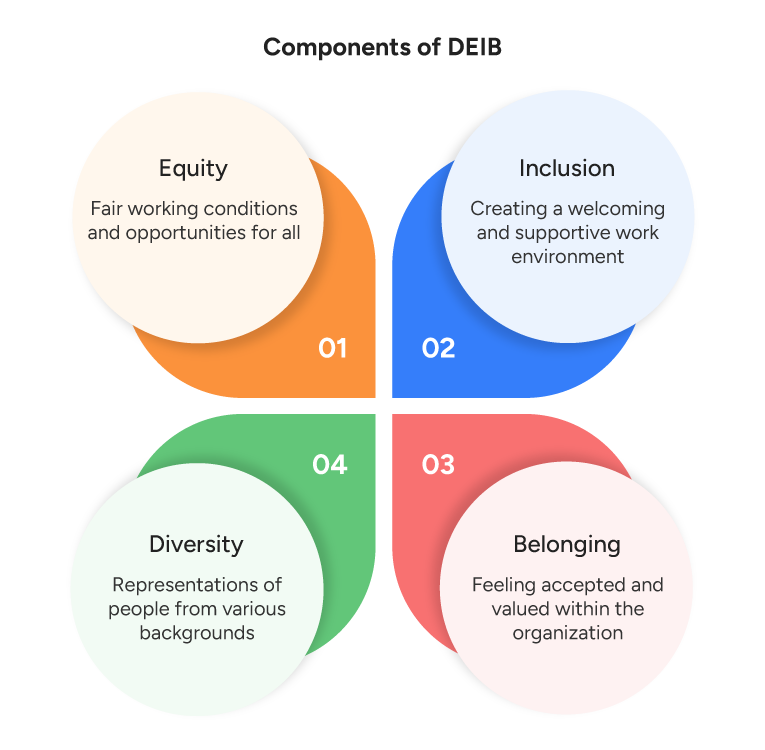
Diversity
Diversity refers to the representation of people from different backgrounds, such as gender, ethnicity, race, nationality, sexual orientation, disability, or age. You need to know that different sections are considered underrepresented in different countries as well. For example, in the US, military veterans are covered in diversity-related programs. Whereas in India, caste is one aspect covered in diversity efforts.
Equity
Equity means providing fair working conditions to everyone. Here, you should know that “fair” means giving equal opportunities and addressing the specific needs of employees as well. For example, as a recruiter, you should make sure that your simulation tests and other hiring processes are accessible to people with disabilities. Another example is flexible work policies for working parents.
Inclusion
Inclusion is the process of creating a work environment where everyone feels welcome and supported. You should think about your workplace as inclusive when every employee participates in workplace activities and feels valued and empowered. Inclusion is the process of fostering a workplace culture where everyone feels welcome and supported.
Belonging
Belonging is the psychological and emotional outcome of Diversity, Equity, and Inclusion. It is a feeling in which an employee genuinely “belongs” to your organization. When employees feel accepted, welcomed, respected, and safe, their productivity improves, and they contribute more.
Read this table to better understand the four pillars of DEIB
| Pillar | Focus | Example | Outcome |
|---|---|---|---|
| Diversity | Representation of people from different backgrounds | Hiring employees from varied genders, ages, and abilities | A workforce that reflects different perspectives |
| Equity | Fair access to opportunities and resources | Providing flexible work options based on employee needs | Employees receive support suited to their situations |
| Inclusion | Participation and respect in the workplace | Involving all employees in team discussions and decisions | Employees feel welcomed and heard at work |
| Belonging | Emotional connection and psychological safety | Creating an environment where employees feel valued | Stronger trust and commitment to the organization |
Why is DEIB Important in 2026?
DEIB is important in 2026 because implementing DEIB strategies improves retention, helps access a wider talent pool, brings new perspectives, and creates an ethical workplace for everyone.
Accessing a Wider Talent Pool
66% of recruiters say that it’s difficult to find talent in 2026. Hiring candidates from diverse backgrounds can help you tap into a wider talent pool.
Retention
In most workplaces, Gen Alpha and Gen Z form the majority of employees. People from these generations prioritize values as well as other perks. Also, when an employee feels that “they belong to this workplace”, they are more likely to stay with an organization.
Creativity and Innovation
People from diverse backgrounds would bring diverse perspectives to challenges. This, in turn, would help find more innovative and creative solutions.
Improved Business Performance
Firms like Apple have formal DEIB policies. This shows that firms with DEIB policies outperform other businesses. Also, when employees feel a sense of belonging, they are more likely to be engaged and contribute productively.
Better Decision Making
When employees from all walks of life are represented, supported, and encouraged to participate, CEOs can make better decisions and avoid the “groupthink” trap.
- For context, groupthink is a psychological phenomenon in which members of a group agree with one another rather than offering different perspectives when making decisions.
Compliance
In India, laws such as the RPWD Act (Rights of Persons with Disabilities) and the new labour codes provide for an equal and inclusive work environment for everyone. For example, the Occupational Safety, Health, and Working Conditions code (OSHWC) allows for women to work on night shifts with their consent. Another example includes providing an Equal Opportunity Policy under the RPWD Act.
What are the Challenges in Implementing DEIB in 2026?
Common challenges related to implementing DEIB initiatives include biased hiring and recruitment practices, resistance to change, disengagement due to remote and hybrid work arrangements, resource limitations, and insufficient data.
Biased Recruitment and Hiring Practices
Intentionally or unintentionally, recruiters might hire candidates from the same network or culture. Additionally, biased AI tools can also make it difficult to hire candidates from different backgrounds.
Resistance to Change
Employees who do not understand the impact and meaning of DEIB initiatives might think that such initiatives are more in favour of people from certain sections. In such a case, it’s a must that you clearly communicate the objectives of your DEIB programs.
Disengagement Due to Remote or Hybrid Work Arrangements
Some employees may feel less connected to the organization because they are less engaged with the firm due to remote work arrangements. Also, it is difficult for HR to sustain engagement when employees work remotely.
Lack of Resources and Commitment
At times, leaders only mention DEIB in their vision and mission statements and do not encourage inclusive practices or provide funds for implementation.
Lack of Data
Even organizations that launch DEIB initiatives struggle to measure their impact because they do not track DEIB metrics.
Tracking metrics such as diversity headcount, training hiring managers on unconscious bias, checking whether AI tools are biased, and clearly communicating changes to employees are some solutions to these common DEIB challenges.
Successfully Implement DEIB in 2026: A Practical, 10-Step Guide
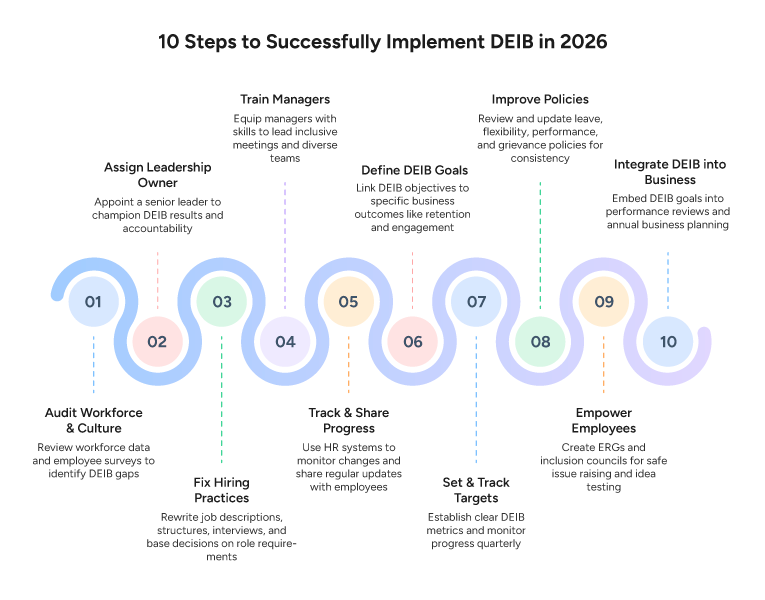
As you know, you may face several challenges when implementing DEIB in your workplace. So, use this 10-step guide to avoid common challenges related to DEIB initiatives in 2026. You can be a small organization, a large business, an MNC, or an Indian startup. Following these 10 steps will give you a good chance of successfully implementing DEIB strategies in 2026.
1. Audit Your Workforce and Culture
Review your workforce data to see where representation is strong and where gaps exist. Examine hiring, promotion, and exit trends from recent years. Compare this with employee survey results on fairness and belonging to understand what is really happening inside your teams.
2. Define What DEIB Should Achieve for Your Business
Decide which business problems DEIB needs to solve, such as attrition in key roles or weak leadership diversity. Link each goal directly to outcomes your organization already tracks, like retention or engagement.
3. Put Leadership in Charge
Assign one senior leader to own the DEIB results. Make inclusive behavior part of how managers are evaluated and how important people’s decisions are reviewed.
4. Set Clear Targets and Track Them
Measure representation in hiring and leadership. Monitor pay equity and promotion outcomes. Use regular employee surveys to understand how supported your people feel and review the data every quarter.
5. Fix how You Hire
Rewrite job descriptions to remove biased language. Change the interviews to follow a structured format so that every candidate is evaluated the same way. Base hiring decisions on defined role requirements rather than personal preference.
6. Improve Policies that Shape Daily Work
Examine leave and flexibility policies to ensure they are applied consistently. Review performance and grievance processes so employees understand how decisions are made and how concerns are handled.
7. Train Managers to Lead Inclusive Teams
Teach managers how to run meetings that let everyone participate. Help them give feedback fairly and manage teams with different working styles. Include DEIB expectations in onboarding and leadership programs.
8. Give Employees a Voice through Ergs and Councils
Create Employee Resource Groups and an inclusion council where employees can raise issues safely. Use these forums to test ideas and support teams that feel underrepresented.
9. Track Progress and Share Updates
Use your HR systems to follow changes in hiring patterns and survey results. Share regular updates so employees can see what is improving and what still needs work.
10. Make DEIB Part of how You Run the Business
Include DEIB goals in performance reviews and business planning. Revisit your approach every year and adjust it based on real data rather than assumptions.
DEIB in India: Laws and Policies You Need to Know in 2026
Here is a brief overview of the laws and policies that you should know as an employer in India from a DEIB perspective.
- Sections 3 and 5 of The Code on Wages, 2019 make sure that women and men are paid equally for the same or similar work.
- Section 28 of the Code on Social Security, 2020, provides for a maternity leave of 26 weeks. Earlier, this was covered by the Maternity Benefits Act.
- Under the Occupational Safety, Health, and Working Conditions Code, women may also work night shifts with their consent under section 25.
- Sections 3 and 9 of The Transgender Persons Protection of Rights Act provide equal opportunities to people with different sexual orientations.
- Under the Rights of Persons With Disabilities Act, 2016, Sections 20 and 21 prohibit discrimination in recruitment and employment and require employees to provide reasonable accommodations to persons with disabilities.
- The POSH Act, 2013, provides for various provisions, such as the internal complaint committee (ICC) (section 4) and the prevention, prohibition, and redressal of sexual harassment (section 19).
- Many public and private-sector businesses also implement policies such as equal opportunity policies.
Conclusion
Diversity, Equity, Inclusion, and Belonging significantly impact your business performance and employee retention. DEIB is not only a compliance requirement that you need to tick off in a list, but it is also the reason why many businesses succeed, and others don’t. Large firms like Apple, Google, and Microsoft implement DEIB initiatives. Indian GCCs (Global Common Capability Centers) also lead in DEIB efforts.
Implement DEIB with factoHR! factoHR provides AI-powered resume screening to eliminate bias in hiring processes. It also supports mood surveys to help you understand the impact of your DEIB initiatives. An OKR-based performance management system ensures that performance is reviewed objectively, providing equal opportunity to everyone. Additionally, you can track metrics such as diversity headcount when developing new DEIB strategies. Try it today!
FAQs
What does DEIB Stand for?
DEIB stands for Diversity, Equity, Inclusion, and Belonging. It is a workplace approach that focuses on fairness and on creating conditions where employees from different backgrounds feel respected and supported.
Why is Belonging Important in Diversity, Equity, Inclusion, and Belonging (DEIB)?
Belonging reflects how employees experience the workplace. When people feel accepted and safe, they are more likely to engage with their work and remain with the organization. Without belonging, DEIB stays limited to policies rather than shaping real culture.
What is an Example of Diversity, Equity, Inclusion, and Belonging in the Workplace?
A company that hires from diverse communities, adjusts support to meet employee needs, and encourages employee participation in decision-making demonstrates DEIB in practice. When employees feel respected in daily interactions, belonging naturally follows.
How do You Promote Diversity, Equity, Inclusion, and Belonging in the Workplace?
You promote DEIB by using fair hiring standards, training managers to recognize bias, applying equal opportunity policies, and giving employees safe ways to share feedback and concerns.
What are the Benefits of DEIB in the Workplace?
DEIB improves engagement and reduces turnover. It strengthens teamwork, supports innovation, and helps organizations build trust with employees while improving long-term performance.
How Can Companies Create a Sense of Belonging at Work?
Companies create a sense of belonging by listening to employees, acknowledging their contributions, treating people fairly, supporting employee groups, and guiding managers to lead consistently and with respect.
Table of Contents
You see companies spending crores on training programs, only to realize that their employees are still figuring out the first-level basics of their jobs. This is where Training Needs Analysis steps in. Rather than a nice-to-have function, it is the fuel that enables companies to rocket towards future-proof success through performance management systems.
Modern Indian businesses face constant disruption from rapid automation to managing a hybrid workforce. A proper TNA identifies gaps that exist and sets the stage for smart, measurable learning opportunities. In an industry where random workshops are the norm, Training needs assessment amplifies productivity to a colossal level.
Your people, processes, and profits demand TNA, as it provides the blueprint for building the next-gen capability you need. This blog doesn’t just explain the TNA process; it dives deep into the concept and the 360° cycle behind building a foolproof learning-and-development strategy.
Let’s read!
What is a Training Needs Analysis (TNA)?
Training Needs Analysis (TNA) is the process of identifying gaps between existing skills, knowledge, and employee performance. It highlights the skills needed to achieve organizational goals. TNA helps Learning and Development (L&D) teams and managers identify individuals who need training and determine the level or category of training they require. By systematically analyzing these gaps, TNA makes learning systems purposeful, targeted, and aligned with individual growth & company’s ambitions.
Training needs assessment, though, is never a magic wand for companies that are facing cultural differences or motivation problems. When employees are not sufficiently motivated, you offer rewards, engagement programs, or smart HR policies. A PowerPoint training will not boost their enthusiasm.
Understanding KSAs: Knowledge, Skills, and Abilities
- Knowledge: What employees must know about their role. For example, a content writer must have basic knowledge of different kinds of content formats.
- Skills: What an employee must have to get work done. For example, a content writer must be skilled enough to distinguish between a press release and a blog post.
- Abilities: How they apply what they know, adapting leadership style for remote teams, for instance. Ability is how an employee applies what they know to their job for maximum impact. For example, how well a blog is written to gain maximum reach and leads is what sets the content writer apart.
TNA works on three levels:
- Organizational: TNA efforts focused on strategic growth
- Job: Define how different roles can grow
- Individual: Pinpointing personal gaps of an employee for maximum potential
The real game-changer is when TNA insights are connected to competency management. You can now plan trainings based on actual skill gap analysis, making your learning framework robust and effective for your team.
The 3 Core Levels of Training Needs Analysis
As a forward-thinking company, you notice that your HR team keeps fumbling payroll reports, and the sales team often misses targets. Your digital strategy is in shambles. Where do you even begin? This is where Training Needs Analysis levels come in. TNA is not a one-size-fits-all solution. It can pinpoint exactly where the gap is and make your training programs high-performing.
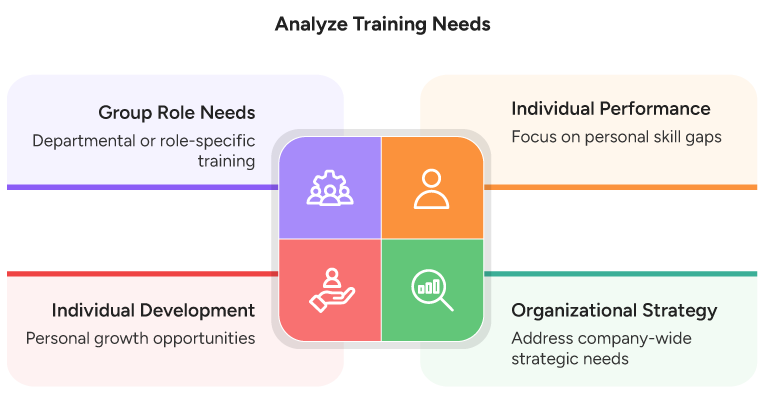
1. Organizational Level Gaps
At this level, you are looking for gaps that affect the whole company. These gaps can be caused by market shifts, new regulations, or even technology upgrades.
- Example: An Indian IT company must train all staff on new data privacy rules following the government’s updates to privacy and compliance laws.
- Use of TNA: You will want each employee to fill the knowledge gap here and adapt to the company’s new direction.
2. Group/Job Role Level Gaps
Here, the TNA is focused on specific departments or roles. This gap does not affect the whole company, but merely certain teams.
- Example: HR department struggles with payroll mistakes after a new HRMS feature is released.
- Use of TNA: The HR department will need to learn the backend of the new feature, a targeted skill upgrade needed to prevent payroll mistakes.
3. Individual Level Performance Gaps
TNA is at its most focused here, as it impacts a person’s performance and career growth.
- Example: A sales executive keeps missing targets due to recurring client-handling errors.
- Use of TNA: TNA can be used to determine whether the executive needs to learn client communication, negotiation, or objection handling. Figuring out the skill gap in this scenario can help the executive immediately.
Let’s see a bird’s-eye view of Training Needs Analysis Levels.
| Level | Focus | Example | Best use of TNA for |
|---|---|---|---|
| Organizational | Company-wide gaps | Employees need to be aware of the recently announced cybersecurity rules. | Strategically aligning employees to the company vision. |
| Group / Job Role | Departmental gaps | The HR department has to adapt to the company’s new HR software. | Increasing departmental efficiency. |
| Individual | Personal performance gaps | The sales manager is missing sales targets due to low negotiation skills. | TNA can help the exec learn negotiation and improve client handling. |
The key behind training needs analysis is simple: Don’t train your team blindly. You need to ask questions like: “Is this a company problem? A team problem? Or an employee problem?” Once you know the level of NA needed, TNA becomes precise rather than being random.
To make the Training needs analysis process even smarter, you can integrate it with your HRMS. An HRMS can help you identify gaps to see where training is truly needed for employee development.
The Purpose and Business Benefits of Conducting a TNA
most Training Programs Fail because You Train Employees without Knowing the Real Gaps. TNA is Supposed to be a Quick Check-Up; It Shows where People Need Support. Every Training Session Bridges Performance Gaps and Benefits both the Company and the Employees.
Why TNA matters:
- It aligns training with business goals, so everyone learns what really matters.
- This identifies missing skills before they affect work, which is great, especially for Indian companies.
- This saves money on workshops that won’t help, as TNA shows exactly what’s needed.
- Employee morale is boosted as their skills and careers improve through effective TNA, directly increasing employee retention and strengthening your overall talent development pipeline.
- Hybrid teams juggling office and remote work especially benefit from role-specific training.
Modern HR tools make training needs analysis easier. HRMS data can reveal skill gaps to complement your Succession Planning or Employee Skill Development Programs. A training needs assessment can be your sure-shot plan to grow skills and business results.
Future L & D Trends in Training Needs Analysis (2026 and Beyond)
In 2026, Training Needs Analysis (TNA) is no longer a reactive, once-a-year HR checklist. Powered by AI and real-time data, modern TNA has evolved into a predictive engine that prevents skill gaps from impacting your bottom line.
Here are the four trends reshaping Learning and Development (L&D):
1. AI-Powered Skills Forecasting
Instead of waiting for performance to drop, predictive analytics now forecast the exact competencies your organization will need 12 to 18 months out. By analyzing HRMS data, behavioral profiles, and market shifts, AI automatically flags talent shortages and triggers targeted upskilling initiatives.
2. Hyper-Personalized Learning Paths
The days of generic, one-size-fits-all workshops are over. Today, Generative AI integrates with your Learning Management System (LMS) to dynamically build custom career paths. Employees receive hyper-targeted learning modules tailored to their real-time performance, role requirements, and individual progress.
3. The Shift to Agile Skill Frameworks
Rigid job titles are losing relevance. The modern workplace runs on agile skill frameworks that prioritize what an employee can do actively rather than what their job description says. Modern competency mapping builds a highly flexible, cross-functional workforce capable of adapting to rapid market changes.
4. Continuous, Data-Driven Assessments
Relying on annual reviews means looking at a highlight reel of missed opportunities. Continuous TNA leverages real-time performance data to identify inefficiencies. This allows L&D teams to deploy quick micro-learning interventions exactly when and where they are needed, replacing slow, outdated assessment models.
In fast-moving sectors like biotech, continuous TNA supports constant upskilling.
Recent World Economic Forum reports focus on one thing: Reskilling must be continuous, data-driven, and future-focused. As automation and AI reshape corporate realities, static training models might fall far behind.
How to Conduct a Training Needs Analysis: Step-by-Step Process

Step 1: Define Your Organizational Goals
The first step in a Training needs analysis is to assess. Without clear goals, training becomes a random activity. Numerous workshops are conducted, with little to no impact. The point is simple: you have to figure out where the business is struggling and make training solve those problems.
You can look for the main points: Are there payroll issues piling up in HR? Or are sales falling apart due to client handling skill issues? Are the hybrid teams missing deadlines because they don’t understand the project? These issues will highlight where training is most needed.
Now, you’ve identified the problems. Define a level for each goal.
Once you identify the problems, break goals into three levels:
- Organizational goals can include company-wide priorities such as improved customer service, better feedback systems, or migrating from legacy systems to digital ones.
- Departmental goals can appear to be team-specific issues. Payroll errors in HR, knowledge transfer in digital marketing for Freshers, or low lead conversion in sales.
- Individual goals can look like filling personal gaps. For example, a manager needing better time-management skills or a junior employee needing data-mining training.
Your TNA will be even more focused when you ask these questions:
- Which gaps are hurting business results the most?
- Which roles are important to hitting company goals?
- What knowledge or skills can fix these issues?
- How will we know if training worked?
Mapping business goals to training focus:
| Business Goal | Training Focus | Level |
|---|---|---|
| Reduce compliance errors | Run HR compliance workshops | Organizational |
| Improve payroll accuracy | HRMS hands-on training | Departmental |
| Increase sales closure rate | Negotiation & client handling | Individual |
| Improve hybrid team productivity | Collaboration & digital tool training | Departmental |
Defining goals in this manner ensures that training does what it is actually meant for: grow the team’s productivity. Every session has a purpose when training is planned in line with the company’s strategy. This step turns TNA into something that solves real business problems, rather than just HR paperwork. It sets the stage for smarter, measurable training methods that deliver outstanding results.
Step 2: Define Relevant Job Behaviors and Outcomes
After step 1, your job is to identify job behaviours that actually drive performance. Training only works when it targets actions that your employees can control. Economies can’t be fixed with a workshop in Excel; your employee needs targeted training to advance their career. This is where job analysis and task inventory become your best tools. You need to break down each role into an employee’s daily activities and how these activities move the business forward.
Ask yourself these questions:
- Which tasks really impact company goals?
- Which behaviors are measurable and observable?
- Where are employees spending time on things that don’t matter (and maybe shouldn’t)?
For example, if the goal is effective onboarding, proficiency in HRMS is most important.
When an HR person repeatedly logs data incorrectly or skips induction steps, it wastes time and creates useless protocols for everyone. Double-checking attendance and submitting reports on time is not a fancy job, but 100% required for accurate payroll. Thus, when a job behaviour is defined, training needs analysis is simpler and more accurate.
This clarity is most important during phases like employee onboarding. If newly hired employees aren’t trained right from day one, it can affect their productivity, goals plus retention.
Job Behavior Analysis Table
| Role | Key Behaviors | Measurable Outcome |
|---|---|---|
| HR Executive | Complete onboarding tasks using HRMS | New employees are onboarded within 3 days. |
| Payroll Associate | Verify attendance and process payroll | 100% error-free payroll submissions |
| Sales Executive | Follow up with leads promptly | Increased conversion rates |
| Customer Support | Respond to queries within SLA | Higher customer satisfaction |
Big goals like increasing productivity or boosting customer experience sound really great on paper. But does your employee actually know what to do to achieve those goals on a Monday morning? This is why defining behaviours becomes highly important for a tangible, result-oriented training needs analysis.
Behaviours are the small, visible actions people can take every day, such as how a sales rep handles objections or how a manager reviews performance. These behaviours can sound dull. Following a checklist or reviewing reports on time. But these boring actions are what separate consistent performers from struggling teams.
This is why defining job behaviour analysis sharpens TNA. Instead of running broad programs and hoping they work, you can create training that specifically leads to measurable results. This way, the training becomes practical, focused, and directly performance-led.
Step 3: Identify Required KSAs and Conduct a Skills Audit
Now that the job behaviours are defined, the next best step is to conduct the skills and knowledge audits needed to perform those behaviours. This helps you identify gaps between what your employees have and what the job demands, enabling you to build a robust competency framework. You can map these findings onto a skills gap analysis matrix to visualize them more easily.
You can start by mapping the KSA to a specific job behaviour. For example, if a payroll associate processes payroll accurately, he should have knowledge about HR compliance and payroll laws. He should have the skills to use the HRMS properly. Their abilities include attention to detail and respecting deadlines.
Once you know the required KSAs, your next step is to assess your employees’ current level of knowledge, skills, and abilities. What are the gaps? These gaps determine where training is necessary and how process improvements can be made better.
You can use these methods to identify gaps:
- Surveys: A quick way to understand employees’ perceptions of their own skills. Pros: Fast and scalable option. Cons: The employee could overestimate abilities. Best for large teams or when initial screening is required.
- Interviews: Direct conversations with employees or managers. Pros: get detailed insights. Cons: It can be a bit time-consuming. Best option for candidates in critical roles or leadership positions.
- Observations: Observing tasks done by employees. Pros: accurate and context-specific conclusions. Cons: Require heavy resources.
- HRIS / HRMS Data Mining: Checking performance data, learning history, and competency levels. Pros: Data never lies, and you gain comprehensive solutions. Cons: It depends on data quality. Best for companies with integrated HR systems.
- Performance Reviews: Includes 360-degree feedback and PMS data. Pros: Intertwines multiple perspectives. Cons: Could be biased if not properly structured. Best when you need to assess ongoing skills.
TNA Methods Table
| Method | Pros | Cons | When to Use |
|---|---|---|---|
| Surveys | Fast, scalable | Self-report bias | Large teams, initial screening |
| Interviews | Deep insights | Time-intensive | Critical roles, leadership |
| Observations | Accurate, context-specific | Resource-heavy | Complex/high-stakes tasks |
| HRMS/HRIS Data | Data-driven, objective | Quality-dependent | Integrated HR systems |
| Performance Reviews | Multiple perspectives | Potential bias | Continuous assessment |
The goal of Training needs analysis is not to collect mountains of data. Rather, it is about gathering actionable insights to identify where employees lack key KSAs. This further helps identify organizational and individual training needs.
As Peter Drucker, the father of modern management and an American author, says: what gets measured gets managed. In this case, measuring Knowledge, skills, and abilities ensures that your training fixes the right gaps at the right time. By systematically mapping KSAs and identifying gaps, companies can design world-class training programs to drive high business growth.
Step 4: Develop Actionable Training Recommendations
You found the gaps, but what should you do about them? Step 4 is the answer to this very question. After identifying the KSAs, you now determine whether training is really the solution. If yes, what kind of training would actually make sense? Not every problem can be solved in a classroom. Some issues require clear guidance, coaching, or strict adherence to protocols. Good training needs analysis tells you exactly what’s needed early and clearly.
Let’s understand when HR training methods are the right answer:
| Training Method | When It’s the Right Answer | Key Characteristics & Benefits |
|---|---|---|
| On-the-job training | When employees need hands-on practice while actively doing their jobs (e.g., system usage, learning processes, or role-specific tasks). | It is the most practical solution for role-specific learning, especially effective for Indian teams. |
| Workshops | Best when addressing common skill or knowledge gaps across entire teams (e.g., compliance awareness, team communication basics, leadership fundamentals). | A proven method that encourages active participation, warranting more role-play rather than just theory. |
| LMS-based learning | When a group needs to learn something consistently and quickly, such as company-wide policy updates or specific process protocols. | Uses an integrated Learning Management System (LMS) to track completion, monitor progress, and help leadership accurately measure the ROI of training. |
One reality check that many organizations miss is that some gaps simply are not training issues.
If employees know the process but refuse to comply, training will not help.
What Non-Training Solutions Can You Use?
- If the issue is employee attitude or effort → coaching
- If the process is unclear or outdated → changes in policy
- Performance is poor despite repeated trainings → focus on performance improvement plans.
A structured Performance Improvement Plan helps clearly set expectations, timelines, and consequences.
This step connects directly to Step 3. KSAs show what is missing. Training recommendations decide what action to take. Mixing these up leads to wasted budgets and tired employees.
Strong recommendations are simple. They respect time, money, and reality. They use training where skills are missing and other tools where behavior or systems are the problem.
When done right, this step turns TNA from analysis into action—and ensures learning actually improves performance, not just attendance numbers.
Real-World Training Needs Analysis Examples
Let us look at some examples of Training Needs Analysis (TNA) and how its conclusions can be implemented in practice.
Organizational Example: Sales Team Capability Gap
Mid-sized B2B companies often face an odd issue. The sales activity is high, with calls, demos, follow-ups, and more. But revenue growth figures are stalled. Most companies jump straight into ‘training’ and ‘sales workshops’. But an ideal solution is to dig deep into deal reviews and historical sales data.
The pattern becomes instantly clear: 20% of sales reps struggle during pricing conversations, and 50% of deals are closed through late-stage negotiations. 30% of leads are untouched, and late responses to hot leads are a major reason for low response rates.
When the reasons are clear, companies can roll out short, role-specific workshops that focus on each reason. Managers can then track the team’s progress and provide feedback. This is when TNA does its job efficiently; it connects business pain to noticeable job behavior.
Job Role Example: HR Team Lacking HRMS Proficiency
For example, an HR team implemented updates to an HRMS. But the performance cycles were still run manually. Appraisals were delayed, feedback was compromised, and reports took months. Companies typically hold training sessions to sort these issues.
But if a role-level training needs analysis is conducted, it would immediately clarify that HR professionals know what to do, but the system lacks the capability to follow through. HR executives knew performance management, but how to do it with the system was the question.
After the task-based HRMS training, the team knew the solution. The data quality vastly improved, and so did the appraisal cycles. It is a textbook case of how TNA can help improve performance management when job behavior and system skills are aligned.
Individual Example: New Hire Onboarding Failure
A newly hired employee completed the induction process but continued to underperform for 3 months. There was no escalation that flagged it, but the training needs analysis of this individual revealed the truth. The employee had a limited understanding of task ownership and no exposure to systems in the early days after induction.
Instead of retraining the employee, HR designed an onboarding process with role-based checklists and HRMS walkthroughs. The outcome was not dramatic, but the employee’s productivity definitely stabilized.
Mini Case: TNA Integration Using factoHR.
Training needs analysis doesn’t have to be noisy. Rather, it addresses problems with clear diagnosis and focused action items.
An Indian company followed a set employee training policy. Training and learning were applied where they mattered and clearly avoided where they didn’t. This is how a training needs assessment not only identifies problems but also reveals potential.
Common Challenges in TNA & How to Overcome Them
Even the best Training needs analysis can face blockages. Ignoring such roadblocks can turn TNA into untouched paperwork that sits in a drawer. But when these challenges are faced head-on, TNA really does improve performance and deliver measurable results.
1. Resistance from Managers and Employees
Managers can see TNA as an unnecessary bureaucratic move. Employees worry that it flags underperformance.
Solution: Teach managers about TNA value and involve them in the early phases. Show examples of how TNA can be applied, i.e., sales teams improving deal close rates via targeted workshops. For employees, position TNA as a growth opportunity. You can even use anonymous surveys to get honest and clear responses from them.
2. Inaccurate or Outdated Data
Relying on old annual reviews leads to wrong conclusions plus inflated skill gaps. Many firms struggle to measure training ROI because the data is old.
Solution: Make decisions based on data. You can use real-time metrics from PMS and LMS, as seen in companies using factoHR’s HRMS Integration. You can combine performance logs or 360-degree feedback to get a complete and accurate picture.
3. Time and Resource Constraints
TNA can take 4-6 weeks and requires significant effort across teams.
Solution: Automate TNA as much as possible. Systems like factoHR help you consolidate different data streams into a single platform. It shows performance data to identify where employees are struggling, so HR doesn’t have to guess who needs training. With the built-in learning system from factoHR, training can be easily assigned, tracked, or reviewed. You can start small with high-impact roles and align them with TNA processes asap.
4. Bias in Remote and Hybrid Assessments
Remote or hybrid setups can misguide results. An employee can score lower due to technical issues or a certain bias.
Use continuous training feedback loops, such as LMSs and analytics, to fairly track employee learning activities. When these tools are matched with structured employee training policies, you can reduce bias to a huge extent. By checking data gaps, resource limits, and bias, TNA can become your strategic tool to improve measurable outcomes.
Free Training Needs Analysis Template (Excel/Google Sheets)
Simplify your TNA process with a ready-to-use, customizable template. This template includes a built-in training needs analysis questionnaire to help managers consistently evaluate their teams.
Download Free Training Needs Analysis Template
Key Questions to Ask during Your Assessment
1. Organizational Level
- Which business outcomes are not being met?
- Are there changes in the market, technology, or regulations affecting us?
- Which departments contribute most to strategic goals?
- What metrics indicate a gap in skills or knowledge?
- Are current training programs achieving desired results?
- Which upcoming projects or opportunities require new competencies?
- Are we spending training resources efficiently?
2. Job Role/Group Level
- Which tasks are most error-prone or slow?
- Which tools, software, or processes are challenging?
- What behaviors separate top performers from others?
- Are employees clear on role expectations?
- Which role responsibilities are changing soon?
- Do teams struggle with collaboration or communication?
3. Individual Level
- Does this employee meet performance expectations?
- Which KSAs are strong, and which are lacking?
- Has the employee expressed interest in upskilling?
- Are there obstacles preventing learning?
- Which skills support their career growth?
- How does their performance affect team or organizational goals?
4. Evaluation & Follow-Up
- How will we measure training effectiveness?
- What timeline is realistic for seeing improvements?
- How will knowledge retention and behavior change be tracked?
- Should coaching or refresher sessions be scheduled?
- Should coaching or refresher sessions be scheduled?
- Can we use HRMS/LMS data to continuously improve training?
- Which gaps still exist after training?
What if every Training Decision Could Make Real Business Impact?
A Training Needs Analysis is not a checkbox on an HR to-do list. It is a strategic tool that can drive real business outcomes. The real value is evident when TNA is continuous and data-driven, leveraging insights from PMS and LMS systems to spot issues. As Indian workplaces today embrace hybrid teams and rapid technological shifts, TNA can serve as a predictive lens for companies. It can help leaders prepare for the future while improving the present performance.
Software like factoHR can make this process seamless and integrate analytics with employee skill development programs and succession planning. Make TNA less about paperwork and more about business advantage, and you get smarter, faster decisions.
FAQs on Training Needs Analysis
Why is TNA Important in 2026?
Talent needs analysis (TNA) helps identify current and future skill gaps, ensuring the workforce remains competitive in an environment where artificial intelligence, automation, and dynamic job roles define the landscape.
How do You Conduct a TNA Step by Step?
Begin with organizational goals, define job behaviors, identify necessary knowledge, skills, and abilities (KSAs), analyze gaps, and design training interventions to meet the objectives.
What are the Best Methods for Training Needs Assessment?
Use a mix of surveys, interviews, observations, performance data, and HRMS analytics to provide accurate information.
How does HR Software Help with TNA?
Systems like factoHR’s performance management software integrate PMS and LMS data to automate gap detection and continuously track progress.
What Should a TNA Template Include?
Fields for organizational goals, job behaviors, KSAs, gap analysis, and training recommendations, so you can plan, assign, and measure TNA efforts efficiently.
How is TNA Different from Performance Appraisal?
While performance appraisals assess past performance, TNA predicts future gaps and helps you develop proactive training modules to improve your employees’ skills.
How do You Identify Skill Gaps in Remote Teams?
You can use LMS analytics, online assessments, and virtual feedback tools to identify gaps in technical and soft skills in a fair way.
Can You Measure the ROI of TNA?
You can track changes in key performance indicators (KPIs), including reductions in errors, increases in productivity, and employee engagement metrics.
What are Common Challenges in Remote TNA?
Challenges of remote TNA include biased assessments, limited visibility into work processes, and low survey response rates. Strategies to overcome these include continuous feedback, the use of xAPI-enabled LMS, and analytics integration.
Table of Contents
Holi is a festival of colors, joy, and togetherness. It can also be a great chance for HR teams to bring employees together and build stronger team bonds at work. While the popular line “Bura na mano, Holi hai!” is often said for fun, it’s important to respect everyone’s comfort and boundaries in the workplace.
In this blog, you’ll find simple and workplace-friendly Holi celebration ideas that help you enjoy the festival while keeping the office environment positive and respectful.
Different Ways to Celebrate Holi in the Office

1. Play Holi with Eco-Friendly Dry Colors
What it is: Replacing water or the usual chemical-based colors with organic gulaal for this fun activity.
How to organize it: Set up tables with eco-friendly gulaal in small bowls. Let employees enjoy the festival by applying the colors gently only to willing participants in an open or outdoor office area. Arrange for wet wipes and sanitizer for cleanup.
Why it works: It brings festive Holi vibes without stained clothes or discomfort. It’s one of the most popular Holi activities in office, keeping things respectful and fun.
2. Welcome Everyone with a Holi Tilak

What it is: Welcoming the employees with a small tilak of gulaal on their forehead.
How to organize it: Set up a welcome desk at the entrance with organic gulaal and rose water. Designate someone to greet employees with a tilak as they arrive. Add a small sweet or festive card to make it feel warm and personal.
Why it works: It sets a festive tone from the moment people walk in, making it a thoughtful addition to your Holi celebration ideas in office.
3. Organize a Rangoli Competition

What it is: Teams compete to create the most amazing rangoli design
How to organize it: You will need a clean, common area, eco-friendly colors, or flower petals. Divide employees into teams of 3 or 4. Give them a reasonable time limit (say 30–45 minutes) to draw the rangoli. To make the competition more fun, you can also assign creative team names for work to each group.
Why it works: It brings teams together, encourages creativity, and adds festive energy to the workplace. Plus, it is one of the best Holi decoration ideas for office.
4. Holi Themed Dress Code

What it is: One of the simplest and best ways to celebrate Holi. Ask the employees to dress in white, bright colors, or traditional ethnic wear.
How to organize it: Send a fun announcement a few days ahead to give everyone enough time for prep. Give employees a reason to make an effort by announcing surprise prizes for “Best Dressed” or “Most Colorful Outfit” on the day itself.
Why it works: Zero setup. Maximum vibe. Employees feel festive, and no one has to clean up a single thing.
5. Holi Special Potluck

What it is: A food festival where employees bring homemade Holi treats and traditional dishes to share.
How to organize it: A few days before Holi, have employees pick chits with different food items like gujiya, thandai, malpua, or namkeen written on them. Whatever they pick is what they bring for the potluck. Set up a table in the cafeteria or common area. Label each dish with the contributor’s name.
Why it works: You get to celebrate Holi in your second home with flavor and without mess.
6. Create a Colorful Holi Photo Booth Corner

What it is: Turn a corner of your office into a colorful photo spot where employees can capture the festive moment without any mess.
How to organize it: Sprinkle the energy and color of the festival into an empty corner or cubicle. Decorate it with some colorful drapes, balloons, and paper flowers. Keep props handy like turbans, sunglasses, funny signs, or even colorful dupattas. Let the selfie kings and queens have a blast clicking vivid poses. Share photos in the office group chat afterward.
Why it works: It’s Instagram-worthy, completely mess-free, and gives employees fun memories to take home.
Looking for Work Anniversary Wishes for Employees?
Check out 100+ Work Anniversary Wishes, Messages & Quotes
7. Holi Tambola (Housie)

What it is: One of the best games for Holi party. Gather all the employees for a classic tambola game for Holi with colorful prizes and festive energy.
How to organize it: Print or buy Holi tambola tickets with festive designs. Let one person call out numbers during lunch break or after work hours. Offer small prizes for early five, corners, and full house. Keep the prizes fun like chocolates, gift vouchers, or festive goodies.
Why it works: It’s simple, inclusive, and doesn’t require anyone to step out of their comfort zone. There is no age or fitness level barrier for participating in this fun game.
8. Holi Trivia Quiz

What it is: A fun quiz about Holi history, traditions, songs, and Bollywood references.
How to organize it: Prepare 10-15 simple questions about Holi. It can be online or on paper. Conduct the quiz with your employees, either in teams or individually, over lunch. Give small prizes to the winners.
Why it works: Employees learn something new while having fun.
9. Holi Music Playlist

What it is: Play popular Holi songs throughout the day.
How to organize it: Compile a playlist of classic Holi tracks like “Rang Barse,” “Holi Khele Raghuveera,” and many other classic Bollywood Holi Hits. Let the songs play softly in common areas during work hours, and let them blast during breaks.
Why it works: Music instantly lifts the mood without disrupting work or making anyone uncomfortable.
10. Virtual Holi Celebration

What it is: An option to celebrate Holi with your remote or hybrid team using the virtual medium.
How to organize it: Host a virtual meeting with fun ideas for virtual Holi celebration in office, like online tambola, Holi trivia, a best-decorated home background contest, or a cooking challenge where employees show off their homemade gujiyas. Send small gift hampers to remote employees in advance.
Why it works: It improves inclusivity, employee engagement, and productivity.
11. Holi Craft Corner

What it is: Employees make Holi-themed crafts like paper flowers, colorful bandanas, or greeting cards.
How to organize it: Arrange colored paper, glue, scissors, markers, and craft supplies on a table. Let employees drop by during breaks to try their hand at creating something festive. Display the finished crafts around the office as part of your creative holi decoration ideas for the office.
Why it works: It’s relaxing, creative, and gives employees a mental break from work.
12. Holi Gift Hampers

What it is: Surprise your employees with small Holi gift hampers filled with festive goodies.
How to organize it: Assemble items like organic gulaal, sweets, thandai mix, or small plants to make your Holi gift hampers. Hand them out during the day or place them on desks as a surprise. Personalize with handwritten notes if possible.
Why it works: Receiving gifts makes employees feel appreciated and adds a personal touch to your Holi party ideas.
13. Holi Dance & Music Session

What it is: Organize a short dance session where employees can groove to Holi songs.
How to organize it: Push desks and chairs into one corner and create a grooving space for your employees. Play energetic Holi tracks and let them dance freely for 15-20 minutes. You can even hire a DJ or instructor to lead a quick Bollywood dance routine.
Why it works: Dance sessions are known to relieve stress and bring instant energy. Employees get a quick break from their desks without any mess.
14. Holi Storytelling Session

What it is: Help employees bond through storytelling.
How to organize it: Invite someone from your team to tell the story of Prahlad and Holika. Keep it short and interactive. You can also share interesting facts about how different states celebrate Holi.
Why it works: It teaches employees about the festival’s history and celebrates the culture behind the colors.
15. Holi Charity Drive

What it is: Channel the festive spirit into something meaningful by organizing a charity drive for underprivileged communities.
How to organize it: Start collecting clothes, books, toys, or food items that are in good condition from employees. Speak with a local NGO to distribute them. You can also organize a fundraiser where employees contribute a small amount toward buying Holi essentials for those in need.
Why it works: It adds purpose to the celebration and aligns your workplace values with social responsibility.
Things to Keep in Mind for Holi Celebration at the Workplace
HR and management must execute Holi celebrations responsibly. Here are a few things you need to remember:
Ask before Applying Colors
Always ask before applying colors. Don’t force people who don’t want to participate. Not everyone celebrates Holi, and that’s completely okay.
Use Safe and Eco-Friendly Colors
Use only eco-friendly, skin-safe dry colors. Skip the chemical-loaded ones that cause rashes or stains. Some people have sensitive skin or respiratory issues. Take these into consideration before you plan
Celebrate in the Designated Area
Don’t turn the entire office into a color zone. Avoid water balloons or liquid colors inside the office, as they can make floors slippery and unsafe. Keep the celebration limited to outdoor spaces so the office environment stays clean and productive.
Frequently Asked Questions
How Can We Celebrate Holi at Work without Affecting Productivity?
You can celebrate Holi at work by planning fun activities during lunch breaks or after office hours. Participation should always be optional. Employees with deadlines can focus on their work without feeling pressured to join.
How Can Remote or Hybrid Employees be Included in Holi Celebrations?
Remote or hybrid employees can be included in Holi celebrations by organizing a virtual Holi party. Plan simple online games like tambola, trivia, or a cooking challenge. Sending small Holi hampers to their homes in advance can also help them feel part of the celebration.
How do HR Teams Plan a Holi Event in the Office?
Planning a Holi event in the office starts with deciding the budget and the type of celebration you want to organize. Create a small committee to manage decorations, food, and activities. Keep safety and inclusivity at the center while planning Holi activities in the office.
How Can We Decorate the Office for Holi?
Start by drawing colorful rangoli designs at the entrance or in common areas to welcome everyone. Decorate walls and cubicles with bright drapes, balloons, and paper flowers to add a festive touch. Hanging string lights and banners with Holi messages can also make the office look cheerful and lively.
What Food is Traditional for an Office Holi Party?
Traditional Holi foods include gujiya, thandai, malpua, namkeen, and samosas. Sweets like laddoos, barfi, and jalebi are also popular during the celebration. While planning the menu, consider employees who may have allergies or specific dietary preferences.
What are Budget-Friendly Holi Ideas for Small Offices?
Even small offices can celebrate Holi without spending much. A simple potluck, where employees bring homemade dishes to share, can make the celebration enjoyable. Fun group activities like tambola or trivia can also bring everyone together and create a festive mood.
Table of Contents
Ever feel like you are drowning in emails? You spend half the day just trying to pick a time to meet someone. Or maybe you had a great candidate, but you had to reschedule three times, and they just gave up. That hurts.
When things are messy, candidates have a bad time. They might think the company is messy, too.
The fix is a good interview schedule. It is just a plan. It tells everyone where to go and when to be there. If you do it right, candidates feel happy and welcomed. They get one email with everything they need.
Here is how you can do it right in 2026.
Summary in 60 Seconds: All You Need to Know about Scheduling an Interview
- Steps for interview scheduling include –
- Preparing a list of standard interview questions,
- Identifying ideal time slots such as Wednesday or Thursday mornings,
- Coordinating with the internal team,
- Sending the invitation mail, and
- Planning for accessibility, including accessible online interview platforms like Google Meet and in-office accommodations if necessary.
- Include these components in an interview schedule. –
- Candidate information, including name, application details, and contact number,
- Logistical details, including the Google Meet/Zoom link, date and time, and approximate duration.
- Interviewer details, including details of all the interviewers if it’s a panel interview.
- The purpose of the interview.
- Link to Google Meet / Zoom or other platforms.
- Prepare sample interview schedule templates in advance, including –
- General interview schedule format,
- Sample template for one-on-one interviews,
- Template for panel interview, and
- A template for an all-day schedule.
- Use automated software to schedule interviews and acknowledge the candidate’s response. Lastly, keep the subject line concise when sending the email.
What is Interview Scheduling?
Interview Scheduling is the process of coordinating meeting times with job candidates. It involves looking at calendars, sending invites, and making sure the candidate says “yes” to the time.
A good schedule has the purpose, the link (if it is online), the date, and who they are meeting. A basic invite might just have a name, but a real schedule has all the details.
Why Make an Interview Schedule?
The benefits of scheduling interviews include enhancing the candidate experience, improving organizational efficiency through automation, strengthening brand perception, and reducing candidate drop-off rates.
- Candidates like it: It shows you respect their time.
- Saves you time: You stop playing email tag.
- Looks professional: It shows your brand is organized.
- Less ghosting: When people know the plan, they show up.
Step-by-Step: How to Schedule an Interview
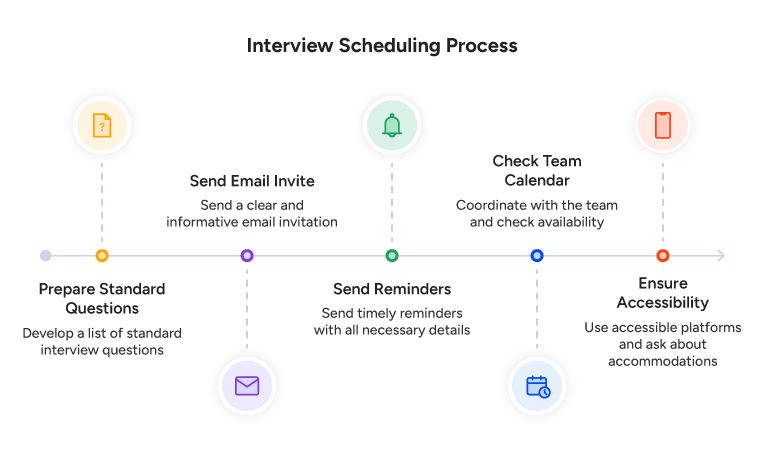
Follow this five-step process to schedule interviews effectively.
1. Prepare a List of Standard Questions in Advance
Prepare a list of standard interview questions that you want to ask the candidate. Doing this helps in conducting a fair interview. Additionally, this step can help you plan for various stages of the interview.
2. Talk to Your Team and Check the Calendar
Check candidate availability. Preferably schedule interviews on Wednesdays and Thursdays. Like you, the candidates would be busy on Mondays and are more likely to relax on Fridays. Also, check with the interview panel and team to see whether any other interviews are scheduled in the same time slots.
3. Send the Email Invite
Send the invitation mail with a clear subject line. For example, an interview for (job role) with (candidate’s name). Also, clearly mention the purpose and duration of the interview so that the candidate has a rough idea of the process. Lastly, use recruitment tools that integrate with an employee self-service (ESS) portal. Such tools allow candidates to choose a time that suits their availability.
4. Make It Easy for Everyone
Make sure the platforms used to interview candidates are accessible. Use platforms like Zoom, Microsoft Teams, or Google Meet that are screen reader-friendly. Additionally, you should ask the candidates whether they require any other accommodations, such as an office ramp.
5. Send a Reminders
Send reminders to the candidates a week before. You should make sure that the reminder also includes relevant details such as interview date, time, location, and mode. Using automated software can help you send reminders on time.
What Goes in the Email?
Don’t leave them guessing. Your email needs these things:
- Who: Candidate name and the job they applied for.
- Where and When: Date, time, and the link (Zoom/Meet) or the office address.
- Important:Put the time zone!
- Why: Tell them what the interview is for. Is it a test? Just a chat?
- The Team: Who will they talk to?
- Papers: Do they need to bring an ID or a portfolio? Tell them.
Components of an Effective Interview Schedule Template
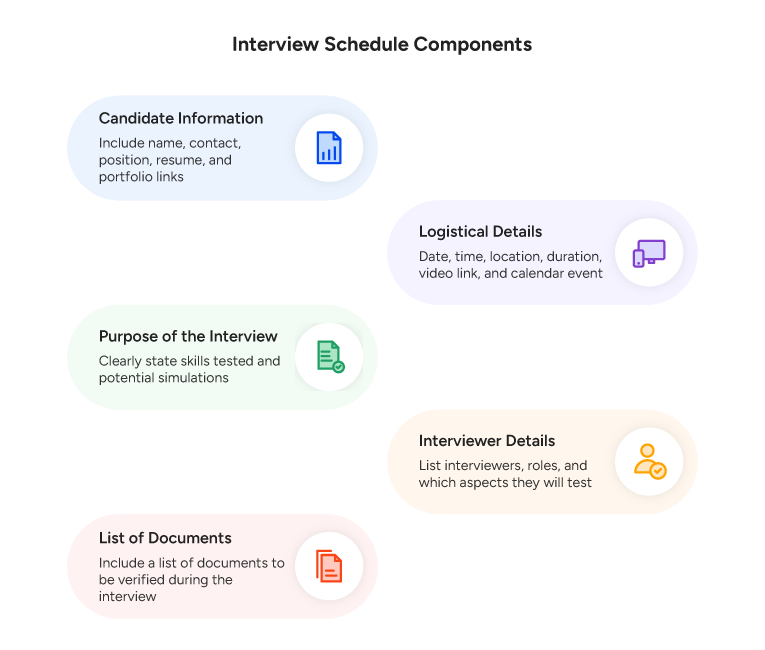
Key components of an interview schedule include candidate information, logistical details, the interview purpose, and interviewer details. You also need to include a list of documents if your organization verifies them during the interview stage.
Candidate Information
Include the candidate’s name, contact information, the position they applied for, and links to their resume and portfolio for reference.
Logistical Details
List the date and time, location, interview duration, and Zoom/Meet link. Make sure to mention relevant time zones. Include the Google map location for the physical address. Lastly, do not forget to add the event to the calendar.
Purpose of the Interview
Clearly state the purpose of the interview. For example, which skills would be tested, and whether they would include a simulation.
Details Related to Interviewers
If it’s a panel interview, list the details related to each interviewer and their role. Also, specify which interviewer will test each aspect.
List of Documents
If your firm verifies documents during the interview, include a list of relevant documents, such as a government-issued ID.
Sample Interview Schedule Templates
Here are four sample interview scheduling templates you can use based on your needs. You can use the general scheduling format to customize your emails. You can also use the one-on-one template for scheduling one-on-one interviews. For panel interviews, you need to follow a slightly different format, and using the given template will ensure that you include relevant details. Lastly, an all-day schedule is different from other schedules, so use the all-day scheduling template to generate your invitation email.
Sample 1: General Interview Schedule Format
Subject: Invitation for [Candidate Name]: [Job Title] Interview
Hi [Candidate Name],
Thanks for applying for the [Role Title] job at [Company Name]. We liked your application and want to chat with you.
Here are the details:
- Date: [Date]
- Time: [Start Time] to [End Time] [Time Zone]
- Mode: [Video / In-person]
- Link/Address: [Insert Link or Address]
If this time is bad for you, please reply with two other times that work in the next week.
Please have these ready:
- Your resume
- A photo ID
If you need help, call [Name] at [Phone Number].
Best,
[Your Name]
Sample 2: One-on-One Interview Template
Subject: Interview with Ananya for HR Executive Role
Dear Ananyah,
Thanks for speaking with us. We want to confirm your interview for the HR Executive role.
Details:
- Date: Tuesday, 18 February 2026
- Time: 11:00 AM – 11:45 AM IST
- Who: Rakesh Malhotra, Senior HR Manager
- Where: BrightPath Solutions, 3rd Floor, Sigma Towers, Bengaluru.
Please come to the reception 10 minutes early. Bring two copies of your resume and an ID.
If you need to change the time, let us know at least a day in advance.
See you soon,
Neha Iyer
Sample 3: Schedule Interview Template for Panel Interview
Subject: 2nd Round Interview with Rahul for Product Manager
Dear Rahul,
We’re pleased to invite you to the next stage of the selection process for the Product Manager role at Vertex Technologies. This round will be a panel discussion with leaders from our product, engineering, and business teams.
Interview details:
- Date: Thursday, 20 February 2026
- Time: 2:00 PM – 3:15 PM IST
- Mode: Video interview (Microsoft Teams)
- Joining link
Panel members you’ll be meeting:
- Priya Nandakumar, Head of Product (product strategy and roadmap thinking)
- Arjun Mehta, Engineering Manager (technical collaboration and feasibility)
- Kavita Rao, Director – Business Operations (stakeholder alignment and execution)
How the session will flow:
- Quick introductions and context setting
- Product case discussion
- Behavioural and situational questions
- Time for your questions
To help the panel prepare, please share the following by Thursday evening:
- Updated resume (PDF format)
- A short product case or portfolio, if you have one
Please join the meeting a few minutes early to avoid any last-minute technical issues.
For any assistance, feel free to contact:
Sonal Deshpande: Lead Talent Acquisition
Phone: +91 98990 11223
Email: sonal.deshpande@vertextech.in
Looking forward to a great discussion.
Best regards,
Sonal Deshpande
Vertex Technologies
Sample 4: All-Day Interview Schedule
Subject: Full Day Interview Schedule for Karthik
Dear Karthik,
Thank you for confirming your availability. This email outlines your full-day interview schedule for the Senior Software Engineer position at Orion Systems.
- Interview Date: Monday, 24 February 2026
Location: Orion Systems India Pvt. Ltd, 4th Floor, TechPark One,
Outer Ring Road,
Hyderabad 500081
Your interview schedule for the day:
- 10:00 AM – 10:45 AM, Technical Round I with Suresh Kumar, Lead Backend Engineer.
- Focus areas: Core Java fundamentals, problem-solving
- Location: Interview Room 4A
- 11:00 AM – 11:45 AM
- Technical Round II with Meenal Joshi, Principal Architect
- Focus areas: System design and scalability
- Location: Interview Room 4A
- 12:00 PM – 12:30 PM
- Managerial Discussion with Rohit Sharma, Engineering Manager
- Focus areas: Team collaboration, delivery ownership
- Location: Conference Room C2
- 12:30 PM – 1:15 PM
- Lunch break (hosted by Orion Systems cafeteria): 1:30 PM – 2:15 PM
- HR Discussion with Pooja Verma, Senior HR Business Partner
- Focus areas: Role alignment, expectations, compensation
- Location: HR Cabin H1
Please carry:
- Printed resume
- Government-issued photo ID
- Laptop (optional, if you prefer your own setup)
Our HR operations team will guide you between interview rooms.
Contact: Amit Patel
HR Operations
Phone: +91 97654 88990
Email: amit.patel@orionsystems.in
We look forward to meeting you and wish you the very best for the day.
Sincerely,
Pooja Verma
Senior HR Business Partner
Orion Systems India Pvt. Ltd.
Pro tip: Use ready-made templates to schedule interviews and reduce the time spent on hiring process logistics.
5 Best Tips for Scheduling in 2026
Follow these five best practices for effective interview scheduling in 2026 –
- Be Fast: 82% of people lose interest if you take too long. Reply quickly.
- Use Tools: Don’t do it all by hand. Use software to send invites.
- Have Templates Ready: Keep these emails saved so you can just click send.
- Let Them Choose: Use a portal where they can pick their own slot.
- Stay Calm: If they reschedule, it’s okay. Be patient.
Interview Scheduling: Smart, Simple, and Fast! The factoHR Way
The factoHR recruitment module allows you to schedule interviews in seconds. All you need to do is follow the given process, and you will be able to send the interview schedule to the candidate in a minute.
- Log in to your dashboard.
- Click “Recruitment > list of candidates.”
- Click “schedule interview” and fill in the required details.
- Choose Google Meet, check the invite via the link, and send it.
- Click “accept” once a candidate receives the invite, select the Google account, and grant access to schedule the interview in Google Calendar.
Both the candidate and the interviewer can access the Google Meet link via their calendars. Watch it on YouTube
FAQs
What Should I Check before Sending an Interview Invite?
Before sending an invite, prepare your cultural fit and behavioral questions and confirm your team’s availability. Always test the video link and ensure the platform is accessible to avoid technical issues during the call.
How Can I Reduce Candidate Drop-Off Rates?
To prevent candidates from dropping out, you must be fast and engaging.
- Schedule instantly using automated software.
- Respond quickly to candidate queries.
- Be flexible with rescheduling requests.
- Gather feedback to improve your hiring process.
Where Can I Find Interview Questions for Different Roles?
You can find comprehensive question banks on factoHR. We offer curated lists including:
- Interview questions for HR recruiters
- Common questions for freshers
- Technical sets like JavaScript interview questions
What are Common Interview Scheduling Mistakes?
Being slow is the worst. Other errors include failing to check internal team calendars (leading to double-booking) and forgetting to convert time zones for remote candidates.
What are the Best Tools for Video Interviews in 2026?
The five best tools for conducting interviews in 2026 are –
Top tools for seamless interviewing include:
- Zoom: Best for recording and breakout rooms.
- Microsoft Teams: Ideal for secure, internal integration.
- Google Meet: Quick, browser-based access.
- HireVue: Great for on-demand screening.
- factoHR: Best for automated scheduling. Select a candidate, click “schedule,” and it instantly syncs with Google Meet and updates everyone’s calendar.
Table of Contents
Every year on March 8, International Women’s Day is more than just a day. It reminds us: Are we just saying nice things about women, or are we helping them grow? Today, honoring women is more than just flowers and emails. It’s about creating a workplace where ambition is encouraged, leaders are developed, and every voice is heard.
HR leaders and business leaders can turn appreciation into action with fair pay, development opportunities, and supportive policies such as Maternity Leave. When women succeed, the workplace improves. But till all these actions are taken, empowerment begins with the simplest thing: the right words at the right time.
Key Takeaways:
- 130+ curated Women’s Day wishes for professional, personal, and social use
- Thoughtful messages for bosses, colleagues, friends, mothers, daughters, and sisters
- Powerful quotes from iconic women leaders and change makers
- Ready-to-use Instagram, TikTok, and LinkedIn captions
Women’s Day Wishes for Colleagues, Bosses & Employees

Great workplaces exist because people show up, lead boldly, collaborate effectively, and set the bar high for all. This section has excellent Women’s Day Wishes for the corporate world.
For Female Bosses & Mentors
- Happy Women’s Day to a leader who proves that authority and empathy can sit at the same table – and win.
- Your leadership doesn’t just inspire results; it inspires belief. Thank you for raising the bar every single day.
- You don’t break glass ceilings – you replace them with skylights. Happy Women’s Day.
- The way you lead makes ambition feel attainable, and excellence feel non-negotiable.
- Because of you, leadership looks smarter, stronger, and more inclusive.
- You’ve taught us that confidence isn’t loud – it’s consistent. Thank you for the example you set.
- The best mentors don’t create followers; they create future leaders. You’ve done exactly that.
- Your vision shapes strategy, but your integrity shapes culture. We’re better because of you.
- Watching you lead is a masterclass in resilience and grace under pressure.
- Happy Women’s Day to the kind of boss who makes success feel like a shared victory.
For Coworkers & Peers
- Happy Women’s Day to a colleague whose work ethic speaks louder than any title ever could.
- Working alongside you makes excellence feel like the standard, not the exception.
- You bring clarity to chaos and strength to every challenge – what a privilege to collaborate with you.
- Success is sweeter when it’s built with teammates like you.
- Your professionalism is matched only by your ability to uplift everyone around you.
- Thank you for being the kind of coworker who competes with herself, not with others.
- The office runs smoother and smarter because you’re in it.
- You don’t just meet expectations; you quietly exceed them.
- Every strong team has a backbone. Ours happens to be you.
- Happy Women’s Day to someone who makes the workplace sharper, kinder, and undeniably stronger.
Short & Sweet Women’s Day Wishes

Not every message needs a speech. Sometimes the most powerful Women’s Day wishes are the ones delivered in a single, confident line.
- Happy Women’s Day to a true force of nature.
- Here’s to strength, grace, and unstoppable ambition.
- You inspire more than you realize.
- Empowered women empower the world.
- Confidence looks good on you – today and every day.
- Keep leading. Keep rising. Keep shining.
- Strong. Capable. Unstoppable.
- Today, we celebrate you and everything you stand for.
- The world works better because of women like you.
- Excellence isn’t a goal for you, it’s a habit.
- Grace under pressure. Power in purpose.
- You redefine what leadership looks like.
- Bold mind. Brave heart. Brilliant future.
- Success follows women who refuse to settle.
- Here’s to breaking barriers and building legacies.
- Happy Women’s Day to someone rewriting the rules.
- Strength isn’t loud, it’s consistent, just like you.
- Keep owning your space. The world needs it.
Empowering & Inspirational Quotes by Famous Women

Before we celebrate the women in our lives, we celebrate the women who shaped history. These are not just quotes. These are reminders you can copy and paste as women’s day wishes.
- Savitribai Phule – “Sit idle no more. Go, get an education.”
- Sarojini Naidu – “We want deeper sincerity of motive, a greater courage in speech and earnestness in action.”
- Rani Lakshmibai – “I shall not surrender my Jhansi.”
- Kalpana Chawla – “The path from dreams to success does exist.”
- Indira Gandhi – “You cannot shake hands with a clenched fist.”
- Sudha Murty – “Vision without action is merely a dream.”
- Indra Nooyi – “There is no limit to what we, as women, can accomplish.”
- Mary Kom – “Never buy success; earn it.”
- Kiran Mazumdar-Shaw – “I think the perception of women in leadership roles is changing.”
- Malala Yousafzai – “I raise up my voice – not so that I can shout, but so that those without a voice can be heard.”
- Michelle Obama – “There is no limit to what we, as women, can accomplish.”
- Oprah Winfrey – “Think like a queen. A queen is not afraid to fail.”
- Frida Kahlo – “Feet, what do I need you for when I have wings to fly?”
- Eleanor Roosevelt – “No one can make you feel inferior without your consent.”
- Ruth Bader Ginsburg – “Women belong in all places where decisions are being made.”
- Amrita Pritam – “I will meet you yet again.”
- Anandibai Joshi – “I go to America to study medicine.”
- Maya Angelou – “Each time a woman stands up for herself, she stands up for all women.”
- Sheryl Sandberg – “In the future, there will be no female leaders. There will just be leaders.”
- Jacinda Ardern – “One of the criticisms I’ve faced over the years is that I’m not aggressive enough.”
- Gauri Sawant – “We want acceptance, not sympathy.”
- Greta Thunberg – “No one is too small to make a difference.”
Heartfelt Wishes for Family Members

Women’s Day is not just about women who make headlines; it is about the women who shaped us in the background.
- Happy Women’s Day to the woman whose strength inspires me every day.
- Your love and sacrifices shape my world in ways words cannot express.
- Thank you for giving me life, courage, and endless warmth.
- Everything I am comes from the love and guidance you gave me.
- You are living proof that love can move mountains.
- Because of you, I know how to keep going no matter what.
- Your resilience built the foundation of my life.
- Happy Women’s Day to the most amazing role model in my life.
- You turned everyday moments into lessons I will never forget.
- Your wisdom guides me, even when the world feels chaotic.
- Strength flows in me because it flows in you.
- You make sacrifice look effortless, and love look infinite.
- The world calls you mother, but to me, you are my hero.
- Your love may be quiet, but it is limitless.
- Happy Women’s Day to the woman who makes the impossible feel possible.
- Thank you for always choosing and believing in me.
- You are my safe place, my guide, and my inspiration.
- Every day, I am grateful for the love and lessons you give.
For Sisters
- Happy Women’s Day to my sister, my first best friend, and my forever partner in crime.
- You know all my flaws and still have my back – I am so lucky to have you.
- Life gave me a sister, but fate gave me a true powerhouse.
- Your loyalty and love speak louder than any words ever could.
- Thank you for growing up with me and always choosing me no matter what.
- You don’t compete – you shine in your own light, and it inspires me.
- We may argue, but at the end of the day, we always have each other.
- Happy Women’s Day to the woman who knows my past and believes in my future.
- You are equal parts strength, humor, and heart – and I wouldn’t trade you for anything.
- Sisters by blood, soulmates by choice.
- Your confidence brightens every room you walk into.
- You’re not just family – you are my safe place and my cheerleader.
- To the sister who makes life sweeter, stronger, and infinitely better – Happy Women’s Day.
- Thank you for being my constant, my guide, and my forever friend.
For Daughters
- Happy Women’s Day to the bright future that walks into my life every day.
- You are growing into a woman the world will admire, and I already do.
- Always know your worth and never let anyone make you doubt it.
- Your courage is already shaping a world full of possibilities.
- The world may challenge you, but it will never dim your light.
- Dream big, stand tall, and never apologize for your ambition.
- Watching you grow is watching strength, kindness, and brilliance unfold.
- You are proof that the future belongs to strong, fearless women.
- Happy Women’s Day to a girl who is destined to leave a mark.
- Rise boldly, speak clearly, and never wait for permission.
- Your voice matters – use it proudly and without fear.
- I don’t just see your potential – I see your inevitable greatness.
- Keep believing in yourself; you are more powerful than you know.
- To my daughter, my pride, my inspiration – Happy Women’s Day.
- Every step you take makes me prouder than words can express.
Uplifting Messages for Friends & “Galentines”

Sisterhood among women is not sweet; it is smart. It is laughter in the midst of strife. It is support in times of struggle. Here are some Women’s Day wishes for your best friends:
- Happy Women’s Day to the friend who cheers the loudest when I win.
- You don’t compete – you lift me higher every single day.
- We laugh harder, dream bigger, and get through anything together.
- Thanks for being my reality check, my hype squad, and my safe space.
- Behind every unstoppable woman is a friend like you.
- You turn my messes into lessons and my tears into laughter.
- Happy Women’s Day to the queen of my heart and my sanity.
- You prove that the chosen family is the strongest kind.
- We don’t just share moments – we share strength.
- Your drive inspires me, and I’m lucky to ride it with you.
- Friends like us make everything feel possible.
- You fix my crown without ever making a fuss.
- Here’s to the friend who texts “You got this” before anyone else even notices.
- You are calm in chaos, and fierce when needed – always.
- Happy Women’s Day to my partner in fun, mischief, and dreams.
- Together, we don’t just get by – we crush it.
- Real queens lift each other and take over the world side by side.
- Life is brighter, wilder, and better with you in it.
Ready-to-Use Social Media Captions
Below are Women’s Day wishes or captions, tailored separately for Instagram/TikTok and LinkedIn. Short, punchy, and confident for the first; longer, career-focused, and thought-leadership-driven for the latter.
Instagram & Tiktok Captions
- “She believed she could… so she did. 💪 #IWD2026 #WomenEmpowerment”
- “Queens don’t compete – they empower. 👑 #HappyWomensDay #IWD2026”
- “Not just surviving, thriving. 🌟 #WomenPower #IWD2026”
- “Empowered women empower the world. ✨ #WomensDay2026 #GirlBoss”
- “Breaking ceilings, building dreams. ❤ #IWD2026 #WomenLeadership”
- “Slaying every stereotype, one day at a time. 🔥 #HappyWomensDay #WomenInCharge”
- “Self-made. Fearless. Unstoppable. 💜 #WomensDay2026 #SheLeads”
- “Celebrating strength, style, and unstoppable ambition. 💃 #IWD2026 #WomenPower”
- “Strong women, stronger world. 🌍 #HappyWomensDay #WomenEmpowerment”
- “Here’s to being bold, brilliant, and unapologetically you. 💫 #WomensDay2026 #BossLady”
- “Courage looks good on you. Rock it today and every day. 💪 #IWD2026 #SheInspires”
- “Women making history in real-time. ⚡ #HappyWomensDay #WomenWhoLead”
- “Cheers to ambition that can’t be boxed. 🥂 #WomensDay2026 #PowerfulWomen”
- “Glasses raised to resilience, brilliance, and unstoppable energy. ✨ #IWD2026 #WomenRock”
- “Not waiting for permission, creating opportunities. 🔑 #HappyWomensDay #SheLeads”
Linkedin Captions
1. I once asked a woman I admire how she handles failure.
She said, “I don’t wait for permission to rise again.”
Today, on Women’s Day, I’m reminded that success isn’t about luck – it’s about resilience, consistency, and refusing to let anyone define your limits.
To the women doing it every day, I see you, I respect you, and I learn from you.
#IWD2026 #WomenWhoLead #Resilience
2.Early in my career, a female mentor told me, “Leadership isn’t about being the loudest in the room – it’s about moving others forward.”
That advice shaped every team I’ve built.
This Women’s Day, I celebrate women who lead with clarity, courage, and care – whether in the boardroom, in startups, or in their communities.
#HappyWomensDay #WomenInBusiness #LeadershipMatters
3. I watched a young woman pitch an idea, get shut down, and then come back the next day stronger. That’s Women’s Day in action – every day.
It’s grit, it’s brilliance, it’s showing up when no one is watching.
To all the women building, leading, and creating impact quietly and loudly: you change the game.
#IWD2026 #WomenEmpowerment #Impact
Conclusion
As March 8th approaches, it’s easy to celebrate with women’s day wishes and flowers, but empowerment isn’t something that can be contained within one day of the year. In every boardroom, team meeting, and mentorship speech, women should be acknowledged, given opportunities, and supported.
HR professionals and colleagues are part of a team that builds a culture of ambition and listens to the voices of women. Today’s appreciation should turn into tomorrow’s action. When companies focus on fairness, mentoring, and a clear path to leadership every day of the year, they aren’t just celebrating women; they are making every part of the business better.
You might want to check out These:
Table of Contents
Key Takeaway:
- This article explains the meaning and full form of LWD (Last Working Day) and its significance in a job.
- It explains the differences between LWD from the resignation date and the relieving date, outlining how each fits into the notice period and the overall exit process.
- Describes how LWD is calculated, taking into account standard notice periods, early release, buyouts, and adjustments for leave.
- Highlights the importance of LWD for employees (final settlements, experience, and relieving letters) and employers (asset recovery, IT access, payroll closure).
- Provides examples of various notice period scenarios and how they affect the LWD.
- Offers a practical checklist of tasks to complete on the last working day, including handover, asset return, exit interview, data wipe, and farewell email.
What does LWD Mean in a Job?
LWD (Last Working Day) is the final date an employee officially works for a company. It is usually determined by the notice period after a resignation or termination. It marks the end of salary and benefits, completion of handovers, and the official exit from the organization. In remote setups, it may also refer to the employee’s final day of virtual work after the notice period ends.
LWD vs Resignation and Relieving
- Resignation date is when the employee submits their resignation; LWD is when the employee actually stops working after serving the applicable notice period.
- In some companies, LWD and the relieving date are the same. In others, the relieving letter is issued only after all exit formalities and clearances are completed, following the LWD.
How is LWD Determined?
The Last Working Day (LWD) is usually the official date on which your employment ends. It is calculated by adding the contractual notice period to the date your resignation letter is accepted or becomes effective, unless there is an agreed-upon change. This can be an early release, buyout, or immediate termination.
Standard LWD Calculation
In many companies, LWD is determined by:
- Taking the resignation acceptance/effective date.
- Adding the applicable notice period (for example, 30, 60, or 90 days).
Example:
- Resignation submitted/accepted: 1 April 2025
- Notice period: 30 days
- LWD: 30 April 2025 (assuming policy defines notice as calendar days from that date).
Early Release and Buyout
Some organizations allow the LWD to be earlier than the full notice period if:
- Buyout: The employee pays (or has deducted) salary equivalent to the unserved portion of the notice period, and the employer agrees to release early.
- Mutual agreement: Manager/HR and the employee agree on an earlier LWD, sometimes to match the employee’s joining date with a new employer or to meet business needs.
In these cases, the revised, mutually agreed date becomes the LWD, not the date obtained by the full notice formula.
Termination and Immediate LWD
When the employer terminates the employee (for performance, redundancy, misconduct, etc.), the LWD is typically:
- The termination effective date stated in the termination letter, which can be “with immediate effect” (same day) or after a shorter/longer notice, depending on the contract and applicable law.
- If the employer pays the employee instead of requiring them to serve notice, the LWD remains the official last day, even if the employee doesn’t work after the termination effective date.
Garden Leave/Forced Leave
In sensitive or high‑security roles, employers may:
- Ask the employee not to attend the workplace or limit system access during the notice period (garden leave), while keeping them on payroll.
- In such cases, the LWD remains the contractual last day of employment (end of the notice period or the agreed date), not the last day in the office.
LWD vs. Resignation Date: What is the Difference?
LWD (Last Working Day) and Resignation Date are not the same:
| Aspect | Resignation Date | Last Working Day (LWD) |
|---|---|---|
| Definition | The date on which an employee formally submits their resignation letter to the employer. | The final date on which the employee actually works for the company. |
| Purpose | Starts the resignation and notice-period process. | Marks the end of employment and completion of notice period. |
| Who Decides It? | Employee | Employer+Employee(based on notice period, policy, or agreement). |
| Timing | Always before or on the LWD. | Always after or equal to the resignation date. |
| Exit Formalities | Triggers handover and HR processes. | Indicates completion of all exit tasks. |
| Example | Resigned on 1st April. | With a 60-day notice, LWD becomes 31st May. |
Companies use LWD for final salary, benefits like PF, and an experience letter. Resignation Date alone does not trigger payouts or formal relief.
How is LWD Calculated?
LWD, or Last Working Day, is calculated by adding the required notice period to the date the employer accepts the resignation.
Standard Formula
LWD = Resignation Acceptance Date + Notice Period Duration (in days)
This duration allows for proper handover and transfer of responsibilities, typically including weekends, unless otherwise specified in the policy.
Factors Influencing LWD
- Company Policy: Standard notice periods are typically 30, 60, or 90 days.
- Leave Balance: Employees may use Privilege Leave (PL) or other accrued leave to reduce the number of working days during notice, if allowed.
- Notice Period Buyout: Employees may compensate the company (or have their new employer do so) to leave before the required notice period.
- Managerial Discretion: An early release may be approved if the employee completes knowledge transfer (KT) and other formalities, such as exit interviews, before the scheduled date.
Example 1: 30-Day Notice Period
Resignation accepted: 1 July 2025
Notice period: 30 days
LWD: 30 July 2025
Example 2: 60-Day Notice Period
Resignation accepted: 15 January 2025
Notice period: 60 days
LWD: 16 March 2025
Counting logic: Start on 15 January, include all calendar days (including weekends/holidays), and the 60th day is 16 March.
Example 3: Early Release/Notice Buyout
- Policy notice period: 60 days
- Employee serves 30 days + buys out the remaining 30 days
- LWD becomes the 30th day, not the 60th.
Important Notes
- Weekends and holidays are usually included in the notice period unless company policy specifies otherwise.
- Always check your appointment letter or HR policy, as rules may differ by organization.
- Using leave or buyout options can adjust the LWD but may affect the timing of the F&F (Full and Final) settlement.
Why is LWD Important?
The Last Working Day (LWD) is important because it marks the official end of employment and helps both the employee and employer complete all exit-related tasks smoothly and correctly.
For the Employee
- LWD sets the Full and Final Settlement payout date, covering dues like unpaid salary and benefits.
- New employers require Experience and Relieving Letters dated to this day for verification.
- It directly impacts the joining date at the following organization, serving as proof of the prior employment end date.
For the Employer
- LWD acts as the deadline for recovering assets such as laptops and ID cards.
- It sets the timeline for restricting IT access and complete security handovers.
- Payroll processing cuts off on this date, enabling accurate final calculations.
Notice Period vs Last Working Day Examples
The examples below demonstrate common situations.
| Scenario | Resignation Date | Notice Period | Last Working Day | Notes |
|---|---|---|---|---|
| Standard Notice Period | 1st May | 30 days | 31st May | Full notice period served; LWD is the end of the notice period. |
| Extended Notice | 1st April | 60 days | 31st May | Longer contract-based notice period. |
| Extended Notice | 15th March | 90 days | 13th June | Longer contract-based notice period. |
| Shortened/Mutual Notice Period | 5th March | 15 days | 20th March | Notice period reduced by mutual agreement. |
| Partial notice served | 1st June | 45 days (employee serves 30 days, paid leave 15 days) | 15th July | A combination of worked and leave-adjusted notice. |
| Notice period waived (by employer) | 1st July | 60 days (employee serves 30 days, waived 30 days) | 31st July | LWD is set at 30 days; the remaining notice period is waived. |
| Compensated notice (buyout) | 10th June | 30 days | 10th June | Employee leaves immediately, pays/adjusts for notice. |
The LWD Checklist: What to do on Your Last Day
Handover
Prepare a detailed summary of ongoing tasks and important contacts. Make sure all tasks, responsibilities, and projects are properly assigned and that no pending work is left unassigned.
Asset Return
Return all company assets, including laptops, ID cards, access cards, and devices. Double-check for any personal belongings left behind. Get acknowledgement receipts from HR or IT.
Exit Interview
Be honest and professional when sharing your experience and feedback constructively, and discuss future opportunities or concerns respectfully.
Data Wipe
Backup personal files from company devices if allowed. Securely delete any sensitive or proprietary organization information from your devices following the IT guidelines. Verify completion of the data wipe with the IT department.
Farewell Email
Write a courteous farewell email to your colleagues and express gratitude for their support and shared experiences.
Conclusion
The Last Working Day (LWD) is an important milestone in an employee’s professional journey, as it marks the official end of their tenure with the company. It differs from the resignation date and is influenced by notice periods, company policies, leave balances, and early-release agreements.
Having a clear understanding of LWD helps ensure that exit formalities are completed on time, final settlements are accurate, and responsibilities are handed over smoothly. Proper planning and adherence to LWD guidelines help both employees and employers maintain professional closure, safeguard company assets, and ensure seamless transitions to new opportunities.
People Also Ask
Can My LWD be Changed after Resignation?
Yes, your LWD can be changed after resignation with mutual agreement between you and HR/management. Changes depend on the notice period, the completion of handover, and company policies.
Is LWD the Same as the Relieving Date?
No, LWD (Last Working Day) is your final day at work, while the Relieving Date is when the company officially relieves you, often after exit formalities. They can be the same or different depending on the company processes.
Can I Take Leave on My LWD?
You cannot take leave on your LWD, as it is the day you are officially relieved from duties. If needed, you must obtain explicit approval from your manager, as per company policy.
Is a 30-Day Notice Mandatory?
A 30-day notice is common but not always mandatory; it depends on your employment contract and company policy.
Table of Contents
Growth is not just about increasing revenue. It is about improving how teams work, how leaders guide, and how systems support performance.
Organizational Development (OD) interventions focus on these improvements. They provide structured ways to solve workplace challenges and build stronger foundations for long-term success.
What You’ll Learn
- Understand what OD interventions are and why they matter
- Learn the main types of OD interventions and when to use them
- Follow the step-by-step organizational development intervention process
- Explore practical workplace examples
- Identify common challenges, mistakes, and key benefits
What are OD Interventions?
Organizational Development (OD) interventions are planned and structured efforts designed to improve how an organization functions. They focus on strengthening performance, improving workplace systems, and supporting a healthy work environment.
These interventions address specific areas such as team effectiveness, organizational structure, communication, and culture. Usually guided by HR or leadership, they aim to solve workplace issues and help the organization adapt to change in a more organized and effective way.
Why OD Interventions Matter for Your Organization
Have you noticed how small workplace issues slowly turn into bigger problems? Deadlines get missed, teams communicate less, and work quality becomes inconsistent.
At the same time, markets change quickly, and employee expectations continue to rise. What worked in the past may not work today. If your organization does not adjust, these small issues can start affecting overall results.
This is where organizational development interventions make a difference.
- When daily work feels slow or confusing, they improve processes and clearly define roles and responsibilities.
- When teams struggle to work together, they improve communication and rebuild trust.
- When customer service becomes uneven, they help people and systems work in better coordination.
- During company growth or major changes, they provide clear direction and reduce confusion.
By fixing these issues early, your organization prevents bigger problems later. Instead of reacting to challenges, you handle them at the right time. As a result, teams work better together, leaders make better decisions, and overall performance improves.
Types of Interventions in Organizational Development
OD interventions are chosen based on the type of problem and the level of change required. Each type focuses on specific workplace challenges and involves different parts of the organization to make the change successful.
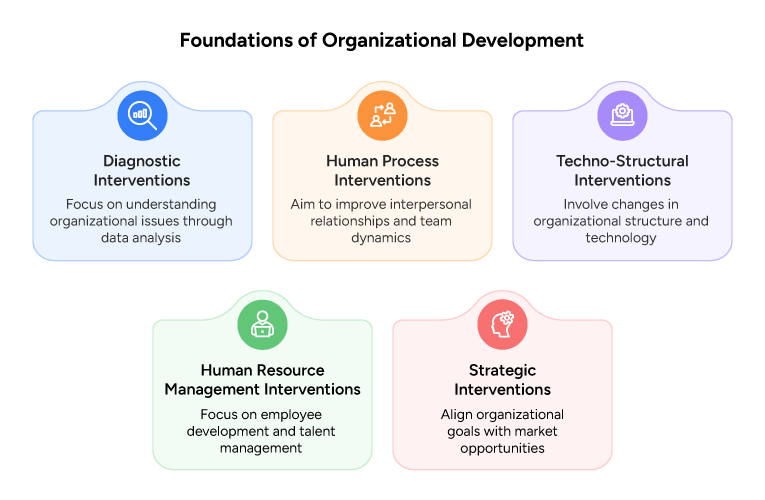
Diagnostic Interventions
These practices help identify problems before decision-makers implement a more specific solution. Organizations can identify the problem by collecting data, gathering employee feedback, and analyzing performance gaps.
Human Process Interventions
These interventions improve how employees work together and provide support where gaps exist. They strengthen communication, trust, collaboration, and conflict resolution within and across teams.
Techno-Structural Interventions
These interventions improve organizational structure and workflows. They simplify tasks and remove delays. A customer service team might restructure from individual case handling to pod-based teams where specialists collaborate on complex issues, improving resolution speed.
Human Resource Management Interventions
Organizations use these efforts to help employees perform their best and get the support they need. This may include setting up performance systems to track results and helping employees build skills for new responsibilities.
Strategic Interventions
Strategic interventions are used when a company goes through big changes like a merger or restructuring. Leaders may update HR policies and explain new rules so everyone understands what to do. For example, when two companies merge, leaders create a shared plan and common goals so employees can work together smoothly.
OD Intervention Process (How It Actually Works)
Understanding the types is important, but knowing how the process unfolds in practice matters even more. Organizational development interventions follow a practical step-by-step process.

Identifying Organizational Problems
The process begins by identifying gaps in performance, communication, or teamwork. These gaps often show up as rising absenteeism, declining engagement, missed deadlines, or inconsistent results. Organizations can use human resources analytics to spot these patterns early and identify where improvement is needed.
Diagnosing the Issue
After identifying the problem, leadership examines the root cause. This may involve employee discussions, surveys, or reviewing performance data to see what is actually going wrong.
Planning the Intervention
Next, leaders create a practical action plan that defines what will change, who will participate, and the expected outcomes.
Implementing the Intervention
In this step, teams implement the planned solution. This could include training sessions, process changes, leadership involvement, or structural adjustments.
Evaluating Results and Feedback
Finally, the team reviews the results to see what worked and what needs improvement. They also gather employee feedback through the employee self-service portal to check if any further changes are needed.
10 Examples of OD Interventions in the Workplace
Organizational development interventions are applied at various stages and levels within an organization. Here are some real workplace examples:
1. Team-Building Programs
Companies use team-building programs when a team struggles to perform or work well together. As part of a Core HR initiative, workshops can improve communication, build trust, and clarify roles instead of blaming individuals.
2. Leadership Development Programs
When managers struggle to guide their teams, organizations provide leadership training. This helps them handle conflict, give feedback, and set clear expectations, leading to better direction and accountability.
3. Performance Management System Improvement
Unclear or unfair performance reviews often demotivate employees and reduce engagement. A structured Performance Management System helps solve this issue by creating clarity, transparency, and continuous communication.
4. Job Redesign and Role Clarity
When roles and responsibilities are not clearly defined, employees may feel confused about who is responsible for what. For example, if two employees prepare the same report, it wastes time, reduces productivity, and creates unnecessary confusion.
5. Training and Skill Development Programs
When new tools or systems are introduced, employees who are used to old methods may resist change. An Employee Skill Development Program that includes hands-on training sessions helps employees learn new tools and understand their benefits.
6. Culture Change Initiatives
As companies grow, workplace culture can become inconsistent across teams. To support long-term culture change, organizations can also improve hiring practices by using well-designed cultural-fit interview questions to select candidates who align with the company’s values.
7. Change Management during Growth or Restructuring
When a company goes through a merger or restructuring, employees may feel unsure about their future. Leaders should clearly explain what is happening and how it affects each team. Regular and honest communication helps employees feel secure and supports a smooth transition.
8. Intergroup Relations Interventions
Intergroup relations interventions are used when there are problems between teams. For example, sales and operations teams may blame each other when work is not completed on time. Managers can bring both teams together for a guided discussion.
9. Large-Group Interventions
Sometimes leaders involve everyone in the company to solve problems. They may hold a company meeting to gather ideas on how to improve customer service. When employees share their ideas, they feel more involved and responsible for the results.
10. Work Design Interventions
If employees spend too much time doing the same tasks again and again, the company may need to change how the work is done. For example, using automation for manual data entry saves time and reduces errors.
Organizations can also use AI in Performance Management to track goals, measure results, and give real-time feedback.
Role of HR in OD Interventions
- HR looks at performance trends and feedback, along with absenteeism and conflict patterns, to understand where improvements are needed.
- They collect and analyze data through employee mood surveys, team discussions, and workforce reports to identify the root causes of workplace challenges.
- HR tracks results and makes changes if the intervention is not delivering the expected outcomes.
- In collaboration with leaders and stakeholders, HR plays a key role in employee training and development by planning and implementing training programs.
Benefits of OD Interventions
- Reduced Employee Turnover: When people feel supported and see real chances to grow, they are less likely to look for opportunities elsewhere.
- Lower Absenteeism and Fewer Conflicts: Clear roles and open communication prevent misunderstandings from escalating into major issues.
- Better and Faster Decisions: When responsibilities are clear, and leaders have the right information, decision-making improves with less back-and-forth.
- Improved Productivity: Simple processes and better coordination help teams complete tasks on time.
- Better Customer Service: Aligned teams deliver more consistent and reliable service.
- Stronger leaders: Leadership training prepares future managers and reduces dependence on only a few people.
- Better results from HR efforts: Training programs, performance systems, and policy improvements generate measurable outcomes instead of becoming routine formalities.
Challenges in Implementing OD Interventions
Even well-planned workplace improvements can face these obstacles:
- Resistance to Change: Employees often feel comfortable with familiar routines. When new systems or processes are introduced, uncertainty leads to hesitation. If previous changes were poorly handled, hesitation becomes stronger.
- Lack of Leadership Support: OD needs strong leadership support. If leaders do not clearly explain or follow the change, employees may not take it seriously.
- Poor Communication: If the change is not explained clearly, employees may feel confused. They may not understand what to do, when it will happen, or what the expected results are.
- Limited Time and Resources: Daily work often becomes the priority. When there is not enough time or support, improvement efforts may slow down or lose focus.
- Low Employee Trust: If employees think the change is only temporary or just for show, they may stop taking it seriously.
- Difficulty Measuring Results: Some improvements, like better teamwork or higher morale, do not show quick results. This makes it harder to see if the change is working.
Mistakes to Avoid in OD Interventions
- Not Finding the Real Problem: If you don’t understand the main issue, the solution won’t work.
- Not Involving Employees in the Process: When employees are not involved in the process, they are less likely to support the change.
- Thinking of OD as a One-Time Task: One workshop or policy update cannot bring permanent change. Real change needs continuous effort and follow-up.
- Using the Same Plan for Everyone: Different departments have different needs. A single approach may not work for everyone.
- Ignoring Employee Feedback: When people speak up, and no action is taken, trust goes down.
- Expecting Fast Results: Real improvement takes time. Change does not happen quickly.
Conclusion
Organizational development interventions deliver results when they are implemented correctly. They’re not quick fixes or one-off workshops; they’re ongoing efforts that actually last when organizations involve their people and follow through.
They build the kind of workplace where people enjoy working, contributing, and growing. And that’s what keeps organizations moving forward.
Frequently Asked Questions
Who Implements OD Interventions in an Organization?
OD interventions are mainly handled by the HR team, along with senior leaders and managers. Sometimes, companies also involve external consultants for expert advice.
Are OD Interventions Only for Large Companies?
No. Organizations of all sizes can use OD interventions. Small and mid-sized companies often apply them to improve structure, communication, and growth planning.
How Long does an OD Intervention Take?
The duration depends on the issue. Some interventions, like training programs, may take a few weeks. Larger changes, such as culture or structure updates, may take several months.
Can OD Interventions Reduce Workplace Conflicts?
Yes. Interventions such as team-building sessions, clear role definition, and improved communication processes can significantly reduce misunderstandings and recurring conflicts.
How Often Should OD Interventions be Reviewed or Updated?
They should be reviewed regularly based on performance results and employee feedback. Continuous review ensures they stay useful and effective.
Table of Contents
Most teams struggle because responsibility lives in their heads rather than being on paper in a concrete form. This is where the RACI matrix quietly helps the most.
In essence, an RACI matrix clarifies who is Responsible, Accountable, Consulted, and Informed for a specific task. But, in real environments, it does more than define roles.
The RACI matrix reduces friction and feedback loops. The ‘I thought you were handling it’ moments come down to zero, and don’t slow down the team anymore.
This guide about the RACI matrix is for HRs, project managers, and cross-team operations who need to work without constantly following up. We will show you how to apply RACI in real scenarios, when it should be used, and how simple templates can clear confusion about transparent ownership.
Key Takeaways
- RACI matrix clarifies the role of everyone in a task and shows who’s accountable.
- It helps HR and Project teams become focused, avoid overlapping tasks, and speed up approvals.
- You will know what the RACI Matrix Full form is and what it means in practice.
- Real HR examples to showcase real-world use of the RACI matrix
- A simple step-by-step guide to building an impactful RACI matrix
- Ready to use RACI templates without starting from scratch
- See how RACI fits into modern, fast-moving workflows
What is an RACI Matrix?
An RACI matrix is a well-articulated framework to define who is responsible, accountable, consulted, and informed for each task or decision. It makes responsibility visible. Who does the work, who owns a decision, who needs an opinion, and who should be updated is all crystal clear. For HR and business teams where unclear ownership is a frequent issue, the RACI matrix creates smooth work processes and faster execution.
Free RACI Templates You Can Use
- RACI Template for HR Projects
| Purpose: Define responsibilities for HR projects (e.g., recruitment drives, policy rollouts, HR system implementation). Ensures ownership, accountability, and communication clarity. | |||||||
| Task / Activity | HR Manager | HR Ops | Recruitment Team | Payroll Team | Finance | IT | Explanation |
|---|---|---|---|---|---|---|---|
| Project kickoff & timeline creation | Accountable | Responsible | Consulted | Informed | Informed | Informed | HR Manager owns the project goals, HR Ops executes timeline planning, Recruitment/Finance/IT provide input or are updated. |
| Define project objectives & deliverables | Accountable | Responsible | Consulted | Informed | Consulted | Informed | HR Manager approves objectives, HR Ops drafts details, others provide feedback or are kept in the loop. |
| Resource allocation (budget & staff) | Accountable | Responsible | Consulted | Consulted | Consulted | Informed | HR Manager ensures resources meet needs; HR Ops executes allocation; Finance validates budget. |
| Stakeholder consultation & sign-offs | Accountable | Responsible | Consulted | Informed | Consulted | Informed | HR Manager approves, HR Ops coordinates meetings; other teams consulted for input. |
| Execution & monitoring of HR tasks | Responsible | Accountable | Consulted | Informed | Informed | Informed | HR Ops executes tasks; HR Manager monitors progress and ensures accountability. |
| Final project review & reporting | Accountable | Responsible | Informed | Informed | Consulted | Informed | HR Manager signs off; HR Ops prepares reports; Finance validates numbers if budget impacted. |
- RACI Template for Employee Onboarding
| Purpose: Assign clear ownership for every step of employee onboarding, from documentation to orientation and IT setup. | |||||||
| Task / Activity | HR Manager | HR Ops | IT | Hiring Manager | Payroll | New Employee | Explanation |
|---|---|---|---|---|---|---|---|
| Collect employment documents | Accountable | Responsible | Informed | Informed | Informed | Responsible | HR Manager ensures all documents are requested; HR Ops collects and verifies; employee submits documents; IT/Payroll are updated. |
| System access setup (email, ERP, LMS) | Informed | Consulted | Responsible | Informed | Informed | Informed | IT executes system setup; HR Ops ensures approvals; managers and employees are informed. |
| Orientation scheduling | Accountable | Responsible | Informed | Consulted | Informed | Informed | HR Manager approves schedule; HR Ops organizes sessions; manager consulted for timing; employee informed. |
| Training session enrollment | Responsible | Accountable | Informed | Consulted | Informed | Informed | HR Ops ensures employee attends sessions; HR Manager tracks compliance; manager consulted for role-specific training. |
| Policy acknowledgment tracking | Accountable | Responsible | Informed | Informed | Consulted | Responsible | HR Manager oversees; HR Ops tracks; payroll and IT informed; employee signs off policies. |
| First week check-in & feedback | Accountable | Responsible | Informed | Responsible | Informed | Informed | HR Manager monitors onboarding success; HR Ops coordinates; Hiring Manager provides feedback on employee integration. |
- RACI Template for Payroll Tasks
| Purpose: Assign responsibilities for payroll processing, approvals, compliance, and reporting to avoid errors and delays. | ||||||
| Task / Activity | Payroll Manager | HR Ops | Finance | IT | Employees | Explanation |
|---|---|---|---|---|---|---|
| Salary calculation | Accountable | Responsible | Consulted | Informed | Informed | Payroll Manager owns calculations; HR Ops executes; Finance validates deductions; IT/Employees informed. |
| Payroll approval | Accountable | Informed | Responsible | Informed | Informed | Payroll Manager signs off; Finance approves payments; HR Ops/IT/Employees informed. |
| Tax deduction & statutory compliance | Accountable | Consulted | Responsible | Informed | Informed | Payroll Manager ensures compliance; Finance executes tax deposits; HR Ops consulted; IT/Employees informed. |
| Payroll disbursement | Accountable | Responsible | Consulted | Informed | Informed | Payroll Manager owns; HR Ops executes; Finance reviews; IT/Employees informed. |
| Payroll reporting | Accountable | Responsible | Consulted | Informed | Informed | Payroll Manager approves; HR Ops prepares reports; Finance validates; IT/Employees informed. |
| Employee payroll queries | Responsible | Consulted | Informed | Informed | Accountable | HR Ops handles questions; Payroll/Finance provide guidance; Employee’s query is closed with accountability to employee experience. |
The 4 Core Roles of RACI Explained
An RACI matrix works because it breaks down roles into four easy-to-follow roles. Each role now answers a different question. Together, it becomes a responsibility matrix that removes the gray areas and helps teams pivot toward their goals.
Responsible (the Doers)
Responsible means the person or the team that actually executes the task. There can be multiple responsible parties for a single project. This is similar to how HR and payroll responsibilities are divided in most companies.
It answers: Who is doing the work?
Accountable (the Owners)
Accountable refers to the single owner of the outcome. This role makes sure that the tasks are completed correctly and on time. In a RACI matrix template, there should always be one and only one accountable role assigned.
It answers: Who is ultimately the person accountable for a task?
Consulted (the Advisors)
Consultation refers to the stakeholders of a project. These stakeholders are supposed to provide input before the process moves forward. In an RACI chart template, they provide their expertise and validation but do not necessarily execute a task.
This role answers: Who needs to be asked before we decide?
Informed (the Followers)
Informed refers to the stakeholders who merely need updates but are not involved in a task. They are updated after decisions are made or major checkpoints are crossed.
This role answers: who needs to know that something happened?
Cohesively, these four roles make the RACI matrix full form much more than a definition. They turn it into a practical responsibility mantra that teams can depend on.
How to Create a RACI Matrix: Step-By-Step Guide
You don’t need complex tools or a heavy project management ideology to create an RACI matrix. If you have basic structured thinking and can align roles, it is quite effortless to do. Let’s see a practical way to build a RACI chart that is actually useful.
List all Tasks and Deliverables
Be specific and start writing all minor tasks, activities, or decisions involved in a task. Don’t write broad items like ‘employee onboarding’. Break it into realistic minor steps like document collection, HR document management, system setup, and induction. A detailed task list reflects the work that truly happens, and not a scattered plan of action.
Define the Team Roles Involved
Identify the roles involved in the process. Not individuals, but roles, so ownership is never missed. This way, if people change, your responsibility matrix template can become adaptable. For example, in HR workflows, the roles could look like: HRops, Payroll manager, IT, Finance, or Vendors.
Assign R, A, C, and I to each Task
For every task, assign each role to an individual. Define who is Responsible, Accountable, Consulted, and Informed. The most important rule is that each task should have an accountable role. This way, you have ownership, execution, expertise, and visibility on one page.
Review and Validate with Stakeholders
A RACI chart should never be created without a stakeholder context. Get the matrix checked by important stakeholders so expectations and reality are not left unchecked. Any conflicts that arise early can be resolved. What matters most is that you have real authority and decisions, rather than misguided assumptions.
Update and Iterate over Time
A RACI matrix is not a one-time document. The way teams can scale, roles can evolve, and processes can change, your matrix should be updated with each modification. Your RACI matrix sample should be a living document that grows with your team.
RACI Matrix Example: Marketing Campaign Launch
| Task / Activity | Marketing Manager | Head of Marketing | Content Team | Design Team | Sales Team |
|---|---|---|---|---|---|
| Campaign brief & goals | Responsible | Accountable | Consulted | Informed | Consulted |
| Messaging & content creation | Accountable | Informed | Responsible | Consulted | Consulted |
| Design creatives | Informed | Informed | Consulted | Responsible | Informed |
| Review & approval | Responsible | Accountable | Consulted | Consulted | Informed |
| Campaign launch | Responsible | Informed | Consulted | Informed | Informed |
| Performance tracking & reporting | Responsible | Accountable | Consulted | Informed | Consulted |
Why does this Work 100%?
- The Marketing Manager is the one responsible for executing and coordinating tasks.
- The Head of Marketing is accountable for results, task priorities, and final approvals.
- Content and Design would always focus on execution, rather than finalizing details.
- Sales is always consulted where market input matters; they do not execute any task.
When done correctly, an RACI matrix turns the most complex teams and projects into visible plans. No more confusion, plain smart work.
When HR Needs a RACI Matrix
HRs need to use an RACI matrix whenever work slows down due to vaguely assigned responsibilities. Which signals should you watch out for?
- When tasks start getting overlooked (use RACI to assign responsibility to get things done)
- When approvals take too long (use RACI to clear who has the final say, so there are no approval delays)
- When too many people are involved, or you notice recruitment challenges (use RACI to define specific roles so there is no disorder)
- When HR depends on managers or other teams (use RACI to set clear expectations)
- When the same issues repeat every cycle (use RACI to pinpoint missing and unclear ownership in the process)
- When communication feels messy (Use RACI so your team can share the right info with the right people)
- When teams grow, or processes change (RACI keeps roles clear even as work becomes more complex.)
RACI is also often seen to be useful in training and development processes, where HR, managers, and employees all share ownership in different stages. In short, if HR work feels unclear, slow, or dependent on assumptions, a RACI matrix is the simplest way to restore clarity and control.
Benefits of Using RACI in HR & Projects
Using the RACI matrix in daily operations across teams can render your team inherently more powerful and comfortable with its pace. Let’s see a few evident benefits:
Eliminates Confusion and Overlap
A RACI matrix helps in identifying ownership of tasks in a structured way, eliminating confusion and overlap. Teams can identify who exactly is doing the work and who is accountable for the results.
Increases Accountability
With a single owner assigned, there are no delays in decision-making and approval. This increases the accountability of the HR and project teams, where you will also see a difference in the employee turnover ratio.
Improves Efficiency in Workflows
This matrix increases the efficiency of the workflows (especially when linked with Best HR administration practices) by eliminating the need for follow-ups and rework. Projects move ahead at a faster pace as the roles are established from the beginning.
Elevates Communication
The RACI chart template clarifies who should be consulted or updated. This eliminates unnecessary meetings while keeping the right people informed.
Optimizes Resource Allocation
The responsibility matrix template helps in identifying where efforts are concentrated and where support is required. This helps to plan and organize the HR and project teams.
RACI in Modern HR Tech & Agile Environments
RACI works, but not the way it used to. RACI earlier was a fixed paper document. Defined once, shared with the team, and rarely reopened. This approach is reasonable when processes were slow and teams were disciplined.
Modern HR is vastly different. Today, work is done through tools, workflows, and cross-functional teams. It becomes a tool for clarity rather than micro-management.
Here’s how RACI supports modern HR today:
- Resolves ownership issues in HR systems. RACI ensures that approvals, workflows, and task ownership are properly aligned in HR technology platforms.
- Decision-makers are identified without slowing down the process, so that teams understand who is responsible for the result, even when work is done at a rapid pace.
- Reduces HR dependency by specifying what managers and leaders are responsible for.
- Improves teamwork by clearly specifying roles. There are no delays due to misunderstandings or misalignment.
- Keeps communication on track. The stakeholders are updated and ensure visibility without getting involved.
RACI works best when:
- Processes involve multiple stakeholders
- Decisions and approvals are important.
- Protocols and accountability are required.
Teams need to adapt the RACI matrix when:
- Work is experimental or changing frequently
- Roles are adaptable or temporary.
RACI isn’t automatically a control mechanism or a tool for rigidity. It is about making responsibility visible and clear, so work moves at an enhanced pace.
Managing RACI More Easily with factoHR Project Management Tool
The simplest part is creating the RACI matrix. The harder part is ensuring the processes are actually followed. The vast majority of teams will create a nice and neat RACI matrix, share it with the team once, and then let it fade into oblivion.
You can’t solve this problem with more documents. The only way the RACI matrix can be put into action is: Infrastructure. By integrating approval processes, document collection, and task ownership into the tools you already use, the RACI matrix becomes more than a document: it becomes the process itself. HR systems like factoHR set up workflows so approvals go to the right person. The onboarding steps are complete, and no one ever references the original spreadsheet.
To assess how well the RACI matrix is working, check the number of approvals, escalations, and task reassignments in progress. If those numbers are high, then the RACI matrix is in place; it’s just not actually doing anything yet.
With factoHR, align every task, approval, and ownership exactly as per plan!
FAQs
What is the Full Form of RACI in HR?
RACI stands for Responsible, Accountable, Consulted, and Informed, which defines the responsibilities of each role in human resources and projects.
What is the Golden Rule of RACI?
Each activity in a RACI chart should have only one Accountable role, which is essential for clear ownership and timely decision-making.
What is the Main Benefit of Making a RACI Chart?
A RACI chart removes confusion by clearly stating who does the work, who is accountable for the result, and who needs to be informed.
What are the Limitations of the RACI Matrix?
The RACI matrix can become inflexible or outdated if there are frequent changes in roles and if the matrix is not updated periodically.
Can One Person be both Responsible and Accountable?
Yes, in small teams, one person can take up both the Responsible and Accountable roles, provided there is clear ownership.
What are Common Mistakes in a RACI Matrix?
Common mistakes include assigning multiple accountable roles, involving too many consulted stakeholders, and failing to update the matrix.
What is the Difference between RACI and RASCI?
RACI and RASCI are both responsibility assignment matrices. RASCI is an extension of RACI that includes a fifth role, support, which represents people who help with the execution but are not responsible.
Is a RACI Matrix Suitable for Small Teams?
Yes, a RACI matrix is ideal for small teams because it prevents confusion that arises from overlapping responsibilities.
What is the Alternative to the RACI?
RACI Alternatives includes:
- RASCI
- DACI
- RAPID
- Gantt chart
- Work breakdown structure
- Project dashboard
What is another Name for the RACI Chart?
A RACI chart is also known as a responsibility assignment matrix or responsibility matrix.
Table of Contents
HR careers are being reshaped faster than ever. With the facts of AI integrations, massive changes in workforce dynamics, and business needs, HRs can no longer just hire and fire the way they used to. A Gartner observation states clearly that when HR leaders understand teams and lessen the culture atrophy, they see a 34% increase in employee performance.
With technology, data, and unpredictable people behaviors now influencing most businesses, HR professionals need hands-on skills in HR tech, compliance, analytics, and people management.
This list of HR courses is put together for freshers, working professionals, managers, and those advancing in HR. The courses focus on practical learning, recognised certifications, and flexible formats that fit real work schedules.
Key Takeaways
- Identify the right HR course based on your career stage: fresher, manager, or career switcher.
- Learn how HR tech tools, automation, and AI are used in real hiring, performance, and workforce decisions.
- Choose courses that build job-ready, practical skills rather than only theoretical knowledge.
- Gain clarity on which certifications strengthen credibility and improve career growth.
Top HR Courses for Freshers, Managers & Career Switchers
Choosing the right HR course depends on your experience level, career goals, and the skills modern HR roles actually demand.
| Course Name | Best For | Key Skills Covered | Duration | Certification | Fees | Provider |
|---|---|---|---|---|---|---|
| AI for Human Resources | HR professionals, managers, HR executives | Generative AI basics, AI prompt writing, AI for recruitment & onboarding, AI ethics | 4 Weeks (10 hrs/week) | Yes | Free | IBM |
| Human Resources Analytics | HR professionals, recruiters, HRBPs, MBA/HR graduates | HR analytics framework, dashboards, HR metrics, Excel & Tableau, ML basics | 2 Months | Yes | ₹8,999 – ₹12,999 | ILMS |
| Professional in Human Resources | Freshers, HR professionals, managers | Workforce planning, hiring strategies, employee relations, compensation & risk management | 40h 50m | Yes | ₹559 | Udemy |
| Talent Acquisition | Recruiters, HR professionals, HR managers | Competency-based hiring, interview techniques, workforce planning, hiring analytics | 6 Months – 1 Year | Yes | ₹26,500 – ₹54,000 | CHRMP |
| HR Generalist Course | Freshers, early HR professionals, career switchers | Recruitment, onboarding, HR policies, compliance, employee lifecycle management | 42 Hours | Yes | ₹45,500 | AIHR |
| SHRM Certified Professional | Experienced HR professionals, managers, employers | Strategic HR management, professional credibility, business-aligned HR practices | ~1000 Hours | Yes | ₹75,032 (India) | SHRM |
| POSH Certificate Course | Managers, entrepreneurs, working professionals | POSH compliance, harassment prevention, reporting procedures, workplace safety | 30 Minutes | Yes | Free | Skill India |
| People Analytics | HR analysts, managers, HR professionals working with data | Workforce analytics, hiring insights, performance analytics, real HR datasets | 1 Week | Yes | ₹7,999/year | Coursera |
| Change Management | Mid-level managers, senior leaders, change professionals | Change frameworks, leadership transition skills, change execution strategies | 2 Days | Yes | ₹20,000 + Taxes | SP Jain |
| HR Management Fundamentals | Freshers, aspiring HR professionals, people managers | Workforce planning, performance management, HR strategy alignment | 5 Weeks | Yes | ₹2,200 – ₹6,500/year | FutureLearn |
1. AI for Human Resources
AI for Human Resources focuses on how generative AI can support and improve modern HR functions. The course explains how AI tools help automate tasks, improve decision-making, and enhance employee experience. It uses practical HR examples, making the learning easy to apply in real workplace situations.
Who Should Enroll
- HR professionals who want to understand how AI fits into everyday HR work
- HR executives managing hiring, operations, or employee engagement activities
- Managers involved in people and HR decision-making
Key Skills You’ll Learn
- How generative AI works at a basic level and where it makes sense in HR
- Writing better prompts to get useful results from AI tools
- Using generative AI to support recruitment, onboarding, and routine HR tasks
- Understanding ethical concerns, common risks, and responsible AI use in HR
Duration
4 weeks (around 10 hours per week)
Teacher/Instructor
Certification
Yes (Generative AI for Human Resources)
Fees
Free
Link
2. Human Resources Analytics
It is no surprise that data is a massive factor in modern-day corporate operations. The human resources analytics course shows you exactly how to leverage data in everyday decisions. HR professionals can learn how to hire, measure performance, and plan their workforce with clear numbers. Instinct is important, but so is practical use of data and analytics tools, which can help you solve everyday HR problems.
Who ShouldEnroll
- HR professionals moving into analytics-driven roles
- Recruiters, HR generalists, and HRBPs
- Working professionals using Excel and Tableau for HR data
- MBA and HR graduates aiming to improve employability
Note: This course is not for absolute beginners with no HR background.
Key Skills You’ll Learn
- Understanding the 4-step HR analytics framework
- Applying HR metrics and industry-standard formulas
- Using data tools and functions for HR analysis
- Analysing staffing, training, and performance metrics
- Creating charts, dashboards, and statistical visualisations
- Building HR dashboards for age, gender, hiring, and departments
- Using advanced Excel, regression models, and basic statistics
- Introduction to machine learning concepts for HR analytics
Duration
2 months
Teacher/Instructor
Not available
Certification
Yes (Human Resources Analytics)
Fees
- Paid
- ₹8,999 / ₹12,999
- No-cost EMI: ₹2,999 per month (3 instalments)
Link
3. Professional in Human Resources
HRs are everywhere, but professionalism, along with intelligent strategic capabilities is a rare combination. If you are looking to become one of these rare commodities, Professional in Human Resources is for you. It teaches you real-world HR responsibilities like workforce planning, hiring, employee relations, and risk management. As a learner, you will gain in-depth knowledge about how business goals are impacted by your decisions.
Who Should Enroll
- People who want to start their career in Human Resources and learn the basics properly
- HR professionals looking to strengthen core HR skills
- Managers handling HR operations and people management
Key Skills You’ll Learn
- Strategic business management in an HR context
- Workforce planning and effective hiring strategies
- HR development and employee training methods
- Compensation and benefits planning
- Handling employee and labour relations
- Applying proactive HR risk management practices
Duration
40h 50m
Teacher/Instructor
Certification
Yes (Professional in Human Resources)
Fees
Paid (₹559, original price ₹3,099)
Link
4. Talent Acquisition
Talent acquisition is an important division of an organisation that deals with hiring the right people. This course teaches HR professionals from planning workforce needs to assessing candidates fairly. It also explains how recruitment connects with business goals and changing talent trends.
Who Should Enroll
- HR professionals at any stage who want to improve their hiring skills
- Recruiters managing the full hiring process, from sourcing to selection
- HR managers involved in workforce planning
Key Skills You’ll Learn
- How to break down job roles clearly and use competency frameworks in real hiring situations
- Making better hiring decisions by working with competency matrices instead of guesswork
- Creating selection tests that actually match the role and its requirements
- Running competency-based interviews and asking the right questions
- Recording interview feedback properly and assigning fair evaluation ratings
- Using numbers and indicators to support selection decisions
- Designing industry-specific talent acquisition strategies
- Optimising workforce planning to reduce hiring costs
Duration
6-month plan or 1-year plan
Teacher/Instructor
Not available
Certification
Yes (Talent Acquisition)
Fees
- Paid
- ₹26,500 for 6 months (1 certificate)
- ₹38,000 for 1 year (2 certificates)
- ₹54,000 for 1 year (4 certificates)
Link
5. HR Generalist Course
The HR Generalist Course is designed to build strong foundational and practical HR knowledge. It covers day-to-day HR responsibilities across the employee lifecycle. The course helps learners understand how HR supports both employees and business operations in real workplace settings.
Who Should Enroll
- People who want to begin their career in Human Resources will find this useful
- Early-career HR professionals seeking structured HR knowledge
- Career switchers entering the HR domain
Key Skills You’ll Learn
- Managing daily HR tasks for smooth employee lifecycles
- Managing recruitment, onboarding and HR admin
- Employee relations handling and HR documentation processes
- Implementing and learning HR policies, compliance and people handling
Duration
42 Hours
Teacher/Instructor
HR experts & community
Certification
Yes (certificate of completion)
Fees
Paid (₹45,500)
Link
6. SHRM Certified Professional
If you intend to understand how HR decisions support business outcomes, the SHRM Certified Professional HR course is the right option. Instead of focusing only on theory, the certification connects everyday HR work with real organisational needs. It is often used by professionals to show readiness for larger or more strategic HR responsibilities.
Who Should Enroll
- Work in HR across different industries, and want a recognised qualification to add value to your role
- Managers handling people and HR responsibilities
- Employers looking to build HR skills within teams
Key Skills You’ll Learn
- Practical HR knowledge for different situations
- Building credibility as an HR professional as per different standards
- Understanding an HR’s contribution to long-term business growth
- Showing commitment to professional HR practices and frameworks
Duration
Around 1,000 hours
Teacher/Instructor
Not Mentioned
Certification
Yes
Fees
- Paid
- ₹98,936 for NRIs
- ₹75,032 for India members
Link
7. POSH (Prevention of Sexual Harassment) Certificate Course
POSH (Prevention of Sexual Harassment) Certificate Course helps learners understand how to create a safe and respectful workplace. The course explains key responsibilities, reporting procedures, and preventive measures related to workplace harassment. It focuses on awareness and practical action rather than theory.
Who Should Enroll
- Management professionals handling teams
- Entrepreneurs and startup founders
- Working professionals responsible for workplace conduct
Key Skills You’ll Learn
- Identifying and preventing workplace sexual harassment
- Understanding POSH guidelines and legal frameworks
- Following proper reporting and redressal procedures
- Creating a safe, respectful, and inclusive work environment
Duration
30 minutes
Teacher/Instructor
National Skill Development Corporation
Certification
Yes
Fees
Free
Link
8. People Analytics
‘People’ are the variable of every business’s success, no matter how small or big. This HR course focuses on data to leverage useful insights about your team. The course explains how HR data can support workforce planning, performance analysis, and strategic people decisions. It also includes hands-on practice with real HR datasets.
Who Should Enroll
- People Analytics specialists
- HR professionals working with data and reports
- Managers involved in workforce planning and analysis
Key Skills You’ll Learn
- Understanding core concepts of people analytics
- Using data to support hiring and talent development decisions
- Learning how analytics improves recruitment, performance, and leadership
- Gaining job-relevant skills through practical examples and projects
Duration
1 week (around 10 hours per week, flexible schedule)
Teacher/Instructor
Certification
Yes (Career Certificate)
Fees
Paid (₹7,999 per year, regular price ₹13,999)
Link
9. Change Management
Change Management is designed to help HRs understand how to plan, lead, and execute change initiatives effectively. The course uses practical frameworks and simulations to explain how change impacts people, processes, and organisations. It focuses on building a balanced and reflective mindset for managing change successfully.
Who Should Enroll
- Mid-level management professionals
- Senior leaders across any industry or domain
- Professionals responsible for driving organisational change
Key Skills You’ll Learn
- Understanding and applying structured change management frameworks
- Leading and executing change in a simulated learning environment
- Designing successful change initiatives with a reflective mindset
- Building leadership capability to manage complex transitions
Duration
2 days (8 hours)
Teacher/Instructor
Certification
Yes (Certificate of Completion from SP Jain)
Fees
Paid (₹20,000 + taxes)
Link
SP Jain School of Global Management
10. HR Management Fundamentals
This HR Management Fundamentals course has been designed to teach standard HR practices and people operations. The course explains how HR can support workforce planning, performance management, and business strategy.
Who Should Enroll
- New and aspiring HR professionals
- Professionals responsible for people operations
- Managers involved in workforce and performance planning
Key Skills You’ll Learn
- Understanding HR professionalism and its importance to organisations
- Applying workforce planning principles, including recruitment and retention
- Managing performance to get the best out of people
- Supporting organisational strategy through effective HR practices
Duration
5 weeks (around 3 hours per week)
Teacher/Instructor
Certification
Yes (Certificate of Achievement)
Fees
- Paid
- ₹2,200 (one-off payment)
- ₹6,500 per year (₹4,450 discounted)
- Free trial available with limited access (up to 5 weeks)
Link
Benefits of Taking Online HR Courses in 2026
Online HR courses offer a practical way to build relevant skills as HR roles continue to change in 2026. They allow professionals to learn flexibly while staying aligned with current workplace needs.
Learn Future-Ready HR Skills
Online HR courses focus on modern skills like HR technology, analytics, compliance, and people management. These skills help professionals stay relevant as HR roles continue to evolve in 2026 and beyond.
Flexibility for Working Professionals
Human resources courses online allow learners to study at their own pace. This makes it easier for working professionals, managers, and career switchers to upskill without leaving their current jobs.
Cost-Effective Learning Options
Online HR courses are infinitely more affordable and practical than traditional classroom programs. You can access high-quality content, tools, and certifications at a lower cost and in your own timezone, making upskilling more accessible.
Globally Recognised Certifications
Well-known HR certification courses offer certificates recognised across industries and regions. These credentials strengthen your profile and improve trust with employers worldwide.
Better Career Growth and Salary Potential
Higher value roles become within reach when you upgrade yourself with value-added HR courses. Strong skills and certifications often lead to better job opportunities, faster growth, and improved salary potential.
FAQs
1. Which Types of Online HR Courses are Worth Considering in 2026?
Courses focused on HR analytics, AI in HR, talent acquisition, compliance (POSH), people analytics, and change management are most valuable. These areas reflect how HR roles are evolving in 2026.
2. What are the Best HR Certification Courses Available Online?
The best options include HR certification courses from recognised platforms and institutions that offer practical learning, clear outcomes, and industry credibility, such as SHRM, People Analytics, Talent Acquisition, and HR Generalist certifications.
3. Can I Switch My Career to HR by Doing an HR Course?
Yes. Many professionals switch careers by starting with HR related courses like HR fundamentals or HR generalist programs. These courses build basic HR knowledge and prepare you for entry-level or junior HR roles.
4. What HR Courses are Best for Beginners and Freshers?
Beginners should start with human resource management courses that cover core HR concepts, HR operations, and employee lifecycle management. HR fundamentals and HR generalist courses work well for freshers.
5. Do HR Courses Help in Getting an HR Job or Promotion?
Yes, the right online HR courses improve practical skills and credibility. Certifications combined with applied learning often help professionals qualify for HR roles or strengthen their case for internal promotions.
6. How do I Choose the Right HR Course for My Career Goals?
First, identify your goal – general HR, analytics, recruitment, or leadership. Then choose human resources courses online that match your experience level, offer relevant skills, and provide recognised certification.
7. Are Online HR Courses Worth It in 2026?
Yes. In 2026, online HR courses offer flexible learning, updated content, and access to global certifications. They are especially useful for working professionals and career switchers.
8. What Skills Should HR Professionals Learn in 2026?
In 2026, HR professionals should focus on smart people management through AI technologies and data analytics. To keep the organisation competitive, compliance knowledge, talent acquisition, change management, and strong people management skills will also be necessary.
Table of Contents
Listening to employees is often overlooked in HR, but it can change a workplace. Engaged employees are almost five times more likely to put in their best effort each day.
Employee surveys are more than just forms. They connect employees and management in a meaningful way. When done well, surveys help leaders learn what employees need, improve workplace culture, and prevent employee turnover. This guide covers the main types of employee surveys, provides sample questions, and explains how to use surveys to get real results.
Key Takeaways
- Action is Mandatory: Collecting feedback without acting on it leads to “survey fatigue” and decreases employee trust.
- Anonymity Drives Honesty: To get truthful data, ensure surveys are hosted on platforms that guarantee respondent privacy.
- Mix Your Methods: Use Annual Engagement Surveys for deep strategy and Pulse Surveys for real-time temperature checks.
- Benchmarking Matters: Don’t just look at one-time scores; compare results over months or quarters to see if your HR initiatives are working.
- The Full Lifecycle: Effective feedback starts on Day 1 (Onboarding) and continues until the final day (Exit).
What are Employee Surveys?
Employee surveys are questionnaires organizations use to collect continuous feedback and insights from employees on their experiences, job satisfaction, engagement, workplace culture, leadership, and other job‑related topics.
They help managers and decision‑makers understand employees’ opinions and perceptions, identify areas for improvement, and inform decisions to improve the work environment.
Why is It Critical for Business Success?
Employee surveys are critical to business success as they provide organizations with real insight into how employees feel and what they require, which, in turn, drives better decisions, increases engagement, and long-term success.
Improve Employee Experience
Employee surveys help identify organizational issues, like operational issues, management concerns, and communication gaps that might otherwise go unnoticed. By revealing these areas, organizations can take targeted action to improve the overall employee experience.
Boost Retention
If employees feel heard through surveys and see changes, it builds trust in leadership and becomes an effective retention strategy. This reduces turnover expense, including hiring and training, while retaining experienced talent that drives greater business value.
Data-Driven Decisions
Survey results provide real data instead of assumptions, helping HR and leadership make informed decisions. This data-backed method permits smarter HR strategies and more effective actions that fit with employee needs.
Top 5 Main Types of Employee Surveys
Employee surveys are effective methods for understanding workplace sentiment, identifying issues, and supporting organizational improvement.
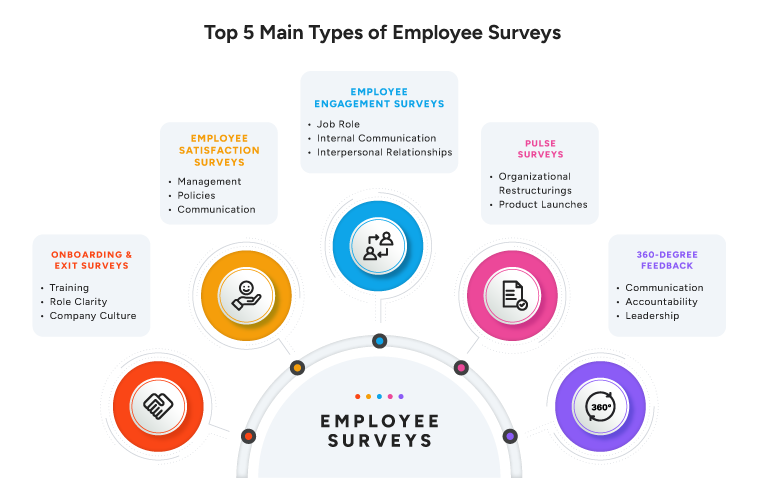
The types of surveys organizations use to collect feedback are:
Employee Satisfaction Surveys
Employee satisfaction surveys measure employees’ happiness with their jobs, work environments, and growth opportunities. They identify areas for improvement, such as management, policies, or communication. When organizations implement changes based on this feedback, they improve morale, engagement, and retention and create a more positive workplace environment.
Employee Engagement Surveys
Employee engagement surveys measure employees’ emotional connection, motivation, and alignment with the business values and mission. They include essential aspects like satisfaction with job role, internal communication, interpersonal relationships at work, and understanding of company goals. The insights gained help organizations develop strategies to improve engagement, productivity, and overall employee engagement.
Pulse Surveys
Pulse surveys are short, frequent check-ins (5-15 questions) that capture employees’ current mood and feelings. They track changes in sentiment over time, especially after events such as organizational restructurings or product launches. By conducting regular surveys, leaders can detect potential issues early and respond quickly.
360-Degree Feedback
360-Degree Feedback collects insights from managers, coworkers, and team members to give a full picture of an employee’s performance. They assess employees’ skills like communication, accountability, and leadership, offering multiple perspectives. It highlights strengths and identifies areas for growth. This supports job growth and continuous learning.
Onboarding & Exit Surveys
Onboarding surveys help new hires provide feedback on training, role clarity, and their first impressions of company culture, assuring a smooth transition and higher engagement. Exit surveys collect insights from departing employees’ experiences, reasons for leaving, and suggestions for improvement. Together, these surveys help organizations fix HR processes, boost retention, and make the workplace better for everyone.
Essential Questions to Ask (Categorized)
Employee Satisfaction Surveys
- How valued do you feel for your contributions at work? (Yes/No/comment)
- Do you see opportunities for career growth? (Yes/No/comment)
- Are you satisfied with your manager’s support? (1-10)
- How manageable is your workload and work-life balance? (1-10 scale)
- How likely are you to recommend this company to friends? (1-10)
Employee Engagement Surveys
- How well do the company’s mission, vision, and values align with your own? (1-10)
- Do you have the resources, training, and support needed to succeed in your role? (1-10)
- Do you feel your work aligns with the company’s goals?
- How satisfied are you with the communication and collaboration within your team?
- How likely are you to recommend this company for work? (0-10)
Pulse Surveys
- Is your workload manageable this week? (Yes/No)
- Do you have the support and resources you need to do your job effectively?
- How would you rate your manager’s support and feedback? (1-10)
- How is your work-life balance right now? (1-10)
- Is there anything that would help improve your work experience right now?
360-Degree Feedback
- What are this employee’s top strengths, and how do they contribute to the team?
- What is one thing this employee should start, stop, and continue doing?
- How effectively does this employee communicate and collaborate with others?
- How well does this employee manage time, priorities, and workload?
- What development areas or skills would help this employee grow further?
Onboarding & Exit Surveys
- How effective was your onboarding training in preparing you for your role? (1-10)
- What are your first impressions of our company culture and team dynamics?
- Any suggestions to improve the onboarding process for future hires?
- What were the primary reasons for your departure? (e.g., career growth, compensation, culture, workload)
- What aspects of the company did we handle well?
- Would you recommend us as an employer, and why?
- Did you feel valued and recognized during your time here?
- What improvements could the company make to retain employees?
Best Practices for Conducting Surveys
Ensure Anonymity
Make surveys anonymous using third-party tools or non-tracking systems so employees feel safe sharing honest feedback. This builds trust and improves the quality of responses.
Set a Benchmark
Set a benchmark from initial surveys (e.g., average satisfaction score of 7/10) to compare results over time. Reference points help track trends and measure progress effectively.
Frequency Matters
Conduct regular surveys, such as monthly pulse surveys or quarterly reviews, to monitor employee sentiment and address changes quickly.
Timing
Conducting surveys at the right time increases participation and encourages more thoughtful feedback. For example, use onboarding surveys in the first 1 or 2 weeks to capture fresh impressions, and share exit surveys soon after the resignation notice to accurately capture experiences.
Follow up Regularly
Share results transparently, implement improvements, and communicate progress. Following up shows employees that their opinions matter and drive engagement.
Common Mistakes to Avoid
Employee surveys are only useful if done right. Making a few common mistakes can lead to low participation, unreliable results, or wasted effort.
- All Talk, No Walk: Requesting input from employees but not acting on it makes them feel ignored and less likely to share opinions in the future.
- Survey Fatigue: Sending too many surveys or making them too long can discourage employees, leading to incomplete or rushed responses.
- Biased Questions: Leading, confusing, or loaded questions can distort results and make it hard to get a true picture of employee sentiment.
Conclusion & Next Steps
Employee surveys are not simply about asking questions; they are about taking action. When feedback is collected, analyzed, and acted on, it leads to better engagement, a stronger culture, and higher retention.
HR leaders should regularly review their survey strategy and make sure they use a system that makes analysis and tracking simple and effective. When feedback is easy to analyze, it’s easier to act on. factoHR Employee Management System simplifies survey automation and analysis, helping HR teams translate employee feedback into clear, actionable outcomes.
FAQs
What are 5 Good Survey Questions for Employees?
Here are five good survey questions for employees
- Are you satisfied with your job role and responsibilities? (1-10)
- Do you feel valued and recognized for your contributions at work?
- How would you rate your work-life balance? (1-10)
- Does your manager provide clear feedback and support for your growth?
- What one change could we make to improve company culture or retention?
What is the Employee Survey?
An employee survey is a tool organizations use to gather feedback from their employees about job satisfaction, engagement, workplace culture, and overall experience. It helps identify strengths, uncover areas for improvement, and guide decisions to boost productivity, retention, and employee well-being.
What are the 7 Types of Surveys?
The 7 types of employee surveys are online, paper, phone, one-on-one interviews, surveys over time (longitudinal), surveys at a single point (cross-sectional), and surveys looking back at past events (retrospective).
How do You Survey Your Employees?
To survey my employees, I use clear, anonymous survey questions shared through digital tools or HR software. Collect feedback regularly, analyze the results, and take action based on the insights.
Table of Contents
Have you ever wondered why you didn’t get a sales executive job even after a great interview? You had the right skills, and your experience matched the role, but someone else was selected.
In this guide, you’ll find 35+ common sales executive interview questions with sample answers to help you prepare better and feel more confident during your interview.
What You’ll Learn
- Prepare for the most common sales executive interview questions.
- Learn how to explain your experience confidently in an interview.
- Improve your communication, pitching, and negotiation skills.
- Know how to handle behavioural and situation-based interview questions.
- Review a last-minute sales executive interview preparation checklist.
- Use a ready-to-use scorecard to evaluate and hire the right sales executive.
Top 10 Sales Executive Interview Questions
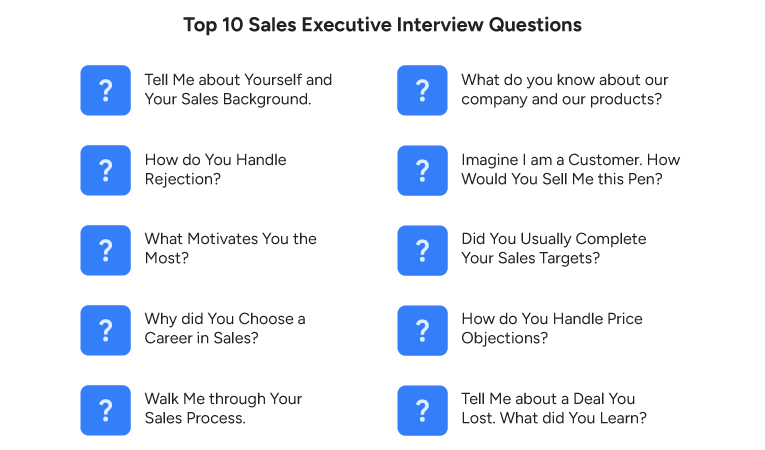
This list of sales executive interview questions will help you prepare for your interview. The sample answers and tips will guide you on how to respond with confidence.
1. Tell Me about Yourself and Your Sales Background.
Why They Ask: Yes, it’s an icebreaker, but it also helps interviewers know your cultural fit and other personality traits.
Sample Answer: I have been working in sales for the past two years, where I handled both customer calls and in-person meetings. On a typical day, I made around 50 calls and managed 20–25 leads at a time. My main responsibility was to understand customer needs and recommend the right product or solution.
Tip: Don’t just talk about your passion for sales. Briefly explain what you actually do in your role and how your experience matches the job you’re applying for.
2. What do You Know about Our Company and What We Sell?
Why They Ask: They want to check if you prepared for the interview.
Sample Answer: From what I’ve read on your site and LinkedIn page, you’re a SaaS company that uses AI to provide affordable fintech solutions to small and medium businesses. I must say, your business growth is impressive when compared to other companies.
Tip: Do not just mention product features; be very specific about the business segment.
3. How do You Handle Rejection?
Why They Ask: Understandably, interviewers want candidates who can stay motivated. However, they also want someone who analyzes rejections objectively.
Sample Answer: I focus on being motivated as well as analyzing CRM reports and regional trends. Lastly, I adjust the presentations and respond to new and old customers based on my analysis of the rejection and their feedback.
Tip: Show that you learn from rejection and improve your approach instead of taking it personally.
4. Imagine I am a Customer. How Would You Sell Me this Pen?
Why They Ask: They want to see your sales basics and know how you would sell and pitch a product.
Sample Answer: I notice that you miss writing as you used to before. It’s understandable that you feel the nostalgia of writing with a good old pen at a time when texts are replacing letters. You know what, you can still draft your emails with this digital pen. It’s flexible, easy, and yes! A pen!
Tip: Focus on the buyer’s needs, create interest, and show how the product solves their problem.
5. What Motivates You the Most?
Why They Ask: They want to identify if you are the right fit for the role.
Sample Answer: I am an extrovert. Also, I like to analyze how people think. Lastly, I like analyzing data points and patterns related to recent trends.
Tip: The best approach for you would be to read about the company, mention some related values in your resume, and prepare related answers for the interview.
6. Did You Usually Complete Your Targets?
Why They Ask: This is a tricky question that employers often ask you to judge what you do when you miss the targets.
Sample Answer: Yes. I usually complete my targets. However, there were times when I wasn’t able to achieve them, and I analyzed the reasons and market trends to adjust my strategies.
Tip: In such questions, most of the candidates might focus on numbers. You should focus on what you do when you don’t achieve the targets.
7. Why did You Choose a Career in Sales?
Why They Ask: Such questions show your motivations. Not only financial reasons, but other reasons as well.
Sample Answer: I like to analyze how people think about products and make decisions. Also, I think this role would help me grow my marketing skills and advance. Lastly, at a time when AI is shaping how we work, I’d like to analyze how and what clients need from AI.
Tip: Keep your answer simple, and avoid just focusing on the financial reasons.
8. How do You Handle Price Objections?
Why They Ask: In negotiations, price objections are the most common. Employers want to see how you can pitch their options by addressing clients’ worries about pricing.
Sample Answer: I first ask the customer why they feel the product is expensive. Based on their response, I explain the ROI and long-term value. For example, if I’m selling HR software, I highlight how it can help avoid compliance penalties, reduce payroll errors, and speed up hiring processes.
Tip: Try to explain the product’s value with a simple example so the customer understands why the price makes sense.
9. Walk Me through Your Sales Process.
Why They Ask: They want to know whether you follow a structured process or not. Usually, a structured answer like our sample answer can get you through such situations.
Sample Answer: I follow a step-by-step process that includes researching, targeted calling, providing a customized demo, and engaging all the departments, such as finance and HR, to avoid last-minute issues.
Tip: Keep your answer concise but structured.
10. Tell Me about a Deal You Lost. What did You Learn?
Why They Ask: Such sales interview questions test your emotional intelligence and motivation to learn from your previous mistakes.
Sample Answer: I lost a big deal with an MNC client. I focused on identifying what went wrong and found that I was only highlighting user benefits. The CFO didn’t approve, and I realized that it’s important to focus on pricing as well as user benefits.
Tip: Preferably, share your own experience. Be honest, own your mistake, and discuss the solution.
Sales Interview Questions for Experienced Candidates
Experience-based sales executive interview questions are more on the practical side of things. They usually include questions related to your previous experience, CRM tools, and time management skills.
11. What were You Selling, and Who were Your Customers?
Why They Ask: To see if your previous experience aligns with their industry-specific needs.
Sample Answer: At my last firm, we offered a subscription-based SaaS HR service that managed HR and payroll for small, medium, and large businesses in India.
Tip: If you have specific metrics that show you in a good light, then mention them, e.g., number of calls, quarterly or monthly targets achieved, etc.
12. What was Your Monthly or Quarterly Target in Your Last Job?
Why They Ask: Employers ask it to gauge your abilities.
Sample Answer: My monthly target was 20 deals or around ₹5 lakh revenue. I achieved close to 100% most months. I achieved this by analyzing current trends and building connections with professionals, who helped me find leads with referrals.
Tip: Mention numbers, but do not forget that people matter the most in sales.
13. What is Your Biggest Sales Success Till Now?
Why They Ask: To identify the “what” and “how” you use to reach deals and solve problems
Sample Answer: I closed a deal with a client who initially said “no.” Instead of focusing only on pricing or installation, I explained the risks of not using our product and how it could impact their operations. This helped the client understand the value, and we were able to move forward with the deal.
Tip: Sharing a short customer story can make your answer more convincing.
14. Where did You Get the Best Leads from in Your Last Job?
Why They Ask: To find out how you generate leads and introduce the product to potential customers.
Sample Answer: I usually get leads from LinkedIn posts, website referrals, and internal referrals. However, some of my best leads have come from our professional network on WhatsApp.
Tip: It’s helpful to mention lead sources that actually worked well for you, even if they are not very common.
15. Which CRM or Sales Tools have You Used?
Why They Ask: It’s a common sales interview question that tests your technical skills.
Sample Answer: I used Zoho CRM to track calls, schedule follow-ups, and update deal stages daily. I am also using Salesforce and learning more about it from Coursera.
Tip: Talk about the tools you’ve used and show that you’re open to learning new ones.
16. When Work Gets Busy, how do You Manage Follow-Ups and Your Sales List?
Why They Ask: To test your time management skills.
Sample Answer: I set priorities on a daily, weekly, and monthly basis to be on track. I also use reminders and take time in the morning to read emails, replies, and comments on my LinkedIn posts.
Tip: Give a short but structured answer.
17. Have You Done inside Sales, Field Sales, or both? Which One do You like More?
Why They Ask: To identify your preferences
Sample Answer: I’ve done both. Inside sales helps with volume, and field sales builds trust faster.
Tip: Be flexible, and focus on the positives of inside and field sales.
Looking for a Sales Executive Job Description Template?
Role-Based Sales Interview Questions
These types of sales interview questions focus on your skills as a sales executive. Interviewers want people who can use their skills to solve problems, not just talk about them.
18. Imagine I’m Hearing about Your Product for the First Time. How Would You Explain It in Simple Words?
Why They Ask: This question doesn’t just check your communication skills; it also assesses your ability to convince clients.
Sample Answer: Our product is a cloud-based HR and payroll software that simplifies your HR management by automating most manual HR operations, such as salary calculation and attendance.
Tip: Explain it as if you are explaining it to a non-technical person.
19. Before You Pitch, What Questions do You Ask to Understand What the Customer Actually Needs?
Why They Ask: Such sales executive interview questions test your ability to “Diagnose” a problem. After all, a pitch’s main goal is to convert a user into a customer.
Sample Answer: I do thorough market research for what I’m selling. Especially, I focus on pain points and ask related questions like How many hours does it take for you to do payroll? Or, which specific challenges do you face when complying with labour regulations as a manufacturing firm?
Tip: Be very specific. The best approach is to identify your clients’ issues.
20. When It Comes to Negotiation, how do You Handle It without Giving Discounts Too Quickly?
Why They Ask: To test your negotiation skills and ability to persuade clients.
Sample Answer: I’d ask specific questions to show what we offer. This helps me sell our product’s USPs. For example, if a client tells me that “We found other vendors offering less expensive plans for managing payroll”, I’d ask them “What are your specific needs?” and offer customized solutions.
Tip: When answering, focus on your USPs rather than just comparing with other clients.
21. After the First Call or Demo, how do You Follow up So the Customer Stays Interested?
Why They Ask: To check what you do to keep in touch with prospects, and if you are able to convert a “lead” into a “client.”
Sample Answer: I do the usual cold calling. I also send short 30-second customized videos or voice notes to each client on their WhatsApp. I engage with them on LinkedIn and remind them of our discussion by sharing relevant posts and highlighting our product.
Tip: Mention that’s something unique to you when you follow up.
22. What Tells You that the Customer is Genuinely Ready to Buy?
Why They Ask: Such questions test if you can read the “buying signals” based on what customers ask.
Sample Answer: When a customer starts to discuss their pain points and compare relevant features, it gives me a clear signal that the customer is more or less convinced to buy our product.
Tip: Don’t give that generic answer of “Price and Contract Arrangements”.
23. How do You Close the Deal Confidently without Sounding Too Pushy?
Why They Ask: To see your response to one of the common scenarios in sales.
Sample Answer: I don’t assume that a customer has agreed to buy our product. I ask specific questions, such as I know that you want us to implement the solution by March. To do that, we need to start implementing it by the 15th of February. Do you think we would be able to conclude our negotiations by the 15th?
Tip: Don’t come across as if you are in a hurry to close the deal. Answer such questions from a strategic perspective, where you subtly focus on aspects like implementation.
24. How do You Ensure Your CRM and Daily Sales Reports are Always up to Date?
Why They Ask: Keeping sales reports updated is a common responsibility of a sales executive.
Sample Answer: I have a checklist for seeing that reports are up to date, and I dedicate 30 minutes of the day to ticking every item in the list. I also rely on Gong and other tools to keep a record of the meetings.
Tip: Don’t give the standard answer of just “Managing Time”. Focus on what you do to make the process a strategic one, rather than an administrative chore.
25. When a Customer Says, “It’s Too Expensive” or “We Already have a Vendor,” how do You Respond?
Why They Ask: Such questions test how you would handle objections and turn challenges into opportunities.
Sample Answer: I’d present specific situations and see if I can highlight ROI. I’d also use specific data points to drive home the point that our product might seem expensive at first, but the ROI will make up for the initial cost.
Tip: When answering such questions, focus on why a product would be a better choice in the long term, despite the higher initial cost.
26. Why Should We Hire You for this Role?
Why They Ask: The question is a way to check your cultural fit as well as your skills.
Sample Answer: As someone with experience in selling SaaS products, I think I’d be a great fit for your product. What’s more, I have some understanding of how AI works. So, I am confident that I’d be able to pitch your product better.
Tip: Mention specific features and problems that you find based on your research of the company.
27. What are Your Biggest Strengths as a Salesperson?
Why They Ask: To know what you are most good at and to find out whether you think enough about your strengths and weaknesses.
Sample Answer: I’d say understanding how people think is one of my strong points. Also, I’m good at analyzing current market trends and tailoring the pitch to the analysis. Lastly, I’m good at simplifying technical concepts and communicating them to stakeholders.
Tip: Don’t mention every single skill. Just pick two or three skills that are your strengths.
Not Sure What to Include in Sales Manager Job Description? Use this Ready-To-Use Template.
Sales Behavioral Interview Questions
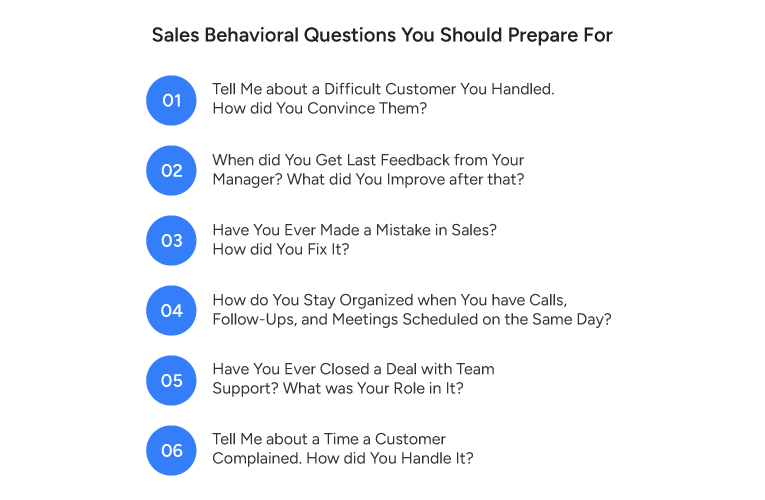
28. Tell Me about a Difficult Customer You Handled. How did You Convince Them?
Why They Ask: To see what you do in getting from “No” to “Yes”. Clients look for the best value for money option, and your job is to pitch your product as the best option.
Sample Answer: I don’t think customers are difficult. They are just worried that they might end up wasting time and not finding the solution. So, I focus on addressing their issues like delays in implementation, and suggest that we run a pilot demo to see if our product works for them.
Tip: When answering, don’t only focus on your “Good Communication”. Rather, focus on addressing the client’s concerns.
29. What’s One Tough Target You Achieved? What Helped You Reach It?
Why They Ask: To assess your resource optimization skills and strategic thinking.
Sample Answer: In Quarter 3 (Q3) of last year, my target was increased by 25%. At the same time, our marketing budget had to be reduced as we were focusing on investing in a new feature. I used LinkedIn Sales Navigator and Zoom info to do targeted selling, and was able to reduce my sales cycle from 45 to 30 days and achieve the target.
Tip: Yes. Hard work matters. But in 2026, you need to focus on strategic analysis as well.
30. When did You Get Last Feedback from Your Manager? What did You Improve after that?
Why They Ask: To see if you learn from feedback.
Sample Answer: Earlier, I used to only focus on one or two stakeholders when pitching our product. My manager suggested that I should focus on multiple stakeholders to avoid last-minute issues. I started reaching out to multiple stakeholders, and my sales velocity increased by 30%.
Tip: Use the STAR (Situation, Task, Action, and Result) method for answering such questions. It’s good for when you get stuck and for structuring your success stories effectively.
31. Have You Ever Made a Mistake in Sales? How did You Fix It?
Why They Ask: You need to know that employers don’t just focus on accountability, but they also look for candidates who improve after analyzing their mistakes.
Sample Answer: I was preparing a presentation for pitching our product, and I mistakenly added one feature that we no longer provide. After that, I always confirmed with multiple people before finalizing the presentation.
Tip: Share the mistake honestly and explain what you changed to avoid it next time.
32. How do You Stay Organized when You have Calls, Follow-Ups, and Meetings Scheduled on the Same Day?
Why They Ask: It’s a classic question that assesses your time management and project management skills.
Sample Answer: I plan my day in advance and decide which tasks are most important. During calls and meetings, I take clear notes so I don’t miss any key points. I also set specific time for follow-ups and emails to make sure I respond on time. Using productivity tools helps me stay organized.
Tip: Mention relevant tools that you use for reducing the time spent reaching out for follow-ups.
33. Have You Ever Closed a Deal with Team Support? What was Your Role in It?
Why They Ask: To test your leadership and collaboration skills.
Sample Answer: In a deal with an MNC, they needed specific API integrations. I made a team that had a solution engineer, designer, and developer. I became the voice of the customer and suggested what needed to be done. We closed the deal without a hitch.
Tip: You are an executive. So, your role is mainly to coordinate with the team in the right direction.
34. Tell Me about a Time a Customer Complained. How did You Handle It?
Why They Ask: To check your emotional intelligence as well as your ability to solve problems.
Sample Answer: Once, due to an update, a client faced an issue with an integration. I actively listened, arranged a meeting between the client and our team, and we solved the issue in a day.
Tip: Stay calm, listen carefully, and show how you worked to fix the problem quickly.
35. Share a Situation where You Took Full Responsibility and Solved a Problem.
Why They Ask: To find out whether you take ownership.
Sample Answer: During the onboarding process, a client was finding it difficult to implement our solution as our team was understaffed. I spend some of my time daily coordinating with the client and our team. The client was satisfied, and from that point on, I always kept track of available team members.
Tip: Share a genuine customer story to show that you take ownership of what you do.
36. Sometimes Results Take Time. How do You Stay Consistent when Sales are Slow?
Why They Ask: Slowing sales is one of the common scenarios that you’d face as an executive, and employers want to know how you would respond.
Sample Answer: I analyze the reasons behind the dip. For example, geopolitical issues, overall decline in my market vertical, or particular issues that are relevant to our product. Based on that, I take the next steps.
Tip: Stay focused on your process, keep learning, and use slow periods to improve your approach.
37. What is One Area You are Currently Improving in Sales?
Why They Ask: To see if you have a learning mindset.
Sample Answer: I’m currently working on improving data visualization skills. I’m taking some courses from Coursera, and reaching out to my colleagues to improve them.
Tip: Mention that you are reaching out to colleagues. It shows that you are willing to learn and don’t hesitate to ask for help when you need it.
Scenario-Based Sales Interview Questions
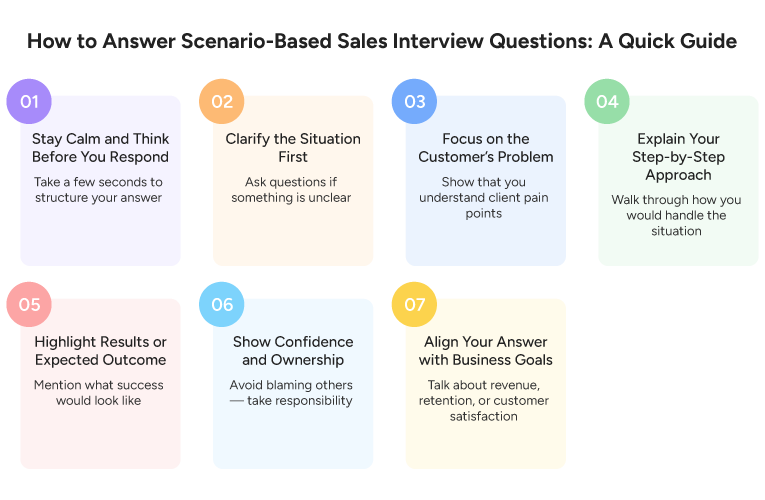
38. You Called a Customer, and They Said They’re Busy. What will You Say Next?
Why They Ask: to test what you do to follow up when a client is busy.
Sample Answer: I acknowledge and apologize for interrupting. I also ask for their permission to share a short video on WhatsApp or another preferred platform that highlights our product.
Tip: Focus on the next best thing you can do if you cannot call the client. You can mention sending a short voice note, or even a small infographic. Be as creative as you can.
39. A Lead Asks You to Share Details on Whatsapp. What Will You Send Them?
Why They Ask: Firms are increasingly using WhatsApp and other similar platforms to interact.
Sample Answer: I’d share infographics and short videos that give a demo of our features. I’d also share presentations that highlight our USPs.
Tip: You can also mention sending them animated gifs that you created.
40. I’m Saying Your Product is Too Expensive. What will You Say?
Why They Ask: To see how you’d handle price objections.
Sample Answer: I’d focus on the current problems that clients are facing, and highlight the cost if they do not address the issues. Then, I’d pitch our product as a solution to their current problems and future needs.
Tip: Focus on ROI gains when answering such questions.
41. We Already Use another Company for this. Why Should We Look at Your Product?
Why They Ask: To see how you would convince clients to use your product.
Sample Answer: I’d focus more on outcomes rather than features in such scenarios. For example, another product might be offering the same feature, but we perform it faster. Also, if available, I’d let the client know that our product can integrate with their existing products.
Tip: Products often offer similar features in the market. Focus on the end result, e.g., improved performance or reduced time.
42. A Lead Showed Interest but Stopped Replying. How Will You Follow up?
Why They Ask: Interviewers want to know how you would try to engage a lead who might not be interested in your product.
Sample Answer: I’d send them a message on LinkedIn and give a couple of calls. Then, I’d drop a text or two on WhatsApp and ask their permission to carry forward our discussion. Lastly, I’d send them a short video of our demo and encourage them to contact me if they are still interested.
Tip: Follow up politely, don’t spam, and always give the lead an easy way to respond or say no.
43. I Need to Get Approval from My Team. What Will You Ask Me Next?
Why They Ask: To check what you would do and how you would keep the client interested in your product in such scenarios.
Sample Answer: I’d share with them a short video and ask them if they can show it to the manager when getting the approval. This would help me in showing the product to the manager and might improve the chances of a deal.
Tip: When answering, focus on active engagement. Don’t wait for approval before giving a demo of your product.
44. You’re behind Your Target, and the Month-End is near. What Will You do Now?
Why They Ask: To see how you react to a pressure situation.
Sample Answer: If I’m behind my target near month-end, I first review my pipeline and focus on deals that are close to closing. I quickly connect with those prospects to understand their concerns and clear any doubts. I also follow up with warm leads and prioritize high-potential opportunities.
Tip: Staying calm under pressure is good, but interviewers want to hear the exact strategies you use to hit your targets.
45. A Customer is Angry because of a Service Issue. How Will You Calm Them and Fix It?
Why They Ask: Service issues are common when you sell a product.
Sample Answer: I’d actively listen to their issues, coordinate with the team, and try to solve the issue as soon as possible. I’d also give them a specific timeline for addressing their concerns.
Tip: One of the easiest questions to answer, it mainly focuses on your communication and time management skills.
46. You have to Start Selling a New Product Tomorrow. How Will You Prepare Today?
Why They Ask: To see how you would sell new features at short notice, and how you would research and pitch the product.
Sample Answer: If I have to start selling a new product tomorrow, I would first understand the target customers and their main problems. Then, I would study the product features and connect them to those problems. I would also review competitor products and common objections. Finally, I’d prepare a clear and simple pitch to confidently explain the product’s value.
Tip: Don’t just say you will “learn the product.” Clearly explain how you will understand customer problems, study competitors, and prepare your pitch.
Sales Executive Interview Preparation Checklist
- Focus on real-life examples as much as possible, and avoid answering like you’ve memorized a script.
- Be thorough with your resume, as interviewers often ask questions to understand your cultural fit and personality.
- Mention tools by category based on their functions, such as note-taking or reporting. You can do the same for your skills.
- Keep your answers short but structured to show strong communication skills while highlighting your experience.
- Arrive on time and maintain a professional attitude throughout the interview.
Sales Executive Interview Scorecard for Employers
This sales executive interview scorecard provides a simple and structured way to review skills using questions, ratings, remarks, and notes that can be customized according to your hiring needs.
| Value | Questions | Ratings (1–5) |
|---|---|---|
| Sales Skills | Describe your approach to selling a product to a new customer. | 1/5: Lacks clarity in sales approach. 5/5: Shows strong selling and persuasion skills. |
| Communication Skills | How do you explain a product to a customer who knows nothing about it? | 1/5: Poor or unclear communication. 5/5: Explains confidently and simply. |
| Customer Handling | Tell me about a time you handled a difficult customer. | 1/5: Avoids responsibility or gets defensive. 5/5: Handles calmly and finds solutions. |
| Target Orientation | Share an example of how you achieved or exceeded a sales target. | 1/5: No clear results or effort. 5/5: Shows strong focus on goals and results. |
| Product Knowledge | What do you know about our product and market? | 1/5: Limited understanding. 5/5: Shows good product and market awareness. |
| Negotiation Skills | How do you convince a hesitant customer to buy? | 1/5: Struggles to close sales. 5/5: Demonstrates confident negotiation skills. |
| Problem Solving | Tell me about a challenging sale and how you managed it. | 1/5: Gives up easily. 5/5: Finds practical solutions. |
| Motivation & Attitude | What motivates you to work in a target-driven sales role? | 1/5: Low enthusiasm for sales work. 5/5: Shows strong drive and positive attitude. |
| Adaptability | How do you adjust your sales approach for different customers? | 1/5: Rigid or inflexible. 5/5: Adapts well to customer needs. |
| Customer Relationship Building | How do you maintain long-term relationships with clients? | 1/5: Focuses only on short-term sales. 5/5: Builds trust and long-term rapport. |
Note: The maximum score is 50 marks. The candidate’s rating is based on their total score. For example, if a candidate scores 42 out of 50, their rating would be 4.2 out of 5.
You Can Evaluate Candidates like this:
- 40–50: Highly Recommended
- 30–39: Good Candidate
- 25–29: Needs Further Evaluation
- Below 25: Not Recommended
Frequently Asked Questions
How do I Introduce Myself in a Sales Interview?
For a sales interview introduction, start with your name, background, relevant skills, and experience. You can finish the introduction by mentioning your interests and motivation for the job.
Which Skills do I Need to Apply for the Sales Executive Position?
Familiarity with CRM tools, communication, project management, time management, problem-solving, and strategic thinking are some of the skills that you require to become a sales executive.
How Should I Answer Target-Based Questions in a Sales Interview?
Focus on your past achievements and explain how you met your targets. Mention the strategies you used and briefly share how you handle situations when targets are not achieved.
What Questions Should I Ask at the End of a Sales Interview?
At the end of a sales interview, you can ask about sales targets, performance expectations, team structure, and available tools. It’s also useful to ask about training support and growth opportunities within the company.
How Should I Answer Cultural Fit Questions in a Sales Interview?
Cultural fit questions are questions that evaluate whether you would match a company’s values and work culture. When answering such questions, it’s best to read some questions in advance and research the company.
More Interview Questions with Sample Answers
Table of Contents
Knowing the HR salary in India is a key factor for students, job seekers, and those planning a career change. Accurate pay data helps individuals set realistic goals and choose the right specializations for long-term growth. This article outlines the current compensation trends across various levels, ranging from entry-level roles to senior leadership positions. It also examines how experience, location, and specific job responsibilities impact earning potential.
Key Takeaways
- The average salary for HR professionals in India varies by experience, role type, and industry. Entry-level roles earn less than senior roles.
- An HR fresher’s salary in India is usually lower at the start. However, it increases with experience and skill development.
- The HR manager’s salary in India is higher than that of executive roles. It grows with leadership duties and decision-making responsibility.
- Pay for roles like HR generalist salary in India depends on company size and sector. Large firms often offer better pay.
- Senior roles, such as the HR head salary in India and director positions, fall within the highest-paying HR jobs.
- Overall, HR salaries in India have been steadily increasing as professionals move into strategic and leadership roles.
What is the Average HR Salary in India?
The average salary indicates what most HR professionals earn per year or per month. It helps you understand typical pay levels before you choose a job or negotiate offers. The average salary includes base pay and, sometimes, bonuses. It does not count other perks like health benefits or incentives.
Average Salary Range (Monthly & Yearly)
- On average, an HR professional in India earns around ₹12.41 lakhs per annum (LPA) in generalist roles.
- Senior HR managers can earn around ₹15.56 LPA.
- Monthly pay often ranges from ₹75,113 to ₹1,29,712 based on experience.
Note: These are average figures for the HR generalist role. Actual salary depends on the company, city, and skills.
HR Salary Range Across Experience Levels
HR salaries in India increase with experience, responsibility, and skills. Each career stage comes with different duties and pay levels. The table below clearly explains the salary range and role expectations as of April 2025.
Entry-Level HR (0–2 Years)
At this stage, professionals are learning core HR processes to focus on support and coordination.
| Experience level | Common roles | Salary range (yearly) | Key responsibilities |
|---|---|---|---|
| 0–2 years | HR Executive / HR Assistant | ₹4.38 LPA – ₹7.13 LPA | Handling HR records, assisting with recruitment, supporting payroll tasks, and employee documentation |
The salary of an HR fresher in India depends on location, company size, and education. Though the HR starting salary in India is modest, it grows exponentially with experience.
Mid-Level HR (3–7 Years)
Mid-level professionals handle people management and policy execution. They play a key role in daily HR operations.
| Experience level | Common roles | Salary range (yearly) | Key responsibilities |
|---|---|---|---|
| 3–7 years | HR Generalist II, HR Generalist III | ₹9.61 LPA – ₹16.59 LPA | Managing recruitment cycles, employee relations, performance reviews, and HR policies |
The HR manager’s salary in India rises at this stage. The HR generalist salary in India varies based on industry and role scope.
Senior-Level HR (8+ Years)
The Senior HR Generalist role focuses on strategy, leadership, and long-term planning. They shape company culture and growth.
| Experience level | Common roles | Salary range (yearly) | Responsibilities | Key skills |
|---|---|---|---|---|
| 8+ years | HR Head, HR Director | ₹40 lakh – ₹1 cr+ | HR strategy, workforce planning, compliance, and leadership decisions | Strategic thinking, leadership, labour law knowledge, and decision-making |
At this level, professionals earn some of the HR industry’s highest salaries in India. The HR head salary in India and the HR director salary in India depend on company size and business scale.
HR Salaries by Job Role (India)
HR salaries in India vary by job role and level of responsibility. Each role below shows typical pay ranges based on the latest salary survey data from SalaryExpert and Salary.com.
HR Executive/HR Assistant
- Average salary range: ₹4.15 LPA – ₹5.49 LPA
- Experience level: 0–2 years
- Key responsibilities: Supporting recruitment and onboarding, maintaining employee records, and assisting with basic HR administration.
HR Generalist (Entry Level)
- Average salary range: ₹9.01 LPA – ₹12.41 LPA
- Experience level: 2–5 years
- Key responsibilities: Handling day-to-day HR operations, employee queries, compliance support, and recruitment coordination.
Senior HR Generalist
- Average salary range: ₹12.41 LPA – ₹15.56 LPA
- Experience level: 5–8 years
- Key responsibilities: Managing complex HR processes, employee relations, and supporting performance and policy awareness.
HR Manager
- Average salary range: ₹19.96 LPA – ₹35.64 LPA
- Experience level: 5–10 years
- Key responsibilities: Leading HR teams, implementing HR policies, and supporting workforce planning and leadership decisions.
HR Business Partner
- Average salary range: ₹19.6 LPA – ₹49.1 LPA
- Experience level: 7–10 years
- Key responsibilities: Aligning HR practices with business goals and advising leadership on people-related decisions.
HR Head/CHRO
- Average salary range: ₹40 LPA – ₹1 Cr+ per year
- Experience level: 10+ years
- Key responsibilities: Setting HR strategy, driving organisational culture, and leading enterprise-level people initiatives.
HR Salary by Industry and Company Type
HR salaries in India also depend on the industry and company type. Some sectors offer faster growth and better pay due to scale and complexity.
IT/Software
- Average salary range: ₹6 LPA – ₹15 LPA
- Growth opportunities: High growth due to rapid expansion and global exposure. HR professionals can move into strategic roles quickly.
- Demand for HR roles: Very high. IT firms need HR support for hiring, retention, and compliance.
This sector often pays above the average salary of HR in India.
FMCG
- Average salary range: ₹5 LPA – ₹12 LPA
- Growth opportunities: Steady growth with chances to handle large workforces and regional operations.
- Demand for HR roles: High. FMCG companies need strong HR teams for field staff and operations.
Consulting
- Average salary range: In consulting firms, HR professionals usually earn between ₹8 LPA and ₹18 LPA, depending on experience and the kind of clients the firm handles.
- Growth opportunities: Consulting offers a strong learning environment. HR professionals work with different industries, which helps them grow faster if they upskill quickly.
- Demand for HR roles: Hiring needs are mostly steady. When consulting firms expand or take on more clients, HR demand rises. During slow periods, hiring reduces, but HR roles remain necessary.
Manufacturing
- Average salary range: In manufacturing companies, HR salaries generally fall between ₹4.5 LPA and ₹10 LPA. Pay changes based on experience and factory size.
- Growth opportunities: Growth is slow but stable. The role focuses on labour laws, factory rules, shift workers, and daily workforce issues.
- Demand for HR roles: HR is always required in manufacturing. Factories need HR to manage workers, attendance, disputes, and legal work.
Startups
- Average salary range: HR salaries in startups usually fall between ₹4 LPA and ₹9 LPA. The exact pay depends on the startup’s size and funding.
- Growth opportunities: Growth can happen quickly, but it is not always stable. HR professionals often manage many responsibilities and learn through hands-on experience.
- Demand for HR roles: As startups expand their teams, they increasingly rely on HR support.
HR salaries at startups in India may start lower but can grow quickly with the company’s success.
MNCs
- Average salary range: ₹8 LPA – ₹20 LPA per year
- Growth opportunities: Excellent growth with global exposure and structured career paths.
- Demand for HR roles: High. MNCs require strong HR systems and compliance support.
MNCs often offer some of the best HR packages in India.
HR Salaries by Location (India)
Location plays a major role in deciding HR pay. Cities with more companies, higher living costs, and global exposure usually offer better salaries. Demand for skilled HR professionals is also higher in metro cities.
Below is a simple city-wise salary comparison for the HR generalist position.
HR Generalist Salary Range by City
| Sr no. | City | Average salary range (LPA) |
|---|---|---|
| 1 | Bengaluru | ₹9.81 – ₹16.95 |
| 2 | Mumbai | ₹9.94 – ₹17.17 |
| 3 | Delhi NCR | ₹9.37 – ₹16.18 |
| 4 | Hyderabad | ₹9.31 – ₹16.08 |
| 5 | Pune | ₹9.51 – ₹16.43 |
| 6 | Chennai | ₹9.28 – ₹16.03 |
| 7 | Kolkata | ₹4.5 – ₹9 |
These figures show the typical HR salary in India across major cities.
Why Salaries Differ by Location
- Cost of living: Cities like Mumbai and Bengaluru have higher living costs, so salaries are higher.
- Industry presence: IT hubs and corporate centres pay more due to demand.
- Company type: MNCs and large firms are mostly based in metro cities.
- Talent demand: Cities with skill shortages offer better pay to attract HR professionals.
As a result, the HR salary in India per month is usually higher in metro cities than in smaller towns.
Key Factors that Influence HR Salaries
Many things shape how much an HR professional earns in India. These factors affect salaries at every stage, from freshers to senior leaders.
Education
Education sets the foundation for an HR career. Individuals with an MBA or a degree in human resources often start at a better pay level. Formal education also makes it easier to grow into higher roles.
Skills
Skills play a big role in salary growth. Knowledge of labour laws, payroll handling, HR systems, and data tools adds strong value. Communication and people skills also make a real difference.
Experience
Salary increases with experience. As professionals spend more years in HR, they move into planning and leadership roles. This change naturally raises earning potential over time.
Responsibilities
Pay rises with responsibility. HR professionals who manage teams, policies, or company strategy earn more than those in support roles. Decision-making duties usually come with better pay.
Company Size
Larger companies tend to offer higher salaries. They lead and manage a large team of employees and more complex HR systems. Smaller firms often work with tighter budgets.
Industry
Industry choice matters as IT, consulting, and multinational companies usually pay more. Manufacturing and smaller businesses offer steady work, but salaries may grow at a slower pace.
Location
Where you work affects your salary. Metro cities often pay more due to higher demand and living costs. Cities with strong corporate activity offer more opportunities.
Certification
HR courses and certifications can boost earning potential. Employers often prefer certified HR professionals for senior roles. Certifications also help speed up promotions and role changes.
Company Revenue
Companies with strong revenue can invest more in their HR teams. Well-performing businesses often pay higher salaries, especially for leadership positions.
Market Condition
The job market impacts HR pay. During active hiring periods, demand for HR professionals increases. In slower markets, salary growth may pause or move slowly.
Conclusion
HR is a stable and growing career in India. Salaries increase with experience, skills, and responsibility. Entry-level roles offer a modest start, with steady growth over time. Senior HR roles offer strong earning potential and leadership opportunities.
If you want to grow in HR, focus on learning new skills and gaining experience. Choose the right industry and role for long-term growth. With the right planning, HR can be a rewarding and secure career choice.
FAQs
1. How Much Can an HR Earn in India?
The average salary of an HR associate is ₹5. 79 LPA. With experience, one can reach up to the position of HR director, where the salary goes beyond ₹1 Cr per year, with an average salary of ₹63.34 LPA.
2. What is the Minimum Salary of an HR per Month?
The HR starting salary in India is usually between ₹36,500 and ₹48,230 per month. This applies mostly to freshers or junior roles in small or mid-sized organisations.
3. What is the Highest HR Salary in India?
The highest salaries in India are earned by senior leaders, such as HR Heads or Directors. In large MNCs, annual pay can cross ₹1 Cr, depending on company size and responsibility.
4. Which City Pays HR Professionals the Most?
Metro cities like Mumbai, Bengaluru, and Delhi NCR pay the most. Higher demand, a strong corporate presence, and the cost of living push the HR salary in India per month higher in these cities.
5. Does HR Certification Increase Salary?
Yes, certifications can improve salary prospects. Certified professionals often earn more than non-certified peers. Certifications support promotions and help HR professionals move into strategic and leadership roles faster.
6. How does Experience Affect Salary in HR Roles?
Experienced candidates have greater control over salary negotiations due to their industry experience. Their areas of expertise across different dimensions of human resource management open doors to managerial positions.
7. Why do HR Salaries Vary across Industries?
Different industries have different HR needs. IT and consulting pay more due to the scale and complexity involved. Manufacturing and smaller firms offer stable but lower pay for HR roles.
8. What are the Best Tips for Negotiating HR Salary?
To be able to negotiate better, research market salary data first. During the interview, highlight your skills, experience, and certifications. Lastly, be absolutely clear about your value and growth plans to be able to crack a good deal.
Table of Contents
Chat process jobs have gained significant importance in the modern business environment, where skilled executives are part of customer support or tech support teams across industries such as e-commerce, banking, IT, and telecom.
Chat support executives resolve issues, calm frustrated users, provide information, and maintain brand loyalty in real time using chat support tools. Candidates require a combination of technical aptitude, written communication acuity, customer-centric thinking, multitasking, and problem-solving prowess to succeed in this role.
This blog covers all the relevant chat process interview questions and answers to help candidates understand the chat process. It also clearly breaks down interview expectations for the chat process role and explains how to prepare for real interview scenarios.
Tips to Crack Chat Process Interview
- Improve Typing Speed & Accuracy: Strong typing skills help candidates respond quickly with minimal errors during chat interviews.
- Maintain Professional Written Communication: Avoid slang, abbreviations, or informal language while interacting with customers.
- Demonstrate Multitasking Skills: Chat support roles require handling multiple conversations and tasks efficiently.
- Understand the Job Role: Research the company, services, customer expectations, and common support challenges.
- Learn Chat Support Tools: Familiarity with chat platforms and support software gives candidates an advantage.
- Practice Before Interviews: Prepare answers to common chat process questions and real customer-handling scenarios.
- Stay Calm and Confident: Maintaining composure helps candidates communicate clearly and perform better during interviews.
1. Tell Me about Yourself
How to Answer
Candidates must focus on their background, highlight their skills, and mention any experience, achievements, or examples related to customer service or chat support.
Sample Answer
“I have been working as a chat support executive in a SaaS company for the last three years. I have excellent written communication and multitasking skills that allow me to handle an average of 4 to 5 live chats simultaneously using support tools. I am passionate about my work, and I’ve consistently received positive feedback for maintaining high customer satisfaction by providing quick, effective solutions to customer issues. I am particularly interested in joining your company because of your strong reputation in customer service and focus on leveraging technology to enhance the customer experience.”
2. What do You Understand by a Chat Process Job?
How to Answer
Explain the chat process job by highlighting the necessary technical, professional, and behavioral skills essential for success.
Sample Answer
“A chat process job involves responding to customer queries and providing accurate information in real time through clear and professional written communication. The role requires handling multiple chats at once, using chat tools effectively, documenting interactions, and following company policies. It also demands strong behavioral skills such as patience, empathy, active listening, adaptability, and the ability to remain calm under pressure.”
3. Why do You Want to Work as a Chat Process Executive?
How to Answer
Explain the aspects that make chat support appealing. To strengthen the response, clearly connect relevant skills and interests with the requirements of the role.
Sample Answer
“I want to work as a chat process executive because it allows me to use my written communication and problem-solving skills to resolve customer queries immediately. I enjoy the fast-paced nature of chat support and the challenge of handling multiple customer interactions, as they keep me engaged throughout the day. Unlike phone support, chat allows me to reference knowledge bases and verify information before responding, which helps ensure accuracy. This role suits my ability to stay organized and deliver timely solutions while maintaining quality standards.
4. What Experience do You have with Chat Tools or Software?
How to Answer
Experienced candidates should mention the chat platforms, CRM systems, or internal ticketing tools they have used in previous roles. Entry-level candidates can highlight their ability to quickly learn and adapt to new chat tools, CRM platforms, and ticketing systems used for managing customer interactions and support queries.
Sample Answer
“I have hands-on experience with Zendesk, which I use daily to provide efficient customer support. I am comfortable navigating chat dashboards, accessing customer history to personalize responses, using canned responses for efficiency, and escalating complex issues to the right teams. If you use a different chat support software, I am confident in my ability to learn it quickly, as I have a strong aptitude for technology and can learn new platforms efficiently.”
5. How do You Manage Multiple Chats at the Same Time?
How to Answer
Candidates must highlight their skills and strategies for maintaining quality across multiple conversations.
Sample Answer
“I manage multiple chats by using a systematic approach. I use templates for common questions to save time without sacrificing quality. I also keep brief internal notes for each chat to track where I left off, which helps me switch between conversations smoothly.”
6. How do You Prioritize Customers when Several Chats are Active?
How to Answer
Candidates must demonstrate the ability to think logically to answer this question. They must also demonstrate fairness and awareness of different customer needs.
Sample Answer
“I prioritize customers based on urgency and complexity when I have to handle multiple requests simultaneously. For critical issues such as payment failures or account access problems, I acknowledge the request immediately and keep the customer informed with regular updates. While working on these complex issues, I resolve simpler queries in parallel to keep response times low. If any customer is waiting, I send a quick acknowledgement to ensure they feel informed and valued.”
7. How do You Ensure Effective Communication in Chat?
How to Answer
Candidates must focus on clarity, professionalism, tone, grammar, and confirm understanding.
Sample Answer
“I ensure effective communication by using simple language while paying close attention to grammar and spelling. I maintain a professional yet friendly tone, avoiding jargon, slang, or abbreviations that might confuse customers. I structure my messages in short paragraphs or bullet points when explaining multiple steps, which makes them easier to follow. Before closing any chat, I always ask if the customer has additional questions or if everything is clear.”
8. How do You Handle Customers Who do Not Understand Your Explanation?
How to Answer
Candidates must explain their focus on being patient, adaptable, and committed to finding alternative ways.
Sample Answer
“If a customer does not understand my explanation, I stay patient and encouraging throughout. I rephrase the explanation using simple terms or break the solution into smaller, step-by-step instructions. For example, if a customer finds technical terms confusing, I’ll use everyday comparisons. I might also ask clarifying questions to understand what part is unclear. My goal is to ensure that the customer leaves the chat with a complete understanding and satisfaction.”
9. How Would You Handle an Angry or Frustrated Customer on Chat?
How to Answer
Candidates must focus on empathy and calmness while addressing the customer’s concerns. They must focus on a resolution using the STAR method (Situation, Task, Action, Result).
Sample Answer
“[Situation] I was assisting a customer who was angry due to a service issue that disrupted their account usage. [Task] My responsibility was to calm the customer, understand and resolve the issue while maintaining a positive customer experience. [Action] I stayed calm and did not take the frustration personally. I listened carefully to their problem, acknowledged their feelings, and apologized for the inconvenience, even though it was not my fault. I asked clarifying questions and then worked on a solution, keeping the customer informed at every step. [Result] The issue was resolved successfully, the customer’s tone became calmer, and they appreciated it with positive feedback.”
10. What Would You do if You don’t Know the Answer to a Customer’s Question?
How to Answer
Candidates must prioritize honesty, resourcefulness, and commitment while answering this question.
Sample Answer
“If I don’t know the answer, I then consult our internal resources or reach out to a senior team member while keeping the customer updated. Once I have the correct answer, I provide it clearly and thank them for their patience.”
11. How do You Handle Long Response Queues during Peak Hours?
How to Answer
Candidates must emphasize their ability to manage stress while maintaining quality under pressure during peak hours.
Sample Answer
“During peak hours, I focus on efficiency without compromising quality. I speed up my responses by using predefined templates while still personalizing them with the customer’s name and specific details. I stay organized by prioritizing urgent issues and closing simple queries quickly. I also manage my stress by staying focused on one chat at a time, even when switching between multiple conversations.”
12. How do You Ensure Customer Satisfaction in Your Interactions?
How to Answer
Candidates must highlight how they use active listening and problem-solving skills to ensure customer satisfaction.
Sample Answer
“I ensure customer satisfaction by fully understanding their issue before making assumptions. I may ask clarifying questions and show empathy throughout the conversation. I provide clear, accurate, and complete solutions to customers. Before closing the chat, I always confirm that the issue is resolved and ask if there’s anything else I can help with. I also maintain a polite, professional tone throughout the interaction.”
13. How do You Quickly Learn about a New Product or Service?
How to Answer
Candidates must highlight their willingness to seek guidance, resourcefulness, and a proactive approach to learning about a new product or service.
Sample Answer
“When learning about a new product or service, I use a combination of self-study, practice, and seeking guidance. I start by thoroughly reviewing all available documentation, training materials, and FAQs, and I take notes to highlight key points. If there is a demo system or sandbox environment, I practice using the product hands-on to understand how it works from a customer’s perspective. I also reach out to experienced team members or supervisors for clarification whenever needed.”
14. How do You Ensure Data Privacy while Handling Customer Chats?
How to Answer
Candidates must stress their sense of responsibility, compliance with policies, and understanding of data security.
Sample Answer
“I take data privacy very seriously and strictly follow company policies and guidelines. I never share customer information with unauthorized people. When handling sensitive data such as payment details or personal information, I ensure it is accessed only for legitimate work purposes and properly documented in secure systems. I am careful not to save customer information on personal devices or unsecured platforms. Protecting customer information is about maintaining trust.”
15. How do You Stay Focused during Repetitive Chat Interactions?
How to Answer
Candidates must demonstrate discipline, professionalism, and a customer-centric mindset to remain focused during repetitive chat interactions.
Sample Answer
“I stay focused by reminding myself that every customer interaction is important, even if the questions are similar. Each customer is reaching out for the first time and deserves patience and full attention. To avoid monotony, I vary how I phrase responses and take short breaks when possible so I can return refreshed and continue providing quality support.”
16. How do You Manage Mistakes Made during a Live Chat?
How to Answer
Candidates must demonstrate their ability to accept mistakes, learn from them, and quickly correct them.
Sample Answer
“If I realize I have made a mistake during a chat, I acknowledge it immediately and apologize. I then provide the correct information and ensure the customer understands the details before closing the conversation. I also make a note of the mistake so I can review it later and avoid repeating it.”
17. How do You Deal with Technical Issues during a Chat Session?
How to Answer
Highlight the importance of remaining calm and transparent with customers in such situations. Also, mention proper escalation when the problem is beyond your control.
Sample Answer
“When I face any technical issue, I stay calm and inform the customer immediately so they understand what’s happening. If I can’t fix it quickly, I raise a query with the designated person and keep the customer updated. If the chat disconnects, I try to reconnect, apologize for the interruption, and then pick up where we left off.”
18. How do You Handle Feedback from Customers?
How to Answer
Candidates must show a willingness to accept criticism and improve.
Sample Answer
“Positive feedback motivates me and reassures me that my efforts are valued. When I receive constructive or negative feedback, I view it as an opportunity to improve. I focus on identifying gaps in my performance and take concrete steps to increase my efficiency.”
19. Are You Comfortable with Rotational Shifts?
How to Answer
Candidates must be honest about their availability while showing that they are flexible enough to meet the demands of the job.
Sample Answer
“Customer support is a 24/7 operation. I understand that serving customers across different time zones requires flexibility from the team. I am prepared to work night shifts, weekends, or holidays as needed. I manage my schedule well and make sure I get adequate rest between shifts so I can perform at my best regardless of the shift schedule.”
20. Why Should We Hire You for this Position?
How to Answer
Highlight relevant experience and technical knowledge. Summarize your positive attributes that are an advantage for this role and company.
Sample Answer
“I have excellent written communication skills and a proactive problem-solving approach. My ability to multitask efficiently, adapt quickly, maintain composure, and deliver high-quality support are strengths for this position. I am committed to delivering my best while meeting performance standards and company policies.”
Key Mistakes to Avoid in a Chat Process Interview
Communication
✔ Avoid grammar and spelling mistakes
✔ Don’t use slang or overly casual language
✔ Avoid one-word or incomplete responses
✔ Keep messages clear and easy to understand
Understanding & Accuracy
✔ Read the question carefully before replying
✔ Avoid copy-paste or generic answers
✔ Don’t share incorrect or unverified information
✔ Acknowledge customer concerns properly
Professional Behavior
✔ Maintain polite and respectful tone
✔ Avoid ALL CAPS or excessive punctuation
✔ Start with greeting and end with proper closing
Response & Time Management
✔ Don’t delay responses unnecessarily
✔ Avoid rushing and sending wrong replies
✔ Always check if customer needs further help
Technical & Formatting
✔ Avoid sending long text blocks
✔ Follow company chat guidelines or scripts
✔ Show basic product or service knowledge
Confidence Check
✔ Avoid robotic or memorized responses
✔ Don’t sound unsure or confused
✔ Stay calm and professional throughout
FAQs
What is the Role of a Chat Process Executive?
A chat process executive addresses customer queries through live chat instead of a phone call, ensuring customer satisfaction while adhering to the organization’s policies.
What does a Typical Chat Process Interview Include?
A chat process interview usually includes questions on customer interactions, typing and communication skills, multitasking ability, basic technical knowledge, and situational scenarios related to chat support jobs.
How to Crack a Chat Process Interview?
To crack a chat process interview, focus on improving typing speed, written communication, and problem-solving skills. Understanding the chat process job description and practicing common chat process interview questions helps significantly.
What Recruiters Expect when Hiring for Chat Process Jobs?
Recruiters prefer candidates with a good typing speed and accuracy, clear written communication, patience, a professional attitude, and multitasking skills. Familiarity with chat tools is an added advantage.
How Important is Typing Speed in a Chat Process?
Typing speed is essential in chat process jobs as it helps manage multiple chats efficiently. However, accuracy and clarity matter more than speed alone.
How does the Chat Process Job Description Help in Preparing for an Interview?
The chat process job description outlines required skills, responsibilities, employer expectations, and tools to help determine whether they are a good fit for the role. Moreover, it provides a structured approach to answering common interview questions for the chat process.
What are the Common Mistakes I Should Avoid in a Chat Process Interview?
Common mistakes to avoid in a chat process interview include failing to research the company, a lack of preparation, poor communication and typing skills, and a negative attitude or body language.
How Can Freshers Prepare for a Chat Process Interview?
Freshers can prepare for a chat process interview by improving their typing, learning customer service basics, reviewing common chat process interview questions for freshers, understanding chat support operations, taking mock interviews, and learning about the company they are applying to.
Table of Contents
A bad IT recruiter doesn’t just cost you a salary; they cost you the talented developers who walked away because of a poor interview process. Here is how to hire the ones who make talent stay.
This is why it is important to frame the right interview questions for an IT recruiter. This list helps you identify candidates who are flexible and a long-term fit for your business. This article includes well-structured interview questions that help recruiters simplify complex technical roles into fair and consistent evaluations.
Key Takeaways
- General IT recruiter interview questions help evaluate a candidate’s understanding and management skills in the recruitment cycle.
- Sourcing & technical knowledge questions can assess how recruiters identify and evaluate technical talent.
- Behavioral & candidate experience questions help recognize how recruiters build trust and maintain a positive work environment.
- Senior IT recruiter questions focus on strategic thinking and its alignment with the company’s long-term goals.
- We have also included questions that test an applicant’s judgment and flexibility during the recruitment process.
General IT Recruiter Interview Questions
1. How did You Get into Technical Recruiting?
Reason behind asking: They want to understand your motivation and learning approach. They can identify if you choose a tech recruiting approach and how well you know the ecosystem.
Sample answer: I started my career in recruitment overall, but I had an analytical mindset, which made me interested in technical roles. One thing that amazed me and made me happy was how these concepts let me have more impactful conversations with candidates. I feel quite satisfied with my job when hiring managers recruit genuine talent, and I contribute to my organization’s growth.
2. What is the Most Difficult Technical Role You have Ever Filled?
Reason behind asking: They question this to understand your problem-solving skills and experience in the technical area. This is also applicable to hard-to-hire roles and niche hiring.
Sample answer: I remember the time when I had to hire a senior backend developer. The company was looking for an experienced candidate to work in different systems, along with utmost security. I know this was going to be a tough challenge for me, but I started by making minor changes in the job description. I also reviewed passive applicants and collaborated with hiring managers to identify the must-have candidates. This way, I could focus more on my skills in marketing analysis and make a successful hire.
3. How do You Stay up to Date with the Latest Technology Trends and Programming Languages?
Reason behind asking: Hiring managers ask this to see if you’re up to date on the latest technologies and coding styles. This is made sure so that you can speak the same language as the candidates and technical teams.
Sample answer: One thing that I’ve always done is read tech-related blogs and stay active through social media like LinkedIn. Reading all of these articles has made me interact with developers, as I can understand all the changing technologies. This way, I can also focus on understanding trends and use this tactic to know if the candidate knows the same.
4. What is Your Favorite Part of the Recruitment Lifecycle?
Reason behind asking: This question helps the interview panel understand your areas of interest, and if it is mentioned as one of your strengths, it is really true. The strengths are matched to role sourcing or candidate closing.
Sample answer: This might come across as a basic answer to you, but my favorite activity from the hiring process is sourcing talent and providing a structured employee onboarding process. I also enjoy conducting interviews because they help me learn about various technical and cultural aspects. This way, I can build trust with the candidate and know their career goals or long-term growth in the organization.
5. Which Applicant Tracking Systems (ATS) are You Proficient in?
Reason behind asking: This question is asked to understand your technical knowledge and how quickly you can adapt to the company’s hiring workflow.
Sample answer: I’ve worked with factoHR’s ATS, and while using the tool, I got to know that I can manage the tracking of candidates’ stages. With this, I can also generate reports and maintain clean data to avoid any confusion while retrieving information.
6. How do You Build Relationships with Passive Candidates?
Reason behind asking: Interviewers ask this to assess your communication skills and empathy toward passive candidates. This can also help evaluate your sourcing strategy, which is especially important in tech.
Sample answer: Everyone’s style to respond is different, and so I try to customize messages. To be clearer, I focus on asking questions related to their interests and career goals to build rapport. After this, I try to connect the same with their work/role, and if they are not interested, I will give regular updates.
7. What do You Think is the Biggest Challenge in IT Recruitment Right Now?
Reason behind asking: This is asked to see if you know some of the current market trends and realities. The answer shows how you think strategically.
Sample answer: I feel, seeing the market right now, the biggest challenge is to find skilled talent. With this, there is high competition among other firms, because of which companies need to make decisions faster. Not to forget the fast-changing technologies, which have made the job of matching skills a bit difficult.
8. How do You Manage Your Daily Pipeline of Candidates?
Reason behind asking: This question is asked to evaluate your time-management skills and organizing skills.
Sample answer: The first thing I do is to check the priority of the tasks. This can be done through an ATS and a structured recruitment process, which helps me schedule interviews. This way, I can make sure that no candidate feels left out or has a negative experience.
9. Do You have a Personal Network or Community of Developers You Tap into?
Reason behind asking: Recruiters want to see if you actually engage with tech people, as in collaborating and connecting with them. The community has the practical skills and experience to solve your problems.
Sample answer: As there are multiple networks and community groups, for example, LinkedIn. I stay connected to some of the discussions on these platforms and join Discord groups if necessary. These groups have helped me stay connected and engage with professionals in this field.
10. Why do You Want to Work in Our Specific Tech Domain?
Reason behind asking: Interviewers ask this question to know if you really understand the tech domain they are hiring for, and your motivation matches the company’s goals.
Sample answer: What attracts me most to your company is how you combine modern technologies with your business to drive towards growth. I’ve kept myself updated on your development on high-quality technical teams and by giving solutions that are user-centric. This is why I want to work with your team, as it combines both my skills and interests.
Sourcing & Technical Knowledge Questions
11. Explain Boolean Search and Give Me an Example String for a “ Java Developer
Reason behind asking: This question is asked to know if you can source candidates and shortlist their profiles for the role.
Sample Answer: Boolean search is a way of using keywords with operators like AND, OR, NOT to filter the most relevant profiles. It helps avoid irrelevant results and saves time. For example, for a Java Developer, I might use: (Java Developer OR Java Engineer) AND (Spring OR Hibernate) AND (Microservices) NOT (Intern OR Trainee). This helps me target experienced Java professionals with the right skills.
12. Apart from Linkedin, What Other Platforms do You Use to Source Tech Talent? (E.g., Github, Stack Overflow)
Reason behind asking: There are multiple platforms through which you can find applicants, but just mentioning LinkedIn can not be useful. Interviewers want to see if you go beyond these platforms, where developers spend time.
Sample Answer: There are so many apps and platforms in the market through which I can find tech talent. Along with LinkedIn, I use GitHub to create/share coding work and Stack Overflow to learn how to solve problems. Nuakri.com has helped me look for local talent, and Reddit has helped me find various discussion groups.
13. How do You Approach a Developer on Github Who hasn’t Listed Their Email?
Reason behind asking: This question is asked to know how you maintain a professional approach and respect boundaries.
Sample Answer: The first task I do is to check their GitHub profile, along with their website and LinkedIn page. To show genuine interest in their work, I would also request a discussion related to their project. This way, I can maintain professionalism and continuously learn.
14. Explain the Difference between Java and Javascript to a Non-Technical Person
Reason behind asking: This is asked to know if you can clearly explain these technical terms to a non-technical person.
Sample Answer: I know there is a common misconception of misunderstanding the difference between Java and JavaScript. Java is used to build large systems like banking software and Android apps. JavaScript is used to make websites interactive with buttons and animations. It’s like a movie script (Java with rules and logic) with actors’ performance (JavaScript to bring life to the screen).
15. What is the Difference between “ Front-End,” “ Back-End,” and “ Full-Stack”?
Reason behind asking: interviewers want to understand if you can identify technical roles easily.
Sample Answer: A front-end developer’s work is to make what users want to see and interact with, for example, a website design. Back-end developers work on the parts that run in the background, like databases and servers. A full-stack developer is someone who works on both and understands the complete flow of work.
16. How do You Verify if a Candidate Actually Knows the Coding Languages Listed on Their Resume?
Reason behind asking: IT recruiters are expected to select candidates who know coding languages and not completely trust their CVs.
Sample Answer: There is a tactic to use when you really want to know who knows the language and who does not. I ask them some of the practical questions, which are role-based, and review their past work through various platforms. I also ask them how exactly they’ve contributed in a real project and what the learning takeaways were.
17. What are the Key Keywords You Look for when Hiring a Devops Engineer?
Reason behind asking: Interviewers want to know whether you know the role-specific building blocks and related keywords.
Sample Answer: There are keywords that show that a candidate has experience with the system. I look for keywords like CI/CD, Docker, Kubernetes, AWS/Azure/GCP, Linux, Terraform, Jenkins, monitoring tools, and automation.
18. How do You Distinguish between a “ Project Manager” and a “ Product Manager”?
Reason behind asking: This is one of the common misconceptions that you might face, as these terms can be confusing.
Sample Answer: A project manager is someone who focuses on timelines and execution, which makes sure that the tasks are done on time. A product manager focuses on what to build and understands the user needs to define features.
19. Have You Used AI Tools for Sourcing or Writing Job Descriptions?
Reason behind asking: In this digital world, it is important to prove that you are tech-savvy and adaptable to modern technology.
Sample Answer: We know that with digitalization, we have to work according to the trends in the market. Nowadays, with an increased use of AI, I’ve used it to draft job descriptions to improve their clarity. I also check the content and make necessary changes to match the company’s requirements.

20. How do You Ensure Your Job Descriptions are Inclusive and Bias-Free?
Reason behind asking: This is being questioned because having job descriptions that are inclusive and bias-free is a core responsibility.
Sample Answer: In the 21st century, we know that it is important to use gender-neutral language. I focus more on skills and experience period rather than seeing a candidate’s qualifications. I check job descriptions to make sure they encourage diverse candidates to apply.
Behavioral & Candidate Experience Questions

21. A Hiring Manager Rejects a Great Candidate because of “ Gut Feeling.” How do You Handle It?
Reason behind asking: This is asked to know your ability to influence stakeholders and maintain objectivity.
Sample Answer: I start by asking questions to a hiring manager about the decision they made. Now that I know what their decision was, I share details about the interview feedback and the candidate’s experience. As this was a subjective decision, I would suggest an additional interview before making the decision.
22. How do You Handle a Candidate Who “ Ghosts” You Right before an Interview?
Reason behind asking: To know how you maintain professionalism and focus on candidate experience.
Sample Answer: This is so common today that I’ve gained experience in handling these kinds of situations. If a candidate does not show up for an interview, I take a follow-up through message to understand their situation and if they are still interested. I tried this once or twice, and there was no reply. I close the application and move ahead with other candidates.
23. Describe a Time You had to Negotiate a Salary with a Candidate Who had a Higher Counter-Offer
Reason behind asking: This measures your negotiation skills and ability to balance the candidate’s expectations with the organization’s restrictions.
Sample Answer: Almost candidate would have gone through this situation, so I would ask what their counteroffer is and what other aspects matter most. I also explain our company’s budget, along with benefits like career growth and work culture. If our ideologies don’t match, I would leave the conversation with respect and clarity.
24. How do You Keep Candidates Engaged during a Long Hiring Process?
Reason behind asking: This is asked to test your communication skills and commitment to maintaining a positive candidate experience.
Sample Answer: My process is to provide clear and regular updates on key decisions/points. Even if there is no news to give, I communicate to build the candidate’s trust. One thing I do is share information about the team and the company’s culture so they are emotionally invested in the role.
25. Tell Me about a Time You Made a Bad Hire. What did You Learn?
Reason behind asking: This question shows your self-awareness and your ability to learn from past experiences.
Sample Answer: One time, due to an urgent hiring need, I had to recruit someone with strong technical skills, but I overlooked some behavioral traits. The employee delivered good results in the short term, but the team dynamics were disrupted. This made me realize that there should be a structured interviewing process that involves all necessary traits. I balance experience with long-term cultural fit so I don’t hire a bad fit.
26. How do You Deliver Bad News (Rejection) to a Candidate You Really Liked?
Reason behind asking: To show how empathetic you are and your professionalism.
Sample Answer: Most of the time, I have to go through this situation where I have to share bad or rejection news with an applicant. I thank them for their time and provide my honest feedback, which allows them to take the response positively. I believe that even when rejected, the candidate should feel respected, which will maintain good employer branding.
27. A Candidate Demands Remote Work, but the Policy is Hybrid. How do You Handle this Conversation?
Reason behind asking: This question helps assess your conflict management skills and ability to set realistic expectations.
Sample Answer: I understand everyone has their own viewpoint, and I would ask the candidate why they need a remote work arrangement. If remote work is non-negotiable for them and we cannot change our company’s terms and conditions, I will share this information to avoid future dissatisfaction. It is better to have a transparent and respectful conversation than oversell a role that does not fit.
28. How do You Deal with a Hiring Manager Who has Unrealistic Expectations?
Reason behind asking: This is asked to know if you can actually evaluate stakeholder negotiations and if you have a consultative approach.
Sample Answer: To make the conversation grounded, I talk more about market data, including talent availability and salary benchmarks. I also question what allows the manager to differentiate between must-haves and nice-to-haves. This way, I try to align what is feasible with business goals.
Senior IT Recruiter Questions (Metrics & Strategy)
29. How do You Calculate Time to Fill and Cost per Hire?
Reason behind asking: Interviewers ask this question to know if you can measure hiring efficiency with multiple formulas.
Sample Answer: Both of these terms have different formulas and approaches. Time to Fill is calculated by counting the number of days from the moment a job requisition is opened until a candidate accepts the offer letter. This helps understand how a role is being filled. Cost per Hire is calculated by adding all recruitment costs and dividing by the number of hires to identify budget efficiency.
30. What Strategies do You Use to Improve the Offer Acceptance Rate?
Reason behind asking: This shows if you understand candidate engagement and compensation competitiveness in closing offers.
Sample Answer: There are multiple ways in which I can apply strategies to improve the offer acceptance rate. I will maintain communication to shorten the time between showing the offer and getting a response. This will help candidates decide whether to accept the offer and act accordingly. I will collect feedback from those who decline offers to see if any changes are needed.
31. How do You Forecast Hiring Needs for the Upcoming Quarter?
Reason behind asking: Interviewers want to know how you plan for strategic workforce planning and not just reactive hiring.
Sample Answer: I forecast hiring needs by collaborating with business and tech leadership to understand upcoming projects. This includes future goals by combining historical data and skill demands for various job roles. This helps me build a hiring plan that keeps demand and talent way ahead of time.
32. Describe Your Experience with Employer Branding in the Tech Space
Reason behind asking: This question is asked to know how you attract passive talent and differentiate the company in the market.
Sample Answer: I have worked on employer branding in the tech space, where I highlighted company culture and growth opportunities. This can be done through social media and employee testimonials. I also work with the marketing team create content that helps position our brand positively and time to hire.
33. How do You Mentor Junior Sourcers?
Reason behind asking: This shows your leadership and development skills, along with targeted hiring.
Sample Answer: I mentor junior sourcers by setting clear expectations and sharing best practices for sourcing candidates with a Performance Management system. I also run workshops on tools and metrics, which help me provide real-time feedback on candidate engagement.
34. How do You Measure the ROI of a Specific Recruitment Channel (E.g., Linkedin Recruiter License)?
Reason behind asking: This tests your ability to combine recruitment activities with business value and budget decisions.
Sample Answer: One way to measure ROI is by comparing total hires generated through a channel to the total cost of that channel. Let’s say, for example, with LinkedIn Recruiter, I can track the number of quality candidates sourced and compare this to subscription costs and recruiter time spent.
35. How do You Handle Diversity Hiring in Tech Roles?
Reason behind asking: Hiring managers want to know if you can build an inclusive hiring practice with minimal biases.
Sample Answer: I start by broadening sourcing channels while hiring to include multiple talent pools and creating inclusive job descriptions. I also train interviewers on unconscious bias to prevent prejudice and improve fair candidate experience.
Culture Fit & Scenario Questions
36. If You Could Automate One Part of Your Job, What Would It be?
Reason behind asking: The interviewer wants to understand your mindset and ability to prioritize tasks during the recruiting process.
Sample Answer: The first thing that I would automate is some of the repetitive administrative tasks, like resume screening and follow-up emails. This helps save my time, and I can focus more on other important activities like candidate engagement and improving hiring quality.
37. What is Your Biggest Pet Peeve when Working with Hiring Managers?
Reason behind asking: This question assesses your emotional intelligence and your ability to solve problems professionally without damaging work relationships.
Sample Answer: My biggest pet peeve is when hiring managers change role requirements regularly after we’ve begun the recruitment process. This slows the process and unnecessarily extends the hiring timeline. What I suggest in these situations is to align expectations and maintain regular check-ins to ensure we are on the same page as business needs grow.
38. How do You Handle Stress during Peak Hiring Seasons?
Reason behind asking: This is asked to see how resilient you are and your skills to perform under pressure.
Sample Answer: This situation is faced by almost everyone, as it is quite common. I handle stress by prioritizing tasks that impact business activity. I set realistic timelines and break hiring goals into smaller milestones. I stay focused on the data available and remain calm under pressure.
Read More Interview Questions with Sample Answer
Table of Contents
Introduction
Pay parity makes sure that employees are compensated fairly for work of equal value, irrespective of gender, race, or other demographics. It is different from pay equality, which applies only to the same/similar roles. In today’s modern workplace, it promotes fairness and meets growing demands for equity.
Fair pay boosts morale, productivity, retention, and company reputation. Reducing pay gaps also lowers financial insecurity and talent loss. This article explores the causes of pay gaps and their impact. We have also included best practices and how HR tools can support pay equity.
Key Takeaways
- Understand what pay parity is and the difference between pay parity and pay equality.
- Learn the common causes of pay gaps, including bias, career breaks, undervaluing certain roles, and a lack of transparency.
- See how pay parity benefits businesses by boosting employee morale, productivity, retention, and employer reputation.
- Explore the negative impact of pay inequality, including financial insecurity, misallocation of talent, lower productivity, and slower economic growth.
- Discover best practices like conducting pay audits, standardizing job roles, creating transparent pay structures, and addressing unconscious bias.
- Learn how laws and HR tools support fair pay, monitor disparities, and ensure long-term compensation equity.
What is Pay Parity?
Pay parity ensures employees receive equal pay for equal work or work of equal value. It means that employees in comparable roles with similar skills, responsibilities, and working conditions receive fair and equitable compensation, regardless of gender or other demographics. The goal is to eliminate unfair wage gaps, promote fairness, and eliminate discrimination.
Pay Parity vs Pay Equality: Key Differences
| Aspect | Pay Parity | Pay Equality |
|---|---|---|
| Definition | Ensuring employees are paid fairly for work of equal value, regardless of demographics like gender or race. | Equal pay for the same work, regardless of demographics. |
| Focus | Fair pay for work of equal value. | Same role and same pay for identical work. |
| Basis of Pay | Job role, responsibilities, and factors like skills, experience, and exclusion of bias. | Equal treatment for the same role without discrimination. |
| Scope | Broad: Applies across different roles of comparable value. | Narrow: Only applies to identical roles or jobs. |
| Addresses | Structural inequalities and subjective differences in work value. | Discrimination in pay for identical work (e.g., gender pay gap). |
| Flexibility | Allows variations based on merit, location, or experience for similar roles. | Low flexibility; pay must be the same for the same job. |
| Legal Aspect | Supported by laws like the Equal Remuneration Act, 1976, and guidelines on fair compensation. | Supported by anti-discrimination laws, ensures exact pay equality for identical roles. |
| Business Impact | Improves employee trust, retention, and morale across roles. | Prevents discrimination but may reduce engagement of high performers if merit is ignored. |
| Examples | A nurse and a factory worker earn similar pay for work of equal value (different roles). | Two software engineers with the same skills and responsibilities earn equivalent salaries. |
| Goal | Ensures fair pay for work of equal value across different roles. | Ensures identical pay for the same job, regardless of personal qualities. |
Causes of Pay Disparity
Pay disparity arises from factors like gender and racial biases, occupational segregation, and unequal access to opportunities. Career breaks, subjective evaluations, negotiation gaps, and legacy pay practices further widen the gap. Understanding these causes helps organizations promote fair and equitable compensation.
Occupational Segregation
This occurs when certain jobs or industries are mostly filled by one gender or group. Some fields dominated by one gender pay much more, creating unfair pay differences.
For example, historically, women often work in lower-paying jobs, such as teaching and nursing, while men often work in higher-paying jobs, such as finance and engineering.
Career Breaks & Caregiving
Many employees take career breaks for family care, such as raising kids, which slows pay raises, delays promotions, and reduces long-term earnings, including pensions.
Discrimination & Bias
Discrimination & bias, whether intentional or unintentional, in hiring, reviews, and promotions, lead to unequal pay for the same work. These biases often persist despite similar qualifications and performance levels.
Negotiation Gaps
People don’t always have the same confidence, guidance, or knowledge when negotiating their salaries. Even small differences early in a career can add up over time, leading to significant pay gaps.
Lack of Transparency
When salaries and pay ranges lack transparency, organizations might not notice the unfair pay. This way, even employees cannot compare wages or challenge unequal pay.
Informal Sector Work
Jobs in the informal economy (like street vending or casual labor) often have no fixed pay, protections, benefits, or minimum pay. Workers here face low pay and unstable income.
Undervaluing “ Women’s Work”
Undervaluing work commonly done by women, like nursing, teaching, etc., often results in lower pay, even though it requires valuable skills. This ongoing undervaluation of women’s work contributes to long-term pay gaps.
Underrepresentation in Leadership
Underrepresentation of marginalized groups or women in leadership roles means they miss out on higher pay and bonuses. It also limits their ability to influence fair pay policies. Moreover, diverse leadership leads to fairer pay across the board.
Societal Norms & Stereotypes
Social beliefs about gender roles do influence job paths and how people are treated at work. These stereotypes push people away from entering high-pay or leadership roles.
Cultural Factors
Cultural factors often influence employment/career opportunities and compensation. In some cases, these factors make pay inequality seem normal and difficult to challenge.
Importance of Pay Parity for Businesses
Pay parity is important for attracting and retaining talent, boosting morale, and building fairness. In the Indian salary structure, with multiple pay components and compliance requirements, equitable compensation also improves productivity, reduces turnover, and strengthens employer reputation.
Improves Employee Morale and Engagement
Parity in pay helps create a fair workplace where employees feel valued and trusted. When compensation is fair, employees work harder, stay engaged, and help drive the organization’s growth and success.
Boosts Employer Brand & Talent Attraction
Organizations that pay fairly build a strong reputation. They gain a competitive advantage in recruitment and offer a better candidate experience. Fair pay attracts talented candidates who value equality, fairness, and inclusivity in the workplace.
Enhances Retention & Reduces Turnover
Fair compensation practices reduce turnover, saving costs on hiring and training. Merit-based promotions provide career progression to help retain employees longer and support continuous performance.
Legal and Compliance Benefits
Pay parity helps companies comply with labor laws, meet equal pay regulations, and avoid discrimination lawsuits. It also shows the company’s commitment to fair and ethical pay practices.
Pay Parity Inequality Affects Business Growth and Workforce Performance
Unequal pay based on gender, race, or other factors can lower employee morale and increase turnover. When employees feel underpaid, companies lose skilled talent and face higher hiring costs, which slows growth and productivity. Fair pay helps create a diverse, motivated workforce and supports long-term business success.
Poverty & Financial Insecurity
Unfair compensation prevents lower-paid workers from meeting basic needs or saving for the future, leaving them financially insecure. This insecurity lowers their disposable income, reducing consumer spending and, in turn, decreasing business revenue. As business revenue declines, employees are more likely to seek better-paying jobs, leading to higher turnover.
Reduced Economic Empowerment
When pay is unfair, women and minorities get less access to credit, investments, and business opportunities. This limits their career growth. Fewer opportunities mean their ideas and perspectives are left out. As a result, companies miss out on insights from a diverse workforce.
Long-Term Financial Hardship
Ongoing pay gaps reduce family savings for retirement and financial savings. With less savings, families are forced to rely on government assistance for generations, leading to increased taxes and business costs.
Health & Education
Unfair compensation makes it difficult for employees to afford quality healthcare and education, which increases skill gaps in the workforce. Because of these gaps, the company’s performance suffers. Pay inequality also leads to greater absenteeism and higher training costs, slowing business growth and making adaptation difficult.
Mental Health
When wages are not fair, they lead to stress, anxiety, and burnout, which reduce focus and increase workplace mistakes. As a consequence of reduced focus and more mistakes, employers face higher healthcare claims. Lower attention also undermines teamwork, which is essential for organizational success.
Misallocation of Talent
When companies do not compensate fairly, skilled workers are more likely to leave, creating talent shortages. Because inequality favors people with connections over those with skills, companies often make poor hiring decisions, which then slows innovation and reduces competitiveness.
Slowed Economic Growth
Broad pay gaps mean poor people spend less because their salaries only cover basic needs. This lower spending reduces demand for products and services. Because people have less money to invest in businesses, growth slows, and expansion opportunities are limited.
Lower Productivity
When workers feel underpaid, they lose motivation, which lowers their job performance. This unfair treatment leads to resentment, which reduces productivity.
Undermines Institutions
Pay inequality reduces both employee trust, undermining workplace culture, and damaging company reputation. Businesses face more regulatory challenges, protests, and setbacks.
Best Practices to Achieve and Maintain Pay Parity
To achieve and maintain pay parity, businesses should periodically review pay data, use clear and transparent compensation policies, and conduct fair performance evaluations. Addressing gaps early and ensuring a consistent salary structure helps organizations maintain equity, build trust, and stay compliant with equal pay laws.
| Laws Against Pay Disparity in India | ||||
|---|---|---|---|---|
| Law / Act | Year | What It Covers | How It Supports Pay Parity | Who It Applies To |
| Equal Remuneration Act | 1976 | Equal pay for men and women | Mandates equal wages for the same or similar work regardless of gender | All employers (public & private) |
| Code on Wages | 2019 | Consolidates wage-related laws | Ensures non-discrimination in wages and recruitment | Organized & unorganized sectors |
| Minimum Wages Act | 1948 | Fair minimum wage standards | Prevents wage exploitation across roles and genders | Scheduled employments |
| Factories Act | 1948 | Worker welfare & conditions | Promotes fair employment practices in factories | Manufacturing units |
| Contract Labour (Regulation & Abolition) Act | 1970 | Contract worker protection | Discourages unequal pay between permanent and contract workers | Employers hiring contract labour |
| Shops and Establishments Act (State-wise) | Varies by State | Employment conditions in shops & offices | Regulates fair wages and work hours | Offices, retail, service firms |
| Constitution of India (Articles 14 & 39(d)) | 1950 | Equality before the law | Guarantees equal pay for equal work as a fundamental principle | All citizens & employers |
| Maternity Benefit Act | 1961 | Women’s employee benefits | Prevents pay discrimination due to maternity | Organizations with women employees |
- Conduct Comprehensive Pay Audits
Start by regularly reviewing the salaries of employees doing similar work, while considering factors like experience and performance. This analysis helps identify pay differences and areas that need attention. - Standardize Job Roles & Pay Structures
Clearly define each job, including responsibilities, skills, and experience. Create transparent pay structures that explain how salaries are determined. Sharing this information builds trust and ensures fair pay across the organization. - Implement Equitable Policies & Practices
Create policies with clear guidelines for hiring and promotions. It is important to train managers to recognize bias and make promotion decisions based on measurable results. - Increase Pay Transparency
Share compensation structures and progression criteria to build trust and encourage accountability. Communicate commitment to fair pay to attract and retain diverse talent. - Adjust & Monitor Continuously
Organizations should regularly audit and monitor pay gaps, gather employee feedback, and get expert advice to evaluate their pay practices. This helps them keep improving to build a fair and inclusive workplace. - Embed Equity in Talent Management
Focus on equal training opportunities and data-driven promotions. Combine pay fairness into performance reviews and succession planning to support long-term growth and maintain employee engagement.
Role of HR Software in Pay Parity
HR software plays an important role in achieving pay parity by simplifying the tracking, analysis, and management of employee compensation.
Centralized Payroll Accuracy
HR software centralizes payroll data in a single system, reducing errors and ensuring that employees in similar roles are paid accurately and consistently.
Automated Pay Equity Reports
The software automatically generates reports to identify any pay gaps, helping HR identify and fix unfair differences.
Integration with Performance & Promotion Data
By integrating pay with performance reviews and promotion data, HR software ensures salaries are based on experience and merit.
Alerts for Disparities
The system sends notifications when pay differences become too high, such as when new hires earn more than experienced employees in similar roles.
Ensure Fair & Transparent Pay Practices with factoHR
factoHR’s platform helps organizations to pay employees fairly. It handles all salary calculations and keeps detailed records of every transaction. This builds trust with employees because they can see that pay is fair and consistent, while also preventing mistakes that can lower morale. With complete visibility into compensation data, HR teams can make smarter, more informed decisions.
Take the next step toward fair pay.
FAQs
What is the Pay Parity Law in India?
In India, the law says that workers must be paid the same for doing the same or similar jobs. This rule from the Equal Remuneration Act 1976 is now stricter under the 2019 Code on Wages, which clearly bans paying people differently based on their gender, race, caste, or other demographics.
What are the Types of Parity?
Types of pay parity are Gender Pay Parity, ensuring men and women are paid equally for the same work; Equal Pay for Equal Work, which applies to employees in the same role with similar responsibilities; and Pay Equity, addressing historical biases to provide fair pay for jobs of comparable value.
Who is Most Impacted by Inequity in Pay Parity?
Those most impacted by inequity in pay parity are women, especially from marginalized communities such as lower castes, ethnic minorities, and people with disabilities. They face unfair bias, fewer job opportunities, and lower pay, even for the same work.
What is PPP in Salary?
In salary, PPP stands for Purchasing Power Parity. It compares pay based on living costs in different locations to show what your compensation can really buy for daily needs.
How do Companies Measure Pay Parity?
Companies measure pay parity through pay audits, as they compare salaries for similar jobs and consider various factors. For example, their education and experience in a particular area. They also use ratios and statistics to analyze these differences.
Does Pay Parity Improve Employee Morale?
Yes, pay parity improves employee morale.
What HR Metrics Help Track Compensation Fairness?
HR metrics that help track compensation fairness include pay equity ratios, salary ranges, range penetration, promotion rates, and bonus distribution, to ensure fair and equitable pay within roles and progression fairness.
Can HR Software Automate Pay Parity Analysis?
Yes, HR software can automate pay parity analysis.
What Laws Support Equal Pay Practices?
Laws that support equal pay in India are the Equal Remuneration Act, 1976, and the Code on Wages, 2019.
Why Should Pay Parity be Part of Modern HR Strategy?
Pay parity should be part of a modern HR strategy because it promotes fairness and boosts employee trust. It also helps companies attract top talent and comply with legal and ethical standards.
Table of Contents
A leave cancellation request is a formal request made by employees to cancel approved or pending leaves. They submit leave cancellation applications to withdraw their request due to improved health or a change in plans. Some dedicated employees also postponed taking leave if there is an emergency at their firm.
Not formatting the request properly and forgetting to include all elements, such as the correct date and time, can result in errors in calculating the leave balance. It is equally important for HR that employees submit proper requests, as maintaining leave records is crucial for compliance.
Read on to get free samples of leave cancellation request letters and to know the best practices for submitting properly formatted leave cancellation applications.
Key Takeaways
- A leave cancellation request is a formal request used for cancelling approved or pending time-off.
- Employees usually send cancellation requests for personal reasons, work-related urgency, or health-related reasons.
- Use formal language, mention leave start and end dates, follow the company’s leave policy, and inform HR after submitting their leave cancellation application.
- List personal reasons for requests related to changes in plans. Similarly, include details related to recovery when asking for cancellation of medical leave.
- For withdrawing leave requests for work urgency or administrative needs, list the relevant details, such as a new project or missed updates to the leave balance.
What is a Leave Cancellation Request?
A leave cancellation request is a formal application sent to HR or a manager to cancel previously applied or approved leave. Here is a table that lists all the common scenarios that require a leave cancellation request.
| When Is Leave Cancellation Required? | |||
|---|---|---|---|
| No. | Situation | When to Cancel Leave | Reason / Explanation |
| 1 | Change in Personal Plans | When travel or personal commitments are canceled. | Leave is no longer required. |
| 2 | Work Emergency | Sudden urgent task or business requirement. | Immediate presence is needed. |
| 3 | Project Deadline | Critical project overlap with leave dates. | Project continuity and meeting of deadlines. |
| 4 | Leave Applied by Mistake | Wrong dates or leave types are selected. | To correct HR records. |
| 5 | Early Return to Work | You resume work before the leave ends. | Prevents attendance mismatch. |
| 6 | Improved Health | Recovery happens sooner than expected. | Sick leave is no longer required. |
| 7 | Business Meeting Scheduled | Important meeting scheduled during leave. | Professional responsibility. |
| 8 | Manager’s Request | The supervisor asks to cancel leave. | Operational requirement. |
| 9 | Policy Requirement | Company policy requires formal cancellation. | Ensures compliance. |
| 10 | Payroll or Attendance Issue | Leave impacts salary or attendance. | Prevent payroll errors. |
Leave Cancellation Request Format
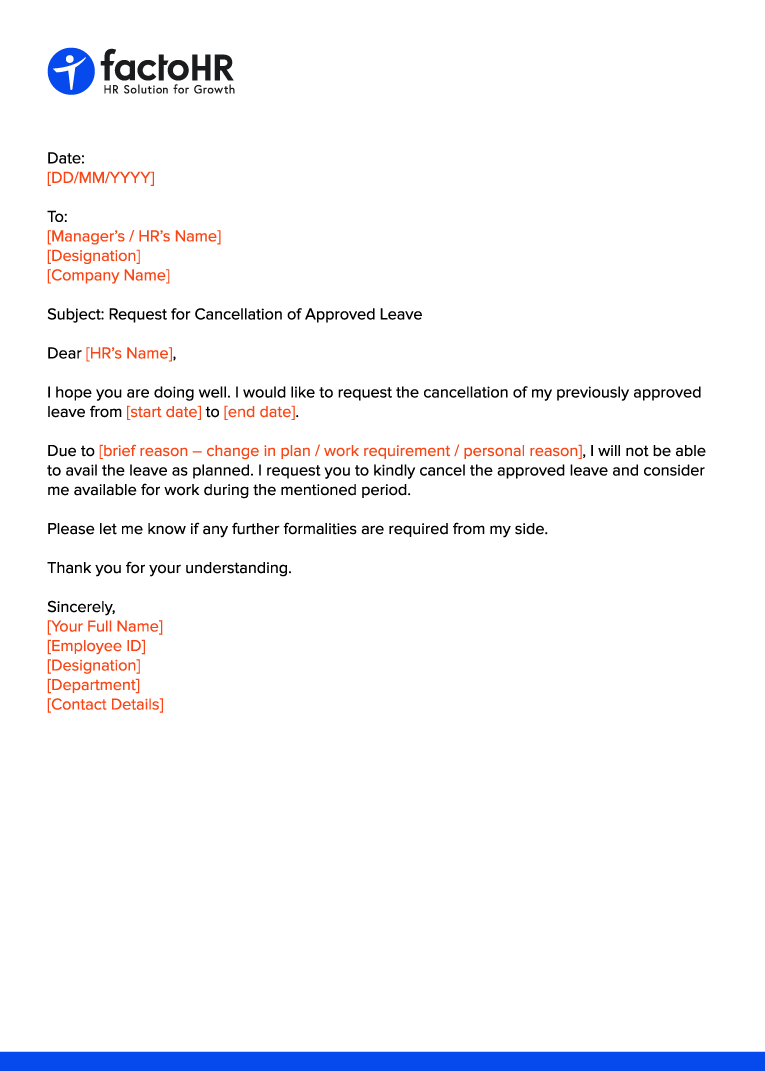
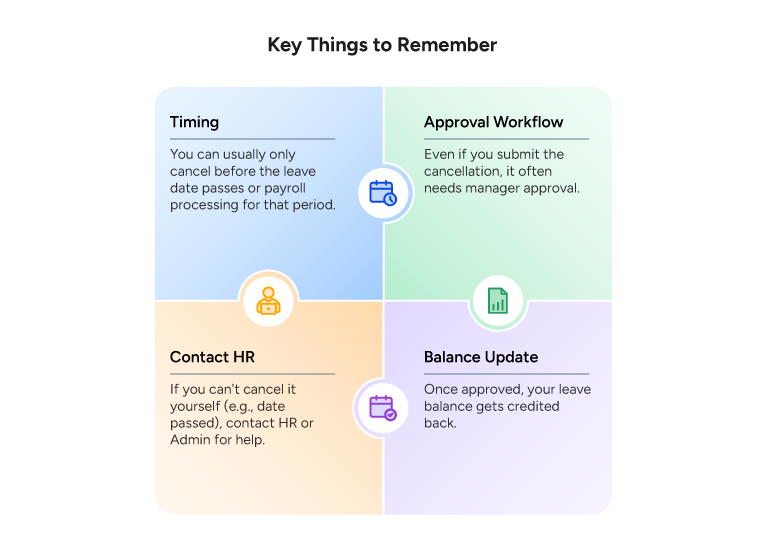
5 Sample Leave Cancellation Applications
Use these five sample leave cancellation request letters to send cancellation applications for different personal, work-related, administrative, or medical circumstances.
Sample 1: Simple Leave Cancellation Application
Date:
05/01/2026
To:
Anita Sharma
HR Manager
Brightwave Technologies Pvt. Ltd.
Subject: Request for Cancellation of Approved Leave
Dear Anita,
I hope this message finds you well. I am writing to request the cancellation of my approved leave scheduled from 10/01/2026 to 12/01/2026.
As certain personal commitments have been resolved earlier than expected, I no longer require the leave during this period. I request you to cancel the approved leave and mark me as available for work on those days.
Please let me know if any additional steps or approvals are needed from my end.
Thank you for your support.
Sincerely,
Rohit Mehra Employee ID: BW1024
Senior Executive – Operations
Operations Department
rohit.mehra@brightwave.com
Sample 2: Personal Leave Cancellation Application (Due to Change in Plan)
Date:
08/02/2026
To:
Neha Kulkarni
HR Business Partner
Vertex Solutions Ltd.
Subject: Request for Cancellation of Approved Leave
Dear Neha,
I trust you are doing well. I would like to inform you that I need to cancel my previously approved personal leave from 15/02/2026 to 18/02/2026.
Due to a change in family travel arrangements, the leave is no longer required. I request you to cancel the approved leave and update my attendance accordingly for the mentioned dates.
Kindly inform me if any formal documentation is required for this change.
Thank you for your understanding.
Sincerely,
Sneha Iyer
Employee ID: VS1189
Marketing Analyst
Marketing Department
sneha.iyer@vertexsolutions.com
Sample 3: Work Urgency Leave Cancellation Application
Date:
12/03/2026
To:
Rahul Deshpande
Head – Human Resources
Nexora Manufacturing India Pvt. Ltd.
Subject: Request for Cancellation of Approved Leave
Dear Rahul,
I hope you are keeping well. I am writing to request the cancellation of my approved leave from 20/03/2026 to 25/03/2026.
Given an unexpected increase in production workload and critical operational requirements, I will need to remain available at work during this period. I request you to kindly cancel the leave and record the same in the leave management system.
Please let me know if any further action is needed from my side.
Thank you for your consideration.
Sincerely,
Amit Kulkarni
Employee ID: NM2047
Production Planning Engineer
Manufacturing Department
amit.kulkarni@nexoraindia.com
Sample 4: Leave Cancellation Request for Administrative Needs
Date:
22/04/2026
To:
Priya Nair
Senior HR Executive
BlueOrbit Consulting LLP
Subject: Request for Cancellation of Approved Leave
Dear Priya, I hope you are doing well. I am writing to request the cancellation of my previously approved leave from 01/05/2026 to 06/05/2026.
Due to an administrative requirement related to audit coordination and documentation handover, I will be required to be at the office during this period. I therefore request you to cancel the approved leave and consider me available for work as scheduled.
Please let me know if any approvals or internal processes need to be completed for this request.
Thank you for your cooperation.
Sincerely, Kunal Shah
Employee ID: BO3312
Consultant – Strategy Consulting Department
kunal.shah@blueorbit.com
Sample 5: Medical Leave Cancellation Application
Date:
18/06/2026
To:
Suman Rao
HR Lead
GreenField Logistics Services
Subject: Request for Cancellation of Approved Leave
Dear Suman,
I hope this email finds you well. I am writing to request the cancellation of my approved medical leave from 20/06/2026 to 27/06/2026.
I have recovered and been cleared to return to work, so I will not take the remaining medical leave. I kindly request that you cancel the approved leave and update my records accordingly.
Please let me know if any kind of declaration or any other formality is required.
Thank you for your understanding.
Sincerely,
Pooja Verma
Employee ID: GF1786
Logistics Coordinator
Supply Chain Department
pooja.verma@greenfieldlogistics.com
Best Practices to Submit a Leave Cancellation Request
Follow these best practices to avoid delays in updating leave balance.
- Make sure to include the original date and time to make sure that your leave balance is calculated correctly.
- Use formal language, as the mail would be used for record-keeping.
- Mention the email address of your HR manager and inform them in person.
- Every firm has its own leave policies; make sure you submit the leave cancellation application on time.
- Only consider your leave request cancelled after you receive a confirmation ticket or email.
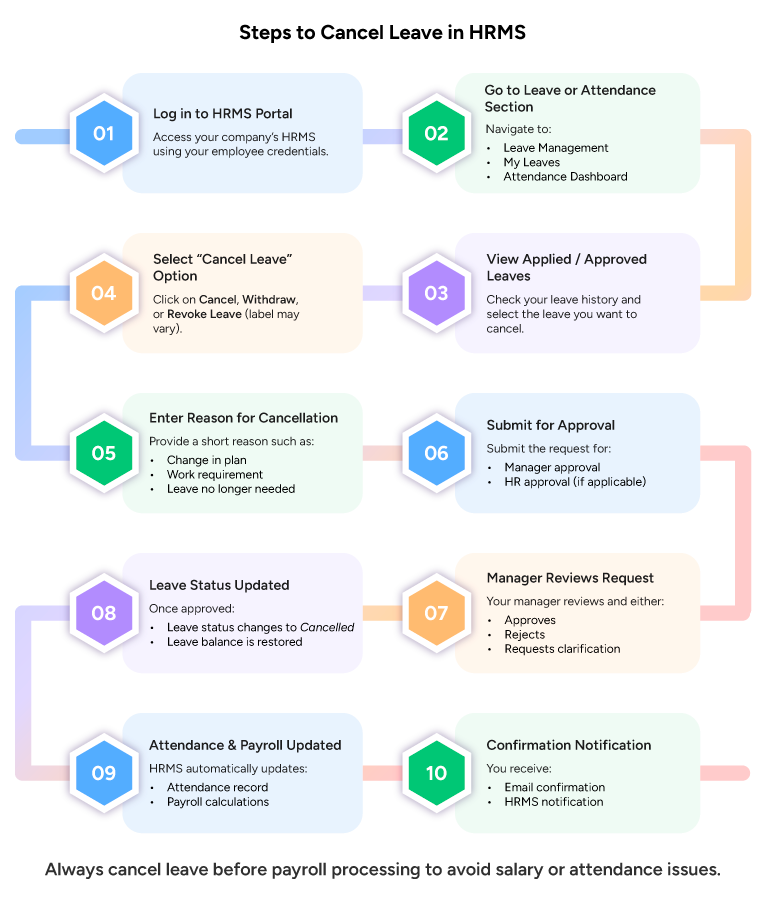
How Leave Cancellation Works in HR Systems
HR systems can help you automate all the aspects of leave cancellation. From integrating with attendance and payroll data to automatically updating leave balances, using HR software can significantly reduce the time spent processing leave requests. Most of the HR systems provide tickets or forms for filling out the cancellation requests, and managers can approve them through the software.
Managing Leave Cancellation Easily with factoHR HRMS
factoHR’s advanced automation and AI-powered features make leave management very easy. Employees can submit leave cancellation requests through tickets in minutes and track their leave balance anytime, anywhere through the ESS portal. Plus, they can also check the cancellation and approval status from their phones. Managers can approve leave requests in bulk, assign role-based controls to designated authorities, and store records digitally for audit purposes. Your employees can ask queries on leave policies to next-gen AI chatbot.
Give Your Employees and Managers a Smarter Way to Manage Leave.
FAQs
Can I Cancel My Leave after It has been Approved?
Yes, you can cancel your leave request after it has been approved. However, the deadline for cancelling the request depends on the policy.
How do I Request to Cancel My Leave?
The method for requesting cancellation varies by firm’s policy, but usually, you can send an email or open a ticket in your firm’s HR software.
Can I Cancel Leave after the Leave has Started?
Yes, you can cancel a time-off request even after it has started, especially if your leave is scheduled for multiple days.
Will My Leave Balance be Restored after Cancellation?
Yes, your leave balance is usually restored after the cancellation request is approved.
What is the Difference between Leave Cancellation and Leave Modification?
In leave cancellation, time off requests are cancelled. In leave modification, the duration of time off is modified.
What Happens if I Forget to Cancel My Leave?
If you forget to cancel your leave, then your leave balance will not be updated.
What are Common Mistakes to Avoid when Submitting a Leave Cancellation Request?
Using informal language, not informing HR, forgetting to mention the date and time, and not following your company’s leave policy are some of the common mistakes that you should avoid when submitting a leave cancellation application.
Which Information Should I Include in a Leave Cancellation Request?
Include the date when you write the letter, your designation and employee ID, email address, leave start and end dates, the contact details of your HR/relevant authority, and the reason for cancellation.
Table of Contents
Most digital marketing interviews test your basic knowledge, problem-solving skills, and how confidently you explain your ideas. Interviewers want to understand how you think, apply concepts to real situations, and communicate clearly.
This guide helps you prepare quickly and effectively. Whether your interview is in a few days or weeks, you can revise common questions, learn practical answers, and feel confident about how to respond.
Key Takeaways
- Understand what skills and knowledge interviewers expect from you
- Revise common digital marketing questions and answers
- Learn how to explain concepts like SEO, PPC, and analytics clearly
- Prepare real examples from your projects or experience
- Stay updated with the latest tools, trends, and Google updates
- Build confidence to answer questions calmly and professionally
- Walk into your interview feeling prepared and confident
Most Asked Digital Marketing Interview Questions with Answers
1. What is Digital Marketing in Your Words?
Reason Behind Asking: The interviewer wants to understand how clearly you can explain digital marketing in your own words, without using memorised or textbook definitions.
Sample answer: To me, digital marketing is about promoting a business online using channels like search engines, social media, email, and websites. My main focus is reaching the right audience and recognizing what marketing strategy actually results in better conversions.
2. Why did You Choose Digital Marketing as a Career?
Reason Behind Asking: They just want to know why you picked this field and if you’ve thought about it at all.
Sample Answer: I chose digital marketing because I enjoy working with data, creativity, and technology. I also like that results are measurable, and learning never really stops in this field.
3. Why is Digital Marketing Important for Businesses Today?
Reason Behind Asking: To check if you understand how digital marketing helps a business thrive in reality.
Sample answer: I think digital marketing is important because most people are looking for information online. People search, scroll, and shop online. It helps businesses reach the right people, spend money wisely, and see what’s working instead of guessing.
4. How is Digital Marketing Different from Traditional Marketing?
Reason Behind Asking: To know if you can explain the difference between the two in a simple and practical way.
Sample Answer: Traditional marketing uses offline methods like TV, newspapers, and billboards, where it’s hard to track results or change campaigns. Digital marketing uses online platforms like Google and social media, where you can target the right audience, measure results instantly, and improve campaigns anytime. This makes digital marketing more flexible, cost-effective, and easier to manage.
5. How does Digital Marketing Help in Business Growth?
Reason Behind Asking: To see if you can connect marketing efforts directly to growth.
Sample Answer: I think digital marketing supports growth by improving online visibility, attracting the right traffic, and turning interested users into leads or customers over time.
6. What are the Four Main Types of Digital Marketing?
Reason Behind Asking: This checks your basic understanding, which is common in marketing interview questions.
Sample Answer: As I understand it, the four main types are Search Engine Optimization (SEO), Pay-Per-Click (PPC) advertising, social media marketing, and email marketing. Each one plays a different role in reaching and engaging users.
7. What is the Difference between Traffic, Leads, and Conversions?
Reason Behind Asking: The interviewer wants to check whether you actually understand how the marketing funnel works in practice.
Sample Answer: Traffic is just potential leads visiting the website. Leads are the ones who show some interest, like sharing their email or details. Conversions happen when leads actually take desired actions, like signing up or buying.
8. How do Businesses Measure Digital Marketing Success?
Reason Behind Asking: To know if you understand how to truly evaluate your digital marketing efforts from the perspective of company objectives.
Sample Answer: I usually look at metrics like traffic, leads, conversion rate, cost per lead, and ROI. These numbers help me understand whether digital marketing efforts are actually working.
9. What is the Difference between On-Page and Off-Page SEO?
Reason Behind Asking: To check if you understand what aspects of SEO you control directly versus what is built externally.
Sample Answer: On-page SEO refers to optimization carried out on the website through content and keywords. Off-page SEO is about building trust outside the site, mainly through backlinks and mentions.
10. What is Technical SEO in Simple Terms?
Reason Behind Asking: They want to see if you can explain technical topics simply, which is important in digital marketing interview questions.
Sample Answer: For me, technical SEO is just about making sure the website runs properly. You have to optimize site loading speed, make mobile-friendly pages, and write SEO-friendly content for search engines without compromising quality.
11. How does AI Help with Automation in Marketing?
Reason Behind Asking: The interviewer wants to know if you are aware of current trends and practical use cases.
Sample Answer: I mostly see AI as something that saves time. It helps with scheduling emails, adjusting ads, replying to chats, and looking at basic data analytics. That makes work faster and reduces the margin of human errors.
12. What is PPC in Digital Marketing?
Reason Behind Asking: The interviewer just wants to check if you understand paid ads at a basic level and when they are used.
Sample Answer: PPC stands for Pay-Per-Click. It means running ads where you pay only when someone clicks. It’s usually used when quick traffic or visibility is needed. When managed well, it can deliver fast results and work alongside long-term strategies like SEO and content marketing.
13. What is Email Marketing, and where is It Used?
Reason Behind Asking: They want to see if you understand how businesses stay connected with customers.
Sample Answer: I use email marketing to stay in touch with users after they visit or sign up. It’s mostly used for updates, offers, and reminders. It also helps bring users back instead of losing them.
14. What is the Difference between White Hat SEO and Black Hat SEO?
Reason Behind Asking: The interviewer is checking if you understand safe practices versus risky shortcuts.
Sample Answer: I see white hat SEO as doing things the right way and following the rules of the search engine. Black hat SEO is about shortcuts that may work for a short time. But those methods usually cause problems later.
15. Recently, Google Released an Update. Do You Know What It was About?
Reason Behind Asking: They want to know if you stay aware of changes, not if you remember updated names.
Sample Answer: Yes, from what I’ve seen, recent updates focus more on helpful content. Google is trying to reduce low-quality pages. The main goal is better results for users.
Digital Marketing Interview Questions for Freshers
16. What is SEO, and why is It Important?
Reason Behind Asking: This is one of the most common digital marketing interview questions. Here, HR wants to check whether your basics are clear for handling fundamental SEO tasks.
Sample Answer: SEO stands for search engine optimization. It is the practice of improving a website’s quality, content, and structure to rank higher in unpaid (“organic”) search engine results, without paid ads. SEO brings steady, high-intent traffic.
17. How do You Stay Updated with Digital Marketing Trends?
Reason Behind Asking: They just want to see if you keep learning on your own or not.
Sample Answer: I mostly follow recent blogs by Ahrefs, Google, and Yoast to keep myself in line with recent trends. I also notice Google updates when they happen. Apart from that, I learn a lot by trying things myself and seeing what works.
18. How Would You Promote a New Website at a Basic Level?
Reason Behind Asking: They want to see how you think at a basic level and how you start, not advanced strategies.
Sample Answer: If I get a new website with no traffic, I would begin with basic SEO optimization to improve visibility, promote it on social media to build engagement, and run PPC ads to drive quick traffic and test performance. This helps generate initial visitors and gives useful insights to improve the strategy.
Digital Marketing Interview Questions for Experienced Candidates
19. How do You Create a Digital Marketing Strategy for a Business?
Reason Behind Asking: They want to know how you think and plan a digital marketing strategy based on project requirements.
Sample Answer: I start by understanding the business goals, target audience, and budget. Then I choose the right channels like SEO, social media, or PPC to run focused campaigns. This way, I can track results and optimize based on data to improve performance and drive better ROI.
20. How do You Decide which Marketing Channel to Focus on More?
Reason Behind Asking: The interviewer wants to know how you make decisions using data, not personal opinions.
Sample Answer: When more than one marketing channel is running at the same time, I first decide where to spend more time and budget. I also check which channels are giving better conversions and reasonable costs. This way, I can focus more on the channels that bring useful results, not just traffic.
21. How do You Prioritise Tasks when Everything Feels Important?
Reason Behind Asking: They just want to see how you deal with pressure when too much work comes together.
Sample Answer: When a lot of work comes at the same time, I try to get tasks done without getting confused or stressed. Then I decide what task needs to be done first and keep the rest aside for later. This makes the workload feel manageable and helps me avoid mistakes.
22. How do You Measure Success beyond Traffic and Leads?
Reason Behind Asking: They want to see if you look at real results, not just numbers that look good.
Sample Answer: First, I try to understand why the results are low. I check if the leads match the right target audience. Then I review conversions, costs, and the lead-to-sale rate. I also use performance management tools to track KPIs and analyze campaign performance. With this, I take feedback from the sales team to check lead quality. This helps me understand what is working and what needs improvement.
23. How do You Improve Lead Quality?
Reason Behind Asking: They want to know if you can fix quality issues, not just bring more leads.
Sample Answer: If leads are not converting, I first analyze the campaign data to find the issue. I review the audience targeting, messaging, and key performance metrics, then make the necessary changes to improve the campaign. This helps us reach the right people and turn them into actual customers.
Scenario-Based Digital Marketing Interview Questions
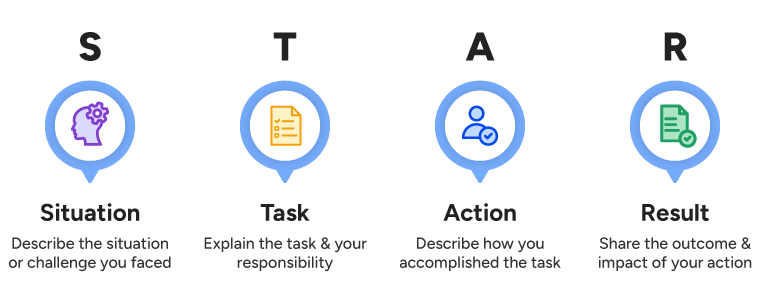
24. Website Traffic Suddenly Dropped. What’s the First Thing You’ll Check and why?
Reason Behind Asking: They want to see how you react under pressure and where you look first when troubleshooting.
Sample Answer: When website traffic drops suddenly, the first thing I check is the traffic source in analytics. I look at whether the drop is coming from organic search, paid ads, referrals, or direct traffic. This helps me quickly narrow down the cause. Sometimes, it happens due to a Google algorithm update or a technical problem on the site.
25. Your Page is Ranking on Page 2. What Will You do to Move It to Page 1?
Reason Behind Asking: They want to see how you think, not hear SEO buzzwords.
Sample Answer: If a page is ranking on page 2, I first check whether the content matches the user’s search intent. Then I improve the content quality and follow an on-page SEO checklist. I also review competitors and add any missing information. Making the page more helpful for users usually helps it move to page 1.
26. Rankings are Stable, but Impressions Dropped. What Could be the Reason?
Reason Behind Asking: To check if you understand the importance of updating content as per the recent trends.
Sample Answer: I’ve seen this happen when search demand goes down or SERP layout changes. Sometimes ads or new features push results lower even if rankings stay the same. That’s why I check trends and search results before changing anything.
27. A Client Wants Fast Results with a Low Budget. What would You Suggest?
Reason Behind Asking: They want to know if you can manage expectations honestly.
Sample Answer: In that case, I’m very clear with the client. I suggest focusing only on high-intent keywords and small targeted ads. Trying everything with a low budget usually doesn’t work, so I keep it simple.
Keyword Research Interview Questions
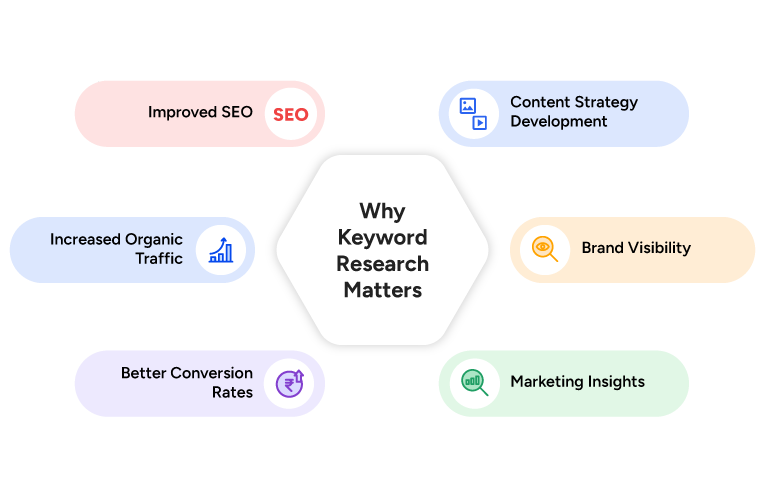
28. What are Keywords in SEO?
Reason Behind Asking: They want to check your basic concepts beyond the technical definition.
Sample Answer: In SEO, keywords are the words or phrases people type into search engines. I use them to make sure my content matches what users are searching for.
29. Why is Keyword Research Important?
Reason Behind Asking: The interviewer wants to check if you can identify high-value keywords using insight and intent, not just tools.
Sample Answer: I look at keyword research as understanding what people actually search for online. It’s important because it helps me create content that matches user intent and attracts the right kind of traffic.
30. What is Search Intent, and why does It Matter?
Reason Behind Asking: The interviewer is checking if you think from the user’s perspective, not just rankings.
Sample Answer: I understand search intent as the reason behind a search. It matters because content performs better when it answers what the user actually wants.
31. How do You Choose the Right Keywords for a Page?
Reason Behind Asking: They want to know how you think practically, not which tools you use.
Sample Answer: I choose keywords based on relevance to the page, user intent, and realistic competition. I focus on what supports the page goal instead of chasing high volume.
32. What is the Difference between Short-Tail and Long-Tail Keywords?
Reason Behind Asking: The interviewer wants to check if you understand keyword behaviour and quality.
Sample Answer: Short-tail keywords are broad and competitive. Long-tail keywords are more specific and usually bring more relevant, higher-quality traffic.
Need a Digital Marketing Manager for Your Team?
Generate a Ready-To-Use Job Description for Digital Marketing Manager with Clear Roles, Skills, and Responsibilities.
Digital Marketing Tools & Analytics Interview Questions
33. Which Tools are Commonly Used by Digital Marketers?
Reason Behind Asking: The interviewer wants to check if you’ve actually worked with common tools, even at a basic level. They also want to see if you understand why you use them.
Sample Answer: I usually use Google Analytics and Google Search Console for tracking and website testing. For SEO, I’ve used tools like Ahrefs. If I’m running ads, I use Google Ads to manage and optimize campaigns.
34. What is Google Search Console Used for?
Reason Behind Asking: They want to know if you understand what the tool helps you do in real work, not a feature list.
Sample Answer: I use GSC to see how a website is doing on Google search. It shows me which pages are visible, what people searched for, and if Google is facing any issues crawling the site.
35. How does Google Search Console Help Website Owners?
Reason Behind Asking: They want to see if you can explain the value in a simple way, like talking to a client or manager.
Sample Answer: I find it helpful because it shows problems that stop a site from ranking properly. It also tells me which pages are getting traffic and where clicks come from. This helps website owners fix the right issues instead of guessing.
36. What is the Purpose of SEO Tools like Ahrefs?
Reason Behind Asking: They want to check if you understand how SEO tools help make better decisions.
Sample Answer: I use tools like Ahrefs to see what competitors are doing. It helps me find keywords, check backlinks, and spot gaps. This way, SEO work is based on data, not assumptions.
37. Why is Analytics Important in Digital Marketing?
Reason Behind Asking: They want to see if you understand why data matters in day-to-day marketing, not just tools.
Sample Answer: For me, analytics is important because it shows what’s really working. It helps me see how users engage with landing, service, or product pages. Once I see the data, I can improve campaigns and avoid wasting money.
38. How do Marketers Measure ROI in Digital Marketing?
Reason Behind Asking: They just want to see if you understand whether marketing is actually helping the business.
Sample Answer: ROI doesn’t necessarily have to be a monetary transaction against your digital marketing efforts. The return on investment could be sales, good leads, or conversions. If nothing useful is coming out of campaigns, then something needs to change.
39. Why is Tracking Performance Important for Campaigns?
Reason Behind Asking: They want to see if you understand that campaigns need regular checking.
Sample Answer: I track performance to see how a campaign is doing while it is running. If something is not working, I try to fix it early. Waiting until the end often means wasting time and money.
40. How does Data Help Improve Marketing Decisions?
Reason Behind Asking: They want to know if you use data to make decisions instead of guessing.
Sample Answer: I use data to see what is working and what is not. It helps me choose the right channels, messages, and audience. This makes decisions clearer and reduces guesswork.
Digital Marketing Interview Questions on Backlinks
41. What is a Backlink and why is It Important?
Reason Behind Asking: They want to see if you understand why backlinks matter.
Sample Answer: For me, a backlink is when another website links to my site. It matters because it shows search engines that other sites trust the content. Good backlinks usually help a website get better visibility and rankings over time.
42. What Makes a Backlink High Quality or Low Quality?
Reason Behind Asking: They want to see if you can tell the difference between good links and bad ones, not just count links.
Sample Answer: I see a good backlink as one that comes from a relevant and trusted website. Low-quality links usually come from spammy sites. For me, having a few good links matters more than having many weak ones.
43. What is the Difference between Dofollow and Nofollow Links?
Reason Behind Asking: The interviewer is checking if you understand how links pass value.
Sample Answer: Dofollow links pass SEO value to a website. No-follow links don’t pass ranking value, but can still bring traffic. Both types can be useful in a natural link profile.
44. Why are Backlinks Important for SEO Rankings?
Reason Behind Asking: They want to see if you understand how backlinks influence rankings beyond their technical definition.
Sample Answer: For me, backlinks matter because other websites are pointing to your site. It feels like a trust signal to search engines. When trusted sites link to you, pages usually rank better.
45. How do Backlinks Support Website Authority?
Reason Behind Asking: They want to check if you understand how authority is built over time.
Sample Answer: For me, backlinks help build authority because other sites are linking back. When good websites link to you, it adds credibility. Over time, this makes the site stronger in search results.
Content Marketing Interview Questions and Answers
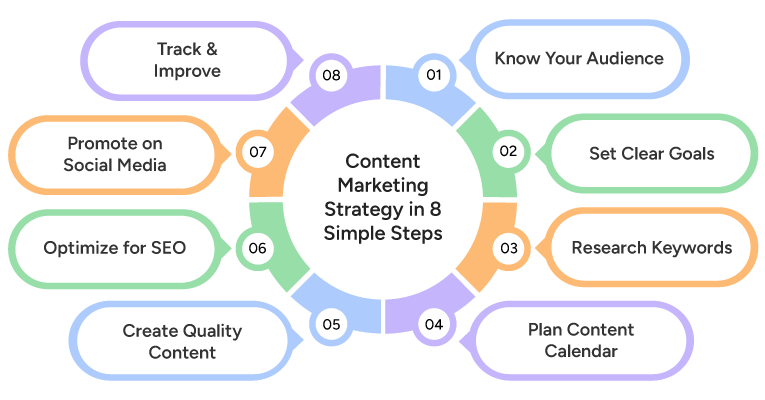
46. What Role does Content Play in Digital Marketing?
Reason Behind Asking: The interviewer wants to check if you understand that content supports the whole marketing process, not just blog writing.
Sample Answer: I see content as the starting point of digital marketing. It helps bring people to the website and answer their questions. Good content also helps with SEO, social media, and getting leads.
47. Why is Content Marketing Important for Brands?
Reason Behind Asking: They want to see in which field you will prioritize, such as brand value or quick promotions.
Sample Answer: I think content marketing is important because it represents brand authority. Brands can explain things and share useful information instead of only selling. Over time, people trust the brand more and engage with it naturally.
48. What Type of Content does Google Prefer to Rank Higher?
Reason Behind Asking: They just want to see if you know that Google prefers content that helps users.
Sample Answer: From what I’ve seen, Google likes content that is useful for people. If it answers questions clearly and matches what users search for, it performs better. Simple, original, and easy-to-read content usually ranks higher over time.
Social Media Marketing Interview Questions and Answers

49. How do Social Media Platforms Help Businesses Grow?
Reason Behind Asking: They want to see if you understand how social media helps a business thrive beyond just posting content.
Sample Answer: Social media is the best medium for businesses to talk directly to their audience. It helps build relationships, bring people to the website, and get leads. Businesses also get quick feedback from users through comments and messages.
50. Which Social Media Platform Should a Business Choose and why?
Reason Behind Asking: The interviewer wants to check how you decide the right platform based on the ideal audience niche for a business.
Sample Answer: The right social media platform depends on your business goals and ideal audience. For example, LinkedIn works better for B2B businesses, while Instagram suits better if you are dealing with visual brands. So, you have to choose the platform where the target audience is most active.
51. What is the Importance of Engagement on Social Media?
Reason Behind Asking: Here, the interviewer wants to test your clarity of a healthy engagement over follower count on social media.
Sample Answer: I call it a healthy engagement when viewers interact with the post. It can be a like, comment, or share. It shows the post is working. When engagement is good, content gets a wide reach without running ads.
52. How do Social Media Activities Support Brand Awareness?
Reason Behind Asking: The interviewer wants to know if you understand visibility and recall, not just paid ads.
Sample Answer: I think regular activity on social media keeps the brand visible. Regularly engaging with a potential audience through new posts and comments increases brand awareness. Over time, this creates familiarity and trust.
53. How do Businesses Measure Social Media Success?
Reason Behind Asking: They want to see if you focus on meaningful metrics instead of vanity numbers.
Sample Answer: It depends on the campaign goal, not just follower count. I measure success using engagement, reach, traffic, and conversions. These metrics show whether social efforts are actually working.
Meta Ads Interview Questions
54. What are Meta Ads?
Reason Behind Asking: The interviewer wants to check if you understand what Meta Ads actually mean in practice, not the company definition.
Sample Answer: Meta Ads are paid ads that we can run on Facebook and Instagram. They help businesses promote products, services, or content to specific audiences. I mainly use them to reach users based on interests, behavior, and demographics.
55. Why do Businesses Use Facebook and Instagram Ads?
Reason Behind Asking: They want to see if you understand the business value, not just that these platforms are popular.
Sample Answer: Businesses use ads to target the right audience easily. You can reach a large audience quickly and get visibility fast. They also work well for building awareness and bringing in leads.
56. How do You Decide the Right Audience for Meta Ads?
Reason Behind Asking: The interviewer is checking your targeting logic, not advanced ad features.
Sample Answer: I decide the audience based on business goals and customer profile. I look at age, location, interests, and behaviour. I also test and refine audiences based on performance data.
How to Prepare for a Digital Marketing Interview
- Revise common digital marketing interview questions and practice your answers out loud
- Review basics like SEO, PPC, content, social media, and analytics
- Prepare simple examples from your past work, projects, or learning
- Stay updated with recent Google updates and industry trends
- Be clear about the tools you’ve used and the results you achieved
- Understand key metrics like traffic, leads, conversions, and ROI
- Explain concepts in simple words, not complex technical terms
- Prepare a few questions to ask the interviewer about the role
- Keep your answers short, confident, and conversational
- Get proper rest and arrive calm and prepared
Related Job Descriptions Sample:
Frequently Asked Questions
Is Digital Marketing a Good Career Option for Me in 2026?
Yes, digital marketing remains a strong career choice in 2026. You can find many opportunities in areas like AI-powered marketing, performance marketing, data analytics, visual and voice search, and influencer marketing.
Which Digital Marketing Role Should I Focus on for Better Job Opportunities?
You should focus on high-demand roles like SEO Specialist, Performance Marketing (PPC/SEM) Specialist, or Digital Marketing Manager.
How Long Will It Take Me to Learn Digital Marketing?
You can learn the basics in 1–3 months. With consistent practice, you can become job-ready within 6–12 months and start applying for entry-level roles. Advanced expertise may take 1–2 years or more.
What Skills do Interviewers Look for in Digital Marketing Candidates?
Interviewers look for a mix of technical, analytical, and soft skills. You should know SEO, PPC, analytics, content, and social media marketing. They also value problem-solving, clear communication, creativity, and the ability to adapt quickly to new tools and trends.
Related Interview Questions:
Table of Contents
Free Payslip Generator
What is a Payslip?
A payslip also called a wage slip or salary slip is a document the employer gives to an employee. It clearly shows your earnings, deductions, and other payroll details. A Payslip format includes details like gross earnings (including basic pay and allowances) and deductions (including taxes and insurance).
Steps to Create Your Salary Slip Using Payslip Generator
There is a step-by-step and user-friendly process to how to make salary slip. Our payslip generator can be created in just a few steps with customizable templates, along with maintaining compliance with laws. Here are the steps below:
- Step 1: Fill in the basic details about the company, which include name, logo, address, and many more.
- Step 2: Include employee information, which includes employee ID, designation, PAN, and bank details.
- Step 3: Income details like basic salary, allowances, bonuses, and deductions (for example, taxes and provident fund) should be entered.
- Step 4: Lastly, preview or download the generated payslip in PDF format.
Understand Salary Slip Format
There are multiple formats of salary statements that an organization follows. Some of the basic elements remain the same, which are mentioned below:
- Header Info: Start with pay period, employee name/ID/PAN, and other important details to confirm the document’s context and validity.
- Review Earnings Breakdown: Check gross pay components like basic salary, HRA, conveyance, medical, and other allowances to calculate total income.
- Check Deductions: This includes statutory (PF, ESI, PT) and voluntary subtractions (TDS, loans), which are calculated to determine the salary.
- Calculate Net Pay: Subtract deductions from earnings to verify take-home salary.
- Verify Extras: Review attendance (days worked, leave), overtime, and any employer contributions.
Key Components of a Payslip
Earnings Section
Basic Salary
It is the total amount of earnings by an employee before any allowances or deductions are made from their salary structure, which is up to 30-50% of the total package.
HRA (House Rental Allowance)
Employees who are living in a rental house can claim HRA to cover the expenses of rental accommodation. Using the HRA Calculator, employers can easily understand how much exemption their employees can claim.
DA (Dearness Allowance)
Dearness allowance is offered to support the employees against inflation, which is decided based on the cost of living and the employee’s location.
Leave Travel Allowance (LTA)
In Leave Travel Allowance, companies need to track all travel-related expenses. Using expense management software makes it easier for HR teams to record and manage these costs.
Performance Bonus
Employers provide bonuses based on employees’ performance, which are considered taxable, and the amounts can vary across organizations.
Medical Allowance
Employees can claim this allowance by providing supporting documents for medical treatment costs incurred during their employment period.
Conveyance Allowance
Companies provide this allowance to cover employees’ traveling costs between the workplace and their residences.
Deduction Section
TDS (Tax Deducted at Source)
This is the advance tax deducted from an employee’s earnings and deposited with the government on their behalf. Businesses/employees can estimate their income tax amount with our income tax calculator to know more tax liability.
Professional Tax (PT)
Professional tax is a payable amount based on the employee’s salary. It is an amount deducted from an individual’s salary, and it varies across states in India.
Employee Provident Fund (EPF)
It is a mandatory saving scheme in India where both the employee and employer contribute towards the EPF account of the employee. It is monitored by the Employee Provident Fund Organization (EPFO) and includes benefits like pension and insurance.
Importance of Employee Salary Slips
Proof of Employment
Employees can use payslips when they are required to provide legal proof of employment. If employees apply for travel visas, they may need to provide a copy of their payslip as proof of their most recent salary and job title.
Salary Slip for Pay Negotiations
A payslip can be helpful when negotiating with potential employers about the total CTC and its components (e.g., basic salary, deductions, etc.). Most employers ask for employees’ past payslips to verify employment and earnings.
Easy Income Tax Planning
A monthly salary slip shows a breakdown of an individual’s total earnings, deductions, and taxable components. The break-up of deductions includes professional tax, TDS, ESIC, and EPF.
To Avail Loans/Credit Cards
This document can be used as legal proof of an individual’s credit-paying ability, i.e., when availing credit cards, loans, and mortgages. Banks or NBFCs can verify the creditworthiness of an individual based on the information from salary statements.
Conclusion
Organizations should know that a reliable free payslip generator can simplify payroll cycle management and help maintain compliance. There are multiple vendors that can help save time and reduce errors when it comes to payroll processing. This includes automated calculations and customization in the payslip.
Using a payslip generator is necessary to simplify HR operations and boost employee satisfaction. Companies can focus on growth and long-term success with automation with factoHR’s payslip generator.
FAQs
What is a Salary Slip Generator Tool?
A salary slip generator tool creates professional payslips for employees, including earnings, deductions, and net pay details. These tools are cloud-based and free for basic use. Know the difference between gross pay vs net pay to understand the topic better.
Can I Customize the Payslip Template?
Yes, you can customize the payslip template. Our generator allows customization, like adding a company logo and other specific fields.
Do I Need to Install any Software to Generate the Payslips?
No, these tools are fully cloud-based and work online without any software installation. These can be used via web browsers on any device.
Can I Remove or Hide Specific Components on the Payslip?
Yes, you can remove or hide specific components on the payslip. Our tool allows you to select which fields to display, so you can easily hide any salary component you do not want to show.
Can I Generate Payslips for Multiple Employees?
Yes, our salary slip generator helps you to generate bulk salary slips for multiple employees at once. It works for small teams as well as large organizations.
Is Disclosing Salary Details Legal in India?
Employees should not share information about their salary packages and offered benefits. There is no specific rule from the government, but some companies may have clauses (in employment contracts) that clearly prohibit employees from disclosing their salary details.
Table of Contents
Boomerang hiring is on the rise as companies bring back employees who left during the Great Resignation. Many workers thought new jobs would be better, but found they didn’t meet expectations, a phenomenon known as the “grass is greener” phenomenon. This is now called the Great Regret. This shift has led companies to welcome back skilled talent familiar with their culture.
In this blog, we explore who boomerang employees are, why they leave and return, the value and pros/cons for employers, and best practices for a smooth rehiring process that maximizes productivity, loyalty, and overall value.
Key Takeaways:
- Explains what boomerang employees are and why they are becoming more common after the Great Resignation and Great Regret
- Examines the key reasons employees leave organizations, including career growth, life changes, burnout, and company shifts
- Explores why employees choose to return to former employers and the factors influencing their decision
- Highlights the value and benefits of boomerang hires for employers, such as faster productivity and lower hiring risk
- Outlines the pros and cons of rehiring former employees to support informed hiring decisions
- Shares best practices for employers and employees to ensure a smooth and successful rehiring process
What is a Boomerang Employee?
A boomerang employee is a worker who returns to a previous employer after leaving. The employee may have left voluntarily for personal or professional reasons. Even seasonal workers can return to previous jobs or pursue new positions. This has become more common, with a notable number of new hires in some firms being former employees.
Companies value boomerang employees for their familiarity with the culture and reduced onboarding requirements. They also bring new skills gained elsewhere, which can increase productivity and lower hiring costs. However, challenges like short-term commitments or unresolved past issues require careful evaluation before rehiring former employees.
Why do They Leave?
Employees leave organizations for multiple reasons, for example, personal and professional. Some step away in search of better opportunities, while others leave due to temporary life circumstances. They might return to the previous organization as boomerang employees. Some Common explanations for why an employee temporarily leaves work are:
- Market Dynamics and Job Trends: Company changes like restructuring, layoffs, or job cuts can also cause employees to leave.
- Company Culture: Long work hours, strict schedules, or burnout can cause employees to leave their organization.
- Personal Commitments: Relocation, caring for family, health issues, or a spouse’s job change can also prompt employees to exit temporarily.
- Planned or Seasonal Departures: Retirees, seasonal workers, or ‘snowbirds’ sometimes leave but plan to come back later.
Why do They Return?
Research and workplace trends show that practical needs, emotions, and career goals play a big role in employees returning to their previous jobs. Whether they didn’t find a better fit elsewhere or realized their old role suited them better, there are common reasons behind their decision to come back. Some Key reasons include:
Disappointment with the New Job
Many employees leave because they are excited about new opportunities. But they find that the new job doesn’t meet their expectations due to poor work culture, unclear roles, limited growth opportunities, or weak leadership. When this happens, their previous position feels more stable and appealing, leading them to want to return.
Stronger Relationships and Emotional Attachment
Employees often leave companies due to temporary issues, but have lasting bonds with coworkers or leaders. These relationships can make them want to return if they miss the teamwork or feel loyal to the company.
Better Pay
Employees often negotiate higher salaries or improved conditions upon return, as data shows boomerangs earn more than those who never left.
Technology and Digital Transformation
Advances enabling remote work allow returns for those who left due to relocation needs, now supported by new infrastructure.
Cultural Transformation
Companies that improve workplace culture, benefits, or flexibility (e.g., hybrid options) address past issues and attract former employees back.
Personal Circumstances
Changes in personal circumstances, such as family needs, health reasons, or life reevaluation, may make it easier for employees to return feeling recharged or after changes like family relocations are resolved.
External Factors
Changes in the job market or industry downturns might make a return to a former employer more practical or desirable.
What is the Value of a Boomerang Hire & Benefits for Employers?
Boomerang hires, or rehiring former employees, deliver significant value to employers. This can be achieved through cost savings, faster productivity, and reduced risks. These employees often adjust quickly and bring new ideas from other workplaces, and already understand the company culture and expectations.
Faster Productivity
Boomerang hires already know the company’s systems, culture, and expectations, so they need less training and can perform their jobs effectively more quickly.
Lower Hiring Risk
Since the employer has worked with them before, their skills, work ethic, and performance are already known, reducing the risk of hiring an unsuitable candidate.
Reduced Recruitment and Training Costs
Rehiring former employees also cuts recruitment and onboarding costs compared to new hires, since far less time and resources are needed for integration and training.
Stronger Engagement and Loyalty
Employees who return often feel more committed and appreciative, which can lead to higher motivation and better retention.
New Perspective with Company Knowledge
Boomerang hires bring new skills, networks, and ideas gained from other workplaces while still understanding how the organization operates.
What are the Pros and Cons of Hiring Boomerang Employees?
Hiring boomerang employees can offer advantages, but it may also present challenges. The table below highlights key features and how each can help or create difficulties for employers.
Pros and Cons
| Feature | Pros | Cons |
|---|---|---|
| Onboarding and Training | Faster onboarding and lower costs due to prior familiarity. | May expect higher pay, increasing compensation expenses. |
| Performance and Skills | Bring new experiences, skills, and networks for higher productivity. | May not bring as many completely fresh ideas as a new hire. |
| Culture and Retention | Stronger loyalty, better fit, and boosted team morale. | Could cause resentment with present coworkers due to perceived favoritism. |
| Hiring Risks and Costs | Reduced recruitment risks and overall savings up to 50%. | Revival of past issues or concerns about loyalty. |
Best Practices for Re-Hiring and to Return for Employers & Employees
Rehiring former employees can be advantageous if done thoughtfully. Both employers and returning employees should follow best practices to ensure a smooth transition, set clear expectations, and build good relationships.
For Employers: Best Practices for Re-Hiring
- The “Exit Interview” Review: Review the employee-exit notes and past performance. Determine whether they left on good terms and if their return is likely to be positive. This helps HR to avoid past mistakes and shows improvement.
- Resetting Expectations: Do not assume returning employees will automatically fit back into their old roles. Discuss any changes related to the role or company goals, along with clearly explaining performance expectations.
- Compensation Conversations: Knowing the payroll calculation and the employee’s new experience, compare the salary to current market rates. Be transparent regarding any adjustments to compensation, benefits, or bonuses to ensure fairness and maintain trust.
For Employees: How to Return Gracefully
- Don’t Burn Bridges: Always leave on good terms and honor notice periods, as your past reputation can affect future opportunities.
- The Narrative: When interviewing to return, focus on what you have learned and how you have grown. Keep your response brief, positive, and focused on the future.
- Reintegration: Work on building good relationships with former coworkers, who might now be managers, as well as with new colleagues. Show flexibility and professionalism.
Questions to Consider with Boomerang Employees
Why Come Back to Us Instead of Moving Forward to a New Company?
Sample answer: “Returning lets me work with people and a culture I already know and trust, while bringing the new skills and experience I gained elsewhere. It offers a faster, more meaningful impact than starting from scratch at a new company.”
How do You Feel about Rejoining the Team where Former Peers Might Now be Your Managers (or Vice Versa)?
Sample answer: “I feel confident and adaptable, ready to respect the new roles while maintaining strong teamwork and collaboration. I see it as an opportunity to grow, collaborate, and contribute positively in a familiar environment.”
What is the One Thing You Learned at Your Other Job that You Think We are Missing Here?
Sample answer: “The one thing that I learned at my other job is the power of daily stand-up meetings to align teams and identify issues early. Implementing a similar approach here could boost collaboration and resolve challenges more quickly.”
What have You been Doing and Learning since You Left?
Sample answer: “Since leaving, I’ve been building my skills and expertise in AI and data analysis through online courses and hands-on projects. These experiences have improved my problem-solving and renewed my interest in working on innovative projects.”
You Left for a Specific Reason. Why is that No Longer an Issue for You?
Sample answer: “The reason I left has been addressed, and I’ve used the time since to grow my skills and gain new experiences. I’m now fully focused and ready to commit to contributing long-term to a team.”
People Also Ask
How to Handle Boomerang Employees?
To handle rehiring of former employees, treat them like any other candidate, evaluate their skills, experience, and fit for the role. Consider their past contributions and growth since leaving to make an informed decision.
Why do So Many Boomerang Employees Come Back?
Boomerang employees often return as new jobs fail to meet expectations, like work culture, poor leadership, or work-life imbalance, making the familiar environment appealing. They also come back for better pay, promotions, stability, and strong ties to former colleagues.
Are Boomerang Employees Common?
Yes, boomerang employees are increasingly common.
What is the Company Boomerang?
It refers to a former employee who returns to work at a company after leaving. In HR and business contexts, the term “boomerang employee” is widely used.
Is Being a Boomerang Employee Good?
These employees return to new jobs that fail to meet expectations, like
- Work culture
- Poor leadership
- Work-life imbalance
- Better pay
- Promotions
- Stability
- Strong ties to former colleagues
Do Boomerang Employees Get Paid More?
These employees receive higher pay and benefits when they bring new skills or experience to the firm. The compensation depends on the role and market conditions, which are sometimes uncertain.
How Long Should You Wait before Returning to a Previous Employer?
There is no fixed timeline for returning, but it is advised to wait for almost 12-18 months. This helps employees to gain experience and highlight their growth for any unresolved matters.
Table of Contents
Some of the strongest workplaces began with a simple change in how people were supported. As the organization grows, the way HR actually shows up in day-to-day interactions is becoming quite important to people. This is the reason why many HR leaders are rethinking how relationships at work are managed as teams evolve.
This article helps you understand common Relationship Manager interview questions, red flags to avoid, and a last-minute preparation checklist to help you get ready for the role.
Key Takeaways
- Clear explanation of what a relationship manager does
- Fresher-friendly relationship manager interview questions with sample answers
- Behavioral answers using real-life examples
- Common CRM tools and basic performance tracking you should know
- last-minute Interview preparation checklist and red flags to avoid
What is a Relationship Manager?
A relationship manager is a professional who turns everyday client interactions into tangible business value. In simple words, they are the trusted bridge between a company and a client; always listening, solving problems, and building rapport. They play a key role in driving growth by strengthening customer trust.
General Interview Questions for Relationship Manager
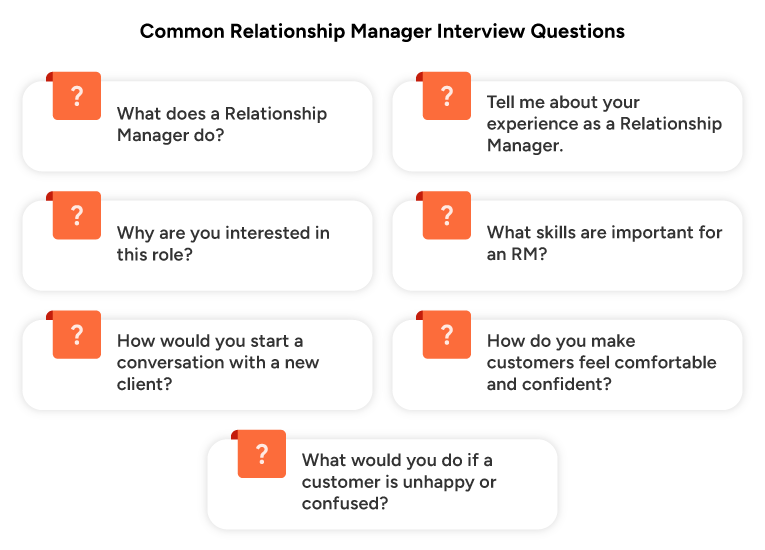
1. What does a Relationship Manager do in Simple Words?
Reason Behind Asking:
To check if you can clearly understand the job responsibilities, beyond the fancy job title.
How to Answer:
Explain in plain language, focusing on clients, trust-building, and problem-solving.
Sample Answer:
A relationship manager understands their client’s needs, solves problems, and makes sure that they feel valued. The specific goal of an RM should be to build an unshakable rapport so that the customer stays with the company for a long time.
2. Why are You Interested in this Role?
Reason Behind Asking:
To understand your mindset and check whether you see this as a long-term career.
How to Answer:
You can connect the answer to your interest in people, learning, and responsibility.
Sample Answer:
I enjoy working with people and solving problems. This role allows me to understand client needs while helping customers succeed. I see it as a strong foundation to grow professionally while adding real value to clients.
3. What Skills do You Think are Important for a Relationship Manager?
Reason Behind Asking:
To check if you actually understand the skills needed to be successful in this role.
How to Answer:
You can talk about your people skills and basic business thinking.
Sample Answer:
In a relationship manager role, good communication, listening skills, patience, and a problem-solving attitude are very important. A relationship manager must be organized and honest, which can make the clients feel confident and supported.
4. What does Good Customer Service Mean to You?
Reason Behind Asking:
To analyze your service mindset and attitude toward client interactions.
How to Answer:
Focus on showcasing how you can be empathetic, clear, and persistent at the same time.
Sample Answer:
Good customer service means understanding the customer’s concern, clearly responding to their queries, and ensuring that the issue is resolved. The customer should feel heard, respected, and confident with the company.
5. How Would You Start a Conversation with a New Client?
Reason Behind Asking:
To gauge your confidence, first-impression skills, and approachability.
How to Answer:
Show politeness, confidence, and curiosity. Start simple and client-focused.
Sample Answer:
I would start by introducing myself clearly and thanking them for their time. Then I’d ask an open question about their needs or expectations. This helps break the ice between the client and me, while showing my genuine interest in understanding them.
6. How do You Make a Customer Feel Comfortable while Talking to You?
Reason Behind Asking:
To analyze your trust and comfort-building ability
How to Answer:
Focus on listening, calm communication, and respect.
Sample Answer:
I listen patiently, maintain a calm tone, and avoid interrupting. I acknowledge their concerns and speak in simple language. When customers feel heard and respected, they naturally feel more comfortable sharing their concerns openly.
7. How Would You Explain Something Complicated in a Simple Way?
Reason Behind Asking:
To test clear thinking and communication skills.
How to Answer:
Show structure, simplicity, and clarity.
Sample Answer:
I would break the information into small parts and use simple examples. I’d avoid technical terms and check if the customer understands before moving ahead. Clear communication builds confidence and prevents confusion.
Situational Interview Questions for Relationship Manager
Situational questions test your behaviour under pressure. Interviewers do not look for perfect answers; rather, they expect calm judgment and customer-first thinking. Strong candidates respond with clear logic and act responsibly in difficult situations.
8. What Would You do if a Customer is Unhappy or Confused?
Reason Behind Asking:
To analyze your empathy while solving client problems
How to Answer:
Use If/Then logic and show empathy before action.
Sample Answer:
If a customer is unhappy, then I would first listen without interrupting and understand the issue with 100% clarity. If the client is confused, then I would explain the solution in simple terms plus confirm their understanding before taking action.
9. How Would You Handle a Client Who is Not Responding to Calls or Messages?
Reason Behind Asking:
To check your persistence, professionalism, and respect for boundaries.
How to Answer:
Show follow-up discipline without sounding desperate or aggressive.
Sample Answer:
If a client is not responding, then I would try a polite follow-up through a different channel. If there is still no response, then I would wait and reach out again with a clear reason and try not to come off as pushy.
10. If Two Clients Need Help at the Same Time, how Would You Manage It?
Reason Behind Asking:
To evaluate your decision-making ability.
How to Answer:
Show how well you can assess urgency.
Sample Answer:
If both clients need help, I would first quickly assess the urgency of each task. If one issue is critical, then I address the urgent task first while informing the other client about a short delay and expected resolution time.
Behavioral Interview Questions for Relationship Managers
Behavioral questions help the interviewer analyze how you act, think, and respond under real-world situations. Interviewers want to see your mindset as well as how well you professionally adapt to situations. Your self-awareness and emotional intelligence are what make you a good customer relationship manager.
11. Tell Me about a Time You Helped Someone Solve a Problem
Reason Behind Asking:
To analyze whether you would take initiative and go above and beyond for your client.
How to Answer:
Use a real example. Highlight listening, action, and result.
Sample Answer:
In my previous role, a client was not sure about our service package. I listened carefully and identified their key concerns. With clear steps, I then provided a tailored solution. The client felt heard and confident, which also helped us retain their business. I learnt that patience and understanding often solve problems faster than rushed solutions.
12. How do You Handle Pressure or Deadlines?
Reason Behind Asking:
To check how you manage stress and handle focus.
How to Answer:
Show planning, calmness, and communication.
Sample Answer:
I prioritize tasks and break projects into manageable steps. If there is a possibility of deadlines overlapping, I always communicate early with clients or team members. This helps me set realistic expectations while being proactive.
13. How do You React to Feedback or Corrections?
Reason Behind Asking:
To check whether you have a learning mindset.
How to Answer:
Position feedback as growth, not criticism.
Sample Answer:
Feedback is a way for immense improvement. I understand the causes and then implement the changes needed. This is what strengthens my performance and client relationships.
14. How do You Stay Informed about Industry Trends?
Reason Behind Asking:
To check how you would always be prepared for your clients.
How to Answer:
Mention continuous learning habits.
Sample Answer:
I follow industry trends, plus webinars, and read newsletters. These resources help me provide relevant advice to my clients and also be a credible point of contact for them.
Relationship Manager Interview Questions on Work Experience
Work experience questions are made to understand the level of your client management skills. They tell the interviewer about your practical exposure and how well you can perform. As a fresher, you can also highlight major achievements from your projects, internships, or volunteer expeditions.
15. Can You Explain Your Previous Role as a Relationship Manager?
Reason Behind Asking:
To understand what kind of responsibilities you have been accountable for in the past
How to Answer:
Summarize responsibilities clearly and confidently.
Sample Answer:
I managed a portfolio of clients, monitoring accounts and resolving their queries. I collaborated with internal teams to provide the best solutions. After this, I followed up regularly to continue value-added interactions for building trust.
16. How do You Build Long-Term Relationships with Clients?
Reason Behind Asking:
To check your strategic thinking ability and customer retention approach.
How to Answer:
Focus on showing consistency and trust-building.
Sample Answer:
I focus on understanding the client’s goals via regular check-ins and proactive problem-solving. Personalized communication and celebrating milestones while keeping the client informed are my way of building strong client relationships.
17. What Kind of Targets or Responsibilities did You Handle?
Reason Behind Asking:
To measure your performance capability and accountability mindset
How to Answer:
Balance the numbers you achieved with service quality.
Sample Answer:
I handled client retention KPIs. Followed up on leads and resolved the client’s complaints. This led to receiving plenty of upselling opportunities. Meeting targets required me to balance service quality with client needs, rather than just punching numbers.
Client Handling Interview Questions for Relationship Manager
Client handling questions test how patient you are with conflict resolution situations and how empathetic you are. Interviewers want to see you composed, professional, and focused on the solutions, especially under pressure.

18. How do You Deal with Difficult or Demanding Clients?
Reason Behind Asking:
To understand your level of emotional intelligence
How to Answer:
Show calmness and a solution-oriented mindset.
Sample Answer:
I stay calm and listen actively to my clients. I acknowledge their concerns. Then, I present possible solutions and involve them in decision-making, which makes them feel highly respected.
19. What Steps do You Take to Retain Important Customers?
Reason Behind Asking:
To assess your relationship-building abilities.
How to Answer:
Highlight how you consistently respond to your clients.
Sample Answer:
I maintain regular contact and offer personalized recommendations. I respond quickly to issues and anticipate their needs based on their requirements. This proactive understanding and readiness make them feel respected by our company.
20. How do You Handle Client Complaints or Escalations?
Reason Behind Asking:
To test how composed you can be in challenging situations and your problem-solving ability.
How to Answer:
Explain, step-by-step, how to proceed with the resolution-based steps.
Sample Answer:
I first understand the complaint fully, convey my message sincerely with a humble tone, and apologize if needed. I also propose actionable solutions and follow-up to ensure 100% satisfaction.
21. Share an Example of Resolving a Challenging Client Issue.
Reason Behind Asking:
To check their real-world problem-solving.
How to Answer:
Show ownership towards handling client grievances.
Sample Answer:
A client used to face repeated delays in the company’s service. I coordinated with the operations team and understood the source of the delay. I came up with a resolution plan and provided regular updates to the client. The client appreciated my transparent approach, a nd we retained them for a longer term.
Business & Growth Interview Questions
These questions examine your ability to balance the sales point of view, company growth, and client satisfaction. As a successful customer relationship manager, interviewers need you to have strategic thinking, strong initiative, and ethical judgment.
22. How do You Identify Opportunities to Upsell or Cross-Sell?
Reason Behind Asking:
To check your business acumen and client understanding.
How to Answer:
Tie company solutions to client needs.
Sample Answer:
I observe over time what the client needs and their patterns. If an additional service genuinely benefits the client as well as the company, I suggest the service clearly without pressure and align our solutions with their goals.
23. How do You Balance Sales Targets and Customer Satisfaction?
Reason Behind Asking:
To check how you ethically balance sales and satisfaction priorities
How to Answer:
Show long-term thinking.
Sample Answer:
I prioritize the client’s trust over short-term sales targets. Satisfied clients generate increased long-term business, referrals, and revenue, which helps in meeting targets naturally.
24. Can You Share an Experience where You Solved a Major Client Issue?
Reason Behind Asking:
To check your problem-solving ability and your impact on business growth.
How to Answer:
Highlight how you created a positive business impact during a challenging situation.
Sample Answer:
A high-value client was at risk due to a service failure. I coordinated solutions, communicated updates transparently, and delivered results ahead of time. The client renewed their contract and even expanded the engagement.
Interview Questions on Tools & Performance Tracking
These questions are designed to test your technical competence and your ability to work systematically. A modern relationship manager relies on tools rather than managing with traditional methods.
25. Which CRM or Client Management Tools You have You Used?
Reason Behind Asking:
To evaluate how familiar you are with technology.
How to Answer:
Mention tools that you have used or can use, along with their purpose.
Sample Answer:
I have used CRM tools like [Name of CRM System] to log and track client interactions efficiently. This helps me stay organized, follow up consistently, and ensure no client is missed across my portfolio.
26. How do You Track Client Interactions and Performance?
Reason Behind Asking:
To check if you can stay organized on busy days.
How to Answer:
Show how disciplined and structured you are.
Sample Answer:
I maintain a daily log of calls, emails, and meetings. I follow up with clients to know regular client satisfaction ratios and ensure timely follow-ups. I can anticipate client needs with organized processes and improve retention.
Common Red Flags to Watch for in Relationship Manager Candidates
| Red Flag | What It Indicates | Why It Matters |
|---|---|---|
| They give vague explanations about their past roles and duties. | Less realistic hands-on experience or grasp of the position | If the answer is unclear, it may show they’re not ready for this role. |
| Too focused on the sales target instead of client happiness | Short-sighted and transactional mindset | If you focus only on numbers, you may lose client trust and hurt long-term retention. |
| Poor communication or unclear justifications | Poor interpersonal or listening skills | If a candidate can’t describe concepts, then they may have difficulty managing the clients. |
| Inability to provide concrete examples of problem-solving or conflict resolution | Limited practical judgment or adaptability | Without examples to share, candidates may stumble under pressure or on escalations. |
| Defensive or negative attitude toward feedback | No learning intent or lack of interest | The candidate may not be able to handle client inputs or feedback with a positive attitude. |
| Overconfidence, without supporting evidence | Risk of poor judgment or mishandling clients | Overconfidence in client communications may lead to missed signals, failure to meet client expectations, or even the end of a relationship. |
Related Job Description
Relationship Manager Interview Preparation Checklist
This quick checklist will help you stay prepared and confident for your Relationship Manager Interview.
- Understand what a relationship manager do on a daily basis.
- Identify relevant skills like problem-solving, teamwork, and give behavioral answers based on the situation, task, action, and result format (STAR).
- Compile and share specific examples during internships, academic work or projects, which showcase your ability to be an efficient RM.
- Master communication and interpersonal skills, as active listening and clients’ emotional management is a big win for an RM position.
- Have a situational and strategic mindset. You should be prepared for hypothetical ‘what if’ questions and use smart reasoning to answer them.
- Showcase how you prioritize tasks under pressure and balanced decision making, ensuring satisfaction for both the business and the client.
- Prepared with knowledge of the company. Not knowing the company you are applying for, can be a major setback in securing an RM position.
- Showcase how you are a self-motivated individual by sharing scenarios where your initiatives helped a client. Recruiters like knowledgeable and self-initiative-taking candidates.
Read More Interview Questions with Sample Answer
Table of Contents
Companies allocate resources and organize exit interviews, only to wonder why a top talent has left their firm. Annual performance reviews are scheduled at a set time, leading to the loss of top talent and a decline in the team’s morale. This is where stay interviews act as a strategic tool for organizations seeking to address turnover issues before they escalate.
Stay interviews can help modern businesses maintain casual and ongoing conversations to keep employees engaged. They can identify pain points of employees and boost retention for the company’s long-term scalability. This blog includes the importance of stay interviews and steps to conduct them. We have also included the top 10 most asked questions for this type of interview, along with its guidelines for organizations.
Key Takeaways
- Proactively retain top talent by conducting stay interviews before turnover issues escalate, unlike reactive exit interviews.
- Boost employee engagement through casual one-on-one conversations that uncover pain points and motivators.
- Reduce employee turnover by addressing concerns like burnout, recognition gaps, and career growth early.
- Ask top 10 questions including “What keeps you here?” and “What might tempt you to leave?” to reveal retention drivers.
- Avoid common mistakes like defensiveness, empty promises, or turning interviews into performance reviews.
- Act on feedback immediately by documenting patterns, measuring impact, and centralizing data for HR strategies.
What is a Stay Interview?
A stay interview is an informal one-on-one conversation between a manager and an employee to understand the pain points they face in their job. This interview is conducted to learn what keeps the employee engaged and the reasons they might leave the organization. The goal is to boost employee engagement and improve job satisfaction by addressing these issues before they escalate.
Companies conduct exit interviews after an employee’s resignation to discover the reasons for leaving. Stay interviews focus on the current high-performing employees to gather feedback and improve retention.
Importance of Stay Interviews
- It helps reduce employee turnover by identifying and resolving their concerns before they become a problem, like a lack of recognition.
- These interviews can increase employee engagement through meetings, which makes them feel valued and heard.
- Team leaders gain feedback on what keeps employees in the firm and what might drive them to resign from their jobs.
- The interview allows for taking preemptive actions against issues, like burnout or dissatisfaction.
- These strengthen the company’s culture by tracking morale and creating a positive work environment that retains top talent.
Stay Interview vs. Exit Interview
The difference between a stay interview and an exit interview is mentioned below:
| Aspect | Stay Interview | Exit Interview |
|---|---|---|
| Timing | It is conducted when an employee is still employed. | It is conducted after an employee’s resignation or departure. |
| Purpose | To identify motivators and risk factors to find solutions to retain talent. | It is to uncover reasons for leaving and identify turnover patterns. |
| Approach | Proactive and forward-looking, individual-focused. | Reactive and focused on company-wide trends. |
| Conductor | By a supervisor or manager | By HR professionals |
| Impact | Real-time issue resolution to boost engagement. | Insights for future policy improvements. |
| Feedback Focus |
|
|
Why Your Company Desperately Needs Stay Interviews
A stay interview should be conducted at a specific time, not after an employee’s start/performance review. The right time to conduct a stay conversation is after an employee has settled into their role and is accustomed to the environment. Organizations should take this interview to yield useful results and boost employee engagement.
HR teams conduct stay interviews within a few days to weeks for each employee. This will help HR teams act on the employee feedback they have collected and identify solutions to challenges. Companies need to address retention issues promptly to reduce turnover costs and boost productivity through higher job satisfaction. Some of the reasons why stay interviews are needed are:
- Proactive Retention Strategy
- Personalized Insights
- Cost Savings
- Enhanced Engagement
- Competitive Edge
- Data-Driven Decisions
How to Conduct a Stay Interview
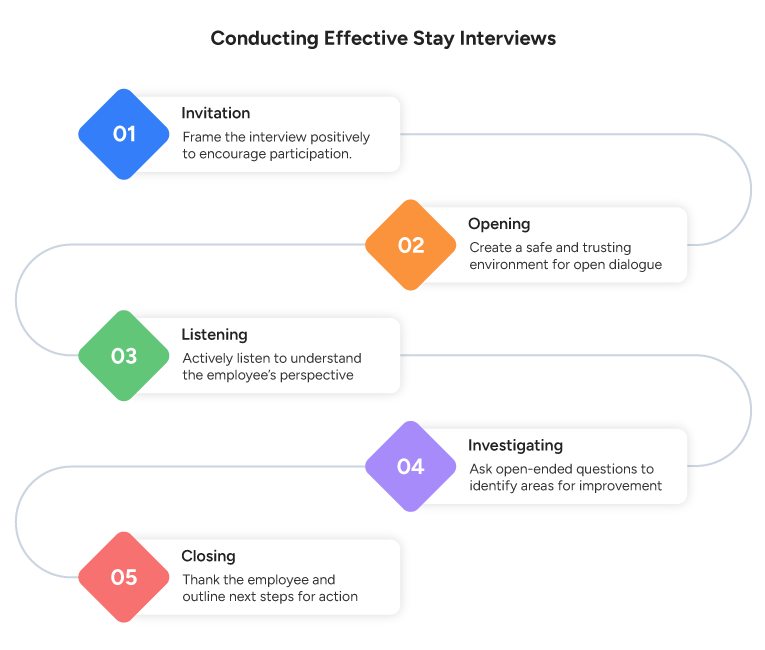
Stay interview questions help organizations retain talent by understanding employee needs through structured and one-on-one conversations. The aim of such interviews is to focus on current job satisfaction rather than post-departure feedback. Every organization has a different approach to conducting stay conversations. We have mentioned some of the standard steps below:
Step 1: The Invitation
HR teams should frame the invitation in a positive way to avoid negative impressions. Using email or other means of communication, the message should convey that this is not a performance review. For example, “I would love to chat about how we can make this workplace even better for you.”
Step 2: The Opening
It is important to build psychological safety for employees at the start of the interview. Managers can provide reassurance and state the company’s goals, like understanding the employee experience. For example, “This session is arranged for you to share your thoughts and perspective to improve our culture.”
Step 3: Listening
Managers should actively listen by having continuous feedback to what employees are saying and understand the challenges they face. The 80/20 rule applies here: listen 80% of the time and speak only 20% to avoid interruptions.
Step 4: Investigating
Some of the questions should include phrases like “Tell me more about this” or “What can make this better?” These open-ended questions allow employees to answer directly.
Step 5: Closing
The last step is to thank the employee for providing their feedback and key points. They should be informed about the following steps and actions.
The “Who, When, and Where” of Stay Interviews
Organizations should plan the process for conducting staff interviews, like who will be talking to the employees. This process also includes when it will take place and where the interviewers will conduct it. Every step should be planned to avoid confusion and allow the conversation to focus on the employee from the start.
Who
- The Interviewer: The manager or supervisor is the interviewer who has a direct professional relationship with the employee.
- The Interviewee: These are top-performing or key employees that the company wants to retain.
When
- Regularly: It can be conducted annually, which is a common practice in most organizations.
- Separately: It can be scheduled every 6 months, before or after performance reviews, to keep the focus on engagement.
- In Advance: It is advised to schedule in advance to show respect and allow the employee to prepare for the interview.
Where
- Neutral space:A quiet space can help the employee feel safe and comfortable being transparent.
- Flexible: It can also be in-person or virtual.
Top 10 Most Asked Questions on Stay Interview
What do You Look Forward to when You Come to Work each Day?
Why Ask this
This shows some of the intrinsic motivators for employees, for example, team interactions and challenging tasks. This way, companies can help identify strengths to improve the workplace environment.
What to Look for in the Answer
Look for positive aspects, like collaborating on projects, which shows high employee engagement. Unclear or vague answers include coffee, which suggests morale issues.
What Keeps You Working Here?
Why Ask this
Companies can identify loyalty factors, for example, culture and growth opportunities. These can help frame retention and overall productivity strategies.
What to Look for in the Answer
Search for answers that include team support, which indicates strong ties with fellow employees. Also, identify answers that include external factors, for example, a convenient location that highlights vulnerabilities.
What is the Best Part of Your Job?
Why Ask this
This question highlights peak experiences across the team and boosts overall satisfaction.
What to Look for in the Answer
Managers should look for role-specific replies, like solving client problems, which show strategies for work. Watch out for some of the generic praise that may hide employees’ dissatisfaction.
What Part of Your Job Would You Cut out if You Could?
Why Ask this
When employees answer this question, it exposes their inefficiencies and frustrations. For example, unnecessary processes for streamlining operations.
What to Look for in the Answer
Answers should include actionable complaints, like excessive reporting. When an employee does not respond, it might indicate hidden burnout.
What Can I do More or less as Your Manager?
Why Ask this
It provides direct, actionable feedback to team leaders, helping them improve one-on-one relationships.
What to Look for in the Answer
The answer should include aspects like “more feedback, less micromanaging”. Hesitation from the employee’s side indicates their trust issues and gaps.
Do You Feel Recognized for Your Contributions?
Why Ask this
Employee rewards and recognition drive retention, which measures if efforts are valued even during burnout risks.
What to Look for in the Answer
Answers should include recognition during meetings or reward programs.
If You were the CEO for a Day, What’s the First Thing You Would Change?
Why Ask this
It shows some of the systemic issues from an employee’s point of view, which prioritize impactful reforms.
What to Look for in the Answer
Employees might pour their ideology, which might include flexible work hours and some unrealistic answers, like double salaries.
What Might Tempt You to Leave? (Crucial Question)
Why Ask this
This question is asked to identify exit triggers for employees, like pay scale or work culture, which allows companies to take preemptive action.
What to Look for in the Answer
Some answers should be used to prevent exit factors, like better work-life balance or competitor packages.
When was the Last Time You Thought about Leaving, and why?
Why Ask this
This answer uncovers employees’ recent pain points and strategies for leaving the organization.
What to Look for in the Answer
Managers should look for answers with recent thoughts with reasons, like last month, due to workload. When an employee answers “never”, it may indicate disengagement.
What does Your Dream Job Look like?
Why Ask this
It shows their aspirations against current reality, which reveals skill gaps or unmet needs.
What to Look for in the Answer
The answers should also include their current role, for example, more leadership. This way, leaders can suggest internal growth paths and success.
Guidelines for Stay Interviews
There are a few guidelines prepared to conduct this type of interview, as the focus is on maintaining trust and retaining the top talent. Some of these guidelines are:
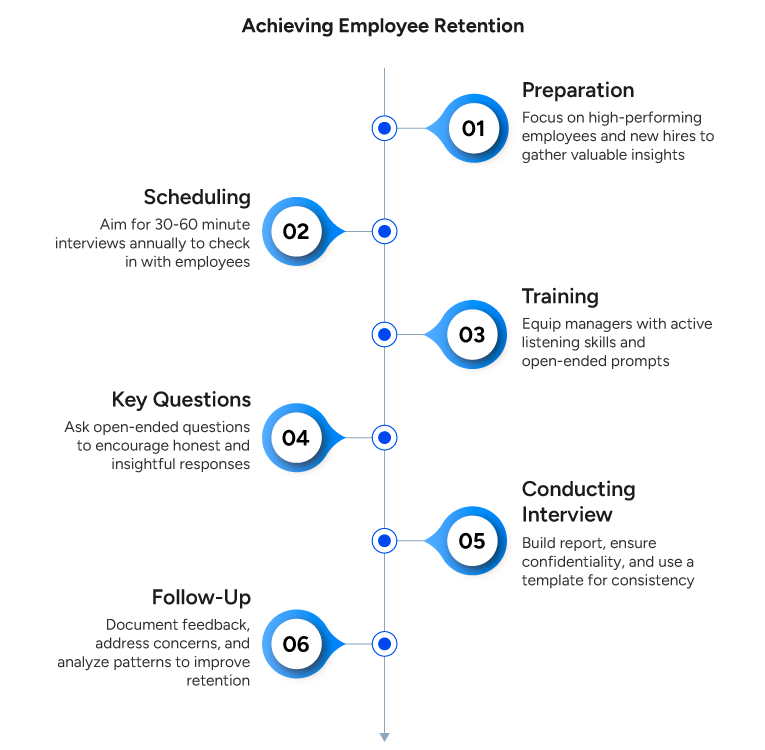
Preparation Steps
- Start small and prioritize: The top-performing employees should be interviewed first, and new hires who have completed at least 3-6 months. Note that it is not necessary to interview everyone at the same time.
- Schedule strategically: The sessions should not be long or too short; for example, 30-60 minute sessions can be conducted annually.
- Train and equip managers: Managers/supervisors should be provided with lessons on active listening (80% listening, 20% talking) and asking questions such as “Tell me more”.
Key Questions
Team leaders should ask some open-ended questions to spark honest answers. Some of these are:
- What is it that you enjoy about your work the most, and why?
- What can be the reason for you to leave your current job, and what keeps you here?
- How can the company make your work more fulfilling?
- What career growth opportunities are you looking for in our firm?
- Do you see yourself here in a year? If yes, why?
Conducting the Interview
- Build mutual rapport: Managers should prioritize in-person conversations and listen to employees to ensure they feel valued in the organization. Their feedback should be summarized in key points at the end.
- Ensure confidentiality: The employees ‘ information should be kept confidential and stored centrally for easy access by managers.
- Follow a template: Keep the interview structured yet flexible, and for consistency, companies can use some templates.
Follow-Up and Analysis
- Act immediately: Employee feedback: loyal employees should be documented to plan retention strategies.
- Spot patterns: There are some trends that can be grouped as recurring patterns. For example, growth opportunities or workload issues, which drive the organization towards growth.
- Measure impact: Regular stay interviews can help reduce employee turnover when actions are taken on time. This also shows the company’s commitment to value for employees and transparency.
Common Mistakes Managers Make
In some cases, managers do not take retention interviews seriously; for example, they lack preparation and treat these as interrogations. This weakens employees’ trust and gives incomplete insights.
- Defensiveness: Managers should not get defensive when employees share constructive feedback about the organization. It is better to actively listen and respond with empathy to build strong relationships.
- Making Promises You Can’t Keep: Team leaders should not make assurances they can’t deliver; employees can remember misleading information.
- Turning it into a Performance Review: Supervisors should not shift their focus from employees’ past failures. These one-on-one conversations should feel supportive and lead to genuine development.
- Lack of Follow-through: It is important for companies to understand that employees feel undervalued if their feedback goes unfulfilled. There should be regular check-ins and progress to show commitment to them.
Conclusion
A stay interview questionnaire template helps organizations to identify employee needs and boost engagement. This way, companies can also retain top talent in a competitive market and scale accordingly. Organizations can focus on team collaborations through genuine connections and showing employees that they matter.
By implementing thoughtful questions and targeted strategies, HR professionals can reduce turnover risks and increase growth opportunities. Managers who prioritize these conversations see higher engagement and lower costs from reduced hiring needs. Schedule a stay interview today and prepare open-ended questions for immediate impact.
FAQs
How do I Prepare for a Stay Interview?
Employees should focus on job satisfaction and growth opportunities. Managers should identify potential issues and frame questions accordingly.
What does a Stay Interview Look like?
It is a one-on-one manager-employee meeting, which is focused on job satisfaction and retention methods. Managers should ask open-ended questions like “What do you like most?” or “What frustrates you?”
How Long Should a Stay Interview be?
The interview should be 25-45 minutes, which is for a focused discussion. This allows honest feedback without overwhelming the employees.
When to Conduct Stay Interviews?
These interviews should be conducted annually after employees have settled into their jobs and should be treated as performance reviews. Companies should arrange interviews with top-performing and disengaged employees to gather feedback.
What are the Tips for Effective Stay Interviews?
Managers should stay focused on building trust between employees to get honest feedback. They should use open-ended questions customized to the employee.
Table of Contents
What if one wrong answer in the final round costs you a 6-figure salary? This is why it is important to know the interview questions that might be asked. At this stage, senior leaders evaluate whether candidates align with the company’s values, goals, and work environment.
This guide helps HRs to evaluate candidates more sharply and helps applicants answer final interview questions more effectively with 25+ proven final round questions, samples, and strategies.
Key Takeaways
- Final round interviews check how well the candidate matches the company’s values.
- HR looks at the candidate’s long-term potential and future growth.
- Decision-making, accountability, and pressure handling matter a lot.
- Final-round checklist to keep the evaluation consistent.
- Watch for red flags during the final interview.
What is a Final Round Interview?
A final-round interview is the last step in the hiring process. This round is usually conducted by senior leaders such as the Hiring Manager, HR Head, or Founder. They analyze cultural fit, long-term potential, and alignment with the company. Success depends on showing genuine interest, confidence, and a good overall fit for the role and organization.
Most Commonly Asked Questions in the Final Round Interview
1. Why do You Want to Join Our Company?
Why They Ask: To evaluate your genuine interest in their company, interviewers check whether you’ve researched the organization and whether your goals align with its mission.
How to Answer: Show that you understand the company’s values, work, or achievements. Explain how they align with your skills, interests, and career goals.
Sample Answer: I want to join your company because of its innovative work in sustainable technology, which aligns perfectly with my passion for green engineering. I appreciate your collaborative culture, which provides an ideal environment for professional growth and allows me to work on impactful projects with a supportive team.
2. Why did You Leave Your Last Job?
Why They Ask: To see if you are reliable, positive about past roles, and looking for growth, a better fit, or new opportunities.
How to Answer: Be honest but positive. Focus on career growth, learning, or finding a role that better matches your skills and goals.
Sample Answer: I left my last job because the company downsized my team, and I wanted new challenges to grow my skills. It was a great learning experience, and I am excited for this opportunity.
3. What do You Know about Our Company?
Why They Ask: To check if you have researched the company, its values, and its products, and are truly interested in the job, not just any paycheck.
How to Answer: Share 2-3 key facts about the company and connect them to your skills, experience, or career goals.
Sample Answer: Your company leads in tech innovation, founded in 2010, with top products like AI tools. I admire your focus on sustainability, and my coding skills can contribute to your mission.
4. Why Should We Choose You over Other Candidates?
Why They Ask: To see what makes you stand out, your strengths, and why you’re the best fit for the job.
How to Answer: Highlight your skills, experience, and qualities that align with the role, show enthusiasm, and explain how you can add value to the team.
Sample Answer: I feel I’m a good fit for this role because I have 3 years of hands-on project management experience. I’m comfortable leading teams, managing deadlines, and keeping everyone aligned on priorities. I enjoy solving problems quickly and making sure projects move smoothly. I’d love the chance to bring that experience to your team and support your goals.
5. What Motivates You at Work beyond Salary?
Why They Ask: To understand if you’ll stay engaged and productive for reasons other than money, like motivation for the work or team success.
How to Answer: Share about real motivating factors like learning, growth, teamwork, challenges, or making a meaningful impact that inspire you to do your best.
Sample Answer: I’m motivated by opportunities to learn new skills and grow, work on challenging projects, and contribute to something meaningful. Being part of a team that drives positive change keeps me engaged and excited to give my best.
6. Tell Me about a Failure You Faced and how You Handled It
Why They Ask: To assess your resilience, ability to learn from mistakes, take responsibility, problem-solving skills, and the capacity to grow without blaming others.
How to Answer: Briefly describe the situation, explain what you did, the outcome, and highlight what you learned.
Sample Answer: In my previous job, I missed a project deadline because I underestimated the time required for testing. I reorganized priorities, communicated with my team, and worked overtime to ensure the project was delivered on time and of better quality. From this, I learned to plan better and ask for help when needed, which improved my time management.
7. Have You Ever Made a Wrong Decision at Work? What did You Learn?
Why They Ask: To assess your self-awareness, honesty, and ability to reflect on mistakes and turn them into positive lessons.
How to Answer: Be honest about a mistake, describe how you fixed it, share the outcome, highlight what you learned, and finish on a positive note.
Sample Answer: Yes, I once made a wrong decision at work by approving a rushed project deadline without checking available resources, which caused delays. I learned to evaluate team capacity first and now use checklists to prevent overload. This has improved both my planning and delivery success.
8. Describe a Time You Took Responsibility beyond Your Role
Why They Ask: To see if you are proactive, a team player, and can step up when needed without being asked, showing leadership potential.
How to Answer: Briefly describe the situation, explain what extra responsibility you took, and highlight the positive outcome.
Sample Answer: In my last job as a junior developer, our teammate was out sick during a tight deadline for a client app update. I volunteered to handle part of their workload in addition to my own tasks and completed it two days early. This saved the project and earned the team praise from the client.
9. How do You Make Decisions when Information is Limited?
Why They Ask: To see if you stay calm under pressure, use good judgment, and make effective decisions with incomplete data.
How to Answer: Describe how you collect information, assess risks, and adjust when things are uncertain.
Sample Answer: When information is limited, I collect relevant data, consult with teammates or experts if possible, and consider potential risks and options. I make a quick, thoughtful decision and stay flexible to adjust if new information emerges. This ensures progress without unnecessary delays.
10. Tell Me about a Tough Decision You Made under Pressure
Why They Ask: To see how you handle stress, think quickly, and make smart choices when time is short and the stakes are high.
How to Answer: Briefly describe the high-pressure situation, explain the options you considered, the decision you made under pressure, and the outcome.
Sample Answer: During a project with a tight deadline, an important task fell behind schedule. I had to quickly decide whether to ask for more time or share the workload with others. I reorganized the team’s tasks, prioritized, and we delivered on time. This taught me to stay calm and make quick decisions under pressure.
Final Round Interview Questions on Leadership
11. How do You Handle Conflict within a Team?
Why They Ask: To check if you can stay calm, communicate well, and resolve issues without disrupting teamwork.
How to Answer: Explain how you listen to all sides, focus on the issue (not the person), find common goals, and work toward a fair solution.
Sample Answer: When conflict arises, I listen to everyone involved to understand their perspectives. I stay calm, focus on the problem over personal differences, and guide the team toward our shared goals while encouraging open communication. This usually helps the team find a solution and move forward together.
12. Have You Ever Mentored or Guided Someone at Work?
Why They Ask: To see if you can share knowledge, support, and develop others, which shows leadership skills and teamwork.
How to Answer: Briefly describe who you mentored, how you helped them, the positive outcome, and what you learned.
Sample Answer: Yes, I mentored a new HR associate on using our HR systems and managing key processes. Within a few months, they were handling tasks independently, and it improved team efficiency. I find mentoring very rewarding because it helps others grow while strengthening team performance.
13. How do You Influence Others without Authority?
Why They Ask: To see if you can persuade and lead teams without authority, and to test your soft skills like communication and relationship-building.
How to Answer: Explain the situation, describe how you built trust or used data or empathy to influence others, listened to their perspectives, and share the outcome.
Sample Answer: I influence others by listening to their concerns and understanding what matters to them. I explain my ideas clearly, use facts or examples, and focus on shared goals. This helps build trust and encourages collaboration.
14. What does Good Leadership Mean to You?
Why They Ask: To check your leadership values, how you view teamwork, and whether your approach aligns with the team and company culture.
How to Answer: Explain what leadership means to you, give key qualities you value, and briefly mention how you practice them at work.
Sample Answer: Good leadership means setting a clear direction, supporting the team, and leading by example. A good leader listens, communicates openly, and helps others succeed. For me, it’s like a coach who listens, motivates, and steps up during tough times.
15. Cultural Fit and Value-Based Interview Questions
What Kind of Work Culture Helps You Perform Your Best?
Why They Ask: To see if your preferred work environment matches the company’s environment and if you will be a cultural fit and stay motivated.
How to Answer: Describe the atmosphere that brings out your best performance, like open communication or flexibility, and connect these to better results without criticizing past jobs.
Sample Answer: The culture that helps me perform best includes work-life balance, collaboration, and open communication in a supportive environment. I like teams that share ideas, give feedback, and trust each other to take ownership of their work. This helps me stay motivated and deliver high-quality results.
16. How do You Align with Our Company Values?
Why They Ask: To see if your beliefs and work style align with the company’s core principles, ensuring you fit in and stay motivated.
How to Answer: Research the company’s values beforehand, then explain 1-2 that resonate with you, and give a brief example.
Sample Answer: I align with your company’s values of collaboration and innovation. In my previous role, I shared ideas with teammates to improve processes and encouraged creative problem-solving that cut project time. This helped the team work efficiently while fostering a positive, innovative environment.
17. How do You Handle Ethical Challenges at Work?
Why They Ask: To see if you have integrity, make responsible decisions, and follow company values without bending rules.
How to Answer: Explain how you identify the problem, check rules, consider the impact on others, and take action.
Sample Answer: To handle an ethical challenge at work, I analyze the situation and review company policies. If I’m unsure, I consult my manager or HR. I ensure my actions are fair, transparent, and respectful. For example, when I noticed a billing error, I reported it and worked with the team to resolve it immediately.
18. What does Professionalism Mean to You?
Why They Ask: To see if you understand workplace expectations like reliability, respect, accountability, and high standards.
How to Answer: Explain what professionalism means to you with 2-3 key traits, then give a brief example of how you show it at work.
Sample Answer: To me, professionalism means being reliable, respectful, and accountable for my work. I show it by meeting deadlines, communicating clearly, and treating colleagues with respect. For example, I once stayed late to fix a project error so we delivered on time.
Best Questions to Ask HR in the Final Round
- What Growth and Career Development Opportunities are Available?
- Can You Explain the Team Structure and Reporting Process?
- How Will My Performance be Measured Initially?
- How does the Company Support Work-Life Balance?
- How does the Team Usually Communicate and Collaborate?
Interview Questions on Career Plans and Long-Term Fit
19. Where do You See Yourself in the Next 3–5 Years?
Why They Ask: To understand candidates’ aspirations, evaluate alignment with the company’s values, and assess their long-term commitment.
How to Answer: Discuss realistic professional goals that show growth, learning, and contribution to the company. Avoid personal or unrelated ambitions.
Sample Answer: In the next 3–5 years, I see myself taking on more responsibility in HR management, leading projects, and improving processes such as recruitment, onboarding, and performance management. I aim to develop my skills in HR technologies and help create a more efficient, supportive workplace.
20. How does this Role Fit into Your Future Plans?
Why They Ask: To see if your career goals align with the role and whether you are likely to grow and stay with the company long term.
How to Answer: Align the role with your short- and long-term goals, and demonstrate your research on the company. Highlight the skills you’ll develop and the contributions you’ll make to their success.
Sample Answer: This role aligns with my future plans because it allows me to use my HR experience, take on new challenges, and work on important projects. I want to improve my skills in HR technology and contribute to tasks that add positive employee experience. This position fits well with the company’s mission and values.
21. What Kind of Growth are You Expecting from Us?
Why They Ask: To understand your expectations for development and whether the company can realistically support your career goals.
How to Answer: Focus on professional growth, like learning opportunities, skill development, exposure to responsibilities, and career progression. Show flexibility and emphasize mutual growth.
Sample Answer: I am looking to grow into a leadership role here by mastering this position first and taking on additional responsibilities. I admire your company’s innovative projects and see myself contributing to them in the long term while growing professionally.
22. How do You Handle High-Pressure Situations?
Why They Ask: To look for resilience, problem-solving skills, and emotional stability when you face tight deadlines, unexpected challenges, or stressful situations.
How to Answer: Describe how you manage stress, prioritize your tasks, and stay organized. If possible, give a brief example from your own experience of successfully handling pressure.
Sample Answer: In high-pressure situations, I stay organized, break tasks into smaller milestones, and set clear priorities. For instance, as a project manager on a tight-deadline project, I prioritized tasks, coordinated with my team, stayed focused, and completed all tasks on time despite unexpected changes.
23. Describe a Time when Things did Not Go as Planned. What did You do?
Why They Ask: To see your critical thinking, flexibility in tough situations, and ability to turn challenges into positive results while staying accountable.
How to Answer: Briefly describe the situation and challenge you faced. Explain what you did to address it, and highlight the positive outcome or lesson learned.
Sample Answer: During an HR project, a training session was canceled at the last minute due to the speaker’s unavailability. I worked with the team to arrange an alternative facilitator and notified everyone of the changes. I learned the importance of having backup plans and clear communication when things don’t go as expected.
24. How do You Manage Stress during Critical Deadlines?
Why They Ask: To see candidates’ ability to stay calm, focused, and productive under pressure, manage time effectively, and deliver quality work without burning out.
How to Answer: Explain how you manage stress by prioritizing tasks, staying organized, breaking work into steps, and keeping a positive mindset. Give a brief example.
Sample Answer: To manage stress, I stay calm, organized, set clear priorities, break tasks into steps, and use time blocks to stay focused. For example, during a month-end payroll deadline, I made a task list and coordinated with my team. This helped me ensure we met the deadline without compromising quality.
25. Have You Handled an Unhappy Stakeholder or Client? How?
Why They Ask: To evaluate your ability to manage conflict, maintain professionalism, and resolve issues while keeping relationships intact.
How to Answer: Describe the situation, explain the steps you took to address the concern, and highlight the positive outcome or lessons learned. Focus on listening, empathy, and finding a solution that satisfies both sides.
Sample Answer: Once, a client was frustrated with delays in onboarding new employees. I listened to their concerns, clarified the reasons for the delay, and proposed a revised timeline with regular updates. By keeping them informed and addressing their concerns promptly, we resolved the issue, and the client appreciated our proactive communication.
Not Sure What to Include in a Job Description?
We’Ve Got 50+ Role-Based Samples Ready for You.
Interview Questions on Joining Date and Salary Expectations
26. What are Your Salary Expectations?
Why They Ask: To understand whether candidates value themselves appropriately based on market trends and how flexible and confident they are during compensation discussions.
How to Answer: Provide a salary range based on your experience and market research, and show flexibility if open to discussion. Focus on your interest in the role and on the growth opportunities it offers.
Sample Answer: Based on what I’ve learned about this role and my experience, I’m looking for a salary between [X] and [Y]. I’m open to a discussion and particularly interested in the growth and learning opportunities this role offers.
27. What is Your Current CTC?
Why They Ask: To understand your current compensation and how it fits their budget and the role’s salary range, this also helps them make a fair and realistic offer.
How to Answer: Be honest and clear about your CTC. State your current CTC and briefly mention any variable components, if applicable.
Sample Answer: My current CTC is ₹X per annum, with a base of ₹Y, performance bonuses of ₹Z, and benefits like PF, HRA, and health insurance. I’m excited about this opportunity and open to discussing a compensation structure that fits the role, responsibilities, and growth opportunities.
28. What is Your Notice Period?
Why They Ask: To plan when the candidate can join, this helps companies organize hiring and manage team or project needs.
How to Answer: Be clear about how long your notice period is and show that you are committed to a smooth handover. If you might be able to leave earlier, mention that as well.
Sample Answer: My notice period is X days according to my contract, which provides enough time for a proper handover. I am also open to discussing an earlier start if my manager agrees.
29. If You are Selected, when Can You Join?
Why They Ask: To determine your availability and expected joining timeline to ensure effective onboarding and planning, with no conflicts or delays in filling the position.
How to Answer: Clearly state your earliest possible joining date based on your notice period or commitments, and express flexibility and enthusiasm while remaining professional.
Sample Answer: I have a X-day notice period, but I may be able to start sooner if required. I’m excited about this opportunity and could be available as early as next month.
30. Final Discussion and Closing Interview Questions to Ask
Do You have any Questions for Us?
Why They Ask: To see if you’re genuinely interested in the role and the company, good questions show your preparation, curiosity, and critical thinking skills.
How to Answer: Ask thoughtful, research-based questions about the role, team, company culture, growth opportunities, or upcoming projects. Avoid basics like salary; focus on growth and contributions.
Sample Answer: Yes, what are the team’s top priorities this year, and how does this role support them? What are the biggest challenges or priorities for this position in the next 6–12 months? How does the company support employee growth and professional development?
31. What are Your Expectations from this Role and the Company?
Why They Ask: To see if your career goals and motivations match the role and company culture, and if you focus on growth and contribution instead of just compensation.
How to Answer: Research the job description and the company’s values, align your skills with their requirements, and highlight growth opportunities. Stay positive and flexible, focusing on mutual benefits without demanding specifics like salary.
Sample Answer: I am looking forward to using my skills in (relevant area) to help the team succeed and support the company’s goals. I am eager to join a collaborative workplace where I can grow professionally and take on challenges that match my career interests.
32. If We Extend an Offer, are You Comfortable Accepting It?
Why They Ask: To assess your interest in the role, your enthusiasm, and commitment, it helps assess if you’re seriously interested or just exploring options.
How to Answer: Express enthusiasm for the role while remaining realistic. You can confirm your interest, but avoid committing before you know all the details (like joining terms or compensation).
Sample Answer: Yes, I’m very much interested in this role and excited about the opportunity. I look forward to reviewing the offer details, and I’m confident it would be a great fit for both the company and me.
Warning Signs HR Should Look for in the Final Round
- No-Questions-Asked: Candidates who ask nothing about the role, team, company, or next steps may not be interested in the role or the company.
- Too Casual or Arrogant: Getting overly informal, especially with the CEO or senior leaders, shows poor professionalism, even if earlier chats were friendly.
- Behavior Changes: A big difference in how they act from the first to the final interview suggests their true personality may not be genuine.
- Last-Minute Surprises: Sharing new limits (such as leaving early every day) or changing salary expectations only in the final interview shows poor planning and transparency.
- Lack of Enthusiasm: A lack of energy or enthusiasm may indicate they are using the interview as a backup or having second thoughts.
Checklist to Prepare for the Final Round Interview for the Candidate
Final-round interviews with senior leaders to assess cultural fit can be best navigated with a checklist to ensure you align with the role, team, and company. Prepare for the final round interview as thoroughly as you did for earlier rounds.
- Learn the company’s goals, what they believe in, what the job involves, the skills they want, and their work environment.
- Review your job description, align your skills with the qualifications, and prepare examples that highlight your impact.
- Prepare STAR examples (Situation, Task, Action, Result) that show the top skills and qualities relevant to the position.
- Practice common final round interview questions and answers to behavior questions (e.g., “Tell me about a time…”) and cultural fit questions.
- Cover how you handle stress, tough challenges, and practical stuff like salary, notice period, and joining date.
- Come up with 3-5 smart questions about the team, top job priorities, growth opportunities, and company culture.
Read More Interview Questions with Sample Answer
Table of Contents
Key takeaways:
- Understand the top Python interview questions asked by interviewers.
- Learn Python basics and internals in simple language.
- Revise data structures, functions, and OOP concepts.
- Prepare for coding and system-level Python interview questions.
- Useful for freshers, experienced candidates, and HR teams.
Python interviews often test more than syntax. Most data science and AI jobs now list Python as a required language due to its extensive ecosystem and ease of use. Interviewers want to know how well you understand Python concepts, how you think through problems, and how you apply Python in real situations. That is why specific Python interview questions recur across interviews, regardless of the company or role.
This guide covers the most frequently asked Python interview questions and answers for freshers, explained in a simple, interview-friendly way. It helps freshers build strong basics and experienced developers refresh core concepts before interviews.
Top 10 Most Asked Python Interview Questions
These are the most frequently asked Python interview questions, appearing in interviews for both freshers and experienced candidates.
1. What is the Difference between a List and a Tuple?
A list and a tuple are used to store multiple elements in Python. The main difference is whether the data can be changed after creation.
| Feature | List | Tuple |
|---|---|---|
| Mutability | Mutable (Can be changed) | Immutable (Cannot be changed) |
| Syntax | Square brackets [] | Parentheses () |
| Memory | Consumes more memory | Consumes less memory |
| Performance | Slower | Faster |
| Example | [1, 2, 3] | (1, 2, 3) |
2. What is the __init__ Method and how is It Used?
The __init__ method is executed when an object is created from a class. It is used to set the initial values of the object.
It runs automatically during object creation, helps store starting data, and prepares the object for use.
Answer
class User:
    def __init__(self, name):
        self.name = name
u = User("Alex")
print(u.name)
Output:
Alex
3. What is a Decorator, and how does It Change a Function’s Behavior?
A decorator lets you add additional work to a function without changing the function itself. It is often used when you want to extend a function’s behavior without changing the main code.
- A decorator wraps another function,
- It can run code before or after the function runs,
- It helps keep the main function clean and easy to read
Answer
def my_decorator(func):
    def wrapper():
        print("Before")
        func()
        print("After")
    return wrapper
@my_decorator
def hello():
    print("Hello")
hello()
Output:
Before
Hello
After
4. What is the Global Interpreter Lock (GIL) and how does It Affect Multi-Threading?

The Global Interpreter Lock (GIL) is a Python mechanism that allows only one thread to execute Python bytecode at a time, even on multi-core systems. It exists to keep Python’s memory management safe, especially because Python uses automatic garbage collection and reference counting, which are not thread-safe by default.
Because of the GIL, multi-threading does not improve performance for CPU-intensive tasks. Only one thread can run Python code at a time, so threads end up taking turns. However, multi-threading still works well for I/O-bound tasks such as file handling, network requests, or waiting for external resources.
For CPU-heavy workloads, multiprocessing is the recommended workaround. It runs multiple processes rather than threads, bypassing the GIL and enabling true parallel execution across multiple CPU cores.
5. What is the Difference between is and ==?
Both “is” and “==” are used for comparison in Python. They compare different things.
- == compares values. is compares memory addresses (identities)
- The same values can exist in different memory locations
Answer
a = [1, 2]
b = [1, 2]
print(a == b)
print(a is b)
Output:
True
False
6. What is a Lambda Function?
A lambda function is a small one-line function. It is used when the logic is very simple and is needed for a short time. Instead of defining a full function using def, a lambda function lets you write quick logic in a single line.
- Lambda functions have no name
- Written in one line
- can take arguments but return only one result
- commonly used with functions like map(), filter(), and sorted()
- Best suited for short and simple operations
Answer
add = lambda x: x + 1
print(add(5))
Output:
6
7. How does Python Manage Memory and Garbage Collection?
Python manages memory automatically, so developers do not need to allocate or free memory manually. It uses a private memory space where objects are created and stored. Python mainly relies on reference counting to track how many variables point to an object. When an object has no references left, it becomes eligible for removal. Python also uses a garbage collector to detect and clean up unused objects, especially those involved in circular references. This automatic process helps prevent memory leaks and makes Python easier and safer to use.
8. What do * Args and ** Kwargs Allow You to do in Function Definitions?
They allow a function to accept a number of arguments. This is useful when the number of inputs is not fixed.
- *args accepts multiple positional values
- **kwargs accepts multiple named values
Answer
def demo(*args, **kwargs):
    print(args)
    print(kwargs)
demo(1, 2, a=10, b=20)
Output:
(1, 2)
{a: 10, ‘b’: 20}
9. What is the Difference between Range() and Xrange() (Python 2 vs 3)?
Both range() and xrange() are used to generate a sequence of numbers. They are most commonly used inside for loops. However, their behavior changes depending on the Python version.
In Python 3, the distinction no longer exists. The range() function itself works like the old xrange(). That means xrange() was completely removed.
In Python 2, the difference is more noticeable:
- range() creates the entire list of numbers in memory upfront. This makes it simple to use but potentially inefficient when dealing with large ranges.
- xrange(), on the other hand, generates numbers one at a time as they are needed. It does not store the full list in memory. This makes it faster and more memory-friendly for large iterations. This on-demand behavior is known as lazy evaluation.
10. What is a Generator, and How is It Different from a Normal Function?
Generators are a special type of function in Python. They produce values one at a time, as needed, rather than all at once. They are highly efficient for handling large datasets or infinite sequences.
What makes a function a generator is the use of the yield keyword. When Python encounters yield, the function temporarily pauses execution. It remembers its current state, and the next time the generator is called, execution resumes exactly from where it left off, not from the beginning.
Core Concepts and Python Basics
This section explains how Python works internally, focusing on execution, scope, and basic rules.
11. Does Python Read Code all at Once or Line-by-Line?
Python first goes through an internal compilation step, where it parses the source code and converts it into bytecode. If there are no errors, it then runs the code step by step.
Answer
print("Hello")
print("World")
Output:
Hello
World
12. When Should You Use a for Loop Versus a while Loop?
This is one of the common Python interview questions. It checks how well you understand loops.
- for loop is used when the count is known, often with lists, tuples, sets, or dictionaries.
- while loop is used when the end condition is known, but the number of future repetitions is unknown.
Answer
for i in range(3):
    print(i)

c = 0
while c < 3:
    print(c)
    c += 1
Output:
0
1
2
0
1
2
13. What is the Difference between / and // in Python?
/ gives exact division and returns a decimal value. // removes the decimal part and always returns the lower whole number.
Answer
print(5 / 2)
print(5 // 2)
Output:
2.5
2
14. Is Strict Spacing Required in Python?
Yes, spacing is very important in Python. It tells Python which lines belong together.
- Indentation defines code blocks.
- Wrong spacing causes errors.
- Makes code easy to read.
Answer
If True:
    print("Valid code")
Output:
Valid code
15. What does It Mean that Python Figures out Data Types Automatically?
Python determines the data type at runtime. You do not need to declare it. This makes the code shorter.
Answer
x = 10
y = "Python"
print(type(x))
print(type(y)
Output:
<class 'int'>
<class 'str'>
16. What is the Purpose of the Pass Keyword?
pass is used when Python expects a statement, but no action is needed.
- Used as a placeholder
- Keeps code valid
- Helpful during planning
Answer
def demo():
    pass

print("Program runs")
Output:
Program runs
17. Explain the Difference between Break, Continue, and Pass.
This is a Python interview question to test loop control.
- break stops the loop,
- continue skips one loop step, pass does nothing
Answer
for i in range(3):
    if i == 1:
        continue
    print(i)
Output:
0
2
18. How does Python Determine where a Variable Can be Used (LEGB Rule)?
Python checks different places to find a variable. It follows a fixed order. So, it knows which value to use when the same name appears more than once.
- First, it looks inside the current function (Local)
- Then, it checks any outer function (Enclosing)
- After that, it checks the main program (Global)
- Finally, it checks built-in names (Built-in)
Answer
x = 10

def demo():
    x = 5
    print(x)

demo()
print(x)
Output:
5
10
19. What are Docstrings, and why are They Used?
A docstring is a built-in way to describe what a piece of Python code does. It acts as an inline guide for anyone reading the code, including future developers and even your future self. Docstrings can be written for modules, classes, functions, and methods to explain their purpose, behavior, and usage.
A docstring is placed immediately after the definition of a class or function and is written using triple quotes, either single (''') or double ("""). When written correctly, Python automatically recognizes it as documentation.
It is stored as part of the object and can be retrieved at runtime using the __doc__ attribute or by calling Python’s built-in help() function.
20. How do You Cut out Specific Parts of a String or List?
This is done using slicing. It is common in Python coding interview questions.
- Uses start and end positions
- Works on strings and lists
- Very fast and simple
Answer
text = "Python"
print(text[1:4])
Output:
yth
21. What is a Namespace, and how does It Prevent Naming Conflicts?
A namespace keeps names (variables, functions, objects) separate to prevent clashes. As each function has its own space, there is no confusion when names are the same.
22. Write a Simple Code to Display the Current Time
Python provides a built-in time module that allows you to access and display the current system time.
Answer
import time

currenttime= time.localtime(time.time())
print ("Current time is", currenttime)
Output:
Current time is time.struct_time(tm_year=2025, tm_mon=6, tm_mday=10, tm_hour=11, tm_min=56, tm_sec=57, tm_wday=1, tm_yday=161, tm_isdst=0)
23. How does the New Switch Statement (Match-Case) Work in Python?
Python uses match-case instead of switch. It makes multiple conditions easier to handle.
- Introduced in Python 3.10
- Cleaner than many if-else
- Used for matching values
Answer
x = 2

match x:
    case 1:
        print("One")
    case 2:
        print("Two")
Output:
Two
24. What does the “:=” Operator do?
This operator assigns and uses a value simultaneously. It is also called the walrus operator.
- Assigns value inside expressions
- Reduces extra lines
- Best used when it improves readability and avoids repeated calculations
Answer
if (n := 5) > 3:
    print(n)
Output:
5
Data Structures (Lists, Dicts, & Sets)
This section focuses on how Python stores and organizes data using built-in data structures.
25. How do You Join Two Lists Together?
This is a common topic in Python interview questions and answers.
In Python, you can join two lists in more than one way. You can create a new list or update the existing one.
Answer
a = [1, 2]
b = [3, 4]

c = a + b
print(c)

a.extend(b)
print(a)
Output:
[1, 2, 3, 4]
[1, 2, 3, 4]
26. How do You Round a Number Down to the Nearest Integer?
This is often asked in Python basic interview questions. Python provides an easy way to round numbers down by using the floor.
Floor means rounding a number down by removing its decimal part using the math module.
Answer
import math

n = 4.8
print(math.floor(n))
Output:
4
27. Can You Show a Short Way to Make a List from another List?
This is done using list comprehension.
Answer
nums = [1, 2, 3]
new_nums = [x * 2 for x in nums]
print(new_nums)
Output:
[2, 4, 6]
28. What is the Main Difference between a Set and a Dictionary?
A set and a dictionary both store data. The way they store data is different.
Set stores only values and removes duplicates. A dictionary stores a key and a value.
Answer
my_set = {1, 2, 2, 3}
my_dict = {"a": 1, "b": 2}

print(my_set)
print(my_dict)
Output:
{1, 2, 3}
{'a': 1, 'b': 2}
29. What are the Basic Data Types Built into Python?
Python has many built-in data types, which are:
- Numeric types: int (whole numbers), float (decimal values), complex (real and imaginary parts).
- Text type: str (text or characters).
- Sequence types: list (ordered, mutable), tuple (ordered, immutable), range (sequence of numbers).
- Mapping type: dict (key-value pairs).
- Set types: set (unordered, unique elements),frozenset (immutable set).
- Boolean type: bool (True or False).
- None type: NoneType (absence of a value).
30. Which Data Types Can You Change (Mutable) vs. those You Can Not (Immutable)?
In Python, data types are classified as mutable or immutable based on whether their values can be changed after creation. Mutable data types, such as lists, dictionaries, and sets, allow their contents to be modified without creating a new object. Immutable data types, such as integers, strings, and tuples, cannot be changed once they are created, and any modification results in a new object being formed.
Understanding this difference is important because it helps prevent unexpected behavior and bugs, especially when working with functions, variables, and shared data.
31. How is a Dictionary Different from a List?
A list and a dictionary differ mainly in how they store and access data. A list stores values in a fixed order and accesses them by index, starting from zero. In contrast, a dictionary stores data as key-value pairs.
Each value is accessed using a unique key instead of a numeric index. As dictionaries use keys, they offer faster and more meaningful data lookup, especially when working with large or structured data.
Answer
my_list = ["Tom", 25]
my_dict = {"name": "Tom", "age": 25}

print(my_list[0])
print(my_dict["name"])
Output:
Tom
Tom
32. Does Python Use Arrays? How are They Different from Lists?
Python supports specialized array structures through modules such as the array module. However, lists are more commonly used in practice. Arrays store values of the same type, but Lists store mixed-type values and are more flexible.
Answer
from array import array

# Array (stores same data type only)
arr = array('i', [1, 2, 3])
print(arr)

# List (stores mixed data types)
my_list = [1, "Python", 3.5]
print(my_list)
Output:
array('i', [1, 2, 3])
[1, 'Python', 3.5]
33. What are Type Hints in Python?
Type hints are optional labels that indicate the expected type of a variable or a function's return value. They make code easier to read and understand, especially in large projects or team environments. Python does not enforce type hints at runtime, so the program will still run even if the types do not match. However, tools like linters, IDEs, and type checkers use type hints to catch errors early and improve code quality.
34. How do You Create a Dictionary in Just One Line of Code?
You can create a dictionary in Python in a single line by using curly brackets and defining key-value pairs separated by colons. This approach is simple, readable, and commonly used in everyday Python programming.
Answer
my_dict = {"a": 1, "b": 2}
print(my_dict)
Output:
{'a': 1, 'b': 2}
35. Can You Make a Tuple in One Line like a List? Or why Not?
Yes, you can make a tuple in one line, just like a list. The primary difference is the syntax; tuples use parentheses while lists use square brackets, and a tuple’s inherent immutability, which means it cannot be changed after creation.
- List uses [] and can change.
- Tuple uses () and stays fixed.
- For a single-item tuple, you must add a comma.
Answer
my_list = [1, 2, 3]
my_tuple = (1, 2, 3)
single_item = (5,)

print(my_list)
print(my_tuple)
print(single_item)
Output:
[1, 2, 3]
(1, 2, 3)
(5,)
36. Why Would You Choose a Tuple Instead of a List?
A tuple is used when data should not change.
- Tuples are fixed, so they prevent accidental changes.
- They are good for records like (name, age).
- Tuples are slightly faster for reading.
37. Which Sorting Method does Python Use when You Run .sort()?
Python uses a sorting method called Timsort. It is efficient for real-world data and is stable.
Answer
nums = [4, 1, 3, 2]
nums.sort()
print(nums)
Output:
[1, 2, 3, 4]
Functions & Functional Programming
This section explains how functions work in Python and how they support reusable, well-structured code which are key topics in many Python interview questions.
38. Can You Pass a Function into another Function as an Input?
Yes, you can pass a function as an argument in Python. This is common in Python programming interview questions.
Functions can be stored in variables. They can be passed into other functions, making them useful for reusable code.
Answer
def greet():
    return "Hello"

def run(func):
    print(func())

run(greet)
Output:
Hello
39. Does Python Send the Actual Value or Just a Link to the Value when Passing Arguments?
Python passes a reference to the object, not a full copy. Mutable objects can change inside a function. That is why lists can change inside a function. Immutable objects do not change in place.
Answer
        def add_item(lst):
    lst.append(4)

nums = [1, 2, 3]
add_item(nums)
print(nums)
Output:
[1, 2, 3, 4]
40. What is the Map() Function, and how is It Used with Lambdas?
The map() function applies a function to every item in an iterable (such as a list). When used with a lambda function, it allows for quick, one-line data transformations without defining a named function.
Answer
nums = [1, 2, 3]
# Square each number using map and lambda
squared = list(map(lambda x: x**2, nums))
print(squared)
Output:
[1, 4, 9]
41. What do * Args and ** Kwargs Mean?
Both *args and **kwargs let a function accept many values without fixing the number in advance.
| Feature | *args | **kwargs |
|---|---|---|
| Full Form | Arguments | Keyword Arguments |
| Input Type | Accepts multiple positional arguments. | Accepts multiple named (keyword) arguments. |
| Data Structure | Received as a Tuple ( ). | Received as a Dictionary { }. |
| Syntax Symbol | Single Asterisk (*) | Double Asterisk (**) |
| Best Used For | When the number of inputs is unknown. | Handling optional or configuration-based inputs. |
42. Can a Decorator accept Arguments? If So, how?
Yes, decorators can accept arguments. You need an extra function layer. The outer function receives the arguments, and the inner function wraps the original function.
Answer
def repeat(n):
    def decorator(func):
        def wrapper():
            for _ in range(n):
                func()
        return wrapper
    return decorator
Note: Here, n is the decorator argument.
43. What is an Iterator?
An iterator is an object that gives values one by one. It remembers where it is in the loop.
- Used in for loops
- Created with iter()
- Next value is read using next()
Answer
nums = [10, 20, 30]
it = iter(nums)

print(next(it))
print(next(it))
Output:
10
20
44. How is a Generator Different from a Normal Function?
A generator gives values step by step using yield. A standard function returns all at once using return. A normal function finishes after one return, but a generator yields one value at a time and uses less memory.
Answer
def gen():
    yield 1
    yield 2

for x in gen():
    print(x)
Output:
1
2
45. What does the Zip() Function do?
zip() joins items from two lists side by side. It combines values in pairs and stops at the shortest list. This function is commonly used in clean looping.
Answer
names = ["A", "B"]
scores = [10, 20]

for n, s in zip(names, scores):
    print(n, s)
Output:
A 10
B 20
46. What are Function Annotations? Do They Force You to Use Specific Types?
Function annotations provide metadata about a function’s parameters and return value. They improve code readability and support tooling such as type checkers and documentation generators, but they do not enforce type constraints at runtime.
With annotations, you can hint at the type of a parameter or the type of the returned value. However, Python itself does not enforce these types. The function will still run even if the types do not match.
Object-Oriented Programming (OOP)
This section covers classes and objects in Python, which are key topics in many Python interview questions.
47. Can a Class Inherit Features from More than One Parent Class?
Yes, Python allows a class to inherit from more than one class. This concept is called multiple inheritance and is common in Python interview questions.
- A child class can inherit from more than one parent.
- It allows the reuse of code from multiple classes.
- It should be used carefully, as complex inheritance hierarchies can make code harder to understand and maintain.
Answer
class A:
    def show_a(self):
        print("Class A")

class B:
    def show_b(self):
        print("Class B")

class C(A, B):
    pass

obj = C()
obj.show_a()
obj.show_b()
Output:
Class A
Class B
48. What is Polymorphism?
Polymorphism in Python allows the same method to behave differently depending on the object that uses it.
When different classes share a common method name, each class can define its own version of that method. Python decides which version to run based on the object calling it, not the method name itself.
This is commonly seen when a child class provides its own implementation of a method already defined in a parent class. Even though the method name stays the same, the behavior changes.
Polymorphism in Python mainly focuses on method overriding rather than method overloading, because it does not support traditional method overloading by default. It helps you write flexible, reusable code in which different objects respond in their own ways while following the same interface.
49. How do You Keep Data Private inside a Class?
Python does not enforce strict privacy. Instead, it uses naming rules to indicate private data.
- _name means internal use
- __name hides the variable more
- Prevents direct access
50. How do You Hide Complex Details from the User?
This concept is called abstraction. The user only sees what they need to use. Abstraction hides internal logic and provides a simple interface, making code easier to use.
Answer
class Car:
    def start(self):
        self.__engine()

    def __engine(self):
        print("Engine started")

c = Car()
c.start()
Output:
Engine started
51. What is the Difference between a Static Method, a Class Method, and a Normal Method?
The main difference lies in how each method interacts with the class and its data.
| Method Type | Decorator | First Argument | Can Access |
|---|---|---|---|
| Instance Method | None | self | Instance & Class Data |
| Class Method | @classmethod | cls | Class Data Only |
| Static Method | @staticmethod | None | Neither (Independent) |
52. What is __init__ and why do We Use Self?
The function __init__ sets values when an object is created. It is used to initialize an object’s data and to provide each object with its own starting values.
However, self refers to the current object. It allows a method to access the object’s variables and methods. The function ensures that data belongs to a specific object, not the class.
53. Does Python have Public and Private Keywords like Java?
No, Python does not use keywords like public or private. It relies on naming style instead. All variables are public by default.
Advanced & System Internals
This section focuses on error handling, memory management, and system-level tools used in Python.
54. How do You Handle Errors so the Program doesn't Crash (Try/Except)?
Errors can stop a program if not handled. Python uses try and except to catch errors safely.
- Code that may fail goes inside a try.
- Error-handling code goes inside the except.
- The program continues running
Answer
try:
    x = int("abc")
except:
    x = 0

print(x)
Output:
0
55. What is the Difference between a Module and a Package?
A module is a single Python file. A package is a folder that contains multiple modules.
| Feature | Module | Package |
|---|---|---|
| Definition | A single Python file ending in .py. | A directory (folder) that contains multiple modules. |
| Composition | Contains Python code, such as functions, classes, and variables. | Contains a collection of modules and optionally an __init__.py file. |
| Purpose | Used to organize related code into a single file. | Used to organize large projects into a hierarchical structure. |
| Importing | Imported using import module_name. | Imported using the import package. module. |
56. What is the difference between a Shallow Copy and a Deep Copy?
| Feature | Shallow Copy | Deep Copy |
|---|---|---|
| What it does | Creates a new object but inserts references to the items found in the original. | Creates a new object and recursively adds copies of the nested objects found in the original. |
| Nested Objects | Does not copy nested objects; references are shared. | Copies all nested objects recursively. |
| References | References to inner objects are shared with the original. | Completely independent; no references are shared. |
| Effect of Changes | Changes to nested data affect both the original and the copy. | Changes to the copy do not affect the original object. |
| Performance | Faster and uses less memory. | Slower and uses more memory. |
Answer
import copy

a = [[1, 2]]
b = copy.copy(a)
c = copy.deepcopy(a)

a[0].append(3)
print(b)
print(c)
Output:
[[1, 2, 3]]
[[1, 2]]
57. How do You Find and Fix Bugs in Your Code?
Python provides simple tools for debugging. Use print() to check values. Read error messages carefully. Test code in small parts.
Answer
x = 5
print(x)
Output:
5
58. How does Python Manage Memory and Clean Up Unused Data?
Python manages memory automatically. Unused objects are removed when no longer needed.
- Memory allocation: Python uses a private heap to store objects. The memory manager controls allocation and deallocation.
- Reference counting: Every object keeps track of how many references point to it. When the count drops to zero, the object becomes eligible for removal.
- Garbage collection: Python includes a garbage collector. It finds and removes unused objects, especially those involved in circular references.
- Memory reuse: Freed memory is reused by Python for new objects. This improves performance and reduces overhead.
59. How do You Delete a File from the Computer Using Python?
You can delete a file from a computer using Python by using its built-in modules, most commonly the os module. Python provides simple functions that allow you to interact with the operating system and perform file-related operations.
To delete a file, you must specify the correct file path, and the file must already exist at that location. If the file path is incorrect or the file does not exist, Python will raise an error.
Answer
import os

# os.remove("test.txt")
print("File deleted")
Output:
File deleted
60. What is PIP?
PIP is Python’s built-in package management tool used to install, update, and manage external libraries. It is typically used from the command line and allows developers to download and install Python packages from online repositories easily.
Answer
# pip install requests
Output:
Package installed
61. What is Pickling and Unpickling?
Pickling saves Python objects to a file. Unpickling loads them back.
- Pickle saves data
- Unpickle restores data
- Used for storing objects
Answer
import pickle

data = {"a": 1}
with open("data.pkl", "wb") as f:
    pickle.dump(data, f)

with open("data.pkl", "rb") as f:
    new_data = pickle.load(f)

print(new_data)
Output:
{'a': 1}
62. What are Unit Tests and why are They Important?
Unit tests check small parts of code. They help catch bugs early.
- Tests small code blocks
- Improves code quality
- Saves time later
Answer
def add(a, b):
    return a + b

print(add(2, 3))
Output:
5
63. How do “Exception Groups” Help Handle Multiple Errors at Once?
Exception Groups allow handling many errors together. They are useful in modern Python programs.
- Handle multiple errors
- Improve error management
- Used in advanced programs
64. What is the Difference between Multiprocessing and Multithreading in Python?
Both are used to run tasks in parallel, but they work differently. Multithreading is used for file downloads, whereas multiprocessing is used for computationally intensive tasks.
| Feature | Multithreading | Multiprocessing |
|---|---|---|
| Memory | Shared memory space | Separate memory space |
| CPU Usage | One core (due to GIL) | Multiple cores |
| Best For | I/O-bound tasks (Network, Web) | CPU-bound tasks (Math, ML) |
| Overhead | Low | High (creating processes is heavy) |
Table of Contents
A career as a data analyst is in high demand today, but preparing for interviews can feel stressful, especially if you’re just starting out.
This guide helps you prepare for data analyst interview questions with simple answers for both freshers and experienced candidates. It also includes a Last-Minute Interview Preparation Checklist to help you revise quickly before your interview.
Key Takeaways
- 30+ Data Analyst Questions to help freshers and experienced candidates prepare effectively.
- Questions are grouped by category, making preparation easier and more organized.
- Learn how to structure clear and confident answers with relevant examples.
- Your Last-Minute Checklist to quickly review important points before your interview.
Data Analyst Interview Questions for Freshers
This section helps freshers learn common data analyst questions with simple answers.
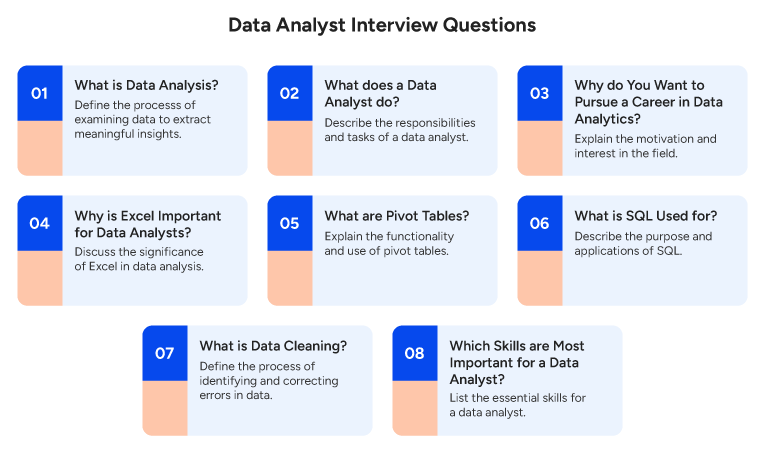
1. What is Data Analysis?
Why They Ask:
This question helps interviewers assess if the candidate understands the core concept of data analysis and can explain it clearly.
How to Answer:
Give a simple definition of data analysis and why organizations need to analyze data.
Sample Answer
Data analysis is basically a process of analyzing, modeling, and interpreting data from multiple sources to identify patterns, trends, and valuable insights. It helps organizations understand their current market position, identify problems, and make informed decisions for improvement.
2. What does a Data Analyst do?
Why They Ask:
Interviewers may ask this question to gauge the candidate’s understanding of a data analyst’s roles and responsibilities.
How to Answer:
Explain how a data analyst role impacts and benefits organizations.
Sample Answer
A data analyst collects and studies data to help companies make informed decisions. They gather data from different sources, filter and organize it, and search for patterns or trends. They present and forecast their findings clearly so teams can improve performance or solve business issues.
3. Why do You Want to Pursue a Career in Data Analytics?
Why They Ask:
Interviewers ask this to understand the candidate’s motivation and interest in the field.
How to Answer:
Focus on a genuine interest in working with data and solving problems.
Sample Answer
I want to pursue a career in data analytics because I genuinely enjoy working with data and solving problems. I like looking at data, finding patterns, and understanding what it actually means. When those insights help a business make better decisions, it feels very satisfying. I also like that this field keeps changing, so I get to learn and improve my skills continuously.
4. What is Structured and Unstructured Data?
Why They Ask:
Interviewers ask this question to assess the candidate’s basic understanding of data types, how data is organized and handled in real-world situations.
How to Answer:
Briefly Explain both Data Types with Simple Examples.
Sample Answer
Structured data is well-organized data stored in tables, spreadsheets, or databases, which makes it easy to search and analyze, such as customer details or sales records. Unstructured data does not follow a fixed format and includes things like emails, images, videos, and social media content, which are harder to analyze using traditional tools.
5. Why is Excel Important for Data Analysts?
Why They Ask:
Interviewers want to assess whether the candidate understands the importance of using Excel for data analysis, especially in entry-level roles.
How to Answer:
Explain that Excel helps organize, analyze, and summarize data easily.
Sample Answer
Excel is essential for data analysts because it helps organize and clean large datasets, perform calculations, and spot trends quickly using various tools, functions, and formulas. It is cost-effective and widely available, which makes it easy to use for preliminary analysis before deeper investigations with more complex tools.
6. What are Pivot Tables?
Why They Ask:
This question tests the candidates’ familiarity with tools for summarizing data.
How to Answer:
Describe the function and usage of pivot tables in data analysis as a way to summarize and reorganize data.
Sample Answer
Pivot tables are used to quickly summarize and analyze large amounts of data in tools like Excel or Google Sheets. They help organize data by grouping it into rows and columns so patterns and totals are easy to see. I can use pivot tables to calculate values like totals, averages, or counts for different categories. Since they work with drag-and-drop, they make reporting fast and easy without complex formulas.
7. What is SQL Used for?
Why They Ask:
Interviewers ask this to assess whether the candidate understands the process of accessing data from databases.
How to Answer:
Give a simple explanation of SQL and its purpose.
Sample Answer
SQL (Structured Query Language) is used to access, manage, and manipulate data stored in relational databases. Data analysts use SQL to retrieve specific information using SELECT statements, combine data from multiple tables using JOINs, filter records with WHERE clauses, and perform calculations and groupings with functions like SUM, COUNT, and GROUP BY.
8. What is Data Cleaning?
Why They Ask:
Interviewers ask this to check if the candidate understands the importance of preparing data before analysis.
How to Answer:
Explain data cleaning as the process of fixing errors and removing unwanted data.
Sample Answer
Data cleaning is the process of identifying and removing misleading or inaccurate records from the datasets. The primary objective of data cleaning is to improve data quality so it can be used for analysis and predictive modeling. It is the next process after data collection and loading.
9. What is Data Validation, and how do You Check Data Accuracy?
Why They Ask:
This question helps interviewers understand whether the candidate knows how to maintain data quality.
How to Answer:
Briefly define data validation and explain common methods for checking accuracy.
Sample Answer
Data validation is the process of checking whether data is accurate, complete, and usable before analysis. Analysts verify data types, ranges, and formats to ensure that values conform to predefined rules. Accuracy is checked by comparing data against source records and identifying inconsistencies, which helps maintain data integrity and prevents errors.
10. What is Data Visualization?
Why They Ask:
Interviewers want to check whether candidates can clearly explain data insights to others.
How to Answer:
Explain data visualization as the presentation of data in a visual format to make information easier to understand.
Sample Answer
Data visualization is the practice of presenting data using charts, graphs, or other visual representations to make information easier to understand. It helps identify patterns, trends, comparisons, and outliers quickly. Effective visualization relies on clean data, choosing the correct chart for the message, and keeping the design uncluttered.
11. Which Chart is Best for Trend Analysis?
Why They Ask:
This question tests the candidates’ knowledge of charts and their use.
How to Answer:
Explain which chart is most suitable for showing trends and briefly mention why it works well for time-based or continuous data.
Sample Answer
A line chart is best for trend analysis because it shows how values change over time. It makes it easy to spot patterns such as upward or downward movement, seasonality, or sudden changes. This helps analysts and stakeholders quickly understand how performance is evolving.
12. What Skills do You Think are Most Important for a Data Analyst?
Why They Ask:
This question checks whether the candidate understands the core skills needed for the role.
How to Answer:
Mention a mix of analytical, communication, and basic technical skills.
Sample Answer
Important skills for a data analyst include strong problem-solving, attention to detail, and the ability to identify patterns in data. Communication skills are essential for clearly explaining insights and supporting decision-making. Proficiency in data cleaning and data visualization, as well as basic programming/scripting, is also important for solving real-world problems.
13. What have You Learned Recently to Improve Your Data Analysis Skills?
Why They Ask:
Interviewers want to assess the candidate’s curiosity and commitment to learning and growth, both of which are important for entry-level candidates.
How to Answer:
Mention a recent learning activity, such as practice, courses, or self-study. Keep it practical.
Sample Answer
Recently, I completed an online course on exploratory data analysis, which helped me approach data more systematically before analysis. I attended a webinar on building dashboards, learning to choose visuals based on audience and goals. I practiced applying these concepts to sample datasets to reinforce what I had learned.
Data Analyst Interview Questions for Experienced Candidates
This section covers some common data analyst interview questions and answers for experienced candidates.
14. How do You Ensure Data Accuracy in Your Analysis?
Why They Ask:
Interviewers ask this question to understand how candidates prevent errors when working with business-critical information.
How to Answer:
Explain the specific checks you perform at different stages, and how you reduce the risk of incorrect insights being shared with stakeholders.
Sample Answer
I ensure accuracy by validating data at multiple stages of the analysis process. I begin by checking for missing values, then cross-verify key metrics against source systems or existing reports to confirm their reliability. Before sharing results, I review assumptions, calculations, and outputs to ensure the insights align with the business context and are accurate.
15. How do You Find and Fix Data Quality Issues?
Why They Ask:
This question helps interviewers assess the candidate’s experience handling raw or unreliable data.
How to Answer:
Describe how you identify common data issues and explain the steps you take to correct or manage them.
Sample Answer
I start by profiling the data to identify missing values, then clean it by correcting formats, removing duplicates, handling missing values appropriately, and validating value ranges. If assumptions or adjustments are required, I document them clearly so the analysis remains transparent and trustworthy.
16. What is Data Wrangling?
Why They Ask:
Interviewers ask this question to determine whether the candidate understands the basic preparation required before proper analysis can begin.
How to Answer:
Define data wrangling and explain its importance in real analytical projects.
Sample Answer
Data wrangling is closely related to preprocessing and is also known as data munging. It involves cleaning, transforming, and organizing raw or unstructured information into a format suitable for analysis. The main objective is to improve the quality and structure so it can be effectively used for reporting, analysis, or model building.
17. How do You Handle Large Datasets Efficiently?
Why They Ask:
Interviewers want to know whether the candidate can handle large volumes of data without delaying analysis or systems.
How to Answer:
Explain how you optimize performance through filtering, summarization, and structured processing.
Sample Answer
When working with large datasets, I focus on filtering data early to include only relevant columns and time periods. I summarize data before analysis, avoid unnecessary calculations, and break the work into smaller, manageable steps. This approach improves performance and keeps the evaluation focused on business goals.
18. How do You Turn a Business Problem into a Data Problem?
Why They Ask:
This question helps interviewers know if the candidate can turn business goals into clear questions that data can answer.
How to Answer:
Explain how you clarify objectives, identify metrics, and define the scope of analysis.
Sample Answer
I begin by understanding the business objective and the decision to support. I then break the problem into specific questions that can be addressed through analysis, such as identifying trends, gaps, or changes in performance over time. This helps define the right metrics, data sources, and scope before the analysis begins.
19. How do You Decide which Data is Important for Analysis?
Why They Ask:
Interviewers ask this to assess whether the candidate can prioritize relevant data.
How to Answer:
Explain how relevance, quality, and business impact guide your selection.
Sample Answer
I focus on data that is directly relevant to the problem being analyzed. I consider factors such as relevance, time period, data accuracy, and potential impact on decision-making. Any data that does not add value to the objective is excluded to keep the analysis efficient and clear.
20. Can You Explain a Time when Your Analysis Influenced a Business Decision?
Why They Ask:
This question helps interviewers assess how the candidate’s work has contributed to business outcomes.
How to Answer:
Share a concise example that includes the problem, your analysis, and the outcome.
Sample Answer
In a previous role, I analyzed customer behavior data and identified a drop-off point in the sales funnel. Based on these insights, the team revised the onboarding flow and messaging. This change improved conversion rates and demonstrated how data-driven insights can support better business decisions.
21. How do You Ensure Insights are Helpful in Business Teams?
Why They Ask:
Interviewers want to know whether the candidate’s analysis leads to action or just reports.
How to Answer:
Explain how you align insights with business goals and present them clearly.
Sample Answer
I ensure insights are helpful to business teams by first aligning them with specific business goals and priorities. I present findings with visuals, so the team can quickly understand the key points. I also highlight actionable recommendations, explaining how the insights can guide decisions or improve processes. I also take feedback from stakeholders and follow up to see how the insights are applied.
22. How do You Explain Data Results to Non-Technical Stakeholders?
Why They Ask:
This question evaluates the candidate’s ability to communicate complex information clearly.
How to Answer:
Describe how you simplify results and use visuals.
Sample Answer
When explaining data results to non-technical stakeholders, I avoid technical jargon and focus on the key insights that matter to the business. I use simple charts to highlight trends rather than detailed calculations. I also relate the findings to real business outcomes, so the impact is clear. This helps ensure the message is easy to understand and supports confident decision-making.
23. How do You Use SQL Joins in Real Projects?
Why They Ask:
Interviewers ask this to assess the candidate’s practical experience combining data from multiple tables.
How to Answer:
Provide a real-world example of when and why you use joins.
Sample Answer
SQL joins are used in real projects to combine data from multiple tables, for example, I use INNER JOINs to create customer-order reports that show only customers with completed orders. LEFT JOINs are helpful to complete the customer list with order details, even for customers who have not placed orders. RIGHT JOINs, or FULL OUTER JOINs, are used in scenarios such as product-supplier or employee-department reporting, where it is important to include all records from one or both tables to provide a complete business view.
24. What is the Difference between WHERE and HAVING?
Why They Ask:
This question tests the candidate’s understanding of SQL filtering logic.
How to Answer:
Explain how each clause works and when it is applied.
Sample Answer
The main difference between WHERE and HAVING is that WHERE filters individual rows before grouping or aggregation, while HAVING filters grouped results after aggregation. The WHERE clause is used for row-level conditions and cannot be used with aggregate functions directly. In practice, WHERE is used to limit the data early, and HAVING is used to refine aggregated results.
25. How do You Improve Slow SQL Queries?
Why They Ask:
Interviewers want to know whether the candidate can optimize query performance.
How to Answer:
Explain the techniques you use to identify and fix performance issues.
Sample Answer
I improve slow queries through several optimization techniques. First, I add indexes on columns frequently used in WHERE clauses, JOIN conditions, or ORDER BY statements to speed up data retrieval. I avoid using SELECT * and instead specify only the columns needed. I review the query execution plan to identify bottlenecks, such as full-table scans or inefficient joins. Breaking complex queries into smaller stages using temporary tables or CTEs can also improve readability and performance.
Data Analyst Interview Questions on Python, Excel, and Analytics Tools

26. When do You Choose Python Instead of Excel?
Why They Ask:
This question evaluates the candidate’s ability to choose the right tool for the task.
How to Answer:
Compare use cases clearly and practically.
Sample Answer
Python is ideal for automation and building consistent, reusable workflows; tasks that would require manual effort in Excel can be scripted and scheduled in Python. I also prefer Python for complex statistical analysis, machine learning, and advanced data transformations beyond Excel’s built-in functions. Python libraries like pandas, NumPy, and scikit-learn provide powerful capabilities for data manipulation and predictive modeling.
27. What tools are Commonly Used for Data Analysis?
Why They Ask:
Interviewers ask this to understand the candidate’s familiarity with the analytics ecosystem.
How to Answer:
Mention commonly used tools and their purposes.
Sample Answer
Commonly used data analysis tools include Excel and SQL for data cleaning, exploration, and querying structured data. Programming languages such as Python or R are used for deeper analysis, automation, and statistical modeling. Visualization tools like Tableau or Power BI help present insights in a clear and visual format for stakeholders. The choice of tools usually depends on the data size, complexity, and project business requirements.
28. How do You Stay Updated on New Data Tools and Trends?
Why They Ask:
This question assesses the candidate’s learning mindset and adaptability.
How to Answer:
Explain how you actively upgrade your skills.
Sample Answer
I stay up to date by regularly reading industry blogs and trusted analytics publications. I also attend webinars and online sessions to understand how new tools and techniques are being applied in real projects. Participating in analytics communities helps me learn from peers and practical use cases. In addition, I experiment with new tools on sample or real datasets to build hands-on understanding rather than just theoretical knowledge.
29. What Steps do You Follow to Analyze a Dataset?
Why They Ask:
Interviewers ask this question to understand the candidate’s overall analytical approach.
How to Answer:
Explain the process from problem understanding to delivering insight.
Sample Answer
I begin by understanding the business problem and the questions that need to be answered. I then collect relevant data and clean it to handle missing values, errors, and inconsistencies. Next, I perform exploratory data analysis to identify patterns, trends, and key drivers. Finally, I use clear visuals and explanations to present insights so stakeholders can easily understand the findings and take action.
30. What is the Importance of Exploratory Data Analysis (EDA)?
Why They Ask:
This question checks whether the candidate understands the value of early data exploration.
How to Answer:
Explain how EDA helps guide deeper analysis.
Sample Answer
Exploratory data analysis is important because it helps understand the structure and behavior of the data early on. It allows analysts to identify trends, relationships, and anomalies that may not be obvious at first glance. EDA also helps detect data quality issues such as missing values or outliers, before deeper analysis begins. This early understanding guides the choice of analytical methods and improves the accuracy and reliability of the final results.
31. What is the Difference between Descriptive and Predictive Analysis?
Why They Ask:
Interviewers use this question to assess the candidate’s understanding of analytical approaches.
How to Answer:
Clearly differentiate between past-focused and future-focused analysis.
Sample Answer
Descriptive analysis focuses on understanding past events by summarizing historical data. It explains what happened, identifying patterns, trends, and relationships through aggregation, visualization, and basic statistics. Predictive analysis builds on this historical data to forecast future outcomes. It relies on methods like regression, time series analysis, and machine learning. It’s used for tasks like product recommendations and predicting patient risk, playing a key role in data-driven decision-making.
32. What are Univariate, Bivariate, and Multivariate Analyses?
Why They Ask:
This question tests the candidate’s understanding of the levels of statistical analysis.
How to Answer:
Define each type clearly with an example.
Sample Answer
Univariate analysis focuses on a single variable and is used to describe its distribution, such as average sales or age distribution. Bivariate analysis examines the relationship between two variables, for example, how price changes affect sales. Multivariate analysis examines multiple variables together to identify patterns and dependencies, such as how price, marketing spend, and seasonality jointly influence revenue.
Behavioral Interview Questions for Data Analysts
33. Why Should We Hire You for this Data Analyst Role?
Why They Ask:
Interviewers ask this to evaluate fit, confidence, and value addition.
How to Answer:
Highlight your skills, experience, and business impact.
Sample Answer
I merge analytical skills and practical business understanding into the data analyst role. Along with working confidently with data and tools, I focus on clear communication and collaboration with different teams. I am careful about data accuracy and take ownership of my work. This approach ensures that analysis is practical, trusted, and supports real business decisions.
34. How do You Prioritize Multiple Data Requests?
Why They Ask:
This question assesses the candidate’s time management and planning skills.
How to Answer:
Explain how you evaluate urgency and impact.
Sample Answer
When handling multiple data requests, I first assess the urgency and potential business impact of each. I also consider dependencies, such as whether one analysis is required before another can move forward. Based on this, I establish a clear execution order and set realistic timelines. Throughout the process, I keep stakeholders informed about progress and any changes to delivery expectations.
35. How do You Handle Feedback on Your Analysis Work?
Why They Ask:
Interviewers want to understand how the candidate responds to feedback and opportunities for improvement.
How to Answer:
Show openness and professionalism.
Sample Answer
I listen carefully to feedback, clarify expectations, and make revisions where needed. Feedback helps improve the quality and usefulness of my analysis.
36. Which Part of Data Analysis do You Enjoy the Most, and why?
Why They Ask:
This question helps interviewers understand a candidate’s motivation.
How to Answer:
Connect your interest to business impact.
Sample Answer
I enjoy the stage where raw data is explored, and patterns start to emerge. This is where numbers begin to explain the actual business scenario and highlight opportunities or risks that may not be obvious. It motivates me to turn these findings into clear insights that teams can understand and utilize. When data directly supports better decisions and outcomes, it is most rewarding.
Data Analyst Interview Questions on Project Scenarios

37. How Would You Analyze a Sudden Drop in Sales?
Why They Ask:
Interviewers ask this to evaluate structured problem-solving skills.
How to Answer:
Explain your step-by-step diagnostic approach.
Sample Answer
If there is a sudden drop in sales, I first validate the data to rule out reporting errors or data quality issues. Once the numbers are confirmed, I segment sales by product, region, and customer group to pinpoint where the decline is occurring. I then review internal factors and assess external factors to identify the root cause and suggest corrective actions.
38. Tell Me about a Complex Data Analytics Project You Worked on.
Why They Ask:
This question helps interviewers assess project ownership and the ability to handle complexity.
How to Answer:
Describe the problem, tools used, and results.
Sample Answer
I worked on a customer churn analysis project that required combining data from sales, customer support, and product usage systems. The challenge was handling different data formats and ensuring consistency across sources before analysis. I used analytical tools to identify churn patterns and key risk indicators, including usage drop-offs and recurring support issues. These insights helped the business design targeted retention strategies, leading to a 12% reduction in customer churn.
39. How do You Design Dashboards for Management?
Why They Ask:
Interviewers want to assess the candidate’s ability to support decisions through visualization.
How to Answer:
Explain your strategy for selecting metrics and designing visuals.
Sample Answer
I categorize the dashboard based on the use case, whether operational, strategic, or KPI-driven, and choose metrics that reflect performance, progress, and risk. I keep visuals clear and consistent by using appropriate charts, logical layouts, and simple labels to highlight trends and patterns at a glance. I also update dashboards in real time so management can review performance.
40. What Will You do if the Data You Receive Looks Wrong or Incomplete?
Why They Ask:
Interviewers ask this question to evaluate a candidate’s troubleshooting and communication skills.
How to Answer:
Explain how you validate and escalate issues.
Sample Answer
If the data looks wrong or incomplete, I first check the source to make sure it was collected correctly. Then, I compare it with related data to find where the issue might be coming from. I look for missing values, mismatched numbers, or formatting problems that could affect the results. If I find any issues, I write them down clearly and explain how they might impact the analysis. Finally, I communicate with the right team and help fix the problem before moving forward.
41. Tell Us about a Data Project that Helped Your Team or Company
Why They Ask:
Interviewers ask this question to evaluate the candidate’s contribution to the team or business success.
How to Answer:
Highlight the outcomes of a data project you managed successfully.
Sample Answer
I worked on a sales forecasting project to help the marketing team plan their campaigns better. I looked at past sales data to understand patterns and seasonal trends, then created a forecast to estimate demand for different product categories. Based on these insights, the team adjusted their campaign timing to match expected demand. This led to a 15% improvement in ROI and helped reduce inventory issues like overstocking or stock shortages.
Last-Minute Interview Preparation Checklist for Data Analysts
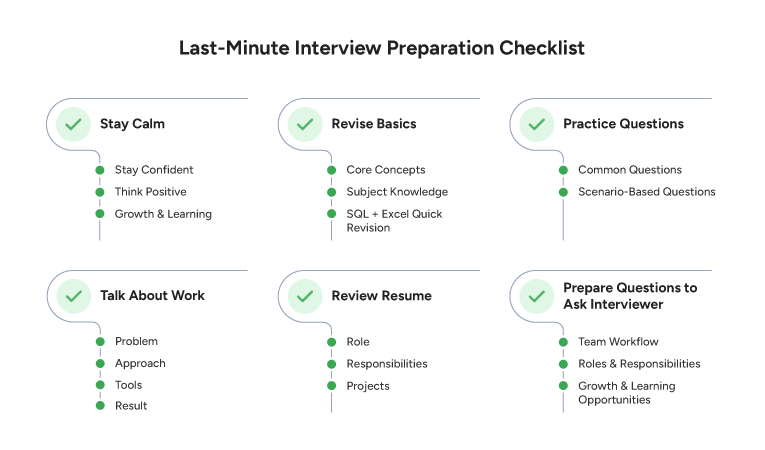
- Quickly revise the basics before your interview. Going in without preparation can make things harder, even if you know the subject.
- Practice common interview questions and keep your answers clear, honest, and to the point. Use simple examples to explain your thinking.
- Be ready to talk about your work such as what problem you worked on, how you approached it, which tools you used, and what result it created.
- Read your resume carefully and make sure you can confidently explain your role, responsibilities, and any projects you’ve listed.
- Prepare a few questions to ask the interviewer, such as about team workflow, tools, or upcoming projects. This shows genuine interest in the role.
- Stay calm and relaxed before the interview. Taking a deep breath and staying composed helps you think clearly and leave a good impression.
Read More Interview Questions with Sample Answer
Related Job Descriptions
Table of Contents
What is the Role of an HR Manager?
An HR Manager is responsible for hiring the right talent, managing employee performance, handling employee relations, ensuring legal compliance, overseeing payroll, and building a positive workplace culture. They also act as a bridge between employees and leadership to support smooth HR operations and business goals.
Key Takeaways
- 70+ HR manager interview questions along with concise, easy-to-follow responses.
- The questions are organized by category (people operations, payroll, performance, onboarding, culture, employee relations, etc.)
- The blog also highlights potential pitfalls and a last-minute interview checklist to help candidates prepare for interviews with confidence.
Most Common HR Manager Interview Questions and Answers
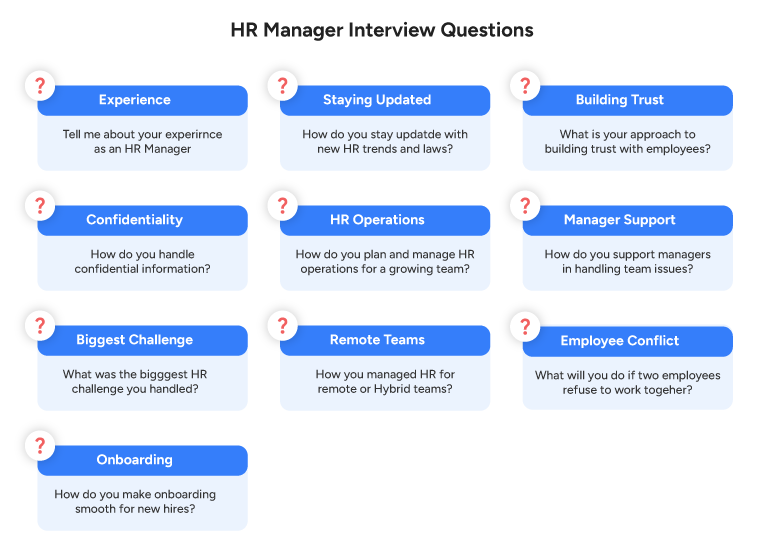
1. Can You Tell Me about Your Experience as an HR Manager?
Reason Behind Asking: The interviewer asks the question to gain a general overview of the candidate’s professional background, areas of responsibility, and practical HR experience.
Sample Answer: As an HR Manager with over 6 years of experience at my previous company, I handled end-to-end HR functions such as recruitment, employee relations, performance management, policy implementation, and compliance. I worked closely with team leaders to support organizational growth and ensure a positive and healthy work environment.
2. How do You Stay Updated with New HR Trends and Laws?
Reason Behind Asking: This question helps interviewers assess the candidate’s dedication to lifelong learning. To minimize organizational risk and enhance workforce management, HR professionals need to stay up to date on human resource planning, changing labor regulations, industry trends, and best practices.
Sample Answer: I stay up to date on current HR trends by regularly reading HR publications, tracking regulatory changes, attending webinars and workshops, and participating in professional HR forums.
3. What is Your Approach to Building Trust with Employees?
Reason Behind Asking: The interviewer would like to know how the candidate builds credibility, transparency, and good relationships in the organization. Trust is an essential aspect of effective HR administration, and it directly influences employee engagement and retention.
Sample Answer: I build trust with employees by communicating clearly, listening to their concerns, and treating everyone fairly. This helps my employees feel comfortable, respected, and supported at work.
4. How do You Handle Confidential Information?
Reason Behind Asking: This question assesses the candidate’s ethical standards, data privacy knowledge, and ability to protect sensitive employee and organizational information. The HR role is a major responsibility regarding confidentiality.
Sample Answer: I am very discreet with confidential information. I limit access to sensitive records and share information only when needed. To build trust and ensure compliance, maintaining confidentiality is essential.
5. What does a Successful HR Function Mean to You?
Reason Behind Asking: The interviewer is assessing how the candidate perceives the role of HR in the organization and how they understand what success is in the organization outside the administrative functions.
Sample Answer: A good HR role to me adds value to both the workforce and the organization. It can provide compliance, a favourable working culture, facilitate employee development, and align people strategies with business objectives to achieve long-term organizational success.
Role-Based HR Manager Interview Questions
6. What is Your Main Responsibility as an HR Manager?
Reason Behind Asking: The recruiter is simply asking whether you are a business partner. They would like to know whether you really understand how the company’s strategy relates to its existence and prosperity.
Sample Answer: As an HR Manager, my primary responsibilities include hiring and onboarding employees, managing performance, handling payroll processes, ensuring legal compliance, and supporting training and development to help employees grow within the organization.
7. How do You Plan and Manage HR Operations for a Growing Team?
Reason Behind Asking: The interviewer would like to test your ability to scale HR operations without causing inefficiencies. This question refers to the extent to which you look forward to improvement, the complexity of the workforce, and the balance between speed and structure.
Sample Answer: I plan and manage HR operations by understanding the company’s growth plans and the skills needed in the future. I look at workforce trends and business goals so I can plan hiring and resources in advance. I use HR tools and basic workforce data to predict talent needs and improve HR processes.
8. How do You Support Managers in Handling Team Issues?
Reason Behind Asking: This question discusses your aptitude as a strategic partner. It helps understand whether managers can be prepared to handle people issues effectively, rather than sending all matters to HR.
Sample Answer: I support managers by listening to their concerns and guiding them on how to handle team issues. I help them improve communication, manage conflicts, and resolve problems early.
9. How do You Align HR Goals with Business Goals?
Reason Behind Asking: The interviewer is interested in how you perceive HR as a strategic or support role. The question assesses your skills in turning business goals into HR action programs.
Sample Answer: I ensure that HR objectives are aligned with business priorities through monitoring key performance indicators and keeping in touch with the leadership objectives. Regardless of whether HR strategies focus on growth, efficiency, or retention, I align the HR initiatives, like hiring schemes, learning initiatives, and performance models, with the goals that will directly aid quantifiable business returns.
10. How do You Measure the Success of Your HR Initiatives?
Reason Behind Asking: This question challenges your results-oriented mind. It assists in determining whether HR initiatives can be measured, rather than being guided purely by intuition or qualitative feedback.
Sample Answer: My measurements of HR success are outcome-oriented, such as engagement (including the benefits of employee engagement), retention rates, time-to-hire, performance trends, and internal mobility. Regular review of these indicators will enable me to assess what is working, identify gaps, and improve HR efforts to deliver specific business value.
Experience & Background Interview Questions
11. Can You Describe Your Past HR Roles and Key Achievements?
Reason Behind Asking: The interviewer wants to understand your hands-on experience, how your role evolved, and whether you delivered tangible outcomes rather than just performing routine HR tasks.
Sample Answer: In previous roles, I managed core HR responsibilities throughout the employee lifecycle and focused on improving processes that directly impacted experience and efficiency. For example, I streamlined onboarding and partnered with managers to resolve people challenges while aligning HR practices with business goals.
12. What was the Biggest HR Challenge You Handled?
Reason Behind Asking: The interviewer wants to understand how you respond to pressure, ambiguity, and sensitive situations involving others.
Sample Answer: One of the biggest challenges I handled was employee uncertainty during a period of organizational change. There was anxiety about role clarity and future growth, which began to affect morale. I worked closely with leadership to ensure consistent communication and created safe channels for employees to voice concerns. Transparency and timely communication helped rebuild trust and stability.
13. Have You Managed Remote or Hybrid Teams?
Reason Behind Asking: This assesses your adaptability to modern work models and your ability to maintain fairness and engagement across locations.
Sample Answer: Yes, I have supported both remote and hybrid teams. One key focus was ensuring that remote employees felt equally informed and included. I worked on standardizing communication, virtual onboarding, and performance tracking to keep expectations clear regardless of location.
14. What HR Processes have You Created or Improved?
Reason Behind Asking: The interviewer is assessing your ability to contribute strategically and actively improve existing systems.
Sample Answer: I have improved several HR processes, including onboarding, performance reviews, and grievance handling. For instance, I helped formalize performance review cycles by defining timelines, documentation standards, and feedback mechanisms. This brought more clarity to both employees and managers and made the process feel fair and structured rather than subjective.
Skills & Competency Interview Questions
15. How do You Prioritize Tasks during Busy HR Periods?
Reason Behind Asking: This question evaluates how you handle workload without compromising accuracy or employee trust.
Sample Answer: During busy periods such as payroll processing or hiring, I prioritize tasks based on urgency and impact. Employee pay, compliance deadlines, and critical employee issues always come first. I rely on task planning, checklists, and clear timelines to ensure nothing important is missed, even when I am handling several tasks or deadlines at once.
16. What Skills Make You an Effective HR Manager?
Reason Behind Asking: The interviewer wants insight into your self-awareness and core strengths.
Sample Answer: My effectiveness comes from a combination of communication, empathy, and attention to detail. I am approachable, which helps employees feel comfortable raising concerns, but I am also structured and policy-driven when making decisions. This balance allows me to support employees while maintaining fairness and consistency.
17. How do You Ensure Accuracy while Handling Multiple Tasks?
Reason Behind Asking: This assesses your reliability in a role where small errors can have serious consequences.
Sample Answer: I rely on structured processes and double-checking critical information, especially for payroll, compliance, and employee records. I also ensure to document tasks and maintain clear records so that nothing depends solely on memory or assumptions.
18. How do You Make Fair and Unbiased Decisions?
Reason Behind Asking: The interviewer is testing ethical judgment and objectivity.
Sample Answer: I base decisions on documented facts, company policies, and consistent standards rather than personal opinions. I also ensure all sides before concluding. This approach helps maintain trust and ensures employees feel decisions are made fairly.
19. How do You Maintain Strong Relationships with Employees?
Reason Behind Asking: This question evaluates trust-building and interpersonal effectiveness.
Sample Answer: I maintain strong relationships by being accessible and responsive. Employees value HR when they feel heard and supported, even if the answer is not always what they expect. Clear communication and follow-through help build credibility over time.
Scenario-Based Interview Questions for HR Managers
20. What Will You do if Two Employees Refuse to Work Together?
Reason Behind Asking: This is a test of neutrality in conflict resolution.
Sample Answer: My initial communication would be one-on-one with each employee to know about the issue behind it. After identifying the root cause, I would organize a discussion on professional expectations and cooperation. This would help them collaborate respectfully despite their differences.
21. How Will You Handle a Complaint against a Manager?
Reason Behind Asking: The interviewer is assessing confidentiality, courage, and fairness.
Sample Answer: I would handle the complaint discreetly and objectively, following the company’s grievance procedure. This includes gathering facts, documenting discussions, and ensuring the process remains unbiased. It is important that employees trust HR to address such issues without favoritism.
22. What Steps Will You Take if an Employee is Consistently Underperforming?
Reason Behind Asking: This evaluates the candidate’s performance management maturity, indicating their understanding of organizational performance systems and strategy implementation.
Sample Answer: I would begin by understanding whether the issue is related to skill gaps, role clarity, or external factors. Based on this, I would work with the manager to set clear expectations and a realistic improvement plan, offering support before considering corrective measures.
23. How Will You Manage a Sudden Rise in Employee Resignations?
Reason Behind Asking: This exercise assesses one’s ability to think critically and analyze information effectively.
Sample Answer: I would review exit feedback and engagement data to identify patterns. Alongside leadership, I would address root causes such as workload, leadership gaps, or growth concerns. Clear communication and timely action are critical to prevent further attrition.
24. What Will You do if Payroll Errors Happen at Month-End?
Reason Behind Asking: The interviewer is looking to assess how candidates demonstrate accountability in challenging situations and under intense pressure.
Sample Answer: I would immediately investigate the issue as soon as possible and inform affected employees transparently. After resolution, I would review controls and checks to ensure the same error does not recur.
Payroll Interview Questions for HR Manager
25. How do You Ensure Payroll Accuracy every Month?
Reason Behind Asking: This question evaluates your attention to detail, process discipline, and ability to manage a critical function that directly affects employee trust.
Sample Answer: I ensure payroll accuracy by following a structured process every month. This includes validating attendance data, approved leave, and salary components before processing payroll. I also cross-check inputs with previous records and coordinate closely with finance to resolve discrepancies early, so employees are paid correctly and on time.
26. How do You Explain the Salary Structure to New Employees?
Reason Behind Asking: The interviewer wants to assess your communication skills and ability to make compensation details clear and transparent.
Sample Answer: I explain the salary structure in simple, clear terms by breaking down each component, including fixed pay, allowances, deductions, and statutory contributions. I also ensure employees understand how their net pay is calculated to avoid confusion later.
27. How do You Handle Employee Queries about Tax, PF, or ESI?
Reason Behind Asking: This question assesses your statutory knowledge and ability to support employees on sensitive financial matters.
Sample Answer: I address employee queries by referring to current statutory guidelines and company policies. I explain the details patiently and ensure accuracy. If needed, I coordinate with payroll or finance teams to provide complete clarity, so employees feel confident and informed.
28. What is Your Process to Verify Attendance and Overtime?
Reason Behind Asking: The interviewer is evaluating operational accuracy and control over payroll inputs.
Sample Answer: I verify attendance through system reports and ensure all leave and overtime entries are approved by managers. I ensure any discrepancies are clarified before payroll processing to avoid errors and ensure fair compensation.
29. How do You Manage Benefit Programs like Insurance or Bonuses?
Reason Behind Asking: This question evaluates your ability to manage employee benefits effectively and consistently.
Sample Answer: I manage benefit programs by clearly communicating eligibility, timelines, and coverage details to employees. I also coordinate with vendors and internal teams to ensure the timely resolution of employee concerns regarding benefits or bonuses.
HR Policies & Compliance Interview Questions
30. How do You Create or Update HR Policies?
Reason Behind Asking: This assesses your understanding of compliance, organizational requirements, and policy structuring.
Sample Answer: I create or update HR policies by reviewing legal requirements, organizational needs, and practical implementation challenges. I ensure policies are clear, compliant, and easy for employees to understand while aligning with company values.
31. How do You Ensure Employees Follow Company Policies?
Reason Behind Asking: The interviewer wants to understand how you drive adherence.
Sample Answer: I ensure policy adherence through clear communication, regular reminders, and consistent application across all employees. When policies are applied fairly and explained well, employees are more likely to follow them.
32. What is Your Process for Handling Compliance Issues?
Reason Behind Asking: This question tests your risk management and problem-solving approach.
Sample Answer: I address compliance issues by first identifying the gap and understanding organizational impact. I then take corrective action, document the process, and implement controls to prevent recurrence, while keeping leadership informed.
33. How do You Audit HR Documents and Records?
Reason Behind Asking: The interviewer is assessing your attention to detail and data governance.
Sample Answer: I conduct periodic audits using checklists to review employee records, contracts, and statutory documents. This helps ensure accuracy and proper documentation at all times.
34. How do You Educate Employees about Policy Changes?
Reason Behind Asking: This evaluates your communication and change management skills.
Sample Answer: I educate employees about policy changes through clear announcements, written documentation, and explanation sessions when required. I also encourage questions to ensure everyone understands the compliance updates and their implications.
HR Manager Interview Questions on Onboarding & Exit Process

35. How do You Make Onboarding Smooth for New Hires?
Reason Behind Asking: The interviewer wants to assess whether you can create a structured employee onboarding guide that helps new employees feel confident, informed, and productive early on.
Sample Answer: I make onboarding smooth by ensuring it is planned well in advance and executed consistently for every new hire. This starts with pre-joining communication, document readiness, system access, and coordination with managers. During onboarding, I clarify the role, set expectations, and help the employee understand how their role fits into the organization.
36. What Information do You Share on a New Employee’s First Day?
Reason Behind Asking: This question evaluates your ability to prioritize essential information without overwhelming the new employee.
Sample Answer: On the first day, I focus on sharing information that helps the employee feel comfortable, so that it does not overload them with too many details at once. This includes core values of the company, basic HR policies, reporting structure, and role expectations. I also explain whom they can approach for support, whether it is HR, their manager, or team members.
37. How do You Collect Feedback from New Joiners?
Reason Behind Asking: The interviewer wants to know whether you actively evaluate and improve the onboarding experience.
Sample Answer: I collect feedback through structured check-ins during the first few weeks and a more in-depth discussion after onboarding. I ask targeted questions to assess support, clarity of expectations, and challenges faced. These insights help identify hidden gaps in processes or support. Using 360-degree feedback, I address issues and continuously improve onboarding to enhance retention, engagement, and time-to-productivity.
38. What Steps do You Follow during Employee Exit?
Reason Behind Asking: This assesses your ability to manage exits professionally while ensuring compliance and continuity.
Sample Answer: I follow a structured exit process that begins with acceptance and confirmation of the notice period. This is followed by planning knowledge transfer, conducting an exit interview, and coordinating final settlement and documentation. A clear employee exit process helps reduce risk, ensures compliance, and maintains professionalism throughout.
39. How do You Ensure a Positive Exit Experience?
Reason Behind Asking: The interviewer is assessing how you safeguard the employer brand even when employees leave.
Sample Answer: I ensure a positive exit experience by maintaining respectful and transparent communication until the employee’s last working day. I address concerns professionally, ensure timelines are honored, and complete exit formalities smoothly. Even when an employee chooses to leave, a respectful exit experience leaves a positive impression and preserves goodwill.
People Operations Interview Questions
40. How do You Improve Employee Engagement?
Reason Behind Asking: This evaluates your ability to build a motivated and connected workforce.
Sample Answer: I encourage open communication by listening to feedback and supporting initiatives that make employees feel valued. Engagement improves when employees understand how their work contributes to the organization and feel recognized for their efforts. I also work with managers to address engagement issues through wellness programs proactively rather than reactively.
41. What Steps do You Take to Keep Teams Motivated?
Reason Behind Asking: The interviewer wants to assess how you sustain engagement over time.
Sample Answer: I help managers keep teams motivated by encouraging regular feedback, recognition, and succession planning. Motivation is not just about rewards but also about clarity, appreciation, and growth opportunities. When employees see progress and feel supported, motivation remains consistent.
42. How do You Manage Employee Data and HR Systems?
Reason Behind Asking: This tests accuracy, confidentiality, and HR Information Systems discipline.
Sample Answer: I manage employee data by ensuring records are updated accurately and on time, and that access is restricted by role. I also conduct periodic reviews to ensure data consistency and compliance. Maintaining accurate employee data is critical for payroll, compliance, and decision-making.
43. How do You Support Teams during Organizational Changes?
Reason Behind Asking: This assesses your change management capability.
Sample Answer: During changes, I focus on clear and consistent communication, including sharing updated organizational charts. I work closely with leadership to ensure messages are aligned and help managers address team concerns. Transparency, timely updates, and empathy are essential to reduce uncertainty and maintain trust during change.
44. How do You Track and Improve Employee Experience?
Reason Behind Asking: The interviewer is testing strategic HR thinking.
Sample Answer: I track employee experience through feedback, engagement surveys, exit insights, and regular interactions. These inputs help identify recurring concerns and improvement areas. Based on the insights, I work with leadership to improve policies, processes, and communication that affect the employee experience.
Training & Development Interview Questions
45. How do You Identify Training Needs in a Company?
Reason Behind Asking: This evaluates alignment between learning initiatives and business needs.
Sample Answer: I identify training needs by reviewing performance gaps and discussing skill requirements with managers. Employee feedback also plays an important role in identifying areas for development. This ensures training initiatives are relevant and aligned with organizational priorities.
46. How do You Design Training Plans for Different Teams?
Reason Behind Asking: The interviewer wants to see whether you can tailor learning initiatives.
Sample Answer: I design training plans based on team roles, required competencies, and career progression paths. Different teams have different learning needs, so customization is essential. Tailored training plans lead to better engagement and the practical application of learning.
47. How do You Measure Training Success?
Reason Behind Asking: This tests outcome-oriented thinking.
Sample Answer: I measure training success through participant feedback and KPI tracking. I also look at how effectively employees apply the skills in their daily work. Training is successful only when it translates into better performance and productivity.
48. How do You Promote Continuous Learning?
Reason Behind Asking: This evaluates the long-term development mindset.
Sample Answer: I promote continuous learning by encouraging knowledge sharing, supporting access to learning resources, and aligning learning initiatives with career growth. When learning is integrated into development rather than treated as a one-time activity, participation improves naturally.
49. How do You Handle Employees Who Resist Training?
Reason Behind Asking: This assesses communication and influence.
Sample Answer: I handle resistance by first understanding the reason behind it. I then explain the relevance of the training and how it supports both individual growth and role effectiveness. When employees see training as beneficial rather than mandatory, resistance usually reduces.
HR Manager Interview Questions on Performance Management
50. How do You Set Performance Expectations with Employees?
Reason Behind Asking: This evaluates clarity and fairness in goal-setting.
Sample Answer: I set performance expectations by clearly defining measurable goals aligned with role responsibilities. I ensure employees understand what is expected and how performance will be evaluated. Clear expectations reduce confusion and support fair assessments.
51. What is Your Process for Conducting Performance Reviews?
Reason Behind Asking: The interviewer wants to assess structure and consistency.
Sample Answer: I follow a structured review process that includes self-assessment, manager feedback, and evaluation against predefined objectives. This approach ensures transparency and consistency across teams and helps employees understand their strengths and improvement areas.
52. How do You Handle Low Performance Fairly?
Reason Behind Asking: This evaluates the balance between empathy and accountability.
Sample Answer: I handle low performance by identifying the root cause and discussing it openly with the employee and manager. I focus on setting improvement plans and providing support before taking corrective action. Fairness comes from consistency and giving employees a genuine opportunity to improve.
53. How do You Support Managers in Rating Employees?
Reason Behind Asking: This tests HR’s role as a business partner.
Sample Answer: I support managers by guiding them on clear, role-based evaluation criteria with the help of a performance management system. This helps ensure performance ratings are consistent, aligned with organizational standards, and fair while actively mitigating unconscious bias in decision-making.
54. How do You Link Performance with Rewards?
Reason Behind Asking: The interviewer is assessing the fairness and transparency of the reward.
Sample Answer: I link performance with rewards by aligning outcomes with company policies and ensuring transparency in how rewards are decided. When employees understand the link between performance and rewards, trust in the system increases.
Interview Questions on Employee Relations & Conflict Handling
55. How do You Build Strong Employee Relationships?
Reason Behind Asking: The interviewer wants to assess how effectively you build trust, approachability, and long-term credibility with employees.
Sample Answer: I build strong employee relationships by being approachable, consistent, and transparent in my interactions. Employees need to feel that HR is a safe place to contact, not only in crisis but also in regular interactions. I listen actively, respond, and follow through on commitments.
56. How do You Handle Employee Complaints?
Reason Behind Asking: This question evaluates your ability to manage sensitive issues objectively while maintaining confidentiality and fairness.
Sample Answer: I handle complaints through active listening and ensuring the employee feels heard. I maintain confidentiality and gather facts before taking any action. I follow a structured, documented process aligned with company policy to ensure the issue is addressed without bias.
57. What is Your Approach to Resolving Conflicts?
Reason Behind Asking: The interviewer wants to understand your mediation skills and ability to handle disagreements professionally.
Sample Answer: My approach to resolving conflicts is first to understand all perspectives involved. I focus on identifying the root cause and then facilitating a professional discussion that emphasizes respect, accountability, and common goals. The objective is not to blame but to help employees move forward.
58. How do You Maintain a Positive and Inclusive Workplace?
Reason Behind Asking: The interviewer is assessing your commitment to fairness and inclusion.
Sample Answer: I maintain a positive and inclusive workplace by promoting respect, fairness, and equal opportunity in all HR practices. I ensure policies are applied consistently and encourage open communication. Inclusion is sustained when employees feel safe, respected, and valued, regardless of background or role.
Culture Fit Interview Questions for HR Manager
59. What Type of Work Culture do You Perform Best in?
Reason Behind Asking: The interviewer wants to assess cultural alignment with the organization.
Sample Answer: I perform best in a transparent and collaborative work culture where accountability and people development are valued. I believe such environments encourage trust, ownership, and long-term growth for both employees and the organization.
60. How do You Help Maintain Company Culture?
Reason Behind Asking: This question evaluates your influence on organizational culture.
Sample Answer: I help maintain company culture by reinforcing values through policies, leadership alignment, and daily HR interactions. Culture is shaped not only by statements but also by consistent behavior, and HR plays a key role in ensuring values are reflected in everyday practices.
61. How do You Handle Employees Who do Not Align with the Culture?
Reason Behind Asking: The interviewer is testing your corrective and coaching approach.
Sample Answer: I address cultural misalignment through timely feedback and targeted coaching. I clearly explain expectations and allow employees to adjust their behavior. If misalignment continues despite support, I follow formal processes to ensure fairness and consistency.
62. What does a Healthy Workplace Culture Mean to You?
Reason Behind Asking: This assesses your personal understanding of workplace culture.
Sample Answer: A healthy workplace culture is one where employees feel respected, trusted, and supported. It encourages open communication, accountability, and psychological safety while enabling employees to grow and perform at their best.
63. How do You Promote Teamwork and Collaboration?
Reason Behind Asking: This evaluates your ability to foster cooperation across teams.
Sample Answer: I promote teamwork by encouraging open communication, shared objectives, and collaboration across functions. When teams understand common goals and feel supported, collaboration becomes natural rather than forced.
64. How do You Communicate Difficult Decisions to Employees?
Reason Behind Asking: The interviewer is assessing emotional intelligence with transparency and clarity.
Sample Answer: I communicate difficult decisions honestly and respectfully. I explain the rationale behind the decision, acknowledge employee concerns, and ensure the message is delivered with empathy. Clear and transparent communication helps employees understand the context, even if the decision is difficult.
65. How do You Ensure Your Communication is Clear?
Reason Behind Asking: This tests your ability to avoid misunderstandings.
Sample Answer: I ensure clarity by keeping communication simple, structured, and relevant. I avoid assumptions and encourage questions to confirm understanding. Clear communication reduces confusion and strengthens organizational trust.
66. How do You Manage Misunderstandings between Employees?
Reason Behind Asking: This evaluates mediation skills.
Sample Answer: I manage misunderstandings by encouraging open dialogue and clarifying facts. I guide employees to focus on professional behavior and conflict resolution rather than personal differences, ensuring the discussion remains respectful and constructive.
67. How do You Communicate Updates to Leadership?
Reason Behind Asking: The interviewer is assessing executive communication skills.
Sample Answer: I communicate updates to leadership in a concise and structured manner, supported by relevant data and insights. This helps leadership make informed, timely, and effective decisions.
Behavioral Interview Questions for HR Manager
68. Tell Me about a Time You Solved a Complicated HR Issue
Reason Behind Asking: This assesses your experience and judgment in complex situations.
Sample Answer: I once handled a sensitive employee relations issue that required careful investigation and neutrality. I gathered facts from all parties, documented each step, and aligned actions with company policy. By maintaining transparency and fairness, the issue was resolved without escalation, and trust was preserved.
69. Describe a Situation where You Handled Pressure Well
Reason Behind Asking: This evaluates resilience and prioritization under stress.
Sample Answer: During a high-hiring period with payroll processing, I managed the pressure by prioritizing tasks, planning timelines, and maintaining focus on accuracy. Staying organized enabled me to meet deadlines without compromising quality.
70. How do You Respond when Employees Disagree with Your Decision?
Reason Behind Asking: The interviewer is testing professionalism and openness.
Sample Answer: I listen to employee concerns and explain my decision clearly, including the rationale behind it. While I remain open to discussion, I also ensure consistency and fairness in applying policies.
71. Tell Me about a Time You Supported an Employee in Distress
Reason Behind Asking: This assesses empathy and discretion.
Sample Answer: I noticed the team member was stressed, so I talked with them one-on-one, listened to their concerns, reduced their workload for a time, and supported them until they felt comfortable again.
72. Describe a Situation where You Led a Challenging HR Project
Reason Behind Asking: This evaluates leadership and execution skills.
Sample Answer: I led an HR process improvement project that required coordination across multiple teams. The challenge was to align stakeholders and maintain timelines. Through clear communication, regular follow-ups, and stakeholder engagement, the project was completed successfully and improved operational efficiency.
Red Flags to Watch for
- Lack of knowledge on HR-related practices and principles.
- Not able to provide clear answers in the interview.
- Unable to handle employee conflict and other difficult conversations.
- Showing a negative attitude towards previous companies/employers.
- Difficulty in explaining their last job roles and achievements in HR.
- Responses that are contradictory when it comes to their work history.
- Unprofessional behavior or inappropriate language during the interview.
- Fails to ask questions related to the company and the role they applied for.
Your Last-Minute HR Manager Interview Checklist
- Review Company Culture and Values.
- Prepare examples for behavioral questions.
- Understand the basics of HR compliance.
- Familiarize yourself with HR tools and analytics.
- Review organizational charts, HR strategy, and succession planning.
Read More Interview Questions with Sample Answer
Table of Contents
How do I prepare for a Project Manager interview? If you’re not sure what HR and hiring managers may ask, don’t worry, we’ve covered 60+ common Project Manager interview questions with sample answers and helpful tips, so you can easily prepare and give your best in the interview.
What Will You Learn?
- 60+ project management interview questions for freshers, mid-level, and experienced candidates with sample answers.
- Basic HR questions on planning, key skills, and why you want this role.
- Senior-level questions on budget, risks, team handling, and real work situations.
- Agile questions explained in simple words, including Agile vs Waterfall, Scrum, and Sprint.
- Common questions about handling stress, resolving conflicts, and working under pressure.
- Quick Interview Tips: What Hiring Managers Expect
Project Manager Interview Questions and Answers for Freshers
Is this your first project manager interview as a fresher? You’re in the right place. This section includes easy interview questions with sample answers to help you get started.

1. What is Project Management, and what does a Project Manager do?
Why They Ask: Interviewers test your conceptual understanding as well as your practical knowledge for the position.
How to Answer: Briefly define what project management is and describe the role of a project manager.
Sample Answer: Project management is the practice of leading a team to achieve specific goals within defined constraints such as time, scope, and budget by planning, executing, monitoring, and closing tasks. A project manager is responsible for coordinating with stakeholders and guiding the team through the project cycle from initiation to completion.
2. Why did You Choose Project Management as a Career?
Why They Ask: Such questions are often asked to know more about your motivations for preferring a job.
How to Answer: Answer honestly about what interests you in project management. Keep it positive, practical, and show enthusiasm.
Sample Answer: I chose project management because I enjoy turning plans into results, solving problems, working with a team, and seeing a project successfully completed.
3. What Skills are Required for a Project Manager Role?
Why They Ask: Interviewers assess your theoretical and practical understanding of the role with such questions.
How to Answer: Mention technical, leadership, and soft skills.
Sample Answer: A project manager requires leadership, communication, time management, risk management, budgeting, and stakeholder management skills. Technical proficiency in project management tools and methodologies such as Agile or Waterfall is also essential for delivering projects effectively.
4. Explain the Project Management Life Cycle Process
Why They Ask: To assess your knowledge of the project management cycle.
How to Answer: Briefly define and list the phases of the project management cycle.
Sample Answer: I would start by clearly defining the project goals. Then, I’d make a detailed plan with timelines, resources, and possible risks. During execution, I’d coordinate the team, manage daily tasks, and monitor progress. At the end, I’d close the project by delivering the final output and reviewing what went well and what could be improved.
5. What is the Difference between a Project and a Program?
Why They Ask: To evaluate your basics related to organizational structure.
How to Answer: Clearly differentiate between the scope and purpose of a project and a program.
Sample Answer: A project is temporary, specific, and narrower compared to a program and focuses on achieving specific deliverables. While a program is broader and comprises a group of projects, it aims at broader organizational goals.
6. What is the Triple Constraint in Project Management?
Why They Ask: Interviewers want to know whether you understand how project success factors are interrelated.
How to Answer: Briefly define the triple constraints and give an example of how to manage constraints in a project.
Sample Answer: The triple constraint, also called the project management triangle, refers to the three project constraints: scope, time, and budget. As these factors are interconnected, changing one factor affects the others. For instance, adding scope affects time and cost.
7. How is Project Success Defined?
Why They Ask: to find out how you measure project success.
How to Answer: Define and explain success criteria.
Sample Answer: Project success is defined by achieving objectives within the approved scope, schedule, and budget while meeting quality standards and stakeholder expectations. A successful project also delivers measurable business value.
8. How has Your Education or Experience Prepared You for this Role?
Why They Ask: to identify whether your background aligns with the role.
How to Answer: Highlight relevant education, certifications, and real-world experience.
Sample Answer: My degree in engineering provided strong analytical and problem-solving skills, while my experience managing cross-functional projects taught me planning and scheduling, along with communication skills. Additionally, I hold a PMP certification.
9. What do You Enjoy Most about Managing Projects?
Why They Ask: Interviewers want to know what you specialize in and like about project management.
How to Answer: Focus on aspects like leading teams, solving problems, and delivering value.
Sample answer: I particularly enjoy collaborating with cross-functional teams for complex and interdisciplinary projects. They help me explore different domains and make a project more interesting.
10. Why do You Want to Join Our Organization as a Project Manager?
Why They Ask: Employers want to know whether you researched their firm and identify your personality and cultural fit with the firm.
How to Answer: Prepare in advance by researching the organization you are applying to, and note down relevant values that resonate with you.
Sample Answer: I appreciate your company’s commitment to innovative software and teamwork. My background in leading cross-functional teams and managing projects will help me deliver strong results and support the company’s goals.
Mid-Level Project Manager Interview Questions and Answers
Candidates with 2-4 years of experience should prepare for this set of project manager interview questions. The sample answers are ideal for answering questions on execution and risk management.
11. Where do You See Yourself in the Next 3 to 5 Years?
Why They Ask: Managers want to know your career aspirations and gauge your growth potential in their organization.
How to Answer: Demonstrate ambition and commitment while aligning with realistic career paths in project management.
Sample Answer: In the next 3 to 5 years, I aim to grow into a senior project manager or program manager role, leading larger, strategic projects and mentoring junior project managers.
12. How do You Create a Basic Project Plan?
Why They Ask: To test your awareness of the basic project management concepts.
How to Answer: Explain the process of creating a basic project plan by mentioning the relevant steps.
Sample Answer: I would start by defining the project goal and deliverables, then break the work into smaller tasks. I would estimate time and cost, arrange tasks in the right order, and assign them to the team. Finally, I would create a timeline with milestones and keep a simple risk plan ready.
13. What is a Work Breakdown Structure (WBS)?
Why They Ask: To assess your understanding of WBS in terms of a theoretical concept and practical application.
How to Answer: Define WBS, and state its purpose.
Sample Answer: A Work Breakdown Structure is a hierarchical decomposition of the total project scope into smaller, manageable work components. It organizes deliverables and tasks into logical levels, making the work easier to estimate, assign, track, and control.
14. How do You Estimate Project Timelines?
Why They Ask: To assess your ability to set a realistic schedule.
How to Answer: Describe the estimation inputs and methods you rely on.
Sample Answer: I estimate timelines by dividing the project into small tasks, checking how long each task will take, and arranging them in the right order. Then I create a schedule, build in a buffer for risks, and review it with stakeholders.
15. What is a Milestone in a Project?
Why They Ask: to identify whether you understand the basics of project tracking and scheduling.
How to Answer: Define milestones and explain their purpose in monitoring progress and decision points.
Sample Answer: A milestone is a significant point or event in a project timeline that represents the completion of a key phase or deliverable. Milestones help keep track of the project by facilitating reviews and monitoring progress.
16. What is a Project Charter, and why is It Important?
Why They Ask: To find out whether you understand the processes involved in managing projects.
How to Answer: define the project charter and briefly state its purpose.
Sample Answer: A project charter is a document that formally authorizes a project, defines objectives, scope, key stakeholders, and initial requirements. It enables the manager to allocate resources and serves as a reference for decision-making.
17. What Project Management Tools are Commonly Used?
Why They Ask: To check your knowledge of the popular project management tools.
How to Answer: Candidates should group tools by purpose rather than listing brand names randomly.
Sample Answer: Common project management tools include:
- Scheduling and planning tools such as Microsoft Project and Smartsheet,
- Task and work management tools like Jira, Asana, and Trello,
- Collaboration and communication tools, including Microsoft Teams, Slack, and Confluence, and
- Reporting and performance monitoring tools such as Power BI dashboards.
18. How do You Prioritize Project Tasks?
Why They Ask: Task prioritization reveals your ability to manage constraints and risk, ensuring that critical activities receive focus and resources within a limited time.
How to Answer: Explain your prioritization criteria: impact on objectives, dependencies, deadlines, risks, and resource limits.
Sample Answer: I prioritize tasks by looking at deadlines, what matters most for the project, and what needs to be done first to avoid delays. I also take care of high-risk tasks early, consider the team’s availability, and keep stakeholder priorities in mind.
19. What is a Project Baseline, and why is It Important?
Why They Ask: This tests whether you understand project control and performance measurement.
How To Answer: Define what a baseline is, state what it includes, and explain its role in tracking performance.
Sample Answer: A project baseline is the approved reference point for key elements of the project, typically scope, schedule, and cost. It serves as a benchmark against which progress and performance are measured throughout execution.
20. How do You Monitor Project Performance and Keep It on Track?
Why They Ask: Interviewers want to see whether you understand the continuous monitoring process.
How to Answer: Describe how you use defined performance indicators and regular data reviews to compare planned vs. actual progress.
Sample answer: I monitor performance by tracking key performance indicators such as schedule progress, cost usage, and quality measures against the approved baseline. I use dashboards and reports to compare actual outcomes with planned targets, and review risks and change requests.
21. How do You Involve Your Project Team Members in the Planning Process?
Why They Ask: Employers assess your collaboration skills with such questions.
How to Answer: Mention the methods that you use to include team members in the planning phase.
Sample Answer: I involve my team members and stakeholders from the start by holding planning discussions and asking for their input early. Throughout the project, I stay in regular touch with stakeholders to confirm progress, validate key steps, and get their feedback on tasks related to their areas.
22. What KPIs Should a Project Manager Track?
Why They Ask: They want to see if you know specific measurable metrics.
How to Answer: List specific KPIs and briefly state what each measures and why it matters.
Sample Answer: I include KPI such as –
- Timetable metrics like schedule variance and on-time completion percentage,
- Budget measures like cost performance index (CPI) and actual vs planned cost,
- Quality indicators such as rework rate and customer satisfaction, and
- Effectiveness metrics like resource utilization rate.
23. How do You Handle Missed Deadlines?
Why They Ask: Employers want to know how you would communicate missed deadlines to stakeholders and find the root causes.
How to Answer: Explain how you would adjust the strategies and communicate with the stakeholders.
Sample Answer: When a deadline is missed, I first find the real reason behind the delay. Then, I assess the impact on the overall schedule and adjust the plan with updated task durations or resource allocation. Finally, I share the revised timeline and next steps with stakeholders to keep everyone aligned.
24. How do You Manage Multiple Projects at the Same Time?
Why They Ask: To assess your time management skills.
How to Answer: Discuss prioritization frameworks, use of tools, and regular checkpoints.
Sample Answer: I manage multiple projects by prioritizing work based on business importance and available resources. I make clear schedules and use project management tools like Trello to keep track of everything. I also check in regularly and communicate to balance my workload and keep all projects moving forward.
25. How do You Ensure Quality during Project Execution?
Why They Ask: They want to know if you actively plan for quality and validate deliverables through structured checks.
How to Answer: Explain both preventive and verification measures you use.
Sample Answer: I define clear acceptance criteria and organize peer reviews. I also use feedback loops to improve processes.
26. How do You Control Project Costs?
Why They Ask: Employers want to know how you would optimize costs by forecasting future needs and monitoring spending.
How to Answer: Walk through your cost control process, including tracking and escalation.
Sample Answer: I control project costs by setting a detailed budget, tracking expenses, and comparing actual costs to the budget. I use tools like Excel or MS Project to monitor spending and identify variances early. When needed, I reallocate resources or revise timelines to stay within budget.
27. How do You Manage Vendors or Third-Party Stakeholders?
Why They Ask: To evaluate your communication skills and ability to oversee contracts.
How to Answer: Highlight clear expectations, performance metrics, and accountability mechanisms.
Sample Answer: I manage vendors by clearly outlining SOWs and SLAs. I define deliverables and establish clear performance criteria. Lastly, I hold regular coordination meetings and monitor progress with KPIs and performance monitoring tools.
28. How do You Manage Task Dependencies?
Why They Ask: Dependencies impact schedule logic; interviewers want to see if you can identify, sequence, and adjust work dependencies to avoid bottlenecks.
How to Answer: Explain how you capture and sequence dependencies, and how you adjust when changes occur.
Sample Answer: I identify task dependencies early in planning and setting the project timeline. I use tools like Gantt charts and project management software to visualize task relationships. I monitor progress, adjust resources as needed, and inform the team of any delays or changes to ensure projects remain on track.
29. How do You Balance Scope, Time, and Budget Conflicts?
Why They Ask: The project management triangle (scope, time, cost) is a foundational concept, and interviewers want to see your decision-making framework for trade-offs.
How to Answer: Mention impact analysis and stakeholder engagement.
Sample Answer: When conflicts happen, I first understand what’s changing and how it will affect the scope, timeline, and budget. Then I share clear options with stakeholders so we can decide the best way forward. For example, if the deadline can’t change but the work increases, we may need more budget, or we may deliver only the priority features first.
30. What are the Key Steps to Closing a Project Successfully?
Why They Ask: Successful project closure is critical, and interviewers want to analyze how you would close a project.
How to Answer: List the closure steps in order: acceptance, documentation, transition, and lessons learned.
Sample Answer: To close a project successfully, I first get final approval from stakeholders. Then I confirm all work and contracts are completed and hand over the project to the support or operations team. Finally, I document the results, save project files, and note key learnings to improve future projects.
31. What is Risk Management in Project Management?
Why They Ask: Risk management is a formal concept in project management, and interviewers want to assess your theoretical and practical understanding of it.
How to Answer: Define risk management clearly and explain the structured process for identifying, analyzing, planning responses, and controlling risks throughout the project lifecycle.
Sample Answer: Risk management is the structured process of planning what to do if problems occur. It is about noting possible risks, keeping track of them, understanding how serious they could be, and planning what to do when they happen.
32. What is the Difference between a Risk and an Issue?
Why They Ask: Understanding the distinction between risks and issues is fundamental to proper decision-making and documentation in project control.
How to Answer: Contrast risks and issues based on timing, certainty, and management approach.
Sample Answer: A risk is a potential future event or condition that may or may not happen and could affect project objectives. An issue is a current event or problem that has already occurred and needs quick action. In a project, I track risks in a risk register, and I record issues in an issue log so they can be fixed immediately, and the work doesn’t stop.
33. How do You Identify and Prioritize Project Risks?
Why They Ask: This assesses whether you know how to identify threats or opportunities systematically and then focus attention on those that matter most to project outcomes.
How to Answer: Describe identification methods, then explain how you prioritize risks using probability and impact measures.
Sample Answer: I identify project risks through structured methods such as brainstorming with the team, expert interviews, historical data reviews, and using a risk breakdown structure to cover all categories. Once identified, I prioritize risks by evaluating their probability of occurrence and potential impact on project objectives.
34. How do You Handle Unexpected Project Problems or Crises?
Why They Ask: Interviewers want to see whether you can remain composed under pressure and apply systematic problem-solving rather than reacting impulsively.
How to Answer: Explain your approach for assessing the situation and managing unexpected challenges.
Sample Answer: To handle unexpected problems or crises, I will calmly assess the root cause and impact. I communicate clearly with stakeholders and collaborate with the team to quickly implement effective solutions. After resolution, I review the incident to prevent recurrence. For example, when a server crashed and risked missing a deadline, we quickly used a backup system and finished the work on time.
35. How do You Manage Project Delays?
Why They Ask: This is often asked to assess your analytical, problem-solving, and communication skills.
How to Answer: Describe your process for managing project delays and touch on how you would communicate the changes to the relevant stakeholders.
Sample Answer: I have a three-step process for managing project delays. I identify root causes such as dependency bottlenecks or external factors. Next, I assess the overall impact on the schedule and resource plan. Lastly, I explore options such as fast-tracking or crashing and communicate them to relevant stakeholders.
36. How do You Prevent Recurring Project Issues?
Why They Ask: Such questions evaluate your ability to learn from past mistakes and implement systemic solutions based on those lessons.
How to Answer: emphasise the importance of process improvement and documentation.
Sample Answer: I prevent recurring issues by conducting root cause analysis after an issue is resolved to understand why it happened. I then implement preventive measures such as adjusting templates, refining processes, updating checklists, and increasing training. I document these actions in a lesson learned register so the entire team benefits, and I include checkpoints in plans to catch similar issues before they arise.
37. What is Scope Creep, and how do You Prevent It?
Why They Ask: Scope creep is one of the most frequent causes of project overruns and failures. Interviewers want to assess your ability to control project boundaries.
How to Answer: Define scope creep concisely and list preventive measures tied to formal controls.
Sample Answer: Scope creep refers to the uncontrolled or continuous expansion of the project scope beyond what was originally agreed upon. I prevent scope creep by defining the project scope and baselining it upfront, and establishing an approval process. I also frequently communicate impact assessments before incorporating any change.
38. How do You Manage Change Requests?
Why They Ask: Change requests affect scope, schedule, and budget, so interviewers want to make sure you follow a formal, controlled approach.
How to Answer: Outline the change control process from submission through evaluation and approval.
Sample Answer: I document the change request and assess the change’s impact on scope, timeline, risk, cost, and quality. Then, if approved, I communicate the change to the team to ensure everyone is on the same page. Lastly, I updated the project baseline to reflect the change.
39. How do You Evaluate the Impact of Scope Changes?
Why They Ask: Employers want to evaluate whether you can translate scope changes into measurable impact.
How to Answer: Describe the factors you analyse and how you present the evaluation to stakeholders.
Sample Answer: I follow a structured process for analyzing factors related to scope changes. I analyze how the scope affects time, cost, resources, dependencies, and risk exposure. I compare the current baseline with the proposed changes using scheduling models and estimation techniques. Additionally, I present the report to stakeholders to support informed decision-making.
40. How do You Communicate Risks and Changes to Stakeholders?
Why They Ask: Such questions assess your communication skills.
How to Answer: Focus more on formal communication, such as documenting risks rather than informal communication channels.
Sample Answer: I use formal reports and risk dashboards. Next, I document risks and changes in a risk log and share updates at regular intervals to keep the stakeholders in the loop.
Senior Project Manager Interview Questions and Answers
Candidates with 5+ years of experience can prepare for these project manager interview questions for senior-level roles. This section covers leadership, strategic planning, team management, and Agile project management.
41. How do You Align Projects with Business Goals?
Why They Ask: Interviewers want to confirm that you can ensure strategic alignment.
How to Answer: Describe a structured approach using strategic planning, portfolio processes, and clear links between project objectives and business goals.
Sample Answer: I focus on three aspects for aligning projects with objectives. First is tying project outcomes to strategic objectives. Then I ensure value alignment during portfolio planning, and use performance metrics like KRAs and KPIs to ensure that the performance goals are linked with the firm’s strategic objectives.
42. How Would You Create the Budget for the Project?
Why They Ask: Creating a project budget tests whether you can translate scope into financial terms.
How to Answer: Give a step-by-step explanation of the budgeting process.
Sample answer: I create a budget by reviewing the WBS to identify required resources and estimate labor costs. This includes contingencies for known risks by analyzing historical data and ensuring that all the processes are documented for future reference.
43. How do You Prioritize Projects at a Portfolio Level?
Why They Ask: Prioritization at the portfolio level ensures the organization invests in the right mix of projects.
How to Answer: Describe the criteria and frameworks used to rank projects for selection and resource allocation.
Sample Answer: I prioritize projects by assessing their strategic alignment, expected benefits, resource requirements, risks, and ROI potential. I rely on various scoring models and a prioritization matrix to align the project with organizational priorities.
44. How do You Ensure Projects Deliver Strong ROI?
Why They Ask: Interviewers want to see that you can drive business value.
How to Answer: Mention both upfront ROI estimation and ongoing value tracking.
Sample Answer: I define realistic ROI goals based on financial expectations. Throughout execution, I rely on benefits realization metrics such as Net Present Value (NPV) and Benefit Cost Ratio (BCR) to estimate the potential gains. Lastly, I adjust resourcing or scope as needed to protect returns.
45. How do You Manage High-Budget or High-Risk Projects?
Why They Ask: Interviewers want to know how you manage high-risk / high-budget projects.
How to Answer: Discuss what you do for managing risks and planning.
Sample Answer: I focus on quantitative as well as qualitative aspects of risk management. Additionally, I submit performance reports to stakeholders to keep everyone aligned. I also tie performance metrics to schedule, cost, and value, which helps me mitigate any issues earlier.
46. How do You Handle Executive Stakeholders?
Why They Ask: Interviewers want to know you can communicate upwards effectively and manage expectations.
How to Answer: Explain your approach to communication with senior leadership.
Sample Answer: I communicate strategic updates and decision points. I actively listen to their priorities so that I can reflect them in the project decisions.
47. What Role does Data Play in Project Decision-Making?
Why They Ask: Interviewers want evidence that you rely on objective measures rather than intuition.
How to Answer: Mention specific data types (performance metrics, trends, forecasts) and how they inform decisions. Add in an industry statistic that can make your answer strong.
Sample Answer: Data provides objective insights into project performance and trends. I use performance metrics like cost variance, schedule indexes, and trend analysis to detect deviations early. I also rely on analytics for forecasting risks.
48. How do You Manage Organizational Change through Projects?
Why They Ask: Interviewers want to know you can manage people, processes, and expectations as well as deliver outputs.
How to Answer: Describe change management activities that help stakeholders adapt and adopt.
Sample answer: I communicate the change clearly to all the stakeholders. I especially make sure to discuss any significant organizational changes with employees who might be affected. Additionally, I rely on data to suggest and implement the changes.
49. When Should a Project be Stopped or Pivoted?
Why They Ask: Interviewers want to know if you can recognise when continuing a project no longer delivers value, and if you can make tough decisions based on evidence.
How to Answer: Mention checkpoints and objective criteria.
Sample Answer: A project should be stopped or changed when it’s not giving the expected results. This can happen if the cost goes too high, the risk becomes too big, or the business priorities change. I review progress at key stages and decide whether to continue, make changes, or stop the project.
50. How do You Build High-Performing Project Teams?
Why They Ask: Employers want to find out whether you can create a collaborative and motivated team.
How to Answer: Explain your philosophy and approach for building and managing teams.
Sample Answer: I believe teamwork always comes first, and no one person is more important than the team. I build the same mindset in every project by keeping everyone focused on the goal and working together as one team.
51. How do You Mentor Junior Project Managers?
Why They Ask: Interviewers look for managers who can not only manage projects but also build future leaders.
How to Answer: Describe how you would mentor junior colleagues.
Sample Answer: I make sure junior team members feel comfortable asking questions and sharing ideas. I stay available for them whenever they need help. Most importantly, I encourage them to take ownership of their decisions, to include them in important decisions, and to share insights with them as needed.
52. How do You Handle Underperforming Team Members?
Why They Ask: Such questions evaluate your ability to improve team performance while ensuring that the team is motivated and engaged.
How to Answer: Mention that you have a balanced approach that combines formal and informal practices.
Sample Answer: If a team member is not performing well, I first understand the reason behind it and talk to them openly. I would also give constructive feedback. Then, if the team member doesn’t improve, I discuss performance improvement plans and reassign tasks.
53. How do You Resolve Conflicts within a Team?
Why They Ask: Interviewers assess your emotional intelligence through such questions.
How to Answer: Focus on collaborative solutions and describe your approach for resolving conflicts.
Sample Answer: I engage in in-person conversations with the people involved. I listen to their concerns, note the key points, and help them find a fair solution. If needed, I also support a proper investigation to make sure the issue is handled in the right way.
54. How do You Manage Remote or Distributed Project Teams?
Why They Ask: The post-COVID increase in remote workers influences how teams are distributed, and interviewers want to know what you would do to effectively manage remote teams.
How to Answer: Highlight the importance of communication and interactive activities. Also, emphasise the use of tech tools for better collaboration.
Sample Answer: I keep the team engaged by making meetings more interactive and using dashboards to clearly show progress. I also support work-life balance and tell the team they can reach out anytime. If possible, I include them in office activities to strengthen team connections.
55. How do You Prevent Team burnout?
Why They Ask: Interviewers want a candidate who can improve morale and retention by preventing team burnout due to workload.
How to Answer: Mention what you would do to improve a team’s well-being and balance workload.
Sample Answer: I ensure that the workload is equally distributed among all the team members. I also advise team members to take short breaks and promote a culture of work-life balance by encouraging them to spend time in recreational activities.
56. How do You Ensure Accountability across Teams?
Why They Ask: Employers look for a candidate who can ensure accountability through transparent and constructive mechanisms.
How to Answer: Explain the processes that you use for measuring performance and giving feedback.
Sample Answer: I ensure accountability by setting clear expectations and deadlines for each team member. I use measurable performance indicators and regular updates to make progress visible. In case of any issues, I focus on implementing corrective actions that we have agreed on.
Project Manager Interview Questions on Agile and Scrum
As a senior candidate, you must be aware of different methodologies of project management, such as agile and waterfall. Interviewers often ask related questions to assess your conceptual knowledge as well as the practical application of these methods.
57. What is Agile Project Management?
Why They Ask: As an experienced candidate, you are expected to know different methodologies used in managing projects.
How to Answer: Briefly define agile project management.
Sample Answer: Agile project management is an iterative approach that delivers value in small, measurable increments rather than in a single final deliverable. It emphasises stakeholder collaboration, adaptive planning, and continuous improvement throughout the project lifecycle.
58. What is the Difference between Agile and Waterfall?
Why They Ask: To check your knowledge on different methodologies used in project management.
How to Answer: Clearly differentiate agile and waterfall methods of project management by contrasting them with each other.
Sample Answer: Agile is iterative and flexible,e and delivers projects in short cycles. Waterfall is sequential and defines requirements upfront. Agile is ideal for projects with evolving requirements. Waterfall is more suitable for projects with an established, stable scope.
59. What is Scrum, and how does It Work?
Why They Ask: Scrum is a primary Agile framework. Interviewers want to know if you understand roles, artifacts, events, and iterative delivery cycles.
How to Answer: Explain Scrum roles in brief.
Sample Answer: Scrum is a way of working where the team completes work in short time periods called sprints (1 to 4 weeks). One person sets the work priority, one person helps the team follow the process, and the team delivers the work. Every sprint has planning, short daily updates, and a review at the end to check what was done and improve for next time.
60. What is a Product Backlog?
Why They Ask: To check if you understand how Agile teams manage and prioritize work over time.
How to Answer: Define what it is and briefly mention its role.
Sample Answer: A product backlog is an ordered list of features, bug fixes, and enhancements required for the product. It is continuously refined and prioritised by the Product Owner based on business value and stakeholder input. The team selects backlog items for each sprint during planning.
61. How do You Prioritize Backlog Items?
Why They Ask: They want to gauge how you would prioritize items and tasks.
How to Answer: Describe prioritization methods like MoSCoW, value scoring, cost-of-delay, and alignment with business goals.
Sample Answer: I prioritize backlog items by working on the most important tasks first. I look at deadlines, impact on the project, and task dependencies. I also talk to stakeholders and update priorities when things change.
62. How do You Handle Changing Requirements in Agile Projects?
Why They Ask: Employers want to know your approach to managing change in agile projects.
How to Answer: Mention a systematic approach for managing evolving requirements.
Sample Answer: I handle changing requirements by adding them to the backlog. I would prioritize the items based on value and risk. Lastly, I would review the prioritized items with the team when refining backlogs and consider them during sprint planning.
63. When Should Agile Not be Used?
Why They Ask: They want to assess your ability to select the right methods for different projects.
How to Answer: List scenarios or projects where agile’s strengths would be counterintuitive.
Sample Answer: Agile is not suitable when requirements are fully defined and unlikely to change, or when projects require strict schedule, cost, and scope control, such as in highly regulated industries or long infrastructure projects. In such cases, Waterfall or hybrid approaches are more suitable.
Behavioral and Situational Interview Questions
Behavioural and situational questions about managing stress, resolving conflicts, and meeting deadlines are common in project management interviews. Read on to learn how to answer such questions using the STAR (Situation, Task, Action, Result) method.
64. Tell Me about a Challenging Project You Managed.
Why They Ask: Interviewers want to assess your problem-solving, leadership, and adaptability skills in real-world scenarios.
How to Answer: Use the STAR (Situation, Task, Action, Result) method to structure your answer.
Sample Answer: In one project, we had a tight deadline and many stakeholders involved. The team faced delays due to dependencies. I reprioritised tasks, held daily meetings, and coordinated with stakeholders to match expectations. By adjusting the schedule and focusing on results, we completed the project on time.
65. Describe a Project that Failed and What You Learned from It
Why They Ask: Such questions gauge your self-awareness, accountability, and ability to learn from previous mistakes.
How to Answer: Describe a real-life example, and emphasize what you learned from the failed project.
Sample Answer: In one project, we missed the quality targets because the initial requirements were not clear and complete. I took responsibility for it and fixed the process. I worked closely with stakeholders to identify missing points, improve communication, and update our requirement templates so the same issue doesn’t happen again.
66. Describe a Conflict You Resolved during a Project
Why They Ask: Firms want project managers who can demonstrate emotional intelligence and leadership skills.
How to Answer: Describe the conflict and your approach to solving it.
Sample Answer: In a project, two teams disagreed on resource allocation. I met with both teams, noted their views, and suggested a rotating use of resources to avoid future conflicts. As a result, team collaboration improved.
67. How do You Manage Stress in High-Pressure Projects?
Why They Ask: Employers want to know how you would maintain team performance under pressure.
How to Answer: Explain practical techniques you use, like structured planning, prioritization, delegation, and mindfulness, while maintaining team morale.
Sample Answer: I handle pressure by planning the work in advance and breaking it into small tasks. I distribute the tasks equally and stay calm in case of delays. Additionally, I encourage the team to take breaks and maintain a positive environment.
Project Manager Interview Tips: What Hiring Managers Expect
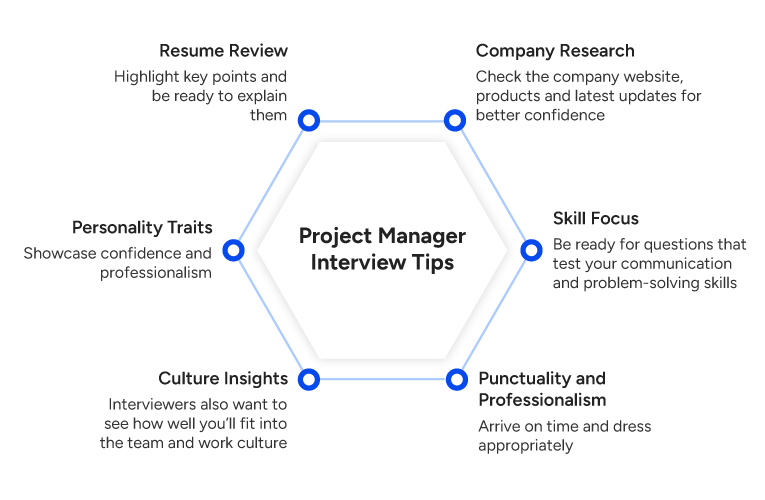
As you learned how to answer common interview questions for project managers. Now, let’s explore the most helpful tips that can help you ace the project manager interview.
- Read about the company’s values, employees, products, and clients. This will help you demonstrate your thinking ability by asking relevant questions.
- Reviews on popular platforms like LinkedIn and Indeed are ideal to gain insights about the work culture and employees of the organization.
- Focus on skills as well as discipline-specific concepts. So, prepare basic definitions and familiarize yourself with common project management terms.
- Companies focus on personality traits as much as skills. So, make sure that you appear confident, but do not exaggerate or sound arrogant.
- Arrive on time, and if you fail to do so, then mention a genuine reason for being late. Maintain a friendly but professional tone, and wear professional attire.
- Remember, your resume is your first impression. So, before the interview, read it once, highlight your key points, and be ready to explain them in your own words.
We hope that this guide helped you prepare for the project manager’s role. We included common PM interview questions that are usually asked in interviews. We wish you all the best for your project manager interview!
Read More Interview Questions with Sample Answer
Related Job Descriptions
Download Job Description & Interview Questions Word Format For Free

Table of Contents
Recent reports suggest that employees are finding it difficult to search for new jobs, with over 80% of individuals planning to seek new job opportunities in 2026. The economy is growing continuously in a way that leads to the creation of new jobs in various sectors. Top job portals in India play a pivotal role in helping organizations maintain steady growth. Recruiters post their requirements on job search platforms to screen applications and shortlist suitable candidates.
Top job sites may have made finding candidates easier in some ways, but the portal also makes it difficult when too many unsuitable applications come for screening. This listicle curates a list of the best job portals in India by considering their listings, costs, features, branding, and ease of use. Let us understand each one of them.
List of Top 17 Job Portals in India for Job Seekers, HR Professionals, and Recruiters
To help organizations decide on the best job portal, we have outlined the top 17 job portals in India based on their benefits and suitability.
Naukri.com
Founded: 1997
Location: Noida
Naukri.com is the oldest and one of the best job boards in India. Naukri.com has transformed the job hunting for organizations and has been helping millions of Indians find jobs every day. Besides listing jobs and making them easy to find with the help of filters, the portal provides job seekers with the latest trends and career guidance.
The platform offers a huge database of professionals (thanks to its popularity) and makes it easy for recruiters who are looking to fill multiple positions.
Benefits
- It provides a large number of job postings, including multiple industries and experience levels.
- It improves the brand’s visibility and response from candidates.
- If a job seeker is following a recruiter’s profile, the portal provides notification through email about new openings.
- The portal offers both free and paid options for recruiters to choose top talent.
- The subscription to Naukri.com includes services, like resume analysis, to enhance the recruitment process.
- Hiring teams can use filters in search criteria to help find candidates that match their requirements.
Best Suited for
Naukri.com is suitable for small to large-sized Indian companies that are seeking a broad reach and efficient recruitment in the changing job market. And considered one of the best hiring platforms in india.
Foundit
Founded: Before 2010
Rebranded: 2022
Location: Hyderabad, Telangana
Established before 2010, Foundit, previously known as Monster India, is another popular job posting site available for job seekers and recruiters. It provides useful search filters to show relevant job vacancies. Once registered on the portal, candidates can apply for jobs directly.
It offers paid services to employers, very similar to Naukri.com, and can buy data for hiring assistance. Many premium services are available for job seekers. They include resume writing, profile highlighting, career advice, and tips to help land a job.
Benefits
- Foundit offers multiple career portals and job search services designed to increase job seekers’ visibility.
- Employers can increase their hiring productivity by using AI-powered tools.
- Employers can reach both active job seekers and passive candidates through Foundit.
- Its “super profiles” feature allows employers to get a detailed view of candidates’ professional journeys.
- The platform provides collaborative tools and features, for example, shared folders, to enhance the effectiveness of the hiring process.
Best Suited for
Medium and large-sized businesses that seek candidates for multiple roles can benefit from Foundit.
Internshala
Founded: 2010
Location: Gurugram (Gurgaon), Haryana
Internshala is India’s leading internship and job posting portal. Over 400,000 companies in India use it, and more than 2,500 international companies use it. Whether companies are looking to hire interns, fresh graduates, or experienced employees, Internshala also allows companies to register on the platform for free, which makes hiring top talent faster and cost-effective.
With an AI-powered ATS and smart filters, hiring teams can shortlist candidates. Using advanced hiring tools, like a built-in interview scheduler, assignment tool, and AI-powered hiring assistant, helps automate and streamline the hiring process.
Benefits
- Hiring teams can register and post one free job listing per month.
- The platform provides a guarantee to hire candidates with a refund policy if companies do not hire within 30 days.
- It provides an Applicant Tracking System (ATS) and a chatbox for shortlisted candidates to accelerate the recruitment process.
- Its subscription plans allow employers more visibility and access to the candidate database.
- The platform is designed for recruitment agencies to hire candidates and onboard new employees quickly.
Best Suited for
Intershala is best suited for small and medium-sized enterprises, as well as MNCs looking for interns.
Shine.com
Founded: 2008
Location: Gurgaon, Haryana
Established in 2008 and owned by HT Media Limited, Shine is a portal that relies on media partners to provide valuable resources, including an online hiring platform across various industry domains. Its data-driven approach to jobs and hiring is its USP, which has made this portal different from others.
Premium services provided by this portal include resume and cover letter writing, customized job alerts from all leading portals, and a profile booster. It also provides curated assistance to different types of employers, including startups, SMEs, and corporates.
Benefits
- The platform helps match profiles of suitable candidates with relevant job openings.
- Employers get access to a larger database of candidates, which helps create a talent pool.
- When an organization posts a job, it can reach millions of users per month.
- Hiring teams can post free job postings in a trial period, and basic plans start with minimal fees.
- Shine.com provides a unique feature for recruiters to engage in face-to-face interactions and gain HR-related insights for decision-making.
Best Suited for
Shine.com is useful for recruiters looking to fill roles in various industry sectors, for example, mid-level and entry-level segments.
Jobseeker
Founded: 2021
Location: Netherlands
Jobseeker is an all-in-one toolbox for job seekers at any step of their career. It offers a worldwide job board, resume builder, cover letter generator, and job application management tool.
Available in 26 languages, the platform also offers in-depth guides to help job seekers improve their chances of landing interviews and finding their next job.
Benefits
- The platform provides tools to create/edit professional CVswith in-built template.
- Candidates can access job listings that match their skills and preferences.
- It is user-friendly and available in many languages, which improves the experience.
Best Suited for
Jobseeker is best suited for beginners or professionals globally who need multilingual support.
Indeed
Founded: 2004
Location: Austin, Texas, and Stamford, Connecticut, United States
Indeed is a multinational corporation that caters to all types of job seekers and recruiters. It provides a clutter-free job search on its homepage with two fields asking what organizations are looking for and where. It also lists popular searches below the main search fields.
Resources provided by this portal include company reviews and salary guides for various job positions. The site claims to be the number one job site in the world, based on the total number of unique visits.
Benefits
- Organizations can make their job postings more appealing to attract qualified candidates through the portal’s unique features.
- Indeed helps businesses to make job openings more attractive through the Indeed Company Page.
- It is one of the largest job sites, which helps organizations gain access to millions of profiles.
- Companies can choose to hire globally, as the hiring portals includes candidates from more than 60 countries.
- One feature of Indeed, for example, flexible job listings can help recruiters customize application questions for screening candidates.
Best Suited for
Indeed is the best option for SMEs or companies with urgent hiring needs, as the applicant flow is high.
SleekJob
SleekJob is a modern and innovative job portal in India, designed to simplify job hunting and recruitment for both candidates and employers. The platform allows job seekers to search for opportunities across industries, locations, and experience levels, with advanced filters making it easier to find the right fit. Beyond job listings, SleekJob provides career resources such as interview preparation tips, skill development guidance, and insights on industry hiring trends to help professionals advance their careers.
For recruiters, SleekJob offers a comprehensive database of candidates, enabling organizations to identify, evaluate, and connect with potential hires efficiently. Its recruitment tools support end-to-end hiring—from posting jobs and screening applicants to managing the interview process—catering to roles ranging from entry-level to senior management. SleekJob aims to bridge the gap between talent and opportunity, empowering both job seekers and employers with a streamlined, user-friendly experience.
FreshersWorld
Founded: 2006
Location: Bangalore (Bengaluru), Karnataka
FreshersWorld caters to fresh graduates without any work experience. The simple search is based on keywords, like company or skill, the courses the candidate has completed, and location.
Since this portal is aimed at freshers, it also provides courses for upskilling and guidance on qualifying tests conducted by many companies. It also offers entry-level hiring and recruitment solutions for employers.
Benefits
- FreshersWorld provides organizations with one of the largest databases of freshers in India, especially for entry-level hiring, to find suitable candidates.
- Organizations can post job openings for free in a trial period, which helps reach candidates quickly.
- For more advanced functions, companies can take paid plans to gain instant access to profiles that match their criteria.
- The platform guides all stages of the recruitment process, from job posting to scheduling interviews.
- The platform focuses more on entry-level recruitment, which is particularly well-suited for freshers.
Best Suited for
FreshersWorld is suitable for organizations of all sizes, including entry-level and fresh graduates.
JobsforHer
Founded: 2015
Location: Bengaluru, India
JobsforHer was founded in 2015. This platform connects women career seekers to mentors, communities, upskilling, jobs, and more. Millions of women job seekers are subscribed to this platform. It is a rich source of female candidates for recruiters, particularly when helping the organization build a diverse team.
Benefits
- Organizations gain access to a large pool of experienced women to help fill vacancies and reduce time-to-hire.
- Some of these women are available with no notice period and want to restart their careers, allowing businesses to increase their visibility.
- When companies hire women returnees, it helps improve overall productivity and innovation.
- The portal promotes job opportunities through social media and helps increase diversity in the company.
- It helps organizations eliminate biases against women and promotes a flexible work culture to improve retention of female talent.
Best Suited for
JobsforHer is best suited for organizations in India that actively support women’s empowerment and include women professionals at higher levels of management.
TimesJobs
Founded: 2004
Location: Noida, Uttar Pradesh
TimesJobs is a flagship business of Times Business Solutions, owned by Times Group.
Some of the valuable resources provided by this portal include JobBuzz, company listings, reviews, salary information, and blogs. It’s a good source for government job openings, too, and hence gets significant viewership. Recruiters can choose from a range of data, job postings, and branding solutions with TimesJobs.
Benefits
- Organizations get access to a vast and diverse database of candidates, including searches by skill and experience.
- The large pool of resumes includes candidates from diverse industries, promoting diversity in the workplace.
- The platform provides advanced tools and technology to make the recruitment process more efficient.
- There are opportunities available for company branding, for example, showcasing the company’s cultural values to attract new employees.
Best Suited for
TimesJobs is best suited for mid-sized and large organizations in sectors like IT and finance.
Glassdoor

Founded: 2007
Location: San Francisco, California
Glassdoor began as a site where current and former employees of a company could review their company and share salary expectations. It provided prospective candidates with insights into how a company treats its employees and what they could expect in their journey. Both job seekers and recruiters use the portal. Recruiters looking to build or improve their company brand as an employer cannot afford to be absent from Glassdoor.
Benefits
- Organizations can manage their company profile and highlight their culture to build a positive image for candidates.
- Companies can also increase their engagement and reputation by responding to employee reviews.
- Hiring teams can help make a candidate’s decision by depicting the company culture and a healthy workplace.
- The portal offers analytics on candidates’ engagement and trends, which allows hiring teams to identify strengths.
Best Suited for
Glassdoor is suitable for businesses of all sizes, from startups to large enterprises.
Upwork
Founded: 2015
Location: San Francisco, California
Upwork provides a platform where one can find short-term assignments. Since it is global, many interesting gigs are available for professionals to bid for. If an organization plans to recruit freelancers in creative fields, for example, writing and design, this is one of the best sites to find them.
Benefits
- Hiring teams can recruit freelancers from all over the world with diverse skills and expertise.
- The portal allows companies to manage their budgets by selecting a cost-effective financial plan.
- The platform provides verified reviews and customer ratings, which help companies hire qualified candidates.
Best Suited for
Upwork is suitable for businesses of all sizes, from startups to large enterprises, that want to hire skilled freelancers.
WorkIndia
Founded: 2015
Location: Bengaluru, Karnataka
WorkIndia is a popular job portal site that helps job seekers find the best job for them, and employers recruit the best candidates. The portal mainly focuses on job posts serving blue-collar and grey-collar job seekers. Overall, it gives a convenient and cost-effective platform for HR managers to find the right talent for their job openings.
Benefits
- The platform provides a database of candidates, which helps hiring teams find the most suitable talent.
- Employers can post job vacancies and reduce hiring time by receiving calls from relevant candidates.
- The portal uses AI and machine learning to recommend candidates based on the company’s job requirements.
- Organizations can select a premium plan to increase their visibility and gain access to a larger candidate database.
Best Suited for
WorkIndia is suitable for organizations looking to hire employees for blue-collar and entry-level jobs.
Google Jobs
Founded: 1998
Location: Mountain View, California
Google Jobs always has the majority of the market share and enjoys widespread support. The portal collects job postings from across the web. Every day, thousands of job seekers search Google for job openings and easily find relevant job postings. Additionally, the portal gives recruiters an effective tool to increase job posting visibility, helps them reach their target audience, and streamlines the entire recruitment process.
Benefits
- The portal provides job listings from multiple sources, which helps organizations gain access to a large pool of job seekers.
- The portal is free of cost and can be used by both employers and job seekers.
- Organizations can improve the candidate experience by allowing job seekers to filter jobs by location and other relevant preferences.
- Google’s intelligent search and filter can help reduce the time wasted on irrelevant applications.
Best Suited for
Google Jobs is suitable for organizations of all sizes, including startups and NGOs.
Hirect
Founded: 2018
Location: Bangalore, Karnataka
Hirect is a job portal website that is one of the best job posting sites for start-up companies, which links potential job seekers with hiring managers. The best part is that recruiters and candidates can chat directly through the platform itself. It is the leading chat-based job portal for hiring managers and candidates.
Besides that, more than 1 lakh start-up companies and SMEs trust Hirect for their recruitment processes. Thus, it gives transparency to both candidates and employers.
Benefits
- The platform can help companies reduce time to hire by providing a larger database of candidates.
- Organizations can reduce turnover rates and costs related to hiring, as the candidate’s profile matches company requirements.
- The platform can help improve employee engagement by portraying the company culture.
Best Suited for
Hirect is the best option for small to large-sized enterprises, including startups.
Cutshort
Founded: 2015
Location: Pune, Maharashtra
Cutshort is considered the best tech hiring platform in India. Instead of just being a job board, cutshort is a networking platform for finding suitable professionals using AI, gamification, and a trusted network. It is similar to SleekJob but without the ability to create social networks, which makes this job portal unique and highly effective.
Its AI innovation makes the job search process smooth and efficient. Making it easy for job seekers to find a job faster and for hiring managers to find the right talent quickly.
Benefits
- The platform uses advanced AI and machine learning algorithms to match the company’s requirements with candidates’ resumes.
- It provides a database for tech-savvy professionals, which helps companies choose the best candidate for the job.
- The portal provides tools for employer branding and candidate engagement, helping organizations attract top talent.
Best Suited for
Cutshort is best suited for companies in the tech industry or startups.
Quikr Jobs
Founded: 2008
Location: Bangalore, Karnataka
Quikr Jobs provides its users access to one of the largest and best job portals in India. Job seekers can easily find suitable jobs in their local areas. The USP of Quikr jobs is that it allows candidates to search for jobs based on criteria like full-time, part-time, fresher, internship, remote work, or freelancing. This job portal primarily focuses on blue-collar, grey-collar, and entry-level jobs. It helps job seekers post their resumes and create free alerts to receive thousands of job offers.
Benefits
- Recruiting teams gain access to a large pool of job seekers, which includes blue-collar and entry-level candidates.
- Organizations can fill vacancies in various categories by improving outreach and visibility.
- The platform certifies job postings and helps organizations avoid common hiring fraud.
Best Suited for
Quikr Job is best suited for organizations that are seeking to hire blue-collar and grey-collar workers across various industries in India. Which makes best job search websites in india
Comparison of Top Job Portals in India of 2026
| Job Portal | Pros | Cons |
|---|---|---|
| Naukri.com | Oldest and most trusted in India, with a vast database of job updates. | Interfaces can be a bit difficult, and premium services can be expensive. |
| Foundit | Strong presence with career tips, intuitive resume tools. | Smaller database compared to Naukri. |
| Internshala | User-friendly and diverse internships. | Some misleading placement claims. |
| Shine.com | Includes online recruitment fairs and resume services. | Smaller job listings compared to Naukri and Indeed. |
| Jobseeker | Easy to use and good for landing jobs. | Full features require a paid subscription beyond basic access. |
| Indeed | Simple UI, and strong for entry to mid-level. | Ads can create confusion in search results. |
| SleekJob | Combines job search with professional networking and employer branding. | Not primarily for freshers. |
| FreshersWorld | Focused more on freshers and campus placements. | Limited options for experienced candidates. |
| JobsforHer | Women-centric platform with work-from-home opportunities. | Fewer listings. |
| TimesJobs | Jobs and internships in various sectors. | The interface can be improved. |
| Glassdoor | Provides company reviews and insights. | Fewer job listings |
| Upwork | Good choice for project-based jobs globally | Fewer choices for a full-time job. |
| WorkIndia | Focused more on blue-collar and semi-skilled jobs. | Limited choice for white-collar jobs. |
| Google Jobs | Gathers listings from many sources, and is easy to use. | Minimal advanced features. |
| Hirect | Focus on startup and tech roles. | It is limited to startups and tech jobs. |
| Cutshort | AI-based matching for tech jobs. | Limited industry coverage. |
| Quikr Jobs | Blue-collar and entry-level focus. | Less curated job postings. |
The job market in India is highly competitive; therefore, HR managers need to leverage the best job portal sites to attract and hire the right talent. Numerous job posting sites offer organizations access to a wide pool of talent across different industries and job roles. The above-mentioned are the popular job sites in India that empower HR with advanced search tools and dynamic filtering options.
By taking advantage of these platforms, hiring managers can reduce their hiring time, lower recruitment costs, and find the best suitable candidate for the open job position.
FAQs
How Many Job Portals in India?
There are over 50 active job portals in India. The market is dominated by major general platforms like Naukri.com, LinkedIn, and Indeed, but also includes specialized sites for specific needs, such as Internshala (for freshers) and Apna (for blue-collar and gig workers).
Which is the Best Job Portal for Freshers in India?
The following job portals provide a wide range of opportunities for both job seekers and hiring teams in India. These are jobs website list:
- SleekJob
- Naukri.com
- Indeed
- FreshersWorld
What are the Costs Associated with Premium Job Portal Features?
The costs of some of the premium job portals in India vary by platform. These paid packages increase an organization’s visibility and enhance resume services. These costs vary by service type and the employer’s budget.
How do I Choose between Multiple Job Portals?
To select between multiple job portals, there are several steps to follow. They are:
- Define Specific Needs
- Assess Portal’s Effectiveness with User Reviews
- Ease of Use Interface
- Track Applications
- Change the Strategy
Which Portals Offer the Best ROI for Recruiters?
If a recruiter wants to compare which portals offer the best ROI, they should first consider a few factors. These factors include the types of candidates they are trying to reach and pricing models to fit the company’s budget. Some portals that offer the best return on investment are:
- SleekJob
- Indeed
- Glassdoor
Are there Specialized Portals for Specific Industries?
For certain industries, there are special portals designed to meet their needs, also known as vertical or industry-specific portals. These are customized to meet an industry’s requirements and workflows. Its examples are:
- Healthcare portals
- Real estate portals
- Finance portals
- Industrial B2B portals
Table of Contents
A Universal Account Number (UAN) is essential for managing your Provident Fund (PF) account in India. Issued by the EPFO, it combines all PF contributions from various employers into a single account, through regular contributions from both the employee and employer.
With a UAN, employees can earn interest on their PF savings, enjoy tax benefits, and easily use services like PF withdrawal, transfer, and viewing or downloading their passbook anytime. In this guide, you’ll learn what a UAN is, who can create it, which documents are required, how to generate and activate it step by step, and the benefits of having an active UAN.
Key Takeaways
- Understand what a UAN is and how it links all your PF accounts under one lifelong number.
- Learn who can create a UAN, when a new UAN should not be made, and how to create one.
- Steps to generate, activate, and manage UAN via EPFO and UMANG app.
- Discover how to link Aadhaar, reset UAN password, and download PF passbook online.
- Common UAN issues, solutions, and benefits for PF, EPS, and EDLI.
What is a UAN Number?
A UAN (Universal Account Number) is a unique 12-digit number issued by India’s EPFO (Employees’ Provident Fund Organisation). It remains the same throughout an employee’s career. This single UAN covers all PF savings from every job the employee has held, making it easy to check, manage, and transfer PF funds when switching jobs.
Who Can Create a New UAN Number?
An employer creates a new UAN (Universal Account Number) when a new employee joins the company. The employer registers the employee with the EPFO using details like Aadhaar and PAN. The employee can also generate their own UAN directly through the EPFO member portal.
They can use the “Direct UAN Allotment” option with a valid Aadhaar and registered mobile number. It is advised not to create a new UAN if the employee already has one; employers can update KYC or link previous PF balances. This is because a Universal Account Number (UAN) remains the same throughout the employee’s career once generated.
Documents Required to Create a New UAN
Documents required to create a new UAN include identity verification documents, proof of address, and bank account details. These documents are usually submitted through the employer or directly via the EPFO portal.
Mandatory Documents
- Aadhaar Card – for identity and biometric verification.
- PAN Card – for tax identification.
- Bank Account Details – account number and IFSC for salary and PF transfers.
- Proof of Employment – usually submitted by the employer (like an appointment letter or joining details).
Additional/Optional Proofs
- Address proof (e.g., utility bill, ration card, rental agreement).
- Other identity proofs, if needed (e.g., Passport, Voter ID, Driving License).
Since August 1, 2025, Aadhaar has been mandatory for creating a new UAN, and employees must use Aadhaar-based Face Authentication through the UMANG app. Employer-based UAN generation is now limited to International Workers and citizens of Nepal or Bhutan only.
Step-by-Step Process to Generate a New UAN Number
The employer generally generates a new UAN for EPF through the official EPFO portal during the first-time registration. Under the new mandate, effective from August 2025, employees will be able to initiate UAN allotment or link their existing UAN using the UMANG app.
Steps for Employees
- Download the UMANG and Aadhaar Face RD apps.
- Open UMANG, Go to EPFO Services → UAN Allotment and Activation.
- Enter your Aadhaar number and the linked mobile number, and give consent for verification.
- Verify the OTP sent and complete face authentication using the Aadhaar Face RD app.
- Receive your UAN instantly via SMS, which is automatically activated.
Note: This method became mandatory for employees from August 2025. No prior UAN or employer involvement is needed for new users.
Steps for Employers
- Employers registered with EPFO generate UANs for new employees via the EPFO Employer Portal.
- Log in with credentials.
- Navigate to Member > Register – Individual.
- Enter employee details that match
- h Aadhaar (Name, DOB, Gender, ETC.)
- Verify Aadhaar, and register to auto-generate the UAN.
- Confirmation occurs under Member > Active Members by searching via name or Aadhaar.
How to Activate UAN for the First Time?
To activate your Universal Account Number (UAN) for the first time, download and install the UMANG app from the App Store or Google Play Store, follow the EPFO-mandated process involving Aadhaar-linked OTP and face authentication, as this is now mandatory for new activations.
Activation Steps
- Open the UMANG App and Select EPFO Services. Go to UAN Services through Face Authentication, then select UAN Activation.
- Enter details by providing your UAN (if available), the Aadhaar number, name, date of birth, and mobile number.
- Verify Mobile by entering the OTP sent to your registered mobile number.
- Complete Aadhaar-based Face Authentication (FAT) for identity verification.
- Create a password for your UAN account.
- Now log in to the UAN portal or app to access PF services.
How to Change Your UAN Password Online?
You can change your Universal Account Number (UAN) password online at any time to maintain account security. This process allows you to reset your password through the EPFO portal or the UMANG app, ensuring secure access to your PF account and related services.
To Change Your UAN Password Online, Follow the Steps below
- Visit the official EPFO member portal at unifiedportal-mem.epfindia.gov.in.
- Log in – Enter UAN and existing password.
- Go to “Change Password” – Find the “Change Password” option in the menu.
- Enter Details – Enter current password, new password, and confirm new password.
- Submit – Click Submit to update the password.
- Confirmation – You will receive a message, and the new password will be activated.
How to Link Aadhaar for UAN Activation?
Linking Aadhaar to your Universal Account Number (UAN) is essential to activate EPF services and enable seamless claims on the EPFO portal.
Follow these Steps to Link UAN with Aadhaar Online Using OTP
- Visit the EPF India official website.
- Go to EPFO Members → Link with Aadhaar.
- Enter your UAN and registered mobile number to get an OTP.
- Enter the OTP and click Confirm OTP.
- Select gender and enter your Aadhaar number.
- Choose ‘Using Mobile/Email-based OTP’ for Aadhaar verification.
- Enter the OTP sent to your Aadhaar mobile/email and the Captcha code.
- Click Submit.
- Once verified, your Aadhaar is linked to your EPF account.
Using UMANG App
- Download and install the UMANG app.
- Open the UMANG app and log in.
- Go to the Services tab → EPFO → e-KYC Services → Aadhaar Seeding.
- Enter your UAN and click Get OTP.
- Enter your Aadhaar details. Another OTP will be sent to the registered mobile/email.
- Enter the OTP to verify. Once verified, your Aadhaar is linked to your UAN.
By Visiting the EPFO Office
- Fill out the Aadhaar Seeding Application form with your UAN, Aadhaar number, and other details.
- Attach self-attested copies of UAN, PAN, and Aadhaar.
- Submit the form and documents at your EPFO field office or CSC.
- Wait for verification.
- You will receive a confirmation message on your registered mobile once your Aadhaar is successfully linked.
How to Download a UAN Passbook?
You can easily view and download your EPF passbook linked to your Universal Account Number (UAN) to keep track of your contributions and account balance. This can be done via the EPFO portal or the UMANG app.
EPFO Portal Method
- Visit passbook.epfindia.gov.in.
- Enter your UAN, password, and captcha to log in.
- Select the relevant Member ID from the list if you have multiple.
- Click “View Passbook” or “Download Passbook” to get the PDF.
UMANG App Method
- Open the Umang app.
- Search for “EPFO.”
- Go to Employee Centric Services > View Passbook.
- Enter UAN, and verify with OTP.
- Select the Member ID and download the PDF passbook.
Common Problems while Creating a UAN Number (+How to Fix)
These problems often prevent successful UAN registration. Common problems faced while trying to create a UAN number include:
- Aadhaar Already Linked Error: This error occurs when Aadhaar is already linked to an existing UAN. To fix this, you can find your UAN using the EPFO’s “Know Your UAN” option or contact the employer/HR to help retrieve or merge accounts.
- Details Mismatch: This error occurs when your EPF details do not match in UIDAI records. Resolve this by updating Aadhaar details first, and make sure all information matches exactly before trying again on the UMANG or EPFO portal.
- Technical Issues: Often caused by poor internet connectivity or app glitches. Troubleshoot with a stable internet connection, update the app, or ask your employer to generate the UAN via the EPFO website.
Benefits of Having an Active UAN Number
- Acts as a lifelong, portable identifier that links all EPF accounts from different employers into one centralized account, simplifying tracking across your career.
- Automatically transfers PF balances when switching jobs, with no paperwork or employer involvement, and provides real-time online tracking.
- Check PF balance, view and download passbook, update KYC info (Aadhaar, PAN, bank), and access UAN card anytime.
- Apply online for partial or full PF withdrawals/advances (e.g., for housing, education, medical needs), with faster processing and status alerts via SMS/email.
- Monitor employer contributions, transactions, and balances anytime using our EPF Calculator, ensuring accountability and preventing errors or fraud.
- Manage your PF account, update KYC, and set nominations online without needing your employer’s help.
- Integrated with the EPS (Employees’ Pension Scheme) and Employees Deposit Linked Insurance Scheme (EDLI) for added coverage.
Conclusion
A Universal Account Number (UAN) provides a secure and centralized way to manage an EPF account. It combines all EPF contributions under a single identifier, allowing employees to track balances, transfer funds, and withdraw savings online, even when changing jobs.
With Aadhaar-based verification, real-time updates, and integration with EPS and EDLI, the UAN system ensures easy access to benefits. Also, helping employers remain compliant with EPF regulations.
Eliminate compliance bottlenecks with factoHR Provident Fund software. The platform directly handles member onboarding, activation, KYC updates, loan approvals, and statutory reporting, making UAN management effortless for both employers and employees.
Frequently Asked Questions
What Should I do if I Already have a Universal Account Number (UAN)?
If you already have a UAN, give it to your new employer to link your new Member ID and activate it online via UMANG/EPFO using Aadhaar/PAN for KYC. If you have multiple UANs, report them to your employer or the EPFO to merge all your PF funds under a single active UAN.
Can I have More than One Universal Account Number (UAN)?
No, you should have only one UAN. If you have multiple PF accounts, inform your employer or the EPFO to merge them into a single UAN.
Can I Use My Old PF Account when I Join a New Company?
Yes, you can use your old PF account by giving your UAN to your new employer. This links your new Member ID to your PF funds so they continue under the same account.
How Can I Transfer My Old PF Balance to a New PF Account?
To transfer your old PF balance to a new PF account, you can use the UMANG app or the EPFO portal following our Payroll Compliance Checklist to transfer it online using your UAN linked to both accounts. Get a printout of Form 13 and submit it to the employer; your funds will be transferred automatically within 10-15 days.
Is My UAN Linked with My PAN Card?
Yes, your PAN card is meant to be linked with your UAN. You can check it by logging into the EPFO member portal.
What is the Difference between UAN and PF Account Number?
The difference between a UAN and a PF account number is that a UAN is a permanent 12-digit number issued by EPFO that links all your PF accounts for easy tracking and transfers. PF Account Number, or member ID, is employer-specific, changes with each job per our Payroll Components, and tracks your contributions in that organization.
How Can I Check My EPF Balance without a UAN Number?
To check your EPF balance without a UAN, use your PF account number on the EPFO portal or send an SMS/ missed call from your registered mobile number. Alternatively, you can visit a nearby EPFO office or contact your employer to get your PF passbook.
Is It Compulsory to Upload KYC Documents for UAN?
Yes, it is compulsory to upload KYC documents (Aadhaar, PAN, and bank details) for UAN to verify the EPF account. It ensures smooth PF contributions, withdrawals, and transfers.
Table of Contents
An interview is a two-way conversation where both the employer and the candidate get to know each other better. For employers, it helps assess whether a candidate’s skills and personality are the right fit for the role. For candidates, it’s a chance to understand job responsibilities, expectations, and the work environment before moving forward.
This guide covers the best HR intern interview questions to help you prepare confidently for a career in Human Resources (HR). It also includes a ready-to-use interview scorecard, making it easier for employers to evaluate candidate responses fairly and consistently.
Key Takeaways
- Most Commonly Asked HR Intern Interview Questions
- 20+ HR Internship Questions on Communication, People Skills, Work Style, and Culture Fit with Sample Answers.
- HR Intern Interview Scorecard
- Red Flags to Watch out for in an HR Intern
Most Commonly Asked Questions for HR Intern Interview
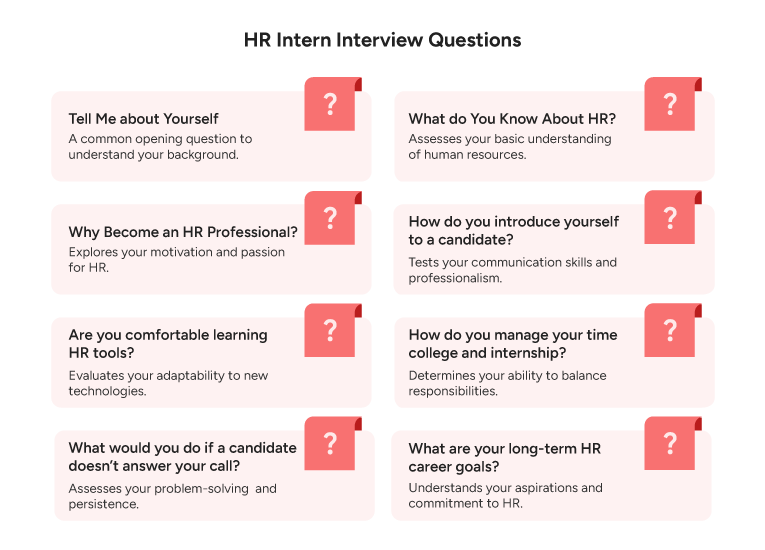
1. Tell Me about Yourself
Reason Behind Asking: This is a common question that evaluates your skills and personality traits to see whether they match the given role.
Sample Answer: Of course. I am (your name), a graduate with a bachelor’s degree in administration from (name of your college/university). I am attracted towards the people side of things in a business, and I like reading books and interacting with people to know their perspectives.
2. What do You Know about HR?
Reason Behind Asking: Managers want to assess your awareness of HR’s role in an organization.
Sample answer: I believe that HR’s role is very important from an operational as well as strategic perspective. Operationally, HR improves compliance and safety, among other aspects. Strategically, they ensure that a workforce is happy and productive. Also, HR can improve the work culture by focusing on values such as Diversity, Equity, and Inclusivity (DEI).
3. Why do You Want to Become an HR Professional?
Reason Behind Asking: Such interview questions reveal your motivations and your thought process behind accepting a job request.
Sample Answer: My interest in HR started after a conversation with my cousin about how her HR manager supported employees. That made me curious about the role. I really enjoy working with people and helping them feel comfortable and supported at work, which is why I want to become an HR Professional.
4. How Will You Introduce Yourself when Calling a Candidate?
Reason Behind Asking: Employers want to assess your communication skills.
Sample Answer: After calling, I’d confirm their identity and introduce myself as (name), HR from (organization’s name). I would keep the tone engaging but professional enough.
5. Are You Comfortable Learning HR Tools or Software?
Reason Behind Asking: These HR internship questions evaluate your ability to adapt and learn both traditional and modern technologies.
Sample Answer: I am comfortable learning new AI HR tools. During my school and college years, I have had several projects that required me to learn new tools. In fact, I recently learned some of the functions of factoHR from our college’s HR.
6. How do You Manage Your Time when You have College and an Internship?
Reason Behind Asking: Managers want to know whether you would be able to perform your responsibilities and manage studies simultaneously.
Sample Answer: I plan my day in advance and focus on what’s most important first. This helps me balance college and internship work smoothly and meet deadlines without stress.
7. What Will You do if a Candidate does Not Pick up Your Call?
Reason Behind Asking: Such interview questions assess what you would do in one of the common scenarios.
Sample Answer: First, I’d text them on WhatsApp or their preferred platform. If they don’t respond, I’d send them an email. Finally, I’d give them another call; if there’s no response, I’d move to the next candidate.
8. What are Your Long-Term HR Career Goals?
Reason Behind Asking: Employers want to know your long-term goals and find out whether they align with their organizational goals.
Sample Answer: My long-term goal is to implement best practices that actually improve work culture and productivity. I think great culture makes a difference in retention, engagement, and productivity.
9. Why do You Want to Intern with Our Company?
Reason Behind Asking: Hiring managers want to know how much you have researched an organization and what motivates you to work for it.
Sample Answer: I especially appreciate your work culture. Particularly, your philosophy of work hard, play hard. Also, your commitment to sustainability and inclusivity deeply resonates with me.
20+ Best HR Intern Interview Questions by Category with Sample Answers

Skill & Behaviour Questions
10. How Would You Handle Multiple Tasks at the Same Time?
Reason Behind Asking: The question assesses a candidate’s project management skills.
Sample Answer: I’d talk to relevant stakeholders and find out what I need to do first. I’d also set small, realistic sub-goals that I can complete within a given time. Most importantly, I try to be as composed as possible in the situation.
11. Tell Me about a Time You Worked in a Team.
Reason Behind Asking: Hiring managers want to identify how you worked in a team environment earlier.
Sample Answer: I have great experiences working in a team. Just recently, my friends and I were part of an art exhibition. I made sure that we coordinated properly, and the exhibition went without a hitch.
12. Tell Me about a Time You Solved a Problem in College or on a Project.
Reason Behind Asking: Managers ask such questions to evaluate your problem-solving skills.
Sample Answer: Our college runs a monthly magazine, and the management was finding it difficult to hire a content writer. I reached out to my network, and one of my friends was willing to join us as an intern.
13. How do You Handle Conflicts or Disagreements?
Reason Behind Asking: Conflict resolution is one of the most important aspects of managing people, and managers want to know how you would handle potential situations.
Sample Answer: I’d listen to all the parties involved and try to reach a compromise to find a mutually acceptable solution. If the conflict is more serious, I’d bring in the department head and show them the notes from our discussions.
14. Are You Comfortable Talking to New People or Candidates?
Reason Behind Asking: These interview questions assess your communication skills and your ability to reach out to new candidates.
Sample Answer: Yes, I am very much comfortable talking to new candidates and employees. In fact, as an extroverted individual, I quite enjoy it.
Practical HR Work Questions
15. Are You Comfortable Calling Candidates for Interviews?
Reason Behind Asking: Employers ask such practical questions to get an idea about how you would perform different aspects of your job.
Sample Answer: Yes. I would be happy to call new candidates for interviews and discuss their work profiles.
16. Can You Manage CV Screening?
Reason Behind Asking: CV screening is an important process in hiring, and managers want to know the level of exposure you have in CV screening.
Sample Answer: I have some experience in screening CVs. I actually approached one of my acquaintances, who is a hiring manager. He also shared some tips on using AI for resume screening.
17. Are You Good with MS Excel/Google Sheets?
Reason Behind Asking: Many organizations use Google Sheets and other similar tools to maintain reports.
Sample Answer: I am proficient enough with both. I’m learning more advanced functions with Udemy and other platforms to be better at Microsoft’s and Google’s tools.
18. Have You Used any HR Software?
Reason Behind Asking: Such questions help employers get an idea of how familiar you are with HR tech and tools.
Sample Answer: Yes, I’ve used factoHR’s HRMS software to manage resumes and learn basic payroll calculations.
19. What do You Know about Recruitment?
Reason Behind Asking: Recruitment is one of the most important roles in human resource management, and managers want to know how you will perform in this role.
Sample Answer: I have a theoretical understanding of it. Recruitment is a process of hiring and selecting candidates for available job roles.
20. What do You Know about Onboarding?
Reason Behind Asking: Managers want to see whether you know enough about onboarding and related processes like document verification and orientation.
Sample Answer: Onboarding is a critical process, and HR usually gathers documents of new joiners and conducts orientation sessions. However, I look forward to learning the practical aspects related to onboarding.
Communication & People Skills Questions
21. How Would You Introduce Yourself over a Phone Screening Call?
Reason Behind Asking: Such questions help managers in evaluating your communication skills.
Sample Answer: I’d start by asking them about how they are doing and mention the purpose of our discussion. Then, I’d introduce myself and the organization that I represent.
22. How do You Build Comfort with a Candidate in the First Minute?
Reason Behind Asking: Hiring managers want to know how you communicate with new prospects and find out more about your soft skills.
Sample Answer: I’d keep the tone conversational but professional. I’d also ask them about their interests and what they recently shared on LinkedIn or other social media platforms.
23. How do You Handle Nervous Candidates?
Reason Behind Asking: Such HR intern questions probe your ability to make others feel comfortable around you.
Sample Answer: I’d share my experience and highlight aspects that are relatable to that candidate. I would also switch to their native language if necessary.
Learning & Growth Questions
24. What do You Want to Learn in this HR Internship?
Reason Behind Asking: Such questions help employers know your job expectations. They also probe how much you thought about the given role.
Sample Answer: I’d like to learn the practical aspects of human resource management. With my degree in Business Administration, I have some idea of how people are managed, but a hands-on experience would be really helpful.
25. Which HR Skills do You Want to Improve?
Reason Behind Asking: Hiring managers want to know if you can judge your own skills objectively.
Sample Answer: I’d like to improve my technical skills in HR tools. I’d also like to learn more about AI in HR and how to incorporate it into my day-to-day tasks.
26. How do You Stay up to Date on HR or People Practices?
Reason Behind Asking: These questions examine your mindset about continuous learning and how you keep up with new HR trends.
Sample Answer: I read LinkedIn posts from HR professionals and firms. I also rely on podcasts and articles from major publications like HBR, McKinsey, and others.
27. What are Your Career Goals in HR?
Reason Behind Asking: The question evaluates what and how you think about your long-term career goals.
Sample Answer: My major career goal is to build a work culture that lasts. I think all the other factors, like retention, high turnover, productivity, and work-life balance, would improve if the work culture of an organization is flexible and people-centric.
Work Style & Productivity Questions
28. How do You Organize Your Daily Tasks?
Reason Behind Asking: These HR interns’ questions are often asked to understand how you would work day-to-day.
Sample Answer: I would take about 10 to 20 minutes to plan the day. Next, I’d complete the smaller tasks. Of course, I’d swap the tasks based on priority if required.
29. How do You Ensure Deadlines are Met?
Reason Behind Asking: Such questions assess your time management skills.
Sample Answer: I categorize tasks by urgency and break large tasks into smaller chunks. I use scheduling tools like Google Calendar to organize the day’s events by priority.
30. Do You Prefer Working Alone or in a Team?
Reason Behind Asking: Employers ask such interview questions to find out whether you can adapt to the organization’s needs and can work independently as well as in a team.
Sample Answer: It really depends on the task. If the task is more individual, I’d prefer to work alone. However, for strategically important tasks that affect many people, I’d like to discuss strategies with the team and get their feedback on next steps.
Culture Fit Questions
31. What Kind of Work Environment do You like?
Reason Behind Asking: Such interview questions help employers identify your preferred work environment and find out whether your preference aligns with the employer’s preferences.
Sample Answer: I prefer working in a remote setup, as it would make it easier for me to manage studies and a job. However, I’m open to working in an office as well.
32. How do You Take feedback?
Reason Behind Asking: Hiring managers want to know how you handle feedback and collaborate with the team.
Sample Answer: I take feedback positively and see it as a chance to improve. I value 360-degree feedback from managers, peers, and teammates, work on the suggestions, and follow up to make sure the improvements are effective.
33. What Motivates You to do Good Work?
Reason Behind Asking: Such interview questions probe your motivations and personality to understand your values and preferences.
Sample Answer: A sense of responsibility and purpose. For example, I have a responsibility to keep the workforce happy. Rather than discussing problems, finding solutions is more important. These two things motivate me to give my best.
HR Intern Interview Scorecard
It is important to evaluate a candidate’s answers objectively. We have included a sample HR intern interview scorecard that you can use and customize to your needs.
| Value | Questions | Ratings |
|---|---|---|
| Cultural fit | Describe a situation where you promoted fairness or inclusion while working in a group or team. | 1/5 reflects indifference or bias. 5/5 reflects awareness and inclusive action. |
| People Management Skills | Tell me about a time you supported someone struggling with their task. | 1/5 ignores the issue or takes over unfairly. 5/5 guides patiently and empower the person. |
| Communication | Explain how you would clarify a misunderstanding between an employee and a manager. | 1/5 communicates vaguely or defensively. 5/5 communicates clearly and neutrally. |
| Behavioural Attributes | Share an instance where you made a mistake and how you responded. | 1/5 denies responsibility or repeats errors. 5/5 accepts accountability and improves. |
| Personality Traits | How do you stay consistent and motivated during repetitive tasks? | 1/5 loses focus or disengages. 5/5 maintains discipline and purpose. |
Note: The maximum score a candidate can achieve is 25 marks. For example, if a candidate scores 20 out of 25, their overall rating will be 4 out of 5, and they can be shortlisted for the second round. Similarly, other scores can be evaluated using the same method.
- 21–25: Excellent Fit – Strongly Recommended
- 16–20: Good Fit – Can be Selected or Shortlisted
- 11–15: Average Fit – Needs Further Review
- Below 10: Not Suitable at this Stage
Red Flags to Watch out for Early
Here are some early signs you should pay attention to when hiring an HR intern:
- Not Interested in the Job: If a candidate does not show interest in the role, they are less likely to stay motivated or perform well.
- Giving Unclear Answers: More often than not, a candidate gives vague explanations when they do not want to be honest.
- Being Late: An interviewee should clarify the reasons behind being late and should genuinely apologize.
- Poor Problem-Solving Skills: If a candidate cannot solve simple problems even with available resources, it may be difficult for them to handle complicated tasks.
- Lack of Empathy and Openness: An HR intern should be understanding and respectful toward others. They should also be open to different people and their opinions to avoid disagreement.
We hope this list of HR intern interview questions helps you make a better hiring decision. Feel free to use the above scorecard to evaluate responses to your questions. Finally, watch out for red flags, such as dishonesty and disinterest in the job, to make a sound decision.
Table of Contents
EPF Calculator
Calculate your retirement corpus accurately with Indian Labor Law standards.
Fill in your EPF details, then click “Calculate Maturity Amount” to check your EPF maturity projection.
Disclaimer & Assumptions (Indian Labor Laws)
- Interest Calculation: Interest is calculated on the monthly running balance and credited annually as per EPFO guidelines. The current assumed rate is 8.25%.
- Employer Contribution: As per standard rules, 12% of Basic is the Employee share. The Employer share is split: 8.33% to EPS (Pension) and 3.67% to EPF. This calculator projects the EPF portion only, as EPS is a pension scheme and not part of the lump sum withdrawal corpus.
- Limit: Calculations assume contributions are made on the full entered Basic Salary (Voluntary Provident Fund logic for higher brackets), ignoring the statutory wage ceiling of ₹15,000 for calculation purposes to reflect actual potential growth.
The Employees’ Provident Fund (EPF) is a government-supported retirement savings scheme in which both employers and employees make monthly contributions.
You can calculate your total EPF savings and plan your retirement with our free EPF calculator. Easily estimate your Provident Fund balance by entering your monthly contributions, interest rate, and tenure.
- Free tool – No charges or hidden fees
- Instant results – Get your projected fund value in seconds
- No login needed – Quick, secure, and hassle-free
Perfect for employees and employers looking to plan with accurate EPF projections. This article helps you understand EPF calculations, projections, and benefits.
What is EPF (Employee Provident Fund)?
The Employees’ Provident Fund (EPF) is a government-backed retirement savings scheme where both employees and employers contribute 12% of the employee’s basic salary and dearness allowance each month. Managed by the Employees’ Provident Fund Organization (EPFO), it helps employees build financial security for retirement through regular, long-term savings.
EPF is mandatory for organizations with 20 or more employees and applies to workers earning below ₹15,000 per month. However, many companies voluntarily offer it to all employees to promote financial security.
EPF Contribution & Interest Rates
Both employees and employers contribute a portion of the salary each month, and the balance grows over time with annual interest declared by the Employees’ Provident Fund Organization (EPFO). Understanding how contributions and interest work helps employees estimate their long-term savings more effectively.
How Much do You Contribute?
Both employees and employers contribute 12% of the employee’s basic salary and dearness allowance each month. While the employee’s full 12% goes to the EPF, the employer’s contribution is divided: 8.33% is directed to the Employee Pension Scheme (EPS), and 3.67% is added to the EPF account.
Example:
1. Salary Structure
First, we look at the wages used to calculate PF.
| Component | Amount |
|---|---|
| Basic Salary | ₹29,500 |
| Dearness Allowance (DA) | ₹500 |
| Total PF Wages | ₹30,000 |
2. Contribution breakdown
Here is how the money is deducted and where it goes.
A. Employee’s Share (Deducted from Salary)
The employee pays a flat 12% of their Total PF Wages.
- Calculation: 12% of ₹30,000
- Amount: ₹3,600
Note: This entire amount goes into your EPF (Provident Fund) account.
B. Employer’s Share (Company Pays)
The employer also pays 12% total (₹3,600), but it is split into two different funds:
| Fund Name | Rate | Calculation / Logic | Amount |
|---|---|---|---|
| EPS (Pension Fund) | 8.33% | Calculated on a cap of ₹15,000 | ₹1,250 |
| EPF (Provident Fund) | 3.67% | Balance amount (Total 12% – Pension) | ₹2,350 |
| Total Employer Pay | 12% | ₹3,600 |
Summary
- Total Monthly Deposit to Your PF Account: ₹7,200 (₹3,600 from you + ₹3,600 from employer)
Interest Rates
The EPFO determines and updates the EPF interest rate each year. This rate, typically around 8-8.5%, is compounded annually, ensuring consistent growth of your retirement corpus. The credited interest is added to your balance at the end of each financial year, helping your savings grow steadily and securely over time.
How to Use Our EPF Calculator?
You can easily estimate your total EPF savings using our interactive EPF Calculator, located just below this section. Here’s how to use it in three simple steps:
- Enter basic salary and dearness allowance.
- Select the contribution rate (usually 12%) and enter years of service.
- Click “Calculate” to view the total EPF balance, including employer contributions and interest.
What Inputs do You Need?
You will need to enter age, basic salary + dearness allowance, contribution rate, tenure, and the current EPF interest rate.
What Outputs Will You Get?
The calculator instantly displays the total contributions, interest earned, and final maturity amount, allowing employees to plan their retirement savings with clarity and accuracy.
To understand how EPF is calculated, a hypothetical example set in 2025:
- Employee basic salary + dearness allowance (₹19500 + ₹500): ₹20,000
- Employee contribution (12%): 12% × ₹20,000 = ₹2,400
- Employer contribution towards EPF (3.67%): 3.67% × ₹20,000 = ₹1,150
- Employer contribution towards EPS (8.33%): 8.33% × ₹20,000 = ₹1,250
Total monthly contribution to the employee’s EPF account = ₹2,400 (employee) + 1,150 (employer) = ₹3,550
Total monthly contribution to the employee’s EPS account = ₹1,250 (employer)
Interest Calculation
At an interest rate of 8.5% per annum, the monthly rate is:
Monthly Interest Rate = 8.5% ÷ 12 = 0.708%
If the employee joins in January 2025, the total EPF contribution for January will be ₹3,550. Since EPF does not accrue interest for the joining month, the balance at the end of February 2025 will be:
- Total for February 2025 = ₹3,550 (Jan) + ₹3,550 (Feb) = ₹7,100
- Interest Earned for February: ₹7,100 × 0.708% = ₹25.13
- Interest Earned for March: ₹7,100 × 0.708% = ₹50.29
- Total Balance: ₹7,100 + ₹75.44 = ₹7,175.44
This process continues monthly until retirement, with the interest compounding each month. The final EPF balance will be the sum of all contributions plus accumulated interest over the years.
Real-World Examples
Here are sample calculations to help you visualize how contributions add up. Note that for salaries above ₹15,000, the Pension Fund (EPS) contribution is capped at ₹1,250, meaning the remaining employer share goes directly into your EPF to help it grow faster.
Example 1: ₹25,000 Monthly Salary @ 8.50% Interest Rate
| Component | Correct Calculation |
|---|---|
| Employee Contribution (12%) | ₹3,000 |
| Employer Share to EPS (Pension) | ₹1,250 (Capped limit) |
| Employer Share to EPF | ₹1,750 (Balance amount) |
| Total Monthly Deposit in EPF | ₹4,750 |
| Annual EPF Contribution | ₹59,222 (Including Interest Amount of 2,222) |
Example 2: ₹50,000 Monthly Salary @ 8.50% Interest Rate
| Component | Correct Calculation |
|---|---|
| Employee Contribution (12%) | ₹6,000 |
| Employer Share to EPS (Pension) | ₹1,250 (Capped limit) |
| Employer Share to EPF | ₹4,750 (Balance amount) |
| Total Monthly Deposit in EPF | ₹10,750 |
| Annual EPF Contribution | ₹134,029 (Including Interest Amount of 5,029) |
Key Takeaway for the Reader:
In the second example, notice that even though the salary doubled, the Employer’s EPF Share increased by more than double (from ₹1,750 to ₹4,750). This is because the pension deduction stays fixed at ₹1,250, channeling more money into your high-interest savings.
EPF Withdrawal Rules
Here are some key rules to follow.
Can I Withdraw before 60?
Yes, you are allowed to make partial withdrawals for marriage, medical emergencies, or home purchases after five years of continuous service.
Is the Withdrawal Taxable?
Withdrawals after 5 years of service are tax-free. Early withdrawals (made before the 5-year mark) may be subject to TDS and tax on the interest earned.
What if I Leave My Job?
You can either transfer your EPF to a new employer or withdraw the balance after two months of unemployment.
Benefits of a Provident Fund Calculator
An EPF Calculator helps salaried individuals make informed financial decisions by providing a precise estimate of their future savings. Here are the key benefits:
- Know your retirement amount: Calculate the EPF you’ll have by the time you retire at age 60.
- Plan your finances: Understand how your monthly contributions impact your long-term savings goals.
- Track contributions easily: Stay aware of how much you and your employer have contributed over time.
- Monitor interest growth: View how your fund balance increases each month with interest.
Conclusion
Understanding your EPF contributions helps you plan a secure and stress-free retirement. Use an EPF calculator to estimate your total savings and interest growth. Calculate your EPF retirement amount now to see how small monthly contributions add up over time.
You can also explore related tools like a gratuity calculator or retirement planners to gain a complete view of your financial future.
Frequently Asked Questions
How Can I Check My Employee Provident Fund Balance Online?
Visit the EPF portal and select the ‘e-Passbook’ option. Enter your UAN, password, and captcha. Click ‘Sign In’ and select your ‘Member ID’ to view your balance. This allows employees to monitor their Employee Provident Fund contributions and accumulated interest.
What is a PF Calculator, and How does It Help?
A PF calculator is an online tool that estimates your EPF savings at retirement. It calculates the maturity amount by considering monthly contributions, interest rates, and duration. This helps you plan your retirement by projecting future fund values based on contributions and interest. It simplifies financial planning and ensures accuracy in tracking savings and investments.
What are the Contribution Rates for EPF?
Employees contribute 12% of their basic salary and dearness allowance. Employers also contribute 12%, with 8.33% going to the Employee Pension Scheme and 3.67% to EPF. This consistent contribution helps in building a substantial retirement corpus over time.
How is the Employee Provident Fund Interest Rate Decided?
The Employees’ Provident Fund Organization (EPFO) decides the interest rate annually. The rate can vary based on economic conditions and EPFO’s financial performance. The interest rate is crucial as it affects the overall growth of PF savings.
How Can I Check My PF Balance Online?
You can check your PF balance at any time on the EPFO e-Passbook portal using your UAN.

Table of Contents
A Medical Representative helps promote healthcare products by building strong relationships with doctors and pharmacies while achieving sales goals. Medical Representative interviews are important as they evaluate applicants’ communication, planning, and sales skills.
This article helps you prepare for your MR interview by explaining the questions and how to answer them with confidence.
Key Takeaways
- HR evaluates communication skills, product knowledge, sales mindset, problem-solving ability, and cultural fit through these MR interview questions.
- Candidates learn how to give clear and confident answers using real-life sales scenarios and role-specific examples.
- The questions highlight the importance of relationship building with doctors, pharmacies, and distributors in pharma sales.
- Strong preparation helps candidates handle behavioral, situational, and competitive questions with confidence.
- Being well-prepared improves candidates’ interview performance and increases the chances of securing a Medical Representative role.
10 Most Common Interview Questions for Medical Representatives
Discover the MR job interview questions and answers for medical representative roles in our guide to the 10 most common questions. Get expert tips, sample responses, and strategies to confidently showcase your pharma sales skills and land your dream job.
1. Tell Me about Yourself.
Reason Behind Asking: To evaluate a candidate’s education, communication skills, experience, and overall fit for the role.
Sample Answer: I hold a degree in Pharmacy and am passionate about healthcare. I have experience in pharmaceutical sales, strong communication skills, and I enjoy promoting products.
2. Why do You Want to Work as a Medical Representative?
Reason Behind Asking: To understand candidates’ motivation, passion for healthcare, and whether their goals align with the role.
Sample Answer: I am motivated to work as a Medical Representative because I enjoy building relationships, promoting high-quality pharmaceutical products, and combining my passion for sales.
3. What do You Know about Our Company?
Reason Behind Asking: To assess candidates’ research, interest in the company, understanding of its products, values, and cultural fit within the organization.
Sample Answer: Your company is well known for its innovative healthcare solutions, high-quality products, strong ethical standards, and focus on patient welfare.
4. What does a Medical Representative do in Their Daily Work?
Reason Behind Asking: To evaluate applicants’ understanding of the role, daily responsibilities, sales targets, client interactions, and product promotion.
Sample Answer: Medical Representatives promote pharmaceutical products by visiting doctors, pharmacies, and hospitals. They build relationships, explain products, manage orders, gather feedback, answer questions, and work to meet sales targets.
5. Why is Product Knowledge Important for an MR?
Reason Behind Asking: To check if the candidate understands how product knowledge helps build trust, answer queries, and promote medicines effectively.
Sample Answer: Knowing the products well helps me explain medicines clearly, answer doctors’ questions, highlight our brand’s unique value, and build trust to increase sales.
6. How Will You Plan Your Doctor Visits in the Assigned Area?
Reason Behind Asking: To assess planning skills, time management, territory coverage strategy, and the ability to prioritize doctors for effective sales performance.
Sample Answer: I plan my visits by prioritizing important doctors, scheduling appointments efficiently, covering all areas, and following up regularly.
7. How Will You Promote Our Product to a Doctor?
Reason Behind Asking: To evaluate applicants’ sales strategy, communication skills, and ability to influence doctors to choose the product effectively.
Sample Answer: I highlight the product’s benefits, share clinical trial results, address doctors’ concerns, and conduct regular follow-ups to build trust.
8. How do You Handle Monthly Sales Targets?
Reason Behind Asking: To understand your approach to achieving sales goals, managing pressure, and consistently delivering results in a target-driven role.
Sample Answer: I break down targets into daily goals, plan my activities to track progress, and adjust my approach using CRM data to stay on track.
9. How do You Deal with Rejection during Sales?
Reason Behind Asking: To evaluate your resilience, persistence, positive attitude, and ability to learn from setbacks while maintaining motivation in sales.
Sample Answer: I see rejection as a chance to learn. I look at what went wrong, learn from it, adjust my approach, and quickly move on to the next prospect.
10. What Will You do if Your Competitor Offers a Lower Price?
Reason Behind Asking: It assesses applicants’ sales strategy, problem-solving skills, and ability to handle competitive pricing effectively.
Sample Answer: I will highlight our product’s superior quality, proven efficacy, and clinical data compared to the competitors, then offer free samples for trial.
24 Medical Representative Interview Questions with Answers
Role-Specific Questions
11. How Would You Introduce a New Product to a Doctor Who Already Uses a Competitor Brand?
Reason Behind Asking: To assess your persuasion skills, product knowledge, handling objections, and ability to build value over loyalty.
Sample Answer: I would highlight our product’s superior efficacy, fewer side effects, and clinical data compared to the competitor, then offer free samples for a trial.
12. What Factors do You Consider when Identifying High-Potential Doctors in Your Territory?
Reason Behind Asking: To understand applicants’ market analysis skills, strategic planning, and ability to prioritize doctors who drive maximum sales effectively.
Sample Answer: I consider prescription volume, patient demographics, doctors’ influence, specialty relevance, and past sales trends to prioritize high-potential doctors.
13. How do You Ensure Accurate and Timely Reporting of Your Daily Field Activities?
Reason Behind Asking: To evaluate accountability, time management, and the ability to maintain accurate records for effective sales tracking.
Sample Answer: I keep organized records, use digital tools, review my daily work, and submit detailed reports on time to ensure reporting accuracy and accountability.
14. What is Your Approach to Increasing Prescriptions for a Low-Performing Product?
Reason Behind Asking: To analyze candidates’ sales strategy, problem-solving ability, creativity, and effectiveness in boosting performance for low-performing products.
Sample Answer: I would assess the challenges, explain the product’s benefits to doctors, present clinical evidence, address any concerns, and implement targeted strategies to increase prescription rates.
15. How do You Maintain Strong Relationships with Pharmacy Staff?
Reason Behind Asking: To understand the candidate’s relationship management, interpersonal skills, and ability to build long-term, cooperative partnerships.
Sample Answer: I maintain good relationships with pharmacies by visiting regularly, listening carefully, meeting their needs, sharing helpful product information, and building trust.
16. How do You Stay up to Date on New Medicines, Competitors, and Medical Guidelines?
Reason Behind Asking: To analyze applicants’ commitment to continuous learning and up-to-date industry knowledge, and ensure accurate and competitive product information.
Sample Answer: I stay up to date on new medicines, competitors, and guidelines by reading industry journals, attending conferences, and participating in professional groups.
Behavioral Interview Questions
17. Tell Me about a Time when You Handled a Difficult Doctor or Customer Professionally.
Reason Behind Asking: To assess candidates’ problem-solving, communication, and interpersonal skills, and their ability to manage disagreements professionally.
Sample Answer: I listened to the doctor’s or customer’s concerns, provided information, resolved the issue respectfully, and maintained a professional relationship.
18. Describe a Situation where You Missed a Target and Explain the Steps You Took to Improve Afterward.
Reason Behind Asking: To assess applicants’ accountability, problem-solving, adaptability, and ability to learn from setbacks to improve future performance.
Sample Answer: When I missed my sales target, I analyzed the reasons, changed my approach, improved my time management, and asked for guidance. This helped me perform better and work toward my next target.
19. Share an Example of how You Built Long-Term Trust with a Doctor or Client.
Reason Behind Asking: To evaluate candidates’ relationship-building skills, reliability, professionalism, and ability to foster long-term trust with doctors or clients.
Sample Answer: I built trust by providing accurate information, addressing concerns quickly, following up often, and maintaining professional, reliable communication with doctors or clients.
20. How do You Deal with Stress when You have Multiple Visits and Deadlines?
Reason Behind Asking: To assess candidates’ time management, stress-handling ability, prioritization skills, and performance under pressure.
Sample Answer: I manage stress by prioritizing tasks, planning my visits, staying organized, maintaining a positive mindset, exercising regularly, and focusing on daily achievable goals.
21. Describe a Situation where You Took Initiative to Improve Sales or Territory Performance.
Reason Behind Asking: To evaluate applicants’ initiative-driven mindset, problem-solving skills, and ability to drive sales growth independently.
Sample Answer: To improve sales or territory performance, I took the initiative to organize doctor education sessions, improve product materials, and adjust the call schedules. These actions increased doctor engagement, resulting in more prescriptions and higher sales.
Operational & Situational Questions
22. If Two Important Doctors Give You Appointment Slots at the Same Time, how Will You Manage?
Reason Behind Asking: To analyze applicants’ prioritization skills, time management, and ability to handle scheduling conflicts.
Sample Answer: I will assess urgency, communicate respectfully, and politely reschedule one appointment, ensuring that both doctors feel valued and that relationships remain strong.
23. What Will You do if You Reach a Clinic and the Doctor Suddenly Cancels the Meeting?
Reason Behind Asking: To assess adaptability, problem-solving, professionalism, persistence, and productivity despite unexpected challenges.
Sample Answer: I would thank the receptionist, reschedule the meeting, use the time to engage with other doctors or share product information while waiting, and then follow up by phone or email.
24. How Would You Plan Your Route on a Day with Hospital Visits and Clinic Visits?
Reason Behind Asking: To assess organizational skills, time management efficiency, and the ability to efficiently cover multiple hospitals and clinics daily.
Sample Answer: I plan my visits by location, map out the best route to save time, make sure I have enough time for each meeting, and cover all important contacts.
25. A Doctor is Unhappy Due to Delays in Product Delivery. How Would You Handle the Situation?
Reason Behind Asking: This evaluates candidates’ problem-solving and customer service skills when managing complaints from doctors or delivery issues.
Sample Answer: I would listen to the concerns, sincerely apologize for the delay, explain the reason, offer solutions or alternatives, and follow up quickly to rebuild trust.
26. What Steps Will You Take if a Pharmacy is Not Stocking Your Product Regularly?
Reason Behind Asking: To assess problem-solving skills, negotiation, supply chain knowledge, and the ability to ensure product availability and sales targets.
Sample Answer: I would talk to the pharmacist to understand why the product isn’t being stocked, offer support or incentives, and follow up regularly to ensure consistent stock supply, maintain a steady supply, and build a strong relationship.
27. If Your Territory Shows a Sudden Drop in Prescriptions, What Will be Your Immediate Action?
Reason Behind Asking: To analyze applicants’ analytical and problem-solving skills, and their ability to identify issues and take action to boost prescription sales quickly.
Sample Answer: I would look into the sales drop, identify the cause, meet with doctors or pharmacists, address the issues promptly, and implement strategies to recover sales.
28. What Will You do if Your Travel Expenses Go beyond the Allowance?
Reason Behind Asking: To assess candidates’ financial responsibility, planning skills, and ability to manage expenses within company limits effectively.
Sample Answer: I would track expenses, choose cost-effective travel options, discuss any extra costs with my manager, and adjust future spending to stay within the allowance.
Problem-Solving Interview Questions
29. A Competitor Offers Doctors Heavy Incentives. How Will You Protect Your Sales?
Reason Behind Asking: To assess candidates’ competitive strategy and ability to maintain sales ethically despite competitors’ strong incentives.
Sample Answer: I would focus on our product’s quality, offer professional support, build strong relationships with doctors, and always act ethically to protect sales.
30. One of Your Major Prescribing Doctors Suddenly Reduces Prescriptions. How Will You Find the Reason?
Reason Behind Asking: To evaluate applicants’ investigation and problem-solving skills in identifying causes behind reduced prescriptions and addressing them.
Sample Answer: I will schedule a meeting with the doctor, ask politely about any concerns, Review prescription trends, identify the issues, and offer quick solutions.
31. If a Product is Not Performing Well, how Will You Find out the Root Cause?
Reason Behind Asking: To analyze applicants’ analytical and investigation skills in identifying reasons for poor product performance and sales.
Sample Answer: To find out why a product is not performing well, I would review sales data, gather feedback from doctors and pharmacists, identify the challenges, and use strategies to improve results.
32. How Will You Convince a Doctor Who Believes Your Product is Too Expensive?
Reason Behind Asking: To assess candidates’ sales skills, value-based persuasion, objection handling, and ability to justify pricing.
Sample Answer: I would highlight the product’s ROI, proven efficacy and quality, and the improved patient outcomes and long-term cost savings.
33. A Pharmacy Keeps Pushing Competitor Products. How Will You Solve this?
Reason Behind Asking: To evaluate applicants’ relationship-building skills, negotiation ability, problem-solving approach, and strategies for handling competition.
Sample Answer: I would build a strong relationship with the pharmacy owner, show our product’s better results with clinical data, offer volume incentives, and ensure supply availability to encourage preference.
34. You Notice a Delay in the Distributor’s Stock Replenishment. How Will You Address the Issue?
Reason Behind Asking: To evaluate candidates’ problem-solving, communication, and supply chain management skills in medical representatives.
Sample Answer: I would contact the distributor immediately, find out the cause, inform my supervisor if needed, and arrange an alternative supply to ensure stock availability.
Table of Contents
Organizations realize that some recruiters can hire qualified candidates quickly, while others take longer to review and screen resumes before hiring. An HR recruiter finds and attracts top candidates to fill organizational roles. Their job is to align candidates’ skills with the organization’s needs through job portals.
Companies hire HR recruiters to simplify the talent acquisition process and compete in India’s job market. This guide on HR recruiter interview questions and answers helps both freshers and experienced professionals prepare for entry-level and senior roles.
Here are important HR recruiter interview questions to help managers assess candidates’ skills and identify the best fit.
Key Takeaways
- Understand the end-to-end process for screening resumes, scheduling interviews, and extending offers.
- Manage candidates and know how to introduce roles and explain the company culture to create a positive image.
- Know how to handle nervous candidates and follow up on non-responders/decliners.
- Show skills in time management across multiple vacancies and in urgent hiring situations.
- Prepare questions that showcase candidates’ technical proficiency and behavioural fit.
- This guide adds value for both freshers and experienced candidates.
- For freshers, focus on basic criteria like resume review and understanding job descriptions.
- For experienced candidates, highlight strategies for KPIs and higher-level job positions.

HR Recruiter Interview Questions and Answers for Freshers
This section includes some of the HR recruiter interview questions and answers for freshers and covers important topics. These include sourcing/screening candidates and behavioural interviews. Organizations or startups can use these curated Q&A examples for talent acquisition.
1. What do You Understand about the Recruitment Process?
Reason Behind Asking:
Managers ask this to check whether you are familiar with the concept of end-to-end hiring and whether the candidate can explain it clearly.
Sample Answer:
The recruitment process starts by identifying the need to hire, then sourcing candidates through job portals. This also includes conducting interviews and assessing skills, which results in the issuance of an offer letter.
2. Why do You Want to Become an HR Recruiter?
Reason Behind Asking:
Recruiters ask this question to assess a candidate’s motivation and intent for connecting people with opportunities.
Sample Answer:
I like to match talented candidates with job roles where they can succeed. It makes me feel good when someone starts their professional journey in a good manner.
3. What is the Difference between Sourcing and Screening?
Reason Behind Asking:
Organizations include this question to test applicants’ knowledge of hiring stages and screening-related terms.
Sample Answer:
Sourcing is finding potential candidates through social media, for example, LinkedIn and Indeed. Candidates can also be referred by the current employees of the firm. Screening is reviewing these applicants’ profiles and selecting the best fit for the organization.
4. How Would You Introduce a Job Role to a Candidate?
Reason Behind Asking:
The hiring manager asks this question to evaluate overall communication skills in the job.
Sample Answer:
There are multiple responsibilities and benefits to mention when introducing a job role. For example, competitive salary and growth opportunities in the company can excite them.
5. How do You Deal with a Nervous Candidate?
Reason Behind Asking:
This question is asked to see a candidate’s empathy and ability to build rapport under pressure.
Sample Answer:
I can create a relaxed environment for the candidate so they feel confident and comfortable while answering. I will start with simple questions, for example, about their background and interest areas, to help them open up.
6. What do You Check First while Reviewing a Resume?
Reason Behind Asking:
This question is asked to understand how a candidate reviews some of the key elements of the resume.
Sample Answer:
The first thing I check is the relevant experience of the candidate, along with skills that match the job description.
7. How do You Identify whether a Candidate is Suitable for a Job?
Reason Behind Asking:
This query is intended to understand a candidate’s evaluation criteria, not just qualifications.
Sample Answer:
The first thing I will match is their skills and experience to the company’s requirements and job description. The next step is to assess cultural fit through behavioral interviews and organizational values, like teamwork.
8. How Will You Understand the Job Description Clearly?
Reason Behind Asking:
This is asked to check if an individual can interpret the job role with clarity.
Sample Answer:
The first step I will take is to review the job description and discuss it with the hiring manager to clarify expectations for the role. This will help me understand the role more clearly, and in case of any doubts, I will take guidance from the hiring manager.
9. How Will You Explain Company Culture to a Candidate?
Reason Behind Asking:
Managers ask this question to know how the candidate will attract applicants through the company culture/values.
Sample Answer:
I will share some real-life examples of how our company collaborates on lunches and support sessions.
10. Have You Used any Job Portals or ATS before?
Reason Behind Asking:
Recruiters ask this question to know if the candidate is using any hiring tools.
Sample Answer:
As a fresher, I have used Indeed for sourcing and a basic Applicant Tracking System (ATS) to track applications.
11. How Comfortable are You with Excel or Google Sheets?
Reason Behind Asking:
The Manager asks this question to check data management skills for tracking and reporting in the process.
Sample Answer:
I am very comfortable using Excel or Google Sheets for sorting candidates’ resumes.
12. A Candidate is Not Responding to Your Calls. What Will You do?
Reason Behind Asking:
This is asked to know the persistence level and follow strategies.
Sample Answer:
I will contact an individual via email or other means to keep them interested in the role. I respect their space and continue interviewing with other candidates.
13. You have Multiple Interviews to Schedule in a Day. How Will You Manage Your Time?
Reason Behind Asking:
This question is asked to check organizational skills and the ability to manage multiple tasks.
Sample Answer:
Using factoHR, I could easily schedule multiple interviews. It helped me simplify key interviews and reduce scheduling chaos.

HR Recruiter Interview Questions for Experienced Candidates
14. How do You Manage the End-To-End Recruitment Process?
Reason Behind Asking:
Interviewers ask this question to understand the recruitment lifecycle and the ability to handle tasks.
Sample Answer:
I would start by compiling a job description from various sources and coordinating with interviewees for hiring. I will conduct interviews to shortlist candidates and ensure a smooth onboarding process.
15. What Strategies do You Use to Reduce Time-To-Hire?
Reason Behind Asking:
This evaluates methods to fill roles faster and minimize any disruptions.
Sample Answer:
I can shortlist resumes using an AI tool and run multi-stage interviews simultaneously.
16. How do You Track and Organize Candidate Applications Effectively?
Reason Behind Asking:
This question allows managers to check organizational skills and ensure compliance in the process.
Sample Answer:
I kept candidates feeling supported with regular updates after I started using factoHR. It makes it easy to track all tasks, follow up on time, and deliver a more positive experience.
17. How do You Approach Passive Candidates Effectively?
Reason Behind Asking:
Managers ask this question to understand how the candidate plans to fill roles with passive candidates.
Sample Answer:
I can convince them by sending multiple emails that highlight growth opportunities and the salary package.
18. Which ATS Tools have You Used, and What Features do You Rely on Most?
Reason Behind Asking:
This question is asked to identify some of the trending ATS tools on the market for managing workflows.
Sample Answer:
I have used factoHR’s ATS tools to create custom dashboards for KPIs and integrate data seamlessly.
19. How do You Maintain Clean, Up-To-Date Pipelines in an ATS?
Reason Behind Asking:
Recruiters ask this to ensure that the candidate maintains a database for efficient management.
Sample Answer:
I export various reports to hard disks to maintain duplicate data and set calendar reminders for data cleaning.
20. How do You Handle Disagreements with a Hiring Manager?
Reason Behind Asking:
This is asked to test diplomacy and partnership skills during conflicts.
Sample Answer:
When a hiring manager disagrees, I will try to share the candidate’s metrics, for example, their skill level and experience.
21. How do You Prioritize Multiple Job Openings at Once?
Reason Behind Asking:
The manager asks this question to assess the ability to multitask and make decisions under pressure.
Sample Answer:
I create a list that includes priority-based work and focus more on the top 3 tasks.
22. How do You Negotiate Salary with Candidates?
Reason Behind Asking:
This measures closing skills to hire the top talent within budget constraints.
Sample Answer:
I refer to some of our competitors and then offer the best salary package, including perks.
23. What Steps do You Take to Reduce Offer Dropouts?
Reason Behind Asking:
This is asked to identify retention methods to protect the company.
Sample Answer:
To reduce the dropout ratio, I will make offers on the same day and schedule check-ins to prevent miscommunication.
24. What Recruitment KPIs do You Track Regularly?
Reason Behind Asking:
Managers ask this to check if a candidate has a data-driven mindset and recruitment outcomes.
Sample Answer:
I regularly track key recruitment metrics such as time-to-hire and cost-per-hire to evaluate hiring efficiency and improve the recruitment process.
25. How do You Measure the Success of Your Recruitment Strategy?
Reason Behind Asking:
Companies include this question to better understand strategic thinking, not just to fill vacancies.
Sample Answer:
I measure the success of a recruitment strategy through KPIs and employee feedback. This will ensure that success aligns with business goals and that our employees recommend our company to others.
26. You have an Urgent Hiring Request. How Will You Manage It?
Reason Behind Asking:
This question is to test crisis response and the balance of quality in this kind of scenario.
Sample Answer:
I would look into my database first and communicate with the hiring manager about which candidates are a good fit for our company.
27. A Top Candidate Accepted the Offer but Later Declined. How Would You Handle It?
Reason Behind Asking:
This question tests the resilience of the candidate and learns from failures/post-rejection.
Sample Answer:
In this case, I would contact the second-most-selected candidate and track them through ATS.

How to Prepare for the HR Recruiter Interview?
Here are a few steps on how to prepare for the HR Recruiter Interview:
- Research the Company and Role: It is advised to research the company through its website and learn its mission/ values.
- Master Common Questions: There are some basic questions about sourcing methods, so prepare for candidate-handling situations.
- Practice STAR Responses: The STAR (Situation, Task, Action, Result) method for behavioral questions should be practiced.
- Prepare Your Questions: Candidates should ask questions to show engagement and to learn more about growth opportunities or hybrid work policies.
- Final Logistics:The final step is to review and align your resume with the job description.
Table of Contents
Cultural fit interview questions help employers understand how a candidate approaches work and interacts with others. These questions reveal whether a person’s values align with the company’s expectations and day-to-day culture. When that alignment is present, teams function better, and employees feel more settled, which improves overall stability and employee engagement.
In this guide, we cover the top 50 cultural fit interview questions, including questions on behavioural attributes, personality traits, core values, and management style. We conclude by listing red flags to watch for when hiring and common questions about cultural fit.
What’s inside?
- What is Cultural fit? And why is it essential in recruitment?
- Top 10 cultural fit interview questions 2026
- Collaboration and Communication Style Interview Questions
- Questions related to adaptability and resilience
- Culture fit questions on management and leadership preferences
- Core values, personality, and interests related to cultural fit interview questions
What is Cultural Fit & why It Matters in Recruitment?
Cultural fit refers to the alignment between a candidate’s behavioural attributes, personal traits, core values, and a company’s culture. Hiring candidates who are aligned with company culture improves cohesion, employee engagement and productivity. Cultural fit also helps reduce turnover and improve engagement and retention.
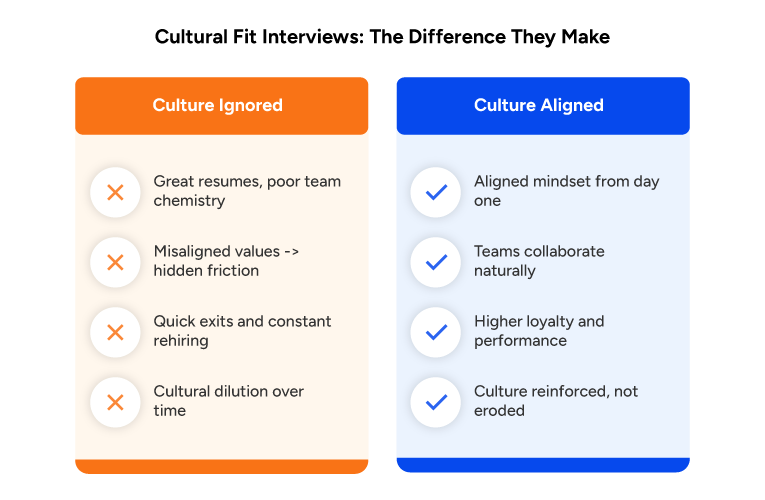
However, HR managers are also combining cultural add with cultural fit. Cultural Add refers to bringing new perspectives and expanding the company culture.
Moving from Cultural Fit to Cultural Add
For decades, the goal of hiring was to find a “Cultural Fit.” Recruiters looked for someone who would blend in perfectly, often asking, “Would I want to grab a coffee with this person?” or “Do they think like us?” While the intent was to ensure team harmony, this approach often created “echo chambers” in which everyone shared the same background and ideas. In 2026, top-performing companies have realized that harmony doesn’t always equal high performance. The industry is now moving toward Cultural Add.
What’s the Big Difference?
To understand the shift, think of your company culture like a puzzle.
- Cultural Fit is like looking for a piece that is an exact duplicate of the ones you already have. It keeps the puzzle the same size.
- Cultural Add is looking for the missing piece that completes a new section of the picture. It seeks someone who shares your core values but brings a different perspective, skillset, or life experience.
| Feature | Cultural Fit (The Traditional Way) | Cultural Add (The 2026 Way) |
|---|---|---|
| The Goal | To maintain the status quo. | To evolve and grow the culture. |
| The Focus | Shared interests and similarities. | Unique experiences and “gaps” in the team. |
| The Result | High comfort, but risk of groupthink. | High innovation and better problem-solving. |
Top 10 Cultural Fit Interview “Must Ask” Questions for Every Candidate

These are the top 10 cultural fit interview questions. These questions cover a range of aspects, including behavioural attributes, core values, personality traits, and work environment.
1. Describe the Work Environment in which You are Most Productive
Why:
HR managers often ask Such questions to evaluate how flexible you are.
How to Answer:
Give an answer that suggests that you are adaptable and would be productive in a team environment as well as in a relatively individual setup.
Sample Answer
The team environment is appropriate when collaborating on the strategic aspects of any project, as brainstorming helps generate better ideas and diverse perspectives. However, I also thrive in situations that require me to work independently.
2. What Would Make You Quit a Job in the First Month?
Why:
Such culture-fit questions help HR understand the reasons behind turnover and implement strategies to improve retention.
How to Answer:
When answering such questions, consider some aspects that are non-negotiable for you. Remember, your answer should focus on a solution first.
Sample Answer
Lack of transparency, unclear expectations, micro-management, and a toxic work environment would make me reconsider my position. Also, I’d prefer to address any issues related to recognition or engagement first, and then consider quitting the job.
3. What is the Biggest Misconception People Often have about You?
Why:
Such questions assess a candidate’s emotional intelligence and self-awareness.
How to Answer:
Pick a misconception, preferably related to your soft skills, and give an example that shows that you have worked on changing a particular misconception.
Sample Answer
At my previous workplace, my colleagues believed that I avoided debates and discussions. I preferred to observe rather than put across my points. I started taking notes and communicating my suggestions in the meetings afterwards, and the step changed their earlier beliefs about me.
4. Tell Me about a Time You Strongly Disagreed with a Manager
Why:
Such culture round interview questions show how you handle conflict with power dynamics and whether you can disagree respectfully and constructively.
How to Answer:
Talk about a situation where you disagreed, and remember to focus on your relations with the manager after the disagreement, as well as the outcome.
Sample Answer
My manager wanted to rush a release without user testing. I asked for a private chat, brought data showing likely user impact, and suggested a small pilot. We did the pilot, found a usability fix, and launched with fewer support tickets. The manager appreciated the calm, data-driven approach.
5. Do You Prefer to Ask for Permission or Forgiveness?
Why:
Such open-ended questions are asked to gauge what you would do in a particular situation and what your approach would be in different situations.
How to Answer:
Keep in mind that every situation requires a specific response and answer accordingly. Preferably, include an example.
Sample Answer
I generally ask for permission when performing tasks that affect people and key priorities. However, if the task is low risk, I perform it first and update the relevant people afterwards.
6. How do You Recharge after a Tough Week at Work?
Why:
Managers ask such questions in the cultural fitment round to understand how you avoid burnout.
How to Answer:
Keep your answer genuine and do not include things that you do not do. List some habits or things you do on the weekends that help you recharge.
Sample Answer
I play music, read books, spend time with my family, and take short trips with friends. Also, I play games like chess and cricket if I can.”
7. Whose Mentorship has had the Most Significant Impact on Your Career?
Why:
HR managers include such questions to evaluate and identify which kinds of people influence you the most.
How to Answer:
Mention someone who has had a noticeable influence on your career and personal traits.
Sample Answer
My marketing manager at the previous workplace had a noticeable influence on my personality and career. She taught me how to collaborate with other stakeholders, respond to emergencies, and receive feedback constructively.
8. If You Could Start Your Own Company, What Values Would It be Built on?
Why:
This is a fundamental cultural fit interview question, as it helps HR managers in gauging whether or not your principles align with their organization’s core values.
How to Answer:
Do some in-depth research and learn about the company’s values. Then, match some of your core personal values with the organization’s principles.
Sample Answer
Honesty, empathy, inclusivity, and transparency are the core values that I’d like to have in my organization.
9. How do You Handle Feedback that You Feel is Unfair?
Why:
Interviewers often include such questions to find out how you respond to a disagreement professionally.
How to Answer:
When answering, explain your process for responding to feedback.
Sample Answer
First, I’d like to thank the person for their feedback. Then, I’d reflect and analyse the given feedback. If I disagree, I prefer an in-person conversation to reach a mutual agreement.
10. What is the One Thing You Want to Learn in the Next 6 Months?
Why:
Such questions are included to assess whether you believe in continuous learning and would be willing to learn new skills related to your field.
How to Answer:
Choose a skill or tool you want to learn in your field and answer accordingly.
Sample Answer
I just completed a few LinkedIn Learning courses on professional writing. Next, I want to learn the technical aspects of SEO so I can better understand the SEO side of things.
50+ Cultural Fit Questions Categorized by Skillset
Here is an extensive list of cultural fit interview questions for 2026 in India. We have picked the top 50 cultural round interview questions. Let’s explore all the interview questions related to different categories.
Collaboration and Communication Style Interview Questions

1. Do You Prefer Working Alone or as Part of a Team? Why?
Why:
Interviewers ask this to determine whether your working style aligns with the role’s demands and the team’s structure.
How to Answer:
Be honest but flexible. Say which mode you naturally prefer and give one real example of success in that mode.
Sample Answer
I prefer working independently because it helps me think clearly. However, I also like to collaborate for brainstorming and discussions.
2. How do You Prefer to Receive Feedback: In Real-Time or during Scheduled 1: 1s?
Why:
Managers ask such cultural fit questions in 2026 to determine whether your feedback rhythm aligns with their management style. Regular 1:1s build relationship and alignment, while timely feedback can fix minor course corrections quickly. Modern performance management software helps streamline these 1:1s.
How to Answer:
Give a clear preference but show nuance. Describe when you want immediate feedback and when you prefer scheduled deep conversations.
Sample Answer
I prefer one-on-one feedback, as it is more interactive and allows me to ask any follow-up questions in person. However, real-time feedback also makes a difference to my projects, as it helps me in incorporating suggestions promptly.
3. Describe a Time You had to Deliver Difficult News to a Colleague.
Why:
This evaluates communication skills, empathy, and professionalism. Employers want to know you can handle sensitive conversations without escalating conflict.
How to Answer:
When answering, focus on empathy and clarity. Remember, here the process matters more than the result.
Sample Answer
At my last workplace, we were restructuring some departments and had to ask a colleague to step down. I had a candid discussion with him, and to his credit, he understood the necessity and accepted the offered severance package. I also suggested a couple of references to help him transition.
4. How do You Handle a Teammate Who isn’t Pulling Their Weight?
Why:
This culture fit question assesses your ability to have difficult conversations regarding a teammate’s performance.
How to Answer:
Include a step-by-step process that you follow for such a conversation in your answer.
Sample Answer
I would have an in-person conversation to understand the cause. If productivity doesn’t improve, I would involve the manager and document the records. For better documentation, many firms now use automated attendance tracking to monitor consistency.
5. What is Your Preferred Method of Communication (Slack, Email, Phone, In-Person)?
Why: Such cultural fit questions help employers know which channels you use for instant and formal communication.
How to Answer:
Be honest, but be nuanced in your answers.
Sample Answer
I prefer Slack and similar platforms for messages and suggestions. For formal communications, I prefer emails. For constructive feedback or sensitive issues, I prefer in-person discussions.
6. Tell Me about a Successful Collaboration You were Part of. What Made It Work?
Why:
They want concrete evidence of how you create outcomes with others.
How to Answer:
Focus on a particular cultural trait that made a difference in the project.
Sample Answer
I collaborated with the marketing department for launching a new campaign. We performed well and generated 20% more revenue than the target. We had to revamp our old approach, and we all approached strategising objectively.
7. How do You Explain Complex Ideas to Non-Technical Colleagues?
Why:
This question is asked to evaluate your communication skills.
How to Answer:
Answer with a practical example and highlight what you did to simplify the topic.
Sample Answer
In a recent project, I explained machine learning to some non-technical clients. I used visual diagrams and a few sports-based examples for simplifying the concept.
8. Describe a Time You Disagreed with a Decision Made by the Group
Why:
Employers want to know whether you can speak up and raise disagreements respectfully.
How to Answer:
Show you raised concerns constructively, offered alternatives, and supported the final decision or reached a compromise.
Sample Answer
I disagreed with a single-vendor decision and shared a concise risk report. The group went ahead but agreed to monthly risk checks. I continued to support implementation while tracking those risks.
9. How do You Handle Interruptions when You are in “Deep Work” Mode?
Why:
This culture fitment round question assesses how you respond to urgent priorities when focusing on other projects.
How to Answer:
When answering, mention your process or framework for such situations.
Sample Answer
Even when I’m concentrating on something important, I am available on Slack and Teams to answer queries. If the query is not urgent, I respond to it later; for formal queries, I answer by email.
10. What Role do You Typically Take in a Group Project (Leader, Mediator, or Executor)?
Why:
They want self-awareness about your natural contribution and whether you fill a needed gap.
How to Answer:
Mention your default role, why you have it, and give an example of how you can adapt when the team needs something else.
Sample Answer
I usually fit into the executor’s role as I’m good at organizing. However, I can mediate conflicts and have also led a couple of projects within my domain.
Adaptability and Resilience Interview Questions

1. Tell Me about a Time a Project’s Priorities Changed Abruptly. How did You React?
Why:
Such culture-fit interview questions help evaluate a candidate’s adaptability.
How to Answer:
Include one or two examples and show how you responded to changing priorities.
Sample Answer
I was working with the team to launch a new feature. However, we identified a bug in our system. We put in extra effort, fixed the bug, and launched our latest feature ahead of schedule.
2. Describe a Stressful Situation at Work and how You Handled It.
Why:
Interviewers ask such questions to assess how you respond to pressure and handle unexpected challenges.
How to Answer:
When answering, pick a real situation and list the steps you took to reduce stress.
Sample Answer
During a product launch, a vendor missed a key deadline, which made things tense. I prioritized the tasks and reorganized the plan. We updated stakeholders early, and the launch went ahead with only a minor delay.
3. Have You Ever Failed at a Task? What did You Learn?
Why:
Such cultural fit interview questions are often included to assess whether the candidate is honest and has a growth mindset.
How to Answer:
Include a step-by-step process and mention what you did next to avoid repeating the mistake.
Sample Answer
I underestimated the complexity of the integration and missed a deadline. I owned it, ran a post-mortem to identify assumptions we missed, and introduced a short integration spike in future sprints. Since then, delivery estimates have been more accurate.
4. How do You Approach Learning a New Tool or Software You’Ve Never Used before?
Why:
Hiring teams want to know your learning strategy and self-sufficiency.
How to Answer:
Make sure to include a framework that you follow for learning a new tool.
Sample Answer
I usually start learning a new tool by watching video tutorials. I also read reviews on social media to get a better idea of common queries about the tool. Lastly, I ask experienced colleagues about best practices and look up help articles for the software.
5. What Would You do if You didn’t Know the Answer to a Client’s Question?
Why:
This cultural fit question focuses on honesty and integrity.
How to Answer:
Show that you are willing to be honest, conduct research, and follow a set framework.
Sample Answer
I’d say I don’t have the exact answer right now, ask a clarifying question, and promise to follow up within a specific window. I’d then research, confirm with internal experts if needed, and send a concise reply with evidence and recommended next steps.
6. Describe a Time You had to Work with Limited Resources
Why:
Employers want to see resourcefulness, prioritisation, and creativity in constraints.
How to Answer:
Explain constraints, show how you re-prioritized or reused assets, describe any tradeoffs, and quantify the result if possible.
Sample Answer
We had one designer for three parallel features. I designed a phased approach that reused core UI components, documented clear acceptance criteria, and shifted lower-impact items to later dates. We launched the highest-value features on time and cut design hours by 30%.
7. How do You Stay Motivated during Repetitive Tasks?
Why:
Such cultural round questions reveal discipline, ability to maintain quality, and whether you apply tactics to prevent disengagement.
How to Answer:
Share tactics and include some ways you help yourself rejuvenate.
Sample Answer
I break down such tasks into smaller tasks, take short breaks, and get back to the task at hand.
8. When was the Last Time You Took a Risk at Work? What was the Outcome?
Why:
This assesses calculated risk-taking, judgment, and whether you learn from outcomes.
How to Answer:
Describe the risk, show how you mitigate risks, state the outcome, and explain what you learned.
Sample Answer
I proposed a small pilot to replace a legacy process with an automated workflow. I limited the pilot to one team and measured error rates. The pilot reduced manual effort by 40 percent, and we rolled it out company-wide.
9. How do You Handle Constructive Criticism from a Peer versus a Manager?
Why:
Such cultural fit interview questions help assess if an employee can receive constructive feedback from different stakeholders.
How to Answer:
Show that you are willing to collaborate with a peer to improve and that you would discuss the manager’s feedback through regular check-ins.
Sample Answer
I respond the same to both by thanking them and asking for specifics. With peers, I often collaborate on a fix. With the manager, I present a short plan to address the issue and check back on progress. That keeps feedback practical and results-focused.
10. Tell Me about a Time You had to “Unlearn” a Process and Learn a New Way.
Why:
This shows cognitive flexibility and humility. Unlearning demonstrates that you can abandon comfortable but outdated habits when evidence or context changes.
How to Answer:
Describe what you used to do, why the change was required, how you retrained yourself and the team, and the measurable improvement that followed.
Sample Answer
Our team shifted from long release cycles to quicker, week-to-week updates. I adapted by focusing on small, manageable changes rather than big launches. I also helped set up simple guidelines for quickly fixing issues. The move made our releases smoother and reduced last-minute problems.
Management & Leadership Style Culture Fit Questions

1. Describe the Best Boss You’Ve Ever had. What Made Them Great?
Why:
Such cultural fit questions help employers understand your preferred management style and whether they align with the organization’s approach to management.
How to Answer:
Pick two to three specific behaviors (for example: develops people, gives clear priorities, shows empathy). Give one short example of how those behaviors affected your performance.
Sample Answer
My best boss consistently developed people and gave clear priorities. She held monthly career check-ins, delegated stretch assignments, and removed blockers so we could focus. Because of that structure, I grew into a senior role in 18 months and delivered two major product launches on schedule.
2. Describe the Worst Boss You’Ve Ever had (without Naming Names). Why didn’t It Work?
Why:
Employers ask such questions to evaluate the ability to critique leadership without being unprofessional.
How to Answer:
Focus on being objective and list how you adapted and what you learned.
Sample Answer
I once worked for a manager whose decisions were unpredictable and poorly explained. That created confusion and frequent rework. I learned to document decisions and confirm expectations proactively.
3. What Kind of Management Style Drives You Crazy?
Why:
Such questions about management style help hiring managers identify potential reasons an employee might leave.
How to Answer:
Name the management style that hinders your work without being personal.
Sample Answer
I struggle with micro-management, as such management interrupts work and creates trust issues. In such cases, I communicate short checkpoints to keep the manager in the loop.
4. How Much Autonomy do You like in Your Role?
Why:
This checks fit against role scope and team structure. Some jobs require tight alignment and oversight; others demand independence. Interviewers want clarity on how much direction you need.
How to Answer:
Give a range and explain your decision-making process: what you’ll decide independently versus when you’ll seek alignment. Show accountability, autonomy, plus clear checkpoints.
Sample Answer
I like high autonomy on execution with alignment on objectives and measurable checkpoints. I prefer a clear goal from leadership, then run experiments and report weekly results to keep stakeholders informed.
5. If You were the CEO of Your Last Company, What is One Thing You Would have Changed?
Why:
This cultural round question tests strategic thinking and whether your priorities align with the organization’s areas for improvement. Interviewers look for constructive, realistic suggestions.
How to Answer:
Choose one specific, high-impact change, explain the rationale, and mention a practical first step.
Sample Answer
I would have invested in predictive analytics earlier. It would have helped identify the industry trends on engagement and hiring, and we would have been able to forecast future needs.
6. How do You like to be Recognized for a Job Well Done? (Public Shoutout vs. Private Note)
Why:
Managers want to tailor recognition to what motivates you. Recognition preferences affect engagement and retention.
How to Answer:
Be honest. If you like both, say so and explain when each is appropriate. Give an example of recognition that mattered to you and why.
Sample Answer
I appreciate both. A private note makes the recognition personal, and a public recognition feels more apt from a team perspective.
7. What do You Need from Your Manager to be Successful?
Why:
This clarifies expectations and whether the manager can meet your needs.
How to Answer:
List two to three practical needs and mention how the support improved your performance previously.
Sample Answer
I need clear priorities, timely feedback, and someone who removes organizational blockers. When I had that role, I focused on high-impact work, and we considerably reduced cycle time for major features.
8. How do You Handle Authority Figures You Disagree with?
Why:
This evaluates diplomacy, courage to speak up, and respect for organizational hierarchy.
How to Answer:
Explain a respectful workflow: gather facts, present a concise alternative with risks and benefits, and accept the final decision while helping execute it. Give an example.
Sample Answer
I present my case backed by data and proposed options, then listen to their perspective. If they decide differently, I commit to making it work and tracking outcomes so we can revisit later.
9. Do You Prefer a Structured Environment or a More Chaotic/Fluid One?
Why:
This cultural fit interview question helps determine whether your preferences align with the organization’s setup.
How to Answer:
State your preference and show adaptability. Describe the conditions under which each mode works for you and how you switch between them.
Sample Answer
I prefer a structured environment, as it clarifies who does what. However, I recently collaborated with a startup on a design project and came to appreciate a less-structured climate as well.
10. What Qualities do You Look for in a Leader?
Why:
This reveals your leadership values and whether they match the organization’s leadership model.
How to Answer:
Pick three to four qualities and mention how each affects you.
Sample Answer
I look for clarity, empathy, inclusivity, and the ability to develop others. These qualities create a productive environment for me where I can grow personally and professionally.
Core Values and Work Ethics Questions
1. What are the Three Values that are Most Important to You in a Workplace?
Why:
Interviewers want to see whether your core values align with the company’s culture and norms.
How to Answer:
Pick two or three concrete, work-relevant values and give a short example that shows the value in action.
Sample Answer
The three values I prioritize are clarity, ownership, and empathy. Clarity helps me better understand my role. Empathy makes employees happy and improves the quality of work. Lastly, I like to own my failures as well as successes.
2. Tell Me about a Time You Faced an Ethical Dilemma at Work
Why:
This gauges integrity, judgment, and whether you can navigate ambiguous, high-stakes situations responsibly.
How to Answer:
Briefly describe the dilemma, list the options you evaluated, and conclude by justifying your choice.
Sample Answer
A vendor asked me to alter invoice dates to meet a milestone. I declined and raised it with my manager and procurement. We paused payments until procurement verified the records. It delayed the vendor slightly but preserved compliance and led to more explicit vendor invoicing rules.
3. What does “Integrity” Mean to You in a Professional Context?
Why:
Employers want to know how you define and apply integrity in a professional context.
How to Answer:
Give a concise definition that connects to actions. Mention being truthful and following policies even when inconvenient. Give an example to substantiate your answer.
Sample Answer
Integrity means taking ownership of mistakes and being transparent about tradeoffs. For example, I once openly reported a missed QA step, owned the fix, and documented the gap so the team could prevent recurrence.
4. Which of Our Company Values Resonates with You the Most, and why?
Why:
Employers ask this question to determine whether the candidate has researched the company’s values.
How to Answer:
Prepare in advance by researching the company’s vision and mission, and give a genuine answer by discussing the relevant value.
Sample Answer
The value that resonates the most is transparency. Being transparent reduces conflicts and represents moral commitment. Having read your annual reports, you are transparent about the processes you follow.
5. Have You Ever Felt Your Personal Values Clashed with a Company’s Actions?
Why:
This explores resilience, judgment, and whether you will tolerate or act on misalignment.
How to Answer:
Be honest but diplomatic. Describe the situation briefly, how you raised concerns or tried to address it, and the eventual resolution or learning. Focus on the steps you took to align behaviour with company objectives and on what you learned.
Sample Answer
Yes. I once worked at a place where marketing made claims that I felt overstated product capabilities. I raised the concern with product and marketing, proposed clearer messaging, and helped test updated copy.
6. What Social Causes or Community Activities are You Passionate about?
Why:
Employers ask to understand cultural fit, potential volunteer alignment, and whether your extracurricular passions support company CSR or community programs.
How to Answer:
Share two meaningful activities, explain your involvement, and briefly state why they matter to you. If relevant, mention skills you bring from volunteering that benefit work.
Sample Answer
I volunteer for a local literacy program and mentor students in basic coding. Literacy work taught me to simplify complex ideas for beginners, and mentoring honed my coaching skills, which I use daily when onboarding new teammates.
7. How do You Define “Success” in Your Career?
Why:
This reveals whether your career goals align with the role and company. Interviewers want to know if your success metrics are individual, team-based, or impact-oriented.
How to Answer:
Give a balanced definition that includes measurable outcomes, learning, and impact on others.
Sample Answer
I define success as delivering measurable impact while growing my capabilities and helping others succeed. In the short term, it means shipping features that move key metrics. In the long term, it means mentoring others and building an ethical, efficient work culture that endures.
8. How do You Ensure Inclusivity in Your Daily Work Interactions?
Why:
Employers want concrete habits that create psychological safety and equitable participation.
How to Answer:
List specific, repeatable behaviours, such as soliciting opinions from quieter members, using inclusive language, rotating meeting facilitation, and ensuring actions align with outcomes. Give a short example showing impact.
Sample Answer
I prefer to ask questions to teammates who are usually quiet. Three months ago, one of our products was facing some technical bugs. I asked a teammate to check for accessibility issues, and we resolved the bugs in time.
9. What Legacy do You Want to Leave at Your Next Company?
Why:
This culture-fit question helps employers gauge whether you prioritize long-term impact or short-term collaboration.
How to Answer:
Be specific and describe the impact you want to have on an organization.
Sample Answer
I want to build a culture on the foundations of shared learning, growth, empathy, and honesty. I want to create a team that knows how to take calculated risks and appreciates challenges. As a popular quote goes, “You must do the thing you think you cannot do.
Personality and Personal Interest Questions

1. What are You Passionate about Outside of Work?
Why:
Employers ask this question to know your personality better and to find out any transferable qualities like discipline or creativity.
How to Answer:
Give a genuine answer and only include your real interests.
Sample Answer
I like to read fiction and some non-fiction books. I also love playing chess. Additionally, I am passionate about cricket.
2. What is the Last Book You Read or Podcast You Listened to?
Why:
This cultural fit question helps managers know your key traits, such as curiosity, self-improvement, and intellectual engagement.
How to Answer:
Be specific but avoid listing more than two to three books/ podcasts.
Sample Answer
I listened to the podcast’ Startalk.” The podcast covers topics ranging from emergence, consciousness, and the universe to social media addiction.
3. If You Could have Dinner with any Historical Figure, Who Would It be?
Why:
This kind of question helps interviewers see what values, ideals, or traits resonate with you. It reveals what kind of people you admire.
How to Answer:
Pick someone you really admire. They could be from any field. Briefly explain what attracts you to them and what you hope to discuss.
Sample Answer
I’d like to have dinner with Shri Atal Bihari Vajpayee ji. I’d particularly like to discuss the nuclear testing and India’s relations with Pakistan at the time. His courage and steadfastness in the face of adversity are admirable.”
4. What is Something You’Ve Taught Yourself Recently?
Why:
Employers use this to test your self-motivation, learning agility, and growth mindset — whether you take initiative to upskill or adapt.
How to Answer:
Choose a real skill or knowledge area you picked up. How to Answer: Describe how you learned (course, books, self-study, practice), why you chose it, and if possible, how you applied it or plan to apply it.
Sample Answer
I recently taught myself basic data visualization using free online courses. I did it to interpret data more effectively and communicate insights clearly. I’ve already used it to build a small dashboard to track project metrics — it helped the team spot trends faster.”
5. If You Could Act as a Mentor to Someone, What Would You Teach Them?
Why:
This shows leadership potential, willingness to support others, and what skills or values you think are essential.
How to Answer:
Choose a skill or mindset you believe strongly in. Explain why it matters and how you’d teach it — through guidance, feedback, and leading by example. Show empathy and clarity about development.
Sample Answer
I’d mentor someone on balancing long-term vision with day-to-day execution planning without losing sight of short-term results. I’d teach goal-setting, prioritization, and regular reflection. I believe that mindset helps maintain consistent progress, even in chaotic environments.”
6. What is Your “ Superpower” in a Team Setting?
Why:
Interviewers want to know what unique strength you bring that can benefit a team — what you contribute beyond technical skills. It reveals self-awareness and where you see your value in group dynamics.
How to Answer:
Pick one strength you truly have (e.g., empathy, facilitation, clarity, creativity, dependability). Provide a short example of how that strength helped a team succeed or navigate a challenge.
Sample Answer
My superpower is clarity under ambiguity. When requirements are fuzzy, I ask clarifying questions, outline assumptions, define minimum viable deliverables, and share a simple plan. That helped a prior project avoid scope creep and ship a stable version on time.”
7. Describe Your Perfect Work Day from Start to Finish.
Why:
This helps interviewers determine whether your ideal pace, structure, and rhythm align with what the role offers.
How to Answer:
Paint a realistic, balanced day. Include work, collaboration, focused time, breaks, learning or growth, and satisfaction.
Sample Answer
I’d like to start the day by prioritizing the day’s tasks. Then, spend four hours focusing on a priority project. After the lunch break, have a meeting and brainstorming sessions. Lastly, I’d like to conclude by reading or learning something new related to my field.
8. What Specifically Attracted You to Our Company Culture (and Not Just the Role)?
Why:
Employers ask this culture-round question to identify candidates who align with their core values. They also want to know whether the candidate has researched the company.
How to Answer:
Pick a value that genuinely resonates with you and refer to the vision and mission statement when answering.
Sample Answer
I’m drawn to your emphasis on transparent communication and continuous learning. I read on your website that you run regular knowledge shares and encourage cross-team collaboration. That resonates with me — I believe growth comes from shared learning and open dialogue. I’d enjoy contributing to and benefiting from that environment.”
Common Red Flags to Watch for when Hiring for Culture
Here are five common red flags to watch out for when hiring for cultural fit in India for 2026 –
- Negative talk about past employers, constant complaining, or blame.
- Interrupting interviewers or dominating the conversation.
- Showing no interest in questions about the company, role, or team.
- Talking only about salary, benefits, or perks, not the work or mission.
- Refusing to acknowledge past mistakes or take responsibility for failures.
How to Evaluate Answers: The Cultural Fit Scorecard
Here is a scorecard for assessing cultural fit in 2026. We use a scorecard approach that rates each question’s answer on a scale of 1-5. Feel free to use it or make one on your own based on the given sample.
| Value | Scenario | Rating Criteria (1 vs. 5) |
|---|---|---|
| Teamwork | Helping under pressure | 1: Blames others 5: Intervenes with a clear outcome |
| Communication | Explaining complex ideas | 1: Overly technical 5: Simplifies & adapts message |
| Accountability | Handling a mistake | 1: Deflects/Hides 5: Owns it & fixes process |
| Adaptability | Sudden priority changes | 1: Overwhelmed 5: Calm trade-offs |
| Remote Collab | Building remote rapport | 1: Passive/Vague 5: Proactive 1:1s |
| Inclusion | Making space for others | 1: No awareness 5: Amplifies quiet voices |
| Growth Mindset | Self-taught skills | 1: No recent learning 5: Applied learning to work |
| Integrity | Ethical dilemmas | 1: Avoids the topic 5: Shows judgment/Escalates |
| Problem-Solving | Recent complex problem | 1: One option only 5: Weighs multiple options |
| Culture Add | Unique perspective | 1: Generic answers 5: Expands the team’s range |
| Resilience | Managing stress | 1: Shuts down 5: Practical steps & delivery |
| AI/Data | Tools for decision making | 1: No real use 5: Data-backed decisions |
Frequently Asked Questions (FAQs)
Is Hiring for Cultural Fit Discriminatory?
Not necessarily. However, do not use cultural fit as an excuse to discriminate against a candidate. In fact, the Constitution of India and the four new labour codes provide for equal work opportunities for all sections of society.
What is the Difference between Culture Fit and Culture Add?
Culture fit emphasizes whether a candidate will blend into existing norms. At the same time, culture seeks people who bring new perspectives or strengths the team lacks.
How Many Cultural Fit Questions Should I Ask?
4 to 8 focused, behavioural questions are usually enough. That gives enough insight without overloading the interview. Pair them with objective assessments for deeper evaluation.
Is Cultural Fit the Same as Personality?
No. Personality is about individual traits. Cultural fit is about alignment with organizational values, expectations, and working habits. Focusing on fit doesn’t guarantee performance or inclusion.
Can You Teach Culture Fit?
You can model and encourage desired behaviours such as communication style, feedback rhythm, collaboration norms, but core values and personal ethics are harder to teach.
How do You Assess Culture Fit without Bias?
Define values transparently, ask structured behavioural questions of all candidates, rate them using a shared rubric, include diverse interviewers, and back interviews with objective evidence such as work samples or reference checks.
Table of Contents
Employee recognition and employee turnover are directly related. In fact, a lack of sufficient recognition is one of the reasons an employee switches jobs. One way to recognize your employee’s contribution is to celebrate their employment anniversary by sending them work anniversary wishes.
For old employees, these wishes help convey a sense of gratitude. For new employees, the work anniversary messages help foster a sense of belonging.
In this guide, we have compiled a list of the best work anniversary messages and wishes to help you appreciate your colleagues and employees. We also give you a few tips for writing the best work anniversary wishes.
Key Takeaways:
- 100+ work anniversary wishes and messages for different situations to send to colleagues, bosses, or employees.
- Sending employment anniversary wishes is essential as it reduces turnover and improves employee satisfaction.
- Tips to send a personalized employment anniversary message
- FAQS on the importance and celebration of work anniversaries.
What is a Work Anniversary?

A Work anniversary is the day that marks the completion of one or more years of work. It is a significant milestone in an employee’s professional journey, symbolizing hard work and persistence. An employment anniversary also signifies the end of one chapter and the beginning of another chapter in an employee’s career.
Why is It Important to Acknowledge a Work Anniversary?
Celebrating milestones is one of the most effective employee retention strategies. It makes employees feel valued, significantly reducing the likelihood that they will leave the workplace.
- Sending these wishes builds a culture of respect and appreciation. In turn, a positive culture makes employees more productive. In fact, Gallup research shows that employees who don’t feel recognized are twice as likely to say they’ll quit within a year.
- Acknowledging it can also improve job satisfaction. It is proven that satisfied and happy employees are more productive and perform better than disengaged employees.
- Celebrating milestones can also help reduce employee turnover and make employees feel valued, making them less likely to leave the workplace.
- Sending these messages to colleagues can also improve team spirit and collaboration.
100+ Best Work Anniversary Wishes & Messages
There are funny, happy messages that can express admiration and make your colleagues laugh. Some are professional messages that are ideal to send to your boss as well. First, let’s explore some popular work anniversary quotes.
Top 10 Popular Work Anniversary Quotes

We have included 10 popular quotes on work from famous personalities. Send these work anniversary messages to your employees to make their employment anniversary meaningful.
- Your work is going to fill a large part of your life, and the only way to be truly satisfied is to do what you believe is great work. – Steve Jobs
- Choose a job you love, and you will never have to work a day in your life. – Confucius
- With hard work and dedication, anything is possible. – Timothy Weah
- Dedication sees dreams come true. – Kobe Bryant
- Your work is love made visible. – Kahlil Gibran
- Work hard, play hard. – Wiz Khalifa
- Work is a search for both daily meaning and daily bread. – Studs Terkel
- You can only become truly accomplished at something you love. Don’t make money your goal. Instead, pursue the things you love doing, and then do them so well that people can’t take their eyes off you. – Maya Angelou
- Pleasure in the job puts perfection in the work. – Aristotle
- Do what you love, and the money will follow. – Marsha Sinetar
Simple Work Anniversary Wishes
These are some simple work-anniversary messages you can send to any colleague or work friend. If you need a more formal format for these simple wishes, you can find various HR letter templates to help you maintain a professional tone.
- Happy work anniversary (name)! You make our successes more meaningful and our failures more bearable.
- Congrats to the best HR ever! Your hands-on approach to management makes this workplace a great place to work!
- Happy workiversary (name). Your never-give-up attitude and work ethic inspire us all.
- Congratulations to the best coder I’ve had the pleasure to work with! (name), Your coding brilliance is only matched by your team-first attitude.
- Happy workiversary! Here’s to the 30 years of service and excellence.
- Happy work anniversary (manager’s name). Thank you for imbuing our team with a go-getter attitude!
- Congrats. It’s been a joy to watch you grow from a junior employee to one of the most sought-after senior professionals of our organization.
- Congrats on completing one year with us. Keep learning, and have a successful year ahead.
- Happy work anniversary. It’s been an absolute pleasure to discuss all things SEO and marketing with you over the years.
- Congrats on completing another successful year with us! We genuinely thank you for contributing to our growth and making our workforce one of the best in the industry.
Funny Work Anniversary Wishes

Here are some funny employment anniversary quotes that can bring a smile to your colleague’s face.
- Here’s to legendary typos, bad jokes, and endless pranks! Happy work anniversary!
- So, you have managed to survive one year with us! Here’s to your late submissions, endless excuses, but brilliant work!
- Yes! Time flies when you have a colleague who knows how to pretend to be at work! Happy work anniversary (name)! Keep laughing and keep learning.
- Congrats! You have finally learned the art of catching up on socials and appearing busy! Happy work anniversary!
- Here’s to the best teammate and worst joker ever! Happy workiversary. May you continue to improve and spare us from your serious jokes!
- Keep working, keep growing, and that last prank might make me give you some more work!
- You survived with us for X years! Happy work anniversary (name)! Thanks for being the best boss ever!
- May you keep impressing and annoying all of us! Your negotiation skills are excellent, as are your coffee spills in the meeting rooms!
- Here’s to more spreadsheets, not so secret naps, and Insta scrolls! Keep mastering that “work stare” of yours! And impressing all of us with your go-getter attitude!
- Happy 10th workiversary to the best leader ever! You are the best team leader, although I am not so sure about your cooking skills!
10 Professional Work Anniversary Wishes
Here are some great employment-anniversary quotes you can send to your seniors.
- Happy 15th work anniversary (name)! You are the guiding light of our organization.
- Continue to keep inspiring new and old employees alike—happiest employment anniversary to one of the firm’s founding figures.
- Your competitive attitude can only be compared with your compassion. Here’s to another year of achievements and perseverance.
- You enlighten us all with your experience and wisdom. Happy 20th work anniversary, boss.
- Your legacy is our vision. Happy 30th work anniversary to one of this organization’s pillars.
- It is a joy to watch you work. Thank you for teaching us so much by personifying our organization!
- Here’s to the end of one chapter and the beginning of another successful chapter with our firm. Happy work anniversary.
- And so it is that you complete another year with us. Here’s to another year of success and unwavering commitment.
- Here’s to the most considerate leader: Happy 13th Work Anniversary. You are a comforting presence for new and old employees.
- Happy 5th work anniversary. Here’s to the legacy of five years of success and sheer brilliance.
10 Work Anniversary Wishes to Colleagues

These employment anniversary quotes are ideal to send to a co-worker.
- Happy work anniversary. I look forward to working with you for many more years.
- Happy ‘Work-Year’ to the best colleague. Your positivity and enthusiasm are contagious.
- We really appreciate your go-getter attitude and proactive approach to solutions. Happy another year to one of the best brains of our firm.
- Keep learning and keep coding. You are one of the best coders I have had the pleasure to work with happy 2nd work anniversary.
- Here’s to the beginning of another successful year with us. Your last few marketing campaigns have delivered exceptional results.
- Your domain expertise is a force to reckon with. We are lucky to have you with us on your 6th work anniversary.
- Cheers for completing another year (name of the colleague)! You are the best colleague, and regardless of the workload, you make every day a little brighter!
- I congratulate you on completing your first year with us! From your first day to this day, you have shown a great sense of purpose and a thirst for knowledge.
- Happy work anniversary (manager’s name). Your humble nature and hands-on approach make a big difference in our work and lives.
- Thank you for completing another year with us, and for sharing our successes, failures, challenges, and opportunities! Happy work anniversary (name).
Formal Work Anniversary Wishes for Your Boss

Here are 10 respectful work anniversary messages you can send to your boss and other senior leaders.
- Happy work anniversary, boss. Thank you for mentoring us in life and work.
- Happy 10th work anniversary (name). Your ability to be composed under pressure is really admirable.
- Happy 10th work anniversary to one of the pillars of our firm. You truly define us as a brand, and thanks to you, we have achieved new heights in the last year.
- Happy work anniversary (name). We look forward to your next year with us, and we are positive that it will be another successful year in your glorious career.
- Happy 40th work anniversary (name). You symbolise loyalty and dedication for all of us.
- Here’s to another memorable year of your career—happy work anniversary (name).
- Thank you for guiding our firm through some challenging times last year. Your presence made all the difference—happy work anniversary (boss’s name).
- Happy work anniversary. Your passion and leadership skills make our workforce one of the best in the industry.
- May you continue to grow and scale new heights of success with us—happy work anniversary to the best boss the organization ever had.
- It is an honour to be mentored by such an illustrious and down-to-earth boss—happy 16th work anniversary (name).
10 Warm Work Anniversary Wishes for a Work Bestie

Here are 10 warm and friendly work anniversary wishes you can send to a friend:
- Employment Anniversary! So proud of how far you’ve come. Your hard work truly pays off.
- Cheers to another year of smashing goals and growing stronger in your career. Keep shining!
- Happy work anniversary, my friend! You make success look effortless. Here’s to many more amazing years ahead.
- Another year of late nights and well-deserved wins. Keep chasing your dreams!
- Congrats on your work anniversary! You’ve come a long way and inspired everyone along the path.
- Time flies when you’re doing what you love. Happy employment anniversary. You’ve earned every bit of your success!
- Wishing you a wonderful work anniversary! Your dedication and energy are truly inspiring.
- Here’s to another year of learning and incredible achievements. Keep going strong, my friend!
- Happy work anniversary! You’ve made your mark and built something worth celebrating.
- So proud of your journey! Keep achieving new heights and making every year count.
Celebrating a Decade: 10-Year Work Anniversary Wishes
Here are 10th work anniversary wishes suitable for colleagues, employees, or leaders:
- Congratulations on 10 incredible years! Your dedication and commitment have been a cornerstone of our success.
- Here’s to 10 years of hard work and excellence. Happy 10th work anniversary to one of our organization’s best brains.
- Happy 10th Milestone anniversary (name). Keep growing as a professional and keep evolving as a person. We are lucky to have you.
- Ten years of countless achievements and endless impact. Happy 10th work anniversary to the heart of our workforce.
- Cheers to 10 years! Your consistency and passion continue to make a lasting difference every single day.
- Happy 10th work anniversary! You’ve inspired and led by example when the going was tough!
- Ten years of dedication deserve more than a celebration; they deserve heartfelt appreciation. Congratulations!
- A 10-year milestone is no small feat. Thank you for bringing your best self to work every single day.
- Congratulations on completing 10 years! Your contribution and positivity have helped shape our culture and success.
- Happy 10th-anniversary milestone to one of the firm’s founding figures. We hope that you achieve all that you desire and more.
Best Happy Work Anniversary Messages

These quotes are ideal for celebrating your colleagues’ milestones, as they strike the perfect balance between humour and admiration for their work.
- Here’s to another year of questionable decisions and even more dubious sense of humour.
- Happiest work anniversary to the master of bad puns, debatable quirks, and grumbling disagreements! Your presence makes the day funnier and meetings less dull!
- Proud to call you a colleague and a great friend! Although I’d question your chai-making skills. Happy New Year! Keep growing and keep bringing your sense of humour.
- We indeed offer coffee and snacks for free, but probably not for you anymore! Here’s to another year of too many breaks and hard work!
- Another year of brilliance! You’ve mastered the art of juggling deadlines.
- Here’s to the chief for coming late! Happy employment anniversary to the best designer!
- May you keep badgering new joinees as you did us! Happy another year to the best HR.
- Here’s to another year of questionable fashion choices but passionate leadership! Happy workiversary!
- It will be a joy to see you being reprimanded for another year of interesting excuses! Here’s to the best sales manager and worst excuser!
- Happy work anniversary to the best intern ever! Your meeting memes make the meetings bearable!
Meaningful Job Anniversary Quotes & Messages

Use these quotes to send meaningful messages that reflect gratitude and genuine appreciation.
- Congratulations on completing another successful year. Your determination and focus continue to elevate the team’s performance.
- Wishing you a happy work anniversary. Your commitment and integrity make a lasting impression every single day.
- Thank you for the dedication you bring to your role. Your consistency and innovation have strengthened our culture and success.
- Your contributions over the years have helped shape our workplace for the better. Wishing you continued growth in your journey ahead.
- Happy work anniversary to a colleague who brings excellence and positive energy into everything they do.
- Another year of remarkable effort and results deserves recognition. We appreciate your drive and continued enthusiasm.
- You’ve been a steady source of dependability and insight. Congratulations on another milestone in your professional journey.
- Your efforts have not only achieved results but also inspired collaboration across teams. Wishing you many more successful years ahead.
- Thank you for bringing value through your initiative and reliability. We’re proud to celebrate your anniversary with us today.
- Happy work anniversary. Your contribution adds meaning to our goals and motivates others to give their best every day.
Remote Work Anniversary Messages for Virtual Teams

Here are 10 work anniversary messages that you can send to remote employees to improve employee engagement and satisfaction.
- Although we only meet virtually, your presence truly makes a difference! Happy 2nd work anniversary (name).
- Happy workiversary to our consistent manager. Even your virtual presence encourages us every day.
- You are not just a square on the screen. You are a very important member of our team! Happy work anniversary (name).
- Your online presentations and brainstorming sessions have become as much a part of our office as that desk we cannot do without. Happy 5th workiversary!
- Thank you for being an invaluable part of our remote team for 3 years. Here’s to many more years of success and growth.
- You are like that customary greeting, that daily cup of tea, without which the meetings would not be the same. Happy work anniversary (name), and thank you for being a dependable employee.
- I really appreciate your consistency even in a remote environment. Happy workiversary, and I hope to meet you soon in the office.
- Happy work anniversary (name). That slideshow for our next campaign was fabulous. Just like your other presentations! Keep learning, and feel free to text if you need any assistance.
- Just seeing your “available” status makes it worth working. Keep inspiring old and new employees alike.
- Happy work anniversary (name). It is a joy to see you evolve into a senior employee of our remote team.
Celebrating Extraordinary Loyalty: 20 & 30-Year Milestones
- Happy 20th work anniversary! You aren’t just an employee; you are a pillar of this organization. Thank you for being the foundation of our growth.
- Two decades of dedication, innovation, and leadership. Your journey here is a masterclass in professional excellence. Happy 20th!
- Celebrating 20 years of your brilliance! Thank you for being the heartbeat of our company culture and a mentor to so many.
- In a world of constant change, your 20 years of loyalty is a rare and beautiful thing. We are honored to have you on our side.
- Happy 30th anniversary! Your influence is woven into the very fabric of this company. We wouldn’t be where we are today without you.
Linkedin Captions for the Employee
- Grateful to celebrate [X] years at [Company]! Reflecting on the growth, the challenges, and the amazing team that made it all possible.
- Time flies when you’re doing work you love. Today marks my [Number] year milestone with the [Company] family. So proud of what we’ve built. #Workiversary #Gratitude
- X years of learning, leading, and laughing with the best team in the industry. Happy work anniversary to me! #LifeAt[Company] #Milestone
- Help us celebrate [Name]’s [Number]-year work anniversary! [Name] has been a driving force in our [Department], and we are so lucky to have their expertise. #TeamSpotlight #EmployeeRecognition
- Milestone unlocked: [Number] years at [Company]! A huge thank-you to my mentors and colleagues for their constant support. Let’s keep crushing it! #CareerMilestone
How to Write and Congratulate an Employee on Their Work Anniversary?
Include these six elements when drafting a formal employee recognition letter or a casual anniversary message to ensure it hits the right note:
Step 1: Personalization
Mention the employee’s name or specific achievements to make the message more meaningful.
Step 2: Appreciation
Express genuine gratitude for their hard work and dedication over the years.
Step 3: Acknowledgment of Growth
Highlight how their skills or contributions have evolved during their time with the company.
Step 4: Positive Tone
Keep the message uplifting and encouraging to reinforce motivation and engagement.
Step 5: Connection to Team or Organization
Emphasize how their work has positively impacted colleagues or organizational goals.
Step 6: Forward-Looking Note
End on an optimistic note about their future contributions and continued success.
Pro-Tip: If you’re writing for a remote employee, mention a specific virtual meeting where they excelled. It proves you’re paying attention despite the distance.
Wrapping up
Employment anniversaries hold great value in strengthening employee relationships and fostering a culture of appreciation. Recognizing milestones through thoughtful messages boosts morale, enhances engagement, and reflects an organization’s gratitude for its people.
In this guide, we explored the meaning and importance of work anniversaries, shared a wide selection of messages for colleagues, bosses, friends, and employees, and offered writing tips to make your wishes more personal and meaningful. Whether you’re celebrating a one-year or decade-long journey, the right message can make employees feel valued and inspired to continue contributing with pride and dedication.
Recommended for You:
FAQs
What Counts as a Work Anniversary
The work anniversary is based on the official hire date. Managing these dates efficiently across a large workforce is much easier with an automated payroll management system.
When Should I Send a Work Anniversary Message?
Send congratulations on the exact anniversary or within the same week to keep recognition timely and meaningful. Automated reminders from HR systems help ensure messages are not missed.
Which Channel is Best for Sending Wishes
Use the channel that fits the relationship, such as email or team chat for peers and a public mention in meetings or company feeds for broader recognition. Personalized notes remain the most valued form of acknowledgment.
What Should a Brief Work Anniversary Message Include
Mention the employee by name, acknowledge a recent contribution or milestone, and close with a positive note about their future with the team. Short, specific messages are more effective than generic lines.
How Formal Should Messages be for Leaders or Executives?
Keep messages respectful and concise, referring to leadership impact or strategic contributions rather than casual humour or slang. For senior leaders, consider a formal announcement or recognition at a leadership meeting.
Are Gifts or Rewards Expected for Anniversaries?
Gifts vary by company policy and the milestone length. Standard options include service awards, extra time off, or small tokens of appreciation for significant milestones. Check your organisation’s recognition program for eligibility and approval steps.
How to Celebrate Remote Employee Anniversaries
Use virtual shout-outs, e-cards, and scheduled team video moments to create connections. Sending a physical gift or voucher can further reinforce appreciation for remote employees.
Should HR Maintain a Formal Anniversary Policy
Yes. A documented approach clarifies who is eligible, which forms of recognition apply, the timing, and the budget, ensuring fairness and consistency across teams. Recognition policies also help scale celebration practices as organisations grow.
How Frequently Should Anniversaries be Celebrated Publicly?
Public recognition is common for milestone years and anniversaries that reflect notable contributions. Smaller anniversaries may be celebrated privately to suit individual preferences and maintain balance in company-wide communication.
Table of Contents
Imagine it’s a classic Monday morning, coffee in hand, and meetings are arranged for the day. Two managers suddenly quit out of nowhere, and the sales team is urgently hiring to fill the vacancies. This situation forces you to operate reactively, as all planning is disrupted.
This is exactly what happens when Human Resource Planning (HRP) is missing. Even today, many of you hire only when vacancies arise. This is why you need smart HR policies that actually work to prepare your workforce in advance.
Let’s look at how HRP works and how it helps you avoid hiring the wrong candidate. The blog also includes a step-by-step HRP process and some of the challenges you may face during the recruitment process.
Key Takeaways
- What Human Resource Planning (HRP) means and how it helps ensure the organization has the right number of skilled people when needed.
- Why HRP is important for improving productivity, controlling costs, and supporting business growth and continuity.
- The step‑by‑step HRP process, from assessing current staff to forecasting future needs and filling skill gaps.
- Common challenges HR teams face include skill shortages, resistance to change, and adapting to new technology.
- How effective planning and the use of modern tools can help organizations respond to change and make better workforce decisions.
What is Human Resource Planning (HRP)?
Human Resource Planning (HRP) is basically an ongoing process where you figure out smart strategies to make sure your business has just the right number of people to achieve its goals. It’s all about planning ahead efficiently to handle your team.
This process includes checking what your team needs and seeing what you’ve got now. This way, you can create plans to fill any gaps or vacancies.
Importance of Human Resource Planning
Here’s why the HRP process is important for various factors in your business:
1. Cost Control
When you need someone urgently, you often end up paying a higher salary just to get them on board quickly. HRP gives you time to search for talent properly and negotiate. It prevents over-hiring during a recession, which is, of course, beneficial for you.
2. Ensures Business Continuity
HRP focuses on succession planning to keep the business running smoothly when a manager quits or when a team lead needs to be promoted. It ensures you always have a “Plan B” person ready to step up, so your business never stops.
3. Fixes Skill Gaps
HRP helps you identify current and future employee needs in the market. Instead of firing your employees with outdated skills, you can train them for new roles.
The 7-Step HRP Process
Human resource planning is a step-by-step process that you can follow. The steps are mentioned below for detailed understanding.
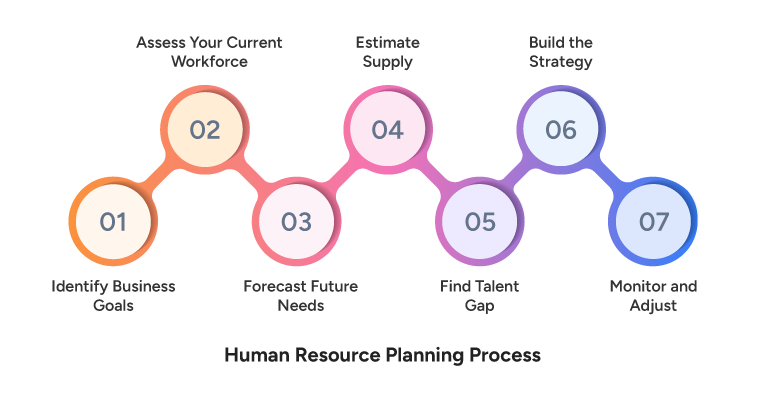
Step 1: Identify Business Goals
As an HR professional, you know you can’t work effectively without close collaboration with your team leaders.
- Are we expanding into a new city? (We need sales staff).
- Are we automating a factory? (We need fewer manual workers but more technicians).
- Rule: If it doesn’t align with the business goal, it’s not a good HR plan.
Step 2: Assess Your Current Workforce
The next step in the process is to evaluate current employees’ performance. How does assessing your workforce’s skills and competencies help you identify issues for long-term planning? Conduct proper research on whether you have the right talent and the right skills in the right place.
Step 3: Forecast Future Needs
This can be a difficult step as you need to calculate the number of individuals you need.
- Managerial Judgment: Ask department heads, “If we grow 20%, how many more people do you need?”
- Trend Analysis: Look at past data. If sales go up by ₹1 Crore, do we usually add two salespeople?
Step 4: Estimate Supply
Look at your current team. Who is retiring next year? Based on your attrition rate, how many people will likely quit?
- Example: You have 100 people. You know, 10% usually quit. So, you only have 90 people for next year.
Step 5: Find Talent Gap
This step can be made easy, as it requires a comparison between steps 3 and 4.
- Deficit: You need 10 people, you have 5 (Action: Hire).
- Surplus: You need 10 people; you have 15 (Action: Layoffs or Redeployment).
Step 6: Build the Strategy
Now, decide how to close the gap. You usually have three options here:
- Recruitment: Start hiring early.
- Training: Upskill current staff.
- Contingent Workforce: Hire freelancers if the need is temporary.
Step 7: Monitor and Adjust
One way to evaluate the productivity of the plan is to gather feedback from teams and employees. This will help you determine whether the plan has increased productivity and solved workforce gaps.
The Real Challenges HR Teams Face
Planning processes are not always simple. Some of the challenges that can affect your planning include:
1. Lack of Reliable Data: If you are tracking your employees data on Excel sheets, you cannot plan. Without solid information on your team’s skills and who’s jumping ship, planning becomes difficult.
2. Resistance to Change: Employees often resist changes like restructuring or new ways of working because they fear the unknown, worry about their job security, or feel unsure about what’s expected of them.
3. The World Changes Fast: A 5-year plan is often useless in today’s economy due to market changes and tech shifts. Focus on a solid 1-year plan and a flexible 3-year outlook.
4. Employee Retention: You’ve probably seen how quickly disengaged employees start looking for exits. When you don’t have clear visibility into engagement levels, performance, or growth paths – retaining the right people gets harder.
5. Unpredictable Market Conditions: Market shifts, budget changes, and sudden business decisions can disrupt even the best plans. When conditions change fast, rigid long-term workforce plans stop working – and you’re forced to adapt on the go.
6. Compliance That Keeps Changing: Keeping up with updated labour laws and compliance requirements is never easy. When data is scattered or tracked manually, ensuring compliance while planning your workforce can feel stressful and time-consuming.
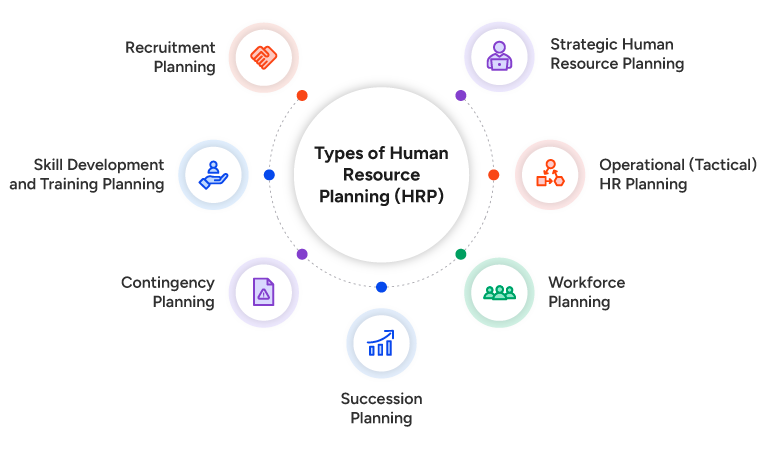
Why are Spreadsheets Failing You?
In the old days, HRP was performed in manual spreadsheets using complex formulas. But planning is prone to human error and delays. One wrong formula can mismanage your entire hiring budget plan.
In 2026, successful HR teams use technology. This is where factoHR comes in.
Turn Spreadsheet Limits into Data-Driven HR Decisions with factoHR
We don’t just process payroll; we help you plan your future.
- Centralized Data: Get a single view of every employee’s skills, cost, and performance.
- Real-Time Reports: See attrition trends instantly. Know exactly which department is losing talent.
- Succession Planning: Identify your high performers and track their career paths automatically.
Stop guessing with Excel. Start planning with data. See how factoHR helps you build a smarter workforce strategy.
FAQs
What is the Purpose of Human Resource Planning?
HRP ensures the organization has the right talent and workforce to perform any task. The planning process coordinates HR strategies with the organization’s objectives.
What are the Objectives of Human Resource Planning?
The objectives of human resource planning are to ensure the right number of employees with the right skills are available when needed and to help employees work toward the company’s goals.
What are the Factors Affecting Human Resource Planning (HRP)?
The factors affecting human resource planning include organizational goals, company culture, HR policies, budget, and required skills. They also include external factors such as labor market conditions, economic conditions, technology changes, and government regulations.
What is the Future of HR Planning?
The future of HR planning will be data-driven and AI-enabled, with a focus on a skills-based approach and strategic talent management. It will emphasize flexibility, upskilling, and aligning people with long-term business goals.
How Can Technology Improve the Human Resource Planning Process?
Technology improves the human resource planning process by using data, analytics, and AI to forecast workforce needs and accurately identify skill gaps. It also automates routine HR tasks, helping teams make faster decisions and support business goals.
What are the Key Features of HRP in Workforce Alignment?
The key features of HRP in workforce alignment are assigning the right people to the right roles and ensuring workforce efforts support organizational goals. It also includes workforce forecasting, gap analysis, skill development planning, succession planning, and adapting to changing business needs.
What is the Difference between HR Planning and Workforce Planning?
HR planning focuses on short-term processes like hiring, performance, and compliance to manage current employees, while workforce planning focuses on long-term forecasting of talent needs, skills gaps, and labor market trends to align with business goals.

Table of Contents
Teamwork makes the dream work This concept is true for organizational success. Overcoming the challenges of working in groups can help teams perform better. Trust, clear communication, shared goals, and inclusion are some key elements that make teams more efficient.
Investing in team-building activities, setting clear goals, and recognizing group achievements can help organizations create a positive work environment. Organizations benefit from improved problem-solving, productivity, innovation, and employee engagement when individuals collaborate.
Key Takeaways
- Teamwork makes the dream work, as working in teams brings numerous benefits for individuals and organizations.
- Working together toward shared goals with mutual responsibility improves performance, morale, innovation, and problem-solving.
- Leadership plays a crucial role in guiding and supporting team members.
- Clear communication and trust are the pillars of strong teams.
- Team-building activities, recognition, continuous feedback, and setting clear goals help organizations build stronger teams.
What does “Teamwork Makes the Dream Work” Really Mean?
The phrase “teamwork makes the dream work” means that goals become more achievable when people work together. It highlights the importance of collective effort, shared responsibility, and cooperation in achieving individual and organizational success.
This concept became widely popular when motivational speakers repeatedly used it in the workplace to encourage collaboration. Leadership experts promoted it by emphasizing the importance of teamwork in improving work ethics and productivity.
Businesses face complex challenges, work under tight deadlines, and must continue innovating. To keep pace with the fast-changing demands of today’s workplace, companies depend on strong teamwork to achieve lasting success.
Key Elements of Effective Teamwork
Strong teams rely on these essential elements for success:
Trust and Transparency
A positive team culture creates respect, eliminates uncertainty, and fosters psychological safety. As people trust each other’s intentions and abilities, it helps teams stay focused on shared goals rather than personal issues, strengthening the overall work ethics in the organization.
Transparency clarifies expectations, responsibilities, and decisions, thereby preventing conflicts and improving coordination. High transparency in teams directly supports better employee retention over time.
Shared Goals and Mutual Accountability
When roles and responsibilities within a team are well defined, it makes team members accountable and committed to the work they are assigned. Regular communication of the team’s vision, especially in virtual teams, keeps everyone focused on achieving the same outcomes.
Diversity and Inclusion in Teamwork
Teams with individuals from diverse backgrounds, experiences, and perspectives perform better, as each member brings their unique ideas and problem-solving capabilities to the team, strengthening overall workforce diversity.
Inclusion ensures that every member’s insight is heard and respected. Thus, diversity and inclusion create an environment where people feel motivated to perform their best.
Benefits of Teamwork in the Workplace
Effective teamwork creates measurable value for both employees and organizations.
Improved Problem-Solving and Innovation
Different viewpoints of team members allow teams to review challenges from multiple angles and explore practical, holistic solutions, a process strengthened by systems that track employee productivity. When team members collaborate, it improves information processing, enabling them to adopt helpful ideas and make informed decisions.
Teamwork also plays a key role in driving innovation. While an individual may suggest one solution, a group generates a broader range of ideas. New thinking emerges when people with varied backgrounds and experiences work together. Diverse teams are more creative, understand challenges more clearly, and consistently perform better than uniform groups.
Higher Morale and Employee Engagement
Teamwork builds a positive work environment where employees feel supported and valued, creating stronger employee engagement. When collaboration is based on respect, open communication, and mutual understanding, employees are more willing to cooperate and support one another during challenges.
Working in supportive teams boosts motivation, reduces stress, and increases productivity and reduces turnover. Research from the University of Warwick also shows that happier employees can be up to 12 percent more productive, reinforcing this link between well-being and performance.
Faster Achievement of Organizational Objectives
In today’s work environment, it is difficult for individuals to address complex business problems independently. When employees use their specialized skills within a collaborative setting backed by structured performance management systems, it helps organizations achieve their objectives quickly while maintaining quality.
Teamwork enables organizations to achieve goals more efficiently by sharing responsibility and reducing work pressure. Clear accountability within teams ensures work is delegated correctly, improving quality and ensuring timely completion.
Employee Skill Enhancement
When individuals collaborate within teams, they gain exposure to different working styles, ideas, and problem-solving approaches. Regular interaction helps employees identify both their strengths and areas for improvement. Peer feedback helps employees avoid repeated mistakes and improve their working methods.
Skills such as communication, listening, time management, and critical thinking improve naturally through daily collaboration, with structured training and development reinforcing these gains. As employees grow individually, their improved capabilities strengthen the team’s overall performance.
Challenges Teams Often Face
Even well-managed teams can face challenges that can affect collaboration, productivity, and trust.
Ego and Unhealthy Competition
Ego and unhealthy competition arise when individuals focus more on personal recognition than on team success. Instead of sharing knowledge or supporting others, team members may focus on getting credit or avoiding extra work patterns often seen as signs of bad leadership if left unchecked. This mindset can lead to poor communication, lack of cooperation, and unnecessary conflicts.
Miscommunication or Lack of Clarity
Poor communication results in misunderstandings, delays, and errors, particularly in fast-paced or remote work environments, which directly undermines organizational objectives.
Unclear Roles and Responsibilities
When roles and responsibilities are not clearly defined, team members may duplicate work or overlook critical tasks. This creates confusion, delays, and frustration within the team. Also, accountability/workflow becomes disorganized, and overall team efficiency declines.
Resistance to Feedback
Feedback is essential for identifying mistakes, improving performance, and learning new skills. When team members are unwilling to accept constructive feedback, it affects both individual progress and overall team development.
Limited Collaboration Skills
Team members must possess active listening, clear communication, cooperation, and conflict resolution skills. When team members lack these skills, team coordination breaks down, and misunderstandings increase.
Strategies to Strengthen Teamwork and Overcome Challenges
Teams perform effectively when common challenges are addressed through the following practical strategies:
Setting Clear Goals and KPIs
Organizations should define clear objectives and measurable KPIs for every team using HR software to track and centralize these metrics. Defining quality benchmarks for every role provides performance expectations. Regular tracking and reviews should be conducted to monitor progress, along with providing timely feedback, and keep teams aligned with overall business priorities.
Clarifying Roles and Responsibilities
Document and share job roles and decision-making authority at the start of each project to avoid confusion among team members. Managers should review and adjust responsibilities as workloads or priorities change to maintain smooth coordination.
Team-Building Activities
Organizations should plan problem-solving exercises, collaborative workshops, or off-site retreats. Team-building activities strengthen relationships and improve collaboration. The focus should be on improving communication, encouraging cooperation, and helping employees understand each other’s working styles and strengths.
Fostering Trust and Open Communication
Open dialogue and idea sharing strengthen team relationships, build trust, and reduce misunderstandings. When leaders initiate discussions, employees feel confident in expressing their views.
Aligning Strengths with Tasks
Responsibilities must be assigned based on each team member’s strengths to accomplish tasks efficiently and to a high standard. When tasks align with individual skills, it improves confidence, engagement, and overall job satisfaction.
Encouraging Continuous Improvement
Encourage teams to update their skills through training programs, mentoring, and learning opportunities. Focusing on continuous improvement helps teams adapt to change, improve efficiency, and maintain consistent progress toward long-term goals.
Providing Time for Self-Reflection
Self-reflection helps individuals improve their contribution to the team. Employees should be given time and space to reflect on their strengths, interests, and areas for development to support better role alignment, career planning, and personal accountability.
Recognizing Collective Achievements
When leaders value teamwork and recognize collective achievements, employees are more likely to collaborate and work toward common goals. Effective leadership promotes fairness, respect, and shared responsibility within the team. It also improves morale and builds loyalty.
Conclusion
For any organization, teamwork is crucial to workplace success. Teams may achieve results more quickly and efficiently than individuals. Mutual trust, open communication, and working toward shared goals improve the team’s performance across all areas.
Leadership support, transparent processes, and consistent encouragement help teams overcome challenges. Organizations that invest in strong teamwork build a culture of cooperation, steady growth, and long-term success.
Table of Contents
Key Takeaways:
- What Attrition vs Turnover truly means and why the difference matters.
- How turnover impacts short-term hiring needs and daily operations.
- How attrition shapes long-term workforce planning and cost decisions.
- The eight key differences that help HR leaders understand both metrics clearly.
- How to calculate turnover, attrition, and churn with simple formulas.
- When HR should track each metric to make smarter staffing decisions.
- Proven strategies that reduce unwanted exits and improve retention.
- How HR leaders use combined data insights to make strong workforce decisions.
Strong HR decisions depend on how well you interpret Attrition vs Turnover trends. When your top performer suddenly resigns, do you call it attrition or Turnover? Many HR teams use these terms interchangeably.
Here, you will learn clear definitions, easy formulas, example calculations, real-world scenarios, and proven strategies to reduce both attrition and Turnover, along with practical HR insights you can apply immediately.
What is Employee Attrition?
Employee attrition refers to an organization’s decision not to fill positions after employees leave. Instead of hiring new staff, the organization allows headcount to shrink naturally. Attrition can take several natural forms, such as:
Voluntary Attrition
Employees leave on their own through retirement, relocation, or career change, and the company chooses not to refill those positions.
Involuntary Attrition
The organization terminates employees due to reasons like poor performance, misconduct, or company restructuring, and chooses not to replace them.
Internal Attrition
Employees move into other internal roles, and their previous positions remain vacant or are merged into different responsibilities.
Demographic-Specific Attrition
When employees from a specific age group, skill set, or department leave the organization at a higher rate than other groups.
What is Employee Turnover?
Employee turnover is the number of employees who leave and are replaced by new hires in an organization within a specific period. The number clearly indicates the frequency of Employee exits, Recruitment cycles, Onboarding & training sessions
Turnover is an important workforce indicator because it affects employee retention, engagement, hiring costs, and overall stability. Many HR teams track turnover to understand workplace culture, team satisfaction, and talent sustainability.
Employee turnover can be divided into the following categories:
Voluntary Turnover
Employees resign on their own due to reasons like better career growth, poor management, low engagement, or higher compensation elsewhere.
Involuntary Turnover
The organization asks employees to leave because of layoffs, performance issues, restructuring, or disciplinary actions.
Internal Turnover
It indicates an employee’s transition to a different role or department within the same organization. Internal turnover does not reduce overall headcount but affects team stability.
Functional vs. Dysfunctional Turnover
- Functional Turnover: Low-performing or misaligned employees leave, improving team efficiency.
- Dysfunctional Turnover: High performers leave, causing productivity loss and higher replacement costs.
Attrition vs Turnover: 8 Key Differences Explained
When it comes to understanding the gravity of attrition vs turnover in a situation, consider evaluating the following eight key differences.
1. Replacement Intent
- Turnover: The organization immediately hires someone to fill the vacant position to maintain continuity and avoid workflow disruption.
- Attrition: The organization chooses not to replace the employee. The role may remain vacant temporarily or be filled permanently, depending on business requirements.
2. Impact on Headcount
- Turnover: Headcount stays the same because the organization hires immediately.
- Attrition: Headcount gradually reduces as the organization does not fill the vacant positions.
3. Speed and Urgency
- Turnover: The process feels urgent, and hiring begins immediately to avoid productivity loss.
- Attrition: The process is slow as the HR has time to assess workload distribution or redesign job roles.
4. Cost Implications
- Turnover: Recruitment, onboarding, and training of new hires increase costs associated with recruiting, hiring, and training.
- Attrition: Saves payroll costs in the short term but may impact team productivity without additional support.
5. HR Response Strategy
- Turnover: Focus on improving core issues and boosting employee engagement to reduce churn rate in the first place.
- Attrition: HR invests in succession planning, internal mobility, knowledge transfer, and long-term workforce planning.
6. Business Planning Impact
- Turnover: Impacts recruitment budgets, training schedules, and operational timelines due to constant hiring and training cycles.
- Attrition: Influences big decisions, such as departmental restructures and forecasting future workforce models.
7. Control and Predictability
- Turnover: HR professionals have less control over the churn rate, as employees may also leave suddenly for personal reasons.
- Attrition: In the case of attrition, management typically plans and controls natural exits or gradual workforce reduction over time.
8. Metric Focus
- Turnover: Tracked by specific categories like department, job level, tenure, or demographics to identify problem areas.
- Attrition: Measured across the whole organization to support long-term workforce and budget planning.
As you can see, both attrition and Turnover are useful for tracking employee exits and developing strategies for long-term retention.
Attrition vs Turnover: Side-by-Side In-Depth Comparison
Let us have a quick attrition vs Turnover comparison below for better understanding.
| Factor | Employee Turnover | Employee Attrition |
|---|---|---|
| Definition | Employees leave, and the organization hires replacements to fill the same roles. | Employees leave, but the organization intentionally does not replace them, reducing headcount. |
| Replacement Decision | Backfilling is immediate to maintain workflow continuity. | The position is left vacant or removed from the structure. |
| Headcount Effect | Stays stable because each exit is replaced quickly. | Declines gradually as roles go unfilled. |
| Common Causes | Poor management, low engagement, burnout, career change, and better offers. | Natural retirement, restructuring, hiring freeze, budget cuts, and role redundancy. |
| Timeline | Fast and urgent replacements within weeks. | Vacancies remain open for months or permanently. |
| Cost Impact | High costs for recruiting, hiring, onboarding, training, and productivity loss | Short-term savings on payroll, but possible workload pressure on existing teams |
| HR Priority | Retention improvement, employee engagement, hiring efficiency | Succession planning, role consolidation, long-term workforce design |
| Warning Signs | Frequent resignations, high exit interview issues, and rising hiring volume | Increasing vacant roles, smaller team size, and dependency on remaining staff |
| Measurement Frequency | Monthly or quarterly by department or job category. | Yearly across the whole organization |
| Business Goal Alignment | Supports operational stability and ongoing productivity | Supports restructuring, cost optimisation, and strategic workforce planning |
| Employee Morale Impact | Lower morale due to high Turnover and onboarding cycles | Teams may feel pressured due to vacant positions. |
| Example Scenarios | The sales manager quits, and HR immediately hires a new manager | A retiring admin assistant’s role is removed due to automation. |
How to Calculate Employee Attrition Rate
Employee attrition rate shows how fast a company loses people without hiring new ones. This metric helps HR make better decisions to improve employee engagement.
Attrition Rate Formula
(Employees who left and did not get replaced ÷ Average number of employees) × 100
Step 1: Count the employees who left and were not replaced.
Step 2: Find the average number of employees:(Opening headcount + Closing headcount) ÷ 2
Step 3: Divide the non-replaced exits by the average employee count.
Step 4: Multiply the answer by 100.
Employee Attrition Rate Example
- Employees who left without replacement: 5
- Average employees: 150
- Attrition Rate = (5 ÷ 150) × 100 = 3.3%
Types of Attrition Rates to Track
- During restructuring or cost control periods
- When many employees retire or shift careers
- When you want to study long-term workforce health
This insight supports strong planning and better attrition vs turnover analysis.
How to Calculate Employee Turnover Rate
Employee turnover rate indicates the percentage of employees who leave a company during a specific period. This is a basic metric for comparing Attrition vs Turnover patterns and for addressing workforce challenges.
Turnover Rate Formula
(Number of employee separations ÷ Average number of employees) × 100
Step 1: Identify how many employees left during the selected period (month, quarter, or year).
Step 2: Calculate the average number of employees: (Opening headcount + Closing headcount) ÷ 2
Step 3: Divide separations by the average number of employees.
Step 4: Multiply the result by 100 to get the percentage.
Employee Turnover Rate Example
- Employees who left: 12
- Average employees: 150
- Turnover Rate = (12 ÷ 150) × 100 = 8%
Types of Turnover Rates to Track
- Voluntary Turnover Rate: Measures employees who resign by choice, often linked to culture, compensation, or career growth.
- Involuntary Turnover Rate: Tracks exits due to termination, layoffs, or performance issues.
- Departmental Turnover Rate: Measures which teams have higher turnover, helping pinpoint leadership or workload issues
- New Hire Turnover Rate: Tracks employees who leave within the first 90 days or first year.
- High-Performer Turnover Rate: Shows how many top performers leave. This is critical because losing key talent affects productivity and morale.
HR teams track turnover trends, exit patterns, and hiring needs using HR software. These softwares help HR measure employee flow, study workforce trends, and make faster decisions.
How to Reduce Employee Turnover (12 Proven Strategies)
Let’s discuss twelve proven strategies to reduce employee turnover and improve retention rate at the same time.
1. Improve Hiring and Onboarding Quality
- Hire skilled candidates who best match the role and your culture.
- Offer a realistic view of the job profile during the interview for candidates to make a conscious decision.
- Develop a strong onboarding process to reduce early exits and rehiring costs.
2. Offer Competitive Compensation and Benefits
- Offer a competitive salary to attract top talent and retain them for a long time.
- Include attractive perks like health cover, work-from-home flexibility, and task bonuses.
- Regularly ask employees what they value in a compensation and benefits package to identify areas for improvement.
3. Provide Clear Career Development Paths
- Map out progression routes for employees at different verticals of your organization.
- Offer upskilling, internal mobility, and promotion roadmaps.
- Provide opportunities for employees to practice new skills through cross-training, job shadowing, or on-demand projects.
4. Strengthen Manager–Employee Relationships
- Managers influence daily experience more than any system you introduce.
- Train managers to listen to employees and guide them toward long-term retention.
- Investment in manager capability will immediately provide structured support to your workforce.
5. Foster Work–Life Balance
- Work-life balance drives employee performance.
- Try to control workloads by providing predictable schedules that help employees avoid burnout.
- Designing healthier work rhythms helps people give better output and stay longer.
6. Build a Recognition and Appreciation Culture
- Employees notice when their efforts are recognized.
- Recognition motivates them faster than most financial perks.
- When you acknowledge sincere efforts, teams stick with the company during challenging phases.
7. Conduct Stay Interviews
- Stay interviews are all about understanding why people might leave months before they decide.
- The insights help you uncover risks early, identify leadership gaps, and address them to reduce turnover.
8. Improve Workplace Culture and Engagement
- Your organization’s culture is what employees experience daily at the workplace.
- Promote fairness, transparency, and strong teamwork in every aspect of the work culture.
- When employees feel safe contributing ideas, it will automatically resolve trust issues quickly.
9. Address Toxic Leadership Immediately
- Toxic leaders create hidden attrition long before resignations appear in data.
- When you see early signs like sudden sick leave, team transfers, or silence in meetings, take action quickly. Removing negative leadership, trust, and retention improves instantly.
10. Offer Meaningful Work
- Employees feel motivated to work when you assign tasks to them that align with their strengths.
- Once they begin to appreciate their task, voluntary turnover decreases.
11. Improve Internal Communication
- Clearly communicate task priorities and expectations to teams.
- You can share weekly clarity updates and reduce unnecessary conflicts.
- Help employees see the bigger picture so that they feel more connected to your mission.
12. Analyse Turnover Data for Patterns
- Simple Turnover percentages tell you nothing without context.
- Study exists by tenure, performance, manager, and role type to identify the root causes.
- When you segment data, you get an actual attrition vs Turnover picture and act with confidence.
How HR Can Use Turnover and Attrition Data Together?
- Perform the attrition vs turnover analysis to understand both fast exits and slow workforce changes
- Analyze turnover data to pinpoint the factors behind rapid exits and increased recruitment activity.
- Attrition data shows long-term gaps, shrinking teams, and future skill needs.
- HR can use both metrics to improve retention and reduce hiring costs.
- This combined view can help HR plan team size, manage workloads, support leaders, fix culture issues, improve communication, and build a stable workforce.
Common Mistakes Companies Make with Turnover and Attrition
Let’s take a look at the top five mistakes organizations make with turnover and attrition.
Mistake 1: Using Terms Interchangeably
Most organizations lack clarity on the distinction between attrition and turnover and treat them as the same. This leads to flawed decisions because the two metrics show different workforce changes.
Mistake 2: Only Tracking Overall Numbers
Focusing on reducing attrition and turnover rates should not be the core purpose. HR must study the deeper patterns. Investigate the factors driving the score and work on lowering them with the right strategy.
Mistake 3: Ignoring Voluntary Turnover Patterns
Voluntary exits indicate cultural and leadership issues in the workplace. HR should compare attrition vs turnover rates to identify valid reasons.
Mistake 4: Viewing all Attrition as Positive
Some attrition helps reduce costs, but high attrition weakens skills and increases stress. HR must judge it carefully within the attrition vs turnover context.
Mistake 5: No Action Plans Post-Analysis
Most organizations study attrition and turnover data but take no action. It is important to work on the insights to create real changes in engagement, leadership, and communication.
Wrapping up
Understanding attrition vs turnover is the key to making better workforce decisions. Turnover shows fast exits that need quick hiring. Attrition shows slow changes that shape long-term planning. It is imperative to understand the implications of both situations to optimize hiring costs and address core workplace issues. The right approach turns employee data into practical action and builds a healthier workplace.
FAQs
Are Attrition and Turnover the Same?
No, attrition vs turnover shows two different types of employee exits. The comparison shows which exits reduce headcount and which need new hiring.
Is a 20% Attrition Rate High?
Yes, 20% is high for most industries. High attrition puts pressure on teams, increases workload, and weakens long-term workforce strength.
Which is Worse for a Company: High Attrition or High Turnover?
Both hurt the business, but high turnover affects teams faster in the attrition vs turnover comparison.
How Can HRMS Software Help Track these Metrics?
HRMS software tracks exits, headcount changes, trends, and reports in one place.
Can Attrition Ever be Beneficial?
Yes, positive attrition removes extra roles and reduces costs in attrition vs turnover planning.
Table of Contents
Key Takeaways
- The 9‑Box Grid evaluates employees based on performance and potential across nine categories.
- It helps identify high performers, high-potential talent, and development areas.
- Using the grid supports succession planning and strategic workforce decisions.
- HR teams can combine it with other tools, such as 360-degree feedback, to achieve more accurate assessments.
- Clear criteria, rating scales, and real examples improve fairness and consistency.
- Common challenges include bias, oversimplification, fixed labels, and limited depth, which can be managed with multi-rater input and qualitative feedback.
- The model encourages targeted development, internal promotions, and better alignment with company goals.
- Customizing the criteria to the organization’s culture makes the tool more effective.
- Its real value comes from the conversations, evaluations, and development actions that follow the grid placement.
What is the 9 Box Grid?
The 9-box grid is a standard talent management tool that assesses employees based on performance and potential. It categorizes staff into nine segments, helping HR teams identify top performers, high-potential individuals, and individuals requiring focused development.
The effectiveness of this performance tool increases when combined with regular feedback, performance reviews, and targeted learning programs. When implemented appropriately, the 9‑box grid helps organizations make informed decisions, nurture talent, manage the succession pipeline, and build a future-ready workforce.
How to Create and Use the 9 Box Model
Managers and HR teams can follow these steps to create and use the 9-box model as an effective talent management tool:
Define Criteria for Performance and Potential
Start by setting clear, objective criteria to ensure everyone follows the same standard. This step reduces bias and maintains fairness in the process. Use performance indicators such as work impact, quality, efficiency, and quantity to assess performance. Managers can rate an employee’s performance using the 1–3 scale:
- Does the person meet the role’s primary responsibilities?
- Is the work accurate and reliable?
- How well does the person manage workload and timelines?
To assess potential, consult with managers and team members to get a holistic view. Focus on indicators such as leadership interest, adaptability, emotional awareness, and learning ability. Managers can ask these sample questions to rate an employee’s potential using the (1–3 scale):
- Does the person learn new skills quickly?
- Can the person handle new or challenging tasks with limited support?
- Does the person show interest in taking on more responsibility or guiding others?
Construct the Grid
Once the performance and potential axes are drawn, divide each axis into low, medium, and high levels. This creates the nine boxes(9 Box Grid), where each intersection represents a distinct combination of performance and potential. For clarity, label each box, for example: ‘Underperformer’ (low/low), ‘Core Team Member’ (medium/medium), or ‘Future Leader’ (high/high). These labels provide a simple reference for discussion and development planning.
Evaluate Employees and Calibrate
Managers must assess each employee using the criteria and rating scale. To ensure success, it is advisable to focus on one team or division at a time. After initial ratings, hold a calibration meeting to ensure consistency and reduce bias. Additionally, ask managers to provide brief examples or observations to support their ratings.
Plot Employees on the Grid
Position each employee in the appropriate box based on their performance and potential scores. Managers and stakeholders must confirm the placements after repeated discussions to avoid mistakes and misjudgements. To strengthen transparency and trust, it is also important to ensure that employees have the opportunity to provide input.
Detailed Breakdown of the 9 Box Grid
Understanding what each box represents helps HR and managers take the appropriate steps for talent management and succession planning. Below is an explanation of all 9 Box Grid and guidance on how to support the individuals in each group.
Low Potential, Low Performance
This box is the lowest on the grid, with employees in it struggling with both performance and potential. They may be a misfit for their current role.
Check if personal issues or role mismatches are affecting their work. If performance does not improve even after support, reconsider the hiring decision.
Low Potential, Moderate Performance
These employees perform at an average level but show limited long-term potential.
The best approach may be to clearly communicate that their performance needs improvement. Set clear goals and provide a structured performance improvement plan to help them overcome personal hindrances.
Low Potential, High Performance
Although these employees score low on potential, they consistently perform well.
Motivate these employees and recognize their contribution through salary increases. Offer relevant skill-building opportunities so they are ready to face future changes. They may not be ideal for promotion, but they are valuable assets.
Moderate Potential, Low Performance
These employees can grow, but are currently not meeting expectations. This may happen due to unclear responsibilities or a lack of feedback from senior leadership.
Identify the reasons behind their low performance. Subsequently, provide support, guidance, and regular feedback to help them improve.
Moderate Potential, Moderate Performance
The employees in this group are reliable, consistent, and capable of developing further. They meet expectations, but have the calibre to improve their performance and potential.
Expose these employees to new tasks and moderately challenging roles, while providing the support and guidance they need to excel. Continue setting clear expectations and recognizing good work when they meet or exceed expectations.
Moderate Potential, High Performance
These employees are strong performers, consistently delivering excellent results while showing promising potential.
Invest in their training and development. Identify the areas where they exceed expectations and assign them similar, more challenging responsibilities. Acknowledge their achievements and encourage them for their initiatives.
High Potential, Low Performance
They have strong potential but are currently underperforming due to factors such as the time required to adjust to new roles or unclear expectations.
Identify and clear the barriers affecting their performance. Assign them a role that aligns with their capabilities, career goals, and objectives. Set clear expectations and provide ongoing feedback to accelerate improvement.
High Potential, Moderate Performance
These employees are highly ambitious, willing to tackle multiple projects, gain knowledge, and take on new challenges. However, they need to deliver more consistent results to be identified as high potential.
Offer targeted development opportunities and set clear performance benchmarks. Help them progress toward the top-performing category.
High Potential, High Performance
These are top performers with strong leadership potential. They should be the focus of the organization’s succession planning strategy as they are key contributors and future leaders.
Keep them engaged with challenging projects. Focus on advanced development, especially in leadership and people management skills, to prepare them for senior roles.
Benefits of the 9-Box Model
The 9-box model is one of the most commonly used talent management tools because it is simple, practical, and effective across different industries. A few key benefits include:
Improves Succession Planning and Reduces Hiring Costs
Hiring externally, especially for senior roles, is time-consuming and can be expensive. The 9-box model helps HR identify people who can grow into leadership roles based on their performance and potential, making succession planning more structured.
Teams can spot high performers with strong potential, as well as moderate performers who can advance with focused training and support. This makes internal promotions easier, reduces future skill shortages, and lowers recruitment expenses. To back this claim, Wharton research shows that external hires cost 18 to 20% more than internal hiring.
Re-Evaluate Talent Placement
The model provides a clear overview of an individual’s current performance and future growth potential. This helps leaders identify where the company may lack critical skills or future leaders.
The grid also highlights performance issues early, helping managers decide who needs extra training, coaching, or support. By addressing these gaps promptly, organizations build a stronger, more capable workforce.
For evaluation, managers can ask questions such as:
- Has the team member shown interest in growing within the company?
- Would they perform better in a different role?
- Are they prepared for a more senior position?
- Is someone struggling because the role does not match their strengths?
These insights help managers develop people into roles that align with their skills and career goals.
Flexible and Easy to Use
The 9-box model can be used in any department, even in roles where performance is difficult to quantify. It is quick to learn and implement.
Its visual layout helps managers and HR teams understand performance and potential easily. Instead of focusing only on past performance, the model encourages teams to consider long-term growth and future contribution.
It also creates space for honest conversations between HR, managers, and team members by answering questions such as:
- Who consistently delivers strong results?
- Who could take on more responsibility soon?
- Where are the most significant growth areas in the team?
- Which skills or behaviors support strong performance?
These discussions help teams better understand strengths, areas for improvement, career goals, and training priorities.
Common Challenges and Solutions
While the 9-box model is useful, some limitations should be managed carefully. Implementing these solutions can mitigate the challenges and ensure the tool is applied fairly and responsibly.
Bias and Subjectivity
One of the most significant risks is relying too much on personal judgment. Performance and potential interpretations may vary across managers, leading to inconsistent ratings. Intentional or unintentional bias can also influence an employee’s placement on the grid. These biases can affect morale and may disadvantage people from underrepresented groups.
Ensure that assessments are not based on a single viewpoint by involving managers, peers, and HR. Use clear criteria, documented examples, and structured rating scales to focus on evidence-based evaluations and reduce personal assumptions.
Oversimplification of Talent
The grid summarises a team member’s performance and potential into a single category, which may not fully reflect their varied strengths. An employee can excel at specific tasks and still be developing in other parts of the role.
Combine quantitative ratings with qualitative feedback to build a more accurate understanding of each person. Use notes from one-on-one discussions, project outcomes, and real work examples to provide a holistic overview.
Risk of Fixed Labels
Once team members are placed in a box, managers may unintentionally hold on to that label. For instance, someone marked as low potential may be overlooked for projects that could help them grow. This can restrict development, limit career mobility, and reduce motivation.
Review placements regularly, at least once or twice a year. Talent changes as people learn new skills or take on new responsibilities. Frequent updates ensure the grid reflects current performance and growth.
Limited Depth
The 9-box model offers a quick overview, but it cannot replace a detailed performance review. The simplicity that makes it easy to use also makes it imprecise. Without deeper conversations, managers may misinterpret where someone truly stands.
Use the grid alongside broader performance management tools, such as goal tracking, competency assessments, and development plans. Encourage open conversations with team members about their placements to clarify expectations, identify skill gaps, and set meaningful development plans.
Conclusion
The 9 Box Grid provides a straightforward method to understand employee performance and growth potential. It helps HR teams recognize talent, identify development needs, and support planning for future roles. The grid works efficiently with regular meetings, feedback, and learning programs. This approach helps organizations make fair decisions about development and support different career paths.
factoHR’s performance management tools support this process by giving teams a centralized location to track goals, reviews, and development plans. The platform makes it easier to record feedback, monitor progress, and keep performance data organized throughout the year. When the 9 box grid is used alongside these tools, HR teams gain clearer insights, make faster decisions, and provide more structured support for employee growth.
How Often Should a 9-Box Review be Conducted?
Annually or bi-annually during performance review cycles.
Does the 9-Box Grid Demotivate Employees?
Yes, if not implemented carefully. Labeling employees as “low potential” can discourage growth and reduce engagement.
How does the 9-Box Grid Relate to Succession Planning?
It identifies high-potential, high-performing employees as successors for leadership roles and guides their development.
What are the Modern Alternatives to the 9-Box Grid?
4-Box Grid, Skill-Will Matrix, 360-Degree Feedback, Competency Models, AI-Driven Predictive Models, and Talent Profiles.
How do You Plot an Employee on a 9-Box Grid?
Assess performance (X-axis) and potential (Y-axis), then place the employee in the corresponding box on the grid.
Download Free Employee Performance Appraisal Template (PDF)
Table of Contents
Decisions about promotions, rewards, and training depend heavily on performance appraisals. Yet many companies treat them as a routine task they must complete. Once done, the form is filed away and rarely used again.
But when used correctly, ideal performance appraisal methods offer powerful benefits. Organizations can keep employees productive, engaged, and aligned with business goals.
This guide offers the clarity and tools managers need to design performance appraisals that yield maximum benefits.
Key Takeaways
- A performance appraisal is a structured process used by organizations to evaluate employee performance over a defined period.
- It helps recognize valuable contributions, identify training needs, and make informed decisions about promotions, pay adjustments, and other workforce actions.
- There are several performance appraisal methods, each designed for different needs and situations.
- Irrespective of the method used, organizations may still face challenges that affect fairness, clarity, and employee morale.
- Applying thoughtful HR practices and using a clear appraisal template helps build a culture of trust, accountability, and continuous improvement.
What is a Performance Appraisal?
A performance appraisal is a structured process for an organization to measure employee performance over a specific period. The appraisal takes into account an employee’s work, skills, and achievements for a specific window, like a month, quarter, or year. The purpose is to offer helpful feedback, set future expectations, and highlight areas where the employee can grow.
Importance of Performance Appraisal Methods
Performance appraisal methods play an important role in building a productive workplace. They:
- Provide Feedback: Employees get a clear view of what they are doing well and where they can improve
- Recognize Achievements: Acknowledge and appreciate employees’ efforts.
- Support Goal Setting: Managers and employees get the clarity to set achievable goals for projects
- Guide Development: Appraisals reveal areas that may need training or additional support
- Boost Motivation: When efforts are noticed and growth paths are clear, employees stay motivated
- Improve Decisions: The results help managers make informed choices about promotions, salary changes, and other key actions
6 Best Performance Appraisal Methods Every HR Should Know
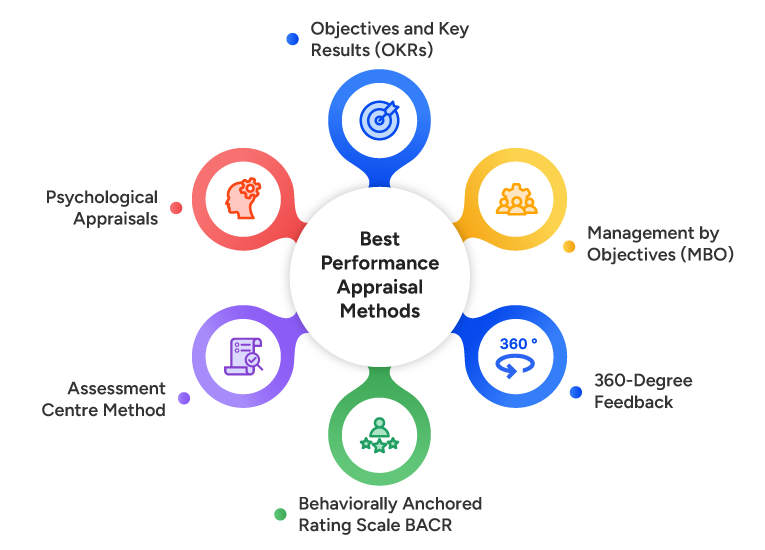
Objectives and Key Results (OKR)
The OKR method ensures that employees at all levels work toward a shared direction, while each team sets goals and tracks metrics that suit their role.
How the Process Works:
- Set clear objectives that define what the organization or team wants to achieve.
- Identify key results that measure progress toward those objectives.
- Communicate the goals across teams and individuals.
- Track progress regularly and adjust when required.
- Review results at the end of the cycle to assess performance.
Management by Objectives (MBO)
MBO is one of the effective performance appraisal methods where managers and employees work together to set clear and measurable goals. The focus is on aligning individual efforts with organizational priorities.
How the Process Works:
- Set specific and measurable goals
- Hold regular check-ins to review progress.
- Measure performance against the agreed targets.
360-Degree Feedback
360-degree feedback is a method where an employee’s performance is reviewed by the people they work with regularly. This includes managers, peers, team members, and sometimes customers.
How the Process Works:
- Select reviewers such as supervisors, peers, subordinates, and include the employee’s self-review.
- Collect feedback from each reviewer.
- Review and interpret the feedback to find key patterns.
- Share the results with the employee.
- Work together to create a development plan.
Behaviorally Anchored Rating Scale (BARS)
The Behaviorally Anchored Rating Scale (BARS) method combines clear behavioral examples with numerical ratings to evaluate employee performance.
How the Process Works:
- Collect input from employees, managers, or subject experts.
- Define detailed descriptions for each performance level.
- Rate employees based on how closely their actions match these descriptions.
- Assign numerical scores to summarize performance.
Assessment Centre Method
The assessment center method is used to assess employees’ professional skills through structured activities and real-life simulations.
How the Process Works:
- Employees take part in exercises such as group discussions, role plays, case studies, and presentations.
- Observers evaluate their performance based on predefined competencies.
- Participants receive detailed feedback along with development suggestions.
Psychological Appraisals
Psychological appraisals evaluate the mental and emotional qualities of an employee. These performance appraisal methods use psychological metrics such as personality, motivation, and how they interact with others.
How the Process Works:
- Employees take psychological tests and assessments.
- Responses are evaluated to understand their traits, preferences, and emotional health.
- Results are compared with the job’s requirements and performance expectations.
Key Challenges in Performance Appraisal
Even well-designed appraisal systems are not free from challenges that affect fairness, clarity, and employee confidence. Some of these challenges that HR should overcome to build a more transparent and effective review process are:
Inconsistent Appraisal Process
Inconsistency arises when managers use different standards or interpret goals differently. For example, one manager tries to rely heavily on attendance for appraisal scoring while another prioritizes communication. In such an event, two similar performers may receive very different scores.
Poor Communication
Employees feel overwhelmed when managers set vague goals or review criteria. The lack of clarity about the end goal curbs their ability to prepare or improve. For instance, an employee might think their focus should be speed, only to learn during the appraisal that accuracy mattered more.
Low Motivation
When the appraisal ratings don’t reflect the actual performance of employees, they lose motivation. For example, imagine employees engaged in multiple roles still receive an average rating because the manager didn’t track their contributions throughout the year. The final appraisal will leave them discouraged.
Lack of Feedback
Vague or infrequent feedback prevents employees from knowing where they stand. If feedback is shared only once a year, issues remain unaddressed for too long. For example, an employee may continue making the same mistake for months simply because no one pointed it out earlier.
Best HR Practices for a Successful Performance Appraisal
Strong HR practices ensure that employee performance appraisals are fair, consistent, and meaningful. With the right approach, organizations can create a smooth experience for both managers and employees.
Plan Appraisal Meetings with Clear Objectives
Performance reviews may feel uncomfortable for both employees and managers. The future of employees depends on the outcome of the evaluation. HR can ease this by providing a structured appraisal outline or form. These templates will guide managers and employees to prepare for a clear, job-specific evaluation.
Involve Employees Actively in the Review Process
Employees feel more satisfied with the appraisal when they can share their views, explain their work, and discuss how they can improve. HR should design a process that encourages active participation. Employees should be given the chance to provide insight on how they could perform their jobs better.
Build Transparent Communication from Managers
Not every employee handles constructive comments well. So HR must train managers in flexible feedback techniques. They should provide feedback without hurting any motivation.
Research by Daniel Pink (2018) shows employees respond better when areas for improvement are discussed early. It concluded the session on a positive note.
Provide Regular Feedback
Around 63% of employees prefer immediate, real-time feedback to understand their strengths and areas for improvement. Performance management software can be an ideal tool for maintaining a continuous feedback loop.
Document Every Appraisal Session Accurately
Performance appraisals guide decisions that may happen months later, so relying on memory can lead to errors. HR should require clear, consistent documentation for every review to ensure details are easy to access when needed. Using HRMS for performance evaluation can help HR professionals maintain accurate and organized records.
How HR Can Create a Performance Appraisal Form
A good appraisal form should follow a well-structured format to help managers evaluate employee performance within a few minutes. It should have all necessary performance metrics, document achievements, identify gaps, and set clear goals for the next review cycle.
Use the template & sample below for a structured and consistent review:
Employee Performance Appraisal Template
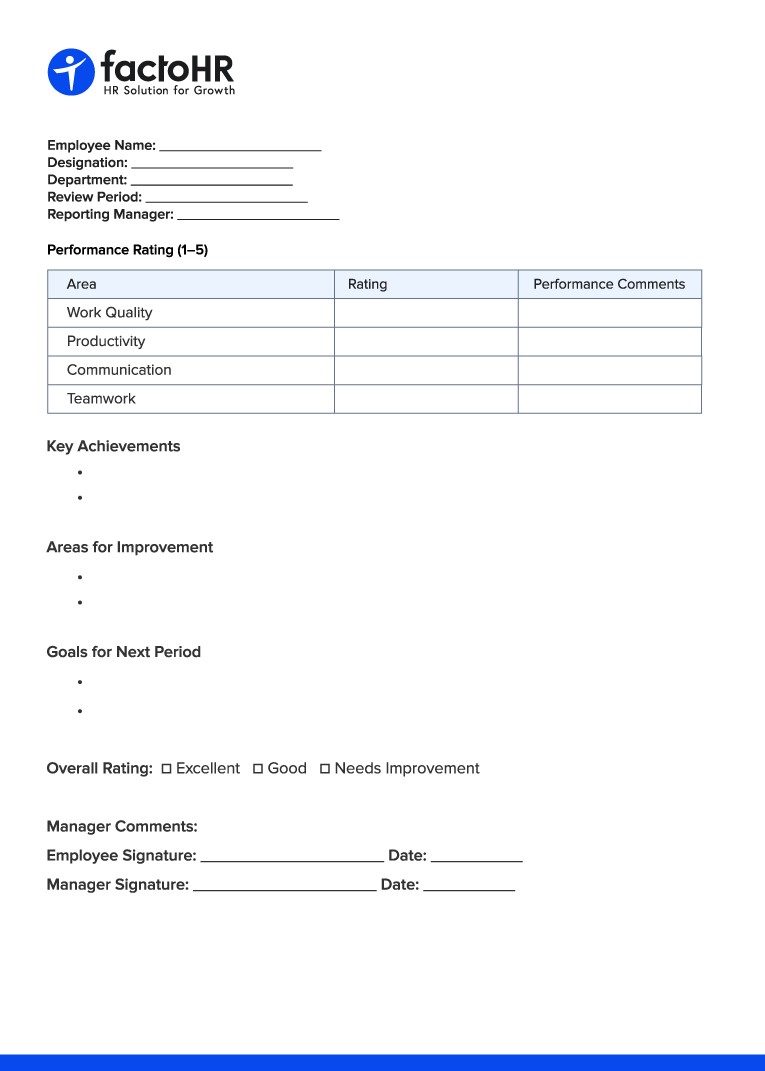
Employee Performance Appraisal Sample
Employee Name: Riya Sharma
Designation: HR Executive
Department: Human Resources
Review Period: April 2024 – March 2025
Reporting Manager: Amit Verma
Employee Performance Rating (Scale: 1–5)
| Area | Rating | Performance Comments |
|---|---|---|
| Work Quality | 4 | Delivers neat and accurate work with minimal corrections |
| Productivity | 4 | Manages tasks well and meets deadlines consistently |
| Communication | 3 | Communicates clearly but can share updates more proactively |
| Teamwork | 5 | Always ready to help teammates and works well with others |
Key Achievements
- Successfully managed end-to-end recruitment and onboarding processes
- Reduced candidate follow-up delays and improved hiring experience
Areas for Improvement
- Improve communication with stakeholders during high-volume hiring
Goals for Next Review Period
- Strengthen communication skills and take ownership of HR initiatives
Overall Performance Rating: ☑ Good
Manager Comments:
The employee has shown consistent performance and strong teamwork skills. With improved communication, overall effectiveness and career growth potential will increase.
Employee Signature: Riya Sharma Date: 31/03/2025
Manager Signature: Amit Verma Date: 31/03/2025
Make sure these rating levels are defined properly so managers apply the scale consistently. Building a checklist for ideal performance evaluation will even better streamline the process.
Conclusion
Performance appraisals provide valuable information about employee growth. They give clarity on the strengths and weaknesses of employees and where they need support to move forward.
When HR follows the right performance appraisal methods and processes, appraisals become more accurate, fair, and meaningful. Such performance appraisals not only motivate employee performance but also build a culture of trust, accountability, and continuous improvement.
Frequently Asked Questions
What are the Benefits of a Performance Appraisal?
The benefits of a performance appraisal are to evaluate an employee’s work, highlight strengths, identify areas for improvement, and set clear goals. It also supports decisions on the company’s growth, training, and promotions.
How do I Choose the Right Performance Appraisal Method for My Company?
Choosing the right performance appraisal method depends on your company’s size. You need to align performance goals with business objectives to make the process fair.
Is a Performance Management System Better than Using Spreadsheets for Appraisals?
Yes, a performance management system reduces manual work, minimizes errors, stores data securely, and offers real-time tracking. Spreadsheets can work for small teams, but become unreliable as you grow.
What are the Different Aspects of 360-Degree Feedback?
360-degree feedback includes input from managers, peers, subordinates, and sometimes customers. It gives a well-rounded view of performance by combining multiple perspectives, self-assessment, and behavior-based observations.
Table of Contents
The UAE is a land of celebrations, but how does the government maintain a healthy work-life balance? The United Arab Emirates comprises a blend of Islamic holidays that follow the lunar Hijri calendar. Its community focuses more on faith, and some of the key festivals include Eid al-Fitr (marking the end of Ramadan with 3-5 days of prayer) and the Islamic New Year.
Islamic holidays like these shift their dates each year on the Gregorian (solar) calendar, which creates a sense of unpredictability. This blog provides a detailed breakdown of the UAE public holidays, presented in table format to help individuals plan their holidays.
List of UAE Public Holidays 2026
- New Year – January 1st (Thursday)
- Eid Al Fitr – March 20 to March 22 (Friday to Sunday)
- Arafat Day – May 26 (Tuesday)
- Eid Al Adha – May 27 to May 29 (Wednesday to Friday)
- Islamic New Year – June 15 (Monday, but the official day to fall on Tuesday, June 16, holiday moved to start of the week)
- Prophet Muhammad’s Birthday – August 24 (Monday, but official day to fall on Tuesday, August 25, holiday moved to start of the week)
- Eid Al Etihad (UAE National Day or Emirates National Day) – December 2 to 3 (Wednesday to Thursday)
UAE Holiday 2026 Calendar Table
| Sr. No. | Holiday | Predicted Dates | Day(s) of Week | Notes |
|---|---|---|---|---|
| 1 | New Year’s Day | January 1 | Thursday | Fixed Gregorian holiday |
| 2 | Eid al-Fitr | March 20-22 | Friday-Sunday | 3 days; end of Ramadan, non-transferable |
| 3 | Arafat Day | May 26 | Tuesday | Precedes Eid al-Adha |
| 4 | Eid al-Adha | May 27-29 | Wednesday-Friday | 3 days; Feast of Sacrifice |
| 5 | Islamic New Year | June 16 (or June 15) | Tuesday (or Mon) | May shift for the long weekend |
| 6 | Prophet Muhammad’s Birthday | August 25 (or August 24) | Tuesday (or Mon) | May shift for the long weekend |
| 7 | UAE National Day / Emirates National Day | December 2-3 | Wednesday-Thursday | Celebrates union formation |
UAE Public Holidays 2026: Date-Wise Explanation
New Year’s Day (January 1)
New Year’s Day, which marks the start of the Gregorian calendar year, is a public holiday for both the public and private sectors. Individuals use this holiday to celebrate with their friends and family, which includes fireworks at landmarks (Burj Khalifa) and other special events.
Eid Al Fitr (March 20-22)
Eid Al Fitr marks the end of the holy month of Ramadan and is one of the most important Islamic holidays in the UAE. Muslims attend Eid prayers along with family visits and exchange of gifts (Eidiya or Eidi).
Arafat Day (May 26)
Arafat Day is celebrated on the 9th day of Dhul Hijjah, which is the last month of the Islamic calendar. It is a public holiday, which is a day of reflection and fasting for devotees.
Eid Al Adha (May 27-29)
Eid Al Adha is celebrated to remember Prophet Ibrahim’s willingness to sacrifice his son in obedience to Allah. This occasion is also known as the “Festival of Sacrifice,” and devotees perform Eid prayers.
Islamic New Year (June 16)
The Islamic New Year marks the beginning of the Hijri lunar calendar year. It is a United Arab Emirates public holiday, which celebrates the Prophet Muhammad’s migration from Makkah to Madinah.
Prophet Muhammad’s Birthday (August 25)
Prophet Muhammad’s Birthday, also known as Mawlid Al Nabi, celebrates the birth of the Prophet Muhammad. It is a public holiday for muslims as they gather around for sermons and Quran recitations highlighting the Prophet’s life and teachings.
Commemoration Day (December 1)
Commemoration Day is celebrated in honor of the sacrifices and dedication of Emirati martyrs who lost their lives in the line of duty. This holiday is famous for its official ceremonies and national events that pay tribute to the martyrs.
Emirates National Day (Eid Al Etihad) (December 2-3)
Emirates National Day is celebrated to remember the formation of the United Arab Emirates in 1971 and the union of the seven emirates. This is one of the most important UAE public holidays, celebrated with fireworks and decorations across the country.
Conclusion
It is important to plan for emirates public holidays, as organizations might face challenges in leave management. This way, it helps teams collaborate easily and plan to boost employee engagement.
Companies can use factoHR HR management system to simplify holiday tracking, and employees can submit leave requests through an ESS portal. factoHR can help ensure compliance with UAE labor laws and maintain a smooth workflow during peaks. Automation can prevent any disruptions and support a work-life balance.
Explore Our UAE HR & Compliance Blog
Frequently Asked Questions about Holidays in the UAE
What are the Public Holidays in the UAE in 2026?
Some of the united arab emirates public holidays in 2026 include:
- New Year’s Day on January 1
- Eid al-Fitr from March 20-22
- Arafat Day on May 26
- Eid al-Adha from May 27-29
- Islamic New Year on June 16
- Prophet Muhammad’s Birthday on August 25
- Emirates National Day on December 2-3
How do Moon Sightings Affect Islamic Holidays?
Moon sightings decide the start of lunar months for holidays like Eid al-Fitr and Eid al-Adha. This is known by using the Hijri calendar, and the UAE committees use telescopes and public reports after sunset to confirm the crescent moon.
How to Maximize Your UAE Holidays?
Employees can combine public holidays with weekends and annual leave to maximize their holiday entitlement. It is advised to plan early by marking holidays and checking weekends, which helps in submitting leave requests in advance.
Are Dubai’s Public Holidays Different from those of Other Emirates?
Public holidays are uniform across the UAE emirates, which are set by federal Cabinet resolutions. There are no major differences for Dubai, and all observe the same national/Islamic dates.
What’s the Best Way to Plan to Leave around Eid?
Individuals can plan leave around Eid by noticing moon sightings and public announcements. This will align leave with weekends, for example, employees can take days around Eid al-Fitr or al-Adha to extend their breaks by up to 12 days.
What if a Public Holiday Falls on a Weekend in UAE?
There are no additional days off given if a public holiday falls on a Thursday-Friday weekend. The UAE Labour Law confirmed that the weekend stays unchanged without compensation.
What is the Next Upcoming Holiday in UAE (as of January 2026)?
As of January 2026, the next holiday after New Year’s Day (January 1) is Eid al-Fitr, which occurs in late March 2026.
How Many Emirates Public Holidays are there each Year?
The emirates have 7-14 official public holidays each year. This includes fixed national days and variable Islamic ones.
What Makes UAE National Holidays Unique?
The celebrations include fireworks and traditional dances like Al Ayala, which highlight the culture. There are events of falconry and camel parades, as well.
Why is UAE National Day Now Called Eid Al Etihad?
As of late 2024, the UAE officially renamed the National Day celebrations to ‘Eid Al Etihad’ (Festival of the Union). This change highlights the country’s Arabic heritage and the values of unity and identity established during the unification of the emirates in 1971.
How Holidays Differ Across Emirates (Focus on Dubai Public Holidays)
Holidays across the UAE, including Dubai, align with federal law. This ensures consistency for national and religious holidays like Eid and National Day.
Table of Contents
Key Highlights
- A budget helps the organization manage resources wisely and make better financial decisions.
- Different types of budgets give structure to personal and business planning.
- Budgeting supports financial stability by preparing for present needs and future goals.
- A clear financial plan is the key to tracking income, expenses, and resources over time.
- Understanding various budget types improves long-term financial growth and security.
What is a Budget?
The meaning of budget is a detailed financial plan that outlines expected income, projected expenses, and the allocation of resources over a defined period.
The budget provides a structured framework for managing financial resources, which includes various HR activities. Some of these include employee salaries, training and development programs, recruitment expenses, benefits, and other critical HR functions.
Benefits of Budgeting
Explore some of the major benefits of a well-planned budget for an organization.
- Budgeting helps the organization track income and expenses so you can manage money more effectively.
- It helps prevent overspending by illustrating how resources are allocated and identifying areas where costs can be reduced.
- A clear financial plan helps companies set and prioritize financial goals like savings, debt repayment, and investments.
- It supports better decision-making by giving a clear picture of the financial situation.
- Budgeting helps build an emergency fund for unexpected expenses or financial stress.
- It improves financial discipline and helps stay committed to long-term financial commitments.
Types of Budget
Organizational budgets vary by purpose, scope, and frequency of preparation. There are several types of budgets, such as:
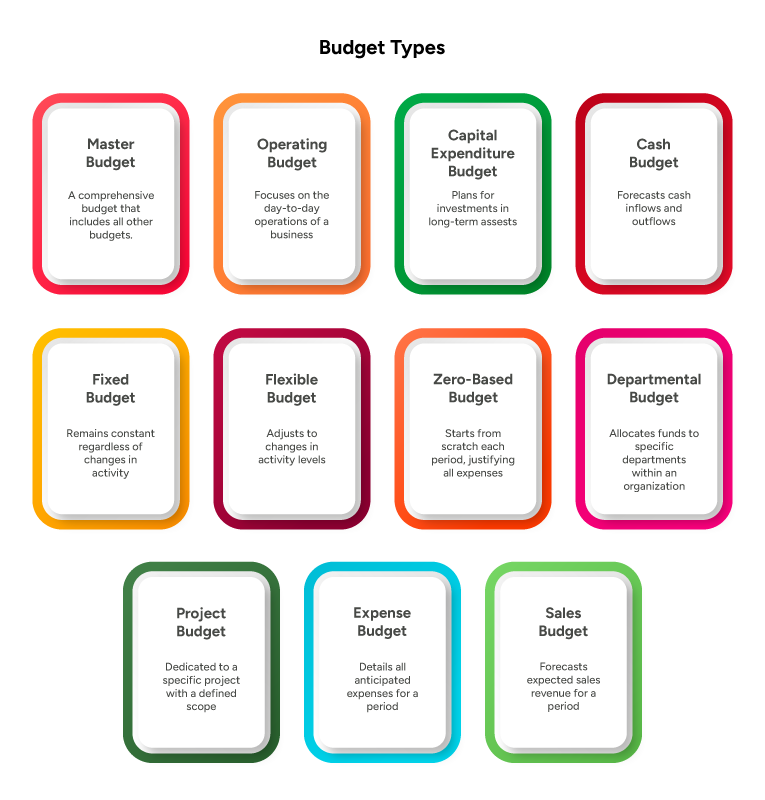
Master Budget
A master fund is a complete financial plan that combines all individual budgets of a company, such as sales, production, and cash budgets. It gives a clear overall view of expected income and expenses and helps the organization plan, control, and achieve its financial goals.
Operating Budget
An operating financial plan outlines a company’s expected income and expenses for daily operations within a specific period. It includes projected sales, production costs, and operating expenses. An operating budget helps the organization plan its activities, control spending, and ensure smooth business operations throughout the year.
Capital Expenditure Budget
A capital expenditure fund outlines the planned spending on long-term assets such as machinery, equipment, and buildings. In situations where determining which major investments are necessary for growth is challenging.
This financial plan provides the clarity needed to make informed decisions. You will be able to estimate costs, expected returns, and the financial impact of future projects.
Cash Budget
It shows inflows and outflows over a set period. It helps an organization plan its cash, avoid shortages, and run daily activities smoothly. It also highlights cash flow issues early so managers can take timely and informed decisions.
Fixed Budget
A fixed fund is a plan in which the revenue and expense amounts remain the same throughout the period. It does not change even if activity levels rise or fall. This provides stability and helps organizations control costs with clear spending limits.
Flexible Budget
A flexible financial plan changes its income and expense estimates based on actual activity. The aim is to help organizations adjust to market changes when production or sales increase or decrease. This gives managers better control over changing business conditions.
Zero-Based Budget
A zero-based financial plan requires every expense to be justified from the beginning for each period. Every cost must be approved and connected to a clear purpose. This method removes wasteful spending and ensures money is used only for necessary activities.
Departmental Budget
A departmental fund refers to the funds allocated to a specific team or department within an organization. It covers that department’s expenses and expected income. It serves as a key tool to strategic planning, enabling better control of resource utilization and supporting the achievement of team objectives.
Project Budget
A project plan lists all the estimated costs required to complete a particular project. This includes costs for materials, labor, and other project requirements. Managers can track expenses and avoid overspending with ease.
Expense Budget
This budget shows the planned expenditure of an organization for a given period. It includes costs like salaries, utilities, supplies, and maintenance. This acts as a reference to keep the organization within its financial limits.
Sales Budget
It predicts future revenue using past sales, market demand, and industry trends. Every organization is dependent on this type of fund to decide sales targets, plan production, and guide major financial decisions.
Various types of budgets are used in organizations. However, the specific plan may differ based on the organization’s size, industry, and goals.
Key Reasons why a Budget is Important
There are five core reasons that show the importance of budget for both large enterprises and small startups.
Financial Control
It helps you understand your income and operational expenditure. It gives better financial control and helps avoid unwanted expenses.
Emergency Readiness
A fund helps save for emergencies. These savings support during difficult times without disturbing recurring monthly expenses.
Better Cash Flow Management
It assists in planning the timing of funds and scheduled expenditures. This makes it easier to pay bills on time and stay organized.
Review Budget Performance
This can help in monitoring the financial progress regularly. You can see what is going well, what needs improvement, and make changes to stay on track with performance management software.
Stronger Team Accountability
In companies, it sets clear spending limits for each team. It helps everyone use company money responsibly and prevents overspending.
How to Create a Budget Plan
If companies want to plan their income and expenses clearly for better financial management, here is a quick step-by-step guide.
Step 1: Set Your Financial Goals
Set clear targets and choose simple measures to track progress. Form a small team to handle the budgeting work.
Step 2: Gather Financial Data
Collect past financial records like income, expenses, and cash flow. Check patterns to understand the current financial position and identify your limits and opportunities.
Step 3: Identify Your Income Sources
List all ways an organization can generate revenue, such as sales, grants, or donations. Estimate future income based on market conditions, like inflation and seasonal demand.
Step 4: Estimate Expenses
List all fixed, variable, and semi-variable expenses. Use records or industry averages to estimate future spending.
Step 5: Create a Budget Structure
Organize all income and expense items in a simple format. Make the financial plan easy to read and understand to ensure every cost is justified clearly.
Step 6: Review and Revise
Check the financial plan with the team to confirm it matches goals. Correct any errors or missing details and get approval from senior leaders before finalizing.
Step 7: Put the Budget into Action
Share the plan with all departments and track actual income and expenses regularly. Make sure teams follow the budgetary constraints.
Step 8: Monitor and Adjust
Compare actual results with the fund often. Update the plan when market conditions or goals change. Use mid-year reviews to keep the financial plan relevant.
Step 9: Evaluate Results and Improve
Review the full budgeting process at the end of the year. Identify areas that perform well and those that require improvement.
Best Budgeting Tools for Corporate Use
Budgeting tools have pre-coded functionalities to help plan cash flow, control costs, and get a clear view of your finances. Explore some of the best tools for leaders to track spending and make quick decisions.
ERP Systems
ERP (Enterprise Resource Planning) systems combine budgeting with other finance functions in a single system. This provides a unified view of company income, expenses, and cash to plan better.
Financial Planning Software
These tools help create detailed budgets, forecasts, and “what if” scenarios. You can count on them to see how changes in sales, costs, or plans can affect your business. To manage travel expenses more easily, companies can use tools like travel and expense management software.
Spreadsheets
Spreadsheets like Excel or Google Sheets are simple and flexible. They suit small teams that want basic budgeting, quick edits, and easy sharing.
Cloud-Based Budgeting Tools
Cloud tools allow teams to work on the same budget from anywhere. Data updates in real time, so everyone sees the latest numbers and avoids confusion.
AI-Driven Tools
AI budgeting tools use data to predict trends and future results. They help companies identify risks early and plan more confidently using insights, not guesswork.
Conclusion
Understanding the different types of budgets helps organizations manage their revenues better and achieve financial goals. Budgeting is a continuous process; therefore, it is advisable to review it regularly and update it when needed.
Businesses can simplify their human resource management by integrating effective budgeting strategies to drive organizational success.
Frequently Asked Questions
What are the Five Stages of the Budgeting Process?
The five stages are setting goals, collecting financial data, preparing the budget, implementing it, and reviewing the results. These steps help keep the budget practical and useful.
What are the Common Challenges to Avoid in Budgeting?
Incorrect data, unclear goals, and a lack of periodic review are three common challenges in every budget. Avoiding these helps you maintain a simple and effective budget.
What are the Three Main Types of Budget?
The three main types are operating budgets, capital budgets, and cash budgets. Each one supports different financial planning needs.
How does Budgeting Help a Company Grow and Expand?
Budgeting helps companies plan spending, manage costs, and use money wisely. This supports better decisions and long-term business growth.
Why do Organizations Need to Revise Their Budgets from Time to Time?
Budgets must be updated when market conditions or expenses change. Regular revisions keep the financial plan accurate.
What is Budget Management?
Budget management means planning, tracking, and controlling income and expenses. It ensures funds are used appropriately and supports financial stability.
What is Budget Forecasting and Planning?
Budget forecasting predicts future income and expenses. On the other hand, budget planning helps set clear limits and goals, which allows organizations to prepare for financial changes and make better decisions.
Table of Contents
Key Takeaways
- Company training programs have higher income per employee than those without formal training.
- Training and development in HRM help employees build skills for current and future roles.
- A clear process supports better performance, career growth, and retention.
- Effective programs rely on needs assessment, defined goals, suitable training methods, and regular evaluation.
- Tools like a Learning Management System and personalized learning paths improve learning outcomes.
- Trends such as AI-driven learning, immersive tools, microlearning, and inclusive training will shape future skill development.
- Strategic training and development practices help organizations stay competitive in a fast-changing environment.
What is Training and Development?
The meaning of training and development in HRM focuses on helping employees build the skills, knowledge, and behaviours required for present and future roles.
Training in HRM focuses on improving the abilities required for an employee’s current role. It is usually short-term and may include structured courses, on-the-job learning, or coaching.
Development supports long-term professional growth. It prepares employees for future responsibilities through activities such as mentoring, job shadowing, workshops, or advanced training sessions.
Benefits of Training and Development
The importance of training and development in HRM extends to both employees and businesses. Implementing training, education, and development together helps build a skilled workforce capable of meeting both present and future business demands.
Increased Employee Performance
Training, education, and development programs increase the quality of employee output by providing the information, tools, and skills they need. It is directly linked with better job performance, as employees who receive adequate training are more confident in their job roles.
Improved Employee Retention
Employees today seek roles that support growth. When organizations focus on structured employee skill development programs, it becomes easier to attract and retain skilled talent. This investment builds commitment, lowers turnover, and supports a stable workforce.
Enhanced Innovation and Creativity
Employees who receive practical professional development training can develop new ideas, skills, and approaches, which allows them to find innovative solutions to problems as they continuously learn and improve.
Stronger Leadership Pipeline
These training programs help identify and train leaders within the organization by offering leadership development training programs. This ensures a smooth succession planning process and continuity in leadership, reducing interruptions during transitions.
Enhanced Customer Satisfaction
By acquiring knowledge and skills, a well-trained employee can deliver exceptional customer service. They understand customer needs and effectively address inquiries and concerns, and provide personalized experiences.
Positive Company Culture
It contributes to establishing a positive organizational culture. When organizations prioritize employee development, they create a supportive environment where employees feel valued and motivated.
Difference Between Training and Development
Understanding the difference between training and development in HRM is important for effectively using them to support employee growth.
| Basis | Training | Development |
|---|---|---|
| Meaning | Training is a learning process that provides an opportunity to upgrade the knowledge, skills, and competencies necessary to meet job requirements. | Development is a continuous process that goes beyond a particular role, supporting both personal and career growth. |
| Aim | To improve employees’ job performance. | To support the overall growth of employees. |
| Duration | Short-term process. | Long-term process. |
| Orientation | Job-oriented. | Career-oriented. |
| Skills | It involves the teaching of technical skills. | It involves imparting technical, human, and conceptual skills. |
| Initiative in learning | Employers take the initiative to provide training to their employees. | Individuals take the initiative themselves for their growth and development. |
| Integration | Training programs cover areas such as software, safety, and customer service. | Programs are designed to develop leadership and decision-making skills. |
| Level of knowledge imparted | Training imparts the knowledge necessary for a specific job role. | Knowledge is imparted to support an employee’s overall development. |
| Nature | Using performance feedback to identify and address skill gaps. | Proactive about developing leadership ability |
| Outcome | Focus is on measurable outcomes. | Outcomes are subjective and baised. |
6 Steps for the Training and Development Process
When implemented strategically, these training and development steps provide a structured approach to the employee learning cycle.
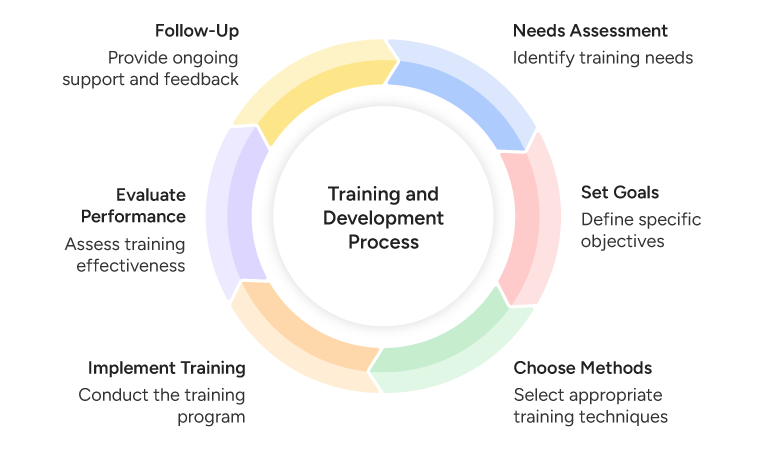
Needs Assessment
HR processes for employee training and development identify skill gaps within the organization and determine the training employees require. The process involves collecting information through surveys, discussions, and other methods to identify areas for improvement and set clear training goals.
Set Specific Goals and Objectives
Once training needs are identified, companies should align goals with organizational objectives and set measurable targets for the training program. For example, the goals could be to improve customer service skills, improve leadership capabilities, or increase technical proficiency.
Decide on Training Methods
Organizations should select training methods (in-person, online, or on-the-job training) based on required skills, available resources, and employee needs. Rotational training can also be considered to expose employees to different roles.
Implement the Training Program
The implementation phase includes planning and executing the training program. It incorporates developing training materials, designing the curriculum, scheduling training sessions, securing necessary resources, and ensuring effective communication and coordination with the participants.
Evaluate the Output and Performance
Evaluating performance outputs using surveys, tests, and performance reviews assesses whether the training achieved its goals and improved employee performance.
Follow-Up
Follow-up ensures employees apply the skills and knowledge they have acquired through training in their daily work. Regular coaching, refresher sessions, and continuous feedback track progress. Additionally, a training needs analysis highlights the requirement for additional support or new learning to keep pace with changing skill requirements.
Best Practices for Employee Training and Development Programs
Some of these practices deliver the desired outcomes when organizations follow reliable practices:
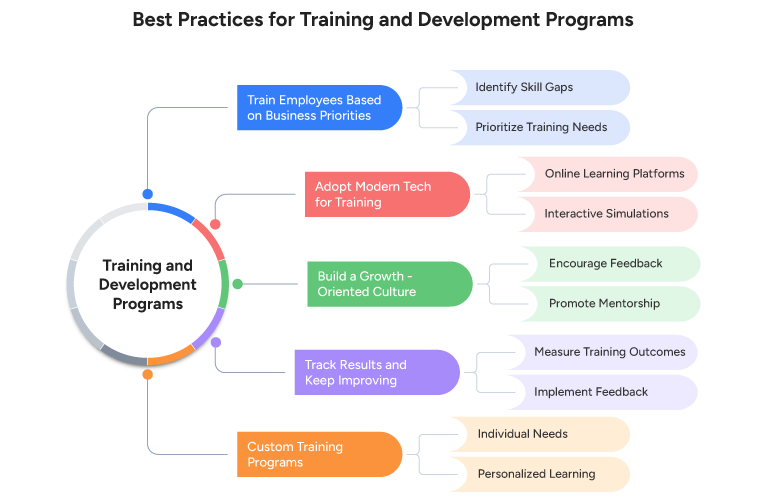
Train Employees Based on Business Priorities
The concept of training and development revolves around planned organizational efforts that enhance an employee’s capability. It begins by evaluating current employee skills against future requirements. Individual development plans are then aligned with organizational objectives.
Adopt Modern Tech for Training
Modern platforms also offer AI-based insights, cloud accessibility, and mobile learning, allowing employees to learn from any location. A Learning Management System helps organize learning content, track employee progress, and support different formats such as videos, quizzes, and virtual sessions.
Build a Growth-Oriented Culture
When leaders participate in development initiatives, it demonstrates the value of growth. Robust leadership development training programs cultivate managers who can guide teams effectively. A culture that promotes continuous learning strengthens overall performance and prepares the workforce for future challenges.
Track Results and Keep Improving
Regular evaluation identifies the benefits of the training on employee performance and the areas that need improvement. As part of Human Resource Management, organizations can review completion rates, performance changes, and employee and manager feedback.
Create Custom Training Programs for Employees
Customized employee training programs address individual skill levels, learning styles, job needs, and career goals. A recent report on Employee Training by Devlin Peck states that many employees recognize the impact of these training programs; a large majority believe training directly improves their performance, and over 90% say they are less likely to leave when they receive meaningful development opportunities.
Current Trends in Training and Development
Training and development are significant for an organization’s success. As work environments evolve, so do trends in this field. Various current trends shaping the field are:
Digital Learning
Digital learning methods have become dominant post-pandemic, using technologies to deliver engaging learning experiences. This also includes e-learning, virtual classrooms, and mobile learning.
Personalized Training Programs
Personalized employee training programs are created to meet the employees’ preferences. These programs often include coaching, self-directed learning, and personalized learning paths.
Microlearning
Microlearning offers training in concise formats, such as infographics, videos, and quizzes. This approach is designed for employees who prefer to learn on the go and for organizations looking to provide just-in-time learning.
Gamification
Gamification makes training more interactive by turning learning into an engaging, competitive experience. It mainly includes training through elements to make training engaging.
Diversity, Equity, and Inclusion (DEI) Training
Organizations are investing in employee training programs that address bias, inclusive leadership, and cultural competence.
Soft Skills Development
To acquire soft skills, organizations are increasingly investing in experiential learning. Methods, such as role-playing exercises and peer feedback sessions, encourage practical application and deeper engagement.
What are the Best Ways to Measure Employee Performance after Training?
Organizations can measure employee performance after training through:
Continuous Feedback
Continuous feedback helps organizations assess the success of the training program. Managers can hold regular meetings to determine if the knowledge and skills acquired through training support employees in their everyday tasks. Through feedback, the manager can track progress, challenges, and improvements that support better performance and continuous learning.
OKRs
OKRs help measure employee performance after training by setting clear goals and expected results. It is also vital for organizations to understand the differences between OKRs and performance management to track goals clearly and manage employee performance effectively.
360-Degree Reviews
360-degree employee reviews identify strengths and areas that need improvement through feedback from peers, managers, and other colleagues. The 360-degree feedback approach provides a complete overview of an employee’s performance and supports transparency by combining multiple perspectives.
How Training and Development Will Change by 2026
AI-driven technology, changing workforce dynamics, and evolving business requirements are set to redefine the future of training and development in India.
AI and Automation
AI-driven tools tailor learning to each employee, suggest relevant modules, and manage routine administrative tasks. With AI in performance management, it becomes easier for HR to review performance and plan employee development effectively.
Immersive Learning Technologies
Learning will become more interactive and realistic with technological advancements. Virtual reality will create hands-on learning experiences that replicate real-world work situations. Employees can apply these skills confidently before performing day-to-day operations.
Microlearning with Smart Learning Systems
Short and focused learning will become the norm, improving efficiency and keeping learners engaged without overwhelming them. It will deliver small, easy-to-understand lessons that can be incorporated into daily routines. Employees will receive personalized modules based on their progress with smart learning systems.
Intelligent Performance Support
Intelligent systems will provide real-time support by offering guidance, suggestions, or reminders during tasks. The need for repeated formal training sessions will reduce as these systems will help employees apply their training immediately, solve problems quickly, and maintain accuracy.
Sustainable and Inclusive Learning
Organizations will design sustainable, flexible, and accessible learning programs for diverse employee groups. This focus ensures long-term impact and equal access through these learning modules.
Examples of Training and Development in HRM
Here are some of the best examples of training and development in HRM from organizations that truly are setting high standards:
Amazon
Amazon, a successful e-commerce company, has upskilled more than 300,000 of its employees and pledges to continue doing so in 2025 by providing the training needed for high-growth future jobs.
Google’s specially designed program allows employees to teach and learn from one another within their areas of expertise. The company also offers a wide range of programs that incorporate technical skills training, leadership development, and wellness.
Microsoft
Microsoft offers a wide range of development programs, including best leadership training and career advancement workshops. Its annual Hackathon event encourages employees to work together and innovate by developing new ideas and solutions.

Conclusion
Organizations need to implement practical training and development policies to build a skilled, future-ready workforce. Companies widely adopt modern HR software as it centralizes learning data and supports overall business growth through integrated modules, making it suitable for hybrid and remote teams.
Frequently Asked Questions
What are the Key Responsibilities of HR in Training and Development?
HR key responsibilities include identifying skill gaps, planning, and executing training programs to support employee development. They also monitor progress, evaluate results, and ensure training aligns with organizational development.
Why do Organizations Conduct Training and Development Programs?
Organizations conduct these programs to improve employee skills, strengthen performance, support career growth, and meet changing business needs. These programs also help increase engagement, productivity, and retention.
Which Factors Make Training and Development Difficult to Implement?
Budget and time constraints make it difficult to implement training programs. Low employee participation, outdated methods, rapid technological changes, and unclear training goals add to these challenges.
Table of Contents
A 360-degree performance appraisal evaluates employee performance by collecting feedback from managers, peers, subordinates, and the employee. It is a structured approach that offers an in-depth understanding of workplace behaviors and performance trends, helping organizations identify strengths and development needs with greater accuracy. When supported by clear design, proper training, and careful feedback delivery, the process encourages constructive discussions and meaningful action planning.
Key Takeaways
- What 360-degree feedback is
- How to design and implement the process step-by-step
- How to analyze and utilize constructive feedback
- Benefits and Challenges of the 360-degree performance appraisal approach
- Best practices to overcome challenges
- Sample questions to include and what to avoid
- Differences between 360-degree appraisals, traditional appraisals, 180-degree appraisals, and OKRs
What is a 360-Degree Performance Appraisal?
A 360-Degree Performance Appraisal, also called a multi-rater performance appraisal, gathers feedback from multiple sources to provide a holistic overview of an employee’s strengths and development areas. By including feedback from different perspectives, this employee evaluation method provides a more accurate and balanced assessment that traditional methods might overlook.
The 360-Degree Performance Appraisal method collects ratings and feedback from people who have a close working relationship with the employee, such as peers, direct reports, and managers. The employee also gives a self-assessment as another source of feedback.
It can also incorporate external stakeholder feedback from customers, vendors, and suppliers.
The Four Key Components are:
| Component | Who Provides Feedback | What It Evaluates |
|---|---|---|
| Self-assessment | Employee | The employee evaluates their goal achievement, perceived strengths, and areas for improvement, encouraging reflection and ownership. |
| Manager assessment | Direct manager | Managers evaluate goal achievement, quality of work, reliability, and contribution to team outcomes. |
| Peer assessment | Colleagues at the same level | Peers assess employees based on collaboration, teamwork, communication, and day-to-day behavior. |
| Subordinate assessment | Direct reports | It is mainly used to evaluate managers. Evaluates leadership style, coaching ability, communication, and level of support provided. |
Conducting the Appraisal Process
The 360-degree appraisal involves several steps:
Step 1: Define the Appraisal’s Objective
The process begins by deciding whether the purpose is development, leadership evaluation, promotion decisions, or strengthening the feedback culture. A clear objective maintains consistency throughout the appraisal.
Step 2: Identify the Competencies to be Reviewed
Organizations decide which competencies will be assessed, such as teamwork, communication, leadership, or problem-solving. A structured questionnaire is created based on these criteria.
Step 3: Select the Raters
A balanced group of peers, managers, direct reports, and, sometimes, clients is selected. Selecting six to ten raters provides diverse insights and makes the review more accurate.
Step 4: Communicate the Process and Timelines
Everyone involved receives a brief orientation on giving objective, behaviour-based feedback. This helps reduce bias and ensures all responses remain constructive.
Step 5: Distribute the Questionnaire
The survey is shared with participants along with a deadline, usually five to seven days. HR monitors completion and supports anyone who needs help during the process using a performance tool like performance management software
Step 6: Collect and Analyze the Feedback
Once responses are received, HR compiles and reviews the data. Individual identities are kept confidential, and only overall patterns, strengths, and development areas are highlighted.
Step 7: Conduct the Feedback Discussion
The combined report is shared with the employee to focus on gaining insights, clarifying doubts, and identifying areas for improvement.
Step 8: Create an Action Plan
A short development plan is prepared with two or three practical goals. This may include training, mentoring, or taking on new responsibilities to support growth.
Step 9: Track Progress through Follow-Ups
Quarterly follow-ups are a form of continuous feedback, helping to review improvement, refine development goals, and maintain accountability.
Analyzing and Utilizing Feedback
Once the 360-degree appraisal steps are complete, the next stage is to interpret the feedback and take action.
Reviewing the Combined Feedback
All ratings from managers and direct reports are compiled into a single report to reveal clear patterns. When multiple rater groups mention the same behaviour, it clarifies the employee’s consistent strengths and the areas that need further development.
For example, if several peers and direct reports note strong collaboration across projects, it shows that the employee performs well when working as a team. Similarly, if many raters point out delays in responding to queries, it highlights a recurring issue that needs attention.
Identifying Perception Gaps
A key area of 360-degree analysis is comparing self-ratings with feedback from others. Perception gaps show where an employee’s understanding of their performance differs from how colleagues and managers observe it. A higher self-rating than external ratings may indicate overestimation of certain behaviours, whereas a much lower self-rating may suggest limited confidence.
For example, if an employee rates themselves 4.5 and their peer average is 3.2 on a scale of 5 for teamwork, this discrepancy may indicate a perception gap, indicating a need for improvement in their communication and collaboration skills.
Navigating Tough Feedback
Some feedback may be difficult to accept, but constructive criticism often offers the strongest insights. The review should focus on observable behaviours, not personal characteristics.
Managers can help employees understand feedback objectively and translate vague feedback into clear actions. For instance, “Needs to improve leadership” can be interpreted as “Needs to delegate tasks more clearly during team projects.” It is also helpful to separate areas that can be addressed quickly from those that need longer-term development.
Creating a Practical Development Plan
Managers and employees work together to build a development plan to outline priorities, goals, support needs, and timelines. It becomes a roadmap for improvement and is reviewed regularly to keep progress on track.
- Identify 2–3 Focus Areas: Identify the key skills or competencies that the employee needs to strengthen by using patterns from the 360-degree feedback to highlight areas where multiple raters noted improvement opportunities. For example, if several peers mention delayed communication or difficulties in delegation, these would become focus areas.
- Set Specific Goals: Set measurable, actionable, and time-bound behaviour-based objectives that address the focus areas. Example: “Respond to team queries within 24 hours” targets communication responsiveness, providing a concrete standard to achieve.
- Outline Actionable Steps: Outline practical steps to reach the goals. This may include attending training sessions and participating in mentoring programs. It can also include taking on specific responsibility to practice the skill.
- Provide Support: Identify the resources, guidance, or tools needed for improvement. This can include access to learning platforms, coaching from managers, or support from HR.
- Set a Timeline: Set milestones to monitor progress at regular intervals; typically 30, 60, and 90 days. This helps the employee focus on incremental improvements.
- Review Progress: Schedule regular meetings to assess progress and provide guidance. This keeps development aligned with real-time feedback, maintaining accountability and momentum.
Benefits of 360-Degree Feedback for Employees and Organizations
A well-implemented 360-degree feedback system provides a holistic view of performance, helping both employees and organizations grow.
Employee Benefits
Strengthened Skills and Performance
Multisource feedback helps employees identify performance gaps and areas for improvement. It enables employees to set targeted goals, improve daily performance, refine leadership skills, and prepare for future roles. Gallup research shows that strengths-based feedback can increase performance by 8–18%, thereby improving motivation and retention.
Enhanced Self-Awareness
Feedback helps employees understand the impact of their behavior on colleagues and team outcomes. When employees accept and implement the feedback, it promotes personal growth and improves team interactions.
Organizational Benefits
Accurate Performance Assessment
360-degree reviews offer a holistic view of employee performance, including remote or independent workers. They help address unnoticed performance gaps and support fair, consistent evaluation practices that align with internal HR policies and compliance standards.
Expanded Talent Pipeline
85% of Fortune 500 companies incorporate 360-degree feedback into their leadership development. By identifying high-potential employees through these insights, organizations can effectively plan for succession planning and cultivate a strong internal talent pipeline.
Improved Customer Service and Loyalty
Incorporating input from customers or clients highlights areas to enhance service, leading to stronger relationships and loyalty.
Competitive Advantage
By developing capable leaders and coordinated teams, organizations improve productivity, employee satisfaction, and overall business performance.
Challenges in 360-Degree Performance Appraisal
While 360-degree feedback offers valuable insights, implementing it comes with specific challenges that organizations must anticipate. Understanding these obstacles ensures the process achieves its intended goals.
Time-Consuming Process
Collecting feedback from multiple raters, compiling scores, and analyzing patterns takes significant time and effort.
Potential Bias
Personal preferences, workplace relationships, or recent conflicts may influence raters. For example, a peer who recently had a disagreement might give lower ratings.
Focus on Negative Feedback
Many people take comments personally; they focus more on critical comments than positive ones. For instance, an employee praised for strong teamwork may feel discouraged if a minor communication issue is repeatedly brought up.
Resistance to Change
Employees and managers may hesitate to shift away from traditional appraisals due to comfort with older methods or fear of peer judgment. This is especially common in hierarchical or conservative workplaces.
Best Practices and Considerations for the 360-Degree Appraisal
Follow these best practices to ensure that the 360-degree appraisal delivers accurate, actionable, and fair feedback for both employees and the organization.
Design
A well-structured design ensures accurate and valuable feedback. Start by defining the purpose of the 360-degree appraisal. Keep the questionnaire short, behaviour-based, and aligned with organizational competencies. Define a minimum number of raters to avoid skewed scores and ensure anonymity through grouped reporting.
Avoid linking 360-degree results to pay or promotions at the outset; doing so can discourage honest feedback and increase resistance. In India, supportive leadership helps teams accept the process from the beginning and reduces doubts about its purpose.
Implementation
Precise planning and communication are key to smooth implementation. Start by deciding the ideal timeframe for conducting the process. 360-degree feedback once every 12–24 months is appropriate for most organizations. Train all participants to give objective, behaviour-focused feedback. Use a secure digital tool to collect responses and support new participants in the process. Setting realistic deadlines and monitoring progress ensures consistency and reduces delays.
Feedback Delivery
Feedback delivery often determines the outcomes: growth or discouragement. Managers should review consolidated reports in advance and focus on patterns rather than isolated comments. During the discussion, highlight both strengths and development areas with clear, practical actions instead of vague statements.
Address any perception gaps to create meaningful reflection. Keep the dialogue private, supportive, and forward-looking. Encourage employees to prepare a simple action plan to achieve the goals within the stipulated timeframe.
Common Mistakes to Avoid
Several mistakes can reduce the impact of a 360-degree appraisal.
- Overloading employees with too many raters or too many competencies creates fatigue and lowers quality.
- Giving untrained raters complete freedom without guidance can make the feedback vague or emotionally driven.
- Rushing the process or skipping communication can create anxiety or mistrust.
- Sharing individual rater comments breaks confidentiality and discourages honest participation.
- 360-degree feedback should not be treated as an annual event; for real improvement, reviews and periodic check-ins are essential.
360 Feedback Frequency and Timing
Most organizations run 360-degree reviews every 12 to 24 months. This timeframe gives employees enough time to apply feedback, cultivate new habits, and show visible progress. Shorter cycles, such as twice-a-year reviews, often feel repetitive because behavioral changes take longer to reflect. On the other hand, waiting more than two years slows development and reduces the usefulness of the insights.
The industry’s nature can also guide the frequency. Tech, SaaS, and startup teams usually follow a 12-month cycle as roles shift quickly, and fast feedback helps them adjust. Manufacturing, retail, and traditional firms often choose an 18–24 month cycle since roles are more stable and improvements take time. For senior leadership, a two-year cycle is appropriate due to long-term developmental goals.
Sample 360 Feedback Questions
These examples focus on specific behavioural traits and can be used for managers, team members, or cross-functional roles. These questions help raters provide clear, unbiased input.
Questions for Managers
These questions clarify how well managers guide and support their teams.
- Does the manager respect other team members?
- Does the manager consider the team’s input before making decisions?
- Does the manager respond promptly to the team’s needs and queries?
- Does the manager provide clarity on goals, priorities, and expectations?
- Is the manager capable of handling pressure and deadlines?
Leadership
These questions assess how consistently an employee demonstrates leadership behaviours.
- Does the employee take accountability for the work?
- Does the employee offer practical solutions when issues arise?
- Is the employee proactive in supporting colleagues by sharing knowledge or guidance?
- Does the employee contribute ideas during discussions or problem-solving?
- Does the employee take ownership of tasks or projects?
Communication
This set of questions evaluates how well an employee exchanges information and interacts with others.
- Does the employee listen attentively to suggestions or concerns?
- Does the employee communicate clearly with peers, managers, and customers?
- Does the employee ask for clarification when needed?
- Does the employee write clear, accurate messages?
- Does the employee communicate ideas concisely and in a structured manner?
Interpersonal Skills
These questions check an employee’s ability to build strong working relationships.
- Does the employee work cooperatively with colleagues on shared tasks?
- Does the employee treat others with respect and professionalism?
- Does the employee manage emotions and stress in a balanced way?
- Does the employee handle disagreements without escalating conflict?
- Does the employee support team culture and contribute to a positive environment?
Problem-Solving
This question set assesses how effectively an employee identifies and resolves issues.
- Does the employee recognize problems early and bring attention to them?
- Does the employee evaluate situations before proposing solutions?
- Does the employee suggest practical or creative options when needed?
- Does the employee work independently to resolve routine issues?
- Does the employee communicate the problem clearly and involve the right people?
Organizational Alignment
These questions reflect how well an employee connects with the organisation’s purpose and direction.
- Does the employee understand the organisation’s goals and priorities?
- Does the employee align daily work with the broader vision?
- Does the employee demonstrate company values in behaviour and decisions?
- Does the employee show interest in organisational initiatives or updates?
- Does the employee speak positively and informatively about the organisation?
Motivation
These questions explore how consistently an employee shows interest, drive, and willingness to contribute.
- Does the employee display enthusiasm toward tasks and responsibilities?
- Does the employee show initiative without waiting for reminders?
- Does the employee maintain motivation even during challenges?
- Does the employee encourage others and contribute to team morale?
- Does the employee proactively share progress and updates?
Efficiency
These questions assess how consistently an employee works in a productive and organised manner.
- Does the employee complete tasks on time and with accuracy?
- Does the employee deliver work that meets agreed standards?
- Does the employee manage workload without unnecessary delays?
- Does the employee look for ways to simplify or improve processes?
- Does the employee help the team stay organised by sharing updates or resources?
Open-Ended Questions for 360 Reviews
These questions help raters explain their ratings or add context that close-ended questions may not capture.
After a closed-ended question
- Please elaborate on your answer.
- What example best reflects this behaviour?
At the end of the questionnaire
- What else would you like to share about this employee?
- What would help this employee be more effective in their role?
- Are there any attributes that have not been covered in the earlier questions?
360 vs Other Appraisal Methods
Many organizations use a combination of approaches for performance feedback and appraisal. For instance, some use OKRs for goal tracking and a 360-degree appraisal for behavior-based evaluation to gain balanced insight into results and competencies.
Depending on the evaluation’s purpose and objectives, organizations can select the most appropriate method that aligns with the company’s size, type, and policies.
| Method | Sources of Feedback | Best Use Case | When to Avoid |
|---|---|---|---|
| 360-Degree Appraisal | Peers, manager, direct reports, self, sometimes customers | Leadership roles, teamwork-focused roles, and development planning | When used for promotions or compensation decisions |
| Traditional Manager-Only Review | Direct manager | Small teams, routine performance cycles | When broader collaboration insights are needed |
| 180-Degree Appraisal | Employee + manager | Junior roles, limited peer interaction | For leadership roles requiring more input |
| OKR-Based Review | Measurable objectives | Goal-driven environments, tech, and startups | Roles with less quantifiable work |
| Project-Based Reviews | Project team members | Short-term or cross-functional projects | Long-term roles with broad responsibilities |
Conclusion
A well-designed 360-degree appraisal supports employee development through holistic feedback from multiple sources. When organizations clearly define objectives and utilize structured tools to collect and interpret feedback, the process becomes easier and more reliable.
Taking the Next Step: Seamless 360-Degree Appraisals
Understanding the benefits of a 360-degree appraisal is the first step; implementing it effectively is the second. If you’re looking for a solution that makes collecting, analyzing, and acting on multi-rater feedback simple and systematic, you need the right tools.
The factoHR Performance Management Software includes a robust 360-Degree Appraisal feature designed to streamline this complex process. Our platform helps you:
- Set Clear Expectations: Define KRAs and KPIs easily.
- Gather Holistic Feedback: Collect data from peers, managers, and subordinates.
- Facilitate Two-Way Communication: Allow employees to share feedback for managers and company management directly.
Ready to move from theory to truly comprehensive employee evaluation? Explore factoHR and see the difference a dedicated tool can make.
FAQs
Is 360-Degree Performance Appraisal Suitable for Small Teams or Startups?
Yes, 360-degree appraisals can work in small teams and startups if there are enough raters to maintain anonymity and avoid personal bias.
Should 360-Degree Feedback be Used for Salary Hikes and Promotion Decisions?
Ideally, no. It should primarily be used for development, because linking it directly to pay or promotions can reduce honesty and increase anxiety among raters.
How Many Raters are Ideal for a 360-Degree Performance Review?
In most cases, 6–10 raters from different groups (manager, peers, direct reports, and sometimes clients) provide a balanced and reliable set of insights.
Is 360-Degree Performance Appraisal Effective for Remote or Hybrid Employees?
Yes. It is particularly useful for remote and hybrid employees because peers, managers, and cross-functional collaborators can highlight behaviours that are not visible through output metrics alone.
What Type of Roles Benefit the Most from 360-Degree Performance Appraisal?
Leadership, managerial, and highly collaborative roles benefit the most, as the method captures behaviours like communication, influence, teamwork, and people management that multiple stakeholders experience.
Table of Contents
HRA Calculator
Example of HRA Calculation
HRA Rules
The entire HRA received is not always fully exempt from tax. The least of the following three will be taken to exempt from tax:
(A) HRA received from your employer
(B) Actual rent paid minus 10% of salary
(C) 50% of basic salary for those living in metro cities
(C) 40% of basic salary for those living in non-metro cities
- Basic Monthly Salary = ₹50,000
- HRA Received from Employer = ₹1,00,000
- Total Rent Paid = ₹1,80,000
- Live in Metro City
| Calculation | |||
|---|---|---|---|
| Sr No. | Particulars | Calculation | Amount |
| 1 | Actual HRA Received from Employer | ₹1,00,000 | |
| 2 | Actual Rent Paid – 10% of Salary | 1,80,000 – 10% (50,000*12) | ₹1,20,000 |
| 3 | 50% of Basic Salary | 50% (50,000*12) | ₹3,00,000 |
| Least of the Above | ₹1,00,000 | ||
An HRA calculator is designed to calculate the tax-exempt and taxable portion of your House Rent Allowance. Employees receive HRA from their employers to pay accommodation rents. HRA is mainly governed by the Income Tax Act and helps reduce employees’ tax liability. You need to enter your salary details, rent paid, and city type to get your exempt and total HRA portions.
Key Takeaways:
- HRA calculator helps you split your House Rent Allowance into tax‑exempt and taxable portions for better tax planning.
- It uses inputs like basic salary, DA, HRA received, rent paid, and metro/non‑metro city type to compute HRA accurately.
- HRA exemption is always the lowest of three: actual HRA received, rent minus 10% of salary, and 50% (metro) or 40% (non‑metro) of salary.
- Correct HRA calculation can significantly reduce your taxable income if you live in rented accommodation and have proper rent proofs.
- Salaried employees with HRA claim exemption under Section 10(13A), while those without HRA or self‑employed claim rent deduction under Section 80GG.
- Key documents include rent receipts, rent agreement, landlord PAN (if annual rent > ₹1,00,000), payment proofs, Form 12BB (salaried), and Form 10BA (for 80GG).
- Online HRA calculators save time, avoid manual errors, and instantly show your eligible exemption and potential tax savings.
What is an HRA Calculator?
An HRA calculator is a tool that helps estimate tax-exempt HRA and taxable house rent allowance. Enter details like your basic salary, dearness allowance, monthly rent, and whether you live in a metro or non-metro city.
The calculator then shows your eligible HRA exemption, taxable portion, and potential tax savings. Calculating HRA helps plan tax payments and can be beneficial for knowing your tax-exempt HRA income.
House Rent Allowance (HRA) in India
House Rent Allowance (HRA) is a salary component paid by an employer to an employee and used to pay rent. If you live in a rented house, HRA can reduce your taxable income, provided you have valid rent receipts.
HRA exemptions are different for metro and non-metro cities. If you live in metro cities like Delhi and Mumbai, then 50% of your basic salary and DA are considered part of HRA. However, if you live in non-metro cities, then 40% of your basic salary + DA is considered for exemption.
How to Calculate the HRA Tax Exemption?
Your HRA exemption = the lowest of these three amounts:
- Actual HRA received from the employer in a year.
- Rent paid – 10% of the basic salary + dearness allowance.
- 50% of basic salary + dearness allowance if living in a metro city, and 40% of basic + DA if living in a non-metro city.
Let’s understand this with an example:
- Basic Salary + DA: ₹30,000 per month
- HRA Received: ₹12,000 per month
- Monthly Rent: ₹10,000
- City Type: Non-metro
| Method | Calculation | Result |
|---|---|---|
| Actual HRA received | ₹12,000 × 12 | ₹1,44,000 |
| Rent paid – 10% of (Basic + DA) | ₹1,20,000 – ₹36,000 | ₹84,000 |
| 40% of (Basic + DA) | ₹30,000 × 40% × 12 | ₹1,44,000 |
Lowest amount = ₹84,000. So, you can claim ₹84,000 as tax-exempt under HRA.
Eligibility for a Tax Deduction on House Rent Allowance
Both salaried and self-employed individuals are eligible for house rent allowance. The eligibility criteria for salaried employees are provided under section 10(13A) of the Income Tax Act. Section 80(GG) lists the eligibility criteria for self-employed individuals.
Salaried Employees Should be:
- Receive HRA as a part of their salary,
- Living in a rented home, and
- Submit rent receipts and other proof of rent to the employer.
Self-Employed Individuals Can be Eligible for HRA if They:
- Do not receive HRA from any employer.
- Claim the maximum deductible HRA of ₹5000 per month (₹60000 per year).
- Must submit Form 10BA with rent receipts and rental agreement, and provide landlord PAN if annual rent exceeds ₹1,00,000.
Four Factors that Affect the HRA Calculations
The following four factors include basic salary, HRA from the employer, area of residence, and actual rent paid. For basic salary and related components, check your payslip.
Basic Salary
This forms the foundation of the HRA calculation because the exemption is based on a percentage of basic salary. For example, if the basic salary is ₹30,000 per month, then the annual basic is ₹3,60,000.
HRA Received from Employer
The amount of HRA paid to an employee each month directly impacts the final exemption. For instance, if the HRA received is ₹12,000 per month, then the annual HRA is ₹1,44,000.
City of Residence (Metro vs Non-Metro)
In metro cities, 50% of basic salary + DA is considered when calculating HRA. However, this amount is 40% in non-metro cities. So, in a metro, 50% of ₹3,60,000 = ₹1,80,000. In a non-metro city, 40% = ₹1,44,000.
Actual Rent Paid
The yearly rent, minus 10% of the basic salary, is compared with other factors to determine the exemption. Suppose your monthly rent is 10,000. This makes your annual rent ₹1,20,000. So, Rent paid – 10% of ₹3,60,000 = ₹1,20,000 – ₹36,000 = ₹84,000.
How Much Can Salaried Employees Claim the HRA Amount?
If you are a salaried employee living in a rented home, calculate the HRA exemption by finding the lowest of the following three amounts.
Basic salary = ₹30,000 per month (₹3,60,000 per year). Actual HRA received = ₹15,000 per month (₹1,80,000 per year). Monthly rent = ₹10,000 so annual rent = ₹1,20,000.
In this case:
- Actual HRA received (annual) = ₹1,80,000.
- 50% of basic (metro) or 40% of basic (non-metro)
- 50% of ₹3,60,000 = ₹1,80,000
- 40% of ₹3,60,000 = ₹1,44,000
- Rent paid – 10% of ₹3,60,000 = ₹1,20,000 − ₹36,000 = ₹84,000.
Now, let’s find the lowest of the three amounts:
Lowest of {₹1,80,000, ₹1,80,000, ₹84,000} = ₹84,000. So, you can claim an HRA of ₹84,000.
Section 80 (GG) Self-Employed and those without HRA
Maximum: ₹5,000 per month. ₹60,000 per year. You can claim a deduction under Section 80(GG) if you pay rent for residential accommodation and do not receive HRA. The deductible amount is the least of the following three conditions:
- ₹5000 per month (₹60000 annually).
- 25% of the total income is adjusted as per the income tax rules.
- Rent paid for the year minus 10% of total income.
For example, A is self-employed with a total annual income of ₹3,00,000 and pays rent of ₹6,000 per month (₹72,000 per year). In this case:
- Condition 1 = ₹60,000
- Condition 2 = 25% of ₹3,00,000 = ₹75,000
- Condition 3 = ₹72,000 − (10% of ₹3,00,000) = ₹72,000 − ₹30,000 = ₹42,000.
In this case, the lowest of the three = ₹42,000. A can claim ₹42,000 as a deduction under Section 80(GG) after filing Form 10BA.
Comparison
Section 10(13A) provides an exemption from HRA for salaried employees who receive HRA from their employer. Section 80(GG) provides a rent deduction for those who do not receive HRA, including self-employed individuals and salaried taxpayers without an HRA component.
Key Requirements: Checklist for Claiming HRA
To successfully claim HRA, make sure to have the documents needed, which are:
- Monthly rent receipts signed by the landlord, show property address, month, and amount. They prove the rent was actually paid.
- Rental/lease agreement a formal tenancy contract that establishes you live at the rented address and shows the agreed rent and tenure.
- Landlord’s PAN or declaration is required when the annual rent you pay exceeds ₹1,00,000. This enables the tax authorities to link rental income to the landlord and prevent fictitious claims. If the landlord has no PAN, a signed declaration is accepted in practice.
- Proof of payment bank transfer, cheque, or digital payment records (recommended when rent is paid to relatives or for large amounts). These create an audit trail for verification.
- Form 12BB (salaried employees) employer submission form for HRA and other tax exemptions, used to record the receipts you hand to payroll.
- Form 10BA (for Section 80GG claims) mandatory declaration to be filed by taxpayers claiming 80GG (those not receiving HRA), confirming eligibility and rent details.
- If rent receipts are in cash and exceed statutory limits, revenue stamp rules may apply; ensure receipts follow an acceptable format.
Conditions Required
- Salaried with HRA (Section 10(13A)) HRA exemption applies only if HRA is part of your salary and you actually reside in rented accommodation.
- City factor for exemption: for computing the HRA exemption under Section 10(13A), use 50% of salary if the employee is in a metro (Delhi, Mumbai, Kolkata, Chennai), otherwise 40% of salary.
- Rent paid to relatives/parents, HRA can be claimed if you pay rent and possess proof.
- An HRA or self-employed (Section 80GG), you may claim a deduction under 80GG if you or close family members do not own a house in your place of residence. Also, the deduction should be the least of ₹5,000 per month, 25% of adjusted total income, or rent paid minus 10% of adjusted total income.
Conclusion
Calculating HRA correctly helps you lower your taxable income and legally save more money each year. With the right inputs like basic salary, HRA received, and rent paid, an online HRA calculator instantly shows how much exemption you can claim.
Don’t miss out on the tax benefits you are entitled to; make sure you claim the maximum allowable HRA. Take the next step now and calculate your HRA with the factoHR’s HRA calculator to boost your tax savings.
Frequently Asked Questions
Who is Eligible to Get a House Rent Allowance?
A person working for any employer and self-employed people living in a rental house are eligible for the House Rent Allowance.
Does the HRA Tax Deduction Differ for Armed Forces?
The Income Tax Act governs HRA for salaried and self-employed individuals. At the same time, the armed forces’ HRA is determined by the Ministry of Defence’s guidelines under the Seventh Pay Commission.
What is the House Rent Allowance Calculation Formula?
Under section 10(13A) of the Income Tax Act of India, HRA is calculated as the least of the following three amounts:
- Actual HRA received from the employer.
- Actual rent paid minus 10% of your salary (basic salary + dearness allowance + any relevant commission).
- 50% of your salary if you reside in a metro city (Delhi, Mumbai, Kolkata, or Chennai) or 40% of your salary if you reside in a non-metro city.
Which Documents are Required for Claiming Tax Deductions under Section 80GG?
The following documents are required under section 80(GG) –
- Provide a rental bill or agreement with your name, address, and rent paid.
- If annual rent exceeds Rs 1,00,000, provide the landlord’s PAN.
- Attach documents while filing your tax return.
- Claim HRA deduction accordingly.
Is HRA 50% of the Basic Salary?
HRA can be considered to be 50% of the basic salary + dearness allowance if you reside in a metro city. If you live in a non-metro city, then HRA accounts for 40% of basic salary + DA.
What are HRA and LTA in Salary?
HRA stands for House Rent Allowance, an exemption that helps cover rent. On the other hand, LTA stands for Leave Travel Allowance, which covers domestic and other travel expenses.
Table of Contents
Overtime Calculator
Example of Overtime Calculation
- Basic Monthly Salary = ₹85,000
- Dearness Allowance (DA) = ₹5,000
- Rent Allowance (RA) = ₹3,000
- Total Number of Working Days in a Month = 30 Days
- Maximum Working Hours in a Day = 8 Hours
- Overtime Hours Worked = 5 Hours
- Overtime Multiplier = 2
Overtime = Overtime Multiplier * [(Basic Monthly Salary + DA + RA) / (Total Number of Working Days in a Month * Maximum Working Hours in a Day)] * Overtime Hours Worked
= 2 * [(85,000 + 5,000 + 3,000) / (30 * 8)] * 5
= 2 * [93,000 / 240] * 5
= 2 * 387.5 * 5
= ₹3,875
Accurate overtime calculation is necessary from a compliance perspective. In fact, employers can be charged up to ₹50000 under the code on wages. Overtime means any work beyond the legal schedule. In this guide, we explain overtime rules, the step-by-step formula with an example, and why accuracy matters, along with how automated overtime calculators help reduce errors and improve compliance.
Key Takeaways
- Overtime pay in India is mandatory at twice the ordinary hourly rate for hours beyond 8 daily or 48 weekly limits, as per Code on Wages 2019 (Section 14) and OSH Code 2020 (Section 25).
- Formula: Overtime Pay = (Monthly Wage ÷ (26 × 8)) × 2 × Overtime Hours; e.g., ₹30,000 salary yields ₹144.23/hour, so 10 OT hours = ₹2,884.60.
- Automated calculators ensure compliance, eliminate penalties (up to ₹50,000), save time, reduce disputes, and integrate with payroll for audit-ready records.
- Key factors: regular hourly rate, total OT hours, special days, state caps (e.g., 125 quarterly max), and exclusions from PF/bonus bases.
- Usage steps: input basic info (wage, OT type), calculate, review results, save/share reports for transparency.
Overtime Calculation
When an employee works beyond their regular 48-hour week, they earn overtime pay, calculated at twice the ordinary hourly rate. For example, if your monthly salary is ₹20,000 and you work 50 hours in a week, the extra 2 hours qualify as overtime. At twice the hourly rate, this adds ₹192 to your pay, making the total ₹20,192 for the month. Overtime rules can differ slightly across states, but the new Labour Codes set a uniform baseline for working hours and overtime payments.
Overtime Calculation Rules
The Code On Wages 2019, and the Occupational Safety, Health and Working Conditions code, 2020 list the provisions related to overtime. There are mainly five provisions related to overtime Calculation including:
- Section 14 of the Code on Wages, 2019 mandates that every worker must be paid overtime at not less than twice the normal rate of wages for hours worked beyond the prescribed daily or weekly limits.
- Section 25 of the OSH Code, 2020 sets the maximum working hours at 48 hours per week and 8 hours per day, which triggers the payment of overtime.
- The OSH Code, 2020 also requires that entitlement to overtime wages must be granted, and employers must maintain proper records of extra hours worked (Section 50).
- Section 2(y) (Definition of Wages) of the Code on Wages, 2019 clarifies that overtime wages are generally excluded from the wage base used for calculating PF and other statutory entitlements.
- The power to notify a maximum limit for overtime hours, which is suggested in the draft model rules to be 125 hours quarterly, is provided under Section 25(4) of the OSH Code, 2020.
Overtime Calculation Formula
Overtime Pay = Ordinary Hourly Rate × 2 × Overtime Hours Worked
To calculate the ordinary hourly rate, employers use the statutorily mandated period of 8 hours worked.
- Monthly Basis: Ordinary Hourly Rate = Monthly Wage ÷ (26 days × 8 hours)
- Daily Basis: Ordinary Hourly Rate = Daily Wage ÷ 8 hours
- Hourly Basis: Ordinary Hourly Rate = Statutory Wage for the Period ÷ 8 hours.
Let’s understand this better with an example.
Priya works a standard schedule and earns a statutory monthly wage of ₹30,000. When her weekly hours crossed the 48-hour limit, the extra time qualified as overtime payable at twice her ordinary hourly rate.
Ordinary Hourly Rate = 30,000 ÷ (26 × 8) = ₹144.23
Overtime Pay for 10 extra hours = 144.23 × 2 × 10 = ₹2,884.60
Her total monthly earnings including overtime = ₹32,884.60
How to Use the Overtime Calculator?
It works on collecting some primary data. The users must provide the data, and several steps are involved in this calculation process. Here, we mentioned the steps involved in using these calculators.
Provide Basic Information
To calculate your overtime pay, you have to gather some basic required information for the tool you chose. After getting the information, you are supposed to put it in the necessary section.
Overtime Type
The employer pays overtime depending on whether it’s daily, weekly, or monthly. So, after entering all necessary basic information, users must choose their OT type. In some tools, you need to pick your overtime type first, and then provide your basic information.
Overtime and Pay Calculations
After inputting all the essential requirements for the overtime pay calculation, you have to click the calculation button. Then, the calculator starts to generate the results and provide them within a short period of time.
Results
Once it successfully calculates the required overtime hours, the user can get their result. They can review the total hours of overtime that an employee served during a certain period of time and also the corresponding compensative payment that an employee is eligible to receive.
Save and Share Reports
The result reports and the series of records of the overtime the employee serves can be saved, and the user can share them if required. This feature enables the user to get the record and the reports at any time for any period. The employees can also track their compensative payment for the overtime served by them.
Why do Indian Companies Need an Automated Overtime Calculator?
Indian companies increasingly rely on automated overtime calculators because they help avoid errors, support compliance with the new labour laws, and ensure employees are compensated correctly. A well-designed tool syncs attendance, applies statutory rules, and keeps records inspection-ready without adding complexity to payroll teams.
- Eliminates Penalties: Prevents underpayment or delayed OT by automatically applying double-rate rules under the new labour codes.
- Saves Time: Replaces repeated manual entries with instant calculations once attendance is approved.
- Reduces Disputes: Offers clear, traceable OT hour records that employees and managers can verify.
- Creates Audit-Ready Reports: Maintains organised OT logs that can be downloaded for inspections.
- Integrates with Payroll Systems: Pushes approved OT hours directly into payroll without extra steps.
- Improves Compliance: Reflects updated legal standards on working hours and overtime as the new labour laws evolve.
Factors Involved in Overtime Calculations
Overtime calculations depend on multiple inputs that determine how much an employee should be paid for extra hours worked. These factors ensure accuracy, prevent payroll disputes, and keep payroll aligned with statutory requirements.
- Regular Pay Per Hour: The employee’s hourly wage derived from daily or monthly statutory wages.
- Overtime Pay Per Hour: The overtime rate applied as per applicable labour laws, typically double the ordinary hourly rate.
- Total Overtime Worked: The number of extra hours recorded daily, weekly, or monthly in line with company payroll cycles.
- Working on Special Days: Additional compensation when employees work on weekly offs or public holidays.
- Allowances and Variable Pay: Clarifies which components form part of statutory “wages” when arriving at OT calculations.
- Rounding Rules: Specifies whether OT minutes are rounded up, down, or to the nearest block.
- Employee Exemption Status: Identifies employees who are not eligible for overtime under certain state or sectoral rules.
- State Caps: Applies state-specific limits on maximum daily or weekly working hours before overtime begins.
Conclusion
The overtime calculator is a useful tool that simplifies overtime calculations, saving time and reducing errors. It ensures compliance with labor laws and promotes transparency between employees and employers. Using software with built-in overtime calculators can enhance this process, making it easier to maintain records and access them for review.
Frequently Asked Questions
How to Calculate Hourly Rate?
Divide the wage components that qualify as “wages” under the Code on Wages by the total monthly working hours. The result is the ordinary hourly rate, which becomes the base for calculating overtime at twice the rate.
What’s the Difference between Factories Act and My State’s Shops & Establishments Act?
The Factories Act is a Central law focused on manufacturing units with uniform rules on working hours and overtime. State Shops & Establishments Acts apply to commercial and service workplaces and differ by state in working-hour limits, overtime rules, and exemptions.
What are the Penalties for Not Paying Overtime Correctly?
Penalties are prescribed under the Wages Code and other applicable Codes, which include fines, compounding options, and enforcement actions by inspectors, depending on the specific violation and the rules notified by the Centre or state.
Can I Give Compensatory off (Comp Off) Instead of Overtime Pay?
The OSH Code allows compensatory holidays for work done on weekly holidays or designated days, but the Code on Wages separately requires overtime wages at twice the ordinary rate. Whether comp-off can substitute depends on the exact rule notified.
How do I Handle Overtime for Female Workers?
Female employees can work overtime subject to consent and prescribed safety conditions, especially for night hours, as outlined in the OSH Code and relevant state notifications. Conditions may vary across states.
What’s the Maximum Overtime a Single Employee Can Work per Quarter/Year?
Model draft rules propose a 125-hour overtime cap per quarter, while some states reference higher limits. The applicable cap depends entirely on the specific central or state rules that have been officially notified.
Does Overtime Pay Affect Annual Bonus, Performance Pay, or PF Calculations?
Overtime wages are generally excluded from calculations of statutory bonus and certain other payments. The Code on Wages definition of “wages” determines which pay elements are included or excluded for PF, bonus, and similar computations.
Do I Need to Track Overtime in Writing, or are Digital Timesheets Enough?
Both are acceptable as long as records are accurate, auditable, and maintained in the format prescribed. Digital systems are valid if they clearly capture hours, approvals, and link to wage records and payslips.
Are Managers and Supervisors Eligible for Overtime Pay?
Eligibility depends on how the role is classified under the Code. While the Wage Code covers most employees, some roles with managerial or supervisory functions may fall outside overtime provisions depending on definitions in the notified rules.
What if My Employee Works Irregular Shifts or Rotating Schedules? How do I Calculate Overtime?
Use the daily and weekly hour limits under the Codes to determine excess hours. Any hours beyond those limits qualify as overtime, calculated at twice the ordinary hourly rate, with shift-based spread-over and transition rules applied where relevant.
Table of Contents
Team names define a group’s identity and communicate its purpose within the workplace. The group names also reflect how members align with organizational goals and how they want to be acknowledged. A well-chosen squad name strengthens teamwork by improving communication and creating belonging across departments.
This guide explores the best team name ideas for businesses, with reasons for each. It includes names that show leadership strength, reflect creativity, or add a lighter touch to office interactions. You will also find practical insights and answers to common questions that simplify the process of selecting a name that truly represents your team.
Key Takeaways
Here’s what you’ll discover inside this complete guide to team names for work:
- Why team names matter – They boost motivation, belonging, and alignment with team goals.
- 420+ unique team name ideas – Funny, professional, powerful, one-word, tech, sports, dance, music, food, and cool workplace names.
- What makes a great team name – How names shape identity, teamwork, and communication.
- Team-building benefits – Strong names improve collaboration and morale.
- Easy naming process – Simple steps to choose a meaningful, inclusive name and avoid mistakes.
Why are Team Names Important?
Team names play an active role in shaping how a group is identified in an organization. A clear and thoughtful name brings structure and recognition, helping members understand their shared goals.
- Setting standards: A team name defines what the group stands for and communicates its values through its title and reputation.
- Improving motivation: Recognition through a meaningful name helps members stay focused and maintain consistent performance.
- Improving engagement: When people relate to the team name, participation in meetings, projects, and initiatives grows naturally.
- Promoting a sense of shared purpose and unity: A unique group name builds trust and reinforces a sense of belonging, helping members work toward common goals.
For example, unique names can be used during virtual corporate events to boost team engagement.
List of 420 + Team Names for Work
We have compiled a list that covers unique team names, funny team name ideas, powerful group names, and other unique names.
40 Unique Team Names for Work
- Vision Pulse
- The Core Collective
- Quantum Path
- Infinite Draft
- The Insight Forge
- Echo Vector
- Apex Blueprint
- The Motion Guild
- Catalyst Circle
- Fusion Orbit
- Silent Dynamo
- Vertex Crew
- The Idea Loop
- Nova Current
- Prism Unit
- Shift Horizon
- The Focus Realm
- Origin Line
- Pulse Circuit
- Zenith Code
- The Strategy Hive
- Ember Logic
- Vector Wave
- The North Axis
- Prime Core
- Lumina Flow
- The Output Frame
- Synapse Drive
- The Gradient Edge
- Blueprint Syndicate
- Orion Unit
- The Pattern Field
- Frame Theory
- Deep Nexus
- The Logic Thread
- Halo Grid
- Parallel Orbit
- The Mind Sector
- Axis Vision
- Frame Pulse
40 Funny Group Names
- The Meeting Escapers
- Coffee Dependent Crew
- Brainstorm Breakers
- Slightly Off Schedule
- Not Our Problem
- Keyboard Caffeine Unit
- Office Chair Experts
- The Pending Legends
- Snack Time Society
- Rough Draft Heroes
- Casual Friday Squad
- The PowerPoint Pirates
- Spreadsheet Circus
- Mic Drop Division
- The Late Logins
- No Reply Team
- Idea Pending Forever
- Deadline Dancers
- Typo Titans
- WiFi Wanderers
- The Nap Ninjas
- Mute Button Masters
- The Proxy Pros
- Calendar Overlords
- Breakroom Philosophers
- The Copy Paste Crew
- Slightly Productive
- The Waiting Warriors
- Error 404 Team
- The Printer Whisperers
- Inbox Zero Dreamers
- The Snack Stashers
- Status Pending
- Always on Mute
- The Overtime Prophets
- Ctrl Shift Laugh
- Draft Mode Heroes
- The Casual Loggers
- Almost Done Squad
- The Paper Jam Syndicate
40 Powerful Team Names
- Performance Powerplayers
- Productivity Commanders
- Peak Achievers
- Force Executives
- Powerhouse Performers
- Bold Operators
- Velocity Drivers
- Dynamic Executors
- Precision Dominators
- Iron Performers
- The Power League
- Relentless Producers
- Target Titans
- Prime Controllers
- Supreme Operators
- Output Masters
- The Force Collective
- Bold Commanders
- Result Mechanics
- Apex Performers
- Performance Syndicate
- Power Motion Crew
- High Impact Unit
- Titan Achievers
- Dominance Core
- Driven Mavericks
- The Bold Network
- Peak Executors
- Iron Achievers
- The Output Force
- Dynamic Powerline
- Focus Operators
- Power Orbit
- Relentless Producers
- The Command Crew
- Apex Powerforce
- Bold Function Unit
- The Drive Network
- Velocity Syndicate
- Absolute Achievers
Check out these farewell quotes and messages to make the moment memorable.
40 One-Word Team Names
- Pathfinders
- Groundbreakers
- Frontliners
- Powerhouse
- Achievers
- Innovators
- Gamechangers
- Pioneers
- Visionaries
- Catalysts
- Dominators
- Executors
- Mavericks
- Conquerors
- Performers
- Challengers
- Controllers
- Titans
- Accelerators
- Revivers
- Overcomers
- Inspirers
- Transformers
- Motivators
- Gladiators
- Invincibles
- Definers
- Builders
- Enforcers
- Commanders
- Drivers
- Strikers
- Reformers
- Forgers
- Unstoppables
- Firebrands
- Originators
- Gameplanters
- Achievers
- Frontiers
40 Professional Team Names
- The Strategy Hub
- Vision Executives
- The Insight Group
- Prime Planners
- The Performance Council
- Taskforce Alliance
- The Objective Crew
- Precision Partners
- The Core Consultants
- The Execution Unit
- Strategic Operators
- The Growth Bureau
- Optima Network
- The Project League
- Focus Collective
- The Performance Board
- Value Architects
- The Coordination Desk
- The Enterprise Circle
- Benchmark Crew
- The Planning Division
- Vision Matrix
- The Corporate Guild
- Optimum Pathfinders
- The Insight League
- Process Controllers
- The Command Unit
- Execution Circle
- The Prime Function
- Target Directors
- The Operational Crew
- Plan Matrix
- The Enterprise Syndicate
- Benchmark Collective
- The Core Division
- The Solution Frame
- Priority Partners
- The Vision Network
- Taskline Controllers
- The Strategic Order
40 Sports Themed Group Names
- Goal Getters
- Power Players
- The Winning Edge
- Victory Vibes
- Rapid Runners
- The Endgame Crew
- Match Masters
- Swift Strikers
- The Scoreboard Squad
- Peak Performers
- The Hustle Unit
- Full Court Force
- The Fast Lane
- Dynamic Dashers
- The Finish Line
- Speed Setters
- Game Point Crew
- The Powerplay League
- Net Breakers
- Field Commanders
- The Goal Line
- Motion Mavericks
- Team Endurance
- The Drive Zone
- Playmakers
- The Impact Zone
- Victory Lineup
- The Speed Syndicate
- Rush Hour Team
- The Action Crew
- Fast Trackers
- The Winning Formula
- Prime Scorers
- The Power Circuit
- Goal Oriented
- The Knockout Crew
- The Hustle Line
- Field Legends
- The Strike Zone
- Ultimate Finishers
40 Tech Team Names
- Code Commanders
- The Debug Force
- Binary Builders
- The Data Drivers
- Algorithm Alliance
- Cloud Controllers
- The Innovation Lab
- Pixel Pioneers
- The Logic Unit
- Quantum Coders
- System Architects
- The Code Collective
- Syntax Crew
- The Cyber Core
- Digital Mechanics
- The Tech Guild
- Byte Force
- The Function Frame
- Logic Operators
- Tech Titans
- The Core Circuit
- Script Masters
- The Command Line
- Data Dynamo
- The Source Squad
- Cloud Navigators
- The Network Hive
- Code Orbit
- The Output Crew
- Pixel Engineers
- The Core Compilers
- Data Architects
- The System Grid
- Debug Developers
- The Quantum Unit
- Tech Fusion
- The Logic League
- The Cyber Grid
- Program Executors
- The Code Syndicate
40 Dance Themed Group Names
- Rhythm Rebels
- Groove Collective
- Motion Masters
- Step Sync
- Beat Breakers
- The Tempo Crew
- Flow Mechanics
- Pulse Shifters
- The Spin Syndicate
- Move Makers
- The Groove Line
- Sync Society
- Rhythm Circuit
- The Step Force
- Motion League
- Beat Squad
- The Spin Collective
- Step Nation
- Pulse Factory
- The Groove Guild
- Dance Dominion
- Tempo Tribe
- The Flow Network
- Beat Mechanics
- Rhythm Operators
- Motion Unit
- The Step Syndicate
- Groove Factory
- Pulse Controllers
- The Tempo Troop
- Spin Crew
- The Rhythm House
- Step Sphere
- Beat Line
- The Motion Grid
- Tempo Dynamics
- The Groove Circle
- Pulse Movers
- The Flow Frame
- Rhythm Core
40 Music-Themed Best Team Names
- Sound Syndicate
- Harmony Crew
- The Beat Collective
- Sonic Wave
- The Rhythm Section
- Melody Makers
- Bassline Builders
- The Tune Force
- Vibe Controllers
- The Note Network
- Tempo Titans
- The Chord Circle
- Frequency Flow
- The Echo Unit
- Soundwave Society
- The Melody League
- Groove Grid
- The Jam Crew
- Pitch Perfectors
- The Audio Axis
- Resonance Realm
- The Tune Tribe
- Vibe Operators
- The Sound Circuit
- Tempo Collective
- The Bass Bureau
- Chord Commanders
- The Melody Motion
- Beat Engineers
- The Harmony Hub
- Sonic Fusion
- The Frequency Frame
- Echo Operators
- The Beat Mechanics
- Acoustic Alliance
- The Tune System
- Vibe Dynamics
- The Melody Guild
- Tempo Force
- The Sound Command
40 Food Themed Group Names
- The Spice Squad
- Sugar Rush
- The Snack Pack
- Rolling Scones
- Fork It Over
- Grill Masters
- The Tasty Tribe
- Bake My Day
- Nacho Average Team
- The Hungry Hippos
- Cereal Killers
- Team Extra Cheese
- The Foodie Force
- Butter Half
- The Saucy Bunch
- The Roast Crew
- Souper Heroes
- The Guac Stars
- The Flavour Foundry
- Whisk Takers
- The Munch Bunch
- Dough Nation
- Brew Crew
- The Crunch Committee
- Pie Hard
- Spice It Up
- Frying High
- The Sweet Tooths
- Bite Right
- The Chill Peppers
- The Rolling Pins
- Just One More Bite
- The Noodle Network
- Full Plate Crew
- Dip Happens
- The Breakfast Club
- Snack Attack
- Grill Thrills
- Sizzle Society
- The Yummy Union
40 Cool Team Names
- Urban Legends
- Apex Rebels
- Quantum Crew
- Neon Knights
- Gravity Shift
- Velocity Squad
- Electric Pulse
- Shadow Hawks
- Lunar Vibe
- Nova Collective
- Iron Mavericks
- Alpha Spectrum
- Phantom Force
- Stellar Tribe
- Apex Syndicate
- Rogue Nation
- Eclipse Unit
- Infinity Edge
- Vortex League
- Prism Hunters
- Obsidian Crew
- Titan Pulse
- Radiant Strikers
- Midnight Syndicate
- Horizon Hunters
- Pulse Mechanics
- Ignite Network
- Neon Pioneers
- Apex Dominion
- Flux Alliance
- Quantum Strikers
- Phantom Operators
- Velocity Syndicate
- Eclipse Collective
- Nova Vanguard
- Shadow Circuit
- Zenith Hunters
- Stellar Syndicate
- Radiant Orbit
- Apex Vibe
Wrapping Up
Each section offers team name suggestions that reflect team purpose and personality. The collection emphasizes unique group names for work that convey cohesion and distinctiveness.
Recognition through a meaningful name helps members stay focused and maintain consistent performance. Combine this with employee appreciation ideas to further motivate your team.
Frequently Asked Questions
What Makes a Good Team Name?
A good team name clearly reflects the team’s purpose and creates a shared identity that members can relate to.
How do I Choose Team Name Suggestions that Actually Work?
Consider the team’s goals, personality, and the environment, and involve members in selecting a name they feel connected to.
Why are Unique Group Names worthwhile?
Unique group names distinguish teams from others and encourage a sense of belonging among members.
Can a Team Name Impact Workplace Culture?
A thoughtful team name reinforces shared values and can influence how members perceive their role within the organization.
Are There Naming Mistakes to Avoid?
Avoid names that are unclear, excessively long, or irrelevant to the team’s purpose, and ensure they are inclusive for all members.
When Should a Team Update Its Name?
A team should consider a name change if its focus, responsibilities, or composition changes significantly to maintain clarity and relevance.
Table of Contents
Recruitment marketing applies marketing principles to attract, engage, and nurture both active and passive job applicants. It promotes an organization’s employer brand through channels like social media, blogs, and career sites.
In today’s competitive job market, merely posting vacancies is insufficient; companies must actively communicate their culture and growth opportunities to build a strong talent pipeline. This article explores what recruitment marketing is, why it matters, and how organizations can master it to stand out in a crowded talent landscape.
Key Takeaways
- Purpose-driven and authentic: Recruitment marketing should communicate the organization’s core values and mission to attract candidates who genuinely connect with its purpose.
- Candidate-centric approach: Focus on understanding and addressing the motivations, needs, and aspirations of potential candidates throughout their journey.
- Consistent brand narrative: Ensure all messaging across digital platforms, job postings, and social media reflects a unified employer brand image.
- Data-informed strategy: Use insights from analytics and talent metrics to refine messaging, channel selection, and campaign performance.
- Seamless digital experience: Use data and technology (including AI tools) to personalize communication, screen candidates efficiently, and continuously improve your recruitment marketing strategy.
- Continuous communication: Recruitment marketing nurtures relationships with potential hires even before job openings arise, ensuring a stronger talent pipeline.
- Collaboration between HR and marketing: Align both teams to create impactful campaigns that combine creative messaging with strategic recruitment goals.
- Long-term value creation: Beyond filling positions, recruitment marketing builds a reputation that attracts, engages, and retains talent over time.
What is Recruitment Marketing?
Recruitment marketing is a proactive, relationship-driven strategy that uses marketing techniques to attract, engage, and nurture potential candidates before and throughout the hiring process. Unlike traditional recruitment, which relies mainly on posting jobs and waiting for applicants, recruitment marketing focuses on building relationships, promoting employer branding, and creating a positive candidate experience.
In 2026, it’s more crucial than ever as organizations compete for talent in a hybrid and remote setup, where candidates research employers online, value company culture, and expect seamless, engaging experiences.
Recruitment marketing using social media, content marketing, job ads, and career events to attract diverse talent and ensure the right people are ready when needed.
Why Recruitment Marketing Matters?
Recruitment marketing matters because it helps employers make better hires, hire faster, and build a stronger employer brand. Companies attract significantly more qualified applicants and reduce time-to-fill by engaging candidates early with targeted messaging and a clear brand.
This leads to more accurate hires, higher employee retention, and lower recruitment costs. A positive candidate experience improves the company’s image, helping attract top talent and satisfied customers. Overall, recruitment marketing accelerates hiring, improves hire quality, and elevates employer brand perception with measurable impact.
Key Aspects of Recruitment Marketing
Employer Branding
Employer branding shapes how candidates view your company by clearly communicating your mission, values, culture, and what makes you an employer of choice. It starts with a strong Employee Value Proposition (EVP) that reflects your real workplace experience and is promoted through channels like social media, career sites, and employee stories.
Candidate Personas
Candidate personas are detailed profiles of ideal hires that describe the essential skills, personality traits, and goals. These personas should be created using real data and insights from key stakeholders to avoid bias and ensure accuracy. Well-constructed personas align recruitment efforts across teams, enabling more focused and effective recruitment marketing that resonates with the right candidates.
Content Marketing
Content marketing uses blogs, videos, and social media to highlight company values, showcase employee experiences, and share industry insights. Regular, authentic content helps attract candidates and strengthen the employer brand.
Social Recruiting
Social recruiting uses social media platforms like LinkedIn, Twitter, and Instagram to showcase a company’s culture, values, and job opportunities. Engaging posts, campaigns, and authentic interactions increase visibility, attract top talent, and connect with both active and passive candidates.
Employee Advocacy
Employee Advocacy plays an important role in attracting new talent by sharing authentic insights and experiences about their workplace. Their stories, testimonials, and social media posts create trust and showcase the company culture, strengthening the employer brand.
Recruitment Technology
Recruitment technology, including Applicant Tracking System (ATS), Customer Relationship Management (CRM), and AI tools, simplifies the recruitment process by automating tasks and improving candidate engagement. These tools help organizations manage applications efficiently, identify top talent faster, and improve overall recruitment strategies.

The Recruitment Marketing Funnel
The recruitment marketing funnel is a strategic framework that guides potential candidates from initial awareness of a company to applying for a job, focusing on marketing tactics to attract and engage talent before the hiring process begins. It has four key stages:
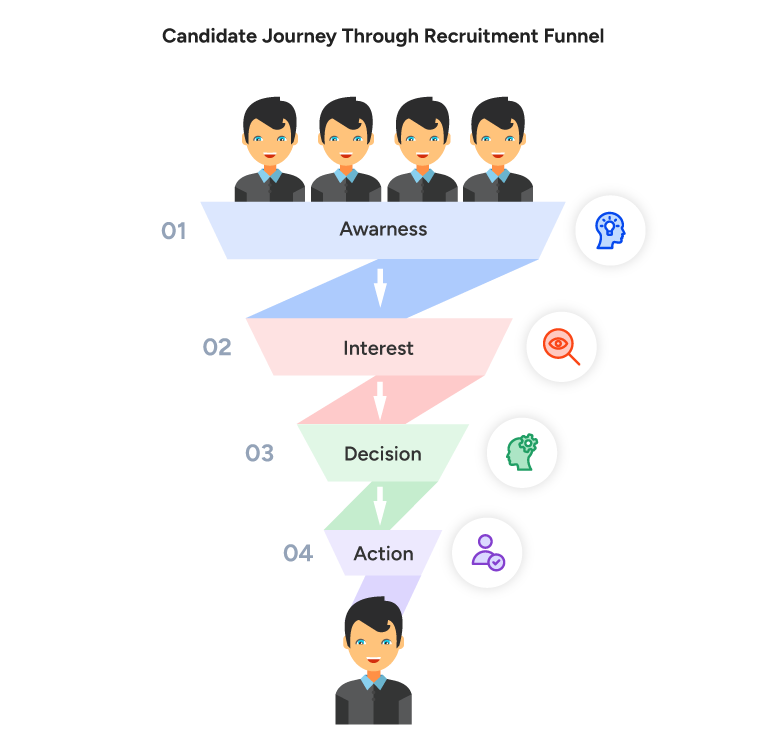
Awareness
At the top of the funnel, the goal is to make candidates aware of your employer brand and open roles by promoting your company culture and open roles across job boards, social media, and other online channels. This stage targets both active and passive candidates to expand reach.
Interest
Once awareness is established, deepen candidate engagement by sharing genuine content such as employee testimonials and company values that showcase a positive work environment and appeal to candidates’ aspirations.
Decision
In this phase, recruiters nurture candidate interest by providing relevant and detailed information about the job, benefits, growth opportunities, and the hiring process to help candidates make informed decisions.
Action
The final recruitment marketing stage prompts candidates to apply for a role through a simplified, user-friendly application process that minimizes friction and encourages completion.
This funnel systematizes the journey from brand exposure to application, aligning marketing tactics and candidate experience. This optimizes recruitment outcomes before candidates enter the typical funnel stages of screening, interviewing, and hiring.
Using a recruitment marketing funnel helps organizations attract more qualified candidates, improve the candidate experience, reduce time-to-hire, and strengthen their employer brand. It also provides data and insights to continuously optimize recruitment strategies.
What are the Recruitment Marketing Strategies that Work?
Optimize Your Career Page
The career page is often the first interaction candidates have with an employer brand, so it must be clear, engaging, and designed to convert visitors into applicants.
Tips for an Effective Career Page:
- Showcase your Employee Value Proposition (EVP) prominently: Clearly and simply communicate what sets your company apart.
- Incorporate compelling visuals: Use photos, short videos, and authentic team testimonials to portray your company culture vividly.
- Improve search and navigation: Enable candidates to easily filter job opportunities by location, department, or job type.
- Add social proof: Highlight awards, employee success stories, and ratings from review sites to build trust.
- Design for mobile-first: Since most candidates browse jobs on their phones, prioritize mobile usability.
Example:
A tech company, for instance, features a ‘Day in the Life’ video and an interactive office tour on its careers page, which boosts time on page and increases application completion.
Leverage Social Media
Social Media platforms offer practical ways to connect with both active and passive candidates.
Platform-Specific Strategies:
- LinkedIn: Share job openings, thought leadership content, employee spotlights, and behind-the-scenes glimpses. Use LinkedIn Recruiter and sponsored ads for targeted outreach.
- Instagram: Highlight company culture through reels, photos, team events, and behind-the-scenes employee spotlights, focusing on authenticity.
- TikTok: Use creative, short videos to showcase workplace humor, career tips, and advice, ideal for attracting Gen Z candidates.
- Facebook: Promote job vacancies and events, and engage with relevant industry groups or communities.
- X (Twitter): Participate in industry talks, share company updates, and accomplishments.
Create Engaging Content
Content marketing helps establish credibility and an emotional connection before candidates even apply.
- Blogs: Share stories about career growth, core values, employee experiences, and expert insights.
- Videos: Feature day-in-the-life stories, office tours, leadership messages, and highlights of projects.
- Webinars / Live Q&A: Host interactive sessions around interview advice, industry trends, or meet-the-team panels.
Use Data & Analytics
Using data in your recruitment marketing makes your efforts more effective and cost-efficient.
Key Metrics to Monitor:
- Source of Hire: Track which channels yield the best candidates.
- Candidate Engagement: Measure click-through rates, page dwell time, and video views.
- Conversion Rates: Monitor progress from job ad to application, interview, and hire.
- Cost per Applicant/hire: Optimize budget allocation.
- Pipeline Health: Analyze application volume and quality over time.
Improvement Tactics:
- A/B test job titles, descriptions, and ads.
- Allocate budget to top-performing channels.
- Use heatmaps to identify where candidates drop off on your career page.
- Refine messaging based on engagement analytics.
Build Talent Communities
Maintain contact with individuals before they apply. Ways to do this:
- Add a simple form to join your talent network.
- Send newsletters with job news and events.
- Host online meetups or workshops.
- Use tools to group candidates by skills or interests.
- Share content for different career stages.
Personalize Candidate Communication
Today’s hiring success depends on connecting with candidates in a human, timely, and personalized way.
- Email: Offer personalized career suggestions, application status updates, and candidate engagement messages.
- Chatbots: Provide immediate responses, guide candidates through the application process, and help schedule interviews.
- SMS/Text: Deliver quick reminders, event invites, and interview confirmations particularly useful for high-volume hiring.
Recruitment Marketing Tools
| Tool Type | How it helps | Examples |
|---|---|---|
| Applicant Tracking System (ATS) | Primarily manages the entire recruitment process from job posting to hire. Modern ATS tools also support career page creation, candidate communications, and talent pool management. | TrackerRMS, Bullhorn, iCIMS, Jobvite, Lever |
| Recruitment CRM Software | Helps recruiters build long-term relationships with candidates, track interactions, segment talent pools, and nurture candidates through personalized campaigns. | Recruit CRM, Beamery, SmartDreamers |
| Content Management System (CMS) | Supports creating, managing, and updating career content on company websites or career pages, ensuring consistent employer branding. | WordPress, Drupal, Joomla |
| Email Marketing | Helps targeted, automated email campaigns to candidates, like job alerts, newsletters, and follow-up sequences, improving engagement and application rates. | Mailchimp, HubSpot, SendinBlue |
| Career Site | Acts as the company’s recruitment hub, showcasing open roles, company culture, employee stories, and employer branding to attract candidates. | Custom-built sites, Careers pages on corporate websites |
| Job Boards | Increases visibility of job openings by posting roles to multiple platforms, helping reach both active and passive candidates. | Indeed, Monster, LinkedIn Jobs, ZipRecruiter |
| Employee Referral Tool | Streamlines referral programs by tracking referrals, automating communication, and rewarding employees for successful hires. | RolePoint, ZALP, Jobvite Employee Referral |
| AI-Powered Recruitment Platforms | Uses AI to improve candidate sourcing, screening, engagement, and personalized communication, helping recruiters to make data-driven decisions. | Eightfold.ai, HireVue, Pymetrics |
| Social Media Management Tools | Helps schedule and manage posts across multiple platforms, track engagement, and promote employer branding to reach a wider candidate audience. | Hootsuite, Buffer, Sprout Social |
Real-World Examples & Case Studies
Here are 3 real-world and case studies of successful recruitment marketing campaigns showcasing what companies did, the results they achieved, and the lessons learned:
Kruidvat: Apply with Your Bestie
Kruidvat targeted Gen Z talent, who made up over 75% of their workforce, by making the job application process social and fun. They created a campaign called “Apply with Your Bestie,” using duo-shirt visuals,
WhatsApp applications, and engaging TikTok content. The campaign was based on research into Gen Z values and behaviors, aligning the messaging and channels with candidate insights.
Results Achieved
Applications increased by 52%, duo applications rose by 83%, and the bounce rate dropped by 8.25%. The company moved from #10 to #3 in favorability among young workers. They received 1,684 applications and made 300 hires with balanced gender representation.
Lessons Learned
Thorough audience research and aligning communication channels and messages with target candidates’ preferences can significantly improve application rates and candidate engagement.
IKEA’s Career Instructions Campaign
IKEA Australia wanted to hire for new stores and targeted their existing shoppers. They created IKEA-style “career instructions” that were included inside flat-pack furniture boxes, so customers literally brought job opportunities into their homes.
Results Achieved
This clever approach generated 4,200 job applications and led to 280 hires.
Lessons Learned
Reaching potential candidates where they already spend time with creative, relevant messaging can significantly increase applicant engagement.
Ogilvy & Mather’s “World’s Greatest Salesman” Campaign
Ogilvy & Mather looked for top sales talent by requiring applicants to create a video selling a brick to the company before applying.
The campaign was promoted with a dramatic and memorable YouTube video.
Results Achieved
The campaign was highly memorable, attracting motivated sales candidates who were serious about the challenge.
Lessons Learned
Setting high entry barriers with creative challenges can attract highly skilled and motivated candidates, making the recruitment process more distinctive and compelling.
These examples demonstrate how innovation, in-depth audience insights, appropriate channel selection, and engaging content are key components of successful recruitment marketing.

Common Mistakes to Avoid
Common Mistakes to Avoid in Recruitment Marketing are:
- Ignoring Mobile Optimization: Failing to optimize recruitment content and applications for mobile devices limits reach and engagement, as many candidates use smartphones for job searches.
- Not Tracking Metrics:Without monitoring key recruitment metrics, organizations miss insights into which strategies are working or lagging, leading to inefficient resource use and missed opportunities to improve hiring.
- Overlooking Candidate Experience: Neglecting it during recruitment can damage the employer brand and reduce candidate engagement, leading to the loss of top talent.
- Using Inconsistent Employer Branding: A lack of consistency across channels confuses candidates and weakens trust, reducing overall recruitment effectiveness.
Future Trends in Recruitment Marketing
- AI and Automation: AI tools and automation help companies save time by screening resumes, matching candidates, and chatbot interactions, improving efficiency and reducing hiring time.
- Video Recruiting: Video interviews and job ads make hiring faster and more engaging, allowing companies to connect with candidates anywhere in the world.
- DEI (Diversity, Equity, & Inclusion) Initiatives: Recruiters are prioritizing inclusive messaging and unbiased hiring practices to reach diverse candidates and build a more inclusive workforce.
- Predictive Analytics: Using data-driven insights, predictive analytics helps forecast hiring requirements, identify top talent, and improve overall recruitment strategies.
Final Words
Recruitment marketing plays a vital role in attracting and retaining top talent in a competitive landscape. Through the use of personalized communication, a well-defined employer brand, and sustained interaction across digital platforms, organizations can cultivate meaningful relationships with active and passive talent.
These strategies boost visibility, create a long-term talent pipeline, and position companies to stand out and hire more effectively. A well-planned recruitment marketing approach not only fills roles efficiently but also strengthens the organization’s reputation as an employer of choice, driving long-term growth and success.
How does Recruitment Marketing Improve Candidate Quality?
By targeting the right audience with tailored messaging and strong employer branding.
Can Recruitment Marketing Engage Passive Candidates?
Yes, it nurtures relationships with passive candidates through ongoing communication.
Why is Employer Brand Storytelling Important?
It builds trust and emotional connection, increasing candidate interest.
How do You Measure Recruitment Marketing Success?
Track metrics like time-to-fill, cost-per-hire, and candidate engagement rates.
Table of Contents
The Payment of Bonus Act, 1965, also known as the Bonus Act, is an Indian law that mandates the payment of bonuses to employees. The Act applies to certain establishments that meet specific criteria. A company distributes bonuses to its employees based on profits and productivity. The Payment of Bonus Act provides for a minimum bonus of 8.33% and a maximum bonus of 20% of an employee’s salary. Additionally, employers are required to pay the bonus in cash within eight months of the closing of the accounting year. The government enforces the Bonus Act with the Payment of Bonus Rules 1975, and amends the act from time to time to keep up with the cost of living.
The Payment of Bonus Act Updates in November 2025
- The government issued a notification repealing the Payment of Bonus Act and replacing it with the new Code on Wages, effective from November 21, 2025.
- The Code on Wages, 2019, will replace the old wage and labour laws and consolidate them into four labour codes.
- The last major change before this was in 2015, when the government amended the Bonus Act and increased the bonus limit to ₹7,000.
What is the Payment of Bonus Act?
The Payment of Bonus Act, 1965, is one of India’s wage and labour laws that mandates minimum and maximum bonuses for employees. The act was enacted in 1965 and has since been amended to account for changes in cost-of-living factors. The Indian parliament passed the act to address the growing number of industrial disputes between employers and employees, thereby bringing uniformity to the bonus structure. The government operationalized the act by passing the Payment of Bonus Rules 1975.
The Payment of Bonus Rules, 1975
These rules were passed under section 38 of the Payment of Bonus Act 1965. There are mainly three important rules, namely –
- Rule 3: Authorizes the central labour commissioner and state labour commissioners to grant permissions for the change of accounting year.
- Rule 4: Makes it mandatory for employers to maintain registers related to computation, allocation, payroll deductions, and bonuses given to each employee.
- Rule 5: Makes it mandatory for employers to send the annual returns to the appointed inspector.
The Payment of Bonus Act Applicability
Sections 1 and 3 of The Payment of Bonus Act detail the applicability criteria, while Section 32 lists exemptions. First, we will see the sectors/establishments covered under sections 1 and 3. Then, we will list the exemption criteria provided under section 32 of the Bonus Act. This helps employers clearly understand who is eligible for bonus payouts and who is not.
Where does the Bonus Act Apply?
The bonus act in India applies to –
- Every factory and establishment with 20 or more employees.
- Any establishment that employs 10 or more employees may also need to pay a bonus if the government notifies it.
- Every department and branch of an establishment, whether located in the same place or a different place, is also covered under the Payment of Bonus Act.
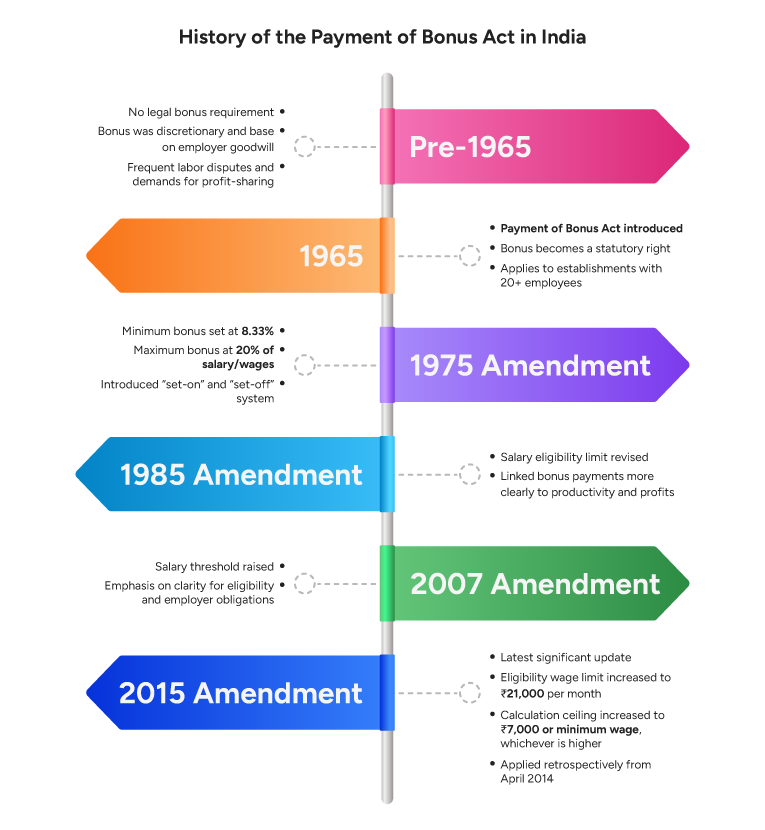
Which Institutions are Exempted under the Payment of Bonus Act?
The exempted institutions include:
- The Life Insurance Corporation of India,
- Other insurance agencies,
- Industries under the authority of the central/state government, or a local authority (municipalities and more),
- The Indian Red Cross Society and similar non-profit organizations,
- Educational institutions, including universities,
- Any state/central financial institution constituted under the Deposit Insurance Corporation Act, 1961, with a capital of more than one crore rupees,
- Employees employed in any public sector institution.
Who is Eligible, and Who is Exempt from Receiving Bonus under the Bonus Act in India?
Sections 8, 9, 12, 13, 17, 18, 19, 20, and 32 define the eligibility criteria in the Payment of Bonus Act:
- Section 8: An employee must have worked for at least 30 days in any establishment for the accounting year, and
- Section 3: All the employees of an establishment with more than 20 employees and of any department or branch of such an establishment.
Employees who are exempt from the bonus act include:
- Section 9: An employee is disqualified from receiving a bonus in that accounting year if they are engaged in theft, violent behaviour, misappropriation, or sabotage of property.
- Section 32: As mentioned, employees employed in certain institutions, such as non-profit, central/state financial institutions (other than banks), and public sector industries, are exempt.
- Seamen as defined in the Merchant Shipping Act, 1958.
| Bonus Act Timeline & Penalty Table | ||
|---|---|---|
| Requirement / Event | Timeline / Deadline | Penalty for Non-Compliance |
| Calculation of bonus for the financial year | After closing of accounts and determination of allocable surplus | Delay may trigger interest payments or legal claims |
| Mandatory payment of bonus | Within 8 months from the end of the accounting year (can be extended by government approval) | Fine up to ₹1,000 or 6 months’ imprisonment, or both |
| Filing annual bonus return if applicable | Within the prescribed period after bonus distribution | Fine for failure to maintain or produce records |
| Maintaining bonus-related records | Continuously throughout the year | Penalties for improper or missing documentation under the Act |
| Payment of minimum bonus | Even if company has no allocable surplus, subject to certain conditions | Legal liability for violation and possible employer prosecution |
| Payment of bonus to eligible employees | Employees who worked at least 30 working days | Employee can legally claim non-paid bonus through authorities |
| Recovery of unpaid bonus | Employee may apply to authorities within one year from due date | Company can be ordered to pay pending bonus + delay interest |
How to Calculate Bonus in India According to the Bonus Act?
Here is a step-by-step guide that can help you calculate bonuses in India. We will cover the calculation process and the set-on and set-off concept. Then, we conclude with a real-life example.
Calculation Steps
- Check whether the employee is eligible under the Act, meaning their monthly wages do not exceed ₹21,000 and they have worked at least 30 days in the accounting year.
- Determine the salary to be used for calculation, capped at ₹7,000 or the applicable minimum wage, whichever is higher.
- Calculate the annual salary by multiplying the monthly salary by twelve.
- Apply the minimum bonus rate of 8.33 percent on the annual salary calculation.
- Apply the maximum bonus rate of 20 percent only if the allocable surplus permits.
- Adjust the amount using the set-on or set-off provisions, if they apply, during that accounting year.
- Ensure the bonus is paid within eight months from the end of that financial year.
Set-On and Set-Off Bonus Calculation
- Set-on occurs when the allocable surplus is higher than the amount required to pay the maximum bonus for that year.
- The excess surplus is carried forward for up to four accounting years and can be used to support bonus payments in low-profit years.
- Set-off occurs when the allocable surplus is not sufficient to pay the statutory minimum bonus.
- This shortfall can be carried forward for up to four years and adjusted against future surpluses.
The bonus calculation, with a real-life example, is described below.
Scenario: An eligible employee earns ₹14,000 per month. The minimum wage applicable to the role is ₹12,500.
- Calculation salary = higher of ₹7,000 or ₹12,500 → ₹12,500.
- Annual calculation salary = ₹12,500 × 12 → ₹150,000.
- Minimum bonus = 8.33 percent of ₹150,000 → ₹12,495.
- If the employer declares a 10 percent bonus:
10 percent of ₹150,000 → ₹15,000. - If the employer declares a 20 percent bonus:
20 percent of ₹150,000 → ₹30,000.
Set-on example: If the surplus allows a 25 percent bonus, only 20 percent can be paid. The surplus, equal to the additional 5 percent, is set aside and carried forward.
Set-off example: If surplus supports only a 4 percent bonus, the employer still pays 8.33 percent. The deficit is set off and carried forward to future years.
Minimum Bonus and Maximum Bonus
The minimum bonus is the statutory floor (8.33% of an employee’s basic salary, or the prescribed minimum amount) and applies even when the surplus is limited. The maximum bonus is capped at 20% of an employee’s basic salary and is payable only when the allocable surplus is sufficient.
| Growth of Bonus Eligibility & Range Under the Bonus Act | ||
|---|---|---|
| Year | Eligibility Salary Limit | Bonus Range |
| 1965 | ₹750 | 8.33–20% |
| 1995 | ₹3,500 | 8.33–20% |
| 2007 | ₹10,000 | 8.33–20% |
| 2015 | ₹21,000 | 8.33–20% |
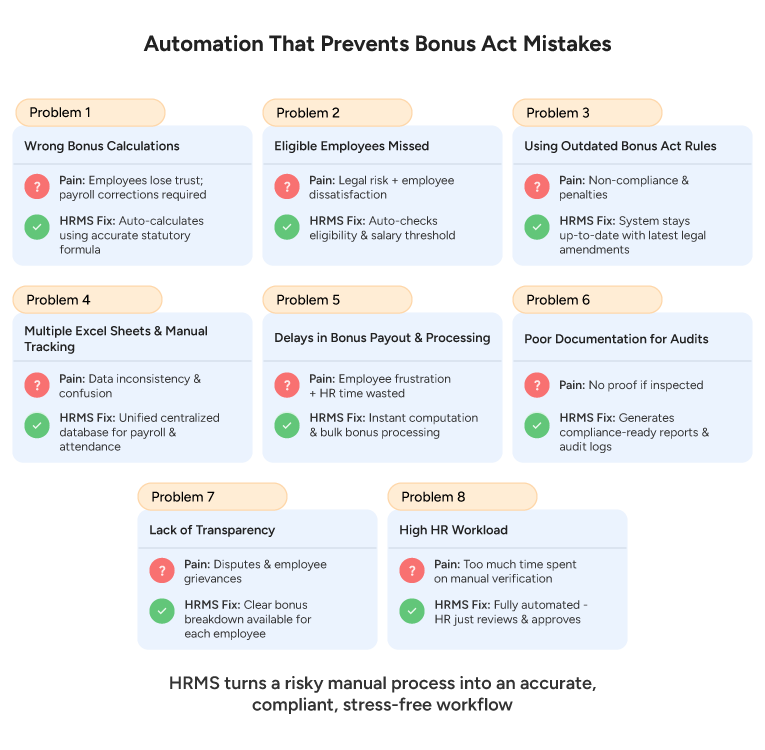
The Payment of Bonus Act: A Quick Recap
The Payment of Bonus Act is a statutory measure that ensures that employees receive sufficient bonus from the employer’s profits. The act defines applicability criteria, provides for the calculation of bonuses, lists exemptions, and sets out a set of provisions. The payment of bonus rules also specify the state/central labour commissioners as authorities that grant permissions for the start of any accounting year for any establishment. Lastly, in November 2025, the government issued a notification that merges the provisions of the Payment of Bonus Act with the Code on Wages, 2019.
FAQs
Does the Bonus Count as Part of CTC, or is It Separate?
The bonus of the Payment Act does not regulate the CTC structure, so employers may include a statutory bonus within CTC or keep it separate.
What are an Employer’s Responsibilities under the Bonus Act?
Employers must determine applicability, correctly compute eligibility and calculate wages, calculate available and allocable surplus, apply set-on/set-off where relevant, pay statutory bonus on time, and maintain prescribed records.
What is the Meaning of Allocable Surplus in the Bonus Act?
Allocable surplus is the portion of an establishment’s available surplus designated for bonus distribution after permitted deductions; it governs whether employers can pay above the statutory minimum bonus.
What Issues Commonly Arise for Employers when Calculating Bonus Eligibility?
Common problems include mixing up the eligibility ceiling versus calculation ceiling, using gross instead of permitted salary components, incorrect surplus computation or tax adjustments, and misapplying set-on/set-off carryforwards.
How Can HR Ensure Bonus Act Compliance?
HR can ensure Bonus Act compliance by:
- Maintaining proper employee records and wage data
- Calculating bonus accurately as per eligibility rules
- Paying bonuses within the statutory timeline
- Keeping updated with amendments to the Act
- Using reliable payroll tool to avoid calculation errors
- Documenting bonus payments for audit and legal verification
What Bonus Rights do Employees have?
Eligible employees have a statutory right to at least the minimum bonus and, where allocable surplus permits, to a proportionate bonus up to the statutory maximum bonus. They also have the right to timely payment and to challenge non-payment through the prescribed authority.
What Bonus Rights do Employers have?
Employers can disqualify an employee from receiving a bonus for misconduct, theft, misappropriation, and violent behaviour on the premises. They can also deduct bonuses if an employee has worked for less than 30 days.
What Offences Can Disqualify an Employee from Receiving the Bonus?
Specified misconduct, such as fraud, riotous or violent behavior connected with employment, theft, misappropriation, or deliberate damage to employer property, is grounds for disqualification for that accounting year.
Table of Contents
Key Takeaways
- A code of ethics is a set of principles that help employers and HR professionals to make fair decisions in any unwanted situations.
- The purpose of these principles is to build a strong work culture based on honesty, integrity, respect, and accountability.
- These principles set the rules that guide employee behavior, protect the workplace, and maintain stakeholder trust.
What is a Code of Ethics?
The meaning of code of ethics is a formal framework of ethical principles that guides employees, leaders, and stakeholders in making moral and responsible decisions.
An organization’s code of ethics establishes behavioral standards for issues like conflicts of interest, fraud, discrimination, or harassment so that everyone is operating in alignment with a consistent set of ethical expectations.
Some industries, such as finance or healthcare, have vital legal requirements that require adhesion to a set of rules. Many organizations voluntarily adopt such codes to demonstrate their commitment to rightful practices.
Purpose of Codes of Ethics
The sustainable development of an organization is the primary purpose of all ethical codes.
Below are some of the goals:
- It ensures compliance with laws and rules.
- Build and promote an ethical and predictable environment.
- Identify and address the need to enforce ethical values and guidelines.
- It offers clear rules and guidelines for internal and external stakeholders.
- It promotes trust among all the stakeholders by clarifying the organization’s ethical stance and intent.
Core 3 Principles of a Code of Ethics
Core values are the foundation of the organization’s central ideas, which serve as the basis for an ideal code of conduct.
While these rules may differ based on organizational standards, general principles of business ethics form the core of these rules.
Integrity
This is the basis of moral behavior. It means upholding ethical standards under challenging situations and operating honorably and consistently, irrespective of the scenario. Employees should make wise judgments, avoid conflicts of interest, and behave accordingly.
Respect
Respect is the basic principle of creating an inclusive and balanced work environment. This principle involves treating colleagues, customers, and other stakeholders professionally. Respectful conduct helps build genuine relationships and manage work conflicts.
Responsibility
Responsibility means accepting accountability for one’s deeds and choices. Employees become aware of their actions, choices, and their impacts.
Importance of Code of Ethics
A code of conduct is essential for any company because it sets the foundation for its culture, ensures legal compliance, and builds stakeholder trust. Below are the main reasons why every business should have one.
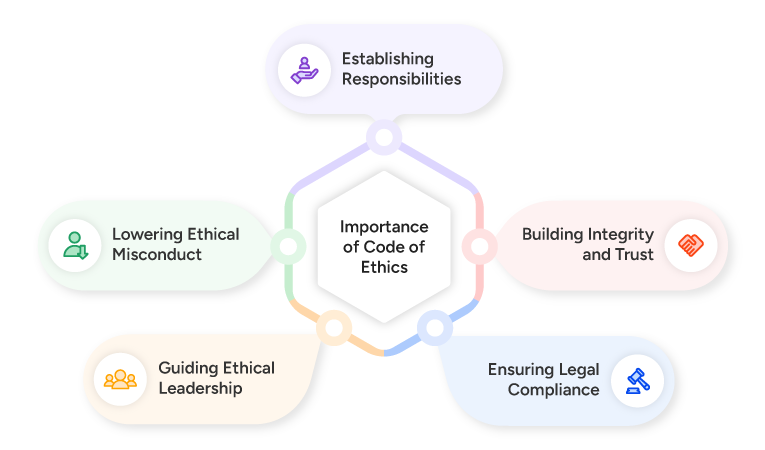
Establishing Responsibilities
It clarifies satisfactory operations and helps staff learn their roles. The establishment of legal norms ensures equality and provides a foundation for addressing moral responsibilities.
Building Integrity and Trust
Ethical conduct builds trust among the company and stakeholders, including the community, suppliers, investors, and consumers. Transparent organizations easily retain employee loyalty and partners.
Ensuring Legal Compliance
Organizations can adhere to applicable rules and regulations by having a clear code of conduct. In sectors like banking or healthcare, where laws are stringent, well-defined principles support legal compliance, helping companies avoid legal issues and maintain regulatory requirements.
Guiding Ethical Leadership
A code of conduct encourages leadership at all organizational levels. When leaders model proper conduct by upholding the code, subordinates understand their moral responsibilities and work responsibly to achieve their goals.
Lowering the Risk of Ethical Misconduct
Companies with an ideal ethical code are less vulnerable to problems related to fraud, corruption, or misconduct. In addition to protecting employees, the code helps address the hazards of inappropriate behavior.
Code of Ethics vs Code of Conduct
| Aspect | Code of Ethics | Code of Conduct |
|---|---|---|
| Purpose | Defines the organization’s moral principles and values to guide ethical decision-making. | Provides specific rules and expected behaviors employees must follow daily. |
| Scope | Broad, value-based, and focused on integrity, honesty, transparency, and accountability. | Narrower, action-oriented, detailing acceptable and unacceptable behavior. |
| Focus Areas | Addresses core components of ethics such as integrity, responsibility, respect, fairness, and confidentiality. | Covers policies like workplace behavior, mission and vision alignment, disciplinary actions, and employee rights. |
| Application | Helps employees handle ethical dilemmas and make responsible decisions. | Ensures consistent behavior and compliance with organizational rules. |
| Keyword Coverage | Explains ethical standards, values, and moral expectations. | It explains the meaning of a code of conduct and includes examples like anti-harassment rules, attendance guidelines, and reporting procedures. |
Types of Code of Ethics
Depending on the sector, the organization’s objectives, the law, and codes of conduct could take many shapes.
Compliance-Based
Most ethics codes under this category commonly emphasize adherence to the law and avoiding illegal activities. Compliance-based codes are usually created to spell out the exact conditions and steps to be taken by employees in their work.
Value-Based
This kind of code does not just limit itself to following the laws of the land, but highlights the organization’s core values. A value code based on ethical conduct often reflects the company’s honesty, integrity, respect, and fairness. The subjects can also include corporate social responsibility and environmental sustainability.
Profession-Specific
This code of conduct applies only to members of a particular profession, such as doctors and lawyers. Profession-specific regulations generally express professionals’ ethical obligations to their clients, colleagues, and the public.
Content-Focused Codes
Content-focused codes define the rules precisely. Thus, they give straightforward instructions that lead to ethical behavior among the organization’s members. These codes ensure the staff knows what is expected of them, resulting in a shared understanding of moral behavior.
How to Create a Code of Ethics for Your Organization
- Gather Information: Understand your company’s values and issues employees may face.
- Create the Draft: Write clear and simple ethical guidelines.
- Review the Draft: Get feedback from leaders and employees.
- Adopt the Code: Get formal approval from the management.
- Introduce the Code: Share it with all employees through training or meetings.
- Enforce the Code: Monitor behavior and take action when rules are broken.
Some Examples of a Code of Ethics
Below are examples of codes of ethics from world-renowned companies to help you better understand the topic.
- Encourages employees to act with honesty and transparency.
- Focuses on respect, fairness, and doing what is right.
- Applies the same standards to employees, vendors, and contractors.
Hershey
- Uses a Q&A style to help employees make ethical choices easily.
- Promotes honesty, respect, and following legal rules.
- Guides employees on how to handle confusion or ethical dilemmas.
Pepsico
- Provides clear guidelines on different aspects of work ethics.
- Supports diversity, inclusion, and respectful interactions.
- Encourages employees to speak up when they see unethical actions.
Starbucks
- Encourages employees to raise concerns without fear.
- Focuses on making ethical choices in difficult situations.
- Promotes community involvement and positive behavior.
Visa
- Teaches employees to act with accountability and respect.
- Encourages open communication and teamwork.
- Provides guidance for making decisions that match company values.
Conclusion of Code of Ethics
Every organization benefits from having clear ethical rules that promote honesty, responsibility, and trust. A strong code helps employees understand the right way to act, make better decisions, and avoid unethical behavior.
Companies can use a code of conduct policy template or follow basic guidelines for developing a code of ethics to create a policy that fits their values. Whether compliance-based or value-driven, an ethical framework helps businesses stay responsible, fair, and sustainable in the long run.
Frequently Asked Questions
What is Code of Conduct?
Code of conduct is a set of rules that explains how employees should behave at work. It includes acceptable and unacceptable actions to maintain a respectful and professional workplace.
What Happens if an Employee Violates the Code of Conduct?
In that case, the company may issue a warning, provide corrective training, or take disciplinary action such as suspension or termination, depending on the seriousness of the violation.
How Often Should a Code of Conduct be Reviewed and Updated?
A code of conduct should be reviewed at least once a year or whenever laws, company policies, or workplace practices change.
Are Employees Legally Required to Follow the Code of Conduct?
Yes, Employees must follow the code of conduct because it is an official company policy.
What are the Five Ethical Principles?
The industry is guided by five ethical principles: integrity, objectivity, professional competence, confidentiality, and professional behavior.
Which Methods Can HR Use to Assess the Impact of the Code of Ethics?
HR can evaluate how well their Code of Behavior works by conducting employee mood surveys, tracking adherence to ethical standards, reviewing incident reports concerning ethical breaches, and examining the general workplace culture.
How Can HR Implement the Code of Ethics across the Organization?
HR professionals can implement a code by organizing training sessions for employees about its significance and incorporating ethical considerations into the hiring process.
Table of Contents
Salary increments are usually determined as a percentage of an employee’s annual salary. Employees view them as a financial and career progression, and in India, it remains a core part of retention strategies.
This guide explains what a salary increment is, why it is essential, and how performance reviews, industry trends, and payroll budgets influence the final amount.
Key Takeaways
- A salary increment for employee groups is planned during scheduled reviews and aligns with internal pay structures, budget, performance, and market standards.
- Different types of increments help organizations reward achievement, career progression, and skill relevance.
- Competitive and well-timed increments support retention, strengthen engagement, and contribute to higher job satisfaction.
- Clear criteria and a structured process help reduce bias and maintain fairness during reviews.
- Linking salary increase to measurable goals strengthens accountability and supports business growth.
What is a Salary Increment?
A salary increment is a pay raise added to an employee’s basic salary as part of a scheduled salary revision. It is usually expressed as a percentage increase decided during the company’s salary review process, often linked to performance results, market benchmarks, and payroll budget approvals.
An increment is applied during the organization’s increment cycle, which may follow quarterly, half-yearly, or annual payroll revision timelines, depending on internal policies and business needs.
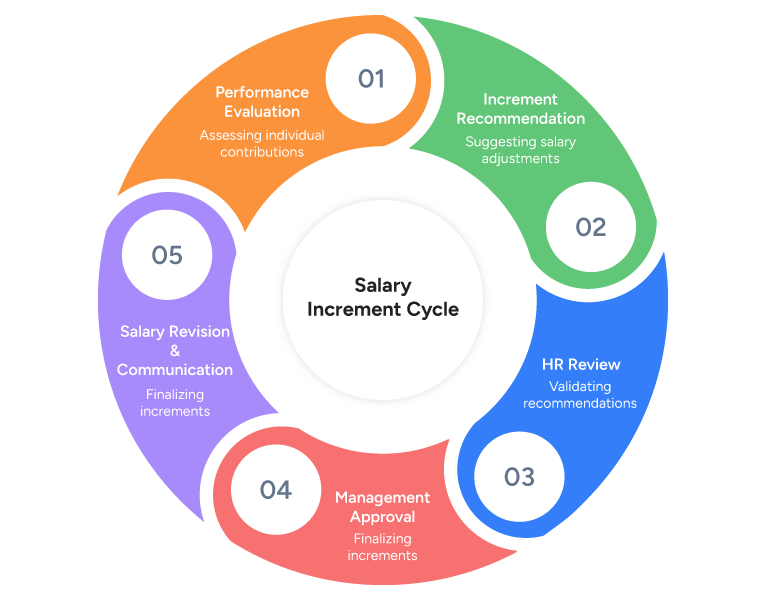
Types of Salary Increments
The framework for providing increments varies by an organization’s sector, size, financial position, and workplace culture. Understanding these variations helps employees understand the process and form realistic expectations.
Annual Increment
A routine pay raise is given once a year as part of the organization’s increment cycle and salary review process. It reflects standard growth and may be tied to company policies such as the annual payroll revision.
Performance-Based Increment
A raise given after reviewing an individual’s or a team’s performance. It is usually tied to performance management and may be awarded outside the regular cycle when employees deliver results that exceed expectations.
Promotion-Based Increment
A salary revision is granted when an employee moves into a higher role or assumes additional responsibilities. It is usually part of the organization’s career progression or promotion policy and is typically higher than standard annual increments.
Market Adjustment Increment
A raise is offered to align pay with industry benchmarks during a payroll revision, especially when the market rate changes due to talent shortages or new skill demands.
Retention Increment
A targeted increase is given to retain key employees who hold critical skills or contribute to essential projects. This increment is often decided during leadership or HR discussions on workforce stability.
Inflation/Cost-of-Living Increment
A raise that helps employees maintain their purchasing power as prices rise. Many companies add this component during the annual salary review process to stay competitive.
How to Calculate Salary Increment?
Here is how you can determine the calculated salary increment percentage by the following formula:
Salary Hike Percentage = New Salary − Current Salary / Current Salary × 100
Using Salary Increment Calculator:
A salary hike calculator is a digital tool that simplifies the calculation of the percentage increase in an employee’s compensation. It allows people or organizations to enter their current salary and the % increase to determine the final salary after the boost.
Factors that Determine Salary Increment
Salary revision decisions depend not only on individual performance but also on several internal and external factors.
Performance and Contributions
Employers value professional commitment, consistent effort, and the achievement of set goals. They review how well an employee met goals, delivered results, and added value to projects or teams. Exceptional performance leads to a higher increment during the revision cycle.
Experience and Qualifications
Higher educational qualifications, relevant certifications, and professional expertise enhance an employee’s skill set and productivity, often justifying a higher salary revision.
Skills and Competencies
Technical, behavioral, and job-specific skills influence the salary review process, especially when the skills are in high demand or critical to business needs.
Length of Service
An employee’s tenure reflects loyalty and stability. Companies value such employees with extended service and consistent performance, and they offer them favorable increments during payroll revision discussions.
Company Performance and Budget
Company decisions for increments depend on overall business health, revenue growth, and the approved payroll budget. Even strong performers may see limited increases if the organization is managing costs or restructuring.
Company and Team Performance
When a department or team meets targets, delivers key projects, or contributes to business growth, it supports the justification for an updated salary. Managers usually have more flexibility to offer higher increments in such scenarios.
Market Conditions and Industry Standards
Companies monitor industry benchmarks, competitor pay trends, and current hiring patterns. If the market shows upward salary movement, it often prompts salary revisions across multiple roles.
Inflation
The rising cost of living prompts organizations to offer increases that help employees maintain their real income. These are often applied in addition to performance-based increases to maintain compensation fairness.
Skill Scarcity
When specialized skills are scarce, companies may offer higher increments or targeted pay raises to attract or retain talent. This is common in tech, analytics, and emerging skill areas.
Salary Increment Percentage in India
The salary increment percentage in India for 2026 is expected to remain in the 8–10% range, though actual increases differ by industry and job level. Companies also review pay structures against market benchmarks and internal frameworks, such as the salary structure in India, to align pay with changing skill demands.
Budget planning plays a significant role in determining pay revisions. Organizations evaluate revenue forecasts and allocate payouts through a defined payroll budget, helping finance and HR teams maintain consistency across departments. Salary revision decisions also depend on the structure of statutory deductions and net pay calculations, which are reviewed during salary revisions using internal payroll deduction guidelines.
Regional differences also influence salary increments. Growth-focused metros such as Bengaluru, Hyderabad, Mumbai, and Delhi NCR usually offer higher hikes due to competitive talent markets, while tier-2 and tier-3 cities tend to follow more stable ranges.
Salary Increments in 2026
Private Sector (Projected Avg: 9%)
- Real Estate / Infrastructure: 10.9%
- NBFCs: 10.0%
- Retail: 9.6%
- Technology Consulting & Services (lowest): 6.8%
Central Government (8th Pay Commission)
- Expected salary hike: 20%–25%
- New fitment factor (estimated): ~1.96
- Likely effective from: Jan 1, 2026
- Final recommendations due: April 2027
Impact of Salary Increments on Employees
The role of HR in payroll management is crucial, as it ensures fairness and consistency across all employee groups. Salary increments reflect how an organization values its workforce. It supports employee decisions around financial planning, skills, and long-term stability.
Motivation and Job Satisfaction
A fair pay raise boosts morale and gives employees a sense of recognition. Timely increments strengthen satisfaction and make employees feel valued.
Performance and Productivity
When increments are tied to performance, employees tend to take greater ownership of their work. This leads to higher productivity and a stronger focus on delivering consistent results.
Financial Stability
A structured salary revision improves financial security and helps employees plan commitments such as EMIs, savings, and household expenses. These reviews also involve recalculating net pay, often verified using calculate-in-hand salary tools.
Retention and Loyalty
Clear increment cycles and fair compensation practices improve retention and build trust. Employees are less likely to explore alternatives when they receive predictable and transparent salary increments.
Engagement and Commitment
A meaningful salary increment percentage encourages deeper engagement with organizational goals. When employees are fairly compensated for their efforts and contributions, they show greater commitment.
Skill Development and Career Growth
Salary updates often motivate employees to upgrade their skills and prepare for future roles. Continuous learning supports long-term development and complements internal promotion pathways. Employees can use salary increment letter template to request future reviews, ensuring the process remains transparent and well-documented.
Workplace Culture
Equitable pay progression contributes to a positive work culture built on fairness and transparency. When compensation decisions are clear, teams experience higher trust and better collaboration.
Negative Impact
If a salary revision is lower than expected or perceived as unfair, it can reduce motivation and lead to frustration. This may also affect retention and overall morale, making transparent communication essential.
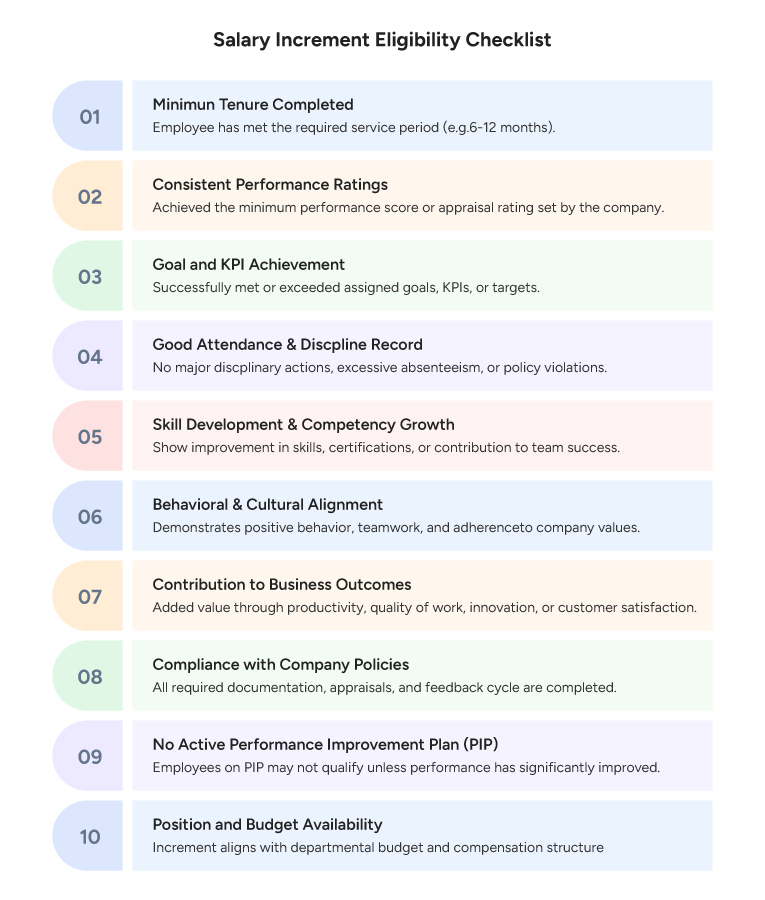
How do You Negotiate for Salary with an Employee?
Whenever an HR manager or employer considers salary increments, applying a smart salary negotiation strategy helps create a win-win outcome. Effective negotiation ensures both employer and employee feel satisfied with the increment. Here are a few key points employers should keep in mind when negotiating salary increases:
- Research thoroughly about the employee. Look at the performance analysis, target achievements, behavior, company certifications, and other relevant aspects.
- Check the market rates for similar jobs and see how these rates affect and help the change. You can also research increment rates online.
- Discuss with the seniors and finance managers the percentage of increase to be given to the employee.
- Finalize everything for the increment and inform the employee with a salary increment letter or formal email. This is because the process for notifying employees of their salary increments must be followed.
- If the employee needs additional hikes, discuss them with him in the meeting and set a hike rate that everyone agrees on.
Conclusion
Salary increments are not just annual procedures; they play a key role in strengthening motivation, stability, and long-term commitment. However, they work best when supported by fair policies and structured compensation practices that take performance, budgets, and market benchmarks into account.
Using factoHR’s payroll software for salary increments ensures smooth revisions, accurate calculations, and timely updates – enabling HR teams to manage increments with confidence.
Boost employee trust with transparent payroll & increment
FAQs
What is a Good Salary Increment Percentage for Employees in 2026?
The average compensation increase percentage for employees in 2026 is projected at around 8.9%, depending on performance, industry growth, inflation, and skill demand.
How do I Know if My Salary Increment is Fair Compared to Industry Standards?
Reviewing industry salary reports, checking regional benchmarks, and using salary increment calculators can help an employee assess if their pay progression aligns with market standards.
What is the Difference between a Salary Increment and a Salary Appraisal?
A salary appraisal evaluates an employee’s performance, skills, and contributions. A salary increment is the financial adjustment to the pay that results from this evaluation.
What Criteria do Companies Use to Decide Salary Increments?
Organizations consider several factors, including individual and team performance, relevant skills and experience, years of service, organizational budget, market competitiveness, and role responsibilities, while deciding salary increments.
Do Skills and Certifications Increase My Increment Percentage?
Yes. Specialized or in-demand skills and professional certifications improve productivity and market value, which often results in higher increments.
How Can Employees Request for Salary Increment?
During performance reviews or salary discussions, employees should prepare a summary of key achievements, gather market data, and submit a structured salary increment application to give their request greater weight.
What Should I do if My Salary Increment Request is Denied?
Denials may be due to budget constraints or market trends rather than personal shortcomings. Therefore, employees must seek constructive feedback, set goals for the next review cycle, and improve their performance.
What is the Typical Salary Increment Cycle in Companies?
Most organizations follow an annual cycle linked to performance reviews and budget planning. Adjustments usually occur during annual salary revisions, though promotions, market adjustments, or exceptional performance may result in increments outside the regular cycle.
What Communication Mistakes Often Occur in Salary Increment Meetings?
Common issues include unclear expectations, incomplete performance evidence, or focusing only on the raise rather than on outcomes. Employers may share limited feedback or skip explaining the salary review process, which can create confusion for employees.
How does Performance Evaluation Affect Salary Increments?
Salary increments depend on performance evaluations based on KPIs, KRAs, and yearly assessments. However, a performance appraisal does not always guarantee a salary increase.
Table of Contents
Top recruitment trends for 2026 in India focus on skill-based hiring, AI-driven screening, hybrid work models, employee advocacy, and internal mobility. AI enhances recruitment efficiency by speeding up resume screening and improving candidate matching.
Skills and diversity are prioritized, while data-driven hiring and emerging tech like blockchain shape future strategies. Organizations adapting these trends hire smarter and stay competitive.
Key Takeaways:
- AI accelerates resume screening, candidate matching, and interview scheduling, making hiring faster and more efficient.
- It helps manage large volumes of applications and supports language assessments critical for India’s diverse workforce.
- AI can assist with compliance checks and reduce manual workload while improving candidate-job fit.
- Limitations include challenges with non-standard resumes, cultural fit interpretation, and potential reproduction of biases.
- AI should be implemented as a decision-support tool, not the sole decision-maker, with thorough testing and monitoring for fairness.
- Popular tools fitting Indian recruitment include Lever, Greenhouse, and Freshteam, which offer automation while aligning with budget and hiring workflows.
What is Meant by the Term Recruitment Trends?
Recruitment trends refer to the evolving patterns and practices that shape how organizations attract, evaluate, and hire talent. These trends highlight the latest approaches and technologies changing recruitment, such as AI-powered hiring, skills-based recruitment over traditional degree-based hiring, increased focus on candidate experience, and the rise of remote and hybrid work models.
Recruitment trends also reflect the growing importance of diversity, equity, and inclusion (DEI), internal mobility, data-driven decisions, automation in screening and interviewing, and employer branding as key factors influencing hiring strategies in 2025.
Trend #1: Skill-Based Hiring
Why Degrees Failed in India
Employers in India have gradually realized that a degree does not guarantee workplace readiness. The rise in the number of colleges has led to a wide variation in teaching quality. Added to this, the variation between academic syllabi and actual industry needs is compelling companies to prioritize demonstrated skills over educational credentials.
India’s Data on this Shift
India is moving quickly toward skill-based hiring to bridge the growing talent gap. Swiggy, Unacademy, and PhonePe prioritize hands-on skills, portfolios, and real-world projects over degrees, indicating a substantial shift toward evaluating practical ability rather than academic credentials.
How Companies are Assessing Skills
Skill-based hiring is detailed and relies on reliable, realistic assessments. Assessments now mirror real job tasks to ensure a closer match between candidate strengths and role expectations. Organizations can assess skills using the following steps:
- Update role descriptions to highlight the skills needed for day-to-day work, making it easier to attract even non-traditional background candidates who can perform the tasks. You can also refer to structured job descriptions to standardize skill expectations.
- List the core abilities required for each role, for instance, technical skills, problem-solving ability, communication, or field-specific tasks.
- Many Indian companies use platforms like Codility, HackerRank, or Pymetrics to assess core skills rather than relying solely on resumes.
- Managers must be provided with clear guidance on reading assessment reports, evaluating skill demonstrations, and avoiding bias toward degrees or college names.
- Apply this method across different roles.
Trend #2: AI-Powered Recruitment
What AI Actually does
AI can help teams process applications 20–30% faster. It can screen resumes quickly, match candidates to job requirements, and manage interview scheduling. TCS uses AI to manage screening for its large-scale entry-level hiring, helping teams filter volumes of applications.
It also helps with language assessments, which matter in a country where applicants speak many regional languages. Some organizations also use AI for compliance checks, such as reviewing POSH or Bonus Act data records.
The Hidden Problem
These AI strengths come with limitations. AI still struggles with non-standard Indian CVs, cannot interpret cultural fit, and may overlook its own errors without human intervention. It can also reproduce historical hiring biases if trained on incomplete or skewed data.
This can worsen issues such as IIT preference, gender imbalance in tech roles, or regional bias. This means AI works best as a support system, not the primary decision-maker.
How to Implement AI
- Start with roles that receive large volumes of applications, as this is where screening automation has the most significant impact.
- Choose a tool (Lever, Greenhouse, Freshteam) that fits your hiring workflow and budget while offering reliable screening and scheduling features.
- Verify how the model was trained, what data it uses, and how it is monitored to avoid issues linked to gender, college, or region.
- Test the tool on a smaller sample first (around 50 candidates) to understand how it performs before rolling it out across all roles.
- Review the results to confirm whether the tool reduces workload and improves matching without creating unfair filtering.
Learn More About How Ai Impacts Hiring Here: AI and Machine Learning in Recruitment
Trend #3: Hybrid & Remote Work in India
Why Hybrid Works in India
Hybrid work offers clear advantages in the Indian context. Flipkart, NASSCOM, and many Indian startups . have embraced this working model for its flexibility and convenience For employees, the most significant relief is the commute. In cities like Delhi and Bangalore, people easily lose two hours or more every day in traffic, so working from home even part of the week significantly reduces stress and frees up personal time. It also opens opportunities for people living in smaller cities, as they do not have to relocate to metros to find better jobs.
Hybrid policies help reduce real estate and infrastructure costs for employers while improving access to talent from a broader range of locations. Many companies also report that productivity remains stable or even improves with such a balanced working approach.
India-Specific Challenges
Despite the advantages, hybrid work in India comes with its own set of hurdles. Internet reliability in tier-2 cities can still disrupt meetings and deadlines. Companies that work with global teams need to manage time zones more carefully when employees are scattered across locations. Remote employee monitoring software helps track productivity and attendance in flexible setups.
Some managers still struggle with trust and are concerned about visibility when people are not physically present. There is also a legal and ethical concern around remote workers being offered lower pay simply because they live outside major cities. In specific industries, clients continue to expect in-person meetings, which limits how far remote policies can go.
How to Structure a Hybrid Model in India
A practical hybrid model in India usually combines predictable office days with scope for flexibility. Many companies ask employees to come in midweek, typically Tuesday to Thursday, so teams can collaborate without requiring a whole week in the office.
Flexibility by role also works well. Engineering teams often function smoothly with fully remote arrangements. At the same time, sales roles still need regular client visits, and HR teams benefit from being available in person a few days a week.
Pay structures should match the model: commute allowances can apply on office days, and reimbursements can cover internet use on remote days. The primary concern is ensuring that pay does not vary unfairly by candidate’s city, as such cuts raise compliance concerns and create inequity.
Trend #4: Employee Advocacy & Employer Branding
Why this Works in India
Employee advocacy fits naturally into the Indian hiring landscape because people trust recommendations from peers far more than polished corporate communication. This links well with the strong referral culture inside most organizations, where internal recommendations already account for a significant proportion of hires.
As platforms like LinkedIn, YouTube, and Instagram continue to grow, employees have more space to talk about their work in a genuine, relatable way. Fresh graduates and early-career talent actively follow workplace stories online, giving employee voices more influence than traditional ads or job posts. Strong employer branding also plays a major role in attracting talent. Advocacy also helps lower recruitment costs by reducing reliance on expensive external channels through employee-led content and referrals.
Real examples of this trend are already visible across India. Accenture India runs structured advocacy efforts where employees frequently share their growth stories and project experiences, helping candidates see the culture from the inside. Microsoft India uses video-led storytelling to highlight internships, early-career paths, and team journeys, which draws strong engagement from students and new graduates.
How to Build Employee Advocacy
A strong advocacy program starts by helping employees feel comfortable sharing their experiences. Many hesitate because they are unsure of what to post, so that training sessions can make a significant difference. These sessions can show simple post formats, good examples, and basic dos and don’ts. Providing ready-to-use content also removes pressure, since you don’t want to create posts from scratch.
Incentives help participation grow. Cash rewards work well for hard-to-fill roles, while perks like an extra day off or public appreciation encourage ongoing involvement. Translating content into regional languages and providing easy-to-use talking points allows more people to participate, not just those confident in English.
Employer Branding in India
Reputation plays a significant role in hiring, and it is shaped by how companies communicate not only during milestones but also in challenging moments. Platforms like Glassdoor influence decisions quickly, so timely and honest responses matter.
The way layoffs are communicated has become especially important in the current startup environment. Clear, respectful messaging from leadership helps maintain trust, and Indian employees tend to value approachable leaders. When communication is unclear or delayed, it affects the brand for years and makes hiring harder.
Trend #5: Internal Mobility
Why this Matters in India
Internal mobility has become essential for Indian organizations, especially in tech and IT, where attrition often reaches 15–20 percent a year. Many professionals leave for better compensation, startup equity, or global tech roles, and replacing them is costly. Moving existing employees into open positions avoids much of that expense and helps preserve institutional knowledge that is hard to rebuild through external hiring.
India-Specific Barriers
Even with clear benefits, mobility can be hard to implement. Indian workplaces tend to be hierarchical, and employees often hesitate to switch teams due to fear of negative repercussions. Some managers also resist releasing strong performers.
Career paths are not always defined; therefore, employees do not know the expected progression from one level to the next. Teams also operate in silos, creating the impression that domains such as finance and technology are too different to move between, even when transferable skills exist.
How to Enable Internal Mobility
Companies can ease these barriers by creating structured opportunities for employees to explore new roles. Short project rotations help individuals understand different domains without committing to a complete transition immediately. Mentorship programs that pair senior members with junior employees from other teams can also give employees more confidence to switch functions.
Publishing internal roles before external hiring provides equal access to employees, primarily when the window is clearly defined. This works best when supported with an internal job posting policy. Skill-building programs support employees who want to move into roles in analytics, product, or engineering. A strong example is TCS, which built an internal career marketplace that lets employees view open roles, match skills, and plan long-term growth paths, making movement easier and more transparent across the organization.
Trend #6: Data-Driven Recruitment
India’s Recruitment Data Problem
A large share of Indian organizations still depend on intuition rather than evidence when making hiring decisions. Many teams manage the entire process in Excel rather than using an applicant tracking system, which means key information gets scattered or overlooked. As a result, companies do not consistently track key hiring metrics and are often unsure which metrics to prioritise. This lack of structure makes it challenging to identify delays, compare sourcing channels, or understand why specific roles take longer to close.
How to Start with Limited Data
The best approach for teams working with limited data is to start small and work consistently towards the goal. In the first month, pick only three core metrics (time-to-hire, cost-per-hire, and source effectiveness), and set a baseline using data from the past six to twelve months. A basic worksheet works well at this stage, and the focus should be on getting a clear view of current performance instead of gathering every detail at once.
In the second month, start tracking these metrics in real time. Even a basic ATS like Freshteam or Zoho CRM can help the team log candidates more systematically. Weekly updates keep the numbers accurate and help HR adopt a data-first approach.
By the third month, the focus shifts to patterns. Reviewing the funnel shows where candidates drop off, which hiring channels bring the strongest talent, and whether specific roles take longer than others. This stage is where insights start to emerge and decisions become easier to justify. HR analytics tools further improve recruitment decision-making.
Data-Driven Decisions in India
Once a consistent flow of data is available, companies can make more grounded recruitment decisions. Hiring patterns in India vary throughout the year, so if the peak season is February to March, planning should begin at least three months earlier. Channel performance also changes quickly; if LinkedIn becomes too costly, shifting to niche job boards or referral-heavy strategies can deliver better outcomes. Salary benchmarking is another area where data helps teams stay competitive without overspending.
Data analytics can help companies identify bias or prejudice in the hiring process. For example, if women consistently drop off at the phone-screen stage, it becomes a clear signal to review interviewer behaviour or screening criteria. Over time, this kind of analysis helps create a fairer and efficient hiring system.
Trend #7: Diversity, Equity & Inclusion (DEI)
India’s DEI Problem
The Indian workplace still has wide gaps in representation, especially in the tech sector, where men make up more than 90% of the workforce. Women also leave jobs at roughly twice the rate of men, which shows that hiring alone cannot fix the imbalance. Other forms of diversity, such as caste, religion, and regional background, are rarely discussed openly, even though they affect opportunities in subtle ways.
Class also plays a role, with many organizations unintentionally favouring urban candidates and English-speaking, which limits access for capable applicants from smaller towns. A diversity recruitment strategy helps organizations overcome such gaps.
How to Build Inclusive Recruiting
A more inclusive hiring process begins with job descriptions. Highlighting flexibility and work-life balance helps attract women and caregivers who might otherwise self-select out. Candidate sourcing can be improved by partnering with women-focused bootcamps such as She++ or Grace Hopper. It also helps to engage with community colleges and include state universities that are often overlooked.
The interview process plays an equally important role. Structured interviews, where every candidate receives the same set of questions, reduce bias, and a diverse interview panel ensures different perspectives. Offering remote options, longer breaks between interview rounds, and accessibility support helps candidates with varied needs. A quarterly check on representation and retention can help teams track and maintain their DEI goals.
Trend #8: Recruitment Technology & Tools
Hiring teams in India increasingly rely on an organized set of hiring tools that work together across different stages of recruitment to reduce manual work and speed up decision-making. Using a recruitment platform helps integrate these tools seamlessly. The essentials include an Applicant Tracking System(ATS), video interview platforms, and chatbots that handle routine queries. As companies scale, dashboards help track metrics and spot bottlenecks.
Most teams follow a gradual budget approach by starting with basic tools and adding features as hiring volume grows. The best systems for India also support salary slip uploads, statutory compliance, and multiple languages, which improve accuracy and the candidate experience.
ATS Options by Budget
The ATS in India spans from enterprise-grade systems such as Workday and SAP SuccessFactors to mid-market options such as Lever, Greenhouse, and SmartRecruiters. These offer deeper automation and analytics for growing teams. SMEs often choose Freshteam, Zoho, or Naukri Pro because they are affordable and easy to set up. India-focused features like bulk SMS communication and compliance automation matter a lot because they align with how Indian candidates apply and how HR teams operate.
Video Interviewing Tools
Companies often combine free live platforms such as Zoom or Google Meet with asynchronous tools like HireVue or VidCruiter. The async model is beneficial in India because many candidates from Tier-2 cities cannot take time off for weekday interviews. It offers more flexibility for both sides and speeds up early screening. Costs vary widely, but even smaller teams can adopt basic video solutions without straining their budgets.
Chatbots
Chatbots help manage the early stages of candidate communication by answering common questions, capturing basic qualifications, scheduling interviews, and sending updates. Tools like Drift and Intercom are widely used, and Indian teams often build multilingual versions to support Hindi and regional languages. This reduces manual follow-ups and gives candidates quicker responses, especially during high-volume hiring.
Trend #9: Emerging Trends
Several ideas are beginning to shape hiring practices in the coming years. Most of these innovations are being tested globally, with India expected to adopt them gradually.
Metaverse Recruiting
Some global companies are experimenting with virtual interviews, 3D office tours, and interactive hiring events inside metaverse environments. While the technology is still early, it could help candidates experience workplace culture without travelling.
Blockchain Credentials
Blockchain-based verification can confirm degrees and certificates instantly, which is helpful in India, where document validation delays are common. Universities issue credentials on the blockchain, and candidates share them with employers through secure links. Adoption is slow but growing, and it has strong potential because it reduces fraud and speeds up onboarding.
Micro-Credentials
Short professional courses are becoming a credible alternative to traditional degrees, especially for tech and operations roles. Many companies now hire candidates based on certifications from Google, AWS, or Coursera rather than insisting on a full-time degree. This shift is visible in India, with firms like TCS openly recognizing these certifications for entry-level positions. All these trends ultimately influence long-term talent acquisition strategy.
In Final Words
Recruitment in 2026 will be shaped by AI, skills, data, and employee-driven culture. Organizations that adapt early will hire better and retain stronger talent. By understanding these trends, HR teams can build a future-ready workforce and stay competitive.
What are the Top Recruitment Trends for 2026?
AI-powered hiring, skills-based recruitment, a focus on candidate experience, internal mobility, and more remote/flexible work options are key trends for 2026.
Why is Skill-Based Hiring Growing in India?
Skill-based hiring is rising because employers value practical abilities over degrees, helping them find better job-fit candidates as industries evolve.
How is AI Changing Recruitment?
AI speeds up resume screening, removes bias, improves candidate matching, and automates scheduling, making hiring faster and fairer.
What is Internal Mobility in Hiring?
Internal mobility means moving current employees to new roles within the company, which boosts retention and fills jobs faster.
What are the Biggest Challenges in Recruitment?
Finding qualified candidates, managing remote work, adapting to AI, and keeping up with changing regulations are top recruitment challenges.
Table of Contents
In India, understanding salary arrears is essential for both employers and employees. Employees must understand what arrears in salary are to verify their pay and plan their finances. At the same time, employers rely on accurate arrears of salary for regulatory compliance and accurate payroll management.
People are unclear about salary arrears meaning, so this guide explains payment in arrears, its causes, examples, tax rules, and steps to avoid disputes.
Key Takeaways
- Salary arrears represent pending payments owed from previous payroll cycles.
- They typically arise from salary hikes, payroll mistakes, or retroactive adjustments.
- Arrears are taxable in the year they’re paid, not when earned.
- Section 89(1) allows tax relief on arrears through Form 10E.
- HR must ensure accurate calculations and transparent communication with employees.
- Payroll automation tools help avoid errors and maintain compliance.
- Proper documentation and regular payroll audits reduce disputes and legal risks.
What is Salary Arrears?
Salary arrears are amounts that should have been paid to an employee but were delayed or missed in an earlier payroll cycle due to payroll delays, salary revisions, errors, or retrospective policy adjustments. These delayed payments can include basic arrears, allowances, bonuses, or other pending salary components.
What is Arrears in Salary Slip?
Salary arrears on payslips include payments for amounts an employee was entitled to receive in the past but did not receive on time for any reason. Late salary increments or payroll errors can delay the payment of salary arrears. When these arrears are paid, they are mentioned in an employee’s payslip for the month in which they are paid. The salary slip shows the net payment amount owed from previous payroll cycles. The payslip will include:
- A separate component is named “Salary arrears” or “August Increment Arrears”.
- This amount on the salary slip is the difference between what was paid previously and what should have been paid.
- For example, an employee is supposed to receive a salary of ₹75,000, but received only ₹70,000. The outstanding amount will be adjusted in next month’s salary, and the payslip will include arrears of ₹5,000.
What are the Scenarios for Salary Arrears?
Some instances might result in delays in compensating employees during payroll processing. These scenarios require HR professionals to process salary arrears promptly and address any resulting employee queries or disputes.
Salary Hike & Pay Commission Recommendations
Salary arrears arise when an employee’s salary increase is delayed. An employee’s payroll is revised, and the difference is identified for each month. The difference is paid in the next payroll cycle along with last month’s salary.
Back Pay for Unpaid Overtime/Vacation
Another scenario can be payment to an employee for overtime and vacation time. It involves calculating the salary for work that has already been performed, but the employee is not compensated according to labor laws.
Administrative Errors & Payroll Mistakes
Payroll errors can occur due to miscalculation and incorrect attendance data. These errors result in missed overtime or bonuses, as employees are underpaid.
Retrenchment & Full-And-Final Settlements
In cases of full and final settlement (FnF) and retrenchment, the employer is required to pay all outstanding dues to an employee. This includes any pending amount or reimbursements, up to the last working day of the employee.
Bankruptcy or Insolvency of Employer
If an employer is declared insolvent or bankrupt, salary arrears must be considered a preferential debt. Employees are paid before creditors, which includes unpaid wages and certain benefits.
How to Calculate Arrears of Salary
Accurately calculating arrear salary simplifies the payroll process and ensures fairness. Here is a step-by-step guide to calculate pay arrears:
Identify the Revised Salary
The first step is to record the new salary and the effective date of implementation. The revision may result from an increment, promotion, or updated company policy.
Calculate the Salary Difference
This step includes subtracting the old salary from the new salary and multiplying it by the number of months for which arrears of salary are due.
Salary Difference = New Salary − Old Salary
Arrears = Salary Difference × Number of Months
Include Allowances and Bonuses
If the revised salary includes adjustments to allowances, benefits, or bonuses, include them. If the HR or payroll teams overlook these components, it can cause an incorrect arrear amount in salary.
Double-Check the Total
Review the calculation carefully to avoid any disputes or conflicts. Verify salary differences, the number of months involved (arrear days, if applicable), and any extra payments.
Use Payroll Software
Lastly, manual calculations can take time and may have errors. An arrear salary calculator can simplify the process and ensure compliance.
Example of Arrear Salary Calculation
Mr. Z had a monthly salary of ₹30,000, which was revised to ₹36,500. This increment was effective from March, but the change was paid in June.
Monthly difference = ₹36,500 − ₹30,000 = ₹6,500
Arrear amount payable for March, April, May = ₹6,500 × 3 months = ₹19,500
This total of ₹19,500 will be added to the June payslip, along with the revised June salary. This demonstrates what is arrears in salary slip are and how arrears in salary calculation work in practice.
Payment in Advance vs Payment in Arrears
Here is a table showing the difference between payment in advance and payment in arrears.
| Aspect | Payment in advance | Payment in arrears |
|---|---|---|
| Timing of Payment | It is paid before the goods/services are delivered or the period begins. | It is paid after the goods/services have been delivered or the period ends. |
| Cash Flow Impact | The customer pays beforehand and provides immediate cash flow to the provider. | The provider receives payment after the service and may experience cash flow delays. |
| Risk & Trust | Requires trust since payment is before service. | This approach requires less trust as payment is made after the service is delivered. |
| Accounting | Recorded as prepaid | Recorded as an expense |
| Examples |
|
|
Tax Implications of Salary Arrears
Salary Arrears are Taxed
Salary arrears are taxable in the year they are paid, not the year they were actually earned. This can increase the total income shown in that financial year. As a result, the tax deducted at source (TDS) may also be higher.
Potential for Higher Tax
Many employees notice a sudden increase in tax deductions when arrears are processed. Since the arrears salary is added to the current year’s income, the overall taxable amount can increase. This may place the employee into a higher tax slab, leading to more tax deductions.
89 (1) Relief
Relief under Section 89(1) helps employees reduce the additional tax burden arising from delayed payments. It works by spreading the arrears amount over the years to which they actually belong. To claim this benefit, employees must submit Form 10E to their employer or the Income Tax Department.
How to Claim Tax Relief on Salary Arrears?
When a financial year includes salary or pension paid in arrears or advance, tax relief under Section 89 can be claimed. To claim this relief, Form 10E must be filed online.
Steps to File Mandatory Form 10E
Step 1: Log in to the Income Tax portal at www.incometax.gov.in using your User ID and password.
Step 2: Go to e-File > Income Tax Forms > File Income Tax Forms.
Step 3: Select the tab for Persons not having any business/professional income and choose Form 10E.
Step 4: Select the correct Assessment Year and click Continue.
Step 5: Click Let’s Get Started to begin filling the form.
Step 6: Choose the relevant sections based on your arrear details and click Continue.
Step 7: Open each link shown on the next screen and enter the required information for every section.
Step 8: After all details are filled, click Preview to review the form.
Step 9: Once everything is verified, proceed to e-verify and submit the form.
Step 10: After submission, a confirmation message will appear with the transaction ID and acknowledgement number.
HR and Employer Checklist for Handling Salary Arrears
- Establish Transparent Payroll Guidelines: Employers must set clear rules for salary revisions, bonuses, and reimbursement to avoid confusion or errors.
- Leverage HRMS/Payroll Automation for Accuracy: Use payroll software or an arrear salary calculator to calculate arrears correctly, reduce manual mistakes, and ensure compliance.
- Conduct Routine Payroll Compliance Audits: Schedule regular payroll audits to detect missing payments or discrepancies in salary, attendance, or bonus payments.
- Ensure Clear & Consistent Employee Communication: Inform employees about issues or delays with their pay. Transparent communication builds trust and keeps employees informed.
- Upskill Your Payroll and HR Personnel: Train your HR and payroll teams on payroll processes, arrears calculations, tax rules, and using payroll software.
- Track and Implement Latest Labor Law Updates: Stay updated with changes in wage laws, tax rules, and compliance standards to protect your business from penalties and legal action.
- Maintain Organized and Audit-Ready Documentation: Keep all salary revision records, applications for arrear salary, approvals, and payroll reports ready for audits.
Conclusion
Salary arrears ensure employees receive the pay they were rightfully owed, even if delayed due to payroll revisions or administrative errors. Understanding how arrears are calculated, taxed, and reflected in payslips helps both employers and employees maintain transparency and trust. With the right processes and ideally an automated payroll software, organizations can ensure accuracy, reduce disputes, and stay compliant with labour and tax regulations. Ultimately, proper arrear management supports fair compensation and a more efficient payroll ecosystem.
FAQs
What is Basic Salary Arrear?
A basic arrear is the portion of the salary difference resulting from a revision in the basic pay. Salary Arrears: Meaning, Calculation & Tax ImplicationsThis amount for previous months is paid along with the revised salary.
Are Arrears of Salary Taxable?
Yes, the arrears amount is considered part of an employee’s total income for the financial year in which it is received. Thus, salary arrears are subject to the same income tax rules as regular salary payments.
How are Arrear Payments Made?
Arrear payments are usually made in the next salary cycle once the delay is identified. They may be added to the monthly salary or issued as a separate payout, and are clearly labelled on the salary slip.
How Can HR Avoid Disputes Related to Arrear Payments?
HR can avoid disputes by:
- Maintaining clear payroll policies.
- Communicating changes and calculations to employees.
- Keeping accurate records of salary revisions and approvals.
How Long Can a Company Delay Salary Arrears?
The exact limit for clearing arrears amounts depends on company policy or an employment agreement; however, companies should pay arrears as soon as possible, as unnecessary delays can violate labor laws.
What are the Benefits of Salary Arrears?
Salary arrears ensure:
- Employees receive the correct pay.
- Previous payroll errors are corrected.
- Trust between employees and employers.
Is TDS Applicable to Arrears of Salary?
Yes, tax is deducted at source on arrears in the year they are paid. Employees can claim relief under Section 89(1) using Form 10E if needed.
Table of Contents
Working Hours Calculator
Enter the start and end times, then click Calculate to find out the total number of working hours.
Example of Working Hours Calculation
- Start Time = 09:00 AM
- End Time = 06:00 PM
- Break Time = 30 Minutes
- Number of Days = 3 Days
Working Hours = (End Time – Start Time – Break Time) * Number of Days;
= (06:00 PM – 09:00 AM – 30) * 3;
= (1080 – 540 – 30) * 3;
= 510 * 3;
= 1530 (In Minutes);
= 25 hours 30 minutes
A working hours calculator helps employers calculate staff work hours quickly, ensuring clarity and accuracy. It captures start times, end times, and breaks to easily display the total hours for every shift. Companies with rotating or flexible shifts use the tool to save time and reduce manual work. Employees also benefit because their working hours and overtime are recorded clearly without confusion.
What You’ll Learn in This Blog:
- What a working hours calculator is and why it matters for HR and employees.
- Step-by-step guidance on how to calculate total work hours, including breaks and overtime.
- The benefits of using working hours calculators accuracy, time-saving, compliance, and cost efficiency.
- An overview of the types of tools available, from online calculators to payroll software and mobile apps.
- Tips for manual hour calculation and converting time formats for payroll needs.
How does the Working Hours Calculator Work?
A working hours calculator follows a simple process to calculate work hours for each employee. It uses shift timings and break durations to display the exact number of hours worked each day.
1. Enter Shift Times
The process begins by entering the shift details into the calculator. Enter the start and the end time of the shift, as well as the date. These details are used for further calculations.
2. Account for Breaks
Breaks or lunch intervals are added separately to accurately reduce the total hours. Employees have to punch in and out every time they take a break. Lunch hours are automatically accounted for by the tool.
3. Calculate Total Hours
The calculator shows total working hours excluding breaks and lunch hours. It also highlights the extra hours employees work beyond the standard shift limit.
4. Show Final Results
The tool displays total payable hours, productive hours, and overtime in a clear format. These results help HR and employees maintain transparent and reliable time records.
Real-World Example
A shift from 9:00 AM to 6:00 PM totals nine working hours for the day. After subtracting a 30-minute break, the calculator shows the employee’s total working duration as 8.5 hours.
Why Use a Working Hours Calculator
A working hours calculator helps companies track time accurately and avoid costly payroll mistakes. However, the tool offers several additional advantages outlined below.
1. Accurate Payroll Processing
A working hour calculator helps HR teams eliminate manual errors and provides better oversight of monthly overtime and applicable deductions. Such accurate records help HR build stronger trust between employees and management.
2. Labor Law Compliance
The government labor laws and mandatory office hours can vary from one country to another. The calculator can ensure the working policies of the organization comply with all applicable labor regulations.
3. Fair Treatment and Transparency
When there is confusion about actual working hours, employees lose trust in the attendance process. Clear time reports show every employee’s actual work hours without confusion or guesswork.
How to Check Your Hours Manually?
Suppose you work a shift from 9:00 AM to 6:00 PM with a 30-minute lunch break.
- Start by noting your clock-in time: 9:00 AM
- Note your clock-out time: 6:00 PM
- Calculate total shift duration: 6:00 PM – 9:00 AM = 9 hours
- Subtract your break time: 9 hours – 0.5 hours (30 minutes) = 8.5 hours
If you worked any overtime, add that separately. For example, if you stayed until 6:30 PM, add 0.5 hours to get 9 total hours.
Manually doing this every day can be time-consuming and prone to mistakes, especially with variable shifts or multiple breaks. Using a working hours calculator automates these steps, ensuring accuracy and saving time.
Types of Working Hours Calculators
In today’s tech-driven world, there are various tools available for calculating working hours. Users can select a tool that suits their specific needs and preferences. Below are the different types of working-hour calculators.
- Online tools and calculators
- Mobile applications
- Desktop Applications
- Excel Templates
- Payroll Software Modules
- Employee Time Clock Systems
Online Tools and Calculators
You can find many online tools and calculators that can help you track employees’ working hours. Some of them not only offer online calculators but also cloud storage for saving the generated working hours reports. This allows users to access their data and reports from anywhere.
Mobile Applications
Mobile applications are more convenient for users. Users can manage their working hours through mobiles and tablets. They can input their login and logout timings and breaks, including lunch breaks. They can also track their shift hours report.
Desktop Applications
It is installed on the employee’s desktop and is mainly used for tracking working hours for remote professionals. It also provides features similar to those of online working hours calculators, almost the same as those in mobile applications.
Excel Templates
It is spreadsheet software that provides a simple way to calculate employees’ working hours. Many pre-designed templates are available, and users can use them to maintain their working hours report.
Payroll Software Modules
Track and manage employee working hours seamlessly with advanced payroll solution. It offers integrated calculators that not only help employers review employees’ shift timings and payroll details in one place but also generate comprehensive working hour reports alongside payroll summaries for streamlined workforce management.
Employee Time Clock Systems
Most companies use biometric tools for employees to record their working hours by punching in and out. The time clock system is also available on the desktop. With this system, the employer can track employees’ productivity, working hours, break times, and meeting hours.
Benefits of Using a Working Hours Calculator
A working hours calculator makes time tracking simple while reducing errors and saving valuable effort. It supports both employees and HR in reflecting on reliable work-hour reports.
1. Accuracy
The tool eliminates calculation errors and provides accurate hours, overtime, and deductions every time. This accuracy reduces payroll issues and creates stronger trust among employees.
2. Time-Saving
It minimizes manual work and helps HR complete payroll calculations much faster every month. Teams can invest their time in important tasks instead of repeatedly checking hours.
3. Cost Efficiency
The calculator reduces administrative workload and lowers the need for extra staffing resources. This improves overall efficiency and supports better financial management for the company.
Conclusion
A working hours calculator helps companies track employee time with accuracy and confidence every day. It records hours, breaks, and overtime clearly, giving HR and employees reliable data for payroll. The tool also supports legal compliance and reduces the overall manual effort required from teams.
Calculate your team’s working hours now using factoHR’s free working hours calculator for accurate and quick results. You can also explore factoHR’s timesheet software to manage attendance and payroll more efficiently.
What are the Maximum Working Hours?
The maximum average working hours permitted under the Working Time Directive is 48 hours per week for adults aged 18 and over.
How do You Calculate Working Hours for Part-Time Employees?
You can calculate part-time hours by adding the total hours they worked each day and summing them for the week or month.
How to Calculate Rest Breaks?
To calculate rest breaks, subtract the break duration from the total working hours for the day.
How to Convert HH: MM Time to Decimal Hours?
Convert the minutes to a decimal by dividing them by 60, then add that value to the hour part.
Can I Calculate Employee’s Working Hours Online?
Yes, you can calculate employee’s working hours online. Many websites and online tools are available nowadays to calculate the employee’s office hours. In addition, one can generate a report and save it in cloud storage. You have to input the required details and generate the results.
What is a Work Time Calculator Sheet?
The work time calculator sheet can be generated via Microsoft Excel or Google Sheets. These programs have many pre-prepared templates for this calculation. Users can use the sheets and input the essential details in the prescribed columns and rows, which in turn provides the result for them. Users can add comments to the sheets if they have to mention something in the table.
What is a Time Duration Calculator?
The time duration calculator is generally used to calculate the time between two points. It is usually fixed in every office or company as a biometric punching machine. Many desktop time duration calculators are also available to track elapsed time, working hours, meetings, and permissions sought by employees.
Table of Contents
Bonus Calculator
Bonus payouts in India are eagerly awaited but often difficult to calculate. HR teams must follow the mandatory compliance requirements under the Payment of Bonus Act, which slows the process and makes it prone to errors. A statutory bonus calculator solves this problem by delivering fast, accurate, and compliant bonus calculations.
It helps companies reduce manual work and avoid mistakes during the busy bonus season. In this guide, you will learn what a statutory bonus calculator is, how it works, and how your organization can use it to simplify bonus planning.
Key Takeaways
- Statutory bonus is mandatory for employees earning up to ₹21,000 per month under the Payment of Bonus Act, 1965, with rates between 8.33% and 20% of basic salary plus DA.
- Bonus calculators automate and simplify bonus calculations, ensuring accuracy, compliance, and timely payments while reducing HR workload.
- Different bonuses include statutory, performance, signing, retention, and festival bonuses, each serving specific organizational goals and industries.
- Accurate bonus calculation motivates employees, supports fair pay practices, and helps businesses plan finances effectively.
- Compliance with bonus laws avoids legal risks such as fines, disputes, and reputational damage while strengthening employee trust.
- Performance and profit-sharing bonuses offer flexibility for rewarding talent but must respect statutory minimum payouts.
What is a Bonus Calculator?
A bonus calculator helps employers figure out the right bonus for each worker based on inputs like salary, bonus percentage, and performance ratings. It provides clear outputs, including total bonus amounts and tax deductions, while ensuring compliance with laws. This tool saves HR time, enhances accuracy, and fosters employee trust through fair calculations.
Types of Bonuses
Let us take a look at different types of bonuses employers offer based on company policies or industry practices.
1. Statutory Bonus
It is a mandatory bonus under the Payment of Bonus Act, 1965. Employees earning less than or equal to ₹21,000 per month are eligible for this bonus. As per the rule, they will get a minimum of 8.33% and a maximum of 20% bonus on their salary.
2. Performance Bonus
This bonus is linked to sales targets, productivity metrics, or KPI results. It is common in IT, telecom, banking, and FMCG roles. In India, performance bonuses help companies reward high-performing staff and retain skilled talent in competitive sectors.
3. Signing Bonus
These upfront payments compensate new hires for accepting positions to attract top talent. They are often used in highly competitive labor markets or for critical skill sets, like IT, consulting, finance, and startup roles, especially when notice periods are long or when companies need niche skills.
4. Retention bonus
Retention bonuses help reduce employee turnover. In industries where people frequently change jobs, this type of bonus becomes essential. It is common in BPO, IT services, hospitality, and aviation industries.
5. Holiday or Festival Bonus
Festival bonuses are popular in India, especially during Diwali, Durga Puja, or regional festivals. These bonuses support cultural traditions and strengthen employee morale. They may be paid as a fixed amount or linked to salary and years of service.
| Bonus Type | Mandatory or Discretionary | Purpose | Common in |
|---|---|---|---|
| Statutory Bonus | Mandatory under the Payment of Bonus Act, 1965 | To reward eligible employees based on company profits | Manufacturing, retail, and service sectors where employees earn ₹21,000 or less |
| Performance Bonus | Discretionary | Reward high performance, targets, and KPIs | IT, telecom, banking, sales, and FMCG to boost productivity |
| Signing Bonus | Discretionary | Attract skilled new hires | IT, consulting, finance, and startups for niche or urgent roles |
| Retention Bonus | Discretionary | Prevent employee turnover | BPO, IT services, aviation, and hospitality to retain trained staff |
| Festival / Holiday Bonus | Discretionary (customary in many regions) | Celebrate cultural festivals and support staff morale | Diwali bonus, Durga Puja bonus, or regional festival bonuses based on local tradition |
Formula for Bonus Calculation
Bonus calculation in India depends on whether it is a statutory bonus or a performance-based bonus. Each follows a different method.
1. Standard Formula
There is a simple formula to calculate an employee’s bonus. The company calculates a bonus percentage out of the total salary of the employee as follows:
Formula: (Employee’s Salary * Bonus Percentage) / 100 + Additional Factors (if any)
Example
If an employee’s annual salary is ₹6,00,000, and the bonus percentage is 10%, he will get ₹60,000.
2. Statutory Bonus Formula (as per Indian Law)
Under the Payment of Bonus Act, the bonus must be calculated on the lower of:
- The employee’s basic salary and dearness allowance, or
- ₹7,000 per month, or
- The set minimum wage for the role.
The bonus rate ranges from 8.33% (minimum) to 20% (maximum).
Formula: Salary (or ₹7,000 limit) × Bonus %
Example
Employee monthly basic salary: ₹6,000
Bonus rate: 8.33%
Since the salary is below ₹7,000, use the salary amount.
= 6,000 × 8.33%
Statutory Bonus = ₹499.80 (₹500 approx.)
If the salary is ₹12,000, the formula uses the capped amount of ₹7,000:
= 7,000 × 8.33%
Statutory Bonus = ₹583.10 (₹583 approx.)
3. Performance Bonus Formula
Performance bonuses do not follow the statutory law. They depend on company policy, performance ratings, tenure, or sales targets.
Formula: (Employee Salary × Bonus %) / 100 + Additional Factors (if any)
Example
Employee annual salary: ₹6,00,000
Bonus percentage: 10%
No additional factors
= (6,00,000 × 10%)
Bonus = ₹60,000
Bonus Act and Legal Considerations
The Payment of Bonus Act, 1965, sets the legal framework for the payment of bonuses in India. It defines who is eligible, how bonus percentages are decided, and the minimum and maximum amounts employers must pay. The Act applies to employees earning up to ₹21,000 per month.
| Rule | Requirement |
|---|---|
| Eligibility | Employees earning up to ₹21,000 per month |
| Salary for calculation | Basic + DA, capped at ₹7,000 or minimum wage, whichever is higher |
| Minimum bonus | 8.33% of eligible salary |
| Maximum bonus | 20% of eligible salary |
| Payment deadline | Within 8 months of the end of the financial year |
| Applicability | Establishments with 20 or more employees |
Employee Rights under the Act
- Right to receive the statutory bonus if eligible.
- Right to know how the bonus was calculated.
- Right to receive payment within the legally defined timeline.
- Right to raise disputes if bonus rules are not followed.
Compliance and Risks
Following the Bonus Act, companies are protected from complaints, legal notices, and labour disputes. Labor laws like minimum wage and overtime rules can affect bonus payments. Thus, compliance with the provisions of the Bonus Act strengthens trust with employees and supports good workplace relations.
On the other hand, non-compliance can lead to:
- Fines
- Legal action
- Back-dated payments
- Damage to the company’s reputation
- Loss of employee confidence
Illustration of Different Scenarios on Bonus Structure
Bonus structures vary across Indian organizations. Let’s understand each type based on some real-life examples.
1. Performance-Based Bonus
Consider an employee earns ₹6,00,000 per year and receives a 15% bonus for an outstanding rating.
Bonus = ₹6,00,000 × 15% = ₹90,000
A standard rating of 10% would have resulted in a payment of ₹60,000.
Benefits:
- Rewards high performers
- Boosts employee motivation
However, the bonus can feel biased if performance reviews are unclear.
2. Tiered Bonus Structure
Let’s say a company follows a tiered bonus structure based on employee performance ratings as follows.
- Rating 5: 15% bonus
- Rating 4: 10% bonus
- Rating 3: 5% bonus
If an employee earns ₹5,00,000 with a rating of 4, he would be entitled to a ₹50,000 bonus.
Benefits:
- Clear and structured for employees
- Align employee goals with company objectives
The management should ensure that there are no sharp differences between tiers. Otherwise, it may demotivate borderline performers.
3. Cap and Floor System
In this method, a company can set a minimum (floor) and maximum (cap) bonus window.
Let’s say for a company, these values are ₹8,000 and ₹40,000, respectively.
If the bonus calculated for an employee as per the formula comes to ₹55,000, the company will give ₹40,000. If the bonus calculates to ₹5,500, the employee will receive ₹8,000.
Benefits:
- Organisations can control variable labour costs
- Companies gain flexibility in managing overall compensation budgets
This type of bonus structure is useful for Micro, Small, and Medium Enterprises (MSMEs) to manage tight budgets. However, high performers may feel limited by caps.
4. Profit-Sharing Bonus
In this method, the company sets a bonus pool based on yearly profits and distributes it among employees.
For instance, a company may set a bonus pool at ₹50,00,000. An individual’s bonus is a percentage of this total, based on their salary and performance. Let’s say it is 2% for an employee. That means, he is eligible for a bonus of ₹1,00,000.
Benefits:
- Links rewards to company goals
- Motivates employees for better productivity
However, for eligible employees, statutory minimums under the Bonus Act (8.33%–20%) still apply.
Quick Comparison Table
| Scenario Type | Example | Key Benefit | Limitation |
|---|---|---|---|
| Performance-Based | 15% of salary for top rating | Motivates talent | Depends on fair reviews |
| Tiered Structure | 5%, 10%, 15% | Clear criteria | Sharp jumps between tiers |
| Cap & Floor | ₹8,000–₹40,000 | Budget control | Limits high performers |
| Profit-Sharing | 2% of bonus pool | Aligns with profits | Drops in low-profit years |
Conclusion
Accurate bonus calculation is important for both HR and finance teams. A bonus calculator reduces manual work, avoids errors, and ensures fair payouts for employees. It also supports compliance with Indian labour laws when the right tool is used.
Use factoHR’s Bonus Calculator to make bonus calculations fast, accurate, and error-free. You can also explore other payroll tools, attendance systems, and compliance resources on our platform to further simplify your HR operations.
Who is Eligible for Bonus Salary Limit 21000?
Employees with a monthly basic salary plus DA up to Rs. 21,000 are eligible for statutory bonus. They must have worked for at least 30 days in the accounting year.
How Much Will My Bonus be Taxed?
Bonus income is treated as part of salary and taxed according to the employee’s applicable income tax slab rate.
What is the New Rule for Bonus?
Bonus rules related to the Payment of Bonus Act now increase the maximum wage for receiving a bonus to $21,000 per month.
What is a 3/2 Bonus?
A 3/2 bonus (or 3:2 bonus issue) is when a company issues three additional shares for every two shares owned by existing shareholders.
Table of Contents
HR interviews can be challenging, but with the proper preparation, they become manageable opportunities to showcase communication skills, personality, and cultural fit. Top HR Interview Questions and Answers helps you prepare for your next interview with practical, up-to-date examples. Whether you are a fresher or an experienced professional, being ready for commonly asked questions is crucial to securing your dream job.
This guide covers 20+ of the most common HR interview questions, including tailored answers for freshers and experienced professionals. Explore sections on behavioral questions, salary negotiations, and culture-fit topics to understand what employers expect today. Questions are organized by experience level and subject.
Before Your Interview: Key Takeaways
Be Yourself and Stay Honest
Genuine answers leave a more substantial impact than rehearsed ones, so let your personality and real motivation come through.
Research the Company and the Role Thoroughly
Understand the mission, current initiatives, and how your strengths fit their needs so you can communicate with confidence.
Practice Your Answers out Loud
Speaking your responses helps improve flow, timing, and comfort, especially with behavioral questions. Take your prep to the next level! Practice with our mock interview tool or download this Q&A as a PDF.
Top HR Icebreaker Questions (Asked in Almost Every Interview)
1. Tell Me about Yourself
Why They Ask
This is one of the most frequently asked questions in HR interviews for both freshers and experienced candidates. HR managers ask this to understand how well you present yourself.
How to Answer
Keep your response brief and relevant, highlighting your background, key skills, experiences, and why you’re a good fit for the role. The goal is to provide a clear, focused overview that sets the tone for the rest of the interview without shifting off-topic.
Sample Answer
Hello, my name is [Name]. I have a background in [field/education] with a [degree/qualification] from [Institution], where I developed skills in [key skills]. In my previous jobs and internships, I gained experience in [specific skills], contributing to team projects and delivering results. I’m particularly interested in this role as it aligns with my skills and offers the opportunity to grow and make a meaningful impact.
What to Avoid: Sharing irrelevant details, rambling, being too generic, or reciting your CV.
Pro Tip: Keep it brief, highlight strengths that match the role, speak naturally, and end with enthusiasm for the position.
2. What are Your Strengths and Weaknesses?
Why They Ask
This question provides an opportunity to showcase the qualities that make you a suitable candidate for the role.
How to Answer
Focus on strengths that align with the position responsibilities. When discussing weaknesses, show self-awareness and honesty by selecting an area that does not impact the key requirements of the position and explain how you are working to improve it.
Sample Answer
My strengths include being well-organized, adaptable, and systematic, which help me deliver high-quality results consistently. A weakness I’m working on is public speaking, as well as managing my time more efficiently and being less self-critical, so that I can stay focused and productive.
What to Avoid: Avoid vague clichés and irrelevant points; instead, state one key strength aligned with the job and one honest weakness that you are actively improving.
Pro Tip: Frame your strengths as unique value to the employer and your weaknesses as growth opportunities, with a brief example of how you’re addressing each.
3. Why do You Want to Work with Our Company?
Why They Ask
HR professionals want you to explain why you are interested in working with their company.
How to Answer
Discuss what attracts you to its culture, HR policies, job role alignment, and employee benefits such as incentives, bonuses, and vacation policies. You may also describe the specific aspects of the company that appeal to you personally.
Sample Answer
I am interested in working with your company because it aligns with my career goals and values, offering opportunities to grow while contributing to meaningful projects. Your innovative approach and strong reputation make it an ideal place to learn and make an impact.
What to Avoid: Avoid vague, overly generic answers or focusing solely on salary and personal gain; instead, show enthusiasm by connecting your goals with what makes the company unique.
Pro Tip: Research the company thoroughly and provide a concise, authentic response that clearly highlights how your skills and ambitions align specifically with the company’s mission and culture.
4. Why Should We Hire You?
Why They Ask
HR interviewers ask the question to assess how well a candidate fits the role, the company, and the team.
How to Answer
Discuss your skills, dedication, and positive attitude while working on a project, and how you make a valuable contribution to your team’s success.
Sample Answer
You should hire me because my skills and experience align perfectly with the role, and I bring a strong commitment to delivering quality results. I’m eager to contribute ideas, learn quickly, and help the team achieve its goals.
What to Avoid: Avoid vague, generic answers like “I’m a hard worker,” overpromising without evidence, sounding arrogant, or focusing only on what the job offers you.
Pro Tip: Tailor your answer specifically to the role, using concrete examples of your achievements and skills.
HR Interview Questions for Freshers

Preparing for an HR interview as a fresher can be both exciting and challenging. These questions help assess your personality, communication skills, and cultural fit within a company. Understanding what to expect can boost your confidence and help you make a strong impression during your interview.
1. Why are You Interested in this Job?
Give details of the skills and expertise that fulfill the job profile. Tell the interviewer about your interest in a particular field. Also, give reasons such as the timing policy, leave allocation, and anything else you like about the company.
Sample Answer
I am interested in this job because it best fits my skills and expertise. This position will enhance my skills and contribute to my professional growth. The company’s learning-oriented environment also provides valuable opportunities to acquire new knowledge and expertise.
2. How do You Stay Motivated when Learning Something New?
When answering this question, explain your process and how you set goals. Discuss the discipline required to be consistent and the system that you follow to keep on track. Talk about your innate curiosity that keeps you motivated to learn new things.
Sample Answer
I am always eager to learn new skills, as continual learning enhances my perspective on my career. Addressing the critical skills gaps for my position helps me build the competencies required for my role, which benefits my career progression.
3. What Skills have You Gained during Your Education that are Relevant to this Job?
Discuss the skills or technical expertise that you learned during your education. Also, talk about skills that suit your job and discuss projects or certifications that you earned during your education.
Sample Answer
I learned Photoshop and Canva during my education. I have earned professional certifications in [course name], which make these skills relevant to the graphic design job I applied for.
4. How do You Prioritize Tasks when You have Multiple Deadlines?
Describe your task management skills, particularly in handling multiple projects with strict deadlines while collaborating effectively within a team. My ability to prioritize tasks, allocate resources efficiently, and maintain clear communication ensures smooth workflow and timely project completion.
Sample Answer
I am used to managing multiple deadlines without compromising quality. I use ERP systems to allocate resources efficiently and centralize data for better coordination. I can handle multiple tasks at once, and my time management skills are excellent.
5. Can You Work under Pressure?
Here, you need to tell your strengths in working under pressure. You can provide some examples of projects you completed during your education.
Sample Answer
I acknowledge that working under pressure can be incredibly stressful, but in my experience, these situations help me stay level-headed and improve my overall input. To manage pressure, I break my tasks into attainable goals, which helps me focus better on the project as a whole.
6. How do You Handle Constructive Criticism from a Senior or Manager?
The motive behind this question is to determine your attitude towards feedback and how you accept it. Mention your listening skills, curiosity to learn, and eagerness to improve. To handle criticism professionally, you must show maturity, adaptability, and commitment to continuous learning.
Sample Answer
I am open-minded and always willing to work on my weaknesses to improve myself. Constructive criticism helps me improve my performance and broadens my learning opportunities.
7. Which of Your Strongest and Weakest Points Apply Most?
Sample Answer
My good people skills enable me to relate to a wide range of personalities. Project management and problem-solving are my strengths. My meticulous nature guarantees work of excellence. I occasionally hesitate to assign work. I’m getting better by believing in team capacity.
8. Where in Five Years do You Envision Yourself?
Sample Answer
I aim to become knowledgeable in my role and take on additional responsibilities. I picture myself supervising group initiatives and supporting organizational development.
Fresher Power Moves
“Highlight your academic or personal projects by focusing on what you built, the tools you used, and what you learned. Present theoretical knowledge as a strength by showing how it sharpens your problem-solving and adaptability. Address the “no experience” gap confidently by focusing on internships, coursework, or personal initiatives that show drive, learning ability, and readiness to take on challenges”.
HR Interview Questions and Answers for Experienced Candidates

1. Why did You Leave Your Last Job?
Always avoid blaming an employer or a colleague for your departure from a previous job. You do not need to talk about poor salaries or management. Just discuss the areas of improvement that affect your current job position.
Sample Answer
In my previous role, I had the opportunity to improve my communication skills, but moving forward, I want to focus on refining my leadership and delegation skills. I am on excellent terms with my colleagues and employers, but I have reached a point where there are no more opportunities for me, and I want to expand my horizons.
2. What Challenges have You Faced in Your Last Job, and how did You Solve Them?
Be mindful of your job role when picking a challenge to discuss. Ensure you explain your problem-solving process step by step while remaining completely honest. Avoid exaggerating and always present the problems in a positive light.
Sample Answer
One of the challenges I faced was managing multiple tasks with tight deadlines. To overcome this, I prioritized tasks by urgency and strategically allocated resources to optimize efficiency and effectiveness. I also created a detailed plan and effectively communicated with team members to ensure everyone remained on track. I received recognition for successfully overcoming this challenge.
3. Can You Share an Example of a Strategic Decision You Made that had a Significant Impact on Your Team or Organization?
When discussing a strategic decision, focus on how your planning and analysis addressed a challenge, improved efficiency, or added value to the team or organization. Be sure to highlight your leadership, problem-solving skills, and the measurable positive outcome.
Sample Answer
In my previous role, I identified a gap in our project timeline management, which often caused delays. I introduced a new project tracking tool and revised our workflow to improve coordination. This decision increased project efficiency by 25% and improved team communication, leading to consistently timely deliveries.
4. Describe a Situation where You had to Manage Pressure during a Major Organizational Change. What did You do?
Focus on staying calm, prioritizing tasks, and supporting your team as you adapt to new processes. Emphasize problem-solving, flexibility, and maintaining productivity under pressure.
Sample Answer
During a company-wide restructuring, my team faced tight deadlines and shifting responsibilities. I prioritized tasks, communicated clearly with my team, and adjusted workflows to meet new expectations. This approach helped us stay on track, maintain quality, and support each other through the transition.
5. How do You Ensure Continuous Improvement and Efficiency within Your Team or Department?
Focus on showing that you promote growth, innovation, and productivity by encouraging feedback, learning, and data-driven decisions. Highlight teamwork, adaptability, and measurable progress.
Sample Answer
In my previous role, I regularly reviewed team workflows and encouraged open feedback to identify areas for improvement. By implementing small process changes and tracking performance, we increased efficiency and reduced errors. Moving forward, I want to continue fostering a culture of continuous learning and innovation within the team.
6. Describe Your Ideal Work Environment.
This question asks whether your preferences align with the company’s work environment. It will identify whether your vision aligns with the company’s values. You can consider company culture and a positive work environment ideal.
Sample Answer
My ideal work environment encourages collaboration, creativity, and a well-organized atmosphere. I appreciate creative freedom, but I also understand the importance of teamwork. I want to work in an adaptive environment that motivates me to work in the company.
7. How do You Stay Updated in Your Field?
The interviewer wants to know your learning style and how you stay up to date with trends in your field. You can share how you choose to stay updated.
Sample Answer
I prioritize ongoing learning through online courses, workshops, social media channels, and reading. I am always happy to gain knowledge that will help me grow professionally. Staying up to date with the latest trends in my field will help me meet my objectives and benefit the company.
8. Do You Prefer Working Independently or in a Team?
This question identifies whether you are an introvert or an extrovert. It specifies how well you collaborate with team members and how you can adapt to a new work environment. You need to give an answer that highlights your strengths and shows why you are a perfect fit for the organization.
Sample Answer
I appreciate both working independently and as part of a team. Working independently helps me focus on tasks and produce high-quality results. When working with a team, I focus on bringing diverse perspectives together to generate ideas outside the box, which helps achieve goals efficiently.
9. How do You Implement New Technologies in Your Current Role?
Sample Answer
I research innovations, develop implementation plans, and effectively train team members.
10. What is Your Approach to Performance Management?
Sample Answer
I develop clear metrics, provide regular feedback, and ensure fair evaluations.
HR Interview Preparation Timeline
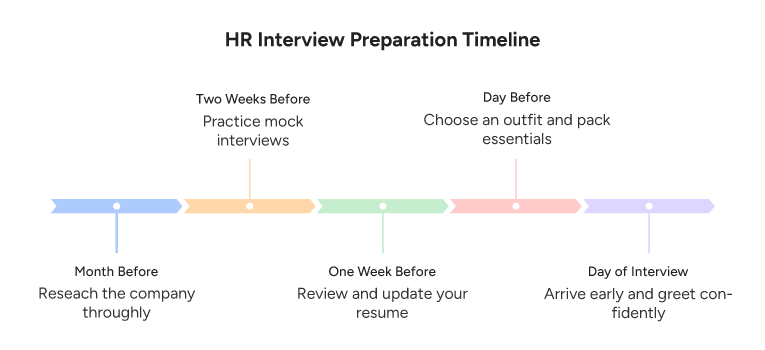
Preparing for an interview can feel daunting, but staying organized and confident makes all the difference. To help you prepare effectively, it’s important to follow a clear timeline, from understanding common questions beforehand to managing your final preparations on the interview day.
Month before
- Research the company thoroughly. Write down its mission, culture, key products, and recent milestones.
- Analyze the job description line by line and highlight the skills and responsibilities you can match from your own experience.
- Create a list of examples from your work or academic background that demonstrate these required skills.
Two Weeks before
- Practice mock interviews and record your sessions to observe your tone and body language.
- Prepare clear, concise answers using the STAR method (Situation, Task, Action, Result) for common HR questions.
- Study typical behavioral questions and refine your responses to reflect teamwork, leadership, and problem-solving abilities.
One Week before
- Review and update your resume to accurately reflect your recent work and achievements.
- Read the company’s latest news releases, HR initiatives, and social media updates to identify fresh talking points.
- Prepare 2–3 thoughtful questions to ask the interviewer about the role or the company culture.
Day before
- Choose an outfit that aligns with the company’s dress code, try it on, and ensure it’s clean and comfortable.
- Pack essentials, including printed resumes, ID, a notepad, a pen, and any requested documents.
- Check the interview location, map your route, and plan your travel time to ensure you arrive on time.
Day of Interview
- Arrive at the location at least 15 minutes early to settle in and review key notes.
- Turn your phone to silent and keep it out of sight during the interview.
- Greet the interviewer with a confident smile, maintain eye contact, and listen actively before responding.
Red Flags to AVOID: What NOT to Say in Your HR Interview
1. Frequent Job Changes
What to Avoid: Don’t say things like “I left because I got bored” or “The pay wasn’t good enough.” These statements make you seem unreliable or only motivated by money.
How to Address It Positively: Explain your career moves as part of your growth journey. You can say, “I was seeking opportunities to learn new skills and take on greater challenges,” or “I found roles that aligned better with my long-term career goals.” This shows maturity and purpose in your decisions.
2. Lack of Enthusiasm
What to Avoid: Avoid appearing uninterested or saying, “I haven’t read much about the company.” This signals to the interviewer that you may not care about the role.
How to Address It Positively: Show genuine excitement. Research the company’s values, products, or recent achievements, and mention what inspired you to apply.
3. Negative Attitude about Previous Employer
What to Avoid: Never criticize your previous manager or team. It comes across as unprofessional and may raise concerns about how you handle workplace conflicts.
How to Address It Positively: Stay professional and focus on what you gained from the experience. You might say, “That role taught me valuable lessons about teamwork and adaptability, and I’m ready to apply those skills in a new environment.”
You Might Like To Explore:
FAQs
How Many Types of HR Round Interviews are there?
There are several types of HR Round interviews that candidates may encounter during the hiring process. These typically include:
- Phone Screening
- General HR Interviews
- Panel Interviews
- Face-to-face Interviews
- Walk-in Interviews
What Questions do They Ask in an HR Round Interview?
HR interviews are not about your technical skills. They are to identify whether a candidate is suitable for the company. It includes general information, job and company-related questions, skills and experience, behavioral questions, and career goals.
What is the HR Round for Freshers?
The HR round is designed to assess a candidate’s soft skills, attitude, and personality. For freshers, this round primarily evaluates how well they fit the role and align with the company’s goals. It is important to be honest, confident, and positive throughout the HR interaction. To prepare effectively, freshers can refer to Common Interview Questions And Answers For Freshers, which cover common queries and provide sample responses to help build confidence and readiness for the interview process.
How Can I Pass the HR Interview?
- Read the job description.
- Review your resume.
- Visit the company website.
- Collect proper information.
- Take certifications with you.
- Wear professional attire.
What Questions do HR Ask about Salary in Interviews?
- What salary do you expect?
- Do you have another job offer?
- Are you applying to other jobs?
- Do you have a good work ethic?
What if I Don’t Know the Answer to a Question in the HR Round?
If you don’t know the answer, stay calm and be honest, acknowledge it instead of guessing. Show a learning mindset by explaining how you would find the answer or how quickly you are willing to learn.
What Should I Ask HR at the End of the Interview?
At the end of the interview, ask thoughtful questions about the company culture, team structure, or growth opportunities. You can also inquire about the next steps in the hiring process to show your interest.
Can I Negotiate Salary in the HR Round?
Yes, you can discuss salary expectations during the HR round, but do so professionally and back up your request with market research. Focus on your skills and value while expressing flexibility and interest in the role.
How do I Follow up after the HR Interview?
Send a polite thank-you email within 24 hours, expressing appreciation for the opportunity and reiterating your interest in the role. If you haven’t heard back within a week, send a brief follow-up to inquire about the next steps.
How Long is a Typical HR Interview?
A typical HR interview lasts about 20 to 45 minutes, depending on the role and company. It may take longer if multiple topics or assessments are covered.
What are HR Round Interview Questions on Work Ethic & Professionalism?
- How do you prioritize your work when handling multiple tasks?
- What does it mean to have a good balance between work and personal life?
- How do you ensure that you meet deadlines?
- How do you keep yourself motivated at work?
- Specific questions about the company and your job role.
What if the HR Interviewer Asks about Other Job Offers?
You can mention that you are exploring options, but emphasize your strong interest in this role and how it aligns with your career goals. Stay honest and confident without sharing unnecessary details.
Table of Contents
The interview is a crucial step for freshers transitioning from academia to a professional career, offering the first chance to demonstrate potential. Adequate preparation is key, significantly boosting your confidence and removing the fear associated with the process.
To help you succeed, this guide will provide the top 20 common interview questions and answers for freshers.
This article focuses on the most frequently asked interview questions and provides a clear structure for answering them effectively. It also covers additional frequently asked interview questions to ensure candidates are fully prepared for their entry-level role.
Interview Tips for Freshers
- Before appearing for an interview, freshers should prepare for some commonly asked interview questions.
- Frequently asked interview questions include questions on your graduation, interests, hobbies, and skills.
- Interviewers often also test your behavioural attributes and cultural traits to know whether your profile aligns with the role.
- Preparing for such questions can help boost your confidence and improve your chances of being hired.
- Freshers should avoid common mistakes such as giving vague answers, not researching the company, and appearing overly confident or underconfident.
- Tips for preparing for an interview include practicing common interview questions and preparing a list of questions to ask at the end.
- HR selects candidates based on factors like skills, cultural fit, personality traits, and other behavioural attributes.
- Candidates should wait a week or 10 days before requesting a follow-up to their interview. Following up with a formal email is advisable.
1. Tell Me about Yourself
Why They Ask: Interviewers ask this to understand your background, communication style, and how well you match the role.
How to Answer: Keep it structured and start with your education, then skills, then a short achievement, and end with what you want to contribute.
Sample Answer
I recently completed my Bachelor of Commerce from Delhi University, where I developed strong analytical and communication skills. During my final year, I led a financial planning project that enhanced my problem-solving and teamwork skills. I am now seeking an opportunity to contribute to meaningful work and grow professionally.
2. What are Your Strengths?
Why They Ask: This is one of the common interview questions that focuses on understanding your abilities and how well they fit the role.
How to Answer: Pick strengths relevant to the job and support each with a small example.
Sample Answer
One of my key strengths is my ability to learn quickly. During college, I joined an inter-college exhibition team at short notice. I understood the model quickly and presented confidently, which helped the team deliver well.
3. What are Your Weaknesses?
Why They Ask: Interviewers want to see how self-aware you are and whether you take initiative to improve.
How to Answer: Choose a real weakness that does not affect core job requirements and explain what you are doing to improve it.
Sample Answer
I realized I needed to get more comfortable with new software updates used in my field. To improve, I have been learning the latest version through online training and hands-on experience.
4. What are Your Hobbies?
Why They Ask: They seek to understand your character and how you manage responsibilities with your personal pursuits.
How to Answer: Share hobbies that reflect discipline, creativity, or balance.
Sample Answer
I follow a regular workout routine because it keeps me energized and helps me stay focused.
5. Why do You Want this Job?
Why They Ask: They aim to know whether your objectives align with the role’s requirements.
How to Answer: Mention what you like about the role, what you can bring, and why the company appeals to you. Including specific goals from the company’s vision and cultural traits is also an important factor.
Sample Answer
This role matches the skills I developed through my projects and internships. I thrive in environments where learning is continuous, and this company’s focus on growth makes it a great place to begin my career.
6. What do You Know about Our Company?
Why They Ask: They want to confirm whether you researched the company and evaluated the role.
How to Answer: Mention specific details such as services, key achievements, or culture highlights.
Sample Answer
I learned that your organization is a leading HR tech brand with a strong client base across industries. I also noticed that your HR software is widely adopted for improving recruitment efficiency. Your expansion plans for global markets reflect my long-term vision. I would love to know more about upcoming projects.
7. Why are You Interested in this Position?
Why They Ask: They want to know whether your interests and hobbies align with the role.
How to Answer: Relate your skills, interests, and what excites you about the position.
Sample Answer
This position aligns with my skills in communication and analysis. I enjoy tasks that require attention to detail, which makes this role a strong fit. I am also interested in understanding the functioning of software and how AI drives change through automation. Since your company focuses on automating tasks, I am even more eager to work with you.

8. How Well do You Handle Stress or Pressure?
Why They Ask: They want to know how you handle difficult situations or occupational stress.
How to Answer: Maintain your composure and focus on finding solutions.
Sample Answer
I stay focused on the task rather than getting pressured. During my post-graduation project, our team had coordination issues, but I focused on preparing the final presentation, which helped us complete the project smoothly.
9. Do You Prefer Working Alone or in a Team?
Why They Ask: They want to evaluate your ability to adapt to various work styles.
How to Answer: Show flexibility and openness in both situations.
Sample Answer
I enjoy collaborating in a team because it introduces fresh ideas, but I’m also comfortable working independently when tasks require my expertise.
10. What are Your Short-Term and Long-Term Goals?
Why They Ask: They would like to know about your goals and plans for growth.
How to Answer: Keep your goals realistic and relevant to the role, aligned with the company’s expectations.
Sample Answer
In the short term, I want to strengthen my digital marketing skills and contribute effectively to campaign execution. Over time, I plan to grow into a strategist role where I can lead projects.
11. What Skills are You Currently Working on Improving?
Why They Ask: They want to observe your eagerness to develop and improve so you can be future-ready. Based on that, they prepare a training and development plan.
How to Answer: Mention skills and explain how you are strengthening them.
Sample Answer
I am improving my presentation skills by confidently expressing myself and delivering my content in an organized way.
12. Where do You See Yourself in the Next Few Years?
Why They Ask: They want to understand your long-term commitment to the firm.
How to Answer: Give a practical response.
Sample Answer
In the next few years, I plan to gain expertise in digital marketing, mentor new team members, and manage projects.
13. What’s Your Biggest Accomplishment?
Why They Ask: They want to see how you tackle obstacles and goals.
How to Answer: Share an achievement that shows your determination or skill.
Sample Answer
Completing my degree with a 7.76 GPA while managing part-time work is my proudest accomplishment. It taught me time management and discipline.
14. How do You Evaluate Success?
Why They Ask: They want to understand your work ethic and code of conduct.
How to Answer: Give a thoughtful and practical reply.
Sample Answer
I am successful when I complete my tasks responsibly and contribute to meaningful results. Each project is an opportunity for me to learn something new.
15. Are You Willing to Change Your Role if Needed?
Why They Ask: They want to assess adaptability.
How to Answer: Be transparent with the response.
Sample Answer
Yes. I am willing to experiment with different roles as a new employee, as I believe exposure to a variety of situations promotes personal development.
16. Are You Willing to Relocate?
Why They Ask: They want to check your flexibility.
How to Answer: Be honest.
Sample Answer
I’m open to relocating if the role requires it. I would also like to understand the location and team structure.
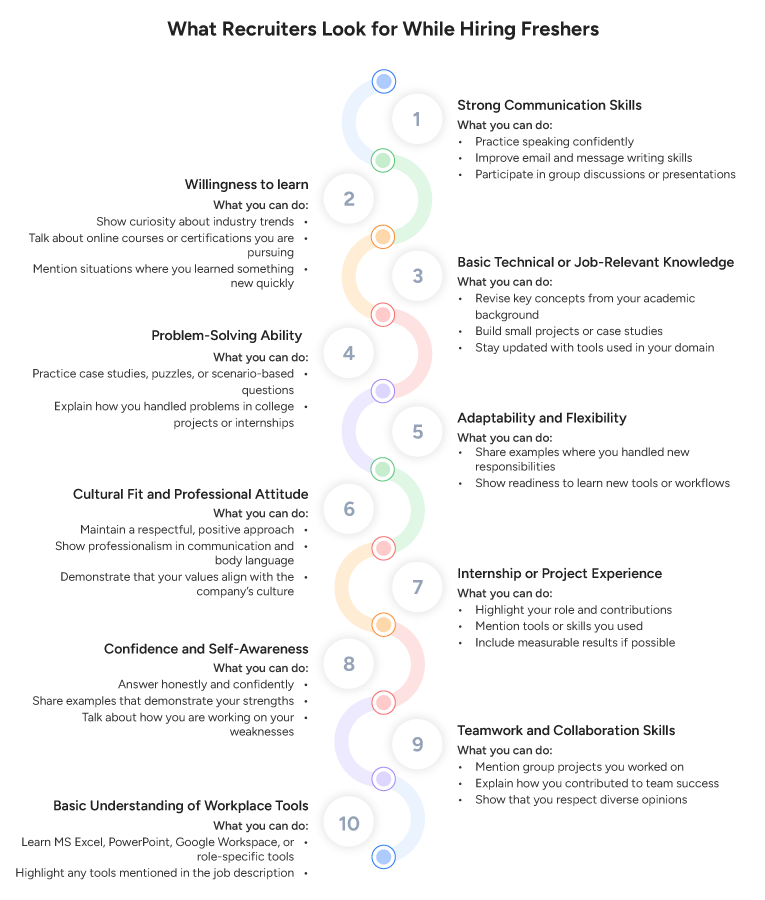
17. What are Your Salary Expectations?
Why They Ask: They want to ensure your expectations match their budget.
How to Answer: Show flexibility.
Sample Answer
As a fresher, I am open to the company’s standard compensation for new hires. My priority is learning and professional growth.
18. Why Should We Hire You?
Why They Ask: They want to know what makes you a suitable candidate.
How to Answer: Highlight your skills and enthusiasm.
Sample Answer
I offer commitment, quick learning ability, and a mindset focused on improvement. My projects and college involvement have helped me build practical skills that I can apply from day one.
19. When Can You Start?
Why They Ask: They want to plan the onboarding process.
How to Answer: Give a clear timeline.
Sample Answer
I can join immediately, but I would also like to know your preferred start date so I can align with it.
20. Do You have any Questions for Us?
Why They Ask: They want to see whether you are genuinely interested.
How to Answer: Ask thoughtful questions about the company or role.
Sample Answer
Yes, I would like to know more about the company’s work culture and how collaboration works across teams.
Interview Preparation: Do’s and Don’ts for Freshers
Here are some dos and don’ts that freshers should keep in mind when preparing for an interview.
| Do | Don’t |
|---|---|
| Research the company and role | Going to the interview without understanding the company |
| Practice common interview questions | Memorise answers in a rigid way |
| Prepare examples from projects or internships | Give vague or generic responses |
| Dress appropriately | Wear casual or distracting outfits |
| Arrive early and stay focused | Arrive late or appear stressed |
| Keep your answers clear and structured | Speak too fast or provide long answers |
| Carry essential documents | Forget important documents or ID |
| Maintain good posture and eye contact | Look distracted or avoid eye contact |
| Ask thoughtful questions at the end | Say you have no questions |
| Show willingness to learn | Claim you know everything already |
Conclusion
Having discussed the standard questions, if the candidate is prepared to face the interview, they will crack it easily. And more than that, make sure you maintain good posture, which enhances your appearance. Even if there’s a question you are not prepared for, do not panic, sit up straight, and be honest and confident in your answers. These will surely help you make the best impression throughout the interview process.
FAQs
Why is Interview Preparation Important for Freshers?
Interview preparation builds confidence, reduces anxiety, and helps you communicate clearly. It strengthens your understanding of common interview questions so you can respond with clarity.
What are some Expert Tips to Crack Interviews for Freshers?
Research the company, practise common interview questions, prepare examples from real experiences, and stay calm.
What are the Common Mistakes Freshers Should Avoid in an Interview?
Avoid vague answers, speaking too fast, arriving unprepared, or skipping company research. Lack of clarity can reduce your chances.
What are Good Strengths to Mention in an Interview for Freshers?
Adaptability, willingness to learn, problem-solving, communication, and discipline are well-received.
How do I Handle Tricky Interview Questions as a Fresher?
Pause, think, and answer honestly. Use short examples from academics or internships to support your response.
What are some Smart Questions to Ask at the End of an Interview?
Some smart questions to ask at the end of an interview include:
- What does success look like in this role during the first 90 days?
- Can you describe the team I’ll be working with?
- What are the biggest challenges this position aims to solve?
- How is performance measured and reviewed here?
- What opportunities are available for learning and career growth?
- How would you describe the company culture and work environment?
- What are the next steps in the hiring process?
Table of Contents
A Human Resource Information System (HRIS) helps organizations overcome these challenges by automating repetitive HR processes, centralizing employee data, and improving decision-making through real-time insights.
With a Human Resources Information System, businesses can eliminate spreadsheet use, reduce manual errors, and ensure data accuracy across all departments. Which often delay HR processes, making it difficult for HR teams to manage employee data and maintain performance consistency.
As workforce management grows more complex, these inefficiencies directly impact productivity and decision-making. This guide examines how modern HRIS solutions enhance workforce management, enabling organizations to stay compliant, efficient, and prepared for the future.
Key Takeaways
- HRIS is cloud-based software centralizing employee data, payroll, benefits, analytics, and compliance in one platform.
- It automates and streamlines HR tasks, reducing manual work and improving accuracy.
- HRIS improves employee experience with self-service portals for leave, attendance, and payslip access.
- Different from HRMS and HCM, HRIS focuses on core employee data and basic HR administration.
- Suitable for small businesses or teams needing simple HR record-keeping; scalable options exist for larger enterprises.
- Key benefits include time savings, compliance management, real-time data access, and enhanced decision-making analytics.
- HRIS supports remote and hybrid workforces by providing unified access and mobile-friendly interfaces.
- Choosing the right HRIS involves assessing business needs, scalability, feature set, user experience, vendor support, and demos.
- Common challenges include adoption resistance, evolving compliance, data silos, and ethical AI use.
- Leading HRIS software examples include factoHR, Workday, BambooHR, Rippling, and SAP SuccessFactors.
What is Human Resource Information System (HRIS) Software?
A Human Resource Information System (HRIS) is cloud-based software that centralizes employee data, payroll, benefits, analytics, and compliance management in a single, secure platform. It empowers HR teams to manage people operations efficiently, providing employees with easy access to their information at any time, on any device.
With this software, organizations can move beyond paper-based processes and manual record-keeping to achieve higher accuracy, transparency, and control. By digitizing HR operations, the Human Resources Information System makes data more accessible, traceable, and reliable, helping HR leaders focus on strategy rather than administrative tasks.
HRIS vs HRMS vs HCM – What are the Differences?
| Category | HRIS | HRMS | HCM |
|---|---|---|---|
| Primary Functions |
|
|
|
| Best For |
|
|
|
| Core Use Case |
|
|
|
HRIS (Human Resource Information System)
HRIS is an HR tool that centralizes essential employee information. It focuses on simplifying administrative HR tasks and maintaining accurate records.
- Central repository for employee data
- Tracks attendance, leave, and basic payroll inputs
- Supports compliance and documentation needs
HRMS (Human Resource Management System)
HRMS builds upon HRIS by incorporating automation and enhanced operational HR capabilities. It helps organizations reduce manual workload and bring efficiency to everyday HR tasks.
- Includes all HRIS functionalities with added automation
- Manages payroll, benefits, and time & labor processes
- Provides employee self-service for routine requests
HCM (Human Capital Management)
Human Capital Management (HCM) is a comprehensive suite of strategic HR tools that manage the full employee lifecycle from hiring to development to long-term workforce planning. It is built for organizations focused on talent growth and performance optimization.
- Combines HRIS + HRMS with advanced talent management
- Supports recruitment, onboarding, learning, and performance
- Includes analytics for strategic workforce planning
Which System is Right for Your Organization?
Small Businesses (1–100 employees) – HRIS
HRIS is ideal for small teams that need simple, reliable HR record-keeping without heavy workflows.
- Need basic HR record-keeping without complexity
- Have small HR teams
- Prefer cost-efficient, easy-to-implement solutions
Growing SMBs (100–500 employees)- HRMS
HRMS suits growing companies that need automation to streamline daily HR operations as their workforce expands.
- Require automation to reduce manual errors and workload
- Need centralized operations for payroll, attendance, and benefits
- Want scalable HR processes as the workforce grows
HCM is the best fit for larger organizations that prioritize advanced talent management and long-term workforce planning.
- Need integrated systems for hiring, development, and talent retention
- Operate across multiple teams, functions, or regions
- Require analytics to drive strategic HR and workforce planning
Why is a Human Resource Information System Important?
Compliance Risk
Manually tracking shifting labour laws, tax requirements, and overtime rules can leave your organization exposed to fines and audit risks. A modern HR system offers built-in compliance tracking, audit-ready reporting, and centralised governance.
Remote & Hybrid Workforce Challenges
Disconnected spreadsheets and disparate systems struggle to manage time, attendance, and leave for a dispersed team. A robust HR system provides HR with a single view of a remote workforce, even across different geographies.
Payroll Errors and Inefficiencies
Research from McKinsey & Company shows that about two-thirds of current HR tasks can be highly automated. This can reduce errors in HR reporting, time tracking, and more.
HR Operations Burden & Strategic Distraction
When HR teams are bogged down with routine administrative tasks (such as leave processing, attendance tracking, and payroll preparation), they can’t focus on retention, engagement, and talent strategies. It helps HR managers transition from a reactive admin to a proactive talent manager.
Employee Experience & Loyalty
Accurate pay-runs, self-service portals for leave and attendance, and transparent benefits build trust and engagement. With Human Resources Information System data, HR managers uncover employee preferences and tailor benefits to foster loyalty.
Who Uses an HRIS?
| Stakeholder | What They Gain | Concrete Example |
|---|---|---|
| HR Departments | Automated admin, fewer errors, more time for strategic HR work | Automated payroll runs eliminate manual spreadsheets |
| Managers & Supervisors | Real-time performance & attendance visibility, easier decision-making | Instant attendance reports help adjust team schedules |
| Employees | Self-service tools, transparency, and faster access to information | Employees can view payslips and apply for leave within seconds |
| Executives/ Owners | Workforce insights for planning, cost control & risk reduction | Dashboards reveal compensation shifts and turnover patterns |
Automated Payroll Features for HR Departments
Automated payroll ensures accurate salary calculations without manual data entry.
Key Benefits
- Automates payroll, attendance, leave, and benefits administration.
- Reduces clerical workload, allowing HR to focus on hiring, engagement, and development.
- Ensures accuracy and compliance through standardized processes and centralized data.
Real-Time Attendance Dashboards for Managers
Real-time attendance dashboards allow managers to adjust shift schedules instantly during periods of peak demand.
Key Benefits
- Visibility into team attendance, performance, and workload.
- Faster, data-driven decision-making based on updated dashboards.
- Simplifies scheduling, performance reviews, and approvals.
Self-Service Portals for Employees
Self-service lets employees download their payslips or tax documents instantly, without emailing HR.
Key Benefits
- Empowered through self-service for payslips, leave, attendance, and profile updates.
- Transparent access to HR information increases trust and productivity.
- Reduces dependency on HR for routine tasks.
Executive Dashboards for Business Owners
Executive dashboards display turnover trends on a quarter-by-quarter basis, enabling leaders to anticipate potential retention risks.
Key Benefits
- High-level insights into workforce productivity, turnover, compensation trends, and HR costs.
- Supports strategic planning with data-backed reports and analytics.
- Helps mitigate risk with compliance and audit trails.
What are the Benefits of Implementing a Cloud HRIS System?
Utilizing a Human Resources Information System platform for business can help ensure better scalability, greater control over employee attrition, and easier innovation within the workspace. Some of the key benefits are:
- Automation & time savings: Automates repetitive tasks like payroll and attendance, cutting manual work hours by up to 75%.
- Better compliance and audit readiness: Centralizes records and policy updates, reducing compliance errors and audit prep time by 60%.
- Accurate analytics/reporting: Delivers real-time workforce insights, helping HR teams make faster, data-backed decisions.
- Employee self-service: Enables staff to manage leave, documents, and profiles, reducing HR queries by nearly 40%.
- Cost savings & scalability: Scales with your workforce through cloud deployment, lowering infrastructure and admin costs by 30–50%.
- DEI support & Security: Offers bias-free workflows and enterprise-grade security, strengthening data protection and inclusive decision-making.
What are the Essential Features of a Modern HRIS?
| Feature Category | Legacy Systems | Modern HRIS |
|---|---|---|
| Automation | Manual paperwork, delays | 75% reduction in workload |
| Compliance | High error risk | Centralized, audit-ready |
| Analytics | Static reports | Instant dashboards |
| Self-Service | HR-dependent | 40% fewer queries |
| Scalability | Costly upgrades | 30–50% cost savings |
| Security & DEI | Fragmented | Secure & bias-free |
Automation & Time Savings
- User Impact: Faster processes, fewer errors, and leaner HR teams.
- Legacy Comparison: Manual payroll, paper-based attendance, and spreadsheet tracking hinder team productivity.
- Modern HRIS: Automates payroll, attendance, and routine tasks, cutting admin hours by up to 75%.
Better Compliance & Audit Readiness
- User Impact: Lower risk, smoother audits, and instant access to regulatory data.
- Legacy Comparison: Disjointed files and outdated policies lead to non-compliance.
- Modern HRIS: Centralizes records and policy updates, reducing compliance errors and audit prep time by 60%.
Accurate Analytics & Reporting
- User Impact: Quicker decisions and proactive workforce planning.
- Legacy Comparison: Static spreadsheets make trend analysis difficult.
- Modern HRIS: Real-time dashboards and reports help HR teams make data-backed decisions instantly.
Employee Self-Service
- User Impact: Empowered employees and fewer repetitive HR queries.
- Legacy Comparison: HR teams handle every request manually (leave, payslips, documents).
- Modern HRIS: Self-service portals reduce HR query volume by 40%.
Cost Savings & Scalability
- User Impact: Predictable costs and effortless scaling as the company grows.
- Legacy Comparison: On-premise systems require expensive upgrades and IT support.
- Modern HRIS: Cloud deployment lowers infrastructure and admin costs by 30–50% and supports rapid growth.
DEI Support & Security
- User Impact: Fairer decisions and stronger protection for employee data.
- Legacy Comparison: Bias-prone manual evaluations and fragmented security protocols.
- Modern HRIS: Bias-free workflows and enterprise-grade security strengthen inclusivity and compliance.
What are the Challenges in Human Resources Systems
Here are some of the key challenges of HR systems.
- Challenge: Disjointed systems and data silos
How to Overcome: Use a unified cloud-based HRIS that connects payroll, attendance, performance, and collaboration tools. - Challenge: Low user adoption and resistance to change
How to Overcome: Provide clear communication, user training, and mobile-friendly access to support remote and hybrid employees. - Challenge: Constantly evolving compliance requirements
How to Overcome: Keep HRIS policies updated with new regulations such as pay transparency laws, AI governance rules, and remote-work tax updates. - Challenge: Poor analytics and limited decision-making insights
How to Overcome: Use HR systems with built-in AI and predictive analytics to forecast turnover, track performance gaps, and support strategic planning. - Challenge: Managing remote and hybrid workforce complexity
How to Overcome: Choose HR tools that support remote onboarding, multi-country payroll, global compliance, and time-zone–friendly workflows. - Challenge: Ethical and responsible use of AI in HR
How to Overcome: Establish internal AI guidelines, maintain human oversight in critical HR decisions, and ensure transparent, bias-free processes.
How do You Select the Right HRIS for Your Business?
Choosing an appropriate Human Resources Information System brings multiple benefits to both human resources and HR operations.
Here are critical aspects for making an informed decision:
Assess Your Business Needs
- Identify current HR pain points, including manual payroll, high administrative burden, complex compliance requirements, and challenges associated with a remote workforce.
- Map these needs to your growth plans.
If you’re a company with 100+ employees struggling with manual leave and payroll, start by prioritizing automation and employee self-service.
Consider Scalability
- Check whether the system can support future expansion, new locations, and remote/hybrid hiring.
- Look at storage capacity, workflow automation options, and the ability to add new modules later.
If you expect to double headcount in the next 18 months, choose a cloud-based HR software that can add new users instantly without infrastructure upgrades.
Examine Available Features
- Ensure the HR software includes essential tools such as employee self-service, applicant tracking, onboarding, attendance management, performance management, analytics, and compliance management.
- Compare system tiers (basic vs pro) to understand what you truly need.
If you hire 10–15 employees monthly, a Human Resources Information System with an ATS and onboarding automation becomes a must-have, not a nice-to-have.
Evaluate User Experience and Accessibility
- Check whether the interface is intuitive for employees and HR teams.
- Confirm mobile access, remote logins, and ease of use for non-technical staff.
If your workforce consists mainly of field or remote employees, prioritize HR systems that offer mobile apps and one-click self-service.
Review Vendor Reputation and Support Quality
- Look for case studies, response times, service SLAs, and reviews from similar-sized companies.
- Verify the vendor’s ability to support 2025 needs like AI-driven workflows, DEI tools, and updated compliance modules.
If you are a global startup hiring across multiple countries, choose a vendor known for substantial compliance and global payroll integrations.
Request Demos and Pilot Trials
- Ask for live demos tailored to your use cases.
- Run a 14–30 day pilot with a small group of HR and employee users.
- Compare at least three vendors side-by-side.
What are the Common Mistakes to Avoid?
- Choosing a system based only on price instead of long-term scalability.
- Overlooking integration needs with payroll, ERP, or collaboration tools.
- Ignoring mobile accessibility for remote and frontline employees.
- Not involving end-users (HR, managers, employees) in demo or pilot stages.
- Focusing on feature quantity instead of feature relevance.
What are the Top 5 HRIS Systems Examples?
- factoHR: An AI-powered, mobile-first HRIS that covers recruitment, payroll, attendance, performance management, and compliance. factoHR is Highly scalable and feature-rich, especially popular in the Indian market.
- Workday: A comprehensive enterprise HRIS known for robust HR, finance, and analytics features.
- BambooHR: User-friendly and ideal for small to medium businesses focusing on employee experience.
- Rippling: An all-in-one platform combining HR, payroll, IT, and benefits management.
- SAP SuccessFactors: Offers advanced talent management and global HR solutions for complex organizations.
When to Invest in an HRIS System?
An investment in a Human Resources Information System becomes crucial for your organization because your HR tasks have become too complex and time-consuming, and your business is expanding too rapidly. There are indications that highlight the necessity of investing in HR systems.
Triggers that Signal It’s Time to Invest in an HR System
- Rapid Company Growth: When hiring accelerates and manual HR processes can’t keep up.
- Compliance Problems: Increasing audits, regulatory changes, or errors in statutory filings.
- Frequent Data Errors: Payroll discrepancies, duplicate records, and mismatched employee data across spreadsheets.
- Growing a Remote or Hybrid Workforce: Remote onboarding, document collection, attendance tracking, and multi-location compliance become more difficult.
Final Wrap
HRIS is the backbone of modern HR, encompassing automation, analytics, and compliance, helping organizations eliminate manual work, improve accuracy, and keep pace with 2025 expectations, such as AI-enabled workflows and remote workforce management. The right system strengthens decision-making, supports compliance, and frees HR teams to focus on strategic priorities rather than routine administrative tasks.
As your business grows, a scalable HR software becomes crucial for maintaining efficiency and delivering an enhanced employee experience. Ready to find your HR software? Download our buyer’s checklist or book a free consultation.
What is HRIS in HR?
A Human Resource Information System (HRIS) in HR is a software solution that helps organizations manage, store, and automate core human resources processes.
What does HRIS Stand for?
HRIS stands for Human Resource Information System. It refers to an integrated software platform designed to collect, manage, and process employee information.
Where Can HRIS be Managed from?
A state-of-the-art HR system provides users with access through cloud-based platforms. Corporation employees can manage their operations through any device, increasing flexibility and mobility.
How does a Human Resources Information System Help Recruitment?
Recruitment procedures become more efficient through HRIS automation of job advertisement distribution and applicant tracking, candidate communication management, and analytical capabilities that enable practical hiring assessments.
How Many Employees Can an HRIS Handle?
Every vendor and software manufacturer builds their HR systems with unique processing capabilities. Multiple systems across the market can manage employee numbers ranging from hundreds to thousands, making them suitable for businesses of all sizes.
Is an HRIS Suitable for Small Businesses?
A properly implemented human resource information system enables small businesses to automate repetitive tasks and scale the system flexibly, supporting business expansion and streamlining administrative duties.

Table of Contents
Conveyance allowance helps employees cover daily commuting expenses and offers tax benefits under Indian tax laws. A recent report found that Indian office workers spend, on average, 59 minutes commuting one-way (roughly 20 km).
Employees can claim tax exemption of up to ₹1,600 per month (₹19,200 per year). This allowance reduces taxable income and lowers monthly travel costs. Employers usually add a conveyance allowance as a fixed part of the salary structure. It supports employees who travel to work and helps them manage their expenses efficiently.
Key Takeaways:
- A conveyance allowance helps employees cover daily commuting expenses between home and the office.
- Tax exemption limit is ₹1,600 per month or ₹19,200 per year under Section 10(14) of the Income Tax Act.
- Amounts exceeding ₹1,600 per month are taxable as part of the employee’s salary.
- No receipts are required to claim the exemption, but keeping basic records is advisable.
- Eligibility excludes self-employed individuals and those using company-provided transport or fuel reimbursement.
- Special higher exemptions apply to employees with disabilities and certain government officials.
- Conveyance allowance is typically part of the salary structure and reflected in Form 16 and monthly TDS.
What is a Conveyance Allowance?
Conveyance allowance is a fixed or variable monthly amount that employers pay to help employees cover their daily commute between home and the workplace. It also offers tax benefits under Section 10(14) of the Indian Income Tax Act, with an exemption of up to ₹1,600 per month. It is one of the commonly offered non-taxable allowances for salaried employees.
Employees generally receive a conveyance allowance when their role involves regular office travel.
How to Calculate Conveyance Allowance?
Calculating this allowance is straightforward when you know the exemption limit. Under Indian tax rules, the maximum exemption is ₹1,600 per month or ₹19,200 per year. The exempt amount is the least of the following:
- Allowance paid by the employer
- Actual commuting expenses (if considered)
- ₹1,600 per month
The applicable calculation formula is as follows:
Taxable Conveyance Allowance = Total Allowance – ₹1,600 (monthly exemption)
Example Calculation
If your employer pays ₹6,000 as travel allowance per month:
- Total allowance: ₹6,000
- Exempt amount: ₹1,600
- Taxable amount: ₹4,400 per month
Yearly Impact
- Yearly allowance received: ₹72,000
- Yearly exemption: ₹19,200
- Yearly taxable allowance: ₹52,800
This taxable amount affects how you calculate income tax during filing. Receipts are not mandatory for availing this exemption. However, keeping basic travel records can be helpful for clarity and organization.
If your salary includes other allowances that affect your tax slab or if you have a complex tax structure, it is advisable to consult a tax professional. Understanding this figure also requires knowing the difference between CTC vs Gross vs Net Salary.
Conveyance Allowance Exemption Limit for AY 2025-26
Under Section 10(14) of the Indian Income Tax Act, most salaried employees can claim this type of allowance exemption of ₹1,600 per month or ₹19,200 per year. This exemption applies only when the employee receives a travel allowance as part of the salary and is not using company-provided transport facilities.
Since FY 2018–19, this exemption has been merged into the ₹50,000 standard deduction. This means salaried employees now receive the tax benefit automatically through the standard deduction. However, the original conveyance allowance structure still applies in cases where employers continue to list this allowance as a separate component in the salary structure.
Employees are advised to maintain supporting evidence when claiming actual commuting expenses, particularly if the employer requests documentation.
Special and Additional Exemptions
Some employees qualify for higher transport-related exemptions under specific rules. These exemptions fall under Section 10(14) and apply only in special situations:
- Employees with disabilities: A higher exemption is allowed for employees who are blind or have an orthopedic disability. The transport allowance for such cases is fully exempt up to the limit defined by law.
- Government officials and UPSC members: Travel allowances for duties performed by certain government officers and UPSC members are exempt from taxation.
- Diplomats and foreign nationals: Transport allowances granted to diplomats and foreign citizens working in India are entirely tax-free.
- Employees working in remote areas: Additional transport-related benefits may be exempt when commuting involves high costs or difficult travel conditions.
- Employees working in hazardous or high-risk locations: Workers posted in dangerous zones may be eligible for extra transportation compensation that qualifies for exemption.
These exemptions are applied only when supported by proper records or official documentation. So, when does it usually apply?
- Employees who travel daily to their office or work location.
- Staff who use public transport or personal vehicles for regular commuting.
- Workers whose salary structure includes a separate conveyance component.
- Daily travel costs between home and office.
- Fuel or public transport charges for routine commuting.
- Minor travel-related expenses linked to everyday office travel.
Benefits of Conveyance Allowance
- Save on commuting costs: Helps cover fuel, maintenance, and public transport fares for daily office travel.
- Enjoy tax exemptions: Reduces taxable income by up to ₹1,600 per month under Indian tax rules as per the TATAAIG survey and data.
- Flexible commute options: Provide employees with the freedom to choose their preferred mode of transportation, such as bus, train, bike, or car.
- Improve work-life balance: Reduces commute stress and time pressure, which supports better productivity and personal well-being. Organizations may also support travel through employee wellness programs.
Recent data (January – December 2024) from the MoSPI Time Use Survey shows that Indian male workers spend 77 minutes per day commuting for employment-related activities, and female workers spend 67 minutes per day. This makes conveyance benefits more important for modern workplaces.
Employers can further encourage sustainable commuting by offering subsidies for public transport or cycling schemes.
Eligibility Criteria
Employees can receive a conveyance allowance when they meet specific conditions related to daily travel and salary structure. It generally applies in the following cases:
- The employee commutes regularly between home and office, typically over medium or long distances.
- The employee uses a personal vehicle or public transport for daily travel.
- The allowance is included in the salary structure or mentioned in the employment contract.
- Self-employed individuals are not eligible for this type of allowance.
- Employees who use company-provided cars or receive fuel reimbursement may not be eligible for this allowance.
- If the employer offers a transportation facility or office shuttle, the travel allowance may not be applicable.
How to Claim Conveyance Allowance?
Claiming conveyance allowance is straightforward, as the process is primarily managed through your salary structure. The amount is displayed on your payslip and in Form 16 under the salary details section.
The tax exemption of ₹1,600 per month is usually applied automatically by the employer while calculating your monthly TDS. You do not need to submit a separate form to claim it.
Employees should maintain basic records of commuting expenses only if they intend to claim actual travel costs in excess of the fixed allowance. This situation is uncommon, but having proof helps when employers request documentation.
If you are unsure about your eligibility or how your salary is structured, it is advisable to consult your finance team or speak to a tax advisor.
Conclusion
The conveyance allowance helps employees reduce their daily travel costs and save tax through the ₹1,600-per-month exemption. It is essential for employees to know how this allowance is shown in their salary and how the tax benefit is applied. With this understanding, they can plan their monthly budget better and avoid mistakes during tax filing.
Keeping basic travel records is helpful if the employer requests proof or if actual travel claims are required. Use factoHR’s payroll software to manage salary structures easily and stay compliant with conveyance allowance rules. You can also check related tools and calculators for quick guidance.
FAQs
Is Conveyance Allowance Taxable?
It is partly taxable. Employees get a tax exemption of up to ₹1,600 per month, and the remaining amount becomes taxable as part of their salary. If an employee receives more than the limit, only the extra portion is added to taxable income.
How to Calculate the Conveyance Allowance in the Salary?
You can calculate it by subtracting the exemption from the total amount paid. The exemption is ₹1,600 per month.
Taxable Allowance = Total Allowance – ₹1,600.
This helps you know how much of the allowance is added to your taxable income.
What is a Conveyance Allowance in Salary?
It is a fixed monthly amount paid by employers to help employees cover daily travel between home and office. It also offers a small tax benefit. Many companies include it in their salary structure to support employees who incur regular commuting expenses.
How Much Conveyance Allowance is Exempt?
Employees can claim a tax exemption of up to ₹1,600 per month or ₹19,200 per year. This is the maximum limit allowed under Indian tax rules. Any amount above this limit becomes taxable and is added to the employee’s salary income.
Conveyance Allowance Exemption is under which Section?
The exemption falls under Section 10(14) of the Indian Income Tax Act. This section covers various types of allowances designed to support employees in covering specific expenses, including daily travel between home and the workplace.
Table of Contents
HRM functions are a set of core operations that the HR department performs to improve people management. These functions are essential for any organization, as they help align human resources with business objectives.
They are also important for managing employee lifecycles. Operational HRM functions improve administrative support. Functions like workplace safety and compliance with wage and labour laws help mitigate risks and ensure compliance with regulations.
This blog discusses the definition of core HRM functions and explores the managerial and operational functions of human resources. We conclude by examining the importance of these functions and answering some of your frequently asked questions related to the role of human resource management.
Key Takeaways
- The core functions of HRM include a set of key operations that combine both managerial and operational aspects of human resource management.
- Managerial functions include strategically important areas, including HR planning, talent management, organizational development, and change management.
- Operational HRM functions focus on core HRM activities related to the employee lifecycle, such as recruitment, onboarding, and employee relations. They also include compliance and risk mitigation.
- These functions are important for four reasons:
- Strategically, they align human resource planning with business objectives.
- They also streamline processes related to the employee lifecycle.
- HRM functions enhance risk mitigation and facilitate compliance with regional and global regulations.
- Operational HR functions improve support mechanisms that enhance employee relations and workplace safety.
What are the Functions of HRM?
The core functions of HRM include operations such as recruitment, onboarding, talent management, succession planning, and change management. These functions are divided into two categories: managerial HRM functions and operational HRM functions.
Managerial functions include roles such as strategic HR planning, change management, succession planning, organizational development, and policy implementation. On the other hand, operational functions focus on aspects such as recruitment, job analysis, employee retention, and compliance.
Managerial Functions of HRM
Managerial functions of HRM are essential from a policy and management perspective. Some of the key managerial HR functions are HR planning, change management, organizational development, policy formulation, and diversity and inclusion.
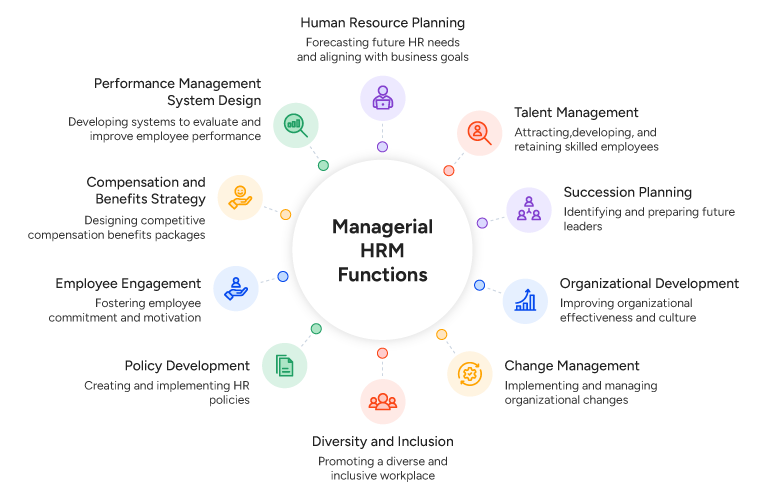
1. Human Resource Planning
Human resource planning is a key HRM function that includes forecasting an organization’s future needs and developing strategies for talent acquisition, employee retention, and talent management. It focuses on analyzing the strengths and weaknesses of the workforce and forecasting future supply and demand. By aligning departmental goals with business objectives, HR planning helps allocate human resources as per organizational needs.
2. Talent Management
Talent management is one of the core HRM functions that includes acquiring and developing talent to meet current and future needs. It encompasses recruitment, onboarding, performance management, and succession planning. Thus, it helps improve performance and develop a leadership pipeline for business continuity.
3. Succession Planning
Succession planning is used by organizations to identify potential employees for future leadership roles. The process focuses on creating a career path for high-performing employees through effective training and development. Succession planning helps retain top talent and ensures a smooth transition in leadership. It is also critical from a risk mitigation perspective.
4. Organizational Development
Organizational Development (OD) is another core HR function that relies on data to identify organizational issues. Being a continuous process, it enables an organization to remain flexible and adapt to changing market conditions. The function is important as it improves change management, work culture, and organizational strategies with data-backed evidence.
5. Change Management
As one of the key functions of HRM, change management manages technological, structural, and other systematic changes. It focuses on clear communication and transparency to improve employee engagement. The function also involves formulating strategies for a smooth transition. Finally, employees are trained to adapt to new technology or other changes.
6. Diversity and Inclusion
This function focuses on creating a work environment that is fair and equal for all employees. It specifically emphasizes equal participation for those sections of society that have been historically underrepresented. Diversity and inclusion are critical HRM functions as they help maintain a diverse workforce with diverse perspectives.
7. Policy Development
Policy development includes creating, implementing, and monitoring policy guidelines. A flexible and well-implemented policy development function helps mitigate risks. It also sets a clear code of conduct, outlining the organization’s values and standards related to expected employee behaviour.
8. Employee Engagement
Employee engagement is a core human resource management function that cultivates positive employee relations through targeted strategies. Firms focus on improving communication and transparency, along with providing more incentives for retaining employees.
9. Compensation and Benefits Strategy
Compensation and benefit strategies are a set of incentives that provide targeted benefits and compensation packages. This is particularly important in attracting new talent and retaining old employees. Organizations typically provide complementary memberships, insurance premiums, and product discounts as benefits. Some companies also reward their employees with performance-based incentives as part of compensation.
10. Performance Management System Design
As a managerial HRM function, performance management system design includes setting goals, reviewing employee performance, and providing feedback. Organizations are increasingly focusing on tools such as 360-degree feedback to provide both internal and external feedback. They also rely on automated systems for measuring KPIs and tracking performance.
Operational Functions of HRM
The operational functions of HRM encompass various activities, including recruitment, job analysis, training and development, and employee and labor relations. Compliance and risk mitigation are also a part of the operational functions of HRM.
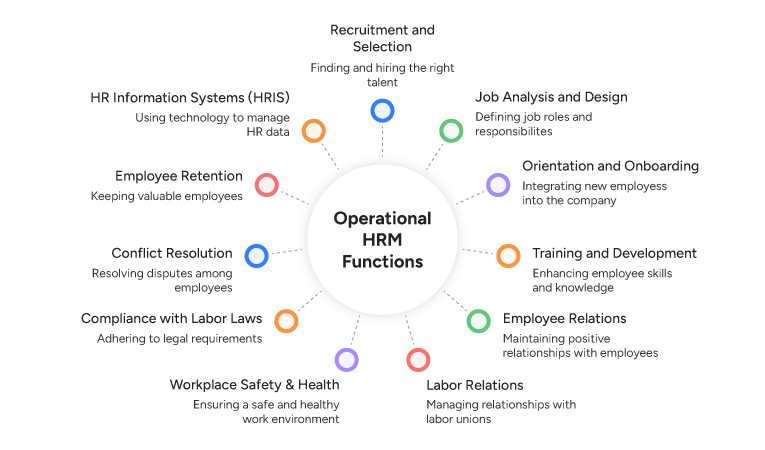
11. Recruitment and Selection
This function focuses on recruiting and selecting candidates who are ideal fits for available job positions. Firms are increasingly focusing on both cultural traits and skill analysis. Leaders rely on HR metrics such as cost per hire and time to hire to improve the recruitment and selection process.
12. Job Analysis and Design
Job analysis involves examining the roles, responsibilities, and skills necessary for a job. Conversely, job design is a process of restructuring a job to make it more appealing to employees. Together, these core functions of HRM help plan recruitment and create tailored job descriptions. Determining compensation is also an important component of job analysis and design.
13. Orientation and Onboarding
Orientation helps new employees understand organizational values and policies. On the other hand, onboarding is a broader function that encompasses training and development, building connections, and role integration. Both of these functions are important as they help employees integrate with the workforce and understand their roles more effectively.
14. Training and Development
This human resource management function helps employees grow by improving performance and productivity. Training and development initiatives also help retain talent and support an employee’s career growth. This function also prepares a workforce for change and aligns employee goals with business goals.
15. Employee Relations
Employee relations is one of the core functions of HRM, focusing on building and maintaining positive employee relations. This function improves employee engagement and satisfaction and fosters a sense of belonging. Some key aspects of this function are conflict resolution, open communication policy, and grievance management.
16. Labor Relations
Labor relations involve negotiating with workers who are part of unions and ensuring compliance with labor regulations. The function helps maintain a productive relationship between management and unions. Leaders implement dispute resolution mechanisms to ensure fair and transparent negotiations. Compliance with labor laws such as the National Labor Relations Law is also an important aspect of the function.
17. Workplace Safety and Health
This function entails creating a safe and healthy work environment for all employees. Professionals develop and implement safety policies, as well as conduct training sessions related to risk mitigation and safety measures. Compliance with regulations such as the Workplace Safety and Health Act and OSH (Occupational Safety and Health) regulations is a critical aspect of this function.
18. Compliance with Labor Laws
In this function, HR professionals ensure that organizational policies and guidelines comply with national and regional labour regulations. In India, it is mandatory for organizations to comply with wage and labor laws, such as the Minimum Wages Act, the Maternity Benefits Act, and the Factories Act, 1947.
19. Conflict Resolution
Conflict resolution addresses workplace disagreements through mediation and policy enforcement. Primarily, this function fosters a harmonious workplace where employees respect one another’s opinions. In serious cases, HR professionals also serve as third-party investigators and conduct investigations.
20. Employee Retention
Employee retention is a core function of HRM that helps organizations retain employees through targeted initiatives. As a part of this function, HR professionals implement targeted strategies and design attractive compensation packages. They also conduct surveys to identify causes of disengagement. Lastly, firms offer remote and hybrid working conditions to improve the work-life balance.
21. HR Information Systems (HRIS)
HR Information System (HRIS) is a system that automates all the key functions of HRM. HR professionals are increasingly utilizing such Human Resources Management Systems for tracking payroll, managing performance, and engaging employees. Leaders also incorporate HRIS into decision-making, as it provides data to guide strategies.
Importance of HRM Functions in 2026
HRM functions are important because they help formulate strategies, manage employee lifecycles, mitigate risks, and provide operational support.
Strategic Importance
HRM aligns employees’ strategies with business goals, shaping workforce planning, leadership, and culture so that human capital drives competitive advantage.
Employee Lifecycle Management
HRM manages the end-to-end employee journey from attraction to exit, optimising recruitment, onboarding, development, and retention to improve engagement and performance.
Risk Mitigation and Compliance
Core functions of HRM related to labor relations, risk mitigation, and compliance with labor laws help reduce risks and comply with the labour regulations of the region.
Operational Support
Operational HR management functions, such as conflict resolution and employee engagement, make the workforce more productive and harmonious.
Conclusion
We covered 21 core functions of HRM that are essential for people management. The managerial functions of HRM are critical from both strategic and management perspectives. These functions include strategy formulation, performance management, succession planning, and organizational development. Operational functions focus on creating a safe, harmonious, and equal environment by focusing on diversity and inclusion and conflict resolution.
Businesses are increasingly adopting solutions that automate HRM functions. For example, firms are leveraging AI-powered features such as predictive analytics for forecasting future needs. Therefore, AI and automation will continue to shape the core functions of HRM in the near future.
Simplify and Automate Your HR Functions with factoHR
FAQ
What is the Difference between Managerial and Operational HRM Functions?
Managerial functions focus on planning, organizing, directing, and controlling HR strategy, while operational functions handle day-to-day tasks like hiring, payroll, and employee relations.
What are the Major Functions of HRM?
Core HRM functions include:
- Recruitment and selection
- Training and development
- Performance management
- Compensation and benefits
- Employee relations and compliance
What is the Role of Human Resource Management in an Organization?
HRM ensures that the right people, policies, and processes are in place to build a productive, engaged, and legally compliant workforce that is aligned with organizational goals.
What Human Resource Management Functions Can be Outsourced to Third-Party Providers?
Commonly outsourced functions include payroll, recruitment, compliance management, benefits administration, and HR analytics.
Why are HRM Functions Important for Business Success?
They improve productivity, enhance employee engagement, ensure compliance, and help organizations attract, retain, and develop top talent.
How are Functions of HRM Evolving with Technology and Automation?
Automation streamlines HR tasks like payroll, attendance, and performance reviews, enabling data-driven decisions and freeing HR to focus on strategic initiatives.
How do HRM Functions Promote Diversity and Inclusion at Work?
HRM promotes inclusion through unbiased hiring practices, equitable pay, diversity training, and transparent performance evaluation frameworks.
Table of Contents
Key Takeaways
- Maternity leave is the paid/unpaid time off work offered to a woman around the period of childbirth/adoption to recover and care for her child.
- Maternity leave in India is governed by the Maternity Benefit Act 1961, amended in 2017. The act applies to establishments with 10 or more employees, where women must have worked at least 80 days in 12 months.
- The duration of paid maternity leave is 26 weeks for the first two children, with up to 8 weeks allowed before the expected delivery date. The leave duration is 12 weeks for the third child/subsequent children/adoption/surrogacy.
- In case of miscarriage or medical termination of pregnancy, 6 weeks of leave is offered to women.
- Maternity benefits offered are full salary payment and complete job protection during leave. Companies with 50 or more employees should provide crèche facilities and work-from-home arrangements.
- Maternal leave challenges for both employers include an overall reduction in efficiency and productivity.
Understanding multiple rules and eligibility criteria for maternity leave can be challenging. This is because many women are unsure about their rights and job security during pregnancy.
Companies that prioritize a supportive work environment for women should be aware of their pregnancy leave policies and stay current to avoid compliance issues. This article outlines the current rules and eligibility criteria for pregnant women, as well as the maternity leave benefits available in India.
What is Maternity Leave in India?
Maternity leave is a period of paid time off from work for pregnant women employees, as provided under the Maternity Benefit Act, 1961. It is a legally protected absence from work for female employees during pregnancy and after childbirth.
Maternity Benefit Act, 1961
The maternity leave policy and its benefits are regulated under the Maternity Benefit Act, 1961. Some key highlights of the act include:
- Scope: This act applies to all establishments that employ 10 or more employees. This includes factories, shops, mines, plantations, and other organizations.
- Paid Leave: Pregnant women are entitled to paid maternity leave, along with other benefits, during the leave period. The leave can be taken before and after the child is delivered for up to 6 months (26 weeks).
- Job Security: During the leave period, employers cannot fire/demote, or mistreat a woman employee. They must reinstate them in their original job position upon return.
Maternity Benefit Act, 2017
The Maternity Benefit (Amendment) Act, 2017, was introduced with multiple provisions. This includes provisions related to maternity leave and its benefits. These are:
- Extension of Pregnancy Leave Duration: This leave can be taken 8 weeks before the delivery date and 18 weeks after delivery. For the third/subsequent child, the pregnant woman is given 12 weeks of leave.
- Leave for Surrogate and Adoptive Mothers: For adoptive mothers who adopt a child below 3 months of age/commissioning mothers (surrogacy), the maternity leave duration is 12 weeks.
- Option to work from home: The act provides an option for new mothers to work from home after the maternity leave period. This arrangement includes factors such as the nature of work and mutual agreement between the parties.
- Creche facilities: This act also provides childcare services or crèche facilities for all businesses with 50 or more employees. Mothers are allowed to visit the facility four times a day, including breaks.
Maternity Leave Policy in India (Sector Vise)
There are multiple sectors that have different approaches to maternity leave policy. Here is how maternity leave provisions work across industries and what companies need to know.
- Public Sector: Public organizations offer 26 weeks of leave (for the first two children) along with additional leave options and childcare facilities. With this, male government employees also get paternity leave in India for improved work-life balance and shared parental duties.
- Private Sector: Private companies offer flexible pregnancy leave benefits, which include 26 weeks of leave (for the first two children) with additional benefits, including crèche facilities and nursing breaks.
- Unorganized Sector: Pregnant women have limited access to maternity benefits, which include schemes under the Employees’ State Insurance (ESI) and the Pradhan Mantri Matru Vandana Yojana.
- Specialized Industries: Certain industries adopt a customized approach, for example, flexible work-from-home arrangements in the IT sector. Manufacturing industries are assigning lighter tasks during pregnancy.
Who is Eligible to Apply for Maternity Leave in India?
The eligibility criteria to provide support to pregnant working women are:
| Eligibility | Leave Duration | Additional Notes |
|---|---|---|
| First 2 Children | 26 weeks (up to 8 weeks pre-delivery). | Applies to establishments with 10 or more employees. |
| 3rd Child Onwards | 12 weeks (6 weeks pre-delivery). | Reduced leave for third and subsequent children. |
| Adoptive Mother (Child under 3 Months) | 12 weeks from the date the child is handed over. | Eligible for women adopting an infant below 3 months. |
| Commissioning Mother (Surrogacy) | 12 weeks from the date care is assumed. | Surrogate commissioning mothers are eligible. |
| Miscarriage/Abortion | 6 weeks from the date of miscarriage. | Paid leave granted for medical termination of pregnancy or miscarriage. |
| Tubectomy (After Sterilisation Surgery) | 2 weeks | Post-surgery recovery leave following sterilisation. |
| Prenatal Leave | Limit up to 8 weeks before delivery. | Leave taken before delivery is included in the total leave duration. |
Maternity Leave Benefits in India
Pregnant women working under pressure during work is not a good practice, which is where this type of leave becomes essential. The importance of this leave ensures the well-being of the mother and her child. Some of these maternity leave benefits for pregnant mothers are:
Paid Leave: Any pregnant woman on leave is entitled to receive full pay as per the Maternity Benefit Act, 1961. They also receive medical benefits, which help maintain their financial stability.
Job Protection: Employers cannot dismiss/fire female employees during this type of leave. They are given assurance that the same or an equivalent job position will be offered post-maternity leave.
Work-Life Balance: It allows women to take time off after delivery while continuing their job/employment. This promotes a smooth transition into motherhood and maintains career progression.
Support for Modern Mothers: This includes biological mothers, along with adoption and surrogacy.
Maternity Leave Rules in India
maternity Leave Rules are Governed by the Maternity Benefit Act (1961), Followed by Its Amendment in 2017. there are Multiple Rules that Employers Must Follow to Remain Compliant with Indian Labor Laws. Some of the Key Details to Focus on are:
- Timing of Leave: Expectant mothers can start their leave 8 weeks before their delivery date. After childbirth, women can take leave for the remaining weeks to attend to their personal needs.
- Employer Communication: Pregnant employees should inform their employer of their plans for maternal leave in advance. This helps employers plan for temporary recruitment and ensure business continuity.
- Documentation Requirements: A medical certificate must be provided to the company, confirming the pregnancy and the expected delivery date. These can be easily created with maternity leave letter template, and details can be added to the document.
- Employer Responsibilities: There are multiple employer responsibilities, for example:
- Financial Support: Employers must pay an employee’s entire salary once they receive proof of pregnancy to support female employees during this phase of life.
- Post-Delivery Payment: Employers are required to clear post-delivery wages in a lump sum within two days of receiving proof of childbirth.
- Task Allocation: Once female employees have resumed their work, employers are not supposed to assign heavy tasks. These include activities like standing duties and overtime work.
- Creche Facilities: Organizations with 50 or more employees should provide a crèche facility for mothers to visit their child during work hours.
- Medical Certificates: These certificates are essential paperwork required for the processing of maternity benefits. These include pre-delivery certificates and post-delivery certificates.
Maternity Leave Challenges for Employers and Employees in India
Maternity leave rules are quite significant, but they come with their own set of challenges for both employers and employees. These are discussed below:
For Employers
- Decreased Productivity: When pregnant mothers go on leave, the organization’s productivity is affected.
- Workforce Management: When employees take this type of leave, it becomes difficult for employers to redistribute tasks or hire temporary replacements.
- Financial Strain: For startups and SMEs, this change can be costly and may result in a financial burden.
- Compliance and Legal Risks: There are multiple companies that struggle with staying updated with legal laws and those that can lead to fines/penalties.
- Retention Concerns: Companies face retention issues about whether an employee will return to work after these types of leave.
For Employees
- Career Setbacks: Even with legal protection, many women fear demotion from projects or experience delayed promotion while taking leave.
- Workplace Discrimination: Many male-dominated or conservative companies pressure women to resign or are sidelined after their return from leave.
- Lack of Awareness: There are many female employees who are unaware of their leave rights and benefits under Indian law.
- Challenges in Reintegration: When female employees return to work after leave, catching up on developments can be challenging.
Maternity Leave for Government Employees in India
- The central government rules, and the Maternity Benefit Act governs maternity benefits for government employees.
- The leave provisions and benefits are offered to all women along with defined working hours in the government sector.
- Pregnant women can take leave for 26 weeks during pregnancy and the delivery of the child.
- From these 26 weeks, 8 weeks of leave can be taken before the delivery date, and can be extended up to 26 weeks after the delivery.
- For adopting mothers, the child should be below 3 months, and 12 weeks of leave can be taken.
- Commissioning mothers can also take 12 weeks of leave after the child is handed over to the mother.
How does factoHR Help You Manage Maternity Leave?
Maternity Leave rules have policies that combine both legal and financial support to female employees. According to industry norms and workplace needs, these new accommodations are made during this phase of a woman’s life.
The act and leave laws aim to create a positive environment for maternal health and child well-being. factoHR’s Leave Management System helps businesses in India manage everything, including maternity leave. Some core features of factoHR’s LMS are:
- Employee Self-Service Portal (ESS)
- Customizable Leave Policy Template
- Customizable Approval Workflows
- Integration with the Payroll and Attendance System
Frequently Asked Questions
Is Maternity Leave Paid or Unpaid?
Maternity Leave is paid leave, where female employees receive full compensation during their leave period.
Is Maternity Leave 6 or 9 Months?
Pregnancy leave is 26 weeks, which is about 6 months (not 9 months). This can be taken up to 8 weeks before and 18 weeks after delivery.
Can I have 12 Months Maternity Leave?
No, Maternity Leave cannot be taken for 12 months. The maximum paid leave is 26 weeks (6 months) for the first two children. This is reduced to 12 weeks from the third child onwards.
Can Maternity Leave be Extended in India?
Yes, Maternal Leave duration can be extended beyond the standard time in certain instances, for example, complications that require medical certification.
Can Maternity Leave be Taken after Delivery?
Yes, this type of leave is taken after and even before delivery. Before delivery, up to 8 weeks of leave can be taken, and the remaining leave can be taken after delivery.
Can My Employer Replace Me while on Maternity Leave?
Employers can hire someone temporarily to delegate your work during pregnancy leave to maintain business continuity, but note that they cannot dismiss you.
Are Women Eligible for Maternity Leave during the Probation Period?
Women’s eligibility depends on the company policy during probation. Female employees who have worked for at least 80 days in the 12 months are eligible.
Can Women Take Maternity Leave for a Third Child?
Yes, women can take this type of leave for a third child during and after pregnancy, with a maternity leave duration of up to 12 weeks, instead of the standard 26 weeks.
What is the Maternity Benefit Act 1961?
The Maternity Benefit Act, 1961, is a law that provides paid leave and benefits to working women in establishments with 10 or more employees.
How does the Legal Framework Support Maternity Leave?
The Maternity Benefit Act mandates paid leave and job protection during leave for pregnant women. Other additional benefits include crèche facilities and the right to receive full pay.
What is the Maternity Leave Applicability?
Pregnancy Leave applies to all women working in establishments with 10 or more employees. They should have worked for at least 80 days in the last 12 months.
© 2026 Copyright factoHR